In the tech world, we call a drone as ‘Unmanned Aerial Vehicle’. Started as a military invention in the US, drones and their scope of use is growing day by day. At present, civilians and police departments around the world are also enjoying the benefits of the drone technology at an increasing rate. Photography, videography, food-delivery, farming, environmental and crime surveillance, etc. are the activities for which we are using the features of drones. We can buy drones for personal of professional use from any local or online tech or gadget store starting from a range of USD 50 or INR 45,000 to 50,000.
Scope of drones
Drone is another rapidly growing and adaptive gadget which the humans can manipulate for humanitarian causes and as well as causing harm to life and property. From delivering food packets for flood-relief to deadly gunshots on people, drone industry is much diverse and is rising soon creating a boom into the ecommerce delivery system and agricultural industry in the coming years.
But before that, let’s have a look at some important facts about drones which you probably don’t know.
Drones are not always remote controlled.
It will surprise you that there are three types of drones according to their piloting methods:
Remotely Piloted Drone–Piloted from a remote station where the drone is not directly visible.
Model Remotely Piloted Drone-Piloted for educational, recreational or experimental usage only within a visible area of sight.
Autonomous Drone–Does not require a pilot. We feed the flight and working instructions into its system before taking off, just like any targeted missile.
Drones can legally invade your privacy.
To your shock, there is no national framework or statutory body to govern the use of drones by the police. Police don’t even require a warrant or permission to survey using drone. The drones flown by the police or military drones have ungoverned access to all parts of the United States to gather data except government properties and lands. Many other countries act similarly for regulating drones by government authorities.
Can you fly a drone easily in your country?
The drone rules of each country are different and very complex. It takes days or months for common people to get certain licenses and permissions to fly drones in a particular country.
Examples:
A foreigner or a foreign company cannot fly drone in India. To use drone for commercial activities, a foreigner is bound to lease their drone to an Indian company who will get Unique Identification Number (UIN) and drone permit called UAOP (Unmanned Aircraft Operator Permit) from DGCA (The Directorate General of Civil Aviation) for the foreigner.
A non-US citizen is bound to take permission and licenses 15 days prior to using drone in the US.
Drones have killed lakhs of children
The military, police, and terrorists use attack drones or weaponized drones at the time of warfare. Drones work as small weapons, which is very hard to notice for a common citizen. This reckless use of drone technology by military, police and criminals over the years is taking many lives. Most of the victims are civilians and children.
Resolving worst farming and food problems by using drones.
Thermal cameras installed on drones can identify water leakages and identify which crops are getting enough water. A drone can zoom down to even an individual plant. Farmers in Canada and other countries are using drone data for years to calculate the health of the plants.
Web domains are a huge concern for businesses and even educational institutes that have created recognition for their ventures and have to entertain large followership of visitors, customers, and clients online.
Not only are they important due to the current internet addressing scheme, but they also help you, and your website gets found by search engines and online users. However, domain names can be extremely competitive, and some of them can even cost more than $3 million at times, e.g. Voice.com was sold for $30 million back in 2019.
According to a recent study by Statista.com, 51.6% of the global websites as of October 2020 used a ‘.com’ top-level domain.
The market share of leading TLDs worldwide 2020 study also reveals that 6.3% of the global websites used ‘.ru’ followed by 4.5% of global websites using ‘.org’ as top-level domains. Furthermore, 3.4% of global websites used.net TLD.
This data was based on the top 10 million websites, whereas some 1.83 billion websites are speculated to being present on the internet.
In light of this information, let’s take a quick look at some handy tips that you should consider when purchasing domains for yourself or your business.
·Picking a Good Domain Name
Picking the right name domain name for your website is absolutely crucial for both your short and long term success. In fact, for the best colleges, it is a matter of grave concern. Here is what you should do:
·While domain name extensions have a lot of variety, sticking with .com offers you the common use advantage.
·Including keywords in your domain name can serve as an advantage and help you rank higher on search engines.
·Short domain names are user friendly, and anything longer than 15 characters can be difficult to remember.
·Domain names should also be easy to spell and pronounce. This naturally makes them more shareable across multiple channels.
·Branded domain names are always appreciated since that makes them unique and stand out from the crowd.
·But most important of all, always research your domain name and check its availability. It should never lead to a trademark war with other companies.
·Choosing the Right Registrar
We cannot buy a domain name for life. That is why it has to be registered with a domain name registrar. You should only prefer to work with ICANN (Internet Corporation for Assigned Names and Numbers) accredited domain name registrars.
The ICANN is a non-profit organization that monitors the domain name market and regulates domain name registrars in general. Choosing the right registrar matters as you will be required to renew your registration every year-end.
In this case, you should look for domain name registrars that give you the maximum grace period to renew your contract with them once it expires.
For establishments that are confident and looking forward to the long haul often register their domain names for a period of 10 years; however, 1-2 years is pretty standard for all companies and organizations.
Here are some of the most recommended domain name registrars you should consider buying your domain name:
1.Domain.com – one of the most popular domain name registrars on the planet. Started in 2000, they can offer you all TLDs and several dozen ccTLDs (country code TLDs).
2.GoDaddy – one of the oldest and most popular domain registration companies. They manage more than 77 million domain names for over 18 million customers.
3.HostGator – another renowned domain name registrar along with web hosting services that should be evident through their name. HostGator offers nice options with domain privacy, etc.
·Privacy Protection (WHOIS & RDAP)
The ARIN (American Registry for Internet Numbers) identified RDAP (Registry Data Access Protocol) as a WHOIS alternative.
WHOIS is a query and response protocol that is widely used for querying databases that store information, including domain name, IP address block, and much more. The important point you need to understand here is that you need to check your domain privacy.
Some companies have clauses in their contract that allow them to automatically collect your customer and visitor information related to your domain. Registrars who are noteworthy offer domain privacy where the user’s information in the WHOIS is replaced with a forwarding service via proxy server.
Always look for domain privacy so that you know that your domain data is not being leaked to other parties without your knowledge.
·Add-Ons and Extras
When searching for domain names and domain names registrars, it is best that you look for those that offer you the best add-ons and extras.
These can be completely free of cost or come at a very marginal cost that barely serves to become a bother. Young learners who buy coursework should also consider such add-ons and extras before deciding to buy a domain. Some of the best add-ons include:
·Domain privacy
·Customized email addresses
·Free web hosting for a limited period of time
·A finely designed and easy to use user panel to control your domains
·Payment methods and solutions such as PayPal, credit card, bank transfer, etc.
·Website builders
·Extended expiration protection
·Domain parking and much more
·Transfer Fees
Domain names can be moved from one domain registrar to another. However, this request cannot be processed during the first 60 days of registration, as ICANN decided.
While most domain name registrars make it easy to transfer domain names without any additional charges, however, some can double down and downright make you pay hefty amounts.
Hence it is always best to review the domain transfer policy before you decide to purchase a domain. Pupils that request maestros to do my essay should also consider transfer fees before planning to run their own website.
·Check for Domain Abuse
You want to stay clear of any domains that have been abused in the past. Therefore you should always consider checking the domain name history if it has one.
There are various tools available online that can help you determine how the domain was handled and whether they were some disputes regarding its use in the past.
Obviously you want to stick with a domain that provides you with a clean slate to build your own reputation. ICANN Lookup and WHOIS History are good places to start looking into domain history.
Conclusion
As an ending note, I would like to mention that before you decide to buy a domain name, please consider the hidden charges and go through the customer reviews.
This will give you a better idea of what domain name registrar you should decide to work with and whom you should absolutely avoid at all cost.
Your research in this regards matters a lot, and any sensible person would not make light of this advice. For now, this is it. All the best for your future endeavors!
Author Bio
Stella Lincoln currently works as the Assistant Editor at Crowd Writer and Student Essay. This is where higher education candidates can request professionals to write my assignment to acquire specialized assistance for their subjects and topics. During her free time, she likes to doodle and create wall art.
Do you feel like you are missing out on some amazing series and movies? Don’t worry; we have got just the thing for you. No more FOMO for you all. The sneaky tricks I am going to tell you will help you get a Netflix account for FREE!! All of these tricks are a hundred percent genuine and will get you the results you want. So what are we waiting for? Let’s dive in.
Use The Netflix Trial Offer
This one is pretty basic and is very well known already, and this is an excellent way to enjoy your favorite Netflix films and shows at no cost at all. As you might already be familiar with it, Netflix offers its users a free one-month trial time period, so why not dwell on the offer and use it to its fullest.
This offer stays valid for a month only, although Netflix does send a follow-up subscription trial for another month at times. If you are lucky enough, it sends you one as soon as your previous one gets expired, or it can take a few months to send one across. Honestly, it’s very easy to use. Now there are very few steps that you have to follow to avail this thing.
Download the app on your smartphone/ laptop. Then you will see a button there which says “join free for a month” simply click it. This will lead to the subscription page, which will show you all the plans available. Choose the premium plan on the chart and just continue. Now you just need to register yourself, sign up, and click continue. In the next step, they will ask you for your credit card details.
You don’t have to worry. You won’t have to pay anything. After that is done, you’ll simply have your account, and you’ll get your subscription for free now, voila enjoy. Do not forget to cancel your subscription after one month, or else the money will be deducted from your card.
Netflix Gift Card
This is also one of the easiest and most efficient ways to avail a Netflix subscription at absolutely no cost at all. If someone gifts you one of these, you are good to go for a subscription. Although Netflix itself does not sell cards online, there are a few on amazon on Flipkart that can help you. It is pretty easy to use it once you have the card.
The steps go like this:
Firstly you need to go to the official site of Netflix.
Go to the subscription plan page.
Select the gift card option.
Enter the 11 digit code on the back of the card.
You are then all set to use your Netflix card, see we helped you decide your birthday gift too. You are welcome.
Use The SBI Net Banking Trick
** This trick is only for state bank of India users**
The first step is to open the SBI site and then login.
Select the dashboard section and then go to the section of where it shoes cards, and then lastly go to the selection of cards and go to virtual cards > Virtual Cards.
Then you have to create a virtual card that has validity for only one single day.
Copy the details of your card.
Log in to your Netflix Account, Choose the Netflix Subscription Plan.
Click on pay after using the virtual card option.
Done, congratulations. You now have a new Netflix account for free.
Use Flikover And Get Netflix At 100 Rs
First, you have to visit the official website of flikover
Make a new account and register here.
And just pay ₹100 to the account using your card.
All set, now you have successfully got a Netflix Premium Account for just free.
You can enjoy this offer for a month now without any hesitation at all.
Use IRCTC I Mudra App
Firstly, you have to download the IRCTC IMUDRA APP from your play store.
Create an account and log yourself in
Complete your KYC (Know Your Customer) after that.
You can use any official government id to do so.
Now, after that, you will see the option of Getting A VISA Virtual Card.
You have to click on it.
After that, you’ll get your VISA Card from IRCTC iMudra App.
Now you have to open your Netflix Account and then Go to the section where it shows you the premium membership plans.
And finally, use your IRCTC’s VISA Card to Get your own Netflix Free Subscription.
Conclusion
Without any second thought, Netflix is being used by everyone majorly. It is being preferred more than any cable also. People will just get a Netflix subscription other than that of a cable. This is fair also because Netflix has a lot of various genre shows and movies and for everyone from kids to the older people, so there Is nothing that can keep people away from it except its price, which we got the perfect solution for that is you can actually use netflix for free, you can thank us later! Go grab your favorite food to munch on. Let the show begin.
To cope up with the increasing reliability of technology we have a new and advanced tool for grading & assessment which will reduce the manual workload of assessing papers and will provide valuable feedback to the students which will have a learning curve for them. The time saved by the instructors in checking papers manually will help them utilize their time more productively & this will also help the institute to keep records for easier accessing with intuitive reports & analysis.
Gradescope is a leading remote assessment and feedback platform that will be a step forward in this new digital world.
Leveraging the digital rubrics and AI in Gradescope will help instructors cut grading times by up to 80%, increase grading consistency and quality of feedback, and dramatically improve instructor/TA workflow vs. traditional grading.
Gradescope provides actionable feedback to both the students & the instructors.Here are 10 ways Gradescope can help your institute turn grading into learning:
1. Gradescope Modernizes Traditional Grading Gradescope was founded with the belief that there has to be a better way to evaluate student work. By combining deep instructor expertise with the latest machine learning (ML) and artificial intelligence (AI), Gradescope leverages modern technology to dramatically reduce the pain and time associated with traditional grading.
2. Gradescope Streamlines the Workflow By creating a digital record of student work, Gradescope restructures the traditional grading workflow. Gone are the logistical nightmares associated with transporting and returning stacks of paper, marathon grading parties, and lost in-class time; gains are efficiencies that enable high-quality assessment from anywhere at any time.
3. Gradescope Promotes Student Equity Gradescope helps mitigate opportunities for unconscious bias in two key areas: By helping graders focus exclusively on the content of an individual answer rather than the students’ overall submission or identity. By helping teams of graders to build, maintain, and apply one aligned grading standard for all students The result is a fairer learning experience for students and greater consistency across graders.
4. Gradescope Enhances Scoring Flexibility Built in advance or created on the fly, Gradescope’s Dynamic Rubrics can be constructed collaboratively and adjusted at any time, automatically applying changes to previously graded work and creating a reliable real-time standard for all students. Keyboard shortcuts can help speed up the workflow, helping cut grading time even further.
5. Gradescope Promotes Meaningful Feedback In addition to quick and consistent feedback, Dynamic Rubrics ensure students receive detailed insight into how points were awarded or deducted. With a richer understanding of evaluation criteria and guidelines around concept mastery, instructors can direct students to the best resources for their individual needs.
6. Gradescope Systematizes Grading Patterns Answer groups and AI-Assisted Grading deliver a more methodical approach to reviewing student work. Gradescope helps instructors digitize student submissions and identify patterns, subsequently arranging them in assessable groups. This process helps eliminate redundancies, saves time, and produces higher quality and consistent feedback at scale.
7. Gradescope Accelerates Feedback Loops Once assessment is complete, graders can immediately publish and notify students with a single click, either directly via Gradescope, emailed, or exported to their institutions’ LMS. Students can then review the feedback and quickly manage confusion or disagreement by initiating a Regrade Request. With the Gradescope workflow, feedback can be timely, detailed, and developmental.
8. Gradescope Supports Existing Assessments The breadth of compatible assignment types is wide-ranging – from paper-based exams, quizzes, and homework, to online assignments, programming assignments, and multiple-choice. Gradescope can accommodate assessment preferences, existing assignments without adjustment, and a variety of disciplines, from humanities to the sciences.
9. Gradescope Highlights Student Learning Gradescope produces meaningful and detailed student performance data to help identify knowledge gaps. Per-question and per-rubric item analytics deliver insight into which concepts were mastered and which were misunderstood. Graders can also measure course-level progress and align to key learning objectives with assignment statistics.
10. Gradescope Helps Refine Instruction The Gradescope data can also inform improvements to assessment and course content. With targeted visibility into students’ areas of strength and weakness, instructors can address potential roadblocks in real-time and scaffold new concepts appropriately. Gradescope also surfaces insights that can guide long-term curricular improvements and refined lessons that ensure critical learning objectives are truly understood.
The country’s largest corona vaccination campaign is underway. The Union Health Ministry said that a total of 75 lakh people have been vaccinated in the country till Friday, the 27th day of the vaccination campaign. Out of this, 58.14,976 health workers and 16,90,034 Front line workers are included.
Why vaccination is important?
Vaccines can help limit the spread of antibiotic resistance.
The global increase in disease caused by drug-resistant bacteria, due to overuse and misuse of antibiotics, is a major public health concern. Vaccinating humans and animals is a very effective way to stop them from getting infected and thereby preventing the need for antibiotics.
Making better use of existing vaccines and developing new vaccines are important ways to tackle antibiotic resistance and reduce preventable illness and deaths.
According to the ministry, a total of 1,54,370 sessions of immunization have been completed across the country so far. Immunization campaign is fastest in India. On 11th February, a total of 4.5 lakh people were vaccinated. This includes 1,09,748 health workers and 3,78,148 front line workers.The corona virus is seen to be dying with speed in the corona vaccination campaign, according to the report released by the Union Health Ministry on Friday, 9309 cases were reported in the last 24 hours across the country, this is the third time in February when less than ten thousand cases were reported.
According to the Health Ministry, there were seven days in February when the daily death rate from Corona has been less than 100. There was no death reported from corona in 18 states and union territories of the country in the last 24 hours.
The country’s largest corona vaccination campaign is underway. The Union Health Ministry said that a total of 75 lakh people have been vaccinated in the country till Friday, the 27th day of the vaccination campaign. Out of this, 58.14,976 health workers and 16,90,034 Front line workers are included.
Why vaccination is important?
Vaccines can help limit the spread of antibiotic resistance.
The global increase in disease caused by drug-resistant bacteria, due to overuse and misuse of antibiotics, is a major public health concern. Vaccinating humans and animals is a very effective way to stop them from getting infected and thereby preventing the need for antibiotics.
Making better use of existing vaccines and developing new vaccines are important ways to tackle antibiotic resistance and reduce preventable illness and deaths.
According to the ministry, a total of 1,54,370 sessions of immunization have been completed across the country so far. Immunization campaign is fastest in India. On 11th February, a total of 4.5 lakh people were vaccinated. This includes 1,09,748 health workers and 3,78,148 front line workers.The corona virus is seen to be dying with speed in the corona vaccination campaign, according to the report released by the Union Health Ministry on Friday, 9309 cases were reported in the last 24 hours across the country, this is the third time in February when less than ten thousand cases were reported.
According to the Health Ministry, there were seven days in February when the daily death rate from Corona has been less than 100. There was no death reported from corona in 18 states and union territories of the country in the last 24 hours.
It is said that “Sleep deprivation will kill you more quickly than food deprivation.” A good night’s sleep is one of the basic necessities of the human body for its active metabolism and better productivity. An average adult human requires 8 hours of continuous sleep each day. Any interference in the natural regular sleeping patterns can have a tremendous impact on one’s health: mentally as well as physically. Nowadays, people tend to sleep less than they did in the past and their quality of sleep has also faced a downturn.
We live in the middle of a world full of technologies and are surrounded by screens of smartphones, laptops, tablets, e.t.c. Though these gadgets make our lives easy and fast, we are least bothered about its negative effects on our lives. The overuse of technology causes eye strain, musculoskeletal health issues, sleep deprivation, etc. not only in adults but also in teens and kids. According to the American Optometric Association (AOA), prolonged use of computers, tablets, and cellphones can lead to digital eye strain which results in blurred vision, dry eyes, headaches, due to screen glare, bad lighting, and improper viewing distance. The unnatural way of holding the smartphones induces a lot of stress on the neck, shoulder and spine. Initially, these physical strains might seem negligible but can cause severe health impacts in the long run.
Technology in the bedroom can interfere with sleep in a number of ways. Studies have found that 90% of US citizens use screening devices in the hour before going to bed, which can cause immense psychological and physiological impacts, capable enough to disrupt one’s sleep. Scientifically speaking, the blue light emitted from the gadgets suppress the sleep-inducing hormones like melatonin disturbing the biological clock. Lack of sleep causes stress, increased blood pressure, memory issues, weakened immunity, increased risk of heart diseases etc, thus dramatically decreasing our quality of life. Studies reveal that the increasing number of depression and anxiety among people, especially youth, has a correlation with the overuse of gadgets and social networks. Kids who are exposed to television, video games, mobile phones, and tech toys beyond the recommended time limit is seen to have retarded brain growth than other kids. They too experience sleep problems in addition to behavioural and social problems.
From buying groceries to attending online classes, from consulting a distant doctor virtually to paying bills and dues, technology and gadgets plays an intangible role in making our lives smooth and less hectic. The technologies which we depend on for our comforts should never be the reason for our own distress. For that, we should always make sure to keep a balance between technology and healthy lifestyle.
Cybersecurity became a full new ball game for a few IT departments when coronavirus forced businesses into enabling employees to figure from home, many of them for the primary time. Risk-averse organizations will have it covered with long-standing business continuity plans; others may have been smart enough to determine protocols and processes within the origin of the lockdown, but more are struggling to place something in situ after the event. One certainty in uncertain times is that hackers and complicated cybercriminals are looking to use the explosion in home working and vulnerabilities that are inevitable when unexpected arrangements replace the carefully monitored activity that typically protects a business. Here’s a list of the top 5 things that can help you secure your home cyber experience.
Make a password management tool and make sure you use strong passwords: You may have heard that strong passwords are critical to online security. Use this link (https://iprouterlogin.com/192-168-2-1/ ) to know about the ip logins and passwords. The reality is passwords keep your hackers out of your data. If you want to make it easy to manage your passwords, try to use a password account vault or a password management tool. According to the National Institute of Standards and Technology’s (NIST)2017 new password policy framework, you should consider:
Dropping the crazy, complex mixture of upper case letters, symbols, and numbers. Instead, go for something that is more user-friendly but at least eight characters and a maximum of 64 characters.
Do not use the same password twice.
Always reset your password in case you forget it and change it at least once in a year for general safety.
Your password should contain at least one lowercase letter, one uppercase letter, one number, and four symbols but not the following &%#@_.
Set your password that is easy to remember and never leave any hint for the public or the hackers to hack it.
2.Use anti-virus protection and firewall: Anti-virus (AV) protection software has been the foremost prevalent solution to fight malicious attacks. Antivirus software stops any kind of viruses from entering your device and hampering it. Take an AV software from a trusted vendor and use only that software for your device. Using a firewall is additionally important when defending your data against malicious attacks. A firewall helps classify hackers, viruses, and other malicious activity that happens over the web and determines what traffic is allowed to enter your device. Your router should even have a firewall inbuilt to forestall attacks on your network.
3.Keep your software up to date: Ransomware attacks were a serious attack vector of 2017 for both businesses and consumers. One of the foremost important cybersecurity tips to mitigate ransomware is patching outdated software, both software systems, and applications. Here are some quick tips to induce you started:
Turn on automatic system updates for your device
Make sure your desktop browser uses automatic security updates
Keep your applications program plugins like Flash, Java, etc. updated
4.Learn about Phishing Scams – be very suspicious of emails, phone calls, and flyers: In a phishing scheme attempt, the attacker poses as someone or something the sender isn’t to trick the recipient into divulging credentials, clicking a malicious link, or opening an attachment that infects the user’s system with malware, trojan, or zero-day vulnerability exploit. This often ends up in a ransomware attack. 90% of ransomware attacks originate from phishing attempts. A few important cybersecurity tips to recollect about phishing schemes include:
Bottom line – Don’t open email from people you don’t know
Know which links are safe and which don’t seem to be – hover over a link to find where it directs to
Be suspicious of the emails sent to you generally – look and see where it came from and if there are grammatical errors
Malicious links can come from friends who are infected too. So, be extra careful!
5.Protect Your Sensitive Personal Identifiable Information (PII): Personal Identifiable Information (PII) is any information that may be employed by a cybercriminal to spot or locate a person. PII includes information like name, address, phone numbers, date of birth, Social Security Number, IP address, location details, or other physical or digital identity data. Your MasterCard information should be protected by companies if they follow the PCI DSS standards.
In the new “always-on” world of social media, you ought to be very cautious about the data you include online. it’s recommended that you just only show the very minimum about yourself on social media. Consider reviewing your privacy settings across all of your social media accounts, particularly Facebook. The risk of social security will increase if you add your birth date, home address, or other personal identification information. Hackers use this information to their advantage!
So here are few tips that can help you secure your home cybersecurity. Do give it a read and apply it.
The Impact Of Internet On Society: A Global Perspective
This article entails the broad societal impacts of the Internet in our lives. But first, let us throw some light on the definition of the Internet.
What Is the Internet, Exactly?
The Internet is a global computer network that provides a variety of information and communication facilities to people around the world and consists of interconnected networks. In a nutshell, it connects millions of computers globally.
The discovery of the Internet has revolutionized the world; this alone bears the basis of other inventions happening worldwide. The Internet laid the foundation for communication and information technology and made our work more comfortable in every sector.
How Has It Impacted Us?
Today we can not imagine our lives without the Internet, it has become a necessary utility for us. Through this discovery, humans are now connected more than ever in all its entirety. This has proved to be a boon for us. It has provided us easy and affordable access to communicate with anyone on the planet and free and effortless information about anything, including the routers that help to connect. This resource provides us with various router logins. Besides, this reforming discovery laid the stepping stones for e-commerce, cashless transactions, digital marketing, and much more.
Has It Helped Us In Any Way?
The Internet has brought unprecedented growth in the world’s economy by making all the rigorous methods into unchallenging acts. Moreover, this has provided awareness and education to the masses and simultaneously made the decision-making process a piece of cake.
‘Internet is a technology of freedom’ words of Ithiel De Sola Pool in 1973. This freedom has opened doorways to the utopian and dystopian perceptions when analyzed carefully.
It has pioneered social networking, enabling people to socialize and connect intimately with their friends and family in the nick of time, which has proved to be benevolent and malevolent. There are so many platforms for people to engage with others on the Internet like Facebook, the largest of all social media websites accessible worldwide, Mixi in Japan, Baidu for China, Orkut in Brazil, and many more. These platforms brought a significant change for society at large.
Has It Redefined Socializing?
These social media websites have brought a profound meaning of socializing. As of now, around 4.5 billion people are Internet-connected, 3.725 billion active social media users, and ordinary people spend about 142 minutes of the day being on social networking. These stats have proved the irony that people are more social in virtual life than in the real material world.
Due to the Internet’s presence in the business sector, it has seen exponential growth as people are now taking initiatives and launching their startups more efficiently than ever before. Companies are managing the offshore subsidiaries, marketing their products, and operating like a walk in the park.
The Internet has played a vital role in the booming of the entertainment industry. It is also very beneficial for other sectors to take the lead like the Tourism sector, telecommunications, and more. It has decreased by about 70% of the red tape and provided a place to store your data and information safely.
Is It All Good, Or Does It Have Its Bad Sides?
In the world where the balance concept has a large fan base, Yes, the Internet does have a dark side. Today it is also easier to fall prey to the illegal activities and malpractices performed by people, and also it has increased bullying, stalking, spamming and social isolation. The Internet is the leading cause of pornographic content and violent acts, moreover people hack accounts of others to get access to private things.
What Is Cyber Crime?
Together, these acts of aggression have coined the term ‘Cyber Crimes, ’ which in brief entails all the wrongful doings on the Internet.
The Internet poses significant challenges to us as expansion in every sector is seen in terms of technology and can create vulnerable systems in which security and privacy are the biggest concerns. The growth of the Internet Of Things has a lot to offer but protecting, and safeguarding have been holding it back. During the era of cybercrimes, you should be well aware of insightful guides from routerlogin.mobi.
With the burgeoning merits of the Internet, the disadvantages also have taken an upturn. Thus, people using the Internet daily look at the bright side and end up being easy targets to illicit practices. The Internet has also been an encouragement to social segregation, anxiety, addiction, trolling, fake news, and viruses.
Conclusion
The Internet is a two-edged sword, but the better side outweighs the other one. This century is defined by the discovery of the Internet, hence to enjoy the benefits, we have to tackle the dark effects that come with it. To be safe and secure, we must first be aware of all the scams and misdoings happening around us and then follow the steps to safeguard ourselves towards them.
From writing letters to taking meetings on Zoom, we all grew up and can see the change and dynamism that came with this reforming invention. The Internet is the weapon to destroy humanity\’s hopes for the worse, or it has the power to trigger revolutionary change for the betterment of humankind.
It is in the fitness of things that the Karnataka High Court has most recently on January 25, 2021 in its interim order in the latest, landmark, learned and laudable judgment titled Anavir A Aravind vs Ministry of Home Affairs and others has restrained the Government of India and National Informatics Centre (NIC) from sharing the response data of users of Aarogya Setu app, observed that sharing of health data of citizens without their informed consent will violate right to privacy under Article 21 of the Constitution. A Division Bench of Chief Justice Abhay Oka and Justice S Vishwaith Shetty very rightly noted that, “The information contains data about the health of the user which all the more requires the protection of right to privacy.” It was also very rightly observed that, “The sharing of health data of a citizen without his/her consent will necessarily infringe his/her right of privacy under Article 21 of the Constitution of India.” This observation is the real crux of this entire commendable judgment.
While specifying the purpose of the writ petition, it is stated right at the outset that, “This Writ Petition is filed under Article 226 of the Constitution of India praying to direct the respondent Authorities to make the use of Aarogya Setu application by citizens voluntary and etc.” It is also pointed out that this Writ Petition having being heard and reserved for passing order on prayer for interim relief, coming on for pronouncement of order.
To start with, the Division Bench first and foremost sets the ball rolling by first and foremost observing in para 1 that, “On 19th August, 2020 rule nisi has been issued in this petition. Thereafter, submissions were heard from time to time on the prayer for interim relief. The submissions were lastly heard on 17th December, 2020 and order was reserved.”
To put things in perspective, the Bench then observes in para 2 that, “The issue in this writ petition concerns Aarogya Setu application (for short, ‘the Aarogya Setu app’) introduced by the Government of India after the nationwide lockdown was announced by the Hon’ble Prime Minister on 24th March, 2020. The National Informatics Centre (‘NIC’ for short)-seventh respondent launched the Aarogya Setu app on 2nd April, 2020 which is stated to have been downloaded by more than one hundred million users. One of the issues involved is whether the Government of India has a right to use the personal data of Aarogya Setu app users on the app and whether it can transfer/ share the data without obtaining the informed consent of the users. On 1st May, 2020, an order was made by the Union Home Secretary, the Ministry of Home Affairs, in his capacity as the Chairperson of the National Executive Committee of the National Disaster Management Authority (for short, ‘the NDMA’) under the Disaster Management Act, 2005 (for short, ‘the said Act of 2005’). The said order was passed in exercise of powers under Section 10 (2) (l) of the said Act, 2005, by which, new guidelines were issued on lockdown which were annexed to the said order. The guidelines appended to the said order provided for ensuring 100% coverage of the Aarogya Setu app amongst the residents of Containment Zones. On 11th May, 2020, an order was issued by the Chairperson, Empowered Group on Technology and Data Management which was constituted by the National Executive Committee of the NDMA. By the said order of 11th May, 2020, directions were issued in the name and style of “the Aarogya Setu Data Access and Knowledge Sharing Protocol, 2020” (for short, ‘the said protocol’).”
Be it noted, the Bench then enunciates in para 4 that, “Prayer III-C refers to clause 3 (vii) of Annexure-N which is a Standard Operating Procedure (for short, ‘SOP’) issued by the Government of India, Ministry of Health and Family Welfare on 4 th June, 2020 relating to the preventive measures to contain spread of COVID-19 in the offices. Clause 3 (vii) of the said SOP seeks to make the installation and use of the Aarogya Setu app by the employees mandatory.”
For the sake of clarity, the Bench then clarifies in para 5 that, “We must note here that by the Order dated 19th October, 2020, this Court directed that till the petition is heard on the prayer for interim relief and in the absence of any legislation, neither the State Government nor the Central Government, its agencies or instrumentalities can deny any benefit of any services to a citizen only on the ground that he has not installed the Aarogya Setu app on his cell phone. As far as the prayer made in clause (2) for interim relief is concerned, we must note here that the Government of India (8th respondent), Airports Authority of India (4th respondent) and Bengaluru Metro Rail Corporation Limited (9th respondent) have taken a clear stand that installation and use of the Aarogya Setu app is not mandatory for those who want to avail facilities provided by them. The order dated 12th June, 2020 clearly records that the passengers who wish to travel by Air or Railway are not mandatorily required to download and install the Aarogya Setu app as a condition precedent for travelling. The Order dated 3rd August, 2020 records the statement made by the Government of India in the memo dated 2nd August, 2020 wherein it is stated that installation of the Aarogya Setu app is voluntary in nature which is intended to help the users to have reduced risk of infection of COVID-19. The Order dated 19th August, 2020 records the submission made by the learned counsel appearing for the Airports Authority of India to the effect that downloading and installation of the Aarogya Setu app for Air travelers is not mandatory and it is optional. Thus, the second prayer for interim relief is virtually worked out. The same is the case as regards the first prayer for interim relief. Thus, what remains for consideration is the third prayer for interim relief.”
Significantly, the Bench then puts forth in para 26 that, “We have perused the contents of Annexure-R19 which is an Order/Notification dated 11th May, 2020 regarding the issue of the said protocol. The said protocol is issued by the Chairperson, Empowered Group on Technology and Data Management appointed under Order dated 29th March, 2020 issued by the Ministry of Home Affairs, a copy of which produced as Annexure-R2. Clause-2 of Annexure-R2 is relevant which reads thus:
“2. The measures taken hitherto have been effective in containing the pandemic so far. However, considering the gravity and magnitude of the challenges, which are emerging with every passing day, there is a pressing need to augment and synchronies efforts cutting across various Ministries/Departments. Keeping in view the need for such comprehensive action and integrated response, in exercise of the powers conferred under the section 10 (2) (h) and (i) of the Disaster Management Act, 2005, the undersigned in the capacity as Chairperson, National Executive Committee, hereby constitute eleven Empowered Groups of Officers (as per Appendix). These Groups are empowered to identify problem areas and provide effective solutions therefor; delineate policy, formulate plans, strategize operations and take all necessary steps for effective and timebound implementation of these plans/policies/ strategies/decisions in their respective areas.””
More significantly, the Bench then elucidates quite remarkably in para 27 that, “On plain reading of clause-2 referred above, the role of the Empowered Group is of identification of problems/difficulties, finding out solutions, formulating contingency plan etc. There is nothing placed on record to show that the Chairperson, Empowered Group on Technology and Data Management is empowered to pass any order which will have a binding effect. Prima facie, it is not shown that this Empowered Group has any statutory power either under the said Act of 2005 or any other Act to pass such an order. There is nothing on record to show that the powers of the authorities under the said Act of 2005 have been delegated to the said Empowered Group. We have perused the said protocol. Clause 5(a) clearly stipulates that any response data and the purpose for which it is collected by NIC shall be clearly specified in the Privacy Policy of Aarogya Setu App. Perusal of Privacy Policy available on the App. shows that there is no reference incorporated therein to collection of response data by NIC and purpose of collection. Clause 6 of the protocol permits sharing of data by NIC with the entities mentioned therein. The said entities are State Government, Public Health Institutions etc., But, the Privacy Policy says that the data will be shared only with the Government of India. Clause 8 permits NIC to share the response data for research purposes with third parties. It is pertinent to note that there is no reference to the said Clauses 5, 6 and 8 in the privacy policy or terms of service available on app itself. Thus, the collection of the data as per clause 5 and sharing of response data as per Clauses 6 and 8 is being done without the consent of the user, much less, an informed consent. Though Clause 8 provides for the anonymisation, there is nothing on record to show that the claim of anonymisation is tested by any agency. The sharing of health data of a citizen without his/her consent will necessarily infringe his/her right of privacy under Article 21 of the Constitution of India. Therefore, prima facie, the said protocol regarding sharing of ‘response data’ cannot be permitted to be implemented for two reasons. Firstly, the user of Aarogya Setu app is not informed about the said protocol at all and the same is not at all a part of the terms of use or privacy policy which are available on Aarogya Setu app itself. The users are not even informed about the said protocol and the provisions therein about sharing of the response data before he uploads his personal information. Secondly, it is not the case made out by the Government of India that the informed consent of the user is obtained to sharing of the response data, as provided in the said protocol. The information contains data about the health of the user which all the more requires the protection of right to privacy. Prima facie, we find that the sharing and use of the response data as per the said protocol will infringe the right of privacy of the users, thereby amounting to violation of the rights guaranteed under Article 21 of the Constitution. We may note here that by order dated 10th November, 2020 which has been produced along with the memo dated 11th November, 2020, it has been directed that the said Protocol will remain in force for a further period of six months i.e., till 10th May, 2021.
Finally and far most significantly, the Bench then holds in para 28 that, “Therefore, we pass the following interim order:
i) We accept the assurance given by the Government of India that no individual will be denied the benefits of any services that are being provided by the Governments, its agencies and instrumentalities on the ground that he has not downloaded and installed Aarogya Setu app;
ii) Prima facie, we hold that informed consent of the users of Aarogya Setu app is taken to what is provided in the privacy policy which is available on Aarogya Setu app itself and, therefore, there is an informed consent of the users of Aarogya Setu app which is limited only to collection and manner of collection of information, use of information and retention, as provided in the privacy policy which is available on the Aarogya Setu app. However, it is made clear that the use and retention of information and data shall remain confined to what is provided in the privacy policy which is available on the Aarogya Setu app;
iii) Prima facie, we hold that there is no informed consent of users of Aarogya Setu app taken for sharing of response data as provided in the Aarogya Setu Data Access and Knowledge Sharing Protocol, 2020, as there is no reference to the said protocol in the terms of use and Privacy Policy available on the app.
iv) Till further orders, we hereby restrain the Government of India and National Informatics Centre, the eighth and seventh respondents respectively from sharing the response data by applying the provisions of the Aarogya Setu Data Access and Knowledge Sharing Protocol, 2020 issued vide order dated 11th May, 2020 (Annexure-R19) unless the informed consent of the users of Aarogya Setu app is taken;
v) However, it will be open for the Union of India and National Informatics Centre, the eighth and seventh respondents respectively to file an affidavit for satisfying the Court that the Chairperson, Empowered Group on Technology and Data Management or the said Empowered Group is legally empowered to issue the said protocol and that the informed consent of the users of Aarogya Setu app is taken for implementation of clauses regarding sharing of the data as provided in the said protocol. After filing of an affidavit and the documents as aforesaid, it will be open for the said respondents to apply for vacating the limited interim relief granted as above, in terms of clause (iii).”
Of course, it goes without saying that the Karnataka High Court Division Bench has very rightly upheld the prayer made in the petition filed by cyber security activist Anivar A Aravind who had specifically sought an order restraining the respondents during the pendency of the petition from proceeding with the Aarogya Setu app and with the data collected, in any manner, whether the collection of data from members of the public is stated to be voluntary or involuntary. Senior Apex Court advocate Colin Gonsalves while appearing for the petitioner had heavily and very rightly relied on the landmark judgment of the Supreme Court in the case of Justice KS Puttaswamy (retired) vs Union of India. It is certainly a well-written, well-reasoned, well-substantiated, well-articulated and well-comprehended 50-page judgment by a Division Bench of the Karnataka High Court which must be read certainly in its entirety! All the governments must always respect the right of privacy of citizens which is an inalienable fundamental right and should desist from sharing any data without the prior informed consent of concerned citizens as held very commendably in this leading case also! There can certainly be no denying or disputing it!
We live in a century where technology and gadgets are closely knitted to our everyday life and it is hard for us to imagine that the generations before our’s existed with near to zero exposure to the kind of technologies we have today. With the introduction of modern technologies, a significant change in the basic routine of people’s lives is clearly visible. Though these technologies are meant to make life easier and better, they do come with several drawbacks as well. Many aspects of the modern lifestyle have severe impacts upon our health both mentally as well as physically.
While new technologies are introduced every day, simultaneous attempts are made by the researchers to understand its various health impacts. Of all the identified threats caused by the excessive use of technology, especially electronic gadgets, infertility stays high in the order followed by cancer, poor mental being etc. People often overlook the health consequences and carry these gadgets most of the time because of the convenience it provides. Many have a habit of scrolling through their phones right before they go to sleep. Apart from sleep deprivation, studies have revealed that this habit can cause far more shocking repercussions like reproductive disorders in both males and females.
According to studies, the electromagnetic radiations are transferred directly to the reproductive organs when cell phones are kept in trouser pockets for a longer period. Evening or late-night exposure to short-wavelength light(SWL) emitted from electronic gadgets and digital media devices can result in poor sperm quality, reducing sperm motility, sperm progressive motility and sperm concentration. The long-term exposure and its proximity affect the ovarian activity in women leading to infertility. The radiation from mobile phones affects one’s DNA destroying our cell’s natural ability to recover and might result in abortions.
Abstinence from electronic gadgets is not practical but their excessive use must be reduced. The people suffering from fertility issues must consider reducing the use of electronic gadgets. Cutting down the screen time helps one to avoid health consequences like sleep deprivation, fatigue, headache caused by the overexposure to digital gadgets. Pregnant women should limit their exposure to cell phones as it is known to affect the growth of the fetus. Exposure to EMF radiation / RF from laptops, cell phones, Wi-Fi and other personal devices are known to be key detriments to the mental health of a child in its pre-term and neonatal days.
Modern technologies and gadgets are invented to reduce physical efforts and make life easier and better for. The introduction of new technologies every day is revolutionising our world and lifestyle. But the comforts provided by these technologies should never be the ground for us to move away from our basic instincts. Exploiting these technologies without its proper and limited usage will be similar to digging our own grave.
Yup , the transformer which are used to increase or decrease the alternating voltages in electric power appliances .
As we all know without electricity we all return to the Stone age . No bulbs , no fans , no computers , no machines nothing . Everything depends upon the electricity and effective electricity distribution or we can say propagation depends upon the transformer .
We need high voltage for effective power transmission but we can’t use that high voltage to charge our mobile phones ,hence presenting the transformer . It’ll step down that voltage to the value suitable for your phone’s charging .
Depending upon where they are used they can be of two type step up and step down . When we need more output voltage we use step up and vice versa.
So thank you all the brains that were involved in the invention of such beauty.
So, what else would you like to include in this because I guess for that to you need an electricity. Think.
Technology has opened a new frontier in mental health support and data collection. Mobile devices like cell phones, smartphones, and tablets are giving the public, doctors, and researchers new ways to access help, monitor progress, and increase understanding of mental wellbeing.
Mobile mental health support can be very simple but effective. For example, anyone with the ability to send a text message can contact a crisis center. New technology can also be packaged into an extremely sophisticated app for smartphones or tablets. Such apps might use the device’s built-in sensors to collect information on a user’s typical behavior patterns. If the app detects a change in behavior, it may provide a signal that help is needed before a crisis occurs. Some apps are stand-alone programs that promise to improve memory or thinking skills. Others help the user connect to a peer counselor or to a health care professional.
Excitement about the huge range of opportunities has led to a burst of app development. There are thousands of mental health apps available in iTunes and Android app stores, and the number is growing every year. However, this new technology frontier includes a lot of uncertainty. There is very little industry regulation and very little information on app effectiveness, which can lead consumers to wonder which apps they should trust.
Before focusing on the state of the science and where it may lead, it’s important to look at the advantages and disadvantages of expanding mental health treatment and research into a mobile world.
The Pros and Cons of Mental Health Apps
Experts believe that technology has a lot of potential for clients and clinicians alike. A few of the advantages of mobile care include:
Convenience: Treatment can take place anytime and anywhere (e.g., at home in the middle of the night or on a bus on the way to work) and may be ideal for those who have trouble with in-person appointments.
Anonymity: Clients can seek treatment options without involving other people.
An introduction to care: Technology may be a good first step for those who have avoided mental health care in the past.
Lower cost: Some apps are free or cost less than traditional care.
Service to more people: Technology can help mental health providers offer treatment to people in remote areas or to many people in times of sudden need (e.g., following a natural disaster or terror attack).
Interest: Some technologies might be more appealing than traditional treatment methods, which may encourage clients to continue therapy.
24-hour service: Technology can provide round-the-clock monitoring or intervention support.
Consistency: Technology can offer the same treatment program to all users.
Support: Technology can complement traditional therapy by extending an in-person session, reinforcing new skills, and providing support and monitoring.
Objective data collection: Technology can quantitatively collect information such as location, movement, phone use, and other information.
This new era of mental health technology offers great opportunities but also raises a number of concerns. Tackling potential problems will be an important part of making sure new apps provide benefits without causing harm. That is why the mental health community and software developers are focusing on:
Effectiveness: The biggest concern with technological interventions is obtaining scientific evidence that they work and that they work as well as traditional methods.
For whom and for what: Another concern is understanding if apps work for all people and for all mental health conditions.
Privacy: Apps deal with very sensitive personal information so app makers need to be able to guarantee privacy for app users.
Guidance: There are no industry-wide standards to help consumers know if an app or other mobile technology is proven effective.
Regulation: The question of who will or should regulate mental health technology and the data it generates needs to be answered.
Overselling: There is some concern that if an app or program promises more than it delivers, consumers may turn away from other, more effective therapies.
Current Trends in App Development
Creative research and engineering teams are combining their skills to address a wide range of mental health concerns. Some popular areas of app development include:
Self-Management Apps
“Self-management” means that the user puts information into the app so that the app can provide feedback. For example, the user might set up medication reminders, or use the app to develop tools for managing stress, anxiety, or sleep problems. Some software can use additional equipment to track heart rate, breathing patterns, blood pressure, etc. and may help the user track progress and receive feedback.
Apps for Improving Thinking Skills
Apps that help the user with cognitive remediation (improved thinking skills) are promising. These apps are often targeted toward people with serious mental illnesses.
Skill-Training Apps
Skill-training apps may feel more like games than other mental health apps as they help users learn new coping or thinking skills. The user might watch an educational video about anxiety management or the importance of social support. Next, the user might pick some new strategies to try and then use the app to track how often those new skills are practiced.
Illness Management, Supported Care
This type of app technology adds additional support by allowing the user to interact with another human being. The app may help the user connect with peer support or may send information to a trained health care provider who can offer guidance and therapy options. Researchers are working to learn how much human interaction people need for app-based treatments to be effective.
Passive Symptom Tracking
A lot of effort is going into developing apps that can collect data using the sensors built into smartphones. These sensors can record movement patterns, social interactions (such as the number of texts and phone calls), behavior at different times of the day, vocal tone and speed, and more. In the future, apps may be able to analyze these data to determine the user’s real-time state of mind. Such apps may be able to recognize changes in behavior patterns that signal a mood episode such as mania, depression, or psychosis before it occurs. An app may not replace a mental health professional, but it may be able to alert caregivers when a client needs additional attention. The goal is to create apps that support a range of users, including those with serious mental illnesses.
Data Collection
Data collection apps can gather data without any help from the user. Receiving information from a large number of individuals at the same time can increase researchers’ understanding of mental health and help them develop better interventions.
So, we can only expect the fact that there will be some boom for mental health because of technology.
Graphic design is the process of visual communication and problem solving through the use of type, space and image. The field is considered a subset of visual communication and communication design but sometimes the term ‘graphic design’ is used interchangeably with these due to overlapping skills involved. Graphic designers use various methods to create and combine words, symbols and images to create a visual arts and page layout techniques to produce a final result. Graphic design often refers to both the process (designing) by which the communication is created and the products (design) which are generated. Common uses of graphic design include identity, publications, print advertisements, posters, billboards, website graphics and elements, signs and product packaging. For example a product package might include a logo for other artwork organised text and pure design elements sketches images shapes and colour which unified the piece. Composition is one of the most important features of graphic design specially when using pre existing materials or diverse elements.
•Skills
A graphic design project me in work to stylisation and presentation of existing text and either pre existing imagery or images developed by the graphic designer. Artistic pieces can be incorporated in both traditional and digital forms which involves the use of visual arts typography and page layout techniques for publications and marketing for example a newspaper story begins with the journalist and photo journalist and then becomes the graphic designer job to organise the page into a reasonable layout and determine if any other graphic element should be required. In a magazine article or advertisement often the graphic designer or art director will commission photographers or illustrators to create original pieces just to be incorporated into the design layout or the designer may utilise stock imagery or photography. Contemporary design practice has been extended to the modern computer. Nearly all popular and ‘industry standard’ software programs used for graphic design since the early 1990’s are products of Adobe systems incorporated. They are Adobe Photoshop (a raster based program for photo editing), Adobe illustrator (a vector based program for drawing), Adobe InDesign ( a page layout program) and Adobe Dreamweaver (for webpage design).
Another major page layout tool is QuarkXPress (a product of Quark Inc. a separate company from Adobe). Both QuarkXPress and Adobe InDesign are often used in the final stage of the electronic design process. Raster images maybe edited in Adobe Photoshop, logos and illustrations in Adobe illustrator and the final product may be assembled in one of the major page layout programs. Most graphic designers entering the field since 1990 are expected to be proficient in at least one or two of these programs.
my work
Another one
•Occupation
Graphic design career paths cover all ends of the creative spectrum and often overlap. Employment within graphic design in walls workers performing specialised tasks such as design services publishing advertising and public relations. The main job responsibility of a graphic designer is the arrangement of visual elements in some type of media. The main job titles within the industry can vary and are often country specific. They can include graphic designer, are director, creative director former animator and the entry level production artist. Depending on the industry served commerce responsibilities may have different titles such as DTP associate and graphic artist But despite changes in the title graphic design principles remain consistent who start the responsibilities may come from early to specialised skills such as illustrations photography animation or interactive design. Today’s graduate in graphic design students are normally exposed to all these areas of graphic design and I guided to become familiar with all of them as well in order to be competitive. Graphic designers will face strong competition when applying for positions for organizations look for candidates with convincing talents and college level education post of field requirements consist of having strong portfolio and bachelors degree first of graphic designers can work in a variety of environments while many will work in companies devoted specifically to the industry such as design consultancies or branding agencies, others may work in publishing, marketing for other communication companies. Increasingly, special sense the introduction of personal computers to the industry commerce many graphic designers have found themselves working in non design oriented organizations as in house designers. Graphic designers may also work as freelance designers, working on their own terms, prices, ideas etc. A graphic designer reports to the art director, creative director or senior media creative. As a designer becomes more senior, he/she may spend less time designing media and more time leading and directing other designers on broader creative activities such as brand development and corporate identity development. Senior designers are often expected to interact more directly with clients, for example taking and interpreting briefs.
Automation is the technology by which a process or procedure is performed with minimal human assistance. Automation or automatic control is the use of various control systems for operating equipment such as machinery, processes in factories, boilers and heat treating ovens, switching on telephone networks, steering and stabilization of ships, aircraft and other applications and vehicles with minimal or reduced human intervention.
Network automation is the process of automating the configuring, managing, testing, deploying, and operating of physical and virtual devices within a network. With everyday network tasks and functions automated and repetitive processes controlled and managed automatically, network service availability improves. It is the process of using software to automate network and security provisioning and management in order to continuously maximize network efficiency and functionality.
Automation is still green, but when it begins to mature, network admins and engineers will not even need to log into any router or firewall equipment. Of course, automation will not replace human intelligence (our jobs). With the proper automation tool, we will be able to do thousands of tasks per day, something that probably took months before. Automation will give us more time to think about network architecture, design, and plan for its capacity.
Best Network Automation Tools and Software of 2020:
Here are some of the best network automation tools, some are free, and others are paid :
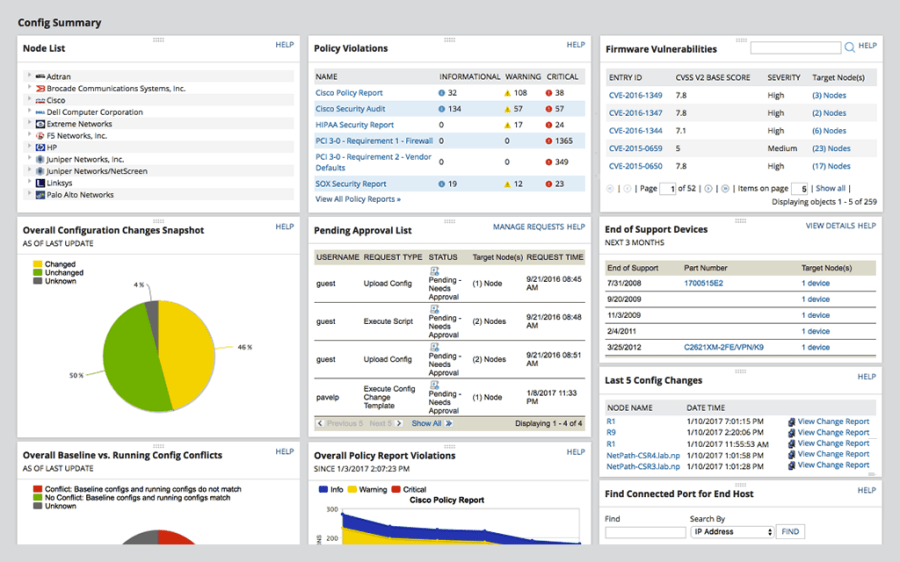
Solarwinds Network Automation Manager(NAM) –
Solarwinds Network Automation Manager (NAM) is an integrated network automation tool designed for highly scalable or enterprise networks. It provides full automation and management from a unified web-based console. (NAM) includes components of various network automation tools and operations management software for all your network deployments.
It includes some features of the Network Performance Monitor (NPM), Netflow Traffic Analyzer (NTA), User Device Tracker (UDT), Network Configuration Manager (NCM), IP Address Manager (IPAM), VoIP & Network Quality Manager (VNQM), and SolarWinds High Availability. The network engineer can configure certain network automation functions on NAM and let the tool monitor the availability, faults, and performance for all nodes and paths in your network.
Its key features include : analysing traffic and bandwidth and find hogs, monitoring and backing-up network devices automatically, deploying network configurations in bulk, automatic subnet discovery and IP scanning and monitoring network performance.
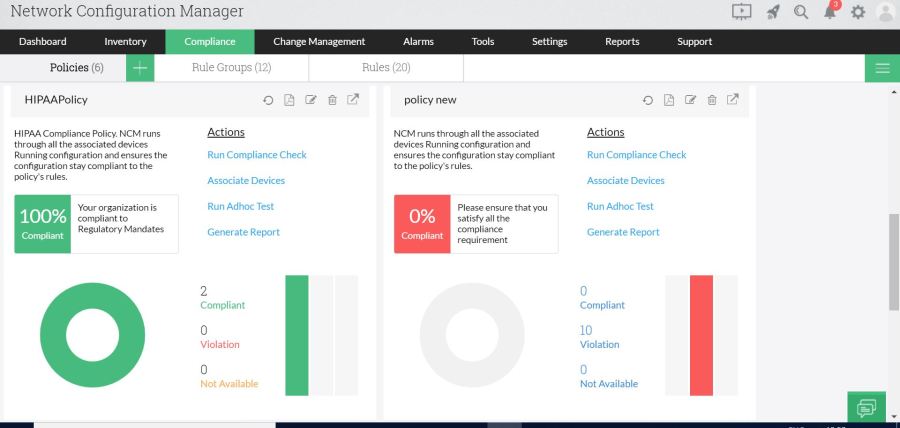
ManageEngine Network Configuration Manager (NCM) by ManageEngine is one of the most comprehensive software for network configuration, change, and compliance management. It supports multi-vendor networks with products from Cisco, NetGear, Fortinet, Juniper, HP, and more.
NCM can help you automate the management of the entire lifecycle of network device configurations. You can automate daily monotonous configuration tasks in bulk. Instead of going one by one, which generally would take a long time, you can apply a new configuration or changes to multiple devices. You can also schedule automatic configuration backups that might be useful in case of rollbacks.
Its key features include : automating new or edit configuration in bulk, network automation using Configlets, configuration backups, configuration change notifications and rollback actions.
Ansible (Tower) –
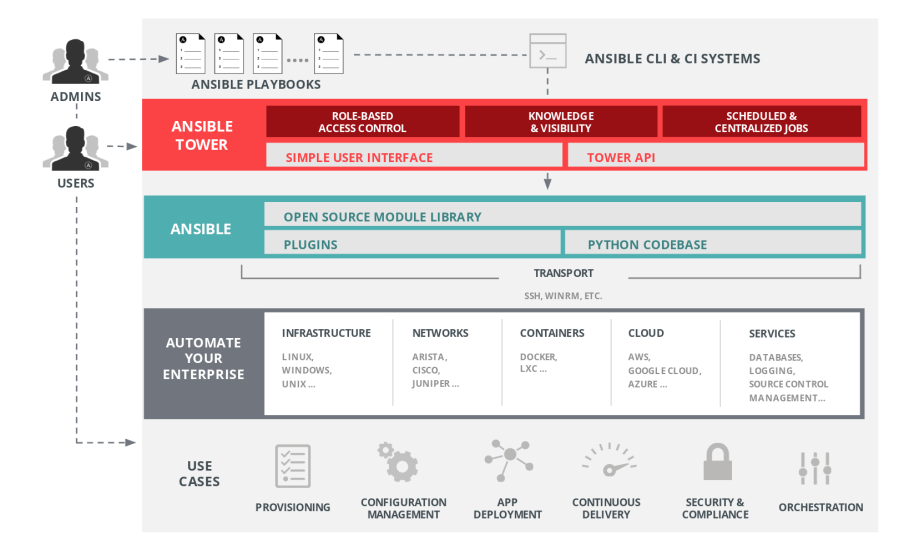
Ansible by RedHat, the simple automation framework, is definitely at the core of a lot of new networking DevOp solutions. It automates the configuration of servers and provides native support for legacy and open network infrastructure. Ansible is an open-source project built by the community. It is available for Linux/Unix-like OS and Windows.
To automatically configure servers, Ansible uses playbooks, which are ordered units of scripts (written in YAML) that define how a server should work and behave through the Ansible automation tool.
Ansible Tower is the enterprise web-based GUI tool that makes Ansible easy to use. The software is designed to be the central platform for all automation tasks. Ansible Tower helps network teams manage complex deployments.
Its key features include : leveraging the current network CLI commands to automate over 45 different networking vendors, between switches, routers, load balancers, and firewalls, provide automation for software-based controllers (SDN), automate interconnection of hybrid and multi-clouds.
Netmiko –
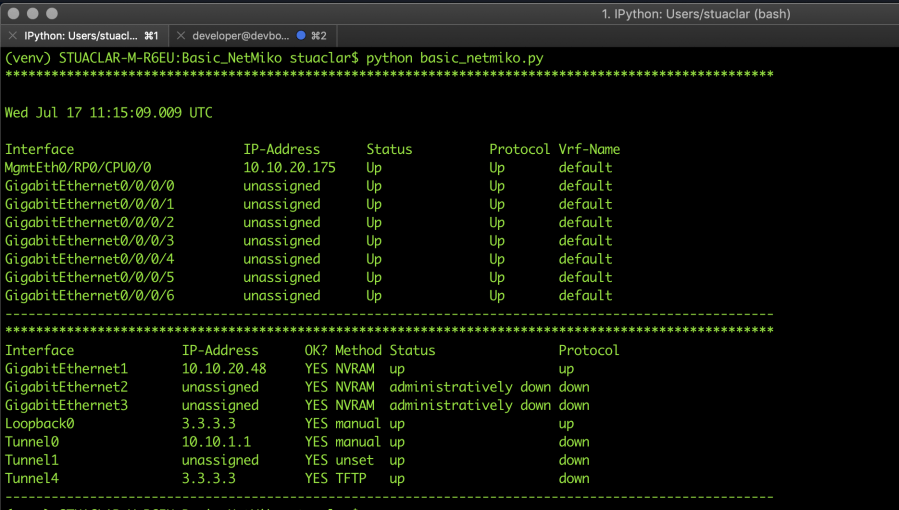
Netmiko is an open-source Python library based on the Paramiko SSH library. It allows easier management and connection of network devices through SSH. Netmiko improves the library of Paramiko by including support to a wide range of networking vendors and platforms, such as Arista EOS, Cisco ASA, HP Comware7, Juniper Junos, Linux, and more. The tool simplifies and automates the logging to a network device through SSH and executes commands.
Its key features include : establishing an SSH connection to network devices, execute “show” commands and retrieve the results, execute configuration commands, it supports a wide range of vendors and platforms.
NAPALM–
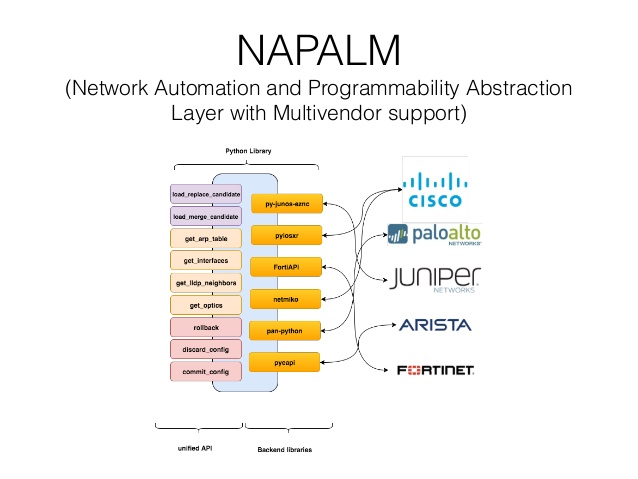
NAPALM (Network Automation and Programmability Abstraction Layer with Multivendor support) is a Python library that can interact with different network devices via a unified API. The software is cross-platform and open-source. It uses different technologies to connect to the network devices, execute configurations, and retrieves the output data. It can support different networking operating systems such as Arista EOS, Cisco IOS, Cisco IOS-XR, Cisco NX-OS, and Juniper JunOS.
Its key features include : connecting to single or multiple devices, executing commands automatically, replace, merge, and compare configurations, discarding or rollbacks configuration, retrieving and audit information.
Truesight Network Automation –
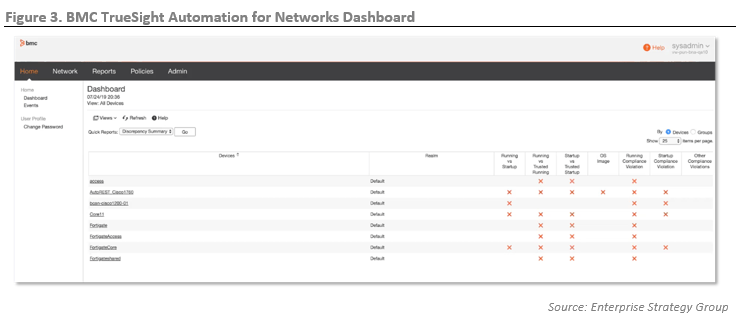
Truesight formerly known as BladeLogic, is now part of the BMC product portfolio. Truesight is an APM with AIOps (Artificial Intelligence Operations) capabilities. It is designed to improve the performance and security of hybrid-cloud environments at a cost-efficient price. TrueSight provides scalable and automated network configuration management capabilities. The software gives full control of the entire configuration across the network, from systems, routers, and firewalls. It can also be programmed to automatically keep track of changes in configuration and apply rollback in case of failure.
Its key features include : service-aware analytics, auto-scans and auto-backups, automatic audits and security compliance checks, patch and image update automation, capacity optimization.
Apstra OS–
Apstra OS (AOS) is referred to as a self-operating network, which automates the lifecycle of leaf-spine network switching. AOS supports multiple switches hardware vendors (Cisco, Juniper, Arista, and more) and operating systems (EOS, Junos, NX-OS, and more).
Apstra comes with a single console to automate your network. It decouples the network (software) from the underlying physical and virtual infrastructure. It works at the management plan to control switches or other devices through their open APIs.
ApstraOS ensures that network elements such as protocols, design, cabling, etc. work continuously. With AOS, you can create, edit, or remove leaf-spine devices, instantly across different network vendors. AOS also comes with closed-loop real-time validation and advanced data analytics.
Its key features include : automated L3 design and deployment with intra-rack virtual networks, operational analytics. Intent-Based Analytics (IBA), built-in Telemetry, NSX-T and vSphere Integration.
NetBrain Automation–
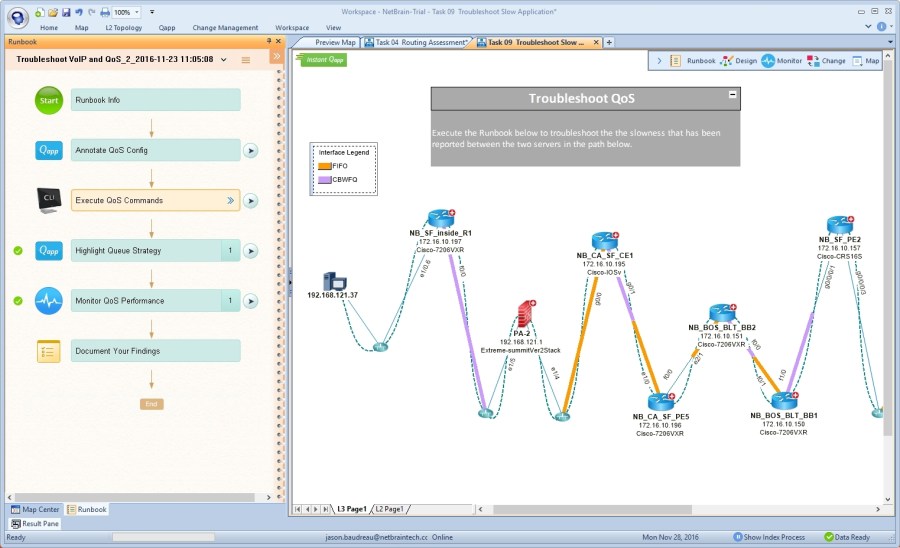
NetBrain is an adaptive network automation platform. It uses a single-pane-of-glass that shows all network data through mapping and visualization. The software also comes with a powerful search engine that allows you to look through all your network elements.
NetBrain performs an in-depth automatic network discovery to collect data from all network devices. It decodes multi-vendor networks and builds a digital representation of the network. The software creates a dynamic map to be used as a UI to all devices and to configure automation tasks. The software improves the device map experience by adding CLI automation and data from third-party network vendors through API.
Its key features include : automaticing network device inventorying, single-pane-of-glass and dynamic maps, viewing device’s CLI at the map-level, automating workflows with Executable Runbooks.












 my work


 Eduindex
You must be logged in to post a comment.