EduPub (Edupedia Publications Pvt Ltd) is a company dedicated to the development of the education, learning, research and innovation in the field of the research and books publication. We are pioneer in providing wide range of services to educational institutions, government agencies, individuals and corporates in the field of training and education, research and development, research and innovation. research and publication.
India could be a land of festivals. an outsized no of festivals and fairs square measure celebrated by the folks within the villages and cities. The Teej competition is additionally very talked-about within the country. This competition comes throughout Saavan ( Rainy Season). now folks square measure getting ready to celebrate it with nice enthusiasm. The competition is additionally called Kajari Teej, Hartali Ka Teej etc. this is often the competition of girls and youngsters.There has been a good amendment within the celebration of this competition. The essence of this rural competition is marred by the current news. There was the time once folks started celebrating it for several days. The were swings established seven to ten days before the competition.
Young and recent ladies, ladies and youngsters would get pleasure from the swings unceasingly for hours. however currently there’s no time for such activities.There square measure fairs command at the large area in each village and town. There square measure stalls for eatables, bangles, toys, artificial jewelry, henna etc. The truthful starts within the evening and continues for three to four hours. youngsters additionally get pleasure from swings.
With the passage of your time, the design of those swings have additionally modified.There is additionally the kothli ( bag filled with gifts) tradition throughout this competition particularly in Haryana. The parental members of the family of the married ladies bring kothli a number of days before the competition. Even mothers-in-law supply special gifts referred to as sindhara to their freshly married sisters-in-law. The puja is performed within the morning. The worship takes place within the sq.. ladies worship deity Hindu deity ( Lord Shiva’s Consort). this is often additionally the competition of songs and dances. ladies organize programmes for themselves wherever they sing and dance.
The Haryanavi people song कच्चे नीम की निम्बोली …… सावन जल्दी आयो रे is at each rural woman’s lips now. youngsters square measure happier throughout the competition.
They additionally wear new garments. They purchase toys and luxuriate in chaats. Some youngsters additionally fly kites on at the moment. Special dishes like Puri, Kheer, halwa are ready for dinner.Evening Time is additional special, specially for the youngsters. they’re going to the Teej truthful with their oldsters and luxuriate in swings and buy toys.
But one factor is bound the important essence of this competition is lost in modernization and development. currently no one is aware of those songs that accustomed be the spirit of this competition, swings square measure gone and fairs square measure finished.
As it comes to the Copa America, South American championship of Nations that is one of the prestigious tournament in the sport and also considered one of the oldest international football tournament. the tournament consist of 10 national team- Argentina, Bolivia, Brazil, Chile, Colombia, Ecuador, Paraguay, Peru, Uruguay, and Venezuela.
The Copa America ended with a long-overdue glory for Lionel Messi, but it was not an easy one but the success led to victory not by individual but due to many reasons.
“I have been lucky enough to win everything at club level and individual level and it would be lovely to win something with the national side” the 34 year old said on the eve’s of this year Copa America. “That’s my dream”.
COPA AMERICA 11-07-2021 WINNER Argentina against Brazil
all those hard work and training finally paid off for the country, the unmeasurable skills set by the players and the strategy that the coach led to their victory have also helped the team. The heavy pressure put on by Brazilians players on Messi- that he’s never “done it” for Argentina has now silenced been silenced. And its not the enduring image shown in the picture of him holding the victory trophy but, the level of performance and dedication to achieve victory performance throughout the game. Messi is not known only for his skills but his amalgamation of teamwork and dedication have trained him to achieve victory until the end.
Messi who won the victory trophy, but was not titled man of the match. an honour probably belong to Rodrigo De Paul , with Demaria also in the running, but Messi was undoubtedly player of the tournament.
Brazilian accumulate all the energy against the Argentinian player Messi. they put on the lots of pressure in the second half of the match, but even with their five strikers on the forward filed, they could not equalized against the Argentinian defenders, protected by the outstanding defenders Rodrigo De Paul.
“First we have to congratulate our opponents especially for the first half when they neutralized us,” said Brazilian defender Thiago Silva
Technology and gadgets are now indispensable in our daily lives. In the past few years carrying a miniature computer (a smart phone) in a pocket has become commonplace. Technology helps advance the human race forward and makes doing mundane things more efficient and repeatable. Technology has helped create the information revolution. With technological advances, devices have evolved to be so powerful and smart that it feels like having a super-computer on one’s hands. Humans now have an insatiable appetite for information at their fingertips. When technology makes this happen, the natural tendency is for this to become an expectation. Life Without Gadgets: ■People born before the 1980’s would very well relate to life before the information age, when people had no access to internet or personal gadgets. Let’s briefly walk down the memory lane to relive those moments — a life without gadgets. ■Children played together outdoor — they had a lot of physical activity. ■People talked to each other more often, and verbal communication face-face was at its peak. ■Chat jargon did not exist and people knew their spellings well, as they read more books. ■People enjoyed spending more time outdoors with family and friends. ■It was commonplace to get the news from newspaper or radio. ■Entertainment came from playing board games, playing sports, going to the movies, watching VHS tapes, etc. ■Writers often used either a type-writer or a word processor on their computer. ■Computers were expensive and bulky. ■Doing research was hard; frequent visits to the library or scouring through plethora of papers, books, etc. were necessary. ■Communication was slow. Life With Gadgets: Gadgets equipped with internet have transformed our lives in several ways and brought about a paradigm shift in our dependence on technology to perform key tasks in our everyday routine. To highlight a few: ■Enormous amount of information at our fingertips ■Use Google Maps to get directions, watch YouTube videos to learn to cook, sing, draw, learn science, etc. ■Health monitoring apps on the cell phone that would remind people to walk, run, bike, check BP periodically, etc. ■Capability to share daily life or special events instantly with thousands of people and see reaction in a matter of minutes, if not seconds ■Expedited research with access to information galore ■Ability to watch videos on demand from anywhere (Netflix, Amazon, etc.) ■Ability to read e-books online on demand — no more visits to library needed ■Use of mobile phones, tablets as pacifiers for kids ■Improved speed of communication by orders of magnitude leading to faster decision-making ■Existence of mobile apps for entertainment, social interaction through digital media, paying bills, accessing bank accounts, etc. Effects of Gadget Addiction: While the business model of the top few app companies hinges on people spending more time with their gadgets every day, we need to recognize that the most important fallout of this induced behavior would be the rising epidemic of gadget addiction. A sense of urge to use the phone or any other gadget when bored or idle equates to addiction. Gadget addiction doesn’t discriminate who is affected, it affects all age groups and people of all races. The effects range from mental, physical, emotional to even threatening our democracy. Mental and Emotional Health: Dopamine is a neurochemical that largely controls the pleasure and reward centers of the brain. High levels of dopamine are usually associated with motivation and excitement to fulfil goals that would lead to recognized rewards and thus reinforcement of a sense of pleasure while achieving those goals. Procrastination, lack of enthusiasm and self-confidence, and boredom are linked to low levels of dopamine. Research has shown that the brain gets “rewired” as excessive amounts of dopamine get released in the body on frequent interaction with a rewarding stimulus, i.e., using a smartphone app like Facebook. Boredom triggers an interaction with the rewarding stimulus (Facebook app), which in turn results in wide variety of rewards in the form of likes, messages, photos, etc. causing high releases of dopamine in the body. Frequent cycles such as these cause the brain’s receptors to become more insensitive to dopamine, causing the body to experience less pleasure than before for the same natural reward. This leads the person down a spiral, where one has increased craving for the same reward to achieve normal levels of pleasure. If the increased craving cannot be satisfied, it would lead to anxiety, lack of motivation and depression. Gadget addiction is likened to addiction to alcohol or drugs since it results in similar negative consequences. Studieshave shown that children’s cognitive and emotional development can be adversely impacted by internet/gadget addiction. More screen time means more virtual interactions and rewards through social media (shares, likes) and less face time. Less face-to-face interaction with other people results in lack of empathy for fellow human beings. Physical Health: Today’s children are immersed in technology right from a very young age. With more than half the schools in the US using smart devices as teaching tools in class, coupled with at-home smart device usage, the total screen exposure time of students in the age group 8-18 has exceeded ten hours a day. There are obvious benefits to being exposed to technology right from a very young age, i.e., development of skills needed to be successful in technology-related areas in a future career. However, on the downside, there could be lack of development of social behavioral skills and high risk of obesity due to limited physical activity. As one would also expect, one of the biggest health risks of excessive smart device usage is vision-related. The National Eye Institute has found that the frequency of myopia (near-sightedness) has increased exponentially in Americans over the last few decades. The other effect on eyes was reduced blink rate leading to higher incidence of dry eye symptoms. Based on these findings, the American Academy of Pediatricshas revised recommendations for limiting screen time for kids at different ages. Listening to loud music through earbuds has detrimental effects on hearing ability The National Institute of Deafness and Other Communication Disordersreports that about 15% of Americans between the ages of 20-69 have a reduced capability to hear high frequency sounds due to exposure to loud sounds. Other negative effects on physical health from excessive gadget usage include lack of sleep and increased weight on the spine as the head tilt increases to view the screen. As we see the rise of ill effects of long term gadget use, rising health concerns amidst this drive to seek mindshare, finite attention of the same consumers there are groups of individuals who are now speaking up and taking a stand. These groups are investors, ex-employees of these companies and consumer groups. Starting 2018 these voices have amplified and there is a call for action and change is imminent.
The story of human origins is complicated since our ancestors swapped genes (and probably skills).
The first humans emerged in Africa around two million years ago, long before the modern humans known as Homo sapiens appeared on the same continent.
There’s a lot anthropologists still don’t know about how different groups of humans interacted and mated with each other over this long stretch of prehistory. Thanks to new archaeological and genealogical research, they’re starting to fill in some of the blanks.
The First Humans
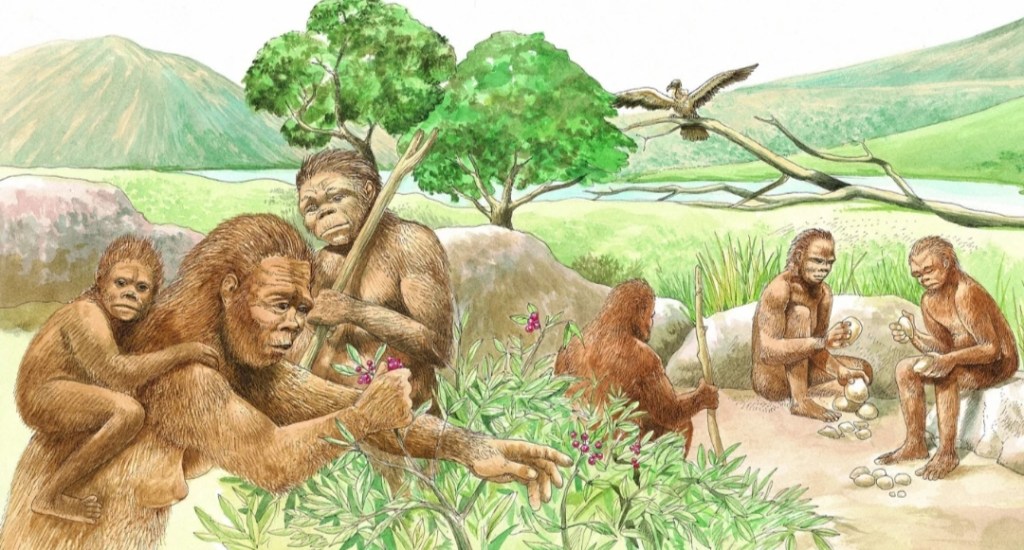
Homo habilis individuals chip away at rocks, sharpening them for cutting up game or scraping hides while a woman, with her child, gathers wild berries to eat and branches to make shelters.
First things first: A “human” is anyone who belongs to the genus Homo (Latin for “man”). Scientists still don’t know exactly when or how the first humans evolved, but they’ve identified a few of the oldest ones.
One of the earliest known humans is Homo habilis, or “handy man,” who lived about 2.4 million to 1.4 million years ago in Eastern and Southern Africa. Others include Homo rudolfensis, who lived in Eastern Africa about 1.9 million to 1.8 million years ago (its name comes from its discovery in East Rudolph, Kenya); and Homo erectus, the “upright man” who ranged from Southern Africa all the way to modern-day China and Indonesia from about 1.89 million to 110,000 years ago.
In addition to these early humans, researchers have found evidence of an unknown “superarchaic” group that separated from other humans in Africa around two million years ago. These superarchaic humans mated with the ancestors of Neanderthals and Denisovans, according to a paper published in Science Advances in February 2020. This marks the earliest known instance of human groups mating with each other—something we know happened a lot more later on.
After the superarchaic humans came the archaic ones: Neanderthals, Denisovans and other human groups that no longer exist.
Archaeologists have known about Neanderthals, or Homo neanderthalensis, since the 19th century, but only discovered Denisovans in 2008 (the group is so new it doesn’t have a scientific name yet). Since then, researchers have discovered Neanderthals and Denisovans not only mated with each other, they also mated with modern humans.
“When the Max Plank Institute [for Evolutionary Anthropology] began getting nuclear DNA sequenced data from Neanderthals, then it became very clear very quickly that modern humans carried some Neanderthal DNA,” says Alan R. Rogers, a professor of anthropology and biology at the University of Utah and lead author of the Science Advances paper. “That was a real turning point… It became widely accepted very quickly after that.”
As a more recently-discovered group, we have far less information on Denisovans than Neanderthals. But archaeologists have found evidence that they lived and mated with Neanderthals in Siberia for around 100,000 years. The most direct evidence of this is the recent discovery of a 13-year-old girl who lived in that cave about 90,000 years ago. DNA analysis revealed that her mother was a Neanderthal and her father was a Denisovan.
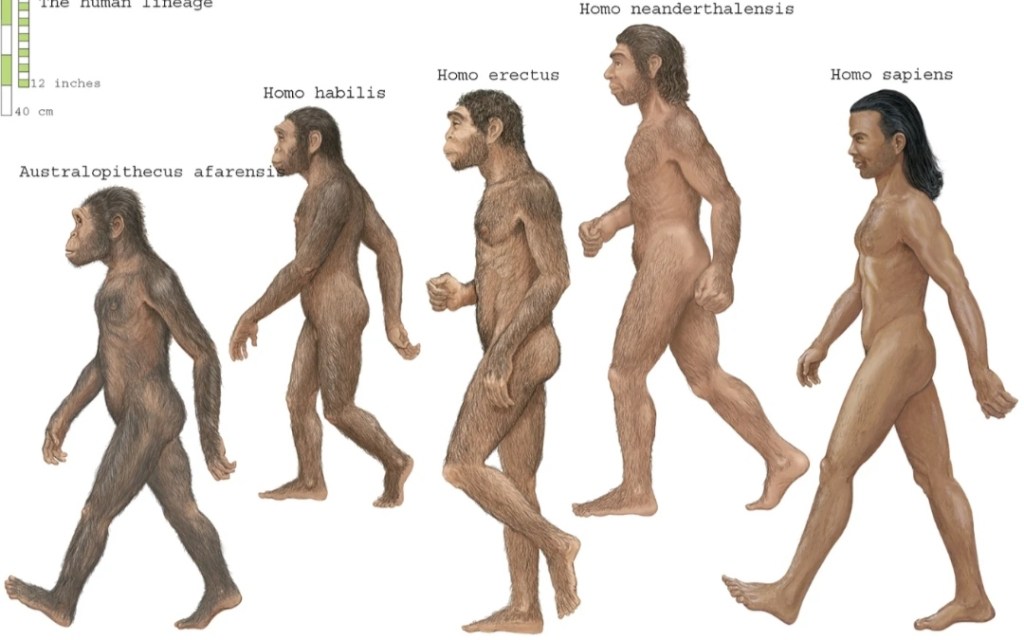
The human lineage of Australopithecus afarensis, Homo habilis, Homo erectus, Neanderthals and Homo sapiens.
Scientists are still figuring out when all this inter-group mating took place. Modern humans may have mated with Neanderthals after migrating out of Africa and into Europe and Asia around 70,000 years ago. Apparently, this was no one-night stand—research suggests there were multiple encounters between Neanderthals and modern humans.
Less is known about the Denisovans and their movements, but research suggests modern humans mated with them in Asia and Australia between 50,000 and 15,000 years ago.
Until recently, some researchers assumed people of African descent didn’t have Neanderthal ancestry because their predecessors didn’t leave Africa to meet the Neanderthals in Europe and Asia. But in January 2020, a paper in Cell upended that narrative by reporting that modern populations across Africa also carry a significant amount of Neanderthal DNA. Researchers suggest this could be the result of modern humans migrating back into Africa over the past 20,000 years after mating with Neanderthals in Europe and Asia.
Given these types of discoveries, it may be better to think about human evolution as a “braided stream,” rather than a “classical tree of evolution,” says Andrew C. Sorensen, a postdoctoral researcher in archaeology at Leiden University in the Netherlands. Although the majority of modern humans’ DNA still comes from a group that developed in Africa (Neanderthal and Deniosovan DNA accounts for only a small percentage of our genes), new discoveries about inter-group mating have complicated our view of human evolution.
“It seems like the more DNA evidence that we get—every question that gets answered, five more pop up,” he says. “So it’s a bit of an evolutionary wack-a-mole.”
Early Human Ancestors Shared Skills
Human groups that encountered each other probably swapped more than just genes, too. Neanderthals living in modern-day France roughly 50,000 years ago knew how to start a fire, according to a 2018 Nature paperon which Sorensen was the lead author. Fire-starting is a key skill that different human groups could have passed along to each other—possibly even one that Neanderthals taught to some modern humans.
“These early human groups, they really got around,” Sorensen says. “These people just move around so much that it’s very difficult to tease out these relationships.”
Rolihlahla Mandela was born into the Madiba clan in the village of Mvezo, in the Eastern Cape, on 18 July 1918. His mother was Nonqaphi Nosekeni and his father was Nkosi Mphakanyiswa Gadla Mandela, principal counsellor to the Acting King of the Thembu people, Jongintaba Dalindyebo. In 1930, when he was 12 years old, his father died and the young Rolihlahla became a ward of Jongintaba at the Great Place in Mqhekezweni. Hearing the elders’ stories of his ancestors’ valour during the wars of resistance, he dreamed also of making his own contribution to the freedom struggle of his people. He attended primary school in Qunu where his teacher, Miss Mdingane, gave him the name Nelson, in accordance with the custom of giving all schoolchildren “Christian” names He completed his Junior Certificate at Clarkebury Boarding Institute and went on to Healdtown, a Wesleyan secondary school of some repute, where he matriculated. Mandela began his studies for a Bachelor of Arts degree at the University College of Fort Hare but did not complete the degree there as he was expelled for joining in a student protest. On his return to the Great Place at Mqhekezweni the King was furious and said if he didn’t return to Fort Hare he would arrange wives for him and his cousin Justice. They ran away to Johannesburg instead, arriving there in 1941. There he worked as a mine security officer and after meeting Walter Sisulu, an estate agent, he was introduced to Lazer Sidelsky. He then did his articles through a firm of attorneys – Witkin, Eidelman and Sidelsky. He completed his BA through the University of South Africa and went back to Fort Hare for his graduation in 1943. Meanwhile, he began studying for an LLB at the University of the Witwatersrand. By his own admission he was a poor student and left the university in 1952 without graduating. He only started studying again through the University of London after his imprisonment in 1962 but also did not complete that degree. In 1989, while in the last months of his imprisonment, he obtained an LLB through the University of South Africa. He graduated in absentia at a ceremony in Cape Town. Entering politics: Mandela, while increasingly politically involved from 1942, only joined the African National Congress in 1944 when he helped to form the ANC Youth League (ANCYL). In 1944 he married Walter Sisulu’s cousin, Evelyn Mase, a nurse. They had two sons, Madiba Thembekile “Thembi” and Makgatho, and two daughters both called Makaziwe, the first of whom died in infancy. He and his wife divorced in 1958. Mandela rose through the ranks of the ANCYL and through its efforts, the ANC adopted a more radical mass-based policy, the Programme of Action, in 1949. In 1952 he was chosen as the National Volunteer-in-Chief of the Defiance Campaign with Maulvi Cachalia as his deputy. This campaign of civil disobedience against six unjust laws was a joint programme between the ANC and the South African Indian Congress. He and 19 others were charged under the Suppression of Communism Act for their part in the campaign and sentenced to nine months of hard labour, suspended for two years. A two-year diploma in law on top of his BA allowed Mandela to practise law, and in August 1952 he and Oliver Tambo established South Africa’s first black law firm, Mandela & Tambo. At the end of 1952 he was banned for the first time. As a restricted person he was only permitted to watch in secret as the Freedom Charter was adopted in Kliptown on 26 June 1955. The Treason Trial: Mandela was arrested in a countrywide police swoop on 5 December 1956, which led to the 1956 Treason Trial. Men and women of all races found themselves in the dock in the marathon trial that only ended when the last 28 accused, including Mandela, were acquitted on 29 March 1961. On 21 March 1960 police killed 69 unarmed people in a protest in Sharpeville against the pass laws. This led to the country’s first state of emergency and the banning of the ANC and the Pan Africanist Congress (PAC) on 8 April. Mandela and his colleagues in the Treason Trial were among thousands detained during the state of emergency. During the trial Mandela married a social worker, Winnie Madikizela, on 14 June 1958. They had two daughters, Zenani and Zindziswa. The couple divorced in 1996. Days before the end of the Treason Trial, Mandela travelled to Pietermaritzburg to speak at the All-in Africa Conference, which resolved that he should write to Prime Minister Verwoerd requesting a national convention on a non-racial constitution, and to warn that should he not agree there would be a national strike against South Africa becoming a republic. After he and his colleagues were acquitted in the Treason Trial, Mandela went underground and began planning a national strike for 29, 30 and 31 March. In the face of massive mobilisation of state security the strike was called off early. In June 1961 he was asked to lead the armed struggle and helped to establish Umkhonto weSizwe (Spear of the Nation), which launched on 16 December 1961 with a series of explosions. On 11 June 1964 Mandela and seven other accused, Walter Sisulu, Ahmed Kathrada, Govan Mbeki, Raymond Mhlaba, Denis Goldberg, Elias Motsoaledi and Andrew Mlangeni, were convicted and the next day were sentenced to life imprisonment. Goldberg was sent to Pretoria Prison because he was white, while the others went to Robben Island. Mandela’s mother died in 1968 and his eldest son, Thembi, in 1969. He was not allowed to attend their funerals. On 31 March 1982 Mandela was transferred to Pollsmoor Prison in Cape Town with Sisulu, Mhlaba and Mlangeni. Kathrada joined them in October. When he returned to the prison in November 1985 after prostate surgery, Mandela was held alone. Justice Minister Kobie Coetsee visited him in hospital. Later Mandela initiated talks about an ultimate meeting between the apartheid government and the ANC. Release from prison: On 12 August 1988 he was taken to hospital where he was diagnosed with tuberculosis. After more than three months in two hospitals he was transferred on 7 December 1988 to a house at Victor Verster Prison near Paarl where he spent his last 14 months of imprisonment. He was released from its gates on Sunday 11 February 1990, nine days after the unbanning of the ANC and the PAC and nearly four months after the release of his remaining Rivonia comrades. Throughout his imprisonment he had rejected at least three conditional offers of release. Mandela immersed himself in official talks to end white minority rule and in 1991 was elected ANC President to replace his ailing friend, Oliver Tambo. In 1993 he and President FW de Klerk jointly won the Nobel Peace Prize and on 27 April 1994 he voted for the first time in his life. President: On 10 May 1994 he was inaugurated as South Africa’s first democratically elected President. On his 80th birthday in 1998 he married Graça Machel, his third wife.True to his promise, Mandela stepped down in 1999 after one term as President. He continued to work with the Nelson Mandela Children’s Fund he set up in 1995 and established the Nelson Mandela Foundation and The Mandela Rhodes Foundation. In April 2007 his grandson, Mandla Mandela, was installed as head of the Mvezo Traditional Council at a ceremony at the Mvezo Great Place. Nelson Mandela never wavered in his devotion to democracy, equality and learning. Despite terrible provocation, he never answered racism with racism. His life is an inspiration to all who are oppressed and deprived; and to all who are opposed to oppression and deprivation. He died at his home in Johannesburg on 5 December 2013.
Modern world has opened the doors for newer technologies. Every day, people bring new ideas to transform the way of thinking and doing things. Stories from all over the world from different fields influence many to pursue with their field of interest. There are several successful women in many fields in India also; they become true inspiration to all the young dreamers. Moreover, this pandemic have also taught us to be more skillful to achieve success and continuous growth in our lives.
One of the inspiring stories that have made young girls believe in their dreams is that of P.V. Sindhu. She started playing Badminton at the age of 8 and made her international debut when she was 17 yrs old. After tremendous hard work and with constant learning she became the World’s 6th Ranking Women in Single Badminton. This dedication and her constant efforts are real inspiration for the women out there who believe on themselves.
Image: Sports24
Likewise, Sharanya a 24 yr old young junior doctor who treated the victims of the Kozhikode Plan Crash. After working for 1 year at Kozhikode General Hospital,she quits to start preparing for her NEET exams. On one of the fateful night, when the hospital needed all hands on deck, she jumped into help without a second thought.
12 year old Haaziq from Pune came up with ingenious innovation- Ervis – which is a prototype ocean cleaner ship that can suck out plastic from the surface of the ocean. The picture of a young whale that died of intestinal blockage after consuming huge amount of plastic is what made this 12 year old to wage war against plastic. His novel idea received global attention and he got a chance to present this idea before audience through TED-X club.
India is one of the countries having most number of youths; the need is to give them a proper direction to think and to bring a change. Engagement of young people at local, national and global levels is impacting lives. The more they explore the more idea they collect. At this stage of confusion and uncertainty youths from different part of India are setting examples for others. No talent should be wasted, because they are capable of much more. But due to societal pressure and constant discouragements they often confused to choose their field of interests.
Image: Rightful Owner
The 22 year old a Haimanti founder of the NGO Junoon, is the inspiration for people who want to bring a change in the field of education especially for underprivileged children. Since May 2018, she has been on a mission to equip them with necessary skills along with education that will enable her to enroll them in a regular school under the Right to Education Act.
There are several more tales of young minds whose acts inspire us to work towards innovative methodologies. A young regular college student from Palakkad district, Shahinsa belongs to an agrarian family from the Panamanna village have deep passion for farming and finds the time to grow crops using modern technology in the fields.
Sriya Donepudi (15), a school going girl from Khajaguda started an initiative to recycle used flowers after social functions. She collected discarded flowers from various events and with the help of women from economically weaker sections they made soaps, paper-weights and other items from floral waste. According to The New Indian Express, this initiative made her bag The Diana Awards of 2020.
In the year 2017, Malhar and his friends collected the garbage thrown by visitors at Dadar Beach. Earlier, they started it as a weekend activity that gradually turned into a fully fledged cleanup movement engaging over 20,000 Mumbaikers. Collectively they have gathered 1000 tonnes of waste including plastics, stale food and religious offerings that had been cleared from the beach side. His efforts for this cleaning drive recognized globally when United Nations felicitated him on the International Volunteer Day.
Most of Indian startup and innovation landscape provide opportunity to young inventors to bloom. Their keen observations combined with deep sense of strategic ideas helps them in dealing with various problematic situations in the field of technology. These tales not only made us proud but also inspire us to build a new India with innovative thoughts.
Image : Shutterstock
Each of us is great in our own fashion. Even a tiny story of inspiration can influence thousands of youngsters to pursue their dream; each act can impact the world. Every one of us has that hidden power, the requirement is to have faith and continue our work with relentless efforts. These tiny tales of youths inspires many to pursue their dream . This pandemic is really tough and a challenging time for all the innovators but if you’re passionate enough to achieve your goal, you should continue with perseverance and patience.
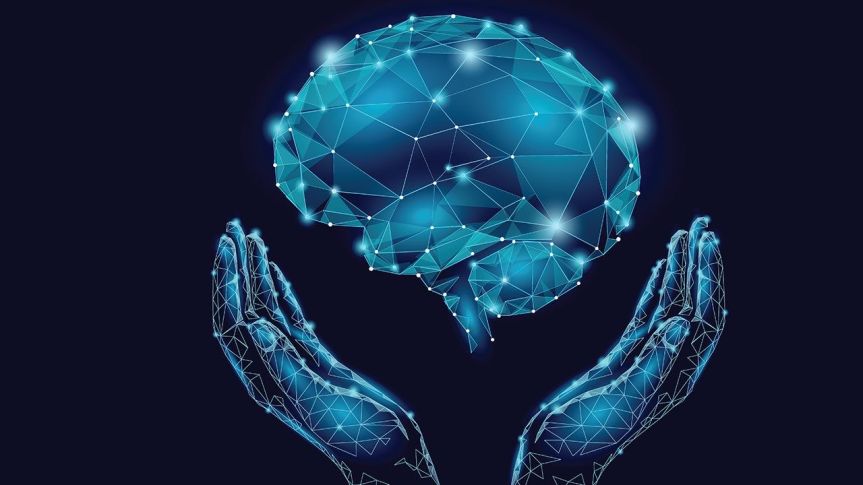
Artificial Intelligence means analytics, problem solving and autonomous automation based on data, knowledge and experience. AI is an intelligent entity that is created by humans. It is capable of performing tasks intelligently without being explicitly instructed to do so. The present day pervading of AI, given how little it is noticed in everyday life, suggests that in important ways this objective has been reached. We are all familiar with applications like Google Assistant, Siri, Alexa, YouTube and so on. All these applications use AI for their functioning.
The purpose of Artificial Intelligence is shared by all the different tools and techniques that we’ve invented over the past thousand years – to simplify human effort, and to help us make better decisions. Artificial Intelligence has also been touted as our Final Invention, a creation that would invent ground-breaking tools and services that would exponentially change how we lead our lives, by hopefully removing strife, inequality and human suffering. That’s all in the far future though – we’re still a long way from those kinds of outcomes. Currently, Artificial Intelligence is being used mostly by companies to improve their process efficiencies, automate resource-heavy tasks, and to make business predictions based on hard data rather than gut feelings. As all technology that has come before this, the research and development costs need to be subsidised by corporations and government agencies before it becomes accessible to everyday laymen.
There’s no doubt in the fact that technology has made our life better. From music recommendations, map directions, mobile banking to fraud prevention, AI and other technologies have taken over. Plus point of AI is that it’s of more convenience and makes life easier. There’s a fine line between advancement and destruction. There’s always two sides to a coin, and that is the case with AI as well. The advantages of Artificial Intelligence are as follows:
Reduction in human error
Available 24×7
Helps in repetitive work
Digital assistance
Faster decisions
Rational Decision Maker
Medical applications
Improves Security
Efficient Communication
Although there are several speculations on AI being dangerous, at the moment, we cannot say that AI is not at all dangerous even though it has benefited our lives in several ways. This can be a boon as well as a bane to the society. As said by Stephen Hawking “either the best or the worst thing ever to happen to humanity.” Other than the fear of evil robots taking our space, the existing AI has also been under the radar of human fear. Let us look at some of the reasons:
Complete relying on AI is not safe. Here one can personalize a device but not their data. Hence, every possibility arises of leaking information. Their information can be misused.
Wrong data input may cause misinterpretation leading to losses.
It may lead to diminution of jobs in industries. The responsibility of handling will be in single person’s hand. AI has faced the question of taking up jobs ever since it came into existence. AI has taken up a lot of tasks that were earlier carried out by people.
The dangerous use of AI can be weaponry. AI leaders said that these threaten to become the third revolution in warfare.
The fear of AI reaching in the wrong hands is also prevalent. Misusing technological advancements have been there in human history. AI cannot explain why it arrived at an answer. It cannot reason nor think rationally. Once it archives the human intelligence, humans might use them to cause a negative impact. AI’s black box has been in discussions for a long time. This caters to another fear – fear of the unknown.
Advances in Artificial Intelligence will reach the superintelligence stage in a couple of years. However, starting a new technology transition has begun, and most businesses are incorporating this unique fixture. It has not only helped with better sales and forecasts but also gives companies new growth opportunities.
AI comes with its own ethical and security issues. It causes privacy concerns to businesses, which needs to be mitigated if you want the user to stay within the company for a while. You will also need to work on job reallocation so that the people who have engaged with you for years can stay happy and engaged. The idea is to transform the future of AI without harming the goodwill of loyal people. It would help if you also introduced the overall culture and organisation-level changes to build a robust AI-induced enterprise. There is no doubt that the Artificial Intelligence future is exciting and extremely promising.
“Extinction is the process of evolution that leads to the dissappearence of a population or species.”
When a species becomes extinct, all its genetic heritage is lost. The species evolve into new species in order to adapt to the environmental changes or changes in the genetic heritage.Over 99% of all the species that once lived on the Earth amounting to over five billion species are estimated to be extinct. As per the estimations on the number of current species, a range from 10 -14 million, of which more than 1.2 million have been studied and more than 86% have not yet been discovered.This could happen naturally due to a change in the climate or because of human activities like overhunting or due to the destruction of habitat.
Despite the uncertainties, extinction has three major elements:
For species collectively, extinction is a probability if the killing stress is so rare beyond their experience and therefore outside the reach of natural selection.
The mass extinctions would pave way for the major restructuring of the biosphere where a few successful groups are eliminated allowing minor groups to expand.
In a few cases, there is evidence that extinction is selectively argued by Darwin. It has been made impossible to predict which species are going to be the next victim of an extinction event
1.THE DODO:
The Dodo was a flightless bird native to Mauritius whose population began dwindling and eventually became extinct over the short course of a century when sailors began arriving on the East African island nation.The last of the Dodos were seen in the 1660s and because there really wasn’t an emphasis on specimen preservation, many of the remaining fossils were lost or destroyed.
Even though the Dodo went extinct more than 150 years ago, their story is important. People didn’t believe that God would take away a creature’s existence after having gone through the trouble of creating them, so no one was truly alarmed at their disappearance. This led people to believe that there were more Dodos tucked away somewhere in nature and so, specimens weren’t handled as carefully as they should have been.In fact, Dodo specimen damage and loss was common in 17th and 18th centuries.
Cause of Extinction:
popular belief has sailors hunting and eating the Dodo to the point of extinction, but it’s more likely that the rats (and other animals) the sailors brought with them caused the Dodo’s decline. The BBC reports that rats likely ate dodo eggs and other animals outcompeted the bird for food sources.
2.SCHOMBURGSK’S DEER:
Schomburgk’s deer was native to Thailand and was named after German-born explorer, Sir Robert H. Schomburgk, who was knighted in 1844.Some scientists believe that there may still be a few of these deer in the wild even though they were officially declared extinct in 2006 with the last known deer reportedly killed in captivity in 1938.
Cause of Extinction:
Besides humans, Schomburgk’s deer were hunted by native tigers and leopards. Today, we only know of one mounted deer head which resides in Paris’ Muséum National d’Histoire Natural.
SUMATRAN RHINO:
The last Sumatran rhino in Malaysia passed away in November, 2019, making the extremely rare species locally extinct. The rhino was named Iman and she died due to cancer.The death of Iman made the species critically endangered, with less than 80 Sumatran rhinos left all over the world, primarily in Indonesia. Currently, Sumatran rhinos are the smallest rhino species in the world.
Cause of Extinction:
Iman, the last Sumatran rhino left in Malaysia, died over the weekend after a long battle with uterine tumors.
The fate of this critically endangered species now lies with a tiny population of no more than 80 individuals in Indonesia, where captive breeding has yielded some success in recent years.
The critically endangered species was decimated by poaching and habitat loss in the past, but today observers say the small and fragmented nature of their populations, and a correspondingly low birthrate, is the biggest threat to their survival. Few of the remaining populations left in the wild are believed to be large enough to support natural reproduction, and isolated individuals have been found to be prone to developing reproductive pathologies like the uterine tumors suffered by Iman(rhino).
INDIAN CHEETAH :
In a report by ANI in September, 2019, it was stated that the Indian Cheetah, along with three other species is now extinct in India due to desertification. The numbers dropped down to 150 and eventually the species died out.This intense desertification was caused due to the excessive use of pesticides and heavy industrialisation in agricultural areas. The report also showed how this desertification had a negative impact on the entire food chain.
Cause of Extinction:
Trapping of large numbers of adult indian cheetah’s, who had already learned hunting skills from wild mothers, for assisting in royal hunts is said to be another major cause of the species rapid decline in india as they never bred in captivity with only one record of a litter ever.The animal is believed to have disappeared from india when Maharaja Ramanuj Pratap Singh Deo of Koriya hunted and shot the last three recorded Asiatic cheetahs in india in 1947. It was declared extinct by the government in 1952.
INDOCHINESE TIGER :
This species was mainly found in southeast Asia before it became critically endangered. Its numbers reduced to 1500 and then eventually the species became extinct.The species is completely extinct in the wild but there are a few tigers that are living in captivity. It is completely wiped out in Cambodia and the largest number of tigers are now residing in Thailand. The main reason for its extinction is hunting and poaching.
According to a lot of media and UN reports, the world is on track to lose two-thirds of its wildlife population by the end of 2020. Even common wildlife species like Koala bears are now prone to extinction because of the Australian bushfires, which happened due to climate change in the area.
Cause of Extinction:
According to the World Wildlife Fund (WWF), indochinese tiger numbers are in shocking decline across its range because of shrinking habitats, expanding human populations, poaching, and illegal wildlife trade. Vital tiger populations are also depleted by a growing commercial demand for wild meat in restaurants
Hunting for trophies, poaching by farmers, and the growing demand for tiger bones in Oriental medicine are key factors for the indochinese tiger decline. Habitat loss due to population growth is also a major concern.It’s believed there are around 350 indochinese tiger leftin the world. This low population is due to poaching and habitat loss.
CATARINA PUPFISH :
Catarina pupfish is a freshwater fish found in Mexico. The species got extinct when their natural habitat got disrupted due to groundwater extraction.The fish was living in the wild till 1994, but due to the rapid loss, the species was moved to captivity. It survived till 2012 and then got completely extinct in 2019.
Cause of Extinction:
The species got extinct when their natural habitat got disrupted due to groundwater extraction. The fish was living in the wild till 1994, but due to the rapid loss, the species was moved to captivity. It survived till 2012 and then got completely extinct in 2019.
Habitat loss caused the extinction of the Catarina pupfish, and it is threatening thousands of species. Humans have modified more than 70% of terrestrial and 60% of marine habitats. The most recent report from the UN estimates that one million animal and plant species are facing extinction in the next few decades as a result of habitat loss and degradation, overexploitation, poaching, climate change, pollution, and invasive species.
PYRENEAN IBEX :
The Pyrenean ibex was a type of goat abundant across the Pyrenees mountains. It declined over two centuries from hunting, disease and inability to compete with other species. The last was a female called Celia, who died in 2000. In a first, it was declared “unextinct”in 2003 when a cloned female ibex was born alive, but died several minutes later from lung defects.The Pyrenean ibex, a subspecies of the Spanish ibex, is one more recently extinct animals.
Cause of Extinction:
The ibex, native to the Pyrenees Mountains on France and Spain’s border, was declared extinct in 2000. During medieval times, the Pyrenean ibex was abundant, but their population decreased due to hunting. 21 years ago this month, a wild goat species went extinct — and kicked off a bizarre but ultimately hopeful scientific adventure. The pyrenean ibex became extinct in January of 2000, when a falling tree landed on the last surviving member of the species.
SPLENDID POISON FROG :
In 2020, the IUCN (International Union for Conservation of Nature) declared that the splendid poison frog was extinct. Sadly, that makes the splendid poison frog one of the most recently extinct animals on the planet.The small red frog, a species of poison dart frog, lived in the neo-tropical forests of Panama in the mountain ranges adjacent to Costa Rica. Common names of the splendid poison frog in Spanish are Rana venenosa and Sapito venenoso
Cause of Extinction:
Deforestation and habitat degradation are the primary threats to the splendid poison frog. Human activities such as logging, expansion of urban and suburban areas, and the construction and use of rail lines have had a significant impact on population numbers.The splendid poison frog or splendid poison-arrow frog (Oophaga speciosa) was a species of poison dart frog endemic to the eastern end of Cordillera de Talamanca, western Panama.
SPIX’S MACAW:
The Spix’s macaw is a recently extinct animal from near the Rio São Francisco in Bahia, Brazil. In 2019, the bird known as the “Little Blue Macaw” because of its vibrant blue feathers was declared extinct in the wild. Fortunately, experts have documented about 160 Spix’s macaws in captivity. Scientists and the Brazilian government are working on a planned release of the parrots to the wild in 2021.
The species was popularized in 2011 when the animated movie “Rio” depicted a cartoon characterization of the breed. Early scientists named the species for the German naturalist who documented them in 1819.
Cause of Extinction:
Though it perished in 2000, some 60-80 are still being bred in captivity. 5. While they were driven to extinction by human factors like the building of dams and trapping for trade, there is still hope to clone and revive these birds in wild populations.Since the year 2000, the species has been considered extinct in the wild. In addition to illegal trafficking, the destruction of habitat due to human influences was the main reason for the extinction of the species.
Habitat destruction and illegal trapping and trade are what caused the wild Spix’s macaw’s demise.A female spix’s macaw released from captivity at the site in 1995 was killed by collision with a power line after seven weeks. The last wild male disappeared from the site in October 2000; his disappearance was thought to have marked the extinction of this species in the wild.
PASSENGER PIGEON :
Although the passenger pigeon went extinct over 100 years ago, you could say that it is one of the recently extinct animals in relation to the earth’s age. The passenger pigeon’s abundant numbers made the species seem ineradicable, but it became the poster child of animal conservationist groups after its demise. Most ecologists estimate that passenger pigeons numbered in the millions when Europeans began settling North America. Eyewitnesses reported that skies would darken when flocks flew overhead on sunny days.
Cause of Extinction:
Passenger pigeons vanished after farmers cleared their habitat and hunters netted, shot and poisoned them to the point of extinction. The extermination of the passenger pigeon was part of the motivation for the birth of 20th century conservation. The last known bird died in the Cincinnati Zoo in 1914.People ate passenger pigeon in huge amounts, but they were also killed because they were perceived as a threat to agriculture. As Europeans migrated across North America, they thinned out and eliminated the large forests that the pigeons depended on.The last passenger pigeon died in the Cincinnati Zoo in 1914
THE QUAGGA :
Another of the relatively recently extinct animals is the Quagga. The odd-looking animal resembled a cross between a stout pony and a zebra. With the zebra’s dazzling stripes across its head, mane, and neck, and the chestnut colouring of a pony or horse throughout the rest of its body, the quagga was hunted to extinction in the late 1800s by European settlers.
The somewhat recently extinct animal was native to South Africa and was a subspecies of the plains Zebra. Named by the African tribe of Hottentots for its distinctive ‘kwa-ha-ha’ call, quagga is an onomatopoeia. The last animal died in the Amsterdam Zoo in 1883.Interestingly, scientists of the Quagga project are using selective breeding of zebras in an attempt to revive the extinct quagga.
Cause of Extinction:
The Quagga’s extinction is generally attributed to the “ruthless hunting”, and even “planned extermination” by colonists. Wild grass eating animals such as the Quagga were perceived by the settlers as competitors for their sheep, goats and other livestock.Quagg’s extinction a Nasty Surprise. 1883: The quagga goes extinct when the last of these South African zebras dies at the Amsterdam Zoo.
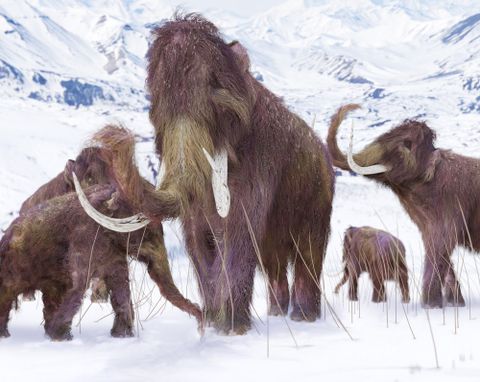
MAMMOTH:
Woolly mammoths lived during the last ice age, and they may have died off when the weather became warmer and their food supply changed. Humans may also be partly responsible for their disappearance due to hunting. Although the word “mammoth” has come to mean “huge,” woolly mammoths were probably about the size of africian elephants. Their ears were smaller than those of today’s elephants. This was probably an adaptation to the cold climate that kept their ears closer to their heads and kept them warmer. Their tusks were very long, about 15 feet (5 meters) and were used for fighting and digging in the deep snow. Mammoths were herbivores and ate mostly grass, but also ate other types of plants and flowers.
Cause of Extinction:
Most woolly mammoths went extinct roughly 10,000 years ago amid a warming climate and widespread human hunting.They pinpointed a collection of genetic mutations in the Wrangel Island mammoth and synthesized these genes in the laboratory to test their functionality.While woolly mammoths were once plentiful across the northern hemisphere, they actually went extinct in two separate events. The first wave of mammoth extinction occurred on the heels of the last ice age and global warming led to the loss of their habitat, around 10,500 years ago.
REASONS FOR EXTINCTION OF SPECIES:
The important causes of extinction include:
Asteroid Strikes:
A meteor strike on the Yucatan peninsula in Mexico led to the disappearance of dinosaurs millions of years ago. Most of the mass extinctions, such as KT-extinction or Permian-Triassic extinction were caused due to such events. The astronomers constantly keep an eye on comets or meteors that could lead to the end of human civilization.
Climate Change:
Climate change is yet another factor that could destroy terrestrial organisms. During the end of the last ice-age, most of the megafauna were unable to adapt to the changing warm temperatures. They died due to lack of food and hunting by early humans. Even modern civilization is stepping towards the threat of extinction due to global warming.
Disease:
Various epidemics had been the cause of extinction of a large population of humans and animals on earth. The Black Death wiped out one-third of the European population in the Middle Ages.
Loss of habitat:
Every animal has its own comfort zone where it can breed and raise its young ones. For eg., a bird is comfortable only on the branch of a tree. Due to the expansion of human civilization and industrialization, the forests have been destroyed which are an abode to most of the animals. Due to lack of space and eventually food, the populations of many organisms have been minimised.
Better Adapted Competition:
The better-adapted populations win over the ones that lag behind. For eg., the pre-historic mammals were better adapted than the dinosaurs. The ones which are well-adapted survive, while the others become extinct.
Pollution:
The pollution from the industries and vehicles have led to a drastic change in the oxygen levels in the atmosphere as well as water. This has led to the extinction of most of the aquatic as well as terrestrial species.
Just because no one else can heal or do your inner work for you, doesn’t mean you can, should or need to do it alone.
Lisa Olivero
Have you ever felt the stark desire to inevitably scream in a room full of people, hoping they just care enough to notice the signs you have been leaving regarding your deteriorating mental state and how desperately you need help? But instead, you just accept your solitude in an empty chair and try to repress your bottled-up emotions deep within the realms of your consciousness.
A lot of us might have gone through the same situation at a certain point in our lives. The primary reason behind this subconscious aversion to the expression of thoughts is the mere fact that humans have been conditioned to do so throughout their lives. Men are typically the most vulnerable victims of this detrimental mindset. From an early age, they are frequently instructed to not cry like a girl. According to a survey, a significant percentage of men in the nation are currently depressed, and they themselves admitted that they lack a support system.
Mental health is still a deeply rooted stigma that people aren’t ready to accept. In order to understand the concept one needs to broaden the perspective of understanding humans and follow certain ways like-
Instead of asking,”How are you?” ask,” How are you, really?”
Look for obvious signs in a person- whether they feeling low from abnormal no. of days.
Asking your closed ones to describe their day in detail and be a good listener.
Do not mistreat someone who is already going through some sort of trauma.
Treat people with kindness, you never know what someone is going through.
Additionally, in India, therapists continue to be overlooked as a useful resource for treating a person’s mental health. A person is called a “lunatic” if they see a therapist. In light of the increased public awareness during the pandemic’s lockdown time, these issues are being explored on social media, and many people now see psychology as a crucial component of the educational system. People have now started considering mental health as being equally essential as physical health as because of an alarming spike in suicide incidents during this period. Still, awareness needs to be assured at ground level and there is still a long way to go to see the day when all of us are not reluctant to lend a helping hand to our fellow humans.
A fundamental aspect of any society should be understanding, accepting, and embracing each and every emotion one feels which makes them human.
Nothing can last forever. The Green will turn Yellow yet, the life goes on.
Have you ever wondered at the marvel of human species? Does human superiority make them all-powerful?
Humans are the only creature in the world that can decide on their destiny. They are the only creatures that has the potential to make or break the world.They are the masters yet ,they are not. Their fragility is marked by their transience.The universe has its own laws for the cosmic balance ,which limits the unlimited powers of man.
About the essay
This essay is penned by Hilaire Belloc in 1908 and published in The Oxford Book of Essays. The essay follows a conversational style and the dialogues are uttered by two people, the unnamed Host and the Youth. There is one other important character the Master, who is powerful yet never appears in the essay. The Master almost exerts a sense of omnipotent power over the other two characters and it can be understood as the personification of Time or may be the Divine. All the chief characters in this essay are unnamed and are kept gender-neutral, this allows the readers to accommodate themselves easily within the pages of this essay. In this essay, Belloc metaphorically represents human body as a house, whose owner is the Host, the soul personified and the temporary resident, the Youth personified. This essay touches on the themes of transience of youth and worldly possessions, immortality of soul, virtues and vices and human choices and their after effects.
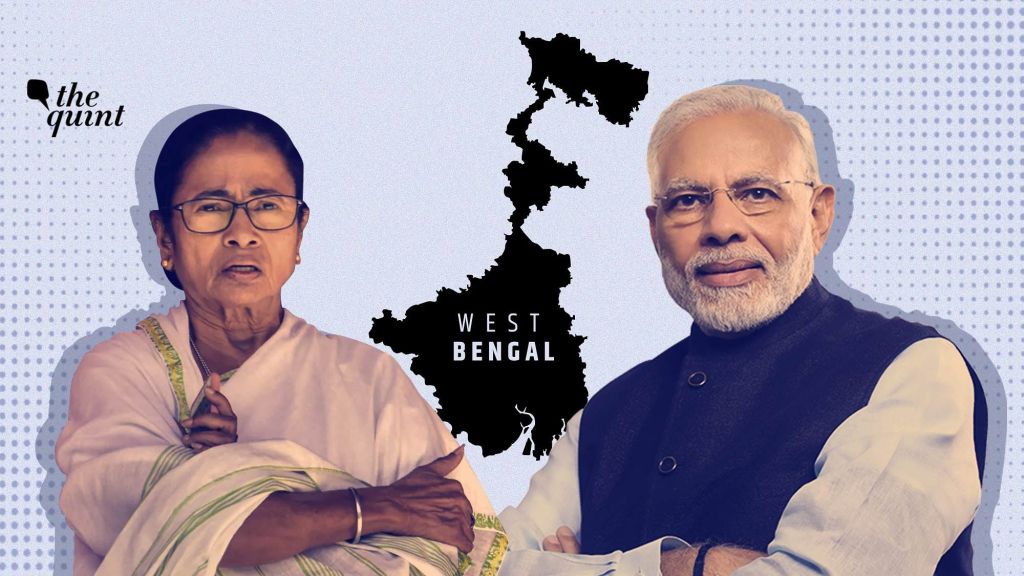
It seems that PM Narendra Modi had already started preparing for the Bengal elections long ago as he visited Kolkata on the occasion of Netaji Subhash Chandra Bose’s 125th anniversary in January. While he also dressed in a certain way where critics say that he impersonated Rabindranath Tagore. Despite there being elections in 4 states and 1 union territory, BJP seemed to have poured its maximum energy into the Bengal elections.
Some of BJP’s tactics:
Home Minister Amit Shas’s lunch: Mr. Amit Shah had lunch at one of his Adivasi party workers. It was seemed to be a move for tribal votes’ appeasement. He also had lunch at a farmer’s house and this one assumed significance in the wake of the ongoing farmers’ protest in Delhi. This was largely covered by media houses.
Anti-Incumbency centric campaign: The saffron party allured Bengalis for a change, while the PM quoted “Asol Parivartan” (real change). Bengal was ruled by the left (communist) parties for 34 years, succeeded by TMC for 10 years. In the 2016 assembly election, BPJ had won only 3 seats, so Bengalis and never tasted BJP’s governance, and hence creating excitement for a change (Parivartan) was BJP’s prime motive. Leader J P Nadda seemed to have been assigned with this task.
Modi brand and the 8 phase election: BJP demanded an unprecedented 8 phase election and the election commission of Indian, surprisingly, too agreed to it. Conducting elections in 8 phases gives more time for campaigning and Mr. Modi himself seemed to have vigorously campaigned in each phase. The Modi brand was effectively used. Also, BJP did not announce its CM candidate’s name. Suvendu Adhikari’s name was anticipated. But if the CM candidate’s name would have been announced, at the face value, it would have been Suvendu v/s Mamata but BPJ wanted to keep it Modi v/s Mamata, as Modi is a bigger brand.
Prime Minister’s visit to Bangladesh: The Prime Minister went to Bangladesh at the invitation of PM Sheikh Hasina. There, he visited the Matua Mahasangha temple. This place is the hometown of Matua Mahasangha. Many Matuas have migrates to India in 1947 and also in 1971 and have settled in a large population in Bengal.
The defection of TMC leaders: Many leaders, including TMC minister Suvendhu Adhikari, had abandoned their party and joined BJP. BJP exhorted that there is a split and desertion of leaders in TMC and portrayed that Mamata’s days are over. Also, their slogans “Do Mai, didi gai” (Didi will go on 2 May) as the election results were to be announced on 2 May. They ran large social media campaigns with top trends- #EbaarBJP (this time it is BJP), #Ebaar200paar (this time we will cross 200 seats). Last time it was TMC that had crossed 200 (out of 294 seats).
Visit of Union Ministers and other Leaders. Many leaders like Smriti Irani, Piyush Goyal, Narendra Singh Tomar, UP CM Yogi Adityanath had joined the campaign. They talked on issues related to Hinduism. Besides, they had emphasized and reminded that Mamata had banned Durga pooja in Bengal. This was no surprise as the saffron party uses Hindutva as its principal agenda in every election.
Also, Mithun Chakraborty joined had joined the campaign as the celebrity face for BJP.
Despite pouring all their resources, energy, and time into Bengal, why did BJP end up winning only 77 out of 292 seats? Mamata too gave befitting replies to each of BJP’s tactics.
Daughter of Bengal v/s the Outsiders: While BJP was stressing on anti-incumbency, to ouster Mamata and bring change; Mamata publicized herself as Bengal’s daughter and that Bengalis have to fight out the outsiders. Mamata fielded many popular Bengali singers and actors who took to the street to highlight that how the Baahaaris (outsiders) are destroying Bengal’s culture and communal inclusiveness. CM Mamata had earlier funded many female-centric schemes like Sabooj Sathi- bicycles for girls and education loans.
Muslim appeasement: While the saffron party goes ahead with its Hindutva narrative, Mamata turns up to be ultra-secular. During her tenure as the CM, she had introduced schemes like scholarships for Muslim students from classes 1 to 10, reservations for Muslim OBCs, etc. The Muslim population has a significant 28-30% vote share in the state. This time, she seemed to have an emerging threat from AIMIM’s Owaisi and also the head of one of the biggest shrines walking into the Indian Secular Front party. Despite this, almost all the Muslim-dominated constituencies had voted in favor of TMC.
SC/ST vote share. Amit Shah’s lunch tactic did not seem to have worked well as, in more than 50% SC/ST dominated constituencies, TMC candidates had won.
Broken leg- The Masterstroke: Mamata Banerjee had reported that while she visited Nandigram for the campaign, she was attacked and suffered a serious leg injury. However, out of hundreds of cameras focused on her, not one captured the alleged incident, making BJP immediately respond that she was bluffing. Mamata also responded to this by posting a picture of her lying on a hospital bed. Later she campaigned on a wheelchair with her leg wrapped with bandages. Evidently, she gained a lot of sympathy because of this.
Some of her party workers were disappointed with her nephew Abhishek Banerjee and political analyst Prashant Kishor controlling the entire campaign. Prashant Kishore had earlier helped Mr. Modi with his election strategy in the 2014 Lok Sabha election and is popularly known as an election magician. This time, he helped TMC and announced that he would quit politics if BJP crosses 100 seats.
While BJP was very confident and chanted ‘Ebaar 200 paar’, little did we know that they were actually talking about TMC! On 2nd May, as the results were announced, TMC had won the mandate with startling 213 seats out of 292. On one hand, BJP with PM, HM, CM Yogi, Mithun, and many other union leaders, Mamata seemed to have fought vigilantly and has shown everyone that the Modi brand can be defeated and is now being considered as the face of UPA in 2024 Lok Sabha elections by many.
Serial killer, what do you think of when you hear this word. What is a Serial Killer?
Serial Killer is a person who has killed at least three people and there are a lot of cases of serial killing that you may have heard of. But have you ever thought about the youngest serial killer in the world.
Yes, A child who is around the age of 8-10 years old may have killed someone. Could there be anyone like that who can kill at such a young age? If you are interested in true crimes then you might have heard of this killer.
This is Amarjeet Sada, A boy who was accused of killing three children .
Amarjeet Sada was born in 1998 in Begusarai district of Bihar. The family later moved to village named Mushahari village. The financial condition of Amarjeet’s Family were not very good due to a large number of family members and very low income. The reason behind family moving to Mushahari village was having better employment opportunity in the village but nothing much changed.
On a day in the year 2007 one of the villager’s 6 month old baby girl ,named Khushboo went missing from the house. Upon looking for the baby when they did not found the baby girl, one of the ember of Sada family came forward telling that he might know about the baby and who has taken her.
After this the police was called and the baby was reported missing. The member of Sada family told police that he knows who has taken the baby and he took the police to Amarjeet Sada who was playing with other childern of the village.
Police officers were still not sure that a child that young can kill anyone but when they asked him about the baby girl he did agreed to knowing about her. Police were still not sure if the child is telling the truth or not but upon further investigating Amarjeet told them that he knew where the baby girl is and what had happened to her cause he himself has killed her.
All of this was still something that police cannot just trust as it was coming from a child but then he took them to the place where he has hidden the body of 6 month old Khushboo. On the edge of village he had hidden the dead body in a shallow grave and had covered it dust and leaves.
He told police that he took the child from the house when no one was around and then tried to strangle her but when he did not get much of a reaction from her he took a stone from the ground and continued hitting her until she was dead.
After this Amarjeet was taken to the police station and according to the police officers present there the child had no idea way he was there and had no remorse for his actions. when asked why he killed khushboo he didn’t answered and just smiled at the police officer. He was so carefree just smiling and swinging his legs from the chair.
It is also said that prior to khushboo’s murder he has also committed two more murders of a 6 years old cousins and 8 months old his own baby sister IN BETWEEN 2006-2007. By the time he was 10 year old he has committed three murders in total.
The details regarding previous two murders are available but there are possibilities that the murders took place in the same way as of khushboo’s, which means that he killed the 6 years old and 8 month old with the stone by hitting them on their head over and over again.
Amarjeet was taken under custody and was assessed by a Patna based Psychoanalyst, Shamshad Hussain, who said that the boy Prima Facie appears to be a sadist who derives pleasure from inflicting injuries on others. According to experts such cases need immediate medical attention by addressing the chemical imbalance in patient’s brain. These things can lead to an anti social behavior in an individual.
Amarjeet Sada is about 22 years old now and is now living a new life under a new identity. No one knows where he is or what he does all that we can hope for is that staying at the remand home he had received the treatment he needed and can live as a normal person.
Due to Amarjeet being of a young age, he cannot be sentenced to death or prison under Indian Law so Amarjeet was sent remand house near Munger in Bihar for 3 years and be imprisoned until he turns 18 years old.The problem with the whole case was that the JuvenileJustice Act states that the central and state government must be guided by Principle of Right to Privacy and Confidentiality of the child, which was totally ignored by the authorities. The name and the pictures of the boy were released by the media houses without any legal actions. ( THE CASE TOOK PLACE BEFORE THE AMMENDMENT IN THE LAW)
The conspiracy behind the case
The conspiracy behind the case states that Amarjeet didn’t actually killed the three children but someone else from the village or from his own family and the child just accepted cause he was told to do so. Many people believe that the family member who told police that Amarjeet was the one who killed the children but this has never been proved.
So, it was all about the world’s youngest serial killer. What do you think about this case and about the fact that the person who committed three murders at the age of 10 is now free and no one knows anything about him. Is it possible for a 8 year old to kill or to overcome killing after growing up so that he can live as a normal person, and who do you think was the real killer. Please share your thoughts with us.
Rath Yatra is a Hindu festival associated with Lord Jagannath. It is held at Puri in the state of Odisha, India. It is the oldest rath yatra in the whole world, and it’s description can be found in Brahma Purana, Padma purana, etc. It is among the most famous Vaishnavite rituals in India and abroad, so, usually witnessed much fervour and enthusiasms among devotees who come to pray- Lord Jagannath, Lord Babhadra and Lordess Subhadra.
For the festival, in the Lord Jagannath Puri Rath Yatra, special chariots are built every year, and this year has been no different. But, this year due to corona restrictions, no devotee’s are allowed during the most awaited Rath Yatra, even though Lord Jagannath is one of the principal deities in the state of Odisha. Though, this year the chariot pullers who had participated in the procession had been tested Covid-19 negative and had been fully vaccinated before the festival.
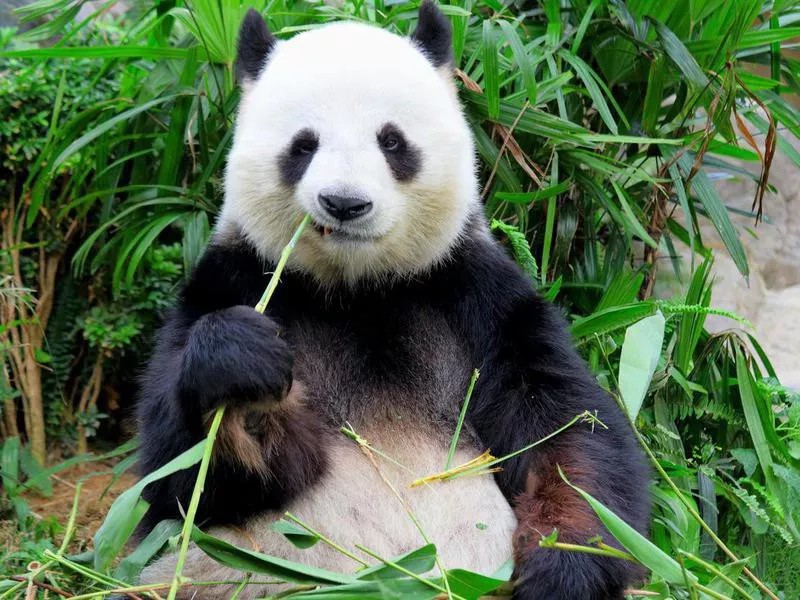
The giant panda (panda bear/ panda) can be found in South Central China, primarily they live in China’s Yangtze river basin. Pandas were actually belongs to group of carnivorous animals but still it eats more of bamboo leaves and shoots. They occasionally eat grasses, wild tubers and even meat of birds or rodents.
Why giant pandas became endangered species of animals?
They were endangered mainly because of habitat loss. During the year of 1984 people of China started to clear bamboo forests which is needed more in number for the survival of pandas because they live in forests, they cannot adapt to live outside the forests and they also eat the same. People used to hunt them to make money from their skins. in the year 1990 pandas were declared as endangered.
Why pandas were removed from list of endangered species now?
After nearly 30 years of struggle to preserve species of giant pandas. Now there is an evidence documenting the increase in population of the pandas. Now 25% China’s land designated for ecological protection according to China’s State Council Information Office.
>>Stay connected to eduindex.org for more updates 🙂
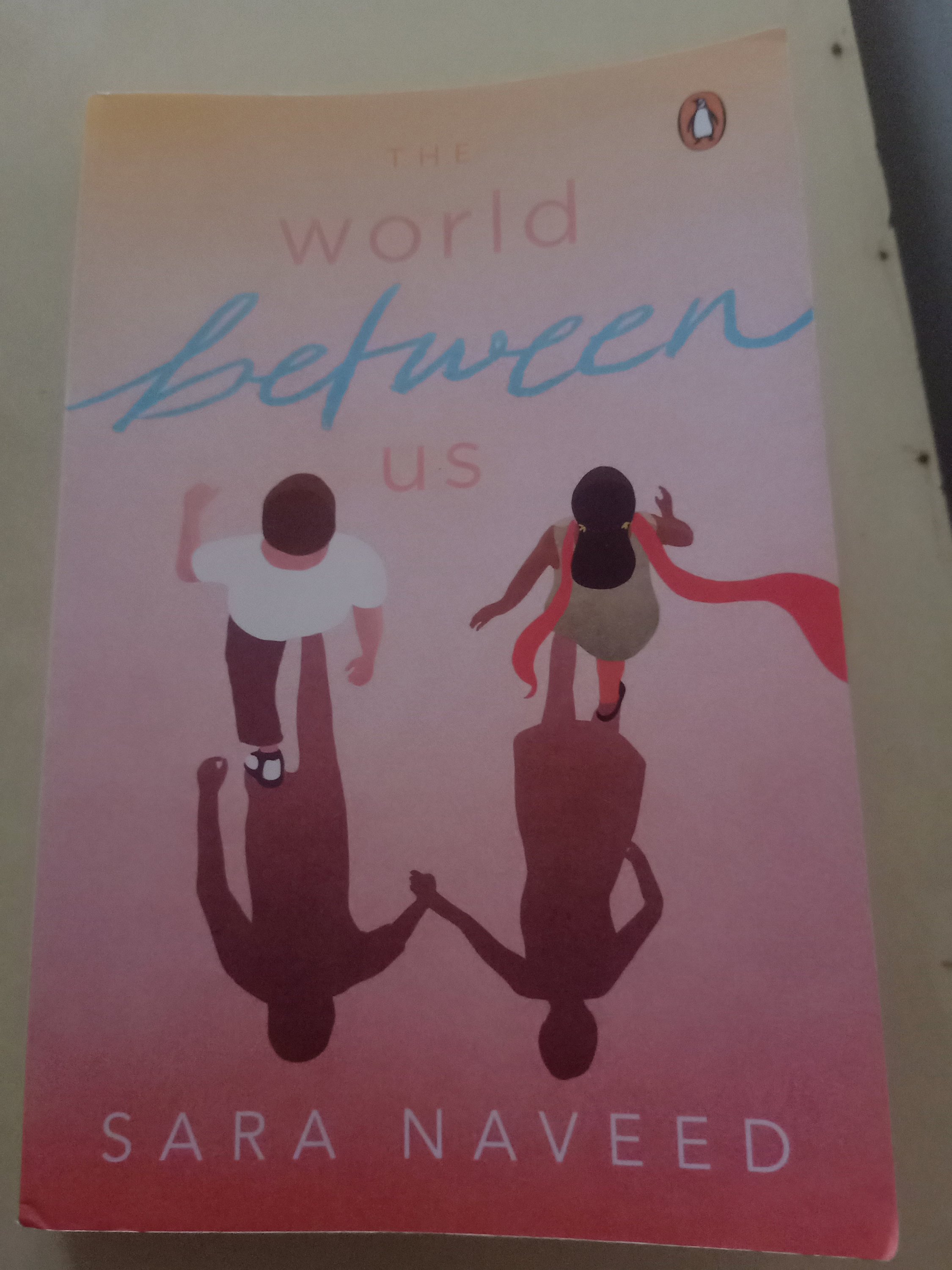
This book is written by Sara Naveed, who is a Pakistani author, she wrote this book in the year 2020, she usually writes lighthearted romantic fiction stories for the young audiences. Apart from this book she has written three more best selling novels.
The book describes the story of Qais and Amal who belong to two completely opposite world’s and how there world’s collide.
Amal has been widowed on the day of her marriage and Qais on the other hand is devastated by his mother’s death and is unable to cope up with the same . Both the characters are weaved together by different tragedies they faced early on in their life . And and even though they have different coping mechanisms with their loss they both have their own ways to deal with it. Amal is unable to move on after Haider’s death is keeping herself busy with work and family responsibilities, whereas Qais Ahmed has become distant towards his father who is thinks is directly responsible for his mother’s death. Qais seems to be disturbed by an incident at a party in Washington which leads him to quit his job at Microsoft and turn to drugs. Qais and Amal both join a dating app reluctantly, on their respective friend’s request and it ultimately leads them to a date together whereby Amal finds Qais to be a disastrous dating match. After a series of events Qais Ahmed joins the same company as that of Amal. He tries hard to get Amal’s attention, but she doesn’t reciprocate the same initially.
Eventually Amal and Qais fall in love, but there is more then what meets the eye, Amal and Qais are connected with a past incident which has changed both their lives.
Will their love save them and is it bigger then their pasts they are trying to hide from or will it fade away before the truth. These are the questions which arise in a readers mind while we go through their story. Sara has intricately weaved different emotions, both our protagonists go through. The book does feel lengthy at times, it could be a little summarised on some occasions. But the fact that the lead characters story has been defined well enough, makes it a good read all together. The book keeps you rooting for happy ending from the start as both the characters have suffered immense heart break in the beginning. Amal is portrayed as a strong career oriented woman with a mind of her own, who at the same time is very compassionate and soft hearted. Qais on the other hand is a rich somewhat spoilt but an extremely intelligent boy who is also a heartbroken soul deeply disturbed by the events that had unfolded in his past, which makes his story just like that of Amal’s. This book is about two broken individuals who both have the power to make each other whole again through forgiveness and love.
This is an office romance with lots of filmy twists to keep you hooked in this lockdown . Read it on a Sunday morning with a cup of hot coffee and get immersed in this refreshing and feel good story.























 Eduindex
You must be logged in to post a comment.