FINANCE-SOME BASICS

Finance is required by a business to establish and run its operations is known as Business finance. No business can function without an adequate amount of funds for undertaking various activities. The funds are required for purchasing fixed assets (fixed capital requirement), for running day-to-day operations ( working capital requirements) and for undertaking growth and expansion. Finance is a major function of any business enterprise, it deals with the arrangement of an adequate amount of capital to achieve the objectives of the enterprise and for the development of the enterprise.

SOURCES OF FINANCE FOR DIFFERENT TYPES OF BUSINESS FIRMS

No one can start a business or run an enterprise without adequate funds. Every business requires money to start which is called initial capital. In business, capital is required for both productions as well as the distribution of goods and services. The amount of capital required depends upon the nature and size of the business. The requirement of capital and sources of capital for different types of business firms are:

1. Sources of finance for sole trade

 A sole trader operates at a smallscale and requires a limited amount of capital to procure fixed assets and also for meeting day-to-day expenses. The proprietor brings in his capital to meet the above expenses. In a sole trade, owned capital consists of the owner’s contribution, and also earned profits are credited to his capital account at each financial year. In a sole trade, owned capital consists of the owner’s contribution, and also earned profits are credited to his capital account at the end of each financial year. In addition to this, a trader can raise by taking a loan from his family, friends, relatives and any known people and also can borrow money from banks and any financial institutions. Short-term finance to meet the day-to-day expenses and requirements may be obtained from commercial banks and long-term finance for the purchase of fixed assets is obtained from the state financial corporation and other financial corporations. The Central and central governments also provide financial assistance to small scale units to encourage Entrepreneurship and self-employment.


2. Sources of finance for a partnership firm

Capital requirement for a partnership firm is bigger than that of a sole trader business. The owned capital is contributed by the partners themselves in an agreed proportion. Accumulated profits of the firm credited to the accounts of partners also constitute a part of owned capital. A partnership firm can also raise loans from commercial banks and other financial institutions. In case of need, partners also advance loans to the firm.

3.Sources of finance for a joint-stock company

A joint-stock company generally requires a very large amount of capital in comparison to a sole trade and a partnership firm. A joint-stock company raises capital through the issue of shares and debentures. In addition to the issue of shares and debentures, it can utilize and retain profits in the form of reserves. It can raise borrowed capital through loans from financial institutions and commercial banks.

Continuation of Criminal Proceedings After Compromise Would Cause Oppression And Prejudice To Parties: Allahabad High Court

It must be noted that the Allahabad High Court has just recently on October 30, 2019 in a latest, landmark and laudable judgment titled Smt. Gomti Devi and others vs State of UP and another in Application u/s 482 No. – 27341 of 2012 has reiterated that once the parties had decided to enter into a compromise, it would be oppressive and prejudicial to continue the proceedings. Why should the parties continue to suffer even after the compromise is entered into? Why should the proceedings not be nipped in the bud once the parties had decided to enter into a compromise?

                               To start with, this noteworthy judgment authored by Justice Sanjay Kumar Singh of Allahabad High Court first and foremost reads out the introductory part by observing that, “Heard learned counsel for the applicants, learned Additional Government Advocate for the State/opposite party No. 1 and Mr. Rajeev Chaddha, learned counsel for opposite party No. 2 and perused the record with the assistance of learned counsel for the parties.”

                              To be sure, the ball is then set rolling in the real sense in this notable judgment by laying down that, “This application under Section 482 Cr.P.C. has been filed by the applicants for quashing the charge sheet No. 38 of 2012 dated 20.3.2012 as well as entire proceedings of Criminal Case No. 335 of 2012 (State vs. Smt. Madhu  and others) arising out of Case Crime No. 97 of 2012, under Section 420 IPC, police station Simbhawali, district Panchsheel Nagar pending in the court of Additional Civil Judge (Junior Division)/Judicial Magistrate-1st, Garh Mukteshwar, district Panchsheel Nagar.”

                                        While elaborating further, it is then explained in this new para about the applicants version that, “It is submitted by learned counsel for the applicants that applicant No. 1 is the purchaser of land in dispute from one Madhu Sharma, who is daughter-in-law of opposite party No. 2 and applicant Nos. 2 and 3 are the witnesses of sale deed dated 12.12.2011. It is also submitted that as per prosecution case, opposite party No. 2 lodged first information report through an application under Section 156(3) Cr.P.C. on 29.2.2012 making allegation inter alia that his daughter-in-law, Madhu Sharma has wrongly and illegally executed a sale deed of plot in question situated at village Goardhanpur, Ghaziabad (now district Hapur) dated 12.12.2011 in favour of applicant No. 1 after the death of his son, Pramod Kumar, in which the Investigating Officer has submitted impugned charge-sheet dated 20.3.2012 under Section 420 IPC. The said charge sheet dated 20.3.2012 has been under challenge before this Court, in which vide order dated 28.8.2012, interim protection was granted to the applicants directing that until ordered otherwise, no coercive action shall be taken against the applicants.”

                           Delving deeper, it is then stated that, “It is further submitted by learned counsel for the applicants that during the pendency of this application before this Court, parties concerned have entered into a compromise outside the Court, and thereafter, Civil Suit No. 62 of 2017 filed by grand-son of opposite party No. 2 for cancellation of sale deed dated 12.12.2011 has been decided in terms of compromise made between the parties concerned vide order dated 4.5.2017, which has been brought on record as annexure No. 2 to the supplementary affidavit dated 27.2.2018.”

                                  Not stopping here, it is then envisaged that, “It is also submitted that opposite party No. 2, Om Prakash has also moved an affidavit dated 16.10.2017 before the court of Additional Civil Judge (Junior Division)/Judicial Magistrate, Garhmukteshwar in Case No. 335 of 2012 (State vs. Smt. Gomti Devi and others) mentioning the factum of compromise made between the parties concerned praying therein to decide the case in terms of compromise, as he does not want to get the case proceeded further. On the said affidavit, order dated 11.1.2018 has been passed by the concerned court below accepting the said compromise affidavit on record. The said order dated 11.1.2018 has been brought on record as annexure No. 5 to the supplementary affidavit dated 27.2.2018.”

                                   Going forward, it is then also pointed out that, “It is also submitted that on account of compromise entered into between the parties concerned, all disputes between them have come to an end and on the aforesaid facts continuance of criminal proceedings pursuant to impugned charge-sheet against the applicants after compromise arrived at between the parties would be a futile exercise, therefore, same is liable to be quashed by this Court.”

                                          Needless to say, it is then also pointed out that, “Learned Additional Government Advocate as well as learned counsel appearing on behalf of opposite party No. 2 do not dispute the aforesaid fact. Learned counsel for opposite party No. 2 has also submitted at the Bar that since the parties concerned have settled their dispute as mentioned above, therefore, opposite party No. 2 has no grievance and has no objection in quashing the impugned criminal proceedings against the applicants.”

                                                It cannot be lost on us that it is then rightly laid down that, “After having heard the arguments of learned counsel for the parties, before proceeding further, it is apposite to give reference of some judgments of the Apex Court, wherein the Apex Court has laid down the guideline for quashing of criminal proceedings arising out of non-compoundable offences under Section 320 Cr.P.C. on the basis of compromise and amicable settlement of criminal cases involving offences which arise from commercial, financial, mercantile, partnership or similar transaction with an essentially civil flavor dispute, etc. between the parties concerned, which are as follows:-

(i)                         Nikhil Merchant vs Central Bureau of Investigation, 2008 (9) SCC 677.

(ii)                      Manoj Sharma vs State and others, 2008 (16) SCC 1.

(iii)                   Parbatbhai Aahir @ Parbatbhai Vs. State of Gujarat, (2017) 9 SCC 641.

(iv)                   The Apex Court in case of State of Madhya Pradesh Vs. Laxmi Narayan and others AIR 2019 SC 1296, considering previous judgments and section 320 Cr.P.C. has laid down guideline for exercising the inherent power under Section 482 Cr.P.C. in case of settlement of dispute between the parties concerned. Paragraph no. 13 of the said judgment is reproduced herein-below:-

“13. Considering the law on the point and the other decision of this Court on the point, referred to hereinabove, it is observed and held as under:

  1. i)that the power conferred under Section 482 of the Code to quash the criminal proceedings for the non-compoundable offences under Section 320 of the Code can be exercised having overwhelmingly and predominantly the civil character, particularly those arising out of commercial transactions or arising out of matrimonial relationship or family disputes and when the parties have resolved the entire dispute amongst themselves;
  2. ii)such power is not to be exercised in those prosecutions which involved heinous and serious offences of mental depravity or offences like murder, rape, dacoity, etc. Such offences are not private in nature and have a serious impact on society;

iii)           similarly, such power is not to be exercised for the offences under the special statutes like Prevention of Corruption Act or the offences committed by public servants while working in that capacity  are not to be quashed merely on the basis of compromise between the victim and the offender;

  1. iv)offences under Section 307 IPC and the Arms Act etc. would fall in the category of heinous and serious offences and therefore are to be treated as crime against the society and not against the individual alone, and therefore, the criminal proceedings for the offence under Section 307 IPC and/or the Arms Act etc., which have a serious impact on the society cannot be quashed in exercise of powers under Section 482 of the Code, on the ground that the parties have resolved their entire dispute amongst themselves. However, the High Court would not rest its decision merely because there is a mention of Section 307 IPC in the FIR or the charge is framed under this provision. It would be open to the High Court to examine as to whether incorporation of Section 307 IPC is there for the sake of it or the prosecution has collected sufficient evidence, which if proved, would lead to framing the charge under Section 307 IPC. For this purpose, it would be open to the High Court to go by the nature of injury sustained, whether such injury is inflicted on the vital/delegate parts of the body, nature of weapons used etc. However, such an exercise by the High Court would be permissible only after the evidence is collected after investigation and the charge sheet is filed/charge is framed and/or during the trial. Such exercise is not permissible when the matter is still under investigation. Therefore, the ultimate conclusion in paragraphs 29.6 and 29.7 of the decision of this Court in the case of Narinder Singh (supra) should be read harmoniously and to be read as a whole and in the circumstances stated hereinabove;
  2. v)while exercising the power under Section 482 of the Code to quash the criminal proceedings in respect of non-compoundable offences, which are private in nature and do not have a serious impact on society, on the ground that there is a settlement/compromise between the victim and the offender, the High Court is required to consider the antecedents of the accused; the conduct of the accused, namely, whether the accused was absconding and why he was absconding, how he had managed with the complainant to enter into a compromise etc.””

                                                 What can be deduced from the above foregoing discussion is stated thus: “On going through the judgments referred herein above makes it very clear that even in the cases which involved non-compoundable offences, their quashing has been approved by the Apex Court if the nature of the offence is such which does not have grave and wider social ramifications and where the dispute is more or less confined between the litigating parties. The inherent jurisdiction of this Court may be suitably exercised if the parties inter-se have mutually decided to bury the hatchet and settle the matter amicably in between them in a criminal litigation emanating from such dispute which are quintessentially of civil nature and other criminal litigations, which do not have grave and deleterious social fall-outs. The Court in the wider public interest may suitably exercise its power in appropriate case and terminate the pending proceedings in order to secure ends of justice or to prevent an abuse of the process of any court. Such positive exercise of the inherent jurisdiction can also find its vindication in a more pragmatic reason. When the complainant of a case or the victim of the offence itself expresses its resolve not to give evidence against the accused in the backdrop of the compromise between the parties inter-se or if the fact of inter-se compromise in between the parties is apparent on the face of record, and they are still called upon to depose in the Court, they in all probability, go back on their words and resile from their previous statements, the truthfulness of which is best known only to themselves. They are in such circumstances very likely to eat their words and perjure themselves. The solemn proceedings of the Court often get reduced to a sham exercise and farce in such circumstances. The proceedings can hardly be taken to their logical culmination and in such circumstances, the prospect of the conviction gets lost.”

                                   More importantly, Justice Sanjay Kumar Singh also in this judgment minces no words to conclude that, “The object of criminal law is primarily to visit the offender with certain consequences. He may be made to suffer punishment or by paying compensation to the sufferer, but the law at the same time also provides that it may not be necessary in every criminal offence to mete out punishment, particularly, if the parties concerned wants to bury the hatchet. If they want to move on in a dispute of civil nature on the basis of compromise, they may be allowed to compound the offences in terms of settlement.”

                                    Most importantly, it is then rightly held that, “After compromise/settlement arrived at between the parties in the present case, the chance of ultimate conviction is bleak and therefore, no useful purpose is likely to be served by allowing a criminal prosecution against the applicants to continue, as the same would be futile exercise and a sheer wastage of precious time of the Court. The continuation of a criminal proceedings after compromise would cause oppression and prejudice to the parties concerned.”

                                           Equally important if not more is what it is then held that, “Considering the facts and circumstances of the case in the light of dictum and guideline laid down by the Apex Court as mentioned above, this Court feels that this is a fit case, where this Court can exercise its inherent power to secure the ends of justice. In view of above interest of justice would be met, if the prayer of parties is acceded to and the criminal proceedings and other litigation between the parties is brought to an end.”

                                              Lastly, it is then held that, “As a fallout and consequence of above discussions, charge sheet No. 38 of 2012 dated 20.3.2012 as well as entire proceedings of Criminal Case No. 335 of 2012 (State vs. Smt. Madhu and others) arising out of Case Crime No. 97 of 2012, under Section 420 IPC, police station Simbhawali, district Panchsheel Nagar pending in the court of Additional Civil Judge (Junior Division)/Judicial Magistrate-1st, Garh Mukteshwar, district Panchsheel Nagar against the applicants are hereby quashed. The instant application under Section 482 Cr.P.C. is allowed in terms of compromise as mentioned above.”

                                    In conclusion, it may well be said that the Allahabad High Court has in this extremely laudable judgment very rightly reiterated once again that continuation of criminal proceedings after compromise would cause oppression and prejudice to the parties. The curtains have thus been set on this vital issue. There is thus now no lingering doubt left on this that has not been clarified most clearly by the Allahabad High Court on this key issue!

Sanjeev Sirohi, Advocate,

s/o Col BPS Sirohi,

A 82, Defence Enclave,

Sardhana Road, Kankerkhera,

Meerut – 250001, Uttar Pradesh.

India Cannot Be Ever Complete Without Muslims

It was most ashaming to see that how the students of Banaras Hindu University’s (BHU’s) Sanskrit Vedvigyan Sankay (SVDVS) went on strike  demanding the cancellation of the appointment of Assistant Professor Feroze Khan and transfer him to another faculty. These students were opposing the appointment of a Muslim to teach Sanskrit in Banaras Hindu University’s Sanskrit studies department! Nothing on earth can be more shameful than this! India as a nation cannot be ever complete without Muslims and this cannot be ever denied or disputed!

                                             Why do we forget that Muslims are an integral part of India just as Hindus? Why do we forget that many Muslims like Ashfaqullah Khan smilingly sacrificed their lives while fighting against the Britishers so that we can gain freedom? Why do we forget that it was Abdul Hamid who was the main hero of 1965 war against Pakistan who destroyed more than 22 tanks of Pakistan and inflicted huge damage on them?

                                             Why do we forget that we are a secular nation where all religion are equal and not a theocratic nation like Pakistan where one religion alone reigns supreme? Why do we forget that Dr Abdul Kalam was also a Muslim who fathered India’s nuclear weapons and India’s missile programmes like that of Agni, Prithvi among others and went on to become the most popular President of India acceptable to people from all religion equally? Why do we forget that Muslims have contributed for the betterment of our country in all fields? Why do we forget that it was Maulana Abul Kalam Azad who had opposed the partition of India on ground of religion till the last even though Jawaharlal Nehru, Sardar Patel and Mahatma Gandhi had agreed to it? Why do we forget that it was Khan Abdul Ghaffar Khan who while opposing partition had said that, “Nehru what have you done? You have made me a foreigner in my own country by agreeing to partition of India on the basis of religion?”

                                   I cannot ever even dream of India without Muslims! I still feel that majority of Indians are secular but such shameful incidents damage the reputation of our country on the international fora! I can never forget how Maulana Mehmood Madani had sharply rebuffed former Pakistani dictator General Pervez Musharraf who when while in India had slammed the condition of Muslims in India saying that, “I am seeing that you want to do politics on the condition of Muslims in India. Don’t worry on this score as 90% Hindus are with us. They shall always remain with us.”

                                             It is good to note that students ultimately decided to call off a fortnight long protest against the appointment of a Muslim to teach Sanskrit in BHU’s Sanskrit studies department, ostensibly swayed by the huge support he received even from the Rashtriya Swayamsevak Sangh (RSS) and BHU Vice Chancellor Rakesh Bhatnagar as reported in Hindustan Times newspaper dated November 23. The local chapter of RSS described “as totally wrong” the protest against the appointment of Dr Firoz Khan at the department of Sahitya in the faculty of Sanskrit Vidya Dharma Vigyan (SVDV). RSS which is the ideological mentor of BJP expressed full support for the appointment of Dr Firoz Khan which is extremely commendable!

                                         While elaborating on this, Jai Prakash Lal who is a senior functionary at the Kashi region RSS while coming out in full support of Dr Firoz Khan said that, “It is the firm, and clear view of the RSS that the protest on communal grounds against a person, who is dedicated to teaching Sanskrit reverentially and has been appointed through a legal selection process, is entirely wrong.”

                                    Good to see that BHU students have now called off their 15-day dharna. It was also good to see that the students associated with Joint Action Committee of BHU took out a march to support the appointment of Firoz Khan as an Assistant Professor in the faculty of Sanskrit Vidya Dharm Vigyan. They expressed their full solidarity with him which has only served to enhance their own image in front of the nation! A senior administrative official of the BHU also said that that 99% of the University staff and administration were behind Mr Khan.

                                    It is also good to note that even the BHU Vice Chancellor Rakesh Bhatnagar took a firm stand in favour of the appointment of Dr Firoz Khan which helped defused the protest! He said without mincing any words that, “There is no question of looking back at the matter as the appointment has been done on basis of pure merit.” Why the hell are then some few students objecting on the baseless ground of religion alone? This is most despicable and deserves no space in a democratic country like India which cannot be ever complete without Muslims!

                             In my personal life only once I witnessed a Muslim who faced discrimination on the ground of religion about which I have never written earlier. My school friend Rais Khan who studied with me in Class XI in Sagar once way back in 1990-91 while standing alone stood a lot dejected with virtual tears in his eyes. I asked him what happened. He said that wherever I go our class fellows stop talking and slowly start going away and I am left totally alone.

                                 Let me be candid enough to concede that I had never observed this till that time but when I started observing I found that he was right and wherever he used to go and stand except he and me, all used to leave on one ground or the other like going to drink water etc! My friend Rais Khan said inconsolably that, “They feel that I am Muslim and as Mulayam Singh Yadav had ordered firing on Hindus at Karsewaks in 1990 in which many Hindus had died so I should be boycotted.” I became very angry for this unpardonable act of theirs!

                                   I immediately consoled Rais and told him that I am with you so just don’t worry and we both will stay together always and you don’t bother about others. I started slamming hard all those who did such boycott act and asked them whenever they tried to taunt me for talking with him that, “What is the fault of my friend Rais Khan if Mulayam Singh Yadav ordered police to open firing on karsewaks? Did Rais Khan play any role in it? When he has no role then why are you all boycotting him for what has been done by a Hindu politician named Mulayam Singh Yadav? Why no one is boycotting him who is the real culprit and who was the real force behind ordering fire on karsewaks? Why is Rais being singled out just on ground of his being a Muslim?” These words of mine did the magic and slowly all Hindus of my class realized their folly and started talking with him gradually one after the other in a normal manner for which he thanked me but I said that there is no need to thank me as you are my friend and shall always remain so no matter what others may say or behave in the most foolish manner!

                              I must acknowledge that Rais too stood with me in my trying times and even once told the Principal most bluntly that, “If Sanjeev Sirohi will be expelled from school on any ground whatsoever then expel me also because he always stood by me in my trying times while narrating the whole incident. I will not continue with my studies without my friend Sanjeev Sirohi”. The Principal who was a “Sister” of St Joseph Convent School was visibly shaken and she commended me for standing with him when all others had boycotted him!

                                            Coming back to the subject at hand, it is most heartening to note that even Dinesh Sharma who is UP Deputy Chief Minister has come out strongly in support of Dr Firoz Khan and he categorically and clearly asserted that, “Teachers do not have any religion. Students can always raise questions about the appointment process, whether merit has been compromised in the selection process of the teacher. But students cannot raise questions about the religion of teachers. I was taught Sanskrit by a Muslim teacher, Sir Waliullah Khan, when I was studying at Government Jubilee Inter College in Lucknow. Recently, I felicitated Waliullah Khan Sir at a function held in my school. It was such an emotional moment for me.” I have just no words to appreciate Dinesh Sharma for such a strong stand as he has taken on this sensitive issue even as many others strangely prefer to keep quiet on it! Every Indian must emulate the worthy example of UP’s Deputy Chief Minister Dinesh Sharma if we truly want our nation to grow powerful, progressive and prosperous! India as a nation cannot be ever complete without Muslims and we all must ensure that no Muslim ever feels isolated on any ground whatsoever!

                                        It goes without saying that we must all live like good human beings without discriminating against anyone on ground of religion alone. Deanswift had once rightly said that, “We have just enough religion to make us hate one another but not enough to make us love one another.” We must always remember that India as a nation can be complete only with people from all religion living in peace and harmony and respecting each others sentiments always!

                               If this does not happen then there will be communal violence, strife and discord which can never be in the long term national interest of our country! Strict legal action must be taken against all those who try to discriminate against anyone on ground of religion, caste, sex or community or any other ground whatsoever! There has to be zero tolerance for intolerance!

Sanjeev Sirohi, Advocate,

s/o Col BPS Sirohi,

A 82, Defence Enclave,

Sardhana Road, Kankerkhera,

Meerut – 250001, Uttar Pradesh.

Maharashtra – Urgent Floor Test Ordered To Curtail Horse Trading, To Protect Democratic Values: SC

It is quite significant to note that just recently, the Supreme Court on November 26, 2019 in Shiv Sena And Ors. Vs Union Of India And Ors. in Writ Petition (Civil) No. 1393 of 2019 in the ongoing serious political deadlock in Maharashtra has very rightly ordered an urgent floor test to be held on November 27 at 5 PM so that it may well be pretty clear as to whether the newly sworn in Chief Minister Devendra Fadnavis enjoys majority in the State Assembly or not! This latest order was necessitated after Shiv Sena knocked the doors of the Apex Court along with Nationalist Congress Party (NCP) and Congress. It is also notable that the Apex Court has made some very important observations which shall be discussed later.

                                      To start with, this notable and latest judgment delivered by Justice NV Ramana, Justice Ashok Bhushan and Justice Sanjiv Khanna sets the ball rolling by first and foremost pointing out in para 1 that, “There is no gainsaying that the boundaries between the jurisdiction of Courts and Parliamentary independence have been contested for a long time [Erskine May, Parliamentary Practice, 25th edition, 321 (2019)]. However, there is a need and requirement for recognizing institutional comity and separation of powers so as to tailor judicial interference in the democratic processes only as a last resort. This case pertains to one such situation, wherein this Court is called upon to adjudicate and maintain democratic values and facilitate the fostering of the citizens’ right of good governance.”

                                  While laying the background, it is then recapitulated in para 2 that, “Before we pass any orders, we need to make a brief reference to the factual aspects giving rise to the petition herein. It was well known that there existed a pre-poll alliance between the Bharatiya Janata Party [for short ‘BJP’] and the Shiv Sena, who contested the Fourteenth Maharashtra Legislative Assembly elections jointly. On 24.10.2019, the results for the aforesaid elections were declared and no single party had the requisite majority in the House. On 09.11.2019, the Governor called upon the BJP to indicate its willingness to form the Government, being the single largest party with 105 seats. However, the BJP declined to form the Government on 10.11.2019, as the alliance with the Shiv Sena allegedly broke down.” This clearly manifests that at this point of time the BJP did not have the requisite numbers to prove its majority in the floor of the House!

                                              Moving on, it is then illustrated in para 3 that, “Subsequently, the Governor invited the Shiv Sena to form the Government. In this regard, the Shiv Sena is said to have shown its willingness to stake a claim to form the Government, claiming to have support of the majority. However, the aforesaid endeavor was not fruitful either. Thereafter, the Governor’s effort to seek the Nationalist Congress Party’s [for short ‘NCP’] willingness to stake a claim to form the Government was also not successful. Ultimately, the Governor recommended President’s Rule on 12.11.2019, which was imposed by a Presidential Proclamation on the same day.” This clearly manifests that no party had the requisite numbers and the Opposition were not united in staking claim to form the Government at that point of time. The coalition between Shiv Sena, Congress and NCP took an excruciatingly long time to emerge as a legitimate stakeholder. This alone explains why we saw that President’s rule was imposed.

                         Needless to say, it is then laid bare in para 4 that, “It is brought to our attention that the Petitioners, i.e. , Shiv Sena, NCP and the Indian National Congress [for short ‘INC’] were in discussion to form a coalition government during this period, and accordingly, a press conference is supposed to have been held on 22.11.2019 regarding the same.”

                                     Going forward, it is then enunciated in para 5 that, “It has been canvassed before us that at 5:47 a.m., on 23.11.2019, the President’s Rule was revoked in exercise of powers conferred by clause (2) of Article 356 of the Constitution. Thereafter, the Governor, by letter dated 23.11.2019 invited Respondent No. 3 to form the Government. The oath of office and secrecy was administered accordingly to Respondent Nos. 3 and 4 at around 8:00 a.m. on 23.11.2019 at Raj Bhavan, Mumbai.” This came in for a lot of stinging criticism from various quarters as transparency in sticking to rules were given a complete good bye!

                               Most importantly, it is then very rightly held in para 27 that, “We may note that in the present case, oath has not been administered to the elected members even though a month has elapsed since the declaration of election results. In such emergent facts and circumstances, to curtail unlawful practices such as horse trading, to avoid uncertainty and to effectuate smooth running of democracy by ensuring a stable Government, we are of the considered opinion that it is necessary to pass certain interim directions in this case. In this context, it is necessary and expedient to conduct the floor test as soon as possible to determine whether the Chief Minister, who was administered the oath of office, has the support of the majority or not. Since the elected members of the Legislative Assembly are yet to take oath as specified in the III Schedule of the Constitution, and the Speaker is also yet to be elected, we request the Governor of the State of Maharashtra to ensure that a floor test be held on 27.11.2019. The following procedure is to be followed for conducting the floor test:

  1. Pro-tem Speaker shall be solely appointed for the aforesaid agenda immediately.
  2. All the elected members shall take oath on 27.11.2019, which exercise should be completed before 5:00 p.m.
  3. Immediately thereafter, the Pro-tem Speaker shall conduct the floor test in order to ascertain whether the Respondent No. 3 has the majority, and these proceedings shall be conducted in accordance with law. The floor test will not be conducted by secret ballot.
  4. The proceedings have to be live telecast, and appropriate arrangements are to be made to ensure the same.”

                                            Lastly, it is then held in para 28 that, “Eight weeks time is granted to the learned counsel for the respondents to file their respective counter affidavits. Rejoinder affidavit, if any, is to be filed within four weeks thereafter. The matter to be listed after twelve weeks.”

                                            On a concluding note, it may well be said that the Apex Court has chosen the right path in holding that  a floor test to be held on 27.11.2019. The Apex Court has rightly decided not to delay this crucial matter any further as it would have only served in ensuring that horse trading happens which can never be allowed under any circumstances as it gives a bad name to our democratic country and ensures that corrupt politicians rule the roost! To ensure that no unfair means are resorted to by any of the political party and to ensure that democratic values are  duly protected, the Apex Court has also rightly decided to direct that the  proceedings have to be live telecast, and appropriate arrangements are to be made to ensure the same!  It has also been made clear that the floor test will not be conducted by secret ballot. It is a highly commendable ruling and it has rightly relied on the proposition that floor test was the best method to test majority and certainly it must be lauded unequivocally!

Sanjeev Sirohi, Advocate,

s/o Col BPS Sirohi,

A 82, Defence Enclave,

Sardhana Road, Kankerkhera,

Meerut – 250001, Uttar Pradesh.

Master plan of China- DISCLOSED!!!

The life after the pandemic situation will not be normal again as this pandemic situation is also not normal.

Knowingly or unknowingly the virus developed in China (according to news) created the biggest impact in the health and economic sector of the world. Nobody knows how much time will it take to come out completely from this pandemic situation. China with the most power in terms of technology and population might have a master plan to be executed in the name of Novel Corona virus by supplying the goods of medical department and further other essential commodities which might be needed by the people in the near future to the world and soon they will earn billions of dollar by supplying it to the world. So, again now world will depend more on China than before.

download


We as a responsible citizen of India, need to stop the master plan of China as in the near future it will harm us very very badly. Let us understand by an example, India is surrounded by countries like Pakistan, Bangladesh, Sri lanka, Nepal this all countries have taken huge amount of money from China like wise Pakistan took huge money from China to develop a road passing from the mountain, so now Pakistan is in debt to pay the money and in return China can do anything to gain the money back. Pakistan took more money from China than from IMF, and has to pay around 19 billion US$, which will be extremely hard for Pakistan. In the same way Sri lanka owes 1.4 billion US$ which is left over from from 99 years and now China will ask for payback or will capture the Sri lanka. Bangladesh debt for 64.9 billion US$. India is also in debt of paying to China, but China will not capture India first it will first capture our surrounding countries and than head towards India. So, we need to become very attentive towards each step of China and understand their activity, we also need to stop buying Chinese goods to save our country and instead go for Made In India goods. JAY HIND…

made-in-india-vector-16416448

Karnataka HC Issues Guidelines To Keep Illegal Migrants In Foreign Detention Centres Even After Grant Of Bail

In a latest development, the Karnataka High Court in the case of Babul Khan And State of Karnataka in Case No. : CRL.P. No. 6578/2019 delivered on May 19, 2020 while taking a stern view of illegal migrants and foreigners overstaying in India has held in no uncertain terms that they should be kept in ‘detention centers’ till the further orders of the court or till they are deported to their mother country. It minced no words to put across that illegal migrants sometimes pose threat to national security and infringe rights of Indian citizens. It also made it clear that this cannot be allowed to go on with impunity!

                                          To start with, the ball is set rolling in the opening para of this latest judgment by stating that, “This petition is filed seeking grant of bail under Section 439 of Code of Criminal Procedure, pertaining to Crime No. 213/2018 of Sarjapur Police Station. The said case after charge sheet culminated into CC No. 1734/18. Finally after committal proceedings, it came to be registered as SC No. 5014/2019, pending on the file of III Additional District and Sessions Judge, Bangalore Rural District, sitting at Anekal. The said case was registered for the offence punishable under Sections 14A and 14B of the Foreigners Act, 1946; under Section 25 of the Indian Arms Act, 1959; and Section 34 of the Aadhaar Act, 2016.”

                                                 Delving deeper and setting the background, para 3 then envisages that, “The brief facts of the case divulged from the Charge sheet papers are that:

Accused Nos. 1 to 15 named in the Charge sheet belonged to Bangladesh, illegally migrated to Indian Territory, without Passport and Visa and they have been staying in Indian Territory without any legal documents or any license or permission from the competent authorities. It is also alleged that Accused Nos. 1, 3, 14 and 15 have illegally obtained Aadhaar Cards by fraud and misrepresenting themselves as Indian Citizens. It is further alleged that Accused No. 2 was possessing bullets and thereby the Accused persons have committed an offence under the Arms Act.”

                                                   While elaborating further, it is then pointed out in para 4 that, “On plain reading of the Charge sheet papers, it is seen that specific allegations have been made against the petitioners that, they are Bangladesh citizens, and they have been illegally migrated to Indian Territory and residing in India without any authority of law. Hence, they have committed the offence under Sections 14A and 14B of the Foreigners Act. So far as other offences are concerned, no such allegations are made against the petitioners.”

                                               Be it noted, a Bench of Karnataka High Court of Justice KN Phaneendra after going through the case in detail has issued the following detailed guidelines in para 112 on dealing with illegal migrants and foreigners facing proceedings under the Foreigners Act, 1946 which form the bedrock of this notable judgment:

  1. As soon as the offence under Foreigners Act and other Laws is detected and there is a strong prima facie material to show that the detected person is a foreign national, and if he has no Passport or Visa, or if the Visa is expired, and he has no right to stay in Indian Territory, proceedings shall be immediately started to deport him to his nation, without unnecessary delay, from the date of registration of FIR against such person.
  2. The jurisdictional police have to immediately take steps to inform the concerned competent authorities to initiate proceedings to deport such foreign nationals to his/her mother country vis-à-vis other competent authorities also share the details of such person amongst themselves and the concerned jurisdictional Court.
  3. If the Court refuses to grant bail to those persons (foreign nationals) in any criminal case, the Court shall keep such person in regular jail, till the disposal of the case.
  4. If for any reason the Court grants bail including anticipatory bail, in any criminal case where the offender is a foreign national, and the offences are under the Foreigners Act and/or also under any other Laws for the time being in force, and their Visa is cancelled or lapsed, or they have no Passport, or they are illegal migrants, then the Courts shall specifically order to keep them in detention centers, unless the competent authority has passed any order under section 3(2)(a) to (f) of Foreigners Act, 1946, or till further orders of the court or till they are deported to their mother country.
  5. If the case registered against the foreign nationals, ended in conviction, they shall be ordered to be kept in regular prison of the state till they serve the sentence, and after serving the sentence, they shall be kept in detention centers till, they are deported to their country.
  6. If the case ends up in discharge, release of the accused or acquittal, and their nationality is in dispute before the competent Tribunal, they shall be ordered to be kept in detention centers till they are deported to their country unless they have any right or otherwise entitled to remain in India, or the competent authority has passed any orders under section 3(2)(a) to (e) of Foreigners Act 1946, the acquittal, discharge or release of the accused is no bar for the concerned competent authorities to question the nationality of that person before the competent Tribunal.
  7. The Public Prosecutors, the Defence Counsel and the Courts shall make all their efforts to expeditiously deal with such cases by giving priority, for its early disposal, so as to enable other competent authorities to take appropriate steps under the facts and circumstances of each case for deportation of such foreign national (accused) as early as possible. The Court may also if permissible under law, and applicable to the facts and circumstances of a case may invoke sections 265A to 265L under chapter XXI (A) of Code of Criminal Procedure, after following due procedure.
  8. As far as possible where a foreign national is involved in a case, the courts shall make their endeavor to record evidence and write the judgment in English language, if the accused in such case is not conversant with the local language.
  9. The Central Government and the State Governments shall take all necessary steps to establish as many as necessary Detention Centers, at Cities, Districts and Taluka places as per the Detention Center Manual referred to in this judgment, with all necessary basic facilities, as per the Detention Center Manual, as per the directions and guidelines of the Hon’ble Apex Court in the case of Upadhyaya Vs State of A.P. and others reported in (2017) 15 SCC 337, so as to keep the foreign nationals, till their deportation whenever they are ordered to be kept in detention centers by competent authorities or by the Courts.
  10. In case, the accused/foreign national is a woman or a woman having a child or the child itself, the competent authorities, including jail authorities, detention centers and the Courts and Juvenile Justice Boards have to follow the guidelines of the Hon’ble Apex Court laid down in Upadhyaya’s case noted supra; in addition to the provisions under the Prisons Act as well as Prisons Rules, and Juvenile Justice Act and Rules strictly and meticulously in their letter and spirit.
  11. If a mother who is a foreign national, is in custody and having infant below the age of six years or up to six years, the court may order the child to accompany the mother during her custody. If, either of parents got arrested, then the custody of the child may be given to the other parent who is not arrested. If both the parents are arrested and they are in custody of children to their close relative or to Government shelter home, or to any other organization recognized or undertaking of the government where government or concerned authorities can monitor the well being of the child, as per Juvenile Justice (Care and Protection of Children) Act, 2015 and Rules.
  12. If a foreign national is convicted by the Court and any application for parole is made, the jail authorities have to take into consideration the conditions enumerated under Section 4 of the Foreigners Act, 1946, in addition to the Prisons Act and Rules.
  13. If a foreign national is found to be an illegal migrant and not a citizen of India, and has been involved in criminal offences under other law of the land for the time being in force, apart from Foreigners Act, the State Government or the Central Government as the case may be, take immediate necessary steps by exercising their discretion after applying their mind to the facts and circumstances of the case, if necessary and if the circumstances warrants, if the said offences are not heinous or anti-social, or not punishable with imprisonment for more than three years, or with fine only to withdraw those cases under Section 321 of Cr.PC., so as to enable the concerned authorities to take necessary steps to deport such persons to their mother country, as expeditiously as possible.
  14. The State Legal Services Authority, District Legal Services Authorities and Taluka Legal Services Committees, shall make a periodical visit to the jails and Detention Centers to ensure and satisfy itself that the concerned authorities have taken necessary steps to implement the directions issued by the Ho’nble Apex Court in Upadhyay’s case and also the Detention Center Manual, so as to take appropriate action to inform the concerned authorities to rectify their mistakes and also the Legal Services Authorities suo-motu can take steps in accordance with law to get the mistakes or errors rectified on the legal side.
  15. The Central Government and the respective State Governments shall often revise the Detention Center Manual and also the Prisons Act and Rules based on the need of the hour to bring necessary changes, so as to effectively and efficiently implement the very object of such Manual and laws.
  16. The Central Government, the State Government, the Karnataka State Legal Services Authority, Karnataka Judicial Academy and Police Academy in the State shall take appropriate necessary swift action to sensitize all the stake holders, Judges, Prosecutors, Police Officers, Custom and Immigration Officers (FRRO-FRO), Jail Authorities and Officers delegated in Detention Centers, in this regard.
  17. Registry is directed to send a copy of this order to the Chief Secretary, Principal Secretary to Home Department, Director General and Inspector General of Police, Karnataka State Legal Services Authority and Karnataka Judicial Academy, for appropriate necessary steps.

                                            Going forward, it is then aptly stated in para 115 that, “However, when the police have invoked Section 14 of the Foreigners Act, the presumption u/s. 9 of the Foreigners Act will come into play, unless it is shown to the court during the course of trial, that the petitioners are not foreign nationals, they should be presumed as foreign nationals. Apart from invoking Section 14A of the Foreigners Act, it is alleged that they were holding empty cartridges with them and therefore, the police have invoked Section 25 of the Indian Arms Act. However, the major offences are u/s 14A and 14B of the Foreigners Act. The offence u/s. 25 of the Arms Act is not punishable either with death or life imprisonment. Therefore, in my opinion, by means of imposing stringent conditions, the petitioners are entitled to be enlarged on bail. However, it is made clear that though the court is enlarging them on bail, they cannot be given free movements to wander across India as per their whims and fancies, till the case is decided or till the Government decides whether they have to be deported to their mother country or not. Till that point of time, in my opinion, they shall be kept in Detention Centre with all facilities as noted above and if they are acquitted in the case registered against them, the Government has to take appropriate steps whether the determination of their nationality has to be done by the Competent Authority and whether they are still to be deported to their mother country and thereafter only appropriate decision has to be taken by the Government. Further, if they are convicted for any reason, the Competent Authorities have to take appropriate steps to deport them to their country immediately.”

                                          In essence, this latest judgment pronounced by the Karnataka High Court lays down in no uncertain terms that illegal migrants have to be kept in any of the Foreign Detention Centers in Bangalore or at any place nearby Bengaluru city even after the grant of bail till the trial is concluded. They have to comply strictly with bail conditions and not indulge in hampering or tampering the prosecution witnesses! It also makes it clear that authorities have to provide proper facilities to children of illegal migrants who are in jail or detention centers till they are deported to their country in consonance with the UN Declaration with reference to the rights of the child as adopted by the General Assembly and Article 24 of the International Covenant on Civil and Political Rights, 1966! Same is the case with women also!

Sanjeev Sirohi, Advocate,

s/o Col BPS Sirohi,

A 82, Defence Enclave,

Sardhana Road, Kankerkhera,

Meerut – 250001, Uttar Pradesh.

Zero Tolerance For Violence Against Doctors And Healthcare Workers

Nothing on earth can be more disgusting, more degrading and more demoralizing than to see that how brazenly so many dastardly and cowardly acts of unprovoked and uncalled for attacks against doctors and healthcare workers have been carried out ever since the outbreak of this corona pandemic is going on! We must be honest enough to concede that the Covid-19 pandemic is akin to a full fledged war which is completely unprecedented where we don’t even know where the enemy is hiding and who can spread it so easily by just body contact also! We also must be gracious enough to concede that the doctors and other health staff are our new frontline soldiers and they must be protected from violence against any lumpen elements and those who dare to attack them must be meted out the most severe punishment so that a stern and strong message goes out that violence against them who risk their own lives to protect their patients will not go unpunished and unaccounted for!

                                    Truth be told, doctors are rendering willingly so many sacrifices and hardships that it cannot be described in words! Dr Javed Ali Huda had barely removed his PPE after a long day attending to the patients at the emergency OPD of Meerut’s Lala Lajpat Rai Memorial (LLRM) Medical College when he received the heart breaking news of his father’s untimely demise. He had to give the funeral a miss. He laid bare his feelings while controlling his emotions that, “I wanted to go home and see my father one last time. But, I am a doctor and could not have risked the lives of others back home. I was put on a video call and my family sent me pictures of my father’s burial!” There are so many such similar instances where doctors have willingly given the highest priority to their sacred duty placing them above their family and their near and dear ones! Still can we ever allow violence against doctors who are the living form of “God” who attend to their patients most willingly without any discrimination under any circumstances?

                                             Needless to say, the dire need for a strict law to protect doctors and health workers was felt most when two medical doctors – Zakiya Syed and Trupti Katdare were attacked and pelted with stones by a violent mob in a dense settlement in Indore.  These two medical doctors had then fled to save their own lives but they then returned to the spot a day later along with their team of health workers to screen people for the coronavirus disease (Covid-19). Dr Zakiya Syed said that, “I am injured but not scared at all. This won’t deter me from doing my duty.”

                                It is certainly a solace to see that the Union Government too acted with alacrity and approved an ordinance to amend and strengthen the Indian Epidemic Diseases Act, 1897, making offences against doctors and nurses cognizable, non-bailable and carrying imprisonment terms from six months to seven years. We also saw how even the Indian Medical Association too taking serious note of the repeated attacks on doctors and health workers did not shy away from calling a two-day strike by the doctors on April 22 and 23. When the Union Home Minister Amit Shah assured them that no guilty attackers would ever be spared under any circumstances that the strike was ultimately called off!

                                                 It is also most reassuring to see that even the PM Narendra Modi has strongly condemned the growing attacks against doctors and reiterated his government’s full solidarity with doctors and health workers by following a zero tolerance policy against all such attackers. This alone explains why it has not dithered in enacting a strict law also to protect doctors from dastardly attacks by those with criminal bent of mind. This was in fact the crying need of the hour also!

                                                As it turned out, soon after the Union Cabinet had approved the ordinance, Prime Minister Narendra Modi said that there can be no compromise on the safety of healthcare professionals fighting the Covid-19 pandemic. He also eloquently pointed out that, “The Epidemic Diseases (Amendment) Ordinance, 2020 manifests our commitment to protect each and every healthcare worker who is bravely battling COVID-19 on the frontline. It will ensure safety of our professionals”  The Centre has also made it clear that the law will mandate that the police complete the probe in such cases within 30 days and that the courts pronounce judgment within a year! Very rightly so!

                                              Be it noted, SK Sarin who is Director of Institute of Liver and Biliary Sciences, Delhi has minced no words in observing in his enlightening editorial titled “The safety of healers” in ‘The Indian Express’ dated April 27, 2020 that, “While hundreds of acts of violence against doctors have been reported every year for the past two decades, many more are never brought to light. Doctors, nurses and healthcare professionals will remember the day the Union government passed an ordinance ensuring that acts of violence against doctors and other medical staff will be a cognizable and non-bailable. Imprisonment from six months to seven years and a penalty from Rs 50,000 to Rs 7 lakh can be sanctioned by the courts. Such punishments will serve as a deterrent to unruly patients and their relatives, if found guilty.”

                                                    To be sure, in this same enlightening editorial, Dr SK Sarin while continuing in the same vein adds a caveat by pointing out that, “Will the courts change their outlook in the wake of the new ordinance? If these very warriors are ostracised while returning from work or are thrown out of their houses, bruised by a crowd pelting stones, will the courts and judges rise to the occasion and take suo motu action? Will they be able to deliver timely and exemplary punishments and safeguard the dignity and lives of HCPs? Healthcare professionals need a sensitive and accountable judicial system and this ordinance should be given more punch and wider applicability in the times to come.”

                              Furthermore, AIIMS Resident Doctors Association (RDA) General Secretary Dr Srinivas Rajkumar T said while welcoming the Centre’s decision that, “We appreciate the central government for taking note of this situation, albeit late, and ensuring immediate amendments are made as feasible so that frontline warriors are able to serve the country without fear.”

                               Interestingly enough, the Union Health Ministry also advised the Chief Secretaries of all states and Union Territories to adopt adequate measures in ensuring the safety of the health workers. Separately, the Union Home Ministry in a letter asked all states and Union Territories to provide adequate security to doctors and front-line health workers who are facing attacks from unruly people. Amit Shah who is Union Home Minister also told a group of doctors and representatives of the Indian Medical Association (IMA) that safety of health care professionals treating the virus infected patients is non-negotiable.

                                 Going forward, the Home Ministry letter sent by Home Secretary Ajay Bhalla to all State Chief Secretaries also urged that governments impose strict penalties against those obstructing the functioning of healthcare workers and against those offenders who obstruct the last rites of healthcare workers who may have died due to Covid-19 or any other reason. It also asked states and Union Territories to appoint a nodal officer both at the state and at the district level on a 24×7 basis, to redress any safety issues of medical professionals. It also conceded that at this time, even a single incident of violence against healthcare professionals was likely to create a sense of insecurity among the entire healthcare community!

                            Of course, we must also pay attention to what Dr Ullas Batra who is Senior Consultant, Medical Oncology of Rajiv Gandhi Institute and Research Centre Delhi says on the proposed ordinance which the President recently approved also that, “This ordinance is exclusively for those doctors who are working to treat COVID-19 patients. In my opinion, it needs to be extended to all medical doctors.” Centre too must pay heed to what Dr Batra has said so plainly!

                                          No doubt, this new ordinance protects not just doctors but also paramedical staff and accredited social health activists. It is also provided that two times the cost to be recovered from vandals if cars or clinics of health care professionals are damaged! There is also the provision of Rs 50 lakh insurance for health workers.

                                 All said and done, what now truly matters most is strict, swift and sincere implementation of the new law to ensure that there is zero tolerance for any kind of violence or threat or intimidation in any form  against not just doctors but also health workers which include nurses, paramedical staff among others! It is solely because of them that India has managed to limit the death casualty to such a low level not crossing the figure of even ten thousand even though in advanced and developed countries like USA, the death toll has exceeded one lakh and ten thousand for which they deserve full credit also! This has certainly  enhanced the reputation of our country at the world stage also!

                             In other words, this alone explains that why even PM Narendra Modi has also while appreciating the relentless work done by them expressed his firm commitment and resolve to ensure that those who attack them are dealt with sternly and strictly and not left scot free under any circumstances for which he certainly deserves accolades! It must be now ensured that not even a single act of violence against doctors, nurses and health workers should ever go unpunished under any circumstances, come what may! This again is possible only if this new ordinance is implemented in totality against all those who dare to attack doctors and health workers in any way!

                                 In conclusion, the ball is now clearly in the court of the courts, police and law enforcing agencies who must lead from the front by ensuring that no guilty is ever spared under any circumstances for which special police officers should also be appointed to serve its purpose! This will certainly help resolve the issue of scarcity of law enforcers for immediate response!

                          Only then will a loud and clear message go out to one and all that there shall be zero tolerance from now onwards against any form of dastardly attack against doctors and health workers! Also, the government must now leave no stone unturned to ensure that the provisions of this new ordinance are disseminated widely using all the tools at its disposal so that people become aware fully about it and are able to use it when needed!

                          Even the political parties too must now step forward and lead from the front and ask their cadres to inform the people of this new ordinance! Only then can this new ordinance serve its true purpose for which it has been enacted! There can be certainly  no denying or disputing it!

Sanjeev Sirohi, Advocate,

s/o Col BPS Sirohi,

A 82, Defence Enclave,

Sardhana Road, Kankerkhera,

Meerut – 250001, Uttar Pradesh.

Big Surprising News: Planet Nine does exist in our Solar System …///

Two recent studies have shown that the existence of a mysterious, hypothetical Planet Nine could explain why the planets in our Solar System don’t fully line up with the Sun. Researchers have been speculating about a ninth planet since January this year, and these latest studies add more weight to the hypothesis that, at some point in time at least, there was an extra planet orbiting our Sun.

In fact, if Planet Nine does exist (or did), it would help to explain something that scientists have puzzled over for decades – why the Solar System is tilted.

Credit : Third Party Reference

What does that mean? 

Well, basically, all of the prime 8 planets that orbit our Sun do so on the same plane, making the Solar System look like a disc. The problem is that the Sun spins at a different angle, with its axis roughly 6 degrees off from the rest of the planets.

In the past, researchers have attempted to explain this slant by blaming the temporal tug of passing star or interactions between the Sun’s magnetic field and the disc of the dust that formed an our planets. But none of these hypotheses have fully accounted for the misalignment.

“Using an analytic model for secular interactions between Planet Nine and the remaining giant planets, here we show that a planet with similar parameters can naturally generate the observed obliquity as well as the specific pole position of the sun’s spin axis, from a nearly aligned initial state,” the team states.

“Thus, Planet Nine offers a testable explanation for the otherwise mysterious spin-orbit misalignment of the solar system.”

Credit: Third Party Reference

In the French study, conducted by astronomers at the Côte d’Azur Observatory in Nice, the team suggests that Planet Nine’s tilt is likely to blame for this misalignment, rather than its mass.

According to the researchers, while mass is often used to explain why objects in space influence one another – and that’s what the Caltech team looked into – in this case, it would mean that Jupiter – the juggernaut of our Solar System – could have caused the tilt, which it didn’t.

Instead, their models showed that Planet Nine’s tilt could have skewed everything else – coming to the same conclusion as the Caltech researchers. Combined, the results of both the studies add a significant amount of evidence that Planet Nine exists, though not enough to actually prove it.

Instead, the studies seem to say that something influenced the early Solar System and made the mysterious 6-degree tilt – and Planet Nine fits the profile.

Credit: Third Party Reference

While Planet Nine will stay hypothetical until researchers manage to actually find it in the night sky, it’s not stopping researchers from piling up evidence of its existence. For example, revert in April, a team started devising a way to spot the planet using black-body radiation, which basically scans the sky for hotspots that could be planets cooling down.

These latest results haven’t been peer-reviewed as yet, so we need to take them with a grain of salt for now. While the debate over Planet Nine will likely continue well into the future, it’s exciting to see that it fits into models explaining why our Solar System is the way it is.

Reference- divyanshspacetech.wordpress.com

Bombay HC comes to rescue a 70-yr old widow

‌Bombay High Court has recently rescued a 70 year old widow after she was torture by her daughter. The widow was kept under house arrest whose shoulder was fractured and nerves were broken for months. She was kept without any proper medical support and was being tortured physically and mentally. This is so pathetic that if children cannot take care of their parents then at least they must not make their lives a living hell. The judges got to know after talking to the petitioner, that she witnessed serious torture and harassment from her daughter if she went to live at her own flat with the daughter. The bench said that they are not going to pass any order directing the daughter to make some arrangements due to the pandemic and the problems that individuals are facing.

‌ The elderly woman sought eviction under the Maintenance and Welfare of Parents and Senior Citizens Act, 2007 after she was brutally abused by her daughter and her son. But she could not get urgent help or relief due to the coronavirus pandemic. She further claimed that her abusive daughter was in a bad company since long in 1998. She even eloped with her boyfriend who had a criminal background. Later on, she was abandoned by him along with her son. After she returned to her parents place at Lokhandwala and started living there forcibly. She then started harassing both of her parents. She left both of her mother and father helpless and threatened to falsely accuse her father.

‌This must be a lesson to all of us. It is our responsibility to take care of elderly parents. The elderly people are our ancestors. Since they have taken care of our childhood so we need need to take care of them as well. Society today is no longer parent-oriented. Earlier people were living with their children because they were too old to work but now this is not the trend. We notice that the elderly people are moving out of their homes to places that cater to their needs. Such stories about mistreatment of the elderly people are horrifying. According to an activist, many citizens in Delhi had been verbally abused, while 33% of them had been physically abused. This is not just an urban phenomenon that witnesses abusing and abandoning of the senior citizens. This happens in rural India too. The family system is eroding, with the younger generation moving towards the cities along with their spouses and their children to start new life while leaving their parents or grandparents away in rural.

‌People are seeking help from the law to get justice. Things have come to such a situation now, that the old people have to petition the government for care. What kind of life is that? How to overcome this issue? Well, this is so so simple. Today’s youngsters are so busy exploring the new technologies, need to spend some time daily to learn moral values of life, should practice ethical living. They should take out some time to talk to their parents and relatives along with their academics.

Why It’s Worth It To Pay The Costs of Being Yourself


Handel
inner circle
being yourself

“Being yourself” isn’t always easy. It means being honest about who you are – how you think, feel, and act – and sometimes that may turn people off.

In this way, being yourself comes with costs. People will see you. People will judge you. Some people will like you, some people will hate you, and plenty of people won’t even care about you. Ouch.

In the classic book On Becoming A Person: A Therapist’s View of Psychotherapy, psychologist Carl Rogers goes in-depth about the importance of being true and authentic to yourself, and why sometimes this isn’t always an easy and pleasant experience.


“In my relationships with persons I have found that it does not help, in the long run, to act as though I were something that I am not. It does not help to act calm and pleasant when I am actually angry and critical. It does not help to act as though I know the answers when I do not. It does not help to act as though I were a loving person if actually, at that moment, I am hostile. It does not help for me to act as though I were full of assurance, if I actually I am frightened and unsure. Even on a very simple level I have found that this statement seems to hold.”
Being open to others about who you are means being open about both the “good” and “controversial” aspects about yourself – which can be painful – but what’s most important is that people will know you and understand you better.

Thus, the people who like you will actually like you for who you really are, not what you pretend to be. And having one real relationship with someone who “gets you” is more fulfilling than a hundred fake relationships with people who like a “pretend you.”

In theory, most people agree that “being yourself” is a good thing. But what does it really mean? Is it even possible to be anything else?

Technically, you can never be anything but yourself. It’s whatever you are – right now – in this present moment. Yet that doesn’t stop people from struggling to “be themselves” on a daily basis.

What do people usually mean by that?

Many people walk through life feeling as though they are constantly “putting on an act” for others. Sometimes we put on masks for others and hide our true face. We try to meet countless expectations. And we hide the parts about ourselves that don’t seem favorable.

We do this mostly for the sake of social appearances and social reputation. It’s tremendously important to be accepted by others and to have strong relationships. So we think, “Why risk showing parts of myself, if that could mean threatening my relationships and losing people in my life?”

It’s a question we all ask ourselves in some way: “How much of myself should I really show this person? How much of myself should I really hide?”

You don’t need everyone to know your life story, but the deeper your relationships are, the more a person should know who you are.


We all struggle with dealing with superficial relationships. These are most common at work, school, and environments where we need to be professional and “down to business.”

However, we need realness too. We need people we can share our innermost thoughts and feelings with. And most importantly, we need to be real with ourselves.
On Becoming A Person is a classic book by humanistic psychologist Carl Rogers, the founder of “client-centered therapy.” It’s a highly influential work on the importance of being true and authentic to ourselves.

“Being yourself” and person-centered therapy


Carl Rogers is most well-known for starting the “person-centered therapy” movement.

According to this type of therapy, one of the most important things a therapist can provide is unconditional positive regard. Instead of judging the client, or trying to fix their problems, the goal of the therapist is to provide an avenue for the individual to express themselves in a free and unlimited way.

By exercising “unconditional positive regard” – accepting the person for who they are, without trying to change them – the person is given the opportunity to grow on their own terms and discover who they really are and what they want to be.

One of Carl Rogers most famous quotes is:

“The curious paradox is that when I accept myself just as I am, then I can change.”
The goal of person-centered therapy is to make this process easier for the client by providing them a space to explore themselves and discover more about themselves without judgment.

A good therapist must be accepting, empathetic, and able to listen to a client express their innermost thoughts and feelings without always needing to provide a solution or explanation.

Interestingly, this approach to therapy is very consistent with a theory in psychology known as common factors theory.

According to “common factors” theory, all specific therapies are equally effective (Cognitive-Behavioral Therapy, Psychodynamic Therapy, Dialectical Behavioral Therapy, etc.) and what matters most is the relationship between the client and the therapist.

Basically, it often doesn’t matter what type of therapy is being used as long as the therapist and client have a strong, trustworthy, and accepting relationship. That’s what’s most important.

“Being yourself” is a process of becoming

One of the keys to truthfully and authentically “being yourself” is recognizing that you’re a dynamic process – not a fixed thing.

Who you are today is probably different from who you were 10 years ago. And who you will be 10 years from now will likely be different than who you are today.

You are always changing. From moment-to-moment, day-to-day, month-to-month, and year-to-year.

So when you think about “being yourself” or “discovering yourself,” recognize that you aren’t searching for a fixed thing, but a process that is always changing and unfolding.

Here Carl Rogers reflects on this “process of becoming” as it relates to therapy:

“When he enters the therapeutic relationship, the client is likely to wish to achieve some fixed state: he wants to reach the point where his problems are solved, or where he is effective in his work, or where his marriage is satisfactory. He tends, in the freedom of the therapeutic relationship to drop such fixed goals, and to accept a more satisfying realization that he is not a fixed entity, but a process of becoming.”
This is one of the major themes throughout On Becoming A Person: it’s important to understand that you are a “process of becoming” and to recognize the changing nature of yourself.

Similarly, the therapist must also view their client as a “process of becoming.” And according to Rogers, this is why we must also be careful of using labels or diagnoses:

“If I accept the other person as something fixed, already diagnosed and classified, already shaped by his past, then I am doing my part to confirm this limited hypothesis. If I accept him as a process of becoming, then I am doing what I can to confirm or make real his potentialities”
It helps in all of your relationships – both with yourself and with others – that you recognizing the changing nature of people, and everyone’s ability to grow into a better person, especially yourself.

This attitude often helps us to maximize our relationships with others.

“Being yourself” and real relationships

Here are some final thoughts from Carl Rogers on the importance of “being yourself” and why it’s essential for keeping your relationships real:

“Being yourself doesn’t ‘solve problems.’ It simply opens up a new way of living in which there is more depth and more height in the experience of your feelings, more breadth and more range. You feel more unique and hence more alone, but you are so much more real that your relationships with others lose their artificial quality, become deeper, more satisfying, and draw more of the realness of the other person into the relationship.”
Like he says, sometimes being yourself can make you feel more unique and more alone.

When you are yourself truthfully, that may turn some people off who you are incompatible with. But that’s okay, because you’d rather have those few real relationships instead of a bunch of fake ones.

In this way, the rewards for “being yourself” far outweigh the costs.

Business Environment

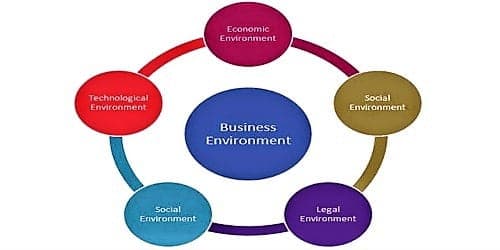
Business is a very economic activity of buying, selling, manufacturing, and rendering auxiliary services to trade and generating income through this activity. Modern Business is the economic and social organ of the society and also of the country and in today’s world modern business is not independent and it cannot work in isolation and business environment constitute- Government, public and economic, political and social situations constitute the business environment. Business environment may be defined as those conditions and forces external to a business unit under which it operates and these forces include government, suppliers, customers, creditors, political parties, socio-cultural organizations, and internal organizations, etc. Some of these may be direct influence over the business firm while others may operate indirectly. “Business environment encompasses the ‘climate’ or set of conditions, economic, social, political or institutional in which business operations are conducted”- Arthur M. Weimer.

– From opentextbc

The broad national economic environment is set by the nature of the economic system embodying the nature of property rights, ownership means of production, the role of planning, the functioning of the price mechanism, etc. Judged from these angles, the economic system of a country may be characterized as capitalist, socialist, communist, or mixed. The business environment consists of all those conditions and forces in the surroundings of a business enterprise under which the business operations are to be carried out efficiently and effectively and without any mistake. The management of the environment forces is an important task before every businessman of today and suitable decisions are required to be made in respect of various developments that are expected to take place for shaping the survival and growth of the business.

Characteristics of the business environment

1. The totality of external forces: The business environment is the total of all those factors/forces which are available outside the business and over which the business has no control. It is the group of many such forces, that is why the nature of it is totality.

2. Specific and General forces: The forces that exist outside the business are (a) Specific forces: These are the forces which affect the firms of an industry separately like customers, suppliers, etc. (b) General forces: These are the forces that affect all the firms of an industry equally, e.g., social, legal, political and technical situations.

3. The Business environment is dynamic: It is obvious that the environment is a mixture of so many factors and there are constant changes in some of them, due to these changes the business environment is dynamic.

4. The Business environment is complex: The nature of an environment in any field is the combination of so many factors and all these factors are related to one another. So the influence that they exercise on business cannot be recognized independently. That is why it is difficult for a business to face them.

5. The Business environment has a long-term impact: Any change in the environment has a long-term effect and impact on any kind of business because the changing environment affects the profitability, productivity, and development of the business.

6. The Business environment affects different firms differently: A change in the environment doesn’t need to affect all businesses in the same manner. One business may welcome the change in the environment while the other may not. Therefore, it is a special o environment that affects different businesses differently.

No Automatic Conviction U/s 306 IPC For Abetment Of Suicide Merely Because Accused Was Found Guilty U/s 498A IPC: SC

Coming straight to the nub of the matter, it has to be said that the Supreme Court just recently on November 26, 2019 in a latest, landmark and extremely laudable judgment titled Gurjit Singh vs State of Punjab in Criminal Appeal Nos. 1492-1493 of 2010 has remarkably ruled that merely because an accused is found guilty of an offence punishable under Section 498-A of the Indian Penal Code and the death of the wife has occurred within a period of seven years of marriage, the accused cannot be automatically held guilty for the offence punishable under Section 306 of the IPC by employing the presumption under Section 113-A of the Indian Evidence Act. To sustain a conviction under Section 306 IPC, the Apex Court made it clear that the prosecution has to establish that some act or illegal omission by the accused has driven the deceased to commit the suicide. Very rightly so!

                                          To start with, this commendable judgment authored by Justice BR Gavai for himself and Justice Navin Sinha sets the ball rolling by first and foremost observing in para 1 that, “These appeals by special leave challenge the judgment and order dated 20.2.2009 passed by the Division Bench of the Punjab and Haryana High Court in Criminal Appeal No. 544-DBA of 2001 and Criminal Appeal No. 959-SB of 2000. All the four accused, including the appellant herein (accused No. 3), who is husband of the deceased, were charged and tried by the learned trial Court for the offence punishable under Section 304-B and Section 498-A of the Indian Penal Code, 1860 (hereinafter referred to as “IPC”). The other accused were the father (accused No. 1), the mother (accused No. 2) and the sister-in-law (wife of brother) (accused No. 4) of the appellant. The Additional Sessions Judge, Hoshiarpur, held that the prosecution had succeeded in proving the case against accused Nos. 1 to 3 for the offence punishable under Section 498-A of the IPC but has failed to prove the case against the said accused (Nos. 1, 2 and 3) for the offence punishable under Section 304-B of the IPC. Insofar as accused No. 4 is concerned, it was held that the prosecution has failed to prove the case against her for both the offences and she was accordingly acquitted of the offence charged. The trial Judge, therefore, convicted the appellant and his father and mother for the offence punishable under Section 498-A of the IPC and sentenced them to undergo rigorous imprisonment for a period of three years and to pay a fine of Rs. 4000/- each and, in default of payment of fine, to further undergo rigorous imprisonment for a period of three months.”

                                     As a consequence what ensued then is stated in para 2 that, “Being aggrieved by the conviction and sentence under Section 498-A of the IPC, the appellant along with his parents preferred an appeal (being Criminal Appeal No. 959-SB of 2000) before the High Court. So also, the State preferred an appeal (being Criminal Appeal No. 544-DBA of 2001), being aggrieved by that part of the order by which the trial Court acquitted accused No. 4 and also acquitted accused Nos. 1, 2 and 3 for the offence punishable under Section 304-B of the IPC. The High Court upheld the conviction of accused Nos. 1, 2 and 3 for the offence punishable under Section 498-A of the IPC. It also upheld the acquittal of accused No. 4 and further held that, though the prosecution could not bring the case under Section 304-B of the IPC, the appellant herein was liable to be punished for the offence punishable under Section 306 of the IPC. The High Court maintained the order of the sentence and fine as recorded by the trial Judge for the offence punishable under Section 498-A of the IPC. For the offence under Section 306 of the IPC, the High Court sentenced the appellant herein to undergo rigorous imprisonment for a period of five years and to pay a fine of Rs. 5000/- and in default of payment of fine, to further undergo rigorous imprisonment for a period of five months. Being aggrieved thereby, the present appeals are preferred by the appellant.”

                                    To be sure, it is then elegantly observed in para 5 that, “The perusal of the record would reveal that though the appellant has disputed the date of marriage to be 04.02.1989, both the courts have disbelieved him and rightly so. The deceased died an unnatural death on 28.09.1994 by consuming poison. As such, the unnatural death occurred within a period of seven years of the marriage. The learned trial Judge has acquitted the appellant for the offence punishable under Section 304-B of the IPC since the prosecution has failed to prove the demand for dowry, while convicting him along with the parents for the offence punishable under Section 498-A of the IPC. The High Court maintained the conviction under Section 498-A of the IPC, however, it also convicted the appellant for the offence punishable under Section 306 of the IPC with the aid of Section 113-A of the Indian Evidence Act, 1872.”

                                                   More importantly, it is then rightly envisaged in para 33 that, “Applying the aforesaid principles to the present case, we find that though the prosecution is successful in proving the case under Section 498-A of the IPC, we are of the view that the prosecution has failed to prove that the cruelty was of such a nature which left no choice to the deceased than to commit suicide. The prosecution has not been in a position to place on record any evidence to establish beyond reasonable doubt that any act or omission of the accused instigated the deceased to commit suicide. There is no material on record to show that immediately prior to the deceased committing suicide there was a cruelty meted out to the deceased by the accused due to which the deceased had no other option than to commit the suicide. We are of the view, that there is no material placed on record to reach a cause and effect relationship between the cruelty and the suicide for the purpose of raising presumption.”

                                     What’s more, it is then elaborated in para 34 stating that, “It could further be seen from the evidence on record that the time gap between the last visit of the deceased to her parents with regard to the illegal demand and the date of commission of suicide is about two months. As such, there is nothing on record to show that there was a proximate nexus between the commission of suicide and the illegal demand made by the appellant. In the case of Sanju Alias Sanjay Singh Sengar vs. State of M.P. [(2002) 5 SCC 371] this Court found that there was time gap of 48 hours between the accused telling the deceased ‘to go and die’ and the deceased ‘committing suicide’. As such, this Court held that there was no material to establish that the accused had abetted the suicide committed by the deceased.”

                                        It cannot be lost on us that it is then pointed out in para 35 that, “Another aspect that needs consideration is that the cases wherein this Court has held that the conviction under Section 306 of the IPC was tenable though charge was only under Section 304-B of the IPC, it was found the charge specifically stated that the deceased was driven to commit suicide on account of cruelty meted out to the deceased. However, in the present case, the charge reads thus:

“That you all on 28.9.94 in the area of Village Bohan, the death of Jaswinder Kaur wife of you, Gurjit Singh and daughter-in-law of you, Gurdial Singh and Mohinder Kaur and sister-in-law of Ranjit Kaur, was caused otherwise than under normal circumstances, you all being her relatives, within a period of seven years of her marriage subjected her to cruelty and harassment for all in connection with demand for dowry and thereby committed an offence of dowry death punishable under section 304-B of the Indian Penal Code and within my cognizance.””

                                   Needless to say, a bare perusal of para 35 would make it clear what is then mentioned in para 36 stating that, “It would thus be seen, that the charge does not state that the deceased was driven to commit suicide on account of the harassment meted out to the deceased. It also does not mention that the accused had abetted in commission of suicide by the deceased. In that view of the matter, we are of the considered view that the cases wherein conversion is held to be permissible are clearly distinguishable.”

                                          No wonder, the Apex Court Bench then rightly held in para 37 that, “In the foregoing circumstances, the appeals are partly allowed. Conviction under Section 498-A of the IPC is maintained and the conviction under Section 306 of the IPC is set aside. The appellant is acquitted of the charge under Section 306 of the IPC.” Finally, it is then held in the last para 38 that, “The appellant is stated to be on bail, his bail bonds shall stand discharged and he is directed to surrender within four weeks for serving the remaining period of his sentence, if not already undergone.”

                                             It is quite discernible from the above foregoing discussion that the Supreme Court while citing leading case laws like Ramesh Kumar vs State of Chhattisgarh (2001) 9 SCC 618 minced no words to conclude unambiguously that there shall be no automatic conviction U/s 306 IPC for abetment of suicide merely because accused was found guilty U/s 498A IPC by employing the presumption U/s 113-A of the Indian Evidence Act. It is imperative that to sustain conviction under Section 306 IPC, the prosecution has to establish that some act or illegal omission by the accused has driven the deceased to commit suicide. As nothing of any act or illegal omission by the accused could be proved that could be considered as having driven the deceased to commit suicide, therefore the accused conviction under Section 306 IPC is set aside even while he is held guilty under Section 498A of the IPC! Very rightly so!

Sanjeev Sirohi, Advocate,

s/o Col BPS Sirohi,

A 82, Defence Enclave,

Sardhana Road, Kankerkhera,

Meerut – 250001, Uttar Pradesh.

Worst incidents of 2020 till date!!!

2020 is probably the year of histories to be created and to taught in the coming decades that how intelligent and cruel are the humans!!!

There is the series of bad events on it self starting of the year…again and again humans are proved that the level of damage can be upmost by them. We are taking ourselves to the path of destruction which might not have any end. Let us see what are the events that give us hint that 2020 will be written in history.

1- Australian forest fire

Australia encounters fires almost every year but this time it gave a new signal. Over 1 billion animals are believed to be dead and an estimated 2,000 homes were lost, the overall damage and economic losses would reach 100 billion US$.

brown open field
Photo by Matthis Volquardsen on Pexels.com

2- Flood in Jakarta- Indonesia

In Indonesia, flooding is common particularly during the rainy season of October-April, but this particular flood occurred in January and killed almost 70 people on Sulawesi Island and hundreds of people were displaced by heavy rain in West Java.

man pouring water from dipper on blue and grey house
Photo by hitesh choudhary on Pexels.com


3- Riots in Delhi

Riots in Delhi was based on anti-CAA protest in which violence, property destruction and also rioting that killed 53 people, most of whom were Muslims shot, slashed with kicks and set on fire by Hindu mobs in North East Delhi.

image-75

Image source: This week

4- The Pandemic- COVID-19

This is the worst situation till date of 2020 a 2 gm virus( research says that total molecules of corona virus from all over the world would weigh 2 gm i.e. equal to a coin weigh) it almost broke the economic condition of every country in the world.

pexels-photo-4031867.jpeg
Photo by Edward Jenner on Pexels.com

5- Olympics & IPL- 2 biggest event of world brought to halt.

Due to COVID-19 outbreak 2 most popular event were called off which was very disappointing for the players as well as their supporter.


6- Brutal killing of Saints

This incident took place in Palghar were people of village mysteriously attacked the van on saints which was heading towards their senior saints funeral program. People on investigation said that they were informed that this van contain corona virus patient, it was more worse when police also joined people in this attack.

Man-Lynched

Image source: Siasat.com

7- Gas leakage- Visakhapatnam

This was a major gas leak in LG polymers chemical plant in Visakhapatnam which killed 11 people, 800 were hospitalized and many more faced issues like headache, ill, vomiting etc.

image-4

Image source: The Hindu

8- Justice for Blacks

The conflict raised when George Floyd, 46, died on May 25, after a video showing a white Minneapolis police officer kneeling on his neck for almost 9 minutes.

crowd of protesters holding signs
Photo by Josh Hild on Pexels.com

9- Indian cinema lost 2 gems

Bollywood lost 2 precious gems Irfan Khan an Rishi Kapoor. Actor Irfan Khan were facing problem related to Neuroendocrine tumor which became the reason for his death where as on the other hand actor Rishi Kapoor died by Leukemia.

10- Brutal death of a pregnant Elephant- Kerala

This incident took place in Velliyar River in Kerela where a pregnant elephant came in search of food where local offered a pineapple loaded with fire cracker which exploded in her mouth, doctors tried to save her but unfortunately couldn’t save. Suspect was arrested by forest officials and was interrogated. This shows how cruel has mankind became over the years.

image-5

Image source: Facebook


Like, Comment and Share the post if you agree.

Govt mandates distinct colour strip on top of sticker carrying details of registration for BS-VI vehicles

Ministry of Road Transport and Highways has mandated  a strip of green colour of one centimetre width on top of the existing sticker carrying details of registration for  BS-VI vehicles of any fuel type.

For petrol and  CNG vehicles, there is a light blue colour sticker and for diesel vehicle, it is of orange colour.

The Ministry in a statement said that such stickers will now have a green strip of one centimetre width on top for BS VI four wheel vehicles.

Green strip of such thickness for BS 6 vehicles for sticker of registration details is being stuck on windshields of 4 wheelers.

COVID19 recovery rate improves to 48.49 per cent

Health Secretary Preeti Sudan today interacted with District Collectors, Municipal Commissioners and Chief Medical Officers of select districts that are seeing a surge in COVID-19 cases.

45 Municipal Corporations across 38 districts in ten states are witnessing a surge in COVID-19 cases. These districts are from Maharashtra, Telangana, Tamil Nadu, Rajasthan, Haryana, Gujarat, Jammu and Kashmir, Karnataka, Uttarakhand and Madhya Pradesh.

Union Health Ministry said, the State officials were advised on the measures to be taken in the containment zones for case management, buffer zones surveillance activities and promotion of COVID appropriate behaviour.

To reduce the case fatality rate, the officials were briefed on measures to be taken like prioritising the high-risk and vulnerable segments like elderly people and people with co-morbidities while contact-tracing to prevent deaths, active surveillance measures, adequate testing and promoting health seeking behaviour for timely detection of cases. Municipal authorities were advised that along with COVID-19 management efforts, care needs to be given to the regular and essential health services.

The Ministry said, a total of one lakh 24 thousand 430 people have been cured so far. In the last 24 hours, five thousand 137 patients were cured. The total recovery rate has reached 48.49 per cent. The total number of active cases is over one lakh 24 thousand.