
IMPORTANCE OF AGRICULTURE ( in Indian Economy)

The word agriculture is derived from the Latin language importance of agriculture. So we all know that India is an agricultural country . And we have been hearing this since the very beginning . That is , most of the people here are involved in agriculture, So no doubt that when so many people are involved in agriculture,  then maximum people will get national income. So agriculture plays a very important role in the Indian economy. Agriculture generates 24% of the nation’s income. Means, out of 100 rupees, 24 rupees comes from your agriculture and the rest is in other sectors. And which is 60% of the population of India, it is in agriculture, which means that 40% of the population is either they are doing service or they work in the industry. And until production does not come from agriculture, then you can think that no industry will serve. The industry which depends on the agricultural product also cannot survive without the product And the agriculture that plays an important role of development of industries and foreign trade. Because so many companies are, it depends on the agricultural product itself. Agriculture play the back bone of Indian economy.

Following one the role of agriculture in the India economy.

  • 24% of the national income comes from agriculture.       
  • There is 60% employment in agriculture.
  • Supply of raw material: If we want to make any product, then we need items. Like we need seeds to make oil. We need cotton for textile industries, so all these sources we call raw material, The things from which any other product is made, we called it raw material like cotton, seeds accepted vet, all these raw materials are supplied to us from agriculture.
  • Role A agriculture in international trade: About 70% of the products we export to other countries, we export products that are supplied from agriculture or apiculture. There are some important products which export from India. Like Tea, Sugar, Oils Seeds, Tobacco, Spices, Rubber are all agricultural products which we export to other countries.
  • Contribution to GDP(Gross Domestic Product):Apart from the industries in our country, agriculture sector and human being contribute to the multi GDP.So we can say that agriculture plays a very important role in increasing GDP.Agriculture has contributed 51% in 1950-52, while between 2018 and 2019, only 14.4% was contributed But this does not mean that there is no importance of agriculture sector but agriculture also plays a very important role If the contribution of agriculture to GDP has been reduced, then the reason is because that the people who are they have started moving towards the secondary and territory sector They have moved out of the ruler area to Auburn Places and started working, so the agriculture contribution has come down a bit in GDP But still we will say that agriculture is very important for us.
  • Supply of wage goods: We get oil, wheat, rice, all from agriculture. In India or outside country, we also need important stuff like oil, rice, wheat. All that we get from agriculture And you can see that in today’s time, 121 crore people in India get all these things from agriculture.85% of what we take every day is an agricultural product, while the remaining 15% comes from egg milk and meat.
  • Source of employment: Agriculture is a huge source of employment because even today there are many people who depend on agriculture He grows crops on his farm and he himself takes consume and also earns money by selling it to the market 50% of the population is engaged in agriculture Agriculture is also taken care of in the economy planning that is made for India.

  • Source of demand for industrial goods :The work of industrial goods is to make heavy products, make heavy machines And now our agriculture sector which is there demands this kind of machine Because we need tractor, compiler, all this in agriculture which comes from industries This means that agriculture demands industries to make machines and we will buy them So agriculture plays a very important role for industries as well.
  • Support to transport industry :So we all know that rail, roadways, air comes in transport But agriculture, which is mostly beneficial for railways, roadways Like goods trains, trucks, food items go in all these, if there is no agriculture then there will be no sugar can then there will be no transport Means has also given maximum employment opportunity in this, Agriculture is also very important in transport industries.
  • Wealth of Nation : The most important thing in our country is that we have agricultural land And there will be very few such countries in the world which have agricultural land So this is our heritage and we have to protect it and keep improving That’s why we would say that agriculture is very important to us because it is a wealth of nation.

And these are all the points due to which agriculture is considered important .

Acid Rain

“The unthinkable is that we’re distorting this atmospheric balance. We’re shifting the chemical balance so that we have more poisons in the atmosphere – ozones and acid rain on ground level – while we’re also changing the thermal climate of the earth through the greenhouse effect and – get this – simultaneously causing destruction of our primary filter of ultraviolet light. It’s incredible. Talk about the national-debt crisis – we’re piling up debts in the atmosphere, and the piper will want to be paid.”

~ Michael Oppenheimer

Introduction

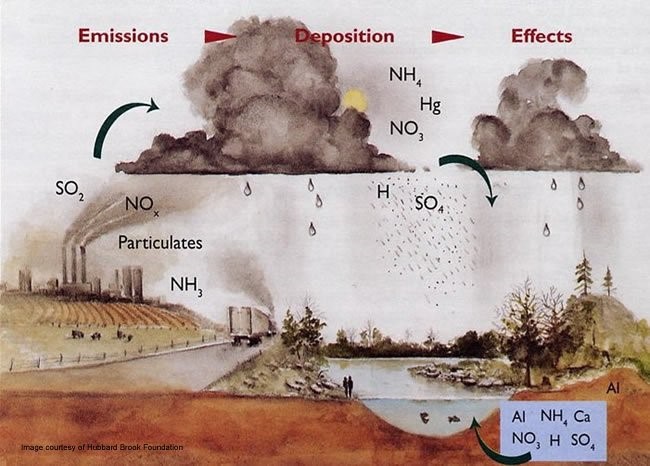
Acid rain, or acid deposition, is a broad term that includes any form of precipitation with acidic components, such as sulfuric or nitric acid that fall to the ground from the atmosphere in wet or dry forms. This can include rain, snow, fog, hail or even dust that is acidic.

Acid rain is caused by a chemical reaction that begins when compounds like sulfur dioxide and nitrogen oxides are released into the air. These substances can rise very high into the atmosphere, where they mix and react with water, oxygen, and other chemicals to form more acidic pollutants, known as acid rain.

It can have harmful effects on plants, aquatic animals, and infrastructure.

Effects of Acid Rain

The ecological effects of acid rain are most clearly seen in aquatic environments, such as streams, lakes, and marshes where it can be harmful to fish and other wildlife. As it flows through the soil, acidic rain water can leach aluminum from soil clay particles and then flow into streams and lakes.

Acid rain has been shown to have adverse impacts on forests, freshwaters, and soils, killing insect and aquatic life-forms, causing paint to peel, corrosion of steel structures such as bridges, and weathering of stone buildings and statues as well as having impacts on human health.

Acid rain also causes the corrosion of water pipes. Which further results in leaching of heavy metals such as iron, lead and copper into drinking water.

Prevention

1. The only precaution that we can take against acid rain is having a check at the emission of oxides of nitrogen and sulphur.
2. We have so far seen the details of acid rain and its harmful effect on animals, plants and the monuments.
3. Being responsible citizens, one should be aware of the harmful effects they cause and of the industries which give out nitrogen and sulphur compound wastes unethically. 4.A great way to reduce acid rain is to produce energy without using fossil fuels. Instead, people can use renewable energy sources, such as solar and wind power. Renewable energy sources help reduce acid rain because they produce much less pollution.

Acid Rain in India

Analysis of rainwater samples from Nagpur, Mohanbari (in Assam), Allahabad, Visakhapatnam and Kodaikanal in the decade 2001-2012 showed a pH level varying from 4.77 to 5.32, indicating that these places have actually been receiving ‘acid rain’. Rainwater with pH below 5.65 is considered acidic.

As energy requirements in India will grow rapidly in tune with the economy, coal dependence is expected to increase threefold over the current level of consumption, making the clouds of acid rain heavier over many highly sensitive areas in the country – the northeast, parts of Bihar, Orissa, West Bengal ,etc ,.

The rains in the Indian Ocean and the Arabian Sea and the Bay of Bengal have become acidic. Studies show the importance to regularly monitor more places for acid rains. But the mechanism to study acid rains is at present inadequate in India. imd stations are not located in the most polluted areas in the country.

Link

HUMAN TRAFFICKING DURING PANDEMIC

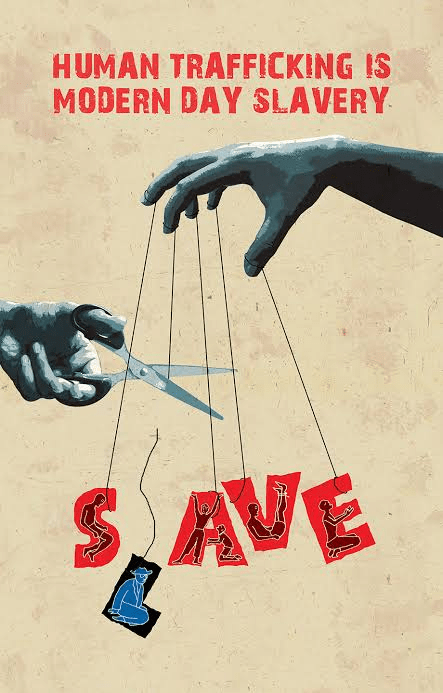
Human Trafficking is a major issue in India and Worldwide. Though, it has been there for ages, the reason for the need of immediate attention is the COVID – 19 Pandemic. The pandemic bought about various social and economical changes in India giving rise to human trafficking cases. The lockdown raised higher level of unemployment amongst daily wage earners. This further lead to effecting the economic background of such families, especially in the rural areas. Having no other source of income lead to desperation in people which made them promote human trafficking by selling their children, making them beg for money and sending their children for child labour. Moreover, the closure of schools increased human trafficking cases as there was no source of education for children. This gave the families and opportunity to use the children economically for labour and wed their girl child at an early age to save the future expenses. Absence of schools further increased the burden on families as many rural schools provided mid-day meal to their students. Absence of which made the children a further burden on the families and an additional stomach to feed. This made them give their children away in a hope for a better future for them and food for their children.


Along with such cases, many organ removal cases in the name of covid cases were found. Many physically fit people with weak financial backgrounds were falsely shown positive for corona virus and later declared dead because of the same. It was found that many traffickers removed organs from such bodies and declared them dead. Hence, this issue is important in the current times and require more attention than ever.

Yes, it’s difficult to step outside and help in this uncertain times but we individuals can start from our homes. The family domestic help, house help, workers, etc belong to rural and economically weak family backgrounds. Hence, talking to them and knowing about their lives can help us get a clear picture of their situation. We can educate them and spread awareness about the wrongs that they might be exposed to. This knowledge might help them be aware and spread the words to different people in their families and neighbourhood, that in turn might create a huge impact on the society as a whole.

Many a times people give into such situations where they willingly promote human trafficking, out of desperation and helplessness. As in case of a daily wage worker who has no other means to support his family economically might sell his child to survive. Hence, it is important to make them aware about various other way where they might get financial help without getting trapped into such rackets. There are government supports yojanas and schemes where they help such people, but in order to get help it is important to know about the availability of that help and that can only be done through awareness. It may not change the entire world scenario but one step by every citizen might make a huge impact altogether.

Entrepreneurship Development

Entrepreneurship is the ability to develop, organize and run a business enterprise, along with any of its uncertainties in order to make a profit. Entrepreneurship is basically the act of creating a business or businesses while building and scaling it to generate a profit. It’s about building a life on your own terms. No bosses. No restricting schedules. And no one holding you back.
Entrepreneurship development is a process of developing certain skills in an individual which are required to make him/her a successful entrepreneur. The success of an entrepreneur can be judged by success of his project or business. Finding a way to sell oneself before anyone believes in one or ones business, being able to explain and prove why their product or service is worth the price or investment, knowing when something is valuable, even if no one else does etc. are some of the features a successful entrepreneur possess.
Big successful companies like Microsoft, Google, Apple etc. have all attained the status they have now because of their respective entrepreneurs. Success of such start-ups not only benefits the people associated with it but also the economy as a whole. It slowly changes the world. Off course not every start up is a massive hit, some might be pretty mediocre and some might even do more losses than gains but nevertheless in the contemporary world, the need and urge for entrepreneurship development has drastically increased.
There are certain characteristics which are observed in entrepreneurs who write big success stories. These characteristics are a prerequisite for becoming a successful entrepreneur. The first and foremost skill is creativity. It means thinking out of the box. Coming up with new ideas, being open to new methodologies, creating something new etc. are some examples of being creative. Creativity gives birth to Originality. Risk taking is another characteristic of a successful entrepreneur. Without the will to explore the unknown, one cannot discover something unique. Risk-taking involves a lot of things. Using unorthodox methods is also a risk. Investing in ideas, nobody else believes in but you is a risk too. Good entrepreneurs are always ready to invest their time and money. But, they always have a backup for every risk they take.
Planning is another characteristic and probably the most important one. They say “If you fail to plan, you plan to fail.” Planning is strategizing the whole thing ahead of time. It basically sums up all the resources at hand and enables one to come up with a structure and a thought process for how to reach ones goal. It involves how to make optimum use of these resources. Facing a situation or a crisis with a plan is always better. It provides guidelines with minimum to no damage incurred to a business.
Other characteristics include passion for the work or business one choose to do, professionalism in the way the work is done, knowledge of the field of work or business, social skills including relationship building. An entrepreneur must be open minded towards learning, people and even failures.

https://www.jbcnschool.edu.in/blog/characteristics-of-an-entrepreneur/

https://www.entrepreneur.com/article/250564

BRITISH INFLUENCE ON URBANIZATION IN INDIA

INTRODUCTION

India shares a long history of urbanization, with Indus Valley Civilization dating back to 2350 BC as its first stepping stone towards urbanization. After this and post-independence period, with the emergence of Planning Commission, India witnessed the urbanization which it had never seen before. And this period marks the progression and flourishing of urbanization in India. However, cities in India have been urbanized in number of phases. The urbanization history in India has 5 different phases (given by historians) :

  1. The Pre – Historic Period (Indus): 2350 – 1800 BC
  2. The Early Historic Period (Aryans and Dravidians): 600 BC – 500 AD
  3. The Medieval Period (Mughal): 600 – 800 AD
  4. The British Period: 800 AD – 1947
  5. Post Independence Period: 1947 – till date

URBANIZATION IN BRITISH PERIOD

The British came to India in 1858 when India was one of the most urbanized nations due to Mughal supremacy. But in the early phase of British rule, Indian cities witnessed decline in the level of urbanization and during the later phase of British rule, the Indian cities regained the lost importance and new towns and cities emerged and newer urban form was added to existing cities.

Fort St. William in Calcutta is one of the best examples of factories constructed during British Era and fortified for protection.

URBAN DECLINE IN 19TH CENTURY

The main reasons for urban decline during the British Period were:

  1. Lack of interest in British in economic development, prosperity and growth of India and their negative attitude towards the traditional industries of India which were present during that period.
  2. The alteration of urbanization in India due to the industrial revolution in England.
  3. The diversion in existing trade routes due to sudden growth and building of rail networks.
  4. Disrupted monopoly in trade especially in port towns.

BRITISH CONTRIBUTION TO URBANIZATION SCENES IN INDIA

  1. Emergence of three metropolitan port cities which emerged as leading colonial cities (Calcutta, Bombay and Madras).
  2. Creation of hill stations and plantation settlements.
  3. Modification of urban landscape in existing cities.
  4. Introduction of civil lines, camps and cantonments.
  5. Improvement in connectivity through railways.
  6. Enhanced scope of industrialization.
  7. Improvements in urban amenities and urban administration.

CONCLUSION

British era had both positive and negative impact in India but the extent of positive changes is more. The process of urbanization and building of new cities can be seen as the breaking of the continuum. During British Period, the Indian cities emerged as the focal points of urbanization and westernization. The westernization brought by the British Period continued to guide the destiny of urban elite in India. It helped in transforming the agriculture as a means of commerce by introducing new crops like indigo, tobacco, coffee etc. Thus, British Era can be seen a the period when India came across fundamental economic transition, mechanized industries and developed connectivity through railways and foreign trade. But the British Era didn’t consider the rural – urban conflict which increased the gap between urban and rural areas of India.

Thus, it can be concluded that British rule had definitely been useful in providing the foundation of development and urbanization to India. As per Census 1941, which is the last census before Independence, India had 49 one lakh cities and 2500 urbanized towns. So, when this urbanization is compared to previous trans, it can be seen that the urbanization attained zenith during the end of British period as compared to past events.

žIn 1941, which marks the last census before independence, There were 49 one-lakh cities in India and in all round 2500 urbanized towns. Urbanization attained zenith during end of this period compared to entire past events.

The utterly butterly delicious story of Amul

Over the years, Amul, one of the most beloved brands of our country, has become the taste of India, just as its tagline claims. Every Indian millennial has grown up listening to the jingles of its many dairy products, and the Amul girl, the brand’s mascot in the polka-dotted dress, has become a nostalgia-evoking symbol. Amul has truly come a long way since its founding in 1946.

The beginning

Amul was formed as a part of a cooperative movement against Polson Dairy in Anand, Gujarat, which procured milk from local farmers of Kaira District at very low rates and sold it to the then Bombay government. Everyone except the farmers benefited from this trade. The farmers took their plea to Sardar Patel, who had advocated farmers’ cooperatives since 1942. The result was the formation of the Kaira District Co-operative Milk Producers’ Union Limited in Anand.

The union started pasteurising milk produced by a handful of farmers for the Bombay Milk Scheme and grew to 432 farmers by the end of 1948. The rapid growth led to problems including excess production that the Bombay Milk Scheme couldn’t accommodate. To solve this issue, a plant was set up to process all that extra milk into products such as milk powder and butter.

Amul is born

The late Dr. Verghese Kurien, rightly called the Milkman of India, was Amul’s true architect. His journey at Amul began in 1949 when he arrived in Anand to manage a dairy as a government employee. He went from helping farmers repair machinery to revolutionising India’s dairy industry with the White Revolution (or Operation Flood), the largest dairy development programme in the world.

The new dairy with the milk processing plant was ready for operation in October 1955, the year that also saw a breakthrough in dairy technology —buffalo milk was processed to make products for the first time in the world. The word ‘Amul’, derived from ‘Amulya’, which means ‘precious’ or ‘priceless’ in Sanskrit, was used to market the range of milk products developed by the Kaira Union. It is also an acronym for Anand Milk Union Ltd.

Dr Kurien had a vision. He wanted to offer small-scale dairy farmers quality-control units and centralised marketing, which were missing at the time in the dairy economy. Thus, the Gujarat Cooperative Milk Marketing Federation (GCMMF) was created in 1973 to market milk and all milk products produced by six district cooperative unions in Gujarat. GCMMF is the largest exporter of dairy products in India and Amul is the umbrella for all of its products.

Awards, accolades, and a global presence

Over the years, Amul, together with GCMMF, has won numerous awards. Some of these include the Rajiv Gandhi National Quality Award, 1999; the Golden Trophy for Outstanding Export Performance, 2009-10; Best Marketing Campaign, 2014; and World Dairy Innovation Award, among many others. Amul earned recognition all over the world when GCMMF  introduced it on the Global Dairy Trade (GDT) platform, where only the six top dairy players across the world sell their products.

More than a mere slogan

Amul’s famous slogan, which is now a part of its logo, was created in 1994 by Shri Kanon Krishna of a Mumbai-based advertising agency called Advertising and Sales Promotion (ASP). According to Amul, the Taste of India slogan is more than just corporate positioning or advertising jargon. This slogan lends meaning to the brand’s never-ending commitment to taking quality food and products to the rural man, which he otherwise couldn’t have afforded.

The Butter Girl

Amul did not always have the round-eyed moppet as its mascot. The Butter Girl was born in 1966 when Sylvester daCunha, the then MD of the advertising agency handling Amul butter’s account, created her for its campaign. It was a pleasant change from the dull, corporate ads that the previous agency had come up with. Being a seasoned marketer himself, Dr Kurien gave daCunha complete creative freedom to create and release the ads without taking the company’s permission. 30 years later, the Utterly Butterly Girl still wins hearts wherever she is, whether on a billboard or on the packet of butter.

Amul is not just a brand; it is also a movement that represents farmers’ economic freedom. The name is now a household term that is here to stay, and the chubby-cheeked Amul girl will continue to cast a spell on the public.

Video Game crash of 1983

In 1983 the video games industry was hit with a recession that almost ended the existence of video games of that time period. This period lasted for almost two years from 1983 to 1985. Many people and journalists who were critical were calling video gaming a fad. Numerous companies went bankrupt or stopped making video games entirely. This recession is known as the Great North American Video Game Crash or Atari Shock (Primarily in Japan).

Video games in the 1970s were dominated by arcade machines and by the end of the decade home game consoles were also getting popular. With the start of the 1980s, the video gaming industry witnessed a boom with numerous companies like Mattel, Atari, and Coleco dominating the market. The early 80s was a time of innovation and growth in the video game industry but there was instability in the industry as well. This was a time period when video games were becoming more mainstream and popular. Many new players entered the market ranging from industries to small developers that had no association or prior experience in game development in general.

Pacman was a big hit in the early 80s and it was not of the most popular video games in the arcades. Its successor Miss. Pacman improved on the formula and was a success as well. After the success of Pacman in the arcades, Atari wanted to replicate the success in the home game consoles. But with the limited constraints with the memory and short development period, the game was not well received by the consumers and critics alike. In 1982 Atari also brought the license to release the video game of the movie for 21 million. The game was developed in a time period of only 5 weeks. The game was negatively received and only 1 million copies of the game were sold off the 5 million manufactured. Many of the sales were also returned to the retailers furthering the damage. During this period video games were being published by small developers with very poor quality and many big developers were producing games that were more of a marketing token than the game. There were many clones of the same games with little to no redeeming quality and replayability. There were also numerous consoles unlike today with too many options that were no different from one another. With the abundance of supply and low sales of games, retailers started to remove stocks of video games and this led to the shrinking of the industry. Atari had lost $500 Million in 1983 and had to cut its workforce from 10,000 employees to just 400 employees.

During the 1980s there was a boom in the Personal Computers market as well. The PCs were much more powerful than consoles and they could play games and do many tasks like word processing and spreadsheets. The PC industry was unaffected by this low point of video game consoles.

In 1985 Nintendo Corporation launched the Nintendo Entertainment systems in North America and Nintendo ensured that only a limited number of games to be released under their license agreement. This ensured a certain threshold of quality for the games that were released for the system and Nintendo emerged out of the survivor from the video game crash. The Nintendo Corporation started to dominate the video game industry with an assurance of quality that was unmatched by any other corporation at that time. Many other entrants like SEGA also emerged after the crash. Nintendo with its approach and license and quality assurance of video games has left a big impact on the industry to this date. Video games industry has only grown since then and also overtaken other source of entertainment. Nintendo can be credited to provide the industry a trajectory that was severely needed after the crash of 83.

References:

Third wave of covid-19 knocking at our doorstep

While mass vaccination drive is going on around the whole globe,news of emergence of Third wave of coronavirus have started to surface. WHO (world Health organisation) have also warned about the third wave in Europe. Cases recorded in this wave are of ‘Delta-variant’ of coronavirus.

Second wave of coronavirus caught us all off-guard and hit us hard and many lives were lost and there was a State of panic amongst us all for few months, due to this wave of coronavirus. After, passing of this second wave, people flocked the hill stations and flouted covid norms.
Even, in markets people are walking without masks and not taking necessary precautions.

Alarmed by this situation government of India have warned the citizens about this 3rd wave. Lav Agarwal, Joint Secretary, Health Ministry, on Tuesday said that the third wave of Covid-19 may be caused due to the gross violation of covid appropriate behavior. He told that :

We would like to request to everyone- when we talk about the third wave (of COVID-19), we are taking it as a weather update and not understanding its seriousness and our responsibilities associated with it

Lav Agarwal (joint secretary, Health ministry, GOI)

According to union health ministry data on Tuesday there were 32,906 new cases of Covid-19 and 2020 related fatalities, which pushed the overall tally to 30,905,819 and the death toll to 410,784.

Markets are open and govt offices and school’s are running with 50% capacity, but the way in which common people are violating the covid-19 precaution guidelines, day is not far when we’ll have to pay for this type of behaviour. If situation remains like this, then the government in order to control the spread may impose lockdowns and come up with strict measures.

Hill Stations will be there,if we’ll be safe,then we can visit there later on. We need to learn from our mistakes commited during the second wave of pandemic and try not to repeat them this time.


Government is preparing on its behalf to face up with the inevitable third wave of pandemic. We all as a responsible citizen should adhere with the government guidelines and take precautions,then we can defeat this pandemic.

Why isn’t everyone a feminist?

It has come to my surprise that most people do not identify themselves as feminists. I have no idea what some people think feminism is. So, here is the dictionary meaning of the word feminism. 

Feminism is defined as the belief in social, political, and economic equality of sexes. 

I would like to emphasise the word equality. Feminism does not support sexism.Feminists do not put men down, nor do we support the women who put them down. Feminism is the belief in equality and not female superiority.

I was surprised to see some of the women not identifying themselves as feminists. I have come across women saying things like: 

I don’t face gender discrimination, so why should I support feminism. 

To all the women who have similar beliefs, it is the FEMINISTS that got you to a place where you can say sentences like these. 

Do you really think that without voices being raised, you got to a place where you are?

Women did not even have the right to vote, study, or work. Back in the old days, men did not even consider women. So, we have come a long way from women-only staying in the households to now becoming presidents.

 Secondly, there are still so many issues happening against women, and we must raise voices. If you have the privilege to face no gender discrimination, that is good for you. But do you not want that for every single girl out there?

To all the people who think that feminism is unnecessary, I would like to show some of the achievements done by feminists.

  • Right to vote
  • Gain access to birth control
  • Bought women out of household
  • Calling out on rape culture
  • Fought for legal discrimination
  • Making the workplace a little more equal

These were just a few of the things done because of feminists. So, the next time you think feminism is not needed and that we are already in an equal world.

Well, open your eyes. There is still a long way to go.

  • Saudi Arabia gave women the right to drive in 2018.
  • Each minute 28 girls are married before they are ready
  • One in three women have experienced physical or sexual violence
  • 62 million girls are denied an education all over the world
  • 4 out of 5 victims of human trafficking are girls

These were just a few facts out of 100 more issues that women face today. This data is for people who think we already have achieved gender equality. We have not and, we still need feminism.

If you are one of those people who does not like being labeled but believes in equality of both sexes. What are you afraid of? It is just a label for the betterment of our society. If you think people are going to judge you for it. Those are the people who did not do their research on what feminism is.

I am a proud feminist and, I am here to fight against the injustice that women go through. If you are with me, I hope you all identify yourself as a feminist.

If you are not convinced and, women with strong opinions on achieving equality bother you. Well, you can contribute to the world of misogyny. 

The Flash Theory: Iris Brings Back The Arrowverse Multiverse Post-Crisis

Warning! Spoilers ahead for The Flash season 7 episode 16, “P.O.W.”

The Flash season 7 is barreling towards its two-part finale and Iris West-Allen’s latest storyline could bring back the Arrowverse’s multiverse following its collapse in Crisis on Infinite Earths. Time and interdimensional travel have been heavily utilized in the shared universe ever since The Flash unlocked the titular character’s abilities to move backwards and forwards in time. The team’s trip to Earth-2 opened up yet another gateway to traversing the multiverse. While Crisis on Infinite Earths changed that for good, Iris’ situation could unlock the multiverse once again. 

Iris has been noticeably absent from two episodes of The Flash. In season 7’s episode 15, Barry revealed she wasn’t feeling well and was recovering from a bout of illness at home. In the following episode, however, Iris confirmed what she was experiencing was far more than a regular cold; when she sneezed, her eyes briefly and startlingly flashed green before returning to their normal color afterward. Why the illness is affecting Iris in this way remains unclear, but her symptoms have led her molecules to become unstable, inducing headaches and time displacement.   

At the end of the episode, Nora West-Allen confirms that Iris will be okay, but there’s no telling when her symptoms will clear up or what will happen before they do. That said, it’s possible Iris moving in and out of the timeline could play a crucial role in the future of the multiverse and the reason for her predicament may be hiding in plain sight.

Iris Is Phasing In & Out Of The Timeline

Iris’ absence from The Flash season 7’s episode 15 was suspicious, especially since it involved a possible pregnancy storyline that was happening without her. In the following episode, however, fans learned why Iris has been absent. As it turns out, her cold wasn’t a normal one and it was somehow causing her to phase in and out of the timeline. It got so bad apparently that Deon, the Still Force, swooped in to protect Iris by using his abilities to stabilize her from phasing through various temporal planes, moving her to “pure temporal strains” to keep her alive. If it wasn’t for Deon, Iris would have fractured through time itself, which doesn’t sound very pleasant and could have unprecedented repercussions.

This subplot creates an interesting twist considering everything happening on The Flash right now. Between what’s going on with Iris, the Godspeed clones, August Heart — who originated as Godspeed in 2049 pre-Crisis on Infinite Earths — coming into the picture, and Barry dreaming about Nora telling him there seems to be something wrong in the future, Iris’ timeline instability may be the one thing connecting each of these separate storylines. That said, the reason why she’s suddenly phasing in and out of the timeline has yet to be confirmed on the show, but all roads seem to be leading back to one cause.  

Iris Being Pregnant Is Causing Her To Be Unstuck From Time

Barry and Iris have been trying to conceive for a few episodes now. After Barry dreamed about Nora the first time, he assumed Iris was pregnant only for the results of the test to come back negative. However, this could have been a false negative. Considering that Iris’ presence in the timeline has been unstable, it’s possible that she is already pregnant and doesn’t realize it. What’s more, being pregnant with speedster babies won’t follow the same patterns of a normal pregnancy and it’s possible that Iris carrying metahumans is causing her to be unstuck from time. Her phasing in and out of the timeline could be The Flash’s equivalent to morning sickness. 

This could also explain why she will be able to regain her speedster powers in the season 7 finale. In the comics, Iris phases back and forth in time because it’s revealed she is actually from the future and was sent back to the 20th century by her birth parents. The Flash showrunner Eric Wallace has teased this storyline coming into play, but like with all things that make their way onto the show, it will probably be a loose adaptation from the comics storyline it’s based on. Traveling between timelines because of a pregnancy might be the closest the series gets to this particular comics arc in this instance.

Jay Garrick’s The Flash Return Hints At Alternate Earths Connection

Jay Garrick (aka, The Flash of Earth-3) was last seen prior to Crisis on Infinite Earths, warning Barry of the impending doom facing the multiverse. However, the speedster didn’t participate in the crossover, nor was he confirmed to be alive in the aftermath that saw the multiverse rebooted and Earth-1 merge with others (including Supergirl’s Earth-38) to become Earth-Prime. Jay will be appearing in The Flash’s two-part season 7 finale to aid in the Godspeed clone war. How his reappearance will be explained remains to be seen, but it’s possible he will show up courtesy of Iris’ temporal phasing. Jay originally hails from Earth-3 and his return to The Flash coinciding with Iris being able to phase through time (and maybe dimensions) could be connected. Iris may be acting as the bridge between Earth-Prime and Jay’s world without even realizing, and the superhero series might confirm that he is now from Stargirl’s Earth-2 instead.

Theory: Iris’ Temporal Phasing Brings Back The Multiverse

In The Flash season 6, Nash Wells detected particles of Eternium, an interdimensional (and multiversal) element, on Iris prior to the events of Crisis on Infinite Earths. At the time, nothing much came of it, just another tease that seemed to lead nowhere. However, this could come back into play now that Iris is phasing through temporal planes in season 7. It’s possible the combination of Eternium and her moving in and out of time now allows her to connect to not only different time periods on Earth-Prime, but alternate universes as well. Perhaps before she is finally stabilized, Iris will indeed fracture through time and that’s what breaks the barrier separating Earth-Prime from the rest of the multiverse, which has remained a secret post-Crisis.

Namely, Iris’ temporal instability could alert her and The Flash to the fact there are still other worlds out there despite the collapse of the multiverse during Crisis. After all, Stargirl exists on the rebooted Earth-2 and it’s been confirmed that Jay Garrick will make an appearance on the series in its sophomore season. And so Iris’ temporal imbalance could open the gateway to interdimensional travel once more, reestablishing the connection between Earth-Prime and other earths. There has to be a reason for why Nash detected Eternium on her. All of this could also be setting up The Flash’s five-episode crossover event in the fall. Whatever the reasons behind Iris’ phasing in and out of time, the introduction of this storyline for her could finally tie together so many loose plot threads for The Flash and the Arrowverse at large. 

What is The International Monetary Fund ?

Intergovernmental organisations (IGOs) have always played a very important role in the global economy . These groups are generally created through the enactment of a treaty and are composed of a group with member states . The goal of individual IGOs depends on their genre of function and membership . Some of the most common and widely known IGOs include the United Nations , the World Bank and International Monetary Fund ( IMF)

International Monetary Fund () IMF also called The Fund , based in Washington ,D.C. is an international monetary institution established by 44 nations under the Bretton Woods Agreement of July 1994.

The IMF was established to promote economic and financial cooperation among its members in order to facilitate the expansion and balanced growth of world trade . It started functioning from March 1,1947 , the Fund has currently 189 member countries each of which has representation on the IMF ‘s executive board in proportion to its financial importance .

IMF is an international organisation that promotes global economic growth and financial stability, encourages international trade and reduces poverty Quotas of member countries .

IMF ‘s mission is

“To foster global Monetary cooperation ,secure financial stability , facilitate international trade , promote high employment and sustainable economic growth and reduce poverty around the world.”

Origin :-

IMF was originally created in 1945 ,as part of the Bretton Woods Agreement, which attempted to encourage international which attempted to encourage international financial cooperation .

The principal aim was to avoid the economic mistakes of the 1920s and 1930s . The attempts of many countries to return to the old gold system after the First World War failed miserably.

The World Depression of the thirties forced every country to abandon the gold standard .This led to adoption of nationalist policies which marked decline in world trade and extension of depression.

44 nations assembled at the United Nations Monetary and Financial Conference at Bretton Woods, New Hampshire from July 1 to July 22,1944 and established The International Monetary Fund .

The Article of Agreement of the IMF provided the basis of the international monetary system .


Structure of The Fund


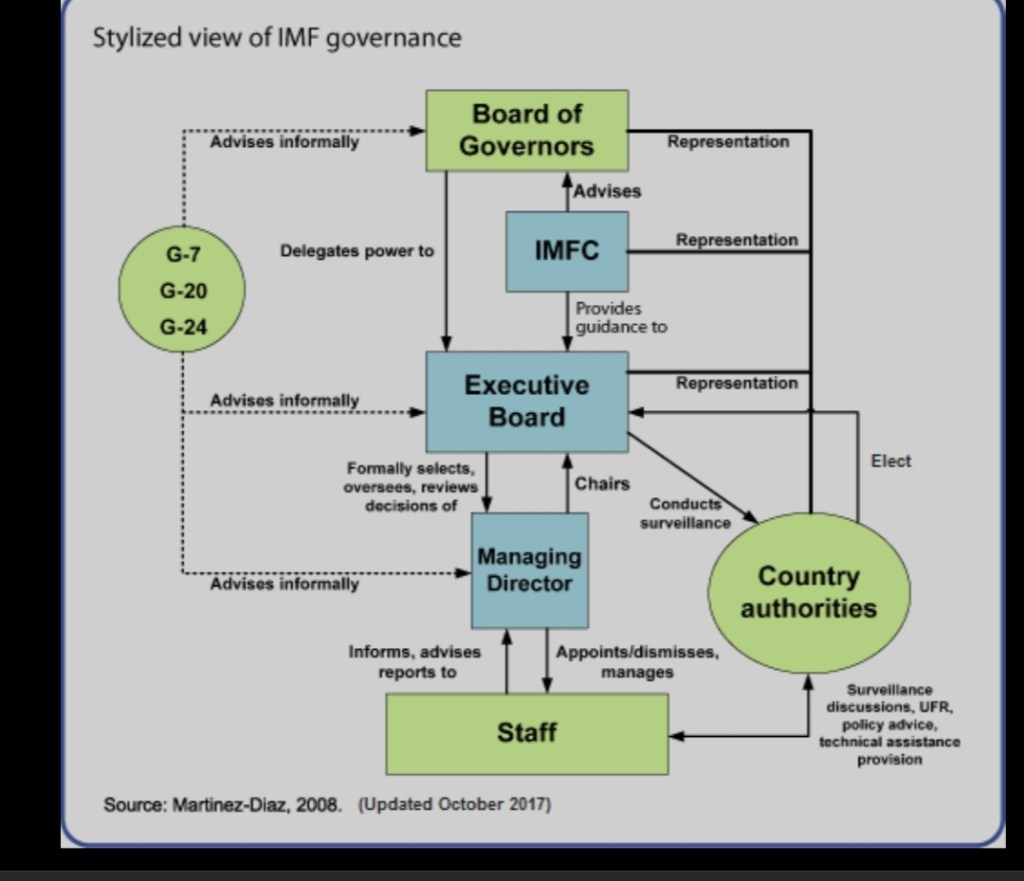
The structure of The Fund consists of a Board of Governors , an Executive Board , A Managing Director, a Council and a staff with its headquarters in Washington DC, USA.

The Board of Governors is the top in the structure of The Fund . They are decision making organs of the Fund..They exercise power and make decisions that are binding on members and the Fund .

The board of the Governors, which now has 24 members ,meets annually in which details of the Fund activities for the previous year are presented.

Other members include :-

The Executive Board , which has 21 members at present . Five Executive Directors are appointed by the five members ( USA , UK , Germany., France and Japan ) having longest quotas .

The Managing Director is elected by the Executive Directors .He is usually political or any other international official.

The Interim Committee (now IMFC ) , is established to advise the Board of Governors on supervising the management and adoption of international monetary policy .

The Development Committee advises and reports to the Board of Governors on all aspects of the transfer of real resources to developing countries .


Objectives :-

The fundamental purposes and objectives of the Fund had been laid down in Article 1 of the original Articles of Agreement . The major six objectives of IMF are :-

1: To promote international monetary cooperation through a permanent Institution which provides the machinery for consumption and collaboration in international monetary problems.

2: To facilitate the expansion and balanced growth of international trade, and to
contribute thereby to the promotion and maintenance of high levels of employment and
real income and to the development of the productive resources of all members as
primary objective of economic policy.

3: To promote exchange stability, to maintain orderly exchange arrangements among
members, and to avoid competitive exchange depreciation.

4: To assist in the establishment of a multilateral system of payments in respect of
current transactions between members and in the elimination of foreign exchange
restrictions which hamper the growth of world trade.

5: To give confidence to members by making the general resources of the Fund temporarily available to them under adequate safeguards, thus providing them with the
opportunity to correct maladjustments in their balance of payments, without resorting
to measure destruction of national or international prosperity.

6: In accordance with the above, to shorten the duration and lessen the degree of dis –
equilibrium in the international balance of payments of members.
___________________________________________

Functions of IMF

The principal function of the IMF is to supervise the international monetary system.
Several other functions performed by the IMF .
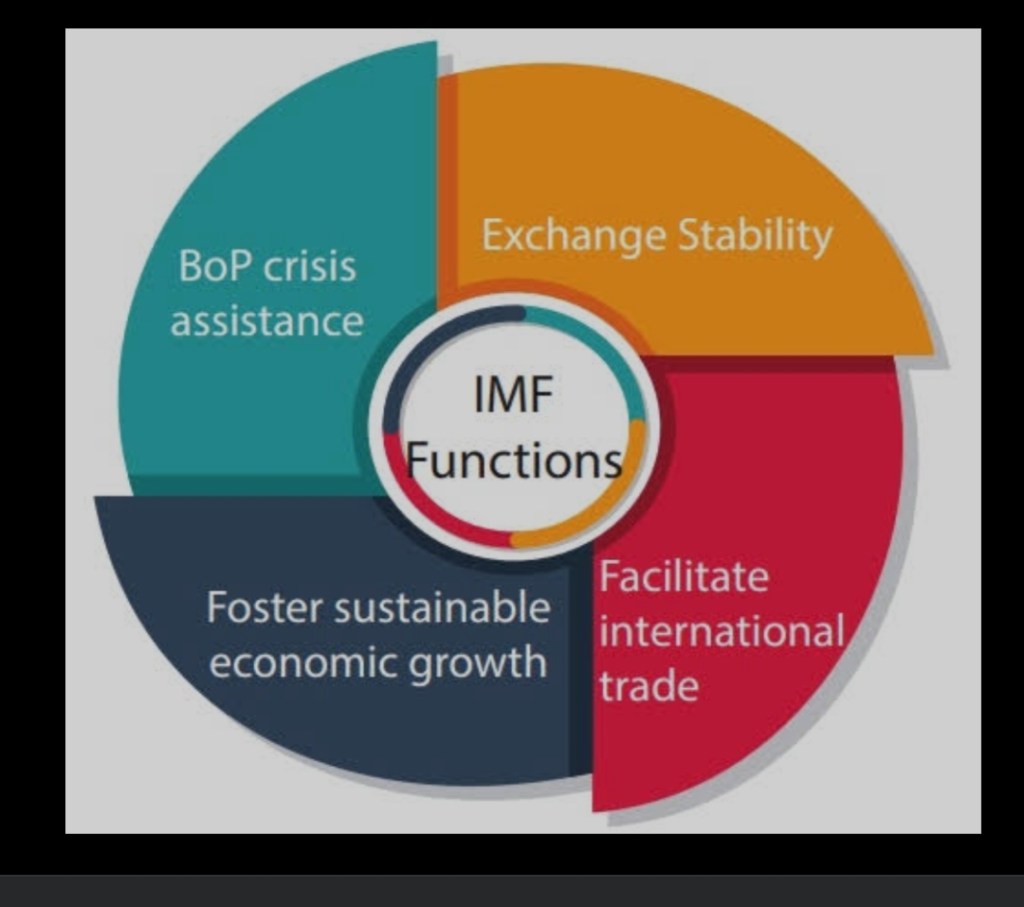
Three major functions of IMF are :-


Surveillance over Members Economic Policies :-

The IMF closely monitors each member’s country’s economic and financial development . The IMF holds a conference with member countries on a regular basis Usually once each year to assess its economic conditions with a view to providing policy recommendations .


Financial Assistance :-

IMF functions as an agency of providing resources to meet short term and medium term
. It lends to its member countries facing BOP disequilibrium .

IMF loan is usually provided under an “arrangement ” requiring a borrowing country to undertake the specific policies and measures to resolve it’s balance of payments problem as specified in a “Letter of Intent ” .
Most IMF loans are primarily financed by its member countries through payment of quotas .


Consultative Function:

It functions as a centre for international cooperation and a source of counsel and
technical assistance to its members.IMF provides technical assistance to help member countries strengthen their capacity to design and implement effective policies in four areas :- monetary and Financial policy ; fiscal policy; statistics ; and economic and financial legislation.

Other functions :-

• Stabilizing Economics
• Maintaining Balance between demand and supply of member countries.
• Maintenance of Liquidity .
• Reducing tariffs.
• General watch .
___________________________________________

Financial Resources of The Fund :-

The bulk of financial assistance performed by the IMF has its financial resources from two sources .


(i) Subscription or quota of the member nations :-

Each member country is required to subscribe to an amount equivalent to its quota. It is
the quota on which payment obligations, credit facilities, and voting right of members
are determined. As soon as a country joins the Fund, it is assigned a quota which is
expressed in Special Drawing Rights (SDRs).


(ii) Borrowings :-

The Fund is authorised to borrow in special circumstances if its own resources prove to
be insufficient. It sells gold to member countries to replenish currency holdings. It is
entitled to borrow even from the international capital market. Though the Articles of
Agreement permits the Fund to borrow from the private capital market.

The IMF has two accounts of
operation—the General Account and the Special Drawing Account.
The Fund burrows under the General Arrangements to Borrow in order to forestall or cope with an impairment of the international monetary system.
__________________________________________

Credit Tranches :-

To meet the severe BOP disequilibrium , the Fund has been gradually raising the limit of borrowing by its members under the credit tranche.
Since the 1960s , the Fund has created several credit facilities for its members.

Some borrowing facility provided by the Fund are :-

(i) Stand-by Arrangements:
The term “stand-by” here
means that, subject to conditionality, a member has a right to draw the money made available, if needed.
This method of borrowing has become the most normal form of assistance by the Fund.
Under this form of borrowing, a member state obtains the assurance of the Fund that,
usually over 12-18 months, requests for drawings of foreign exchange (i.e., to meet
short- term BOP problems) up to a certain amount will be allowed if the country
concerned wishes.
However, the stand-by arrangements can be extended up to 3 years while repayments
are required to be made within 3-5 years of each drawing.


(ii) Extended Fund Facility (EFF):
Stand-by arrangements to stabilise a member’s BOP run usually for a period of 12-18
months. Developing countries suffer from chronic BOP problems which could not be
remedied in the short run. EFF provides credit upto a period of 10 years and loan upto 300 percent of a member’s Quotas are allowed.


(iii) Compensatory Financing Facility (CFF):
Apart from the ordinary drawing rights, there are some ‘special finances’ windows to
assist the developing countries to tide over BOP difficulties. CFF, introduced in 1963, is
one such special drawing provision.
It can now draw up to 45 p.c. Since the mid- 1990s, this has been the least-used facility.


(iv) Structural Adjustment Facility (SAF) and the Enhanced SAF (ESAF):
In 1986 a new facility—the SAF—was introduced for the benefit of low income
countries.
Under it, credit facilities for economic reform programmes are available at a low
interest rate of 0.5 p. c compared to 6 p.c. for most Fund facilities. Loans are for 10
years with a grace period of five and a half years.
SAF provides to undertake medium-term structural
adjustment programmes to foster economic growth and improve BOP conditions
The ESAF has been replaced
by a new facility, called Poverty Reduction and Growth Facility in 1999.


(v) Poverty Reduction and Growth Facility (PRGF):
The PRGF that replaced the ESAF in November 1999 provides concessional lending to
help the poorest member countries with the aim of making poverty reduction and
economic growth —the central objectives of policy programmes.


(vi) Supplemental Reserve Facility (SRF):
This instrument provides additional short-term financing to member countries facing
exceptional BOP difficulties because of a sudden and disruptive loss of market
confidence reflected in capital outflows of countries concerned. Consequent upon the
After the eruption of the East Asian financial crisis, the SRF was introduced in 1997.

___________________________________________

India And The IMF

India is one of the founder members of the IMF . It signed the Fund Agreement on 27 December , 1945 . Till 1970 India ‘s Quotas in the Fund was the fifth and it had the power to appoint permanent Executive Directors.


With increase in the Fund Quotas of other countries like Canada , Italy , Japan etc . India ceased to hold a permanent position as Executive Directors .
With the Eleventh Review of Quotas , India’s quota in the IMF declined from 2.09 per cent . As a result , India’s position in the Fund quota came down to 13th .

The current IMF data shows India’s position at seventh .


India has been benefited in certain ways by the IMF by receiving loans to meet the deficit in its balance payment in several years .India has been getting advisory help from the Fund under the Fund surveillance conditionality .
Hence , as a member India has gained much help from the IMF to have an economically stable system.

Parliamentary Privileges

Introduction

India is called the world’s largest democratic country. The power to make law exists with the Indian Parliament. The members of lower house of Parliament are elected from the direct election while the members of upper house are elected from the Legislative Assembly of States and Union territories by means of single transferable vote through proportional representation. The concept of parliamentary privilege in the Constitution of India has been taken from British Constitution. Parliamentary privileges are special rights, immunities, exceptions enjoyed by the members of the two houses of Parliament and their committees. The main motive of these privileges is to uphold the supremacy of the offence of the office of the Parliament and its members.

Who Enjoys Parliamentary Privileges

These rights are mainly for the members of both houses of Parliament. Apart from this, these rights are also given to those individuals who speak and participate in any committee of the Parliament, which includes the Attorney General of India and the Union Ministers. President, even if he is a part of Parliament, does not have parliamentary privileges.

Breach of Parliamentary Privileges

If any person or officer violates the individual or collective privileges of a Member of Parliament, such as, disrespect, abuse, attack, etc., such acts are comsidered as breach of Parliamentary Privileges which is punishable by the house.

Thus, the above facts make it clear that Parliamentary Privileges in India have been enforced so that the respect of the Parliament and its members can be ensured.

But it is observed that after winning the elections, these representatives do not respect the public while on the other hand they expect that the public should give them due respect. Apart from this, you may have noticed that the Parliamentarians are often seen misbehaving with the officials and the general public. This is called the misuse of parliamentary privileges.

Therefore, it is the need of the hour that if the government wants to maintain the dignity of the democracy then it should make appropriate changes in the parliamentary privileges because nobody can be superior to the general public.

Conclusion

The privileges are conferred on the members for smooth functioning of the Parliament. But, these rights should always be in conformity with the fundamental rights because they are our representatives and work for our welfare. If the privileges are not in accordance with the fundamental rights then the essence of democracy for the protection of the rights of the citizen will be lost. It is the duty of the Parliament not to violate any other rights which are guaranteed by constitution. The members should also use their privileges wisely and not misuse them. They should always keep in mind that the powers do not make them corrupt. The Parliament cannot adopt every privilege that is present in the house of commons but should adopt only those privileges that accordingly suits our Indian democracy.

Greed vs Generosity: Which Gives a Better Competitive Advantage?

Many people think that in the professional world, selfishness and greed are the characteristics that pay dividends. But the truth is, excepting win-lose situations, that the most successful people in the medium and long term are those who are the most generous in their business and personal lives.

Ambition is a desire to take on more than you can realistically accomplish, to constantly strive for improvement, to grow both personally and professionally, and, of course, the desire to generate more income. However there comes a time when ambition crosses a line, and when that happens it becomes greed. Greed is the desire to chew more than you can eat, a desire that distracts you from realistically possible goals. Greed is wanting to get more than what you have actually earned, obtaining maximum profit at minimum cost, or as an old adage has it: “Grasp all, lose all.”

Today there is an abundance of courses and books on finance, limitless knowledge on hand with a simple click. But to know what is right, to subdue the pirates of greed and to follow your trading plan- this is another story. People who look for easy money invariably find that there is no such thing, paying a heavy price for this lesson. Ego, vanity, and revenge play a part, causing people to fail on their trading accounts. This is one of the factors that explains why people might not fall into the exclusive 10% that ‘win’, and find themselves one of the 90% that lose.

Literature and film are full of greedy and stingy characters, and the moral of films like ‘A Christmas Carol’ or ‘The Wolf of Wall Street’ is always the same: the fate of the greedy is heartbreaking. Their addiction to work means that they live a lonely life, and their search for wealth means that at the end of their lives, they have only the sober memory of their friends from the Stock Exchange.

GIVE AND TAKE

People do not realize that giving without expecting something in return could be a competitive advantage, as well as making ones outlook more positive. Studies have shown that the most successful people are generous. At least this is the affirmation of Adam Grant, a psychologist and professor at Wharton and author of “Give and Take”.

A generous person builds bigger and stronger networks, improves communication with their existing contacts, and also finds it easier to interact with people outside of their core network- this gives them access to new contacts and valuable sources of information. Generous people inspire in others a predisposition, or positive receptivity, to reconnect with them, as well as a greater willingness to collaborate.

Moreover, being a giver encourages persistence because givers are able to enthusiastically motivate people, inspiring confidence, because they are liberal with praise. They create a generally positive environment. Talent is important, but the most important factor in success is persistence. And what’s even more interesting is that being a giver has an energizing effect that increases levels of happiness.

According to Bill Williams, famous trader and writer of “Trading Chaos”, people with a ‘giving’ mindset enjoy more happiness and success. For example, later in his career Bill always traded two accounts, one for himself and one for his charities. The charity account always made more money, even though he traded using the same method with both accounts. In the charity account he never veered from his strategy, while in his own account he would sometimes take a trade based on a “feel”, or get in a trade before the actual signal. This shows us the importance of sticking to a plan, but also the importance of being a ‘giver’.

Giving distracts us from our problems, adds meaning to our lives and helps us feel valued by others. This explains why avidity and egoism are the trader’s worst enemy. Having a benevolent mindset while trading helps the trader to increase performance. Happy people earn more money on average, score higher yields, make better decisions and contribute more to their organizations. Furthermore, traders who are givers are at the top of the most successful trading operations.

THE GREED EFFECT

Focusing only on money results in the ‘greedy effect’, something that all professional traders know. In fact, one of the most common pieces of (rarely followed) advice that newbies receive is to shift their focus from trade results to the trading process, analyzing and following the rules of their trading system. Another suggestion is to start reasoning in pips and ticks instead of dollars. This reduces the greedy mindset and develops a more reliable attitude.

However we can make a further effort to improve our performance by shifting our focus to be more generous. One example is trading for charitable purposes like the aforementioned Bill Williams, another could be simply committing a small part of your monthly or annual profit to microcredits, which promote a world of stability and self-sufficiency, key to overcoming poverty.

Material things can be recovered, but feelings of guilt, helplessness and loneliness cannot be solved with money. If humans would be more understanding of and generous to others, the world would be a very different place. And that is why those who practice generosity, making it part of their daily lives, experience an uplifting of their mental and emotional state, and are generally filled with more satisfaction in their professional and personal lives.

In conclusion, we see that generous people are the most successful in their daily trading performance for the reasons described above. Having a giving mindset helps professionals become part of that exclusive group, the 10% of winners.

Sanskrit.

Sanskrit is a standardized dialect of Old Indo-Aryan, originating as Vedic Sanskrit as early as 1700-1200 BCE. One of the oldest Indo-European languages for which substantial documentation exists, Sanskrit is believed to have been the general language of the greater Indian Subcontinent in ancient times.

Sanskrit ; attributively संस्कृत-, saṃskṛta-; nominaly संस्कृतम्, saṃskṛtam, is a classical language of South Asia belonging to the Indo-Aryan branch of the Indo-European languages. It arose in South Asia after its predecessor languages had diffused there from the northwest in the late Bronze Age. Sanskrit is the sacred language of Hinduism, the language of classical Hindu philosophy, and of historical texts of Buddhism and Jainism. It was a link language in ancient and medieval South Asia, and upon transmission of Hindu and Buddhist culture to Southeast Asia, East Asia and Central Asia in the early medieval era, it became a language of religion and high culture, and of the political elites in some of these regions. As a result, Sanskrit had a lasting impact on the languages of South Asia, Southeast Asia and East Asia, especially in their formal and learned vocabularies.

Sanskrit generally connotes several Old Indo-Aryan varieties. The most archaic of these is Vedic Sanskrit found in the Rig Veda, a collection of 1,028 hymns composed between 1500 BCE and 1200 BCE by Indo-Aryan tribes migrating east from what today is Afghanistan across northern Pakistan and into northern India. Vedic Sanskrit interacted with the preexisting ancient languages of the subcontinent, absorbing names of newly encountered plants and animals; in addition, the ancient Dravidian languages influenced Sanskrit’s phonology and syntax. “Sanskrit” can also more narrowly refer to Classical Sanskrit, a refined and standardized grammatical form that emerged in the mid-1st millennium BCE and was codified in the most comprehensive of ancient grammars, the Aṣṭādhyāyī (“Eight chapters”) of Pāṇini.The greatest dramatist in Sanskrit, Kālidāsa, wrote in classical Sanskrit, and the foundations of modern arithmetic were first described in classical Sanskrit. The two major Sanskrit epics, the Mahābhārata and the Rāmāyaṇa, however, were composed in a range of oral storytelling registers called Epic Sanskrit which was used in northern India between 400 BCE and 300 CE, and roughly contemporary with classical Sanskrit. In the following centuries, Sanskrit became tradition-bound, stopped being learned as a first language, and ultimately stopped developing as a living language.

Ways to how you can approach by flirting with a girl

                       Techniques you can do to attract focus of girls on you with and without media 

This habit becomes common among teenagers nowadays in every place. Flirting with a girl does not require any pre-prepared speeches, or extra efforts to be told. A woman/girl can understand your feelings and will reply accordingly as per your words being told. They might be your friend or stranger but express a tone of affection and politeness while you interact with them while flirting. It is also noted that in this modern world teenagers do find difficulties to speak with a random person with fear or shyness that stops them from conversing with them boldly. 

It is necessary to note their situation accordingly and act wisely. If they have met with an accident or in a troublesome place be the first one to help/support them. That will make them feel secure in your presence. Make them admire the skills that you exhibit to grab their intention.  Feel free while talking with a girl to deliver our intention of speaking with them. 

There are also different ways one must behave in virtual and in reality. You can make girls flirt with you by using some ways that might penetrate their feelings so they too will spend a lot of time with you without any worries. So, let me discuss the criteria where you can converse in several ways to pull their concentration on a boy.

1.  Flirting via text messages

If the girl is a stranger try starting your conversation by just a ‘Hi’ text that might trigger their anxiety to know who you are. Use your relevant experience with them that helps them to recollect the memories of you. Asking about their self-health, living and the family members will improve conversation for longer duration. Make sure you don’t give them disturbed feeling while texting. Ensure to make them happy by some jokes or facts created on your own this will help you to take leads for continuous connectivity with them.

2.  Flirting with a girl as a girl

As a girl you have an advantage of starting your conversation with some random girl. You get to know her personal life incidents and happenings as they can consider you as a friend. Figure out their reactions if you are near them. Don’t try to commit things that the girl dislikes the most. Try promoting handwritten notes to your precious one that will make them feel rejoiced about you and your character. Maintain your dignity and use humor to keep them feeling over the moon.

3.  Flirting via phone (calls)

Try to surprise them by contacting them with calls, but make sure they are work free or in a good mood. You can guess their state of situation with the tone of their voice. Ask it out and console them that might be a relief for them at times. Try to ask out their favorite things in life and gather information about their precious memories and incidents. It is an opinion to mingle with their family if possible that provides you more space to speak with the girl.  Let your speech be in an affectional way that might pull out her emotion towards you and reveal it in calls. There is always a unique touch in hearing a girl speaking with us jovially. This can help you get closer in flirting.

4.  Flirting via WhatsApp with a girl

This platform has a unique feature of flirting through stickers and GIFs where you can share your expressions out of clips in it. Try sending heart symbols and some smiles and share your thoughts and opinions about her that might impress her. Take a step ahead of your conversation by asking her for a meeting out for coffee. Make some jokes to her and with her own routine that will motivate her to enjoy your humor. Sharing your instances will take you closer to her as she will trust you to open up her heart to tell you about her past in life. This a very good platform and try making video calls to grasp an enormous attention of her as that feeling takes you to a different world. Speaking without topics or contents .

5.  Flirting a girl in reality face to face

While meeting in reality an unknown one, use your sense to be the best one in dressing up. This situation helps you to admire the girl’s beauty beyond words. Show your actions in a nervous way that would help to indicate your expression of happiness. To make it more special for the face-to-face meeting, do things that she likes the most and the things she wants her partner to have in life. Smile after every speech of yours to make her feel free and happy with you. She will give you chances of talking and knowing things of her own life and use it to get yourself suitable for her like how she wants her partner to be. If these things happen then you are almost done flirting and make her fall for you.

6.  Flirting a girl who is already known to you

If you know the girl already it is an added advantage for you to move on with flirting and know about her recent times of life. Since she is a known person, you will be a trust-worthy and precious to her in life, so use it to flirt with her at random topics that make you closer with her. Try to pull out her emotions on you and how she thinks about you. You can try asking her if she has a boyfriend or not, casually, so you get a lead to flirt freely. She is desperate as you are known to her and that is where you can flirt and make her admire you by your character and actions.  

7.  Flirting with a random girl on a dating site

 Finding a girl online does mean that you can be genuine and cautious as it may be a kind of trap for you. In that circumstance allow her to debate upon topics that can get a feel of love and emotion so can get closer. Flirt with her in a gentle, firm way that she enjoys the most. Intro yourself to her as she can consider you based on your talents also. Try asking her questions like ‘wanna have coffee’, ’Snacks’ so it can help her to choose you for a relationship but don’t try to discover her past as in the first meeting itself.

These are the random ways to express your feelings and to connect with them as a method called flirting. “Flirting is not just how you attract girls; it is about how you understand about them”. Respect them and behave in a way that can increase your rate of becoming their beloved ones for lifetime. In all these cases use your eye-contact to communicate with girls as it only shows the truth and power of your feelings upon them. Be as a pillar to all their incidents in life to struggle and come out of it together by consoling each other.