Applications of Artificial Intelligence-I

What is AI?

Artificial Intelligence is the intelligence exhibited by machines based on the premise that intelligence is not ‘real’ or human’. It mimics cognitive functions exhibited by humans such as learning and problem-solving.

Artificial intelligence based on Natural intelligence

What is the scope of AI?

Jobs related to AI will increase exponentially in the coming days. It helps to find smart solutions to the problems in various fields in medicine, agriculture, education, security, and so on.

Three stages of Artificial Intelligence. We are near to the second stage.

Applications of AI

  • Machine Learning includes Deep Learning- Neural network
  • Vision includes Image & pattern recognition- Facial recognition
  • Hearing includes Voice and speech recognition
  • Natural Language Processing(NLP) includes Natural Language Understanding(NLU)- Natural Language Generation(NLG)
  • Robotics
  • Expert Systems

We are currently using the following AI-based applications:

  1. Image recognition: Recognizes objects, places, people, and actions in an image.
  2. Speech recognition: Allows humans to use their voices to communicate with the software.
  3. Language translation: Translates a word or sentence from one language to another. Ensure that the translated word is culturally and linguistically correct.
  4. Product analysis: Enables companies to leverage data to reveal user engagement with products or services and tracks the activities, likes, and dislikes of the user.
  5. A/B testing: Determines the version of a webpage and compares two versions and delivers better performance.
  6. Sentiment analysis: Analyze a piece of text to determine the writer’s attitude. It can be categorized as positive, negative, or neutral.

Let’s see few examples of Artificial Intelligence

  1. SIRI: Siri is a popular personal assistant offered by Apple which uses Machine Learning and Voice recognition.
  2. COGITO: It improves the intelligence of customer services by analyzing the human voice emotion and provides real-time guidance.
  3. NETFLIX: Uses predictive technology and provides the user with movie recommendations based on the user’s likes.

Use of Artificial Intelligence in society

“AI is a huge benefit to the society as it enhances the efficiency and throughput while creating new opportunities for revenue generation, cost savings, and job creation.”

-Anand Sampat(Datmo)

‘Robots and AI will destroy jobs’ is nothing but fiction and not fact. But instead, AI creates job opportunities in the market.

“The unparallel combination of human and machine will become the new normal in the workforce of the future”

– Matthew Lieberman

The presence of Artificial intelligence enhances our lifestyles and creates efficient businesses.

“Machine allows humans to do the most interpersonal and creative aspects of work”

 -Chalmers Brown(Due company)

AI platforms will provide real-time insights combined with the explosion of computer power.

“Smart homes will reduce energy usage and provide better security for humans. Marketing will be more targeted and health care will become more effective with smart devices”.

 – Naresh Soni

Start-ups using Artificial Intelligence 

  1. NEST: Alphabet Nest uses AI to learn a home owner’s habit resulting in a reduction of energy consumption. It adjusts the house temperature according to the weather hence energy consumption can be controlled.
  2. COMFY: Comfy offers services for reducing energy consumption in office buildings.
  3. PG&E: Pacific gas and electric company(PG&E) connected 200,000 solar customers, accounting for one in every four houses with solar rooftops.

AI benefits multiple Industries and society will be benefitted from the use of facial recognition, digital content analysis, accuracy in identifying patterns.

“AI risks are real if we don’t understand the quality of the incoming data and set AI rules which are making granular trade-off decisions at increasing computing speeds”

-Mark Butler

Facial recognition: Facial recognition is a biometric technology used to identify human faces and can be used for security purposes. 

Example: Snapchat

Snapchat differentiates between images of objects, pets, sports, and food. It suggests relevant borders and stickers. Identifies your location and suggests location-based filters.

Snapchat filters use Machine Learning and image classification techniques called Convolution Neural Networks(CNN).

Polynomials and identities

Photo by George Becker on Pexels.com

TO start with the topic first of all its necessary to know basic identities:-

a + b whole square is what? I.e a square +2ab+ b square. Similarly there are many more. TO begin with our basic topic we will try some questions and their approaches.

Q1. IF x +1/x = 4 then what is x2 +1/x2

So guys we are given value of x + 1/x =4. Now simply square both sides. You will get x2 + 2 + 1/x2 as 16. Now if you take to on RHS side it will be simply 16-2 i.e 14. Hence 14 is your answer. So dear reader you can follow a shortcut to solve orally that 4 square minus 2. I.e same 16-2 . Similarly if you have 9 instead of 4 in the question the answer would be 81-2 =79.

If now instead of this you need to find value of x4 +1/x4 . Then how would you solve. Just take out value of earlier one and square it and minus. For eg in first question as 14 was our answer subtract 2 from it and its your new answer .

Q2. If now in first question you need to find x3 +1/x3 (note its cube not three)

So you can use a shortcut i.e. p3 -3p. I.e. 4 cube -4×3 which will be 64-12=52.

Q3. If x-1/x =p then x3-1/x3 will be

Its easy just in above formula replace minus sign by plus . p3+3p.

Q4. If in first question I need to find x5+1/x5 then.

Here you need to know just the basic formula (xa )b = xa+b . Dear reader we now that 2+3=5 . So find the value in example 1 and 2. I.e 14 and 52 now multiply both of them and minus with value in question. 728-4=724.

For reference

https://www.google.com/url?sa=t&source=web&rct=j&url=https://byjus.com/maths/algebraic-identities/&ved=2ahUKEwiXnezZueLxAhWIxzgGHfbGChQQFnoECDMQAQ&usg=AOvVaw3kOAhEDrCdK4_MLjcyXg9U

https://www.google.com/url?sa=t&source=web&rct=j&url=https://www.vedantu.com/maths/algebraic-identities&ved=2ahUKEwiXnezZueLxAhWIxzgGHfbGChQQFnoECDQQAQ&usg=AOvVaw3S4Vj2T2sw7UHmGmefLXFC

OLYMPIAD EXAMS .

Never put an age limit on your dreams.

– Dara Torres

Olympiad’s are competitive exams conducted all across the world to compare students performance of similar educational levels. These Olympiads are helpful for children to know about their capabilities .we are living in a world where we need to be exceptionally good at things we are doing , and for that confidence and creative skills are the two pillars. These Olympiads are doing the same thing , they are making you ready to face the world with your unbelievable ideas and thoughts . Olympiad exams helps you to think out of the box as it is held to test your skills .

The term Olympiad is associated with the Ancient Greek Olympic games. Olympiad’s first started in the summer of 776 BC. They started with different games and slowly the modern Olympiad are being held every four years. The first modern Olympiad started on January 1st ,1896 . Olympiads are all about your education .

what type of Olympiads are there ?

The Olympiad exams conducted in many sectors :

  • International maths Olympiad (IMO)
  • International science Olympiad (ISO)
  • English International Olympiad (EIO)
  • General Knowledge International Olympiad (GKIO)
  • International computer Olympiad (ICO)
  • International Drawing Olympiad (IDO)
  • International Social Studies Olympiad (ISSO)
  • National cyber Olympiad (NCO)
  • National science Olympiad (NSO) . etc.,

The Olympiad exams are conducted both in National and International wise . These are alot based on your educational aspects and they conduct these exams based on your age . so, it is easy for you to participate and understand the levels given in the exams . Another important point to be noted is that :the participants of lower grades can participate at any higher level they want to ,if they are selected for that . For this the participant need to prove themselves by submitting any work they did or by proving your level by the questions asked by them. But any higher grade participate is not permitted to participate in the exams held for lower grade participants .

Photo by Zen Chung on Pexels.com

Benefits of Olympiad’s:

  • Olympiad exam builds self-confidence in children ,gives the power to tackle more such challenges in the best way possible .
  • These exams encourage self-learning that goes a long way in students life .It enables to check their progress on a timely basis.
  • Olympiad exams require students to think creatively .Instead of taking reviews from others ,they will be habituated to see things differently and correct their lacks and to become a successful person in life.
  • It challenges children to come out of their comfort zone.It in-builds their desire to learn and seek more. It builds positive attitude and pusses their ability to perform well.
  • These exams helps you to find the better version of you ,as they get you plenty of experiences where you can learn through. These exams gather different regions children at a place whom you meet there ,so you can understand how things are done there .It not only makes knowledgeable but also makes you understand how the world works.

Hinduism | Origin, Deities, Beliefs & some other basic things people should know about.

Hinduism is now the third largest religious community with more than 1 Billion followers around the world. After the British rule, the Hindu Religion came to known as Hinduism, but before that Hindu was termed as Sanatana Dharma, Which means the eternal Duty of life, No matter any caste, gender or race. Every Hindu People used to practice the Sanatana Dharam through their whole life. In texts, Sanatana Dharma Was written as a way of living a healthy Life with honesty, Purity, Goodwill, Mercy, & Patience. According to some Scholars, along with Hindu devotees and priests, beliefs that the Hinduism is the oldest religion and has always existed in this world. Around 90% of the total Hindu population lives in India (also Hindustan or Bharat) with different beliefs and culture. India is well known for their mix culture, traditions and the believe in their deities. In Fact, Buddhism and Jainism were also originated in India.

Hinduism Beliefs

As this religion has no specific founder, nobody knows that when and how it was originated, but as per the Hindu priests and many scholars had specified it as an oldest religion. Hindu believes in karma (law of cause and effect). They Worships a single god with a believe in the existence of the other gods or goddess. They believe in soul (Atman) and a pure & gentler way to live. Hindu believes that people should live together without harming any other religion or People in the name of God or as any part of their worshiping. They believe in Moksha (also called as Mukti) which is an Indian Philosophy & Religion, that means release from the cycle of Rebirth. Their Goal of Life is to live with their Dharma in the very proper way the Dharma asks their devotees to live. There many other Interesting beliefs of Hinudusim, one would know if they explore more about it.

Hindu Deities

Devas and Devis are called as the God and Goddess of Hinduism. Hinduism itself is very wide and have different traditions to worship their Deities and that’s the Beauty of this religion. People with different Traditions are united by Hinduism and they live together. Some of the Deities are:-

  • Lord Brahma
  • Lord Vishnu
  • Goddess Saraswati
  • Lord Shiva
  • Lord Krishna
  • Goddess Lakshmi

Many other religions have also adopted the Hindu Deities and the traditions outside the India. In the medieval era the texts of Hinduism describe the Human Body as Temple and the soul as the deities residing it.

The Yugs (Era)

There are 4 different Yugs (Era) Every Yuga is Shorter than the preceding one and in each Yuga the humanity will be found less than the Old Yugas. The 4 Yugs are:

  • Satya Yug
  • Treta Yug
  • Dvapara Yug
  • Kali Yug

Kali Yug Lasts for 4,320,000 years (12,000 divine years). The Kali Yug (Present Era) is Believed that started around 3102 BCE. In the ancient texts of Purans it was also written that the Kali Yug will be dominated by Hatred, intolerance, lust, and corruption.

Hinduism Origin

The Vedic Period where Vedas Were written was lasted around 1500 BC to 500 BC. At that period rituals Used to make sacrifices, chants, and many other mystical practices of that periodic time. It was really hard to be found the exact time period that when did the Hindu religion was actually originated. As per scholars the birth of Hinduism was found in the Indus River Valley, which runs through Northwest India to Pakistan. It was originated around 4500-5000 BCE. The Indus River Valley was diminished around 1800 BC cause of climatic conditions. It was also named as Sindhu as, a Sanskrit Word. It’s location created a lot of problems because of the Iranian plateau. Around 712 AD, Muslims invaded the The Indus Valley.

Around the 7th century, Muslim Arabs began Invading Areas in India. In 1200 to 1757, Islamic ruler prevented Hindus worshipping their Deities. Some of the Hindu Temples were also destroyed around 1757 to 1947, under British Control. Some Christaniers were also found to convert & westernize the Hindu people, which is still happening around the Country.

Hinduism Holy Books

The Vedas were written around 1500 BC. That Book was filled with prayers and verses written by the Hindu Saints in Sanskrit letters and it includes:

  • The Rig Veda
  • The Samaveda
  • Yajurveda
  • Atharvaveda

Hindu Festivals

Hindu festivals are well known for the way of believing & celebrating it, with full of Joy and worshipping Hindu deities, Devotees enjoy their festival days. Some Of the Hindu festivals Are:

  • Diwali
  • Holi
  • Janmashtami
  • Raksha Bandhan
  • Maha Shivratri
  • Navratri
  • Ganesh Chaturti
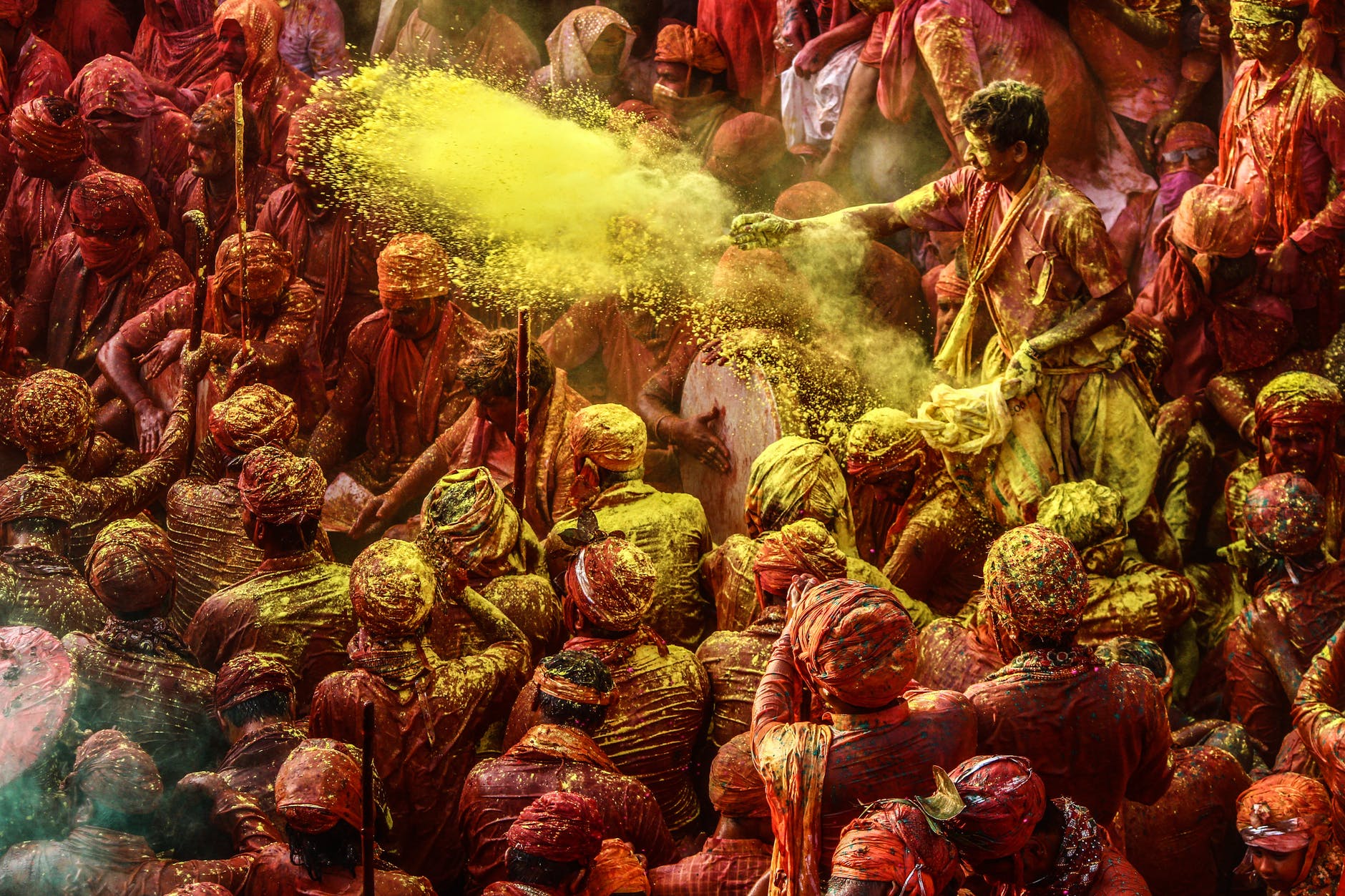
Photo by Yogendra Singh on Pexels.com

Hindu Culture is filled with joy, teaches a better way of living, Unites the people, Gives freedom to worship the god that their devotees believe, and always wanted people to live in a better place with their family and to enjoy the worshipping.

Sources And Links:

https://www.history.com/

https://www.britannica.com/topic/Hinduism

NOVAL APPROACHES TO BUILD A STRTUP TEAM FOR AN AGILE WORLD

Start ups are different from large established companies .So in order to thrive in technological world the corporate culture must be changed from traditional mind set to agile mind set. So, in order to change the traditional cultures of start ups they must need a perfect team which converts the entrepreneurial ideas into reality. Corporate culture has been changing extensively from the last two decades on wards with its instinctive technology, salary package and benefit factors. In todays competitive situations every startup or an established company must have a team with agile mindset.

WHAT IS AN AGILE MINDSET?

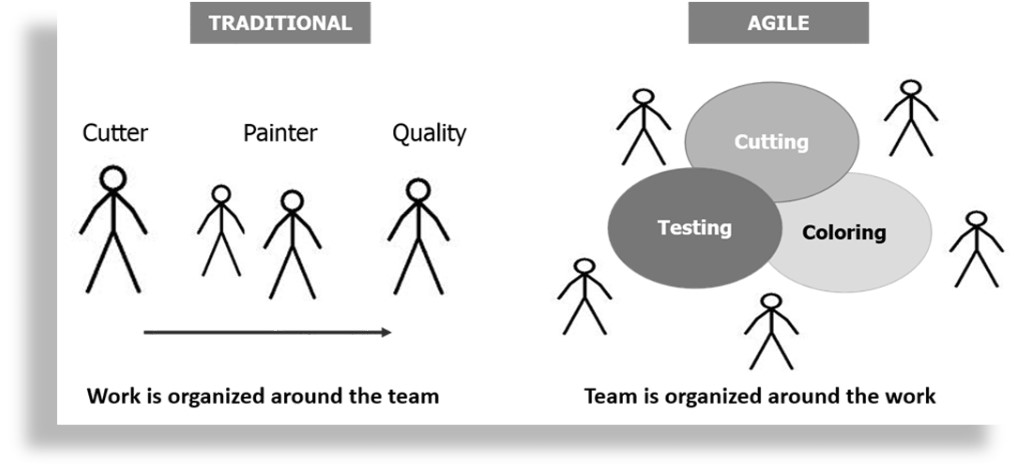
The Agile Mindset is a movement away from traditional, which avoids the bureaucratic leadership like which can involve office politics and a “whoever is loudest is right” mentality. Instead, the agile mindset keeps ego aside from the teams and focus on what is right, instead of who is right. This agile methodology was emerged in 2001 for the development of software practices by providing more reliable workspaces and improved management but now it is a globally embraced framework and mindset which enables business to be better in almost every field with its viability of vision.

THE CHARACTERISTICS OF AGILE MINDSET ARE AS FOLLOWS:

PRINCIPLES OF VISION TO VIABILITY FOR AN AGILE TEAM ARE AS FOLLOWS:

Keeping the above picturized principles in mind which can help a start up to build a perfect team to become more open-minded to the agile mindset approach. These are the core values which helps to nurture more efficiency in teamwork.  This methodology can be used for our personal development also, in order to determine the clear goals or achievements that we want to reach. Now, let’s have an idea about ” How to build an agile team ? “

THE SEVEN MAJOR VISIONARIES TO BUILD AN AGILE TEAM IS AS FOLLOWS:

1 ATTRACT AWSOME TALENT: Try to choose every individual with complementary skills who share the excitement for the company vision. So that they give their best for growth of the company.

2 CREATE FOCUSED & ALIGNED TEAMS: Companies should create the teams which concentrate on the key initiatives to meet the desired goals and achievements of the company.

3 CREATE A LEARNING ORGANISATION: The team must posses the flexibility to manage or make some adjustments to the plan to avoid un necessary risks.

4 BUILD A COHESIVE TEAM: Building a cohesive team adds a marks to the company because this type of team celebrates the collective win over the individual gain and learns from the failure.

5 BUILD A TEAM TO EMBRACE THE DIFFICULT DECISIONS: The team must address the mistakes that has been done previously or during the running project and should change them according to needs of project growth.

6 Foster a culture into the team which can embrace flexibility and also to thrive in good time or bad time.

7 Give an allow for both GEN Y and GEN Z categories in order to tap the high performance energy and fresh thinking ability.

Finally, founders or HR’s of the start ups must cross check all the abilities in hiring a person. Try to maintain some techniques while hiring a person i.e give priority to the aptitude over the experience because fresh thinking always enhances better results and look for the passion in the candidate who want’s to join in the company. Always remember that hiring persons from different cultures can give a strong grip to the foundation of a start up because diversity creates better decisions and the most important thing in hiring process is constantly polishing the way of hiring. Try to look for the culture “FIT” and always be recruiting so that we can form the best teams than the previous once which helps in the growth of the company.

Stress Management

Nowadays people have become fascinated about their money and beauty but they are not giving due care to their mental health. Stress is a mental tension caused by demanding ,taxing , burdensome circumstances and our increasingly busy lives.A life full of stress is something which is not acceptable and desirable by a person because when a person is in stress the hormones called CORTISOL and ADRENALINE are released into the blood stream thereby suppressing the functioning of the immune, digestive and reproductive system.

Also we need to understand every stress is not considered the bad one because stress is actually the survival response, when our body thinks that it is in danger it is also called as fight or flight response. The problem arises when the situation is constantly prevailing causing stress in the lives and a person don’t know how to manage it. That’s why stress management is tremendously important for our health, quality of life and relationships.

Migraines due to stress

Ways to Overcome Stress

1- Avoid Caffeine , Alcohol and Nicotine:

Many people try to overcome their stress by consuming alcohol , nicotine and rich in caffeine drinks but this is the big mistake people are committing which needs to be stopped first. Caffeine and Nicotine are stimulants which increases the level of stress rather than reducing it. Also alcohol is not ultimately helpful as it is a depressant when consumed in large quantities and a stimulant in small quantities. Herbal and other natural drinks must be consumed for keeping a person hydrated and to avoid these harmful stimulants.

2-Get more sleep:

Sleep plays an important role in maintaining a well being of an individual both physically and mentally. Lack of sleep is also an ultimate cause of stress. The environment of the bedroom must be calming and relaxing for a person so that they can have a sweet sleep also it is important to make sure that the bedroom is a tranquil oasis with no items of causing stress. There must be a fixed schedule for a person to sleep everyday so that the body get used to a predictable bedtime routine.

3-Talk to someone:

Communication allows a person to either distract them from their stressful situations or helps in reducing the built up tension by discussing it . In most of the situations a good friend and a colleague or a family member can guide us in a better way and also can provide us with the best solution for our stress.

4-Stress Diary:

In order to overcome stress the most significant thing is to understand what is the situation causing it so a person must have to maintain a stress diary in which they can write about their feelings and different situations along with their date ,time and the people they were with . This will eventually let them know what triggers them. It is basically a effective stress management tool to avoid stressful situations and to handle them with ease.

5-Physical activities:

Accompanying the daily life with proper exercises ,games and meditation will also help in avoiding stress as they can be used as a surrogate to metabolize the excessive stress hormones and restore the body in more calm state.

Muhammad-bin-Tughlaq

The Tughlaq administration, also called as Tughluq or Tughluk dynasty, was a Muslim line of Turkey which managed over the Delhi sultanate in medieval India. Its rule began in 1320 in Delhi. Ghiyasuddin Tughlaq was the first ruler of this dynasty. Khusrau Khan, the last ruler of the Khilji administration was executed by Ghazni Malik. Slave dynasty was the one which mark the beginning of delhi sultanate.

He was intellectual of reasoning, philosophy, astronomy, mathematics, calligraphy and physical sciences. He had good knowledge of various languages such as Turkish, Sanskrit, Persian and Arabic. The famous traveller Ibn Battuta visited India during his reign.  He was a liberal king who believed in equality. He gave freedom to Hindu as well as Jains.

Reforms- Taxation in the Doab: The Sultan made a stupid budgetary examination in the Doab between the Ganges and Jamuna. He expanded the rate of duty as well as restored and made some extra Abwabs or cessess, Transfer of Capital (1327): It seems that the Sultan needed to make Deogir as his second capital so that he may have the capacity to control south India better. Deogir was renamed Daulatabad. After two or three years, Muhammad Tughlaq chose to forsake Daulatabad basically on the grounds that he soon found out that he couldn’t control south India from Delhi and he couldn’t control north from Daulatabad, Introduction of Token Currency(1330): Muhammad Tughlaq chose to present bronze coins, which were to have the same worth as the silver coins. Muhammad Tughlaq may have been effective in the approach if he could keep individuals from moulding the new coins, Khurasan Expedition: The Sultan had a dream of widespread victory. He chose to win Khurasan and Iraq and activated a gigantic armed force for the reason. Be that as it may, his campaign demonstrated a disappointment, Quarachi Expedition: This campaign was propelled to counter Chinese attacks. It likewise gives the idea that the campaign was coordinated against some headstrong tribes in Kumaon-Garhwal district with the objective of bringing them under Delhi Sultanate.

He died in Thatta while battling in Sindh against Taghi, a Turkish slave.

Balance diet

What is a balanced diet?
A balanced diet gives your body the nutrients it needs to function correctly. To get the nutrition you need, most of your daily calories should come from:

fresh fruits
fresh vegetables
whole grains
legumes
nuts
lean proteins

What to eat for a balanced diet
A healthy, balanced diet will usually include the following nutrients:

vitamins, minerals, and antioxidants
carbohydrates, including starches and fiber
protein
healthy fats

balanced diet will include a variety of foods from the following groups:

fruits
vegetables
grains
dairy
protein foods
Examples of protein foods include meat, eggs, fish, beans, nuts, and legumes.

Food groups in your diet
eat at least 5 portions of a variety of fruit and vegetables every day (see 5 A Day)
base meals on higher fibre starchy foods like potatoes, bread, rice or pasta.
have some dairy or dairy alternatives (such as soya drinks)
eat some beans, pulses, fish, eggs, meat and other protein.

Little about Jesus Christ.

The cross- symbol of God’s love to people.

Jesus Christ is the central figure of Christianity. He was born at Bethlehem; Judea in Roman empire in 4-6 B.C and his mother was Mary. The Christians traditionally believe that Jesus was born of a virgin, performed miracles and founded an independent religious movement. The majority of Christians worship Jesus as the incarnation of son of god, one of three divine persons of a trinity. A few Christian groups, however, reject trinitarianism, partly or wholly, taking it to be non- scriptural. The principal sources of information regarding Jesus are the four canonical gospels, and most critical scholars find them useful for reconstruction the life and teachings of Jesus. Some scholars believe apocryphal texts such as the gospel of Thomas and the gospel of Hebrews are also relevant.

Later on, the Bible has been divided into two parts- the Old Testament (before Christ) and the New Testament, containing the life of Jesus and principles of Christianity. In Islam, Jesus (transliterated in Arabic as Isa) is considered one of God’s prophets, and the product of a virgin birth; but do not believe that he was God incarnate.

Most of the historians agree that Jesus was a Jew regarded as a preacher and healer, and was crucified between the age of 33-36yrs in Jerusalem on the orders of the Roman Prefect of Judaea, Pontius Pilate, on charge of sedition against the Roman Empire. His date of death was 30-33 A.D.

Population explosion and its problems

population is a very serious and underrated issue in todays life. Its need to be considered and handled as soon as possible. the population of whole world is estimated around 7.5 billion, which is a huge number.it has its own advantages and disadvantages.

Photo by Oscar Chan on Pexels.com

the biggest problem we are facing is population explosion. Population explosion is sudden or sharp increase in number of people in an area . due to which we face lot of problems such as poverty, unemployment migration of people from rural to urban areas due to less facilities, shortage of food items, low standard of living and many other effects.

causes of population explosion

There are many causes of population explosion some of them are listed below:-

  1. The most important reason of the huge population explosion is Birth rate. The rate of birth rate is very high.it is due to many reasons such as lack of awareness and knowledge among people .especially in our country India .The rate of birth rate is very very high and some of the main reason is people are very fond of having a male child ,joint families ,infant mortality rate and many other reasons.

2. Falling death rate of human beings is also a big reason of such increase in population . Medical sciences have discovered many medicines (vaccines and antibiotics) and treatments through which human life has been increased significantly.

3.Poverty in developed countries is one of the reasons of population explosion.it is because it is considered that having more children means an extra chance of earning more when he/she will be grown up.

These are few causes of popuation explosion.

Problems due to population explosion

This sudden increase in population will definitely have some serious issues, some of them are:-

1 .More increase in population will result in more demand of food, healthcare, water, transportations housing and many other things. that will be impossible at one point if we will not do something to stop it.

2. The more population will result into more violence and conflicts in different parts of world.

3. Deforestation:- we all are aware of the term deforestation population is increasing day by day we need more land or area to live and it can only be accompished by cutting trees (forests).due to which our ability to take carbon dioxide decreases. Due to deforestation, wild animals and species are also suffering .

4.global warming :it is due to the burning of greenhouse gases. As population is increasing ,fossil fuels have a large impact in industrial societies when these fossil fuels (coal ,gas and oil) are burned they give carbon dioxide in huge amount and other greenhouse gases such as methane, carbon monoxide etc, which also leads to depletion of fossil fuels.

these are some few problems associated with population explosion which are creating a lot of problem for human beings.

Actions that can be applied to solve this problem

According to united nation, the population of world will be 10.8 billion by 2100.This is a very huge number and we do not know whether we will be able to tackle that difficulties in future.

strategies should be made to control population explosion that should include making public realize about consequences of overpopulation like it will decrease the quantities of basic needs of life .Employment rate should be increased as much as possible, family planning should be made, medical facility should be good in developing nations and there are many other measures that can be taken to control population explosion.

What is World Trade Organisation ( WTO ) ? ( History , Objectives , Principles , Structure )

The World Trade Organisation is the successor of General Agreement on Tariffs and Trades (GATT ).
The WTO Agreement is the Uruguay Round agreement where the original GATT is now part of the WTO Agreement which came into force from January 1,1995.

WTO is a multilateral organisation .It has its headquarter in Geneva , Switzerland. It is the central body that facilitates global trade .


It is the only international organization that deals with global rules of trade between nations.
It provides a framework for conduct of international trade in goods and services.


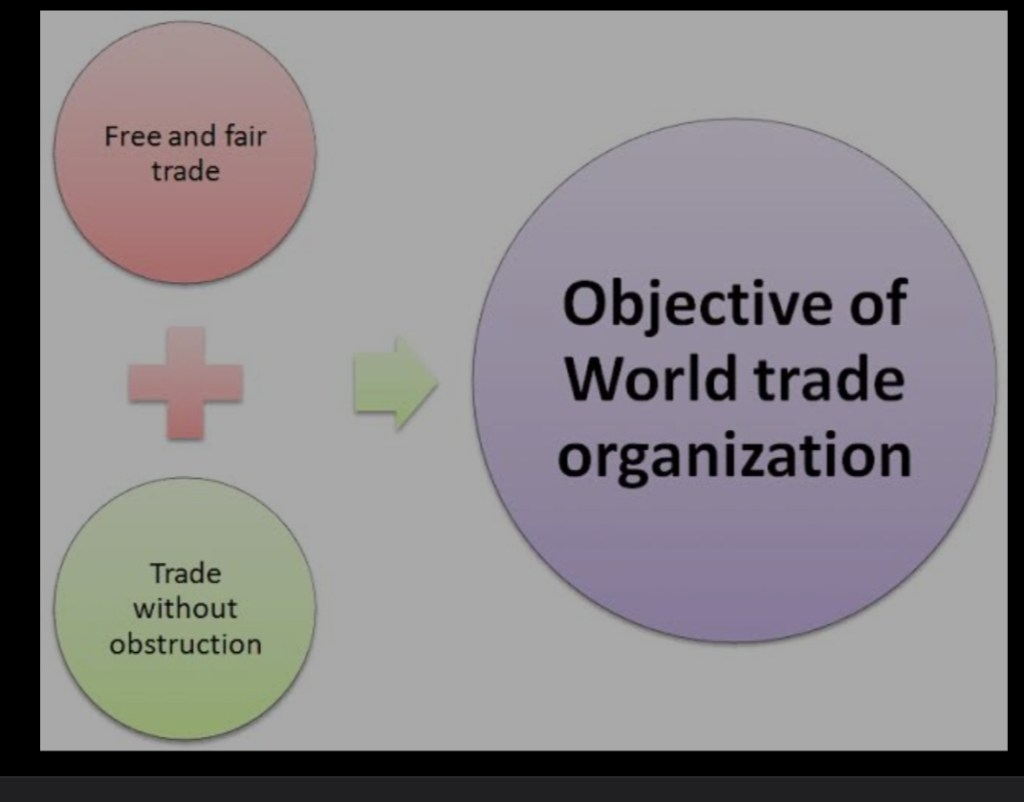
The fundamental objective of the rule-based system of international trade under the WTO is to ensure that international markets remain open and their access is not disrupted by the sudden and arbitrary imposition of import restrictions.


It lays down the rights and obligations of governments in the set of multilateral agreements.
It also covers a wide range of issues related to international trade, such as protection of intellectual property rights and dispute settlement, and prescribes disciplines for governments in formulation of rules, procedures, and practices in these areas.


Structure of WTO

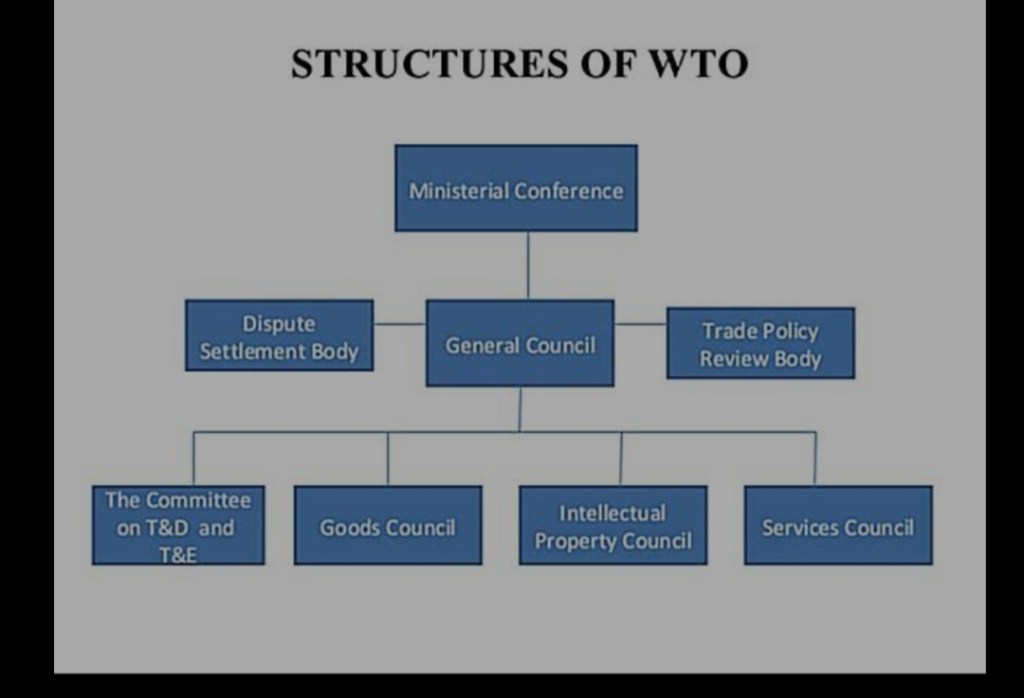
The structure of WTO is headed by the Ministerial Conference composed of representatives of all members which meet at least once every two years.
It carries out the functions of the WTO and takes actions necessary to this effect .

The Ministerial Conference is the supreme authority of the WTO .
The Ministerial Conference operations by different authority bodies.

General Council composed of representatives of all members to oversee the operation of the WTO Agreement and ministerial decisions on a regular basis. It also acts as a Dispute Settlement Body (DSB) and a trade policy review body (TPRB) ,each having its own Chairman.

The Director General , who is the secretariat head of WTO . The Ministerial Conference appoints the Director General and sets out his power duties , conditions of services and term of office. The Director General appoints the members of Staff of the Secretariat and determines their duties in accordance with the regulations adopted by the Ministerial Conference.

There is the Council of Trade in goods , The council for Trade in Services and the Council for Trade Related Aspects of Intellectual Property Right (TRIPs) which operates under the General Council .

Principle of WTO

Five important principles of WTO are :-

Non-discrimination
Reciprocity
Binding and enforceable commitments
Transparency
Safety values

___________________________________________


Objectives

The Preamble of the organisation , The Agreement establishing the WTO lays down the following objectives :-

• It’s relation in the field and economic endeavour shall be conducted with a view to raising standards of living , ensuring full employment and large and steadily growing volume of real income and effective demand and expanding the production and trade in goods and services.

• To allow for the optional use of the world’s resources in accordance with the objectives of sustainable development , to protect the environment and to enhance the means for doing so in a manner consistent with respective needs and concerns at different levels of economic development.

• To make positive efforts designed to ensure that developing countries , especially the least developed among them , secure a share in the growth in international trade commensurate with the needs of their economic development.

• To achieve these objectives by entering into reciprocal and mutually advantageous arrangements directed towards substantial reduction of tariffs and other barriers to trade and the elimination of discriminatory treatment in international trade relations.

• To develop an integrated , more viable and durable multilateral trading system encompassing the GATT , the results of past liberalisation efforts and all the results of the Uruguay Round of multilateral trade negotiations .

• To ensure linkages between trade policies , environment policies and sustainable development.

___________________________________________

Functions :-

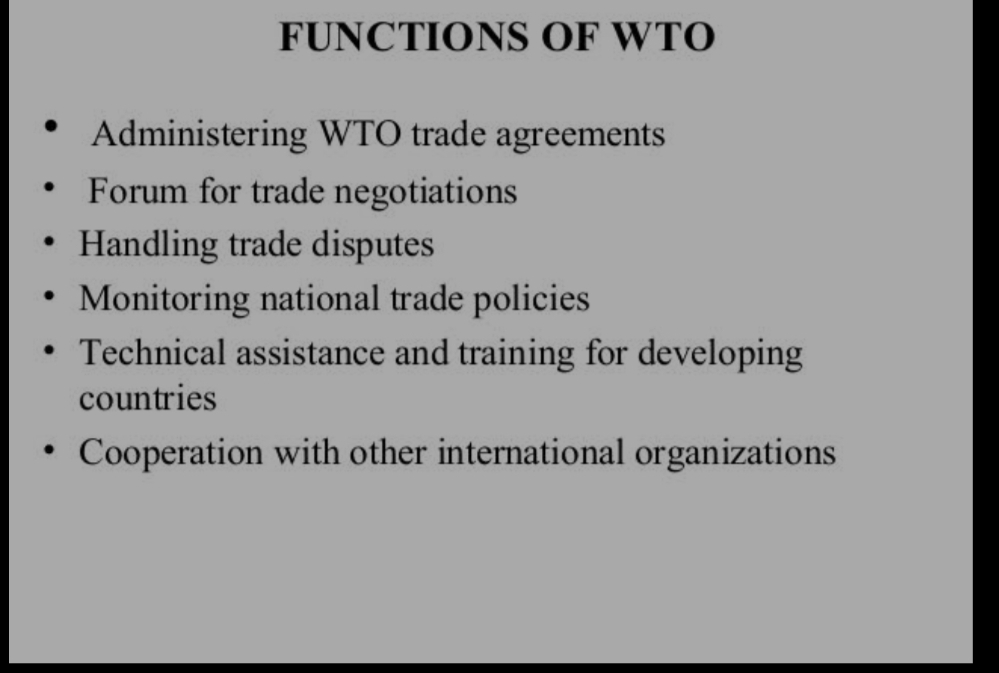
The main functions of WTO are :-

1. To facilitate implementation, administration and operations of the objectives of the Agreement and of the Ministerial Trade Agreement.

2. To provide the forum for negotiations among its members concerning their multilateral trade relations , in matters relating to the agreements .

3. To provide a framework for implementation, administration and operation of multilateral and bilateral agreements of world trade.

4. To administer the understanding of rules and Procedures governing the Settlement of dispute .

5. To ensure the optimum use of world resources.

6. To assist international organizations such as, IMF and IBRD for establishing coherence in Universal Economic Policy determination.

___________________________________________


WTO Agreements

The Agreement establishing WTO consists of the following :-

1: Multilateral Agreements on Trade in Goods :

The general agreement on trade in goods defines the GATT 1994 and includes various agreements dealing with Different aspects related to trade in goods.

• GATT Rules 1994
,•Agreement on Agriculture
•Agreement on Textiles and Clothing
•Agreement on Technical Barriers to Trade
• Agreement on Trade Related Aspects of Investment Measures ( TRIMs)
• Agreement on Anti – Dumping


2: General Agreement on Trade in Services .

This agreement covers all Internationally traded services .It also sets out special conditions relating to individual sectors .

In financial services , it establishes the right of governments to take appropriate measures for the protection of investors , depositors and policy holders to ensure integrity and stability of the financial system.

In telecommunications ,the Agreement requires a Member to establish , construct , acquires ,lease , operate or supply telecommunications transport networks and services and make it available to the public

The GATS also contains consultations and dispute settlement and the establishment of a Council on Services.


3: Agreement on Trade – Related Aspects of Intellectual Property Right ( TRIPs) .

The TRIPs covers seven categories of intellectual property –

• Copyright and Related Rights.
• Trademarks
• Geographical Indications
• Industrial Design
• Patents
• Integrated Circuits
• Trade Secrets

This agreement refers to controls of anti competitive practices for developed countries to bring their legislation and practices into conformity for the implementation of TRIPs.


4:. Understanding on Rules and Procedures governing the Settlement of Disputes.

This agreement applies to consultations and the settlement of disputes between Members concerning their rights and obligations under the provisions of the Agreement establishing the WTO .
For this, a Dispute Settlement System was established .


5: Plurilateral Trade Agreement .

This agreement consists of the Agreement on Trade in Civil Aircraft , Agreement on Government Procurement , International Dairy Agreement and International Bovine Meat Agreement . The first Agreement was made at Geneva in April 1979, as subsequently modified , rectified or amended . The latter three Agreements were done at Marrakesh on April 15,1994.


6: Trade Policy Review Mechanism.

The TPRM aims to carry out reviews of the trade policies and practices under the Multilateral Trade Agreements and the Plurilateral Trade Agreements for the smoother functioning of the multilateral trading system.To operate this purpose , Trade Policy Review Body ( TPRB) was established. For better transparency each member reports regularly to the Trade Policy Review Body about the trade policies and practices pursued by it .

__________________________________________

Entrepreneurship Development

Entrepreneurship is the ability to develop, organize and run a business enterprise, along with any of its uncertainties in order to make a profit. Entrepreneurship is basically the act of creating a business or businesses while building and scaling it to generate a profit. It’s about building a life on your own terms. No bosses. No restricting schedules. And no one holding you back.
Entrepreneurship development is a process of developing certain skills in an individual which are required to make him/her a successful entrepreneur. The success of an entrepreneur can be judged by success of his project or business. Finding a way to sell oneself before anyone believes in one or ones business, being able to explain and prove why their product or service is worth the price or investment, knowing when something is valuable, even if no one else does etc. are some of the features a successful entrepreneur possess.
Big successful companies like Microsoft, Google, Apple etc. have all attained the status they have now because of their respective entrepreneurs. Success of such start-ups not only benefits the people associated with it but also the economy as a whole. It slowly changes the world. Off course not every start up is a massive hit, some might be pretty mediocre and some might even do more losses than gains but nevertheless in the contemporary world, the need and urge for entrepreneurship development has drastically increased.
There are certain characteristics which are observed in entrepreneurs who write big success stories. These characteristics are a prerequisite for becoming a successful entrepreneur. The first and foremost skill is creativity. It means thinking out of the box. Coming up with new ideas, being open to new methodologies, creating something new etc. are some examples of being creative. Creativity gives birth to Originality. Risk taking is another characteristic of a successful entrepreneur. Without the will to explore the unknown, one cannot discover something unique. Risk-taking involves a lot of things. Using unorthodox methods is also a risk. Investing in ideas, nobody else believes in but you is a risk too. Good entrepreneurs are always ready to invest their time and money. But, they always have a backup for every risk they take.
Planning is another characteristic and probably the most important one. They say “If you fail to plan, you plan to fail.” Planning is strategizing the whole thing ahead of time. It basically sums up all the resources at hand and enables one to come up with a structure and a thought process for how to reach ones goal. It involves how to make optimum use of these resources. Facing a situation or a crisis with a plan is always better. It provides guidelines with minimum to no damage incurred to a business.
Other characteristics include passion for the work or business one choose to do, professionalism in the way the work is done, knowledge of the field of work or business, social skills including relationship building. An entrepreneur must be open minded towards learning, people and even failures.

https://www.jbcnschool.edu.in/blog/characteristics-of-an-entrepreneur/

https://www.entrepreneur.com/article/250564

CSR at Cafe Coffee Day

Corporate social responsibility, often abbreviated “CSR,” is a corporation’s initiatives to assess and take responsibility for the company’s effects on environmental and social wellbeing. The term generally applies to efforts that go beyond what may be required by regulators or environmental protection groups.

As the business environment changes, customer’s expectations from a company also change. Nowadays, Customers prefer brands that are socially responsible and give back to the society. Let’s take a look at CSR initiatives taken by the Cafe Coffee Day, one of India’s leading coffee brands.

CSR goals at Cafe Coffee Day

  1. Improving livings standards for communities through increasing employment opportunities- CCD believes in working for the people, and working with the people. It ensures that it creates new employment and livelihood opportunities for millions across the globe. This is done through direct employment and contracts, as well as through inclusive business opportunities.
  2. Enhancing the health and wellbeing of communities– It works with communities at large and aims to help them become healthier and happier.
  3. Reducing environmental footprint– It works towards reducing its environmental footprint by ensuring that it allows the legislation regarding carbon production and release. It works towards designing operational processes that reduce water and land pollution. All products manufactured and distributed come with a disposal method to reduce wastage, and increase recycling.

Corporate social responsibility is an integral part of CCD’s operations. They are committed to offering ethically purchased and responsibly produced products of the highest quality, and serving quality coffee that is responsibly grown and ethically traded. They facilitate UTZ and Rainforest certification for their major coffee supplier’s estates. The UTZ Code of Conduct is a recognized global ‘decency’ standard for coffee and production criteria for socially and
environmentally appropriate growing practices and efficient farm management techniques. The Rainforest Alliance works to conserve biodiversity and improve livelihoods by promoting and evaluating the implementation of the most globally respected sustainability standards in a variety of fields which are designed to generate ecological, social and economic benefits. CCD aims to create the most value in the following aspects:

  1. Nutrition- The primary focus remains on ensuring health safety for children and infants.
  2. Water- It administers all its internal sewage plants to dispose of waste optimally without risking water life.
  3. Air Cleansing- The company also takes responsibility for ensuring that all its industrial sites and operations are placed away from residential areas to reduce maximum exposure of plant operations to the public.
  4. Rural Development– It created varied employment and livelihood opportunities for these communities to help them raise their living standards and quality of life.
  5. Protecting water- With the high scarcity of clean drinking water, CCD works and strives to provide communities with clean drinking water through having installed filter plants.
  6. Protecting natural resources- It ensures that all its operational sites are designed in a way that they do not harm or risk the natural ecosystem. In addition, the company works towards protecting the environment by building green spaces.
  7. Safeguarding the environment- The operations of CCD, like other players in the industry, are being affected by the climatic changes, and the weather alterations. To fight this change, and to safeguard the environment, CCD works towards creating safe green spaces through high rate plantations. This is to ensure environmental sustainability and
    enrichment of the ecosystem.

Commitments made by CCD

Commitments at CCD have helped shape its CSR and CSV approach based on multiple trends from across the globe. These commitments have helped maintain focus in giving back to the community as well as in developing a more sustainable environment and workplace. Commitments are the long-term goals that CCD wants to fulfil and
achieve in the following different aspects:

  1. For individuals and families
    Living healthier lives– Helping individuals attain a balance between healthy nutrition and physical exercise as a means of a healthier lifestyle and healthy living. With today’s work style and busy schedules, this is quite a challenge. 
    Having Nutritional Knowledge- CCD works with the long-term aspiration of enhancing the lifestyles of communities. The company plans to do it by sharing information regarding nutritional facts, and by raising awareness of nutritional intake.
  2. For Communities

Rural Development– It works towards developing rural communities-especially where it is operational and present. The company engages not only in employment creation but also infrastructure development and education deployment programs to help communities improve their living standards.
Promoting Diversity– It works towards inclusion through its diversity programs. The company has designed programs and policies to ensure the inclusion of all community groups in the employment cycle. In addition, the company also conducts training and skill enhancement sessions for all community groups including disabled and special persons.

Finding the potential in coffee is a key part of success. Similarly, CSR activities focus on finding
the potential in the people, society and environment.

TRAINING
CCD works through a unique partnership model wherein they have established strategic partnerships with various training bodies, non-governmental organizations, and government and leverage their relationship to provide skill training and employability to the under privileged. In states like Jammu and Kashmir and Orissa, they have provided self-improvement and vocational training to youth.

DIFFERENTLY-ABLED EMPLOYMENT
Coffee Day Global has also tied up with NGOs such as “Enable India” to work out avenues to employ more differently-abled people. Over 150 speech and hearing-impaired people are employed at their cafés, popularly called as “silent brew masters”.

WATER, SANITATION AND HYGIENE
During the manufacturing process and value additions, Cafe Coffee Day maintains an emphasis on water, sanitation and hygiene. All plants and manufacturing units operated by Cafe Coffee Day have an authorized sanitation system in place which ensures minimal water wastage. Besides, all industrial waste is disposed of off through authorized channels only ensuring that no natural water body and water source is harmed or polluted.

NATURAL RESOURCE STEWARDSHIP
Cafe Coffee Day is also an active pioneer of natural resource stewardship. Cafe Coffee Day has devised ways to ensure that natural resources are sustainably used for industrial operations, and are not damaged during business processes. Cafe Coffee Day shares this knowledge publicly for the overall welfare of the environment and the planet.

WOMEN EMPOWERMENT
During its manufacturing process, Cafe Coffee Day also ensures to employ women labour in various managerial and operational level jobs. These women are usually from local communities and are trained for new skill development and enhancement. In doing so, Cafe Coffee Day ensures that women are equipped with the confidence and decision-making abilities that they advance not only in their professional but also in their personal and social lives.

ANIMAL WELFARE
In all its sourcing, CCD ensures that no animals are harmed. CCD makes sure that all animals are fed high quality fodder, and that they are kept in a clean and safe environment. In addition, it also provides safe breeding grounds for
animals and regularly authorizes veterinary check-ups for all animals in partner farms.

HUMAN RIGHTS
CCD is also particularly careful to ensure that all human rights are upheld in its business operations. This
includes no child labour, and inclusive diversity, amongst other things. Also, the business operations of CCD also include high dependence on local workers for labour and management, making sure all local and global human rights are followed thoroughly.

CCD changing lives with Education and Employment

· Their social transformation initiatives are led by SVGH Vocational Training College (VTC) at Chikmagalur, Karnataka and are fully funded by their Promoter. VTC seeks to promote education to economically underprivileged rural youth and supporting them to be independent, responsible and adaptable to urban environment. VTC has trained over 2,500
students, many of whom have since joined CCD Group companies, including Coffee Day Global’s outlets across the country. The entire expenses of the course which includes imparting education, providing food and accommodation, uniforms and transport facilities is borne by VTC.

· The institute provides free education and training to youngsters, with all their expenses being covered by the chairman’s trust. The chairman and founder, V G Siddhartha, was keen to create employment for the rural youth, so that they could lead a productive life and contribute to society. A large number of youths were unemployable due to skill gaps, so it was decided to offer hotel management courses at Yuva (their vocational training institute).

· The institute provides a one-year course in hotel management, which includes six months of theory and six months of internship, where students get an on-the-job experience. Apart from hotel management, the institute also provides courses in audit, micro-finance, supply chain and culinary skills, which depends on the needs and demands of the organisation.


· It provides them an opportunity for personal and professional development thereby equipping them with skills to handle the rapidly changing environment. The college has trained 1180 students many of whom have found employment at CCD outlets across the country. Courses offered include Certificate Course in Hospitality Management & Micro Finance. The Trust bears the entire expenses of the course which includes imparting education, providing food
and accommodation, uniforms and transport facilities. The trained students are guaranteed employment. Current employees are involved actively in SVGH programs and help by conducting modules etc.


· “Communication skills are critical to success in customer-service roles and there is a strong commitment to building job-ready skills.” The focus has been on right skilling and reskilling to keep pace with the dynamic market needs. They aim to groom students who can think, ideate, solve problems, communicate and collaborate. They also provide specialisation studies to the students in the last quarter of the course, so as to place them in various roles at CCD in
accordance with their skills. Placements are done within the organisation. By providing quality education and employment to these students, the organisation is changing their lives and offering them a great career path. 


· Every year, around 350 students pass out from the institute and are employed by the organisation. Almost all of them are hired by Café Coffee Day. This kind of programme also creates loyalty in the minds of the employees and they are likely to stick around for a longer period of time.


· Providing a good career path, professionalism and quality skill training, the institute— which had taken birth as a simple CSR activity—is changing the lives of its students and their families. This is the best way to not only educate the underprivileged but also provide jobs to those who actually need them.


BRITISH INFLUENCE ON URBANIZATION IN INDIA

INTRODUCTION

India shares a long history of urbanization, with Indus Valley Civilization dating back to 2350 BC as its first stepping stone towards urbanization. After this and post-independence period, with the emergence of Planning Commission, India witnessed the urbanization which it had never seen before. And this period marks the progression and flourishing of urbanization in India. However, cities in India have been urbanized in number of phases. The urbanization history in India has 5 different phases (given by historians) :

  1. The Pre – Historic Period (Indus): 2350 – 1800 BC
  2. The Early Historic Period (Aryans and Dravidians): 600 BC – 500 AD
  3. The Medieval Period (Mughal): 600 – 800 AD
  4. The British Period: 800 AD – 1947
  5. Post Independence Period: 1947 – till date

URBANIZATION IN BRITISH PERIOD

The British came to India in 1858 when India was one of the most urbanized nations due to Mughal supremacy. But in the early phase of British rule, Indian cities witnessed decline in the level of urbanization and during the later phase of British rule, the Indian cities regained the lost importance and new towns and cities emerged and newer urban form was added to existing cities.

Fort St. William in Calcutta is one of the best examples of factories constructed during British Era and fortified for protection.

URBAN DECLINE IN 19TH CENTURY

The main reasons for urban decline during the British Period were:

  1. Lack of interest in British in economic development, prosperity and growth of India and their negative attitude towards the traditional industries of India which were present during that period.
  2. The alteration of urbanization in India due to the industrial revolution in England.
  3. The diversion in existing trade routes due to sudden growth and building of rail networks.
  4. Disrupted monopoly in trade especially in port towns.

BRITISH CONTRIBUTION TO URBANIZATION SCENES IN INDIA

  1. Emergence of three metropolitan port cities which emerged as leading colonial cities (Calcutta, Bombay and Madras).
  2. Creation of hill stations and plantation settlements.
  3. Modification of urban landscape in existing cities.
  4. Introduction of civil lines, camps and cantonments.
  5. Improvement in connectivity through railways.
  6. Enhanced scope of industrialization.
  7. Improvements in urban amenities and urban administration.

CONCLUSION

British era had both positive and negative impact in India but the extent of positive changes is more. The process of urbanization and building of new cities can be seen as the breaking of the continuum. During British Period, the Indian cities emerged as the focal points of urbanization and westernization. The westernization brought by the British Period continued to guide the destiny of urban elite in India. It helped in transforming the agriculture as a means of commerce by introducing new crops like indigo, tobacco, coffee etc. Thus, British Era can be seen a the period when India came across fundamental economic transition, mechanized industries and developed connectivity through railways and foreign trade. But the British Era didn’t consider the rural – urban conflict which increased the gap between urban and rural areas of India.

Thus, it can be concluded that British rule had definitely been useful in providing the foundation of development and urbanization to India. As per Census 1941, which is the last census before Independence, India had 49 one lakh cities and 2500 urbanized towns. So, when this urbanization is compared to previous trans, it can be seen that the urbanization attained zenith during the end of British period as compared to past events.

žIn 1941, which marks the last census before independence, There were 49 one-lakh cities in India and in all round 2500 urbanized towns. Urbanization attained zenith during end of this period compared to entire past events.

The Beauty of Tierra del Fuego

Tierra del Fuego, which stands for “Land of Fire” in Spanish, is an archipelago or a cluster of islands in the southern most tip of South America. It is located across the Strait of Magellan.  The archipelago consists of the main island, Isla Grande de Tierra del Fuego and a group of many islands, including Cape Horn and Diego Ramirez Islands. Tierra del Fuego is divided between Chile and Argentina and is located close to the perennially frozen continent of Antarctica. Tourism is a major component of the local economy.

Brief History

The History of Tierra del Fuego ranges from settlement of the region by the local Yaghan and the Selk’nam people to it’s discovery by the infamous Portuguese explorer Ferdinand Magellan on whom the strait of Magellan is named after, to Spanish European colonization and the genocide of the natives during the gold rushes in the region.

In recent history, both countries have explored the region for oil extraction and formulated their Antarctic claims. In the 1960’s and 70’s there was even a threat of military conflict looming between the two countries over a few islands which almost led to an Argentine invasion of Chile in 1978. Ths very threat of war caused the Chilean regime of Dictator Augusto Pinochet to give logistical support and information to the British during the Falklands War of 1982.

Geography

The archipelago consists of the main Isla Grande de Tierra del Fuego island. Its westernmost part belongs to Chile and the rest to Argentina. The Chilean part is the region named Magallanes y Antarctica Chilena whose capital is Punta Arenas. The village of Puerto Toro located here is probably the Southernmost village in the world.

The eastern part of the main island, and a few small islands in the Beagle Channel, belong to Argentina. They are part of the Tierra del Fuego, Antarctic territory and South Atlantic islands province. The capital is Ushuaia, whis claims the title of the southernmost city of the World.

Flora & Fauna

Only few Islands here forests which are classified as Magellanic subpolar. Trees like winter’s bark, Lenga beech, Magellan’s beech, Northofagus Antarctica etc are found here.

The most notable animals found here are Sea Gulls, Guanacos, Foxes, Kingfishers, Condors, Penguins, Owls, Austral Parakeets, North American Beavers, Sea Lion, Leopard Seals etc.

https://www.adventure-life.com/patagonia/articles/tierra-del-fuego-culture