History of Internet…

internet is a global computer network providing a variety of information and communication facilities, consisting of interconnected networks using standardized communication protocols. It connects millions of computers together globally, forming a network in which any computer can communicate with any other computer as long as they are both connected to the Internet. the full form of the internet is  Interconnected Network, firstly the Internet has its origin in the efforts to build and interconnect computer networks that arose from research and development in the United States and involved international collaboration, particularly with researchers in the United Kingdom and France.

Fundamental theoretical work in data transmission and information theory was developed by Claude Shannon, Harry Nyquist, and Ralph Hartley in the early 20th century. Information theory, as enunciated by Shannon in 1948, provided a firm theoretical underpinning to understand the trade-offs between signal-to-noise ratio, bandwidth, and error-free transmission in the presence of noise, in telecommunications technology. With so many different network methods, something was needed to unify them. Robert E. Kahn of DARPA and ARPANET recruited Vinton Cerf of Stanford University to work with him on the problem. By 1973, they had worked out a fundamental reformulation, where the differences between network protocols were hidden by using a common internetwork protocol, and instead of the network being responsible for the reliability, as in the ARPANET, the hosts became responsible. Cerf credits Hubert Zimmermann and Louis Pouzin designer of the CYCLADES network and his graduate students Judy Estrin, Richard Karp, Yogen Dalal, and Carl Sunshine with important work on this design.

800px-Internet_map_in_February_82

During the first decade or so of the public Internet, the immense changes it would eventually enable in the 2000s were still nascent. In terms of providing context for this period, mobile cellular devices like smartphones and other cellular devices, which today provide near-universal access, were used for business and not a routine household item owned by parents and children worldwide. Social media in the modern sense had yet to come into existence, laptops were bulky and most households did not have computers. Data rates were slow and most people lacked means to video or digitize video; media storage was transitioning slowly from analog tape to digital optical discs (DVD and to an extent still, floppy disc to CD). Enabling technologies used from the early 2000s such as PHP, modern JavaScript, and Java, technologies such as AJAX, HTML 4, and various software frameworks, which enabled and simplified speed of web development, largely awaited invention and their eventual widespread adoption.

The Internet was widely used for mailing lists, emails, e-commerce and early popular online shopping (Amazon and eBay for example), online forums and bulletin boards, and personal websites and blogs, and use was growing rapidly, but by more modern standards the systems used were static and lacked widespread social engagement. It awaited a number of events in the early 2000s to change from a communications technology to gradually develop into a key part of global society’s infrastructure.

The first Internet link into low earth orbit was established on January 22, 2010, when astronaut T. J. Creamer posted the first unassisted update to his Twitter account from the International Space Station, marking the extension of the Internet into space..) This personal Web access, which NASA calls the Crew Support LAN, uses the space station’s high-speed Ku band microwave link. To surf the Web, astronauts can use a station laptop computer to control a desktop computer on Earth, and they can talk to their families and friends on Earth using Voice over IP equipment.

Communication with spacecraft beyond earth orbit has traditionally been over point-to-point links through the Deep Space Network. Each such data link must be manually scheduled and configured. In the late 1990s, NASA and Google began working on a new network protocol, Delay-tolerant networking which automates this process, allows networking of spaceborne transmission nodes, and takes the fact into account that spacecraft can temporarily lose contact because they move behind the Moon or planets, or because space weather disrupts the connection. Under such conditions, DTN retransmits data packages instead of dropping them, as the standard TCP/IP Internet Protocol does. NASA conducted the first field test of what it calls the “deep space internet” in November 2008. Testing of DTN-based communications between the International Space Station and Earth has been ongoing since March 2009 and is scheduled to continue until March 2014.

As the Internet grew through the 1980s and early 1990s, many people realized the increasing need to be able to find and organize files and information. Projects such as Archie, Gopher, WAIS, and the FTP Archive list attempted to create ways to organize distributed data. In the early 1990s, Gopher, invented by Mark P. McCahill offered a viable alternative to the World Wide Web. However, in 1993 the World Wide Web saw many advances to indexing and ease of access through search engines, which often neglected Gopher and Gopherspace. As popularity increased through the ease of use, investment incentives also grew until in the middle of 1994 the WWW’s popularity gained the upper hand. Then it became clear that Gopher and the other projects were doomed to fall short.

In recent years, it’s become very clear that the internet is key to living in the modern age. Basically, everyone is expected to have an internet connection and everyone is expected to use that internet on a daily basis. The idea of doing something as simple as finding work without the internet is alien to most Europeans. I remember entering a job center in Norway and seeing the staff completely baffled and out of ideas when I informed them I was temporarily out of the internet. I also found it near impossible to manage here without some form of daily internet access, I think everyone who has been without it for more than a day will realize how much they rely on it, not just ‘want’ it.

However, when people think, “free internet” I don’t think they mean “we should have free WiFi hotspots everywhere.” I think they instead mean that you should not have to pay for WiFi to be wired to your house, and you should not be charged by a company to provide you the internet. I agree with this fully, the internet should not be a paid commodity like it’s simply something you can go without, it simply is too important. Like water and electricity, most developed countries monitor these services consistently and try to ensure they’re as cheap as possible, otherwise, the cost of surviving is simply too high, that’s why you can often find electricity and water for rather cheap prices. Internet, however, can be damned expensive, and the packages and contracts that must be signed are sometimes akin to signing a contract with the devil. Sometimes the companies won’t even deliver your modem, or they will purposely throttle you in order to ensure you upgrade your package. Internet providers can be, and often are, thieves, it’s almost completely unchecked.

In 2015, Google started the ‘Station’ program to bring free public Wi-Fi to 400 busiest railway stations in New Delhi, India, Google has decided to gradually wind down the service globally as it believes that better data plans and improving mobile connectivity have made it “simpler and cheaper” for users to get online. Google explained that it took the decision to end the program because it was becoming difficult to scale up and to make a sustainable business. The company had worked with various partners in each market where it offered the Station service, but each had different technical and infrastructure requirements. In India, it worked with RailTel, Indian Railways, and Pune Smart City, for example, while in South Africa it worked with Think WiFi. However, Google isn’t the only company to have tried to make it easier for users in developing markets to get online. Facebook founded the Internet.org project in 2013, and in 2016 it launched Express Wi-Fi In India after its previous internet service was banned in the country.
 

How to attract people in first 90 seconds- Must read!!!

These are the secrets from an amazing book called “How to Make people like you in 90 seconds or less” by Nicholas Booth Man. Likable people are always open, welcoming and friendly in nature and you can notice their sincerity, trust, and self-confidence in their behavior as well, and you can develop all these qualities in yourself by meeting other people in a regular manner. If other people do not find you interesting in first 90 seconds after meeting you, then they would want to get rid of you as soon as possible.

How to Maintain Communication and Culture as a Growing Startup ...

If you want that people like you more, then you have to invest your efforts from the very beginning, and this starts even before you speak a single word from your mouth. Any new person notices three basic things just after meeting you, these three things are your

  1. Body language
  2. Your eyes
  3. Expression on your face

Thus, it is essential that when you meet anyone, these three elements give the feeling of openness to other people. For doing this, you will have to show your interest in them, along with your body, you will have to move your brain as well toward them. This effort will show your sincerity and commitment and openness in the conversation and in them as well after this, you need to see directly in the eyes of other people, this establishes the trust and as soon as you make an eye contact with other person make sure you give a genuine smile to them before they think or assume anything else about you. Let your positive attitude shine with a broad and genuine smile with this simple action, other people will consider you as a genuine, open and sincere person with this simple effort, you already made a warm and welcoming mood for the situation, and now you need to initiate by introducing yourself. You can do that with a standard greeting, like Hi or hello and you must need to do that in a very pleasant tone. Along with that make sure you share your first name to the other person and it will encourage the other person to introduce themselves for example, you can say,….”Hello, I am Akash”. When you say this, then the other person will also share his or her name with you, and as soon as they share their name, you must need to repeat their name like wise you said… “Hello, I am Sahil” you got response… “Hi, I am Sohil” now you have to say, “Sohil, Nice to meet your Sohil.” In his famous book, “How to win friends and influence people,” Dale Carnage shared the fact that the name of any individual is the sweetest sound in the entire world for that person that is why it is essential that you repeat other person’s name in the conversation as much as possible. This method will increase your acceptance and respect, it will also make it easier for your to memorize their name. And finally, you have to lean forward slightly. Just a little leaning would be enough, just like Mr. Obama is slightly leaning forward in this photo.

How To Give A Proper Handshake - Business Insider

Image source: BusinessInsider

With your slight inclination, other people will assume you are showing interested in them, and you are listening to them carefully, also, it will give you a pleasant appearance. Just look at photo and tell who is looking more generous in both of them. Of course, it is Mr. Obama, because he is using this principle.

Studies proved that people hire those people that are similar to them and even most of the time they date people with similar people because they make them feel safe and comfortable. If you try to pay attention, you will find, you enjoy the company of those people who think like you, who behave like you and those who make you feel comfortable. You can be comfortable for them just by synching your voice with their voice. The synching of voice is a very powerful tool in communication skills for this, you need to speak at the same pace as other people are speaking that means if they talk slow, then you should not run fast and second thing, you shall try to use the same tone similar to them. If they are calm and relaxed, and you will speak loudly or with excitement, then it won’t work well for you. You need to use same volume and you need to relax while talking. With this, other people will think you are like them and they will feel more comfortable while talking to you.

photo of people doing handshakes
Photo by fauxels on Pexels.com

In 1979, Dr. Lisa Berkman did a study on 7000 people, and this study lasted for 9 years with this study, she found that people that do not have more social connections or those who do not meet other people, they get ill more often, and it increased their chances of earlier death as well and who meet other people more often, were likely to live longer. So, go and expand your social circle without having any fear, without any complications.


#NoExamsInCovid trends on social media

Covid-19 : Due to the spike in corona cases, students and parents all across the country are demanding for the exams to cancel. A large group of parents filed a petition against conducting CBSE exams in July in pandemic situation in Supreme Court.

HRD Minister Ramesh Pokhriyal conducted review meetings with CBSE, NTA, and the School Education and Literacy department of MHRD. CBSE, NEET and JEE all were supposed to be conducted in July, but corona cases rising rapidly becoming a risky time for students. Amid all these, #NoExamsInCovid are trending over Twitter. Memes are being shared for cancellation of exams.

The student body, National Students’ Union of India (NSUI), has demanded the cancellation of ICAI CA and ICSI CS exams 2020 which are scheduled from July-end to mid-August.

CBSE had informed the Supreme Court that a decision would be made on the CBSE exams in July within June 23.HRD Minister Ramesh Pokhriyal Nishank has been holding regular consultations on the issue, as well as demands for postponement or cancellation of the National Eligibility cum Entrance Test (NEET) and JEE (Joint Entrance Exam), entrance examinations for admission to medical and engineering courses.

Any further postponement in the CBSE’s school Board examinations will also lead to further delays in college admissions and the higher education schedule for the next academic year, said an official. If the examinations are cancelled internal assessment scores may be considered instead, along with the student’s performance in the examinations already completed.

However, students are sharing memes on social idea for expressing their views on exams. We can only wait for further announcements.

FOOD SPOILAGE

Food is considered contaminated when unwanted microorganisms are present. Most of the time, the contamination is natural, but sometimes it can be artificial too.
NATURAL CONTAMINATION occurs when microorganisms attach themselves to foods while the foods are in growing stages.
ARTIFICIAL CONTAMINATION occurs when the food is handled or processed such as when fecal bacteria enter food through improper handling procedures.
CAUSES OF FOOD SPOILAGE:

  1. Growth and Activity of microorganisms – Bacteria, yeasts and molds are microorganisms that cause food spoilage. They produce various enzymes that decompose various constituents of food.
  2. Enzyme activity – Action of enzymes start the decomposition of various food components after death of plants and animals.
  3. Chemical reactions – These are the reactions that are not catalyzed by any enzyme. E.g. Oxidation of fats
  4. Vermin – It includes weevils, ants, rats, mice, birds, larval stage of some insects. Vermin are important due to asthetic aspect of their presence, possible transmission of pathogenic agents and consumption of food.
  5. Physical changes – These include changes caused by freezing, burning, drying, pressure etc.
    SOURCES OF FOOD CONTAMINATION. PHYSICAL SPOILAGE is due to physical damage to food during harvesting, processing or distribution. The damage increases the chance of chemical or microbial spoilage and contamination because the protective outer layer of food is broken and microorganisms can enter through it. CHEMICAL SPOILAGE in food are responsible for changes in the color and flavor of foods during processing and storage. After harvesting, chemical changes begin automatically within foods and lead to deterioration. Every living organism uses specialized proteins called enzymes to drive the chemical reactions in its cell. After death, enzymes play an important role in the decomposition of living tissues in a process called as autolysis (self-destruction) or ENZYMATIC SPOILAGE. MICROBIAL SPOILAGE is due to bacteria, yeasts or molds. They produce various enzymes that decompose various constituents of food. • Besides natural microorganisms, foods can be contaminated with different types of microbes coming from outside sources such as air, soil, sewage water, humans, food ingredients, equipments, packages, insects, etc.

The primary sources of microorganisms in food may include –

  1. Soil and Water – Soil grows agricultural produce and raise animals and birds which might contain several microorganisms. Also, these microbes can multiply in soil and their numbers can be even very high as expected. Fecal materials may also contaminate soils which can act as a source of microorganisms. Sewage water can also contaminate crops with variety of microorganisms when sewage water is used as a fertilizer. So, Sewage must be always treated before using as a fertilizer.
  2. Plants and plant products – The inside tissue of food from plant sources are essentially sterile except for few porous vegetables such as radish, onion and cabbage. Also it has been observed that some plants produce natural metabolites that can limit the presence of microorganisms in those particular foods. Fruits and vegetables contain a variety of microorganisms on their surface and their presence and number depends on various factors such as disease of the plant, storage, etc.
  3. Food utensils – Many different microorganisms can contaminate food utensils from which they can transmit to human body and make them ill if pathogenic. Proper cleansing and sanitization of food utensils is required before serving food in them.
  4. Food handlers – Food handler is a person who touches or handles food. The microorganism may be transmitted from his hand to the food and may be harmful for the person consuming that particular food. The microbes can come from animals or from the environment.
  5. Animal hides and skins – Food animals and birds normally carry various indigenous microorganisms some of which are pathogens and are responsible for food-borne diseases in humans. The number of these microorganisms is less than10/g.
  6. Air and dust – Microorganisms may be present in dust and moisture droplets in the air. The microorganisms which are present in air may be transient or variable depending on the environment. Some pathogenic microorganisms may cause air-borne diseases.

TELEVISION AS AN IDIOT BOX: A PERSPECTIVE

Television in the 20th century emerged as a potent medium of entertainment, information and education. It has a profound way of influencing our thought process, attitudes and beliefs and it all hinges on the amount of television we watch. When children are exposed to this device, initially the box attracts and eventually, it starts distracting. A child develops a fondness for programs and over a while, the tendency to watch for long hours increases. Ultimately a child ends us spending considerable time watching TV. It is a herculean task to strike a balance between physical activities, homework, house chores and leisure time, especially for school going kids. As they devote time to television, striking balance becomes ever tricky, and a child becomes a victim of hyperactivity. With eyes glued to the box, the idiot box holds a child’s attention entirely, cutting him/ her from the rest of the world.

We understand that the environment is a great teacher, and one must move out to learn and explore life. But now that this child is living inadvertently in isolation, alas there rises a threat to overall development. Yes, the world of TV provides numerous experiences; it offers knowledge that otherwise wouldn’t be available to us. Studies also reveal that learners learn faster and better from TV than classroom instruction and even retain information for a longer duration. There’s a catch though- Not all content is suitable to be viewed by children. There is a dramatic increase in violence, coarse language, murder, crime and emotional ‘atyachaar’. Children entering into adolescence and children already in it are quite vulnerable to such feeding. They are uncritical of the information they receive and may commit acts under its influence, which can bring nothing but bad name. In this day and age, there are complaints of poor conduct, antisocial behaviour and aggressive attitude displayed by children at home. Who’s the culprit? The Idiot Box is one of the many things which condition such behaviour in intense viewers.

Wasting time is an inherent shortcoming of TV. Viewer’s reading ability also suffers. There is no benefit to our academic skills and other skills. Children don’t view programs which their parents want either way. Activities like active play outside with friends, eating dinner together with family or reading are compromised. The Idiot box also takes away time, particularly from sports, music, art or other activities that require practise to become skilful.

There are so many points that go against the television:

  1. It increases the spending habit as people want to upgrade to HD connections and also to bigger LEDs. Children wish to game consoles which further adds to the family cost.
  2. It has detrimental effects on a child’s brain. A child, when growing up, may struggle to engage socially.
  3. Book writer Stephen King believes that watching television kills creativity. Many say it shuts down critical thinking. The noise emitted from screens is so mesmerising to kids that it captures their attention entirely separating them from people around.
  4. Interacting with other children and people is essential for personality development. The lesser a child engages with them; difficulty generates, and there are complaints of poor conduct and antisocial behaviour.
  5. There are some instances where overexposure to TV leads to poor grades at school and develops aggressive behaviour.
  6. Too much junk food on TV can mean too much desire for it.
  7. Some people watch it for pass time. What they don’t realise is that becoming a follower of a daily soap can be taxing their mind. All sorts of anxiety, frustration and depression can happen.
  8. TV appeals more to emotions than logic. People watch it more for fun than learning.
  9. TV addicts can feel that they have lost a friend if they prolong their TV viewing.

Even adults can’t escape the magnetic charm of the idiot box. Excessive TV viewing is contributing to sleep problem, behaviour problems, obesity, laziness, and leads to several health issues. A homemaker subject to too much daily soap viewing will not gain much, and even if she does, the chances are that more negativity will be taken than positivity. The Idiot box lastly provides only a monologue; there’s no scope for dialogue. And we humans must reciprocate to learn, to clear our doubts, to move forward in life and to take the right decision. The only idiot delivers one-way communication; therefore, TV is an Idiot box.

What we don’t know about Ocean?

Ocean cover 70 % of Earth’s surface and still we human know more about the surface of the mars than Earth’s oceans,but just about time scientist our making progress but there is still lot of work in targeting the fully-mapping of Earth’s Ocean.The Seabed 2030 Project launched in 2017 have made a progress , the scientist have successfully mapped 19 percent of the Earth’s ocean.The GEBCO_2019 Grid was the first global bathymetric grid released which remarkably collected depth data of 5.6 million squares for the seabed 2030 project.The project is a collaboration between the Nippon Foundation of Japan and GEBCO. This initiative has been assisted by 133 contributors,and partners.The seabed project 2030 target to generate the definite map of the earth oceans so that it can be available to all.

However ,the fulfillment of this project would improve the human understanding about the Earth’s ocean all together with tides and tsunami and even it help in underlying data cables evidently improving data access for everyone .

Let’s start exploring the facts about Earth’s oceans which might you don’t know.

Internet |Undersea Cable

Since most of you might not know that 99 % of International data is transferred by wires at the bottom of the ocean surface.Recently ,Google has announced about its third private undersea internet cable network which will run between Europe and Africa.

Gold in the Ocean

It might make you surprise that according to National Ocean Service, Earth’s oceans hold somewhat about 20 million pounds of gold,but you fortunate to take it since it so diluted that it’s measured in parts per trillion. For over a years scientist are trying to find a way to extract gold from sea water but everything has proven to be pointless.

Marine Life

Marine life is still unexplored by humans .We have only explored 10% of marine life.An estimated 50-80% of all life on earth is found under the Earth’s ocean surface .But there’s a progress ,on average 2000 species are found every year.

Tsunami

Tsunami is a series of wave produced by an underwater earthquake .In 2004 ,Tsunami takes way 230,000 lives in a matter of hours.This was the deadliest tsunami ever experienced .

Ocean helps us breathe

Over more than half of the oxygen come from Earth’s ocean .That’s right .Every time we breathe we should thank oxygen Since 70 percent of the oxygen in atmosphere come from arine photosynthesizers , like phytoplankton and seaweed.

Ocean is really very very deep than that we imagine

The average ocean depth is 2.3 miles.The deepest part of the ocean is known as Challenger Deep and is located below the western Pacific Ocean in the southern end of the Mariana Trench.Challenger Deep is approximately 36,200 feet deep.

In last i want to say save the ocean.Don’t forget it provide to oxygen to survive and they contain 97% of water and moreover it take carbon dioxide from atmosphere hence reduce risk of climate change .To live we need healthy oceans. We have to take precautionary measure from our side.Unfortunately people are becoming careless,over 50% of sea turtles found dead because they are eating lot of plastic .If we want to save marine life ,stop using plastic.Even your small steps will altogether help to make a big change .Encourage your friends and family to help in saving the oceans.

Please let me know your thoughts in the comment below and have a wonderful day.

Read completely

If you are in a thought of reading this ensure that you decide without reading it. If you have already started reading it then ensure to read it completely. Know completely before you speak. Listen completely before you know. You don’t know until you know it completely. The repeated mistake we keep on doing is ‘not listening’. We make excuses to ourselves as though we know everything by knowing something. People hate to listen because it requires lot of patience. People like to speak because its the easiest job ever.You can’t judge a post without completely looking at it.

Do it completely else give up. Knowing half things bothers the most because if we don’t know we shut our mouths. Knowing nothing is better these days. If you have started then don’t stop. We don’t know until we know completely. If you start something end it by finishing it, not by giving up. These habits play a vital role and reflect in every possible action. If you can’t read completely then you can’t write completely, you can’t think completely. You should habituate to do anything completely. Develop the habit of doing the thing in full-fledged manner. Doing for the sake of doing isn’t considered as doing. You should have done it if you were doing it in the past.

Compete to complete the thing that you have started. Perfection evolves through completion. Try to be patient to become perfect. Read throughout because you never know until you read something completely. Nothing goes in vain. Try to read and try to listen from others. Don’t always try to express only from our side. Take the things from the other end as well. Everyone can speak but none listens. A good speaker isn’t always a good listener but good listener is always a good speaker. Things become tough when we speak because we have no control over it. Things become easier when we listen. The attitude of never giving up starts building up from habit of going through something completely. Don’t leave even a little bit of food in the plate. Don’t leave a single chapter for choice in the examination. Leaving a question for choice describes your way of choosing options and waiting for the opportunities to come. We can define one’s character by the way they eat. Even tiniest things matter the most. They decide the way we life and portrays us in such a manner. We may find it crazy but it’s true.

If you stop in the middle you can’t survive till the end. Starting is simple but ending is tough. The fighting spirit and the fire for desire aren’t the things that come instinctly. They have been developed in the course of time. Habituate the actions that are necessary for survival. May not be something regarding your career. But if you try to develop such things which effect your personality and social growth. The most foremost thing that should be developed is the ability to listen. Everyone hears, no one listens. Give yourself a push to succeed in your life. Character is a process not a result. Try to built it with you. The process must be able to change you in such a manmer that it reflects your personality. Focus on one thing because people try to do multiple tasks at same time. Doing multiple tasks is not at all a problem but doing it at parllely doesn’t make sense. The only thing I want you to develop is a habit which eventually turns your character and helps you in buliding personality.

If you have completed reading this post keenly. Completing doesn’t ensure finishing it. If you haven’t read it thoroughly please make sure that you read it again. I don’t expect you to follow all those things I mentioned there. I only expect you to read completely. Not understanding this post is not at all a problem. But reading it completely made you to complete it. You had atleast read this post patiently until you finished. You didn’t end it in the middle or even you didn’t skip the reading. Push yourself to read it completely. Develop the habit of completing which will surely help you. If you are not interested then don’t start reading but if you have started then don’t stop because no one know until he goes completely.

“Questioning the Healthy State of Milk”

Food is the necessity of our life and we cannot live without it for obvious regions. People and our ancestors have travelled distances in search of better and pure food. Food consists of various constituents helpful for our body to grow well and thus perform well. Proteins, vitamins, some fats and fibre along with carbohydrates helps our body to generate its own energy which helps us to perform our day to day activities. Also some of these helps our body to develop a protective shield which is our immune system which do protect us from various harmful bacteria and virus and thus fight them back, keeping us healthy and fit. Humans have been eating various foods for the purpose of taste and dissolved energy sources in them. Milk is one of them and has helped our dynasties to build up the desired strength from it’s richness in desired components. Milk has been the basics of life as soon as a new baby is born. Mammals feed their babies with their own milk initially which not only keeps the new one  feeded but also provides the necessary antibodies and proteins which help him/ her to survive the  new environment and protect them by building a strong immune system

We shifted to animals excreted milk be it cow, goat or sheeps. As we came to know about the nutrition and taste in those dairy products which could be made from these. But with times  people’s mindset has seen a change and have shifted to dairy diets thus food which is not made from dairy products and especially milk. Various controversies have come up and people have made a number of claims which do suggest the negative effects of milk on human health. People have come up with the thought that milk and it’s product causes:

  1. Bones to be brittle
  2. Cancer 
  3. Disease related to cardio
  4. Allergies
  5. Pesticide in these products

There have been researches and studies which do find relation between milk and it’s cancer causing possibilities.These could be breast cancer, or prostate cancer especially.But from different sources and collecting on a wider scale it was found out to be healthier than unhealthy. Rather various studies on a contrary came up with the possibility of how milk can be healthy for cancer patients as it do build a protective wall and immune system.But still the risk of Prostate cancer was seen as they increase the quantity of milk products in their diet with this also is believed to be incorrect by many scientist and food expert, also no significant result could find any relation between milk causing bones to be brittle, cardiovascular disease and many others. But people do believe that these do consist of pesticides as cattle and other animals do feed on them might have them.But The milk or the products we consume are fully tested and purified and all these adultrants are removed from them, thus making it healthier to drink but facts regarding allergies have been found real especially the acne. 

But we know that milk has the desired nutrients, fast, proteins responsible for making our body stronger and healthier. But the other factors which do make these products as suffering is the treatment with cow, as they are impregnated over and over so as to obtain milk from them. Also they are killed when they become non productive to us. But we acknowledge that milk is an important part of our lives and we can not just stop utilizing it. But what could be the other source? Plant based milk is a good option, which includes soy milk  and has equal constituents like those of normal milk. There are other sources like almond, coconut and many more. But there are some other ways to make milk also. Various technologies and machines have come up which can prepare alternative milk and identical to the dairy ones this is done by fermentation and gene modifying bacteria. 

“Milk is not harmful for humans and not for other animals but it’s production does let to increase in animals suffering. So we need to surely come up with the ideas so as to reduce the harm effect and increase its usage and spread it with more of its benefits and make people around us and the coming generation more healthy and fit”. 

Leopons: Hybrids Between Leopards and Lions

Animals all over the world are known to exhibit unnatural behaviors in a typical zoo environment. The pairings which very little off chance of happening in the wild or a natural environment can surely be imagined happening in a zoo. One such pairing is between a lioness and a leopard. In the wild, they both use different mating techniques and would be unlikely to find themselves in a position of compatibility. However, factors change when talking about the same animals in the confined environment of a zoo. They have been successfully bred in captivity to produce a hybrid known as a leopon.

Leopons have been bred in zoos in India, Japan, and Germany. Originally bred for the leopard fur, the hybrid offspring proved to be very sterile. The last of the leopons in India died in 1985, but the British Museum of Natural History still has the leopon skin and skull from an animal bred at the Kolhapur Zoo, India in 1910.

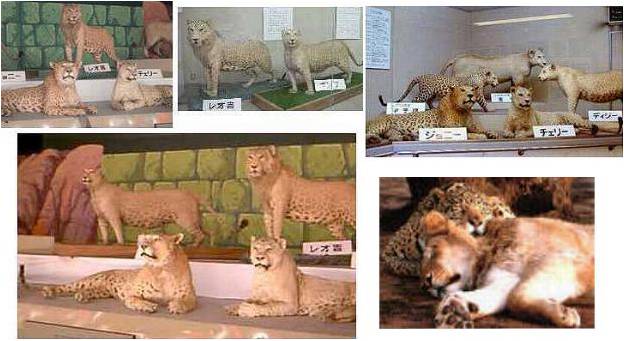
The most successful leopon program was in Nishinomiya City in Japan. Here a lioness named Sonoko was mated to a leopard called Kaneo, both born in 1955 in the Koshien Hanshin Park. The first litter of two leopon cubs was born in 1959 after a gestation period of 97 days. This is an intermediate between the gestation period of a leopard (90 – 95 days) and a lion (105 – 110 days). Usually, in captivity, the big cat males are known to show social behavior and the same happened with Kaneo when he remained with the family after the birth. After this, the couple had three more cubs in 1962.

Leopons are larger in size than leopards and have the combined features of the parents, that is, a lion and a leopard. They have a lion’s stout body while the rest of the appearance resembles a fuzzy leopard with spots and shorter legs. Instead of the classic black spots of a leopard, they have paler brown spots and a reddish-yellow skin. Their tails are tufted like that of a lion while they love to climb trees and play in the water, much like leopards. This distresses the lioness mother as lions are known to hate water. On maturing, the males have a small and sparse mane about 20 centimeters long while the females deal with an internal conflict of having to choose between the solitary lifestyle of a leopard and the social nature of a lioness. Their lifespan is about 20 years, which is more than that of a leopard (12 – 17 years) and that of a lion (10 – 14 years). The lioness mother, leopard father, and leopon offspring were taxidermized and are still on display.

hybrid

Even though it is very unlikely for such hybrids to occur in a natural state, there still are reports suggesting otherwise. Such a natural hybrid is called a Marozi. As for the case of a reciprocal cross between a male lion and a female leopard, the hybrid is known as a lipard and was last found in Italy.

Image COurtesy: GOOGLE

Parents and their importance…

A parent is their child’s first teacher and should remain their best teacher throughout life.  Functioning as a coach, the parent exposes a child to age-appropriate challenges to encourage development as well as to experiences that allow the child to explore on their own and learn from interacting with their environment. Child Development specialists have learned that from birth children are goal-directed to experiment and learn from each experience. Child Development experts have taken the concept of scaffolding from the building trades.  Just as scaffolding is put up to support the structure of the building as it is being built and gradually taken down as the building is able to stand on its own, a parent will need to provide the necessary support for a child to allow them to safely and productively explore and learn from their environment.

As the child matures and develops mastery the scaffolding is removed or changed to allow the child to become more independent.  If the child is not quite ready, the support is reinstated and then gradually withdrawn once again. As children develop from infants to teens to mature they go through a series of developmental stages that are important to all aspects of their personhood including physical, intellectual, emotional, and social.  The proper role of the parent is to provide encouragement, support, and access to activities that enable the child to master key developmental tasks.

Parents and caregivers make sure children are healthy and safe, equip them with the skills and resources to succeed as adults, and transmit basic cultural values to them. Parents and caregivers offer their children love, acceptance, appreciation, encouragement, and guidance. They provide the most intimate context for the nurturing and protection of children as they develop their personalities and identities and also as they mature physically, cognitively, emotionally, and socially.

The role of grandparents in the rearing of healthy and happy children should not be overlooked. A recent study concluded that spending time with a grandparent is linked with better social skills and fewer behavior problems among teenagers, especially those living in single-parent or stepfamily households. This study found that children and teenagers whose parents have separated or divorced see their grandparents as confidants and sources of comfort. In fact, supportive relationships with other family members outside the immediate family may lead to better adjustment for all children and teenagers.

Here some when parents involve in child education life:

Families are the keystone that holds the educational framework together. In a research report, Southwest Educational Development Laboratory (SEDL) concluded: “When schools, families, and community groups work together to support learning, children tend to do better in school, stay in school longer, and like school more.” The synergy of these forces is infinitely more beneficial to students when parents do their part. Consider the following benefits to students who have involved parents, according to SEDL:

  1. Higher grades and test scores, enrollment in more advanced programs.
  2. Grade promotions, earn more credits.
  3. Better school attendance and homework completion rates.
  4. Improved social skills and behavior allow students to acclimate better to school environments.
  5. Higher self-esteem.
  6. High school graduation and advancement to post-secondary education.

Even parents themselves benefit when they are involved in their children’s education. By involving themselves at the school and community levels, parents:

  1. Interact with their children more and are thus more sensitive to their emotional and intellectual needs.
  2. Have more confidence in their parenting abilities.
  3. Have a better understanding of the teacher’s role and the curriculum.
  4. Use more positive reinforcement the more they know about developmental stages.
  5. They are more likely to respond to teachers’ requests for help at home when they stay apprised of what their children are learning.
  6. Have higher opinions of and feel more committed to their children’s schools.
  7. Become more active in policy-making at school and in the community.

parents-505x336

Sometimes, Considering the heavy workload at the workplace and stress, parents find it difficult to take out time for their children. They spend very little time listening to and communicating with children because of their long working hours. As a result, children avoid sharing their school life or other regular events with their parents and feel neglected. These factors form communication barriers between them, and their child gets more freedom to whatever they wont to do, and they become fearless of parents or guardians they can not choose their right way of success, so parents are one of the entities, who can control and give batter information regarding better career, sometimes a child does like their parent’s suggestions, they start to grumble but they do no think that it is life-changing steps are taken by the second face of GOD.

so, please respect parents and their suggestions and discussions.


How Surat Boy and NIT Hamirpur Graduate Shantanu Yadav cracked CAT with 99.7%ile and got into IIM Ahmedabad for MBA 2020!

Shantanu Singh Yadav, CAT 2019 topper from Surat, cracked the exam with 99.73 percentile and has converted number of top B-schools including IIM Ahmedabad. A graduate from NIT Hamirpur, Shantanu belongs to a modest service class family. While preparing for CAT exam, he earned 3 years of working experience in a fertilizer industry. Read his CAT preparation strategy and success mantra

Coming from the small town of Surat in Gujarat, Shantanu Singh Yadav cracked CAT 2019 with 99.73 percentile and has converted number of top B-schools including IIM Ahmedabad. A graduate from NIT Hamirpur, Shantanu belongs to a modest service class family. While preparing for CAT exam, he earned 3 years of working experience in a fertilizer industry.


Shantanu appeared in CAT 2018 also, and scored 95.73 percentile but decided to prepare again to get his dream B-school. He likes playing Football and his hobbies and interests include Photography, Trekking and Hiking.


MBAUniverse.com invited Shantanu to share his exam taking strategy and GD-PI experience. Read on for his views and success mantras.


Q: How did you perform in CAT 2019?

A: I scored 99.73 overall percentile in CAT 2019; 89.44 percentile in VARC section; 99.76 in DILR Section and 99.86 percentile in Quantitative Ability section. I also appeared in CAT 2018 and scored 95.73 percentile.


Q: Apart from CAT 2019, which other exams did you appear?

A: Apart from CAT 2019, I appeared in XAT 2020 and scored 99.914 percentile; appeared in IIFT 2020 and scored 98.74 percentile.


Q: Which top B-schools have offered you admission and which one you have finally chosen?

A: Apart from getting final admission offer from IIM Ahmedabad, I have converted IIM Calcutta, IIM Shillong, MDI Gurgaon, all Baby IIMs. I have finally decided to join IIM Ahmedabad


Q: What have been your academics and family back ground? Do you have some work experience as well?

A: I graduated from NIT Hamirpur with Chemical Engineering in 2017 with 82.6 percent. I scored 91.2 percent in class X; 90.2 in class XII and 82.6 in Graduation. I have 3 years of work experience in the Fertilizer Industry. I belong to a service class family. My father is in Service, Mother is a housewife and younger brother is in 11th grade.


Q: What was your overall preparation strategy for CAT?

A: CAT 2019 was my second attempt at the exam, when the first one in 2018 fetched me admits to some new and baby IIMs. I started preparing again in May’19, mostly focusing on mocks and timing my attempts effectively. I started cross-checking and analysing my wrong answers, something I never used to do earlier.


The quants section was my strength but still I devoted equal time to all the three sections with some extra effort towards DI and LR which is I believe is the most unpredictable section in the exam. You could practice a hell lot of LR sets prior to the exam but might still hassle on the D-Day. LR sets are not straightforward like Quants or DI sets. Timing my complete mocks and sectional tests along with thoroughly analysing my wrong as well as right attempts turned out to be fruitful.


Q: Please share your sectional preparation strategy for VARC in CAT

A: For Verbal and RC, I used to read articles from diverse fields to get a hold of difficulty faced to comprehend as well as retain a column when it does not belong to something you’re usually used to. Reading articles from newspapers and business magazines not only helped in VA and RC but also made a solid base to ace the current affairs during the interview and GD rounds.


Q: Please share your preparation strategy for DILR Section

A: For DILR, I focused mostly on LR and LR based DI sets, as for the past few years you rarely get to see a pure DI set in the actual exam. LR being the most unpredictable section in CAT, I followed a strategy to solve and analyse each and every set I face either during mocks or during practise from dedicated books. Try looking for practise material online on GoogleDrive and you’ll find plenty of LR sets to solve. IMS’s mocks helped a lot in DI LR section as they had questions which were closest to the ones actually faced in the CAT Exam.


Q: Please share your preparation strategy for Quant Section

A: For Quants, I thoroughly practised books by Arun Sharma with a timed approach to solve at least 25-28 questions from various topics under 60 minutes. Apart from this I also solved previous years’ CAT papers with minimal use of on screen calculator.


Q: Was there any particular section/area that you were weak at? How did you overcome this challenge?

A: I was lagging a bit in VA and LR during my initial preparation. For VA there’s only one approach and that is to read, read and read. Read from publications you’re not familiar or used to. Read foreign journals/magazines, editorials in intl. newspapers etc. For LR I solved as many sets I could get my hands on with a timed approach, trying to crack the set within 10-12 minutes was my strategy.


Q: What role did Mocks play in your success? How many mocks did you attempt before the exam?

A: Mocks are the key to better preparation as well as time management skills. I solved about 40 mocks before the actual CAT.


Q: Did you self-prepare or attend a coaching centre and why?

A: I self-prepared for the exams and took guidance from IMS Surat for the WAT-GD-PI. I also enrolled for mocks with IMS because of their well-structured and closest to CAT mocks.


Q: Please share your strategy for the CAT Day. What was your last-minute preparation? How did you plan your CAT test taking?

A: Strategy for D-Day would be to avoid any last minute preparation. Since the syllabus for CAT is so wide and even has no boundaries defined for VARC and DILR, last minute hustle mostly turns fruitless and overloads you with added stress. I appeared for one mock, a day before the exam and scored just 16 in VARC which freaked me out. It somehow affected my actual performance in CAT where I scored merely 40 marks in VARC which took my sectional percentile below 90.


Take rest and sleep well a day before the exam, not much you’ll be able to change with a day’s preparation. I spent my rest of the day watching Netflix after flunking VARC a day before CAT.


Q: How did you prepare for GD/PI/WAT. Please share your GD/WAT topics & PI questions?

A: Post the release of response sheets by IIM Kozhikode and realizing I was scoring 180+, I started my preparation for GD and PI. The first thing I did was to prepare an exhaustive write-up about myself, starting from academics, work experience, achievements, projects, interests and hobbies, short and long term goals. Current affairs for GD and PI didn’t require much preparation owing to my habit of reading newspapers and magazines religiously.


I attended a few sessions from experts along with two mock GD and PI sessions, of which one was purely focused on my IIM Ahmedabad interview, which was only my second interview in a long list of 14-15 shortlists including IIM A,C,L,S, MDI, SPJIMR, XLRI and IIFT. I also prepared a few core subjects from my engineering and also mathematics, which eventually aided me a lot during my IIM A, C & L interviews.


Q: Your final message and tips for candidates preparing for CAT 2020.

A: I want to share following four tips for the prospective candidates:


Always analyse your mocks thoroughly. It’s not at all tough to land in the top 1 percentile.

Try not to appear for a mock on the penultimate day. Relax and sleep well for the D-Day.

Try not get stressed, during the exam and also in the interviews.

Never globe in the interviews. Professors will have a laugh and you’ll walk out looking like a clown.

23 June – World Olympics Day – History…

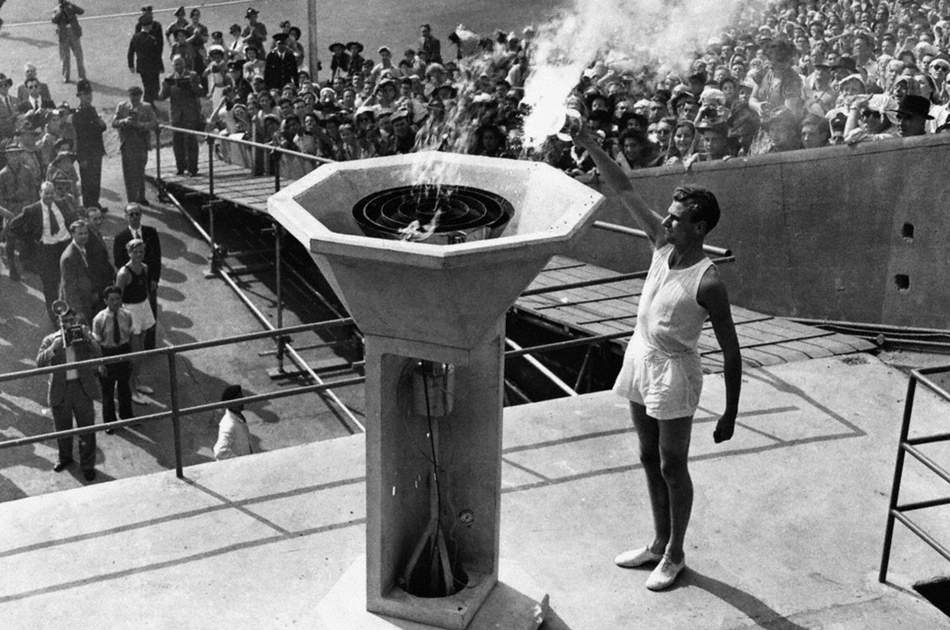
On the 23rd of June 1894 the International Olympic Committee was founded at the Sorbonne in Paris. Prior to the IOC establishment by Pierre de Coubertin the British physician Dr. William penny Brookes had set up the Wenlock Olympian games in the English market town of Much Wenlock although he always maintained that he had the idea of reviving the ancient Olympic Games for amateur athletes himself, Coubertin entered correspondence with Brooks and benefited from his connections with the Greek government Coubertin was the Secretary General of the Union of French sports associations.

A Brief Look At The Olympics History

Image source: Confidential man.com

Coubertin first proposed establishing a modern Olympic Games at his meeting on the 25th of November 1892 although his enthusiasm was met with little more than general polite applause Coubertin wasn’t deterred and commenced to get the groundwork for what was to become the primary Olympic Congress at the Sorbonne in Paris in 1894. Initially invited participants to a gathering entitled reflections on and propagation of the principles of amateurism Coubertin later changed the name to a congress on the revival of the Olympic Games seventy-nine delegates from nine countries subsequently met at the Sorbonne though Coubertin himself recognized that there was still little enthusiasm for reviving the games. Despite this a vote was held at the last word meeting of the Congress on the 23rd of June that established the International Olympic Committee Coubertin was elected to the role of general secretary with the Greek businessman and writer Demetrius Vikelas because the first president it had been further agreed that the primary modern Olympic Games would happen in Athens in 1896. The second in Paris four years later the IOC has remained liable for the Olympic Games ever since.

All About the Olympics for Kids - The History and Symbols of The ...

There are two main events there are the Winter Olympics and the Summer Olympics if you’re wondering when the winter and summer olympics take place they take place every four years when you see the Olympic logo there are five rings the reason for that is in history it has been told that a man named Baron de Coubertin saw the five rings on an ancient Greek artifact the reason we see five colors on each ring is to represent the five continents Europe, Asia, Africa, Oceania and the Americas finally with sports like track gymnastics figure skating and more each category is awarded a gold silver and bronze medal for the first second and third place winners. Hope you enjoy the Olympics.

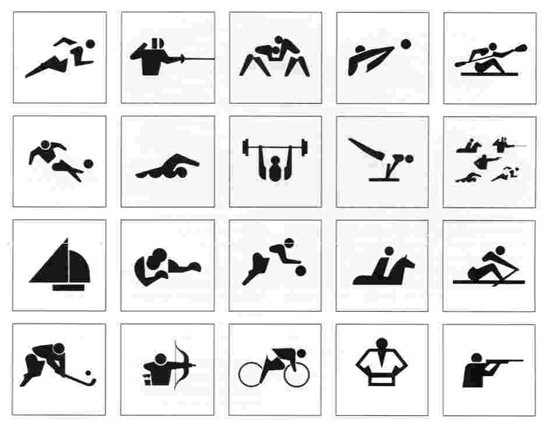
The History of the Olympic Pictograms: How Designers Hurdled the ...

Image source: Smithsonian magazine

World AND Internet

WORLD BEFORE INTERNET

 Have you ever wondered how life was without internet?  Those were the days when connecting to people and places took days, even months and were mostly delayed. Things used to take more time than usual…  Life was so different without internet.  Life appeared to be slow and much subtle. It was long and tedious process that feels like never ending. But after the invention of the internet, the world has never been the same.

After invention of internet life became wait-free, stress-free and much more comfortable.   From receiving letters in a minute to posting pictures, and even live videos and broadcasts- life has become super easy and fun to explore. Internet has given a boom to educational society. Earlier we would have to search and consult hundreds of different books of thousands of pages manually in library for finding something and now all of this can be done in a blink of an eye – just enter your question in Google and get the answer to all the problems on your mind and more which might not have even crossed your mind.

INTERNET: The Technology

The Internet is the global system of interconnected computer networks that use the Internet protocol suite (TCP/IP) to link devices worldwide. This protocol defines the format of all the electronic communication which travels between computers through wired or wireless media. Internet is the fast mode that helps resolve many problems in one click.

Internet has made the world a global village where communicating with people sitting thousands of miles away and seeing places is just a click away. Internet has made the world more explored and lively. From entertainment to infotainment internet has everything that the world needs. From travelling to connecting people in another part of the world has been made easy with the help of internet.  Obviously internet has changes the meaning of life to much extent.

Like other imperative advanced inventions, internet connectivity too has seen much development in recent years.  From slow dial-ups to fast broadband to Wi-Fi and now the recently being much discussed is the Li-Fi service of the internet.

FORMS OF INTERNET CONNECTICITY

Broadband has the highest access speed and is most used service of the internet. It is available in four different forms like DSL (Digital subscriber line), fiber-optic, cable, and satellite based connections. It is believed to be one the cheapest available connectivity methods of the internet.  Broadband is a WAN (wide area network) mostly used in an organization or a city.

On the other hand, a Wi-Fi is mainly a wireless local network. It allows the devices to connect with each other without the cables. It is simply being called as the wireless medium of the internet. Local area network (LAN) has a limit and has a restricted range where it can be used. It can limit the no of user you want to allow to connect to your network and can be password protected.

Velofel South Africa- Pros and Cons

Velofel South Africa consists of all natural and herbal ingredients. They are of extremely high quality and purity. They are-
 Nettle root extract- it plays a major role in boosting testosterone levels. It stops the production of enzyme, aromatase, which is responsible for converting testosterone to oestrogen, thus, testosterone levels naturally increase as compared to oestrogen levels.
 Tongkat Ali- it is a type of antioxidant. Antioxidants are beneficial due to many reasons but here, it prevents experience of erectile dysfunction. Moreover, it increases the penal size and grants a long lasting erection.
 Horny goat weed- it increases sexual urges to a large extent primarily by boosting testosterone levels.
 Orchic substance- it is responsible for increasing libido. It also plays a role in increasing strength, energy and overall vigour of the body.
 Zinc- it plays a role in determining potency. It improves the sperm count and motility.
 Citrus fruits- citrus fruits improve the lasting time, which improves the sexual satisfaction experience.
 Muira Puama- it is an herbal ingredient which provides nutrients, vitamins and minerals to the body. It improves assimilation of Velofel readily in the body.
 Pomegranate- it is a type of a citrus fruit which increases excretion of toxins from the body. When the toxins flush out, the working efficiency of the supplement improves.
 Gingko Biloba- it is plant which is responsible for production of nitric oxide in the body. Nitric oxide releases all sort of sexual tension and makes your experience smoother and convenient.
 Tribulus terrestris- it aids in boosting testosterone by maintaining a good balance of all sexual nutrients.
 Boron extracts- these extracts prolong the ejaculation time, which makes you last longer in bed.
 Epimedium- it plays a key role in sex as it betters the flow of blood to the penis, this automatically solves the problem of erectile dysfunction.
 Bioperine- its origin is pepper extract. It absorbs nutrients and minerals in the intestinal wall and boost blood flow to the genital area.

Benefits

Let us know about the various benefits Velofel South Africa provides us with-

  1. It produces nitric oxide which increases blood flow to the penis and helps keep it erect.
  2. Best male enhancement supplement.
  3. It causes no side effects as it only contains natural and herbal ingredients.
  4. It consists of no chemical or toxic ingredients.
  5. It increases the body’s stamina to perform longer and strenuous sessions.
  6. It prevents occurrence of erectile dysfunction by improving blood flow to the penile area.
  7. It controls early ejaculation.
  8. It boosts libido levels, which promote the quality of experience.
  9. It maintains an overall sense of energy and vigour in the body.
  10. As it boosts testosterone, it empowers muscle building.
  11. It increases self-confidence.
  12. It improves sexual immunity by provision of nutrients.
  13. It provides harder erections solving the problem of brokenness.
  14. It provides a 100% satisfactory climax.
  15. It increases length, girth and size of penis.
  16. Strengthens relations with your partner.

Pros of Velofel South Africa

 Quality sexual experience.
 Long lasting in bed.
 Natural enhancement of genitals.
 Boosts confidence.

Cons of Velofel South Africa

 Not fit for teenagers.
 Not fit for females at all.
 Only available online for purchase.

Side effects

Men are inquisitive to know if Velofel South Africa causes any side effects. The answer is NO. This supplement causes no side effects as it is a composition of only natural and organic ingredients. It is free of all chemicals and toxins.

“Ring of Fire”: Solar Eclipse 2020

Solar Eclipse 2020: The moon covering the sun formed a celestial event “Ring of Fire” today, 21 June, being the longest day of year.

A solar eclipse occurs when the moon passes between the sun and the earth. When this happens, the moon blocks the light of the sun from reaching the earth. The shadow of the moon falls on the earth.‘The solar eclipse of 21 June, however, is an annular eclipse.This happens when the moon is farthest from the earth, according to NASA blog ’.

What is Ring of Fire?

When solar eclipse occurs, a bright light of Sun is observed around the moon at the height of annual solar eclipse that beautiful ring is called “Ring of Fire”. “ Annular solar eclipse is a particular case of the total solar eclipse. Like the total solar eclipse, the moon is aligned with the sun. However, on that day, the apparent size of the moon happens to be a wee smaller than the sun. Hence the moon covers the central part of the sun, and the rim of the sun appear like a ‘ring of fire’ in the sky for a very brief moment” Samir Dhurde of The Inter-University Centre for Astronomy and Astrophysics said.

“Ring of Fire”

Today, a beautiful celestial event, an annular solar eclipse, which is popularly known as the “ring of fire” eclipse, was visible on Sunday in parts of India.It has been spotted in Delhi, Haryana, Uttrakhand, Gujarat and Maharashtra. Social media and TV news channels were flooded with pictures of beautiful ring by sunlight. This was the first solar eclipse of 2020 which coincided with the Summer Solstice, being the longest day. The eclipse started around 10:30 am and ended at 3:05 pm. .

‘Ring of Fire’ observed at Dehradun (Uttrakhand)
‘Ring of Fire’ at Kurukshetra (Haryana)

Due to covid-19 pandemic, a large number of people could not able to observe this event at planetariums as large gatherings are banned.

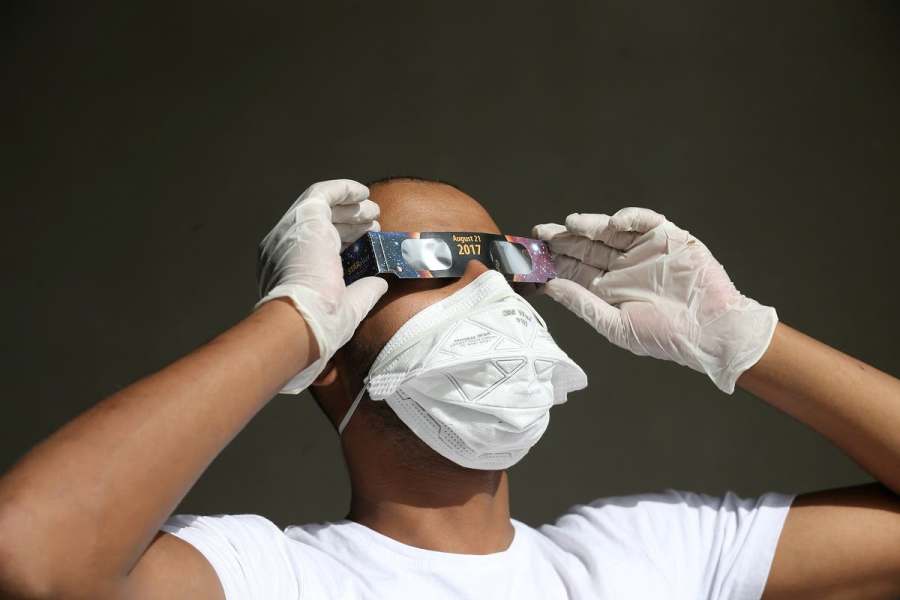
People looking for Solar Eclipse with masks on face, due to covid-19

Observing Solar eclipse event, one must have proper eye protection because looking directly at the Sun can cause permanent damage to the eye’s retina. However many people could not step out and watch the eclipse, many watched it online on their YouTube using NASA tracker. The eclipse was also visible in other countries such as Congo, Sudan, Ethiopia, Yemen, Saudi Arabia, Oman.