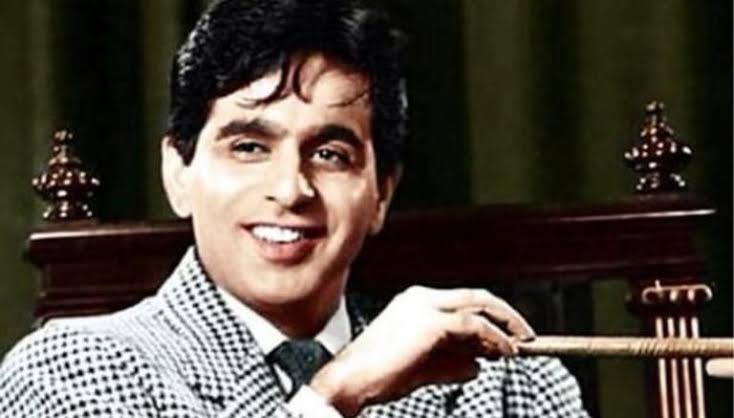
Today, July 7, will be a very sad day for Indian Cinema as it lost one of the most popular actors in its history, Dilip Kumar. The 98 year old actor took his last breath in Hinduja Hospital, Mumbai.
Photo Credits: Republic World.
Mr. Dilip Kumar was born in Peshawar, Pakistan (at the time British India) and was one of the twelve children of his parents. Their family later shifted to Indian state of Maharashtra. Let us remember some of this memorable happenings from his life and pay a tribute to him for his extraordinary work for Indian Cinema.
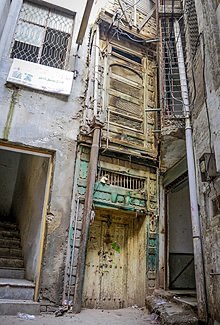
1) Dilip Kumar and his Peshawar Home.
The ancestral home of Dilip Kumar in Peshawar. (Photo Credits: Dilip Kumar/Twitter)
Dilip Kumar in his old interviews has revealed how his ancestral home in Peshawar was always special to him. On a visit to Pakistan, years after the India-Pakistan partition, Dilip Kumar reportedly fell to his feet and kissed the floor of this childhood home. He also remembered how he used to play and mingle with other friends and family at his home.
2) Joining Bollywood.
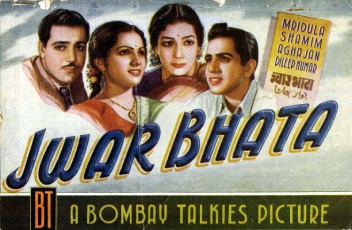
Photo Credits: Bombay Talkies.
Dilip Kumar debuted in Hindi Cinema with the movie Jwar Bhata in 1944. After a string of failures in Indian Cinema, he gained popularity with his film Jugnu in 1947 alongside Noor Jehan which was also his first box office success. He became even popular with films like Shaheed and Mela in 1948.
3) Receiving the title “The Tragedy King”.
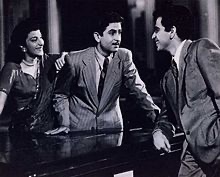
Dilip Kumar with Raj Kapoor and Nargis in Hindi film Andaaz in 1949.
1950s was completely a decade meant for Dilip Kumar in Hindi Cinema. His films such as Deedar, Hulchul, Naya Daur, Devdas, Paigham, Madhumati established his image as “Tragedy King” as these films has a tragic or mournful plot. Dilip Kumar also suffered from depression due to portraying many tragic roles and as a result his psychiatrist suggested him to take up light roles as well.
Dilip Kumar has received several awards and recognitions in his life. He received Padma Bhushan and Padma Vibhushan, the third highest and second highest civilian honours of India in the years 1994 and 2015 respectively. He also received Nishan-e-Imtiaz, the highest civilian honour of Pakistan in 1998. He’s the one of the few actors with highest number of Filmfare awards with about 8 Filmfare awards. He also received Dada Saheb Phalke award in 1994.
Although Mr. Dilip Kumar passed away leaving all of us with a heavy heart, he’ll forever remain immortal in all hearts. Very few have been able to achieve what he has achieved in his life and that’s what we should be remembering always!
The elliptical galaxy M87 is the home of several trillion stars, a supermassive black hole and a family of roughly 15,000 globular star clusters. For comparison, our Milky Way galaxy contains only a few hundred billion stars and about 150 globular clusters. The monstrous M87 is the dominant member of the neighboring Virgo cluster of galaxies, which contains some 2,000 galaxies. Discovered in 1781 by Charles Messier, this galaxy is located 54 million light-years away from Earth in the constellation Virgo. It has an apparent magnitude of 9.6 and can be observed using a small telescope most easily in May. This Hubble image of M87 is a composite of individual observations in visible and infrared light. Its most striking features are the blue jet near the center and the myriad of star-like globular clusters scattered throughout the image. The jet is a black-hole-powered stream of material that is being ejected from M87’s core. As gaseous material from the center of the galaxy accretes onto the black hole, the energy released produces a stream of subatomic particles that are accelerated to velocities near the speed of light. At the center of the Virgo cluster, M87 may have accumulated some of its many globular clusters by gravitationally pulling them from nearby dwarf galaxies that seem to be devoid of such clusters today. For more information about Hubble’s observations of M87, see: http://hubblesite.org/news_release/news/2008-30 http://hubblesite.org/news_release/news/2000-20 http://hubblesite.org/news_release/news/2013-32
Recollecting those distressing periods of all times in the world of history, where the Holocaust is considered one of the most prominent events which is still a devastating wound to the Human community. Especially, One of the most terrorizing historical traumas for the Jews.
Profoundly, any form of Art: Literature, Films, etc have held their back and portrayed Nazism and the terrified rule of Adolf Hitler which is famously a topic when discussed Communism. Majorly the movies had contributed their best and still giving the audience a piece of vibrant information about the politics, social life of that time of Nazi protocol.
“Heil Hitler”! – The Autocratic power of Hitler:
The movie begins with the background music of the song “The Beatles’ Komm gib mir Deiner Hand (the German version of their smash single I Wanna Hold Your Hand). This shows us how the Protagonist (JoJo Betzler) who is a kid of 10yrs and Appears on the screen dressed up with the uniform of Scouts of Germany which is a dress commonly for the Young boy who is trained for the war.
Imaginary Friend Hitler: We see that the movie starts where JoJo is Practicing being strong and confident and saying Heil Hitler to his friend Hitler himself – (Heil Hitler was the word people used to wish each other as a greeting purpose) This symbol presents us that Hitler was the god Figure for Germany.
Brainwashing young minds of Germany: Many instances from the movie portray us how the young children were brainwashed and made them the ardent follower of Adolf Hitler. “The Weekend Training of boys’ and girls’’ in the movie where boys were taught to be tough and made ready for the war, whereas the girls were trained to be like a woman and teach the nursing skills if men get injured in war.
Events like, “Burning of books” – A real incident where the kids are trained to burn all books and literature of the Jews. These young minds are taught at schools about the Jews and how much they are not good for the world. Hitler politically tried to depress the Jews with his young generation of Germany so that this war will continue till the end.“Burning of Books” is commonly referred in Holocaust literature which happened during Hitler reign where Nazi Germany main motive was to make german literature flourishby supressing Jew literature.
Structure of the house: The structure of the house, people, and the lifestyle portrayed in the movie is the same as people at the time of Nazi Germany lived.
Theme: A pervasive theme in the film is that of the Nazi party and their anti-Semitic and oppressive regime. The film’s protagonist, JoJo, wants badly to fit in with his fellow Nazis and to ascend the ranks of the party, becoming a soldier.
Johanna Betzler, (Mother of JoJo): She was the fiercest woman who raised his son alone while her husband was at war. She was secretly keeping a Jew at her house in the attic, which her son later got to know, and his life became upside down after the Jew girl’s arrival. The mother was Anti- Nazi and hated wars, this trait of her gave her death at the end, and she tried to raise his son just like her, but his son became just like the other boy of his age who was anti–Jew.Usually we come across certain movies and literature with holocaust elements have this setup of attic where the jews are hidden by there friends as not all germans were bad!
Relationship of Jew and Nazi: The movie represents us how a Jew and Nazi lived under one roof and the differences in their mindsets made them different. But it’s fun watching if you would like a light-hearted, comedy movie with the real events of Nazi conspiracies held onto it.In particular, this movie is best for children to make them understand about friendship, love , life and compatibility in different types of relationships.
Conclusion: Well, it is worth watching this movie as it not only provides us information about Nazi Germany but also gives us the message of “An Anti-hate satire,”“Jojo Rabbit” seeks to strike a delicate balance in using a Hitler-obsessed boy – during Nazi Germany’s final throes. Love, war, Trust, and friendship are also important themes that can be taken into consideration.
“Jojo Rabbit “, is one of the best Holocaust movies which are portrayed with all the fine lines between Nazi Germany and the Jews. The dialogues by each Character make them unique in their own way as all of them are portraying the audience of that period who were under the grip of Adolf.
Magic , which encompasses the subgenres of illusion, stage magic, and close up magic, among others, is a performing art in which audiences are entertained by tricks, effects, or illusions of seemingly impossible feats, using natural means.
Observe, all these points before you start practicing Magic; 1. As a magician you should face the audience with a smile on your face, cracking jokes and fluent language. 2. Be confident with your presentation, without stage fear. Presentation depends upon the performer. 3. You may need to face many kind of audience, tough people, naughty boys and many questions you should be ready with your answers. 4. Practice the magic several times before stage presentation. As “Practice Makes Man Perfect.” 5. Practices should be done in front of the mirror which will make your mistakes visible. 6. Watch as many magic shows as possible and study their manners. 7. Preserve your magic items and chemicals in a safe place properly locked. 8. Be careful while you handle chemicals, blades, knifes, fire. Read instructions thoroughly. 9. Chemical tricks should be done in adult supervision only. If a child is practicing magic tricks then, it’s parent or supervisor should be there to observe him. 10. Never neglect the small tricks. These are often most mystifying than stage illusions . 11. Accidents may occur, while performing chemical tricks be careful. 12. Mistakes do occur while doing magic but you must have the talent to divert the concentration of the audience. 13. The more you perform, the more you learn about the Magic and mind of the audience. 14. Join in a reputed Magic circle, read Magic journals, Magic Magazines. 15. Never repeat the same tricks before the same audience. 16. It is better to present the show with least number of assistants. 17. Self-confidence is important for the performer to present without hesitation. 18. Magic is a skill, wonderful art, else there are no psychic powers, super natural powers it is all illusion that is created by the magician. 19. Train your assistants perfectly else you have to be ashamed before the audience. 20. A magician must win the audience’s mind, to create a perfect illusion. 21. Never criticize other’s performances in your shows. 22. Never prove that, what magic you are performing is because of God or such superstitious beliefs. Show people that, there are people who are exploiting poor and innocent people in the name of God and showing some tricks . 23. Make a list of your performance item wise. 24. Choose your dialogues carefully and then talk neatly. 25. Never under estimate the audience. They are more clever than you. People may vary in their expressions, everyone’s reactions will be different. 26. Carry few pocket tricks with you, when you attend small functions, parties and picnics with your simple tricks you can entertain every one. 27. Do not apply lengthy procedure’s because audience do not have patience to watch So. 28. Better you perform happy half an hour than two dull hours. 29. After one show rearrange your tricks for the next show, it is a good habit. 30. Always have at least one spare item for your trick for emergency. 31. The place you choose for giving performance should be clean. Arrange your items neatly and your dress should also be suitable for the magician look. 32. Pack up your items as soon as to show is completed, otherwise curious person may tamper with it. 33. Say to people you have no Mantras or Tantras in your show . This truth may attract more audience for your show . 34. When you read good magic books or observe shows of other magicians note down the particular points neatly . 35. Finally , education is important; for your passion do not spoil your educational future.
To engage a social learner, encourage both group collaboration and presentation. Consider:
Roleplaying historical events or works of literature
Collaborating on maths problems
Working as a class on comprehension questions
Auditory learners like to hear solutions and examples explained to them, and may gravitate towards music subjects and group learning as a way to understand information. Auditory learners often have a high aptitude for distinguishing notes and tones in music and speech.
Qualities often associated with auditory learners include:
Possessing a ‘good ear’ for music and tones
May be distractible
Likes to talk to self / others / hum / sing
Auditory learners might say words out loud or hum tones to better learn them. This strategy is key for keeping musical learners engaged in class lessons.
How to engage them?
If you’re a music teacher, you’re in luck. Auditory learners will be engaged from start to finish. For other subjects however, engaging aural learners requires some tact and forethought.
The key here is your voice (and the voice of your students). Write down something on the whiteboard, then read it out loud. Work on your delivery so you can express learning material in interesting and engaging tones. Similarly, encourage your students to read back their own notes to themselves (and the class). Hearing the sound of their own voice and the voices of others is engaging to auditory learners, but it can be a great learning tool for students of all types.
Other strategies you can try include:
Recording lessons for later listening and reference
Encouraging auditory listeners to ‘teach others’ verbally
Seating them away from distractions
2. Visual and Spatial learner
Visual learners like diagrams, drawing out concepts, charts and processes. They learn by looking at visual concepts, creating them, and watching other people create them. Visual learners might be organised or creative in their application, and find things like colours and shapes useful.
Visual learners often possess the following qualities:
Habitual doodlers / drawers
Observant
Not easily distracted
Enjoys planning
Prefers visual instructions
How to engage them?
To engage a visual learner in the classroom you’ll want to include elements like maps, diagrams and imagery. If you have a projector, try to include relevant images to go along with the course content. In geography and history, maps are helpful, while for maths and logic, go with diagrams.
Charts, images and diagrams will aid most students, so catering to visual learners doesn’t mean you have to ignore other types. When it comes to self-driven learning, encourage the spatially aware to sketch out their ideas, create mind maps and flowcharts. It should probably come to them naturally, but a bit of prompting can always help.
Other tactics you can use include:
Sitting visual learners near the front
Using colour codes and cues
Encouraging note taking and recopying notes during study
3. Verbal learner
Verbal learning includes both writing and speaking. Verbal learners might have a preference for reading and writing, word games and poems. Verbal learners know the meanings of a broad category of words, can use them effectively, and actively seek out new words to add to their repertoire.
Some qualities associated with verbal learners include:
Intellectual
Bookworm
Good story teller
Verbal learners often seek out careers in journalism and writing, administration, law and politics.
How to engage them?
Verbal learners will want to write down notes, talk about concepts and potentially present them as well. The trick with verbal learners is knowing what adjacent types of learning apply to them – are they an outgoing or more introspective verbal learner? Some may lean more to talking, while others to reading and writing. Try to cater to preference while also using their verbal abilities to push personal boundaries every once in awhile.
4. Logical and Mahematical learners
Perhaps unsurprisingly, mathematical learners err towards careers in programming, accountancy, science, research and other number and pattern-orientated careers. Some qualities associated with mathematical learners include:
Pattern recognition
Good with numbers
Predisposition towards grouping and classification
How to engage them?
Mathematical learners will greatly appreciate any type of learning that logically explains the subject at hand. For maths, that’s easy. For other subjects, it requires some effort and planning:
History and geography: Try to include statistics and classification taxonomy in your lesson plans.
Literature: Ask your students “What category of book is this?” Or in poetry, have them learn the meters and explain them to other students.
Music: Teach both musical instrument classification (woodwind etc) and the mathematical relationships between notes.
Art: A good starting point is the colour wheel and the effects of combining different colours.
With logical students, always look to incorporate a system. If you’re unsure, include the students in the development of that system. They’ll benefit from it greatly.
5. Physical and Kinaesthetic learner
Commonly called hands-on learners, kinesthetics prefer to physically engage with the materials of the subject matter. Some qualities associated with physical learners include:
Preference to ‘get their hands dirty’
Energetic, may drum fingers or shake legs
Action-orientated and outgoing
May de-prioritise reading and writing
Physical learners represent about 50% of the population,and gravitate towards careers with lots of hands on work like emergency services, physical education and sports.
How to engage them?
Channeling the energy and excitability of physical learners is key to offering a good lesson. Taking breaks so they can move around can help, but so can encouraging role play and movement within the lesson itself. Physical interaction is also important. The use of props and models will greatly benefit a kinaesthetic learner. Give them something to grab onto and they’ll process information much better than from a book or whiteboard.
Other strategies to engage physical learners include:
Encouraging movement during study (don’t punish them for fidgeting)
Decluttering desks and surfaces so they can focus on learning
6. Social and Interpersonal learner
Social learners show preference towards groups and collaboration. Some, but not all, will gravitate towards leadership within a group. Some of the qualities often associated with this type of learner include:
Extraverted
Good communicator
Sensitive and empathetic
It’s important for educators to understand that not all social learners are extraverted or highly communicative, and that they can also be visual, auditory, verbal, logical or physical learners. The interpersonal aspect perhaps better describes the settings in which they are most comfortable, rather than how they absorb information.
As such, teachers should be cognisant of the breadth of variation between different types of social learners. For example, social doesn’t strictly mean verbal. Some social learners prefer to listen in a group setting, rather than on their own.
How to engage them?
Interpersonal learners like to ‘do’ and to ‘share’. This can sometimes lead to distraction for other students who are more intrapersonal in their learning habits. To prevent this, try to channel social learners into providing value to the group, giving them tasks that use their energy usefully, with a focus on empathy for their classmates.
7. Social and Intrapersonal learner
Solitary learners can be visual, auditory, physical, verbal or logical learners. Fulfilling all the needs of the solitary student will ensure they are fully engaged. Some of the qualities often associated with this type of learner include:
Independent
Introspective
Private
Intrapersonal learners may gravitate towards careers with a lot of self determination or motivation, as well as solitary workloads. Think:
Researchers
Writers and authors
Programmers and coders
How to engage them?
In a classroom environment it can sometimes be difficult to engage a solitary learner. They might sit silently in the back of the classroom, only to ace the exam at the end of semester. For the educator, it’s important to engage them during class. Provide visual materials, books and learning aids. Designate quiet areas, and collaborate with defined sharing time so the solitary learner can feel adequately prepared.
Mixed learning approach
With large classrooms, it’s not always easy to personalise lessons, but using a mixed learning approach throughout coursework can help you cater to each type of learning style. You may decide to focus on a particular learning type each lesson, or incorporate multiple strategies within each lesson. The most important element is first recognising the differences in student learning – the rest will flow from there.
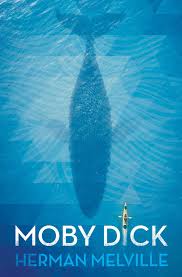
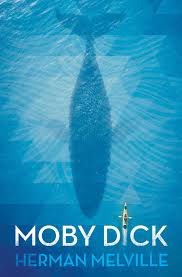
Herman Melville (1819-1891), the author of Moby Dick, is recognized today as one of America’s greatest writers, although there was a time when critics as well as readers rejected his writings. He wrote more than ten major novels, based on experiences that he had gone through himself. Some of his adventures in real life were more exciting than the ones he describes in his novels, but none was as strange and thrilling as the story he tells in Moby Dick. Melville was born in 1819 in New York City. His parents, like many other Americans, were of mixed nationality, being partly English and partly Dutch. The Melville family was a well known one, but had become poor at the time of Herman’s birth. He was forced to give up school at the age of fifteen in order to earn his living. He tried his hand at various jobs: farming, teaching at schools, working in offices-in fact, any work that he could find. Finally, in 1839, he went to sea as a common sailor. His first voyage took him to the port of Liverpool, in England. He found life at sea so attractive that he decided to remain in this profession.
In December 1840, Melville joined the crew of a whaling-ship, the Acushnet, and went on a long voyage to the Pacific. After sixteen months on board, he and a shipmate ran away from the ship when it stopped at Nukhera, an island in the group of islands in the Pacific known as the Marquesas. They spent several weeks on this island, where they were in danger of being killed and eaten by cannibal tribes, before returning to America on another ship. Melville described these adventures in two of his novels which became instant hits-Typee and Omoo.
Between 1840 and 1843, Melville worked on two other whaling ships, the Lucy Ann, and the Charles and Henry. His experiences on these ships were used by him in writing Moby Dick. He gave up his sea-going life in 1844 and devoted himself completely to writing. In 1850, he met the great American writer, Nathaniel Hawthorne, who encouraged him to write Moby Dick, and to whom this novel was dedicated.
About the book
Moby Dick is a book with several layers of meaning and can be read at different levels. At one level, it is an exciting tale of adventure. There are many other well known stories of adventures at sea, but what makes Moby Dick special is the fact that it provides a rare glimpse into a particular kind of life-life on a whaling-ship, or whaler, which Melville knew at first hand.
This is the story of Captain Ahab, the captain of a whaling-ship, the Pequod, and his unending battle against a white whale, to which sailors had given the name Moby Dick. Because of its unusual colour and its great size, Moby Dick had become a valued prize for all whale-hunters. But in the case of Captain Ahab, there was an element of personal enmity and a desire for revenge as well. In an earlier meeting with Moby Dick, Ahab had lost one of his legs, which was bitten off by the whale. Thereafter, he had only one goal in life-to kill the white whale. After months of pursuit through the oceans, the man and the whale came together at last; the battle is resumed. The story is narrated by a sailor called Ishmael, who becomes a witness to the battle between Ahab and Moby Dick.
MOBY DICK as an Allegory
It becomes clear from the beginning that the author wants us to read his story as an allegory-a story with hidden spiritual meaning. Almost everything in the book has symbolic value and represents something abstract. The names of the major characters in the story are taken from the Bible, which was a source of inspiration for Puritans, a religious group.
Moby Dick can be read, at one level, as a tale of adventure. However, the fame of this book rests chiefly on the complex spiritual and religious elements that Melville wove into the story. Moby Dick is regarded as an epic, like our own Mahabharat or Ramayan, or the Iliad and the Odyssey, which were written by the Greek poet Homer, thousands of years ago.
An epic is a long tale which presents before us a vast, many-sided picture of human life and nature. Everything in an epic is on a grand scale there may be hundreds of characters, engaged over a long period of time in numerous exciting adventures. Most epics are stories of great battles, in which human beings perform heroic, almost superhuman deeds. These battles often represent wars between the forces of good and those of evil, with the former becoming victorious in the end.
Moby Dick is also an allegory in which ordinary objects, characters and events become ‘symbols’, representing abstract qualities or emotions. In poetry, for example, the rose is often used as a symbol to represent beauty and love, both of which are abstract things. Another common example of a symbol is the national flag of a country-though only a piece of cloth, it can give rise to the powerful but abstract emotion of patriotism. Many men and women have sacrificed their lives to protect the honor of their national flag.
The early American writers were mostly Puritans from New England. The Puritans, who became powerful in England in the sixteenth and seventeenth centuries, belonged to a Christian group which believed that God had created man only to serve and obey Him and that it was the duty of every human being to lead a pure and strict life, avoiding all forms of temptation. For a Puritan, life was a constant struggle against Evil. They believed that they were the only true Christians. In the sixteenth century, a group of Puritans left England and sailed to America, because they felt they did not have the freedom to lead the kind of religious life which they wanted. The part of America where they settled was known as New England.
Herman Melville was brought up as a Puritan and was deeply influenced by other Puritan writers. It was natural for him, therefore, to see life as a struggle between the forces of good and evil. Moby Dick is a powerful expression of this Puritan view of life, although there are other elements in it as well, taken from other cultures and religions that Melville became interested in. When we read Moby Dick as an allegory, symbolizing the battle between good and evil, it is not always easy to decide which qualities a character represents. Is Ahab a symbol of Goodness, and does Moby Dick symbolize Evil? This is what one might think at the beginning of the novel, since Ahab is shown as a heroic character, possessing superhuman courage and determination, while Moby Dick, the whale, is described as a killer. But gradually, we begin to see that there are many sides to both Ahab and Moby Dick. The whale turns into a mysterious supernatural power, which is beyond human understanding, while Ahab appears to become inhuman in the way he ignores the pain and suffering of others in his thirst for revenge. The line separating good from evil is not clear; both good and evil are seen to be parts of a larger design, balancing each other. Here, Melville seems to move away from a Puritan view of life and may have been influenced by other religions such as Zoroastrianism (the religion of the Parsis) as well as Buddhism and Hinduism.
Likewise, the 90s and early 2000s kids and teens were always found playing various sports on the grounds be it in the scrounching heat of summer Or the rainy days. The Gen Z today, are always found sitting in the corner of their rooms, binge watching several movies and series. Now as we got the reference to the title. Let’s take a look at some proofs of it;
According to Deadline’s september 2020 report, “NETFLIX has thrived during COVID-19, adding about 26 million global subscribers in the first half of the year to reach a total of 193 million. The streaming giant has fended off competition from a handful of multi-billion-dollar services coming to market over the past year, including Disney+, Apple TV+ and HBO Max.
According to Omdia (which excludes subscriptions from bundled offers), as of December 2020, Disney+ Hotstar had 18.69 million subscribers, a big jump from 5.36 million in 2019. Amazon Prime Video had 5.83 million subscribers — up from 4.34 million in 2019. The subscriber count of Zee5 and SonyLiv stood at 2.7 million (up from 1.99 million) and 1.81 million (up from 6.5 lakh), respectively, in 2020.
Are you a contributor to these numbers too?. Mostly yes right. OTT platforms, the numerous released web series and the movies has been the biggest buzz of year 2020. While not being permitted to move out of their homes, continue to work Or study properly due to closure of everything, all what people seemed to be left with to entertain themselves was their smartphones, laptops, TVs etc. Some considered this free time, sitting home and watching movies as freedom. Others saw them out of their boredom. Meanwhile the lack of fresh and entertaining content on TV due to lockdown, the slowly growing trends of OTT took a leap up to tremendous success all at once. And thereby arrived a wave of opportunities for the VOD Providers. Each and every every app started collaborating with makers to spruce up their libraries with better shows than competitors and gain as much paid subscribers as possible, leading to a terrific kick start to a era of Digital media. Not only are the platforms realising the need for more and better content but also the demand for the originals hit the grounds due to heavy competition. Netflix, which is the most premium OTT platform in India, charging Rs 499 per month, invested Rs 3,000 crore on Indian originals in 2019-2020. The time spent by each user on these shows increased rapidly, which made every app to double the efforts for attracting more and more rush their way.
According to reports and speculations future of OTT only seems to get better with time. As all the individuals be it kids, teens or adults with access to high connectivity, smartphones and other smart electronic devices and especially thousands of options of releases to watch everyday are only expected to get more and more addicted to this digital media. Being known to western culture, youngsters today are more into the concepts of privacy, space and being happy by themselves. Rather, than playing outdoor games with friends and being active around. And of course the lockdown restrictions and smartphone fever is hidden from none, which has contributed to growth of desirability of audience towards OTT. Along with that curbing of Theatre releases, also influenced bigger production houses to find their way to exploring VoD platforms. Another important feature here is unavailability of Censore board for OTT yet, which gives users the absolute right to choose what kind of creatives they want to watch. Having options of so many different platforms, with a vast choice of seamless content available on every platform, at reasonable prices, on any device of your choice within comfort of home or at every possible place and at any point of time in the day is and will be all what a person, especially the ones trapped in lockdowns could ask for.
Thus, Current scenarios indicate the most wide range of upcoming opportunities to both foreign and local VoD providers, proving it to become a long term market trend. While the maitained leadership to be expected from the platforms providing the most user friendly features in their apps and sites along with the best content as per the viewers’ personal choices.
Have you ever had the flavor of fruits and vegetables cultivated in your garden? If you have not, just give a try at least once in your lifetime and then that would let you take up gardening eternally. Trust me, even the bitter gourd might sound sweet when you get it from your labor and that could be so heart warming and relishing. Some take up gardening in their leisure time and some really have a great passion towards it. It doesn’t matter about the size of your garden it is about the mindfulness, just gather few pot plants and little herbs and that tends leave a huge impact in your life. Cultivating plants aids in cultivating a healthy mind and grants serenity. A study found that ” every green environment improved self esteem”. When you feel distressed and anxious about your repetitive life just drop in to your garden and it will restore all your inner peace.
When you land up in the soil, its smell uplifts your mood and makes you feel elated!
When you clear up the weeds your mind also gets cleaned by giving up all the negativity!
When you dig deep into the soil your mind goes in deep and revives the positivity back!
When you sow the seeds, your heart is been sowed and scattered with cheerfulness and bright thoughts!
When you notice the tiny little branches you will find an intangible happiness sprouting within you and When you sprinkle the water, the mother earth sprinkles her blessings on you.
Spending some quality time in the garden would render many physical and mental benefits. The pulling, digging, reaching, twisting and bending of gardening amounts to light aerobic exercise, which improves heart and lung health, helps prevent obesity. The plants clean the air around us and makes us feel fresh. Currently, the food industry is responsible for emitting 26% of global CO2 waste by transporting food from suppliers to grocery stores. So it becomes apparent that when we grow food in our garden we are reducing our carbon footprint. Spending time in nature can promote the mental health and gardening has been used as therapy for depression for many years. A group of researches have come with findings after tracking over 3000 subjects for 16 years and it stated that gardening regularly reduces the risk of dementia by 35-46%. Gardening is a very big stress buster and watching the plants flourish is a huge stress relief. People who have raised a prosperous garden might know how great it feels to notice the flowers budding and blooming and that boosts a person’s self esteem because developing a garden could be a rewarding hobby. When we invest our diligent & earnest work, certainly the plants will nourish our body and mind in return. The inner happiness that you find when your dining is been filled with the food that you harvest could be so remarkable and rejoice at the fact that you are able to nurture your health with your own scrupulous work.
Besides the mental and physical benefits of gardening there many medicinal plants we can cultivate in our garden space that assures us a healthy lifestyle and those plants are also easily obtainable. Tulsi is believed to be a physical incarnation of Goddess Lakshmi on earth and regarded as the holiest of all. They are rich in adaptogens which help in reducing the stress levels in your body, cures common cold, promotes digestion etc. It is true that there is a science behind every activity and also there is a medicinal benefit behind each plant. Aloevera is extremely useful to speed up healing and reduce the risks of infections. Pepper mint regarded as the world’s oldest medicine is used to treat fevers, inhibit bacterial growth. Coleus amboinicus (Omavalli) can be used a remedy for cough, cold, indigestion. Coriander, curry leaves, mint are very simple to grow and they play a very major role in our daily diet. In addition there are several plants and trees that aids in our physical health.
There are many fascinating facts about plants and one such is, plants could really respond to sounds. Talking to plants to help them grow is a well know old wives’ tale but studies have shown that compared to a silent greenhouse to one where they piped in a voice soundtrack, the plants in the latter grew more. This could also make you to get rid of the loneliness at times. Gardening helps us to overcome our inhibitions and makes our life complete & alluring. I think that we should acquire the great quality from plants of how to grow in silence and letting your success make the noise. Garden is a grand teacher and gardening is enduring and never ceases. To grow a plant is to believe in tomorrow!
Being a comedian, Tanmay Bhat has his way with words. Hence, what could be better than learning about stocks, trading, coding and other financial topics in his voice. It’s a platform where fun meets learning. It’s great for newbies who want to learn about finance or just utilise their time watching something resourceful rather than mindlessly scrolling on social-media.
BUSINESS INSIDER
This YouTube channel is exactly what it sounds like. You can find the inside and the development process of a large variety of topics from art, food, colours to industries, housing, etc. The channel is not geographically restricted. They have covered almost any and every country in the world, portraying what each has to offer, that adds on to their uniqueness.
RADHI DEVLUKIA
Roshni Devlukia aka Radhi is the wife of former monk and life-coach Jay Shetty. She’s a Nutritionists by profession. She uses her Instagram and YouTube channel to influences people to adapt to a healthy lifestyle. She is one of the most honest and transparent YouTuber i have found online. Her video’s are inspirational and her content is to the point (without unnecessary exaggerations). It’s on a must-check list for people interested in meditation, spirituality, self-love and growth.
MOSTLY SANE
MOSTLY SANE aka Prajakta Koli.She is one of the most famous Indian Youtuber and Diverse contentcreator online. Her content varies from Funny videos, vlogs, interviews to inspirational guidance, sister talk, life advisor, habit building, etc. Her channel shows the most transparent life a common yet hard working teenager turning into a successful adult. Her content include any and every adulting topic which we all can relate to. ( Basically, She’s a mix of Mummy, Didi and Best-Friend Advices)
ARJUNA HARJAI
Arjuna Harjai is a music creator, singer and vlogger. Love Kids? Then his channel is the perfect place to find the cuteness along with a reality check of a young parent’s life. Personally, watching his vlogs works more like a dose of serotonin for me as they have the cutest child. The couple went famous from a viral tiktok showing childhood love-birds turning into wedded couple and then to parents of a adorable child. They perfectly portray modernparenting and life after you marry your best-friend.
Because of the World War II and the weak economy, unemployment became widespread in Japan and the cinema industry suffered. During this period,when Japan was expanding its empire, the Japanese government saw cinema as a propaganda tool to show the glory and invincibility of the Empire of Japan. Thus,many films from this periods depict patriotic and militaristic themes.
In 1942, Kajiro Yamamoto’s film Hawai Mare Oki Kaisen portrayed the attack on Pearl Harbor. In 1945, Japan was defeated in World War II, the rule of Japan by the SCAP(Supreme Commander for the Allied Forces) began. Movies produced in Japan were managed by GHQ’s subordinate organisation CIE.
“Akira Kurosawa’s “Akatsuki no Dasso (1950)” was originally a work depicting a Korean military comfort woman starring Yoshiko Yamaguchi,but with dozens of CIE censorship, it became an original work.”
The 1950s are widely considered the Golden Age of Japanese Cinema. Three Japanese films from this decade appeared in the top of sight and sound’s critics and director’s polls for the. EST film of all time in 2002. War movies restricted by SCAP began to be produced, Hideo Sekigawa’s “Listen to the voices of the sea(1950)” and other works aimed at the tragic and sentimental retrospective of the war experience, one after another, it became a social influence.
The decade started with Akira Kurosawa’s “Rashomon(1950)” which won the Golden Lion at the Venice Film Festival in 1951 and the Academy Honorary Award for Best Foreign Language Film in 1952, and marked the entrance of Japanese Cinema onto the world stage. The first Japanese film in color was “Carmen comes Homes” directed by Keisuke Kinoshita and released in 1951.
” The 1980s saw the decline of the major Japanese film studios and their associated chains of cinemas, with major studios Togo and Toei barely staying in business.”
” Mini theaters, a type of independent movie theatres characterized by a smaller size and seating capacity in comparison to larger movie theatres, gained popularity during the 1980s”
In todays cyber world we are driven with a technical life style which introduces software to be an integral part in our day to day life. It is hardly possible to imagine our every day life with out any computerized process. When we closely observe the applications that we use daily we all get a common doubt that, how were these applications are developed and what is the process behind them? Let me explain you about the process of developing a software keenly.
SOFTWARE DEVELOPMENT LIFE CYCLE:
Whenever there is a need for sophisticated system or an end user web or a mobile application we have to design a procedure which describes the whole process of development from starting stage to final stage. Similarly, Software development life cycle is also a methodology or a set of principles that should be followed in every software development team as preliminary steps to development a software.
This software development life cycle organizes the whole work process of the project into different stages which simplifies the work in order to complete it in the desired dead lines and it also focusses on the cost of project development. According to the project type we can apply different software development life cycles. The different SDLC processes applied by the companies are Agile model, RAD model, Waterfall model, Spiral model etc…. Though there are different models for the different kinds of projects, we use the following stages most frequently.
THE STAGES OF SOFTWARE DEVELOPMENT LIFE CYCLE:
1) BRAIN STORMING (OR) PLANNING: This is the first and fore most step in the software development life cycle process. This stage include brain storming session and then the development team finalizes an idea to proceed further into the project. After the completion of brain storming the team plans about the initial and core stages of the project and they also set the time frames and strategies to complete the project. When the prerequisite stage is perfectly completed then only the can move to the requirements stage.
2) DEFINING REQUIREMENTS: In this stage the team understands the project in deeper and classifies the requirements according to the stages of the project development and also in this stage only the team analyzes the future risks of the project and comes to a conclusion on the overall cost of the project.
3) DESIGN: Software design is the most complicated stage in the project development cycle. During this phase the team conceptualizes the created solution and verifies that whether the created solution meets the requirements or not. In this stage the team concentrates on the functionality of the solution and also analyze the structure capabilities, objectives of the proposed solution. After identifying a certain design for the development of software team forward in to development stage.
4) DEVELOPMENT: The development stage is all about converting the design into the actual software through coding. This stage of the development cycle is the longest path as it is the back bone of the whole project and the software development team should have to verify the code constantly to meet the requirements of the project. Once the development of complete architecture of the solution is completed. The team proceeds to the testing stage.
5) TESTING: In this stage the developed solution is tested under different methods in order to fix the bugs in the code and all the verified code at different stages are integrated in this stage. The testing stage is mainly useful for checking the quality of developed code prior to its release.
6) IMPLEMENTATION & MAINTENANCE: Once the software is certified with out having any errors or bugs then the team will release the developed software to production environment. This means the developed software product can be used by customers. Though the software is implemented also the development team must focus on the maintenance of the software in order to fix the bugs and update the new features.
These are the stages that are commonly used in every software development life cycle by a developer team. This SDLC process is use full to make perfect time frames for the completion of desired software product and also SDLC gives a perfect figure about total cost accomplished for the development of the project at every stage. Finally, SDLC is a process which sets the whole work in an organized and simplified manner.
Journalism and mass communication graduates work nationwide and worldwide at newspapers and magazines and in advertising, branding, broadcast news, social media, marketing, media research, photojournalism, publication design, public relations, radio, and other areas
Journalism:-
Journalism is the activity of gathering, assessing, creating, and presenting news and information. It is also the product of these activities.Journalism can be distinguished from other activities and products by certain identifiable characteristics and practices. These elements not only separate journalism from other forms of communication, they are what make it indispensable to democratic societies. History reveals that the more democratic a society, the more news and information it tends to have.
JOURNALISM ESSENTIALS
What is journalism?
What makes journalism different than other forms of communication?
What is the purpose of journalism?
The elements of journalism
What does a journalist do?
The journalist as a ‘committed observer’
The theory of the interlocking public
Bias and objectivity
The lost meaning of ‘objectivity’
Understanding bias
1.What is journalism?
Journalism is the activity of gathering, assessing, creating, and presenting news and information. … Journalism can be distinguished from other activities and products by certain identifiable characteristics and practices.
2. What makes journalism different than other forms of communication?
The vast majority of this communication, however, is not news and especially not journalism. Almost 70 percent of email traffic is spam, according to web security company Symantec. In 2012, there were an average of 175 million tweets each day. But almost all – 99% — consisted of “pointless babble,” according to researchers at Carnegie Mellon University.
3. What is the purpose of journalism?
“The purpose of journalism,” write Bill Kovach and Tom Rosenstiel in The Elements of Journalism, “is not defined by technology, nor by journalists or the techniques they employ.” Rather, “the principles and purpose of journalism are defined by something more basic: the function news plays in the lives of people.”
4. The elements of journalism?
In their book The Elements of Journalism, Bill Kovach and Tom Rosenstiel identify the essential principles and practices of journalism. Here are 10 elements common to good journalism, drawn from the book.
5. What does a journalist do?
Asking who is a journalist is the wrong question, because journalism can be produced by anyone.At the same time, merely engaging in journalistic-like activity – snapping a cell-phone picture at the scene of a fire or creating a blog site for news and comment – does not by itself produce a journalistic product. Though it can and sometimes does, there is a distinction between the act of journalism and the end result.
6. The journalist as a ‘committed observer’
Gil Thelen, the former publisher and president of The Tampa Tribune, believes the journalist has a very specific role in society. He calls it the “committed observer.” What he means by that, Thelen explains, is that the journalist is not removed from community, though at times may stand apart from others so as to view things from a different perspective.
7. The theory of the interlocking public
The splintering of mass media audiences and the migration of information consumers to tens of thousands of niche web sites is further evidence that everyone is interested, and expert, in something. The diversity and magnitude of the public, in fact, is its strength. A mix of publics is usually much wiser than a public comprised of just the elite or one segment of special interest.
8. Bias and objectivity
Journalism attempts to be fair and accurate. It does this through objective methods and managing bias. The guides in this section help you understand and navigate those processes.
9. The lost meaning of ‘objectivity’
One of the great confusions about journalism, write Bill Kovach and Tom Rosenstiel in The Elements of Journalism, is the concept of objectivity. When the concept originally evolved, it was not meant to imply that journalists were free of bias. Quite the contrary. The term began to appear as part of journalism after the turn of the 20th century, particularly in the 1920s, out of a growing recognition that journalists were full of bias, often unconsciously. Objectivity called for journalists to develop a consistent method of testing information – a transparent approach to evidence – precisely so that personal and cultural biases would not undermine the accuracy of their work.
10. Understanding bias
For a time, “bias” was the term of choice to describe anything people hated about journalism, whether the power and influence of corporate news organizations to the choices reporters made in writing individual stories. In 2001, in fact, a book about media unfairness entitled “Bias” was number one on the New York Times bestseller list. In recent years the public seems to have adopted a more nuanced view of bias. Perhaps this is because many critics have found their voice online – where studies confirm that half the blogs contain just the author’s opinion – or that one-sidedness has become a successful business model, as Fox News Channel and MSNBC have demonstrated.
What Is Mass Media?
INTRODUCTION:-
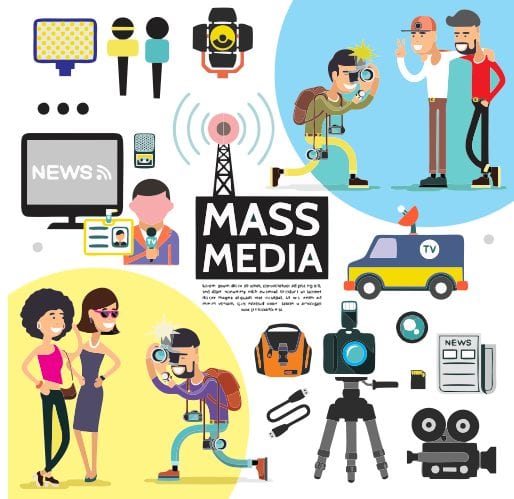
Mass media is communication that is to a large group, or groups, of people in a short time (Mass Media, 2013, p. … This can be written, spoken or broadcast communication. Some of the most popular forms of mass media are newspapers, magazines, radio, advertisements, social media, television, Internet, and films/movies.
Mass Media:-
Think about this for a second: whenever you want to hear your favorite song, watch your favorite show, or see the latest current events, where do you go? You more than likely turn on your television, radio, or computer. The source that the majority of the general public uses to get their news and information from is considered mass media.Mass media means technology that is intended to reach a mass audience. It is the primary means of communication used to reach the vast majority of the general public. The most common platforms for mass media are newspapers, magazines, radio, television, and the Internet. The general public typically relies on the mass media to provide information regarding political issues, social issues, entertainment, and news in pop culture.
There are 6 main types of Mass Media:
Traditional Media
Print Media
Electronic/Broadcasting Media
Outdoor Media or Out of Home Media (OOH)
Transit Media
Digital Media/New Media/Internet
1. Traditional Media:-
People have developed different ways of communication depending upon their local language and culture. Traditional media is one of the oldest types of mass media to transfer traditions and culture over generations. The tools of communication have been developed from beliefs, customs, rituals, and practices of society. Traditional media imparts indigenous ways of communication for ages. Further, this type of mass media varied as per each culture and society as every culture has their own mediums to communicate to their mass audience. Thus, the traditional media can be folk songs, dances, folktales and folklore as well as paintings, sculptures, stupas, statues and fairs, festivals, rural or community radio and announcement mediums like nagada, etc.
Forms of Traditional Media
Folk Dances
Folk Songs and Music
Theatre, Drama, and Folktales
Painting, Sculptures, Inscriptions, Statues, and Stupas
Motifs and Symbols
Announcements made by beating drums or ‘nagada’
Shadow Puppetry and String Puppetry
Storytelling
Nautanki
Fairs and Festivals
Rural Radio
2. Print Media
In simple words, Print Media is all about the printed form of information and news. Before the invention of the printing press, printed materials had to be hand-written that made mass distribution almost impossible. Print media is one of the basic types of mass media tools making it very popular and convenient to reach a wider audience. Newspapers are considered as the oldest forms of mass media after the traditional mass media as for a long period of time, the general public relied on newspapers to know the latest happenings in their local areas as well as from around the world. Thus, print media originally refers to newspapers and then expanded towards magazines, tabloids, promotional brochures, journals, books, novels and comics.
Forms of Print Media
Newspapers (broadsheet and tabloid)
Periodicals, Newsletters, and Magazines (general or specific interest)
Brochures, Leaflets and Pamphlets
Journals
Books, Novels and Comics
3. Electronic/Broadcasting Media
Broadcasting is simply a distribution of audio and video content to a dispersed audience using the electronic broadcasting medium. Originally the term ‘broadcasting’ referred to the sowing of seeds on farms by scattering them over the large field. Broadcast media allows ease of news dissemination to even an illiterate person because it appeals to both the auditory and visual senses making it one of the most lucrative types of mass media. Centuries later after the newspapers were used as the original mass media, the advent of radio and television happened. Radio was the primary medium of news for the general public during wars as well as for sports and entertainment. When television was invented, it became the most effective type of mass media as it was primarily used for news dissemination and then for TV shows, live events and other entertainment purposes.
Forms of Broadcasting Media
Television
Radio (AM, FM, Pirate Radio, Terrestrial Radio, and Satellite)
Traditional Telephone
Film/Movie/Motion Picture
Video Games
Audio Recording and Reproduction
4. Outdoor Media or Out of Home Media (OOH)
This is also known as OOH or Out-of-Home Media and is focussed on transmitting information and news when the public is outside their home. Outdoor media gives importance to display advertising and attracting individuals towards new products, some social cause or any development or change in the society. These are prominent in brand promotion seen on buildings, streets, electric polls, roadside, vehicles, screens, kiosks, etc. This is one of the most prominent types of mass media used for commercial as well as public welfare advertising and mainly includes billboards, banners, posters, brochure distribution, ComPark Advertising, Wallscape, amongst others!
Forms of Outdoor Media
Billboards or Bulletins
Inflatable Billboards
Mobile Billboards
Banner
Lamppost Banners
Posters
Signs and Placards
Blimps, Skywriting
Brochure distribution
ComPark Advertising
Wallscape
5. Transit Media
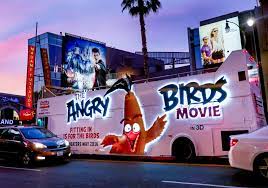
Transit Media revolves around the concept of advertising and information dissemination when consumers are “on the go” in public places or in transit. These include display advertising on vehicles and transportation. With the aim “driving home a message” transit media is significantly used for massive brand promotion to millions of people who travel the country’s streets and highways every day.Some people might think that this type of mass media is outdated or ineffective, yet it is widely visible on the sides of buses, in subway cars, at transit stations where passengers enter or disembark from public transportation.
Forms of Transit Media
Bus Advertising
Railway Advertising
Taxi Advertising
Transit Shelter Advertising
6. Digital Media/New Media/Internet
Since the invention of the World Wide Web by English scientist Tim Berners-Lee in 1989, the Internet has drastically taken over all the types of mass media because of faster dissemination speed and higher digital technology. New Media is an interactive two-way communication with users being the active producers of content and information. The Internet is considered as a highly interactive mass medium and can be simply defined as the “network of networks”. It has quickly transformed as the centre of the mass media as it has marvellously integrated all the prominent types of mass media. Now, you can see news websites, broadcasted TV shows as well as listen to online radio using the internet and this is also called as the convergence of mass media!New Media is normally a re-conceptualization of the existing media. This is a rapidly growing mass media with the ease of accessibility with a computer and an Internet connection (broadband or WiFi). From Story Writing and Graphic Designing to Multimedia and Animation, pursuing a career in this field can be highly advantageous.
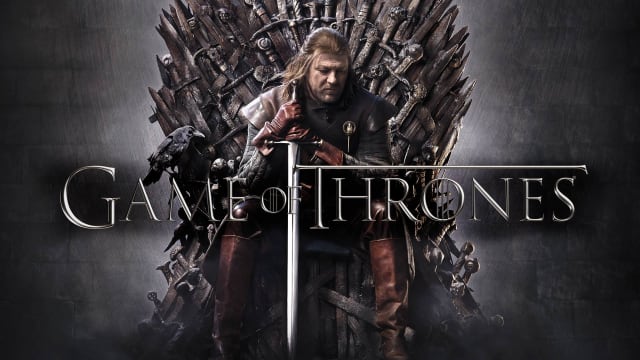
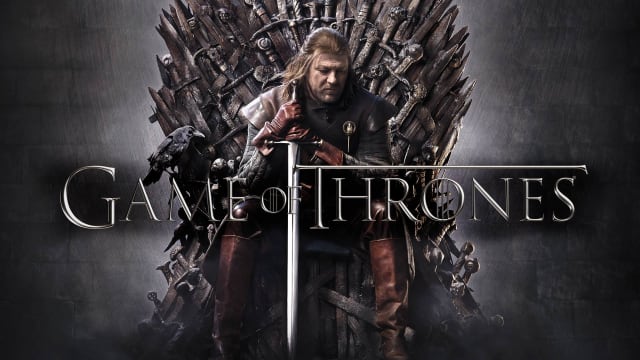
Game Of Thrones is an American television series created for HBO by David Benioff and D.B. Weiss released in 2011. This series is based on a novel ‘A Song of Ice and Fire’, a series of fantasy novels by George R.R. Martin. The show got popularity soon after it is released. This show is shot in UK, Canada, Croatia, Malta, Morocco and Spain. It was released as TV show but now available in online at HBO website. The show is full of fantasy, and best for viewers to imagine and feel the fantasy world.
There are total 10 episodes of approximately 55 minutes. HBO had ordered a television pilot in November 2008; filming began the following year. However, it was deemed unsatisfactory and later reshot with some roles recast. In March 2010, HBO ordered the first season, which began filming in July 2010, primarily inBelfast, Northern Ireland, with additional filming in Malta.
There are total 10 episodes of approximately 55 minutes. HBO had ordered a television pilot in November 2008; filming began the following year. However, it was deemed unsatisfactory and later reshot with some roles recast. In March 2010, HBO ordered the first season, which began filming in July 2010, primarily inBelfast, Northern Ireland, with additional filming in Malta.
The story is primarily upon continent Westeros, with one storyline occurring on another continent to the east, Essos. Like the novel, the story focuses on Nobleman Eddard Stark also called Ned, the Warden of North and ruler of Winterfell. He asked to be ‘Hand’ of the King of Seven Kingdoms Robert Baretheon, also he was his best friend. They won many battles together before Robert became King, and only one Robert trusts is Ned. Later on Ned seeks to find the mystery behind the murder of his predecessor Jon Arryn. He also finds out that the son of Robert is not actually his. He uncovers the dark secret of Lannister family, which includes Robert’s queen, Cersei, that his predecessor died trying to expose. Ned fooling tells this to Cersei(Robert’s wife), and this leads to the murder of Robert. But Robert before dying orders a letter to make Ned the king of Seven Kingdoms till his son(Robert’s) come to a proper age. Ned is killed at the order of Cersei’s tyrannical teenage son, King Joffrey Baratheon.
Meanwhile, in Essos, the exiled Viserys Targaryen, son of the former king, forces his sister Daenerys to marry a Dothraki warlord in exchange for an army to pursue his claim to the Iron Throne. The season ends with Viserys dead and Daenerys becoming the Mother of Dragons.
The story is not only this much, I have given a very very brief from all 10 episodes. There is more to find out by seeing this show. Game of Thrones features a large ensemble cast. Critics praised the show’s production values and cast.
The first season won two of the thirteen Emmy Awards for which it was nominated: Outstanding Supporting Actor in a Drama Series (Dinklage) and Outstanding Main Title Design. It was also nominated for Outstanding Drama Series. U.S. viewership rose by approximately 33% over the course of the season, from 2.2 million to over 3 million by the finale.
However this show is also criticized for its foul language, nudity, high violence and sexual violence. So this is show is highly recommended for adults and one who can see violence. Here violence is not only killing, but it is like to see a surgeon operation. These have showed organs after being cutted by swords, what a head will look if one cuts into half. So I recommend not to watch if you start screaming just seeing blood as there is lot more than just blood.
But this show is must watch. For its locations, natural beauty, fantasy beauty and more.
Its not difficult to imagine a future where our world is slowly dying, for all of the greatness achieved by humanity it hasn’t gone hand in hand with our planets life. We keep hurting the planet that makes life possible for us, depleting its natural resources and wreaking the protection it has. Interstellar a movie by the phenomenal Christopher Nolan which lets peek in the future which would be unavoidable if changes aren’t made. It speaks about a world that has become near inhabitable, blights make it difficult for the crops to survive and massive dust storms threaten humanity. Chances of humanities survival seem dire but the flame hasn’t died yet.
The movie follows the path taken by the best of humanity, there are 2 theorised paths, path A where gravitational propulsion must be developed to send entire settlements to space, path B involves traversing a wormhole that appeared near Saturn and has possibility of 12 habitable planets. To ensure humanities survival a ship known as the Endurance carrying 5000 cryogenically frozen embryos is to be piloted through the wormhole onto a habitable planet. Before sending the Endurance into the wormhole small scale tests were done where volunteer astronauts went to these planets to survey the living conditions, this was referred to as project Lazarus.
The Endurance requires a pilot to complete its crew, Joseph Cooper an ex NASA pilot played by Matthew McConaughey is selected as the pilot. When they venture into the wormhole they begin searching for signals left by the members of the Lazarus Project. They come across a few signals and the closest one seems to coming from a ocean world, a splinter crew descends to the planets surface to recover Miller the astronaut sent to initially survey the planet and confirm the suitability of the planet. After descending to the surface they discover the planet to be uninhabitable due to being plagued by gigantic waves cause by the planets proximity to a blackhole.
After losing time and a crew member they decide to check up one of two remaining beacons, one from Edmunds and another from Mann. Mann’s report seem to be more positive so its decided to visit his planet. Mann played by Matt Damon is however revealed to have faked the reports, he does so to be rescued from the planet which is actually a frigid wasteland and incapable of being the replacement humanity desperately desires. Mann fails an escape attempt killing and damages the Endurance, Cooper manages to pilot the damaged but functioning Endurance to try and reach Edmund’s planet the last hope for humanity. A depleting fuel reserve forces cooper to use the blackholes gravity well to propel the Endurance forward. To reduce weight and to provide a final push to the Endurance cooper decides to separate himself from the craft entering the blackhole in the process.
This movie not only talks about dying earth but manages to satisfy every science fiction enthusiast by depicting time dilation. Time dilation refers to phenomenon of time passing differently depending on either the gravity or the velocity of an object. A popular theory which says time is about all about perspective, for a ship orbiting a black hole what would count as mere minutes may be months or even years for a person on the nearest planet. This difference in the rate at which time passes is generally attributed to the distance said object is from a strong gravitational pull, in the case of a black hole distance from the event horizon being the defining factor.
I’ll recommend this movie to any science fiction enthusiast fascinated with time and space. The visual effects are amazing and most of the physics is spot on. A must watch for anyone that is familiar with Nolan’s work, he never fails to impress even the toughest critic. The movie also serves as a watch glass into our own future if changes are not made soon.





















 Eduindex
You must be logged in to post a comment.