Unending Deadlines

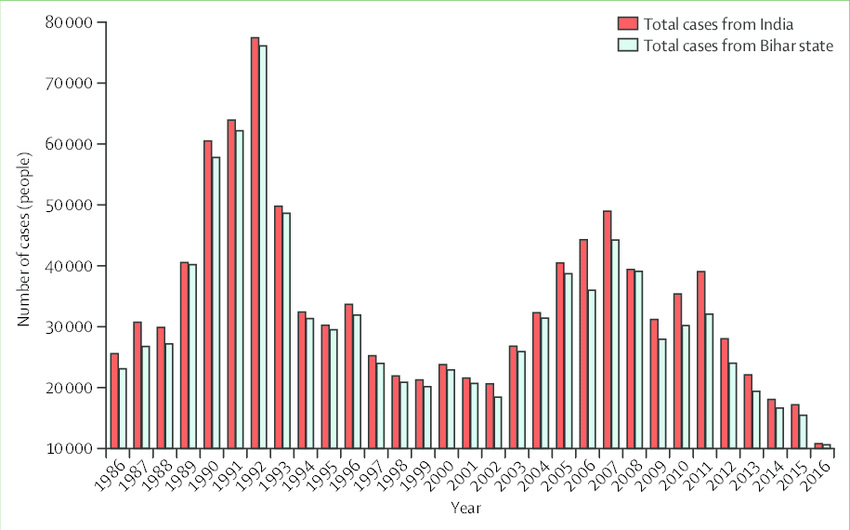
Visceral Leishmaniasis also called Kala Azar in the Indian Subcontinent is yet to be eradicated, Visceral leishmaniasis is caused by deadly protozoan parasite genus Leishmania. This deadly disease is characterized by anemia, weight loss, splenomegaly, irregular bouts of fever, hepatomegaly. This deadly disease is epidemic in more than 80 countries however the majority of the cases are reported from six countries that include: India, Brazil, Ethiopia, South Sudan, Somalia and, Sudan. All over the World, the estimated number of cases is around 2,00,000- 4,00,000 and around 40,000 deaths occur all over the globe. In India, Visceral Leishmaniasis is a pure anthroponotic and parasite that are spread to humans by the bite of an infected female sand fly species Phlebotomus argentipes. India alone accounts for 2/3rd of the global gases of which the state of Bihar alone has 50% of the cases and 61.1% of the Cases in India are from Bihar. Kala Azar is a public health problem in Bihar and in 2015 Government of India entrusted ICMR-Rajendra Memorial Research Institute of Medical Sciences, Patna, to implement an integrated control strategy for achieving the Visceral Leishmaniasis elimination target.
India and Kala-Azar

The Indian Government initiated the Visceral Leishmaniasis program in 1990-1991. In 2005 under WHO and including other countries of Nepal and Bangladesh developed a strategic framework in eliminating Visceral Leishmaniasis as a Public Health problem by 2015, but was later postponed to 2017 and again in 2020 and it is expected that this will be postponed again and in 2002 the Government launched the National Health Policy to eliminate Visceral Leishmaniasis in the region by 2010. India’s Kala-azar surveillance system is shaky and is not proper in detecting the hotspot areas and in providing the health workers with accurate information about the disease. There are some areas where the reach of health workers is negligible and the government needs to take the required steps to eradicate this problem.

The Government needs to :

A. Detect the disease early and provide early treatment for Kala-azar.

B. The government should have effective Survillenance of the diseases.

In India, the spraying of or Indoor residual spraying (IRS) with dichlorodiphenyltrichloroethane (DDT) was mandated and is being used regularly since 1976. Mostly Kala-azar is confined mostly confined to this states Bihar, Jharkhand, Uttar Pradesh, and West Bengal.

Therefore, are possible chances of controlling the Kala-azar and even have a chance to eliminate it from our country. The scientific feasibility of the elimination strategy is formulated based on the epidemiological vulnerability and how the effectiveness and feasibility of intervention are done and how the numbers are being reduced. However, after several efforts taken from different government and non-governmental organizations, Visceral leishmaniasis is still endemic in the 458 poorest blocks of Bihar. A few Visceral leishmaniasis infected blocks have persistently remained highly endemic for several years and there are no signs of improvement in certain areas regardless of the work done. The Visceral leishmaniasis -vector control program in Bihar has suffered from several problems such as the improper implementation of control strategies, weak monitoring and supervision systems, lack of technological involvement, lack of awareness activities about the program, delay in the diagnosis and treatment of infected patients, and the injudicious application of IRS. Therefore, the implementation of all control strategies in an effective way is a very big and huge task to achieve the Visceral leishmaniasis elimination target in Bihar and India overall.

ACCORDING TO WHO:
Visceral leishmaniasis is the main form of the disease in this Region, also endemic for cutaneous leishmaniasis. The region is the only one with an initiative to eliminate visceral leishmaniasis as a public health problem by 2020. In 2018, the Region observed fewer than 5,000 cases – its the lowest number on record.. The Region is poised to achieve this target, with countries aiming to have WHO validate elimination by 2023.

Safoora Zargar Needs Equal Attention As The Elephant Incident

Ever since the NCR act implementation came alive, the country was left with unprecedented anguish. The constitutional’s alarming move saw a full surge of student protests dispersing across the country and worldwide. Now a new incident came into light which has sparked outrage among the nation. 

As soon as the government announced lockdown due to the boost in Coronavirus outbreaks, several students and activists who actively lead a protest in Delhi were put behind bars amidst the lockdown. 

A 21-year-old MPhil student from Jamia Milia Islamia University, Safoora Zargar had been jailed for protesting against her rights as a citizen. The latter is currently nine months pregnant and has a condition of PCOS syndrome, which is widely common in women. 

The young female student has been facing a huge turmoil after her bail was rejected nearly four times. The law being enforced against the pregnant woman is clearly illegal but the judiciary don’t seem to mind breaking the rule when it comes to manning a particular community. 

Safoora was roughly booked under UAPA for allegedly steering the teacup of anti-CAA protest which took place in Delhi around February 2020. 

Comparing the elephant incident with Safoora one, Bollywood celebrity clad showed outrage on the elephant incident while blatantly ignoring the fact that a pregnant woman has been denied her human rights. The conclusion here clearly boasts that the a particular community is being brutally targeted with baseless reasoning to put forth by the rightists. 

Wake up, your child is going to do suicide

“If my parents understood my dreams than today I won’t be stealthy sitting on roof and writing this blog.”

So, you are a parent, if not than at one stage of life you’ll be ( but for now just read and share it with a parent). Every parent has great GREAT expectations from their offspring and sometimes that desire becomes so pressurizing that it takes the toll of the life of that little angel.

How many of you asked your child what he or she wants to become well many of you haven’t and in a rare case if you have, I am sorry to say that you didn’t took that seriously.

A child of 21st century is none less than the most busiest person on Earth, schooling, coaching, homework and much more trouble some tasks are a part of their life and after all that when they get the night time to rest, they wander in the land of dreams; the world that’s their own, they make ambitions and set goals for their life.

But do you even know the amount of grief and misery that your child feels when you say a crisp clear NO to them when they beg you to let them achieve what they want ?

Let me talk in statistics. Globally Around 65000 kids committed suicide in 2019 just because their parents didn’t allowed them to study in the field of their choice.

Just imagine the condition of a student who passed school working hard so that he could take admission in his dream college. But guess what, his CARING parents deny him that because the college is in another city . WTF, like seriously, we kids work our ass whole childhood to satisfy your marks hungry taste buds and what we get in return, a big rejection on our dreams.


As a parent your worries and thinking of well being of ur kid is justified. But you have to understand that the dreams and choice of your child also matters, afterall it’s them who would be studying and if they want to pursue a field of their choice then why deny it to them and become the reason of them going into depression or at worse, commuting suicide.


Parents, you have to understand this, your child knows his interests more than you or anyone else. Please, you just can’t put an end on their life by making them give up on their dreams.

Just go and talk to them, understand what ur child wants. Otherwise the day is not far when your child will cry silently in night and will fear to meet eye with people and will curse his very existence like I do. Please parents, wake up .


What should be the main concern? Corona or Unemployment

What is the main reason behind our fear? Is it media, or the public fear or any other reason. We are making our opinions based on the information conveyed to us. Who takes the responsibility that information conveyed is correct? It is basically the incomplete information which we are receiving on the daily basis. Once we get the clear understanding that what is actually happening around us then this may happen that our fear is reduced a bit. Current scenario says that we have around 2,00,000 cases in India, more than 5000 people are dead, out of 40 lakh people being tested. The most important thing to understand is that what is the role of testing and what is the connection of the fear with it? If the question is asked to someone that what is the reason behind his/her fear? The answer would be because of the number of deaths. It must be noted that the death rate is 3% which means the ratio is 3:100. Is it true?

The population of India is 135 crore. Out of 135 crore people, testing is done only of 40 lakh people which is not even 1%. So out of 40 lakh people being tested, 2,00,000 cases are found positive. So, in this way the calculation went wrong. Each one of us is focusing upon the number of deaths and number of positive cases emerging on the daily basis. But, no one is noticing that these cases are growing as the number of tests are increasing so there arises a need that the actual death rate needs to be calculated. Thus, the decision should be made on that basis.

We do not need to under-report the number of deaths. Instead over-reporting can be done. People in India die in accidents more than they are dying due to Corona. We are actually setting up only the mathematical modelling of the figures. We don’t have the correct information conveyed to us. If the death rate is 0.01 % then why are we scared. Shouldn’t we be scared of other important things? Yes, unemployment should be our matter of concern. In one of the articles, it was mentioned that around 13 crore people are unemployed. We must be scared of this figure. It means that out of economic point of view, this 13 crore people would be spending in limit. Lacs of industries are already in trouble because their demands are getting reduced at the economic level. This will lead to the reduction of supply. Hence, unemployment would rise.

Everyone is trying to increase the fear among the people. Instead we must make efforts to remove the unemployment from the country and help the needy ones. The solution is that only the critical cases need to be tested. People having mild symptoms of Corona can be quarantined at home. Since, it is clearly analysed that it is nearly impossible to test the whole country then why the tests are increased on a daily basis? The death rate is less. So, reality is that we must focus more on the people who have lost their jobs in this pandemic.

NEED OF FINANCIAL SUPPORT OF GOVERNMENT TO EDUCATION SECTOR

COVID-19 has halted all the productive sectors of economy resulting in financial imbalance. However, a unique sector that has emotions of our kids attached to it is their school, where they prepare themselves for the future. The teachers too have been forced to stay away from the school due to COVID-19 outbreak.

We have been hearing that government is providing some financial relief to certain sector. However, there is a necessity to provide some relief to the education sector too. Many educational institutes have taken loan to cater for variety of courses of instructions. The teachers of private and public educational institutes require support of the government, so that they can survive this tough phase. All the educational institutes and the staff working there needs to be supported financially for the time being.

We should ensure a respectful and dignified life for the teachers and support them to be stable and stay cheerful so that they develop the patience required to conduct the online classes for a longer period. A committee of educationist can be set up to look in to the concept of providing insurance cover against the Coronavirus to the school staff and the students. The government can include the public and private education sector in the list of sectors requiring economical support. Education sector has suffered financially and emotionally too.

A minimum financial help can be provided to all the teachers belonging to private sector on priority as it is a fact that they have not received their salaries since lock down was imposed from the month of March 2020.The plight of private school teachers has increased as these schools are totally dependent on fees from the parents.The management running the schools can support the teachers and hold their hands during this period of financial and health related crisis caused due to spread of Coronavirus.

The policies to hire and retain the teachers needs to be strengthened and redefined in the light of certain evil practices of hiring that are in vogue and have been in practiced. Such practices go unchecked specifically in the private hiring of the teachers. Hiring agencies are providing teachers to educational institutes at times overlooking all the laid down rules by the government. Though the efforts of private schools is commendable in contributing positively towards the growth of the students and in turn that of the society, certain scope of improvement in terms of treating teachers with respect exists. As a onetime special case some financial support can definitely be extended to the teachers so that they can support themselves during this uncertain lock downs due to COVID-19 spread.

A complete redefining of education sector can be done and many issues or evil practices that have intruded the system can be resolved and a new energy can be given to education sector for its revival. All the stakeholders need to accept the change for the betterment of students. The government has a greater role to play in this scenario and should come up with flexible policies for the revival of the education industry that can include granting subsidy to the educational institutes and extending some financial help to the teachers. The risk of COVID-19 is still there in the environment. We all have to treat this situation as an opportunity to learn.

World’s food safety day

It is necessary to assure that food remains safe at every stage from production to harvest, processing, storage, distribution, preparation, and consumption. That’s why World Food Safety Day is celebrated on 7 June to highlight the health consequences of contaminated food and water. The World food safety day was observed by the United Nations from 2019. This year’s world is celebrating second world food safety day. Unsafe food is a threat to human health and economies, and marginalized people, especially women and children.

World Food Safety Day Theme: Food-Safety Everyone’s Business

This year’s theme for world food safety day is food safety everyone’s business. This campaign will promote global food safety awareness and will call upon countries, the private sector, civil society, UN organizations, and the general public to take action. The theme Food-safety everyone’s business depicts that whether we grow, transport, process, distribute, store, sell, prepare, or consume food, everyone has a role to play in making consumed food safe and uncontaminated for people. Through World Food Safety Day, the World Health Organization pursues its efforts to mainstream food safety in the public agenda and reduce the burden of foodborne diseases globally.

Food Safety Tips

* It is important to keep foods safe to maintain healthy eating. We all can reduce contaminants in food and keep food safe by following food safety tips:

* Wash your hands properly with soap and water before going to the kitchen.

* Before eating, cooking, and cutting fruits and vegetables rinse them properly under running water.

* Clean inside and outside of appliances and buttons and handles of appliances.

* Daily sanitize kitchen surfaces with hot and soapy water or use disinfectant.

* While doing food shopping keep raw seafood, poultry, and meat in a separate bag and fresh fruits and vegetables ina separate bag.

* Clean your refrigerator once a week, discard cooked leftovers in 4 days and raw poultry and ground meats in 1 to 2 days.

But why can’t Globalized Navic as World Recognized GPS System : Super Exclusive >>>>>>>>

Why Navic :-

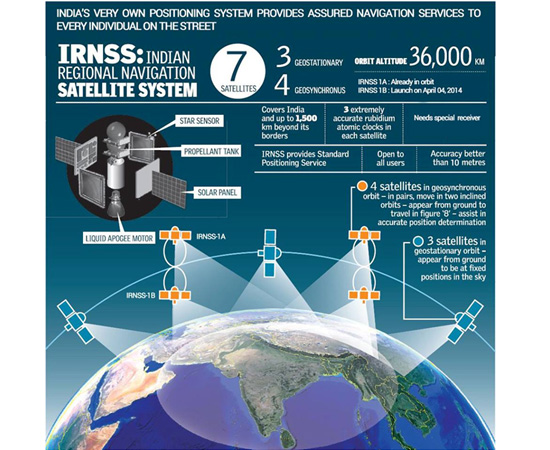
Navic is an independent Indian Satellite based positioning system for critical National applications. The main objective is to provide Reliable Position, Navigation and Timing services over India and its neighbourhood, to provide fairly good accuracy to the user. The IRNSS will provide basically two types of services

  1. Standard Positioning Service (SPS)
  2. Restricted Service (RS)

To date, ISRO has built a total of nine satellites in the IRNSS series; of which eight are currently in orbit Three of these satellites are in geostationary orbit (GEO) while the remaining in geosynchronous orbits (GSO) that maintain an inclination of 29° to the equatorial plane. The IRNSS constellation was named as “NavIC” (Navigation with Indian Constellation) by the Honourable Prime Minister, Mr. Narendra Modi and dedicated to the nation on the occasion of the successful launch of the IRNSS-1G satellite. The eight operational satellites in the IRNSS series, namely IRNSS-1A, 1B, 1C, 1D, 1E, 1F, 1G and 1I were launched on Jul 02, 2013; Apr 04, 2014; Oct 16, 2014; Mar 28, 2015; Jan 20, 2016; Mar 10, 2016, Apr 28, 2016; and Apr 12, 2018 respectively. The PSLV-39 / IRNSS-1H being unsuccessful; the satellite could not reach orbit.

Credit: Third Party Reference

Oh, Did I just ask to not address NAVIC (Navigation with Indian Constellation) as our own GPS (Global Positioning System). Have I lost my mind to go against the trend media has created? Am I actually serious about it? Well, let’s see why I am making such a preposterous appeal.

I have realised while talking to a lot of people on social media that they think GPS is a technology per say in generic terms which is completely incorrect. And the headlines all over media are reflecting as such. So first let’s talk about different satellite based navigation systems.

WHAT IS GPS :-

GPS (Global Positioning System) is a global satellite-based navigation system made up of a network of 24 satellites placed into orbit by the U.S. Department of Defense (DoD). It is a U.S.-owned utility that provides users with positioning, navigation, and timing (PNT) services. This system consists of three segments: the space segment, the control segment, and the user segment. GPS is operated and maintained by the U.S. Air Force. It is currently the world’s most utilized satellite navigation system.

ABOUT GNSS :-

The generic name of what we assume to be GPS is GNSS (Global Navigation Satellite System). Currently there are two operational GNSS:
1) Global Positioning System (GPS) is owned by the United States.
2) GLONASS is owned by Russia.

The third GNSS- GALILEO of European Union isn’t completely operational yet, 12 of 30 satellites in orbit. The forth BeiDou (Chinese Navigation system) is a limited test system, its full-scale global navigation system or GNSS also known as COMPASS or BeiDou-2 is currently under construction, it has about 20 satellites in orbit at present.

THEN WHAT’S THE ISSUE?

See, by now we have developed GPS isn’t a generic term, it’s just most popular and we human race runs after something that’s always more popular and it’s exactly what needs to be changed if we want to create our own identity in this world, if we want to stand with pride, if we want other nations to respect and recognise us then we need to be own people and not some ripped off identity of other nation and that’s what NAVIC deserve.

Credit: Third Party Reference

NAVIC was developed after so much of continuous handwork of ISRO scientists, thorough research and loads of money. It isn’t just another satellite based navigation system, it made us the fifth elite nation in this world to have our own navigation satellite system and it is a big deal. I am forever grateful to GPS for extending its services to us but we (India) developed and deployed NAVIC because many of the GPS services weren’t available to defence forces specially and we needed that thus came NAVIC.

NAVIC made us a proud nation, it showed the world the powerful force India is, it showed that we were Inventers/developers, we are and we always will be. We have some of the best brains in the world that is what NAVIC represents. It’s our pride and giving it a second hand name just dishearten me and it should dishearten you as well.

China has its own search engine Baidu and they do not call it ‘Chinese Google’. We do not call Flipkart as ‘India’s Amazon’ or Ola as ‘India’s Uber’ or every Smartphone an iPhone. Even you wouldn’t like to be called by other’s names!

What we say today, what we trend today will be remembered tomorrow and I do not want NAVIC to be known as ‘Indian GPS’.

If you agree with me then kindly share this post, raise your voice, talk about it, and aware more people about it. All I want is NAVIC to be known as NAVIC to the entire world and I need your help in doing so.

Reference- divyanshspacetech.wordpress.com and isro.gov.in

MS DHONI – a man with a dream

“If the plan doesn’t work, change the plan but never the goal.”

Born in small town of Ranchi,Jharkhand coming from a lower middle class family to becoming a legend in the field of cricket and staying in hearts of billions of people carving his own path of success with gaining the title of captain cool. His journey inspires a lot of people and I am one of them . starting with an accidental adventure in field of cricket ,he has faced all the failures but one thing that remained constant was his determination and the never give up attitude that led him to what he is today. An everyday man who went on to be popularly known as the ‘Captain Cool’ is none other than our very own former Indian Men’s (ODI & T20Is) Cricket Team Captain, Mahendra Singh Dhoni or simply known as Dhoni.

His cricket journey started when he was in his school in his football team  and his coach asked to do wicket keeping that’s where he impressed everyone with his wicket keeping skills and secured his position in  commando cricket club for 3 years and selected for Vinoo Mankad Trophy under 16 during 1997-1998. Well his journey to be a part of Indian cricket team wasn’t that easy for him, after playing cricket at district and state level, he worked as a train ticket examiner at Khargpur railway station in West Bengal to financially support his family. But the young man always had a bigger vision and wanted to achieve more , he saw a dream, which many feared to see.

He made his debut in Ranji Trophy for Bihar in year 1999-2000 and played for three years. Seeing his excellent performance in Ranji Trophy, TRDO officer Prakash Poddar was attracted towards his performance and later sent a report to national cricket academy regarding his performance.  Finally his struggle and hardwork payed off and he was selected for India A squad for a tour of Zimbabwe and scored back to back centuries.

ODI CARRER

After delivering good performance in India A team he was selected in ODI squad for Bangladesh tour in 2004-2005  and was also picked for Pakistan series. Though his initial matches were not a great success.

His turning point came with Sri Lanka bilateral ODI series in 2005 where India  had to made 299 runs among which Dhoni made 183 runs finally winning the game for India. Due to his consistent performance in later ODI’s, Dhoni overtook Ricky Ponting and  became number 1 in ICC ODI ranking for batsmen in 2006.

There are many inspiring lessons that the sportsman has taught us about life. He loved the sport and he wanted to chase his passion. He taught us to dream big and not get satisfied with small joys of life. He is a wonderful human, who was always up for absorbing new learning from his peers. He never hesitates to appreciate the outstanding work of others. He never lost hope and put in extra effort to fulfill his dream.

BECOMING A SENSATION AND HIS JOURNEY AS THE INDIAN CAPTAIN

Dhoni was not only known for his cricket but was also very popular for his lengthy wavy hair style. In fact, it had then become a trend in those days that every boy in the country now wanted to adorn the “Dhoni Hairstyle”.

In 2007, he led the team a whopping victory in ICC T-20 World Cup. He continues to inspire the younger generation with his brilliant captaincy, and out of the box thinking.

MS Dhoni is India’s only two-time World Cup winning captain, leading the team to victory on two occasions which involved two different format. He led a young Indian team to the first ever T20 World Cup victory in South Africa in 2007. Dhoni then led India to their second ODI World Cup victory in 2011.

He is arguably one of the best captains in the history of not just Indian cricket but also world cricket. The miracles he has done on the cricket field makes everyone wonder if he really is a human.

His cricket acumen is so accurate that people believe if Dhoni gives someone out on the field then his team starts celebrating without waiting for 3rd umpire. People started referring the DRS  not as Decision Review System but as Dhoni Review System. His lightning fast stumpings are viewers delight. He has taught us that no situation, however bad can be fought through and defeated. The only Indian captain with over 100 wins in ODI’s, the next best captain after Ricky Ponting with 11 consecutive wins in world cup matches.

He is a phenomenal cricketer and a legend, and  because of him I became a cricket lover. I bet no Indian can ever forget the line – “INDIA LIVES THE WORLDCUP ONCE AGAIN AFTER 28 YEARS” right after his six. He served his nation for 15 years. Dhoni is the most successful captain of India who has won two ICC cricket world Cups for the country.

The person behind the stumps, the cricketer who held is calm and takes his team to victory in immense pressure – famous as captain cool. The man who went on to become one of the most agile wicket keeper in modern limited overs in international cricket , right handed batsman , a magnificent  finisher , absolute fighter and the person who have billions of hearts attached

THE MSD NO.7 GAME.

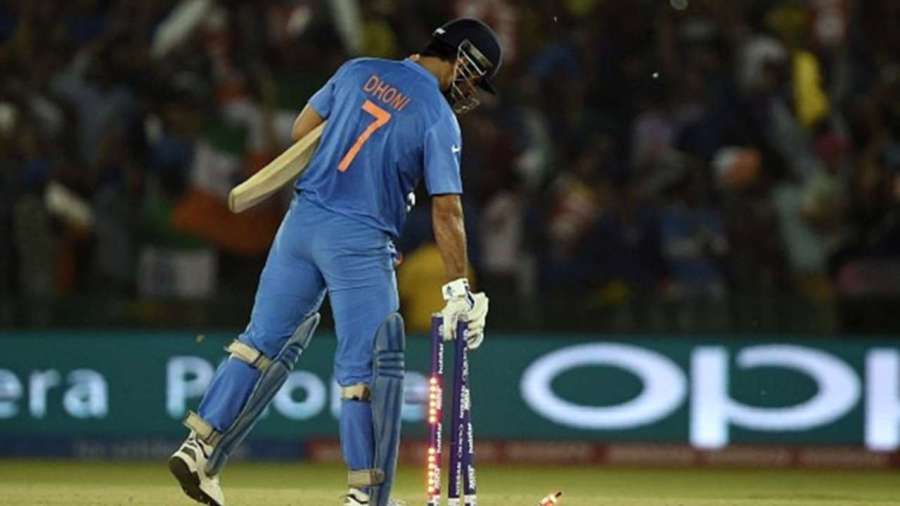
  • Cleary, Dhoni got a special preference for the number as his India shirt also has number 7
  • M.S. Dhoni was born on July 7, 1981. The year 2007 is strikingly significant for such people. No wonder he was won the World T20 Championship that year.
  • The name ‘M.S.Dhoni’ carries 7 characters!
  • India won the final (World T20) when Dhoni was 26 years and 80 days old. The age adds up to 7! (26+80=106). NO.7 will always be in everyone’s heart .

MS Dhoni has been an asset in the Indian cricket team and he has a fan following across the world. When he is in a room full of people, his presence is felt and he is a humble man. He is the man, who never hesitates to improvise. He always improvised his game and never let a failure get to him. This is a true story and it has inspired many! If you have a dream or passion, you should go after it and achieve it. There will be obstacles but life is not easy. Once you go after your dreams, the universe will find a way for you to achieve it.

Worlds first “Internet controlled robot” By 23 year old Indian boy : Covid-19

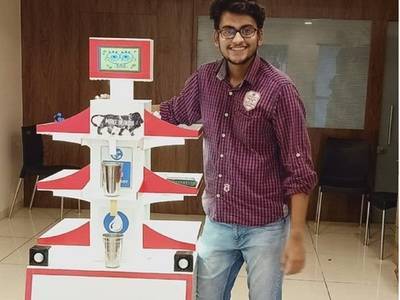
A 23 year old Thane engineer has developed worlds first-of-its-kind internet controlled robot which can be used to treat covid patients in hospitals.

The robot delivers food, water, beverages, medicines and even some good advices to the patients without the help of any hospital nurses or staffs.

This aCoro-bot’ eliminates the need of physical presence or contact of nurses or ward boys with the patient. It can deliver food, water, medicines and interact with the patients through a camera. Through a speaker, it can also advise patients on various precautions like sanitizing their hands before picking up anything from the robotic tray,” Says Pratik tirodkar the creator and designer of this robot.

This smart boy is also the founder of a start up ‘PNT solutions’. Whatsmore this young lad had developed other unique creations when he had barely stepped to college. This include world’s first ‘Humanoid’ with 47 body (axis) movements, a robotic bird ornithopter for various outdoor applicationsapplications,  a mini packaging robot and several others.

This genius has even given over a 100 guest lectures to the brain students of IITs and NITs in the country.

This robot can be operated from any part of the world through internet. The robot comes with 3 trays with a carrying capacity of 10-15 kg each, plus a 30-kg storage at the bottom, enabling it to serve the supplies to over a dozen patients at a time in the COVID-19 ward.

There are separate dispensers for water, tea, coffee, besides sensors for sanitizers which flow out quickly when the patient holds his hand below it and cuts off the supply when the hand is removed. Thus there is minimum wastage,” Tirodkar explained.

“Not only the COVID-19 patients, Coro-bot can also take care of itself. It has three nozzles at the back to give itself a disinfectant bath regularly, it goes on spraying sanitisers on both sides of the path, plus disinfects the ground it moves on by using UV lights” Says the genius.

The Coro-bot also has LED lights illumination to make it convenient for night usage as well, timers for indicating lunch-dinner, emergency button, besides a small PC like screen on the top for basic computer work or entertainment, he said.

This is now successfully deployed at Holy Cross Hospital in kalyan. Impressed by this robot over a dozen of other hospitals have ordered coro-bot in Mumbai.

The Coro-bot costs between Rs 1.60-Rs.3.80 lakhs, depending on various specifications like the load-carrying capacity, etc, and the Ornithopter is around Rs 30,000. I have a small manufacturing unit at Dombivali, but if I can get a good investor, I can get into mass production,” he said.

Pratik tirodkar is currently doing his Btech in instrumentation engineering from Bharati  Vidyapeeth College of Engineering, Navi Mumbai.

Human – The Monsters

After the recent incident, where a pregnant elephant died in Kerala after a fruit filled with firecrackers burst in her mouth, triggered nation-wide outrage, a video of a pregnant cow injured in a similar fashion has been circulating on social media. In the video being shared online, one Gurdiyal Singh, a resident of Himachal Pradesh, who claims to be the owner of the injured pregnant cow, describes how the cow’s mouth had been injured after one Nandlal fed her explosives.

Owner of the preganant cow blames neighbour for the brutal act

Meanwhile, Gurdiyal Singh confirmed that Nandlal, the alleged accused, works as a mechanic in Singh’s neighbourhood. Singh said that Nandlal has no remorse for his action. Nandlal has said that he is not scared of the repercussions and that he will continue to do whatever he deems fit. “Even the village sarpanch cannot harm me”, challenged Nandlal when confronted by Singh.

The video of this brutal act was circulated soon after social media was aflutter with outrage and anger over the demise of an elephant in Kerala. Amid outrage, the district police on Thursday (June 4) constituted a special investigation team under a DSP-rank officer to probe the matter.

One suspect arrested in Kerala elephant killing case

The forest department in Kerala has arrested one suspect in the case of death of a pregnant wild elephant in Kerala. The person is being interrogated in the matter. The elephant had died after she was fed a pineapple filled with firecrackers by some villagers.

The autopsy report of the dead elephant has revealed that the crackers stuffed in the pineapple which was fed to the elephant burst in her mouth leading to severe injuries. The elephant was not able to eat anything due to the deep wounds, due to which she fell and drowned due to weakness. The elephant’s preliminary post-mortem examination was conducted at the Mannarkkad Forest Division. It revealed that the animal died as a result of drowning, followed by inhalation of water which led to lung failure. This has been identified as the immediate cause of the death of the elephant.

The investigation in the case has been moving on a faster pace and the forest department has started interrogating the suspect in custody. As per reports, three people are under suspicion of feeding the pineapple full of crackers.

Pregnant elephant dies in Kerala after cracker-filled pineapple burst in its mouth

Recently, in an act of utmost cruelty, a pregnant elephant had died after some locals fed her cracker-filled pineapple which later exploded in her mouth. The incident took place in Malappuram district of Kerala when the elephant had wandered into a village in search of food. It is being believed that some villagers stuffed pineapples filled with firecrackers on her tusks while she was walking on the streets.

From anybody who throws stones at stray dogs to anybody hurting a living soul,choose one face. A lot of these animals trust  humans because the have been helped by them in past. This is cruel beyond measure. When you lack empathy and kindness,you don’t deserve to be called a buman. To hurt someone is not human . Just stricter laws won’t help. We need a descent execution of law too.
Until the guilty are punished in the worst possible way, these wicked monsters will never fear law. Though it’s difficult, i hope they are able to find out the  one who committed this crime and  punish them  accordingly.

E-LEARNING-CHANGING THE WAY OF EDUCATION.

ABOUT

In this era of Technological boom, e-learning has placed knowledge right at our finger tips, no matter where we are and at what time of the day we wish to study. Literature, Science, Math, Geography, History – you name it; we have it on the display screen of our tablets or phones at the swipe of our fingers.

Just one smart device and some nominal charge for internet connection would take us from the primary level of learning to even college education!e-learning doesn’t In this era of Technological boom, e-learning has placed knowledge right at our finger tips, no matter where we are and at what time of the day we wish to study.

E-learning doesn’t differentiate between a slow learner or a studious one because it helps set up an individualized pattern according to the pace of every student. It doesn’t even matter what our life situation is or how old we are, and is an affordable option for people who can’t meet expenses to purchase lots of books or enroll for tuition or coaching classes website.

WHAT E-LEARNING PROVIDES?

Online learning provides us with an audio-visual treat and 3-dimensional perception that help us comprehend concepts in a much better way. We are open to taking tutorials not only from Indian teachers, but also from people belonging to different parts of the world.

We also get to divide study timings as per our convenience. Literally, no more carrying around books and bags – just sit, stand and walk while learning!

Yet, online learning tempts one to browse through various subjects on a superficial level, rather than going into deep study. This practice, in turn, leads to insufficient understanding of certain basic concepts which might affect our advanced learning.

This is because most online courses do not follow a structured pattern or work assessment. So some students might fail to meet the expected standard of education.

Also, using technology has its own issues like slow internet connection, power shortage crises and cyber security concerns.

If learners use e-learning software, they require devices that are only compatible with that software which is quite a costly investment, at least initially.

One ought to admit though , communication via human connections is a different pleasure altogether, that cannot be substituted by electronic devices in which computer proficiency is essential.

E-LEARNING OVER CLASSROOM LEARNING :

In traditional classroom settings, getting to share ideas with friends, playing with them during break-time, spending some time with nature and listening to encouraging talks from elderly teachers do develop kids’ social skills and empathetic approach.

We cultivate mutual respect and take responsibility for our actions and become better individuals through human connections.

Speaking of health issues, prolonged screen time and sedentary habits eventually lead to dry eyes and obesity. Unhealthy sitting postures cause backache and stiff neck too.

When bored with studies, students play online games and watch inappropriate stuff that could lead them to bad ways or unhealthy lifestyle. Online addiction has been lately categorized as a mental disorder.

In short, e-learning can either shape us into brilliant personalities or can degrade us to lazy and indifferent individuals, depending on our responsible usage & proper supervision of students by adults

 between a slow learner or a studious one because it helps set up an individualized pattern according to the pace of every student.

It doesn’t even matter what our life situation is or how old we are, and is an affordable option for people who can’t meet expenses to purchase lots of books or enroll for tuition or coaching classes.

Online learning provides us with an audio-visual treat and 3-dimensional perception that help us comprehend concepts in a much better way. We are open to taking tutorials not only from Indian teachers, but also from people belonging to different parts of the world.

We also get to divide study timings as per our convenience. Literally, no more carrying around books and bags – just sit, stand and walk while learning!

Yet, online learning tempts one to browse through various subjects on a superficial level, rather than going into deep study. This practice, in turn, leads to insufficient understanding of certain basic concepts which might affect our advanced learning.

This is because most online courses do not follow a structured pattern or work assessment. So some students might fail to meet the expected standard of education.

Also, using technology has its own issues like slow internet connection, power shortage crises and cyber security concerns.

If learners use e-learning software, they require devices that are only compatible with that software which is quite a costly investment, at least initially.

One ought to admit though , communication via human connections is a different pleasure altogether, that cannot be substituted by electronic devices in which computer proficiency is essential.

In traditional classroom settings, getting to share ideas with friends, playing with them during break-time, spending some time with nature and listening to encouraging talks from elderly teachers do develop kids social skills and empathetic approach.

We cultivate mutual respect and take responsibility for our actions and become better individuals through human connections.

Speaking of health issues, prolonged screen time and sedentary habits eventually lead to dry eyes and obesity. Unhealthy sitting postures cause backache and stiff neck too.

When bored with studies, students play online games and watch inappropriate stuff that could lead them to bad ways or unhealthy lifestyle. Online addiction has been lately categorized as a mental disorder. In short, e-learning can either shape us into brilliant personalities or can degrade us to lazy and indifferent individuals, depending on our responsible usage & proper supervision of students by adults.

100% household tap connections in rural areas of West Bengal

In continuation of various initiatives taken up to improve the lives of people of this country, ‘Jal Jeevan Mission’ was launched by Government of India last year to provide every rural household in the country a Functional Household Tap Connection for supply of potable water in adequate quantity and of prescribed quality on regular and long-term basis. Following the true spirit of cooperative federalism, State Governments are implementing this flagship programme to realize the objectives of the Mission so as to ensure ‘ease of living’ of people in rural areas as well as reduce the ‘drudgery’ of women, especially girls. This life changing Mission focuses on the key principles of ‘equity and inclusiveness’, i.e. every family in the village gets tap water connection in their households. With a departure from earlier programmes, JJM stresses on service delivery, rather than infrastructure creation.

The Annual Action Plan (AAP) is very important for timely implementation to achieve the goals of the mission, for which very intensive exercise was carried out in the Ministry in last couple of months and all the States have presented their annual action plan for JJM. West Bengal is yet to present its AAP before the National Committee of the Ministry of Jal Shakti.

            West Bengal has 1.63 Crore rural households spread over 41,357 villages, but only 2 lakh households have a tap connection in their premises. In 2019-20, against a target of 32.24 lakh households to be given tap connections, State could provide only 4,720 household tap connections. In 2020-21, the target fixed for providing tap connections is 64.43 lakh households including the shortfall of about 32.19 lakh from the previous year. This needs rigorous planning and robust implementation strategy to achieve the target.

            In 2019-20, Rs. 993.88 Crore of Central funds was released to the State, however only Rs 421.63 Crore was utilized and rest amount is lying unspent. Further, to provide potable water in Arsenic/ Fluoride-affected habitations, a sum of Rs. 1,305 Crore was provided, out of which Rs. 573.36 Crore is still lying unspent. Thus, as on 1.4.2020, State has an opening balance of Rs. 1,146.58 Crore as Central Share to provide tap water to rural households. During 2020-21, fund allocation to West Bengal has increased to Rs. 1,610.76 Crore. With an opening balance of Rs. 1,146.58 Crore, the State has an assured availability of Rs. 2,757.34 Crore of Central share funds. Therefore, in 2020-21, along with State share about Rs. 5,515 Crore will be available under Jal Jeevan Mission to provide household tap connections in West Bengal. Further, additional funds too can be provided based on progress of implementation in form of performance incentive under JJM. Therefore, the State needs to make a monthly plan for physical progress in terms of tap connections to be provided and expenditure plan for prudent financial management to spend the huge amount of funds available with State.

As Government of India is working in tandem with States to achieve the goals of JJM within the time frame, focus is on retrofitting/ augmentation of existing water supply systems to provide tap connections to remaining households. Out of total 41,357 villages In West Bengal, 22,155 (54%) villages already have piped water supply systems. However, only 2 lakh households in these villages have tap connections. Those which have been left out in such villages belong to poor and marginalized sections of the society. There is a potential to provide 1.08 Crore household tap connections in these villages. State needs to push this agenda forward with utmost speed to provide household tap connections in next 4-6 months in a ‘campaign mode’. Priority is to be given to saturation of villages in quality-affected habitations, aspirational districts, SC/ ST majority villages/ habitations and villages covered under Sansad Adarsh Gram Yojana.

Potable water supply to water quality-affected habitations is given top most priority under JJM and in view of interim order of National Green Tribunal, State has to ensure piped water supply to all households in 2,414 Arsenic and Fluoride affected habitations before 31 December, 2020. In case, potable water piped connections cannot be ensured before December, 2020, as an interim measure, potable water @ 8-10 lpcd for drinking and cooking purpose is to be provided by installing community water purification plants (CWPP).

West Bengal would receive Rs 4,412 Crore as 15th Finance Commission Grants to PRIs, 50% of which will mandatorily be spent on water and sanitation. There is need for convergence planning to be done by the State under various programmes like MGNREGS, JJM, SBM (G), 15th Finance Commission Grants to PRIs, District Mineral Development Fund, CAMPA, CSR Fund, Local Area Development Fund, etc. at village level and Village Action Plan (VAP) of every village is to be prepared by dovetailing all such funds for carrying out water conservation activities to strengthen water source leading to drinking water security.

In all villages, IEC campaign along with community mobilization is to be taken up to make JJM truly a people’s movement. State has to engage women Self Help Groups and voluntary organizations working in social sector and natural resources management to mobilize the rural community for creation of in-village water supply infrastructure as well as for their operation and maintenance.

To achieve the objectives of the Mission to provide tap connection to each rural household in every habitation/ village on long-term basis, skilled manpower in areas like masonry, plumbing, fitting, electricity, etc., will be needed for creation of water supply schemes and their operation & maintenance and such manpower will be required in each village/ habitation. Ministry of Jal Shakti has roped in National Skill Development Corporation to create a pool of skilled Human Resource in rural areas to make villages a self-reliant unit without depending on others for regular upkeep and maintenance of water supply systems.

In the prevailing CoVid-19 pandemic situation, State needs to start works related to water supply and water conservation immediately in villages so as to provide works to the skilled/ semi-skilled migrants to provide livelihood as well as to ensure potable water in the households of rural people as well as boost the rural economy.

Jal Jeevan Mission in Punjab

Union Minister of Jal Shakti, Shri Gajendra Singh Shekhawat has complimented the Chief Minister of Punjab, Captain Amarinder Singh for taking steps to provide tap connections to all rural households by March, 2020. In his letter he thanked the Chief Minister for showing his commitment towards the ethos of Jal Jeevan Mission.

         Minister expressed optimism that the State will not only provide remaining households with tap connections, but potable water service delivery in adequate quantity of prescribed quality on regular & long-term basis will be ensured to all households as envisaged under the Jal Jeevan Mission (JJM).

Minister stressed that funds to the State is provided by Government of India based on output in terms of number of FHTCs provided and utilization of funds. To that effect in 2019-20, Punjab was allocated and provided Rs. 227.46 Crore as Central share, out of which the State could utilize only Rs. 73.27 Crore. With opening balance of Rs. 257 Crore along with allocation of Rs. 362.79 Crore in 2020-21, Punjab has assured availability of Rs. 619.89 Crore Central fund. With State’s matching share, Rs. 1,239.78 Crore will be available under Jal Jeevan Mission to provide tap connections to families in rural areas of Punjab in 2020-21.

Union Minister requested the State to expedite the planning and implementation, in order to ensure that every household is provided with tap connections by March, 2022. He impressed upon the CM to focus on retrofitting/ augmentation of existing water supply systems in villages to provide household tap connections to the remaining households, mostly belonging to poorer section of the society. He urged the CM to provide remaining households with tap connections in next 4–6 months in a ‘campaign mode’ to provide 14 lakh tap connections by taking up augmentation and retrofitting of such schemes and these villages can become ‘Har Ghar Jal Gaon’.  While planning, priority should be given on saturating villages in water scarce areas and aspirational districts, & villages covered under Sansad Adarsh Gramin Yojana.

Since, potable water supply to water quality-affected habitations is a top priority under JJM and in the light of interim order of National Green Tribunal, Union Minister requested the CM to ensure piped water supply to all households in Arsenic and Fluoride affected habitations before December, 2020. In case, potable water piped connections cannot be ensured before December, 2020, as an interim measure potable water @ 8-10 lpcd for drinking and cooking purpose is to be provided by installing community water purification plants (CWPP).

Keeping the 73rd Constitutional Amendment, Jal Jeevan Mission mandates that local village community/ Gram Panchayats and or its sub-committee/ user groups are involved in planning, implementation, management, operation and maintenance of water supply systems in villages to ensure long-term sustainability of water supply schemes to achieve drinking water security.

In 2020-21, under 15th FC Grants to PRIs, Rs.1,388 Crore  is allocated  to the State, 50% of which is to be spent mandatorily on water and sanitation The State has been requested to utilize all available resources through convergence of various programmes like MGNREGS, SBM (G), 15th Finance Commission Grants to PRIs, CAMPA, CSR Fund, Local Area Development Fund, etc. for water supply works at village level and Village Action Plan of every village is to be prepared by dovetailing all such resources.

In the wake of COVID-19 pandemic situation, issue of drinking water gains prominence. At present, there is perhaps no higher priority but to ensure citizens have access to clean water for drinking and multifarious domestic uses. A tap at home will not only help practicing social distancing, but will also ensure better hygiene and hand-washing routine. Besides, the State will also help its local people and migrant workers in providing them with employment through Jal Jeevan Mission.

Clarification over Tiger Deaths in the Country during last 8 years.

It has come to light that some section of media has presented the figure of tiger deaths in the country, in a manner which is a lopsided view of tiger conservation in the country and has apparently attempted to malign efforts of the Government of India in this regard and sensationalize the issue.

The National Tiger Conservation Authority(NTCA),a statutory body of the Ministry of Environment, Forest and Climate Change would like to put across the following :

Due to efforts of the Government of India thorough the National Tiger Conservation Authority, the tiger has been taken from the brink to an assured path of recovery, which is evident in findings of the quadrennial All India Tiger Estimation conducted in 2006,2010,2014 and 2018.These results have shown a healthy annual growth rate of tigers at 6%, which offsets natural losses and keeps tigers at the habitats carrying capacity level, in the Indian context. For the period 2012 to 2019, one can observe that the average tiger deaths per year in the country hover around 94, which is balanced by the annual recruitment as highlighted by this robust growth rate. In addition, the National Tiger Conservation Authority has taken several steps under the ongoing Centrally Sponsored Scheme of Project Tiger to address poaching,which too,is significantly controlled as seen in the confirmed poaching and seizure cases.

The National Tiger Conservation Authority maintains the highest standards of transparency in so far as making tiger death statistics available to the citizen through its website as well as dedicated portal – www.tigernet.nic.in, so that people can make a logical assessment, if they desire. The presentation of data over a long time frame spread across 8 years indicates an intent to imprint the gullible reader with large numbers which may cause undue alarm. Also, not adequately covered is the fact that 60 percent of tiger deaths in India are not attributable topoaching.

It is also pertinent to mention that the NTCA, through a dedicated Standard Operating Procedure, has a stringent protocol to ascribe cause to a tiger death, which is treated as unnatural, unless otherwise proved by the State concerned through submission of necropsy reports, histopathological and forensic assessments besides photographs and circumstantial evidences. It is only after a detailed analysis of these documents that cause is ascribed to a tigerdeath.

While it is appreciated that figures as available on the NTCA’s website and as provided in the RTI reply have been used in these reports, the manner in which it has been presented causes alarm and does not take into account the gamut of processes that go into dealing with tiger death in the country and the natural gains that have been made in tiger conservation,as a result of sustained technical and financial interventions by the Government of India under its Centrally Sponsored Scheme of Project Tiger being steered by the NTCA.

It is expected that media, will inform the aforesaid facts, to the country so that there is no sensationalism and citizens are not led to believe that there is cause for alarm.

Checklist for domestic travel via flights

women in brown blazer and brown skirt set

  1. Plan, Plan & Plan

A lot has changed as per the new guidelines, so it’s best to plan ahead. As per the new rule, you have to reach the airport at least 2 hours in advance, as opposed to the earlier 40 minutes cut off. Also keep in mind, how you will be travelling to the airport as public transport will not be easily available.


  1. Be Vigilant About Your Hygiene & Safety

Now I know that this one isn’t easy. We’ve never had to live or travel in a time with a highly infectious virus. So the best thing to do is not let your guard down. Start from the basic level and ensure that you are packed well. In an ideal scenario, ensure that you do not have to buy anything from a shop or from the airport. Make sure you have a mask, sanitizer and gloves easily accessible in your handbag. Ensure that you take maximum protection while heading to the airport and leaving your destination airport. You can never be too careful.

  1. Pack Only One Hand Bag & One Carry On Bag . As per the new rules, only one hand bag and one cabin luggage is allowed. So make sure you pack light and pack efficiently. Only carry what you need. Also remember, to carry a handbag that is not so heavy that you have to leave it on the floor of the airport. Another important point to note is that metal & plastic are better breeding grounds for viruses. So ensure that you carry a bad that is made of fabric instead of metal.
  2. Rethink Your Airport Look

Well, remember when airport looks were all the rage? You’re probably going to have to rethink that look now since the new look is all about hazmat suits, masks, sanitizers and gloves. As part of the new guidelines, just before you board the flight you have to compulsorily mask up and suit up to prevent infection and the spread of it. Wear comfy clothes underneath your protective gear and ideally pick a hazmat suit that you can dispose off with ease once you reach your destination.

  1. Eat Well Before The Flight/Carry Food

As per the new guidelines no meals will be served onboard the flight, so do ensure that you either eat well before the flight or carry your own food that you can eat after the flight.

  1. Let Your Loved Ones Know When You Are Travelling

We are not asking you to take permission, but do inform your friends and family about your travels and ideally do keep a backup option for stay and help at the destination you will be visiting. Mark your emergency contacts clearly.

  1. Carry Enough Cash & Have Ready Finance Available

No, we are not asking you to carry a briefcase full of money like in those old Bollywood films, but do ensure that you have both some liquid cash available with you and some easily available money in the bank. In case you do have to be quarantined or in the unfortunate situation that you get infected, ensure you have enough money for treatment and for stay.