Jesus Christ is the central figure of Christianity. He was born at Bethlehem; Judea in Roman empire in 4-6 B.C and his mother was Mary. The Christians traditionally believe that Jesus was born of a virgin, performed miracles and founded an independent religious movement. The majority of Christians worship Jesus as the incarnation of son of god, one of three divine persons of a trinity. A few Christian groups, however, reject trinitarianism, partly or wholly, taking it to be non- scriptural. The principal sources of information regarding Jesus are the four canonical gospels, and most critical scholars find them useful for reconstruction the life and teachings of Jesus. Some scholars believe apocryphal texts such as the gospel of Thomas and the gospel of Hebrews are also relevant.
Later on, the Bible has been divided into two parts- the Old Testament (before Christ) and the New Testament, containing the life of Jesus and principles of Christianity. In Islam, Jesus (transliterated in Arabic as Isa) is considered one of God’s prophets, and the product of a virgin birth; but do not believe that he was God incarnate.
Most of the historians agree that Jesus was a Jew regarded as a preacher and healer, and was crucified between the age of 33-36yrs in Jerusalem on the orders of the Roman Prefect of Judaea, Pontius Pilate, on charge of sedition against the Roman Empire. His date of death was 30-33 A.D.
population is a very serious and underrated issue in todays life. Its need to be considered and handled as soon as possible. the population of whole world is estimated around 7.5 billion, which is a huge number.it has its own advantages and disadvantages.
the biggest problem we are facing is population explosion. Population explosion is sudden or sharp increase in number of people in an area . due to which we face lot of problems such as poverty, unemployment migration of people from rural to urban areas due to less facilities, shortage of food items, low standard of living and many other effects.
causes of population explosion
There are many causes of population explosion some of them are listed below:-
The most important reason of the huge population explosion is Birth rate. The rate of birth rate is very high.it is due to many reasons such as lack of awareness and knowledge among people .especially in our country India .The rate of birth rate is very very high and some of the main reason is people are very fond of having a male child ,joint families ,infant mortality rate and many other reasons.
2. Falling death rate of human beings is also a big reason of such increase in population . Medical sciences have discovered many medicines (vaccines and antibiotics) and treatments through which human life has been increased significantly.
3.Poverty in developed countries is one of the reasons of population explosion.it is because it is considered that having more children means an extra chance of earning more when he/she will be grown up.
These are few causes of popuation explosion.
Problems due to population explosion
This sudden increase in population will definitely have some serious issues, some of them are:-
1 .More increase in population will result in more demand of food, healthcare, water, transportations housing and many other things. that will be impossible at one point if we will not do something to stop it.
2. The more population will result into more violence and conflicts in different parts of world.
3. Deforestation:- we all are aware of the term deforestation population is increasing day by day we need more land or area to live and it can only be accompished by cutting trees (forests).due to which our ability to take carbon dioxide decreases. Due to deforestation, wild animals and species are also suffering .
4.global warming :it is due to the burning of greenhouse gases. As population is increasing ,fossil fuels have a large impact in industrial societies when these fossil fuels (coal ,gas and oil) are burned they give carbon dioxide in huge amount and other greenhouse gases such as methane, carbon monoxide etc, which also leads to depletion of fossil fuels.
these are some few problems associated with population explosion which are creating a lot of problem for human beings.
Actions that can be applied tosolve this problem
According to united nation, the population of world will be 10.8 billion by 2100.This is a very huge number and we do not know whether we will be able to tackle that difficulties in future.
strategies should be made to control population explosion that should include making public realize about consequences of overpopulation like it will decrease the quantities of basic needs of life .Employment rate should be increased as much as possible, family planning should be made, medical facility should be good in developing nations and there are many other measures that can be taken to control population explosion.
The World Trade Organisation is the successor of General Agreement on Tariffs and Trades (GATT ). The WTO Agreement is the Uruguay Round agreement where the original GATT is now part of the WTO Agreement which came into force from January 1,1995.
WTO is a multilateral organisation .It has its headquarter in Geneva , Switzerland. It is the central body that facilitates global trade .
It is the only international organization that deals with global rules of trade between nations. It provides a framework for conduct of international trade in goods and services.
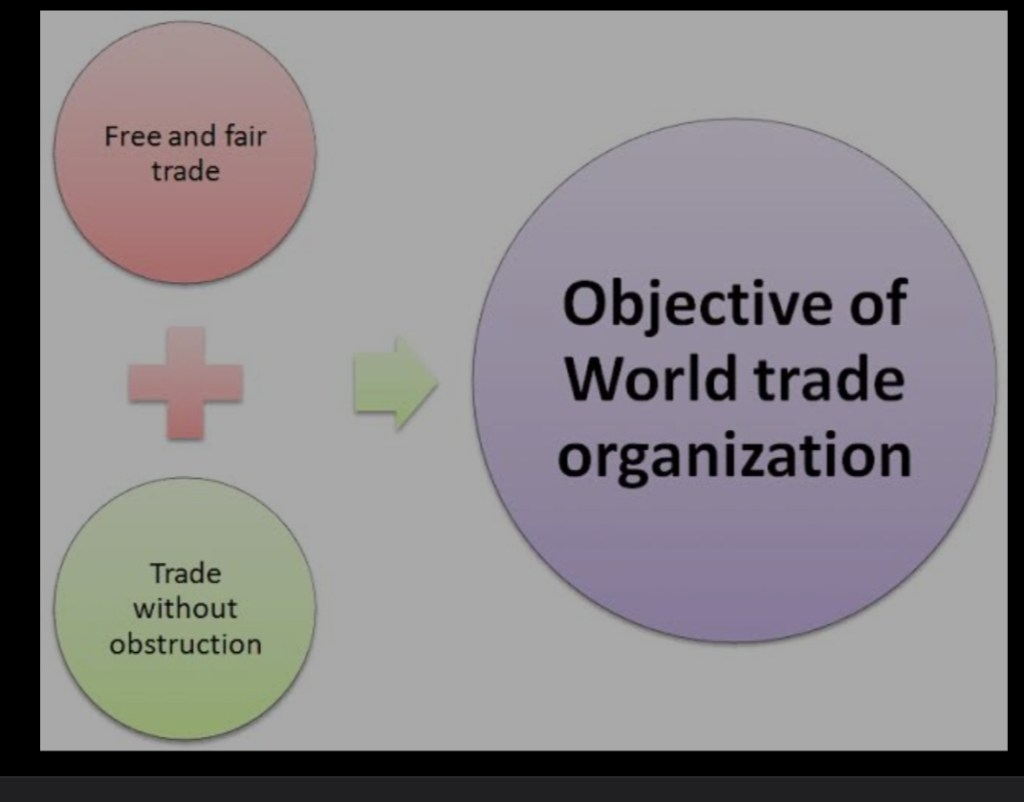
The fundamental objective of the rule-based system of international trade under the WTO is to ensure that international markets remain open and their access is not disrupted by the sudden and arbitrary imposition of import restrictions.
It lays down the rights and obligations of governments in the set of multilateral agreements. It also covers a wide range of issues related to international trade, such as protection of intellectual property rights and dispute settlement, and prescribes disciplines for governments in formulation of rules, procedures, and practices in these areas.
Structure of WTO
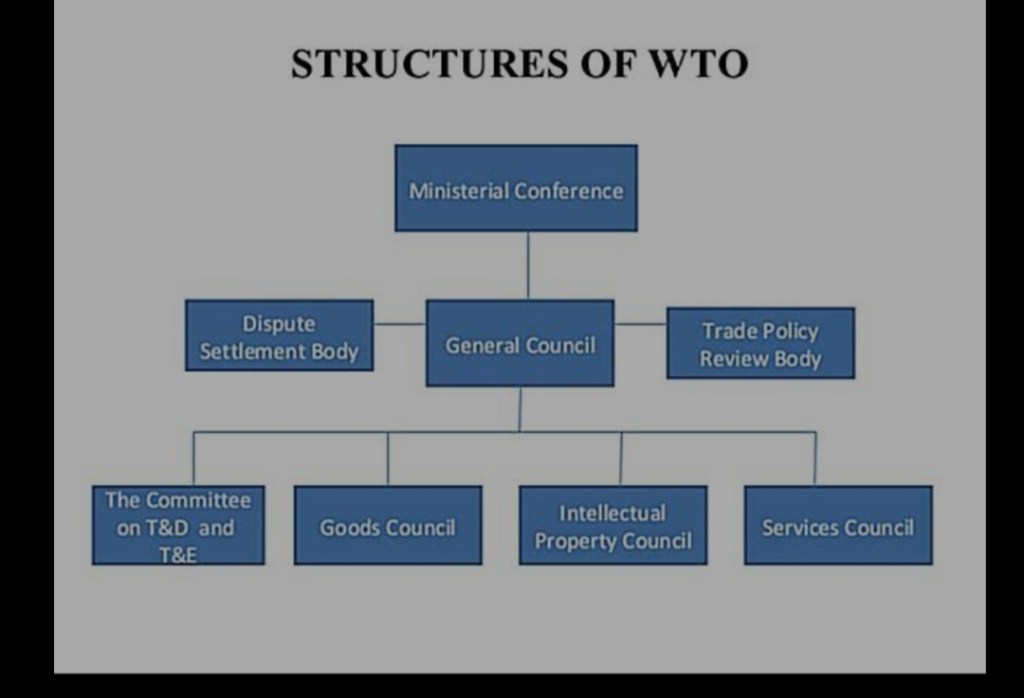
The structure of WTO is headed by the Ministerial Conference composed of representatives of all members which meet at least once every two years. It carries out the functions of the WTO and takes actions necessary to this effect .
The Ministerial Conference is the supreme authority of the WTO . The Ministerial Conference operations by different authority bodies.
General Council composed of representatives of all members to oversee the operation of the WTO Agreement and ministerial decisions on a regular basis. It also acts as a Dispute Settlement Body (DSB) and a trade policy review body (TPRB) ,each having its own Chairman.
The Director General , who is the secretariat head of WTO . The Ministerial Conference appoints the Director General and sets out his power duties , conditions of services and term of office. The Director General appoints the members of Staff of the Secretariat and determines their duties in accordance with the regulations adopted by the Ministerial Conference.
Non-discrimination Reciprocity Binding and enforceable commitments Transparency Safety values
___________________________________________
Objectives
The Preamble of the organisation , The Agreement establishing the WTO lays down the following objectives :-
• It’s relation in the field and economic endeavour shall be conducted with a view to raising standards of living , ensuring full employment and large and steadily growing volume of real income and effective demand and expanding the production and trade in goods and services.
• To allow for the optional use of the world’s resources in accordance with the objectives of sustainable development , to protect the environment and to enhance the means for doing so in a manner consistent with respective needs and concerns at different levels of economic development.
• To make positive efforts designed to ensure that developing countries , especially the least developed among them , secure a share in the growth in international trade commensurate with the needs of their economic development.
• To achieve these objectives by entering into reciprocal and mutually advantageous arrangements directed towards substantial reduction of tariffs and other barriers to trade and the elimination of discriminatory treatment in international trade relations.
• To develop an integrated , more viable and durable multilateral trading system encompassing the GATT , the results of past liberalisation efforts and all the results of the Uruguay Round of multilateral trade negotiations .
• To ensure linkages between trade policies , environment policies and sustainable development.
___________________________________________
Functions :-
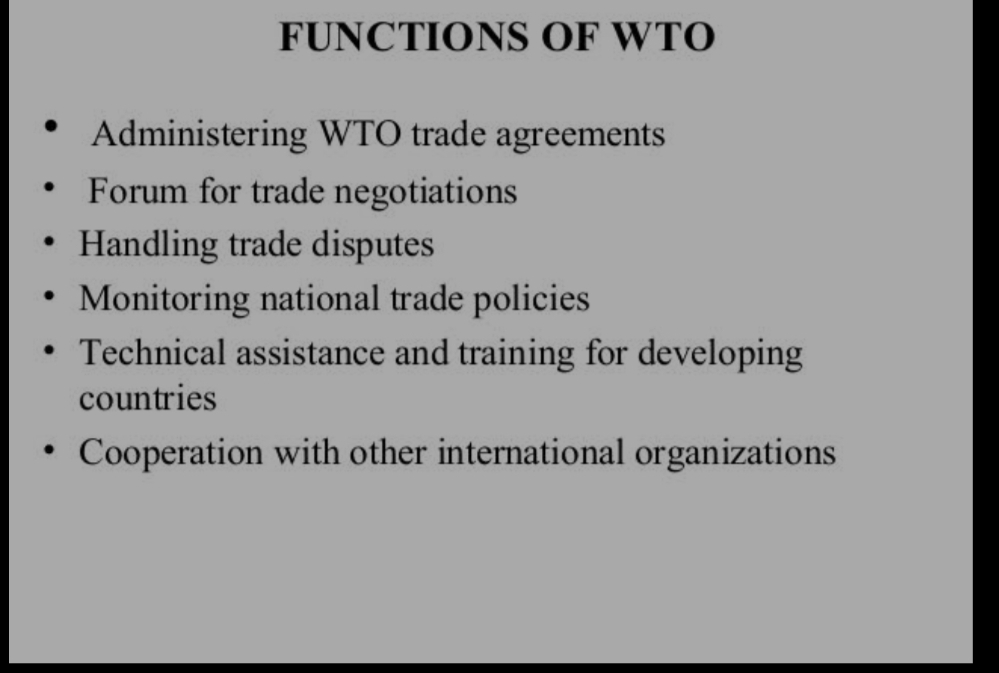
The main functions of WTO are :-
1. To facilitate implementation, administration and operations of the objectives of the Agreement and of the Ministerial Trade Agreement.
2. To provide the forum for negotiations among its members concerning their multilateral trade relations , in matters relating to the agreements .
3. To provide a framework for implementation, administration and operation of multilateral and bilateral agreements of world trade.
4. To administer the understanding of rules and Procedures governing the Settlement of dispute .
5. To ensure the optimum use of world resources.
6. To assist international organizations such as, IMF and IBRD for establishing coherence in Universal Economic Policy determination.
___________________________________________
WTO Agreements
The Agreement establishing WTO consists of the following :-
1: Multilateral Agreements on Trade in Goods :
The general agreement on trade in goods defines the GATT 1994 and includes various agreements dealing with Different aspects related to trade in goods.
• GATT Rules 1994 ,•Agreement on Agriculture •Agreement on Textiles and Clothing •Agreement on Technical Barriers to Trade • Agreement on Trade Related Aspects of Investment Measures ( TRIMs) • Agreement on Anti – Dumping
2: General Agreement on Trade in Services .
This agreement covers all Internationally traded services .It also sets out special conditions relating to individual sectors .
In financial services , it establishes the right of governments to take appropriate measures for the protection of investors , depositors and policy holders to ensure integrity and stability of the financial system.
In telecommunications ,the Agreement requires a Member to establish , construct , acquires ,lease , operate or supply telecommunications transport networks and services and make it available to the public
The GATS also contains consultations and dispute settlement and the establishment of a Council on Services.
3: Agreement on Trade – Related Aspects of Intellectual Property Right ( TRIPs) .
The TRIPs covers seven categories of intellectual property –
This agreement refers to controls of anti competitive practices for developed countries to bring their legislation and practices into conformity for the implementation of TRIPs.
4:. Understanding on Rules and Procedures governing the Settlement of Disputes.
This agreement applies to consultations and the settlement of disputes between Members concerning their rights and obligations under the provisions of the Agreement establishing the WTO . For this, a Dispute Settlement System was established .
5: Plurilateral Trade Agreement .
This agreement consists of the Agreement on Trade in Civil Aircraft , Agreement on Government Procurement , International Dairy Agreement and International Bovine Meat Agreement . The first Agreement was made at Geneva in April 1979, as subsequently modified , rectified or amended . The latter three Agreements were done at Marrakesh on April 15,1994.
6: Trade Policy Review Mechanism.
The TPRM aims to carry out reviews of the trade policies and practices under the Multilateral Trade Agreements and the Plurilateral Trade Agreements for the smoother functioning of the multilateral trading system.To operate this purpose , Trade Policy Review Body ( TPRB) was established. For better transparency each member reports regularly to the Trade Policy Review Body about the trade policies and practices pursued by it .
Entrepreneurship is the ability to develop, organize and run a business enterprise, along with any of its uncertainties in order to make a profit. Entrepreneurship is basically the act of creating a business or businesses while building and scaling it to generate a profit. It’s about building a life on your own terms. No bosses. No restricting schedules. And no one holding you back. Entrepreneurship development is a process of developing certain skills in an individual which are required to make him/her a successful entrepreneur. The success of an entrepreneur can be judged by success of his project or business. Finding a way to sell oneself before anyone believes in one or ones business, being able to explain and prove why their product or service is worth the price or investment, knowing when something is valuable, even if no one else does etc. are some of the features a successful entrepreneur possess. Big successful companies like Microsoft, Google, Apple etc. have all attained the status they have now because of their respective entrepreneurs. Success of such start-ups not only benefits the people associated with it but also the economy as a whole. It slowly changes the world. Off course not every start up is a massive hit, some might be pretty mediocre and some might even do more losses than gains but nevertheless in the contemporary world, the need and urge for entrepreneurship development has drastically increased. There are certain characteristics which are observed in entrepreneurs who write big success stories. These characteristics are a prerequisite for becoming a successful entrepreneur. The first and foremost skill is creativity. It means thinking out of the box. Coming up with new ideas, being open to new methodologies, creating something new etc. are some examples of being creative. Creativity gives birth to Originality. Risk taking is another characteristic of a successful entrepreneur. Without the will to explore the unknown, one cannot discover something unique. Risk-taking involves a lot of things. Using unorthodox methods is also a risk. Investing in ideas, nobody else believes in but you is a risk too. Good entrepreneurs are always ready to invest their time and money. But, they always have a backup for every risk they take. Planning is another characteristic and probably the most important one. They say “If you fail to plan, you plan to fail.” Planning is strategizing the whole thing ahead of time. It basically sums up all the resources at hand and enables one to come up with a structure and a thought process for how to reach ones goal. It involves how to make optimum use of these resources. Facing a situation or a crisis with a plan is always better. It provides guidelines with minimum to no damage incurred to a business. Other characteristics include passion for the work or business one choose to do, professionalism in the way the work is done, knowledge of the field of work or business, social skills including relationship building. An entrepreneur must be open minded towards learning, people and even failures.
India shares a long history of urbanization, with Indus Valley Civilization dating back to 2350 BC as its first stepping stone towards urbanization. After this and post-independence period, with the emergence of Planning Commission, India witnessed the urbanization which it had never seen before. And this period marks the progression and flourishing of urbanization in India. However, cities in India have been urbanized in number of phases. The urbanization history in India has 5 different phases (given by historians) :
The Pre – Historic Period (Indus): 2350 – 1800 BC
The Early Historic Period (Aryans and Dravidians): 600 BC – 500 AD
The Medieval Period (Mughal): 600 – 800 AD
The British Period: 800 AD – 1947
Post Independence Period: 1947 – till date
URBANIZATION IN BRITISH PERIOD
The British came to India in 1858 when India was one of the most urbanized nations due to Mughal supremacy. But in the early phase of British rule, Indian cities witnessed decline in the level of urbanization and during the later phase of British rule, the Indian cities regained the lost importance and new towns and cities emerged and newer urban form was added to existing cities.
Fort St. William in Calcutta is one of the best examples of factories constructed during British Era and fortified for protection.
URBAN DECLINE IN 19TH CENTURY
The main reasons for urban decline during the British Period were:
Lack of interest in British in economic development, prosperity and growth of India and their negative attitude towards the traditional industries of India which were present during that period.
The alteration of urbanization in India due to the industrial revolution in England.
The diversion in existing trade routes due to sudden growth and building of rail networks.
Disrupted monopoly in trade especially in port towns.
BRITISH CONTRIBUTIONTO URBANIZATION SCENES IN INDIA
Emergence of three metropolitan port cities which emerged as leading colonial cities (Calcutta, Bombay and Madras).
Creation of hill stations and plantation settlements.
Modification of urban landscape in existing cities.
Introduction of civil lines, camps and cantonments.
Improvement in connectivity through railways.
Enhanced scope of industrialization.
Improvements in urban amenities and urban administration.
CONCLUSION
British era had both positive and negative impact in India but the extent of positive changes is more. The process of urbanization and building of new cities can be seen as the breaking of the continuum. During British Period, the Indian cities emerged as the focal points of urbanization and westernization. The westernization brought by the British Period continued to guide the destiny of urban elite in India. It helped in transforming the agriculture as a means of commerce by introducing new crops like indigo, tobacco, coffee etc. Thus, British Era can be seen a the period when India came across fundamental economic transition, mechanized industries and developed connectivity through railways and foreign trade. But the British Era didn’t consider the rural – urban conflict which increased the gap between urban and rural areas of India.
Thus, it can be concluded that British rule had definitely been useful in providing the foundation of development and urbanization to India. As per Census 1941, which is the last census before Independence, India had 49 one lakh cities and 2500 urbanized towns. So, when this urbanization is compared to previous trans, it can be seen that the urbanization attained zenith during the end of British period as compared to past events.
In 1941, which marks the last census before independence, There were 49 one-lakh cities in India and in all round 2500 urbanized towns. Urbanization attained zenith during end of this period compared to entire past events.
Indian society has usually lacked gender awareness, and the same is reflected in the mindset of the society. The tale of people who are generally referred to as transgender is a story of pain, misery, and agony.
They have not only face deprivation of rights, but also abuse and violence just because they do not fit within the “norms” that society has generally accepted. They are shunned and defamed by society and are considered to be outcasts and kept far away from participation in various societal activities.
Background
In 2012, the National Legal Services Authority, an Indian statutory body which is constituted under the Legal Services Authority Act, filed a writ petition (writ petition no. 400 of 2012) with the Supreme Court of India. It was followed by another writ petition (No. 604 of 2013) which was filed by Poojya Mata Nasib Kaur Ji Women Welfare Society, a non-governmental organization representing the Kinnar transgender community. Laxmi Narayan Tripathi, an individual who identified himself as a Hijra also approached the court and was also impleaded in the present case.
Issues involved
The petitions mainly raised an issue of “Gender Identity”. It has two facets, viz.:
Whether a person who is born male but has female orientation has the right to be identified as a female as per his choice ; the same question arises when an individual uses surgery to change his/her sex.
Whether a person who does not identify either as a male or a female has the right to be categorized in a “third gender”.
Arguments
The argument was made that the recognition of only the binary genders of male and female and the lack of legal measures to cater for the needs of the represented groups violates Right to Equality (Article 14), Freedom of Expression (Article 19), Right to Life and Personal Liberty (Article 21).
The transgender community urged that their inability to express themselves in terms of a binary gender denies them their rights and social welfare schemes.
Judgment
The judgement was delivered by a 2-judge bench comprising of Justice K.S. Radhakrishnan and Justice A.K. Sikri on 15th April 2014. The Court had to decide whether persons who fall outside binary gender can be legally recognised as “third gender” persons.
The Supreme Court in this case relied on various judgements from foreign courts like New Zealand, Australia, and England and took into consideration different foreign judgements like Corbett v. Corbett with its complete emphasis on biological sex, Attorney-General v. Otahuhu Family Court in which Justice Ellis noted that once a transsexual person has undergone surgery, he or she is no longer able to operate in his or her original sex.
The Court ruled that all provisions in the international conventions including the Yogyakarta Principles must be followed provided they align with the fundamental rights guaranteed under Part III of the Constitution.
In this landmark judgement Supreme Court legally recognised “third gender” for the first time and discussed “gender identity” at length. Further, it declared that eunuchs and hijras can legally identify as “third gender”.
The Court recognised that third gender persons were entitled to fundamental rights guaranteed under Part III of the Constitution and under International law.
The Court declared that the State and Central governments must grant transgenders full recognition in the eyes of the law so that they can avail education and healthcare without being subjected to any kind of discrimination.
Conclusion
Well, we cannot ignore the fact that the transgender community for long have suffered torture, humiliation, and pain. This judgement came as a fresh ray of hope for the transgender community who have faced discrimination and social injustice. This is a landmark judgement because it is the first to legally recognise non-binary gender identities and uphold the fundamental rights of transgender people in India. However, the transgender community still has a long way to go.
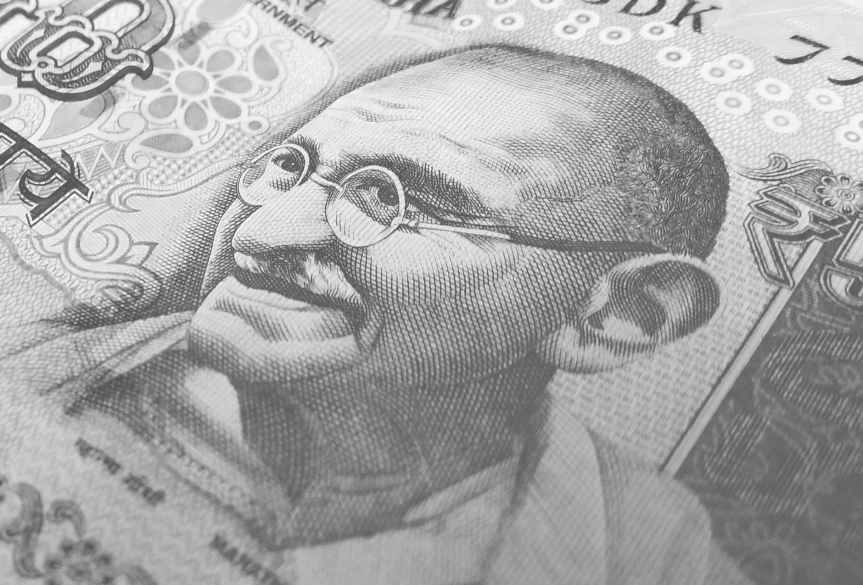
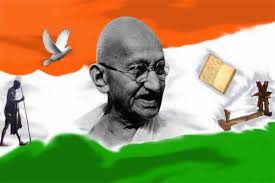
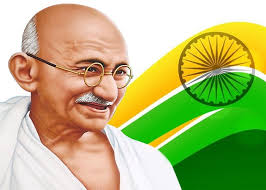
The name ‘Gandhi’ needs no introduction. Any part of the world that understands civilisation and humanitarian values appreciates Mahatma Gandhi (October 2, 1869-January 30, 1948). Thus it doesn’t come as a surprise that you find Gandhi fans in a diverse range-from the present American President, Barack Obama to philanthropic groups working in Rio
Movements launched by Mahatma Gandhi:
Mahatma Gandhi overcame insurmountable odds to bring the mighty British Empire to its knees. It is not merely because of the Non-cooperation Movement or the Dandi March (1931) that we know him today. It is true, of course, that these movements, along with the Quit India Movement (1942), brought the British Government to its knees. Gandhi was a man of the masses. Such was his popularity that the British went weak in their knees at the prospect of arresting him. They were afraid of making a martyr of him and thus adding to his popularity. This was no mean achievement for a man described by Winston Churchill as a ‘half- naked fakir’. Gandhi’s idea of non-violent resistance against the British rule appealed to the conscience of the Indian society groaning under the unjust rule of the British since the Battle of Plassey in 1757.
When Gandhi put Satyagraha into action for the first time in South Africa in1906 and became a success there, it didn’t take much time to recognise and hail the arrival of a great leader. But Gandhi was more than a messiah in the world of politics. He was a powerful social reformer who campaigned relentlessly to end discrimination against India’s untouchable class, whom he called the Harijans (children of God).
Mahatma Gandhi Awards:
• In 1930, Gandhi was named the Man of the Year by Time’s Magazine. • In 2011, Time magazine named Gandhi as one of the top 25 political icons of all time. • He did not receive the Nobel Peace Prize despite being nominated five times between 1937 and 1948.
• The Government of India institutionalized the annual Gandhi Peace Prize to distinguished social workers, world leaders, and citizens. Nelson Mandela, the leader of South Africa’s struggle against apartheid was a recipient of the award
About Mahatma gandhi Personality:
The spiritual strength of Gandhi’s personality has to be given due recognition. His autobiography My Experiments with Truth bears a living testimony to this. Gandhiji used his spiritual strength to overcome all opposition. He walked across the country’s villages trying to make its people realise the importance of sanitation and healthy habits. If this does not prove his sincerity, let us remember his fast-unto-death in the riot-hit Calcutta of September 1947, which brought the Hindus and Muslims together again after a terrible violence.
Would any of our leaders today dare to walk the riot-hit streets of Noakhali with only a Tagore song to give him company? It is stupid to question the courage of this man who perhaps might even have achieved the impossible task of unifying India and Pakistan again had he not been shot dead by a fanatic called Nathuram Godse on January 30, 1948.
Film on Mahatma Gandhi:
Ben Kingsley portrayed Mahatma Gandhi in the 1982 film Gandhi, which won the Academy Award for Best Picture. Therefore, Mahatma Gandhi would be remembered forever as he spread the message of non-violence, truth, faith in God, and also he fought for India’s Independence. His methods inspired various leaders, youth not only in India but also out of India. In Indian history, he is considered as a most prominent personality and as the simplest person who wears dhoti. He spread the message of swaraj and taught Indians how to become independent.
Many people believe that being physically healthy is a sign of good health, but do they even consider their mental health? Today I am going to discuss this particular topic called “Mental health of a human being”.
Today youngsters and even old people are very particular about their physical health. They join gyms, participate in various cardio activities to make themselves physically fit but what about their mental health? How people would understand whether they are mentally fit or not? And if they know, then how will they overcome it? Today in this era of competition in everything, being in studies or fashion or anything else, everyone is running a race and is trying to outshine each other. Because of this, they have forgotten that their mind should also be taken care of like anything else.
Anxiety and depression have now became a common issue for every individual. Some people try to hide their anxiety by talking too much or by remaining extremely quiet.
Have you ever wondered, everybody, talks about an illness like cancer, heart attack, migraine, etc very freely but when it comes to mental health, they often hide from everyone and consider it a shameful thing? No one openly talks about their mental illness because somewhere they think that it is shameful to share it with anyone. Even, if he/she talks about it openly then they get very little support and is stabbed by their friends in tougher times, which makes them weaker and lonely even when surrounded by a crowd. Nowadays there are some who understand this problem and openly help such victims. Else, earlier they used to tag that person insane and didn’t look after them.
But I want to convey to such people to come out, express yourself whatever you are feeling, either share it on your social media or talk with your loved ones, there are definitely people who will help you to overcome it. This is not something to be ashamed of, it is also a part of your health. Never feel low because of love failure, study stress or family problems, etc.
You are not alone in this. Your loved ones are standing behind you to support you.
And in the end, I would like to convey my message to those who take mental health for granted that please don’t judge people in any way. You have no idea about what a person is going through. So, LIVE AND LET LIVE.
Let us give one day tribute to our prior of our life. Yes, you think about right one those are our Teachers. Teacher’s day is the one day tribute to our teachers to appreciate their efforts to make us successfull in life and carrer. It is celebrate on 5th september on the birth aniversary of Dr. Radhakrishnan Sarvapalli.
He was a renowedscjokar, recepient of bharat ratna, first vice president and second president of Independent india. Teacher’s day is one such event for which students and teachers equally look forward to. Teacher’s day is as important as to students just like it is for teachers because it gives a chance to student to understand the efforts that teachers gives us to make our life successful.
Also, According to our Prime Minister ”Narendra Modi” Teaching is not a profession, it is Jeevan Dharma(A way of life). He also said that India should regain the status of Vishvaguru(Leader in education) by giving high respect to teachers.
He told that:- “Teachers Determination and Sincerity will shape the destiny of the nation as they are laying the foundation and the building blocks of the society”.
Despite of playing such a crucial rolw in the lives of student life teacher’s doesn’t get there value of appreciation. So we celebrate this one day for our teachers.
As we all know “Health is Wealth “, we all should take a good care of our health .A good health is equal to valuable treasure .With a good healthy body & mind you will be able to live a long & diseases pain free life , able to get success , & have a happy everyday lifestyle . There are some factors which will helps you to gain in this important field.
Yoga Practices : Yoga is some mental , physical spiritual actions for good mental & physical health .Some research already prove that yoga is an effective exercise for not only fitness of the body but also in mental health with other good improvement in health. WHO also have given positive feedback on yoga & made an 2018-2030 action plan for yoga practice .United Nation announce 21st June as the World Yoga Day .There are various types of yoga with various benefits . Naukasana (Boat Posture) ,Vakrasana((Twisted Posture) for belly-fat lose , Dhanurasana (Bow Posture) for weight-loss . Sukhasana (Easy Posture) ,Kakasana (Crow Posture), Bhujangasana (Cobra Posture), Sarvangasana (Stand On Shoulder Posture) ,Shirasana (Stand on Head Posture) etc are some yoga asana which help in many physical(Blood Circulation, Mussel Growth , Nervous System, Respiratory System, Blood circulation etc) & mental Health ( Relaxation, Mind-peace, sleeplessness, concentration, stress etc) .Only one yoga poster have many remarkable benefits which help to prevent some harmful diseases. Now a days many YouTube channels ,apps ,communities are there for as a yoga instructors . Even some school, college ,company have included yoga in their curriculum keeping the benefactor of yoga in mind .
Regular Exercise or, Workout at gym : Exercise or workout are also very helpful in maintaining fitness . You can do it in a gym using some workout machine & heavy weight equipment or you can do some workout exercise for body fitness as both are effective .Although some research show that there are some negative effects also .Exercise or workout helps in body fat loss , increase muscle strength , improve blood circulation, expand endurance level etc. Some machine used in gyms for workouts are mechanical treadmill , spring stretcher , Adjustable bench ,barbell stand ,cable crossover, lifting etc. Push-up ,aerobic exercise ,walk, squat, swimming ,cycling are some effective exercise . You can take a help from some apps , YouTube channels ,community ,gym ,professionals for doing such exercise or workout for fitness .
Eating Healthy Food: Yoga & exercise help in good health but health foods are also very important in this case .As we all know every vegetables ,fruits ,animal products have some nutritious value and help our body to gain protein ,vitamins, carbohydrates, fat in perfect amount for healthiness if we consume them in a systematic manners . Some nutrition value , and health benefits are mentioned below — 1)Spinach: It is a green vegetable with lots of Calcium, Iron, Vitamins (Vita-K ,Vita-A ,Vita-C) ,antioxidants .It helps in physical energy , clean blood for oxygen circulation, blood pressure reduction for good heart etc. which prevents some health issues . 2) Kale: It is leafy greens . It has 7 calories & some vitamins(A,C,K) as nutrition .It decrease the amount of BP , bad cholesterols & sugar in our blood . 3) Beets: It is a red- pinkish vegetable with good cholesterols , potassium ,antioxidants which helps greatly in diabetes & BP . 4) Carrots: It is a orange colors vegetables but it can also be purple or yellow . It has %2 types of calories , Vitamin A & a lot of amounts of beta carotenes which helps in skin problems , breast cancer ,eyesight . 5) Edible Mushrooms: It has various categories with special shapes ,size colors & very delicious . It has a great amount of Vitamin B-6 ,Vitamin C ,iron , protein & non-fat which it prevents cancer , diabetes , heart problem etc. 6) Lemons: it is sour juicy fruit lots of Vitamin C & antioxidants which works on cold flu , weight loss ,cancer , diabetes etc. 7) Apple: It is a popular health benefiting fruit which contains calories ,carbohydrates ,fibers , potassium etc. & works on cardio-vascular diseases . 8) Avocado: It is green creamy & quit expensive fruit with high amount of potassium ,calories & antioxidants & helps in lowering cholesterols &chances of heart disease . This is just given as an example for showing that every fruits & vegetables have good health nutation. As for animal products like milk , meat , eggs etc. also have lots of protein & other elements with is important for our body growth . So we can see every edible foods have certain amount of nutriments & we should consume them as much as our body needed . Neither less nor more . You can take a help from any app , nutrition in this case .
Good Habits : With the healthy foods , exercise & yoga ,we should develops some good habits for better health benefit , prevention of diseases . Some good habits are mentioned below —– 1) Early To bed & early to rise ,2) Drinking water after raising 3) Don’t go to bed as soon as your lunch or dinner is finished ,4) consume lots of water in a day ,5) do some exercise after eating , 6) yoga after raising 7)drinking mild hot water with lemon or honey in morning instead coffee 7) check about weight on daily or weekly basis 8) Do exercise or yoga in morning daily 9) Don’t drink cold water 10) Bath in morning 11) a healthy breakfast with fruits ,eggs . There are so many healthy habits & you should practices them as you needed but they are important .
India is a land of widespread diversities in terms of religion, language, caste, tribe, race, religion and so on. Hence, the achievement of National Integration becomes very essential for the all round development and prosperity of the country.
Obstacles to national integration:
Regionalism- Regionalism refers to the sub-nationalism and sub-territorial loyalty. It implies the love for a particular region or state in preference to the country as a whole. There is also sub-regionalism that is love for a particular reason in preference to the state of which region forms a part. Some examples of regionalism are demand of the people of certain areas for separate state would like Telangana, Bodoland, Uttrakhand, Vidarbha, Gorkhaland and so on; demand of people of certain union territories for full-fledged statehood like Manipur, Tripura, Puducherry, Delhi, Goa; formation of organisations with regional motives which advocates a militant approach in pursuing its policies and goals like Hindi Sena, Shivsena, Lachit Sena and so on.
Communalism- Communalism means love for one’s religious community in preference to a nation and a tendency to promote the communal interest at the cost of the interest of other religious communities. It has its roots in the British rule where 1909, 1919 and 1935 Acts had introduced communal representation for the Muslims and others.
Casteism- It implies love for one’s own caste group in preference to the general National interest. It is mainly an outcome of politicization of caste. Its various manifestations include formation of political parties on the basis of caste, emergence of pressure groups based on caste, allotment of party tickets during elections and formation of Council of Ministers in the states on caste lines.
Linguism– It means love for one’s language and hatred towards other language speaking people. The phenomena of linguism like that of regionalism, communalism and casteism are also a consequence of the political process. The problem of linguism got accentuated with the rise of some Regional parties in recent times like TDP, AGP, Shivsena and so on.
In 1983 the video games industry was hit with a recession that almost ended the existence of video games of that time period. This period lasted for almost two years from 1983 to 1985. Many people and journalists who were critical were calling video gaming a fad. Numerous companies went bankrupt or stopped making video games entirely. This recession is known as the Great North American Video Game Crash or Atari Shock (Primarily in Japan).
Video games in the 1970s were dominated by arcade machines and by the end of the decade home game consoles were also getting popular. With the start of the 1980s, the video gaming industry witnessed a boom with numerous companies like Mattel, Atari, and Coleco dominating the market. The early 80s was a time of innovation and growth in the video game industry but there was instability in the industry as well. This was a time period when video games were becoming more mainstream and popular. Many new players entered the market ranging from industries to small developers that had no association or prior experience in game development in general.
Super Nintendo Entertainment System released on November 1990 (Successor to NES)
Pacman was a big hit in the early 80s and it was not of the most popular video games in the arcades. Its successor Miss. Pacman improved on the formula and was a success as well. After the success of Pacman in the arcades, Atari wanted to replicate the success in the home game consoles. But with the limited constraints with the memory and short development period, the game was not well received by the consumers and critics alike. In 1982 Atari also brought the license to release the video game of the movie for 21 million. The game was developed in a time period of only 5 weeks. The game was negatively received and only 1 million copies of the game were sold off the 5 million manufactured. Many of the sales were also returned to the retailers furthering the damage. During this period video games were being published by small developers with very poor quality and many big developers were producing games that were more of a marketing token than the game. There were many clones of the same games with little to no redeeming quality and replayability. There were also numerous consoles unlike today with too many options that were no different from one another. With the abundance of supply and low sales of games, retailers started to remove stocks of video games and this led to the shrinking of the industry. Atari had lost $500 Million in 1983 and had to cut its workforce from 10,000 employees to just 400 employees.
During the 1980s there was a boom in the Personal Computers market as well. The PCs were much more powerful than consoles and they could play games and do many tasks like word processing and spreadsheets. The PC industry was unaffected by this low point of video game consoles.
In 1985 Nintendo Corporation launched the Nintendo Entertainment systems in North America and Nintendo ensured that only a limited number of games to be released under their license agreement. This ensured a certain threshold of quality for the games that were released for the system and Nintendo emerged out of the survivor from the video game crash. The Nintendo Corporation started to dominate the video game industry with an assurance of quality that was unmatched by any other corporation at that time. Many other entrants like SEGA also emerged after the crash. Nintendo with its approach and license and quality assurance of video games has left a big impact on the industry to this date. Video games industry has only grown since then and also overtaken other source of entertainment. Nintendo can be credited to provide the industry a trajectory that was severely needed after the crash of 83.
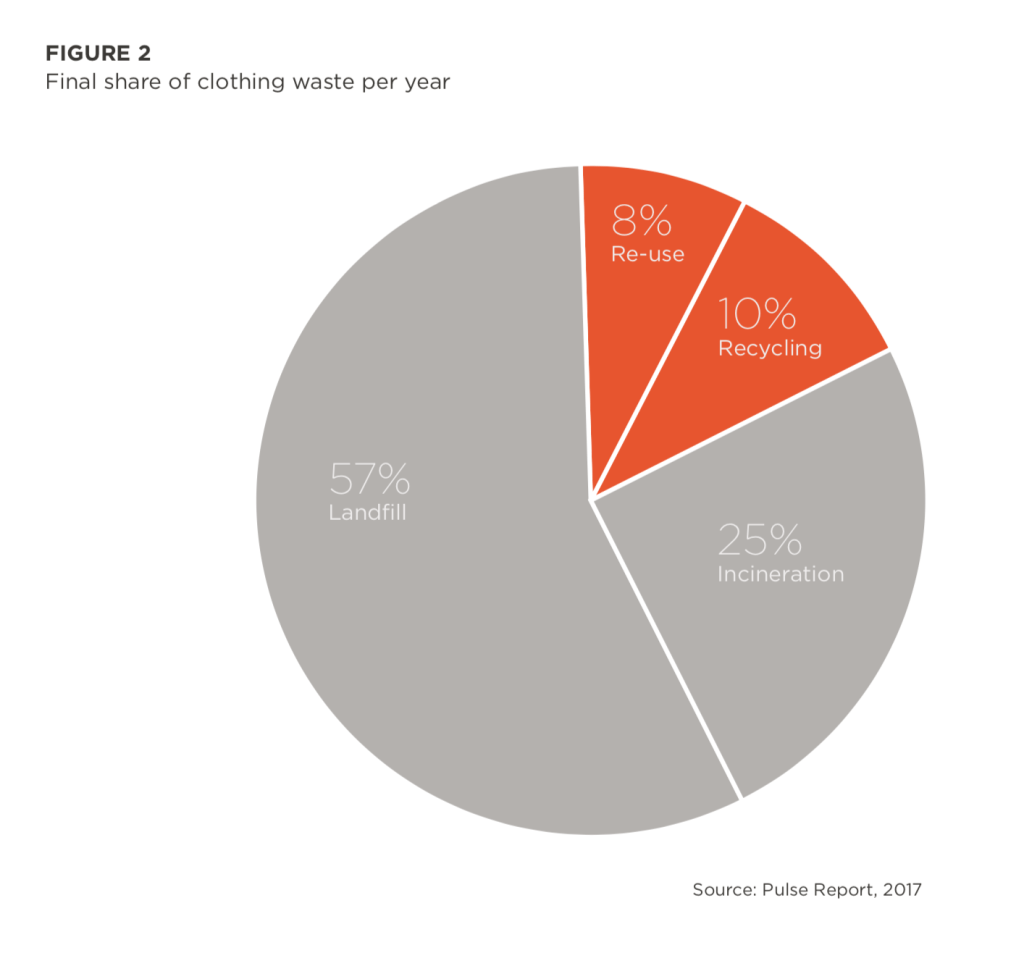
India consists a total population of 139.978 crore individuals and cloths being the most basic necessity of a person to recite on this planet is produced in hundreds and thousands of square metres regularly. Over this, Increasing modern and western culture in the country has boosted up the demands and production of these Industries at a huge percentage. Wishing to have a good appearance is a very usual part of human Psychology. For which, wearing good clothes plays an important role. Majorly, teenagers and youth are the ones’ who tend to follow the trends, look attractive, maintain their social status high which is often judged by how Fancy / cool / branded one’s clothes are and not only them but even elders are seemed to be changing and adapting these notions. Celebrities and fashion bloggers are currently one of the most influential people on social media. India is expected to have 34.33% share of youth in total population by 2020. Thus, clearly desire for fashion and numerous clothing apparels of each person is rapidly rising. In such case, Butobviously tones of material is used everyday and production process of anything is incomplete without Waste Discardation. Previously, population was less, needs were lesser and technology amd productions were limited. However, now with too much demand and availability of all the materials production processes have reached a high pace of resultant hazardous and non- biodegradable waste. Large manufacturers can also recycle these wastes up to a very limited extent only and most of the waste acts as a contribution to landfills which are tragically harmful for environment in present and for several upcoming years.
As per the Indian Textile journal – 2011, the study mentions that more than 1 million tonne textiles are disposed every year based on estimates, with most of this coming from household sources. But, as we have heard ” Where there’s a will, there’s a way”.
A DOOR TO SOLUTION.
Back in 2012, Kriti Tula after completing her Masters degree in design management from London College of Fashion, studied and analysed a lot over wastage created by fashion industry on a regular basis. She saw that a study cites that approximately 16.36% of fabric is wasted from the total material intake during the process of cutting, 6.37% of it is wasted in the stitching process and approximately .09% goes out in quality check. According to calculations last done in 2010, in an optimistic scenario, about 40 billion square meters of leftover fabrics and scraps are created every year. “As a kid raised in the 90’s in India, upcycling was a deeply rooted tradition in most middle and upper-middle class families. Every garment was cherished and every piece lasted more than we hoped. We were simply not so wasteful and everything was less disposable as everyone had much lesser money to spend. It was a good time for earth.” – Kriti Tula, Co-Founder and Creative director Doodlage. So as to live a dream of doing something to sort these problems in a beautiful manner while, trying to return the Environment it’s happiness again, There she ended up finding the concept of producing and selling sustainable and up-cycled garments from the waste collected by other textile Or fashion industries, which gave a birth to her label “DOODLAGE” Settled in New Delhi, India
The aim of Doodlage is to create a sustainable clothing brand, which is an initiative towards protecting the earth from non biodegradable fabric waste and simultaneously fits as per the choices of today’s generation. Each and every attire here is not just eco-friendly but is also very precisely designed and processed. Outfits are all made from scrap, used and leftover materials yet are absolutely stunning, comfortable, cool and highly fashionable in appearance. In 2016, Doodlage collection was also recognised by LAKME FASHION WEEK and they are present in over 40 stores in the country. Kriti got the idea while interning with mass producing brands and export houses. She said “After graduating from Pearl in 2010, I worked with a number of export houses and noticed a lot of fabric was getting wasted at every level of production – cutting, stitching and piece rejection. I knew that I wanted to work on something that already exists and supports a circular economy.” According to her, recycling or up- cycling the products and making the best use of them even if it’s from scrap is what can be called an essential part of lifestyle.
In addition to that, she says art is easy to replicate but doodles are not. “Every doodle is one of a kind. Similarly every piece at Doodlage is one of a kind”.
The brand started at a time where nobody even understood the terms like ‘ethical fashion’. They believe, the reason for its sucess is the Good quality of products. The story doesn’t ends here ; Because the biggest motive of the label was to convert the left over fabric wastes of the industry or the other companies into usable apparels, they even came up with an idea to prevent the wastage of cut outs produced within processing of their own garments by shredding them to create new fabrics and use them as materials for making bags and furnishings. Team of Doodlage for sure is a great inspiration for fashion industry today and in future.
In this digital era we always use an electronic device like computer for getting our works done but coming to the taste of experience a computer will never replace a book. There might be several reasons to say that computer is best than a book but for sure what ever the epic information that we see today in a computer was written in a book priorly. A good book in the words of John Milton is the precious lifeblood of a master spirit, embalmed and treasured up to a purpose of life.
The thoughts and ideas contained in a book are immortal like tulasidas’s Rama Charitra Manas, Veda Vyas Mahabaratha, The Bible and many other religious literary works like shakespere’s play etc… On the other hand, a computer is a machine that can visualize the contents of a specific book but thinking about the replacement of a book by a computer is unthinkable and far fetched.
A book provides the most cost effective for spreading education and literacy. It is available at a fraction of the cost of a computer. Moreover it is extremely portable and handy, it is not dependent on any external factors like availability of power supply, software and space which are essential prerequisites for a computer. To go through the contents of a book, the two basic ingredients required are time and inclination. It can be read at any time of day or night and anywhere, like while travelling or even while dozing off to sleep.
Though the above mentioned all phases can be full filled by an electronic gadget also reading a book does not create any physical discomfort or eye strain. We all are aware of the hazards of back pain and eye strain caused by a long stretch of viewing a computer screen. Another factor in favor of the book is the general high degree of respectability and faith commended by the written word. Thus while we may see or hear event on our computer terminal, there is nothing better than to confirm the same from a newspaper or a book. Besides helping in spreading education to masses, a plays an important role in developing our power of expression, and the generation of new ideas and thoughts, which help in modelling our personality .
A book is a source of knowledge on a particular subject, offering no diversion or distraction while a computer offers multiple sources like reading, entertainment, games or news on one go along with several advertisements which some times leads to the distraction of our mind and consequently hinders the acquisition of knowledge.
Thus the computer can never replace a book either now or in the near future, this is for the conviction and convenience offered by a book and it can never be possible through a computer. Moreover being a machine it has chance to break down or show an error, these factors are non-existent while reading a book.
When a young person uses the Internet or technology to harass, threaten, embarrass, or target another person, this person is called a cyberbullying. Typically, cyberbullying involves tweens and teens; but it’s not uncommon for adults to experience cyberbullying and public shaming as well. Even if someone deletes a mean post, chances are it’s still available in some form such as in a screenshot or a shared text message. Worse yet, those targeted by cyberbullies often don’t know who is bullying them, so they often have no way to bring it to an end.
Impact of Cyberbullying
If your child is being targeted by cyberbullying, it’s important that you work with them to report the cyberbullying and do everything you can to get the victimization to stop. Additionally, you should talk to their pediatrician or a mental health professional about what your child is experiencing. Expecting your child to cope with the cyberbullying on their own is not realistic. Cyberbullying also can lead to increasing levels of anxiety and depression. One study found that as many as 93% of kids victimized by cyberbullies reported feelings of sadness, hopelessness, and powerlessness.
Coping with Cyberbullying
Encourage your child to reclaim control. Cyberbullying can make teens feel like their lives are out of control. For this reason, you want to give them opportunities where they feel like they have some control. One way to do this is to encourage your child to use what they have experienced and turn it into something good like helping others going through the same thing.
Focus on learning from the experience. Whether your child needs a boost to their self-esteem or they need to learn to think positively, help your child identify what they can learn from this experience. You also can help them reframe their experience and focus on the good that has come from it rather than the pain that it caused.



















 Eduindex
You must be logged in to post a comment.