The feminist movement (also known as the women’s movement, or simply feminism) refers to a series of political campaigns for reforms on issues such as reproductive rights, domestic violence, maternity leave, equal pay, women’s suffrage, sexual harassment, and sexual violence, all of which fall under the label of feminism and the feminist movement. The movement’s priorities vary among nations and communities, and range from opposition to female genital mutilation in one country, to opposition to the glass ceiling in another. Feminism in parts of the Western world has gone through three waves. First-wave feminism was oriented around the station of middle- or upper-class white women and involved suffrage and political equality. Second-wave feminism attempted to further combat social and cultural inequalities. Although the first wave of feminism involved mainly middle class white women, the second wave brought in women of color and women from other developing nations that were seeking solidarity. Third-wave feminism is continuing to address the financial, social and cultural inequalities and includes renewed campaigning for greater influence of women in politics and media. In reaction to political activism, feminists have also had to maintain focus on women’s reproductive rights, such as the right to abortion. Fourth-wave feminism examines the interlocking systems of power that contribute to the stratification of traditionally marginalized groups. Feminism in China started in the 20th century with the Chinese Revolution in 1911. In China, Feminism has a strong association with socialism and class issues. Some commentators believe that this close association is damaging to Chinese feminism and argue that the interests of party are placed before those of women.
HISTORY :
Feminism in the United States, Canada and a number of countries in western Europe has been divided into three waves by feminist scholars: first, second and third-wave feminism.Recent (early 2010s) research suggests there may be a fourth wave characterized, in part, by new media platforms The women’s movement became more popular in May 1968 when women began to read again, more widely, the book The Second Sex, written in 1949 by a defender of women’s rights, Simone de Beauvoir (and translated into English for the first time in 1953; later translation 2009). De Beauvoir’s writing explained why it was difficult for talented women to become successful. The obstacles de Beauvoir enumerates include women’s inability to make as much money as men do in the same profession, women’s domestic responsibilities, society’s lack of support towards talented women, and women’s fear that success will lead to an annoyed husband or prevent them from even finding a husband at all. De Beauvoir also argues that women lack ambition because of how they are raised, noting that girls are told to follow the duties of their mothers, whereas boys are told to exceed the accomplishments of their fathers. Along with other influences, Simone de Beauvoir’s work helped the feminist movement to erupt, causing the formation of Le Mouvement de Libération des Femmes (The Women’s Liberation Movement). Contributors to The Women’s Liberation Movement include Simone de Beauvoir, Christiane Rochefort, Christine Delphy and Anne Tristan. Through this movement, women gained equal rights such as a right to an education, a right to work, and a right to vote. One of the most important issues that The Women’s Liberation movement faced was the banning of abortion and contraception, which the group saw as a violation of women’s rights. Thus, they made a declaration known as Le Manifeste de 343 which held signatures from 343 women admitting to having had an illegal abortion. The declaration was published in two French newspapers, Le Nouvel Observateur and Le Monde, on 5 April 1971. The group gained support upon the publication. Women received the right to abort with the passing of the Veil Law in 1975.
Feminism: Belief in and desire for equality between the sexes. As Merriam-Webster noted last month: “the belief that men and women should have equal rights and opportunities.” It encompasses social, political and economic equality. Of course, a lot of people tweak the definition to make it their own.
According to Maggie Humm and Rebecca Walker, the history of feminism can be divided into three waves. The first feminist wave was in the nineteenth and early twentieth centuries, the second was in the 1960s and 1970s, and the third extends from the 1990s to the present.
‘Intellect’ refers to the creations of the mind. Intellectual Property is a type of intangible property and includes inventions, literary and artistic works, symbols, names and paintings.
Intellectual Property Rights (IPRs) are the Rights granted to the creators of Intellectual Property (IP) by the Government. The nature of IPR is territorial. In any country an IP has to seek protection separately under the relevant laws.
Mechanisms which are Special in nature have been kept in place for various territories in order to provide protection to different types of IPRs. It confers an exclusive right to the inventor/ creator or assignee to fully utilize the invention/ creation for a given period of time.
It’s been established that the intellectual labor associated with the innovation should be given due importance so that public good emanates from it.
This is a strong tool, to protect investments, time, money, effort invested by the inventor/creator of an IP, since it grants the inventor/creator an exclusive right for a certain period of time for use of his invention/creation.
Hence it aids in the economic development of a country by promoting healthy competition and encouraging industrial development which shall also aid in the growth of the economy.
WHAT IS AN INTELLECTUAL PROPERTY?
Intellectual Property(IP) refers to creations of the mind; inventions; literary and artistic works; and symbols, names and images used in commerce.
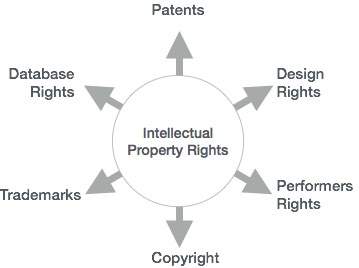
IP is divided into two categories: 1) Industrial Property:- includes patents for inventions,trademarks, industrial designs and geographical indications. 2) Copyright:- covers literary works (such as novels,poems and plays), films, music, artistic works (e.g., drawings, paintings, photographs and sculptures) and architectural design.
In Intellectual property(IP), there are Rights which relates to the rights of performing artists in their performances, producers of phonograms in their recordings, and broadcasters in their radio and television programs are included.
WHAT ARE INTELLECTUAL PROPERTY RIGHTS?
So what do you mean by intellectual property rights? IP rights like any other property right allow creators, or owners, of patents, trademarks or copyrighted works to benefit from their own work or investment in a creation.
These rights are outlined in Article 27 of the UDHR which provides for the right to benefit from the protection of moral and material interests resulting from authorship of scientific, literary or artistic productions.
The importance of intellectual property was first recognized in the Paris Convention for the Protection of Industrial Property (1883) and the Berne Convention for the Protection of Literary and Artistic Works (1886). Both treaties are administered by the World Intellectual Property Organization (WIPO).
There are various pros which are more compelling than the cons.
1) The progress and well-being of humanity rest on its capacity to create and invent new works in the areas of technology and culture.
2) The legal protection of new creations and this encourages the commitment of additional resources for further innovation.
And Lastly the third pros is that the 3) Promotion and protection of intellectual property spurs economic growth, creates new jobs and industries, and enhances the quality and enjoyment of life.
An efficient and equitable intellectual property system can help all countries to realize intellectual property’s potential as a catalyst for economic development and social and cultural well-being. The intellectual property system helps strike a balance between the interests of innovators and the public interest, providing an environment in which creativity and invention can flourish.
INTELLECTUAL PROPERTY HOLDERS IN A QUANDARY DUE TO COVID-19 PANDEMIC
While experts are in a combat mode and the race is on to discover the cure for COVID-19, the claim of intellectual property rights for exclusive use of the cure poses a dilemma as it is not considered the most rational thing to do at the moment.
Carlos Correa addressed to organizations like WHO, WTO and WIPO via an open letter to seek support for WTO countries that invoke the ‘security exception’ contained in Article 73 of the Agreement on Trade Related Intellectual Property Rights (TRIPS) Agreement, to take ‘actions it considers necessary for the protection of its essential ‘security interests’ in the wake of COVID-19 threat.
It has been suggested that invocation of exception under Article 73 will be warranted to procure medical products and devices or to use the technologies to manufacture them as necessary to take cue of the present public health emergency.
By suspending the enforcement of any Intellectual Property right as given under Article 73(b) of TRIPS Agreement, an obstacle for the procurement or local manufacturing of the medical equipments shall be necessary in order to protect the population of the world will be outlasted.
The question which is raised due to the above is regarding IP rights which are aimed to aid the public by promoting technological advancement in return of providing the inventor an exclusive right over the invention, though for a limited time. Though the IP rights are at a standstill due to the outbreak the IP Registry offices all over have limited their functioning.
TYPES OF INTELLECTUAL PROPERTY
Trade Mark: –
A trademark is used in order to identify a business entity and it also differentiates the goods made or services offered by a company or an individual. Names, Words, Logos, Colors, Packaging, Sounds (audible), Signs (visual) or any combination thereof are considered and can be filed as trademarks.
A trademark must be Unique and Distinctive in nature and must also avoid adjectives for eg efficient and Names of person or places (E.g. India). Even Obscene words, Religious or Government words or symbols (E.g. OM) and Common Shapes (Square) should be avoided.
The Trade mark means a mark used in relation to goods for the purpose of indicating a connection in the course of trade between the goods and some person having the right as proprietor to use that mark.
The function of a trade mark is to give an indication to the purchaser or a possible purchaser as to the manufacture or quality of the goods, to give an indication to the trade source from which the goods come or the trade hands through which they pass on their way to the market.
The Trade Marks Act, 1999 is an act which provides for the registration and better protection of trademarks for goods and services and for the prevention of the use of fraudulent marks. A trade mark is valid for a period of 10 years.
Case Name: The Coca-Cola Company v. Bisleri International Pvt. Ltd Case Citation: Manu/DE/2698/2009
Copyright: –
Copyright is an exclusive legal right granted to the creators of an intellectual work. The owner of a Copyright has rights to reproduce, translate, adapt, perform, distribute and must be publicly allowed to display the work, etc.
Registration is not mandatory since copyright comes into existence as soon as the intellectual work is created but it is recommended to register a copyright for better enforceability, since registered copyrights have more evidentiary value in court.
(a) Types of Works covered under Copyright:-
(1) Literary including Software – Books, Essay, Compilations, Computer Programs.
(2) Artistic – Drawing, Painting, Logo, Map, Chart, Plan, Photographs, Work of Architecture.
(3) Dramatic – Screenplay, Drama.
(4) Musical – Musical Notations.
(5) Sound Recording – Compact Disc.
(6) Cinematograph Films – Visual Recording which includes sound recording.
(b) Duration of Copyright:-
(1) Literary, Dramatic, Musical or Artistic Works – Lifetime of the author + 60 years from the death of the author.
(2) Anonymous & Pseudonymous Works – 60 years from the year the work was first published.
(3) Works of Public Undertakings & Government Works – 60 years from the year the work was first published.
(4) Works of International Organizations – 60 years from the year the work was first published.
(5) Sound Recording – 60 years from the year in which the recording was published.
(6) Cinematograph Films – 60 years from the year in which the film was published.
Case Name:- Indian Performing Rights Society Ltd. v. Eastern India Motion Picture Association Case Citation: – 1977 SCR (3) 206
Designs: – The Design Act, 2000 states that it protects the aesthetic and ornamental features of an object. As per the Act a 2D or 3D pattern of a handicraft, a product, or even an industrial commodity.
The Unique Selling Point (USP), protects the looks and feels of the product and it prevents the duplication of the product. An industrial design helps in drawing a customer’s attention and helps in increasing the commercial value of an article.
Case Name:-Cello Household Products v. M/S Modware India and anr Case Citation:- Notice of Motion (L) No. 209/2017 in Suit (L) No. 48/2017
Patents On the 4th December, 2018, The Ministry of Commerce and Industry released the draft (rules amendment) for Patents Act 1970. These rules are mainly amended with respect to international applications, patent opposition and a few form related extensions. The Central Government proposes to make these amendments in exercise of the powers conferred by section 159 of the Patents Act, 1970.In order to align with TRIPS, inventions which are not patentable have been included even, wider rights of patentee is incorporated. Uniform period of protection is 20years. Case Name: Bajaj Auto Limited v.TVS Motor Company Limited. Case Citation: JT 2009 (12) SC 103
5. Integrated Circuits
Semiconductor Integrated Circuits Layout Design (SICLD) Act 2000 states the meaning of Semi conductor Integrated Circuit as, a product having transistors and other circuitry elements designed to perform an electronic circuitry function. There are 2 types of designs as per the act:-
(i) Layout Design – A layout of transistors and other circuitry elements including lead wires which connects semiconductor integrated circuits.
(ii) Layout-Design Registry (SICLDR) is the office where the applications on Layout-Designs of integrated circuits are filed for registration. The jurisdiction of this Registry is whole of India. The Registry, as per the guidelines laid down in the Semiconductor Integrated Circuits Layout Design (SICLD) Act 2000 and the Semiconductor Integrated Circuits Layout-Design (SICLD) Rules 2001, examines the layout-designs of the Integrated Circuits and issues the Registration Certificate to the original layout-designs of the Semiconductor Integrated Circuits.
Case Name: Sunil Alag v. Union of India and Others Case Citation: W.P. (C) 8152/2013
6. Biological Diversity
The Biological Diversity Act 2002 was enacted to realize the objectives enshrined in the United Nations Convention on Biological Diversity (CBD) 1992 which was passed by the Lok Sabha on 2nd December 2002 and by the Rajya Sabha on 11th December 2002.
It recognizes the sovereign rights of states to use their own Biological Resources due to the scarcity and also to conserve it. The Act provides for a mechanism for equal sharing of benefits arising out of the use of traditional biological resources and knowledge. It is a federal legislation enacted by the Parliament of India for preservation of biological diversity in India.
Case Name: Environment Support Group vs National Biodiversity Authority Case Citation: W.P. No.41532 / 2012
7. Plant Varieties and Farmers
Protection of Plant Varieties and Farmer’s Rights Act of 2001(PPV & FR Act, 2001) confers right to breeders, researchers and farmers over their plant varieties. Reaching legislation with regards to establishing rights for farmers to save, use, exchange and sell farm saved seed.
The Act establishes nine rights for farmers of which the most important in this regard are the right to “seed” and the right to “compensation” for crop failure (Art. 39). Not only does the 2001 Act protect the rights of framers to save, use, exchange and sell farm- saved seed, it also seeks to ensure that these seeds are of good quality, or at least that farmers are adequately informed about the quality of seed they buy.
In addition, safeguards are provided against innocent infringement by farmers. Farmers who unknowingly violate the rights of a breeder are not to be punished if they can prove that they were not aware of the existence of such a breeder’s right (Art 42).
Case Name:- Monsanto Technology LLC & Ors Vs. Nuziveedu Seeds Ltd & OrsHigh Court of Delhi Case Citation: CS (Comm) 132/2016
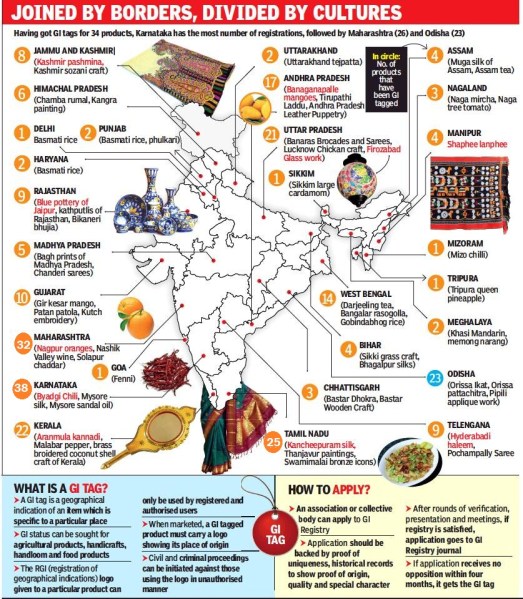
The Geographical Indication of Goods:- The Geographical Indications of Goods (Registration and Protection) Act, 1999 states Geographical Indication as it is primarily an agricultural or food product, natural or a manufactured product (handicrafts, Handloom textiles or industrial goods) originating from a definite geographical territory. A product is considered to be manufactured in a territory if any one of the activities of either the production or of processing or preparation of the goods takes place there. It promotes the producers prosperity of goods which have been produced in the geographical territory.
It helps the producer community to differentiate its products from other competing products that are present in the market and generate goodwill around its products. Hence, it acts as a signaling device by helping consumers to identify genuine quality products.
Case Name:- Tea Board Vs ITC Limited on 20 April, 2011 Case Citation:- GA No. 3137 of 2010 CS No. 250 of 2010
It has been suggested that invocation of exception under Article 73 will be warranted to procure medical products and devices or to use the technologies to manufacture them as necessary to take cue of the present public health emergency.
CONCUSION
The above overview clearly depicts that India has adopted and adhered to the latest IPR Regime and it has forayed into the global trade competition with a double edged sword.
– distortion of language, truth, meaning and reality
– sham killings
– begin repeatedly taken to the point of death or threatened with death
– being forced to witness abusive acts on others
– being forced to make impossible “choices”
– boundaries smashed i.e. by the use of forced nakedness, shame, embarrassment
– hoaxes, ‘set ups’, testing and tricks
– being forced to hurt others
Ritual abuse survivors often describe much the same things.”
Laurie Matthew
Bullying comes easily to us, we have each bullied and been bullied. When the bullying gets out of hand, we go to the authorities. What happens when the authorities start bullying us? What if our “democratic” government becomes our bully? What if they get annoyed and torment us when we stand up for ourselves?
Unfortunately, throughout history, democracy, or dictatorship, people who have had enough and who stood up against their government in power, were tortured. The government confuses free speech for hate speech and plasters the sedition law in bold letters. Perversely, neither the charge is accurate nor is the life sentence fair.
What is the Sedition Law in India?
Article 124A:
“Sedition.—Whoever by words, either spoken or written, or by signs, or by visible representation, or otherwise, brings or attempts to bring into hatred or contempt, or excites or attempts to excite disaffection towards, the Government established by law in India, shall be punished with [imprisonment for life], to which fine may be added, or with imprisonment which may extend to three years, to which fine may be added, or with fine.
Explanation 1. — The expression “disaffection” includes disloyalty and all feelings of enmity.
Explanation 2. — Comments expressing disapprobation of the measures of the Government with a view to obtain their alteration by lawful means, without exciting or attempting to excite hatred, contempt or disaffection, do not constitute an offence under this section.
Explanation 3. — Comments expressing disapprobation of the administrative or other action of the Government without exciting or attempting to excite hatred, contempt or disaffection, do not constitute an offence under this section.”
The above Article 124A is part of the Indian Penal Code and restrains citizens of India from spreading hatred or from urging others to show “disaffection” towards the Government of India.
In the explanations following the article, “disaffection” has been referred to as feelings of disloyalty or enmity. Comments that object the measures of the governments made lawfully are not considered an offence, neither is revealing disapproval of any action taken by the government peacefully.
Indian Citizen’s Rights:
India is a proudly democratic and secular country. It’s been taught to us that India is one of the few countries that celebrate various cultures, religions, languages democratically.
Article 19 of the Constitution:
“Protection of certain rights regarding freedom of speech, etc.,
(1) All citizens shall have the right:
(a) to freedom of speech and expression;
(b) to assemble peaceably and without arms;
(c) to form associations or unions [or co-operative societies];
(d) to move freely throughout the territory of India;
(e) to reside and settle in any part of the territory of India;
(f) Omitted
(g) to practise any profession, or to carry on any occupation, trade or business.”
Article 19 of the Constitution of India gives its citizens freedom of speech, expression and to assemble peacefully.
Assembling Peacefully, aka, Protesting, and showcasing disapproval (without spreading hatred) for any law the Government of India has passed is a citizen’s basic human right.
Using arms, hurting, killing, sexually assaulting, aka Rioting, however, isn’t lawful and is a punishable offense.
2020 North-East Delhi Riots:
Since the anti-CAA and anti-NRC protests started last December in India, thousands of peaceful protestors have been arrested and even more detained. Internet and Phone services were shut down, halting all forms of communication. Many were tortured to death. Journalists have been intimidated and threatened, news channels been suspended. Students have been expelled.
Peaceful protests are every citizen’s right. Rioting is not.
Yet on 23rd February 2020, angry Hindus led a 6-day riot killing 53 and wounding thousands. Most of those deceased and harmed were Muslims, the main targets of the rioters. The week-long riots were bloody, racist, and unnecessary. Students were trapped in universities without electricity, food, or water, fearing the armed haters separated by just a door. Mosques were attacked and set on fire. Saffron flags (a symbol of Hindutva) were hoisted every place the rioters destructed. Hospitals were filled with injured protestors and rioters. Shots were fired, batons were hit, buildings destroyed, lives destroyed, peace destroyed. All this destruction for religious hatred?
This is not just a violent act, but it was driven by religious hatred. Weeks after the riot ended, bodies were still being discovered beaten and tortured. Universities were raided, students were sexually, physically, emotionally assaulted and yet more innocent people are captive.
Fearing for their lives and their loved ones, many minorities left Delhi, soon after. Most of whom remained, have been linked to violent behavior and have been arrested.
Political Prisoners of India – Safoora Zargar, Meeran Haider, Shifa-Ur-Rehman, Asif Iqbal Tanha and more:
“At no time have governments been moralists. They never imprisoned people and executed them for having done something. They imprisoned and executed them to keep them from doing something.”
Aleksandr Solzhenitsyn
All the innocent people arrested with affiliation to the peaceful protests since December 2019 and the Delhi Riots are Political Prisoners of India.
The Encyclopedia of Human Rights quotes, “Many victims of human rights abuses are civilian casualties in the war against him rights abuse; political prisoners are usually the war’s frontline soldiers.”
Although most student protestors and others are charged under the Unlawful Activities (Prevention) Act (UAPA), it is clear that they are political prisoners. If Safoora Zargar was an actual criminal, she wouldn’t have been released following the protests and petitions signed to get her out. A criminal would never be set free as a result of protests.
This is not the secular, democratic India we were proudly taught about. This is not the India I want to be a part of. This is not the leadership, India and its citizens deserve. India should be the most populous democracy it claims to be. India is not a Hindu country, with only one language, Hindi. India is a country with multiple religions and cultures with over 470 languages. India is not an Anti-Muslim Country despite the way it is being portrayed. The only religion India is against is the religion of Terrorism. And Muslims are NOT terrorists!
I am speaking up. I am using my voice. I am not disrespecting my country, India. I am criticizing the way the government, honestly and respectfully! I am using my right to be vocal about what I think is problematic in my country!
A bare reading of the definition of lynching states,
“To punish (a person) without legal process or authority, especially by hanging, for a perceived offense or as an act of bigotry”
One clear understanding from the above-mentioned definition is that there is no place for Mob lynching in a civilized land and especially in the world’s largest democracy.
The drafters of the Indian Constitution knew that laws in the country could be twisted to challenge the Fundamental Rights which were assured to the citizens and that’s exactly why The Right to Constitutional Remedies, that is, a process to seek justice through courts, was included in it.
Also going to through the epics, it holds no substantial, memorable or any quoted reference to this stated vicious practice.
Thus, in today’s world, Lynching stands as an exception.
The biggest irony and misfortune of our country is that everything and anything is politicized for insignificant political interests and vote bank. The same is true with most inhuman and abominable activity of mob lynching.
Early political context has been witnessed in the Kherlanji massacre in 2006. It was when four people were lynched over a land dispute at Kherlanji in Maharashtra. A mob of at least 50 villagers captured Bhaiyyalal Bhotmange’s house, and lynched four members of his family. Bhotmange’s wife and their daughter were marched naked in the village and sexually abused before being brutally murdered. The attack was after these women filed a police complaint against 15 villages who thrashed a relative. And despite such chaos, there were efforts to normalise the lynching later saying it was a casteist outrage against Dalits by the politically dominant Kumbi caste.
The next lynching that shocked the nation happened in Dimapur in 2015. A mob of least 7,000 to 8,000 infuriated people broke into Dimapur Central Jail, dragged Syed Farid Khan accused in a rape case out, marched him naked, stoned him, thrashed him, dragged him for over seven kilometres. There were attempts of tying a rope to his waist from a motorcycle. Ultimately, killing him and displaying his body on a clock tower. The brutal punishment was for the rape on a superficial level but what the mob thought was that they were lynching a Bangladeshi migrant. Khan, originally from Assam, had been living in for over Dimapur eight years. What is conflicting in this case is that the medical reports about the rape initially said the woman, who filed the complaint, was raped and then denying the same. Khan’s family claimed he was framed and said that the woman invited Khan to a hotel, forced him to drink and demanded Rs 2,00,000 from him. Ironically, this horrific mob violence executed was quoted by many as an example of serving justice.
Not much time later, Dadri lynching was witnessed. A 52-year-old Muslim man, Mohammad Akhlaq and his son, were attacked by a village mob with sticks and bricks, accusing them of stealing and slaughtering a cow calf and storing and consuming beef. The son was severely injured in the attack. Akhlaq was beaten till he died. This incident in Uttar Pradesh’s Bisara village near Dadri, was the first case of a Muslim lynched by a Hindu mob in the name of cow and beef. A primary inquiry by the Uttar Pradesh Veterinary Department said the meat recovered from Akhlaq’s refrigerator was not beef but of “goat progeny”. After a year in Mathura’s forensic department, the report said that the meat was of a cow or its progeny. And not much to surprise, the report was said to be politically motivated to normalise the lynching saying the mob was “emotionally charged” since cow slaughter is an extremely emotional issue for Hindus.
India is a multi-religious, multi-cultural, multi-ethnic, multi-dimensional and diverse country where people belonging to various faiths and religious denominations live together in peace and tranquillity. In such a diverse country, mob lynching in the name of protecting cow has the potential of leading to communal disharmony which may lead to national disintegration when national integration is badly required for peace, economic development and societal upliftment of the country.
Even since, Government imposed a ban on the sale and purchase of cattle for slaughter at animal markets across India, under Prevention of Cruelty to Animals statutes in 2017, it flashed a new wave of cow vigilante throughout the country. Though the SC suspended the ban on the sale of cattle in its judgment in 2017, giving relief to the multi dollar beef and leather industries and several states where beef is one among the primary foods, there was a rise in attacks on Muslims accusing them as beef eaters. Several innocent Muslims were murdered in such mob attack.
Law and order is a state subject and therefore all State Governments should deal with this inhuman activity strictly to maintain the rule of law and its supremacy. No one should be allowed to tinker with the law and the law violators and unruly mobs that resort to mob lynching should be put behind bars and severe punishment should be given to them so that this issue will be curbed and the country is saved from disturbance and violence. The primitive mindset and mob lynching are alien to our culture and should as such be discouraged and the secular democracy saved for the welfare of its citizens without any distinction of caste, creed, color or sex. Otherwise we will stoop to the 18th century which will take us back to the days of ignorance and illiteracy.
The government, though, has taken initiatives as it has asked States to appoint a nodal officer in each district to prevent the incidents of mob lynching. It has also asked to set up a special task force to procure intelligence reports about the people who are likely to commit such crimes or who are involved in spreading hate speeches, provocative statements and fake news.
Two high-level committees have also been constituted by the Centre to suggest ways to deal with incidents of mob lynching. One of the committees is being headed by Union Home Minister and the other by Union Home Secretary. The move came a week after the SC asked the Centre to enact a law to deal with incidents of lynching and take action on mob violence. The government respecting the directions of the Apex Court on the issue of mob lynching has issued an advisory to the State governments urging them to take effective measures to prevent such incidents, and also take severe actions as per the law.
Mob lynching should be dealt with an iron hand as it has the ramification of disturbing communal amity and peace in the diverse society and as such should not be tolerated and no one should be allowed to take law into his or her hands. It cannot be associated with any particular religion as it is a criminal activity and the criminal mindset does not come into people of any specific community. Thus to associate it with majority community is unjustified. But the majority community has the moral responsibility to protect and safeguard the minorities and supplement the efforts of the Government in this regard otherwise we cannot claim to build a new India where everyone irrespective of religion and faith will be safe and sound. We can rebuild new India only when there will be peace and the sectarian and communal violence will be things of yesteryears.
Thus, mob lynching should be condemned, discouraged and curbed if we have to build a strong and new India as a big economic power.
Sushant Suicide Case: Subramanian Swamy writes to Modi requesting for CBI Enquiry, Says big names of industry with links to a don from Dubai are trying to cover up • Swamy wrote: My Lawyer Ishkaran Bhandhari investigated on the reasons of sushant’s suicide. • Swamy is confident on his belief that following PM’s advice the Maharashtra CM will allow for the CBI Enquiry. The Demands for CBI Enquiry in case of Sushant’s Suicide are increasing day by day. After commiting suicide on 14th June, many fans of Sushant, Bolywood celebrities and politicians from Bihar have demanded for a CBI Enquiry in this case. Former Union Minister and BJP Member of Parliament wrote a letter to PM Narendra Modi requesting to intervene in the matter. In his letter, Swami wrote: Many big names from the industry are in contact with a Don from Dubai to put pressure on the matter. In the letter- I believe you all might know about the sad demise of Sushant. My laywer Ishkaran Bhandhari investigated the reasons for sushant’s alleged suicide. However, the police is still investigsting the matter. I have come to know from my sources that many big names from the industry in contact with a don from Dubai are pressuring the police to cover up as suicide. I request you to advice the CM of Maharashtra to agree for a CBI Enquiry to gain public confidence. I am sure that the CM would agree for the enquiry upon your advice. Swamy Requested for enquiry five days ago Swamy asked lawyer Ishkaran Bhandhari to see through the matter that if CBI Enquiry is required. Swamy spoke in this matter through several tweets. He said, in the starting it came up as a suicide and as the CBI investigation proceeds it will be mentioned as a murder in the chargesheet.
Spirituality is everything to do with the Spirit, the Soul, the Atman or what in reality is the life energy within us. Why is that important? Because that is everything! If there is no life energy within us, then we are dead, then there is nothing. The only thing that truly exists is this life energy which is us, but which we don’t realize. We think that we are the body, we are the mind, when in reality we are the Spirit. Therefore, Spirituality is the study of the Spirit. It is being conscious of who we truly are. If we do not follow a life that is Spiritual or rather being that life energy, that Soul or the Atman, then we are living a life of illusion.
There is a growing body of evidence indicating that spiritual practices are associated with better health and wellbeing for many reasons, including:
Contemplative practice is good for you. Contemplative practices are activities that guide you to direct your attention to a specific focus—often an inward-looking reflection or concentration on a specific sensation or concept. Many spiritual traditions have a long history of using contemplative practices to increase compassion, empathy, and attention, as well as quiet the mind.
A spiritual community can improve your life. Many spiritual traditions encourage participation in a community. Spiritual fellowship, such as attending church or a meditation group, can be sources of social support which may provide a sense of belonging, security, and community. Strong relationships have been proven to increase wellbeing and bolster life expectancy, which is perhaps why one study found a strong association between church attendance and improved health, mood, and wellbeing
Spiritual strength can help you overcome hardships. Having a strong spiritual outlook may help you find meaning in life’s difficult circumstances. The spiritual practice of recognizing the interconnectedness of all life can also help buffer the pain that comes with difficult. If we can compassionately remind ourselves in moments of falling down that failure is part of the shared human experience, then that moment becomes one of togetherness rather than isolation. When our troubled, painful experiences are framed by the recognition that countless others have undergone similar hardships, the blow is softened.
Spiritual people make healthier choices. Adhering to a particular spiritual tradition may bring an indirect health benefit because many traditions have rules about treating the body with kindness and avoiding unhealthy behaviors. Research shows that perhaps because of these tenets, people who practice a religion or faith tradition are less likely to smoke or drink, commit a crime, or become involved in violent activity, and they are more likely to engage in preventative habits like wearing seatbelts and taking vitamins.
Spirituality may help you live longer. An exhaustive review that compared spirituality and religiousness to other health interventions found that people with a strong spiritual life had an 18% reduction in mortality. Giancarlo Lucchetti, lead author of the study, calculates that the life-lengthening benefits of spirituality can be compared to eating a high amount of fruits and vegetables or taking blood pressure medication. Although some researchers have suggested that the extent of spirituality’s benefit on health is exaggerated, most researchers agree there is a positive relationship between religious and spiritual practices and better health outcomes.
Forgiveness is good medicine. Letting go of blame and negative feelings after a hurtful incident is a practice that is reflected by a number of spiritual traditions, including Christianity, Islam, Buddhism, and Judaism. Modern science shows the health benefits of forgiveness are numerous: better immune function, longer lifespan, lowered blood pressure, improved cardiovascular health, and fewer feelings of anger or hurt.
Ayurveda is a 5,000-year-old system of medicine with historical roots of natural healing in the Indian subcontinent. Ayurveda is a science of life (Ayur = life, Veda = science or knowledge). Globalized and modernized practices derived from Ayurveda traditions are a type of alternative medicine. Approximately 90% of ayurvedic preparations are plant-based. The vast field of Ayurvedic science is gaining more importance and popularity across the globe because of its amazing therapeutic values. In olden days man lived very close to nature and whenever he got indisposed he cured himself by the resources and materials provided by nature, which is nothing but the herbs.
Right from very olden days it is believed that Ayurvedic herbs are supposed to give a solution for all kinds of diseases which was even considered impossible by other field of medical science. The sages in olden days were mainly involved in experimenting the different kinds of herbs and then the preparation of ayurvedic medicine from them. Study of each herb indepth, along with its effects of the doshas is to be considered for designing the Ayurvedic herb formulas. Each herb with its own characteristic features is thus used for specific diseases and its treatment.
Ayurvedic medicines prepared from the herbs are said to have no side effects. Herbs play a major role in Ayurvedic system. Herbs possess infinite potencies or Saktis and work wonders. A small herb dissolves stones in the bladder, kidneys and gall-bladder in a minute or the twinkling of an eye.
An Ayurvedic herb is a plant source which is used in the preparation of ayurvedic medicines. The plant on the whole with its leaves, flowers, fruits, seeds, roots, roots bark, and resin has medicinal values apart from its flavour and fragrance. It acts as a perfect mechanism in bringing a balanced harmony between the mind and spirit. When compared to other synthetic drugs ayurvedic herbal medicines do not cause any side effects. It works effectively fighting against various infections and diseases and thereby gaining quick recovery. Ayurveda is a perfect science of life and consists of a body of most remarkable knowledge on the internal mechanism of human health and longevity, on medicinal herbs and therapeutic roots, on the efficacious treatment of human ills by eradicating from the human system the very sources of their causation. The Ayurvedic science which works based on the herbs promises wonders to mankind when taken in a wise and prudent manner.
The world today is driven by technology. Anything you need is just a touch away. People are being spoon fed by applications that help us tap and order when it comes to food. Some of the famous mobile apps for ordering food in India includes Zomato, Swiggy, Uber eats and lot more. It’s no doubt that these apps are really helpful and mobile technology has gifted us a lot but like every coin has two sides this technology also has some disadvantages. What fuels digital food ordering ? Is it just convenience, low cost or is it complete laziness? These apps have not only has increased reliance on outside food but also has significantly changed the way people eat. Ordering food by tapping your screen literally equals to no energy wasted and one ends up ordering more than they can consume. It somehow killed the mobility of people. According to the statistics reports, the revenue of online these apps is expected to grow at a rate of 9.3% annually. Currently their revenue is USD 94,385M in 2019. It is noticed that social skills of people have been badly affected. It promotes unhealthy lifestyle. It results in high intake of calories which develops obesity in teenagers. These apps manipulate us with false claims of healthy eating. This terrible cycle continues to loop and we are caught in a web spun by these apps and thus there is no way out.
The most basic information technology definition is that it’s the application of technology to solve business or organizational problems on a broad scale. No matter the role, a member of an IT department works with others to solve technology problems, both big and small. Simply put, the work of most organizations would slow to a crawl without functioning IT systems. You’d be hard-pressed to find a business that doesn’t at least partially rely on computers and the networks that connect them. Maintaining a standard level of service, security and connectivity is a huge task, but it’s not the only priority or potential challenge on their plates. More and more companies want to implement more intuitive and sophisticated solutions. IT can provide the edge a company needs to outsmart, outpace and out-deliver competitors Information technology is the study, design, development, implementation, support or management of computer-based information systems—particularly software applications and computer hardware. IT workers help ensure that computers work well for people. Nearly every company, from a software design firm, to the biggest manufacturer, to the smallest “mom & pop” store, needs information technology workers to keep their businesses running smoothly, according to industry experts. Following are the job Opportunities in the field of IT
Development of software using various computer languages and programming.
Hardware support and programming, maintenance of hardware to support the developers and project managers is a more challenging and more important job for the IT professionals.
Developing new sites, networking and testing are the booming career paths in IT.
Providing database support, Database administration, backup of the data, these all come under database management which is also the backbone of the company’s IT.
Developing video games, making animation videos, computer graphics designing and other user interactive technologies have a lot of new opportunities.
Creating and maintaining anti-virus and anti-hacking software, the creation of firewalls for networking security, creating the software to arrest cyber crimes and providing cybersecurity is a booming career path for aspirants to want to work in IT sector.
Software Testing is also a very high fetching career path because any new software has to be tested vigorously as the development of software involves a lot of expenditure and company cannot afford to use software which has bugs
Sushant was definetley a gem that we all lost recently. He was not only a good actor but was also a multitalented human being. He was born in Patna, to Krishna Kumar Singh and Usha Singh. He was the eldest in the family and has four elder sisters. The actor lost his mother at a very young age and was devastated. He was very close to her. He often posted about her and said how much he missed her. Sushant was a bright student with excellent academic career. He secured 7th rank in AIEEE and got admission in Delhi college of engineering in 2003. He was also a winner of national Olympiad in Physics. During his studies he also joined dance classes and also acting classes. He always knew what made him happy and what was he meant for. In 2006 he dropped out of college and devoted his full time for his acting career. He made his television debut with the role of Preet Juneja in the serial ‘Kis desh me hai mera dil’. Later he got fame with his role of “manav” in Pavitra Rishta. Sushant was also part of dance reality shows like “Jhalak Dikhla Jaa season 4” and “Zara nach ke Dikha”. Sushant had a passion for astronomy. He was curious about the world around. He loved computer gaming and coding. Sushant also took Marshal art lessons from Allan Ami. He gave supherhit movies such as M.S. Dhoni, Chichore and Kedarnath. Which were one of the finest movies in Bollywood. He made his film debut with Kai Po Che along with RajKumar Rao. He also Assisted Mohit Suri in the filming of Raaz 2. This is really a great loss to the industry. A man with such dynamic mind and talent deserved the world. But you never know what destiny holds for you. It’s rightly said that you never know what a person in going through. He may have million dollars with him or may own big car but your mental state is the only thing that gives you peace.
Brahmaputra is one of the largest river of the world. it flows through china, India and Bangladesh and then merges with the Ganges, and then flows into the Bay of Bengal. The Brahmaputra is among the world’s top five rivers in terms of discharge as well as the sediment it brings. The river is known to cause havoc in the state of Assam during the monsoon season. The destruction caused by the flood is humongous as it affects the lifestyle of the people in a large way. The government has made some efforts but those efforts have not been successful in finding the solutions to the floods.
Almost every year the river causes flood in the state, making many people homeless and taking lives of many. This year almost 75 people have died due to the flood and a staggering 3 million people have been affected due to it till now. The flood also causes a lot of damage to the flora and fauna of the state. Nearly 95% of the area of Kaziranga National park is under water during these floods which causes the death of many animals in the National Park. It has been found that more rhinoceros have lost their lives due to the floods than poaching. The one horned Rhinoceros have been listed as vulnerable species in the IUCN red list , found only in Assam now. Also, many other animals like Elephant, Hog Deer and wild bear also die every year due to this flood.
There are both man-made and natural reasons behind these floods. The earthquake which cause the landslides are one of the many reason behind these floods as they send in a lot of waste and debris in the river which causes the riverbed to rise above the normal point. The soil erosion and the bank erosion are also an important reason in causing this flood as it has been estimated that nearly 10000 hectares of land is lost to bank erosion every year. The width of Brahmaputra is also increasing every year by substantial figure and has nearly doubled in the past century. Building of dams and encroachment of forest land has also caused the increase in the chances of flood every year.
The government has made embankments to control the floods, but many argue that making embankment causes more problems than solving them. the embankments cause water logging and more floods in the areas where the embankments have not been made because it makes the level of the river to rise. This can be seen from that no. of deaths and damage has not changed despite extensive embankments. Building embankments is only a temporary solution to the problem.
Some solutions have been suggested by the experts to deal with this situation of flood in the Assam. firstly, the government needs to improve the drainage system in the state, so that the problem of water logging can be solved. The government needs to make better safety alarm system which can alarm the people regarding the floods before hand. Also, the infrastructure which can withstand flood needs to built. Houses need to built above the flood level in the state. China which also suffers from lot of floods can also be looked upto as an example as it has been building “sponge cities”, in which instead of hard concrete, more permeable and green spaces are being used to soak up the rainfall. The same solution can be reached out in assam.
The Government need to find some innovative solutions to these floods because it is very disappointing that people are still dying from floods and the state has to deal with so much damage every year due to these floods, when we are living in 21st century. With the help of proper technology, we can create cities which can withstand floods. The media also needs to highlight the situation, so that proper attention can be brought out to this problem which can force the state to take this problem more seriously. It is hard to find a permanent solution to this problem. But, the government can at least try to find some solutions which can reduce the damages caused due to these floods to the minimum.
A good news for the buyers!! Ministry of Consumer Affairs has notified that most provisions of The Consumer Protection Act 2019, will come into force from July 20, 2020. The bill was introduced by the Minister of Consumer Affairs, Food and Public Distribution, Ram Vilas Paswan. It was passed by the Lok Sabha on July 30, 2019, and later cleared by the Rajya Sabha on August 6, 2019. The bill received assent from President Ram Nath Kovind on August 9. The act will replace the three decade old consumer law in the country. Though the decision related to the provisions of e-commerce as well as the constitution of an apex Central Consumer Protection Authority (CCPA) at the national level is yet to be taken in action by the central government.
KEY FEATURES OF THE BILL:
Consumer rights: (i) Right to Protection: the buyer has the right to be protected from the false marketing of goods and services which can be harmful to his life and property. (ii) Right to Information: the consumer has right to get the full information about the quality, quantity, purity, standard and price of goods or services. (iii) Right to Selection: this right ensures that the consumer has the right to access varieties of goods and services. (iv) Right to complain: the consumer has all the right to complain against the unfair trade practices by the seller, manufacturer or the trader. He can complain against them in district commission or state commission or the national commission, depends upon the pecuniary jurisdiction of the commissions.
Pecuniary Jurisdiction: The pecuniary jurisdiction has been increased in the new act compared to the older one.
District Commission: Rupees One Crore
State Commission: Rupees One Crore to Ten Crore
National Commission: Above Rupees ten Crore
E-Filing of Complaints: The consumer can now file complaints electronically. Hearing and examining of the parties can also be done through video-conferencing.
Prohibition and penalty for a misleading advertisement: The act mentions a strict punishment in case of false and misleading advertisement. Under the act the Central Consumer Protection Authority (CCPA) will have the power to suo-moto take cognizance in case of misleading advertisement. For the interest of consumers, imprisonment for a term which may extend to two years and with fine which may extend to ten lakh rupees can be imposed. And for every subsequent offence, imprisonment for a term which may extend to five years and with fine which may extend to fifty lakh rupees can be imposed.
5. Other Offences and Penalties:
Whoever, by himself or by any other person on his behalf, manufactures for sale or stores or sells or distributes or imports any product containing an adulterant shall be punished, if such act—
(a) Does not result in any injury to the consumer, with imprisonment for a term which may extend to six months and with fine which may extend to one lakh rupees;
(b) Causing injury not amounting to grievous hurt to the consumer, with imprisonment for a term which may extend to one year and with fine which may extend to three lakh rupees;
(c) causing injury resulting in grievous hurt to the consumer, with imprisonment for a term which may extend to seven years and with fine which may extend to five lakh rupees; and
(d) Results in the death of a consumer, with imprisonment for a term which shall not be less than seven years, but which may extend to imprisonment for life and with fine which shall not be less than ten lakh rupees. The act also mentions that, manufacturer, seller or traders license can be suspended for 2 years and in subsequent conviction, can be cancelled.
Captain America- otherwise known as Chris Evans and other Avenger’s cast, Chris Hemsworth, Mark Ruffalo, and Tom Holland took time to pay tribute to a real-life hero.
That hero is a six-year-old Bridger Walker of Cheyenne, Wyoming. His heroic deed went viral after his Aunt Nikki Walker shared the story on Instagram and tagged the Avengers stars, who Bridger idolises.
Bridger came between a dog and his sister and sustained several bites on his cheek and head before he got himself and his sister out of danger, with his injuries requiring two hours of surgery and some 90 stitches.
The Walker siblings had gone over to a neighbor’s house and one of their dogs came at Bridger’s sister. Bridger jumped in between in order to save his little sister. He later told his parents, “if someone had to die, I thought it should be me.”
Moved by his heroic deed Hemsworth, Evans, Ruffalo, Holland, and Jeremy Renner sent him warm wishes and inducted him as part of the Avengers. Evans even sent him Captain America’s costume and the shield along with an encouraging video message.
His aunt as been updating social media about Bridger’s progress and the number of celebrities that have reached out to Bridger to praise him. Another post by Nikki Walker shows Bridger dressed in Spider-Man costume and chatting on video call with Tom Holland who plays the superhero on screen.
While Bridger is unable to fully smile due to his injuries, the little boy has been very happy with all the love and adulation that has come his way. Many offered financial assistance to his parents who have appealed them to donate to certain charities instead.
You have probably heard the terms climate change and global warming used interchangeably. That’s because both describe changes in earth’s climate. While global warming focuses on the rising average temperature of the planet, climate change usually refers to the shifts in things like precipitation, wind patterns, and temperatures over a given period. Measured changes in climate could last a few years, decades, or even millions of years. Climate change creates hunger, whether through too little water (drought) or too much (flooding), and its effect contribute to the cycle of poverty in several other ways including disproportionately. One World Bank estimates that climate change has the power to push more than 100 million people into poverty over the next decade.
Climate change has occurred for as long as the earth has existed. It happens anytime earth’s climate patterns change and remain in place for a measurable amount of time. This has notably manifested itself in natural cycles of cooling and warming. Before human causes started to shift the global climate, five main factors interacted with one another as climate changes occurred. These five factors include:
Atmosphere (air)
Biosphere (living things)
Cryosphere (ice and permafrost)
Hydrosphere (water)
Lithosphere (earth’s crust and upper mantle)
Causes of Climate Change
The scientific evidence is clear: global climate change caused by human activities is occurring now, and it is a growing threat to society. A few ways humans are accelerating climate change include the burning of fossil fuels for electricity, heat, and transportation: these activities create greenhouse gases. Greenhouse gases in the atmosphere trap the sun’s energy contributing to global warming.
Its Impact
The long term impact of climate change could be absolutely devastating to the planet and everyone and everything living on it. If the world continues on its current trajectory, then we will likely continue to see increasing effects on everyday life.
Health
There are many ways in which climate change could impact people’s health. Depending on age, location, and economic status. Climate change-related health risks may include:
Heat-related illness
Injuries and fatalities from severe weather
Asthma & cardiovascular disease from air pollution
Respiratory problems from increased allergens
Diseases from poor water quality
Water & food supply insecurities
Negative Impact on Ecosystems
Ecosystems are interconnected webs of living organisms that help support all kinds of plant and biological life. Climate change is already changing seasonal weather patterns and disrupting food distribution for plants and animals throughout the world, potentially causing mass extinction events. Some studies estimate that nearly 30% of plant and animal species are at risk of extinction if global temperatures continue to rise.
Water And Food Resources
Climate change could have a significant impact on food and water supplies. Severe weather and increased temperatures will continue to limit crop productivity and increase the demand for water. With food demand expected to increase by nearly 70% by 2050, the problem will likely only get worse.
Sea Levels Rising
Rising sea levels could have far-reaching effects on coastal cities and habitats. Increasing ocean temperatures and melting ice sheets have steadily contributed to the rise of sea levels on a global scale. At current rates the National Oceanic and Atmospheric Administration estimate sea levels to rise by at least 8 inches by 2100, potentially causing increased flooding and decrease in ocean and wetland habitats.
Solutions For Climate Change
While the effects of climate change can seem bleak, there is still hope. By taking immediate action to curb climate change, we may never see the worst consequences. Below are some practical ways you can battle climate change, including:
Purchase Renewable Energy Certificate for your home power needs
Whether you celebrate today with a happy face, a pair of raised hands, or mere heart-eyes, July 17 marks World Emoji Day.
Well, thinking of messages without emojis is extremely difficult for each one of us today. Emojis make conversations interesting and help us express ourselves the best way. They shapes our feelings and moods in a virtual space. You may be crying, dancing, eating, cooking, or rolling on the floor laughing, there is emoji for every occasion.
As we get busier with no time to type long messages, emojis, animated stickers are becoming the future form of messaging. Who knows, there could be a day soon when we chat only via emojis and no texts.
World Emoji Day is a global event observed to enhance the power of emojis for enhancing our everyday conversations. These digital icons have added more meaning to our conversations. Unlike before, emojis are not only limited to faces; now they also include animals, flowers, planets, alphabets, clothes, activities and the list goes on.
Also, we now have emojis that are gender neutral or the ones that spread across the skin tone spectrum; such an effort makes virtual communication inclusive and accessible by all. There’s a pool emoticons to choose from and each one of them has their own unique meaning.
Do you know that a Japanese engineer created emojis in 1998.
Oxford Dictionary’s Word of the Year for 2015 was the ‘tears of joy emoji’. It was the first time in history the dictionary used a pictograph as its infamous ‘Word of the Year’. It was chosen because it was the most used emoji globally in 2015.
Emojipedia’s Jeremy Burge launched World Emoji Day on July 17, 2004.
July 17 is not a random date. It was chosen because it is the day that featured on the emoji calendar on the apple keyboard. If you are an iPhone user, you can notice this on your smartphone.
To celebrate World Emoji Day, Apple is previewing a selection of new emoji that will be available this fall with a free software update for iPhone.










You must be logged in to post a comment.