Is this what we call a “Revolution”?

The world has been divided into groups, sub-groups in which the people are categorised by either caste or religion and now on the basis of colour also. All of this is a very abstract topic and we just can’t argue on this but can we at least not work like the society, can we just look everyone with the same mindset, treat them equally, respect them equally. Our society has been ruled and judged by the superiors and is still being judged by our so called politicians who have manipulated the minds of the people and have turned off the ‘Humanity’ mode in them.

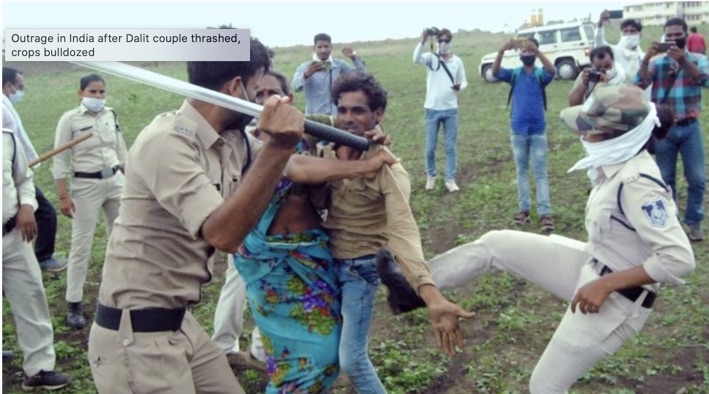
Things have turned really outrageous where people still haven’t learnt the real meaning of helping each other and treating everyone as equal. A recent example of “A Dalit couple” in Madhya Pradesh who have committed suicide because their crops were thrashed and they were being beaten up from the cops. This was a very brutal act against the marginalised sections of our society where those two were crying out for help and were begging to the police to stop and spare them, but nothing happened because it was an order from the government. This cruel and shameful act took place after the couple were seen growing crops on the land which was being inherited by the government. They were quickly rushed to the hospital after both of them consumed pesticides, and now they are in a normal condition.
Al Jazeera

“When our standing crop has been destroyed, we don’t have the option but to kill ourselves” Devi quoted.

All of this took place because the Government wants to build a college at the same spot where the couple had their farms and the government wanted them to leave everything and clear the land, but they didn’t accept their order because they were in debt and farming was the only source of living for their family. But in this also again the Political parties have started their war where they are blaming each other for this incident. This issue has come up weeks after that brutal and senseless incident where a son and a father were beaten up to death in Tamil Nadu by the cops.

What are we doing? where is the world going? On one hand where the policemen/policewomen are given the authority to serve for the country and work for the civilians, protect them, prevent all the evil things which are taking place in the society and on the other hand the police is beating up their people. Please stop, we are already having multiple issues in our society, people are dealing with numerous problems and above all Farmers are the fruit givers to the society, they feed us, how can we take their land and built something in place of a farm. This issue is something very serious and we have to fight against this, we have to fight against the rights of the farmers because they work for the Primary sector of the society. I hope this article will ring a bell of humanity in each one of us and will force us to make an initiative and stop the evil doings of this society, if not this at least we can pray for the farmers, for their health and well-being.

https://www.tribuneindia.com/news/nation/uproar-over-video-showing-madhya-pradesh-cops-beating-up-couple-mercilessly-for-resisting-land-eviction-113744

Mass Communication

The mass communication is the study of mass media. Mass media include newspapers, magazines, television, movies, radio etc. The mass media transmits information to a large number of people simultaneously.


The mass media has several functions. It can be used to highlight issues, create awareness, entertain people, analyze political progress, and is also known to create new social norms. The mass media can influence people’s actions in both good and bad ways. They are therefore responsible for exercising care and monitoring while disseminating information.


For example, in the case of the assassination of Aarushi (Noida) that shocked the country last year, some media outlets went so far as to dismiss their traditional roles and take on the roles of investigative organizations. Things have gotten to the point where some angry members of the public are demanding state laws from the media by slandering the parents of a dead daughter.


In this case, initially, the media, with the help of unconfirmed facts and false information, were able to temporarily influence public opinion which led them to believe that the parents were the ones who were killed. This is widely reported in the media. At the same time, in the case of Jessica Lall and Nitish Katara, the media played a major role in getting the suspect to write. The implication of this is that most media outlets can play an important role in society as long as they are responsible and not discriminated against.


In recent times, the media has become increasingly effective in addressing issues. Reporting dates just gone. In its place there are newly focused media looking for active participants in solving the burning issues of the day. The ‘Times of India’ is an excellent example.


Its ‘lead India’ campaign to identify Indians with leadership credentials to lead the country and his recent ‘Teach India’ campaign to include everyone in his quest to promote literacy among flawless segments are commendable. This is a very big media. Today the media has become a forum for ordinary men to voice their concerns in a way that will be heard by those who are important.


During the Great Depression of the 1930s, US President Roosevelt used social media as a radio to strengthen the morale of the American people. In Germany, however, Hitler used mass media to obtain permission to become his oppressive Nazi regime. So big media can be a tool for achieving good and bad intentions

Photography as a career

Vaishali Singh

Photography is one of the major things of everyone’s life today,

All of us want to freeze the moments we live day to day in a photograph, the new developing technology has made it very easier for people to document their lives easily through photographs and videos and the advancements in technology helps you to put your documented photographs or videos on the platforms like YouTube, Instagram etc. and build your career out of it but the question is how to get started? Now, basically if you want to get started with photography then you do not need a professional degree or course the only thing you need are skills and that’s it but if you’ll do a course or major in photography or cinematography then it will help your chances of getting jobs in the Multi national companies, but if you want to make a career out of blogging vlogging youtubing or photographer then a degree is not a compulsion, what important is teaching yourself about the principles of capturing an image and the lighting conditions and then just go out start practising in real world, now you can learn everything by yourself but it takes time to develop a skill, what’s more important in photography is light.

The word “Photography” itself depicts the meaning as drawing using light. The word photography is made of two words PHOTO and GRAPHEIN where Photo means light and Graphein means to draw.

So, light plays the major role in photography,  after learning the basic principles of photography and light the practising comes into play.

Now, the answer of the question how to get started is very simple just start practising right away, reach out to people, at the earlier stage do the unpaid shoots then build your profile, work as an intern and gain experiences overtime after building your name you can start to earn money through photography and can begin your own photography career. 

http://www.webyurt.com/images-o/images/photography-mountains.jpg

THE BEGINNING OF A NEW AGE: VIRTUAL COURT HEARINGS: THE INDIAN CONTEXT

INTRODUCTION

The Covid-19 pandemic has hit all the countries hard but as far as the legal system is concerned, it has shown us how the coming times and the future shall be and also how things in the ‘new normal’ would be.

But there is always a Silver lining in these tough times which is the Virtual Court Hearings which has ensured that Justice isn’t delayed for the one’s who seek it inspite of these tough times as Justice delayed is Justice denied.

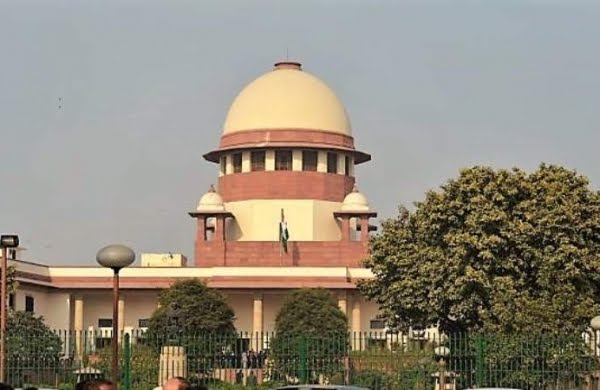
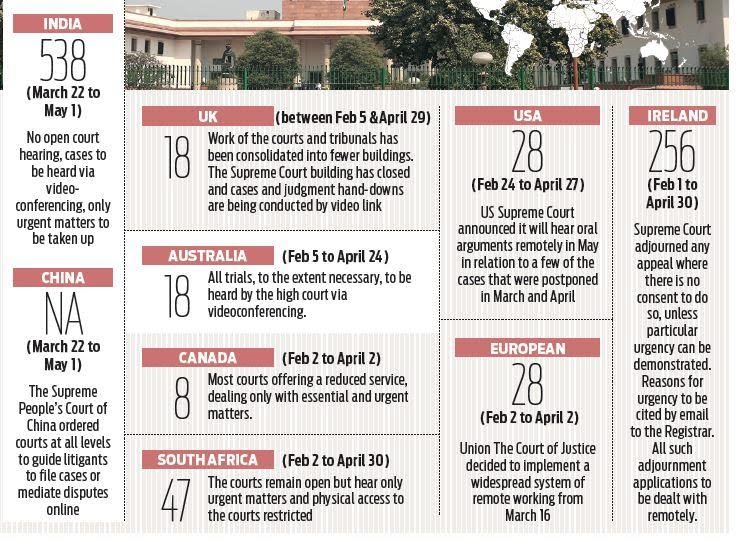
The lockdown has affected the functioning of courts across the globe, but the Hon’ble Supreme Court of India has done much better than the top courts in countries like the UK, the US, Singapore and Canada.

The Apex Court began the hearing of urgent matters virtually till May 1st and heard them for 22 days via video conferencing in March after the imposition of lockdown in order to curb the spread of COVID-19.

ABOUT VIRTUAL HEARINGS

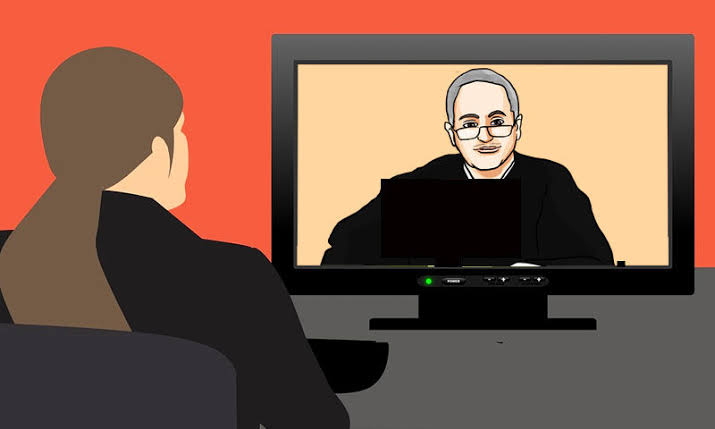
Virtual hearings are court hearings conducted by audio-visual means, where cases are progressed without the need for participants to attend the Court in person. It also shows how the distance becomes immaterial when one has to appear before the court to argue the case.

FOR THE FIRST TIME

The Hon’ble Supreme Court of India held its first Constitutional bench sitting and this is the first time since March 5 that five judges sat together in a single court hall ever since the lockdown forced the apex court to stop physical court hearings and begin hearing cases through videoconferencing from March 25 this year.

It was for the first time on Tuesday, the 14th July, 2020 that a Constitutional Bench (comprising five judges) held a virtual hearing. A bench of justices Arun Mishra, Indira Banerjee, Vineet Saran, MR Shah and Aniruddha Bose appeared wearing masks and maintaining nearly two-feet distance between them on the bench.

The first case that was heard by the five-judge bench was a legal tussle on whether Centre or States have the power to provide reservation to in-service candidates in post-graduate medical degree courses. The plea was brought up by Tamil Nadu Medical Officers Association.

Opening the argument, Senior Advocate Arvind Datar exchanged the extensive compilation of his arguments including cases to be referred through Google drive with all Lawyers. One of the Lawyers, Senior Advocate Vikas Singh appearing for Medical Council of India (MCI) complained about being unable to access Google Drive.

He objected to Datar referring to the same, the first hiccup encountered by the Court in the virtual proceeding. The problem was sorted as Hon’ble court asked Senior Advocate Arvind Datar to give case law citations.

As the virtual hearing proceeded the Senior Advocate Arvind Datar was inaudible to the Hon’ble Court. Hon’ble Justice MR Shah commented in a lighter vein that, “Don’t keep social distancing with your mike.” Datar heard ‘mike’ as “wife”, leaving the bench in splits.

SUCCESS STORY: DATA THAT MATTERS

The Hon’ble Supreme Court of India shared the ‘success story’ of virtual court proceedings. At the beginning of June as many as 2,893 lawyers appeared in the hearings via video-conferencing, it said in the data release.

According to the data, 538 matters were taken up by the SC during the lockdown period, besides 297 connected cases. Judgment was delivered in 57 matters. Besides, 49 special leave petitions, 92 writ petitions, 138 review petitions and 58 pleas for interim relief were also taken up.

HOW THE COURTS FARED AND PERFORMED?

India has fared the best as per the above data as many other countries have been using the virtual system but their top courts that have lagged way behind in the hearing or disposal of cases.

It conducted proceedings via video-conferencing from March 25 as it has suspended the entry of lawyers and other staff into its premises and also the apex court decided to explore the feasibility of ‘physical appearance’ of advocates in real courtroom hearings after strictly adhering to the guidelines of the COVID-19 triggered lockdown and resorting to virtual hearings since March 25.

Data available on other judicial websites indicate that in the nations hit hard by the pandemic like the US, the UK, France, Italy, Germany, China, Canada, Australia etc., The organs of that state which carried out the administration of justice are mostly relying on the virtual court methodologies and online case management.

CONCLUSION

Hence after going through the above facts and circumstances it’s certainly a grand success yet there is always room and scope for improvement.

WEBSITES REFERRED:-

1)https://www.supremecourt.vic.gov.au/law-and-practice/virtual-hearings/virtual-hearings-glossary

2)https://www.google.com/amp/s/www.newindianexpress.com/nation/2020/may/04/virtual-hearing-indias-apex-court-way-ahead-than-many-counterparts-2138843.amp

3)https://scholarlykitchen.sspnet.org/2020/03/30/marketing-amidst-a-pandemic/

4)https://www.google.com/amp/s/m.hindustantimes.com/india-news/supreme-court-holds-first-virtual-constitution-bench-hearing/story-6OIJDbbzpliujLFjz1z3mI_amp.html

Organisational design/framework-basic Understanding

Let’s understand What is Organisation Design.?

“Organization design” involves the creation of roles, processes and structures to ensure that the organization’s goals can be realized.

Some people associate organization design with the mechanical arrangement of positions and reporting lines on the organization chart.

It is certainly true that organizational designers also need to define the vertical structure, including reporting lines.

However, organization design is much more than “boxology”.

Organization design problems are often some of the hardest problems that leaders face. Finding the right design often requires inventing a new solution to resolve a dilemma. And decisions made with regard to formal structure, roles and processes directly impact the jobs and careers of employees – and the ability of the firm to realize its strategic objectives.

In an organization re-design process one may consider elements at different levels:  

  • The overall organizational “architecture” (e.g., the corporate level, the role of the headquarters versus business areas in a large firm, etc.)
  • The design of business areas and business units within a larger firm
  • The design of departments and other sub-units within a business unit
  • The design of individual roles

The field of organization design sits at the intersection of strategy, operations, law and HR.

1. An important driver for organization design is the organization’s strategy – but the design of the organization may also to a great extent determine which strategies we may be able to form in the first place.

2.  We should, in general, attempt to align the organization with the work processes – so there is a close link between operations and organization design.

3. The design of the organization is also influenced by laws, regulations, and governance principles adopted by the industry sector.

4. Last but not least, organization design is fundamentally about people. People inhabit the roles that are defined in the organization design proces. People participate in design processes and also influence designs in many direct and indirect ways.

National Commission For Women

It is said that the best way to know about society, a civilization and a culture, try to know as much possible about the women. In India, women have come a long way from the rare women scholars and sages of the Vedic age to the women in different sectors of society and civilization today, such as the armed forces, arts, information technology, politics and a number of similar sectors which have traditionally been male dominated, while simultaneously balancing the roles of wife, mother and daughter. While Indian women have fought against the patriarchal Indian society and triumphed at many levels, cases of rape, dowry deaths, female infanticide, sexual harassment at workplaces, female illiteracy, and similar problems are still rampant in Indian society. It was in this backdrop that the Committee on the Status of Women in India (CSWI) the establishment of the National Commission for Women to fulfill the surveillance functions and to facilitate redressal of grievances and to accelerate the socio-economic development of women.

The principle of gender equality is enshrined in the Indian Constitution. The Preamble, promotes Equality of status and of opportunity; the Fundamental Rights enshrined in Part III of the Indian Constitution and Directive Principles enshrined in Part IV of the Constitution all promote gender equality. The Constitution not only grants equality to women but has also made special provisions for ensuring equality Thus, as per the recommendations of the CSWI and in order to uphold the mandate of the Constitution, in January 1992, the National Commission for Women (NCW), was set up as a statutory body under the National Commission for Women Act, 1990 (Act No. 20 of 1990 of Government of India) to carry out the mandate set by the Act as well as CSWI.About The Commission. This chapter aims at informing the reader of the need for a commission such as the National Commission for Women and the impetus for its establishment in 1992. The chapter further examines the relationship between the constitution and the commission, the mandate given by the constitution as well as the basic administrative set up of the commission as per the constitution.

Importance of The Commission:

Women as a class neither belong to a minority group nor are they regarded as a backward class. India has traditionally been a patriarchal society and therefore women have always suffered from social handicaps and disabilities. It thus became necessary to take certain ameliorative steps in order to improve the condition of women in the traditionally male dominated society.The Constitution does not contain any provision specifically made to favor women as such. Though Art. 15 (3), Art. 21 and Art. 14 are in favor of women; they are more general in nature and provide for making any special provisions for women, while they are not in themselves such provisions. The Supreme Court through interpretive processes has tried to extend some safeguards to women.

The objective of the NCW is to represent the rights of women in India and to provide a voice for their issues and concerns. The subjects of their campaigns have included dowry, politics, religion, equal representation for women in jobs, and the exploitation of women for labour. They have also discussed police abuses against women.

The commission regularly publishes a monthly newsletter, Rashtra Mahila, in both Hindi and English

1.The commission shall perform all or any of the following functions
• Investigation: The Commission shall investigate and examine all matters relating to the safeguards provided for women under the Constitution and other laws
• Report : The Commission shall present to the Central Government, annually and at such other times as the Commission may deem fit, reports upon the working of those safeguard
• Implementation of those safeguards : As per the reports recommendations for the effective implementation of those safeguards for the improving the conditions of women by the Union or any state
• Review: The Commission shall review, from time to time, the exiting provisions of the Constitution and other laws affecting women and recommend amendments thereto so as to suggest remedial legislative measures to meet any lacunae, inadequacies or shortcomings in such legislations.
• Take up Cases: The Commission shall take up cases of violation of the provisions of the Constitution and of other laws relating to women with the appropriate authorities

• Complaints: The Commission shall look into complaints and take suo moto ( in its own motion ) notice of matters relating to➢deprivation of women’s rights;
➢non-implementation of laws enacted to provide protection to women and also to achieve the objective of equality and development;
➢non-compliance of policy decisions,guidelines or instructions aimed at mitigating hardships and ensuring welfare and providing relief to women, and take up the issues arising out of such matters with appropriate authorities
• Special studies : The Commission shall call for special studies or investigations into specific problems or situations arising out of discrimination and atrocities against women and identify the constraints so as to recommend strategies for their removal
• Promotional and educational research : The Commission shall undertake promotional and educational research so as to suggest ways of ensuring due representation of women in all spheres and identify factors responsible for impeding their advancement, such as, lack of access to housing and basic services, inadequate support services and technologies for reducing drudgery and occupational health hazards and for increasing their productivity

Evaluation of progress :The Commission shall participate and advice on the planning process of socio-economic development of women and evaluate the progress of the development of women under the Union and any State. • Inspect: The Commission shall inspect or cause to inspected a jail, remand home, women’s institution or other place of custody where women are kept as prisoners or otherwise and take up with the concerned authorities for remedial action, if found necessary;
• Litigation Expenses: The Commission shall fund litigation involving issues affecting a large body of women;
• Periodical reports :The Commission shall make periodical reports to the Government on any matter pertaining to women and in particular various difficulties under which women toil;
• Any other matter :The Commission shall any other matter which may be referred to it by Central Government.

  1. Reports to be laid before each House of Parliament:
    The Central Government shall cause all the reports to be laid before each House of Parliament along with memorandum explaining the action taken or proposed to be taken on the recommendations relating to the Union and the reasons for the non-acceptance, if any, of any such recommendations. Where any such report or any part thereof relates to any matter with which any State Government is concerned, the Commission shall forward an copy of such report or part to such State Government who shall cause it to be laid before the Legislature of the State along with a memorandum explaining the action taken or proposed to be taken on the recommendations relating to the State and the reasons for the nonacceptance, if any, of any such recommendations.
  2. Powers of a civil court
    The Commission shall, while investigating any matter have all the powers of a civil court trying a suit and, in particular in
    respect of the following matters, namely :-
    –summoning and enforcing the attendance of any person from any part of India and examining him on oath; –requiring the discovery and production of any document;
    –receiving evidence on affidavits;
    –requisitioning any public record or copy thereof from any court or office;
    –issuing commissions for the examination of witnesses and documents; and
    –any other matter which may be prescribed

the Commission has managed to fulfill the mandate, if not completely then to a great extent. The achievements mentioned in the prior chapter are only a few of many similar achievements and they are proof of the popularity and support the Commission is gaining from the Indian woman. There is no doubt about the effectiveness of the Commission and about the good work which it is doing for the women of India, however, there are certain shortcomings in the working of the Commission, which, if rectified, would lead to a more efficient and productive Commission.

India among top ten nations in intellectual property filings

As per World Intellectual Property Indicators-2019 Report, India has emerged as the top tenth nation in the ranking of the total (resident and abroad) Intellectual Property (IP) filing activity.

With government push to schemes like ‘Make in India’, ‘Skill India’ and now ‘Atma-nirbhar Bharat’, IP Filing and grant activity is likely to increase. Industry 4.0 is witnessing new inventions and breakthroughs as it faces challenges in providing the right environment to stimulate innovation, especially in Artificial Intelligence and Machine Learning. IP-intensive industries have been identified as an important and integral part of a country’s economy and account for more jobs and a larger share of its GDP.

 Director General of Pushpa Gujral Science City, Dr. Neelima Jerath said, this in a webinar on intellectual property Rights today. It was jointly organised by Pushpa Gujral Science City, Kapurthala and Technology Information, Forecasting & Assessment Council, Department of Science &Technology, Government of India. More than 200 students and teachers from various Technolical colleges of Punjab participated in this webinar.

 Dr. Jerath said that innovation and creative endeavors are indispensable elements that drive economic growth and sustain the competitive edge of the economy of any country. The last century recorded unprecedented improvements in health, economic well-being, and overall quality of life worldwide. Developed countries relied on intellectual property as one of the leading tools with which such advances were realized and Patents, trademarks, and copyrights were the principal means for establishing ownership rights to the creations, inventions, and brands that were used to generate tangible economic benefits. 

Head of PFC-IPR Dr.Yashawant Dev Panwar said, the Government of India has taken concrete steps to establish favourable environment for creation and protection of Intellectual Property Rights and strengthening IP administration in the country. The National IPR Policy, launched in May 2016, to promote strong IP regime in the country encourages innovation to achieve Country’s industrial and economic development goals. This will provide efficient IP ecosystem and build up pace of industrial growth in the country.

HRD Minister launches NISHTHA programme for 1200 key resources persons of Andhra Pradesh

Human Resources and Development Minister Ramesh Pokhriyal Nishank today launched the first on-line NISHTHA programme for one thousand 200 Key Resources Persons of Andhra Pradesh.

Speaking on the occasion, Mr Pokhriyal said, NISHTHA is a national initiative for School Heads and Teachers Holistic Advancement at the elementary stage under Samagra Shiksha -a flagship programme of the Ministry to improve learning outcomes. The Minister added that NISHTHA in face-to-face mode was launched on 21st August last year.

He said, thereafter 33 states and Union Territories have launched this programme in collaboration under Samagra Shiksha. In 29 States and UTs, the NISHTHA training programme has been completed by the NCERT at the state level.

The Minister highlighted that around 23 thousand Key Resource Persons and more than 17 lakh teachers and school heads have been covered under NISHTHA face to face mode till date. He said, due to COVID-19 pandemic situation, sudden lockdown has affected the conduct of this programme in face-to-face mode. Mr Pokhriyal said, for providing training to remaining 24 lakh teachers and school heads, NISHTHA has been customized for online mode to be conducted through DIKSHA and NISHTHA portals by the NCERT.

Agriculture Minister stresses on need to reduce dependence on imports

Union Agriculture Minister Narendra Singh Tomar has stressed on the need to reduce dependence on imports, increase production of healthy foods, pulses and oilseeds.

Speaking at a function to celebrate 92nd foundation day of  Indian Council of Agricultural Research (ICAR), the Minister said, at present, India is surplus in foodgrains production due to the research contribution of the scientists and hard work of the farmers. He congratulated the farming community in the country for record production of crops even during the lockdown due to Covid-19 pandemic. The Minister said, Palm oil production needs to be increased by research and increased cultivation.

India,United States to work together to further strengthen trade and economic ties

India and the United States have expressed their resolve to work together to further strengthen the trade and economic ties.

Commerce Minister Piyush Goyal and US Commerce Secretary Wilbur Ross held an informal tele-conversation yesterday. The two leaders discussed the COVID-19 situation in both the countries and appreciated the cooperation between India and the US, in fighting the pandemic. They also conversed on the ongoing India-US trade discussions and appreciated the substantial progress made by the two sides on most of the outstanding issues. There was a desire expressed to conclude this initial limited trade package and recognise the complementarities of the India-US bilateral trade and discussed the possibility of an FTA.

In response to Mr Goyal’s concern on USA keeping 24 Indian items under Trafficking Victims Protection Reauthorization Act list and designating them as ‘child labour sectors’, thereby denying them the opportunity to participate in supply contracts of US government agencies, Secretary Ross offered to set up a meeting between the labour department officials of both sides.

Commerce Minister Piyush Goyal also flagged the pending ‘US-India Social Security Totalisation Agreement’, which had been also discussed during the visit of US President Trump to India in February this year. While appreciating India’s concern, Secretary Ross mentioned that the statutory requirements of the US have to be fulfilled by India in this regard. He offered to arrange a meeting between the U.S. Social Security Administrator and concerned Indian officials to discuss and find a possible solution.

Mr Goyal also raised a concern on the US ban on import of wild catch shrimp from India on the premise that fishing practices followed in India were non-compliant with US regulations to protect sea turtles. He mentioned the various conservation measures taken by Indian maritime states in protecting the sea turtles. Secretary Ross appreciated India’s concerns and agreed to facilitate a discussion between the officials of the US State Department and Office of Marine Conservation with the Indian Department of Fisheries and Ministry of Forest and Environment, in this regard.

Ministry of Finance releases Rs 15,187 crore as grants-in-aid to 2.63 lakh Rural Local Bodies

Ministry of Finance has released an amount of over 15 thousand and 187 crore rupees as grants-in-aid to 2.63 lakh Rural Local Bodies (RLBs) spread in 28 States of the country. The amount was released upon the recommendation of the Ministry of Panchayati Raj, Department of Drinking Water and Sanitation and Jal Shakti Ministry. This grants-in-aid forms part of the Tied Grant as recommended by the 15th  Finance Commission for the Financial Year 2020-21. It will be used by RLBs to facilitate taking up of various developmental work concerning supply of drinking water, rain water harvesting, water recycling, sanitation and maintenance of Open Defecation Free status which are national priorities.

Giving this information, Union Minister of Panchayati Raj, Narendra Singh Tomar said that the release of this fund to the Rural Local Bodies signifies the most appropriate timing when they are fighting the challenges posed by the COVID-19 pandemic situation. He said, availability of the fund with the RLBs will boost their effectiveness in delivery of basic services to the rural citizens. Mr Tomar said it would also empower them in providing gainful employment to migrant laborers who have returned to their native places owing to COVID-19 pandemic situation as well as in augmenting rural infrastructure in a constructive way.

Health Ministry says all registered medical practitioners can now recommend testing for COVID-19

Union Health Ministry has said that all registered medical practitioners can now recommend testing for COVID-19. The Ministry in a statement said that as per the Test, Trace, Treat strategy, the Central Government is driving enhanced testing initiatives in States and Union Territories. It said, as a result, there has been a steady rise in the number of testing labs across the country. The increased testing for COVID-19 is in accordance with the guidelines of the Indian Council of Medical Research (ICMR) and has helped in early detection of cases. The Ministry said, during the last 24 hours, three lakh 26 thousand and 826 samples have been tested. The cumulative number of samples tested, as of now is over one crore 27 lakh. The Ministry said, the testing per million in the country  is consistently rising and today it has crossed the figure of 9231.

It said, the testing lab network is further strengthened with 1234 labs in the country. Out of the total labs, 874 labs are  in the government sector and 360 are private labs.

International flights to US to resume operations from today on interim basis under Bilateral Air Bubble mechanism

Civil Aviation Minister Hardeep Singh Puri has said that Bilateral Air Bubbles will be the way to resume international travel amid the Covid-19 pandemic with certain conditions.

Briefing the media in New Delhi yesterday, Mr Puri said that the government’s negotiations with three countries are at an advanced stage for the purpose under the Bilateral Air Bubble mechanism. He said, in case of the United States, there is an agreement with United Airlines to operate 18 flights between India and US from today till 31st of July but this is an interim one. He informed that Air France will operate 28 flights from tomorrow till 1st of August between Delhi, Mumbai, Bengaluru and Paris. He said they have also received  a request from Germany and an agreement with Lufthansa is almost done.

On the biggest evacuation exercise, Vande Bharat Mission, the Minister said, the fourth phase is going on. He said, under the first phase of the mission from 7th May to 13th May, 12 thousand 700  Indians stranded abroad due to COVID-19 pandemic were repatriated. He said, now double of this number of passengers are being brought back per day. He said, till 15th of this month over 6 lakh 87 thousand passengers have been brought under the mission.

Civil Aviation Secretary Pradeep Kharola said, taking the sheer number of passengers and the number of countries covered, Vande Bharat Mission is the biggest evacuation exercise by any civil airline in the world. He said this will pave the way for operation of Air Bubbles between different countries.

Air India Chairman and Managing Director Rajiv Bansal said that till 13th of this month as part of the Mission for Repatriation Flights for Stranded Indians, Air India group operated 1,103 flights and brought back over two lakh Indians and also helped repatriate over 85 thousand individuals.

On resumption of domestic flight operations, the Minister said, the operation began on 25th May and on the first day, 30 thousand passengers flew. He said, the number is increasing.

Besides, a presentation on Drone operations was also made during the briefing. The Civil Aviation Ministry official said that Drones will play a key role under the Atmanirbhar Bharat Abhiyan and the government is working on the challenges.

India says consular access to Kulbhushan Jadhav given by Pakistan was neither meaningful nor credible

The External Affairs Ministry has said the Consular Officers were not given unimpeded, unhindered and unconditional access to Kulbhushan Jadhav by Pakistan. In a statement, Ministry spokesperson Anurag Srivastava said on the contrary, Pakistani officials with an intimidating demeanour were present in close proximity of Mr Jadhav and Consular Officers despite the protests of the Indian side. He said, it was also evident from a camera that was visible that the conversation was being recorded. The Spokesperson said, Mr Jadhav himself was visibly under stress and indicated that clearly to the Consular Officers. The arrangements did not permit a free conversation between them and the Consular Officers could not engage Mr Jadhav on his legal rights and were prevented from obtaining his written consent for arranging his legal representation.

In the light of these circumstances, the Indian Consular Officers came to the conclusion that the consular access being offered by Pakistan was neither meaningful nor credible. After lodging a protest, they left the venue.

Mr Srivastava said it is clear that Pakistan’s approach to this matter continues to be obstructive and insincere. He said Pakistan has not only violated its assurance to the International Court of Justice (ICJ) to fully implement the 2019 judgement, but also failed to act in accordance with its own Ordinance. He said, External Affairs Minister Dr S Jaishankar has apprised the family of Mr Jadhav of these developments.

The Spokesperson also reiterated India’s commitment to ensure the safe return of Mr Jadhav to India. He said the future course of action will be decided in the light of yesterday’s events. The Spokesperson said, over the past year, India has requested Pakistan more than twelve times to provide unimpeded, unhindered and unconditional consular access to Mr Jadhav, who remains incarcerated in Pakistani custody since 2016. He said this consular access is of utmost importance, as it is the basis for a process of effective review and reconsideration ordered by the International Court of Justice in July last year of the conviction and sentence of Mr Jadhav by a Pakistani military tribunal.

The spokesperson said in May this year, Pakistan passed an Ordinance, ostensibly to comply with the order of the International Court of Justice. It inter-alia envisaged the Consular Officer of the High Commission of India filing a petition before a High Court for the relevant review and reconsideration. He said that in that context, the contacts and conversations between the Consular Officer and Jadhav assume great importance. He added that any conversation between them must necessarily take place in privacy and without the presence of any Pakistani official or recording by Pakistan. He said, it is only then that Mr Jadhav can speak freely without any concerns of reprisal as he remains in Pakistani custody after the meeting. The spokesperson said that it is already evident that Jadhav has been intimidated repeatedly in the past, including in being made to express his alleged disinclination to seek a review.  

India recently requested the Pakistani side for an unimpeded, unhindered and unconditional consular access to be provided on 13th July. Pakistan was asked to ensure that the meeting is held in an atmosphere free from fear of retribution and without the presence of any Pakistani official in the vicinity of Mr Jadhav and the Indian consular officials.  Pakistan was also requested to not record the meeting.

After extensive discussions, the Pakistan side conveyed that they were ready to organize consular access. Mr Srivastava said they were assured that this consular access would be unimpeded, unhindered and unconditional.  On the basis of this assurance by the Pakistani Foreign Ministry, two Consular Officers of the High Commission proceeded to the meeting with Mr Jadhav. He said however, neither the environment nor the arrangements of the meeting were in accordance with the assurances of Pakistan.

Mr Srivastava also said, India strongly protested against construction of Diamer Basha Dam to the Pakistan government. He said, it will lead to submergence of large parts of land of Jammu and Kashmir and Ladakh. He said, India condemns attempts by Pakistan to bring about material changes in Indian territories under its illegal occupation.

The Spokesperson said, India has also consistently conveyed its protest and shared concerns with both China and Pakistan on all such projects in Indian territories under Pakistan’s illegal occupation where it has no locus standi.