In view of this pandemic, it seems like some student’s lives have gone on standstill but the reality is that time is not on standstill so with that in mind I am going to give the difference between various classes of people during this period using a case study.
Take x,y and z to be 3 different student during this pandemic and try to fit yourself into the category you belong to as a student
Student x: was not really that brilliant but has taking it upon himself to become better by utilizing his time wisely during this lockdown period .
Student y: is brilliant but keeps horning his skills by reading more and also reading ahead of where the lecturer has gotten to
While student z: is the one scared of the lockdown being removed because of guilt of having not carried his or her books during this lockdown. Lets consider what category we fall under. To be sincere most of us are in the student z category. And i cant blame anyone. Taking myself as a case study. I started out during this pandemic reading my notes vigorously and also reading ahead of my lectures but as time went on the vibe to read is gone so a student x or y can actually find themselves in the position of student z.
To solve this problem and make your days not be the same make a plan to achieve something different each day at times the plan may not work out until discipline and self control is achieved. Back to myself as a case study. I started thinking out of the box l realized I was nothing if my education is taken away so I started learning vocational skills like hairdressing, baking and learning Korean. After a while I started learning about my course of study in details and gathered certificate for myself.
The point is if your yesterday, today and tomorrow is the same there is no progress in your life. You need to make an effort as much as we want to admit that 2020 is not a part of our lives it is and whatever you do in this lockdown period should impact you positively. Look for opportunities to garnish yourself as a student in preparation for the future. It’s not easy it needs self discipline. Make an attempt today to make your life easier tomorrow
Recruitment is a process of finding and attracting the potential resources for filling up the vacant positions in an organization. It sources the candidates with the abilities and attitude, which are required for achieving the objectives of an organization.
Recruitment process is a process of identifying the jobs vacancy, analyzing the job requirements, reviewing applications, screening, shortlisting and selecting the right candidate.
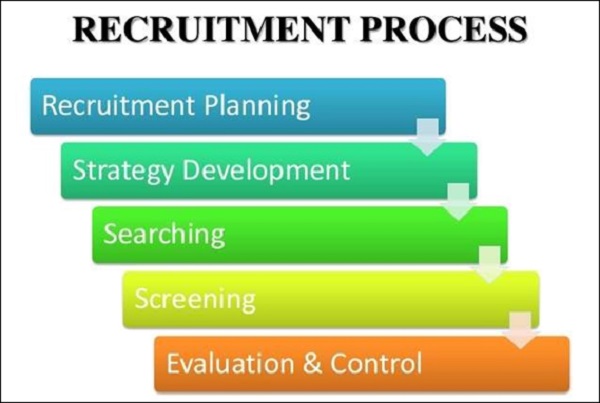
To increase the efficiency of hiring, it is recommended that the HR team of an organization follows the five best practices (as shown in the following image). These five practices ensure successful recruitment without any interruptions. In addition, these practices also ensure consistency and compliance in the recruitment process.
Recruitment process is the first step in creating a powerful resource base. The process undergoes a systematic procedure starting from sourcing the resources to arranging and conducting interviews and finally selecting the right candidates.
Recruitment Planning
Recruitment planning is the first step of the recruitment process, where the vacant positions are analyzed and described. It includes job specifications and its nature, experience, qualifications and skills required for the job, etc.
A structured recruitment plan is mandatory to attract potential candidates from a pool of candidates. The potential candidates should be qualified, experienced with a capability to take the responsibilities required to achieve the objectives of the organization.
Identifying Vacancy
The first and foremost process of recruitment plan is identifying the vacancy. This process begins with receiving the requisition for recruitments from different department of the organization to the HR Department, which contains −
Number of posts to be filled
Number of positions
Duties and responsibilities to be performed
Qualification and experience required
When a vacancy is identified, it the responsibility of the sourcing manager to ascertain whether the position is required or not, permanent or temporary, full-time or part-time, etc. These parameters should be evaluated before commencing recruitment. Proper identifying, planning and evaluating leads to hiring of the right resource for the team and the organization.
Job Analysis
Job analysis is a process of identifying, analyzing, and determining the duties, responsibilities, skills, abilities, and work environment of a specific job. These factors help in identifying what a job demands and what an employee must possess in performing a job productively.
Job analysis helps in understanding what tasks are important and how to perform them. Its purpose is to establish and document the job relatedness of employment procedures such as selection, training, compensation, and performance appraisal.
The following steps are important in analyzing a job −
Recording and collecting job information
Accuracy in checking the job information
Generating job description based on the information
Determining the skills, knowledge and skills, which are required for the job
The immediate products of job analysis are job descriptions and job specifications.
Job Description
Job description is an important document, which is descriptive in nature and contains the final statement of the job analysis. This description is very important for a successful recruitment process.
Job description provides information about the scope of job roles, responsibilities and the positioning of the job in the organization. And this data gives the employer and the organization a clear idea of what an employee must do to meet the requirement of his job responsibilities.
Job description is generated for fulfilling the following processes −
Classification and ranking of jobs
Placing and orientation of new resources
Promotions and transfers
Describing the career path
Future development of work standards
A job description provides information on the following elements −
Job Title / Job Identification / Organization Position
Job Location
Summary of Job
Job Duties
Machines, Materials and Equipment
Process of Supervision
Working Conditions
Health Hazards
Job Specification
Job specification focuses on the specifications of the candidate, whom the HR team is going to hire. The first step in job specification is preparing the list of all jobs in the organization and its locations. The second step is to generate the information of each job.
This information about each job in an organization is as follows −
Physical specifications
Mental specifications
Physical features
Emotional specifications
Behavioral specifications
A job specification document provides information on the following elements −
Qualification
Experiences
Training and development
Skills requirements
Work responsibilities
Emotional characteristics
Planning of career
Job Evaluation
Job evaluation is a comparative process of analyzing, assessing, and determining the relative value/worth of a job in relation to the other jobs in an organization.
The main objective of job evaluation is to analyze and determine which job commands how much pay. There are several methods such as job grading, job classifications, job ranking, etc., which are involved in job evaluation. Job evaluation forms the basis for salary and wage negotiations.
Recruitment Strategy
Recruitment strategy is the second step of the recruitment process, where a strategy is prepared for hiring the resources. After completing the preparation of job descriptions and job specifications, the next step is to decide which strategy to adopt for recruiting the potential candidates for the organization.
While preparing a recruitment strategy, the HR team considers the following points −
Make or buy employees
Types of recruitment
Geographical area
Recruitment sources
The development of a recruitment strategy is a long process, but having a right strategy is mandatory to attract the right candidates. The steps involved in developing a recruitment strategy include −
Setting up a board team
Analyzing HR strategy
Collection of available data
Analyzing the collected data
Setting the recruitment strategy
Searching the Right Candidates
Searching is the process of recruitment where the resources are sourced depending upon the requirement of the job. After the recruitment strategy is done, the searching of candidates will be initialized. This process consists of two steps −
Source activation − Once the line manager verifies and permits the existence of the vacancy, the search for candidates starts.
Selling − Here, the organization selects the media through which the communication of vacancies reaches the prospective candidates.
Searching involves attracting the job seekers to the vacancies. The sources are broadly divided into two categories: Internal Sources and External Sources.
Internal Sources
Internal sources of recruitment refer to hiring employees within the organization through −
Promotions
Transfers
Former Employees
Internal Advertisements (Job Posting)
Employee Referrals
Previous Applicants
External Sources
External sources of recruitment refer to hiring employees outside the organization through −
Direct Recruitment
Employment Exchanges
Employment Agencies
Advertisements
Professional Associations
Campus Recruitment
Word of Mouth
Screening / Shortlisting
Screening starts after completion of the process of sourcing the candidates. Screening is the process of filtering the applications of the candidates for further selection process.
Screening is an integral part of recruitment process that helps in removing unqualified or irrelevant candidates, which were received through sourcing. The screening process of recruitment consists of three steps −
Reviewing of Resumes and Cover Letters
Reviewing is the first step of screening candidates. In this process, the resumes of the candidates are reviewed and checked for the candidates’ education, work experience, and overall background matching the requirement of the job
While reviewing the resumes, an HR executive must keep the following points in mind, to ensure better screening of the potential candidates −
Reason for change of job
Longevity with each organization
Long gaps in employment
Job-hopping
Lack of career progression
Conducting Telephonic or Video Interview
Conducting telephonic or video interviews is the second step of screening candidates. In this process, after the resumes are screened, the candidates are contacted through phone or video by the hiring manager. This screening process has two outcomes −
It helps in verifying the candidates, whether they are active and available.
It also helps in giving a quick insight about the candidate’s attitude, ability to answer interview questions, and communication skills.
Identifying the top candidates
Identifying the top candidates is the final step of screening the resumes/candidates. In this process, the cream/top layer of resumes are shortlisted, which makes it easy for the hiring manager to take a decision. This process has the following three outcomes −
Shortlisting 5 to 10 resumes for review by the hiring managers
Providing insights and recommendations to the hiring manager
Helps the hiring managers to take a decision in hiring the right candidate
Evaluation and Control
Evaluation and control is the last stage in the process of recruitment. In this process, the effectiveness and the validity of the process and methods are assessed. Recruitment is a costly process, hence it is important that the performance of the recruitment process is thoroughly evaluated.
The costs incurred in the recruitment process are to be evaluated and controlled effectively. These include the following −
Salaries to the Recruiters
Advertisements cost and other costs incurred in recruitment methods, i.e., agency fees.
Administrative expenses and Recruitment overheads
Overtime and Outstanding costs, while the vacancies remain unfilled
Cost incurred in recruiting suitable candidates for the final selection process
Time spent by the Management and the Professionals in preparing job description, job specifications, and conducting interviews.
A school fete is looked forward to by most of us. It provides entertainment and also great learning which is useful later in life. It provides entertainment and also great learning. Thus a school carnival gives you lots of unforgettable memories ❤️
Boarding schools provide an unequalled academic environment, because of greater interaction between the students and teachers facilitating mentoring. It gives an opportunity to mingle with students of different backgrounds and inculcates virtues like tolerance and trust.
Boarding schools provide an excellent academic environment, because of greater interaction between students and teachers. This interface unlike day schools is not just limited 6-8 hours. The small class size enables teachers to give individual attention to each student.
Boarding schools are indeed better than day schools for the all round development of the child. They play an important and crucial role in moulding the character and personality, making them useful citizens of the society.
The right to Information Act 2005 which came fully into effect on12th October 2005 is one of the most significant legislation enacted by the Parliament in India. It is a major step towards more accountable and transparent government. RTI has been enacted to provide for setting out the practical regime of right to information for citizens to secure access to information under the control of public authorities in order to promote transparency and accountability. The Act will certainly lead to end the culture of governmental secrecy andfulfil its potential as a truly great democracy.
Objective of the Act:
1. To promote transparency and functioning of the government. accountability in the
2. To set up a practical regime for giving citizens access to Information that is under the control of public authorities.
3. To empower the citizens as the law will promote the participation of the citizens in official decisions that directly affect their lives.
4. The effective implementation of RTI Act will build public trust in the government functioning.
5. It will lead to effective and efficient records management technique that is needed to facilitate the provision of information in response to public interest.
What is Right to Information?
Government information is national resource. Neither the particular government of the day nor public officials create information for their own benefits. Government and officials are trustees of this information for the people. The RTI act enables the citizens to obtain access under the law to documents that may otherwise be available only at the discretion of government.
The RTI Act 2005 provides effective access to information for citizens of India, which is under the control of public authorities. This overrides the ―official Secrets Acts and similar laws and rules.
The Act primarily envisages setting out a practical regime of right to information for citizens to secure access to information under the control of public authorities, in order to promote transparency and accountability in the working of every public authority.
Right to Information means the right to information accessible under this Act which is held by or under the control of any public authority and includes the right to: –
(i)Inspection of work, documents, records.
(ii)Taking notes, extracts, or certified copies of documents or records.
(iii)Taking certified samples of material.
(iv)Obtaining information in the form of diskettes, floppies, tapes, video cassettes or in any other electronic mode or through printouts where such information is shared in a computer or in any other device.
Every information held by or under the control of a public authority is accessible to a citizen, unless information is exempt from disclosure.
What is Accessible under the Law?
Information means any material in any form, including records, documents, memos, e-mail, opinions, advices, press releases, circulars, orders, log books, contacts, reports, papers, samples, models, data material held in any electronic form and information relating to any private body which can be accessed by a public authority under any law for the time being in force.
Features of the RTI Act:
ØThe Act extends to the whole of India except Jammu & Kashmir.
ØAll citizens shall have the right to information, subject to provisions of the Act. The RTI empowers the citizens to ask any question or seek any information from government authorities be it Central, State or Local governments.
ØIt shall apply to Public Authorities which means any authority or body or institution of self-government established or constituted by or under the Constitution; by any law made by the appropriate Government or, any other body owned, controlled or substantially financed directly or indirectly by the appropriate Government, and includes non-government organisation substantially financed by the government.
ØThe Act lays down the machinery for the grant of access to information. The Public Authorities are required to designate Public Information Officer and Assistant Public Information Officer with in the hundred days of enactment to accept the request forms and provide information. The Public Information Officers/Assistant Public Information Officers will be responsible to deal with the requests for information and also to assist persons seeking information.
ØThe Act envisages creation of an independent non-judicial machinery viz, Central Information Commission, State Information Commission. Legal Framework of exercise of powers by the Commission is defined in the Act.
ØThe Act also provides the two- tier Appellate forum. First appeal is to be made to the departmental officer senior to the Public Information Officer. The second appeal is to be made to State Commission.
ØFee will be payable by the applicant depending on the nature of information sought.
ØTime limit has been prescribes for the compliance of information depending upon the information requirements.
ØCertain categories of information have been exempted from the disclosure under Section 8and 9 of the Act like conduct of International Relations, security of the State, trade and commercial secrets, intelligence agency etc.
ØCentral Information Commission and the State Information Commissions monitor the implementation of the Act and prepare an Annual report to be laid before the Parliament / State legislatures.
Richard Brinsley sheridan, a famous Irish Playwright and Poet said “Never say more than is necessary”.This saying is very common in our Daily life. When we talk more than is necessary it leds to problems. It is true , the more one person speaks , the more that person creates question in other person’s mind. And in the midst of speaking, the secret which is kept inside may slip out of one’s mouth unconditionally. As a human knowledge is required to preserve ,the more we speak we give away the knowledge we have in ourselves. Even our speaking manner and materials reveals about our nature and traits , our personality. And this helps people to guess about our further steps and actions. Even people often get fooled for this habit of their.
Advantage of speaking normal is it puts others in a defensive mode. Mahatma Gandhi talked what was necessary, hence , the people around them and English company not able to suspect his next steps which led them to fail to take steps to prevent his future movements and therefore he won Independence.
One more thing , some people think they can impress people by their words but there also remains some gaps – when we are trying to impress people, the more we say we become common to people in appearance and less in control. Even if one say something banal, it will seem original if you make it open minded and sphinx like. Powerful and succesful people impress others by speaking less. The more you speak, the more likely you are to say something foolish.
It is a very fundamental rule going on from many years. People like to speak about their life and share all bullshit things , thus , they expose their personal life to the outer world.
Thus we should practice ourselves to listen more and speak less as-
1.Speaking less will make people reveal more about them. Your short answer and defence will stand as defence and they will jump in their comments which rather will reveal about themselves than others.
2.speaking less will help people to listen and interpret about you carefully. They have to know what you are thinking. People cannot pierce your intentions and meaning, when you carefully control what you reveal.
3. Human tongue is uncontrollable, only few people can have control over it. Be particularly careful with sarcasm. We often get satisfaction by saying our rough words but it creares our image too.
4. The more you say , the more common you become to people and they will no more value your words.
5. Speaking less will save you from speaking something dangerous and harmful . Take the foolish act of coriolanus , a military hero of Rome around 454 BC. People held him in awe. His speach appeared to be arrogance , cruelty.
6.people will never decieve as they don’t know about your position. According to louis xiv gave rise to “i will see” a very short phrase which said in polite manner.so, let everyone speak , you be a careful listener , to know the people’s views about you and their own reality.
Saying /speaking less is not for high authority people applicable but also for normal common people. In every sector of life , the less you open up yourself to people , you become profound and mysterious to them. The more less you speak , you appear intelligence and powerful to people. So, the less you speak up , the less risk you face in life in regarding difficulties.
Moreover, with development of technology and emergence of new era , people are more likely to be find silent suppressing all their words and feelings, as we all know all are ready to spread salt to your wounds oray take advantages of your weakness. So , better change habit , it will be beneficial to all people not only in personal life but also in occupational sector.
Time is of the essence. This phrase is used when something needs to be done promptly. Ironically, this perfectly fits my today’s article.
India first established time-zones in 1884, owing to the British. During the 1884 International Meridian Conference in Washington, D.C. India registered its two official time zones, Bombay Time and Calcutta Time. Madras Time, an unofficial time was used as well as the Railway Time.
Following the celebrations of India attaining its independence from the British Raj, lots of important decisions were made. One such decision was for India to follow a single time-zone, Indian Standard Time (+05:30:00 GMT), to manifest a unified front against the world. With Pakistan separating to form its own country, this time zone decision was more important than ever.
India is the 7th largest country in the world, with a width that runs approximately 2,933kms. On a usual day, such as today, the sun rises in the eastern Guwathi at 04:42 am IST and at 06:05 am on the western Ahmedabad. The difference is 1 hour and 23 minutes. While it may not seem like much of an issue to most of India, the north-eastern states, the Andaman and Nicobar Islands face a huge impact.
Here’s a table of the approximated sunrise and sunset times across different cities of India on 18th July 2020.
City
Sunrise
Sunset
Guwathi, Assam
04:42
18:17
Port Blair, Andaman
05:04
17:47
Bhubaneshwar, Odisha
05:17
18:29
Vijayawada, Andhra Pradesh
05:44
18:43
Bhopal, Madhya Pradesh
05:45
19:08
Solan, Himachal Pradesh
05:30
19:25
Bangalore, Karnataka
06:02
18:50
Ahmedabad, Gujarat
06:05
19:27
Source: Google Search
The affected North-Eastern states and the Andaman and Nicobar Islands detect sunrise very early and are forced to follow the usual 9 to 5 or 10 to 4 work hours. The work hours start almost 5-6 hours after the sunrise when the sun is at its peak and the days are much hotter. Winter months, bring along another issue with the sun setting much earlier, almost by 16:00 – 17:00 in the evenings. Their nights are much longer and it’s already dark by the time schools and offices shut. The tea plantations, local to North-Eastern India is most affected, farmers struggle to work through the heat and dark.
More so than the obvious issues faced by a portion of Indians, is the social, economic, ecological, and financial repercussions. With the loss of several day-light hours before the office and school timings, the electricity usage is higher in these areas. 2.7 billion units of electricity each year can be saved by advancing IST by ½ hour and establishing another time zone. With a time zone 1 hour ahead of IST, India alone could save 5.4 billion units of electricity and so much more money, manpower, and peace.
For years, politicians from the North-East have filed petitions to set 2 official time zones of India to benefit a whole set of population. Each time just to be faced with the same rejection, blaming the resources and expenditure of resetting clocks and syncing India as a whole.
Assam’s then-Chief Minister Tarun Gogoi, in 2014, frustrated with India’s adamance, decided for Assam to follow its unofficial time-zone, the ChaiBagaan/Bagaan Time. The Bagan time is 1hour ahead of IST.
India doesn’t make use of Daylight Savings either. Daylight Savings is the practice of advancing clocks during warmer months (with longer days) and retreating clocks during colder months (with shorter days). DST is another cheaper alternative to setting a 2nd official time zone in India but the central government is unswerving of change. The country has only used it a couple of times during war with China (1962), and twice with Pakistan (1962 and 1971).
Although it was set post-independence, as a symbol of unity, many leaders including B.R. Ambedkar was against the one time zone policy. They recognized the inconvenience and ecological impacts it would have on the people and the climate.
Time is of the essence, and so is money and manpower. It is important to let go of a symbol of unity and practice unity and support people of our country with a time-zone that saves lives and billions of units of electricity and consequently, money.
It’s been a long time since I have stepped outside my home. With all such dreadful news flying in the air, stepping out is becoming more and more difficult. And to think about all the precautions that one needs to take, makes going out unbearable. If I think about not going out for a week, maybe a few months back, I would have definitely felt insane. There were days when even though there was no necessity to hop out, I would still go, maybe just for a stroll. In fact, truth to be told, I loved going out for any reason whatsoever.
But something seems to be changing with time. I am losing all my urge to go out. I feel terrified of the fact that I have go out. There can be numerous reasons for my lacklustre life. One, before going out, I have to make sure that I wear clothes which I am planning to give for washing, have to put on my mask, carry a sanitizer, carry a carry-bag, keep my mobile at home and the worst of it all, wear a headgear. To go out, maybe for 5 minutes, even for small reasons, such amount of preparation seems to be very tiresome. Two, on coming back to home, there seems to be series of drum-roll activities which is mandatory, otherwise I will be banned from my home. Upon returning, I have to directly run to the washroom, have a bath, wash my clothes and sanitize myself and everything I have bought. And then i am allowed to enter my room. Such huge amount of patience is needed. But what I now think is that I am not going out, not because of the two reasons. These two reasons are like fillers, trying to rationalize the situation and give a plausible explanation to my brain as to why I am not going out. The real reason, which i realized a few days back is completely shocking for me, even after self-realization.
The sole reason is completely psychological. My brain seems to have completely adapted to the new normal and somehow, with time, I ended up liking the isolation. Whenever chances of going out crops out, I do not get the urge to dress up to go out. My brain have completely accepted the fact that if I stay inside, I will be able to keep away the danger of contracting the infection. The truth is I am trying to delay the inevitable and somehow I got too much comfortable at home. Most of the times, I watch series or I study. Either of the two. I have also stopped ordering food from outside, via delivery boys, underlying reason is the fear of contracting infection. It seems like I have reached the peak where I do not feel the urgency nor the necessity to go out.
But, there is a problem with this kind of psychological fear. As our government is trying to bring about Unlock in phases, I still feel that there is no need to go outside, for the slightest of reasons. There is a very high chance that it might not be just me, many people across the globe might be feeling this. But they might not be comfortable opening up about this. So according to what I believe, that it might be very impressive as to what the government is doing to combat the entire issue, but at the same time, mental health and welfare institutions must also come in fore-front to break this silo and to take steps to rebuild this psychological breakdown.
Whenever we get a new assignment with a week’s time for submission, we develop a casual approach towards it, thinking that we have an ample amount of time to complete the work, which leads to delaying it until only a day or two is left before the submission. Sometimes you sit down to do that assignment and you get distracted by other things and at the end of the day the task remains incomplete. This happens to most of us on a regular basis and this is what is known as Procrastination.
“A man who procrastinates in his choosing will inevitably have his choice made for him by the circumstances.” – Hunter S. Thompson
The statement stands true as whenever we decide to postpone a task at hand we are also losing the opportunity to give our 100% to that task from the very beginning and make it a success. Procrastinating sometimes let all the good opportunities slip from our hands as it stops us from taking the chances and make decisions that can help lead a better life.
Many students have the habit of postponing things till the very last date as they get easily distracted by the use of social media or hanging out with their friends. While these can be fun to do as they help to take are minds out of worry, these decisions can sometimes lead to pending and piled up tasks at hand or can even become a distraction from studying, eventually leading to not getting good marks in our exams.
Many amongst us have a regular habit of delaying things, which eventually leads to a guilty thought i.e. ‘Maybe I should have started earlier.’ Whenever we get the schedules of our exams we tend to make a timetable for studying daily so that at the time of our examination we only have to do the revision. Many amongst us are able to achieve this goal; however there are some people who get distracted by their social media accounts that they start postponing their timetable to the next day. The increase in the use of social media among the students has lead to a decrease in their study time which eventually leads to them not getting the marks they expected and they start feeling less motivated to do something productive.
WHY DO WE PROCRASTINATE?
Whenever we decide to delay a task, we know that it is probably not a good idea to do but still we do it anyway. We know that we should plan things ahead of time but we still leave it for the last minute, knowing that it will have a negative result. People often say that you procrastinate because you are lazy or you do not have time management skills; however these have nothing to do with procrastinating.
The real reason is that many people stress about the work they have to do and to overcome that stress, they turn to their mobile phones, play video games, or hang out with friends. These things take their minds off the worry however, when they realise that they still have to complete their work, they feel guilty about not starting early.
Another reason for procrastinating is the insecurity that we have relating to the task. There might have been many incidents when you knew the correct answer to the question but you could not muster up the courage to raise your hand and answer because of the lack of confidence and the fear of being judged by others.
HOW TO STOP PROCRASTINATING
Procrastination is a voluntary action where we decide to do something fun rather than doing something that is important and requires our attention. We have the power to stop ourselves from delaying things and to start becoming productive from day one. The ways we can become more productive are:
1. Make yourself aware that you are procrastinating. It is the key step to stop you from delaying things. Instead of thinking ‘I will do it tomorrow.’ consider thinking ‘I need to do it today!’ Try to break the whole task into smaller sets of tasks so that when you complete those smaller tasks you feel accomplished and feel motivated to finish the whole task.
2. Give yourself little rewards like watching a good movie, having your favorite meal, binge watching your favorite series etc. It helps you to look forward to complete the task in order to earn that reward as it makes you feel good about achieving something.
3. Never let your tasks build up to the situation where it gets overwhelming for you to complete all of those in a short span of time. Start working on them from the very first day you get a particular task. If you feel stuck up at any time, feel free to seek help from others.
4. In case you feel getting distracted while working alone, you can always ask your parents to keep you company while you do your work as it will reduce the chances of you turning to your mobile phones whenever you feel bored. You can always ask a friend too for keeping you company or asking for help whenever you get stuck rather than not completing it further.
5. As students, you should start studying from the day one of your new class or semester as it relieves you of the burden of studying the whole syllabus at the time of your exams. Also, make a habit of studying the topics that the teacher is supposed to teach you in the next class, as it will help you feel connected and keep you interested in the class rather than distracting your mind to other things.
6.Turn off all the distractions that divert your mind from completing the tasks. Shut the television off, keep your phone away from yourself or give it your parents or roommates whenever you are studying, stop watching movies or listening to music whenever you are working as it tends to distract and hamper your thinking process.
India provided outdoor exercise equipment for the island-nation Maldives on 13 July through a financial grant of USD 8 million. The equipment was officially handed over to the country by the High Commissioner to Maldives, Sanjay Sudhir, in an event at Male. According to him, installing of equipment will require the involvement of the island councils and will reinforce the concept of decentralized regime cherished by the Maldivian government.
India was among the first to recognize Maldives to recognize as an independent nation in 1965 and diplomatic relations with that country. India and the Maldives have since established strong political, military, fiscal, and cultural relationships. India continues to contribute in maintenance of security of the island nation. This move strengthens the bilateral relations between relations between the countries. Maldives has been an important strategic ally to India with respect to oil transportation lanes, Indian diaspora and checking Chinese influence in the Indian Ocean.
The archipelago of Maldives comprising 1,200 coral islands lies next to main shipping lanes providing an uninterrupted energy supply to India. Maldives’ strategic position in the Indian Ocean is of geopolitical importance to India to restrict the growing Chinese influence. India and Maldives share cultural, linguistic, and religious relations with each other. More than 25,000 Indian people residing in Maldives (second largest expatriate community). Indian visitors account for nearly 6 percent of the annual tourists.
Events that proved to be influential in shaping the bilateral relations
Operation Cactus
In November 1988, 80 armed terrorists of LTTE infiltrated the region. A Maldivian businessman had thought the plot to be a coup attempt waged a Maldivian businessman and politician who opposed the erstwhile President Maumoon Gayoom’s regime. Gayoom later requested India for immediate military assistance. Rajiv Gandhi, the then Indian Prime Minister, ordered 1,600 soldiers to support the government in Maldives. Indian forces arrived, in a military operation codenamed “Operation Cactus”, within just 12 hours of the request for aid being made. India armed forces thwarted the coup and took complete control over the country within hours.
2014 Drinking-water crisis
The collapse of the only water-treatment plant in Male resulted a drinking-water crisis in the island on 4 December 2014. Maldives has sought immediate assistance from India. India came to the rescue by sending its heavy lift air-carriers such as C-17 Globemaster, Il-76 containing huge quantities of bottled water.
The relations got severely when President Abdulla Yameen came into power. His pro-China stance deeply severed the relations for the next five years. India canceled PM Narendra Modi ‘s visit to Male in March 2015, following the rampant political unrests in the country. The Maldives under Yameen declined India ‘s invitation to its biennial naval exercise, Milan.
Relations between India and Maldives have improved after Yameen’s tenure came to an end. India was one of many countries to congratulate Ibrahim Mohamed Solih after the preliminary results of the presidential elections in Maldives. Modi made his first overseas visit to the Maldives, after being sworn in as Prime Minister for the second time. The two leaders reaffirmed their firm commitment to reinforcing and revitalizing historically strong and friendly relationships.
Recently, in April, amidst the lockdown due to the Covid-19 pandemic, Indian Air Force airlifted 6.2 tons of critical and hospital medicines and consumables onboard Indian to Male C-130 aircraft. ‘Operation Sanjeevani’ was launched by IAF and medicines were lifted from various airports across the country with the help of the Indian Army, and then flew to the Maldives.
The HRD Ministry has just tweeted the decision of the eligibility criterion of jee mains exams has been relaxed Considering the partial cancellation of class 12 exams by several Boards, the Joint Admission Board (JAB) has decided to relax this eligibility criterion for JEE qualified candidates. with the new decision, all jee advanced students to get admission in IITs.if he is passed the board exams
The Supreme Court in june said it will investigate the practicality of physical appearances of lawyers in the court while sticking to physical distancing standards in the midst of the COVID-19 pandemic. The court has been hearing pressing cases through videoconference all through the time of the lockdown. The Benches hearing these cases sit in the courts while legal advisors, who are provided with video joins, make their entries from their homes or workplaces. The court had named this component as the ‘virtual court’ system. However, the Supreme Court Advocates-on Record Association (SCAORA) has been making portrayals to the top court that a greater part of the legal counselors find that they can’t adequately introduce their contentions during virtual court hearings. SCAORA had as of late kept in touch with the court to start physical court hearings from July to serve the legal advisors.
The Bar Council of India (BCI) had recently asked the Chief Justice of India Sharad A. Bobde to continue physical court hearings from June 1. BCI chairperson and senior advocate Manan Kumar Mishra had written in a portrayal to the CJI that solitary a “handful of privileged class of advocates are beneficiaries of the virtual court system”. In its short roundabout, the court showed that it was available to the chance of physical court hearings, gave supporters and gatherings who come face to face to introduce their cases give a joint agree with respect to their “eagerness for genuinely showing up and contending in court”. The court said it would think about how conceivable it is dependent upon the accessibility of Benches, requests of the skilled position and physical removing standards.
Since March, 2020 an enormous number of people and associations have moved toward the Supreme Court concerning the effect of Covid-19. A large number of the Petitions, for example, the supplication to pronounce monetary crisis, are trivial. Some others have petitions requiring significant levels of clinical or other mastery, which the Supreme Court doesn’t have, can’t be gone into. Then again, various issues have been brought up in the Supreme Court which it could have and ought to have engaged however neglected to do as such. The essential methodology of the Supreme Court has been to either say that the Government is accomplishing awesome work and in this way the Court ought not meddle or to say that these are matters concerning strategy which can’t be meddled with. Basically the Supreme Court has been profoundly respectful towards whatever the Central Government says, particularly through the Solicitor General; and when pushed, the court will at the most solicitation the Central Government to consider the issue brought up in a Petition. No course of events is given nor any direction with regards to what are the elements to be taken into account while thinking about the issue. No inquiries are posed and no worries communicated; the Petition passes on a characteristic demise. Let us presently take a gander at a portion of the significant issues managed by the Supreme Court concerning Covid-19.
undoubtedly, this was uncommon in which the Government must be permitted a specific opportunity to go about as it saw fit. In any case, to totally abandon its duties towards the poor was something shocking. Possibly, be that as it may, Covid-19 is the darkest stage throughout the entire existence of the Supreme Court when it renounced its obligation at one go towards a huge number of penniless and underestimated individuals and this record will take some beating in the decades to come.
Performance Appraisal is the systematic evaluation of the performance of employees and to understand the abilities of a person for further growth and development. Performance appraisal is generally done in systematic ways which are as follows:
The supervisors measure the pay of employees and compare it with targets and plans.
The supervisor analyses the factors behind work performances of employees.
The employers are in position to guide the employees for a better performance.
Performance Appraisals are done with a few key objectives in mind: 1. To maintain records for compensation packages, wage structure, salaries, pay raises, or restructuring. 2. To identify the strengths and weaknesses of employees. 3. To assess and maintain the potential each person has for further growth and development. 4. To provide feedback to employees regarding their performance. 5. To serve as a basis for improving working habits of employees. 6. To review and retain promotional and other training programmes.
performance appraisal are an investment for both the company and the employees. After evaluate the performance appraisal of employees, company understand about their work performance towards company and they know other quality of the employee like learn other skills, behaviour with employees and others and their responsibilities are fulfil by his / her. And if employees work not well in organisation they ask him about the problem and motivate them for better performance. It is every year in organisation on that basis they decide which employees are promoted or demoted.
There are many advantages of performance appraisal in an organisation as follows:
Promotion: after performance appraisal help the supervisors to recommend promotion programmes for efficient employees but it is demoted or dismissed from the work to inefficient employees.
compensation: Performance appraisals help to evaluate compensation packages for employees. Packages, which include bonuses, higher salary rates, extra benefits and allowances, are dependent on how an employee is performing.
Employees Development : It help supervisors to develop training policies and programmes based on the strengths and weakness of employees so that new role can be designed gor efficient employees.
Communication: For any organisation , effective communication between employee and employer are very important . Through performance appraisal, employers can understand and accept skill of workers, A company can maintain a position labour – management relationship, and employee can also understand, learn to trust and have confidence on supervisors.
Motivation: Performance appraisal serves as a motivational tool. After evaluate which employee achieved their goal or target , a person’s efficiency can be determined. This motivates a person to work toward perhaps a better job, and helps him or her to improve performance in the future.
There are some methods from which performance appraisal are evaluated in the organisation:
# Ranking method
# Forced choice method
Process of performance appraisal:
1: Establishing performance standards
2: Communication standards and expectations
3:Measuring the actual performance
4: comparing with standard
5: Discussing result (providing feedback)
6: Decision making or taking corrective action
360 degree appraisal:
There are three general reasons as to why as organisation would go in for a 360° degree appraisal :
1- To get a better view of performance and prospective of future leaders.
2- To have a board insight of developmental needs of manpower
3- To collect more feedback so as to ensure justice to the job performed by employee.
In 360° appraisal system, the feedback is collected from the managers, peers,subordinates, customers, team member etc. A survey is conducted to get close understanding of- on the job performance of employee.
Everyone is no one to everyone. You is both singular and plural in English grammar but it’s different in life. It’s always singular and you are only you and no one cares. Caring is done only if you pay. Money makes people and breaks people. If you have money, you can buy anything. Believe no one else you become only one.
Have faith in others but don’t trust others. Being you everytime and thinking only about you is atmost necessary in this cruel world. Have faith and beleive in yourself. No one is going to help unless you help them. Why do anyone help anyone without getting something. Giving is difficult and taking is easy. Beleive the process but not people. Trust no one and have faith in you. Life in this selfish world is so selfless. Living for others make your mates treat you as some other random guy. Never hope for something . Expecting is foolish because you are a fool to expect. Never give and never hope for the return.
Someone is something to you when he expects something to you and you become something when he gets his something. Don’t give atleast a thing and if anyone gives you something to you even before you give them believe him. Trusting blindly is so easy. Don’t give them opportunity because that makes them to have a choice between leading a luxurious life and happy life. Everyone will experience a moment in their life whether to choose a luxurious life by breaking the choice or to have a happy life by keeping the promise.
Believing your children isn’t trust worthy because there are few of them whom we can take as examples. Sometimes trusting yourself is too dangerous but there will be no choice to make because you are the choice maker. Make yourself strong because atlast you will be left alone right beside you to condolence yourself. It’s ok if you betray yourself because it’s better than getting betrayed by some others. Have a great hioe and become a master of making you. Don’t ever try to oversmart yourself because you know who you are.
How are you coping nowadays? Is everything going according to what you have planned? Or are you making the efforts to change your ways?
COVID-19 has surely changed our way of living life, doing business and definitely changed our perception of life. Our body was programmed to wake up in the morning, doing personal work, dressing up and heading for work, returning to our loved ones and spending time with our families. But now we wake up and we feel like we are running in circles. Waking up and trying to do everything at one go, with overloaded information and then there is a huge feeling of procrastination and it seems like everything is taking a toll on our mind. Nowadays we are always feeling like doing “more” and “better”, and that too in a very short span of time. Now there is no harm is trying to do more and in a better way, but there should be a pause on this. Our mind is taking its own time to adapt to this drastic change and we should be patient enough to give time to our mind.
Mindfulness. Such a long word and yet so simple. It is a state of our mind where we are aware of the present and we are aware of our own behavior at each moment. Study reveals that it is very crucial to practice and imbibe mindfulness so that we do not feel stressed and depressed. Now is the time, more than ever when such a practice can improve us and make us feel alive more than ever.
A few tips by which you can bring mindfulness in your life:
Wake up early. It is a good habit to wake up by 6 AM in the morning and take a whiff of fresh air. It clears you brain and makes you feel energized.
Meditate. Make sure to meditate for about 10-15 minutes in the morning. It will make you ready for the day.
Read newspaper. Study shows that what we study in the morning, we tend to remember it for a long time. Newspaper or a few pages of your book will open your mind to face the day.
Sip green tea. Obesity is the new form of smoking. To reduce the caffeine intake and to ensure our health is in good condition, switch from black to green tea.
Eat slowly and mindfully. Take small bites and stay away from T.V, laptop or any kind of social media while eating. Let your body and mind to enjoy the food.
Talk to nature. Staying within the closed doors will make us sicker. Take some time out and enjoy the greenery outside.
Check you digital time. Always try to keep a tab on the time you are spending on social media or on the screen. For this one can use Pomodoro Technique.
Follow your passion. Now is a great time of you want to follow up on something which you previously did not get time to do. It will also be good to keep stress at bay.
These are the few techniques which one can definitely follow to practice mindfulness. It is advisable to acknowledge that things are tough but we should also be mindful to not let stress build its house in our mind.








You must be logged in to post a comment.