Nature of Partnership

When two or more persons join hands to set up a business and share its profits and losses it is called Partnership. Section 4 of the Indian Partnership Act 1932 defines partnership as the ‘relation between persons who have agreed to share the profits of a business carried on by all or any of them acting for all’.

Partners are the persons who have entered into partnership individually with one another. Partners collectively are called ‘firm’. The essential features of the partnership are as follows:

Two or More Persons:
There should be at least two persons coming together to form the partnership for a common goal. In other words, the minimum number of partners in a partnership firm can be two.
Indian Partnership Act, 1932 has put no limitations on maximum numbers of partners in a firm. But however, Indian Companies Act, 2013 puts a limit on a number of the partners in a firm as follow:
1.For Banking Business, Partners must be less than or equal to 10.
2.For Any Other Business, Partners must be less than or equal to 20.
3.If the number of partners exceeds the limits, the partnership becomes illegal.

Agreement
The partnership is an agreement between two or more persons who decided to do business and share its profits and losses. To have a legal relationship between the partners, the partnership agreement becomes the basis. The agreement can be in written form or oral form. An oral agreement is equally valid. But, preferably the partners should have a written agreement, in order to avoid disputes in future.

Business
To carry on some business there should be an agreement. Mere co-ownership of a property does not amount to the partnership. The business must also be legal in nature, a partnership to carry out illegal business is not valid.

Mutual Agency
The business of a partnership firm may be carried on by all the partners or any of them acting for all. This statement has two important implications. First, to participate in the conduct of the affairs of its business, every partner is entitled. Second that a relationship of mutual agency between all the partners exists.
For all the other partners, each partner carrying on the business is the principal as well as the agent. He can bind other partners by his acts. And also is bound by the acts of other partners with regard to the business of the firm.

Sharing of Profit
The agreement between partners must be to share profits and losses of a business. Sharing of profits and losses is important. The partnership is not for the purpose of some charitable activity.

Liability of Partnership
Each partner is liable jointly with all the other partners. And also when is a partner, severally liable to the third party for all the acts done by the firm. Liability of the partner is not limited. This implies that for paying off the firm’s debts, his private assets can also be used.

Partnership Deed
Agreement to carry on a business between the partners, partnership comes into existence. The partnership agreement can be either oral or written. The Partnership Act does not require that the agreement must be in writing. But when the agreement is in written form, it is called ‘Partnership Deed’. Partnership deed should be duly signed by the partners, stamped & registered.

Partnership deed generally contains the following details:
1)Names and Addresses of the firm and its main business;
2)Names and Addresses of all partners;
3)A contribution of the amount of capital by each partner;
4)The accounting period of the firm;
5)The date of commencement of partnership;
6)Rules regarding an operation of Bank Accounts;
7)Profit and loss sharing ratio;
8)The rate of interest on capital, loan, drawings, etc;
9)Mode of auditor’s appointment, if any;
10)Salaries, commission, etc, if payable to any partner;
11)The rights, duties, and liabilities of each partner;
12)Treatment of loss arising out of insolvency of one or more partners;
13)Settlement of accounts on the dissolution of the firm;
14)Method of a settlement of disputes among the partners;
15)Rules to be followed in case of admission, retirement, a death of a partner; and
16)Any other matter relating to the conduct of business. Normally, all the matters affecting the relationship of partners amongst themselves are covered in partnership deed.

Contamination

Contamination is the cycle where unwanted poisonous impurities debase our current circumstance like air, water, soil, and so on It is making unexpected changes in the environment, which is straightforwardly on by implication leaving unfriendly consequences for the existences of people, creatures, and plants. It makes an irregularity in the normal framework. Numerous things which are making our lives simple are hurtful to the climate. For instance, vehicles leave gases that dirty the air. Ventures and family trash dirty both water and air.

Each living being on Earth relies upon air and water. At the point when these two things get contaminated, every one of the lives on Earth come at a danger. It is seen that metropolitan regions get more contaminated than in rustic regions. However rustic regions additionally get dirtied by destructive pesticides utilized in cultivating lands. Due to contamination, numerous new infections show up day by day, which are very perilous for the wellbeing of living creatures. It has now become a significant issue all around the world. An unnatural weather change is currently the reason for migraines for all individuals around the world. It is the contamination that is by implication influencing the adjustment of the climate. This worldwide issue needs quick activity. Else, it will be trying to lead a solid way of life.

Sorts of Contamination

There are different sorts of contamination around us. Here, we will talk about additional on the kinds of contamination.

• Air Contamination: It is some of the time noticeable like we can see dirtied air left by the vehicles out and about due to its distinctive shading. By and large, it isn’t noticeable. Dirtied air predominantly influences the eyes and lungs of individuals just as creatures. It can even kill a living animal inside a couple of moments. We think about numerous episodes where unsafe gas spillage has killed individuals. Indeed, even cataclysmic events can make the air harmful. Like volcanic emissions produce hurtful gases that influence human wellbeing and other normal assets too. Vehicles and industrial facilities produce unsafe gases that, in response to daylight, makes thick mist. Air contamination additionally adds to Corrosive Downpour. It can annihilate water life, woodlands, and so on

• Water Contamination: Same like water, one sort of water contamination is apparent like sloppy water, water with trash, and so forth Simultaneously, some noticeably spotless water can contain synthetic substances that are risky to our wellbeing. Drinking contaminated water can cause genuine medical problems. A many individuals kick the bucket worldwide by burning-through debased water. It can likewise in a roundabout way influence people and creatures. Like on the off chance that we eat a fish from a contaminated stream or ocean, we additionally ingest the expected poisons. Flammable gas and oil can likewise add to the contamination of water. Fluid squanders from industrial facilities likewise dirty the water. Strong squanders upset the seepage framework. Sewages, farming waste, corrosive downpour are fundamental reasons for water contamination.

• Soil Contamination: Strong squanders from production lines and families dirty the land. Destructive synthetic substances blend in the dirt through the pesticides utilized in agribusiness. Toxins from landfills blend in the ground and contaminate it. At the point when we eat plants that have filled in the dirtied land, we by implication devour pollutants hurtful to our wellbeing.

• Noise Contamination: When the sound becomes narrow minded and reason of unsettling influence, it is commotion contamination. The hints of vehicles, mike, noisy music, or hardware cause commotion contamination. It causes genuine medical problems like headache, discouragement, hypertension, forceful conduct, and so forth to people. It additionally straightforwardly influences the wellbeing of creatures. It at times turns into the justification their demise.

End

Many individuals and creatures are losing their lives or encountering extreme medical problems because of the expanded degree of contamination. This basic issue needs prompt consideration. The greater part of the reasons for contamination are human exercises. Thus, we should control such exercises that add to contamination. It can basically limit the seriousness of its belongings.

CONSTRUCTION OF OUR WORLD , DESTRUCTION OF THE EARTH

   Imagine a world in which people would not see trees and a blue sky when they go outside. Imagine stepping out of a house and not being able to walk a few feet without getting winded because of the amount of pollution in the air. This might become a reality if our society as a whole does not start to think about the repercussions of our actions. The irrevocable decisions that we make today will ultimately be the arbiter of what the world will be like in the future. The environment is a very fragile thing and if we do not take care of it, future generations will not be able to enjoy it.

             There are many ways in which we can begin to better our environment. One of which is to recycle. One does not have to be an erudite person to know the numerous advantages of recycling. By recycling daily material in our lives, we will perpetuate a lifetime of useful material without using Earth’s transient resources. If our waste is not recycled, then it is sent to landfills, where the harmful substances are left to permeate into the soil. The simple task of recycling is a very powerful way for renewing our supply of natural resources and helping the environment.
             Another way in which we can improve the environment is to conserve energy. The energy that is used to power our lights and televisions is provided by large power plants that can sometimes inadvertently harm our environment. If we retrench the amount of energy that we use at home, than we are able to reduce the chance of harming our fragile ecosystem. With the flick of the switch when the light is not needed, there will be a salutary effect on the environment, even if it is just a nominal amount.

 Our gossamer world is not something that society should take for granted. If we choose to take care of our environment now, the world might become a much better place.

Mankind’s effect on the environment has been one of the most controversial social issues in recent years. The environment has constantly been in the forefront in most political debates. There are two sides to every story. Chris Bright says that yes, mankind is dangerously harming the environment. On the other side, Bjorn Lomborg, says the environment is in fact improving, not declining. I’m going to be discussing both sides of this issue and then giving my own opinion.


  Much of the information on development in the 1960s was based on the belief that all of mankind would prosper. It really ignored the strong effects of development on the environment and assumed that the readiness of raw materials would not be a factor. The thinking was that all people working together would get richer because they would be investing in new technologies that would bring more wealth to all.
             By the end of the 1960s, a marine scientist Rachel Carson’s book Silent Spring, had an enormous impact on the public. Her book noticed the loss of birds to pesticides. Her book also made all classes of the population to realise that the pollution affects everyone, not just the rich.
  

 Another professor, Paul Ehrlich, was worried about overpopulation being the demise of mankind. He thought that the population was about five times too large, and we were using our resources to not only overpopulate but to also over use our environment. We were poisoning the ecological systems which we were dependent on for all of our food and oxygen. Chris Bright said the world population would double to 8 billion sometime between 2010 and 2020. That means at the same time that the population is growing, people are striving to get richer, which in turn means that they would consume more, pollute more and use up all of our resources. He also thought that humans would disturb the ecological system.

Termination Of Agency

Introduction

In a contract of agency, a person appoints another to act on his behalf with the third party it is called ‘Agency’. According to Section 183 of the said Act, Principal must be competent to contract. Any person may be an agent (Section 184). According to Section 185, in the contract of agency, consideration is not necessary. Termination of agency means putting an end to the legal relationship between principal and agent. Section 201 to 210 of the Indian Contract Act 1872 lay down the provision relating to the termination of Agency.

As above said termination of agency means putting end to the legal relationship between principal and agent. Section 201 to 210 of the Indian Contract Act 1872 lay down the provision relating to the termination of Agency.

Section 201, Indian Contract Act 1872 provides for termination of an agency –

An agency is terminated by the principal revoking his authority, or by the agent renouncing the business of the agency; or by the business of the agency being completed; or by either the principal or agent dying or becoming of unsound mind; or by the principal being adjudicated an insolvent under the provisions of any Act for the time being in force for the relief of insolvent debtors.

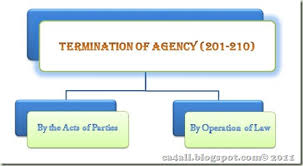
Agency may be terminated two ways –
1) By the Act of the Parties
2) By Operation of Law

1) By the act of the parties –
i) By agreement – The Contract of Agency can be terminated at any time by mutual agreement between the principal and agent.
ii) By revocation of the principal – The Principal revoke agency at any time by giving notice to the agent.
iii) By Renunciation of an agent – Renunciation which means withdrawing from responsibility as Agent. Like Principal, Agent can also renounce the agency. According to Section 206 of the Indian Contract Act 1872, the agent must give to his Principal reasonable notice of renunciation. Otherwise, he will be liable to make good for the damage caused to the principal for want of such notice.

2) By operation of law –
Agency can be terminated by operation of law-
i) By the completion of agency – Agency can become to an end after the completion of work for which the agency is created.
ii) By expiry of the time – Agency can also be terminated by the expiry of time. if the agency is created for the specific period, it is terminated after the expiry of the time.
iii) Death or insanity of principal or agent – Section 209 of the Indian Contract Act 1872 imposes an agent, duty to terminate the contract of agency on the death of the principal. In other words, Agency comes to an end on the death or insanity of the principal or agent.
iv) Insolvency of principal – According to Section 201 of the Indian Contract Act 1872, an insolvent or bankrupt is a person who is unable to run the business due to Excess of liabilities over assets. In this way, if the principal becomes an insolvent agency can be terminated.
v) Destruction of the subject matter – If this subject matter of the agency is destroyed agency comes to an end.
For example – Any agency is created for sale of an Airplane if the Airplane caught fire before the sale the agency comes to an end. In this contract Airplane is the subject matter.
vi) Principal becoming an alien enemy – If the Principal becomes an alien enemy the contract of agency comes to an end. vii) Dissolution of company or firm – A Firm or company may be regarded as a Principal in the contract of Agency. If the company or firm is dissolved the agency comes to an end.

Relationship between Principal agent and sub agent

Relationship between principal agent and sub-agent depends on the question whether the agent has an authority to appoint sub-agent and whether the sub-agent is properly appointed.
If then sub-agent is properly appointed:
1) The principal is bound by and responsible for the acts of a sub agent;
2) the agent is responsible to the principal for the acts of the sub-agent;
3) the sub agent is responsible for his acts to the agent, but not to the principal except in case of fraud or willful wrong.

It is of interest to observe clause (3) above. Sub-agent is responsible and accountable to the agent and not to the principal by clause (1). Principal is liable for acts of the sub-agent if he is properly appointed. Sub-agent is not responsible to the principal because there is no privity of contract between the principal and sub agent. It is case of fraud or willful wrong that the principal can proceed against the sub-agent. Principal can, however, against the agent for acts of a sub-agent. As far as the rights of a third party are concerned, he can enforce the wrongs of a sub-agent on the principal if the sub-agent is properly appointed. Principal is therefore liable for acts of the sub-agents if he is properly appointed.

If the sub-agent is not properly appointed: Where an agent has appointed a person to act as sub agent without having authority to do so, the principal shall not be deemed to be represented or responsible for the acts of the sub-agent so employed, nor is such a sub-agent responsible to the principal. The agent is responsible for the acts of such a sub- agent both to the principal and to third persons.

Sub-agent is said to be improperly appointed where agent delegates his powers without authority from the principal or where none of the circumstances stated above exist which necessitate appointment of a sub agent.

It will be observed that where a sub-agent is not properly appointed, the liability of agent is also towards third parties. As a rule, we have seen that an agent is responsible to the principal and it is the principal who is responsible for the acts of his agent to the third party. However, the section throws additional liability on the agent where he has improperly appointed a sub-agent. Agent stands liable to the third party for the acts of a sub-agent.

Termination of sub-agent’s authority: (Sec 210) Lastly it must be noted that the termination of the authority of an agent causes the termination of the authority of all sub-agents appointed by him

Liabilities of principal, agent and sub-agent: The agent is responsible to the principal for the acts of a sub-agent and the sub-agent is responsible for his acts to the agent but not the principal, except in cases of fraud and willful wrong.

Where an agent improperly appoints a sub-agent, the agent is responsible for his acts both to the principal and to third parties. The principal in such cases is not responsible for the acts of the sub-agent nor is the sub-agent responsible to the principal. But where a sub-agent is properly appointed, the principal as regards third person, is represented by the sub-agent, and is bound by and responsible for his acts, as if he were an agent originally appointed by the principal.

Where an agent under an express or implied authority has named another person to act for the principal, such a person is not a sub-agent, but an agent of the principal. There is no liability on the agent appointing him provided the agent so appointing exercises discretion as a man of ordinary prudence would exercise is his own case (Sec 194 & 195). Such an agent is called a substitute agent.


4 Most Sought After Fields in Germany

German education standards are pretty high. Germany is known for the quality of education it provides as well as its globally recognized qualifications. German universities are highly regarded worldwide, besides being among the highest-ranked in the world.

Planning to study in Germany? Here are the four most popular courses to study there!

Engineering

Every student in the world who wants to do Engineering, for them Germany is like a dream country, all of them wants to complete their Engineering in Germany.

Of course you saw this coming, didn’t you? if you didn’t, where do you think most of your luxury cars are made? Comprising nearly 25% of international students, it is one of most popular courses in Germany. Specializations include – Automobile, mechanical and electrical engineering amongst others. Technical University of Munich, RWTH Aachen University, Karlsruhe Institute of Technology, and the Technical University of Berlin are some of the most renowned universities for this course. 

It takes more or less than 4.5 or 5.5 years to complete your Engineering program in Germany including the time required for learning German and the foundation courses. According to recent statistics, Germany has the second highest number of Engineering workers among all employees in the EU. German Universities offers numerous scholarship opportunities for Engineering students, while studying Engineering in Germany you can research and collaborate with the Engineering Industry. If the student manages to secure a position in any of the public university, study in Germany is free for Indian students, just like students from other part of the world. Students just have to pay a nominal semester fee (around 250 to 500 Euros) per semester        

Humanities

Surprised to see this on the list? Well, Germany offers around 6000 courses in the field of humanities. With some of the best- ranked universities in the world for courses in the Humanities. more than 11,000 international students in Germany were seeking a degree in the humanities, in 2019 only.

A majority of the humanities degree programmes in Germany offer integrated modules which give students the opportunity to obtain the necessary practical skills, besides the theoretical ones. German universities make sure to provide students with both, theoretical and practical skills, in order to ensure that once these students graduate, they will be fully equipped to enter the job market with confidence. Humanities programmes will comprise of professionally related events, study semesters abroad, as well as research projects or internships so students understand exactly what they will encounter in the future, in their professions. Students can also choose from a variety of combinations, which further enhances the experience.  There are many best universities where you can purse your love for languages and the social sciences in Germany. Studying the humanities in Germany, in comparison to other countries, slightly more affordable.

Business and Finance

Boasting of one of the best economies in Europe, Germany is one of the best countries to earn a degree in Business and finance and gain practical knowledge. The strong German economy means a constant influx of educated workers – including many English speakers, who are highly sought in Frankfurt’s finance and business communities. The nation’s GDP has continued to grow in recent years. Economic freedom is partly responsible for why the city has become a seedbed for innovation and entrepreneurial initiative. According to Eurostat, amongst the 28 countries in the European Union more than 40% of all patents are held by Germany. Half of the cities in top-30 metropolitan areas for patents are in Germany.

Germany also has one of the lowest unemployment rates at just over 5%. Germany is a global leader in R & D investment that further assures access to top – notch training and resources.

Computer sciences and Mathematics

Due to Germany’s extremely advanced technology, disciplines intertwined with it are always in demand. Germany is an excellent place to work as a computer engineer, as it’s companies invest heavily in development and research, maintaining the country’s results as the biggest economy in Europe and the third in the world. In a 2015 OECD/PISA study, Germany ranked 16th in mathematics as well as in science.

In turn, the employability rate for careers related to these degrees is also extremely high. Once again, these aren’t restricted to these, one can explore course like Scientific computing, knowledge – Based Systems and robotics among other!

Give Data on Number of Deaths Due to Oxygen Shortage During 2nd Wave, Centre Tells States

The central government wrote to the states and sought data on the number of deaths that took place due to lack of oxygen during the second Covid-19 wave. The data will be collated and presented in Parliament before the monsoon session ends on August 13.

“We have been getting repeated questions on oxygen deaths in the parliament ” a govt official told CNN-News18.

Last week, responding to a question on the acute shortage of oxygen during the second wave of the pandemic, the Health Ministry had said in Rajya Sabha that “no deaths due to lack of oxygen have been specifically reported by States and Union Territories.”

Delhi Health Minister Satyendar Jain had then said that there have been several deaths because of oxygen shortage in Delhi and other places across the country.

The second wave had seen several private hospitals across the country, especially the national capital, take to twitter with SOS messages pointing out acute shortage of oxygen and demanding urgent help.

IMPORTANCE OF MOTIVATION IN ORGANIZATION

1) Improves Performance:

The ability to do the job and the willingness to do both work affect a person’s efficiency. The ability to do the job is achieved through the help of education and training and the determination to do the job is achieved through the help of motivation.

Determination is more important than ability. For example, a person is highly educated and employed for this reason. But it does not matter if you are doing an outstanding job.

He should be encouraged to do good work. This is only possible through

Motivation. Therefore, motivation improves efficiency. Efficiency of a

One is characterized by increased productivity and lower cost.

2) Helps to Change the Negative or Tired Opinion of Employees:

Some employees of the organization have a negative attitude. They always think that doing a lot of work will not bring honor. The counselor uses a variety of techniques to change this attitude.

3) Reduced Employee Benefit:

The dignity of an organization is affected by the benefit of employees. This creates a lot of problems for managers. A lot of time and money is wasted on recruiting staff and providing them with education and training.

The only motivation can save the organization from such damage. Motivated people work longer hours in the organization and there is a decline in profitability.

4) It leads to employee stability

Staff stability is very important from the point of view of dignity and interest in concern. Employees can remain honest in business only when they feel they have participated in management. The skills and efficiency of the staff will always be beneficial to both the staff and the employees. This will lead to a positive public image in the market which will attract talented and trained people. As the saying goes, “Creating enough gold” and the role of promotion here, people are older, more knowledge and their preparation has become a concern that can be useful in business.

From the above discussion, we can say that motivation is an inner feeling that only Mentor can understand since he is in close contact with the staff. Needs, wants and desires are related and are the driving force. These needs can be understood by the Counselor and he or she can arrange incentive programs accordingly. We can say that motivation is therefore an ongoing process because the motivation process is based on unlimited needs. The process should continue everywhere.

We can summarize that motivation is important for individuals and businesses. Motivation is important for each person as:

Motivation will help him achieve his goals.
If a person is motivated, he will have a job satisfaction.
Motivation will help in personal development.
One will always benefit by working with a strong team.
Similarly, inspiration is as important to a business as:

The more employees are motivated, the more powerful the team becomes.
What is more is team work and the provision of individual employees, a highly profitable and successful business.
During the amendment, there will be more flexibility and art.
Motivation will lead to a positive and challenging attitude at work.

5) Helps to Reduce Unemployment within the Organization:

In some organizations, the unemployment rate is high. There are many causes for this negative work environment, poor relationships with colleagues and management, anonymity in the organization, insufficient remuneration, etc. Mentor removes all such shortcomings and encourages employees. Motivational employees are not always absent from work as the workplace becomes a source of joy for them.

Stock Market

A stock market is a cluster of buyers and sellers of the stocks representing the ownership claims on businesses which may include securities listed on a public stock exchange, as well as stock that is only traded privately, such as shares of private companies which are sold to investors through equity crowdfunding platforms. Investment is done through  stockbrokerages and electronic trading platforms which is a computer software program that can be used to place orders for financial products over a network with a financial intermediary. Investment is usually made with an investment strategy in mind. A stockbroker is a person who is a registered trading representative.

The total market capitalization of equity backed securities worldwide rose from US$2.5 trillion in 1980 to US$68.65 trillion at the end of 2018. As of December 31, 2019, the total market capitalization of all stocks worldwide was approximately US$70.75 trillion. The largest stock exchange markets are US stock exchange, Japan stock exchange and UK stock exchange.

Many large companies have their stocks listed on a stock exchange. This makes the stock more liquid and thus more attractive to many investors. Large companies, mainly the multi national companies have there stocks listed in various stock exchange markets. Trade in stock markets means the transfer (in exchange for money) of a stock or security from a seller to a buyer. This requires these two parties to agree on a price. Equities (stocks or shares) confer an ownership interest in a particular company. Equity is ownership of assets that may have debts or other liabilities attached to them. Equity is measured for accounting purposes by subtracting liabilities from the value of the assets.

A potential buyer bids a specific price for a stock, and a potential seller asks a specific price for the same stock. Buying or selling at the Market means you will accept any ask price or bid price for the stock. When the bid and ask prices match, a sale takes place, on a first-come, first-served basis if there are multiple bidders at a given price. The stock exchange provides a safe marketplace facilitating the exchange of securities between buyers and sellers.

The Increasing Divorce Rate in India

In every relation there are some degree of conflicts involve which is very common in the stressful situation. Maximum couple faced a lot of split up after arrival of Covid-19 related to financial matters. The initial lockdown period started with all sort of creative things but with the passage of time it grown with increasing conflicts and misunderstanding between the couples. Covid-19 and lockdown had brought a massive disaster all over the world and had sown the seeds of increasing divorce rate worldwide. Divorce is always subjected as a taboo in our country where all the litigation and bulky process of inquiry is undesirable and this is the reason people usually avoid getting divorced in India.

It’s a sad reality that we human being had a tendency of adjusting and compromising with the situation and this are the foundation of maximum of Indian marriages. As the global outburst occurred it had directly affected on the personal space of the couple by shrinking them inside four walls of the house. In such adverse circumstances acceptance and compromising things becomes much more complicated. We all known that spending time together as well as  taking breaks make things sorted and better but due to this lockdown the burden of work increased for the working partner resulting in increasing fights and conflicts which ultimately ends up in split up of the couples. Females are the backbone of any family who are always found in the receiving end of the all the troubles faced by the family. With the arrival of lockdown period the financial, mental as well as health problems raised a lot being in stuck in such pathetic situation ultimately ends up with increasing bitterness among the family and gradually this bitterness finally leads to divorce of the couple. The increasing divorce rate in India is the clear indication of the growing strained relations. In a famous lawyer platform it was found that after the arrival of this lockdown period they got six to ten calls each day regarding divorce and 20% of divorce cases are increased as per records. But before the arrival of this outbreak of corona there were other factors too which are the root cause of divorce between the couples. They are:

  • Absence of Commitment
  • Increasing Argument between the Family
  • Marriage at Young Age
  • Lack of Equality
  • Increasing Abuse and Agony

  Love is something very pure but also dynamic in nature and because of increasing fights and misunderstanding people decides to end up the relation by giving divorce. Commitment and trust plus respect are the base of any relationship. Abuse and violence are the major reason of ending up of a relationship. Many a time the reason of getting divorce is addiction which is in the form of alcohol, drugs, gambling and even pornography. In some cases these obsession are maintained and the marriage can be repaired but in most of the cases the outcome is negative only. India is a country for love thus we all should learn to spread positivity and managing our relationships.

Is work from home approach the best for the environment?

This pandemic has forced us to switch onto the online mode of work, since going to office is a near impossible task during these difficult times. Most of the corporate offices have adapted to the WFH trend. But the major question arises is the environment benefited from this choice.

For the roughly 20% to 40% of employees who can work from home, many companies are announcing that post-pandemic work won’t necessarily take place at work – at least not five days a week. Microsoft, Spotify, Salesforce, Google, Facebook, Nationwide insurance, Capital One and Citigroup, among others, have embraced hybrid configurations combining remote work and time in the office. There soon could be four times as many people working from home as did pre-Covid.

Shopify’s CEO declared in May of last year that remote work would become a permanent fixture. Accounting for the energy consumption of its nearly 6,000 employees working from home in 2020, Shopify’s emissions dropped 29%, according to Kauk. But “last year isn’t typical remote work,” she said. “It’s remote work during Covid.” What happens when the world opens back up?

Kauk posed the dilemma to Watershed, a software outfit that helps companies track and reduce their carbon footprints.

When workers’ homes become their offices, commutes may fall out of the carbon equation, but what’s happening inside those homes must be added in. How much energy is being used to run the air conditioner or heater? Is that energy coming from clean sources? In some parts of the country during lockdown, average home electricity consumption rose more than 20% on weekdays, according to the International Energy Agency. IEA’s analysis suggests workers who use public transport or drive less than four miles each way could actually increase their total emissions by working from home.

Digital Literacy

 In the times of increasing dependency on digital technology, digital literacy plays a vital role for learning or working in this virtual world. Digital literacy refers to the skills and knowledge to access and use the digital technology responsibly.It is also called the survival skill in this digital world. 

It does not only mean the knowledge to use digital platforms, it also includes other skills such as critical thinking, practical and functional skills, efficient communication, curating information, collaboration, creativity, E-safety, cultural and social understanding, required while operating a digital platform. Digital literacy is extremely important to overcome the obstacles while learning or working in the digital era. 

It does not refer to just a technical know-how or the ability to read content online. It includes the understanding of basic rules, social practices and ethics while using cyberspace. The digital world is filled with information on various topics. It becomes imperative to know how to access and consume credible information. Awareness about the fact that every piece of information received online may not be true is extremely important. 

Most of the content online is shareable. Therefore it is important to check the credibility of the information and know the impact that the shared information can have on others. The content is also searchable. So it is important to know how to search for relevant information. Not every information we see online may be the latest one, its relevance needs to be checked before consuming or sharing it further. 

The cyberspace is interconnected with each other, people can connect here easily. Digital communication is always two-way.  Most of the content has the option to receive feedback. So it is an important aspect of digital literacy to learn effective communication skills for the digital platform. Communication can be both formal or informal in cyberspace. Nowadays, a number of career options require online collaboration and digital communication skills. 

The online behaviour of users also plays an important role. Often people do not realise the consequence of their actions online and take their digital presence for granted. Digital literacy makes people aware to make a safe cyberspace and avoid cyber bullying, abuse and harassment. It is crucial to know about the basic internet safety measures like setting a strong password, maintaining password secrecy, privacy settings in social media, reporting fake accounts etc. 

Digital literacy is being promoted in educational institutions so that the students can find and consume accurate information. The students can access diverse learning content from the digital space, especially from the facilities like the digital library. 

In this constantly changing world of technology, Digital Literacy is a lifelong learning process. The basic knowledge of functioning digitally and constantly learning about the latest updates and features of cyberspace has become essential in today’s world. 

Neighbourhoods

 The term neighborhood is often used to describe the sub divisions of urban or rural settlements. In its purest definition, a neighborhood is the vicinity in which people live. Neighbourhood unit idea was proposed by Clarence Perry in 1929. Neighborhoods have some particular physical or social characteristics that distinguish them from the rest of the settlement. The clustering of these neighborhoods has formed towns, villages, and cities. The Neighbourhood unit plan in brief is the effort to create a residential neighbourhood to meet the needs of family life in a unit related to the larger whole but possessing a distinct entity. 

Perry described the neighborhood unit as that populated area which would require and support an elementary school with an enrolment of between 1,000 and 1,200 pupils. This would mean a population of between 5,000 and 6,000 people. Developed as a low density dwelling district with a population of 10 families per acre, the neighborhood unit would occupy about 160 acres and have a shape which would render it unnecessary for any child to walk a distance of more than one-quarter mile to school. 

About 10% of the area would be allocated to recreation, and through traffic arteries would be confined to the surrounding streets, internal streets being limited to service access for residents of the neighborhood. The unit would be served by shopping facilities, churches, library and a community center, the latter being located in conjunction with the school. Perry outlined six basic principles of good neighborhood design. As may be understood, these core principles were organized around several institutional, social and physical design ideals. 

  1. Major arterials and through traffic routes should not pass through residential neighborhoods. Instead these streets should provide boundaries of the neighborhood 
  2. Interior street patterns should be designed and constructed through use of cul-de-sacs, curved layout and light duty surfacing so as to encourage a quiet, safe and low volume traffic movement and preservation of the residential atmosphere 
  3. The population of the neighborhood should be that which is required to support its elementary school 
  4. The neighborhood focal point should be the elementary school centrally located on a common or green, along with other institutions that have service areas coincident with the neighborhood boundaries 
  5. The radius of the neighborhood should be a maximum of one quarter mile thus precluding a walk of more than that distance for any elementary school child 
  6. Shopping districts should be sited at the edge of neighborhoods preferably at major street intersections.
Neighbourhood unit

Principles of Neighbourhood Planning 

1) Size 

The town is divided into selfcontained units or sectors of 10,000 populations. This is further divided into smaller units called neighbourhood unit with 2,000 to 5,000 based on the requirement of one primary school. The size of the unit is therefore limited to about 1 to 1.5 sq km i.e. within walkable distance of 10 to 15 minutes. 

2) Boundaries 

The unit should be bounded on all its sides by main road, wide enough for traffic. 

3) Protective Strips 

These are necessary to protect the neighbourhood from annoyance of traffic and to provide suitable facilities for developing parks, playgrounds and road widening scheme in future. These are also called Minor Green Belts. 

4) Internal Streets 

The internal streets are designed to ensure safety to the people and the school going children in particular, since the mothers are anxious every day till the safe return of the child. The internal streets should circulate throughout the unit with easy access to shops and community centres. 

5) Layout of Buildings 

To encourage neighbourhood relation and secure social stability and balance, houses to suit the different income group should be provided such as single family houses, double family houses, cottages, flats, etc. 

6) Shopping Centres 

Each shop should be located on the circumference of the unit, preferably at traffic junctions and adjacent to the neighbourhood units. 

7) Community Centres 

Each community will have its centre with social, cultural and recreational amenities. 

8) Facilities 

All public facilities required for the family for their comfort and convenience should be within easy reach. These include the primary school, temple, club, retail shop, sport centre, etc. These should be located within 1km in the central place so as to form a nucleus to develop social life of the unit.

Neighborhood in the Contemporary Urban Context 

The concept of neighborhood unit in traditional built environments and rural settlements constituted a strong sense of attachment, identity, admittance and belonging for inhabitants. Neighborhood feeling in contemporary urban environments is less dependent on the sharing of common close physical residential environment. Impacts of urbanization, rise of mass society, modernization, improved inter connectivity and the consequent increased socio-spatial mobility in the neighborhood has been highly destructive. Increasing mobility and transportation facilities have opened up new possibilities, thereby disregarding the benefits expected of a neighborhood. 
Remote activities and changed lifestyles of dwelling occupants thus become the basic factors that shape the social environment. This issue causes segregation of the social environment from the immediate physical environment. Most of the current housing approaches concentrate on the physical attributes of single dwelling units and exclude the fact that the dwelling units rarely stand alone in a given physical space. The high-rise settlement blocks with inadequately planned physical environment characterize most of the contemporary developments. This however does not diminish the importance of the neighborhood unit.

e-RUPI – To Revolutionise Indian Digital payment system in India

The Indian government has launched an electronic voucher based digital payment system e-RUPI.

What is e-Rupi ?

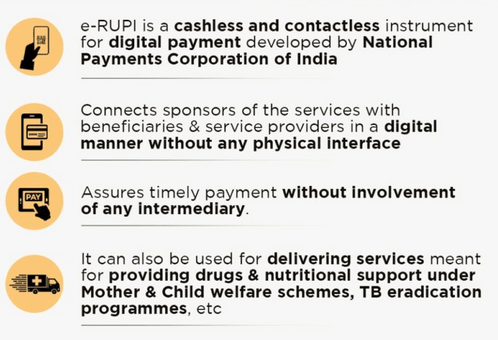
  • It is a cashless and contactless method for digital payment. It is a Quick Response (QR) code or SMS string-based e-voucher, which is delivered to the mobile of the users.
  • The users will be able to redeem the voucher without needing a card, digital payments app, or internet banking access, at the service provider.
  • It connects the sponsors of the services with the beneficiaries and service providers in a digital mode without any physical interface.
  • The mechanism also ensures that the payment to the service provider is made only after the transaction is completed.
  • The system is pre-paid in nature and hence, assures timely payment to the service provider without the involvement of any intermediary.

How is it different from Digital Currency?

e-RUPI is backed by the existing Indian rupee as the underlying asset and specificity of its purpose makes it different to a virtual currency and puts it closer to a voucher-based payment system.

Issuing Entities & Beneficiary Identification

  • The one-time payment mechanism has been developed by the National Payments Corporation of India on its Unified Payments Interface (UPI) platform, in collaboration with the Department of Financial Services, Ministry of Health & Family Welfare, and National Health Authority.
  • It has boarded banks that will be the issuing entities. Any corporate or government agency will have to approach the partner banks, which are both private and public-sector lenders, with the details of specific persons and the purpose for which payments have to be made.
  • The beneficiaries will be identified using their mobile number and a voucher allocated by a bank to the service provider in the name of a given person would only be delivered to that person.

What are its uses?

For the Government

It is expected to ensure a leak-proof delivery of welfare services and can also be used for delivering services under schemes meant for providing drugs and nutritional support under Mother and Child welfare schemes, drugs & diagnostics under schemes like Ayushman Bharat Pradhan Mantri Jan Arogya Yojana, fertiliser subsidies etc.

For the Private entities

Even the private sector can leverage these digital vouchers as part of their employee welfare and Corporate Social Responsibility (CSR) programmes.

What is the significance of e-Rupi?

The government is already working on developing a Central Bank Digital Currency and the launch of e-RUPI could potentially highlight the gaps in digital payments infrastructure that will be necessary for the success of the future digital currency.

Will this workout for India?

According to the Reserve Bank of India (RBI), there are at least four reasons why digital currencies are expected to do well in India

  • Increasing Penetration: There is increasing penetration of digital payments in the country that exists alongside sustained interest in cash usage, especially for small value transactions.
  • High Currency to GDP Ratio: India’s high currency to Gross Domestic Product (GDP) ratio holds out another benefit of CBDCs.
    • Cash-to-GDP Ratio or Currency in Circulation (CIC) to GDP Ratio or simply currency-to-GDP ratio shows the value of cash in circulation as a ratio of GDP.
  • Spread of Virtual Currencies: The spread of private virtual currencies such as Bitcoin and Ethereum may be yet another reason why CBDCs become important from the point of view of the central bank.
  • Will Act as a Cushion: Central bank digital currencies might also cushion the general public in an environment of volatile private virtual currencies.

Programming language

 Programming language is a language to write programs like c, c++,java etc 

It is a language to convert assembly code into machine code ..

Every programming language is great in its own and have vast libraries functionalities

Love

 Love is a great thing which everybody want in his or her life .love make us strong and mentally fit . Love doesn’t require anything in advance ,it  can only be gain independently. 

Love helps to build trust and boost image