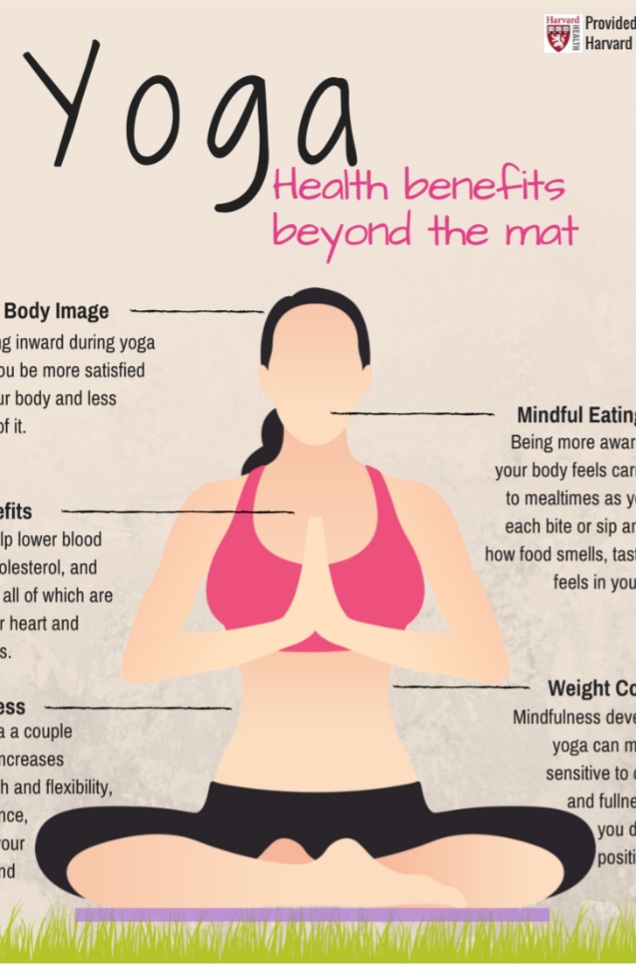
Yoga is also equally important to be mentally calm. Practicing 15 minutes of yoga is so beneficial. All the asanas helps to get stronger muscles with the fitter body and good lifestyle with mental calmness. Yoga relives from the stress and tension we have had. Sparing at least 10 to 15 minutes time on yoga benefit is a lot. It relaxes the muscle and calms the mind. It helps to be physically fit and mentally strong. All the asanas and pranayama helps to Gain strength and to be physically fit.
It helps to be fitter and healthier. It helps to have a healthy lifestyle. Exercise helps to have healthy muscles and it also helps in weight loss who is suffering from obesity and excessive weight. Exercise is the healthy habit that must be added in the healthy lifestyle and must be practiced without any delay.
Exercising, meditation, yoga etc. are great things to regain the strength and to be fitter and also happy.
Types of yoga :
Bhakti yoga :
Bhakti yoga, also called Bhakti marga, is a spiritual path or spiritual practice within Hinduism focused on loving devotion towards any personal deity. It is one of the three paths in Hinduism which lead to moksha, the other paths being jnana yoga and karma yoga.The tradition has ancient roots.
The purpose of bhakti yoga is the practitioners of Bhakti yoga ,known as bhaktas, or loving devotees, express their religious devotion through prayer, ritual, and chanting. Their purpose is to develop feelings of unconditional love and devotion
Karma yoga :
Karma yoga, also called karma marga, is one of the three spiritual paths in Hinduism, one based on the “yoga of action”, the others being jnana yoga and Bakti yoga.
Patanjali Ashtanga yoga :
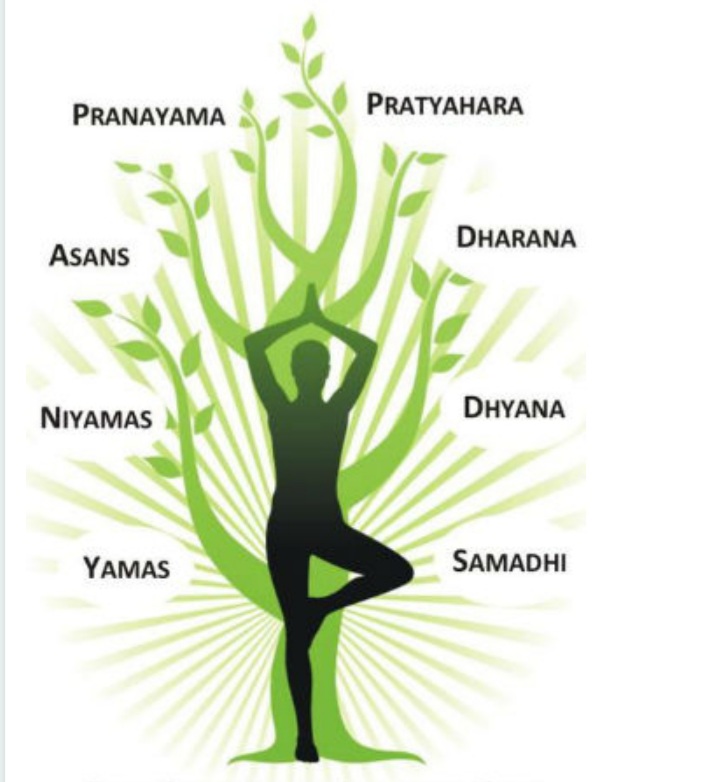
The eight limbs of of yoga is patanjali’s classification of classical yoga, as set out in his yoga sutras. He defined the eight limbs as yamas (abstinences), niyama ( observances), asana ( postures), pranayama (breathing) , pratyahara ( withdrawal), dharana ( concentration), dhyana (meditation), and samadhi( absorption).
The eight limbs form a sequence from the outer to the inner. Postures, important, in modern yoga as exercise, form one limb of patanjalis scheme; he states only that they must be steady and comfortable.
Jnana yoga :
Jnana yoga , also known as jnana marga, is one of the three spiritual paths in Hinduism, which emphasizes the ” path of knowledge”, also known as the ” path of self- realization”. It is one of the three classical paths for moksha. The other two are karma yoga and bhakti yoga.
Swara yoga :
Swara yoga is an ancinet tantric science which involves the systematic study of the breath flow thriugh the nostrils irrelation to the prevalling phases of the moon,time of day and direction. Mainly practiced through the connection of breath and movement, swara yoga creates levels of harmoney that are difficult to reach with other yoga styles. Our main tool is the movement and flow of body through the postures, guided by the breath.
Raja yoga :
In sanskrit, Raja yoga was both the goal of yoga and a method to attain it. The term also became a modern name for the practice of yoga in the 19th century when swami vivekananda gave his interpretation of the yoga sutras of patanjali in his book raja yoga
Kriya yoga :
Kriya yoga is a simple, psycho – physiological method by which the human blood is decarbonized and recharged with oxygen. The atmos of this extra oxygen are transmuted into life current to rejuvenate the brain and spinal centers.
Advanatges of yoga :
* yoga improves strength, balance and flexibility.
We all have trouble concentrating in our lives. Many of us have to sit and study/work for hours on end, especially after the COVID-19 pandemic which locked everyone inside their homes. However, most of us find it very hard to concentrate very long on our work or studies, and we lose focus or start procrastinating after a short while. The result of this is that we complete minimal work, and end up being unproductive for most of the day because of our loss of concentration. However, there is one simple method, called the Pomodoro Technique, which helps improve productivity and focus.
What is it?
The Pomodoro method is very simple. It requires you to work/study for 25 minutes, and then take a 5-minute break. The reason this method works is also simple: evolutionary biology. The human brain is not designed to focus for extended periods of time on singular task, and is made to consider many different things in our lives. This is a result of survival instincts that have developed within us. To protect us from looming threats, the brain is in a constant state of alertness. This makes focusing on one thing for a long time very hard for your brain. So, adhering to this basic instinct, the Pomodoro method makes it possible for us to work in short bursts of time with full concentration, and then take a few minutes to relax or focus on something else so as to not tire ourselves out. This can be repeated for hours on end and helps retain focus, especially if studying for an exam or completing some work.
Also, this technique has been known to increase the quality of your work. When you take a break, you force yourself to take a few seconds to revaluate and rethink certain things. Sometimes, you find that you have to adjust your work to increase the quality of it. In contrast, when you work on a task without a break, it is easy to lose focus and get lost in the work. That is why the 5-minute breaks are equally important as the 25 minutes of work. You must take your breaks seriously and see them as a reward.
What makes it effective?
It makes it easy to get your work started: We may often find it uncomfortable to start a big task or project, and try to avoid doing it as much as possible until the last minute. The most effective way to break out of this avoidance cycle is to just simply start the work, even if it is with a small step. This procrastination-busting strategy is exactly what the Pomodoro technique asks you to do: break down your big tasks or projects into something you only have to do for the next 25 minutes.
Helps combat distractions: As mentioned earlier, it very easy to get distracted while doing your work and most of us can’t focus on the task at hand for long periods of time continuously. The Pomodoro Technique helps you resist all of those self-interruptions and re-train your brains to focus.
Makes us more aware of time: When most of us are planning out our work, we usually underestimate the time needed to complete the tasks, even when we know similar tasks have taken longer in the past. The Pomodoro technique can be a valuable weapon against this problem, as working in short, timed sessions is not an abstract concept but a concrete event that helps keep track of the time.
It is easy to do: The Pomodoro technique is an accessible technique for everyone as it is more about consistency than perfection. Each session is a fresh start to revaluate your goals, challenge yourself to focus, and limit distractions. You can make the system work for you.
Hence, in case you are having trouble with staying focused and productive, give the Pomodoro technique a try to see if it helps you, just as it as helps so many people.
It is a well-known fact that a person without an aim is a person without a life. All the creatures in this universe have one or other specific aim. It is common for all things. As the human is the best creature among them all, he has given a right to select that what he wants to do in his life. The mindset of each and every person is of its own type. Therefore, his aim of life will also be different from others.
Importance of aim in life
There is a popular saying that a man without an aim is like an aim without a rudder. It means a ship without rudder faces danger. Thus similarly a man without aim cannot reach towards his goal of life. He stumbles in his way of life.
So every person must have a definite aim. So, the aim of life is to give your life a purpose and a meaning. Certainly, it is done by finding out what truly matters to you. Your purpose is to create more joy in life or to show others how you can live your life in the best possible manner.
How to Choose the right Aim of life?
It is the responsibility of the parents and the teachers to persuade their wards to select a profession according to their aptitude. Thus one can say that the right aim means right life and the wrong aim means wrong life. So, we should be very cautious while deciding on our aim.
Certainly, this is the most difficult problem that a young man faces is the selection of a profession. If a person does not choose his aim rightly, he will be always misfitted in his life. Thus, the best aim would be for one in which one feels happy always and he can do something worthwhile. Also at the same time, he assures about bright prospects in life.
Everyone should set a goal which is personal to him and will always inspire to reach new heights. Therefore, don’t follow the mob and mimic the ambitions of friends.
Conclusion:
Thus it is a fact that setting an aim and acting to achieve it is very important for a successful life. Everyone must start working towards it. Timely execution of an action plan with a proactive attitude is the key to success. One of the best ways to stay motivated is by visualizing the change and likewise by achieving step by step milestones.
Technical skills are the abilities and knowledge needed to perform specific tasks. They are practical, and often relate to mechanical, information technology, mathematical, or scientific tasks. Some examples include knowledge of programming languages, design programs, mechanical equipment, or tools.
Some of the very famous tech. Skills:
1. Project Management. Being able to effectively coordinate resources, people and budgets as a project manager is one of the best technical skills that you can have. 2. Analysis of Big Data and Business 3.Intelligence. 4. Information Security. 5. Designer. 6. Marketing Assistant. 7. Writer. And many more…
Create a dedicated Technical Skills section for the resume.
If they’re heavily emphasized in the job description, then your Technical Skills section should be at the top of your resume, just below your introduction, and above your professional experience. A bulleted list will make it easy to read.
These are some of the basic tech. Skills:
* Word Processing Skills. * Spreadsheets Skills. * Database Skills. * Electronic Presentation Skills. * Web Navigation Skills. * Web Site Design Skills. * E-Mail Management Skills. * Digital Cameras
How can you improve your technical skills? So, here are the steps to improves ones technical skill.
1. Enroll in Technical Classes or Workshops. 2. Get Technical Books. 3. Volunteer for Technical Projects. 4. Subscribe to Technical Sites and Magazines. 5. Develop Knowledge of a Second Language. 6. Practice What You Learned.
Before directly going into the SEO techniques I would like to make you understand about the concept of digital marketing easily with a simple example that we encounter in our daily routine. ” Most of us use Gmail almost everyday for various purposes. When ever we open our Gmail we observe different sections holding different mails in it especially when we open “Promotions” section in our mail box, we used to see different mails from various websites which are offering discounts on their products or courses.” These mails are the strategic implementations of the websites in order to increase their marketing on the internet to get profits. This type promotions in Gmail sections leave a foot print of ” DIGITAL MARKETING”.
DIGITAL MARKETING:
Digital marketing is a platform that is widely used for marketing with help internet connected devices. It uses latest digital technologies to reach people. Now a days digital marketing is crucial for the entrepreneurs to share their idea, promote their products and build their audience.
SEARCH ENGINE OPTIMIZATION(SEO):
When we search for a content through search engines like google, then that particular search engine shows a random websites for our search as an answer. This random gathering of information by search engines is possible with the help of search engine optimization which helps search engines to show the best available content for the given query.
SEO is an effective way to improve the rank of websites in search engines in order to increase the visibility of websites. SEO is a technique to optimize the website with the suitable key words. Let’s see some latest SEO hacks to improve the ranking of page which helps in increasing your websites market.
LATEST TRENDS OF SEO:
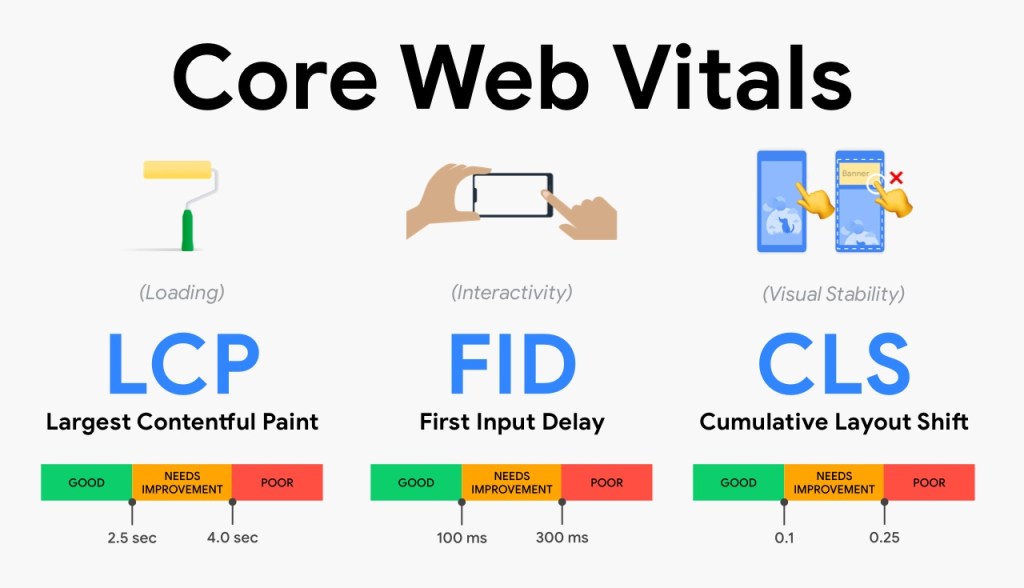
UNDERSTAND CORE WEB VITALS OF THE SITE: Google has recently announced that core web vitals will become the new ranking signals by combining previous UX related signals also. Core web vitals is a new term that haven’t heard in previous years but it plays a crucial role in 2021 because google has developed a new algorithm to measure the page experience based on the score off core web vitals.
To make you understand better, core web vitals are the measurement capabilities of the content in a website. These measurements are depended upon page speed, page responsiveness and page visual stability which are known as LCP(Largest contentful paint), FID(First input delay), CLS(Cumulative layout shift). These measurement speeds are shown in the following picture.
AI PLAYS A LARGE ROLE IN SEO: AI is changing the interaction methods of people with online content. Google has unveiled an algorithm a few years back which is called as “RankBrain”. This algorithm paly’s a crucial role in ranking the pages with the help of “SERP’s ” results. Experts believe that user experience signals are the primary for ranking the page, so by using this algorithm search engine like google can easily captivate the rate of time that has spent on the website by readers which gives the better feedback on the content quality of website.
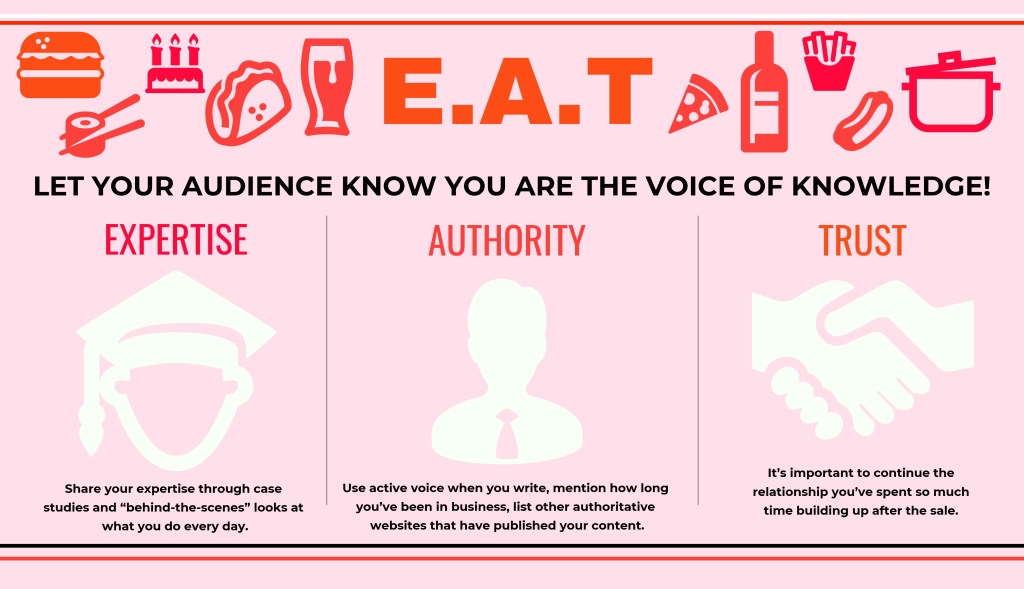
USE “EAT” PRINCIPLE: EAT principle helps website optimizer to master a long term SEO success, despite of Google’s constantly changing algorithms. EAT stands for Expertise, Authority and Trustworthiness. These three principles are essential to measure the brand of websites on the web. In order to establish your brand’s authority, trustworthiness and reputation then you have to follow these rules:
Try to engage with customers in a better way and request them to provide reviews and feed back to your work.
Try to insert high quality links in you site.
Follow EAT principles on your website through testimonials, case studies and other forms of social proof.
Along with the above discussed principles we should also follow the below stated tips to improve the traffic to your website:
Create new content and try to update the old.
Give first priority to the user experience.
Improve featured snippets to make your content more prominent.
Improve mobile friendly content to improve search rankings.
Support long tail key words and optimize the images that you place in your content and don’t forget to keep effective back links on your site.
Finally, The content designers of websites should keep in mind that , Relevant & Optimized content wins every time in the ranking of page on search engines and also the core of SEO is about figuring out what works for the site or client and then changing it when it stops working. Always keep a close eye on your competitors and follow the best practices to thrive best in marketing.
Move towards the stage with energy and enthusiasm and deeply breath for few seconds. Look towards your audience straight in the eyes, and begin to talk as confidently as if every one of them owed you money. Imagine that they do. Acting confidently will help you gain some confidence and its better than talking nervously.
2. CHOOSE YOUR TOPIC WISELY
Your topic is the major factor of the success of your talk. Choose that topic which you feel most earnest and enthusiastic about, because if you feel confidently about your topic then only you can deliver a good speech. For example I like sports and book and I will talk about them.
3. INCLUDE YOUR AUDIENCE
Make the audience a part of your speech, because then only they will attentively listen to you and will eagerly wait for what you have to say. And the best way to do that is by asking simple question that the audience can easily answer.
4. FIRST SPEAK TO YOUR FRIENDS
Before speaking directly to audience, rehearse that topic by actually speaking in front of someone like your friend or your family member. This will help you to become more confident about your topic and also it will help to learn what you have missed in your talk through your friend.
Since its founding in 1949, Public Administration and Development (PAD) has been reviewing and assessing the practice of public administration at the local, regional, national and international levels where it is directed to managing development processes in low and medium income countries.
The role of public administration in bringing about development?
On the role of public administration, it will address such areas as sustained economic growth, the promotion of social development, facilitating infrastructure development and protecting the environment, promoting public- private partnerships, managing development programmes and maintaining a legal framework for
ROLE OF PUBLIC ADMINISTRATION IN DEVELOPMENT TO BE CONSIDERED AT RESUMED GENERAL ASSEMBLY SESSION 15-19 APRIL
19960412 Background Release The crucial role of public administration in development, particularly in developing countries and economies in transition, will be the subject of a one-week resumed session of the General Assembly, beginning on Monday, 15 April. The resumed session represents the first time the Assembly will meet specifically to consider that issue.
The aim of the resumed session of the General Assembly is to explore themes contained in two distinct categories: the role of public administration, and capacity-building for effective administration. Thirteen specific topics were identified within those categories.
On the role of public administration, it will address such areas as sustained economic growth, the promotion of social development, facilitating infrastructure development and protecting the environment, promoting public- private partnerships, managing development programmes and maintaining a legal framework for development.
With respect to capacity-building, the Assembly will discuss improving civil service systems, organizational strengthening, the enhancement of policy-development capacity, strengthening financial management for development, human resource development for the public sector and the development of administrative capacities for post-conflict and crisis conditions.
In deciding to hold the resumed session, the Assembly recognized the important role that governments and public administrations can play in promoting sustained economic growth and sustainable development (resolution 49/136). It also recognized the need for strengthened public administrative and financial management capacities in order to ensure a civil service that is responsive to the needs of the people.
As a stimulant to its discussion, the Assembly will have before it a report of the Secretary-General containing a series of recommendations on strengthening the role of the United Nations in public administration and development, including recommendations for national governments (document A/50/847-E/1996/7).
Recommendations in Secretary-General’s Report
The report of the Secretary-General contains recommendations on the role of policy-making for public administration and development, the focus of the United Nations programme on that subject, the coordination of relevant activities within the United Nations system and support of donors. It also includes recommendations for national governments and United Nations responses.
On the role of policy-making, the Secretary-General recommends that the issue of public administration and development be included as a regular item on the agenda of the General Assembly and the Economic and Social Council and that the Group of Experts on Public Administration and Finance be redesignated the Committee on Public Administration and Development, which would report to the Council. Likewise, the United Nations programme in public administration and finance should be renamed the United Nations programme in public administration and development.
The United Nations programme in public administration and development should enhance its role as the central depository for materials, reports and non-print media on public administration and development worldwide, the report recommends. Using the latest technology, it should become the clearing-house for all materials on the subject, to serve as a catalyst for a network of international, regional and national institutions and organizations involved in those issues. The programme’s focus should be on action-oriented, practical research on effective systems and procedures in public adminstration.
Tied to its research and clearing-house functions is the assistance the United Nations can provide to individual governments, at their request, in helping them improve their governmental machinery and public management systems for development. To that end, the United Nations programme should be strengthened in the areas of advisory services, needs assessment, diagnostics and substantive support to projects. It is recommended that the United Nations assist governments, when requested, in translating the recommendations of global conferences into detailed programmes for implementation.
The report recommends that the United Nations programme assist in all the phases of the restoration of public administration institutions in countries recovering from conflict and crises, and that it actively assist developing countries and countries with economies in transition.
On coordination of public administration and development activities within the United Nations system, the Secretary-General recommends that a consultative group on the matter will meet once a year, under the auspices of the Department for Development Support and Management Services. It will focus on closer collaboration in the planning and implementation of global
– 3 – Press Release GA/9056 12 April 1996
programmes of information exchange, research, preparation of guidelines, and organizations of seminars and workshops. It will also provide a forum for mobilizing international assistance.
With regard to donor issues, the report recommends that the donor community recognize the significance of public administration in development and provide adequate resources to improve such structures in developing countries and those with economies in transition. Particular consideration should be given to the loan of expertise to carry out practical research and advisory missions. To that end, the Secretary-General recommends the establishment of a trust fund for United Nations activities in public administration and development.
The Secretary-General highlights a number of recommendations for governments made by the Group of Experts on Public Administration and Finance, which held its twelfth meeting from 31 July to 11 August 1995. Following each recommendation is a projected United Nations response (document A/50/525- E/1995/122, annex).
The Group states that national governments should strengthen the policy, advisory and administrative capacity in critical areas, while the United Nations programme can organize professional exchanges, arrange professional training programmes and prepare case studies on policy matters for dissemination.
According to the Group, in the process of restructuring public administration, government institutions should be encouraged to develop strategic plans and monitor their performance, while the United Nations would continue to undertake comparative studies on restructuring and disseminate them on a regular basis.
Leaders should invest in people, upgrading the capacity of national training institutions to develop a core group of professional trainers, the report states. The United Nations would seek to create and sustain momentum for a global exchange of information on human resource development.
Governments are asked to establish clear goals, encourage operational flexibility, measure results impartially and develop appropriate incentives, while the United Nations would continue offering advisory services in areas including the management of change, performance management and measurement, and information technology.
Public administration services should be provided to reflect ever- changing needs of the citizens they serve, the Group states. The United Nations can assist in developing state-of-the-art technological communication networks.
– 4 – Press Release GA/9056 12 April 1996
Furthermore, governments should encourage financial management at the grass-roots level, the Group states. For its part, the United Nations would assist governments in creating and strengthening national capacities in fiscal policy analysis and economic management, and in promoting a proper environment for capital flows for investment, private sector development, transparency and accountability.
According to the Group, governments should seek objective evaluations of their privatization programmes to establish the appropriate place and timing of privatization in structural adjustment programmes; they should also pay greater attention to performance improvement in parastatals. For its part, the United Nations shall, at the request of the government, arrange for such evaluations, assisting governments in defining the role and scope of their public, private and combined sectors.
While governments should provide an encouraging environment for small and medium-sized enterprises, the report states, the United Nations would assist countries by operating an information clearing-house, developing case studies of successes and failures and providing technical support.
National governments should assume the responsibility for establishing environmental standards for all infrastructure policies, the Group states. The United Nations would assist governments in administrative capacity- building and infrastructure management. Codification of laws must be undertaken to facilitate access to legal guarantees, with the United Nations assisting governments to organize a legal framework of public administration and strengthen judicial supervision of public administration.
For countries recovering from crisis and conflict, the development of both immediate and transitional or long-term strategies is recommended. The United Nations would provide special assistance to countries in post-conflict situations and to collapsed States, to help restore effective public administration.
Governments should promote the use of aid as a stimulant for development and economic growth in civil society, the Group states. The United Nations would provide technical assistance to strengthen institutional machinery capable of evaluating the consistency between development project outcomes and such macro-objectives as growth, employment and income distribution.
Related Meetings, Activities
A number of activities are also being carried out in connection with the resumed session. Among these, Cabinet ministers and other high-ranking officials from each of the major regions will hold an executive session to discuss their experiences in restructuring governments. An International Technical Forum was held on 11 and 12 April at Headquarters, the site of a
– 5 – Press Release GA/9056 12 April 1996
related Internet Exposition until 19 April. (For more information, see Note to Correspondents No. 5329, of 10 April.)
In the lead-up to the resumed session, regional meetings were held in Africa, Asia, Latin America and the Caribbean, and Central and Eastern Europe. The impetus for the session arose from the June 1994 Tangier Declaration of the Pan-African Conference of Ministers of the Civil Service, which called for the convening of a global conference on public administration and development.
Dou you like sports? Sports are the act as a very much key role in our daily life. If you play the sports in daily it can improves our mental stability and physical stability.
Cricket
Cricket is the most famous game in the world compared to the others game.
History Of cricket
The history of cricket to 1725 traces the sports development from its perceived origine to the stage where it become a major sport in England and had been introduced to the other countries. The Earliest definite reference to cricket course in 1598 and makes clear that the sport was being placed c. 1550, but it true origin is mystery.
Concept and rules of cricket
Concept
Cricket is played with two teams of 11 players each. Each team takes turns batting and playing the field, as in baseball. In cricket, the batter is a batsman and the pitcher is a bowler. The bowler tries to knock down the bail of the wicket. A batsman tries to prevent the bowler from hitting the wicket by hitting the ball. Two batsmen are on the pitch at the same time.
Scoring
The batters can run after the ball is hit. A run is scored each time they change places on the pitch. The team with the highest number of runs (typically in the hundreds) wins the match.
6 runs: A ball hit out of the field on a fly.
4 runs: A ball hit out of the field on a bounce.
Outs
Bowled out: Bowler knocks over (breaks) the wicket with a bowl.
Caught out: Fielder catches a batted ball on the fly
Run out: Fielder catches ground ball and throws it at the wicket, knocking it down before the batsman gets there.
Leg before wicket: Batsman’s body interferes with a bowled ball that would hit the wicket
Rules
Cricket is played between two teams each made up of eleven players. (Sometime in junior competitions you will find 8 player teams).
Games comprise of at least one innings where each team will take turns in batting and fielding/bowling.
The fielding team will have a bowler bowl the ball to the batsman who tries to hit the ball with their bat.
The fielding team tries to get the batsmen out by…
Hitting the wickets with the ball when bowling
Catching a batsman’s shot on the full
Hitting the batsman’s leg in front of the wicket (LBW)
Or hitting the wickets before the batsmen can run to the other end of the pitch
The batmen try to score as many runs as possible before getting out by…
Hitting the ball and running between the wickets and making it to the other end before the fielders can hit the wickets with the ball. Each time you run one full length of the pitch it equals 1 run.
Hitting the ball to the boundary along the ground is 4 runs.
Hitting the ball over the boundary on the full equals 6 runs.
The fielding team must get 10 batsmen out before they can change over and start batting.
The aim of the game is to score as many runs as possible before the fielding team takes 10 wickets. The team with the most runs wins.
Important of cricket
As well as physical health benefits, cricket can also bring other benefits and opportunities such as: Team skills. Social skills such as cooperation, communication and learning how to cope with winning and losing. Social interaction – it’s a great way to meet new people and make new friends.
“When people throw stones at you, you turn them into milestones.”– Sachin Tendulkar
The God of cricket speaks to you. He asks you to turn the negative vibes directed at you, into the incense of calm and spirit of achievement. Sachin’s struggle is widely acknowledged. He is a legend and nobody can deny.
No one is perfect in the world but always try to be the better version of yourself. Every person is unique in herself or himself. person’s behaviour, attitude, character, perception, temper, personality traits make him distinctive.
Be the better version of yourself means making an effort to attain your quintessential self. This is something that applies to every human being, because no one is born perfect. all human beings are distinct from each other internally and externally. Extrinsic differences are visible for all of us. Evaluation or measurement of any person can’t be done only on the basis of his or her external quality. internal qualities make them exclusive and special.
I think our efforts and hard work assists us to be a better version of ourselves. There are many people who want to become exactly like renowned or eminent personality . there is nothing wrong with it . Everyone have their own dream which they want to fulfil. We all have different capabilities , potential , abilities and skill those things decide how far you can go and achieve. Always show the world what you really are. Only you know yourself better than anyone. No need to become anyone’s type. You are your own type .
If you’re feeling anxious about self-improvement. confidence , belief in yourself , hard work and perseverance plays very important role in the journey of self improvement. you just need to stick to your goal. Someone else’s life path cannot be your benchmark of success, since they have different desire, dreams, passions and skills. someone else’s journey would be completely dissimilar than yours.
DISCOVER : you have to discover each and everything about you, before starting the journey of self improvement, you need to identify some of the point and evaluate them. Identify the person you want to be ,identify your passion ,area of interest, dream and desire. What is your positive and negative points. what is your expectation , where you want to see yourself in future, identify your area of weaknesses where you need improvement. what kind of activities do enjoy daily, what is your happiest memory ,what impact do you want to make on the world. Answer all questions sincerely and honestly.
You also need to evaluate yourself. Evaluate your capabilities, potential and abilities. Analyze whether your goal is beyond your ability .Compare your potential with your goal. Your target should match with your capabilities. follow smart approach. Make sure that your goal should be specific, measurable, attainable, realistic and time bounded. This approach increase the chances of achieving your goal. Overall you have to explore yourself thoroughly and deeply.
There are a few ways to be a better version of yourself , you have to take some concrete steps to get there.
Let go of limiting beliefs you know and understand yourself better, but do you know who you could be. we hold back by limiting beliefs. Learn to recognize and let go of all limiting beliefs that are holding you back from being the best version of yourself.
Amplify your strengths you should focus more on our strength ,you’ll get even stronger in those areas, becoming more fully yourself along the way. When you amplify your strengths, you’ll crush the obstacles in your path. It’s also important to focus on your strengths when you hit obstacles – which you will inevitably do.
Develop a growth mindset Having a developed growth mindset is essential for converting a person into better version. we all have some areas which require more attention. Successful people deal with it by having a growth mindset. They believe that there are no weaknesses. They focus on areas of improvement , how they can improve and take action to avail any opportunity .
Throw out expectations our beliefs create our world, but unfortunately, sometimes our beliefs are not our own. Sometime we set up target as per the expectations of others. Your vision for who you want to be should be yours , not someone else’s
Be willing to shed your old identity when you determine to find the best of you. You have to voluntarily give up your old identity .people who know your old self might resist due to the feeling of insecurity, But don’t let it become roadblocks of way. willingly accept the changes and embrace a can do attitude.
Tame your fears whenever you anxious or if you are afraid to try anything , prepare your mind for this kind of situation think about the less scary alternatives and possible results .once your mind is accustomed to this process, you will feel less anxious .and you will be able to take right decision in this kind of circumstances .
Set reasonable goals always set reasonable goal that should be achievable. To boost confidence you can divide your goals into some smaller part that would be achievable in short time. Confidence brings you closer to the better version of you.
Create empowering rituals we all know eminent and renowned personalities because they have successfully become the best version of themselves. Any person’s habit assist him or her to grow. Make good habits like eating healthy food, exercise daily, be punctual, meditation etc.
Have compassion for yourself it’s totally fine if you are not whereyou wanted to be , have compassion for yourself. Instead of worrying deeply about setback, do things that make you happy. And then also analyze negative points and replace it with positive once.
Manage yourself effectively Self management includes time management that should be managed effectively and efficiently. To evaluate yourself you can check your progress on quarterly , monthly and yearly basis Effective time management sets you free from stress, leads you to your ideal self and also gives you self gratification. your management would reflect in your work.
Stay positive whatever situation you face in life you have to be positive. its certain to combat many arduous circumstances in life Make your personality resilient to any kind of adversity, also change your perception towards any problem , take it as an opportunity. Positivity works in a tremendous way.
I know what you’re thinking. “This guy probably read a motivational quote on social media and now he’s telling us that nothing is impossible. Yeah right.”
I think the world has no shortage of motivational articles, books, videos, or Facebook posts.
You don’t need a bigger dose of #mondaymotivation. You know why? That type of motivation is not practical. It doesn’t do anything. It’s not useful. It’s the same as drinking Red Bull. It fades quickly.
Belief, on the other hand, is a tool that’s extremely useful. And it’s underutilized by many.
The problem is that most of us lack belief. And when I talk about belief, I talk about it from a practical point of view.
I’m not talking about hope or faith. I don’t believe that you can “hope” for the best, sit back and wait until good things happen to you.
Hope is not a strategy for life. I prefer to look at facts and make conclusions like a pragmatist.
Like it or not, but everything that’s floating in that head of yours is there because you believe it.
“Life sucks.”
“I’m not good at my job.”
“I can never find my dream job.”
“No one loves me.”
“I will never become successful.”
See? It’s all there because you believe those things. William James, one of the primary figures associated with pragmatism, put it best:
“Belief will help create the fact.”
Belief is a practical instrument that you can use to shape reality.
Have you ever considered that you decide what you believe? Not your friends, colleagues, family, or even the media.
You observe things, and then decide what you believe. That’s why belief creates facts.
No, life is not an R. Kelly song. You can’t fly, no matter how hard you believe it.
A pragmatist always keeps it real.
You will never become a respectable leader without putting in the work.
Your life will never change unless you take action.
But that’s not the point. You know this. There’s no outcome without action.
It comes down to one thing: Do you believe that you can, or can’t live the life you want?
It’s as simple as that. But it’s something that you truly have to believe.
It’s one thing to say that you believe something. It’s a whole different thing to actually believe.
Let me highlight that by sharing a personal story. For most of my life, I lived in fear. It all started at school. People told me:
“If you don’t get good grades, you will not be accepted to a good university, and without a good degree, you will never get a job, and you will become a bum who dies alone.”
After hearing that, my seventeen-year-old brain went into a full-fledged panic mode. I started believing that stupid story.
Who wants to become a bum and die alone?
That’s a metaphor for not believing in yourself. Because somehow, that’s always the alternative.
If you do something that’s uncommon, or maybe a little risky, the common argument is that you become homeless.
I meet a lot of people who say they’ve made important life decisions based on fear.
Do you hate your job, but are you afraid to look for something else because you might lose your house?
Do you want to leave your spouse, but are you afraid you’ll die alone?
Do you study yourself to death because you’re afraid of what your parents will say when you quit?
Do you never expose your work to the world because you’re afraid people will throw rocks at you because you suck?
Will that really happen? Or is that just your mind acting up? Probably the latter.
I always wanted to become a writer. Back in school, I wrote poems for my girlfriend. It was kind of pathetic, but hey, she enjoyed my weird poems. But all jokes aside, I loved to read and enjoyed putting my thoughts on paper.
But no, every adult in my life was trying to scare me to death. “You can’t make a living as a writer.” They were probably right. It’s not easy to make a living by writing.
So what? Everything that’s worth it is hard. I didn’t realize that back then.
So I gave up my goal. I decided to pick the safe road and pursue a degree in business. I don’t regret that decision because I’ve learned many useful things.
But the whole experience turned me into a fearful creature. Because after that whole scare-fest in school, I eventually stopped believing in myself.
I stopped writing and reading. And that’s a pure waste of time that I could’ve used for practicing my skills.
You can achieve anything (as long as you believe in it).
What’s something you once believed in but stopped believing because of fear? I think we’ve all been there. If you’re not careful, you’ll always stay there.
For me, it wasn’t until two or three years ago that I figured out belief is an instrument that can help you to achieve your goals.
Somehow I started reading about pragmatism (which is a way of thinking).
And it completely changed my own way of thinking. I realized that not believing in yourself is useless. So I decided to believe that I could live the life I wanted.
Granted, I’m not fully paying the bills by writing yet. I run a business and do consult. But I do make some money with my blog. And that’s pretty good to know for the seventeen-year-old version of me.
Believing in yourself is very simple. You can do it too. Just understand that belief is an instrument. That idea is not new or anything. It’s been around for hundreds of years. People just have different names for it.
I don’t care how you call it. But guess what happened since I’ve been using belief as an instrument? Most things I believed are facts now. And the other stuff I believe will one day become a fact.
How am I so certain?
Because my mind can conceive it. And if your mind can conceive it, you can achieve it.
What does it take to be successful? No matter what your definition of success is, you know that it’s not easy to achieve it.
Even a simple definition of success like “I want to live life on my own terms” requires hard work. Every sane person who aspires to live a good life understands that.
But when people start talking about the things you have to give up for success, I think they are going down a dark path. No matter what you’re trying to achieve in life; under no circumstances should you “sacrifice” anything.
“But what about all the hard work you’re talking about? I need to sacrifice all the other things I want to do.”
The answer to that question is simple. No one said it better than Tony Robbins:
“If you think it’s a sacrifice, you shouldn’t do it.”
Whether you like Tony Robbins or not, you can’t deny he successfully achieved his goals. He communicates his goals all the time. He talks about how he wants to feed millions of people. And then he does it.
When I started on this whole self-improvement journey, I thought I had to sacrifice things.
“I can’t go out every weekend anymore.”
“I can’t spend my money on useless things.”
“I can’t go on holiday this year.”
“I need to read every day.”
“I need to stay positive.”
When you put it like that to yourself, it looks like you’re sacrificing many things in your life. But that’s the wrong way to look at it.
When you think you have to sacrifice something in your life in order to be successful, what do you think will happen?
You will build frustration and resentment towards yourself. And guess what happens then? That lofty goal that should have made you happy ends up making you miserable.
Don’t Sacrifice—Prioritize
I live by a simple rule: If I think something is a sacrifice, I’m not going to do it.
I look at everything I do as a choice. No one forced me to work hard. Similarly:
You’re not sacrificing your free time. You’re spending your time getting better at what you do.
You’re not sacrificing fun. You’re getting smarter by reading a book.
You’re not sacrificing a holiday and rest. You’re loving the grind.
If you change your mindset from” I’m sacrificing something” to “I’m choosing something,” you’re prioritizing your life. You are no longer looking at what you’re missing out on; instead, you look at what you’re getting out of your life.
You know, this idea of sacrificing things to become successful comes from our nature to compare our lives to others. Why do you think you look at things as a sacrifice? Compared to what? Exactly, you compare it to what others do.
“Well, so and so is having an avocado salad at a rooftop bar in SoHo.” Who gives a shit.
Work-life Balance Doesn’t Exist
Another challenge is that we still believe in the work-life balance. Let’s just settle that whole conversation right here. The dialogue always goes as follows:
We work to pay the bills.
And our work takes up 8-9 hours of our days.
That means we spend the majority of our time working or going to work.
In other words: Your work IS your life.
I’m always amazed when people talk about life and work as separate entities. You are your work. And your work is you. There’s nothing good or bad about that. It’s merely a fact.
Look, the solution to having a successful life is picking a career that fits your goals, lifestyle, and strengths. You want a job that doesn’t feel like a job.
“But how can I get a job I love so I don’t have to worry about work-life balance?”
You probably won’t like this, but here’s my honest answer: Prioritize learning over pleasure.
Get better at what you do. Find out what your strengths are, and work in a field where you can be part of the important minority (Price’s Law).
That means you always choose to improve your skills over going for drinks. That’s not a sacrifice. It’s a well-considered choice.
Do you ever feel that the demands of your job are too much? If so, that’s not a surprise. Modern-day life demands much of us as human beings.
That has been the case for decades. And often, those high demands result in burnout. Researchers have studied the phenomenon of burnout from the 70s. The results? It’s not good.
Research shows that high levels of burnout are associated with the following issues:
Anxiety.
Depression.
Sleep disturbance.
Memory impairment.
Neck pain.
And there’s more. Burnout increases the risk of cardiovascular diseases. And there’s even more. But I think you get the point.
So it’s safe to say that working hard has a price. Personally, I’m very well aware of these risks. I’ve experienced stress because of high job demands in the past.
It doesn’t matter whether your manager has high demands, or whether you have high demands of yourself.
Both result in the same thing: You can’t deal with the daily demands, and that’s what will exhaust you.
How do you prevent that? Unfortunately, that answer is not straightforward. Scientific research only investigates cause and effect.
We know that high job demands increase the risk of burnout. But how can you keep up with the high demands of modern-day work, and not burnout?
I’ve found that there’s not a single answer to that question. No one can say: Do XYZ and you will never burnout.
It’s much better to know yourself, know your job, and understand one thing: Hard work is great, but not at all least.
I can’t give you a blueprint. But what I can do is share with you how I personally prevent burning out.
Over the last 1,5 years, I’ve been working 6 or 7 days a week. And in that period, I just went on one 10-day holiday. I also don’t feel like I need a holiday — a feeling that I had every six months in the past.
I’ve worked hard. Almost every day. But I’ve also managed to stay sane (most of the time). Here’s how I did it.
1. Love What You Do
Let’s get the cliché out of the way first. Work is a lot easier when you enjoy it. We all know what. But did you know that you can also learn to enjoy your current job?
You have two choices:
Complain and say that you hate your crappy job.
Make the best of it.
Sometimes we forget that we always have the ability to decide. If you hate your job, that’s your decision. Marcus Aurelius put it best:
“You have power over your mind — not outside events. Realize this, and you will find strength.”
But you can also choose to get better at what you do. And if that’s not possible, see it as a temporary place.
We’ve all had jobs that we didn’t like. Just deal with it and find something else. But in the meantime, you better enjoy what you do. If you search hard enough, you can always see the bright side of everything.
2. Don’t Overestimate Yourself
Some of us think we can handle everything that comes on our way.
“Do you want to take on this project?” “I think you should go for this promotion.” “Do you want to speak at our event?”
Yes, Yes, YES!
But here’s the thing: You’re not superman or superwoman.
Sometimes it’s time to say: No, no, NO.
3. Ask For Help
Hello there, your proud person, who never asks for help!
“I can do it on my own,” is probably your mantra.
Sure, you’re awesome and all. But no one can do it on their own. You need help. You need a support system. Don’t even think you can do it by yourself.
Reach out to colleagues, friends, managers, family, or any person you know. People will understand. And if they don’t, they are not your friends.
4. Don’t Feel Guilty
Do you feel the weight of the world on your shoulders? Do you feel like you’re responsible for your family, friends, employees, or other people? It’s time to lighten up.
First of all, people can take care of themselves — they don’t need you to be their hero. And second, what kind of leader, friend, spouse, are you if you burnout? Exactly.
5. What’s The Point?
Sometimes we do shit that doesn’t make any sense at all. So ask yourself that question. No good answer? Don’t do it.
I’m all about practicality. What does that mean? Here’s the definition:
“Mindful of the results, usefulness, advantages or disadvantages, etc., of action or procedure.”
The result is the only thing that matters.
6. You Can’t Have It All
I’ve come to terms with the fact that I can’t have everything I want. I can’t spend time with friends, family, work hard, go to the gym, travel, at the same time. Realistically, I have to pick one or two things to focus on.
Life is about making decisions. If you want to do things well, with all your attention, you have to make some sacrifices.
You only have limited time. You can’t buy more of it. So you have to spend it wisely. How will you spend it? Decide and stick with it. FOMO is for the delusional.
Since I’ve been running every day, I’ve gotten a lot better with dealing with stress. Daily exercise is a must. It’s simple: Just do it every day. No excuses.
8. CHILL
Honestly, it’s okay to do nothing sometimes. It’s only life. Who cares? It’s easy to take everything way too seriously.
“I need to make more money.”
“I need to get this promotion.”
“I need to buy a new car.”
Says who?
Also, do you get annoyed by everything? That’s not a good sign. In that case, you definitely should relax.
And realize that everyone is facing the same challenges. Life is not easy, you know. So don’t make it even harder by being such a serious person.
There you go. That’s my recipe for working hard and enjoying myself. I always remember that everything in life is only temporary. And if I don’t like my life, I change it.
What do I have to lose? Money? Reputation? Screw that. I don’t need it. You can always start over. What was that again? The journey is the reward? Yes.
These two lessons are true for every person who wants a long, happy, and satisfying career.
But it’s very hard to put that advice into practice. It took me the first six years of my career to figure that out. And I still have to remind myself that life is bigger than work.
Almost everywhere that I’ve worked in the past, there was a “perception is reality” culture.
That means looks are more important than reality. In other words: The person who’s in the office the longest appears to be the hardest worker. Now, that may be true.
But that’s not what matters. We all know that the only thing that counts is results. However, we collectively insist on looking at vanity factors like participation in meetings, hours spent at the office, and how fast people respond to emails.
It’s pathetic. At our family business, we encourage everyone to leave when they are done for the day. We’ve learned that focusing on priorities is a much better metric than only looking at the hour’s someone works.
And still, people find it uncomfortable to say, “I’ve finished my top priorities, I’m going home.” I get it. When you work in a group, you don’t want to make others feel bad or that things are unfair.
But think about why you’re working in the first place. You’re there to contribute. To your own company, or the company you work for.
Working Too Long Is Unproductive
Now, I’m sure people love to be in your presence for 10 hours a day, but that doesn’t mean you have to stick around so long that you become unproductive. Because that’s one of the main reasons we’ve stopped working standard 9 or 10 hour days. It’s useless.
There’s a large body of research that proves working long hours is counterproductive.
Working too much and the stress that goes along with it can lead to depression, sleep problems, impaired memory, and even heart disease.
You get the idea. That’s why my first rule of work is this:
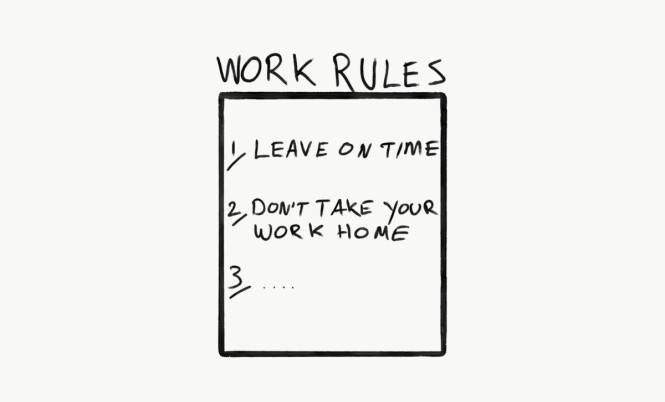
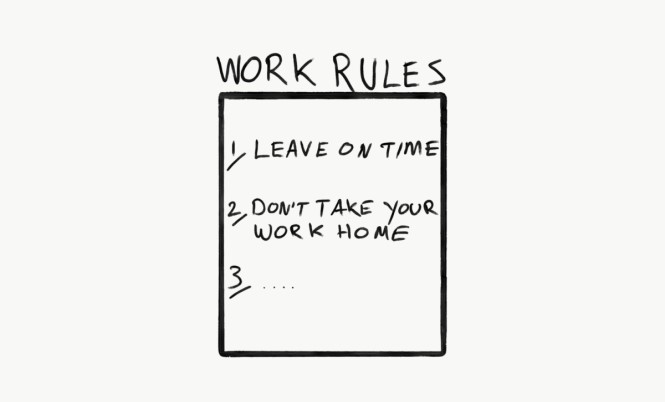
Leave On Time
The other day I was talking to my mentor about how great it is to love your job. He said: “I’ve never had a job in my life that I didn’t love. It’s one of the most gratifying things in life.”
But like my mother always says, “too much of a good thing becomes bad.” I believe that’s the same with work. Now, I’m not talking about intensity.
Don’t get me wrong, I work my ass off. Always have done. But just don’t go on for too long.
The art of working hard is knowing when to quit. But like my mentor told me, that’s very hard: “My biggest problem was that I worked too much. I left the house at 7 AM and came back at 11 PM. That’s too much.”
You must protect yourself against too much work.
And it’s straightforward. Just leave the office on time.
Whether you love your job or not — it doesn’t matter. When it’s time to go home, GO!
No one needs you to be at the office 24/7. Only your ego does. Honestly, the office will be here tomorrow. Your co-workers will still be alive. Your company will not go bust.
Work is about achieving results. If you can’t do that in 6–8 hours a day, you’re not effective. So instead of working overtime, read a book on personal effectiveness or get productivity training.
Leave Your Work At Work
But don’t just go home and bring your work with you. That defeats the whole purpose.
No one thinks it’s cool when you’re closing deals on the phone at dinner. You’re also not doing yourself a service by continually thinking about work when you’re at home.
Relax a bit. Play some Call of Duty. Cook dinner for your spouse. Take the kids for a walk. Whatever.
Look, living a happy life is very simple. It’s all within our control. We can decide what makes us happy. I have printed this Marcus Aurelius quote on my journal to remind me of that:
“Very little is needed to make a happy life; it is all within yourself, in your way of thinking.”
We all know that money, success, fame, or recognition, by themselves, don’t make us happy. And yet, we work too much to obtain those things that don’t even make us happy in the first place.
So why do we keep working too much that it hurts us?
It could be our ego. Maybe we just can’t help ourselves. It’s different for every person. Personally, I don’t care about the reason. All I know is that too much work has a negative impact on the quality of your life and work.
What matters is that we protect ourselves from our own stupidity. We’re just like kids. We need rules to live happily and safely.
That’s why the first rule of work is that we leave the office on time. The second rule is that we don’t take our work home.
And the third rule? Let’s not worry about that for now. We’ll get to that another time. It’s time for me to go home.
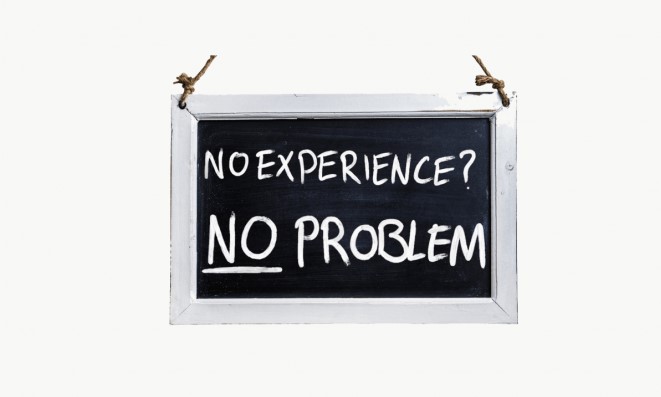
Here’s the challenge everyone who starts their career faces: You can’t get a job because you don’t have prior experience, but you can’t get experience without getting a job.
It’s called the experience paradox or Catch-22 of getting a job. It’s a real challenge. And if you can’t overcome it, you can easily set your career 3 to 5 years back.
Worse, I’ve seen young folks and people who switch careers destroy their potential by making the wrong decisions early on.
I don’t want to scare you. You can still overcome the Catch-22; but not with conventional career advice. Because what’s the standard advice for people who want to build a career?
“Create a resume, browse job boards, and respond to job applications.” Sorry to disappoint you. If you take that route, you will end up like most people: Frustrated and underpaid.
Don’t worry, there’s a different way. With the right strategy, you can break into any industry and earn what you’re worth.
But I have to warn you. It takes at least twice as much work. However, that shouldn’t be a surprise to you. If you want to have a better career than most folks, guess what; you have to BE better than most folks.
When you do the following 2 things, you will become better—that will significantly increase your odds of getting a job without prior experience.
1. Be The Person You Would Hire
Why is it that companies prefer to hire experienced people for a role? When I started my career, I didn’t understand it.
The reality is that there’s a massive difference between someone who doesn’t have experience at a particular job and someone who has two years under their belt.
Even though two years might not sound like a lot of time, it’s actually a lot of time to learn the ins and outs of a job. And especially when you recently got out of college; because your first two to three years are all about learning to be a professional.
Some people never become serious about their careers. They wake up at a time so they can come to the office just in time. They prefer to sleep in. And they are the first to leave at 5 pm. They don’t ask questions, don’t seek out mentors, LOVE their lunch break, and chit-chat with their co-workers every chance they get.
Imagine you would be the CEO of a company. Would you want a person like that on your team? Of course not.
I must be honest; I used to be like that too. But I realized that attitude will not bring you far. If you want career success, you need to take it seriously. You only get rewarded for results. And what brings results? Skills.
Now, the good news is that increasingly more companies are putting emphasis on the skills of the people they want to hire—not their experience.
In his book, The Virgin Way, I read that Richard Branson, the famous founder of Virgin (that employs approximately 71,000 people), hires for character and skills. He prefers to actually get to know applicants instead of asking them a bunch of boring questions.
If you seek out companies who hire for experience and skills, you have a good chance of getting hired—even if you don’t have experience.
There’s only one condition: You must be a person YOU would hire. Someone who’s not only a professional but also has the skills to do a good job. If you feel like your skills are not that good yet, spend more time on your craft.
So how do you find a company that hires for skills and character? You ask.
Look, getting a job is NOT easy. It requires a lot of manual labor. Sometimes you need to reach out to hundreds of people to even get an interview. So that’s what you do. Be ready to do whatever it takes.
You reach out to people in HR of companies you’d like to work for. And you ask them about their interview process. How does the application process work? What are the characteristics you’re looking for in candidates?
You can use that information to apply for jobs you’re interested in. But unlike people who blindly apply, you know what they are looking for.
2. Do Free Work
Often, being good at your job and having information about the application process won’t cut it.
I’m a big fan of demonstrating your skills instead of talking about it. During the interview, we only talk. But when you offer to do free work for a company, you actually demonstrate your skills in a real-life setting.
So how can you do free work? Larry Stybel, a clinical psychologist, wrote an article for HBR about his experience launching his career. He shares 3 great tips:
Look for a company you’d love to work for and then be specific about what value you will provide—What will you exactly do for the company? No need to overpromise. It’s better, to be honest about what you can. Identify a person you want to work for, and reach out to them directly. Also, send your resume along (watch my video on how to create a graphic resume with Canva for tips).
Be specific about what value you will receive—Start with the end in mind. What do you want to get out of it? A reference? A potential job? Experience?
Be specific about the time frame—You don’t want to keep working for free forever. In Stybel’s example, he said: “I promised to work two days a week for two months.” Often, you can’t even work full-time for free. Nor is it something I recommend. Use your time to keep searching for a job.
One of the key lessons for everyone launching their career is to consider yourself as a learning machine. When you feel too proud to learn or work for free, you will be stuck sooner than later.
But when you keep improving yourself and reaching out to people in the industry you want to work in, it will ultimately lead to a real job.
Every individua ‘s life and work are closely related to his environment . Man has progressed in various fields of life such as industrialisation , mechanisation, transport and science, etc. Therefore, this age is called an electronic age or space age. But on the other hand, this development has created such conditions that a person may get injured anywhere and at anytime.
In spite of good measures aimed at industrial safety and the development of safety devices and techniques, the number of accidents is still high in industries and specially in day to day life. Indeed, there is no definite time of such injuries. These can happen to anyone, anywhere and at anytime. Injuries usually occur in industries and on the farm, during the repair, maintenance and operation of vehicles of various kinds, during games and sports and in various situations everyday. These often happen by accident, so it is impossible to anticipate the time and place of an accident. Someone may get fractured, another may be bitten by snake. So, it can be said that every individual is trapped in one way or the other by accidents. In fact, it is very difficult ton get medical aid to victims at the sport of the accident. At that moment, some immediate possible aid is required to the victim. So, first aid is the first help which is given to the wounded or accidental victims before the arrival of the doctor.
In other words, ” It is an immediate and temporary care given to a victim of an accident or sudden illness before the services of a physician is obtained.”
In can also be said that first aid is that aid is that aid which is provided to the injured in case of an accident, injury or sudden illness. It enables the trained persons to render the help to preserve life, promote recovery of the injury until the arrival of the doctor.
In fact, the area of field of sports and games is such a field, where getting injured is very common. Any player can be injured at least once during his/her sports career. The facilities of a qualified doctor are available in national or international level competitions but usually such facilities or services of a doctor are not available during practice, training or competitions of normal levels. The teacher of health and physical education should also have enough knowledge of first aid so that he may provide first aid to the players at the time of training and competitions.























 Eduindex
You must be logged in to post a comment.