WTC Final- day 5

It rained in the morning at Southampton. Many were disappointed that there would be no cricket on day 5. But luckily rain stopped and covers were off. Play started at time. Each session was planned for 2 hours respectively. New Zealand started the day with a score on card 101-2 with still trail India by 116 runs. Captain Kane Williamson and Ross Taylor were at the crease. Since the conditions were cloudy and overcast, the ball started swinging well. So Indian captain used his 3 prime fast bowlers for the whole 1st session.

Session 1

The plan of New Zealand was to play safe for the 1st session. It seemed that the runs didn’t matter much to them. They scored 34 runs in 23 overs in the 1st session. They played riskless shots. They wanted to go without any wicket loss at the end of 1st session. Their plan worked well until India’s senior bowler Mohammad Shami took the wicket of Ross Taylor. It was a good catch by Shubman Gill inside the circle. Then the left hander Henry Nicholls came in. Ishant Sharma bowled a well constructed outswinger outside the off stump. Nicholls played to get caught on the slip. Rohit Sharma took the fantastic catch. After him, BJ Watling joined Kane. He was removed in his 2nd ball by Shami by a inswinger that hit the middle stump. After Watling, their all-rounder Colin de Grandhomme joined hands with Kane. But then, there seemed to be a change in their plan. de Grandhomme looked to play shots. Also, he was conscious about tackling the good balls.

Session 2

At the end of 80th over, India took the new ball. Shami used the new ball very well. He took the wicket of de Grandhomme tactically. He bowled 3 outswingers from position close to the stumps. Then he bowled a inswinger from wide of the crease. Then happened that lbw shout and the batsman gone. Players came in and went out without making a long partnership with Kane. Kane remained at one end without help. Kyle Jamieson joined Kane this time. His attacking plans worked well. He scored some boundaries. He hit Shami to a six after which Shami bowled a good bouncer to take him for a catch at the fine leg. That was a very judged catch by Bumrah. Then Southee came and scored. Kane was dismissed at 49 by Ishant at the slip. Then New Zealand’s innings ended at 249 runs.

Session 3

India opened their 2nd innings trailing New Zealand by 32 runs. Gill and Rohit gave a good start until Southee took Gill for a lbw by an inswinger in the 11th over. Soon Rohit gone scoring 30 runs. The team score was 51 at that time. Some expected a night watchman since the day was nearing the end. But Kohli came at no.4 without discussion. He joined Pujara at the crease. India finished the day-5 at 64-2 with Pujara and Kohli standing at the crease.

Hope there would be no rain on the reserve day and expect a result rather than a draw.
Competitive Programming

“I think everybody in this country should learn how to program a computer, should learn a computer language, because it teaches you how to think.”Steve Jobs

If you are a programmer, you may understand the deep meaning of these words quoted by Steve Jobs, and you may also have this experience even if you turn off the computer, you continue to think about the programming or code you use in it. The project has been written. In programming, you just don’t learn programming, you also learn the “art of thinking“, the method is to break the code into smaller parts, and then use creative, logic-based thinking to solve problems from different angles. Programming is very interesting and it is like brain training. Programming is an intellectual sport. When this sport is practiced by sports programmers on the Internet, it is called competitive programming.

Coding contests or competitions usually require the host to have a series of logical or mathematical questions for the contestants, also called puzzles (ranging from ten to one thousand) problems. Scoring is mainly based on the count of problems solved and the time required to write a successful solution, but other factors (quality of results obtained, execution time, program size, etc.) also do count.

The goal of competitive programming is to write source code for computer programs that can solve specific problems. Most of the problems encountered in the programming Olympics are essentially mathematical or logical problems. Typical problems fall into one of the following categories: combinatorics, number theory, graph theory, algorithm game theory, computational geometry, string analysis, and data structure. Challenges related to deadlines and artificial intelligence are also popular in certain competitions.

These coding contests provides young and talented coders with the opportunity to measure their skills and compare them with other programmers around the world. Some of them are listed as-

1) The ACM-ICPC International Collegiate Programming Contest

2) Google’s Coding Competitions

3) The ICFP Programming Contest

4) BME International 24-hours Programming Contest

5) Microsoft Imagine Cup

6) Facebook Hacker Cup

Book Review for Haemin Sunim’s ‘Things You Can See Only When You Slow Down’

The Things You Can See Only When You Slow Down-How to be Calm and Mindful in a Fast-Paced World. As long as the book title is, it is small book with 173 pages but an ocean of thought. Published on 13 January 2013, this book sold over 4 million copies worldwide. I came across this book recently when the second wave of corona virus hit the country and all hopes of going back to normal were lost and honestly this book helps.

Haemin Sunim began this book with a simple question, “Is the world that’s busy? Or is it just my mind? The world moves fast but sometimes it is okay to take out some time for yourself and that does not make you selfish. An advice that the author gives in the beginning og this book is to take your time and to not rush thorigh it like a novel and to be honest, that is the only right way to read this. It is simple yet powerful. It has 8 chapters addressing various aspects of human’s life- rest, mindfulness, passion, relationships, love, life, the future and spirituality. He uses his real life experiences like when he first fell in love or when his teacher taight him the real meaning of spirituality or the time when he went backpacking trip with his friend and that increases the authenticity of this book. He says, ‘life isn’t a race against your friends, it is a lifelong marathon with yourself’. You have no one but yourself to compare to.

Everyone should give this book a chance. Its a real mind opener. For me this book was definitely a 5/5 and a 100% recommendation.

Want To Make Better Decisions? Do This

Do you ever look back on your decisions and think, “Why I on earth did I do that?”

We all make bad decisions.

  • Buying an SUV that sucks up all your cash
  • Starting a relationship without being in love
  • Saying yes to a job that you’re not passionate about
  • Creating products that no one needs

Shit happens (the above examples are all about me). But the funny thing is that bad decisions never seem like bad decisions at the moment.

I’ve been reading about the decision-making process of Warren Buffet and Charlie Munger, two of the most successful investors of all time.

In Alice Schroeder’s biography of Warren Buffett, I read that Buffet and Munger have a learning strategy that’s based on what you should avoid doing. They identify mistakes and do their best to avoid those mistakes. But as Charlie Munger says:

“Smart people do dumb things.”

You can never avoid making a mistake. However, you can do your best to avoid making dumb decisions.

Plus, by learning from other people’s mistakes, you can make their mistakes your own. You’ll learn faster that way.

Don’t Overthink.

Smart people are way too preoccupied with doing the right things. They want to have a perfect life, career, house, business, car, holiday, etc.

When you put too much pressure on yourself to make the right decisions, you get analysis paralysis.

I recently spoke to a friend who wanted to make a career move. I asked him to walk me through his thinking process:

“I like the company I work for, but my job isn’t engaging anymore. I’ve been doing this work for four years. And sure, I’ve been promoted twice, but it’s still the same work. So I’ve been looking at other companies. But what if I go somewhere else and that doesn’t work out? I’ll have to move on quick. And that won’t look good on my resume.”

I remained silent.

“Just hearing myself talk leads me to another thing: Overthinking it.”

We both laughed our asses off. I can do the same with overthinking. And I bet you’ve been there too.

When you overanalyze every single decision, you become paralyzed. Result? Nothing. Now, that’s a bad outcome!

That’s how people end up wasting their lives.

The only way you can stop overthinking is by making yourself aware of your thinking process. When I asked my friend about his thinking, he became aware of how irrational his process was.

You can’t control the future. So stop thinking about it.

Do This Instead: Make Small Decisions. Decide Often.

I recently read Seeking Wisdom by Peter Bevelin. It’s about the way Charlie Munger thinks. One of his decision-making strategies is to avoid mistakes. But that can be interpreted in different ways.

You can fear decisions altogether because you might make mistakes. What happens is that you don’t make decisions at all. As Munger says:

“The difference between a good business and a bad business is that good businesses throw up one easy decision after another. The bad businesses throw up painful decisions time after time.”

You can interpret that Munger quote in different ways. I interpret it as follows:

When you make small decisions early, before they become big — it’s easy. When you put off decisions, they become big — and painful.

For example, I’m not happy with the email provider I use to send out my newsletter. Their support is slow, there’s no good integration with my online courses platform, and readers have complained about not getting my newsletter.

This is something that’s on my radar for more than 1.5 years. At the time my list was less than half of the size it’s today. I also had only one online course. Now, I have three.

The hassle of moving to another provider gets bigger every day. Had I moved early, it was easy. By now, it’s a painful process.

In life, it’s exactly the same. The longer you stay in a bad relationship, the harder it gets to leave. It’s also true for your job.

Earlier Decisions Lead To Better Decisions

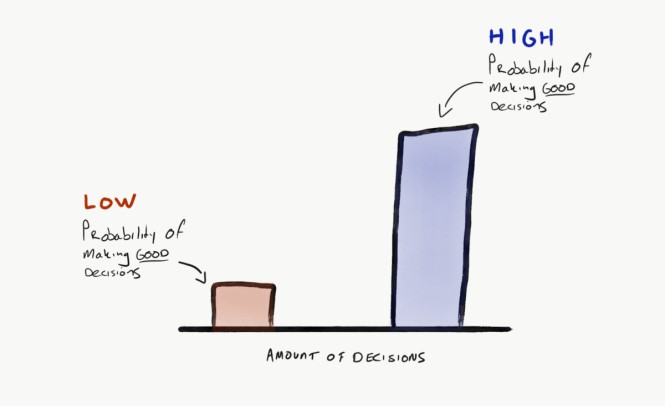
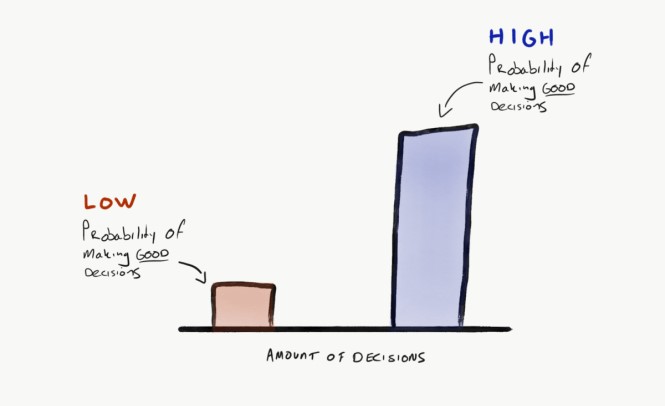
The earlier and more you decide, the more chance that you make better decisions.

I often say that there are no right or wrong decisions — only decisions. That’s not entirely accurate. Of course, there’s a difference in the quality of our choices. That’s the topic of another article.

But here’s the thing: NOT making a decision is also a decision. If that’s a conscious move, that’s okay. You think about something, and you decide that doing nothing is the best option.

However, I’m referring to not making a decision as in “I’ll put it off until another time.”

No matter what, you’re making decisions all the time. Instead of making fewer conscious decisions, we need to make them earlier.

Because all you need are a few good choices in your lifetime anyway. What will be your best? You only find out after, you guessed it, you’ve made a decision.

3 best Books That Teach You To Be Rich

BOOKS CAN CHANGE ANYTHING

What’s your money strategy? Do you even have one?

If not, it’s not uncommon. Until two years ago, I didn’t have a financial plan, whatsoever.

Even though I’ve been reading about money, finance, and investing ever since I made my first few bucks as a teenager, I never created a financial plan.

But now, I think every single working professional needs a financial strategy. How do you spend your money? How much do you save? What are your thoughts about debt? How do you invest your money? How much money do you need to retire?

1. The Richest Man In Babylon by George S. Clason

This book was published in 1926 and as far as I can tell, it was the first popular book on personal finance.

Usually, I’m not into parables. But this is a great book. It’s the only parable that I’ve read that makes the message of the book even more powerful.

What it comes down to is this: Rich people are rich because they save their money, don’t get in debt, and don’t spend their money foolishly.

Clason recommends to save 10% of your income (I believe you should save 50% — more on that later). He calls saving “paying yourself first.” That’s an important mindset.

You only get rich by paying yourself. Don’t foolishly spend all your money on things you don’t need. When you do that, you pay others, not yourself.

Everyone should read The Richest Man In Babylon — the earlier the better.

2. Your Money Or Your Life by Vicki Robin and Joe Dominguez

What I enjoyed most about this book is that it teaches you to transform your relationship with money. This will change your life.

Money is something you trade your life energy for. Think about it. You work to earn money.

But you spend your time to work. That’s why Robin and Dominguez spend the first part of this book to make us aware that more is not better.

More money is especially not better if you have to put your own well-being on the line. It’s never worth it. Just ask the family of the bankers who committed suicide during any recession.

If you want to live a healthy and wealthy life, you must detach yourself from money. Instead of striving for more, get better at managing your money.

Save it. And don’t waste it on stuff you don’t need. Your Money Or Your Life starts out strategically and gets more practical towards the end.

One thing I don’t agree with is retiring early. I don’t want to retire and sit on a beach. That’s because my mentors, who are beyond the retirement age, still work and are very happy. I aspire to do the same.

But I also want to build enough wealth that I don’t “have” to work if I don’t want to. That’s one thing Robin and Dominguez also believe in.

3. The Intelligent Investor by Benjamin Graham (with commentary by Jason Zweig)

I bought my first stocks when I was 20 years old. At the time, the finance sector was doing great, and I thought it would be good to invest in ING, the major Dutch bank.

Oh yeah, I should mention that this was in 2007, right before the financial crisis. I invested €1500 in ING and €500 in AEGON, a Dutch asset management firm.

It was about half of my savings at the time — a lot of money for a student. And a few months later, when Lehman Brothers collapsed, my stock portfolio was worth only a few hundred euros in total.

Man, I was so pissed off. I can’t even tell you how livid I was. But looking back, I understand that losing money is a part of investing.

And fortunately, I didn’t sell and waited until the stocks recovered. That took eight years, though.

I decided to not invest in individual stocks anymore. And The Intelligent Investor is one of the most important books that helped to realize investing in stocks is not for me.

If you already know that you don’t want to invest in individual stocks, you don’t have to read this book. However, if you are interested in finance, I highly recommend it. The commentary by Jason Zweig, a WSJ columnist, is also excellent.

P.S. I skipped the chapters about stock analysis because I’m not going to use it.

On Productivity and It’s Determinants

Productivity refers to the ratio between the volume of output and volume of inputs. Inputs here refer to factors of production like land, labor, capital etc. According to definitions, productivity is the residual output that is not explained by the direct contribution of input resources. It refers to goods and services produced in relation to resources used in their production. High productivity indicates that the resources are being used efficiently. If resources are economically the overall production will increase. This also decreases cost of production. It leads to higher production using minimal resources. It is an important critical indicator of economic performance. Residual output is called as Total Factor Productivity (TFP). Increase in productivity benefits the economy by making it possible to start new industrial units and generating more employment opportunities. Higher productivity is necessary for the growth of any nation.

Higher productivity helps in producing quality goods at lower cost. This will lead to lower prices increasing the standard of living.  Profit maximization is possible because of higher productivity. This facilitates internal financing of expansion programmes. Factors of production can be used efficiently. This also increases income for workers. Higher productivity determines the standard of living. Lower productivity means low standard of living. GDP measures the total output. So, the total output is equal to the economy. This is the reason why American workers are richer than workers of any other developing nation. For example, let us consider Munro as  an  economy. He catches his own fish, grows his one vegetables, and makes his own clothes. His production and consumption can be considered as a simple economy. If he is bad at doing these things, he lives poorly. The standard of  living of his economy depends on productivity. A country’s standard of living depends on its ability to produce goods and services.

The two variants of productivity are labor productivity and total factor productivity. Labour productivity measures the amount of output per worker. Total factor productivity measures the amount of  output per unit of  total input. Total factor productivity is total product output divided into index of all inputs like land, labor, capital etc. Output growing faster than inputs is higher productivity. Productivity increases as a result of advancement of technology, invention of new methods, newer processes etc.  Increasing returns to scale, larger inputs and production will lead to higher productivity.  Even with other factors remaining constant, economies of scale would contribute to productivity. If a product can be produced more efficiently when produced together than apart it creates a different kind of efficiency. It happens in the presence of economies of scope. For example, this happens in the software industry.  When consumers buy software to prepare their federal income taxes the CD-ROM usually contains several other modules, including a link to a Web page, government documents, and a tax preparation manual. This shows economies of scope because the different modules can be more inexpensively produced, packaged, and used together than separately. Economics of scope are like the specialization and division of labor that increase productivity as economies become larger and more diversified. Economies of production and scope are also reasons for increasing productivity. Economies of scale and mass production have been important elements of productivity.

There are other factors that determine Robinson Crusoe’s standard of  living other than productivity. From the example mentioned above we can call other determinants as physical capital, natural resources, and technological knowledge. These factors have a role in real economy.  

Physical capital: physical capital per worker is important as workers will be more productive if they are provided with proper tools. Tools, equipment and structures used in the process of production of goods and services is called physical capital. The processes become easier and simpler with more tools and equipments. A worker with basic tools cannot produce more. Inputs to production are called factors of production. Physical capital is produced factor of production. Capital is an input into the production process that in the past was an output from the production process. Capital is a factor of production that is used to produce all kinds of goods.

Human capital: It includes the knowledge and skills that workers acquire through education, training and experience. The skills and experiences are a result of time spent in schools, programs, colleges, job trainings etc. It is an intangible capital. Like other determinants human capital also contributes to nation’s productivity. Human capital is a produced and completed determinant of productivity. Proper human capital which has effective and efficient workers requires proper educational facilities, teachers and institutions etc. Students are the future workers. They are the human capital that will be used in future production. 

Natural Resources: Natural resource is another determinant of productivity. It includes rivers, land, minerals and other resources provided by nature. Natural resources are of two types: renewable sources and non renewable resources. Renewable resources are sources that can be created again or replaced easily. The supply is infinite. Examples include trees, fresh water, solar energy, biomass etc. Non renewable resources are sources that cannot be created again or replaced. The supply is limited. Examples include oil, gas, coal etc. Natural resource disparities are responsible for some of the differences in living standards around the globe. The historical success of USA was driven in the part by the large supply of land well suited for agriculture. Other examples are countries like Kuwait and Saudi Arabia. They are well off because of oil resources. Though natural resources are important, they are not solely responsible for higher productivity. Japan is a good example for this. Despite having low natural resources, it is one of the richest countries in the world. It imports many natural resources from other countries and exports manufactured goods to those countries.

Technological knowledge: Another important determinant of productivity is technological knowledge. It simply means using the best ways to produce goods. Technological advancements have made production process simpler. Once farming required a high input of labor to produce food for the entire population. Now, it has been made possible to produce for the entire population by employing a small proportion of the population. This has allowed labor to focus on other sectors. Technological knowledge has many forms. Common knowledge spreads to everyone after one uses it. For example, Henry Ford introduced production in assembly lines, other carmakers followed it. Rest is proprietary. Only the company that discovers or invents it knows it. Example: Coco Cola recipe. Some inventions are proprietary for short time. They become available to everyone after the patent expires. These forms of are important for the production of goods and services. Important difference between human capital and technology is technological knowledge refers to society’s understanding about how the world works. Human capital refers to the resources expended transmitting this understanding to the labor force.

Let us discuss about other determinants for better understanding of this. Other determinants of productivity are innovation, education, market efficiency and institutional infrastructure.

Innovation: Invention of new technology leads to development of high value added activities and improves the performance of existing economic activities. When we look back at the past we can know that only few countries have created new technology. They have invested heavily in research and development (R&D). Studies have revealed that creation of new technology is associated with higher TFP. 

Education: There is a positive relationship between productivity and education. It is evident when we look at developing and developed countries. Studies show that the number of schooling years and completion rate of secondary and tertiary education is important in explaining the improvement of TFP for many countries.

Market efficiency: Studies have shown that market efficiency s related to variation in productivity across countries. Inefficiency in the allocation of human and physical capital is the main explanation for a low income among many countries. Estimates reveal that if capital and labor had been allocated at the same level as USA productivity in India and China could have been 1.6 times and 1.3 times higher than USA respectively.

Institutional infrastructure: Quality of governance that includes political stability, rule of law, the absence of corruption and so on is positively related to TFP and economic growth. Governance works as a channel for geographical endowments, such as temperate locations and proper growing environment for grains, to contribute to the growth of economy. Government size is also related to economic growth. It paves way for well executed government investment.

By studying productivity and its determinants we can understand the importance of productivity to an economy. Productivity ensures higher standard of living. It improves the income of labors and helps in developing the economy of a country. Determinants should be strengthened to increase productivity. Government should invest on infrastructure and education. Resources should be used properly. Higher productivity is essential for all nations.

Narada case: SC judge recuses himself from hearing appeals of Mamata Banerjee, Bengal minister Moloy Ghatak

Justice Aniruddha Bose said the issue will now be placed before CJI NV Ramana. Banerjee and Ghatak will submit information about their role in CBI’s arrest of four TMC leaders

New Delhi: Supreme Court judge Justice Aniruddha Bose on Tuesday recused himself from hearing appeals of West Bengal chief minister Mamata Banerjee and state law minister Moloy Ghatak about their role on the day of arrest of four TMC leaders by the CBI in the Narada sting tape case 

As soon as a vacation bench of Justices Hemant Gupta and Bose assembled to commence the day’s proceedings, Justice Gupta said his brother judge is recusing himself from hearing these appeals.

Justice Gupta, presiding over the bench, said the issue would be now placed before Chief Justice of India NV Ramana who may take the decision and the pleas may be listed for hearing during the day itself.

The top court was scheduled to hear three appeals including that of the state government challenging the high court’s denial for filing of affidavits by her and the state Law Minister in their role on the day of arrest of four Trinamool Congress leaders on 17 May by the central agency in the case.

It has been alleged that the state ruling party leaders played a key role in stopping the CBI from performing its legal duty after arresting four leaders in the case.

All that has been lost in the pandemic

We are almost over with the second wave, but we humans as a community have lost so much to the pandemic. It almost feels like the silence after the storm, when all the buildings, trees have collapsed but you are standing there helpless, staring at the damage and destruction that has been caused by this storm named pandemic. We still haven’t recovered from the scars of the 2 waves of covid and there is another wave lurking around the corner, and who knows the devastation it may bring about, although I hope it does not cause any more loss.

The second wave saw deaths at a larger rate than the previous wave, there was not a single night where there was no sound of an ambulance wheezing to save a single life.

The sad part is that many of the people who their lives might have been healthy if not for covid, they might not have had any health complications but still lost their life. Young people, too, have lost their lives in this pandemic.

We will eventually come out of this pandemic but at what cost? For many of us, it won’t even matter if the pandemic ends, after losing loved ones. But this where we should try to understand that now, after losing a life which was so dear to you might feel like “does it matter now that the cases are coming down, that deaths are occurring less and less day by day?” But still, we must realize that there are many more lives that need to be kept safe. The pain of losing a dear one will not pass away easily and when your kids will be reading about the pandemic, in the future, in their books, that memory will come alive again.

Many other things have also been lost, many people have lost their jobs, they have not been able to feed their family and themselves. Many students who were looking for employment lost their chances due to this pandemic. We have lost our normal routines, it feels like a lifetime when we went out for dinners and movies, we now miss even a regular day at schools and colleges.

But the bottom line is, life will go on no matter what, people will eventually forget that you had lost someone during the pandemic, they will move on. You will have to deal with this yourself, and we cannot blame them because everybody has to get on with their lives, so take time your time, sit back and reflect. Let the grief enter your mind and heart, feel it completely, cry, and when you let it sink in completely, then maybe you will be able to detach yourself from that feeling, although you can never forget it, it may help you. This detachment theory was something I read in the book “Tuesdays with Morrie”. We all must hope that the third wave does not bring with it any more destruction or better it does not come at all.

Guidelines to choose your career-for final year and pre-final year students

” I have no problem with starting from scratch” – Leif Garrett

The age 20-25 is quite confusing age of our lives. Everyone will have an inner voice which is constantly interrogating us a set of questions like , ” What are my interests?” , “Which is the field I can excel on?” , “How can I bring the best out of myself?”. Never be terrified by these questions. These are questions which will make you streamline your career path.

During the pre-final year and final times , we all will start to have a fear of future and will begin to recognize the practical aspects of life. The pressure could be due to college placements, peer discussions and expectations of our families. Never make any of these external factors influence your career choice.

The first step in order to identify the career path which best suits you is to know about your interests and skillsets. Write down three important interests of yours which may or may not relate to the stream of your study. Figure out what are the skill sets you have in those interests which could fetch you a job. In case if you have no skillsets in those fields refer to the career sites and find out what are the skill expectations for those roles.

The second step is to understand the industry. In the initial days of our college, we all would have had fun unaware of a world outside which is developing at a rapid phase . Start learning about what’s happening around you. Recognize the fields which are blooming and categorize those which attract you. List down the skills which are anticipated in those fields.

The third and most important step is to write down all the fields , interests and skillsets you have figured out in steps one and two. Write down your short term and long term goals which align with your interests. Narrow down to 2 fields which allure you and make you move forward towards your long term goals.

“We cannot become what we want to be , by remaining what we are” – Max DePree

Kick start your learning phase by acquiring skills and mastering them which attribute to revamp your profile. Make sure you update your profile regularly on career sites like LinkedIn which provides you the opportunity of networking. Never be petrified by the fear of perfection during the learning phases because,

“Continuous Improvement is better than Delayed Perfection” – Mark Twain.

Elements of perfect Headline

The headline is the type of text indicates the nature of the article. the headline purpose is to quickly draw attention of a reader towards the story. It is written by a copy editor, but can also be written by the writer of the article, the page layout designer, or could be by other editors.


Headline is also known as soul of the content or hook of content.
In other word we can say that headline line workout as compass.

Things to keep in mind while writing headline are as follows:


1. Understand the target audience:
While writing a headline we have keep in mind whom we are writing for. we have to know exactly who we are talking to and trying to attract our reader with the help of our headline, so our headline should be effective. We should start headline writing process by keeping in mind who our audience is example for political news we should use diplomatic headline.


2. Show the Benefit of Reading:
While writing headline, we should think about the reader, we should try to put ourselves into their shoes, and should begin writing headlines that could directly connect them with their wants and needs. Should Use our knowledge about the reader to write a headline that gives them a reason to read. Show them how they could benefit by this:
• Solves their problem
• Answers their question
• Makes their life easier
• Leads them to a positive outcome


3. Use the Simple but impressive Language:
The language we choose should naturally impacts the worthiness of your headline. while using words that are bland, uninspiring, or unknown by most, your target readers may go to be turned off.
Instead stick with language that is simple, but powerful. For example, address the reader as “you”, and use the words like “try” or “should”.


4. Headline must Appropriate to the Story:
A humorous headline may work with a soft news, but it most definitely wouldn’t be appropriate for an article about someone being murdered or hard news. The tone of the headline must match the tone of the story.
Example: a man brutally killed his wife for money.


5. Use of the Active Voice
Use the subject-verb-object formula for news writing. That’s also the best model for headlines. Start with subject, write in the active voice, and your headline will convey more information using fewer words. Active voice tells who did what. Where as passive voice tells what happen which hides who.


6. Use of Present Tense
It makes the reader fells more connected towards the story. Even if the news story is written in the past tense, headlines must almost always use the present tense. So that reader could get attracted towards the article.
Example – Liverpool wins first premier league title
Neymar injury hit PSG hopes


7. Must know where to Capitalize
Always capitalize the first word of the headline as should all the proper nouns in the headline. Don’t capitalize every word in headline unless that is the style of your particular publication.
Example: Blackpink’s Lisa showing love to fans


8. Be Direct
Headlines aren’t the place to be obscure; a direct, straightforward headline gets your attention towards it more effectively than something overly creative.
Example- Maggie – 30% off today only


9. Avoid names
It is always better to avoid names while writing headline. But if in case it’s a popular well know name then name should be use because that particular name could attract the readers to read whole news.
Example – if the news is about famous celebrity like Justin Bieber, Drake, BTS. people want to read about them, then it’s worth to use their name.


10. Using of articles in headline
Avoid using of a, an, the in the headline. So that reader could get more connected with the article through headline.
Example- Man releases rabid dog on street (A man released a rabid dog on a street)
These were the few things we have to keep in mind while writing headline. A good headline catches reader attention first, then actual content on it. But then condition is headline should connect to content not any irrelevant information.

Why we should stop judging others

You do you. This is true, do not let the world tell you otherwise. Though all of us know how correct is this, often we find people who do not understand this. Those are the ones belittling you, judging you, and shaming you for your thoughts, preferences, way of life, and everything else too! Would you feel good if someone mocked you, talked about, or made negative opinions about you? The answer is pretty much a no. So if you as a person would be hurt if someone judged you, why would you want someone else to go through that pain? If you are someone who respects others for who they are and accepts them without any judgement, kudos to you. And for the others, it is never too late to be kind. You can start from today, in fact from now, and here are reasons why I think we all should stop judging others.

  1. Judging others spreads negativity – We all know that positivity and kindness are the need of the hour. This means that we should stop doing things that are not bringing positivity to the environment. When you judge someone, that always brings down the other person, they even start associating negativity with you. That would never do any good to you, and the negativity might creep into you as well. It is difficult to stay happy and optimistic if you keep judging others. It like, always finding flaws in things, in situations, and with people. Try to find good in others, maybe appreciate how they smile, and how great it is to meet them. This would automatically infuse all the good vibes in and around your environment.
  2. Judgement means a no to acceptability – Humans are diverse and very different from each other. From cultures to way of living, to life preferences and demands, everyone has their own choices. All of us want to be accepted in our own skin, isn’t it? Changing because someone else likes you better, is something that we all should say no to. Everyone has the right to be who they are and do what they want to do. All of this is negated when we start to judge others. A lot of people cannot stand the judgement and feel ashamed and embarrassed. This forces them to change in the way society wanted them to be, even when they did not want to. We should stop judging others to encourage acceptability and make people feel comfortable in their own skin.
  3. You drive away happiness and contentment from your life – It is often said, judging someone does not define who they are, it defines who you are. There can be innumerable reasons why you are judging others, but a lot of times it is borne out of your own dissatisfactions and unhappiness. It sometimes might become difficult for you to see others happy when you are sad and discontent, and putting someone else down might provide a momentary satisfaction. But remember that it just makes you fall into a deeper pit of negative emotions, unhappiness, and guilt. You need to start being optimistic, accepting, and content with what comes your way. This will help you accept others as they are and spread positivity all around. Let us strive for a world wherein we all respect each other’s feelings, emotions, and thoughts so that our’s are accepted too and where all we diverse humans can live as one.

World Rainforest Day 2021 : History and it’s Theme

‘Save trees save life’ is a well known proverb for everyone. It is our responsibility to save forests because it would save our life. This types of forests are gets more rainfall and it helps to maintain ecosystem. It is important for the survival of life on the earth.

World Rainforest day is celebrated on June 22 every year. The name itself suggested the aim of the celebration. The day is to celebrate the existence of the rain forest and to create awareness or raise awareness among the people to preserve this type of natural resources. This day is celebrated on June 22 every year by millions of people round the world. It maintains the climatic balance and global warming.

History of World Rainforest Day

The first World Rainforest Day was observed on June 22 ,2017 which was introduced through the efforts and collaborations made by a groups called the Rainforest Partnership. The main aim of this initiative is to protect world’s Rainforests and to maintain ecosystem.

Theme of the World Rainforest Day 2021

The theme of this day has been finalized as “Protected together. Now. Forever”. On this special day people across the globe work together to preserve rainforests.

Significance of World Rainforest Day

This day is to promote methods or to preserve rainforests by many people across the globe. Due to this pandemic, no events were held in person but people are asking and willing to take part in the virtual events to highlight the importance of this day.

Two types of Rainforest:

There are two types of rain forests: tropical and temperate. Tropical forests are situated nearer to the equator where the land is hot whereas temperate forests are closer to the north or south pole where the land is cooler compared to tropical forests.

Rain forests gives us fresh water and it absorbs more carbondioxide and other harmful gases and emits oxygen which maintains the climatic balance. In these forests , we could find more valuable trees but all these trees are cutting down by people for money. There were more than 1 billion hectare from the tropical forests have been compressed due to deforestration.

Amazon rainforest alone provides 20% of oxygen and the pure water we drink. Daily there are 40 soccer lands are destroyed by the people. If this continues, 15% of carbondioxide emissions leads to climate change and global warming.

Top 3 Rainforest in the world

There are many rain forests out of which we are now looking at only the top 3 rainforests in the world

1. Amazon Rainforest

This is the world’s largest tropical rainforest located in South America with the land mass of 628 million hectares of tree covering area including 526 million hectares of primary forest and is the forest which has highest forest loss. 30 million hectares of primary forests have been deforestrated from 2002 to 2019.

2. The Congo Rainforest

It is the second largest tropican rainforest located in Congo Basin with the land mass of 288 million hectare of tree cover forest and 168 million hectares of primary forest. Due to deforestration, this forest losts over 6 million hectares of primary forest and 13.5 million hectares of tree cover forest between 2002 and 2019.

3. Australasian Realm Rainforest

This tropical rainforest is found on the island of New Guinea and also north eastern Australia with the land mass of 89 hectares of tree covering including 64 million hectares of primary forest in 2020. Due to deforestration, Indonesian part of New Guinea losts 605,000 hectares of primary forest area while PNG losts 732,000 hectares from 2002 .

SNDT WOMEN’S UNIVERSITY’S MEDIA MANTRA ROPES IN HIGHLY ANTICIPATED GUESTS FOR TWO QUIRKY PANELS. SNEAK-PEAK INSIDE!

This year marks 15th edition of SNDTWU’s Media Mantra. Education panel aims to gain perspective of edu-systems on how pandemic acted as catalyst in enhancing learning process with virtual shift. It reflects upon how lockdown fueled India’s EdTech platforms. The panel revolves around key game-changers like learning solutions, impact of technology, chance to upskill and institution’s crisis-response methods.

SNDTWU Extension & communication head of department Dr Mira K Desai spoke at length, upon asking how did students cope up with online education, she stated “It was challenging mainly in context of gender division of labor. Many of our students found it challenging to cope with new reality of studying with limited connectivity and manage studies while working from home.”

Media Mantra themed around ‘Unlocking Digital’, a flagship event organized by postgraduate students, since it is held virtually for the first time, Mira shared insights on her experience, “Media Mantra helps students explore their own potential and help them connect with industry. This is the first time that we have Online Media Mantra and it has gone National with panels and activities.”

Virtual event’s education panel will also comprise ‘National Survey’. On Challenges of online lectures, Mira K Desai commented,” You can join our panel to know what happened across the country.” A Voluntary Group of eleven media teachers from nine geographical locations across India got together in 2020 and decided to take up a study to understand impact of teaching-learning in online environment. Main objectives were understanding issues of reach and access of online technologies for online teaching/learning and examinations amongst students and teachers involved in media education.

Mira further added about supposed changes, “While all other processes remained unchanged, Media Mantra is an organically generated event for, of and by students. This year it’s different in terms of being online and also being ‘national’.” 

She concluded what brand value Media Mantra holds, “We would like to believe that SNDTWU Media Mantra is a brand. It was launched in the year 2000 and is growing. This edition is 15th and we have 15 logos, taglines, guest lineup and reflection of Media of that time as perceived by our students.”

Influencer-based viral panel will give warm welcome to a string of millennial influencers who have carved a niche on social media platforms. Shradha Vyas, Fever FM RJ and host will overwhelm the audiences acting as moderator. List of content influencers include popular actor and digital creator Adil Feroz Khan, travel blogger Archana Singh, digital artist Diksha Rai, MTV’s former editor and video creator Nikhil Sidhwani. The edu-based panel will welcome guests such as  Dr Akhil Shahani, MD of The Shahani Group and Rishabh Khanna, Cognitive Scientist and founder of the EdTech firm Suraasa which is a Teacher Education and lifestyle management portal. Dr Uma Shankar Pandey, IAMCR India Ambassador. Media mantra will be held on 26th June, courtesy of Nazrana Creation. 

INDIA’S ECONOMIC EXPLOITATION UNDER BRITISH RULE

SOURCE- PINTEREST

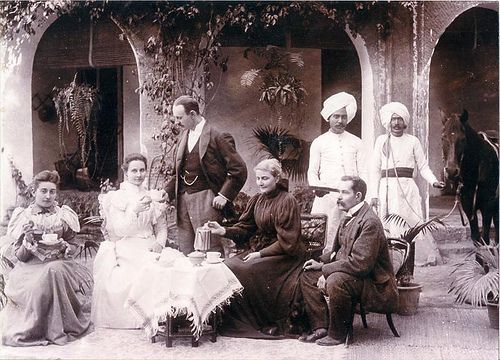
The very first Hindi word to be added in the English dictionary was “loot” which refers to the spoils of war pillaged from an enemy. This first addition was made when the British ruled India and filled their bags with Indian riches.

Before the British established their stronghold in India, our country was known all around the world as “Golden Bird” or “Sone ki Chidiya”.

The disintegration of the Mughal Empire in the 18th CE brought both political and economic fragmentation of the country. It was during this time that the British made their cunning move and eventually began to colonize the country. It was this colonial rule that not only devastated the political and social fabric but also drew out the riches.


A company’s official John Sullivan observed in 1840,
‘Englishmen flourishes, acts like a sponge, drawing up riches from the banks of Ganges and squeezing them down upon the banks of Thames’.

Before the British came, India’s share of the world’s GDP was very significant.
Angus Maddison, a British economic historian observes that the contribution of India to world GDP declined from 24.4% to just 4.2% between 1700-1950. This is really a very dwindling figure.

SOURCE- PINTEREST

It was not that the Indians during the colonial times did not understand it. It was apparent to everyone. The greatest contribution in making the common people realize the economic exploitation goes to Dadabhai Naoroji. He put forward the “Drain of Wealth” theory.
He described the drain of wealth as the major cause of Indian poverty. He said that the British were “bleeding India White”.

“By the end of the nineteenth century, India was Britain’s biggest source of revenue, the world’s biggest purchaser of British exports, and the source of highly paid employment for British civil servants and soldiers all at India’s own expense. Indians literally paid for their own oppression.”
― Shashi Tharoor, Inglorious Empire: What the British Did to India

And now the figures of how much the British drained our country would certainly blow everyone’s mind.
Writing in 1859, George Wingate estimated the drain at £4 million per annum for 17 years between 1835-1851.
V.I. Pavlov, professor of Economics at Moscow State University, estimated that in the 1930’s the British squeezed India of £130 million- £140 million in pure tribute.
He remarks that -“With this amount, India could annually construct 3 plants of Bhilai type each of which would exceed in capacity the country’s iron and steel industry in British period”.

Thus, it can be concluded that the exploitation of Britishers is beyond reparation. The Englishmen understood that India was the bird that could lay golden eggs for them. So, they drained our country so excessively that when they left in 1947, they left behind an economically impoverished country, suffering for centuries from poverty and exploitation.

The Art of Rogan Painting

India is a diverse country, rich in age-old traditions and culture. Throughout its history, India has witnessed the emergence of many exotic art forms and craftsmanship. However, with the rise of cutting-edge technology of industrial textiles, many traditional craft forms have taken a massive hit. Rogan painting is a classic example of an enthralling yet sadly dying art. 

What is Rogan Painting?

Rogan painting is a 400-year old inherited traditional textile craft of Gujarat. It is considered to be the oldest and most challenging printing art in the history of textile. The word Rogan means oil in PersiaWith origins in Persia, it was brought to India around 300 years ago, even though there is not enough historical evidence to support the statement. 

Preparation of the Ingredients

The chief ingredients required for Rogan painting are castor oil, wood, kerosene oil and dyes. The first step in the painting is the preparation of Rogan paste. 

After preparing a furnace and selecting a suitable aluminium container, the local craftsmen boil a litre of castor oil for a minimum of four hours. The time required for boiling may vary depending upon the quantity of the oil taken. Then, they continuously stir the oil until it is time to remove the container from the furnace to let it cool down. While boiling, the castor oil may catch fire, after which it is immediately taken out and covered with a lid. During this, the impurities present in the oil gets thrown out in the form of fumes. This process is repeated several times until the oil forms a thick, gelatin-like consistency and turns yellowish. 

Traditionally, the dyes used in Rogan painting were derived from organic, natural sources such as stones and plants. But today, synthetic dyes are used too. Red, yellow, blue, white, green, and brown are the primary colours used in the painting. 

A manual stone grinder was used to mix naphthol dyes and white chalk powder and prepare the colour paste. With the gradual addition of water, the required consistency of the paste is reached. The Rogan paste is added to the colour paste and ground until it forms the desired soft, smooth, gelatinous dye paste. 

Process of Rogan Painting

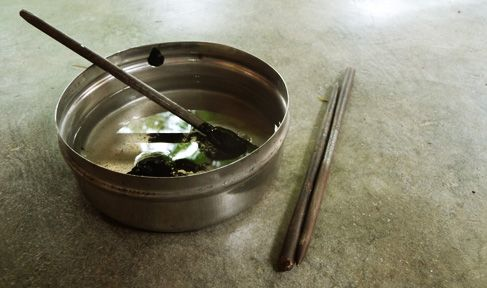
The process of painting is a very tedious and cumbersome task. Initially, the craftsmen lay the fabric to be painted on the floor. Next, they take a lump of the dye paste and put it on the palm of one hand. They hold a suya rod or a metal stylus in the other hand and mix the thick paste till it stretches into a thread-like structure. 

They carefully twist the rod to create beautiful motifs and patterns across the fabric without the rod touching the cloth. After that, they fold the fabric and press it evenly to obtain an identical impression on the other half of the fabric. Lastly, the fabric is left out in the sunlight for about six to seven hours to let it dry.

The intricate motifs that embellish the fabric, such as geometric flowers, peacocks, the tree of life, etc., are inspired by the history and folk culture of the Kutch region of Gujarat.

Originally, the Rogan Art was used to adorn the trousseau of a bride. But due to the limited resources, meeting the market demand has become a challenge. From almost becoming a dying art to gaining worldwide recognition, Rogan Art sure has come a long way.