Development

Development has been a topic of discussion and debate since several decades. It has a very deep meaning. When we talk about development of a particular thing, we should know it’s roots first. We need to understand 3 aspects of that object:-

  1. First existence:- where or how it came into existence?
  2. How it evolved with the passage of time? 
  3. It’s current stage.

These are the three aspects that determines rate of development. 

Development at personal level:-

Self development and analysis plays a cruicial role in personality development. It means evolution of our understanding and knowledge. When we were kids, we were dumber and easily manipulated. But as of now, we know what’s for our well being and what’s not. This growth is defined as development. There’s an ethical side of development too. For instance, if someone act rudely unnecessarily, we should confront them straight in the most decent way possible rather than abusing them, no matter what, we should not be unnecessarily cruel to anyone. This understanding can be a part of development as well. 

Development as a whole:-

The term national development is very comprehensive. It includes all aspects of the life of an individual and the nation.It is holistic in approach. It is a process of reconstruction and development in various dimensions of a nation and development of individuals. It includes full-growth and expansion of our industries, agriculture, education, social, religious and cultural institutions. Moreover, national development implies development of a nation as a whole. It can be best defined as the all-round and balanced development of different aspects and facets of the nation viz. political, economic, social, cultural, scientific and material. 

John Vaizey, noted economist defines:

“National development is the total effect of all citizen forces and addition to the stock of physical, human resources, knowledge and skill.”

Broadly, development of the nation encapsulates such parameters as:

(i) Development through a planned national economy

(ii) Increase in agricultural production through application of modern technical 

(iii) Harnessing industrial production

(iv) Development of human resource

(v) Application of science and technology in production sector

(vi) Provision of mass education and

(vi) Provision of various facilities to meet the needs and aspirations of disadvantaged, deprived and poorest of the poor segments of population.

National War Memorial

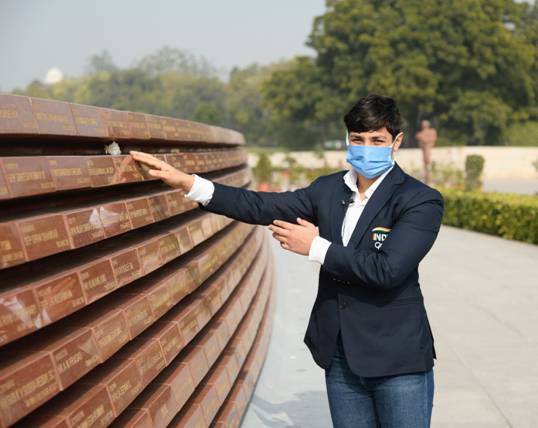
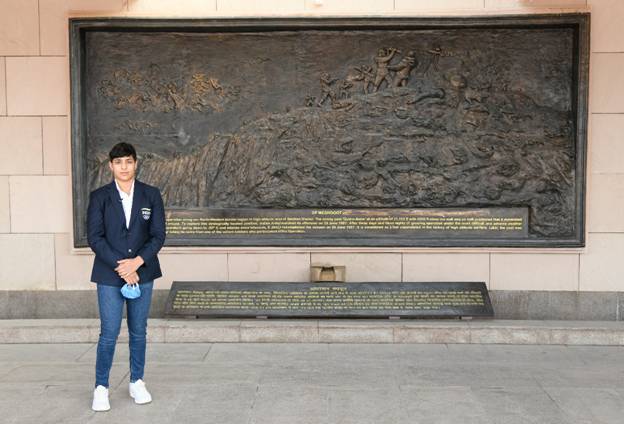
 Wrestler Anshu Malik, who recently etched her name in history books by becoming the first Indian woman to win Silver in the World Championships, visited the National War Memorial at New Delhi.

The 20-year-old Indian wrestler took a tour around the national monument which is designed in a circular form, with ramps leading down into a large amphitheatre-like circular space, in the centre of which stands an obelisk. At the base of this, burns the eternal flame ‘Amar Chakra’ in the memory of all the soldiers who laid their lives during the armed conflicts of Independent India.

“Visiting this monument of great national importance, I feel that it has so much knowledge to offer about the glorious war history of our country. Seeing the names of around 26,500 fallen soldiers carved in the bricks of the Tyag Chakra made me feel as that each soldier is like another strong brick in the nation’s defensive wall”, said Anshu.

“Like the eternal flame in the Amar Chakra, all of these martyrs as well as their act of valour will always remain immortal in the heart of every Indian,” she added.

Meanwhile, Anshu paid tribute to Capt. Pawan Kumar from Dogra Regiment who also hailed from her native town, Jind in Haryana. “It was a great experience visiting the National War Memorial. I urge every Indian to visit this Memorial and witness an important part of India’s history.”

“When a common citizen or any other public figure shows interest in visiting and knowing the war history of the country, we as a soldier feel very encouraged and honoured about belonging to the Armed Forces,” said an Army Official who guided the athlete in understanding all the sections of the memorial.

*******

National Girl Child Day

 National Girl Child Day is celebrated in the country on January 24 every year with an objective to provide support and opportunities to the girls of India. It aims towards promoting awareness about the rights of the girl child and to increase awareness on the importance of girl education, and their health and nutrition and also to promote the girls position in the society to make their living better among the society. Gender discrimination is a major problem that girls or women face throughout their life. National Girl Child Day was first initiated in 2008 by the Ministry of Women and Child Development.

Objectives of National Girl Child Day

The objective of National Girl Child Day is to create awareness about the rights a girl owns and to give girls the opportunities like everyone else, also to support the girl child of the nation and remove gender-based biases. Another objective of celebrating this day is to promote awareness about the inequalities that a girl child faces and educate people about girl’s education. Basically to value them and to respect them like everybody else and give a new perspective towards girl child and to decrease discrimination. The main focus is on changing society’s attitude towards girls, decrease female feticide and create awareness about the decreasing sex ratio.

Steps Taken by the Government

Government of India has taken several steps over the years to improve the conditions of girls. Government has started several campaigns and programmes some of them are :

  1. Save the Girl Child,
  2. Beti Bachao Beti Padhao,
  3. Sukanya Samriddhi Yojana
  4. CBSE Udaan Scheme
  5. Free or subsidized education for girl child,
  6.  Reservation for women in colleges and universities

g. National Scheme of Incentive to Girls for Secondary Education


Background of BBBP


Census 2011 data was a call for urgent action, because it highlighted that the girl child is increasingly being excluded from life itself. The unabated decline in Child Sex Ratio (CSR) since 1961 (from 976 in 1961 to 927 in 2001 and 918 in 2011) was   a matter of grave concern as it reflected the low status of women in our society and indicates her disempowerment over a life-cycle continuum. Declining CSR is also indicative of pre-birth discrimination manifested through gender biased sex selection and post birth discrimination against girls (in terms of health care, nutrition and educational opportunities).

Year

1961

1971

1981

1991

2001

2011

Child Sex Ratio

976

964

962

945

927

918


CSR continued declining in spite of a strong legal and policy framework and various Government initiatives. The sharp decline is associated with an intersection of various factors such as the increasing spread and misuse of technology for prenatal sex selective elimination, changing aspirations of urban and rural societies, changes in family structures and reproductive decision making, favoring a smaller family size. This has accentuated the son preference, associated with the low status of women in society, patriarchal social norms and the disturbing pattern of gender based violence faced by girls and women across the life cycle.

Despite various policy and programmatic provisions, addressing adverse and steeply declining CSR remains a critical challenge. Efforts are needed to ensure survival, protection and education of girl child to help realize her full potential. In this   regard, the Hon’ble President of India, in his address to the Joint Session of the Parliament on June 9, 2014 had stated that “With a commitment of “Beti Bachao Beti Padhao”, my government will launch a mass campaign for saving the girl child and enabling her education. Further the Finance Minister in Budget speech 2014-15 also reiterated Government of India’s commitment by setting aside Rs. 100 Cr. Hon’ble Prime Minister expressed deep concern over the decline in CSR in his Independence Day address.

In this background, Beti Bachao Beti Padhao (BBBP) Scheme was launched by the Hon’ble Prime Minister on 22nd January, 2015 in Panipat, Haryana to address the issue   of decline in CSR and related issues of empowerment of girls and women over a life cycle continuum.


The Scheme was initially launched in 100 districts in 2014-15 (Phase-1), and was  expanded to 61 additional districts in 2015-16 (Phase-2). Following initial success of the scheme, the initiative has been expanded to 640 districts of the Country (as per Census 2011) on 8th March 2018.

The Overall Goal of the Beti Bachao Beti Padhao (BBBP) Scheme is to celebrate the girl child, enable her education.


 Objectives and target groups:


The Scheme is being implemented with a goal to celebrate the girl child and   enable her education. The objectives of the Scheme are as under:


    1. To prevent gender biased sex selective elimination
    2. To ensure survival and protection of the girl child
    3. To ensure education and participation of the girl child

Implementation Status and acheivement:


Scheme has stirred up collective consciousness towards changing the mindset of the public to acknowledge the rights of the girl child. The scheme has resulted in increased awareness and sensitization of the masses. It has raised concerns around the issue of declining CSR in India. As a result of collective consciousness of the people supporting the campaign BBBP has found its place in public discourse.


  • Increase in 19 points in Sex Ratio at Birth at National level from 918 (2014-15) to 937 (2020-21). (Source: HMIS data, MoHFW (April-March, 2014-15 & 2020-21)
  • Gross Enrolment Ratio (GER):  Enrollment of Girls in secondary education increased from  77.45% in 2014-15 to 81.32% in 2018-19. (Source: U-DISE, Mo Education (2018-19 data is provisional)
  • Under Five Child Mortality (Female) has reduced from 45 in 2014 to 36 in 2018. (Source: SRS census india.gov.in)
  • Percentage of 1st Trimester ANC Registration has shown improvement from 61% in 2014-15 to 73.9% in 2020-21. (Source: HMIS data, MoHFW (April-March, 2014-15 & 2020-21)
  • Percentage of Institutional Deliveries has also shown an improvement from 87% in 2014-15 to 94.8% in 2020-21. (Source: HMIS data, MoHFW (April-March, 2014-15 & 2020-21)

NATIONAL GIRL CHILD DAY-2022

In view of COVID 19 situation in the country, it has been decided that all programs should be organised on virtual/ online mode and all kinds of physical interactions should be avoided.

Pradhan Mantri Rashtriya Bal Puraskar-2022

On the occasion of National Girl Child Day on 24th January and as part of Azadi Ka Amrit Mahotsav, a virtual function would be held to recognise the exemplary achievements of children by facilitating PMRBP awardees of 2022. Hon’ble Prime Minister would interact virtually with winners of PMRBP-2022.  The children along with their parents and concerned District Magistrate of their respective district would join the event from their district Head Quarters.

During the function, Hon’ble Prime Minister would give digital certificates to winners of PMRBP.  The certificates would also be given to winners of PMRBP 2021, who could not be given the certificates last year due to COVID situation. The cash prize of Rs.1,00,000/- to be given to the awardees of PMRBP 2022 would also be transferred to the respective account of winners during the programme.


Webinars to be held on 24.1.2022

The Minister, MoWCD, Smt Smriti Zubin Irani will interact with children  from few marginalised identities from across the country in an online event ‘Kanya Mahotsav’- #LadkiyanJahanKhushiyanwahan organised by UNICEF as part of Azadi Ka Amrut Mahotsav. The program will be livestreamed.

The Minister, Ministry of Textile, Commerce and Industries, Consumer Affairs and food & Public Distribution, Shri Piyush Goyal will hold a virtual interactive session with young girls who have made noteworthy innovations in different areas that is pioneering.

        The Minister of State, Ministry of Science and Technology, Shri Jitendra Singh will also interact with young women entrepreneurs who have made noteworthy achievements in the fields of science and technology on a virtual platform.

These interactions with the Ministers will act as a catalyst and inspire such other million girls to have conviction in their ideas and to follow their heart on the path towards economic independence.

National Commission of Women is organizing a virtual discussion through which their speakers will contribute to raise awareness about the rights of girls and on the importance of girl education.

NIPCCD will be organising a webinar on “Addressing Comprehensive Needs of Adolescent Girls in India” #Ladkiyanjahankhusiyanwahan. The talking points of the Webinar will be   Healthy eating during adolescence · Challenges of Adolescent Girls with reference to Education & Way forward · Need and importance of Psychosocial Development among Adolescent Girls

NCPCR will be holding a webinar on the topic,’ Legislative Rights of the Girl Child’. Hon’ble Justice Shri Kalpesh Satyendra Jhaveri, former Chief Justice of Orissa High Court will be the main speaker for the webinar.

All the States/UTs s and 405 multi – sectoral districts under BBBP to organize online programmes such as Gram Sabha/Mahila Sabha on CSR, programme with schools on value of girl child, Posters/Slogan-writing/ Drawing/ Painting competition among school on STEM related topics, and run stories in local media about BBBP local champions etc.

********

PRADHAN MANTRI RASHTRIYA BAL PURASKAR-2022

 29 Children have been conferred the Pradhan Mantri Rashtriya Bal Puraskar this Year, selected from all regions of the country for their exceptional achievements in Innovation (7), Social Service (4), Scholastic (1), Sports (8), Art & Culture (6) and Bravery (3) categories.  There are 15 Boys and 14 Girls among the awardees belonging to 21 States and UTs.

In view of the unprecedented circumstances emerging due to COVID-19 situation in the country, it was not possible to organise a physical ceremony at New Delhi. In order to felicitate and motivate the exceptional works of children, a function was held virtually on the occasion of National Girl Child Day today and also as part of Azadi Ka Amrit Mahotsav. The Awardees of PMRBP 2021 and 2022 along with their parents and concerned District Magistrate of their respective district joined the event from their district Head Quarters. 

During the function, Hon’ble Prime Minister Shri Narendra Modi gave digital certificates to the 61 winners of PMRBP 2021 and 2022 using a Block Chain-driven technology developed by IIT Kanpur under the National Blockchain Project.  The digital certificates are stored on digital wallets installed on the mobile devices of the recipients. The digital certificates issued using the blockchain driven technology are unforgeable, globally verifiable, selectively disclosable and sensitive to user content. Block Chain Technology is being used for the first time for giving certificates to the awardees.

The cash prize of Rs.1,00,000/- was given to the awardees of PMRBP 2022 which was transferred online to the respective accounts of winners during the programme by the Hon’ble PM.

The Hon’ble Prime Minister interacted virtually with the winners of PMRBP 2022. Union Women and Child Development Minister Smt Smriti Zubin Irani and Dr. Munjpara Mahendrabhai, Minister of State were among those present on the occasion.

Interacting with Master Avi Sharma of Indore, Madhya Pradesh the Prime Minister enquired about the secret of his prolific output with regard to various aspects of Ramayana. Master Avi Sharma said that he got the inspiration by the decision of broadcasting the serial Ramayana during the lockdown. Avi also recited some couplets from his creation. The Prime Minister narrated an incident when he went and heard Sushri Uma Bharti Ji when, as a child, she showed immense spiritual depth and knowledge in a programme. He said there is something in the soil of Madhya Pradesh that gives rise to such precocious talent. The Prime Minister told Avi that he is an inspiration and an example of the adage that you are never too young to do big things.

Interacting with Kumari Remona Evette Pereira from Karnataka, the Prime Minister discussed her passion for Indian Dance. He inquired about the difficulties she faced in pursuing her passion. The Prime Minister complimented her mother for ignoring her own adversities to realise her daughter’s dreams. The Prime Minister said that Remona’s achievements are much bigger than her age and told her that her art is a way of expressing the strength of the great country.

Interacting with Kumari Puhabi Chakraborti of Tripura, the Prime Minister enquired about her COVID related innovation. She also informed the Prime Minister about her fitness app for sportspersons. The Prime Minister asked about the support she receives from the school, friends and parents in her endeavour. He asked about her balance in devoting her time to sports as well as developing innovative apps.

Interacting with Master Dhiraj Kumar from West Champaran, Bihar, the Prime Minister asked about the incident where he saved his younger brother from a crocodile attack. PM asked about his state of mind while saving his younger brother and how he feels after the fame he got now. The Prime Minister praised his courage and presence of mind. Dhiraj told the Prime Minister that he wants to serve the country as an Army soldier.

Interacting with Master Meedhansh Kumar Gupta from Punjab, the Prime Minister enquired about his achievement of creating an app for COVID issues. The Prime Minister said that in children like Meedhansh he feels that the government efforts to promote entrepreneurship are bearing fruit and a tendency to become job providers instead of being job seekers is becoming more pronounced.

Interacting with Kumari Tarushi Gaur from Chandigarh, the Prime Minister enquired about her opinion on the balance between sports and studies. The Prime Minister asked why Tarushi idolises Boxer Mary Kom. She informed the Prime Minister that she likes her because of her commitment to excellence and balance that she strikes as a sportsperson and as a mother. The Prime Minister said that the government is committed to providing all the facilities to the sportspersons and creating a mindset of winning at every level.

Addressing the gathering, the Prime Minister noted that these awards become all the more significant in the light of the fact that they have been conferred during the important period when the country is celebrating Azadi Ka Amrit Mahotsav. He said this is the time to draw energy from the past and dedicate oneself to achieving great results in the coming 25 years of the Amrit kaal. He also greeted the daughters of the country on National Girl Child Day. The Prime Minister remembered the glorious history of the Freedom Struggle and the contribution of Birbala Kanaklata Barua, Khudiram Bose and Rani Gaidinilu. “These fighters had made the country’s freedom the mission of their lives at a very young age and had dedicated themselves for it” the Prime Minister noted.

The Prime Minister also recalled his visit to the Nowshera sector of Jammu and Kashmir on Diwali last year where he met Baldev Singh and Basant Singh who had played the role of child soldiers in the post-independence war. They Helped his army at such a young age without caring about their life. The Prime Minister paid tribute to the bravery of these heroes.

The Prime Minister cited examples of the bravery and sacrifice of the sons of Guru Gobind Singh Ji. He pointed out that when the Sahibzadas had sacrificed with immense valour, they were very young. Their sacrifice for India’s civilization, culture, faith and religion is incomparable. The Prime Minister asked the youngsters to know more about the Sahibzadas and their sacrifice.

The Prime Minister remarked that a digital statue of Netaji Subhas Chandra Bose has also been installed near India Gate in Delhi. “We get the biggest inspiration from Netaji – duty of the nation first. Taking inspiration from Netaji, you have to proceed on the path of duty for the country”, Shri Modi added.

The Prime Minister said that in any sector, policies and initiatives are keeping youth at the centre. He cited initiatives like Start Up India, Stand Up India, Digital India, Make in India along with Jan Andolan of Aatmnirbhar India and creation of modern infrastructure. This, he said, is in sync with the speed of the youth of India who are leading this new epoch both in India and outside. The Prime Minister underlined the growing prowess of India in the innovation and start-up sphere. He conveyed the nation’s pride in the fact of major global companies being led by Indian young CEOs. “Today we feel proud when we see the youth of India excelling in the world of startups. Today we feel proud when we see that the youth of India are innovating, taking the country forward”, the Prime Minister said.

The Prime Minister said in areas where daughters were not even allowed earlier, daughters are doing wonders in them today. This is the new India, which does not hold back from innovating, courage and determination are the hallmarks of India today.

The Prime Minister lauded that the children of India have shown their modern and scientific thinking in the vaccination program as well. Since January 3, in just 20 days, more than 40 million children have got the corona vaccine. He also lauded them for their leadership in the Swachch Bharat Abhiyan. The Prime Minister appealed to them to be an ambassador for Vocal for Local and lead the campaign of Aatmnirbhar Bharat.

List of the PMRBP, 2022 awardees are as under:

AWARDEES OF PRADHAN MANTRI RASHTRIYA BAL PURASKAR-2022


S. No.

Name

Category

State


Gauri Maheshwari

Art & Culture

Rajasthan

  1.  

Remona Evette Pereira

Art & Culture

Karnataka

  1.  

Deviprasad

Art & Culture

Kerala

  1.  

Syed Fateen Ahmed

Art & Culture

Karnataka

  1.  

Daulas Lambamayum

Art & Culture

Manipur

  1.  

Dhritishman Chakraborty

Art & Culture

Assam

  1.  

Gurugu Himapriya

Bravery

Andhra Pradesh

  1.  

Shivangi Kale

Bravery

Maharashtra

  1.  

Dhiraj Kumar

Bravery

Bihar

  1.  

Shivam Rawat

Innovation

Uttarakhand

  1.  

Vishalini N C

Innovation

Tamil Nadu

  1.  

Jui Abhijit Keskar

Innovation

Maharashtra

  1.  

Puhabi Chakraborti

Innovation

Tripura

  1.  

Aswatha Biju

Innovation

Tamil Nadu

  1.  

Banita Dash

Innovation

Odisha

  1.  

Tanish Sethi

Innovation

Haryana

  1.  

Avi Sharma

Scholastic

Madhya Pradesh

  1.  

Meedhansh Kumar Gupta

Social Service

Punjab

  1.  

Abhinav Kumar Choudhary

Social Service

Uttar Pradesh

  1.  

Pal Sakshi

Social Service

Bihar

  1.  

Aakarsh Kaushal

Social Service

Haryana

  1.  

Arushi Kotwal

Sports

Jammu & Kashmir

  1.  

Shriya Lohia

Sports

Himachal Pradesh

  1.  

Telukunta Virat Chandra

Sports

Telangana

  1.  

Chandhary Singh Choudhary

Sports

Uttar Pradesh

  1.  

Jiya Rai

Sports

Uttar Pradesh

  1.  

Swayam Patil

Sports

Maharashtra

  1.  

Tarushi Gaur

Sports

Chandigarh

  1.  

Anvi Vijay Zanzarukia

Sports

Gujarat


Following is the Link for Details of Awardees of PMRBP-2022:

Pradhan Mantri Rashtriya Bal Puraskar 2022 – Awardees – YouTube

Children of India have shown their modern and scientific temperament

 Prime Minister Shri Narendra Modi interacted with Pradhan Mantri Rashtriya Bal Puraskar (PMRBP) awardees today via video conference. Digital certificates were conferred on PMRBP awardees for the years 2022 and 2021 using Blockchain Technology. This technology was used for the first time for giving certificates to awardees. Union Women and Child Development Minister Smt Smriti Zubin Irani and Dr. Munjpara Mahendrabhai, Minister of State were among those present on the occasion.

Interacting with Master Avi Sharma of Indore, Madhya Pradesh the Prime Minister enquired about the secret of his prolific output with regard to various aspects of Ramayana. Master Avi Sharma said that he got the inspiration by the decision of broadcasting the serial Ramayana during the lockdown. Avi also recited some couplets from his creation. The Prime Minister narrated an incident when he went and heard Sushri Uma Bharti Ji when, as a child, she showed immense spiritual depth and knowledge in a programme. He said there is something in the soil of Madhya Pradesh that gives rise to such precocious talent. The Prime Minister told Avi that he is an inspiration and an example of the adage that you are never too young to do big things.

Interacting with Kumari Remona Evette Pereira from Karnataka, the Prime Minister discussed her passion for Indian Dance. He inquired about the difficulties she faced in pursuing her passion. The Prime Minister complimented her mother for ignoring her own adversities to realise her daughter’s dreams. The Prime Minister said that Remona’s achievements are much bigger than her age and told her that her art is a way of expressing the strength of the great country.

Interacting with Kumari Puhabi Chakraborti of Tripura, the Prime Minister enquired about her COVID related innovation. She also informed the Prime Minister about her fitness app for sportspersons. The Prime Minister asked about the support she receives from the school, friends and parents in her endeavour. He asked about her balance in devoting her time to sports as well as developing innovative apps.

Interacting with Master Dhiraj Kumar from West Champaran, Bihar, the Prime Minister asked about the incident where he saved his younger brother from a crocodile attack. PM asked about his state of mind while saving his younger brother and how he feels after the fame he got now. The Prime Minister praised his courage and presence of mind. Dhiraj told the Prime Minister that he wants to serve the country as an Army soldier.

Interacting with Master Meedhansh Kumar Gupta from Punjab, the Prime Minister enquired about his achievement of creating an app for COVID issues. The Prime Minister said that in children like Meedhansh he feels that the government efforts to promote entrepreneurship are bearing fruit and a tendency to become job providers instead of being job seekers is becoming more pronounced.

Interacting with Kumari Tarushi Gaur from Chandigarh, the Prime Minister enquired about her opinion on the balance between sports and studies. The Prime Minister asked why Tarushi idolises Boxer Mary Kom. She informed the Prime Minister that she likes her because of her commitment to excellence and balance that she strikes as a sportsperson and as a mother.  The Prime Minister said that the government is committed to providing all the facilities to the sportspersons and creating a mindset of winning at every level.

Addressing the gathering, the Prime Minister noted that these awards become all the more significant in the light of the fact that they have been conferred during the important period when the country is celebrating Azadi Ka Amrit Mahotsav. He said this is the time to draw energy from the past and dedicate oneself to achieving great results in the coming 25 years of the Amrit kaal.  He also greeted the daughters of the country on National Girl Child Day.  The Prime Minister remembered the glorious history of the Freedom Struggle and the contribution of Birbala Kanaklata Barua, Khudiram Bose and Rani Gaidinilu. “These fighters had made the country’s freedom the mission of their lives at a very young age and had dedicated themselves for it” the Prime Minister noted.

The Prime Minister also recalled his visit to the Nowshera sector of Jammu and Kashmir on Diwali last year where he met Baldev Singh and Basant Singh who had played the role of child soldiers in the post-independence war. They Helped his army at such a young age without caring about their life. The Prime Minister paid tribute to the bravery of these heroes.

The Prime Minister cited examples of the bravery and sacrifice of the sons of Guru Gobind Singh Ji. He pointed out that when the Sahibzadas had sacrificed with immense valour, they were very young. Their sacrifice for India’s civilization, culture, faith and religion is incomparable. The Prime Minister asked the youngsters to know more about the Sahibzadas and their sacrifice.

The Prime Minister remarked that a digital statue of Netaji Subhas Chandra Bose has also been installed near India Gate in Delhi. “We get the biggest inspiration from Netaji –  duty of the nation first.  Taking inspiration from Netaji, you have to proceed on the path of duty for the country”, Shri Modi added.

The Prime Minister said that in any sector, policies and initiatives are keeping youth at the centre. He cited initiatives like Start Up India, Stand Up India, Digital India, Make in India along with Jan Andolan of Aatmnirbhar India and creation of modern infrastructure. This, he said, is in sync with the speed of the youth of India who are leading this new epoch both in India and outside. The Prime Minister underlined the growing prowess of India in the innovation and start-up sphere. He conveyed the nation’s pride in the fact of major global companies being led by Indian young CEOs. “Today we feel proud when we see the youth of India excelling in the world of startups. Today we feel proud when we see that the youth of India are innovating, taking the country forward”, the Prime Minister said.

The Prime Minister said in areas where daughters were not even allowed earlier, daughters are doing wonders in them today. This is the new India, which does not hold back from innovating, courage and determination are the hallmarks of India today.

The Prime Minister lauded that the children of India have shown their modern and scientific thinking in the vaccination program as well. Since January 3, in just 20 days, more than 40 million children have got the corona vaccine. He also lauded them for their leadership in the Swachch Bharat Abhiyan. The Prime Minister appealed to them to be an ambassador for Vocal for Local and lead the campaign of Aatmnirbhar Bharat.

***

आज़ादी के खातिर – त्रिलोक कुमार

खून खौल जाता है
जब देश का कोई अपमान करे,

खून खौल जाता है
जब वीरो का कोई न  सम्मान करे,

बहुतो ने आज़ादी के खातिर
अपना लघु बहाया है

कितनो ने फासी को चूमा
कितनो ने गोली खाया है,

तब जाके हमने ये चैन के निंद पाया है
हम कदर करे उन वीरो का
हम सम्मान करे उन वीरो का
जिन्होंने सर्वस्य गवा के हमे ये समान दिलाया है,

तब जाके हैं कही अपना गर्व से सिर उठाया है
हमे अलख जागआना है

राष्ट्र प्रेम दिखलाना है
उन महान वीरो का बलिदान न व्यर्थ हो
दुश्मन चाहे कोई हो अपने प्रहार न पस्त हो,

भारत मा के वीर सिपाही हम करते आपका सम्मान 
आपने बढ़ाया है हम सबका मान

कुछ सपने देखे थे वीरो ने
ऐयसे राष्ट्र बनाना है

कोई न हो दुश्मन सबको अपनआ बतलाना है
कुछ भ्रस्ट लोगो ने मिलके सपने को अपमान किया
हम लोगो ने भी मिलके उनको है नकार दिया।।।

खून खौल जाता है
जब देश का कोई अपमान करे,

खून खौल जाता है
जब वीरो का कोई अपमान करे

कवि – श्री त्रिलोक कुमार


developing the linkage between educational institutions, Industries and R&D Institutions

 Steps taken by the Government for developing the linkage between educational institutions, Industries and R&D Institutions are as follows:

I.          Impacting Research Innovation & Technology (IMPRINT): This initiative aims at providing solutions to the most relevant engineering challenges and translating knowledge into viable technology in 10 selected technology domains, viz. Health care, energy, sustainable habitat, nano technology hardware, water resources and river systems, advanced materials, Information and communication technology, manufacturing, security and defense, and environmental science and climate change. It is a pan IITs and IISc Joint Initiative seeking to develop a roadmap for research. During 2018-2019 Rs. 46.30 crore and during 2019-2020 Rs. 47.20 crore has been released.

I.          Research Park: Research park at IIT Delhi, IIT Guwahati, IIT Kharagpur, IIT Kanpur, IIT Chennai, have been established which provide an interface between entrepreneurship and Industry to establish their R&D units in collaboration with students & faculty members of the IITs. In the year 2020-21 Rs. 144.50 crore has been released.

II.        UchhatarAvishkarYojana (UAY): This initiative promotes innovation of a higher order that directly impacts the needs of the Industry and thereby improves the competitive edge of Indian manufacturing. The project envisages collaboration between the academia and industry – within or outside India.

In order to provide impetus to vocational education the allocation in 2021-22 for National Apprenticeship Training Scheme has been kept at Rs. 500 crore. Further, UGC has already issued guidelines for Apprenticeship/Internship Embedded Degree Program.

IMPACT OF FAMILY ENVIRONMENT ON CHILD’S PERSONALITY

Family plays a very significant role in all round development of a child. Parent- child interaction and parent’s way to deal with their children, develop certain attitudes among the children towards their home environment. The word climate is more comprehensive one. It includes within itself the word ‘environment’. The human element around the child is called’ environment’. It embraces the social, physical and emotional activities of the family. All these combined together constitute the ‘family climate’. Thus, family climate means an interpersonal relationship between the parents and child.

The family environment has a big impact on the quality of life of adolescents. The family environment can be a strong source of support for developing adolescents, providing close relationships, strong parenting skills, good communication, and modeling positive behaviors. It can also be a problematic environment when these supports are lacking, or when negative adult behaviors like smoking and heavy drinking are present. Where adolescent health is concerned, clearly the family matters, and parents’ matter.

CLOSENESS AND COMMUNICATION

Close connections, healthy communication, and perceived parental help are particularly significant during puberty, as youngsters experience numerous physical and emotional changes. For instance, research shows youngsters who have positive associations with their parents represent less chances of participating in different risky practices, including smoking, fighting, and drinking. They are also less chances of showing indications of depression and bound to report undeniable degrees of well-being. Young people who report trouble chatting with their parents are bound to drink liquor every now and again, smoke, and feel miserable (particularly young ladies).

  • Numerous 15-year-olds report trouble talking with their moms and fathers about things that truly trouble them.

Information from 1998 demonstrate that 32% of 15-year-olds explained experiencing issues consulting with their moms about things that truly trouble them. Parent-youngster communication issues are significantly more normal with fathers, where 53% of females and 42% of guys announcing that it is troublesome or extremely challenging for them to examine issues that truly trouble them with their dads. While general communication is vital, parents can also help prevent certain risk behaviours by specifically taking steps to discuss these behaviours with their adolescents.

PARENTAL MONITORING

Parental checking incorporates knowing youngsters’ whereabouts after school, just as knowing kids’ companions and exercises. These practices, when joined with parental help, have been demonstrated to be decidedly connected with higher young adult confidence, higher GPAs in school, and more prominent scholastic achievement. Furthermore, parental checking has been related with less disguising practices, like withdrawal and sorrow, and externalizing conduct issues, like battling and upsetting others, just as a lower probability of drinking, smoking, and taking part in other dangerous practices.

Most teenagers report that their parents know where they are after school. In 2004, 88% of 10th graders detailed that they accept their parents know where they are after school mostly or constantly. Rates were comparable among eighth graders. Detailed degrees of parental mindfulness varied fairly by race and family structure. Among 10th graders in 2004, white understudies were more probable than dark understudies to report that their parents knew where they were after school mostly or constantly (90% versus 83% individually). Understudies who resided with two guardians were almost certain than those in single parent families to report that their parents knew where they were after school mostly or constantly.

EATING MEALS TOGETHER

Family dinners fill in as a significant time for youths to speak with and invest energy with their parents, and have been related with less substance use, misconduct, depressive symptoms, self-destruction, and with better grades and scholastic performance. Teenagers who eat dinners consistently with their parents are additionally bound to eat natural products, vegetables, and dairy food sources and less inclined to skip breakfast. More successive family dinners, a more organized family supper climate, and a positive air at family dinners are related with a lower probability of disordered eating.

PARENTAL HEALTH BEHAVIOUR

Parents’ health related practices can influence young adult well-being in more than one way including giving positive (or negative) good examples and by adding to healthy or unfortunate physical and social conditions. Parental habits can likewise shape young adult wellbeing practices by expanding simple access to cigarettes or liquor in the home, or, on the positive side, expanding admittance to quality food varieties.

Kids who live with somebody who smokes are probably going to breathe in recycled smoke, which builds their danger of creating medical conditions like pneumonia, bronchitis, and other lung sicknesses, just as increased asthma assaults and ear diseases.

  • Teenagers with better-instructed parents are more averse to be presented to smoking and weighty drinking by their parents.

Youngsters who can undoubtedly get to liquor or who have alcoholic parents have a more serious danger of developing their own concerns with liquor misuse, although other factors such as one’s peers also play a large role in determining whether an adolescent will abuse alcohol

  • Teenagers whose parents exercise are less inclined to be inactive themselves.

Almost 3/4 (72%) of teenagers have a parent who revealed practicing intensely somewhat recently. Parents with more significant levels of training are bound to report practicing intensely. In 2003, 77% of adolescents with a parent who had more than a high school degree reported exercising heavily in the last month, compared with 54% of adolescents whose parents had less than a high school degree. Adolescents living with two parents are also more likely than adolescents living with single mothers to have a parent who exercises heavily (79% compared with 54%, respectively).

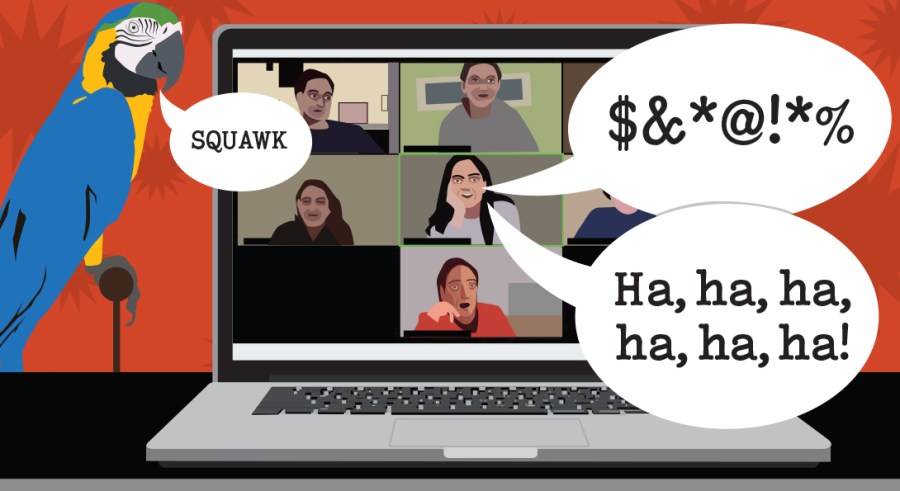
NETIQUETTE

The vast majority know about the term etiquette and what it conveys. From a young age, we are educated to act appropriately and have great habits. Presently, with many pieces of our lives moving web based, including even instruction, a need has emerged for a bunch of specific internet-based etiquette rules that apply to digital conduct.

Netiquette rules are a bunch of guidelines that direct what classy and conscious internet-based conduct is. Instructions to talk consciously without participating in disrespect or bullying is among the fundamental motivations behind why we want these principles. Thus, Netiquette is a blend of the words network and decorum and is characterized as a bunch of rules for satisfactory online behavior.

These standards will quite often change after some time because of the changing idea of the online-based space. For online children, all of the correspondence happens online which is the reason these guidelines are particularly vital to them. The following are a couple of ground netiquette decides for online classes that students ought to know about.

Be Careful with Your Tone

While an online discussion with companions doesn’t really need a lot of thought, the equivalent doesn’t go for when you are having a discussion with educators. You ought to be cautious with capitalization, as writing in ALL-CAPS can be viewed as YELLING!  not only that, it will also be considered discourteous. Likewise, a joke in many cases be seen as an inconsiderate comment. Therefore, you need to ensure that your point doesn’t lose all sense of direction in interpretation.

Be Accurate and Factual

The internet is a tremendous spot with data coming from a wide range of sources. To this end you ought to be cautious while giving data. It’s essential to check all that you read and incorporate sources when offering guidance or data.

Try not to Use Sarcasm Freely

While face to face, we speak with the assistance of looks and signals. Passing on a similar message online can be more challenging. This is particularly evident with regards to sarcastic humour, as it is ordinarily unimaginable to expect to send the tone of voice when sending message. A cheerful joke can be seen diversely in the text. You should be cautious with regards to making the goal behind your words as clear as could be expected, which is the reason sarcasm is forbidden in most occasions. Emojis and smileys can be useful when passing on sarcasm or humour.

Be Polite as You Seem to be In Person

Being polite on the internet ought to be pretty much as normal as, all things considered. Sadly, that isn’t true as a rule. Countless individuals will more often utilize the internet as a cover and their showcase as a safeguard, which prompts them composing what they could never say out in the open.

A critical piece of netiquette is just typing what you would be alright with expressing to somebody’s face. Thus, being aware and polite to others ought to be essential for your communication online. Furthermore, if you wouldn’t say it to somebody’s face, don’t say it online either.

Use Proper Grammar and Punctuation

Many individuals will generally fail to remember the guidelines that apply when conveying message online. Further, falling back on appropriate language and punctuation can cause the message to appear to be more professional and thought out. In addition to the fact that it makes your text more readable, yet it can likewise set you up for professional writing that you may do later on. Contemplate what you might want to understand yourself.  It should be easy to read and comprehensible. That way, you will save valuable time for somebody perusing your email, message, remark, or post. Thus, make sure to keep your composed correspondence formal and professional, and save alternate ways and text speak for your companions.

Remember That Nothing Is Private Online and Respect People’s Privacy

Online protection is something you should remember when composing anything. Most things you post and offer are likely to be there for quite a while. This implies that you should avoid anything considered improper and inconsiderate. Also, never forward private messages or photographs without the consent of those associated with the correspondence.

Treat others’ protection the same way you would need others to deal with your private data. You shouldn’t give the individual data of your colleagues and educators online to anybody. This implies being cautious with passwords, whereabouts, private discussions, and pictures. The equivalent goes for both your and others’ data, as it tends to be dangerous to circulate any of it without caution.

Respect Others’ Opinions

You ought to know that you’re not continuously going to agree with the assessments of your friends or teachers. In any case, remember that you have to be respectful in conversations. You can contradict somebody and regard their perspectives simultaneously. In this way, regard others’ perspectives and avoid putting down assessments that are unique in relation to yours. You can differ or talk about with somebody, obviously, however be sensitive and do that consciously.

ONLINE SHOPPING: ADVANTAGES AND DISADVANTAGES

These days, the vast majority incline toward online shopping. Some utilize the conventional approach of shopping, and some are utilizing the online based strategy to shop.

The Internet has altered the manner in which we shop. As a result of the various benefits and advantages, an ever-increasing number of individuals these days incline toward purchasing things online over the customary technique for going into stores.

BENEFITS

Convenience

Convenience is the greatest advantage. What other place would you be able to easily shop at 12 PM while in your night wear?

There are no lines to stand by in or cashiers to find or assist you with your buys, and you can do your shopping in minutes. Online shops offer us the chance to shop every minute of every day, and furthermore reward us with a ‘no pollution’ shopping experience. There could be no greater spot to purchase enlightening items like digital books, which are accessible to you immediately, when the installment goes through. Downloadable things bought online kill the requirement for any sort of actual material whatsoever, also, which helps the climate!

Better costs

Modest arrangements and better costs are accessible on the online, since items come to you direct from the producer or merchant without including brokers. In addition, it’s simpler to look at costs and track down a more ideal arrangement. Numerous internet-based locales offer markdown coupons and refunds. In addition to the fact that prices are better, you can save money on taxes too, since online shops are possibly needed to gather a sales tax assuming they have an actual area in your state. Factor in the saved cost of gas and parking and you have saved yourself truckload of cash!

More choices

The decisions online are astonishing. You can observe practically any brand or thing you’re searching for. You can get in on the most recent worldwide patterns without burning through cash on airfare. You can shop from retailers in different parts of the state, country, or even world as opposed to being restricted to your own place. A far greater selection of colors and sizes than you will find locally are at your disposal. Additionally, the stock is substantially more ample, so you’ll forever have the option to track down your size and shading. A few online based shops even acknowledge orders for unavailable things and ship when they come in.

No crowds

Particularly during occasions, celebrations, or the weekends, there can be a particularly immense headache. Additionally, being squashed in the crowd of customers in some cases causes us to feel hurried or rushed. You don’t need to fight for a parking place. These issues can be stayed away from when you shop online.

No pressure

Periodically when we’re out shopping, we wind up purchasing things that we don’t actually require, because shopkeepers pressure us or use their selling abilities to urge us to make these buys.

DISADVANTAGES

Negative environmental impact of packaging

Having your purchased item packed in few layers of plastic and cardboard packing and conveyed right to your front door is really great for you, yet not completely ideal for the climate. Regardless of whether you attempt to reuse the cardboard, you’re making waste by shopping online.

Transporting issues and delays

 Indeed, even the greatest and best transportation organizations and online retailers have their awful days, so it’s absolutely impossible to guarantee that you’ll get your hands on your purchase in time except if you get it from a store. Things get lost, bypassed, harmed, or conveyed to some unacceptable location more regularly than you can envision.

Risk of fraud

 Assuming you’re shopping online, there’s a bigger danger of fraud: Visa tricks, phishing, hacking, data fraud, fake items, fake sites, and different tricks are normal.

Investing a lot of time online

Particularly assuming your occupation necessitates that you check out a PC the entire day, you may get worn out during that screen time. Shopping online can transform into a long-distance race of looking over and clicking down deep, dark holes and in no time, you’ve been online for the majority of the day. The internet is a great spot to visit, yet you likely don’t have any desire to live there.

You don’t know precisely the thing you’re getting

 Except if you are personally acquainted with a brand or item, purchasing online requires an act of pure trust, one that doesn’t generally end in support of yourself. Sizes are regularly uncertain. You can’t decide surface, texture, fit, cut, quality, haul, or durability just by checking out a photograph. Items that looked incredible may feel shoddy, awkward or modest when you grasp them.

TIME MANAGEMENT

Time management is the most common way of arranging and controlling how long to spend on specific task. Further, it empowers a person to finish more in a limited timeframe, brings down pressure, and prompts career achievement.

Time management is the most common way of getting sorted out and arranging how to split your time between specific task and needs. The advantages of time management incorporate better habits and more productivity. Furthermore, it expands your concentration, assembles certainty, and permits you to design your time more effectively. Powerful time management helps leaders, business people, and entrepreneurs accomplish their objectives. Dealing with your time effectively further develops balance between fun and serious activities and builds joy. Additionally, it diminishes pressure and permits you to accomplish your objectives quicker and more straightforward.

Time management benefits you in each aspect of your life. It is essential to help you to focus on better. Good time management likewise makes you more deliberate with regards to how to contribute your time. Dealing with your time, assists you with working more efficiently, so you can accomplish more quicker than expected and catch more opportunities. Thereafter, it also assists you with augmenting your assets and plan your day effectively. Not only that, time management helps you with working more efficiently, guaranteeing you accomplish more useful work significantly quicker.

ADVANTAGES

1. Diminished pressure

Figuring out how to deal with your time can decrease your feelings of anxiety. Since you can plan more smaller pieces of your day, you can leave space for inconsistencies or issues that may cause pressure.

2. Expanded efficiency

When you ace time management, you’ll be better prepared to follow through with jobs or activities more rapidly, expanding your productivity. You might see that you’re wrapping up a job quicker than expected and stressing less with regards to deadlines. By following a schedule, tracking deadlines in management programming or keeping a daily agenda of approaching deadlines, you are more likely to arrange your work around those deadlines.

3. Positive reputation

At a point when you stay updated about your work and stay on a timetable, your associates and manager are probably going to acknowledge as they can depend on you and hold you in higher respect. You will be known as somebody who doesn’t hesitate or push undertakings off on others since you’re not sure about achieving them. A positive reputation in the working environment can prompt professional success, expanded acquiring potential, more obligations and better working environment.

4. More energy for free time

Successful time management procedures make you aware when an assignment will be finished, lessening how much energy you may spend stressing whether you can complete all of your work for the afternoon. All things being equal, you can design time for a break from your standard everyday practice. Since time management permits you to arrange when your work will be done before you start it, you can save energy for your leisure time. Having more spare energy can further develop your balance between fun and serious activities and guarantee you’re saving some time for yourself.

5. Clear day by day objectives

By using time management to organize what you need to do each day, you can simplify your day and spend less time deciding what to do or how to do it.

CONSEQUENCES OF POOR TIME MANAGEMENT

Poor reputation
Wasted time
Low quality of work
Loss of control
Helpless work process

Bridge to Terabithia by Katherine Paterson

Bridge to Terabithia is one of the most classic books you may ever read about friendship, imagination, and loss. And, with all of these elements, the book won Katherine Paterson her first Newbery Medal in 1978 (she won another for Jacob Have I Loved in 1981). The novel won a lot of other honors, too, including being named an ALA Notable Children’s Book in 1977 and a School Library Journal Best Book of 1977.

Summary

This is a story about a boy named Jessie who lives with his family in a small town called Lark Creek and has a hard family life. He likes to draw and to run, and is kind of lonely; he’s out-of-place in his family and the only person he really gets along with is his little sister May Belle. He’s about to enter the fifth grade and has been training all summer to be the fastest runner in school.  

The Burke family moves in next door.  Their daughter, Leslie, is creative and smart and becomes Jessie’s classmate.

When the big day of the race arrives at school, however, Jessie gets beaten by Leslie. And, at first Jess is crushed, but later he and Leslie end up becoming good friends.

Since they’re both outcasts, Jess and Leslie spend a lot of time together. They take over a part of a nearby forest that’s only accessible by swinging on a rope over the creek, and name it Terabithia. In this imaginary land, they are king and queen. They can escape from the bullies and the boredom of fifth grade, and dream all they like. When Janice Avery, the resident bully, takes May Belle’s Twinkies, Jess and Leslie get revenge by writing her a fake love note and humiliating her.

The most of the school year has passed. Jess gives Leslie a puppy for Christmas, and she becomes a member of their Terabithia kingdom. They also assist Leslie’s father with the construction of their new home. When they discover Janice the bully is truly upset, they work together to comfort her.

By Easter, it’s been raining continuously for a month and crossing the creek to Terabithia has gotten more difficult. Leslie attends Easter service with Jess’s family. After the service, Leslie and Jess, along with May Belle, debate whether people who do not believe in the Bible go to hell.

One day after Easter, Jess thinks it’s too dangerous to go to Terabithia, with all of the rain that’s been coming down. But he forgets about it when Miss Edmunds, the school music teacher, calls and invites him to a museum with her. He goes and has one of the best days of his life. However, when he returns home, he discovers that Leslie had gone to Terabithia without him and died while attempting to cross the creek.

At first, Jess refuses to believe it. In meeting with Leslie’s parents and spending time with her dog, he slowly begins to understand what he’s lost…but also what he gained by having Leslie in his life at all.

He goes to Terabithia to try to figure out what’s going on, but his younger sister follows him and nearly drowns in the water. In rescuing her he realizes that  he has gained some of Leslie’s bravery.

Later, Jess returns to Terabithia and constructs a bridge across the creek. When May Belle follows him again, he welcomes her to Terabithia and guides her across the bridge.

Review

Despite portraying the power of imagination and the innocence of childhood, this is not really a children’s book in my opinion as it touches upon various adult-related themes and challenges many of the social conventions established in society.  It displays unusual relationships that children may not understand.  Of course, by that fact alone, it does not make the book false or bad, just, shall we say, unique.  

And of course, there is death.  One of the main characters in the story dies.  How is a child supposed to react to this?  How do children react to the death of someone they know?  There doesn’t seem to be a real answer presented to us from the author, but maybe the lack of an answer through Jessie’s struggles to come to understand his situation is relatable enough for children. 

All of these may fly over the heads of children. I do not know how children would take the book or what they would think but other than that it is a great read!

MENTAL HEALTH AWARENESS

Mental illness affects 19% of the adult population, 46% of teenagers, and 13% of children each year.There could be people struggling with their mental health right around you. It could be your family member, friend, teacher. However, only few of them receive thew right kind of help whereas the others don’t because of the stigma attached to it.Mental health is as important as our physical health.I causes disturbances in thinking, behaviour, energy or emotion which make it difficult to cope with the regular activities of life.

COMMON MENTAL HEALTH CONDITIONS:

  • ANXIETY DISORDERS:According to certain studies and statistics, more than 18% of the adults go through this every year. It also includes post traumatic stress disorder(PTSD), obsessive compulsive disorder(OCD), panic attacks, generalised anxiety disorder and specific phobias.
  • MOOD DISORDERS: Mood disorders usually includes depression and bipolar depression.Statistically, it affects around 10% pf adults each year and are characterised by difficulties in regulating ones mood.

STIGMA AROUND MENTAL HEALTH:

The general perception of mental health has improved over the past few decades but studies show that the stigma around mental health is still powerful largely due to lack of education and stereotypes.People happen to attach more negative stigma to mental health than other way more serious diseases. The stigma around it not only affects the number of people seeking treatment but also number of resources available for proper treatment.

WAYS TO HELP:

  • SHOWING INDIVIDUALS RESPECT AND ACCEPTANCE removes a significant barrier which helps in coping with the illness.Its important for them to feel like they are one among us.The best way to help them is to make them feel normal and not be treated like they are ill.
  • ADVOCATING WITHIN OUR CIRCLES OF INFLUENCE is ensuring that these individuals have the same rights as you or any other person.
  • STAYING POSITIVE
  • HELPING OTHERS
  • DEVELOPING COPING SKILLS
  • GETTING ENOUGH SLEEP

EARLY WARNING SIGNS:

  • Eating or sleeping too much or too little
  • Pulling away from people and usual activities
  • Having low or no energy
  • Feeling numb or like nothing matters
  • Feeling helpless or hopeless
  • Feeling unusually confused, forgetful, on edge, angry, upset, worried or scared
  • Yelling or fighting with family and friends
  • Experiencing severe mood swings that cause problem in relationships
  • Hearing voices or believing things that are not true
  • Having persistent thoughts and memories you can’t get out of your head
  • Inability to perform daily tasks like taking care of your kids or getting to work or school.

Appropriation in mental health affects how we think, feel and act. It also helps determine how we handle stress, relate to others and make choices. Mental health is important at every stage of life from childhood and adolescence through adulthood. People with mental health problems can getter and many recover completely.

Juvenile Justice System In India

Juvenile offending is the act of participating in some unlawful behavior against the society by the persons young in age. The term Juvenile Justice refers to fair and just treatment to youth or children in shaping their personality in the society. Juvenile Justice System means a procedure to tackle with the issues related to minors with respect to society. The main purpose of the system is to protect the minors by applying effective treatment and creating a positive human developing environment. The main aim of the system is to adopt measures that are rehabilitative in nature instead of being punitive. If any means a young individual commits or minor turns lawbreaker, then the Juvenile courts takes up the duty to foster delicate treatment and care through special institutions. Thus, it would encourage the Juvenile delinquents to find their path to lead a much better and decent life. The system of Juvenile Justice is considered as one of the most enlightening and developing system worldwide, focusing on the children’s growth. The central focus is to provide proper care to the unprotected child and the reformation of deviants.

Earlier there was no separate system for the juveniles. They were held into prison without trials and were even locked behind the bars accompanied by the desensitized criminals. It was prescribed by the penologists in the nineteenth century that punishment should be equal for both juveniles and adults. As per the history records, juveniles were treated similar to the adult criminals and were imprisoned, hanged and even transported.

In India, the Juvenile Justice System (JJS) aroused during the British rule. Prior the rule of the British, the juveniles were treated either by the family or society in general. Gradually, the Indian Constitution provided distinct treatment for children and women. The issue of juvenile lawbreakers were given separate treatment. The light was thrown on the Juvenile Justice System aftermath the Nirbhaya case, 2012 Delhi gang rape and murder when people expressed their hostile nature attitude and sentiments towards the court’s decision. The minor who was involved in the brutal case was demanded for death sentence by the public. There was chaos and roaring in the Indian parliament, as a result of which new law came into existence. The Juvenile Justice Care and Protection of Children 2015, was a provision of comprehensive nature for minors found and reported guilty of conflict with the law. The law also deals with minors in need of protection and care. This was implemented taking into considerations the conventions of the rights of the child along with other related international instruments. The conception that the children are not mature compared to adults and are not aware of the nature and post effects of their acts led to the development of the Juvenile Justice System worldwide. The idea is based on the principle of doli incapax i.e. children are off the capacity to form intentions of criminal nature. Hence, a minor cannot be held liable for any unlawful act. It should be noted that there is no general consensus about the definition of youth and child. In the matter of age or adultery, different statutes have different mandates. The new act is seemingly a progressive one and a policy shift is observed in the legislation of Juvenile Justice. It was mainly designed to adopt the parens patriae philosophy and prescribe institutionalized care and protection. Punishment of delinquents in case of serious offence is the only shift observed. The socialization and reformation policy of the young individuals with punishment as an exception is being adopted by the Juvenile Justice System. It can also be distinguished from the general criminal courts as in adopting informal hearing. In the existing Juvenile Justice act of 2015, significant amendments were made last year.

The principle on which Juvenile Justice System is based is rights of the child and welfare of the society. It’s main center of focus is rehabilitation and reformation. The aim is to maintain equality and opportunities available to the minors for their personality development. There should be personality transformation from negative to positive. However, taking into account the former experiences, it is necessary to bridge the broad gap between the practice and theory. In order to do so, we have to build an efficient and good infrastructure Juvenile Justice Administration. The dreams are carried by the new legislation and it is our duty to make those dreams reality.

Branches of Philosophy

Aesthetics

This branch of philosophy deals with beauty , art and taste of things. It examines what happens in our minds when we are involved in aesthetic objects like art, music, poetry or while exploring Nature. Aesthetics consider why we like some specific thing over other. Aesthetic judgements may be linked to emotions and mood. When we say an object or art piece is beautiful , it triggers an aesthetic pleasure in ourselves . Beauty is a positive aesthetic value in contrast to ugliness, which is negative.

Epistemology

It deals with questions on nature and scope of knowledge. It focuses on sources of people’s consciousness, cognition ( structure and forms) and the relationship between mind and reality. It examines questions such as ‘ what we mean when we say we know something?’ ; the ability to differentiate between what one knows and what one believes.

Ethics

Ethics is the study of morals and the concept of right and wrong conduct. It deals with questions such as – What is morality ; does morality exists? It has 3 types :

Meta ethics ~ deals with foundations and nature of moral values.

Normative ethics ~ deals with systems of morality and questions on how one ought to act morally.

Applied ethics~ deals with what a person is obliged to do in specific situations.

Logic

It is the act of being rational by application of reason. The reasoning process can be done well or badly. Logic allows human beings to distinguish good reasoning from bad. In logic , we study rules and techniques that enables us to do correct ( whether good /bad ) reasoning. A logic must formulate precise standards for evaluating reasoning by developing proper set of arguments.

Metaphysics

Metaphysics deals with existence. It concerns with the fundamental nature of reality.

Theme 1~ The study of first causes — It studies that which does not change and from which the world has come into play. Some identify it with God.

Theme 2~ The study of being— Study of the fundamental categories of being or which exists. This field is also called Ontology.

It is further divided into disciplines such as cosmology, rational psychology and theology. Specific issues like immortality , free will are discussed.

Philosophy of mind

The branch of philosophy that deals with nature of mind and its relation with body . The aspects of mind such as thought, mental properties , consciousness are studied. It addresses issues like the hard problem of consciousness. It tries to explain how a supposedly non materialistic mind can influence material body and vica-versa. Rene Descartes was the first person to clearly identify mind with consciousness and self-awareness and to distinguish it from the brain , where intelligence lies.

Axiology

It is the study of origin of values or study of worth. Through axiology, one can determine what is valuable and why something can be said to be valuable.

Philosophy of language

It investigates nature of language , meaning, language use and language cognition. It explains how the meaning of complex sentences is derived from the meaning of their parts.

Political philosophy

Political philosophers seek to establish basic principles that will justify the formation of state, show individuals their rights and tell the fair distribution of society’s resources among its members . This usually involves analysing ideas like freedom , justice , authority and democracy and then applying them to institutions in a methodological way.

Philosophy of Science

It studies assumptions , foundation and implications of science. Questions addressed are: What is science; does science lead to certainty and truth; nature of statements and conclusions or how does science explain , predict and harness technology. It deals with the reliability of scientific theories and the ultimate purpose of science .