Cosmic Horror

The Sinking City

A zombie doesn’t scare me nearly as big sky country, where there’s nowhere to hide. Yikes! That’s why I connect with cosmic horror. Cosmic horror stories are a whole different kind of nightmare: the terrifyingly unknowable. These cosmic horror tales draw upon the power of the sublime to make us feel small, inconsequential, and totally helpless against something vast and natural. For instance, that featureless white landscape of a total whiteout snow storm. Or the panic you might feel if the electricity has gone out and you encounter a pitch black house.

Cosmic horror is about finding those moments where the unknown crashes up against the known. Maybe you’ve always avoided open water because it makes you feel powerless. A good cosmic horror story would play on that fear, driving you to a startling encounter with the ocean where you are forced to confront how little you can do to change vast cosmic forces that shape humanity. If you thought we have control over our natural world, cosmic horror will make you think twice.

Cosmic horror can also be intensely psychological. This genre of horror will often ask us to doubt our default psychological experience. What is “reality” if not a construct we take for granted? Psychology still has blind spots in understanding the brain. Cosmic horror delights in exploiting that endless unknown of the mind. Some of the best cosmic horror crosses over into psychological thriller.

Lovecraft’s Influence

The cosmic horror genre generally credits American writer Howard Phillips Lovecraft as its founder, and, indeed, “Lovecraftian horror” and “cosmic horror” are often used interchangeably. A prolific author, Lovecraft penned many stories and novels that are often grouped together in the Cthulhu Mythos. Some of his most widely known work include the novellas At the Mountains of Madness (1936), The Shadow over Innsmouth (1936),and The Shadow Out of Time (1936). A few acclaimed short stories are “The Rats in the Walls” (1924) and “The Call of Cthulhu” (1928).

Lovecraft’s fiction established the Cosmicism literary philosophical movement, of which cosmic horror is one example. At the Mountains of Madness, for instance, is written as a narrative by the leader of a failed Antarctic expedition. The crew encounter a lost prehistoric alien civilization. When this seemingly dormant community shows itself to be active, the men come face to face with an—unnamed and once unknowable—evil. In “The Rats in the Walls,” a man moves back to his ancestral home, a mansion where he hears rats crawl in the walls, a paranoia he cannot prove to be true. As buried family secrets are unearthed, the man’s quest for understanding leads him into the heart of sinister forces. But it’s the sound of the rats—invisible and unknowable—that begin to erode his mind.

The Imago Sequence and other stories by Laird Barron
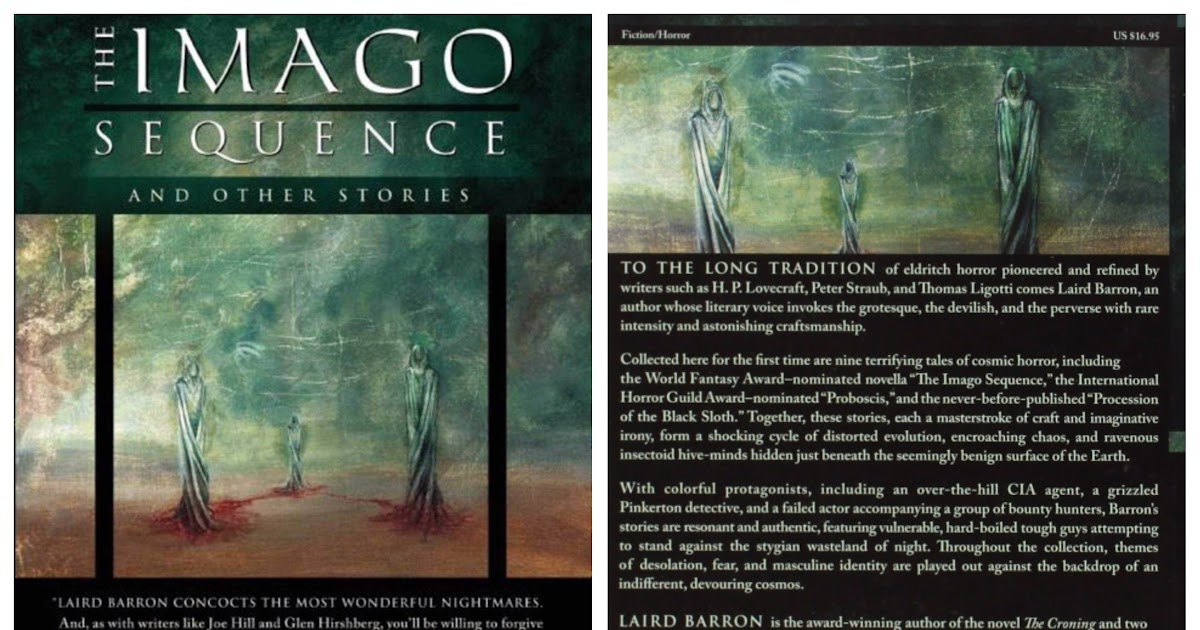
Laird Barron is a leading author of cosmic horror known for high-concept terrors. In this collection, read some of his acclaimed short fiction like the titular novella, “The Imago Sequence,” which was nominated for a World Fantasy Award.

Meddling Kids by Edgar Cantero

Love Netflix’s Stranger Things? You’ll devour Edgar Cantero’s Meddling Kids, an ode to the unique way that horror scares us when we are young. In this cosmic horror novel, a band of teen detectives have grown up after one divisive summer trying to unmask the Sleepy Lake monster in 1977. Fast forward to 1990 when they team up again to find the truth about their past.

The Shape of Water by Guillermo Del Toro

In this novelization of Guillermo del Toro’s Academy Award-winning film The Shape of Water, a mute woman takes pity on a sea creature being studied in secret by the U.S. government. She rescues the creature, only to fall in love with it. This exquisite study of a romantic connection between humans and the unknowable others is classic cosmic horror.

Cthulhu’s Daughters by Silvio Moreno Garcia

Inspired by Lovecraft, this collection of cosmic horror by female authors brings another perspective to the traditionally male-dominated genre. In 25 chilling tales, authors like Selena Chambers and Arinn Dembo give voices to the women characters in Lovecraft’s work. (Note: Cthulhu’s Daughters is the American edition of the anthology She Walks in Shadows).

Annihilation by Jeff Vandermeer

Jeff VanderMeer’s Annihilation helped make new weird mainstream. The opening in the Southern Reach trilogy, this gripping thriller traces the escalating terror among an all-women scientific expedition to the mysterious classified Area X. The narrator, a biologist, is after more than plant observations: she’s trying to solve the mystery of her husband’s disappearance in Area X. Annihilation was made into a feature film starring Natalie Portman. The movie is an excellent adaptation of the novel. Personally, one of my favorite movies of all time.

Magic for Beginners by Kelly Link

Kelly Link’s debut short story collection, Magic for Beginners, almost defies words, winning comparisons to Alice Munro, George Saunders, J.K. Rowling, and others. What’s clear, though, is Link’s voice is distinct and wholly original. Blending magical realism, surrealism, and the absurd in stories featuring fairies, zombies, and rabbits, Link’s work celebrates the weird.

Made for Love by Alissa Nutting

Hazel has recently escaped a psychologically abusive marriage to a tech CEO. Seeking refuge with her father and his lifelike sex doll, Hazel settles into the trailer park for senior citizens. Meanwhile, a conman has a born-again moment after which he can only get aroused by dolphins. As their paths intersect, things get weird.

U.S.-China Trade War : Impact on India

The impact on India as a result of the trade war is a double edged sword, there is potential for India to capitalise on the fraught bilateral economic relationship between the US and China to extend its own gains but the long term implications can be severe. Experts have continually stated that India might not get negatively impacted as a result of the on-going trade war. But, this isn’t exactly correct. India can be impacted both negatively and positively.

“South-East Asia is considered one of the areas along with India that should benefit in the medium term for diversification out of the crosshairs of tariffs between the US and China, but this structural trend has to be supported by policies.”

Trinh Nguyen, Senior Economist, Emerging Asia, Natixis
  1. HARMS

The US is highly dependent on China for access to low cost component parts. Retaliatory tariffs by China have increased the cost of production, driving up consumer prices and leading to a “potential cascading inflationary impact” (Sasi, 2018).

This could propel the Federal Reserve to increase interest rates and limit spending to slow down inflation. This has serious repercussions for India as foreign investors would look for higher returns in the US and pull out capital from investments in India. Money outflow from market bonds and equities would destabilise Indian equity and debt markets and increase market volatility. Stressors can add on pressure on India’s banking system which has already been in the throes of a bad loans crisis.

  • BENEFITS

The benefits for India are categorised to be short term gains, presenting as an opportunity to be a significant trading ally and exporter.

  1. “There are multiple US exports such as flue-cured tobacco, fresh grape chemicals, etc. to China which align with India’s export.” (Niraj, 2019)

There is a chance for India to gain a substantive share in the Chinese market, considering high demand levels. But realising this opportunity requires significant government spending and investments to ramp up production and focus on technological and quality upgrades.

  • It is also crucial for India to solidify its “trade footprint”, especially in areas where tariffs have been imposed on China.

“India gained about $755 million in additional exports, mainly of chemicals (243 million USD), metals and ore (181 million USD), electrical machinery (83 million USD) to the US in the first half of 2019 due to the trade diversion effects of Washington’s tariff war with China. This was also in the form of increased exports in areas such as agri-food, furniture, office machinery, precision instruments, textiles and apparel and transport equipment.” (Nicita, 2019)

There is significant scope to extend these gains in the form of increased exports to the US and strengthen an existing trade relationship.

Vietnam- A country that benefitted from the U.S.-China Trade War

There are a few third-party economies which have gained from the trade war by becoming substitute and alternative sources for consumer products, industrial equipment, component parts and microchips.

Example Based Analysis:

Vietnam is considered to be one of the largest beneficiaries of the trade war between the US and China and according to a study conducted by the Nomura Bank of Japan, the biggest beneficiary of the diversion of imports (in the form of additional US imports).

“Vietnam has continued to expand its economy, growing the fastest in Southeast Asia in 2019, in part due to the US-China trade war.”

(Samuel, 2020)

Chinese companies lost significant market share to Vietnam, in the form of companies producing car tires, refrigerators and furniture. Vietnam has been particularly shrewd and capitalised on an opportunity to try and bypass China by boosting production, providing a stable environment for foreign investors and increasing exports to the US. 

Vietnam’s GDP in 2019 remained robust at 7%, the highest in Southeast Asia. It recorded the second strongest first-quarter growth in the past decade, surpassed only by 7.45% in 2018. And their exports to the US jumped by 34.8% year on year in the first nine months of 2019. (Vietnam Briefing, 2020)

(Vietnam has gained substantially as a result of China and US import substitutions)

Vietnam does face challenges when it comes to sustaining this economic advantage. Ramping up production depends on a focused labour supply. The Vietnamese culture doesn’t look favourably upon working overtime and skill cultivation is lacking.

Vietnam’s present supply chain network, on ground contacts and infrastructural capacity needs to be strengthened and its efficiency enhanced. Sudden, surging demand can put unnecessary pressure and lead to the collapse of an already weak system.

The Vietnamese government must put in concentrated effort to improve the business environment and keep the domestic economy competitive on a global and regional scale.

Conclusion:

While a trade war between two major economies can have a devastating global impact, South-East Asian markets (which were previously overshadowed by the sheer magnitude and the export-driven nature of the Chinese economy) have emerged as winners

The benefits of this trade war is massive for third party smaller economics and can provide a significant boost to their exports, making these countries much more competitive globally (relative to just American and Chinese firms dominating the market). While there is a rapid increase in the number of companies relocating from China, it is essential that policy-making on a government level is strengthened to extend these benefits.

These gains can slip away easily owing to the limited infrastructural capacities of smaller South-East Asian economies which have traditionally lacked the scale to transform into a “mini China”.

JELLYFISH

Life is a beautiful

magnificent things,

Even yo a jellyfish.

~ Charlie Chaplin

Jellyfish

Jellyfish are mainly free-swimming marine animals with umbrella-shaped bells and trailing tentacles. Jellyfish and sea jellies are the informal common names given to the medusa-phase.

Special about jellyfish

Jellyfish have tiny stinging cells in their tentacles of stun or paralyze their prey before they eat them. Inside their bell shaped body is an opening that is its mouth. Tentacles hang down from the smooth baglike body and sting their prey. Jellyfish stings can be painful to humans and sometimes very dangerous.

Where do jellyfish live

They are found in oceans all over the world : at the surface, deep beneath the sea, in warm water, in cold water, some species of hydrozoa , even live in fresh water.

Jellyfish made of

Lacking brains, blood or even hearts, jellyfish are pretty simple critters. They are composed of three layers; an outer layer, called the epidermis, a middle layer made of a thick, elastic, jellyfish-like substance called mesoglea, and an inner layer called the gastrodermis.

Jellyfish reproduction

Jellyfish reproduce both sexually and asexually.one generation (the medusa) reproduces sexually and the next generation (the polyp) reproduce asexually….For both species, fertilized eggs developed into a multi-cellular plan planula and then into polyps that live on the sea floor .

Jellyfish purpose

Researchers describe jellyfish as a ‘Gingerbread house ‘ for fish,providing both food and shelter. Scientists at Queen’s University ,belfast,have discovered that jellyfish are providing habitat and space for developing larval and juvenile fish.

Colors

Some jellyfish are clear, but others are in vibrant colors such as pink,yellow, blue, and purple and often are luminescent.

PAULA SCHER- GRAPHIC DESIGN

“Typography is painting with words” ~ PAULA SCHER

Abstract: The Art of Design, a Netflix Documentary Series featured Paula Scher,
one of the most influential graphic designers in the world.

STYLE
 She has the innate ability to create a distinctive body of work with just letters.
 Design needs to take human behavior into account.
 She gets her best ideas when her mind can freely observe and associate. She calls it ‘state of play’.
 Her work provides sensibility and spirit.
 Ideas can be triggered by working with a team.

WORK
Her work ethic is very strategic and intuitive. Strategic is when she observes exactly what the client wants. Because designing isn’t the hard part, persuading the people to consider it norm is the hard part. She is well knit with the team, very quick paced. She is a part of Pentagram- a large firm where everyone gets to act like an individual. It consists of the best designers in the world.

She’d been working with the Public theatre since 1994. Her work was always considered to be loud and proud. The
style that she used while designing a logo for Public was to use the same typeface to draw in the whole city, the same
typeface with different weight. Paula usually liked to relate with the very motive of the company that she is designing for.

For example, The logo she made for High Line, she made the H look like a railroad track. That itself made it seem industrial and neat. It totally changed the spirit. When she came up with attaching a picture of the same beach view from different streets. This helped orient people and emotionally connect the community and give the people identity and icon. 

HISTORY

She used to paint fonts by hand when she was younger. But when the world advanced with computers, that art form slowly faded away. The loss of touch and feel with her material was huge for her so she adapted painting maps. She loved indulging in things that took a long period to complete. 

She fell in love with typography after being influenced by contemporary culture comics, magazines, record covers. Her First job when she was a teenager was when she started doing record  labels for CBS. Her labels were on demand and she gained a lot of experience  from the same. 

She did exactly what her customer wanted to do most of the time. The more she worked on the covers, the more she realized she like to have control and  typography was meant for her.

VEDANGAS – THE LIMBS OF THE VEDAS

Vedangas are the six forms i.e., the six auxiliary disciples of Vedas. It is said to be the six limbs of the Purusha called Veda. 

  1. Shiksha (Education) – Nose 
  2. Kalpa (Ritual) – Arms
  3. Vyakarana (Grammar) – Mouth 
  4. Nirukta (Etymology) – Ears 
  5. Chhanda (Metrics) – Feet 
  6. Jyotisha (Astronomy) – Eyes 

SHIKSHA

It is referred to as the nose of the body. Shiksha is related to giving instructions through recitation. It consists of instructions for correct pronunciation and accent of the Samhita texts. It mainly focuses on phonetics and gives the rules for the sound of syllables and pronunciation. Phonetics decides the sound changes while recitation and hence becomes very important for Vedic language. The aim is to attain 

  • Akshara suddhi – syllable purity
  • Swara suddhi – tone and pitch purity
  • Maatraa suddhi – durational purity
  • Balam – the force of articulation
  • Samam – evenness
  • Santana – continuity

KALPA

Kalpa is the arm of the Vedas. It speaks about rules for the right method of performing the rituals. These rules are followed in ceremonies such as weddings, naming functions, and other ceremonies. It has its origin from the brahmana texts of the Veda. These are written in sutra style, referring to sacrifices. Kalpa sutras are divided into 

  • Srautasutras – contains rules for performing different sacrifices and rituals.
  • Smarthasutras – further partitioned into 
    • Grihyasutras – gives domestic rites and rituals for the three castes namely – Brahmins, Kshatriyas, Vaisyas, and the responsibilities for the household life.
    • Dharmasutras – gives rules for behaviour and talks about the four stages of life

VYAKARANA

Vyakarana is called the grammar for the Vedas. It is essential for the formation of sentences, phrases, and words. It is the mouth of the Vedas. It is necessary for understanding the Vedas. It is related to the next Vedanga, Nirukta. It is written by scholars named Panini and Yaska. It consists of 4000 sutras which belong to the four padas of the eight chapters. The four divisions are 

  • Siva sutras – deals with phonetics and intonation
  • Ashtadhyayi – deals with sentence structure and construction
  • Dhatupadha – deals with root words
  • Ganapadha – deals with a group of nouns and phrases

NIRUKTA

Nirukta is the ear of the Veda purusha. It means etymology and tells why a word is chosen for the context and the meaning of the used word. It is generally called the Kosa or the dictionary. It deals with the interpretation of obscure and difficult words and provides insights into the hidden meaning delivered in the content. Hence, the study of Nirukta becomes essential to understand the concealed meaning and linguistic significance of the texts.

CHHANDA

It is regarded as the feet of the Veda Purusha. The word Chhanda is derived from the term Chad meaning to cover. It deals with the metrics to be used in the Vedic hymns. A sloka generally consists of four quarters called paadas. Based on the number of syllables in each paada, there are different meters.

  • Gayatri – 8 syllables
  • Trishtup – 11 syllables
  • Jagati – 12 syllables

JYOTISHA

Jyotisha is the eyes of the Vedas and it means astronomy or astrology. It gives knowledge about auspicious dates and times for the ceremonies and rituals to be performed. This is determined based on the position of the sun, the moon, the planets, and other heavenly bodies. It is believed that the rituals succeed when performed under the influence of a particular graha, nakshatra, or thithi. This is calculated using some mathematical calculations and hence mathematics forms an integral part of it.

Atlantis- The Sunken City

There are many unsolved mysteries in the world that we currently inhabit. Add curious human minds that try to provide reasons for every unexpected occurrence and we enter an interesting world of myths, theories, and the most absurdly entertaining possibilities.

Atlantis, the land of Atlas, was believed to be a myth created by Plato in 330 BC. It was described as a utopian, technologically advanced civilization that was inhabited by god-like humans. It was an island of sorts, where exotic vegetation, animals, minerals, and metals existed in abundance. Their naval force was described as impenetrable and unbeatable, which could only mean that they were indestructible. 

Greek legend has it that as generations of Atlanteans were born, the kingdom was overcome with the need to conquer even when they were well-endowed with riches and resources. As a punishment for their hubris, Poseidon, The God of Seas and Earthquakes, sunk the city.

In recent ages, historians and experts believe that Atlantis once existed though the location of the sunken city varies. It could be in the Atlantic Ocean, under Antarctica, or even in the Caribbean.  One of the most popular theories of Atlantis possibly existing is that it is lost in the Bermuda Triangle.

A professional diver, Ray Brown, claimed to have seen advanced structures and buildings when he went diving for treasures near Miami. He also claimed to have found the top of a pyramid. Given that the Bermuda triangle is actually a sight for malfunctioning technology, mystical disappearances, and mysterious sightings, Brown’s statements were highly plausible. Under further investigation by French divers and explorers went to the same area and also reported finding the top of a glowing pyramid, which, with SONAR readings, was confirmed to be bigger than the Pyramids of Giza. Their documentation stated that the pyramid appeared to have two holes that sucked in and released water at an alarming rate which caused turbulence and vortexes. 

Furthermore, believers of this theory stated that there were sightings of other structures on the coasts of Bimini, which were quickly evaluated and dismissed as plain bedrock formations.

Time, with the help of technological advancements, will only pave the path for more possibilities of the existence of Atlantis. Hopefully, we will stumble upon concrete evidence that a possible myth, was indeed a reality.

Conflicts faced and how they help in our development

Erik Erikson was a German-American developmental psychologist and psychoanalyst who was famous for his theory on the psychological development of human beings across a period of eight definitive stages. He stated that at each stage of development, the individual deals with a conflict which is a turning point in his/her development, and when the conflict is successfully resolved, the person is able to develop the psycho-social quality associated with that particular stage of development.

Each stage in Erikson’s theory builds the foundation for the succeeding stages and paves the way for the psychological development of the individual over his/her lifespan. According to Erikson, these ‘conflicts’ that every individual faces are largely centered on them either developing a psychological quality as a result of succeeding or failing to develop that quality in the case that they fail to surpass that stage. He also strongly believed that a sense of competence serves as motivation for positive behaviors and actions that will benefit growth in whichever stage of development. Each particular stage in Erikson’s theory is specifically concerned with an individual gaining the qualities to become proficient in that area of life.

There are eight stages of development consistent with Erikson;

Stage 1: Trust vs. Mistrust

During childhood, if a child is able to successfully establish trust, the child will feel safe and secure in the world. Those caregivers who are emotionally unavailable, inconsistent, negative, or extremely unaccepting of the child, largely contribute to strong feelings of mistrust in the children under their care. This will thereby result in a constant sense of fear and a belief that the world is negative and unaccepting. No child is going to develop a perfectly complete sense of 100% trust or 100% mistrust. Successful development was all about striking a balance between the 2 opposing sides. When this happens, the youngsters acquire hope, which Erikson described as an openness to new experiences tempered by some wariness that danger could also be present.

Stage 2: Autonomy vs. Shame and Doubt

This stage occurs during early childhood and is primarily focused on children developing a greater sense of control and personal independence. Children who struggle with gaining this independence and who are discouraged by their accidents may be left without a sense of personal control. Children who successfully complete this stage feel confident and secure in themselves, while those that don’t are left with a way of inadequacy and self-doubt.

Stage 3: Initiative vs. Guilt

The main theme of the third stage is that children need to begin asserting control and influence over their environment (their surroundings, the people near them, etc.). A sense of purpose is achieved in this stage if the child is successful. Children who try too much to exert their power experience discouragement or disapproval which results in a sense of embarrassment.

Stage 4: Industry vs. Inferiority

Children whose parents encourage and commend them for their actions develop strong feelings of competence and belief in themselves and their skills. Those who receive little or no encouragement from parents, teachers or embarrassment from peers will doubt their abilities to achieve success. Those who aren’t able to appropriately navigate during social interactions and academic challenges may end up feeling inferior and lack self-confidence.

Stage 5: Identity vs. Confusion

This stage plays an essential and integral role in the development of a sense of personal identity which will continue to strongly influence behavior and personality development for the rest of an individual’s life. During adolescence, adolescents explore their independence and develop a strong sense of self which becomes the foundation of their future personalities as they grow and cross each of the remaining developmental stages. Those who receive proper encouragement and reinforcement through personal exploration will emerge confident and guaranteed in themselves with a robust sense of self and feelings of independence and control. Those who remain unsure of their opinions and desires will feel insecure and confused about themselves and their future.

Stage 6: Intimacy vs. Isolation

Young adults need to form strong loving, intimate relationships with other people. Erikson believed that having a strong individual sense of personal identity was extremely important for developing strong intimate relationships. Studies have demonstrated that those with a poor sense of identity tend to possess less committed relationships and are more likely to struggle with loneliness, emotional isolation, and depression. Successful completion of this stage leads to the virtue referred to as love. It is marked by the power to make lasting, meaningful relationships with people.

Stage 7: Generativity vs. Stagnation

As adults, humans have the primitive sense of need to create or nurture things which will outlast them, often by having children or creating a change that causes a positive effect on society or benefits other people. Success in this stage leads to a sense of having purpose and an intense sense of accomplishment, while failure in this stage results in little to almost no involvement in society and the world as a whole.

Stage 8: Integrity vs. Despair

The final stage occurs during old age and is mainly focused on the reflection of one’s life, past actions, and decisions taken. Those who don’t successfully complete this stage will feel like their life has been nothing but a waste and they may experience strong feelings of worthlessness or regret. Others who do complete this stage to succession feel proud of their achievements and will feel an assured sense of dignity and integrity. These individuals will always possess a certain wisdom about themselves, even when confronting death.

Social environment- How does it influence the human personality.

An individual’s personality is the behavioral and mental characteristics that differentiate and makes them unique from other people. It includes all of an individual’s patterns of thought and the emotions that cause them to say and do things in ways that are specifically aligned to suit that particular individual’s interest. One’s personality makes up the most important, and most noticeable parts of an individual’s psycho-social life. People act the same or similar ways during a huge range of different scenarios. Personality does not just influence how we respond and move to stimuli in our environments, it also causes us to act in certain ways. Personality is expressed in more than just one’s behavior or mannerisms. It can also be seen in our feelings, thoughts, familial, platonic, and romantic relationships, and other social interactions.

Both explicit and implicit social norms guide individual behavior and consequently one’s personality. From early stages of development and throughout the course of our life we grow and learn to adapt our behavior appropriately according to societal expectations and requirements, which may differ across various cultures and may be relevant in various degrees for men and women of different ages and/or races.

In many contemporary societies, people differ greatly within the extent of their religious beliefs and practices. Some reject all belief in the supernatural, whereas others have deep religious convictions that greatly change and influence many aspects of their lives. Understanding the psychological characteristics that incline persons toward religiousness and spirituality is an important question for psychologists of religion and for psychologists who study individual differences. 

Despite the importance of religion, there is a huge variation in the extent to which formal religious beliefs and practices are a part of the routine life of people in several cultures. Religion and spirituality are also recognized as potentially favorable aspects of psychological development in general for every individual, and personality development in particular.

Adding to the complexity of culture’s role in shaping our personalities are two important factors. First is the degree to which an individual is integrated into their culture, and vice versa. It is exceedingly rare that a person is either totally integrated into their culture or not integrated into it in the least. Thus, culture provides a framework within which each individual variation is feasible, but at the same time, there’ll always be some consistent basis for understanding the people within a given culture.

Levels of the Human Mind

Sigmund Freud, the famous Austrian neurologist and founder of psychoanalysis used the analogy of an iceberg submerged in water to compare the three levels of the human mind. The top portion of the iceberg that one can see above the water represented the conscious mind. The part of the iceberg that is submerged below the water surface, but is still visible, is the preconscious mind. The bulk of the iceberg that lies unseen beneath the water surface represents the unconscious part of the mind.

He believed that the preconscious mind consisted of any feeling, emotion or memory that could potentially be brought into the conscious mind, the conscious mind contained all thoughts, memories, feelings, and wishes of which we are aware of at all times and at any given moment. It is this aspect of our mental thought process and behavior that we can think about and analyze rationally. It also includes our memory which is something that isn’t always a part of our consciousness but can be brought into awareness at any given moment. The unconscious mind is an endless bank of emotions, urges, thoughts and memories that are very much beyond our conscious awareness. The unconscious mind possesses emotions, urges, etc. that are either unacceptable or unpleasant by the present societal standards, such as feelings of pain, anxiety, or conflict.

Freud further argued that, the unconscious mind is the primary source of human behavior. Like the iceberg, the most important part of the mind is the part you cannot see and is not visible to the eye. Our primitive urges-found in our unconscious minds- often do not reach consciousness because they are unacceptable to our rational, conscious selves who were programmed to behave in ways that adhere to the current societal standards and hence are almost never acted upon because they remain repressed deep within our unconscious minds.

Thoughts and emotions that exist outside of our conscious awareness almost always-although only to subtle effect- continue to exert an influence on our day-to-day habits and behaviors, even though we are unaware (unconscious) of these underlying influences. In this regard, the unconscious part of our minds can include repressed feelings, past habits, wishes, hidden memories, thoughts, and reactions. Emotions-such as grief- and traumatic memories that are too painful, embarrassing, terrifying, shameful, or distressing to consciously come to terms with are stored deep within the enormous bank that makes up the unconscious mind.

The conscious mind however includes all of the things that one is actively aware of. The closely related preconscious mind contains all of the other things that you could potentially pull into conscious awareness (memory, a previous thought, emotions etc.). The preconscious mind also acts as something of a filter that controls the information that is allowed to enter into an individual’s conscious awareness. The conscious mind involves all of the things that you are currently aware of and presently thinking about. It’s primary limitation, however, mainly lies in terms of capacity and is somewhat similar to short-term memory. One’s awareness of oneself and the world around them is a part of their consciousness.

In Freud’s iceberg analogy, the preconscious exists just below the surface of the water. You can see the murky shape and vague outline of the submerged portion of the iceberg if you focus on it and make an effort to see it, however otherwise it still remains very much unseen/hidden from the eye-in this case, the conscious mind. 

Similar to the unconscious mind, Freud believed that the preconscious mind could have a definite influence on our general conscious awareness. Sometimes information from the preconscious manifests in unexpected ways and different forms, for instance during dreams or in accidental slips of the tongue. Hence, while we might not be actively thinking about these things, Freud strongly believed that they still served to influence conscious actions and behavioral patterns in all individuals.

An individual’s lifetime experiences-from childhood to adulthood, can largely influence their subconscious, conscious and unconscious mind. Good life experiences impact the conscious mind in a positive way, such that, the primary knowledge from that past experience or situation can be productively or constructively used by the individual in future situations as a way for it to be in their favor. Bad life experiences can most certainly have great negative effects on an individual; the conscious mind from then on could be reprogrammed in response to the trauma or bad situation to alter the individual’s conscious mind and then personality which could result in a lot of other unexpected effects on the individual’s decisions, situations, reactions and emotions.  

Our subconscious mind has an immense and great power in controlling our life experiences. From the kind of habits, we follow every day to the food we choose to eat, the kind of occupation we pursue, the level of income we earn, our societal status and even how we react to stressful or dangerous situations, our subconscious has an extremely prominent role, and almost all of our decisions are guided by our subconscious beliefs or thoughts. To put it simply, our subconscious mind is like the auto-pilot feature on an airplane. It’s been specially programmed to follow a specific route and we can’t deviate from that route unless we consciously change the directions that were first programmed into it.

Our subconscious mind never rejected anything while we’re young because we didn’t have any pre-existing beliefs to contradict what it perceived and/or understood. It simply accepted the information we received during our early childhood and that was what was considered true, which is why each and every individual’s personality, traits, subconscious/conscious mind and thoughts are unique. This also explains why this later becomes a problem in the later stages of our lives because if when we were young every time someone called us worthless, dumb, stupid, lazy or worse, our subconscious mind simply stored that piece of information away for reference. Over time we may also have received several pieces of information about our potential in life or other limitations we’ll face based on your physical appearance such as skin color, or our gender, or our economic status.

Which brings us to the question of can we change or alter our subconscious? The answer to which is extremely interesting seeing as the answer is that this subconscious programming never stops and still continues to this day. With every new experience, we draw new conclusions, thoughts or opinions which we store once again within our subconscious which will ultimately guide our future actions.

So, if we have an experience that contradicts with an already established belief or opinion, our subconscious mind will either reject it or reframe/alter/add it so that it goes along with our existing view of reality.

Importance of Yoga.

Before we get into the benefits of Yoga, it is essential to understand what exactly Yoga really is. Yoga is not a religion, it’s a way of living that aims towards a healthy mind in a healthy body. Man is a physical, mental and spiritual being; Yoga helps in developing the balance between all the three as stated in  Ayurveda in India. Other forms of exercise, like aerobics, only assure physical well being. These exercises have very little to do with the improvement of spiritual or astral body.

Yoga as a practice has innumerable benefits that positively affect an individual both physically and mentally. During this ongoing coronavirus pandemic, when we are all bound to live a restricted life under the constant fear of infection risks, it is natural for anyone to develop anxiety. The continuous flow of negative news, the inadequacy of daily resources, everything is adding to this growing anxiety and depression. Being confined at home for such long periods of time, can be mentally challenging for us. When our mind is flooded with the uncertainty of the future, we often experience sleepless nights causing fatigue. Many of us are unable to relax our mind during this time thereby increasing the stress on our minds. 

Some of the advantages of yoga are listed below:

  • Yoga increases your flexibility.This is why many people start yoga, and it’s certainly a great benefit of yoga practice. Yoga postures and sequences help to increase the body’s range of motion. The mindful approach of yoga helps to ensure that stretching is done safely, allowing the nervous system to release the muscles into gentle, effective stretches. This reduces the risk of injuring ligaments and tendons, which can occur through more aggressive approaches to flexibility training. Releasing tension in the muscles can also help them to relax and let go, helping your body to open up more.
  • Yoga helps you to build strength. Although many people overlook this one, seeing only yoga’s benefits for flexibility, yoga is actually a fantastic strengthening practice.. Yoga helps to strengthen the muscles that support the body’s weight, leading to functional strength. It is also fantastic for building core strength. This improves athletic performance and your functionality in everyday life, while keeping you safe from injury.
  • Yoga helps to keep your joints healthy. Yoga will strengthen the muscles around the joints, helping to stabilise them. By moving the joints in their full range of motion, yoga can help to promote better joint health. The mobilisation of the joints improves the flow of synovial fluid, which lubricates them, allowing for smooth and healthy movement of the bones. Synovial fluid also delivers fresh oxygen and nutrients to the joint cartilage, helping to restore it and keep it healthy. Yoga can even help those with more serious joint problems such as arthritis, improving physical function and reducing pain.
  • Yoga reduces stress. Many people begin yoga to improve their flexibility, but they keep coming back because they find it makes them feel so much better. The focus, centring and breathing of yoga all help to reduce stress and can be the ideal antidote to a hectic modern lifestyle. In part this is another wonderful benefit of the mindful aspect of yoga. It is also due to the positive impact of increasing activity levels and exercise, along with the relaxation and reduction of physical tension that yoga brings. Yoga can leave you feeling relaxed and refreshed, physically, mentally and energetically.

References:

https://www-medindia-net.cdn.ampproject.org/v/s/www.medindia.net/amp/yoga-lifestyle/yoga-importance.htm?amp_js_v=a6&amp_gsa=1&usqp=mq331AQKKAFQArABIIACAw%3D%3D#aoh=16288671603271&referrer=https%3A%2F%2Fwww.google.com&amp_tf=From%20%251%24s&ampshare=https%3A%2F%2Fwww.medindia.net%2Fyoga-lifestyle%2Fyoga-importance.htm

https://www-hopkinsmedicine-org.cdn.ampproject.org/v/s/www.hopkinsmedicine.org/health/wellness-and-prevention/9-benefits-of-yoga?amp_js_v=a6&amp_gsa=1&amp=true&usqp=mq331AQKKAFQArABIIACAw%3D%3D#aoh=16288671603271&referrer=https%3A%2F%2Fwww.google.com&amp_tf=From%20%251%24s&ampshare=https%3A%2F%2Fwww.hopkinsmedicine.org%2Fhealth%2Fwellness-and-prevention%2F9-benefits-of-yoga

Perception of the world around us through our senses- Is it always accurate?

The term sensation “is the process by which stimulation of sensory receptors—the structures in your eyes, ears, and so on—produces neural impulses that represent experiences inside or outside the body.” We experience billions of sensations every minute and second, of our lives, we’re aware of some of those sensations and most of them we are blissfully unaware of. Our conscious mind chooses to ignore the ones we’re unaware of, and the ones we do know about are those that we recognize and identify. These become our perceptions; sensations that we specifically group as those that we are consciously aware of. 

Although most of us can voluntarily control where we place our attention -to a greater or lesser degree-it is our brains who unconsciously do this all the time. The brain receives more sensory information every second than it can process, so it needs to categorize and organize the remaining unattended sensations into other groups and forms. This categorization is the line of difference between sensation and perception. 

The recognition, interpretation and categorization of sensations one consciously feel is termed perception. It involves two kinds of processing- bottom-up and top-down processing. Bottom-up processing refers to the perceptions that are recognized and obtained from the output of sensations, However, the way we interpret that sensory information is largely influenced by the knowledge we already possess, our in-life experiences and our thoughts-this is referred to top-down processing

Seeing as our senses take in large amounts of both external and internal- stimuli, we only always select the part of the sensory stimuli we receive to organize, interpret and perceive. So primarily, we select sensory information to perceive based on prominence-which is very much influenced and determined by each individual’s visual or auditory stimulation along with their own individual flow of thought and personal beliefs- and this phenomenon of being able to focus on specific stimuli while excluding the other stimuli is called as the Cocktail Party Effect. 

Expectations also largely influence what information we choose to perceive. We organize information that we select to perceive into patterns based on proximity, similarity, and difference. We generally interpret and organize sensory information using a schema- a pattern that follows the thought or behavior which organizes categories of information and the relationships among them- which allows us to interpret the meaning for that sensory input based on past experience and knowledge. Motivation can also largely affect perception. Motivation to detect a relevant stimulus can greatly influence and shift our ability to differentiate between a real sensory stimulus and background noise. This capacity to identify a stimulus when it is present in a disconcerting background is termed  Signal Detection theory.

IS HUMAN RESORCES A GOOD CAREER.

Human Resources (HR) is a position that has consistently ranked high in the list of best career options. An HR person seeks to develop and manage their company culture. Human Resources (HR) is a good career option for those who work with all their heart to improve the company. Ranked as one of the 100 Best Jobs in Human Resources (HR) overall. Those choosing an HR career start by earning an associate’s degree or certificate. A career in Human Resources (HR) matters to everyone and importantly, provides an opportunity to make a real difference while contributing to business success. Here are the major reasons why a career in human resources stands out.

Human Resources (HR) is a core business area and profession which has risen in stature and demand over the years. Most of the highest paying HR jobs in India are also the most rewarding in job satisfaction and professional growth. 

In recent years, the practice of strategic human resource management has gained prominence across industries. It is all about effective planning for organizational HR needs, managing the workforce, and supporting employee development in a way that improves business performance.

Human resources determine the success and failure of any enterprise, driving its vision and profitability. Therefore, the management of this business function is critical to creating a sustained competitive advantage in the industry. Moreover, the corporate culture expressed in the mission and value statements can be reinforced through the training, communications, learning and development, and performance management processes.

Organizations are supposed to be cohesive and integrated places where goal-sharing and team-orientation are of fundamental importance. This approach makes the work of HR personnel more relevant. Now, before we talk about the possible career options and the highest paying HR jobs in India you can get,

human Resource planning
job design and analysis
recruitment and selection
Compensation and employee welfare
performance management
training and development
Maintenance of managerial and labor relations

What is Human Resource (HR)?

human resources For many, a “good career” represents a combination of strong employment growth, ample advancement opportunities and high job satisfaction. A career in human resources (HR) delivers on all counts and, importantly, offers the opportunity to make a real difference while contributing to business success.

In fact, HR specialist ranked among the Best Business Jobs in America for 2019 by U.S. News & World Report.

What is the role of human resource (HR) in company?

     Nearly every company in the human resources position, large and small, needs human resources professionals to manage employee relations, oversee recruitment, and administer benefits A human Resources  (HR )hires manage and retain employees. He is responsible for bringing in skilled employees and their compensation and perks management according to the budget of a company. HR is responsible for organizational outcomes and managing the most valuable business asset — people.

What are the challenges for HR employees in their work

The work of HR staff is very challenging. Finding, hiring and retaining top talent is an art. The stakes are even higher depending on the region, as new benchmarks emerge with the entry of the millennial generation with new expectations, making this a truly strategic act.

conclusion:

I think Human Resources is a very good job, it is a responsibility. Due to which we will get to learn a lot and people will get to learn a lot. And this is a very good opportunity for our career.

10 BEAUTY TIPS EVERY GIRL SHOULD FOLLOW

In today’s era, everyone wants their skin to glow all the time, look attractive and refreshing. Every single girl has dreamt of having a glowing skin, the skin that can grab everyone’s attention and of course why not, in today’s world everyone wants to look perfect. According to me, beauty is something that has the power to attract anyone not only from outside, but from inside too. I think every person should be attractive from inside first because it tells a lot about your character. Then it will automatically glow in your skin, but yes I know I am talking a little bit weird like giving you moral values that you have already taken from your schools. So now I will only be talking about those 10 beauty tips you must follow in order to make your skin glow and look attractive for a longer time even if you are at work and yes, of course you will not regret it. Just take a look-

1. CLEANSE YOUR FACE TWICE A DAY-

No matter what happens, how much you are busy, you have to cleanse your face with a face wash properly twice a day. There must be no excuse because this is a skincare routine you must have to follow. Properly rub your face all sides, your cheeks, chin, forehead, everything with a very smooth rubbing and massaging because if you do it fastly it may harm your skin making it look rough. It is very important to cleanse your face twice a day to remove all the dirt and dust particles from your skin. Any facewash you can apply of your choice.

2. WEAR SUNSCREEN DAILY-

Apply sunscreen daily to protect yourself from harmful ultraviolet (UV) rays. Even if its raining or cloudy you must apply it. It should be applied before going out into the sun and reapplied at least once every two hours. You should choose the sunscreen according to your skin type that is dry skin or soft skin, which ever you are having. Then note its SPF, if it is above 30 then it will give you high protection, you can use it and SPF 15-29 will give you medium protection. SPF 50 will give you very high protection and will be best to use. I prefer you to use LAKME SUN EXPERT SPF 50 PA +++ ULTRA MATTE LOTION, 50 ML. You don’t have to use only and only this, I am just preferring you. You can also use your choice of sunscreen or that you use daily but please check its SPF carefully.

3. USE MOISTURIZER DAILY-

Apply moisturizer daily as it will help your skin to look refreshing and very soft all day. It completely finishes the dryness of your skin and moists it. It is very necessary to apply it daily when you go out. You should choose the moisturizer according to your skin type, Is your skin dry, oily, normal or a combination of types? Choose according to that. For dry skin, choose heavier and oil-based moisturizer, for oily skin, choose lighter, water- based moisturizer and for normal skin, choose light, non-greasy moisturizer but mainly look for heavier moisturizer which helps keep skin hydrated. Always check its scent while buying as it is very important and if you have acne-prone skin, try to avoid any scented moisturizers with perfumes. Use SPF 15 or higher. Apply it two times a day i.e. day and night. Vaseline can be used as an everyday moisturizer for very dry skin. I recommend you to use Lotus Herbals Aloe Soft Body Lotion if you can’t be able to find the suitable one otherwise use it of your choice.

4. APPLY FACE SPRAY ALWAYS AT THE END-

After you have done with all your makeup, apply spray to your face to give it a retouch and fresh look. It makes your skin glowing and feel refreshing as it instantly rehydrate your skin without harming your makeup. Use it two times a day. When you go out, apply it and keep it always in your bag to apply it whenever you feel dizzy, and then apply it at night. Any face spray you are having you can use it like rosewater spray, it is very beneficial for your skin to use.

5. DRINK MORE AND MORE WATER-

As everyone knows, water is very beneficial for your health, the same goes for your skin too. Drink at least 10-12 glasses of water to maintain the glow and charm of your face. You can also drink various types of juices like lemon water, jeera water, turmeric water to increase the beauty of your face. These all are natural things that will help you a lot to look even more brighter and attractive. You can also add drinking water reminders in your phone as it is very tough in our busy lives to remember even about drinking water.

6. EXERCISE REGULARLY-

In order to make your skin glow all the time, exercise plays a very important role. It not only keeps you fit but also benefits your skin to a next level. If you exercise daily, you will definitely see changes in yourselves and it will increase your beauty and you will love it. So exercise daily to glow all the time.

7. ALWAYS CARRY A LIP BALM-

Lip balm is mandatory to one with you all the time. It has various beauty benefits to use. It moisturizes your lips and kicks off its dryness in seconds. It helps in highlighting your face, it just protect your lips from everything making it a very important part of your skin glow. It also do not takes very big space, just fit it anywhere you want and keep applying it from time to time.

8. MODIFY YOUR WALK-

Modifying or changing your walk will have a very big impact on your beauty. Maintaining a good posture makes your appearance look so good and you look more attractive. Imply changes in your walk making it quite soft, sexy and appealing. This can surely level up your game of beauty and you will ace everything.

9. AVOID JUNK FOOD-

Eat healthy food which must include all the veggies, dal and nutritious elements and avoid junk food eating daily as it can harm your health as well as your skin. Eating junk food sometimes at the time of party, etc. but do not make a habit of eating it daily. Healthy eating will benefit in many ways and also make your skin look healthy and prettier.

10. REMOVE MAKEUP AT NIGHT WITHOUT FAILING-

Always remove makeup at night in one go without failing even once when you come from work as it removes all the dust and dirt particles may be present in your skin. Remove very gently by applying proper makeup remover cream and rubbing it all over your face and then wash it with water. It is a very necessary step in your whole beauty process as it refreshes your face and keeps all the harmful things away and you have to remove it in one go, without failing because in other go, it may cause you itchiness and could have harmful effects on your skin.

These all tips will definitely increase your beauty and make your skin glow and look so natural and beautiful all the times. Just try all of them and you will definitely going to love it.

WHAT TO DO WHEN YOU FEEL LIKE GIVING UP ?

Yes, today I am suffering. Today, I don’t feel like writing. Today, I do not feel like sticking to a schedule. Today, I don’t feel like I have great ideas and I don’t feel like I have enough time to make good ideas positive. Today, I feel like quitting.

Research from the University of Pennsylvania has shown that grit is a highly linked factor to success. I can use some grit today.

Here’s what I’m trying to do when I feel like giving up…
Your Mind Suggested Engine
Think of all the ideas you have as a suggestion, not an order. Right now, my mind is suggesting that I feel tired. It suggests I quit. It suggests that I take the easy way out.

If I stop for a moment, though, I might get new suggestions. My mind also suggests that I will feel very happy to accomplish this task once you have completed it. It suggests that I will respect the ownership I build when I stick to the schedule. It suggests that I have the ability to finish the job, even if I don’t feel like it.

Remember, they are not in these order suggestions. They are just options. I have the power to choose which option I follow.

Temporary Discomfort


With regard to the time of day or your typical week, almost any practice you have is soon over. Your exercise will end in an hour or two. Your report will be typed and completed tomorrow morning. This article will be completed in a moment.

Life is now easier than ever. 300 years ago, if you did not kill your food and build your own house, you would die. Today, we cry about forgetting our iPhone charger.

Keep an eye out. Your health is good and your discomfort is temporary. Enter into this moment of discomfort and let it strengthen you.

You Will Never Regret Good Work When Done


Theodore Roosevelt said, “The best reward that life can bring is the opportunity to work hard in the work that needs to be done.” Often it seems we want to make it easier to do the work we have to do. We want our work to be helpful and respected, but we do not want to fight for our work. We want our bellies to be flat and our arms to be strong, but we don’t want to digest other work. We want the end result, but not the previous failed attempts. We want gold, but not grinding.

Anyone can claim a gold medal. Few people want to train like the Olympian.

And yet, despite our opposition, I have never found myself feeling very bad after a hard day’s work. There have been days when it was hard to start, but it always had to end. Sometimes, the simple act of showing and having the courage to do the job, or in the usual way, is a victory worth celebrating.

This is life

Life is an ongoing balance between giving easily to distractions or overcoming the pain of discipline. It is no exaggeration to say that our lives and identities are defined in this critical balance. What is life, if not the sum of a hundred thousand daily battles and small decisions to take it out or leave it?

This is the time when you don’t feel like doing the work? This is not the time to be lost. This is not a dress rehearsal. This moment is your life just like any other moment. Use it in a way that will make you proud.

Let the World Decide


So, what do I do when I feel like I want to quit? I can see.

Am I expressing myself very well? I do not see. But my job is not to judge how good or bad I am.

My job is to do the work and let the world decide.