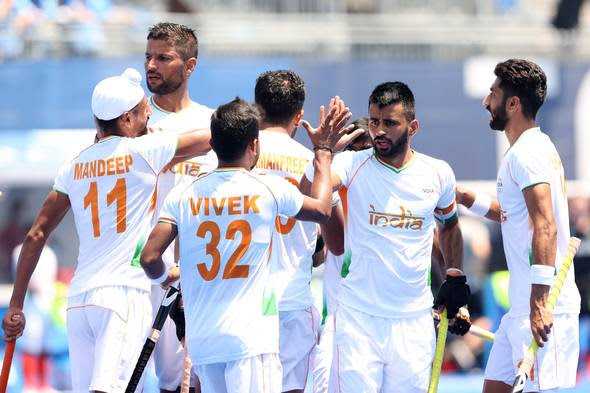
Tokyo Olympics Hockey India vs New Zealand

MATCH REPORT

A brace from Harmanpreet Singh, both off penalty corners, and a Rupinder Pal Singh penalty-stroke conversion cancelled out Kane Russell’s opening goal for New Zealand as India took a 3-1 lead in the 33rd minute.

MATCH HIGHLIGHTS:

AND THE GAME IS OVER! INDIA BEATS NEW ZEALAND 3-2!!!

60′ PC FOR NEW ZEALAND! A brilliant run from Hugo Inglis gives NZL a chance to make it 3-3. But the Indian defence stands strong to keep the score 3-2 in their favour.

59′ NZL REFERRAL! This one is just out of pure desperation. The New Zealand players think they can win a penalty corner here. However, they end up empty handed.

58′ SREEJESH YOU BEAUTY! Kane Russell hit a stunning shot towards the top left corner of the post off a penalty corner. Indian goalie PR Sreejesh executed a full-stretch dive to his right to deny New Zealand the equaliser. Moments later, he pulled off another remarkable save in open play.

57′ BACK-TO-BACK PCs FOR NEW ZEALAND! After a long referral, NZL is eventually given the penalty corner. And, surprise, surprise! the team has won one more.

55′ Harmanpreet Singh has been the standout player on the field here. He’s put in a very good defensive shift and has converted two penalty corners. The substitute Birendra Lakra has been excellent since coming on as well.

52′ New Zealand has a slight edge when it comes to possession (52-48) today. However, the team has been a bit wasteful up front (1/5 PCs with a shooting efficiency of 25%), and that’s why India has the lead.

49′ After three consecutive successful referrals, India has a failed one in an attempt to win a penalty corner. New Zealand regains possession.

47′ Amit Rohidas and Lalit Upadhyay come up with a decent move on the left flank for India. The New Zealand defence stays compact to avert the danger.

THE FOURTH QUARTER BEGINS!

We are heading towards a thrilling final 15 minutes as India leads New Zealand 3-2 in men’s hockey on day two of the Tokyo Olympics.

THE THIRD QUARTER IS DONE AND DUSTED!

43′ GOOOOAAAAALLLLL!!!!!!! NEW ZEALAND PULLS A GOAL BACK!!!! A major lapse in concentration for the Indian defence and NZL capitalises on it. Nick Wilson receives a pass on the right flank, dribbles past Birendra Lakra and sets up Stephen Jenness, who scores past Sreejesh with ease.

40′ UPDATE: Australia beats Japan 5-3 to register the first points in Hockey at the Tokyo Olympics. The Aussies are in the same group (Pool A) as India and New Zealand.

38′ The Indian forwards are pressurising the New Zealand defence big time here. Sreejesh has had absolutely nothing to deal with at the other end this quarter.

36′ ANOTHER INDIAN PENALTY CORNER! Harmanpreet almost completed his hat-trick with the shot on target. But NZL keeper Hayward made a good save.

33′ GOAAALLLLLLLL!!!!! INDIA TAKE A 3-1 LEAD NOW!!! Another Indian penalty corner, another Harmanpreet goal. New Zealand looks extremely rusty in the middle since conceding the second goal.

32′ EARLY CHANCES FOR INDIA! Mandeep Singh has been a menace up front. He’s been supported well by Dilpreet Singh on the right. Another Indian goal looks likely.

THE THIRD QUARTER IS UNDERWAY!

Indian athletes are also in action in various other sports at the Tokyo 2020 Olympics today. Follow them through the links provided below.

SHOOTING BLOG | Read more

ARCHERY BLOG | Read more

THE SECOND QUARTER IS OVER!

29′ New Zealand enjoyed a long period of dominance in this quarter but India scored against the run of play. Nick Wilson’s missed chance could come back to haunt NZL.

26′ GOOOOAAAALLLL!!!!! INDIA TAKES THE 2-1 LEAD!! A penalty-corner innovation from the Indians and Harmanpreet Singh finds the back of the net. Rupinder Pal, the usual PC converter, slipped the ball towards Harmanpreet on his left to trick the New Zealand players.

24′ VERY CLOSE! Vivek Sagar Prasad had a wonderful chance to score. But the New Zealand defence gets the better of him close to goal.

22′ JAPAN 3 – 3 AUSTRALIA! In the other Olympic men’s hockey game happening now, the host nation and the 2004 gold medalist from Athens are involved in an exciting clash, which is in the third quarter.

19′ WHAT A CHANCE FOR INDIA! The captain Manpreet received a long pass from substitute Lalit. He was one-on-one with the NZL goalie. However, his lob attempt was saved by Hayward.

17′ New Zealand is dominating possession against India right now. The Indians are losing the ball cheaply in midfield quite too often.

THE SECOND QUARTER BEGINS!

A penalty-stroke goal from Rupinder Pal Singh cancelled out a penalty-corner strike from Kane Russell as India and New Zealand are tied 1-1 after the opening 15 minutes.

THE FIRST QUARTER COMES TO AN END!

15′ INDIAN COUNTER-ATTACK! The substitute Gurjant Singh rushes forward with the ball. But the New Zealand defence tracks back in time to avert the danger.

13′ FOUR CONSECUTIVE PCS FOR NEW ZEALAND! The Indian defence is struggling to get the ball away here. Sreejesh pulled off a brilliant save for India just moments ago. NZL messes up another penalty corner.

10′ GOOOOAAAAALLLL!!!!!! INDIA EQUALISES!!! Rupinder Pal won a penalty stroke from a penalty corner and he sent NZL keeper Leon Hayward the wrong way from close range.

9′ The experienced duo of Birendra Lakra and Lalit Upadhyay haven’t started in the first quarter. The youngster Vivek Sagar Prasad is also on the bench.

6′ GOOOOAAAALLLL!!!! NEW ZEALAND TAKES THE 1-0 LEAD!! NZL won its first penalty corner and Kane Russell converts it with precision.

5′ FOUL! Indian skipper Manpreet Singh hits New Zealand defender Nic Woods on the face with his stick, unintentionally. Woods is being treated on the field.

3′ PENALTY CORNER FOR INDIA! Mandeep Singh won this one after receiving a pass from Nilakanta Sharma. HITS THE POST! Rupinder Pal Singh misses the target by a whisker.

1′ Good early pressure from India here. Dilpreet Singh moves forward with pace on the right flank but isn’t able to create a clear-cut chance.

AND THE MATCH BEGINS!


The team lineups are out!

INDIA XI: PR Sreejesh (GK), Rupinder Pal Singh, Surender Kumar, Harmanpreet Singh, Amit Rohidas, Manpreet Singh (C), Hardik Singh, Nilakanta Sharma, Dilpreet Singh, Mandeep Singh, Shamser Singh.

COACH – Graham Reid.

NEW ZEALAND XI: Leon Hayward (G), Dane Lett, Nic Woods, Kane Russell, Blair Tarrant (C), Shea McAleese, Nick Ross, Hugo Inglis, Sam Lane, Stephen Jenness, Nick Wilson.

COACH – Darren Smith.


The world’s best coaches and scientific training have given Indian hockey a refreshingly new identity, Moscow Olympics gold medallist MM Somaya writes ahead of the country’s hockey teams’ opening games at the Tokyo Olympics.

READ MORE | Read more

He was marked out for greatness as a player and a leader even before he became a constant in the national side. Having led the Indian team at the Junior World Cup, Manpreet Singh has always had confidence in abundance but it has been tempered with a sense of responsibility as captain.

Ahead of his third Olympics, the Indian skipper shared his plans, disappointments and determination to succeed at Tokyo.

FULL STORY | Read more

MATCH PREVIEW:

It has been over 40 years since the Indian men claimed the most recent of their incredible eight Olympic hockey gold medals, which arrived at Moscow 1980.

However, their superb form in recent times makes them serious contenders to claim a ninth title at the upcoming event in Tokyo.

The team has claimed victories against nearly all the top teams in world hockey over the past few years, with Australia-born head coach Graham Reid, a former international with the Kookaburras, getting the best out of a talented and exceptionally fit collection of athletes.

India had booked its ticket to Tokyo with two victories over Russia in the 2019 FIH Hockey Olympic Qualifiers, winning 4-2 and 7-1 in Bhubaneswar.

“It has not been an easy process to make the final selection of 16 players as there is a lot of quality and ambition in this group of players,” Reid said ahead of the 2021 Tokyo Olympic Games.

RELATED | Read more

“The performance levels of all athletes are at an optimum level and more importantly they work well together. They know what it means to represent the country at the Olympics. We’re now focused on training with the same intensity and our goal is to put forward our best performance as a collective unit in Tokyo,” he added.

Meanwhile, coached by former Black Sticks midfielder Darren Smith, New Zealand – which shocked the world by becoming Olympic champion at Montreal 1976 – is renowned for its tireless work ethic as a team but is also blessed with some exceptional individuals.

Stephen Jenness and Hugo Inglis are both wonderful attacking talents, while veteran defender Shea McAleese and penalty corner expert Kane Russell are consistently excellent performers.

New Zealand reached Tokyo with two victories over Korea in the 2019 FIH Hockey Olympic Qualifiers, winning 3-2 and 3-0 in Stratford.

“It’s a pretty experienced group but it’s also the first pinnacle event for players like Sam Lane who have previously missed out through injury or Jacob Smith and Nick Ross who have been rewarded for their perseverance. They’ve shown they’re really determined to be there,” said coach Smith.

THE SQUADS:

India – P.R. Sreejesh, Manpreet Singh, Harmanpreet Singh, Rupinder Pal Singh, Surender Kumar, Amit Rohidas, Birendra Lakra, Hardik Singh, Vivek Sagar Prasad, Nilakanta Sharma, Sumit, Shamsher Singh, Dilpreet Singh, Gurjant Singh, Lalit Kumar Upadhyay, Mandeep Singh.

New Zealand – Leon Hayward, Blair Tarrant, Hugo Inglis, Steve Edwards, Sean Findlay, Stephen Jenness, Sam Lane, Dane Lett, Shea McAleese, Jared Panchia, Nick Ross, Kane Russell, Jacob Smith, Dylan Thomas, Nick Wilson, Nic Woods.


Sony TEN 3 HD/SD will telecast India events with Hindi commentary while Sony TEN 1 HD/SD and Sony TEN 2 HD/SD will have English commentary.

Live streaming of the events will be available on the SonyLIV and JioTV apps.

Tokyo Olympics Hockey India vs New Zealand

MATCH REPORT

A brace from Harmanpreet Singh, both off penalty corners, and a Rupinder Pal Singh penalty-stroke conversion cancelled out Kane Russell’s opening goal for New Zealand as India took a 3-1 lead in the 33rd minute.

MATCH HIGHLIGHTS:

AND THE GAME IS OVER! INDIA BEATS NEW ZEALAND 3-2!!!

60′ PC FOR NEW ZEALAND! A brilliant run from Hugo Inglis gives NZL a chance to make it 3-3. But the Indian defence stands strong to keep the score 3-2 in their favour.

59′ NZL REFERRAL! This one is just out of pure desperation. The New Zealand players think they can win a penalty corner here. However, they end up empty handed.

58′ SREEJESH YOU BEAUTY! Kane Russell hit a stunning shot towards the top left corner of the post off a penalty corner. Indian goalie PR Sreejesh executed a full-stretch dive to his right to deny New Zealand the equaliser. Moments later, he pulled off another remarkable save in open play.

57′ BACK-TO-BACK PCs FOR NEW ZEALAND! After a long referral, NZL is eventually given the penalty corner. And, surprise, surprise! the team has won one more.

55′ Harmanpreet Singh has been the standout player on the field here. He’s put in a very good defensive shift and has converted two penalty corners. The substitute Birendra Lakra has been excellent since coming on as well.

52′ New Zealand has a slight edge when it comes to possession (52-48) today. However, the team has been a bit wasteful up front (1/5 PCs with a shooting efficiency of 25%), and that’s why India has the lead.

49′ After three consecutive successful referrals, India has a failed one in an attempt to win a penalty corner. New Zealand regains possession.

47′ Amit Rohidas and Lalit Upadhyay come up with a decent move on the left flank for India. The New Zealand defence stays compact to avert the danger.

THE FOURTH QUARTER BEGINS!

We are heading towards a thrilling final 15 minutes as India leads New Zealand 3-2 in men’s hockey on day two of the Tokyo Olympics.

THE THIRD QUARTER IS DONE AND DUSTED!

43′ GOOOOAAAAALLLLL!!!!!!! NEW ZEALAND PULLS A GOAL BACK!!!! A major lapse in concentration for the Indian defence and NZL capitalises on it. Nick Wilson receives a pass on the right flank, dribbles past Birendra Lakra and sets up Stephen Jenness, who scores past Sreejesh with ease.

40′ UPDATE: Australia beats Japan 5-3 to register the first points in Hockey at the Tokyo Olympics. The Aussies are in the same group (Pool A) as India and New Zealand.

38′ The Indian forwards are pressurising the New Zealand defence big time here. Sreejesh has had absolutely nothing to deal with at the other end this quarter.

36′ ANOTHER INDIAN PENALTY CORNER! Harmanpreet almost completed his hat-trick with the shot on target. But NZL keeper Hayward made a good save.

33′ GOAAALLLLLLLL!!!!! INDIA TAKE A 3-1 LEAD NOW!!! Another Indian penalty corner, another Harmanpreet goal. New Zealand looks extremely rusty in the middle since conceding the second goal.

32′ EARLY CHANCES FOR INDIA! Mandeep Singh has been a menace up front. He’s been supported well by Dilpreet Singh on the right. Another Indian goal looks likely.

THE THIRD QUARTER IS UNDERWAY!

Indian athletes are also in action in various other sports at the Tokyo 2020 Olympics today. Follow them through the links provided below.

SHOOTING BLOG | Read more

ARCHERY BLOG | Read more

THE SECOND QUARTER IS OVER!

29′ New Zealand enjoyed a long period of dominance in this quarter but India scored against the run of play. Nick Wilson’s missed chance could come back to haunt NZL.

26′ GOOOOAAAALLLL!!!!! INDIA TAKES THE 2-1 LEAD!! A penalty-corner innovation from the Indians and Harmanpreet Singh finds the back of the net. Rupinder Pal, the usual PC converter, slipped the ball towards Harmanpreet on his left to trick the New Zealand players.

24′ VERY CLOSE! Vivek Sagar Prasad had a wonderful chance to score. But the New Zealand defence gets the better of him close to goal.

22′ JAPAN 3 – 3 AUSTRALIA! In the other Olympic men’s hockey game happening now, the host nation and the 2004 gold medalist from Athens are involved in an exciting clash, which is in the third quarter.

19′ WHAT A CHANCE FOR INDIA! The captain Manpreet received a long pass from substitute Lalit. He was one-on-one with the NZL goalie. However, his lob attempt was saved by Hayward.

17′ New Zealand is dominating possession against India right now. The Indians are losing the ball cheaply in midfield quite too often.

THE SECOND QUARTER BEGINS!

A penalty-stroke goal from Rupinder Pal Singh cancelled out a penalty-corner strike from Kane Russell as India and New Zealand are tied 1-1 after the opening 15 minutes.

THE FIRST QUARTER COMES TO AN END!

15′ INDIAN COUNTER-ATTACK! The substitute Gurjant Singh rushes forward with the ball. But the New Zealand defence tracks back in time to avert the danger.

13′ FOUR CONSECUTIVE PCS FOR NEW ZEALAND! The Indian defence is struggling to get the ball away here. Sreejesh pulled off a brilliant save for India just moments ago. NZL messes up another penalty corner.

10′ GOOOOAAAAALLLL!!!!!! INDIA EQUALISES!!! Rupinder Pal won a penalty stroke from a penalty corner and he sent NZL keeper Leon Hayward the wrong way from close range.

9′ The experienced duo of Birendra Lakra and Lalit Upadhyay haven’t started in the first quarter. The youngster Vivek Sagar Prasad is also on the bench.

6′ GOOOOAAAALLLL!!!! NEW ZEALAND TAKES THE 1-0 LEAD!! NZL won its first penalty corner and Kane Russell converts it with precision.

5′ FOUL! Indian skipper Manpreet Singh hits New Zealand defender Nic Woods on the face with his stick, unintentionally. Woods is being treated on the field.

3′ PENALTY CORNER FOR INDIA! Mandeep Singh won this one after receiving a pass from Nilakanta Sharma. HITS THE POST! Rupinder Pal Singh misses the target by a whisker.

1′ Good early pressure from India here. Dilpreet Singh moves forward with pace on the right flank but isn’t able to create a clear-cut chance.

AND THE MATCH BEGINS!

The team lineups are out!

INDIA XI: PR Sreejesh (GK), Rupinder Pal Singh, Surender Kumar, Harmanpreet Singh, Amit Rohidas, Manpreet Singh (C), Hardik Singh, Nilakanta Sharma, Dilpreet Singh, Mandeep Singh, Shamser Singh.

COACH – Graham Reid.

NEW ZEALAND XI: Leon Hayward (G), Dane Lett, Nic Woods, Kane Russell, Blair Tarrant (C), Shea McAleese, Nick Ross, Hugo Inglis, Sam Lane, Stephen Jenness, Nick Wilson.

COACH – Darren Smith.

The world’s best coaches and scientific training have given Indian hockey a refreshingly new identity, Moscow Olympics gold medallist MM Somaya writes ahead of the country’s hockey teams’ opening games at the Tokyo Olympics.

READ MORE | Read more

He was marked out for greatness as a player and a leader even before he became a constant in the national side. Having led the Indian team at the Junior World Cup, Manpreet Singh has always had confidence in abundance but it has been tempered with a sense of responsibility as captain.

Ahead of his third Olympics, the Indian skipper shared his plans, disappointments and determination to succeed at Tokyo.

FULL STORY | Read more

MATCH PREVIEW:

It has been over 40 years since the Indian men claimed the most recent of their incredible eight Olympic hockey gold medals, which arrived at Moscow 1980.

However, their superb form in recent times makes them serious contenders to claim a ninth title at the upcoming event in Tokyo.

The team has claimed victories against nearly all the top teams in world hockey over the past few years, with Australia-born head coach Graham Reid, a former international with the Kookaburras, getting the best out of a talented and exceptionally fit collection of athletes.

India had booked its ticket to Tokyo with two victories over Russia in the 2019 FIH Hockey Olympic Qualifiers, winning 4-2 and 7-1 in Bhubaneswar.

“It has not been an easy process to make the final selection of 16 players as there is a lot of quality and ambition in this group of players,” Reid said ahead of the 2021 Tokyo Olympic Games.

RELATED | Read more

“The performance levels of all athletes are at an optimum level and more importantly they work well together. They know what it means to represent the country at the Olympics. We’re now focused on training with the same intensity and our goal is to put forward our best performance as a collective unit in Tokyo,” he added.

Meanwhile, coached by former Black Sticks midfielder Darren Smith, New Zealand – which shocked the world by becoming Olympic champion at Montreal 1976 – is renowned for its tireless work ethic as a team but is also blessed with some exceptional individuals.

Stephen Jenness and Hugo Inglis are both wonderful attacking talents, while veteran defender Shea McAleese and penalty corner expert Kane Russell are consistently excellent performers.

New Zealand reached Tokyo with two victories over Korea in the 2019 FIH Hockey Olympic Qualifiers, winning 3-2 and 3-0 in Stratford.

“It’s a pretty experienced group but it’s also the first pinnacle event for players like Sam Lane who have previously missed out through injury or Jacob Smith and Nick Ross who have been rewarded for their perseverance. They’ve shown they’re really determined to be there,” said coach Smith.

THE SQUADS:

India – P.R. Sreejesh, Manpreet Singh, Harmanpreet Singh, Rupinder Pal Singh, Surender Kumar, Amit Rohidas, Birendra Lakra, Hardik Singh, Vivek Sagar Prasad, Nilakanta Sharma, Sumit, Shamsher Singh, Dilpreet Singh, Gurjant Singh, Lalit Kumar Upadhyay, Mandeep Singh.

New Zealand – Leon Hayward, Blair Tarrant, Hugo Inglis, Steve Edwards, Sean Findlay, Stephen Jenness, Sam Lane, Dane Lett, Shea McAleese, Jared Panchia, Nick Ross, Kane Russell, Jacob Smith, Dylan Thomas, Nick Wilson, Nic Woods.

Sony TEN 3 HD/SD will telecast India events with Hindi commentary while Sony TEN 1 HD/SD and Sony TEN 2 HD/SD will have English commentary.

Live streaming of the events will be available on the SonyLIV and JioTV apps.

Poverty

Poverty! Poverty is lack of food, Poverty is lack of shelter, Poverty is being sick and can not afford medicines, Poverty is knowing how to read but can’t afford going to School, Poverty is being unemployed. And Poverty is lack of representation and freedom.Poverty has so many faces, and can describe in different ways. Most often, poverty is a situation people want to escape.

We have to take the step to reduce poverty so that many more may have enough food to eat, adequate shelter to cover their head, access to education and health.Overpopulation and underdevelopment in the country is the main cause for poverty. The birth rate in India is very high and the former has taken the measure of the ‘one child policy’ to change the situation, but the latter has not made any effort yet.

Underdevelopment is another reason, the country do not have enough economic growth to support their growing populations.Poverty in India can eradicate with some effective programmes, just need a joint effort from everyone not only from the government. Government of India should make effective policies aiming to develop rural areas through the key components like primary education, population control policies, family welfare, job creation and many more.

We can define poverty as the condition where the basic needs of a family, like food, shelter, clothing, and education are not fulfilled. It can lead to other problems like poor literacy, unemployment, malnutrition, etc. A poor person is not able to get education due to lack of money and therefore remains unemployed. An unemployed person is not able to buy enough & nutritious food for his family and their health decline. A weak person lacks the energy required for the job. A jobless person remains poor only. Thus we can say that poverty is the root cause of other problems.

How Poverty is Measured?

For measuring poverty United nations have devised two measures of poverty – Absolute & relative poverty.  Absolute poverty is used to measure poverty in developing countries like India. Relative poverty is used to measure poverty in developed countries like the USA. In absolute poverty, a line based on the minimum level of income has been created & is called a poverty line.  If per day income of a family is below this level, then it is poor or below the poverty line. If per day income of a family is above this level, then it is non-poor or above the poverty line. In India, the new poverty line is  Rs 32 in rural areas and Rs 47 in urban areas.

Causes of Poverty

According to the Noble prize winner South African leader, Nelson Mandela – “Poverty is not natural, it is manmade”. The above statement is true as the causes of poverty are generally man-made. There are various causes of poverty but the most important is population. Rising population is putting the burden on the resources & budget of countries. Governments are finding difficult to provide food, shelter & employment to the rising population.

The other causes are- lack of education, war, natural disaster, lack of employment, lack of infrastructure, political instability, etc. For instance- lack of employment opportunities makes a person jobless & he is not able to earn enough to fulfill the basic necessities of his family & becomes poor. Lack of education compels a person for less paying jobs & it makes him poorer. Lack of infrastructure means there are no industries, banks, etc. in a country resulting in lack of employment opportunities. Natural disasters like flood, earthquake also contribute to poverty.

In some countries, especially African countries like Somalia, a long period of civil war has made poverty widespread. This is because all the resources & money is being spent in war instead of public welfare. Countries like India, Pakistan, Bangladesh, etc. are prone to natural disasters like cyclone, etc. These disasters occur every year causing poverty to rise.

Ill Effects of Poverty

Poverty affects the life of a poor family. A poor person is not able to take proper food & nutrition &his capacity to work reduces. Reduced capacity to work further reduces his income, making him poorer. Children from poor family never get proper schooling & proper nutrition. They have to work to support their family & this destroys their childhood. Some of them may also involve in crimes like theft, murder, robbery, etc. A poor person remains uneducated & is forced to live under unhygienic conditions in slums. There are no proper sanitation & drinking water facility in slums & he falls ill often &  his health deteriorates. A poor person generally dies an early death. So, all social evils are related to poverty.

Government Schemes to Remove Poverty

The government of India also took several measures to eradicate poverty from India. Some of them are – creating employment opportunities, controlling population, etc. In India, about 60% of the population is still dependent on agriculture for its livelihood. Government has taken certain measures to promote agriculture in India. The government constructed certain dams & canals in our country to provide easy availability of water for irrigation. Government has also taken steps for the cheap availability of seeds & farming equipment to promote agriculture. Government is also promoting farming of cash crops like cotton, instead of food crops. In cities, the government is promoting industrialization to create more jobs. Government has also opened  ‘Ration shops’. Other measures include providing free & compulsory education for children up to 14 years of age, scholarship to deserving students from a poor background, providing subsidized houses to poor people, etc.

Poverty is a social evil, we can also contribute to control it. For example- we can simply donate old clothes to poor people, we can also sponsor the education of a poor child or we can utilize our free time by teaching poor students. Remember before wasting food, somebody is still sleeping hungry.

Photo by namo deet on Pexels.com

Poverty

Poverty! Poverty is lack of food, Poverty is lack of shelter, Poverty is being sick and can not afford medicines, Poverty is knowing how to read but can’t afford going to School, Poverty is being unemployed. And Poverty is lack of representation and freedom.Poverty has so many faces, and can describe in different ways. Most often, poverty is a situation people want to escape.

We have to take the step to reduce poverty so that many more may have enough food to eat, adequate shelter to cover their head, access to education and health.Overpopulation and underdevelopment in the country is the main cause for poverty. The birth rate in India is very high and the former has taken the measure of the ‘one child policy’ to change the situation, but the latter has not made any effort yet.

Underdevelopment is another reason, the country do not have enough economic growth to support their growing populations.Poverty in India can eradicate with some effective programmes, just need a joint effort from everyone not only from the government. Government of India should make effective policies aiming to develop rural areas through the key components like primary education, population control policies, family welfare, job creation and many more.

We can define poverty as the condition where the basic needs of a family, like food, shelter, clothing, and education are not fulfilled. It can lead to other problems like poor literacy, unemployment, malnutrition, etc. A poor person is not able to get education due to lack of money and therefore remains unemployed. An unemployed person is not able to buy enough & nutritious food for his family and their health decline. A weak person lacks the energy required for the job. A jobless person remains poor only. Thus we can say that poverty is the root cause of other problems.

How Poverty is Measured?

For measuring poverty United nations have devised two measures of poverty – Absolute & relative poverty.  Absolute poverty is used to measure poverty in developing countries like India. Relative poverty is used to measure poverty in developed countries like the USA. In absolute poverty, a line based on the minimum level of income has been created & is called a poverty line.  If per day income of a family is below this level, then it is poor or below the poverty line. If per day income of a family is above this level, then it is non-poor or above the poverty line. In India, the new poverty line is  Rs 32 in rural areas and Rs 47 in urban areas.

Causes of Poverty

According to the Noble prize winner South African leader, Nelson Mandela – “Poverty is not natural, it is manmade”. The above statement is true as the causes of poverty are generally man-made. There are various causes of poverty but the most important is population. Rising population is putting the burden on the resources & budget of countries. Governments are finding difficult to provide food, shelter & employment to the rising population.

The other causes are- lack of education, war, natural disaster, lack of employment, lack of infrastructure, political instability, etc. For instance- lack of employment opportunities makes a person jobless & he is not able to earn enough to fulfill the basic necessities of his family & becomes poor. Lack of education compels a person for less paying jobs & it makes him poorer. Lack of infrastructure means there are no industries, banks, etc. in a country resulting in lack of employment opportunities. Natural disasters like flood, earthquake also contribute to poverty.

In some countries, especially African countries like Somalia, a long period of civil war has made poverty widespread. This is because all the resources & money is being spent in war instead of public welfare. Countries like India, Pakistan, Bangladesh, etc. are prone to natural disasters like cyclone, etc. These disasters occur every year causing poverty to rise.

Ill Effects of Poverty

Poverty affects the life of a poor family. A poor person is not able to take proper food & nutrition &his capacity to work reduces. Reduced capacity to work further reduces his income, making him poorer. Children from poor family never get proper schooling & proper nutrition. They have to work to support their family & this destroys their childhood. Some of them may also involve in crimes like theft, murder, robbery, etc. A poor person remains uneducated & is forced to live under unhygienic conditions in slums. There are no proper sanitation & drinking water facility in slums & he falls ill often &  his health deteriorates. A poor person generally dies an early death. So, all social evils are related to poverty.

Government Schemes to Remove Poverty

The government of India also took several measures to eradicate poverty from India. Some of them are – creating employment opportunities, controlling population, etc. In India, about 60% of the population is still dependent on agriculture for its livelihood. Government has taken certain measures to promote agriculture in India. The government constructed certain dams & canals in our country to provide easy availability of water for irrigation. Government has also taken steps for the cheap availability of seeds & farming equipment to promote agriculture. Government is also promoting farming of cash crops like cotton, instead of food crops. In cities, the government is promoting industrialization to create more jobs. Government has also opened  ‘Ration shops’. Other measures include providing free & compulsory education for children up to 14 years of age, scholarship to deserving students from a poor background, providing subsidized houses to poor people, etc.

Poverty is a social evil, we can also contribute to control it. For example- we can simply donate old clothes to poor people, we can also sponsor the education of a poor child or we can utilize our free time by teaching poor students. Remember before wasting food, somebody is still sleeping hungry.

Photo by namo deet on Pexels.com

A Space Dream

Yesterday when I lay asleep, a magical force lifted me from my bed and I found myself floating towards the skies rapidly. I saw the pale blue sphere that I was leaving behind. Earth never looked so magical before. I took a spin around the moon and marveled at the craters. I passed through the rings of Saturn and played hopscotch on the red soil of Mars. I made a snowman on the icy surface of Neptune. I saw the Milky Way from afar and was awestruck by the vast expanse of our Universe. I rode on the meteors that went whooshing by and saw pulsars and quasars. I almost got sucked into a black hole but pull myself away in time.I danced on the glowing surface of Venus and visited mercury.I took a spin around the sun without a single hair singed.After witnessing all the beautiful sight,I started feeling homesick. I slowly drifted back to the pale blue planet that we call home.Full of memories from the visit,I hoped to take another trip soon.Soon I was laid back on my bed and I drifted back into sleep.

A Space Dream

Yesterday when I lay asleep, a magical force lifted me from my bed and I found myself floating towards the skies rapidly. I saw the pale blue sphere that I was leaving behind. Earth never looked so magical before. I took a spin around the moon and marveled at the craters. I passed through the rings of Saturn and played hopscotch on the red soil of Mars. I made a snowman on the icy surface of Neptune. I saw the Milky Way from afar and was awestruck by the vast expanse of our Universe. I rode on the meteors that went whooshing by and saw pulsars and quasars. I almost got sucked into a black hole but pull myself away in time.I danced on the glowing surface of Venus and visited mercury.I took a spin around the sun without a single hair singed.After witnessing all the beautiful sight,I started feeling homesick. I slowly drifted back to the pale blue planet that we call home.Full of memories from the visit,I hoped to take another trip soon.Soon I was laid back on my bed and I drifted back into sleep.

Time Management

Time management is the course of marshalling everyday routine to harness the maximum time available. Time management is a method to work smarter rather than harder to get more out of your time and resources. Everyone has the same amount of time – 24 hours a day; the key is to allocate appropriate time to your activities based on their importance.

It is up to one to utilize it whatever way one wants. One may waste it on insignificant things or use it productively; the decision is theirs. However, if one wants to get the maximum out of their time, one has to esteem time management. Time management can be very merely done through simple methodologies.

Photo by Lisa on Pexels.com

Students should make a priority-based schedule regarding their studies and assignments. Time to different subjects must be allotted based on the individual difficulties faced by the students in that particular subject.

For example, if a student is good at physics and not so good in Biology; then he/she should award biology with a little extra time than physics. Even the time one likes to spend on TV or other activities must be included in the schedule to keep one in full control of their available time.

In today’s scenario people are so busy in their lives that they are not getting time for themselves. Due to which time management has become the need of the hour. Time management is playing a vital role in mankind. Time management creates discipline or vice versa. If you want to be successful in life then you need to manage your time. As a result, various billionaires teach about time management.

The Meaning of Time ManagementIn our daily life, we have got only twenty-four hours in a day. Therefore we cannot do everything in one day. This creates limitations in our everyday work. In order to manage work, social life and sleep, division of time is important. In a particular way division of time is the need. This will help the person to complete all his tasks. You should write your tasks in a schedule.Designing has to be in a way that each task gets enough time. Your work should have the highest priority. The second priority should sleep. And the last but not the least your social life. Your social life includes family and friends.In order to live a happy and peaceful life socializing is important. Too much workload can make a person ill. So, give your mind a little rest. Spending time with family can help you with this. Moreover, the main purpose to work is to fulfill the needs of the family. Since the fulfillment of needs is important. Which makes a person happy.

Importance of Time Management for StudentsThough adults are working, the students are not spared with work. The students today have many studies to do. Because of this, they are not getting time to enjoy their childhood. Time management for students has become a crucial need. Education has become vast. Therefore proper scheduling of time is important.

A good student knows the importance of studies. But he should also know time never comes back. Thus a student should take out time for personal development too. Since personal development is important for their proper growth. Moreover, personality development is also important for a student. They should at least take out one hour for sports. Sports teach student teamwork. Since it is enjoyable it lessens the stress of the day.The daily routine is School or college, and then coaching. This leaves with no time of self-studies. Self-study is an important aspect of education. The student should not neglect this. As the day ends, they get too tired. Due to which there is no energy left. This degrades the performance of the student.There is a difference between a topper and an average student. That difference is proper time management. A topper student schedules his time. While an average student does not do that. And because he never manages time, he gets no time for self-study. Which in turn leaves him behind.

Job or business

 Many times people get confused What to choose as career like whether to do job or business 

Job demands pretty hard work to sustain while business require hard work in initial building of it 

Also one more disadvantage of business over education is It demands funding which become cumbersome specially for poor people 

Many people do job to gain financial support to start business which is quite good idea to build upon it 

Also doing job make expertise in respective field, treated as experienced wrt society and also it give experience in gaining expertise in team work 

Mass Media

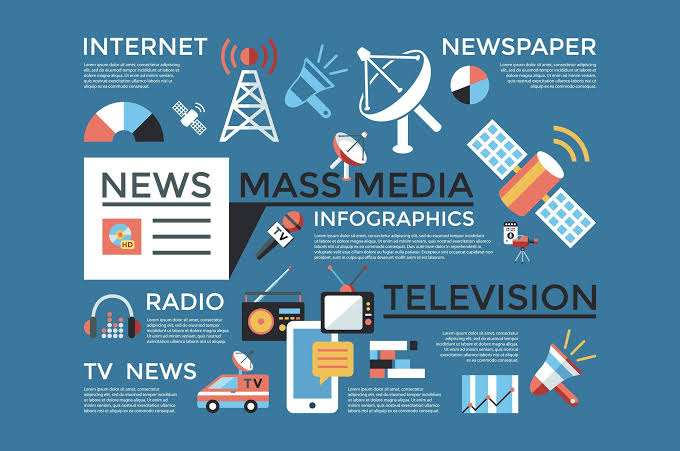
The present age is the age of information & Communication Technology. And mass media is the powerful and the most effective instrument of spreading or sharing information. With the advancement of digital technology, mass media have become a powerful and quick means of communication, broadcasting news and views, disseminating ideas and massages, and making information available anywhere in the world. The means of communicating news and views is termed as mass media. Mass media is classified into two categories print media and electronic media. Print media include newspapers, magazines, journals, and other printed materials. Electronic media includes radio, internet, television, satellite channels, cinema, etc.

In today’s world, mass media embraces internet, cell phones, electronic mail, computers, pagers and satellites. All these new additions function as transmitting information from a single source to multiple receivers.In other words, they are interactive and work on the person to person formula. Thus, it revolves around the masses i.e. the people. It is true that radio, television, press and cinema are in the spotlight when we talk about mass media.Nonetheless, the role of pamphlets, books, magazines, posters, billboards, and more also have equal importance if not less. Moreover, the reach of these tools extends to a huge amount of masses living all over the country.Television, cinema, radio and press are comparatively expensive forms of media which private financial institutions or the Government runs. These tools centre on the idea of mass production and mass distribution.Therefore, newspapers, television and radio cater to the needs of the mass audience and accommodates their taste. As a result, it will not always be refined or sophisticated. In other words, it displays popular culture.

The Function of Mass MediaThe main function of mass media is to reach out to the masses and provide them with information. In addition to that, it also operates to analyze and observe our surroundings and provide information in the form of news accordingly.As a result, the masses get constantly updated about not just their own surroundings but also around the world. This way mass media spreads and interprets information. For instance, weather forecasts equip people and farmers to plan ahead.Similarly, fishermen get updates about the tidal activities from the news. In addition to this, mass media also strives to keep the fabric of our social heritage intact which showcasing our customs, myths and civilization.Another major product of mass media is advertising. This way people learn about the goods and services in the market. It also spreads social awareness. For instance, anti-smoking campaign, women empowerment, green earth clean earth and more.Most importantly, with the numerous mediums available in multiple languages, the masses get entertainment in their own language easily. Millions of people get to access a cheap source of relaxation and pass their time. In fact, it also helps to transport momentarily from our ordinary lives to a dream world. Thus, it remains the undisputed leader in reaching out to the masses.Conclusion of Essay on Mass MediaAll in all, while it is an effective tool, we must also keep a check on its consumption. In other words, it has the power to create and destroy. Nonetheless, it is a medium which can bring about a change in the masses. Thus, everyone must utilize and consume it properly.

Don't give up on yourself!


Knowing and analyzing our insecurities

Have you ever felt like
you just don’t belong anywhere? Whenever you enter into the classroom and you
just feel that people might laugh at you or talk behind your back whenever you
exit your classroom, right? 


Have you ever  SHAPE  \* MERGEFORMAT

been
anxious around strangers and even friends because you think that you are boring? 
Have you ever been ashamed of yourself that you can’t
look into the mirror?

Have you ever felt ugly or worthless when you had invested
a lot in a romantic relationship and all you got in return was your partner
disrespecting you, disrespecting your love, blaming you for everything, coming
back as they please, going back as they please and breaking your heart multiple
times?


It hurts when someone who you trust the most backstabs
you one talks about friendship, relationship or even professional life.

In general, we talk about friendship, the people who
care about others, who are kind to everyone and who are honest at heart might
get hurt very easily because such people end up getting bullied, deceived and
heartbroken.


Such fake friends are only at the time of “their need”
but not when “you are in need”. A sense of abandonment is deeply felt.
 

If one talks about relationships, people emotionally suffer
a lot. I know it’s very easy for anyone to say that “It’s a just a phase to
make you stronger” or “It wasn’t meant to be” but very difficult for anyone to
go through this excruciating pain!

The words like “positivity” or “letting go” are very
easy to hear but to understand its actual meaning and applying it in our lives
is very difficult.

 People who are
your well-wishers would always recommend you to stay positive or move on from
such toxic friendships and relationships.

I really understand that some people might be used to hearing
such words but might not actually listen to it. A person could be irritated,
frustrated and angry even if their well -wishers say those words out of care.

This is because it is difficult for a person suffering
from trauma of any kind of situation whether its friendship, relationship etc
to absorb such words. This is because every individual has different struggles and
each individual endures a lot of pain with varying intensities.

Such people are very emotionally vulnerable. One conversation
which might be a joke to one person, might trigger anxiety in another person. Such
painful incidences in personal and professional might actually make a person
burdened by their insecurities.


I really feel and understand that people who are
burdened by their insecurities due to the external factors often feel
worthless, ugly, underconfident, unloved, anxious, lonely, abandoned, suffocated,
helpless, disappointed and depressed.

In professional life as well, people often feel
underconfident and incompetent. They are often stressed out with their workload
and do not feel happy from inside.

Often due to such overwhelming incidences and
feelings, one also thinks on giving up on themselves! They stop to live, only
exist and feel empty all the time.

You matter!

The important things which I wanted to say to all the
people who have truly loved from the core of their heart, to those who invested
400% in their friendship and those people who gave their best in producing high
quality work, no problem of yours and no feeling of yours is small and invaluable!
Everything that you feel matters! Most importantly, you matter!


Surviving each day with such overwhelming feelings is
really hard and brave work to do. You might not realize it but to get up from
bed when you are severely depressed requires a lot of bravery!

Don’t give up on yourself! You might not realize it but
you might be source of someone’s happiness, you might be very important to
someone and there might be some people who would cry if you harm yourself. You
just need to take your time, open your eyes and heart to see it!

I am not asking you to stay positive or I won’t say “Everything
will be fine”. As your virtual crying shoulder, I would suggest you to let all
your feelings and frustrations out, to fill as much pages of your diary as you
want, to reach out to an understanding councilor if you don’t feel comfortable
to talk to your family.
 

Tips for tackling your insecurities 

I would just ask you to try to see your situation with
a new perspective and at the same time remembering some very important things:

 1.    If
you ever feel such overwhelming feelings and you feel that you are ugly, worthless
or good for nothing by anyone, try to analyze their face.
 Once you do that, you’ll realize that
whatever any harsh words someone says to you is actually them showing and imposing
their insecurities on you.

 Insecurities arise only when you feel someone
is superior than you and such people do not acknowledge the fact but trust me
deep down, they know everything.
 

 If we look at another perspective, if
people who out of their insecurities say harsh words to you, it means that they
are seeking their validation of them being superior from you, so in any sense
they themselves prove that you are much superior!

 2. In
friendships, even after giving your friends chances and confronting them, they
hurt you, take advantage of you or bully you, leave them.
 

 The simplest way is to ignore them. But if you
are bold by nature then directly say what you actually want to say without any
hesitation and simply leave without turning back.
 

If you are friends with
popular group, then also see it from a perspective that people would eventually
forget and won’t remember such groups. Generally, as we would grow older such
things won’t matter to anyone.

 So, it is always better
to be with yourself rather than having such toxic friends. Trust me you would be
much happy and free and one day when you meet real friends, never let them go!

3.    In
relationships, don’t let anyone not even your partner to hurt you, disrespect
you, emotionally, physically and verbally abuse you.

 Its very easy to say these words but there
would be some point where the breakup would still hurt but you will stop
writing emails continuously to your unresponsive partner. 
 

At a point of time, you’ll realize that it is
pointless beating a wall. If anyone really loves you, they will make and effort
to make the impossible to “I am   possible”!
 

If we look at this situation also
with a new perspective, the separation would make you realize your own
feelings, to think about how were you treated, how you treated your partner, to
learn from your mistakes and improving oneself, so that even if fruitful reunion
happens, you will have a clear and stable mind to forgive the past and start a
new beginning.

 Use this separation time
to improve and introspect yourself, take better care of yourself by chanting
prayers, eating healthy food or even junk food once a week, hanging out with
friends again, picking up a hobby which you had left ages ago or even just
playing any sport like badminton!


Taking a salt water bath
can also remove negativities to a great extent.

But if you strongly feel
that your partner will mistreat you again if you reunite, then with a heavy
heart, taking as much time as you need, follow the above steps with the perspective
that you’ll do them solely for yourself. Don’t let anyone make you feel that
you don’t matter or you don’t deserve to exist.

Look at this situation
from the perspective that if your partner who is mistreating you has lots of flaws
in him or her as well. If they would have been perfect, then they would be God
who would have created the whole universe! 

Fortunately, they are not gods who
created you, so it is not necessary that whatever they said is the absolute
universal truth right? 
So, don’t worry, whatever
they say in any way doesn’t define you.
 

   4. Finally,
in professional life as well, if anyone takes advantage of you, think of it as
a learning experience. If you feel insecure that the someone’s personality is
better than you, observe them and make necessary improvements in yourself. It
would not mean losing yourself, it would just mean that you are being a better
version of yourself. 

So, if your head
scolds you, you are allowed to feel hurt but don’t let that hurt overpower you.
Think of this situation as a learning lesson for your personal and professional
growth. Don’t be disheartened by your failures as your failures and mistakes will
only be stepping stones for your success.

L  Finally,
don’t ever give up! You can do everything and your existence is important!


Covid-19 : a travel and tourism wrecker

In the past decades, tourism has experienced continued growth and became one of the fastest growing economic sectors globally. The sector witnessed a 59% growth over the decade in international tourists’ arrivals from 1.5 billion 2019 compared to 880 million in 2009. Globally, the industry contributed to $8.9 trillion to the global GDP in 2019 equaling a contribution of 10.3%. However, the strong growth has been halted in 2020 amid the Covid-19 pandemic. With airplanes on the ground, hotels closed and travel restrictions implemented, travel and tourism became one of the most affected sectors since the very start of the virus spread. The pandemic has cut international tourist arrivals in the first quarter of 2020 to a fraction of what they were a year ago.

Closing borders, tourism & travel ban

Countries all over the world applied travel restrictions to limit the coronavirus spread. Airport closures, the suspension of flights, and nationwide lockdowns are just some of the measures that countries are implementing in an effort to contain the pandemic. After the spread of the pandemic in the first two quarters of 2020, at least 93% of the global population lived in countries with coronavirus-related travel restrictions, with approximately 3 billion people residing in countries enforcing complete border closures to foreigners.

The decline of International Tourists during the Pandemic

The number of international tourist arrivals has been growing remarkably in the last decade and still sustained growth throughout the last years; in 2017 arrivals reached a total of 1.3 billion globally, 2018 reaching 1.4 billion and 1.5 billion in 2019. In 2020, due to the severe impact of the COVID-19 Pandemic, international tourism went down by 65% in the first half of 2020 when compared with 2019 figures.In May 2020, the majority of the UNWTO (World Tourism Organization) tourism experts expect to see signs of recovery by the final quarter of 2020 but mostly in 2021.

Covid-19 and Airline Failures

The International Air Transport Association (IATA) financial outlook released in June showed that airlines globally are expected to lose $84.3 billion in the year of 2020 for a net profit margin of -20.1%. It also stated that revenues will fall by 50% to $419 billion from $838 billion in 2019. In 2021, losses are expected to be cut to $15.8 billion as revenues rise to $598 billion. IATA’s Director General and CEO, stated that “Financially, 2020 will go down as the worst year in the history of aviation. On average, every day of this year will add $230 million to industry losses. In total that’s a loss of $84.3 billion”. What’s shocking is witnessing how many airlines have failed during the coronavirus pandemic. And even for airlines that are still in business, the situation is severely difficult. The second-largest carrier in South America, Avianca Holdings survived the Great Depression – but not coronavirus. The airline filed for Chapter 11 bankruptcy protection in May.

Hospitality Sector Hit by the Lockdown

The lockdown due to the pandemic has affected the tourism industry across the globe, and the hotel sector is among the hardest hit. Global hospitality data company STR compared 2020’s first quarter status to 2019 figures, hotel occupancy rates dropped as much as 96% in Italy, 68% in China, 67% in UK, 59% in US. There’s no doubt that the hotel industry has witnessed a severe impact by the pandemic and the lockdown status.

Balancing the Return of Tourism Revenues and Safety

As of July 2020, the EU opened borders to tourists from 15 different countries leaving the U.S. off the list. Health officials developed a plan to classify accepted countries based on how the country is performing in controlling the coronavirus. A country is considered under control when they have a number close to or below the EU average for new coronavirus cases over the last 14 days and per 100,000 inhabitants. On 15 June, the European Commission launched ‘Re-open EU’, a web platform that contains essential information allowing a safe relaunch of free movement and tourism across Europe. The platform will provide real-time information on borders, available means of transport, travel restrictions, public health, and safety measures.

The Return of Tourism Globally

With lockdowns ending around the world, many countries have started to ease border restrictions and reopen for international tourists. Although many governments are still advising against “nonessential” international travel, a host of popular destinations have eased their Covid-19 border restrictions and are readily welcoming tourists back:

– The European Commission has released guidelines for how its Member States can start to ease coronavirus travel restrictions and enable tourism to begin again

– Destinations like Dubai, the Maldives, Egypt, Lebanon, Croatia, Kenya, Tanzania and Jamaica have already opened their doors to foreign visitors again, while Thailand hope to reopen soon

While tourism is slowly returning in some destinations, most members of the UNWTO Panel of Tourism Experts expect international tourism to recover only by the second half of 2021, followed by those who expect a rebound in the first part of next year.

However, there are still concerns over the lack of reliable information and deteriorating economic environment which are indicated as factors weighing on consumer confidence, especially with the potential new limits on travel as world comes to grips with second Covid-19 wave. The concerns over the waves of coronavirus brought on by returning vacationers are wreaking havoc on the world’s tourism industry.

Brief steps for innovation in the era of E-commerce

As the Economist Joseph Schumpeter said Entrepreneurs can’t sit idle and try to innovate. They are the people who have an uncanny sense of using the resources from less productive use to more productive use. They are the ones who do Value creation, this is what we call innovation.

E-commerce belongs to this generation and Technology is irreversible; no one can hold it back and only curiosity won’t help us. Research activity is also needed. Scientific knowledge is essential (supported). Research is also supplemented by Developmental activities (R&D), closer to practical uses.

The Technological Innovation world involves product and process development activities (converted into manifestation forms). Then it transcends to the market/people with practical uses. Invention and discoveries constitute the technology world/innovation world- product process- market development activities (Administrative capabilities needed as well).

This all has to be assembled holistically and make the tech happen/forward driven with innovation. Business world needs tech entrepreneurship and administrative skills.

We have to question what value the tech will bring to our product. Simple innovation without value creation cannot create Blue Ocean/has no meaning.

Technological importance means the value that the technology brings to a product/potential product

We have to ensure not to bring value to other products in the competition. We need technological positioning. Frontier-ending R&D investment is needed to compete with the rival companies that are deeply entrenched in technology. Keep competitive parity is not an advantage.  

A technology portfolio consists of- Bet, Draw, Cash, and Fold

Regime of Appropriability

Is the effectiveness of legal mechanisms of protection of technology, Patents, copyrights, trade secrets, tacit knowledge, and codified knowledge.

Process innovation can’t be protected by patents.

Codified knowledge is very prone to industrial espionage, in other words, Hiring people from other companies. The regime of appropriability can be from high to low depending on the technology. E.g. KFC spice formula (easy to safeguard) or a new search algorithm (hard to seep safe).

Any innovation passes through two stages-

Pre Paradigm and Paradigm stage

Pre Paradigm is when a technology is in the process of innovation. Every innovation goes through this stage when it remains in the domain of the innovators and scientists.

In the Paradigm stage product designs are fluid and the manufacturing process is loosely organized whereas in the Paradigm stage less uncertainty for the design emerges and a final design emerges. The focus is now on process design.

Our objective is to transit from the pre paradigm stage to the paradigm stage as fast as possible. Successful transit of tech to practical use is called commercialization and has to be ensured with another set of capabilities called complementary assets.

The tinkering or invention needs to be followed by research and then a complimentary stage in development. Entrepreneurs have to ensure that complementary assets have to be built around innovation to be successful. Innovators need to have certain complementary assets which are not generic (highly specialized).

There is a third category of assets called Co specialized. These assets have a bilateral dependence. These assets have no other use other than their intended use. E.g.: A spacecraft manufacturing facility.

Many innovators fail and succumb and they don’t have the complementary assets. To counter that, entrepreneurs can do collaborative strategy by collaborating with partners with complementary assets. It should exclude the possibility of any other collaboration.  

Technology has to be adopted by people otherwise, it has no meaning. Early adopters need to leverage by patronizing the products. This gives way to the early majority who are more market-orientated. If they are satisfied they give way to the late majority. This transition will secure our position in the market.

But there is a catch, when technology falls between the transition space of early adopters and the early majority. This is known as ‘Chasm’. This change in emphasis poses a problem for innovating firms since incumbents are often much better equipped to meet the desire for complete products and low-risk purchases,and once you fall into this space. It gets really difficult to get out of it. A tornado (another group of people) is needed to take it out of the chasm and hit it into the mainstream.

E-commerce implementation can have two strategies:

Bottom-up approach and Top-down approach

Introduction of Ecommerce has complemented traditional business. This has also made traditional businesses more competitive.

Top-down approach implementation is preferred on a large scale and national level but when it comes to administrative (meeting the requirements of civil services), local trade and commerce services are suited to have a bottom-up approach.

Digital infrastructure is essential for making e-commerce successful. Cradle to grave digital identity is emerging as the new measure to the unique identification of people.

Common service center: Helps in providing e-Services to rural and remote locations where availability of computers and Internet is negligible or mostly absent. With the help of Interoperability and common information center data and information can be accessed at any location.

Mobile banking is another approach that is also increasing its proliferation.  But it’s still in its nascent stages.

Another concept that is emerging is Cashless transactions where all the POS and banking services can be attained remotely. Although the security issue remains which has to be taken care of by a central agency (Government).

One of the most important things to consider is Digital literacy. A certain amount of literacy is needed for availing all these digital infrastructure and access. For a widespread utilization of digital services, we have to ensure that more people are digitally literate.

We also have to keep in mind that common support ICT infrastructure and adequate private and public partnership will help to make these services more efficient and better.  With the help of aforementioned knowledge, an E-commerce can certainly endure in the realm of digital world.

References:

https://www.reed.edu/economics/parker/f10/201/cases/appropriability.html

https://smallbusiness.chron.com/stages-paradigm-shift-organization-78904.html

The Untold Story of the Cinema Godfather

One of the biggest tragedies to happen to motion pictures was less about what happened on the big screen but something that happened off camera at the very beginning of the story of the moving image. It was one train ride to Paris that wiped French inventor and artist Louis Le Prince’s name out of the books of history.

Born on 28 August 1841 in Metz, Le Prince was the son of a respected officer of the Lágion d’Honneur, a French order established by Napoleon in 1802. His family referred to him as “Augustin” and English-speaking friends would later call him “Gus”. He grew up spending time in the studio of his father’s friend, the photography pioneer Louis Jacques Mandé Daguerre, from whom the young Le Prince allegedly received lessons relating to photography and chemistry and for whom he was the subject of a Daguerrotype, an early type of photograph.

His education went on to include the study of painting in Paris and post-graduate chemistry at Leipzig University, which provided him with the academic knowledge he was to utilize in the future. Having studied all art, physics and chemistry at university, the Frenchman moved to Leeds where he met, fell in love with, and married English artist Elizabeth ‘Lizzie’ Whitley. Together the new couple began a school of applied art named the Leeds Technical School of Art. Soon they were well-renowned for their work combining photography on metal and ceramic. The family later moved to the US for some years while Louis managed a small group of French artists there.

It was also in the US that Le Prince began to build his sixteen-lens camera and experiment with film stock. In 1886 he created a 16-lens camera and applied for an American patent on 2 November of the same year, receiving this at the beginning of 1888; on 16 November 1888, he received a British patent for his invention. The Le Prince Single-lens Cine Camera, proved to be one of the most ground-breaking inventions of early cinema. While the contraption, which utilises paper-backed stripping film, may appear primitive by today’s standards, evidence that the equipment was successful in projecting moving images means that Louis Le Prince’s movies pre-date those of Edison and the Lumières by over half a decade.

In a cruel twist of fate however, it was a single day that erased the French inventor’s name as the original inventor of the motion picture camera. Once content with his creation, Le Prince had the first public exhibition of his work and his motion pictures scheduled in New York during September, 1890. Yet he never made it, disappearing just on the 16th of that month, never to be seen again and baffling authorities and film theorists for over 100 years. Following the death of his mother, Le Prince had travelled to Dijon, France to visit his family and spend time with his brother, Albert. Having dropped him at the train station with all of the material for his presentation and a suitcase said to be containing his latest patents, his brother waved him off … only for Le Prince never to arrive at his destination. French authorities and Scotland Yard launched an investigation immediately, but not a single passenger on the train reported seeing Le Prince onboard. Le Prince was officially declared dead in 1897. His disappearance for over a century has been riddled with many theories with rivalries with inventors such as Thomas Edison and heavy debt being listed as explanations.

For the most part, his work went largely unacknowledged among the wider public. However, thanks to the continued efforts of his family and the city of Leeds, where he’s considered a local legend, Le Prince’s work has been recognised in recent years. In 1930, there was a bronze memorial plaque unveiled in his honour and he was featured in the 1966 Jacques Deslandes documentary “The Comparative History of Cinema”. In September 2016 a documentary about Le Prince from Leeds filmmaker David Wilkinson, “The First Film” , played at the Morris-Jumel Mansion in New York. This was 126 years after Le Prince was set to screen his first films in the very same building.

What is celebrated today? 24 July 2021

National Cousins Day, Drive-Thru, Pioneer Day.

Cousin: a child of one’s uncle or aunt.

HIstory:

The history of it’s origin is quite unknown. Well, one can theorize that whoever coined this day had special bonds with their cousins.

Cousins are people that are ready-made friends, you have laughs with them and remember good times from a young age, you have fights with them but you always know you love each other, they are a better thing than brothers and sisters and friends cause there all pieced together as one.”

– Courtney Cox

Significance:

This day is celebrated to cherish our bonds with distant to our cousin brother and sisters. When we visit our aunt or uncle’s place, we reunite with our partners in crime. We play games, create some nice nuisance for our elders, talk about our friends and foes, plan an escape to moon, pull an all-nighters, and enjoy heartily.

Be it younger or an grown up group of cousins, we have a lot to learn from each other. Soon, nostalgia about our past mistakes and fun hits us.

What to do today?

  • Get in touch with a long lost cousin.
  • Play a game of charades, ludo, scrabble or any another game available. Don’t let Covid stop you from enjoying a reunion with them. There are few online multiplayers to enjoy.
  • Share a memory you are most attached to.
  • Make plans to visit places you guys always wished to go.
  • Have a friendly competition.
  • Share your books and favorite movies.
  • Have a go and beat each other at video games or outdoor ones.
  • Share your gratitude for their existence and the love you received.

FACTS:

  1. All European Jews Are Distant Cousins.  The global population of Ashkenazi Jews, a Jewish community from Central and Eastern Europe make up a huge amount of present Jews.
  2. Research published in 2014 says close friends are likely to be fourth cousins because they might share quite lot of genetic material.
  3. Queen Elizabeth II and Prince Philip are third Cousins. Yes, you heard it right, the most famous married cousin couple Elizabeth and Philip are both descendants of the U.K.’s Queen Victoria.
  4. It is true that marrying your cousin can cause the baby to have birth defects.

Few other days celebrated today:

  • Pioneer Day
    • Pioneer is a person who is among the first to explore or settle a new country or area.
    • Pioneer Day has been created in order to commemorate the day the very first group of Mormon pioneers came to Salt Lake Valley.
    • It is an official state holiday in Utah
  • Drive-thru Day
    • Drive-thru is a type of take-out service provided by a business that allows customers to purchase products without leaving their cars.
    • A day to celebrate the way drive-thru made getting food easier.
  • Tell an old joke Day
    • “Knock-knock” jokes still gets attention to this day. Well, go and annoy someone with some good old jokes and use today as a good excuse.

REF:

https://www.daysoftheyear.com/days/2021/07/24/

Control of Air pollution

National air quality monitoring programme

  • Central pollution control board is executing a nationwide program of ambient air quality monitoring known as National air quality monitoring programme.
  • National Ambient Air Quality standards prescribed specific standards for residential, ruler, Industrialand other sensitive areas.
  • N. A. M. P, four air pollutants – Sulphur Dioxide, oxides of Nitrogen, suspended particulate matter and respirable suspended particulate matter (pm10) have been identified for regular monitoring at all the locations.
  • Network consists of 683 operating stations covering 300 cities and town in 28 states and 9 union territories of country.
  • Annual average- Annual arithmetic mean of minimum 104 measurements in a year taken twice a week 24 hour at uniform interval.
  • The level of air quality necessary with an adequate margin of safety to protect the public health vegetation and its property.

Air quality index

  • Air quality index is tool for effective dissemination of air quality information to people.
  • There are six categories namely – good, satisfactory, moderately, polluted, poor, very poor and severe.
  • The propose 82 I will consider 8 pollutants PM 10, PM 2.5 NO2, SO2 Co, O3, NH3 and Pb.

Control of air pollution

  • Control measures
    1. Technological
    2. Legal
    3. Economic

Technological approach

  • Adapting Lifestyle that uses less energy and pollutes less or using energy sources that produce less amount of pollutant as by-product.
  • Remove pollutant generating stuff from energy sources
    • example- Remove sulphur from coal before burning it.
  • Reduce the energy used without changing the way of life
    • Use more energy efficient car and replace existing bulb with CFL bulb and LED bulb.
  • Check the generation of pollutant their burned
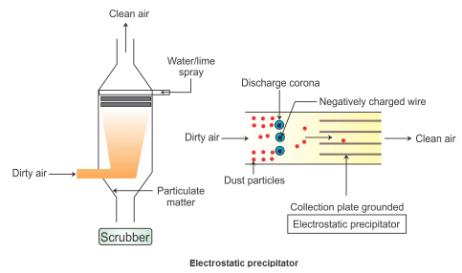
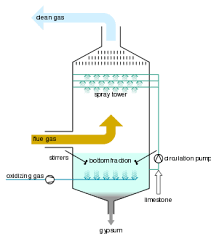
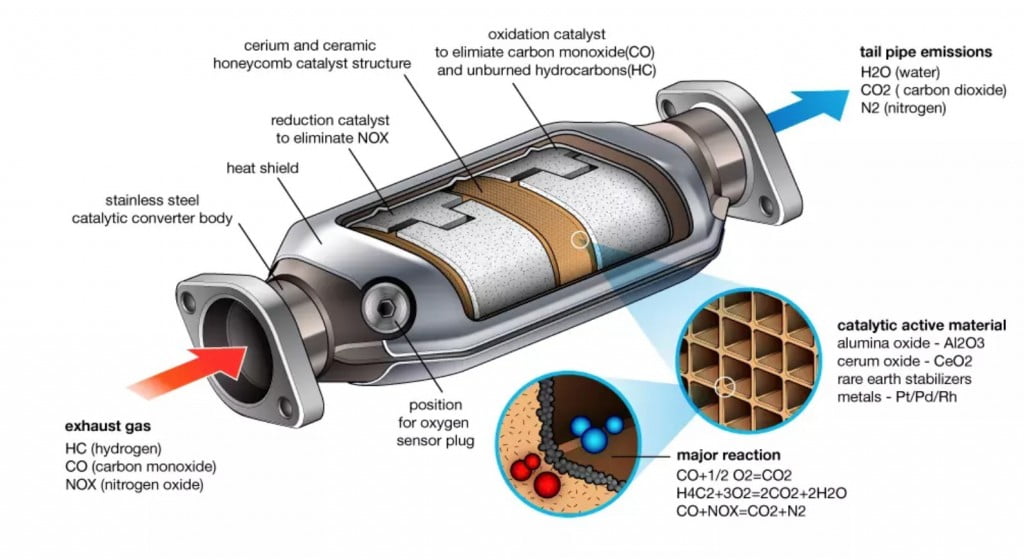
    • Catalytic converter, electrostatic precipitator, scrubber, Bag house collection of particulate emission, cyclone separator etc.
    • Encouraging mass transportation.

Legal approach

  • After Stockholm conference, 1972 the Government of India under article 253 of the Constitution of India in enacted the Air Act, 1981 for the prevention control and abatement of air pollution.
  • To empower the central and state pollution control board. Air Amendment Act, 1987( for prevention and control of pollution) was enacted but this was not strong enough to play precautionary role.
  • After Bhopal disaster of Environment protection Act was passed in 1986 this act has punitive power to restrict any activity that would harm the environment.
  • To regulate vehicles pollution, the central motor vehicle act of 1939 was amended in 1989.
  • As per the current requirement all the transport vehicles must carry a fitness certificate which is to be renewed each year after the first two year of new vehicle registration.
  • National fuel policy announced on October 6, 2003 , a phased program for implementing the emission standards in India by 2010.

Economic approach

  • Cost consideration of air pollution involves 2 factor:-
    1. Cost of controlling the air pollution
    2. Cost of not controlling the air pollution
  • Determination of cost of first in straight forward but that of second is difficult and can be subjective to some extent.
  • Direct air pollution control in India
    • Fuel wood and Biomass burning
    • Transport

Control

  • Using low sulphur coal.
  • Use Proper air pollution control devices in industry
  • Individual efforts to control air pollution
    • Inform to Road Transport office and PCB about the vehicle polluting the environment
    • Regular engine tune up replacement of old more polluting vehicles
    • Shifting to less polluting fuels
    • Using mass transportation
    • Do not use CFC containing sprays for freshners that deplete the ozone layer.
    • Planting more trees
    • Say no to fire crackers in Diwali and other occasions.