What to Expect During the Personal Training Certification Process

Daily writing prompt
What’s your favorite cartoon?

Are you passionate about fitness and helping others achieve their health goals?

Personal training certification is the key to turning that passion into a rewarding career. With the right certification, you can unlock opportunities to make a difference in people’s lives while pursuing a fulfilling profession.
The journey to becoming a personal trainer can open doors to various career paths in the fitness industry. Earning a personal training certification allows you to gain credibility and the knowledge needed to guide clients safely and effectively. In this blog, we will discuss what to expect during the personal training certification process.

Preparing for the Written Exam

Getting ready for the personal training certification exam is important. Start by learning the key topics. Study the terms, exercises, and health concepts that are essential for personal trainers.

Make a study plan and stick to it. Use flashcards to remember important terms. It helps to review old exams and practice questions.

Group study can also help. Join a study group or class. This makes learning fun and effective.

Hands-On Training and Gaining Practical Experience

Hands-on training is a vital part of the personal training certification process. You will learn how to work with clients and teach exercises. This includes showing proper forms and correcting mistakes.

Find a local gym or training center. They often offer practical sessions. Shadowing experienced personal trainers can give you great insights.

Your hands-on experience will boost your confidence. The more you practice, the better you will become. This will help you in your future career as a personal trainer.

Completing the Required Practical Assessments

Practical assessments are crucial for your trainer certification. You will need to demonstrate skills in front of an evaluator. They will check how well you can train clients.

Practice all the required assessments. This includes exercises and client interactions. Knowing what to expect will ease your nerves.

Be sure to follow all guidelines during your assessment. Confidence is key to showing your skills. Doing well will help you earn your personal trainer certification.

Navigating Continuing Education and Recertification Requirements

Once you earn your personal training certification, learning doesn’t end. Continuing education courses help keep your knowledge up to date. These courses ensure you stay informed about new trends and changes in the fitness industry.

You’ll need to complete certain courses for recertification. These may include updates on the latest research and trends in personal training. Make sure you check which courses are required to stay certified.

There are many organizations offering fitness certification courses. You can choose courses that interest you to grow your skills. For instance, visiting https://www.americansportandfitness.com/products/barre-certification can help you gain more expertise and get certified in return.

Ready for Success: Your Path to Personal Training Certification

Obtaining your personal training certification opens doors to a rewarding career. It not only boosts your credibility but also equips you with essential skills to guide others toward their fitness goals. By staying updated through continuing education, you ensure ongoing success in this dynamic industry.

With hard work and dedication, you’ll be well on your way to a fulfilling career as a personal trainer. Keep learning, practicing, and pushing yourself to new heights.

Did you find this article helpful? Visit more of our blogs!
Personal Habits: Exercising

Everyone from India has heard the phrase, “ If you get up by 6 in the morning, everything will set in order.” It is a common phrase made for Millennials and Gen-Z. We hear it so often and tried a few times but it didn’t suit your routine. Did you ever wonder why you weren’t able to adopt it? After reading this, do let me know about your thoughts on this.

Exercising in the Morning

Of course, the most common habit among people. Exercising a few hours after you get up is beneficial to your health. It increases blood flow in you as well as trains your muscles. It increases alertness and also energizes you for the day. It’s common to do cardio in the morning with lifting weights before your first breakfast. This helps in burning fat as well as developing your muscle endurance. But why can’t you do it?

Jogging in the Morning increases blood flow and improves body endurance.

The most common reasons are:

  • Sleeping Late: You may have slept late. Even if you have slept around 11PM, if you need 8 hours of sleep then you will get up at 7AM. Your body needs sufficient sleep to get up or it will keep you tired the entire day. You have to plan your sleep schedule in a way you don’t compromise your sleep.
  • Exhausted: If you had a backbreaking day and you are completely exhausted of your energy, then you may not get up the next day at your set time. If this is your regular routine, you may want to change the time you want to get up.
  • Jam-packed daily routine: If your schedule is full on an everyday basis, you need to start prioritizing your work. It may be tough to change your routine but by doing this, you can improve the amount of time you can give to yourself and your new habits.
  • Feeling awkward where you exercise: Am I doing it well? Is my form right? Is my shirt torn? Am I sweating too much? Am I disturbing someone? Are they looking at how bad I am? Are they judging me? It is okay to feel these when you workout. Everyone goes through this and it’s okay. At the beginning it does feel weird to do a workout but we all started as beginners and we also have made mistakes. The only thing that you can do is ask a friend, family or trainer to help you. They may also point out other mistakes that you may have made which you can correct.
  • You don’t want to: Most of the time when you try to build a habit, there is a feeling that says, “This isn’t worth the trouble we are going through” but sometimes, you just don’t want to. You might want to do it to show others or of the stereotypical “healthy person”. If you think clearly by separating your external ideas/thoughts, you will understand why you want to do it.

How can you tackle these problems?

At first, these hurdles feel the hardest to jump over but unless you jump over them, you cannot reach your goal. There will be hurdles along the way and you are the solution to them. You will become better when you start crossing hurdles. Every hurdle you face is a step that you need to conquer and move forward.

  1. Set a Convenient time: 5 AM may be easy for others but it may be difficult for you. It may not agree with your sleep routine, or with your work routine so you quit. Rather, just change the time. If you get up around 7 AM and have to go to work by 10 AM. Make a slot of 1 hour for your workout and complete your morning routine! If you can’t make a slot of 1 hour, carry it to the evening when you come home. 1 hour before dinner, exercise to your heart’s content! 
  1. Change your workout: If you are the ‘No pain, No Gain’ person, sometimes, you may get too sore from your workout which leads to quitting. Rather than quitting, change your workout a bit. You don’t need to change weight, just change what you do. It is very helpful to have a 10-minute cardio session at the end. Not high intensity but something like walking on a treadmill or yoga, will help you recover efficiently.
  1. Get a workout partner: “Sometimes, the fruit tastes better when it’s shared” Get a partner! A friend who wants to workout or a family member who is bored of being alone in the gym, work together at the gym! When you have someone to look out for you, you get more confident and work better. It will also help in improving your form! If you workout with a partner you are comfortable with, you will be able to focus more on your workout than others.
  1. Take Pictures of yourself: When you take pictures of yourself after you workout, you can see the amount of progress that you are accomplishing over time. This way you get to see how far you have come. Every day that you work is a step forward. You and your partner could record each other’s workout and see where you could improve.
  1. 20% of the work gets you 80% of the way: Some days, you don’t feel like working out, you don’t feel like going to the gym but by showing up and doing 10% of your workout makes you feel happy that you came. Just by showing up and starting your workout sets the wheels in motion. By the time you take off your headset, you are halfway through.
  1. Take cheat days/rest days: When you exercise, it’s important to rest so your muscles recover and become stronger. By not taking rest, you are prone to burning out. If the gym is tiring you out way beyond it should, then you need a rest day. Hitting the gym after your rest day feels better because you will feel stronger and work more.

This article is my personal opinion that I have used when I workout and it has worked well for me. Experiment with your workout routines and I am sure you can find something that works well for you. To become better tomorrow, you have to work today. This way, you will become a better version of yourself. All the Best! 

Why gym rats boast about “pump”

As with most profound physiological processes, the pump results from the complex interplay of a number of related functions. In bodybuilding terms, the required stimulus for an effective pump is, of course, proper weight training. As bodybuilders, they train with weights for the sole purpose of stimulating muscle growth, and the pump indicates we are heading in the right direction as far as this aim is concerned.

To achieve maximum muscular growth a pump (scientific name, hyperemia) is essential, and the only way this can be achieved is to train correctly with the right energy intake, to allow sufficient blood flow to the working muscles. Working muscles need blood to supply them with oxygen and nutrients, and remove waste products (namely, lactic acid and carbon dioxide).When a muscle is trained, blood flow is diverted from many other bodily processes, to supply this muscle with what it needs to perform maximally. The blood first needs to become oxygenated (which is done through gaseous exchange in the alveoli of the lungs) before it is pumped to the working muscles, where it is pooled, thus resulting in the tight feeling we call the pump. It is thought that during training, a muscle can receive up to four times the amount of blood it would ordinarily get. Why exactly do the muscles need all this blood? As mentioned, the muscles require sufficient oxygen and nutrients to continue the sustained contracting that results in a pump. Over time, the pump will also create a greater number of capillaries (tiny blood vessels), which will, in turn, provide the muscles with more nutrients and oxygen and allow for larger pumps and more growth in the long term.

How is the pump achieved?

As mentioned, a number of interrelated factors are required for a muscle to pump with blood. The first of these serves a protective function. When we begin training, the nervous and endocrine systems signal the heart to pump more blood. This blood, made available through an increase in cardiac output and blood pressure, pools in its intended muscle, thereby helping to create the pump.

The fight or flight survival mechanism underlies this process, because the muscles are preparing for vigorous work. Whenever we engage in any form of vigorous activity, blood is diverted from unessential bodily processes (such as the urinary or digestive systems), to be used by muscles relevant to the task at hand.

A muscle that does not receive adequate oxygen will fail to continue contracting over a longer term, thereby limiting the intensity of an exercise, which, in turn, stifles the muscles efforts to pump up sufficiently. Lactic acid (a by product of high intensity work) will also congregate in the muscle, causing it to fall short in terms of energy expenditure.Blood that is supplied to the muscle under conditions of maximal work will help to flush this lactic acid out, thereby assisting the pump. The pump is also achieved when hormones and signaling factors such as nitric oxide (NO), released in response to the acidity caused by high lactic acid levels, cause local capillaries in the muscle to dilate, thereby allowing more blood to flow into the muscle. Blood that is supplied to the muscle under conditions of maximal work will help to flush this lactic acid out, thereby assisting the pump. The pump is also achieved when hormones and signaling factors such as nitric oxide (NO), released in response to the acidity caused by high lactic acid levels, cause local capillaries in the muscle to dilate, thereby allowing more blood to flow into the muscle.

Why calisthenics is the “go-to”, if you dont have the time to hit the gym

calisthenics (American English) is a form of strength training consisting of a variety of movements that exercise large muscle groups (gross motor movements), such as standing, grasping, pushing, etc. These exercises are often performed rhythmically and with minimal equipment, as bodyweight exercises. They are intended to increase strength, fitness, and flexibility, through movements such as pulling, pushing, bending, jumping, or swinging, using one’s body weight for resistance. Calisthenics can provide the benefits of muscular and aerobic conditioning, in addition to improving psychomotor skills such as balance, agility, and coordination.

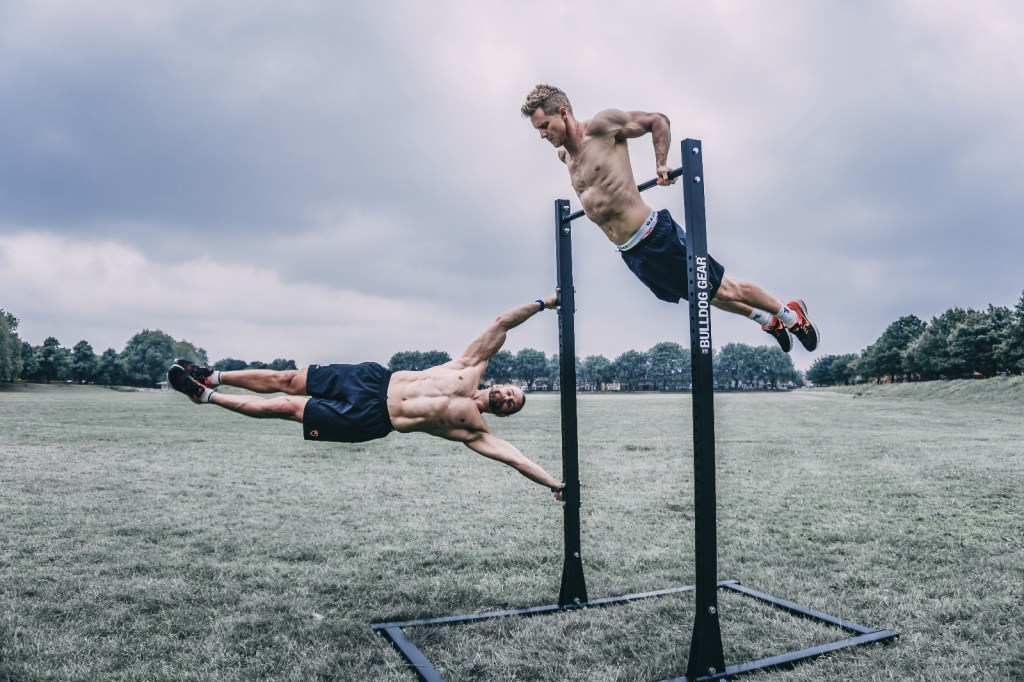
Urban calisthenics is a form of Street Workout; calisthenics groups perform exercise routines in urban areas. Individuals and groups train to perform advanced calisthenics skills such as muscle-ups, levers, and various freestyle moves such as spins and flips.

Sports teams and military units often perform leader-directed group calisthenics as a form of synchronized physical training (often including a customized “call and response” routine) to increase group cohesion and discipline. Calisthenics is also popular as a component of physical education in primary and secondary schools over much of the globe.

History

Catharine Esther Beecher (1800–1878), was an American educator and author who popularized and shaped a conservative ideological movement to both elevate and entrench women’s place in the domestic sphere of American culture. She introduced calisthenics in a course of physical education and promoted it. Disciples of Friedrich Ludwig Jahn brought their version of gymnastics to the United States, while Catharine Beecher and Dio Lewis set up physical education programs for women in the 19th century.Organized systems of calisthenics in America took a back seat to competitive sports after the Battle of the Systems, when the states mandated physical education systems. The Royal Canadian Air Force’s calisthenics program published in the 1960s helped to launch modern fitness culture.

Calisthenics is associated with the rapidly growing international sport called Street Workout. The street workout consists of athletes performing calisthenics routines in timed sessions in front of a panel of judges. The World Street Workout & Calisthenics Federation (WSWCF) based in Riga, Latvia orchestrates the annual National Championships and hosts the World Championships for all the national champions to compete at one competition. The World Calisthenics Organization (WCO) based in Los Angeles, CA. promotes a series of competitions known globally as the Battle of the Bars. The WCO created the first-ever set of rules for formal competitions, including weight classes, timed round system, original judging criteria and a 10-point must system—giving an increasing number of athletes worldwide an opportunity to compete in these global competitions. Street workout competitions have also popularised ‘Freestyle calisthenics’, which is a style of calisthenics where the athlete uses their power and momentum to perform dynamic skills and tricks on the bar, often as part of a routine where each trick is linked together in a consistent flow. Freestyle calisthenics requires great skill to control your momentum and understanding the mechanics of the body and the bar.

Can it give you the pump?

The lower intensities also allow athletes to focus on the muscles involved and to get a good squeeze and pump. Many muscle movements are pulled from appropriate strength movements. Many calisthenics movements involve static holds. Endurance movements train the athletes capability to hold the body various positions. This certainly gives you the pump, and by making small adjustment, u will be able to build muscle too.