The global pandemic of covid-19 has created a atmosphere that have made humans realize the value of one’s life. Pandemic has made potential risks to human life and business starkly visible, forcing the entire civilization and economies to reorient their way of living. The life insurance sector has also seen this impact, the industry settled more claims in the year 2021 than in 2020 due to this global event. A sudden demand for life insurance policies and increased claims induced operational changes for the insurance industry.
The recent trend in the life insurance sector can been seen in below mentioned five points.
Increase in the policy holders.
There has been a noticeable shift in who and how life insurance solutions are being consumed. A particular increase was witness among the young insurer those in the age group of 20-30 years have become more conscious about life insurance.
Implementation of technology in operation.
Insurance advisors earlier engaged potential customers in face-to-face conversations due to the challenges posed due to social distancing. They had to change to online meetings quickly. The advantage of online video conversations is that they can be done at any convenient time or even on-the-go.
Offering of wider range of policies by insurance companies.
With the increase in the demand, it has made mandate for the insurance companies to offer a wide range of policies that can cater to the need of the groups of people. Introduction of specific policy for health care workers, for younger generations, for the one who have been got in the disease of covid are some of the different segment that have got been introduced amid pandemic.
Sustainability and Environment, Social and Governance.
Among financial services companies, life insurers are better positioned to invest based on Environment, Social and Governance (ESG) principles under the broader theme of sustainability. The long-term capital that they hold is an enabler. They can invest in businesses that commit to environmental goals, sustainability, and better governance.
Restoring customers faith by Insurers.
In 2022, insurers will have to make efforts to restore customers’ faith in the industry, as well as minimizing customer losses in the wake of premium rises. Insurers will no doubt focus on improving the customer experience by increasing transparency and simplifying the claims process in order to boost retention rates and strengthen consumer brand loyalty.
This year also like the preceding one will be a difficult year for many insurers, with some industries still predicting losses a year ahead. Hopefully, many of the changes insurers can make to automate and streamline their workflows in the coming years can mitigate these losses in the wake of the pandemic.
How would it feel when a person you know apologizes for something which isn’t their fault? If someone dashed into him, he would apologize saying, “ I am sorry, I didn’t see you coming my way.” There is a limit for everything and after a while it feels weird to hear them say sorry for so many things.
There are so many factors that lead you to apologize for things. It could be how you have been raised or it’s something you have seen your family do, maybe it’s how you see the world. Apologizing is good for finding peace in conflicts or relationships. You say sorry for the mistake you have made so you don’t repeat it again. It reassures a person that you genuinely didn’t expect the outcome that has come and you want to amend your mistake.
You should not apologize for something you have not done or you have done for something that needed help. When you dash into someone, you apologize because you should have seen him coming, but you shouldn’t apologize for someone who dashed into you when you have been standing quietly.
A lot of people apologize for the reason of avoiding conflict or because they feel that they made the other person feel bad. It usually is either of them. Sometimes, it’s guilt that drives them. Guilty for joking/pranking, guilty for ignoring them, guilty for not asking them or the feeling of guilt for putting themselves first.
Reasons why you feel like apologizing:
You were taught to put others first: When you were a kid, you saw someone fall down. You rush to their aid and lift them up with your itty-bitty strength, and they thank you for helping them. You are praised by your family and the incident’s talked about at various family gatherings. It gives you the feeling of responsibility and makes you feel that you have to put others first and it should be your priority over anything. Fast forward to now, your friends ask for your help on their project, and you rush. You complete their project but yours gets delayed. Your sir calls you out in front of the class saying that you delay your work because of your laziness and your friend doesn’t stand up. Neither do they tell the sir after nor give you credit. You don’t say anything because your friend was first even if you were called out. You apologize to sir because you couldn’t finish it and not for helping your friend before yourself.
Truth: By putting others first, you don’t gain much but you do lose out on time that you could have used for yourself. If you had taken time to complete yours along with theirs, the work would have been completed quickly and efficiently with time to go over errors.
You were taught to help others without seeing what you need: You always gave your grandpa medicine on time, you helped your mother in cooking, you would take the newspaper to your dad along with his morning tea/coffee, and you were always told to help people. Today, you help someone, no matter how much stress/workload you have. They ask for anything and you help them out. Sometimes, it’s just a text to their crush on how to ask out and you help them, despite the deadline of your project. So you apologize when you can’t help them because you are placing yourself first.
Truth: You need to see what help you need first so you can complete the necessary task at hand. The text can be sent anytime but your deadline can only be given once. You need to help others but you need to see if it is something that actually needs help.
Scolded when you placed more importance on yourself: A lot of children are told to share and to not be selfish. If you have 2 chocolates, give it to your friend because you are a “good boy/girl”. After growing up, whenever you need new shoes or your family needs a new appliance, you choose the second option because it feels like a need but yours feels selfish.
*Appliance is used twice and placed for “Future Use”*
Truth: Sometimes, being selfish is good. You need new shoes and your home has enough appliances. By getting new shoes, you will stop getting the foot ache that you have been facing for the past 2 months. If you get new shoes, then you can work with more focus and more energy.
Avoiding Conflict: In most cases, when you were a kid, your tantrums would cause your parents to scold you and you would face punishment, or your friends would distance you because you get angry frequently. The last one pushes a child to socializing issues and causes anxiety on how others perceive them for every single action they take. So, they apologize whenever someone raises their voice a little bit, no matter what the conversation is about. They want to avoid the conflict because they don’t want to face what happened earlier and become outcasted.
Truth: You will face conflicts in future, either in relationships or friendships, you need to understand why you should apologize and for what you should stand your ground. Conflicts are what brings people closer to understand the other person better by learning their needs. If you never have a fight, how will you know what the other person actually feels?
Harmed someone in childhood: When a kid unknowingly harms someone, they get scared and cannot move because they don’t know what to do. Their mind goes blank and they freeze because this feeling is new to their system and it’s hard to know what to do next. The kid is then scolded and constantly lectured over and over again to the point the kid feels anxious to touch a person. When they grow, the anxiety grows with them and it constantly pricks them. What if the casual punch hit harder than it should? What should I do if I dash into someone a little too hard? Should I give them a handshake or fist bump? What if I punch them too hard? Let’s go with the handshake so I don’t hit them too hard.
Truth: It’s okay to give a fist bump or handshake or high-five to a person whom you know. You just need to relax your mind. If you want to touch the person but are scared of the force you put into it, then show a sign of initiation. For a handshake, raise your hand out in the form of a handshake, and wait for them to accept it. By showing initiation, you let the other person engage and guide you through the conversation.
Saying sorry is well and good but exceeding it drains you of your self-confidence. You are a person at the end of the day and you need to stop saying sorry for that. You are existing which means that you will make mistakes and you will learn, but saying sorry for things that don’t require an apology then it will just drain you. It’s not going to get fixed overnight because you have taken years to build this habit. It will be fixed if you work on it every time you notice it happening.
Thank you for reading this article. It is something I have faced and I have learnt how to overcome it. Leave a comment on how has overaplogizing affected your life and how have you overcome it or trying to overcome it.
There are many habits that destroy your mental peace, happiness and mostly you. Some of them are usually with different addictions or because of people but what destroys you as a person depends on how you view things and people around you. Your environment is what shapes you but to be different, you have to do it by yourself.
The most common habits have become common because we are more focused elsewhere than ourselves. To be a better version of yourself, you need to view your flaws and work on them.
Spotlight Effect: We overestimate how much attention people give to our words and appearance. Imagine you said something but it felt wrong after it came out. In reality, everyone only remembers it for the moment and immediately moves to the next topic. We ponder over it for days, forgetting that others don’t care as much as we do about it.
Example: “The red shoes don’t match the outfit at all! I guess the guys are laughing because of it”
*Red shoes matched the outfit better than you imagined*
Truth: No one cares about you as much as your loved ones do. Everyone is just a temporary traveler in your life and you have to be okay with it. Dress how you want and be how you want to be.
Status Quo Bias: We prefer for things to be the same; usually change is viewed as a negative aspect of life. If you adopt a new habit that cuts out something from your life, you immediately feel guilty of not being able to manage it, so you quit your new habit for the old one because it feels more comfortable.
Example: “I like to paint, but the classes are on Friday, I won’t be able to party! I can always paint later so let’s party now!”
*Proceeds to miss out on an amazing experience*
Truth: Change is hard. To adapt to a new routine and new place is always difficult and your mind is stuck on the old routine, but only then do you learn more about yourself. You may like to paint now, but when you explore it, you may not want to put the brush down! You need to explore that change for a while to know more about yourself.
Zeigarnik Effect: We focus more on the incomplete tasks than the ones that have been completed. Sometimes, we forget to see that we have accomplished many things on the way, and we focus on the ones that we have not accomplished yet. It pushes you to feel bad that you are not able to do anything.
Example: “Bro I lost the Table-Tennis Pan-India Semi-finals! I feel so like I can’t do it anymore”
*Came so far by winning championships and tournaments*
Truth: You have to see where you are today. Look behind you and see the different hurdles you had to come across. You didn’t cross them just to go back did you? It does feel bad to not achieve something the first time you try it, but when you achieve it, after toiling for some time, the fruit is incomparable.
Pessimism Bias: We tend to overestimate the possibility of negative outcomes. We always have a small part of your mind that searches for a negative outcome. What you see and ask for, is what you get and have. You will increase the chance of losing the opportunity if all you see is losing it.
Example: “I feel like I will lose this chance to be head of department, there are so many others who are way more qualified.”
*Loses opportunity because it messed with your confidence and screwed your interview*
Truth: What energy you put out, is what you usually get. Sometimes, you lose opportunities, but don’t dwell on the wrong aspects. You may not have the necessary qualifications but the way you portray yourself is what gets you opportunities.
Sunken-Cost Fallacy: We invest more in things that have cost us something, even if we have negative outcomes. We feel that if we invest more, the difference can be recovered with just a little gain.
Example: “My portfolio is down by 25%! I will invest 50% of it so with a 25% gain, I can recover the loss”
*Proceeds to lose more because the stock market is in a bear phase*
Self-serving Bias: Our failures are situational but our success is our hardwork’s result. We view that our failures are determined by external factors and our success is because of us. It is also difficult to ascertain what caused success or failure on the spot so we divide it based on the result.
Example: “I lost the game because the opponent was too strong. I got the best player of the match because I practiced well”
*Opponent won because of your overconfidence in your practice*
“The eyes sees only what the mind is prepared to comprehend.”
~Robertson Davies
Sometimes, we see these habits recurring but we don’t want to change because we feel it will make others dislike us. By changing, you are not making your friends feel bad but giving them a chance to understand that it’s time to improve. It’s time to make yourself the person you always wanted to be. Everyday is a learning step and only then can you improve. These habits of biasing situations have a lot of effect on where you are and where you want to be.
Everyone from India has heard the phrase, “ If you get up by 6 in the morning, everything will set in order.” It is a common phrase made for Millennials and Gen-Z. We hear it so often and tried a few times but it didn’t suit your routine. Did you ever wonder why you weren’t able to adopt it? After reading this, do let me know about your thoughts on this.
Exercising in the Morning
Of course, the most common habit among people. Exercising a few hours after you get up is beneficial to your health. It increases blood flow in you as well as trains your muscles. It increases alertness and also energizes you for the day. It’s common to do cardio in the morning with lifting weights before your first breakfast. This helps in burning fat as well as developing your muscle endurance. But why can’t you do it?
The most common reasons are:
Sleeping Late: You may have slept late. Even if you have slept around 11PM, if you need 8 hours of sleep then you will get up at 7AM. Your body needs sufficient sleep to get up or it will keep you tired the entire day. You have to plan your sleep schedule in a way you don’t compromise your sleep.
Exhausted: If you had a backbreaking day and you are completely exhausted of your energy, then you may not get up the next day at your set time. If this is your regular routine, you may want to change the time you want to get up.
Jam-packed daily routine: If your schedule is full on an everyday basis, you need to start prioritizing your work. It may be tough to change your routine but by doing this, you can improve the amount of time you can give to yourself and your new habits.
Feeling awkward where you exercise: Am I doing it well? Is my form right? Is my shirt torn? Am I sweating too much? Am I disturbing someone? Are they looking at how bad I am? Are they judging me? It is okay to feel these when you workout. Everyone goes through this and it’s okay. At the beginning it does feel weird to do a workout but we all started as beginners and we also have made mistakes. The only thing that you can do is ask a friend, family or trainer to help you. They may also point out other mistakes that you may have made which you can correct.
You don’t want to: Most of the time when you try to build a habit, there is a feeling that says, “This isn’t worth the trouble we are going through” but sometimes, you just don’t want to. You might want to do it to show others or of the stereotypical “healthy person”. If you think clearly by separating your external ideas/thoughts, you will understand why you want to do it.
How can you tackle these problems?
At first, these hurdles feel the hardest to jump over but unless you jump over them, you cannot reach your goal. There will be hurdles along the way and you are the solution to them. You will become better when you start crossing hurdles. Every hurdle you face is a step that you need to conquer and move forward.
Set a Convenient time: 5 AM may be easy for others but it may be difficult for you. It may not agree with your sleep routine, or with your work routine so you quit. Rather, just change the time. If you get up around 7 AM and have to go to work by 10 AM. Make a slot of 1 hour for your workout and complete your morning routine! If you can’t make a slot of 1 hour, carry it to the evening when you come home. 1 hour before dinner, exercise to your heart’s content!
Change your workout: If you are the ‘No pain, No Gain’ person, sometimes, you may get too sore from your workout which leads to quitting. Rather than quitting, change your workout a bit. You don’t need to change weight, just change what you do. It is very helpful to have a 10-minute cardio session at the end. Not high intensity but something like walking on a treadmill or yoga, will help you recover efficiently.
Get a workout partner: “Sometimes, the fruit tastes better when it’s shared” Get a partner! A friend who wants to workout or a family member who is bored of being alone in the gym, work together at the gym! When you have someone to look out for you, you get more confident and work better. It will also help in improving your form! If you workout with a partner you are comfortable with, you will be able to focus more on your workout than others.
Take Pictures of yourself: When you take pictures of yourself after you workout, you can see the amount of progress that you are accomplishing over time. This way you get to see how far you have come. Every day that you work is a step forward. You and your partner could record each other’s workout and see where you could improve.
20% of the work gets you 80% of the way: Some days, you don’t feel like working out, you don’t feel like going to the gym but by showing up and doing 10% of your workout makes you feel happy that you came. Just by showing up and starting your workout sets the wheels in motion. By the time you take off your headset, you are halfway through.
Take cheat days/rest days: When you exercise, it’s important to rest so your muscles recover and become stronger. By not taking rest, you are prone to burning out. If the gym is tiring you out way beyond it should, then you need a rest day. Hitting the gym after your rest day feels better because you will feel stronger and work more.
This article is my personal opinion that I have used when I workout and it has worked well for me. Experiment with your workout routines and I am sure you can find something that works well for you. To become better tomorrow, you have to work today. This way, you will become a better version of yourself. All the Best!
For inclusive growth and employment, spending on social services as a share of GDP and investment in social infrastructure are of prime importance. The social sector pursues economic and social goals and is involved in providing social services to disadvantaged groups and communities, whether in urban or rural areas. Recent Economic Research focuses on social services including education, sport, arts and culture; public health and medical, family welfare; water supply and drainage and environmental sanitation; hotel; Urban Development; SC, ST and OBC welfare, labor and labor benefits; social security and welfare, nutrition, disaster relief, etc.
As education and health are two major areas of concern in the context of social sector development and human development achievements, this article explores their situation in India.
ISSUES REGARDING DEVELOPMENT AND MANAGEMENT OF SOCIAL SECTORS
In this regard, issues related to the development and management of social sectors/services are as follows:
1) Fundamental changes in the design of policies/programs needed to approach all segments of society.
2) Expand outreach equitably through people participation, outreach, use of technology, and direct transfer of benefits.
3) Access to education at all levels in rural and urban areas with necessary reforms of the education system to encourage career development.
4) Intensify efforts to impart skills needed to face the 4th industrial revolution, which is a fusion of the physical, digital and biological worlds.
5) An increase in total formal employment in the economy.
6) Challenges of providing both access to health care and access to quality health care nationally.
7) Construction rate of pucca structure housing in rural and urban areas.
EDUCATION
The liberalization of India’s economy has had a major impact on the country’s Gross Domestic Product (GDP) growth, with its economic growth accelerating f. The literacy rate has increased from 77.7% in 2020, while primary education universalization has largely been achieved and the dropout rate has decreased. However, despite significant progress, strong exclusions and disparities exist. Combining accessible affordability and quality assurance with good governance and adequate funding is always a concern.
HEALTH
Significant progress has also been made on the medical side, some diseases have been eradicated or are on the verge of eradication. There have been significant declines in the Index of Fertility (ISF) and the Infant Mortality Rate (IMR), and life expectancy has fallen from 36.7 years in 1951 to 69.66 In 2019. These achievements are impressive, but at the same time, our failures are more prominent. As such, this volume brings together the contributions of leading Indian scholars on a wide range of social issues, including the link between growth, poverty, and the social sector; efficiency of social sector spending in India; disparities in health status; Protecting IPRs in Health Innovations; pollution and health; universal primary education; problems encountered at higher education levels; and child labor issues.
ROLE OF CONSTITUTION IN ENSURING ECONOMIC AND SOCIAL JUSTICE
The right to health is not directly included as a fundamental right in the Constitution of India. The maker of the Constitution placed this obligation on the State to ensure economic and social justice. The fourth part of the Indian constitution is the Directive Principles of State Policy which has imposed obligations on the states. If we just look at these terms, we see that some of them are directly or indirectly related to public health. The Indian constitution does not stipulate the right to health care as a fundamental right. The Constitution orders the State to take measures to improve the health care conditions of the people. Thus, the preamble of the Constitution of India, among other things, aims to ensure social and economic justice for all its citizens. It provides a framework for achieving the goals set out in the introduction. The preamble is amplified and developed in the Guiding Principles of State Policy.
Article 38 of the Indian Constitution places on the state the responsibility that states must ensure social order to promote the welfare of the people, but without public health we cannot achieve this. this. This means that without public health, everyone’s happiness is impossible. Article 39(e) concerned workers to protect their health. Article 41 imposes on the State the obligation to provide public assistance mainly to the sick and disabled. Article 42 provides for the protection of the health of children and mothers through the maternity regime. In India, the guiding principle of state policy under Article 47 states that the primary duty of the state is to improve public health, ensure justice, the human condition at work, and prolong time sickness, old age, disability and maternity benefits are also being considered. In addition, state duties include the prohibition of intoxication and drugs harmful to health. Section 48A ensures that the state strives to protect and enforce a pollution-free environment for good health.
NEW EDUCATION POLICY: ° Students are currently undergoing school exams conducted by responsible authorities in grades 3, 5, and 8. ° 10th and 12th grade board exams will continue, but will be redesigned for overall development. ° Mathematical reasoning and scientific temperament coding begins in 6th grade .Vocational training begins at school in sixth grade and includes internships. ° The 10 + 2 structure is replaced by 5 + 3 + 3 + 4. The new system consists of grades 12 and 3 years preschool / Anganwadi. ° Until 5th grade, this policy emphasizes the local / regional / native language as the teaching language. ° In schools and universities, Sanskrit is also included as a student option at all levels and consists of three language formulas. ° Under Graduate is now 3 or 4 years, with multiple degree options eligible for this period, such as a 1 year certificate, 2 years diploma, 3 years degree, 4 years bachelor’s degree in research, etc. ° An Academic Credit Bank (ABC) is created to store, transfer, and award bachelor’s degrees from digital learning achievements earned by students from various universities. ° The curriculum has been reduced to essentials for all subjects. They focus on critical thinking, discovery, inquiry, debate, and education based on analytical and holistic learning methods for education. ° Focus on e-learning so you can reduce your reliance on textbooks Under the new policy, education will receive 6% of GDP, up from 1.7%. This definitely boosts the education system. ° By the end of 2040, all universities should be interdisciplinary institutions with more than 3000 students each. University affiliation will be phased out over the next 15 years.
Credit- iShiksha
Foucus on Regional /Mother Tongue Language: As you know, young children learn new things as soon as they teach in their own language, not in another language they are unfamiliar with. This policy is aware of it, so children will be taught in their native language until the age of 5, but it can change to 8th grade .
Credit- Sarkari Yojana
NEW CURRICULUM STRUCTURE: •) Rebuild the school curriculum and teaching methods into new 5 = 3 + 3 + 4 patterns. •) The new curriculum structure is designed to attract the attention of learners at various developmental stages, such as 3-8 years old, 8-11 years old, 11-14 years old, 14-18 years old. •) Elementary level lasts 5 years: 3 years before school, 1st and 2nd grade. The preparatory stage lasts for 3 years: 3rd, 4th and 5th grade. Middle school or high school lasts 3 years: 6th, 7th and 8th grade. High school or junior high school lasts four years: 9th, 10th, 11th, 12th grade. All of the above levels include Indian and regional traditions, ethical thinking, socio-emotional learning, quantitative and logical thinking, digital literacy, computational thinking, scientific manipulation, language and communication skills.
“Learning starts with failure; the first failure is the beginning of education.”
Children are being negatively impacted because of exposure to tv and internet. Today kids spend more time watching tv or on phone which tends to slow down thier metabolism rate. Infact browsing stuffs online to playing games all day can make them dull and unproductive. Spending insignificant amount of time on tv and internet can make children suffer from lack of sleep and cause serious health problems. Henceforth, a healthy balance and strict timetable needs to be devised by parents which should restrict the amount of time a child spends on tv and internet. For instance, a child can watch educational videos on youtube which can help them to understand their lessons better or can watch news on tv to get equipped with current affairs apart from just playing games or watching cartoons. Limiting the amount of time being spent on tv and internet, parents can involve their children in other healthy activities such as practising yoga or taking up a sport or say learning a new musical instrument. That way a child can do better not only in his academics but can also excel in other creative artforms
Haemoglobin is an iron-rich protein found in our red blood cells, responsible for carrying oxygen and transporting it to all parts of our body. A drop in level of haemoglobin can make it difficult for the body to get suffecient oxygen and one might exeperiemce dizziness, fatugue, pale skin, etc. Listed below are some foods that can help maintain the level of haemoglobin in blood –
1) Beetroot Beetroot is enriched with natural iron, magnesium, copper, phosphorus, and vitamins B1, B2, B6, B12 and C and can be consumed in either raw form or cooked. It helps in regeneration of red blood cells.
2) Green leafy vegetables Green vegetables like spinach, celery, and broccoli are rich vegetarian sources of iron and including them in your staole diet can help you increase your level of haemoglobin. They can also help you in weight loss and improve digestion.
3) Dates and raisins Dates and raisins are packed with iron and vitamin C. Consuming a handful of raisins and two or three dates in the morning can provide you with instant energy and improve your hemoglobin levels.
4) Sesame seeds Eating black sesame seeds is another great way of increasing your iron intake as they are loaded with iron, calcium, magnesium, copper, zinc, selenium and vitamin B6, E and folate
5) Take vitamin-C rich fruits Vitamin C absorb iron more efficiently. Including oranges, lemon, sweet lime, strawberries, bell peppers, tomatoes, grapefruits, berries in your dietary plan will help in boosting haemoglobin levels.
Haemoglobin is an iron-rich protein found in our red blood cells, responsible for carrying oxygen and transporting it to all parts of our body. A drop in level of haemoglobin can make it difficult for the body to get suffecient oxygen and one might exeperiemce dizziness, fatugue, pale skin, etc. Listed below are some foods that can help maintain the level of haemoglobin in blood –
1) Beetroot Beetroot is enriched with natural iron, magnesium, copper, phosphorus, and vitamins B1, B2, B6, B12 and C and can be consumed in either raw form or cooked. It helps in regeneration of red blood cells.
2) Green leafy vegetables Green vegetables like spinach, celery, and broccoli are rich vegetarian sources of iron and including them in your staole diet can help you increase your level of haemoglobin. They can also help you in weight loss and improve digestion.
3) Dates and raisins Dates and raisins are packed with iron and vitamin C. Consuming a handful of raisins and two or three dates in the morning can provide you with instant energy and improve your hemoglobin levels.
4) Sesame seeds Eating black sesame seeds is another great way of increasing your iron intake as they are loaded with iron, calcium, magnesium, copper, zinc, selenium and vitamin B6, E and folate
5) Take vitamin-C rich fruits Vitamin C absorb iron more efficiently. Including oranges, lemon, sweet lime, strawberries, bell peppers, tomatoes, grapefruits, berries in your dietary plan will help in boosting haemoglobin levels.
As a parent, it’s sometimes hard to be away from your kids. But it’s an indescribable, heartwarming feeling when you return – their smiles, the running to you with open arms, their tiny arms squeezing your neck. Whether you’ve been gone ten minutes or two days, that moment, this sweet reward, is everything.But what if reunions aren’t possible because the goodbyes are too much for your child to bear? If goodbyes are full of tears and fits, your little one might have separation anxiety.
Separation anxiety is a normal part of development that occurs when toddlers begin to grow more aware and develop stronger relationships with their caregivers. This awareness can make them more apprehensive and possibly feel unsafe without their parent or caregiver.Whether it’s dropping your child off at day-care or leaving your child at home as you head out to work, farewells can be difficult. Your child may understand that mommy and daddy didn’t vanish, but they might not know for how long. All they know is that they feel safest when you’re around.
When does it begin?
Separation anxiety typically develops before age 1 and peters out around age 3, but it can be experienced by older children and young adults as well—particularly during major life changes like transitioning to high school or leaving for college. Certain life stressors can trigger feelings of anxiety about being separated, such as divorce, loss of a pet, new caregiver, a new sibling, a new school or moving to a new place.
Separation anxiety can be normal and temporary. Although it can be difficult for your child, and for you as their parent, remember this indicates a strong attachment between you and your child.However, if you notice your child’s anxiety starts affecting their daily life and academics, talk to their doctor. Things like stomach aches, vomiting, headaches, constant worry about losing you or a loved one to a disease or illness or a reluctance to sleep away from you may be a sign of a more serious emotional problem called separation anxiety disorder (SAD. The main difference between the two is that with SAD their fears keep them from normal activities. Adult separation anxiety can have an onset in childhood or adulthood. Similar to other anxiety disorders, adult separation anxiety can affect your quality of life, but the condition can be managed with treatment. Talk to a medical professional if you suspect you or someone you love is living with this disorder.
Common causes of separation anxiety disorder
Separation anxiety disorder occurs because a child feels unsafe in some way. Take a look at anything that may have thrown your child’s world off balance, made them feel threatened, or upset their normal routine. If you can pinpoint the root cause—or causes—you’ll be one step closer to helping your child through their struggles.Common causes of separation anxiety disorder in children include:
Change in environment. Changes in surroundings, such as a new house, school, or day care situation, can trigger separation anxiety disorder.
Stress. Stressful situations like switching schools, divorce, or the loss of a loved one—including a pet—can trigger separation anxiety problems.
Insecure attachment. The attachment bond is the emotional connection formed between an infant and their primary caretaker. While a secure attachment bond ensures that your child will feel secure, understood and calm enough for optimal development, an insecure attachment bond can contribute to childhood problems such as separation anxiety.
Tips to reduce separation anxiety
Separation anxiety may come and go, but there’s plenty you can do to help ease your child’s symptoms. These tips can help them through this difficult period.
Talk to your child in a calm, positive tone. Let your child know what will happen while you are gone, who they will be with and all the fun things they get to do. Even if you feel your child is too young to understand, your positive tone and attitude will send a reassuring message. It may even be helpful to find and read picture books that talk about separation and that goodbyes aren’t forever.
Practice separating. Practice leaving your child at home with a caregiver for a short period of time. As time goes on, you can extend the time you are away before returning home.
Ease the separation. Leave your child with their favorite stuffed animal or toy.
Prepare an activity. Engage your child in a fun activity when the caregiver arrives or ask the daycare teacher to have an activity ready as soon as you drop your child off.
Make your goodbye short. Whenever you leave your child or drop them off, keep the goodbye brief. If you act anxious or keep returning for just one more hug or kiss, you may unnecessarily worry your child
Follow through on your promise. It’s important that you return when you promised to return as this helps your child build confidence and trust.
Aim for consistency. Kids like consistency, so try to schedule the same caregiver whenever possible, so your child feels more comfortable when you leave. Develop a brief, consistent routine for when you leave to create a familiar transition from being with you to being without you.
Attention: When separating, give your child full attention, be loving, and provide affection. Then say good-bye quickly despite their antics or cries for you to stay.
Additional tips for older children
Although separation anxiety tends to lower during adolescence, teens can experience it too. it is necessary to make sure an older child still feels safe and emotionally well to start being independent or it can resurface in untimely situations. . Here are some additional tips to help your adolescent child:
Acknowledge their fears. Let them know you’re there for them and that uneasy feelings are natural parts of adolescence.
Praise them for doing something they are anxious about.
Gently encourage, don’t force, them to do things that make them anxious.
Wait until your child is anxious before stepping in to help.
Remind your child of times when they were initially afraid but still managed to do something.
As a parent, it’s sometimes hard to be away from your kids. But it’s an indescribable, heartwarming feeling when you return – their smiles, the running to you with open arms, their tiny arms squeezing your neck. Whether you’ve been gone ten minutes or two days, that moment, this sweet reward, is everything.But what if reunions aren’t possible because the goodbyes are too much for your child to bear? If goodbyes are full of tears and fits, your little one might have separation anxiety.
Separation anxiety is a normal part of development that occurs when toddlers begin to grow more aware and develop stronger relationships with their caregivers. This awareness can make them more apprehensive and possibly feel unsafe without their parent or caregiver.Whether it’s dropping your child off at day-care or leaving your child at home as you head out to work, farewells can be difficult. Your child may understand that mommy and daddy didn’t vanish, but they might not know for how long. All they know is that they feel safest when you’re around.
When does it begin?
Separation anxiety typically develops before age 1 and peters out around age 3, but it can be experienced by older children and young adults as well—particularly during major life changes like transitioning to high school or leaving for college. Certain life stressors can trigger feelings of anxiety about being separated, such as divorce, loss of a pet, new caregiver, a new sibling, a new school or moving to a new place.
Separation anxiety can be normal and temporary. Although it can be difficult for your child, and for you as their parent, remember this indicates a strong attachment between you and your child.However, if you notice your child’s anxiety starts affecting their daily life and academics, talk to their doctor. Things like stomach aches, vomiting, headaches, constant worry about losing you or a loved one to a disease or illness or a reluctance to sleep away from you may be a sign of a more serious emotional problem called separation anxiety disorder (SAD. The main difference between the two is that with SAD their fears keep them from normal activities. Adult separation anxiety can have an onset in childhood or adulthood. Similar to other anxiety disorders, adult separation anxiety can affect your quality of life, but the condition can be managed with treatment. Talk to a medical professional if you suspect you or someone you love is living with this disorder.
Common causes of separation anxiety disorder
Separation anxiety disorder occurs because a child feels unsafe in some way. Take a look at anything that may have thrown your child’s world off balance, made them feel threatened, or upset their normal routine. If you can pinpoint the root cause—or causes—you’ll be one step closer to helping your child through their struggles.Common causes of separation anxiety disorder in children include:
Change in environment. Changes in surroundings, such as a new house, school, or day care situation, can trigger separation anxiety disorder.
Stress. Stressful situations like switching schools, divorce, or the loss of a loved one—including a pet—can trigger separation anxiety problems.
Insecure attachment. The attachment bond is the emotional connection formed between an infant and their primary caretaker. While a secure attachment bond ensures that your child will feel secure, understood and calm enough for optimal development, an insecure attachment bond can contribute to childhood problems such as separation anxiety.
Tips to reduce separation anxiety
Separation anxiety may come and go, but there’s plenty you can do to help ease your child’s symptoms. These tips can help them through this difficult period.
Talk to your child in a calm, positive tone. Let your child know what will happen while you are gone, who they will be with and all the fun things they get to do. Even if you feel your child is too young to understand, your positive tone and attitude will send a reassuring message. It may even be helpful to find and read picture books that talk about separation and that goodbyes aren’t forever.
Practice separating. Practice leaving your child at home with a caregiver for a short period of time. As time goes on, you can extend the time you are away before returning home.
Ease the separation. Leave your child with their favorite stuffed animal or toy.
Prepare an activity. Engage your child in a fun activity when the caregiver arrives or ask the daycare teacher to have an activity ready as soon as you drop your child off.
Make your goodbye short. Whenever you leave your child or drop them off, keep the goodbye brief. If you act anxious or keep returning for just one more hug or kiss, you may unnecessarily worry your child
Follow through on your promise. It’s important that you return when you promised to return as this helps your child build confidence and trust.
Aim for consistency. Kids like consistency, so try to schedule the same caregiver whenever possible, so your child feels more comfortable when you leave. Develop a brief, consistent routine for when you leave to create a familiar transition from being with you to being without you.
Attention: When separating, give your child full attention, be loving, and provide affection. Then say good-bye quickly despite their antics or cries for you to stay.
Additional tips for older children
Although separation anxiety tends to lower during adolescence, teens can experience it too. it is necessary to make sure an older child still feels safe and emotionally well to start being independent or it can resurface in untimely situations. . Here are some additional tips to help your adolescent child:
Acknowledge their fears. Let them know you’re there for them and that uneasy feelings are natural parts of adolescence.
Praise them for doing something they are anxious about.
Gently encourage, don’t force, them to do things that make them anxious.
Wait until your child is anxious before stepping in to help.
Remind your child of times when they were initially afraid but still managed to do something.
Many modern-day scientists see themselves as the first to create all the technological advancements we use today. Yet many of the so-called discoveries are nothing more than re-inventions created by examining the knowledge of the ancients. Many things related to science and invention have their origins in the thoughts and imagination of the sages of Ancient India. Indian culture has evolved over the ages by India’s ancient Rishis, who at the banks of its holy rivers had ‘discovered’ the Vedic literature – the very foundation of Indian civilization. The term ‘Rishi’ originally denoted the composers and singers of Vedic hymns. However, the Rishi is also a ‘sage’ to whom the Gods revealed the Vedas (knowledge of the eternal truths about the Creator, His creation and means to preserve it).Some lost works of science by Indian sages are-
Acharya Sushruta – Father of Surgery
Acharya Sushruta was a great Indian Physician and was known to be as the Father of Surgery or Father of Plastic Surgery. The Sushruta Samhita is one of the most important survived ancient texts on medicine and it is considered a foundational text of Ayurveda. He was the world’s first surgeon who performed complicated surgeries 2600 years ago.The Sushruta Samhita has 184 chapters containing descriptions of 1,120 illnesses, 700 medicinal plants, 64 preparations from mineral sources and 57 preparation based on animal sources. It describes thoroughly the surgical techniques of making incisions, extractions of foreign body or particles, how to probe, excisions, tooth extraction, how to remove prostate gland, dilation of Urethral stricture, vesicolithotomy, hernia surgery, how to do C-section (Caesarian for baby delivery), laparotomy, management of intestinal obstruction, perforated intestines and accidental perforation of the abdomen with protrusion of omentum and the principle of fracture management. He also classified the eye diseases including cataract surgery.It is interesting to note that when surgery was not even heard and performed by the other parts of the world, here Sushruta was performing Rhinoplasty and many other challenging operations.
Panini – Father of Linguistics
Panini was an ancient Sanskrit philologist, grammarian and a received scholar in ancient India. He is considered as First Descriptive Linguist and is known as the Father of Linguistics. He is well known for his text Astadhyayi, a Sutra on Sanskrit grammar. He analyzed the noun compounds which is still been followed in the theories of the Indian language. Panini’s comprehensive and scientific theory on grammar is conventionally taken to mark the start of Classical Sanskrit.The Astadhyayi is the oldest linguistic and grammar text of any language and of Sanskrit surviving in its entity. His rules have a reputation for perfection – he described the Sanskrit morphology completely. Panini made use of technical metalanguage consisting of syntax, morphology and Lexicon. This metalanguage is organized according to a series of Meta – rules, some of which are explicitly stated while others can be deduced.The Astadhyayi consists of 3,959 sutras in eight chapters. This text attracted many of the ancient authors to upgrade their text in terms of Language.
Acharya Nagarjuna – Master of Chemical Science
Nagarjuna was a great Indian metallurgist and alchemistHe did his research for around 12 years in the field of chemistry and metallurgy. Textual masterpieces like “Ras Ratnakar”, “Rashrudaya” and “Rasebdramangal” are his renowned contributions to the science of chemistry. He also discovered the alchemy of transmuting base metals into gold. He did his experiments especially on mercury. He distinguished between the metals and the sub metals and also between solvents and soluble. He stated that Mercury could dissolve all metals. He also invented the processes of “Distillation” and “Calcinations”. He was the first person in the planet to use a Mercury as medicine. He found five types of mercury: red and grey were good; yellow, white or multi colored had so much of bad qualities and this should use as a medicine after several treatments.Alchemist or today what we called as Chemist was the Gifts for Nagarjuna. He made several discoveries which was the path to the other discovers to lead in this field.
Baudhayana – Discovered Pythagoras Theorem
Baudhayana was a great Mathematician, who was also called a priest. He is the author of the Sulba Sutra which contained several important mathematical results. He discovered the several concepts in mathematics which was later rediscovered by the other scientist in the western world. The value of the pie was discovered by him. Today all know how to use the pie and where to use (calculating the area and the circumference of a circle). He also discovered Pythagoras Theorem in Sulba Sutra. He provided how to find a circle whose area is the same as that of a square. The other theorems includes the diagonals of rectangle bisect with each other, diagonals of rhombus bisect at right angles, area of square formed by joining the mid points of a square is half of original.The mathematics given in the Sulba Sutras is there to enable the accurate construction of altars needed for sacrifices. It is clear from the writing that Baudhayana must have been a skilled craftsman. He was a great Practitioner.
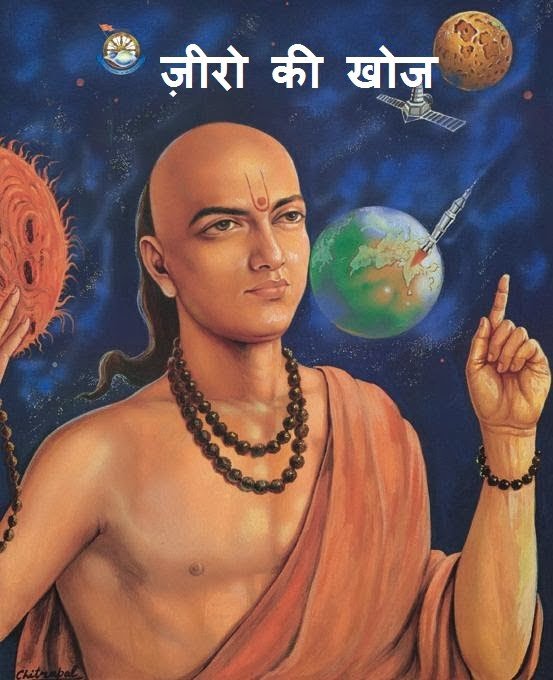
Acharya Aryabhata – Motions of the Solar System
Acharya Aryabhata was the first mathematician astronomer from the classical age of Indian mathematics and Indian astronomy and is not an unknown name. His major work on Aryabhatiya was very successful. It is extensively referred in the Indian mathematical literature and has been survived to modern times.
Acharya Aryabhata correctly stated that the earth rotates about its axis dailyr. He also stated that the motion of the stars are being observed just because the earth is rotating. He was also succeeded in explaining the geocentric model of the Solar System. The positions and periods of the planet was calculated relative to uniformly moving points. He stated that the Mercury and Venus move around the earth at the same speed as of the sun. He was also succeeded in explaining eclipses in terms of shadows cast by and falling on earth. He also mentioned Units of Time or the Sidereal rotation that earth takes 23 hours, 56 minutes and 4.1 second to complete one revolution and the sidereal year has 365 days, 6 hours, 12 minutes and 30 seconds which in turn adds an extra one day every after four years which is called a leap year.Calendric calculation which was devised by him is still being used in India for Practical purposes for fixing the Hindu calendar. India’s first satellite Aryabhata and the lunar crater Aryabhata are both named in his honor.
Maharishi Bharadwaj –Invention of the First Airplane of Earth
In 1875, the Vymaanika Shaastra, a 4th Century BC text written by Sage Bharadwaj was discovered in a temple in India. The book greatly deals with the operation of ancient vimanas and included information on steering, precautions for long flights, protection of the airships from storms and lightning and how to switch the drive of solar energy or some other form of energy.
One of the chapter will reveal the secrets of constructing aeroplanes that cannot be broken or cut, that is indestructible, that is fire resistant. It also deals with the secret of making planes motionless and invisible. It also describes how to defeat the enemy planes etc. as per the Sage Bharadwaj the vimanas were classifies as per the Yugas. During the period of Krita Yuga, Dharma was establishes firmly. The pushpak Vimana which was used by Ravan was an Aerial vehicle. He used this vehicle to kidnap Sita from jungle and took him to his Kingdom Srilanka. Ramayana was during the Treta Yug in which the Vimanas were highly discovered. During this period “Laghima” gave them the power to lighten their vehicle do they can travel freely in the air.In present Kaliyuga both Mantra and Tantra Shakti are almost vanished from the earth and so the ability to control vehicle has also been gone. Today the artificial vehicles are built which is called as Kritaka Vimanas.
Practicing yoga for even a few minutes a day can help you gain more awareness of your body. This will help you notice where you’re holding tension and where you have imbalances. You can use this awareness to bring yourself into balance and alignment. We hardly sit with a straight back or take any effort to improve our body posture. This imbalance in the alignment results in back pain. Sedentary lifestyle and lack of exercise are other reasons for a back ache but it’s not too late. You can get rid of back ache with yoga asanas.
Adho mukha svanasana (Downward facing dog)
Adho mukha svanasana or the downward dog position is one of the best known yoga poses. This asana is for your entire body. It boosts your metabolism, clears your mind, stretches your ankles and calves, strengthens your bones and is an excellent pose to get relief from back pain.
Marjaryasana (cat/cow pose)
Cat/cow pose massages your spine and relieve the stress. This pose keeps your back healthy and limber. It is also effective in improving your mental stability. It allows for a nice flexion and extension of the spine, promotes mobility, and it also helps to just relieve any tension in the lower back.Cat/cow also helps you get familiar with what your neutral spine is—not too arched and not too rounded—which can help improve posture.
Paschimottanasana (Seated forward bend)
The seated forward bend or paschimottanasana stretches your spine and eases lower back pain. It provides relief from neck pain and stiffness, eases PMS symptoms, stimulates liver, improves digestion and reduces fatigue
Salabhasana (Locust Pose)
Locust pose or salabhasana improves your core strength, stretches your spine and strengthens your legs. It will open your chest, improve your digestion and stimulates kidneys. Do not do this if you suffered an injury to your shoulders, arms or back recently
Trikonasana (Triangle Pose)
The triangle pose or trikonasana strengthens your spine, legs, shoulders and chest. It also improves your body alignment and stretches your hamstrings and calves.
Bhujangasana(Upward-Facing Dog)
If you experience back pain when bending forward, this is an especially helpful move since it stretches your low back. This also works to activate the muscles around the spine, which better supports painful areas
Shashankasana (Child’s Pose)
This gentle forward fold is the perfect way to relax and release tension in your neck and back. Your spine is lengthened and stretched. Child’s Pose also stretches your hips, thighs, and ankles. Practicing this pose can help relieve stress and fatigue.
Yoga is such an efficient way to help your body and mental health. It is also very easy, but make sure you follow instructions and try out increate asana to avoid pulling a muscle! You can start a home practice with as little as 10 minutes per day. You can use books, articles, and online classes to guide your practice. Once you learn the basics, you can intuitively create your own sessions.
Practicing yoga for even a few minutes a day can help you gain more awareness of your body. This will help you notice where you’re holding tension and where you have imbalances. You can use this awareness to bring yourself into balance and alignment. We hardly sit with a straight back or take any effort to improve our body posture. This imbalance in the alignment results in back pain. Sedentary lifestyle and lack of exercise are other reasons for a back ache but it’s not too late. You can get rid of back ache with yoga asanas.
Adho mukha svanasana (Downward facing dog)
Adho mukha svanasana or the downward dog position is one of the best known yoga poses. This asana is for your entire body. It boosts your metabolism, clears your mind, stretches your ankles and calves, strengthens your bones and is an excellent pose to get relief from back pain.
Marjaryasana (cat/cow pose)
Cat/cow pose massages your spine and relieve the stress. This pose keeps your back healthy and limber. It is also effective in improving your mental stability. It allows for a nice flexion and extension of the spine, promotes mobility, and it also helps to just relieve any tension in the lower back.Cat/cow also helps you get familiar with what your neutral spine is—not too arched and not too rounded—which can help improve posture.
Paschimottanasana (Seated forward bend)
The seated forward bend or paschimottanasana stretches your spine and eases lower back pain. It provides relief from neck pain and stiffness, eases PMS symptoms, stimulates liver, improves digestion and reduces fatigue
Salabhasana (Locust Pose)
Locust pose or salabhasana improves your core strength, stretches your spine and strengthens your legs. It will open your chest, improve your digestion and stimulates kidneys. Do not do this if you suffered an injury to your shoulders, arms or back recently
Trikonasana (Triangle Pose)
The triangle pose or trikonasana strengthens your spine, legs, shoulders and chest. It also improves your body alignment and stretches your hamstrings and calves.
Bhujangasana(Upward-Facing Dog)
If you experience back pain when bending forward, this is an especially helpful move since it stretches your low back. This also works to activate the muscles around the spine, which better supports painful areas
Shashankasana (Child’s Pose)
This gentle forward fold is the perfect way to relax and release tension in your neck and back. Your spine is lengthened and stretched. Child’s Pose also stretches your hips, thighs, and ankles. Practicing this pose can help relieve stress and fatigue.
Yoga is such an efficient way to help your body and mental health. It is also very easy, but make sure you follow instructions and try out increate asana to avoid pulling a muscle! You can start a home practice with as little as 10 minutes per day. You can use books, articles, and online classes to guide your practice. Once you learn the basics, you can intuitively create your own sessions.
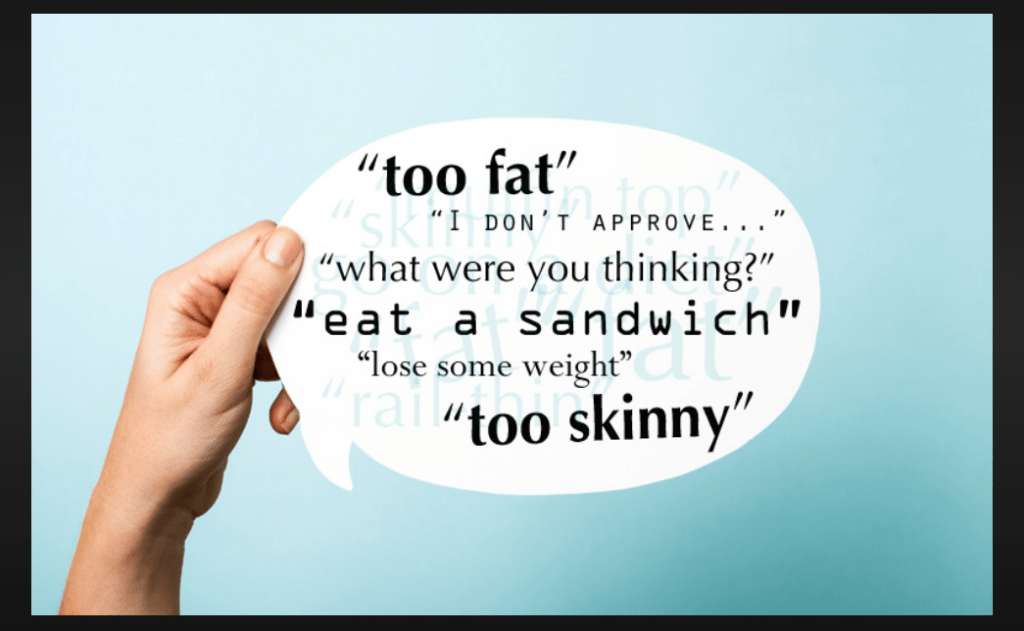
Ever heard these? I hear them daily and it’s either about my self or a group of people or a person talking , to be more clear gossiping about some one else.
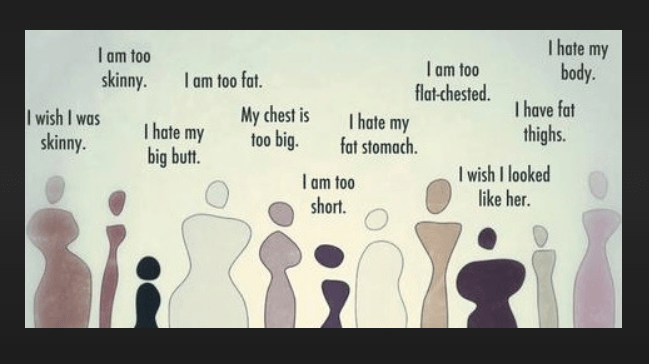
So the society expects one to be perfect ,like fair color, good height and slim and fit ,but are every one built in the same way? of course no , just like all the five fingers of our hand are different ,every human being is different and beautiful in their own ways.
If a girl is dark the whole society gives advices ,how to become fair ,if she or he is fat they are given advices about how to reduce weight , if skinny then how to increase their weight, if short ,how to become tall , I just keep wondering if the society has problem with every one’s appearance ?
From my personal experience , I can tell you that I faced such things , I was bullied in my school by my classmates , my friends and even my relatives bullied for my appearance , I could not tolerate them and even I cried due to that , and used to be envious of others for their personalities. I too wanted to achieve what they had and for that I used to skip meals some times and due to that I would feel more hungry than ever and used to over eat. As the time passed I started to accept my body and for my health and fitness , I took healthy steps in my life and started exercising and developing good healthy food habits.
I understood that everyone is beautiful in their own ways and its something that everyone has to accept , I understood that this bullying and body shaming is not good , not for your mental neither for your physical health, body shaming can lead to mental health issues , people start to overthink and worry about their appearance and in order to look perfect and beautiful they will choose faster and dangerous ways , like trying to reduce fat in just a week or trying to increase height and all this is really dangerous for one’s health and can lead to other dangerous consequences.
People of every gender and of all ages must deal with body shaming , it not a big issues , but this can damage one’s mental health the one at whom we are laughing at , whom we are body shaming, or mocking, this may also lead to emotional damage and trauma and depression.
So who are the culprits behind this , one is the society and the other is we ourselves , the product advertisers are the main ones for creating a pain point and then offering a solution to it, making ourselves think that we are not worthy and if we are not of certain skin tone ,height or weight and all , secondly we have ourselves to blame because we do not believe in ourselves and our bodies and we do not treat them well , we do not accept ourselves for how we are and then all this leads to a solution to overcome our issues and that too in a quick and unhealthy way ,leading to more disasters .
I just want the society to accept everyone as they are and to appreciate everyone’s personality since its unique for everyone and to stop body shaming or bullying . Society can be more beautiful if we accept people how they are and try not to change their appearance and instead help build confidence with in them about how unique they are and how to accept and love your body . Not only the society but firstly you yourself have to accept your body and treat it in a proper way and you have to love yourself the way you are , because self love comes first and you have to your first priority.























 Eduindex
You must be logged in to post a comment.