Future of Electric Automobiles

We are now in the biggest automobile revolution since the 1913 motor revolution led by Henry Ford. Electric cars are going to take over much sooner than we think. Many industry observers believe we have already passed the tipping point where sales of electric vehicles (EVs) will very rapidly overwhelm petrol and diesel cars. Companies like Jaguar, Volvo and Lotus have already said that they plan to go fully electric by 2030. General Motors says it will make only electric vehicles by 2035, Ford says all vehicles sold in Europe will be electric by 2030 and VolksWagen says 70% of its sales will be electric by 2030. But what makes the end of the petrol and diesel engines inevitable is a technological revolution. And technological revolutions tend to happen very quickly.

Global sales of electric cars raced forward in 2020, rising by 43% to a total of 3.2m, despite overall car sales slumping by 20% during the coronavirus pandemic. By 2025 20% of all new cars sold globally will be electric, according to the latest forecast by the investment bank UBS. That will leap to 40% by 2030, and by 2040 virtually every new car sold globally will be electric.

Companies like Tesla have already proved that there is a huge market for electric vehicles. In 2020, they sold almost 500,000 units in the US alone. The Company’s segments include automotive, and energy generation and storage. The energy generation and storage segment include the design, manufacture, installation, sales and leasing of solar energy systems and energy storage products, services related to its products, and sales of solar energy system incentives. The CEO of Tesla, Elon Musk beleives that as soon as electric vehicles become cost-competitive with fossil fuel vehicles, the game will be up. He also said that they’ve seen a real shift in customer perception of electric vehicles, and their demand is the best they’ve ever seen. But, they beleive that there is still work to be done before EVs can completely outclass petrol and diesel engines. Some of the problems are the availability and accessibility to charging stations and of course, the actual affordability of the vehicles themselves. If these problems are worked on and solved in the next few years, we can surely say that electric automobiles will take over in no time as they are much better for the environment and we need them now more than ever.

Brief steps for innovation in the era of E-commerce

As the Economist Joseph Schumpeter said Entrepreneurs can’t sit idle and try to innovate. They are the people who have an uncanny sense of using the resources from less productive use to more productive use. They are the ones who do Value creation, this is what we call innovation.

E-commerce belongs to this generation and Technology is irreversible; no one can hold it back and only curiosity won’t help us. Research activity is also needed. Scientific knowledge is essential (supported). Research is also supplemented by Developmental activities (R&D), closer to practical uses.

The Technological Innovation world involves product and process development activities (converted into manifestation forms). Then it transcends to the market/people with practical uses. Invention and discoveries constitute the technology world/innovation world- product process- market development activities (Administrative capabilities needed as well).

This all has to be assembled holistically and make the tech happen/forward driven with innovation. Business world needs tech entrepreneurship and administrative skills.

We have to question what value the tech will bring to our product. Simple innovation without value creation cannot create Blue Ocean/has no meaning.

Technological importance means the value that the technology brings to a product/potential product

We have to ensure not to bring value to other products in the competition. We need technological positioning. Frontier-ending R&D investment is needed to compete with the rival companies that are deeply entrenched in technology. Keep competitive parity is not an advantage.  

A technology portfolio consists of- Bet, Draw, Cash, and Fold

Regime of Appropriability

Is the effectiveness of legal mechanisms of protection of technology, Patents, copyrights, trade secrets, tacit knowledge, and codified knowledge.

Process innovation can’t be protected by patents.

Codified knowledge is very prone to industrial espionage, in other words, Hiring people from other companies. The regime of appropriability can be from high to low depending on the technology. E.g. KFC spice formula (easy to safeguard) or a new search algorithm (hard to seep safe).

Any innovation passes through two stages-

Pre Paradigm and Paradigm stage

Pre Paradigm is when a technology is in the process of innovation. Every innovation goes through this stage when it remains in the domain of the innovators and scientists.

In the Paradigm stage product designs are fluid and the manufacturing process is loosely organized whereas in the Paradigm stage less uncertainty for the design emerges and a final design emerges. The focus is now on process design.

Our objective is to transit from the pre paradigm stage to the paradigm stage as fast as possible. Successful transit of tech to practical use is called commercialization and has to be ensured with another set of capabilities called complementary assets.

The tinkering or invention needs to be followed by research and then a complimentary stage in development. Entrepreneurs have to ensure that complementary assets have to be built around innovation to be successful. Innovators need to have certain complementary assets which are not generic (highly specialized).

There is a third category of assets called Co specialized. These assets have a bilateral dependence. These assets have no other use other than their intended use. E.g.: A spacecraft manufacturing facility.

Many innovators fail and succumb and they don’t have the complementary assets. To counter that, entrepreneurs can do collaborative strategy by collaborating with partners with complementary assets. It should exclude the possibility of any other collaboration.  

Technology has to be adopted by people otherwise, it has no meaning. Early adopters need to leverage by patronizing the products. This gives way to the early majority who are more market-orientated. If they are satisfied they give way to the late majority. This transition will secure our position in the market.

But there is a catch, when technology falls between the transition space of early adopters and the early majority. This is known as ‘Chasm’. This change in emphasis poses a problem for innovating firms since incumbents are often much better equipped to meet the desire for complete products and low-risk purchases,and once you fall into this space. It gets really difficult to get out of it. A tornado (another group of people) is needed to take it out of the chasm and hit it into the mainstream.

E-commerce implementation can have two strategies:

Bottom-up approach and Top-down approach

Introduction of Ecommerce has complemented traditional business. This has also made traditional businesses more competitive.

Top-down approach implementation is preferred on a large scale and national level but when it comes to administrative (meeting the requirements of civil services), local trade and commerce services are suited to have a bottom-up approach.

Digital infrastructure is essential for making e-commerce successful. Cradle to grave digital identity is emerging as the new measure to the unique identification of people.

Common service center: Helps in providing e-Services to rural and remote locations where availability of computers and Internet is negligible or mostly absent. With the help of Interoperability and common information center data and information can be accessed at any location.

Mobile banking is another approach that is also increasing its proliferation.  But it’s still in its nascent stages.

Another concept that is emerging is Cashless transactions where all the POS and banking services can be attained remotely. Although the security issue remains which has to be taken care of by a central agency (Government).

One of the most important things to consider is Digital literacy. A certain amount of literacy is needed for availing all these digital infrastructure and access. For a widespread utilization of digital services, we have to ensure that more people are digitally literate.

We also have to keep in mind that common support ICT infrastructure and adequate private and public partnership will help to make these services more efficient and better.  With the help of aforementioned knowledge, an E-commerce can certainly endure in the realm of digital world.

References:

https://www.reed.edu/economics/parker/f10/201/cases/appropriability.html

https://smallbusiness.chron.com/stages-paradigm-shift-organization-78904.html

OnePlus launched Nord 2 5G in India, details here…


OnePlus launched Nord 2 5G in India. It has been almost a year since the launch of the OnePlus Nord. Though OnePlus has brought major changes in the new Nord 2 5G like, it is the first OnePlus device to support MediaTek’s Dimensity Chipset rather than Qualcomm chipset. 

The device has been priced at Rs. 27,999 for the basic variant, which comes with 6GB of RAM and 128GB. Additionally, two more variants come with 8GB/12GB of ram with 128GB and 256GB storage, respectively. The device will be available in 3 colors namely; Blue Haze, Gray Sierra, and Green Woods. The Green Woods color will be available exclusively in India. 

The phone will go on sale from the 28th of July via Amazon, the OnePlus online store, and via offline stores. Also, for early access, a buyer can get the device on the 26th of July if they have membership of Red Club and Prime membership via the OnePlus online store and Amazon Prime Day sale, respectively.

The OnePlus Nord 2 5G comes with a 6.43-inch Full HD Amoled display with 90Hz refresh rate. It comes with MediaTek Dimensity 1200 AI Chipset. Also, it comes with dual 5G SIM slots. Also, OnePlus promised to give major Android updates for 2 years and security updates for 3 years. The device comes with a 4,500 mAH battery which supports 65W VOOC charging. Regarding the battery, OnePlus claims that the device will provide a backup of one day by just charging it for 15 minutes. 

Talking about the cameras, the phone comes with a triple camera setup; a 50-megapixel primary lens, an ultra-wide 8-megapixel lens, a 2-megapixel mono lens. The front-facing camera comes with a punch-hole design which houses a 32-megapixel lens.

Though OnePlus has always been a promising company, it is yet to be seen what the new Nord 2 5G can do. 

What is VPS (Virtual Private Server)? Its features!

VPS (VIRTUAL PRIVATE SERVER)
Do you know what VPS is?
The full form of VPS is Virtual Private Server. As the name suggests, it is a virtual private server, which is rented to the user. It appears to the user that on a VPS there is no other user on the server & it is a dedicated server. However, VPS is installed on a server serving multiple websites. There are multiple VPS on a computer. The user has full access to his VPS. It has a unique IP address, disc space, CPU resources and the user doesn’t have to share it. It is independent.
How a VPS works?

There is an OS (Operating System) installed on each VPS. The user can install any software that runs on that Operating System. The web hosting provider uses virtualization technology which installs a virtual layer on the Operating System (OS) of the server. Hence, it separates the server into individual compartments, through a virtual wall. Thus, the user can install their OS & software. Hence, it is a completely private server.

Advantages of a VPS Hosting

The first one & the best advantage is that the user has full access to the VPS’s OS without any restrictions &  no need for permission from the admin for any custom process.
Users can also host additional services such as File Transfer Protocol (FTP), a mail server, an e-commerce store & many more.
It also allows the user to host multiple websites which are best for an organisation, developer, & many other types of businesses.

Disadvantages of VPS Hosting

Generally, small businesses & organisations own VPS, to get the flexibility of a Dedicated Server at a cheap price. But it also has its disadvantages.
Another disadvantage is that it lacks in performance. The VPS generally throttle the server’s performance. Because the VPS provider tries to increase the number of VPS on the server.
Security is not a major disadvantage on VPS. Generally, VPS is separated from another VPS because of server virtualization. But there is also a security requirement, which is avoided by some hosting providers. Hence, it may lead to a major security issue.

The right time to switch to VPS?

Are you currently using any Shared Hosting, Cloud Hosting, etc. & are thinking to switch to VPS. Many questions arise in your mind that what is the right time to switch to VPS hosting. So, I am going to talk about this topic in this section.
Here are the top 5 reasons because of which you can switch to VPS.
1. If you are worried about security, & want some extra & reliable security, extra backup space, extraordinary security for your e-commerce store or any online payment, then you can surely go to VPS. You will get top-level security in VPS.
2. If you are constantly experiencing a high amount of traffic on your website, & thinks that the shared hosting is not able to handle it. And, if you don’t want to take the risk, then you can consider VPS hosting.
3. Sometimes, because of high requests & traffic, your website starts running or loading slowly or lagging. Because Shared Hosting is not idle for this traffic, then you can definitely go for VPS hosting.
4. Sometimes, you need to install software other than WordPress, Drupal, etc. & you want to install your software. You may also need to use a custom server configuration. Then you want a hosting provider, which rents the server with extra configurations. Then, you should buy VPS hosting.
5. If you are constantly running for server errors on your Shared or any other type of web hosting, & want more reliable & budget-friendly hosting, then you can go for VPS hosting.

Conclusion

If your business is going decently & if you want more resources, then you have to surely go for VPS hosting. It’s nowadays budget-friendly.
I will also talk about other types of Web Hosting such as Colocation Hosting, Dedicated Hosting, etc. in future posts. So don’t forget to bookmark this website.
Thanks for reading!

Life of Michelle Obama

Michelle LaVaughn Robinson Obama is an American attorney and author who served as the First Lady of the United States from 2009 to 2017. She was the first African-American woman to serve in this position. She is married to the 44th President of the United States, Barack Obama.

Michelle LaVaughn Robinson was born on January 17, 1964, in Chicago, Illinois, to Fraser Robinson III (1935–1991), a city water plant employee and Democratic precinct captain, and Marian Shields Robinson , a secretary at Spiegel’s catalog store. Her mother was a full-time homemaker until Michelle entered high school

The Robinson and Shields families trace their roots to pre-Civil War African Americans in the American South. On her father’s side, she is descended from the Gullah people of South Carolina’s Low Country region. Her paternal great-great grandfather, Jim Robinson, was born into slavery in 1850 on Friendfield Plantation, near Georgetown, South Carolina. He became a freedman at age 15 after the war. Some of Obama’s paternal family still reside in the Georgetown area. Her grandfather Fraser Robinson, Jr. built his own house in South Carolina. He and his wife LaVaughn (née Johnson) returned to the Low Country from Chicago after retirement.

Robinson was inspired to follow her brother to Princeton University, which she entered in 1981. She majored in sociology and minored in African-American studies, graduating cum laude with a Bachelor of Arts in 1985 after completing a 99-page senior thesis titled “Princeton Educated Blacks and the Black Community” under the supervision of Walter Wallace.

Robinson met Barack Obama when they were among the few African Americans at their law firm, Sidley Austin LLP (she has sometimes said only two, although others have noted that there were others in different departments). She was assigned to mentor him while he was a summer associate. Their relationship started with a business lunch and then a community organization meeting where he first impressed her.

Before meeting Obama, Michelle had told her mother she intended to focus solely on her career. The couple’s first date was to Spike Lee’s movie Do the Right Thing (1989). Barack Obama has said the couple had an “opposites attract” scenario in their initial interest in each other, since Michelle had stability from her two-parent home while he was “adventurous”.

During an interview in 1996, Michelle Obama acknowledged there was a “strong possibility” her husband would begin a political career, but said she was “wary” of the process. She knew it meant their lives would be subject to scrutiny and she was intensely private.

Although she campaigned on her husband’s behalf since early in his political career by handshaking and fund-raising, she did not relish the activity at first. When she campaigned during her husband’s 2000 run for United States House of Representatives, her boss at the University of Chicago asked if there was any single thing about campaigning that she enjoyed; after some thought, she replied that visiting so many living rooms had given her some new decorating ideas. Obama opposed her husband’s run for the congressional seat, and, after his defeat, she preferred he tend to the financial needs of the family in what she deemed a more practical way.

Don’t ever make decisions based on fear. Make decisions based on hope and possibility. Make decisions based on what should happen, not what shouldn’t

The impact of Social Media Influencers on Sales

The way social media influencers directly or indirectly influence publicity and promotion somehow also influence the sales of a brand. Some of the ways in which social media influencers impact sales are:

1. Help in Consumer Research Phase:

Nowadays, market is mostly “consumer-oriented”. Consumers search and research, read reviews about a brand and hence they want someone trusted and experts who will voice their opinions, concerns and recommendations. Influencers play a vital role in spreading the word of mouth and recommendations thereby increasing sales.

2.Help in increasing Return on Investment:

Social Media Influencers help in achieving a relatively high Return on Investments than other factors. It is because of low capital investment. Other forms of advertisement or marketing tools require huge capital whereas dealings with Social media Influencer can be fixed just on a simple phone call.

3.Content Creation helps in increased Sales:

Influencers create meaningful and exciting content that sometimes evoke interest in the viewer to buy the product. Apart from this, Influencers also work on multiple social media accounts and this helps them to reach wide and diverse audience. This is also very helpful for increasing sales in a business.

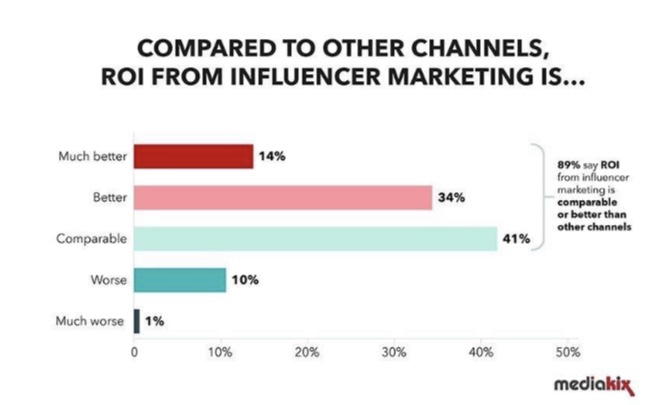
In a recent survey by Mediakix, a famous influencer marketing agency, about 89% of respondents say Return on Investment from Social Media Influencers is better than other channels.

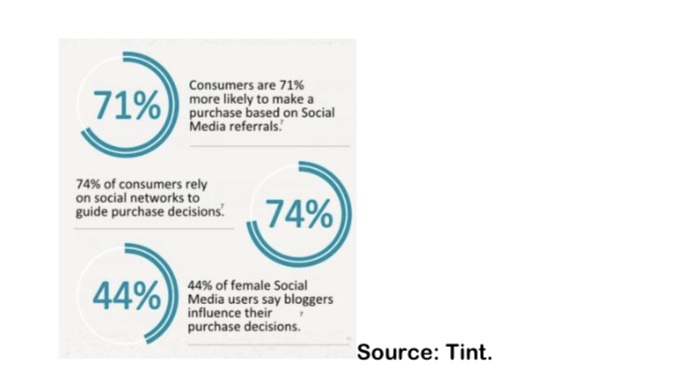
In another survey by Tint, 71% of respondents told that they rely on social media referrals for purchase decisions.

Some Examples:

1) Glossier, USA.

The USA based beauty brand has built its brand image by entirely relying on Social Media Influencers and other forms of digital marketing. They rely heavily on influencers as they send new products to influencers before the products are even launched so that influencers identify the flaws and suggest improvements (if they require) and thereafter the brand makes the changes accordingly.

2)Daniel Wellington, Sweden

This company was able to tap the “business opportunity” and it proved out to be quite fruitful for them. They broke into the Indian market by solely relying on Social Media Influencers. It is a watch brand company sends its new products to big social media influencers in India and enjoys extreme profits and sales. They were able to see India as a good market due to the country’s vast population.

Conclusion:

Social Media Influencer marketing or the Influencer marketing has become the fastest growing trend in communication in last few years. The key factors involved to be a good influencer are trust and credibility in the message. Latest studies and research have proved that social media influencers contribute to a business’s growth in a very positive manner in terms of promotion, publicity, sales and ROI. Many assume this marketing tool is temporary and will extinct in few years, however only time can say it.

Augmented reality

Augmented reality (AR) is an interactive experience of a real-world environment where the objects that reside in the real world are enhanced by computer-generated perceptual information.

sometimes across multiple sensory modalities, including visual, auditory, haptic, somatosensory and olfactory. AR can be defined as a system that incorporates three basic features: a combination of real and virtual worlds, real-time interaction, and accurate 3D registration of virtual and real objects. The overlaid sensory information can be constructive (i.e. additive to the natural environment), or destructive (i.e. masking of the natural environment). This experience is seamlessly interwoven with the physical world such that it is perceived as an immersive aspect of the real environment. In this way, augmented reality alters one’s ongoing perception of a real-world environment, whereas virtual reality completely replaces the user’s real-world environment with a simulated one. Augmented reality is related to two largely synonymous terms: mixed reality and computer-mediated reality.

The primary value of augmented reality is the manner in which components of the digital world blend into a person’s perception of the real world, not as a simple display of data, but through the integration of immersive sensations, which are perceived as natural parts of an environment. The earliest functional AR systems that provided immersive mixed reality experiences for users were invented in the early 1990s, starting with the Virtual Fixtures system developed at the U.S. Air Force’s Armstrong Laboratory in 1992. Commercial augmented reality experiences were first introduced in entertainment and gaming businesses. Subsequently, augmented reality applications have spanned commercial industries such as education, communications, medicine, and entertainment. In education, content may be accessed by scanning or viewing an image with a mobile device or by using markerless AR techniques.

Augmented reality is used to enhance natural environments or situations and offer perceptually enriched experiences. With the help of advanced AR technologies (e.g. adding computer vision, incorporating AR cameras into smartphone applications and object recognition) the information about the surrounding real world of the user becomes interactive and digitally manipulated. Information about the environment and its objects is overlaid on the real world. This information can be virtual. Augmented Reality is any experience which is artificial and which adds to the already existing reality or real, e.g. seeing other real sensed or measured information such as electromagnetic radio waves overlaid in exact alignment with where they actually are in space. Augmented reality also has a lot of potential in the gathering and sharing of tacit knowledge. Augmentation techniques are typically performed in real time and in semantic contexts with environmental elements. Immersive perceptual information is sometimes combined with supplemental information like scores over a live video feed of a sporting event. This combines the benefits of both augmented reality technology and heads up display technology (HUD).

Comparison with virtual reality

In virtual reality (VR), the users’ perception of reality is completely based on virtual information. In augmented reality (AR) the user is provided with additional computer generated information within the data collected from real life that enhances their perception of reality. For example, in architecture, VR can be used to create a walk-through simulation of the inside of a new building; and AR can be used to show a building’s structures and systems super-imposed on a real-life view. Another example is through the use of utility applications. Some AR applications, such as Augment, enable users to apply digital objects into real environments, allowing businesses to use augmented reality devices as a way to preview their products in the real world. Similarly, it can also be used to demo what products may look like in an environment for customers, as demonstrated by companies such as Mountain Equipment Co-op or Lowe’s who use augmented reality to allow customers to preview what their products might look like at home through the use of 3D models.

Augmented reality (AR) differs from virtual reality (VR) in the sense that in AR part of the surrounding environment is actually ‘real’ and just adding layers of virtual objects to the real environment. On the other hand, in VR the surrounding environment is completely virtual. A demonstration of how AR layers objects onto the real world can be seen with augmented reality games. WallaMe is an augmented reality game application that allows users to hide messages in real environments, utilizing geolocation technology in order to enable users to hide messages wherever they may wish in the world. Such applications have many uses in the world, including in activism and artistic expression.

How Technology Has Changed the Lives of Students

Technology is something every kid of today’s generation will be well familiar with. It has been growing at an immense rate and has been impacting every section of the world from quite a few years now. Technology has garnered high attention especially in the recent pandemic times as it has served as an indispensable tool for students amidst their ‘online classes’. However, we cannot restrict ourselves to only one aspect of technology, for technology has been bridging the learning gap from a long time by enabling students the access to a virtual world of resources at almost no cost.

A foremost benefit of technology has been the vast availability of resources for students and teachers. These resources can be in terms of education matters or to discover new ideas. Teachers now are also able to communicate with their students in a convenient way as well as have the freedom to employ new innovative teaching methods in their studies. Free access to e-books, e-magazines and other reading materials has made it a lot easier for students to acquire materials without having to search through libraries or spend a lot of money in bookstores. This divergent range in materials has also enabled them to research their subject of interest from different points of views and gain as much as knowledge available from verified sources.

The second pro point of technology is its feature to obtain a degree through online education. It does not matter whether you are young, old or just passionate about learning a new skill. It is now possible for any individual to gain a degree without the need to attend a university physically. Technology extension has provided such efficient modes that one can now enrol in prestigious universities located abroad without requiring the need for a passport or visa. Technology has also made it possible for people to sign up for a course offered by any valid institution and complete it within the time limit they wish. Giving them advantages like flexible study routines along with the comfort of their rooms.The third way through which technology has changed the lives of students is by giving them the opportunity to learn at their own pace and their own understanding level. Science has proved before that every individual learns and acquires knowledge differently. Some people are visual learners, some auditory, some verbal, some kinaesthetic etc etc. Here, technology gives a chance and means for every type of learner to learn at the best of their ability. For example, the availability of videos, audio books or audio contents, exercises etc accessible through the forum of technology gives every kind of learner a chance to shine compared to the usually dull and closed environment of physical classrooms. In addition to all this the advancement in technology has now enabled digital simulations and models thereby, enhancing the perceiving powers of students.

The fourth advantage of technology is the easy availability of any news or notices related to their subject or university. The official website of a university serves as a major way for students to procure information with ease, which can be further related to their classmates, friends or teachers through any social media apps of their choice. Not only does it provide an instant way to obtain the latest news but also helps to keep the students up-to-date along with their ongoing course subjects.Lastly, in the present times of pandemic, technology has proved to be a big boon in accessing online learning methodology. It has made assessing students efficient as well as helped vastly in maintaining records of student activities through a variety of online applications. Furthermore, teachers can upload their teaching materials and class recording on apps like Google Classroom and make it possible for students to revisit the teachings for revision sake or in case they end up missing any of their online lectures.

To conclude, technology has come a long way and has successfully impacted the lives of students. It has made students’ lives easier and more efficient by providing them various benefits like e-printed books, ease of access to education, faster communication with teachers and friends and overall comfort of homely environment.

Different Types Of Web Hosting: Which One Is Best For You?

Shared Hosting

Have you ever heard the term Shared Hosting, Cloud Hosting, Reseller Hosting, etc? If so, after hearing these terms, a question arises in your mind, “What is the meaning of these terms?” Let me explain, these are all types of web hosting services available in today’s world!

There are many types of Web Hosting such as Shared Web Hosting, Managed Hosting, Dedicated Hosting, Colocation Hosting, VPS (Virtual Private Server), Cloud Hosting, Reseller Hosting, and many more. There are many types of Web Hosting but I am going to talk about only the top 3 in this article. Well, I will also talk about other Web Hosting such as VPS (Virtual Private Machine), Managed Hosting, Colocation Hosting, etc. in our future posts.
If you want to know more about hosting, then read this article – What is Web Hosting? It’s Features, Types! Web Server

1. Shared Hosting – 

Shared Hosting

In Shared Hosting, you share the hosting resources with other users. It involves a certain number of users who share a single server & hosts their website with a specific amount of disc space. All the user’s data is hosted on the same server. The website addresses of the users are placed in a VPN (Virtual Private Network) to protect the users from other users, malware, brutal codes or even others websites sharing the same server space.
In 2021, shared hosting services are run by more complicated servers and software systems that do not allow any downtime or interruptions in uptime.

2. Cloud Hosting –

Cloud Hosting

Cloud Hosting service has become very popular these days. However, its prices are high in the past few years, but in 2021, the prices get lower, hence it gives a chance to small businesses also come online. It is a set of services that are hosted in the cloud to provide users with an easy way to access data storage, online backup and more. In this type of hosting, a client needs to only access it over the Internet from a computer and a browser on a local network.
It hosts your website on a group of connected servers at the same time. The website data is stored in different servers at once. Hence, your site has greater security & reliability as compared to one server. If one server breaks then the other server takes its place so that the site visitors don’t notice any lack of continuity. Hence, cloud hosting gives you perfect uptime.

3. Reseller Hosting –

Reseller Hosting

Renting disc space & bandwidth from a Web Hosting company & then selling it to your clients is called Reseller Hosting. Most of the new Web Hosting provider uses the Reseller Hosting to sell Web Hosting. It is the best & affordable way to start your own Web Hosting business. Most of the big Web Hosting provider provides cheap reseller hosting such as GoDaddy, HostGator, etc.

Conclusion

I think, if you just want to go online & do something big, then I recommend you to only go for Cloud Hosting. It is cheap, reliable, & also trustable than Shared Hosting. You can go for Cloud Hosting plans of Hostinger as they are cheap & also Hostinger is very popular these days.
I will talk about other Web Hosting, such as Colocation Hosting, Managed Hosting, VPS (Virtual Private Server), etc. in future posts. So, don’t forget to bookmark this website. I promise that it will be worth it.
Thanks for reading!


Environmental laws in india

Either Stable burning in various states accrued the air pollution in Delhi and created a gas chamber around NCR ; SC came upon a committee to observe scenario , Or 4 industries inflicting stream pollution were shut down by Maharashtra pollution board . Everybody has responsive to environmental problems as higher than . The key solution for resilience to environmental issues are provided by government in various legislations , enactments and provisions on environment laws .


In republic of India environmental law is concern with the policy and law for protection of the environment . It aims for achieving carbon free economy through taking measures for reducing climate change. All the acts under this laws are safeguards in ensuring effective management of the environment and its multiple ecosystems . It provides for preventing environmental damage .


Natural resources in the earth were unscathed from millions of years. It were remain pure until the industrialized started . After the industrialization this resources have been exploited in Spain of 100 years only . From 19th century, the environment (air , water and land ) is directly exploited by rapidly growing population at alarming-rates.


environment includes water, air and land and the inter-relationship which exists among and between water, air and land, and human beings, other living creatures, plants, microorganisms and property , as mentioned in section 2 of environmental protection Act of 1986 . Environment is a wide sphere , it consists of social, economically , political , religious dimensions .


Addressed area of environmental laws in India :

1. Quality of water : For the prevention and control of water pollution and to maintain or restore wholesomeness of water in the country the water act of 1974 was enacted. It further provides for the establishment of Boards ( CPCB and SPCB ) for the prevention and control of water pollution with a view to carry out the aforesaid purposes. This act prohibits the discharge of pollutants into water bodies beyond a given standard, it also lays down fine and penalties for non-compliance.

2. Reduction of air pollution and maintaining air quality : The Air (Prevention and Control of Pollution) Act, 1981 (the “Air Act”) is an act to provide for the prevention , protection and abatement of air pollution .It provides for establishment of Boards at the Central and State levels with a view to carrying out the aforesaid purposes.

3. Hazardous Waste management : legislations that directly or indirectly deal with hazardous waste management are the Factories Act, 1948, the Public Liability Insurance Act, 1991, the National Environment Tribunal Act, 1995 and rules and notifications under the Environmental Act.

4. Containment cleanup, damage mitigation : preventing future damage to the environment is undeniably the primary objective of environmental law, mitigating and reducing existing damage is also important. This area most often deals with issues like toxic leaks and oil spills. The central objective of this branch of environmental law is deciding liability, planning an appropriate response, and also determining the best process of investigation and monitoring in the overall clean up process. This area also concerns itself with the study and assessment of risk in the long term, to better mitigate any future accidents and risks.

5. Sustainability of resources : United Nations has put great emphasis on ensuring the sustainability of resources. For this vision , it has advocated the formation of various legal principles and legislation. In this regards concept of environmental impact assessment introduced .

Noble legislations and enactments on environment law in India :


Laws on Forest and wild life protection:
• The Indian Forest Act, 1927 ; The Wildlife Protection Act, 1972; The Forest (Conservation) Act, 1980 ; The Environment (Protection) Act, 1986; The National Green Tribunal Act, 2010.


Laws on Water pollution :
• The Water (Prevention and Control of Pollution) Act, 1974.


Laws on air pollution :
• The Air (Prevention and Control of Pollution) Act, 1981 (the “Air Act”)


Laws on hazardous waste management :
• Biomedical Waste (Management and Handling) Rules, 1998 ; Municipal Solid Wastes (Management and Handling) Rules, 2000 ; Batteries (Management & Handling) Rules, 2001 ; Hazardous Wastes (Management, Handling and Transboundary) Rules, 2008 ; E – Waste (Management and Handling) Rules, 2011 .
Laws on wetlands


Ramsar convention (1971) : This convention was initiated to push for greater conservation and sustainable use of wetlands ; Wetlands (Conservation and Management) Rules, 2017.
Constitutional provisions on environment laws


Part IVA (Art 51A-Fundamental Duties) of the constitution casts a duty on every citizen of India to protect and improve the natural environment including forests, lakes, rivers and wildlife, and to have compassion for living creatures.


• the Constitution of India under Part IV (Art 48A-Directive Principles of State Policies) stipulates that the State shall endeavour to protect and improve the environment and to safeguard the forests and wildlife of the country.

environment makes human life possible, and our cultural environment helps define who we are. It is therefore essential that our population and economic growth are environmentally sustainable.

Guide for Solar Water Pumps

In today’s technology driven world, people are turning towards less harmful modes of electricity. For many years now, solar power, hydro power, and wind energy have been the main source of electricity across the globe. But now more advanced technology is known to the world and it is being used to create more effective methods. Scientists and engineers are devising methods to create such sources of energy which will reduce the use of conventional resources furthermore. Solar water pumps are another product of that technology. Many people are already enjoying its benefits. Why aren’t you? Are you searching for the best one? We are here to guide you through the whole of it. At the end of this, you will be able to choose the best solar water pump there is and you can enjoy it too.

What to Look For in a “Solar Water Pump”

  • Efficiency – Efficiency is the most critical factor to check in the solar water pump. The pump should provide great efficiency to work properly.
  • Flow rate – Flow rate defines how fast the water will flow through the pump. More the flow rate, the better. You must remember that the ideal instantaneous water flow rate of a pump must be equal to one-third of its daily consumption.
  • Head – The head of the pump represents the increase in energy accumulated by 1 liter of water. It is also an important factor to consider as it may reduce pressure loss.
  • Power – The power of the solar water pump should be considered properly. It depends on the conversion of solar energy into electrical energy.
  • Speed – Speed is the number of revolutions taken by the pump in a specific interval of time. You need to make sure that you have a high speed pump available.
  • NPSH (Net Positive Suction Head) – Net Positive Suction Head is the main factor to keep in mind while buying a solar water pump. It indicates its inability to create absolute volume.
  • Raw material – You need to check the raw material used to make the solar water pump. It plays an important role in defining the lifetime of the pump. If the pump is made from weak raw materials, it will not last long and will cost you more for maintenance.
  • Quality – Quality is the first and most important factor you keep in mind while buying anything so it applies to solar water pumps too. The quality of a pump varies from company to company and is different for different manufacturers.
  • Size – The size of the pump should also be considered before buying it. It depends on your preference where you want to install the pump or for what purpose you are going to use it.

What do we mean by Solar Water Pump and how does it work?

Solar Water Pumps are also called Solar Photovoltaic Water pumping systems. They are designed like the old, traditional water pumps. But the difference is that they are powered by solar energy instead of fossil fuels.

Photo by eberhard grossgasteiger on Pexels.com

Why use a Solar Water Pump?

There are several purposes for using a solar water pump. Some of them are listed below:

  1. For pumping water for livestock
  2. Providing water for farms and residential areas
  3. For pumping water for crops and irrigation
  4. Providing water supply for general need in households
  5. May be used for water treatment
  6. For pumping fluids across a long distance

And of course, sunlight is free and abundant and water is essential for all living beings. So why not put it to use?

Are they worth it over other conventional options?

Yes, the solar water pumps are worth more than the other conventional options. The main reason is that they are more eco-friendly as compared to the fossil fuels burning for electricity.

Should you just DIY a Solar Water Pump

If you want to experiment with your skills and have much free time on your hands, then you can make a DIY solar water pump at your home. Some of the crucial information you will need to do that is given below:

Main Components of Solar Water Pump

  1. Solar Cell Module –  Solar power generating device that directly converts solar energy into electrical energy.
  2. Solar Pump Inverter – most important equipment of the photovoltaic system. It controls and regulates the operation of the whole system.
  3. Water pump, pipeline, and reservoir – To pump, deliver and store water

Typical Design of Solar Water Pump

  1. Model selection process
  • Confirm head and flow rate of the pump
  • Confirm solar panel capacity
  • Confirm the power of the water pump
  • Confirm the inverter
  • Selection of cable specification
  1. Obtain user demand – Daily water demands, the diameter of the well, depth of the well, area to irrigate, average sunshine daily in the area.

Some Specifications of Solar Water Pumps

  1. Head: 110m
  2. Flow: 1000/(300*0.8*3.5)= 1.19 m3/h
  3. Pump selection: pump motor power 1.5kW, flow 1.2m3/H, head 115m
  4. 1.5KW water pump is equipped with 2.2KW solar pump inverter 
  5. The working voltage of the solar pump inverter is 200V-360V.

Steps of Construction

Step 1: Find a perfect location

  • Before building a solar water pump, the most important requirement is finding a perfect location where you want to lace the water pump. So go on the search right away and get back here to start building your solar water pump.

Step 2: Choose the size

  • The size of the pump is the main factor to look after while building a solar water pump. It is going to affect the amount of water that can be pulled from a water source. For this, you can use a power cord or simply install a solar panel for reducing any further costs.

Step 3: Assemble the pump

  • Assembling the main unit of the pump will be a tiresome job. But it can be easily done by following the instruction manual provided to you with the components of the pump. After you are done assembling the pump, move on to the next step.

Step 4: Add the solar panel

  • Now you are building a solar water pump all by yourself, which means you need to keep a check on your budget. So to ensure that you should install a solar panel instead of a power cord. Choose your solar panel properly. It should be large because you want to absorb as much sunlight as you can. In addition, place it at a proper angle, preferably facing the east or west to absorb light effectively during the day.
  • After installing the solar panel, attach it to the main unit of the pump so that you don’t have to use a power cord. 

Step 5: Cover the pump

  • The last important step you need to follow is to cover the pump so that it is not visible as it may not look good in the middle of the garden. If you don’t want it as decor then consider hiding it in a corner.

Step 6: Modify the pump

  • A solar water pump will be a feast to the eyes in the garden. To decorate it you can add some flowers, some tree leaves, or other things you want it to design it with. You can be creative and make an excellent piece of decor for your garden or pool in the backyard.

That’s it. You are done. In just these 6 simple steps you will have a perfect homemade solar water pump. You can use it to decorate your garden or place it in a pool.

Pros and Cons of Solar Water Pumps

If you are not sure how to decide about the solar water pumps, check out the listed advantages and disadvantages of the same. You will get a proper image of what to look for in a solar water pump before buying. These will help to change your mind about your preference or maybe make you sure of what you want. 

Advantages

  1. Zero fuel cost – Solar water pumps are powered by solar energy so it does not require fuels to operate. Fuel adds a significant cost to the cost of the whole solar water pump system.
  2. Installation costs only – Once you install the solar water pump system, then it only requires sunlight. That means after installation it is free.
  3. Less labor and maintenance – Solar water pumps require very little labor to operate properly. It also does not require much maintenance. In addition, it reduces the time taken to irrigate the farm.
  4.  Environment friendly – They are sustainable and use non conventional energy sources.

Disadvantages

  1. Can’t pump when it’s dark – However great solar water pumps are but they do need sunlight to operate. So this is the biggest disadvantage of them. They can’t operate when it’s dark.
  2. High upfront costs – This may be the reason why it is not much use for the farmers because it is not as easily affordable.

Frequently Asked Questions

Here are some of the important frequently asked questions about solar water pumps.

  1. How does a solar water pump work?
  • It works like any other water pump. The only difference is that it is operated by sunlight.
  1. What is the use of solar water pumps?
  • A solar water pump is useful in irrigation for farms and for extracting water from wells and ponds.
  1. What are the different types of solar water pumps?
  • There are several types of solar water pumps:
  • Submersible pump
  • Surface pumps
  • DC pumps
  • AC pumps
  1. Can a solar water pump be relocated?
  • The system once installed can be relocated but it is not recommended. The process is expensive and can cause severe damage to the system.

Twitter vs Instagram. What’s better for business?

Before we get into the details about marketing on Twitter and Instagram, let us learn quickly about some of the key features of both Twitter as well as Instagram.
Twitter was launched in 2006 whereas Instagram was founded in 2010. As of 2020, there are 1.3 billion twitter accounts out of which only 330 million are monthly active users globally whereas there are 1.2 billion Instagram accounts out of which 1 billion are monthly active users globally.


About 293 million Instagram users are aged between 15 and 24 and 338 million users are aged between 25 and 34. Talking about Twitter, 80% of its global population is below 50 years old. Twitter ranks slightly behind Instagram when it comes to users 60+ users.

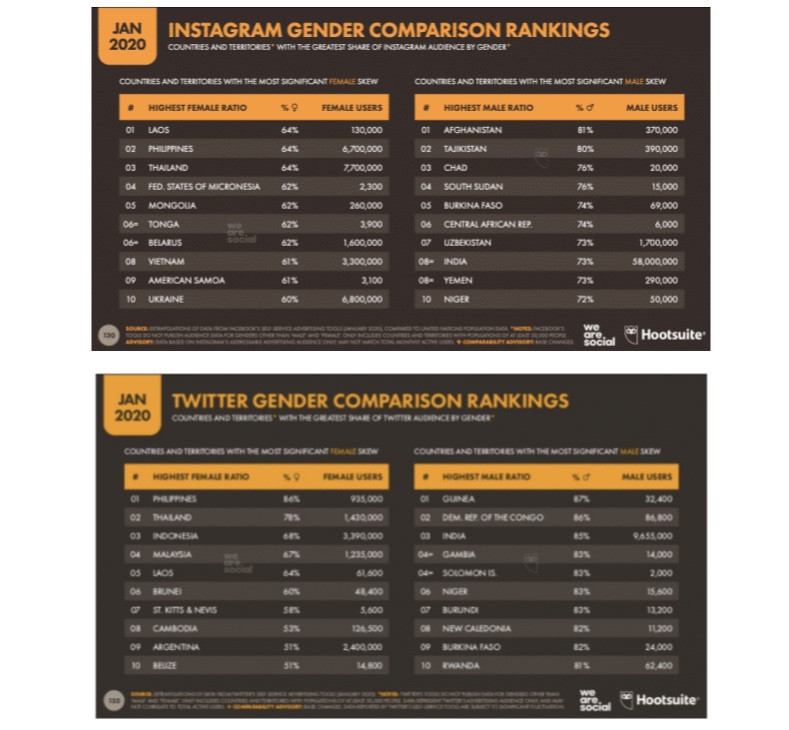
When it comes to the worldwide gender split, about 51% of Instagram users are female and 49% are male and when we talk about Twitter 62% are male and 38% are female. 85% of India’s Twitter audience is male, ranking the country third highest for male-to-female ratio.

With the help of the above graphs, we come to know that Laos has highest female ratio when it comes to Instagram and for Twitter its Philippines with highest female ratio.

1. USER ENGAGEMENT REACH

One of the commonality between Instagram and Twitter is that maximum of their active users are aged between 18 and 29. And if a business is looking for a young audience, then surely it has to select both Instagram and Twitter.
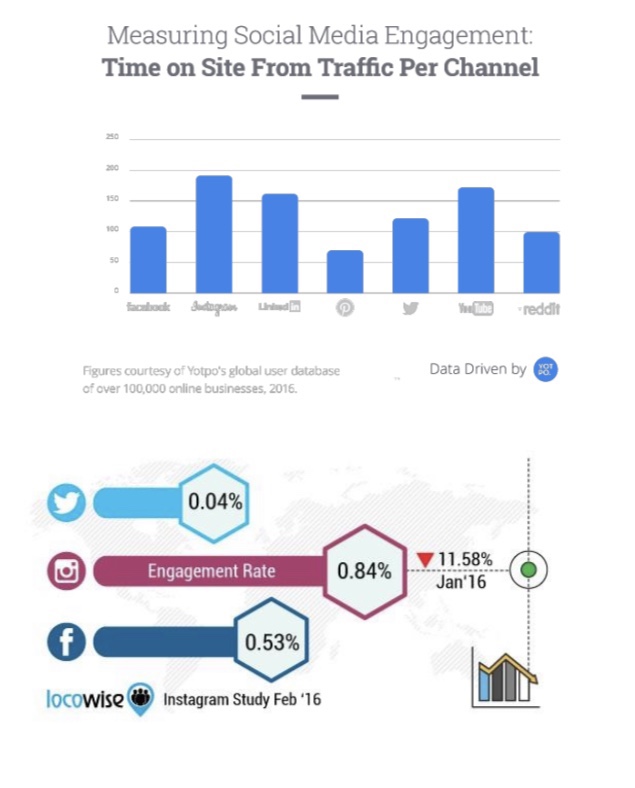
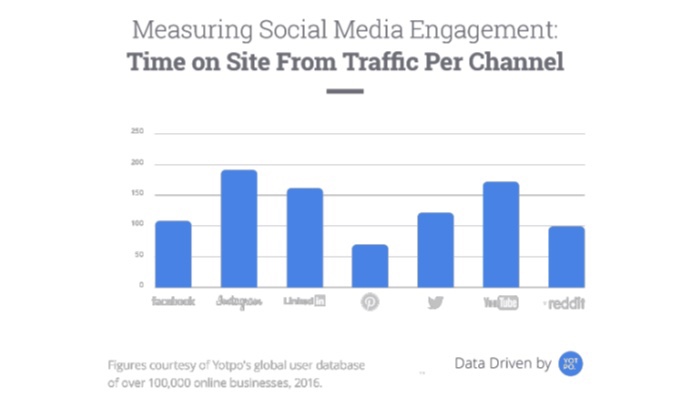
From the above two graphs, it is quite evident that user traffic is much higher on Instagram than any other platform.
However, it is important to note that maximum Twitter users are inactive and Instagram users are mostly active with over 500 million people using Instagram daily whereas only 330 million Twitter users are active monthly. So if a new business wants to enter the market and wants easy and quick promotion, Instagram is a better option any day.

2. Sales

Instagram has separate business profiles specifically for collaborations and business deals. Email, contact number can be directly attached on profiles whereas same does not happen with Twitter.
Another important characteristic where Instagram leads over Twitter is its “Trackable” feature. Sales and Leads can be tracked through Instagram Advertisements and hence we can see clear Return on Investment.

According to Shopify, an e-commerce platform, average price tag for a sale referred from Instagram is $65 and it is $55 for Facebook and $46 for Twitter.
With Instagram settings, we can link our profile to other social media accounts such as Facebook and Twitter but the same is not possible with Twitter and this can indirectly help in increasing sales.

Instagram being a more visual platform with variety of formats available is doing better than Twitter in driving sales.
In the graph below, it is found that traffic on Instagram is more than Twitter. So it is obvious, Instagram is ahead of Twitter when it comes to generating sales.

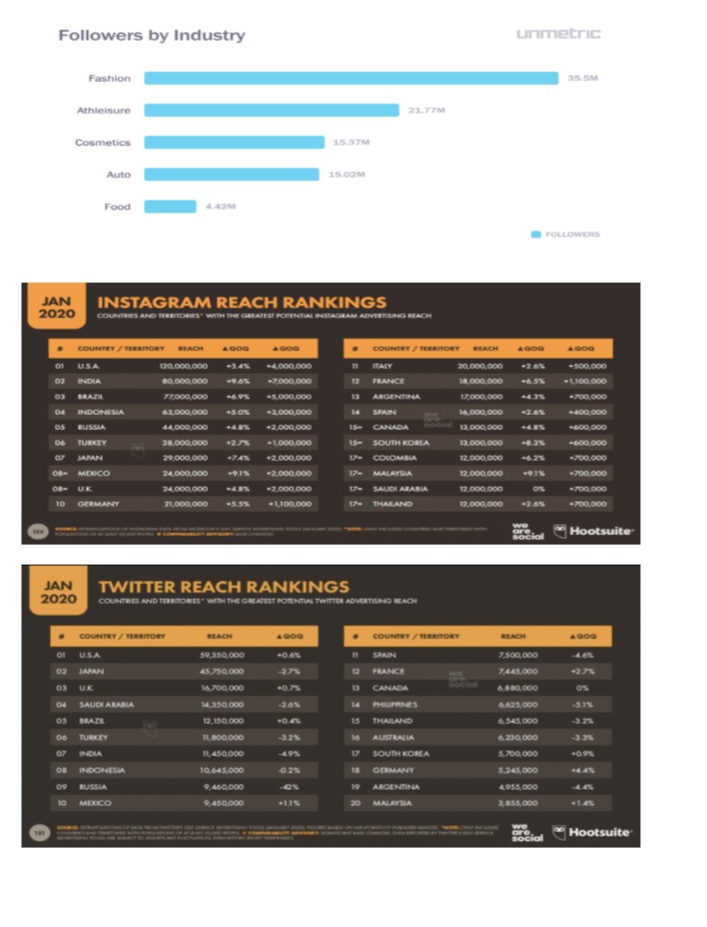
It is also important to note that Sales on social media platforms also depend on the country and the business field one is in.
After analysing the below three graphs, we will be able to understand that it is better to avoid using any of these applications for our business if our target audience is not into these fields and countries.

3) Return on Investment

Providing a link on our Instagram bio can fetch a lot of traffic and doing the same on our Tweets would also increase our traffic. Making good investment on Instagram sponsor advertisements and Twitter advertisement also increases our user traffic dramatically as Twitter shows our advertisements on “TRENDS” while Instagram shows our advertisements on stories.
Mostly, influencers prefer Instagram over any other platform since it is easy to handle and even users like Instagram posts as compared to other formats. And at the end all a business wants to do is to increase sales and earn profits. This is possible more on Instagram due to its unique yet diverse formats, high user engagement and efficient promotional techniques, so definitely ROI is bound to be more in Instagram than on Twitter.

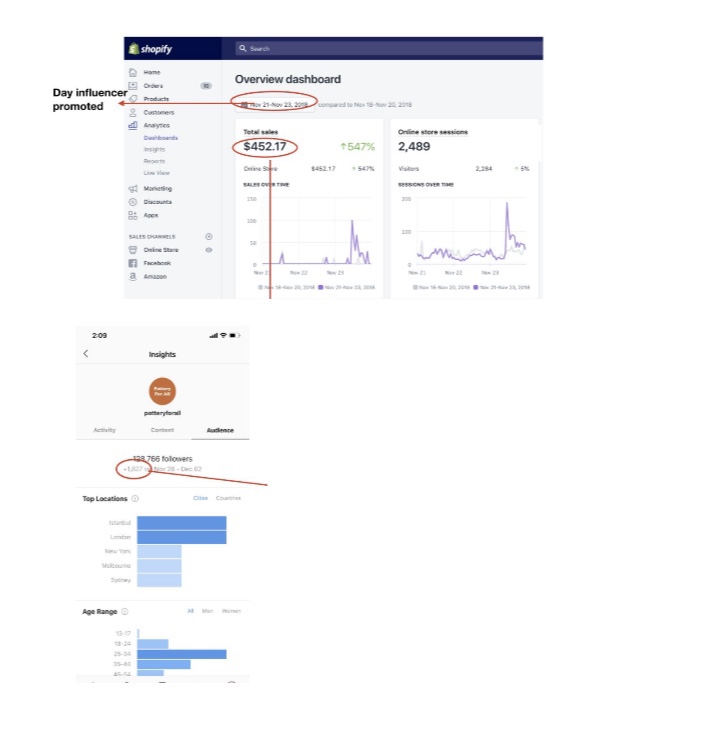
Also, as mentioned before, Instagram Business profiles provide each and every detail about insights, engagements, and sales and as a result it gives better information regarding ROI in comparison to Twitter.
Two examples of Sales Tracking, User Enagagement and ROI information are given below.

Conclusion: Both Instagram and Twitter are doing well when it comes to marketing strategy and business. If we talk about situation half a decade ago, Twitter was leading but in 2020, Instagram is unbeatable winner.
Growth of the business also depends on the industry, for example fashion industry will do better on Instagram while News Industry will do better on Twitter.

Ola electric scooter receives record 1 lakh bookings in 24 hours

Ola Electric CEO Bhavish Aggarwal announced recently that the much-anticipated Ola e-scooter has achieved 1 lakh bookings in just 24 hours of opening of pre-launch bookings, making it the ‘most pre-booked scooter’ in the world.

Ola Electric had announced the opening of bookings on July 15th at a token amount of ₹499 on its official website.

“India’s EV revolution is off to an explosive start. Huge thanks to the 100,000+ revolutionaries who’ve joined us and reserved their scooter,” Bhavish Aggarwal said on Twitter.

“I am thrilled by the tremendous response from customers across India for our first electric vehicle. The unprecedented demand is a clear indicator of shifting consumer preferences to EVs,” Bhavish Aggarwal said in a statement.

The new Ola electric scooter is likely to go on sale in the country later this month.

Ola Electric has claimed that the scooter will get best-in-class boot space as well. Additionally, the new scooter will get an app-based key for a keyless experience.

Ola has claimed that electric scooter will come with ergonomic seating. The company also claims the scooter will come with “superior cornering” ability as well as “class-leading acceleration.”

What is Web Hosting? It's Features, Types! Web Server

WEB HOSTING

Have you ever heard of the term ‘Web Hosting’? Well, I am 99% sure that you heard of the term ‘Hosting’. Web Hosting is different from Hosting. Hosting a show, Webinar, etc. is different from Web Hosting. In Web Hosting, there is no host. As the term suggests, Web Hosting is somewhere related to the Web. So, many of you guess that the term ‘web’ is also included in the keyword ‘Webinar’, then how is it different from it? You are guessing wrong. Let me clarify to you.

Web Hosting is an online service that permits you to host or publish your website, store, etc. on a specific Web Server. The website which you are reading currently is also somewhere hosted on the planet. When you buy a Web Hosting, the hosting provider rents you some space on the server or rents you the full server according to your requirements & budget, where you can store all your crucial files & data of your website.

What Exactly is a Server?

WEB SERVER

A server is a computer that is responsible for the communication of the web user’s browsers to your site from anywhere on the planet.
When the client’s computer requests website data from the server, it delivers the website data such as text, images, videos & website data (like HTML, Databases, etc.). The web server communicates with the web browser using the Hypertext Transfer Protocol (HTTP). The Web Hosting provider is responsible for the maintenance & uptime of the server.
But don’t you think that there is an address of the website, through which the user connects to the server. Yes, there is an address of your website, which is labelled as Domain. Ex- https://google.com , https://www.edupediapublications.org , etc. If you don’t host your website on a domain, then your website address is in the form of an IP address. The user has to enter the IP address in the browser to connect to your website. The IP address is hard to remember, that’s why we used the domain as a website address.
If you don’t know much about Domains, then you can read our other articles –

What are the basic features included in Web Hosting?

1. DISK SPACE –

A disk space, which is also known as web space, refers to the amount of space aligned by the Web Hosting provider to the buyer. The buyer can store all website data such as code, images, videos, & other files related to the website. Web space is generally scaled in MegaByte (MB) & GigaByte (GB).

2. BANDWIDTH OR DATA TRANSFER –

BANDWIDTH OR DATA TRANSFER

Many of us believe that the term Bandwidth & Data Transfer are the same entity, but they are different. Bandwidth is the amount of data that can be transferred at a time. While on the other hand, Data Transfer is the actual amount of data transferred at a particular time. While purchasing a Web Hosting plan, you should make sure that your website size & the amount of monthly visitors you have is completely reliable with the plan.

3. FTP ACCESS –

FTP (FILE TRANSFER PROTOCOL)

FTP, also known as File Transfer Protocol is used to transfer your website data from your computer to the server. It is also used for downloading your website files from the server to your computer. It can also be used for manually backing up your website to your computer.

4. E-MAIL ACCOUNTS –

EMAIL ADDRESS

It is the common feature of Web Hosting. It allows you to create a branded email address according to your domain. You can also send emails through various methods, i.e. POP & IMAP.

Types of Web Hosting?

There are many types of Web Hosting –
  1. Shared Web Hosting
  2. Managed Hosting
  3. Dedicated Hosting
  4. Colocation Web Hosting
  5. VPS (Virtual Private Server)
  6. Reseller Hosting
There are more types of Web Hosting, we will talk about all of them in future posts. We will also talk about all features in detail, how to manage it. So, don’t forget to bookmark this website (or page).
Thanks for reading!

What is Web Hosting? It's Features, Types! Web Server

WEB HOSTING

Have you ever heard of the term ‘Web Hosting’? Well, I am 99% sure that you heard of the term ‘Hosting’. Web Hosting is different from Hosting. Hosting a show, Webinar, etc. is different from Web Hosting. In Web Hosting, there is no host. As the term suggests, Web Hosting is somewhere related to the Web. So, many of you guess that the term ‘web’ is also included in the keyword ‘Webinar’, then how is it different from it? You are guessing wrong. Let me clarify to you.

Web Hosting is an online service that permits you to host or publish your website, store, etc. on a specific Web Server. The website which you are reading currently is also somewhere hosted on the planet. When you buy a Web Hosting, the hosting provider rents you some space on the server or rents you the full server according to your requirements & budget, where you can store all your crucial files & data of your website.

What Exactly is a Server?

WEB SERVER

A server is a computer that is responsible for the communication of the web user’s browsers to your site from anywhere on the planet.
When the client’s computer requests website data from the server, it delivers the website data such as text, images, videos & website data (like HTML, Databases, etc.). The web server communicates with the web browser using the Hypertext Transfer Protocol (HTTP). The Web Hosting provider is responsible for the maintenance & uptime of the server.
But don’t you think that there is an address of the website, through which the user connects to the server. Yes, there is an address of your website, which is labelled as Domain. Ex- https://google.com , https://www.edupediapublications.org , etc. If you don’t host your website on a domain, then your website address is in the form of an IP address. The user has to enter the IP address in the browser to connect to your website. The IP address is hard to remember, that’s why we used the domain as a website address.
If you don’t know much about Domains, then you can read our other articles –

What are the basic features included in Web Hosting?

1. DISK SPACE –

A disk space, which is also known as web space, refers to the amount of space aligned by the Web Hosting provider to the buyer. The buyer can store all website data such as code, images, videos, & other files related to the website. Web space is generally scaled in MegaByte (MB) & GigaByte (GB).

2. BANDWIDTH OR DATA TRANSFER –

BANDWIDTH OR DATA TRANSFER

Many of us believe that the term Bandwidth & Data Transfer are the same entity, but they are different. Bandwidth is the amount of data that can be transferred at a time. While on the other hand, Data Transfer is the actual amount of data transferred at a particular time. While purchasing a Web Hosting plan, you should make sure that your website size & the amount of monthly visitors you have is completely reliable with the plan.

3. FTP ACCESS –

FTP (FILE TRANSFER PROTOCOL)

FTP, also known as File Transfer Protocol is used to transfer your website data from your computer to the server. It is also used for downloading your website files from the server to your computer. It can also be used for manually backing up your website to your computer.

4. E-MAIL ACCOUNTS –

EMAIL ADDRESS

It is the common feature of Web Hosting. It allows you to create a branded email address according to your domain. You can also send emails through various methods, i.e. POP & IMAP.

Types of Web Hosting?

There are many types of Web Hosting –
  1. Shared Web Hosting
  2. Managed Hosting
  3. Dedicated Hosting
  4. Colocation Web Hosting
  5. VPS (Virtual Private Server)
  6. Reseller Hosting
There are more types of Web Hosting, we will talk about all of them in future posts. We will also talk about all features in detail, how to manage it. So, don’t forget to bookmark this website (or page).
Thanks for reading!