A Discussion About Our Mobile Phones

A mobile phone, also known as a cell phone, is something that all of us are familiar with and own. When the mobile phone was initially introduced, it was used primarily for phone calls and messaging. Today, phones have a computing speed greater than even some larger technological devices like a computer or television, and are so technologically advanced that we do not have to bother with most physical actions that take up time and effort. All of it can be done through the phone and the internet available on it, whether it be banking, paying bills, ordering something, etc. Furthermore, we can stay connected through phones with friends and family on the other side of the globe, through means such as video calling and multimedia messaging. A world of social media has opened through the phone that helps us connect with people all over the planet. However, like every other device, the mobile phone also has its own disadvantages.

The Good and the Bad

Possibly the biggest advantage of the mobile phone is that it has helped us stay connected to the people in our lives. This has occurred not only in the form of voice calling, but now also through video calling and social media contacts. It makes day-to-day life so easy and efficient, and has a range of tools that are accessible to us. For example, we can check the weather, the route to our destination, and use a calculator; all on our phones. Furthermore, it is perhaps the biggest source of entertainment in today’s day and age, with a multitude of games and mass media all available on it. Apart from these, the access of internet through our phones has meant that we can perform all our functions and meet all our life’s requirements through this simple device. It acts as a source of a large amount of information about the world, access to things like YouTube and Twitter, and allows to conduct monetary transactions all through the touch of a finger. In this sense, it is an amazing multipurpose, all-in-one device which is a necessary in our lives.

However, the mobile phone can also be the source of distress and disadvantage in one’s life. People are prone to addiction to their mobile phones, and end up using them for hours on end. This means that there is a lack of real-life communication and interaction, as people get sucked into the online world of their phones. Perhaps the most pressing concern today, especially among teenagers, is social media addiction. People get addicted to social media which has wide-ranging effects on their personal health, both mental and physical. Mobile phones also may cause health hazards, as they emit blue light and radiation which can damage brain cells. Furthermore, the mobile phone has also been the primary cause for lack of privacy in today’s world, as all our personal information is available for everyone to see. It is easy to get pulled into the world inside our phones and waste countless hours of our time on it. The phones almost become our lives, and this means that losing our phones is almost equal to losing our lives.

Conclusion

The mobile phone is a fantastic and necessary invention, but we must keep in mind that it comes with its own curses. How the mobile phone affects our lives depends on how much importance we give to it and how much we use it. It is all about finding a middle-ground in such a case, where you are not addicted or living in in your phone, but also not completely neglecting it and how it can enrich your life and make it more convenient. Regardless of its shortcomings, it is impressive to see how far our society has come through the invention of the mobile phone. Now we have everything within the reach of our hands, and the mobile phone has brought about a revolution in the lives of people in this century.

Future of Indian agriculture

Agriculture in India is livelihood for a majority of the population and can never be underestimated.
Although its contribution in the gross domestic product (GDP) has reduced to less than 20 per cent and contribution of other sectors increased at a faster rate, agricultural production has grown. This has made us self-sufficient and taken us from being a begging bowl for food after independence to a net exporter of agriculture and allied products.

Total foodgrain production in the country is estimated to be a record 291.95 million tonnes, according to the second advance estimates for 2019-20. This is news to be happy about but as per the estimates of Indian Council for Agricultural Research (ICAR), demand for foodgrain would increase to 345 million tonnes by 2030.

Increasing population, increasing average income and globalisation effects in India will increase demand for quantity, quality and nutritious food, and variety of food. Therefore, pressure on decreasing available cultivable land to produce more quantity, variety and quality of food will keep on increasing.

India is blessed with large arable land with 15 agro-climatic zones as defined by ICAR, having almost all types of weather conditions, soil types and capable of growing a variety of crops. India is the top producer of milk, spices, pulses, tea, cashew and jute, and the second-largest producer of rice, wheat, oilseeds, fruits and vegetables, sugarcane and cotton.

In spite of all these facts, the average productivity of many crops in India is quite low. The country’s population in the next decade is expected to become the largest in the world and providing food for them will be a very prime issue. Farmers are still not able to earn respectable earnings.

Even after over seven decades of planning since the independence, majority of the farmers are still facing problems of poor production and/or poor returns. Major constraints in Indian agriculture are:

According to 2010-11 Agriculture Census, the total number of operational holdings was 138.35 million with average size of 1.15 hectares (ha). Of the total holdings, 85 per cent are in marginal and small farm categories of less than 2 ha (GOI, 2014).
Farming for subsistence which makes scale of economy in question with majority of small holdings.
Low-access of credit and prominent role of unorganised creditors affecting decisions of farmers in purchasing of inputs and selling of outputs
Less use of technology, mechanisation and poor productivity for which first two points are of major concern
Very less value addition as compared to developed countries and negligible primary-level processing at farmers level.
Poor infrastructure for farming making more dependence on weather, marketing and supply chain suitable for high value crops.
Future of agriculture is a very important question for the planners and all other stakeholders. Government and other organisations are trying to address the key challenges of agriculture in India, including small holdings of farmers, primary and secondary processing, supply chain, infrastructure supporting the efficient use of resources and marketing, reducing intermediaries in the market. There is a need for work on cost-effective technologies with environmental protection and on conserving our natural resources.

The reforms towards privatisation, liberalisation and globalisation affected inputs market at a faster pace. Agricultural marketing reforms after 2003 made changes in marketing of agricultural outputs by permitting private investment in developing markets, contract farming and futures trading, etc. These amendments in marketing acts have brought about some changes but the rate is less.

Along with this, the information technology revolution in India, new technologies in agriculture, private investments especially on research and development, government efforts to rejuvenate the cooperative movement to address the problems of small holdings and small produce etc are changing face of agriculture in India.

Many startups in agriculture by highly educated young ones show that they are able to understand the high potential of putting money and efforts in this sector. Cumulative effects of technology over the next decade will change the face of agriculture.

All the constraints in agriculture make the productivity and returns complex but still a high untapped potential is there in India’s agriculture sector.

Advantageous weather and soil conditions, high demand for food, untapped opportunities, various fiscal incentives given by the government for inputs, production infrastructure, availability of cheap credit facilities and for marketing and export promotion are attracting many individuals, big companies, startups and entrepreneurial ventures to do a lot of investments on innovations, inventions, research and development and on other aspects of business.

The efforts are being done to convert all the challenges in agriculture into opportunities and this process is the future of agriculture.

Key trends expected

1. Changing demand due to increase in incomes, globalisation and health consciousness is affecting and going to affect more the production in future. Demand for fruits and vegetables, dairy products, fish and meat is going to increase in future.

2. Researches, technology improvements, protected cultivation of high value greens and other vegetables will be more. There will be more demand of processed and affordable quality products.

3. More competition will be there among private companies giving innovative products, better seeds, fertilisers, plant protection chemicals, customised farm machinery and feed for animals etc in cost effective ways at competitive prices giving more returns on investment by farmers. Use of biotechnology and breeding will be very important in developing eco-friendly and disease resistant, climate resilient, more nutritious and tastier crop varieties.

4. Some technologies will be frequently and widely used in future and some will become common in a short time while some will take time to mature. For producing the same products in other way so as to use resources judiciously and using new resources also like hydroponics, use of plastics and bio-plastics in production. There will be more of vertical and urban farming and there will also be efforts in long term to find new areas for production like barren deserts and seawater.

5. Precision farming with soil testing-based decisions, automation using artificial intelligence will be focused for precise application inputs in agriculture. Sensors and drones will be used for precision, quality, environment in cost effective manner.

Small and marginal farmers will also be using these technologies with the help of private players, government or farmer producer organisations (FPO). Use of GPS technology, drones, robots etc controlled by smart phones etc can make life of farmers easy and exciting with good results. These advanced devices will make agriculture be more profitable, easy and environmentally friendly.

6. Use nano-technology for enhancement of food quality and safety, efficient use of inputs will be in near future. Nano-materials in agriculture will reduce the wastage in use of chemicals, minimise nutrient losses in fertilisation and will be used to increase yield through pest and nutrient management. IFFCO has already done successful tests in nano-fertilisers.

7. India has improved remarkably in its digital connectivity and market access has become very easy. The number of internet users is projected to reach 666.4 million in 2025. Farmers will be behaving more smartly with mobiles in hands and would be able to be more aware and connected with different stake holders. Government will be making wide use of digital technology for generating awareness among farmers, information sharing, government schemes using digital technology for direct transfers of money.

8. There will certainly be more work by government, village communities, agri startups and private players in conserving sharply depleting water resource. Use of digital technology can make revolution in this direction. There will be use of satellites, IoT, drones for better collection of data regarding soil health, crop area and yield which will make cost for insurers less with better estimations and system will be more exact and effective.

9. There will be more of niche marketers in operations, area, and crop specific small equipments which will make operations even at small farms easier and efficient.
Food wastage will be less and better use of waste materials in agriculture will be more. Number of warehouses in private sector will be more and linkages between government and private warehouses will be increasing. This will help in balancing supply with demand and stabilisation of prices of agri-outputs in the market.

10. Retailing in agriculture will largely be digitalised. A study estimates that over 90 per cent of kirana stores across the country will be digitalised by 2025 with modern traceable logistics and transparent supply chain. Many players have already taking kiranastores to the door steps of consumers like Amazon and Jio Mart.

Question arises whether farmers will be able to make use of modern technologies in a country where education, holding size, infrastructure, low level of technology adoption and many other constraints are there.

HAVE YOU EVER THOUGHT THAT A MOVIE CAN ALSO TEACH A LEADERSHIP LESSON? HERE IS ONE

Breif About Movie

Lakshya is a patriotic movie launched in 2004. The movie showcase how an aimless person who under the influence of his friend joined Army Academy. He ran away due to the frequent punishments he received there but returned with an aim of joining army. Due to his efforts in the Academy he joined the army where he led a team of 12 army officers and soldiers to a successful clash to defeat the Infiltrators and re acquire the territory occupied by them.

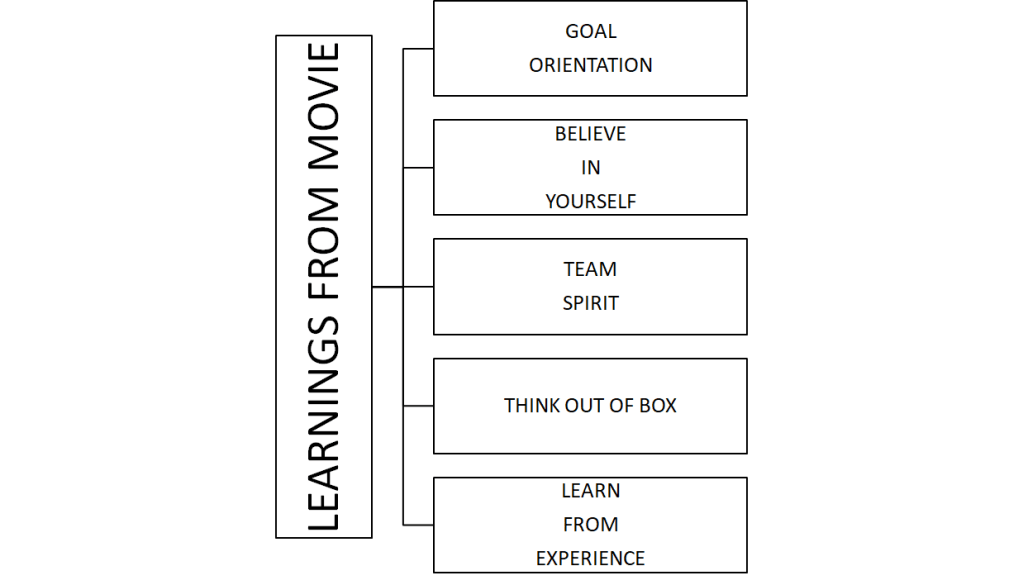
Goal Orientation

“Lakshya” as the name of the movie suggests the movie revolves around the value of having a goal in the life. Whether it be an individual, group, organisation all requires an aim to work upon. The protagonist of this film (Karan) was a lazy and aimless young man who has no goals for his future. He joined a Military Academy under the influence of his friend and as a result he ran away from the academy due to the punishments he had to face due to his undisciplined and lazy attitude. But after he firmly decided to join the army  he returns, takes his punishment, becomes a disciplined and focused officer cadet and eventually commissions into the Army. 

Believe in Yourself

To achieve a goal a person, need to have faith in himself/herself that  he/she can achieve the goal and is ready to face all the challenges and hurdles that act as a barrier in the same. The person should follow the policy that “ I can, and I will.”

When a person builds a believe in himself/herself then this believe acts as a self motivation which plays a crucial role in achieving the individual goals and the goals of the organisation with whom he/she is associated.

 In the movie the proctor along with other team members were able to climb a 1000-foot-high rock cliff of the mountain because of the determination and the self believe they proved that nothing is impossible.

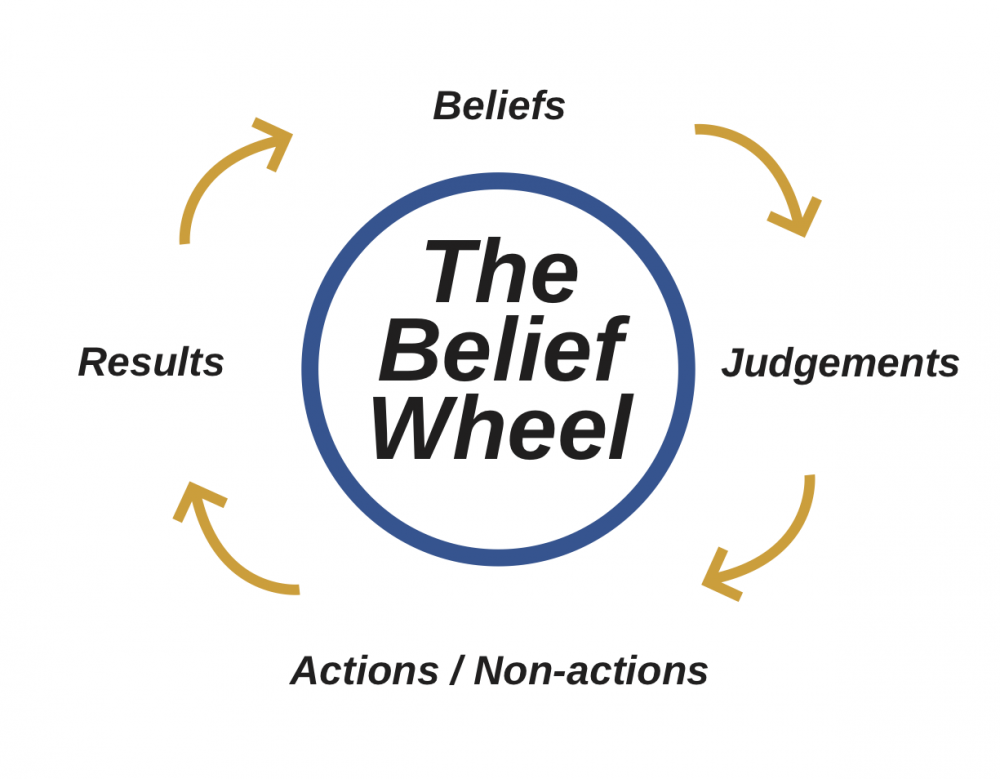
The Belief Wheel – IABC Central Oklahoma

Team Spirit

A single person can’t achieve an organisational goal on his own. He requires the support , unity and co-ordination of all his team members whether it be his senior or sub-ordinates. All the efforts are worthless if the aim is not achieved. A single person can never be expert in all the fields and requires the knowledge and experience of other members to achieve the goal. This team spirit helps to raise new and innovative ideas to make the path of achieving goal effective and efficient. It also helps to improve the interpersonal relationships between the employees of an organisation which is crucial for best output from an employee.

Henri Fayol in one of his Principles Of Management i.e. in the Principle of “Esprit De Corps” defines  that an organization must make every effort to maintain group cohesion i.e. a feeling of unity in the organization. He adds that a conflict in the team member and division of team due to conflict is a serious issue and needs to be resolved at priority to achieve the objective of an organization. 

In the movie a team of 12 army officers and soldiers had a faith in each other and had a feeling of unity which helped them to defeat the infiltrators

Daily Yoga

Yoga is an art that connects our body, mind and soul together and makes us strong and peaceful. Yoga is essential because it keeps us fit, helps in reducing stress and maintains overall health and a healthy mind can help in concentrating well.

Yoga is important because by practicing yoga, you can gain benefits at the following points:
Internal peace – Yoga helps in achieving inner peace and fighting against stress and other problems. Yoga enhances the level of peace in one person and helps to increase his self-confidence and make him happy.

Health – A healthy person can work more than an unhealthy person. Life is very tense nowadays and there is a lot of pollution around us. This is the reason for many health problems. Just 10-20 minutes of yoga can help your health to be good every day. Better health means better life.

Activism – People now feel lazy, tired or sleepy due to which they lose most of their life in fun and are not able to fulfill their work correctly. Being actively, you are more aware of things happening around you and can accomplish your work more efficiently and quickly. One way to do all this is to practice yoga on a regular basis.

Flexibility – People are suffering from various types of pain nowadays. They face difficulties during touching the toes or bending downwards. Regular practice of yoga helps relieve all these types of pain. By doing yoga, the effects of these things can be seen in a few days.

Increase blood flow – Yoga helps make your heart healthy and it works more efficiently by increasing blood flow in your body and veins. It helps keep your body oxygen rich.

Focusing power – Yoga helps calm and relax your body which means stress is low and you can concentrate on your work. This is the reason that children and teenagers are encouraged to do yoga as it helps in better concentration in their studies.

Conclusion

Thus, it can be said that yoga is a miracle and if it is done then it will guide you throughout your life. 20-30 minutes per day Yoga can change your life forever by promoting the balance between your physical, mental and spiritual health.

Time and tide wait for none

Time, is the only factor which is limited in life. Everything else you might stretch, elongate, increase since your birth but time is the only constraining factor which is extremely limited. There are only 24 hours in a day but how you spend the best part of those 24 hours is what shall determine your success or failure in life.

Have you ever stopped at a sea-shore and watched the ebb and flow of the tides of the sea? No matter, how much you want to hold it in the cusp of your hand, it shall flow back and the next tide shall return. Similarly, it is with time. The passage of time shall go on at its own pace, no matter how sad, miserable or happy and delighted you be. It is another matter altogether that moment of grief seems so prolonged and moments of ecstasy seem so transient.The essence of the proverb is then to make best use of the allotted time in creative and positive pursuits rather than in negative and time-wasting pursuits. Time once lost can never be regained. So if in the age- appropriate situation, you do not make favorable use of time, you shall have to remain in regret for the rest of your lifetime. A student who shields away his school years in idle pursuits shall always feel the pinch of lack of education, no matter how high he reaches or how far he travels. If you do not spend hours of warmth and comfort in the company of loved ones, you will always feel the pinch of it once you lose your parents or your children grow up or the love of your life walks away.

Remember that all great people who have registered their names in history or made life-changing contribution to the annals of human history also had access to same 24 hours in a day. It is the manner in which they utilised their 24 hours which made each hour of the day count. We can either while our time in idle, mindless pursuits or browsing through inane social networking sites, or indulging in gossip and back-biting or spend hours complaining or bribing about the state of our life, society, country or world or step up our game, rise up to the occasion and do something positive about it to wield constructive changes.

Whether be it learning new things, paying more attention to our physical fitness, connecting with our friends and family, putting in more productive hours at work, let us make each and every moment count in our life so that at the end of the day, we can go to sleep at peace knowing that the day has been well-spent.

Grab every opportunity that comes in your way, lead every day as the last day of your life and wake up every day as if it is the first day of your life. There can be no greater mantra for success.

Alpha Centauri, Star System Closest To Our Sun

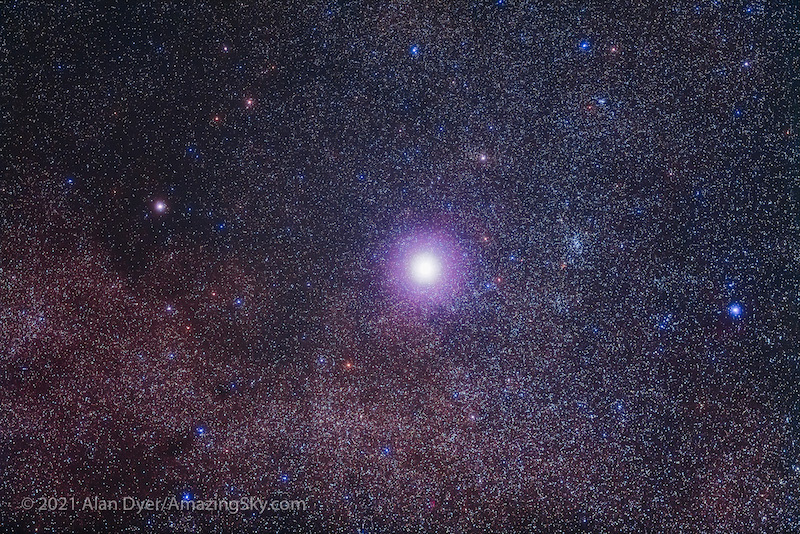
Star Alpha Centauri very bright against a backdrop of extremely dense field of fainter stars and dust clouds.
Alpha Centauri is the third-brightest star in our night sky – a famous southern star – and the nearest star system to our sun. Through a small telescope, the single star we see as Alpha Centauri resolves into a double star. This pair is just 4.37 light-years away from us. In orbit around them is Proxima Centauri, too faint to be visible to the unaided eye. At a distance of 4.25 light years, Proxima is the closest-known star to our solar system.
Science of the Alpha Centauri system. The two stars that make up Alpha Centauri, Rigil Kentaurus and Toliman, are quite similar to our sun. Rigil Kentaurus, also known as Alpha Centauri A, is a yellowish star, slightly more massive than the sun and about 1.5 times brighter. Toliman, or Alpha Centauri B, has an orangish hue; it’s a bit less massive and half as bright as the sun. Studies of their mass and spectroscopic features indicate that both these stars are about 5 to 6 billion years old, slightly older than our sun.

Alpha Centauri A and B are gravitationally bound together, orbiting about a common center of mass every 79.9 years at a relatively close proximity, between 40 to 47 astronomical units (that is, 40 to 47 times the distance between the Earth and our sun).Must Watch Sky Events in 2021

In comparison, Proxima Centauri is a bit of an outlier. This dim reddish star, weighing in at just 12 percent of the sun’s mass, is currently about 13,000 astronomical units from Alpha Centauri A and B. Recent analysis of ground- and space-based data, published in 2017, has shown that Proxima is gravitationally bound to its bright companions, with a 550,000-year-long orbital period.

Proxima Centauri belongs to a class of low mass stars with cooler surface temperatures, known as red dwarfs. It’s also what’s know as a flare star, where it randomly displays sudden bursts of brightness due to strong magnetic activity.

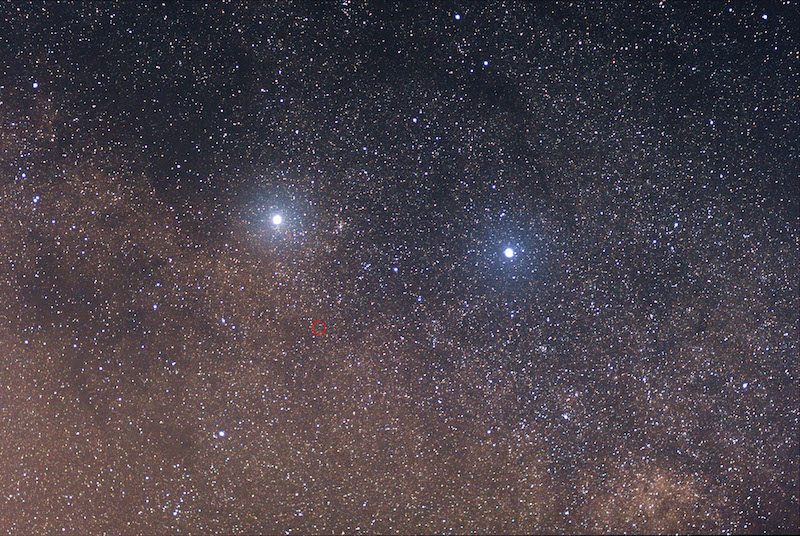
In the past decade, astronomers have been searching for planets around the Alpha Centauri stars; they are, after all, the closest stars to us so the odds of detecting planets, if any existed, would be higher. So far, two planets have been found orbiting Proxima Centauri, one in 2016 and another in 2019. A paper published in February 2021 reported tantalizing evidence of a Neptune-sized planet around Alpha Centauri A, but so far, it has not been definitively confirmed.

Large-appearing bright star with 4 lens-effect bright spikes coming out from it.
Extremely dense star field with 2 brights stars and a small red circle around a much smaller one.

How to see Alpha Centauri. Unluckily for many of us in the Northern Hemisphere, Alpha Centauri is located too far to the south on the sky’s dome. Most North Americans never see it; the cut-off latitude is about 29° north, and anyone north of that is out of luck. In the U.S. that latitudinal line passes near Houston and Orlando, but even from the Florida Keys, the star never rises more than a few degrees above the southern horizon. Things are a little better in Hawaii and Puerto Rico, where it can get 10° or 11° high.

But for observers located far enough south in the Northern Hemisphere, Alpha Centauri may be visible at roughly 1 a.m. (local daylight saving time) in early May. That is when the star is highest above the southern horizon. By early July, it reaches its highest point to the south at nightfall. Even so, from these vantage points, there are no good pointer stars to Alpha Centauri. For those south of 29° N. latitude, when the bright star Arcturus is high overhead, look to the extreme south for a glimpse of Alpha Centauri.

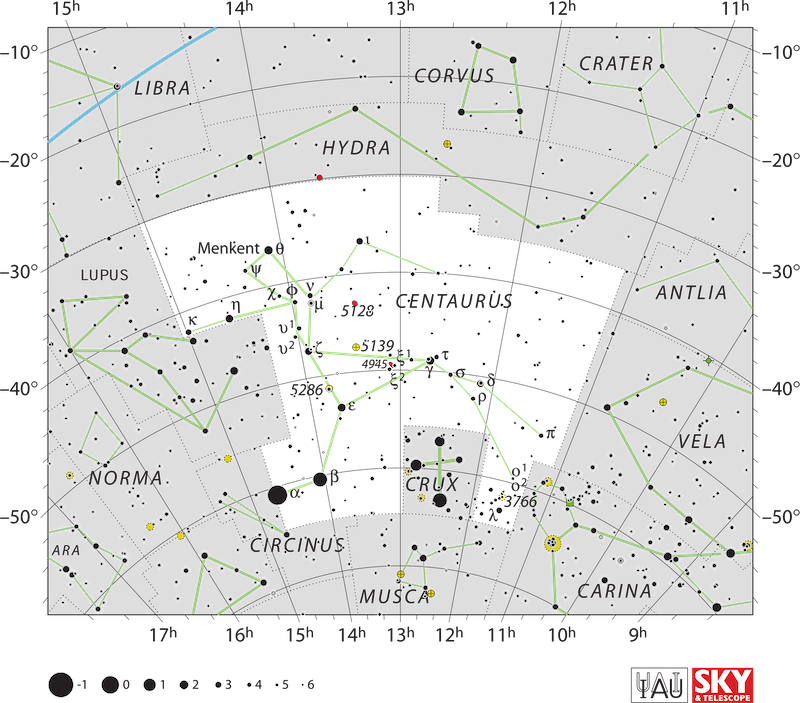
Star chart with stars in black on white, of Centaurus with Southern Cross constellation.
The southern constellation Centaurus. Image via Wikimedia/ International Astronomical Union/ SkyandTelescope.com.

Observers in the tropical and subtropical regions of the Northern Hemisphere can find Alpha Centauri by first identifying the distinctive Southern Cross. A short line drawn through the crossbar (Delta and Beta Crucis) eastward first comes to Hadar (Beta Centauri), then Alpha Centauri. Meanwhile, in Australia and much of the Southern Hemisphere, Alpha Centauri is circumpolar, meaning that it never sets.

A telescope dome at in the foreground with Milky Way and bright stars in the sky.
In this image taken at the European Southern Observatory’s La Silla Observatory in Chile, the Southern Cross is clearly visible, with the yellowish star, closest to the dome, marking the top of the cross. Drawing a line downward through the crossbar stars takes you to the bluish star, Beta Centauri, and then to the yellowish Alpha Centauri. Image via ESO / Wikimedia Commons.

Alpha Centauri in mythology. Alpha Centauri has played a prominent role in the mythology of cultures across the Southern Hemisphere. For the Ngarrindjeri indigenous people of South Australia, Alpha and Beta Centauri were two sharks pursuing a sting ray represented by stars of the Southern Cross. Some Australian aboriginal cultures also associated stars with family relationships and marriage traditions; for instance, two stars of the Southern Cross were through to be the parents of Alpha Centauri.

Astronomy and navigation were deeply intertwined in the lives of ancient seafaring Polynesians as they sailed between islands in the vast expanse of the South Pacific. These ancient mariners navigated using the stars, with cues from nature such as bird movements, waves, and wind direction. Alpha Centauri and nearby Beta Centauri, known as Kamailehope and Kamailemua, respectively, were important signposts used for orientation in the open ocean.

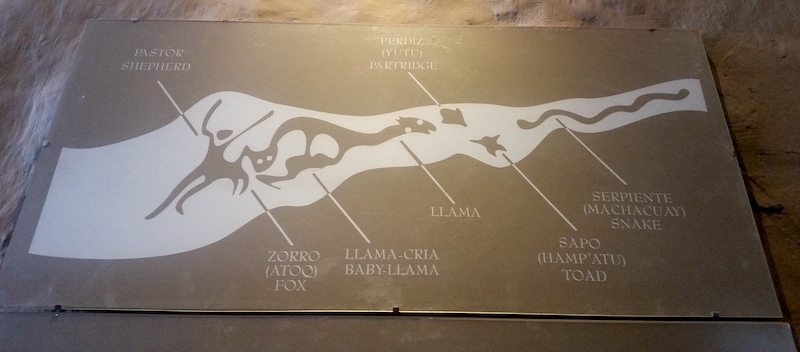
For ancient Incas, a llama graced the sky, traced out by stars and dark dust lanes in the Milky Way from Scorpius to the Southern Cross, with Alpha Centauri and Beta Centauri representing its eyes.

Dark-on-light shepherd, mother llama with baby, partridge, toad, and snake.
A plaque at the Coricancha museum showing Inca constellations. Coricancha, located in Cusco, Peru, was perhaps the most important temple of the Inca empire. Image via Pi3.124 / Wikimedia Commons.

Ancient Egyptians revered Alpha Centauri, and may have built temples aligned to its rising point. In southern China, it was part of a star group known as the South Gate.

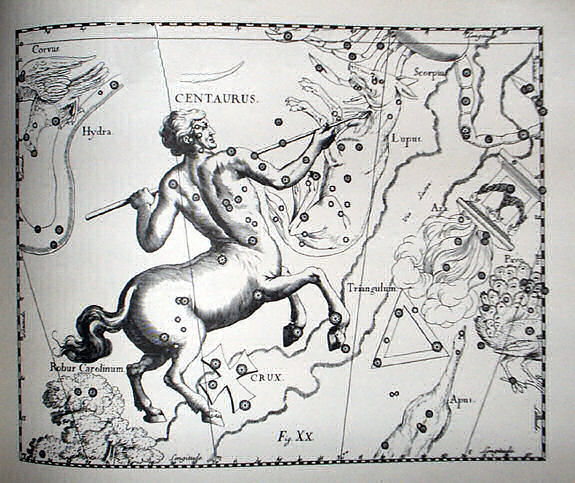
Alpha Centauri is the brightest star in the constellation Centaurus, named after the mythical half human, half horse creature. It was thought to represent an uncharacteristically wise centaur that figured in the mythology of Heracles and Jason. The centaur was accidentally wounded by Heracles, and placed into the sky after death by Zeus. Alpha Centauri marked the right front hoof of the centaur, although little is known of its mythological significance, if any.

Antique etching of half-man-half-horse in field of stars in black on white.
A depiction of the Centaur by Polish astronomer Johannes Hevelius in his atlas of constellations, Firmamentum Sobiescianum, sive Uranographia. Image via Wikimedia Commons.

Alpha Centauri’s position is RA: 14h 39m 36s, Dec: -60° 50′ 02″

Bottom line: Alpha Centauri is actually two binary stars that are quite similar to our sun. A third star that’s gravitationally bound to them is Proxima Centauri, the closest star to our sun.

Html

HTML is the language in which most websites are written. HTML is used to create pages and make them functional.

The code used to make them visually appealing is known as CSS and we shall focus on this in a later tutorial. For now, we will focus on teaching you how to build rather than design.

What are Tags and Attributes?
Tags and attributes are the basis of HTML.

They work together but perform different functions – it is worth investing 2 minutes in differentiating the two.

What Are HTML Tags?
Tags are used to mark up the start of an HTML element and they are usually enclosed in angle brackets. An example of a tag is:

. Most tags must be opened

and closed

in order to function.

What are HTML Attributes?
Attributes contain additional pieces of information. Attributes take the form of an opening tag and additional info is placed inside.

An example of an attribute is:

A photo of my dog.

Golden Rules To Remember
The vast majority of tags must be opened () and closed () with the element information such as a title or text resting between the tags.
When using multiple tags, the tags must be closed in the order in which they were opened. For example:

This is really important!
HTML Editors
Now that we’ve gotten the basic theory out of the way. It’s time to learn how to build our first website.

First off, we must ensure that we have the right tools. Most important, we need an HTML editor.

There are many choices on the market. Here are a handful of the most popular:

Sublime Text 3
However, for this tutorial, we will use the Sublime Text 3 as it is free and also offers cross-platform support for Windows, Mac, and Linux users.

Sublime Text 3
Sublime Text 3 has a mini-preview window on the right.
Pros
Easily customizable
Beginner-friendly
Pleasant color schemes to choose from.
Cons
Can’t print documents or code
No toolbar or dashboard available.
Notepad ++
Another common choice for HTML and other language coders is Notepad ++. It is a tiny program to download and perform the functions you need for writing clean code.

HTML Notepad ++
This is Notepad ++. Far from glamorous but does the job.
Pros
Distraction-free interface
Auto-completion feature
Plugin options for extended functionalities.
Cons
Can be difficult to get used to for beginners
No support for Mac.

Read more: https://html.com/#ixzz70EBqcvpq

Basic Construction of an HTML Page
These tags should be placed underneath each other at the top of every HTML page that you create.

— This tag specifies the language you will write on the page. In this case, the language is HTML 5.

— This tag signals that from here on we are going to write in HTML code.

— This is where all the metadata for the page goes — stuff mostly meant for search engines and other computer programs.

— This is where the content of the page goes.

HTML Structure
This is how your average HTML page is structured visually.
Further Tags
Inside the tag, there is one tag that is always included: , but there are others that are just as important:</p> <p><title><br /> This is where we insert the page name as it will appear at the top of the browser window or tab.<br /> <meta><br /> This is where information about the document is stored: character encoding, name (page context), description.<br /> Let’s try out a basic <head> section:</p> <p><head><br /> <title>My First Webpage

.


Adding Content
Next, we will make tag.

The HTML is where we add the content which is designed for viewing by human eyes.

This includes text, images, tables, forms and everything else that we see on the internet each day.

How to Add HTML Headings To Your Web Page
In HTML, headings are written in the following elements:

Read more: https://html.com/#ixzz70EC2YJuH

SELF DIAGNOSIS : MENTAL HEALTH EDITION

WHAT IS SELF DIAGNOSIS?

Self-diagnosis is the process of diagnosing or identifying, medical conditions in oneself.

OTHER WAYS TO GET IT DONE

It can be done by using study materials such as medical dictionaries, books, and resources on the internet. Not only that but if you have had a past mental health experience then you can figure out if you need a diagnosis or not. Due to your past experience you might be able to help yourself the next time. Another way could be that if someone around you had issues with mental health before you, then you can work on yourself after noticing the symptoms and measures they had and how they dealt with it.

CHALLENGES

One of the main challenges will be Misdiagnosis. It is defines as an incorrect diagnosis of an illness or other problem.

REASONS AND CONSEQUENCES OF MISDIAGNOSIS

  • What might seem “normal” to you, might actually be something not normal.
  • And conversely, what might seem “not normal” to you, might actually be something normal.
  • You don’t know all the disorders that exist and the minute differences between them.
  • The symptoms might actually be that of a physical illness.
  • You may miss something entirely.
  • You might harm yourself if you start medications (allopathic or homeopathic) based on self-diagnosis.

WHY DO PEOPLE DO IT?

  • If there cant find proper resources.
  • If they are not able to access the resources, that could be because of un-supportive family, money issues, cultural beliefs, etc.
  • The research on psychiatric disorders is way too narrow.
  • The resources available and accessible can sometimes be dysfunctional too.
  • They might be in urgent need and want of help that they wouldn’t think of seeking help from someone else but end up doing it on their own.

WHAT DO WE LEARN AFTER THE SELF-DIAGNOSIS

After the self diagnosis we will be able to help ourselves in the future if we ever happened to face something similar. We can come up with support groups or even join one, that will help us maintain our mental health and help us in dealing with post mental health mindset. It is also learnt that after learning thoroughly about self-diagnosis we will be able to understand ourselves and even others who are going through something similar. You will see those changes in yourself and act accordingly to the situations around you.

If you are consider Self-Diagnosis, make sure you are thoroughly educated about it and work efficiently.

Article by : Haniah Mirza

Most Controversial Figure : Vinayak Damodar Savarkar

Vinayak Damodar Savarkar commonly known as Swatanryaveer or simply Veer Savarkar was born on 28 May, 1883 and died on 26th February 1966. He was an Indian independence activist, historian , poet, novelist , politician who formed the Hindu Nationalist philosophy of Hindutva. He was a leading personality in Hindu Mahasabha

Vinayak Savarkar is highly controversial figure in India because of his mercy petition he wrote to British Government when he was imprisoned in Andaman and Nicobar. But what many fails to understand is the mentality behind the mercy petition. Prisoners in Kaala Paani ( Andaman and Nicobar) were treated horribly and brutally. They were tortured to death . They were neither given good food nor good living condition. To save himself from such inhumane torture Vinayak Savarkar appealed for mercy. He was barrister and he knew his rights well. He knew sitting inside jail he will not be able to serve his country and so tried to get out by writing mercy petition.

But before judging and throwing him into the light of black or white , it is important to know why some hate him and others remark him as a patriot

Why he is loved :

1) He went to Gray’s Inn Law college in London and stayed at famous India House. At that time , India House was a hub of student politics . Savarkar founded the Free India Society to mobilise youth against the colonial rule in India

2) He burnt all foreign goods and propagated the idea of ‘Swadeshi’

3) He plotted armed revolt against the Morley- Minto reform but was arrested for it

4) He established a temple called ‘ Patit Pawan Mandir’ in Maharashtra , where people from every caste were welcomed

5) His book ‘The Indian war of Indian Independence 1857’ inspired many freedom fighters like Bhagat Singh , Chandra Shekhar Azad , Subash Chandra Bose .

6) Savarkar was one of the first writers to call for India’s first war for Independence against British. He asked for poorna swaraj ( Total independence) when people were settling for less

7) After his release from jail , he worked on the abolishment of untouchability in Ratnagiri

8) He wrote mercy petitions not only for himself but for other prisoners too.

Why He is Hated:

1) When Savarkar was 12 years old , he lead a march with his schoolmates to vandalise a mosque in order to take revenge against atrocities committed against Hindus by Muslims.

2) He was fierce critic of Indian National Congress and Mahatma Gandhi.

3) He opposed the ‘Quit India Movement and later objected to INC’s acceptance to the Indian partition

4) For his mercy petition written to British Government.

Over the years many facts have beem destroyed and twisted, so no one can ever say if Vinayak was a hero or villain. It is well known fact that there is no person with zero flaws. There is some good in evil and some evil in good.

MOTHER TERESA- THE INSPIRATIONAL WOMAN WE KNOW TODAY

Mother Teresa- the famous founder of order of the missionaries of charity devoted her life helping the poor and the needy people. It is quite inspirational to know how this little girl who lost her father at a very young age, grew to become such a powerful and influential woman known across the world.

‘Mary Teresa Bojaxhiu’ was born with the name ‘Agnes Gonxha Bojaxhiu’ on August 26,1910 in Skopje Yugoslavia to Nicola and Johanna Bojaxhiu. She was baptized(given a nickname) a day after her birth. Teresa later considered August 27, the she was baptized as her true birthday. She would later adopt the name Mother Teresa where she was honored as Saint Teresa of Calcutta in the Roman Catholic Church. Her father Nicola was a politician and also a successful construction business worker. He was able to cater for his family with all the necessities and hence Teresa did not lack anything as a child. However nothing much was known about her early childhood experience. Teresa was the youngest of her parents three children. Her family was rich enough and was able to conveniently afford to have two houses. When Teresa was about eight years old, she lost her father. Her father’s sudden death left the family in slight financial straits. However, Teresa’s mother started a textile business which helped her to properly take care of the family. All through her childhood Teresa was influenced by her family to get involved with the Church. It was reported that Teresa completed both her elementary and high school education in Church Schools, though some believed she went to a state-run secondary school. She was an active member of the choir, literacy session and the drama session.

Teresa generally loved reading, especially articles about missionary service and life in India. This later influenced her decision to become a missionary nun. Teresa was then encouraged by her mother to help those in need and care about her religion. Teresa’s mother offered clothes, food and other necessary items to the needy people at the church. Such were her contributions that eventually people would say this about Teresa’s family- “Bojaxhiu family had long been known in Skopje for their generosity towards the town’s poor and downtrodden”. When Teresa was 12 years old during one of the annual pilgrimages to the Church of the Black Madonna in Legnica she first experienced a call to the religious life. By 1928, when Teresa was 18 years old, she was moved by a desire to become a missionary and so she joined the Institute of the Blessed Virgin Mary(sisters of Loreto) in Ireland where the name sister Mary Teresa was given to her. Later that year Teresa departed for India and arrived in Calcutta in January 1929. In 1931 she made her first Profession of Vows(promise made to God) and used to teach at St. Mary’s School for girls. She made her final Profession of Vows in May 1937 which supposedly made her the ‘spouse of Jesus’ for ‘all eternity’. Since then her public name changed from Agnes Gonxha Bojaxhiu to Mother Teresa. Teresa continued as a teacher at St. Mary’s School for girls and soon became the Principal of the school in 1944. Teresa was a woman of profound prayer and showed immense love for her students and religious sisters. Teresa spent 20 years in Loreto which was filled with intense happiness. She was noted for her courage, unselfishness, charity, hard work and natural talent for organizing.

The Man from Earth

Every culture has a form of immortality and its a concept used in almost every type of media, be it the villain’s motivation or the hero’s reward. Immortality comes in many forms and shapes like using an ancient artefact, using magic, using technology or even being a supernatural creature grants immortality in a fantasy setup. Rarely any depiction of immortality deals with the darker aspects like being detected and experimented, psychological impacts of possibly outliving everything and everyone you loved. Immortality can be as much of a curse as it would be a boon, imagine being alive more than a 1000 years from now and being the only one who cannot connect because you’ve held on the past for so long. Todays generation is a hectic and tired one, only some would dare to accept immortality.

The movie from 2007 follows Professor John Oldman who seems to have survived for almost 14000 years, the entire movie is set in and arounds Johns home and mostly contains intellectual dialogues between him and his friends. John is moving from his current location and is stopped by his friends for an impromptu Farwell party. His friends are his colleagues that are experts in their respective fields and play a crucial part in each story told by John. His friends notice some peculiar things in Johns belongings like what seems to be an original Van Gogh, a hunting bow, some historic texts and objects that could be dated back to the Magdalenian era.

Oldman reluctantly start telling his story to the others. He relocates every ten years to keep anyone from realizing that he doesn’t age. He begins by telling his friends of his origin and later life when he realised he doesn’t age, he started out as a caveman from the Magdalenian era. He later relates being a Sumerian then residing in Babylon before moving to the east to become a follower of Buddha. He then continues telling his story of apparently having sailed with Columbus and having befriended Van Gogh. All the while each of his friends questions his stories pertaining to their knowledge. John tries to leave religion out of their conversations but he has no option when asked about his beliefs, he reluctantly reveals that in trying to take buddha’s teaching to the west he inadvertently became the inspiration behind Jesus.

This revelation of John possibly being the story behind Jesus doesn’t sit right with one of the groups members who is a devout Christian, John decides to say his stories were a hoax and leave to diffuse the tension. Every member of the group has different reactions to Johns revelations, a few believe john and a few don’t. After everyone else leaves John talk to Sandy one of his colleagues who believe in the story, he tells her some of the aliases he used. Will Gruber a psychiatrist friend of John overhears the conversation and recognizes one of the pseudonyms he previously used. Will realises John had been telling the truth all along, he asks John a few questions that can only be answered by someone close to his family. John is revealed to be Wills father who left when Will was young, after the revelation Will suffers a heart attack and passes away in Johns arms.

In conclusion an amazing movie that makes you think about immortality as not just a boon. A must watch movie for a science fiction enthusiast that doesn’t mind watching a movie only for its plot. The entire movie take place in and around Johns house, has no special effects or action, the movie makes up for all of this with its intriguing plot. A sequel was released in 2018 which showed John getting older and feeling the effects of time.

7 Amazing facts about Game of Thrones


Got Facts

Executive Producers David Benioff and D.B. Weiss said the production of the show is a massive undertaking. It lasts the entire year and they shoot the show like a ten-hour movie. Season 5 alone was shot in five countries, on 151 sets, for 240 days, having 166 cast members, over 1,000 crew members and over 5,000 extras.


Got Facts

Prior to being cast, Lena Headey, who plays Queen Cersei, and Jerome Flynn, who plays Bronn, were in a relationship that ended on such bad terms that each had a clause inserted into their contracts that they were never to share scenes and must remain apart on set.


Got Facts

The horse heart Daenerys had to eat in Season 1 was essentially a giant gummy candy—one that, per Clarke, tasted a little bit like bleach. (It also had pasta running through it to mimic arteries.) She ate 28 hearts, and apparently did a lot of puking between takes. To make the proceedings even grosser, all the fake blood made Clarke so sticky that she got stuck to a toilet.


Got Facts

In June 2014, Queen Elizabeth II and Prince Philip visited the “Game of Thrones” set in Belfast as part of a three-day visit to Northern Ireland. Elizabeth was offered the chance to sit on the Iron Throne but declined, as the monarch of Great Britain is not supposed to sit on a foreign throne, even a fictional one. Some news sources claimed Elizabeth is a viewer of the series, though Maisie Williams remarked on the visit, “I did not get the impression she is a fan” as the Queen was unaware of her role in the show.


Got Facts

In the year 2012, around 160 baby girls in the U.S. were legally named “Khaleesi”, after the character in the show, although it is not the character’s name, Daenerys, but a title that is an equivalent of ‘queen’ in Dothraki language.


Got Facts

Queen Cersei was fan-voted as the series’ most hated character. The actress who plays the role, Lena Headey, said that the fans’ hatred for the character often translates to her personally as people at times insult or shun her in real life. While there are plenty of people who adore her and her portrayal of Cersei, Headey reported that during an autograph session at Comic Con, people would snatch their books from her hands to prevent her from signing it.


Got Facts

Peter Dinklage, who portrays Tyrion Lannister in the show, appears in more episodes than any other cast member. Dinklage is in total of 61 out of 67 episodes.


NASA’s Kepler Mission Discovers Bigger, Older Cousin to Earth

Kepler-452b and Earth

NASA’s Kepler mission has confirmed the first near-Earth-size planet in the “habitable zone” around a sun-like star. This discovery and the introduction of 11 other new small habitable zone candidate planets mark another milestone in the journey to finding another “Earth.” 

The newly discovered Kepler-452b is the smallest planet to date discovered orbiting in the habitable zone — the area around a star where liquid water could pool on the surface of an orbiting planet — of a G2-type star, like our sun. The confirmation of Kepler-452b brings the total number of confirmed planets to 1,030.

“On the 20th anniversary year of the discovery that proved other suns host planets, the Kepler exoplanet explorer has discovered a planet and star which most closely resemble the Earth and our Sun,” said John Grunsfeld, associate administrator of NASA’s Science Mission Directorate at the agency’s headquarters in Washington. “This exciting result brings us one step closer to finding an Earth 2.0.”

Kepler-452b is 60 percent larger in diameter than Earth and is considered a super-Earth-size planet. While its mass and composition are not yet determined, previous research suggests that planets the size of Kepler-452b have a good chance of being rocky.

Twelve New Kepler HZ Candidates

Highlighted are 12 new planet candidates from the seventh Kepler planet candidate catalog that are less than twice the size of Earth and orbit in the stars’ habitable zoneCredits: NASA Ames/W. StenzelTwelve New Small Kepler Habitable Zone Candidates

Kepler Planet Candidates July 2015

There are 4,696 planet candidates now known with the release of the seventh Kepler planet candidate catalog – an increase of 521 since the release of the previous catalog in January 2015.Credits: NASA/W. StenzelRead more…

While Kepler-452b is larger than Earth, its 385-day orbit is only 5 percent longer. The planet is 5 percent farther from its parent star Kepler-452 than Earth is from the Sun. Kepler-452 is 6 billion years old, 1.5 billion years older than our sun, has the same temperature, and is 20 percent brighter and has a diameter 10 percent larger.

“We can think of Kepler-452b as an older, bigger cousin to Earth, providing an opportunity to understand and reflect upon Earth’s evolving environment,” said Jon Jenkins, Kepler data analysis lead at NASA’s Ames Research Center in Moffett Field, California, who led the team that discovered Kepler-452b. “It’s awe-inspiring to consider that this planet has spent 6 billion years in the habitable zone of its star; longer than Earth. That’s substantial opportunity for life to arise, should all the necessary ingredients and conditions for life exist on this planet.”

To help confirm the finding and better determine the properties of the Kepler-452 system, the team conducted ground-based observations at the University of Texas at Austin’s McDonald Observatory, the Fred Lawrence Whipple Observatory on Mt. Hopkins, Arizona, and the W. M. Keck Observatory atop Mauna Kea in Hawaii. These measurements were key for the researchers to confirm the planetary nature of Kepler-452b, to refine the size and brightness of its host star and to better pin down the size of the planet and its orbit.

The Kepler-452 system is located 1,400 light-years away in the constellation Cygnus. The research paper reporting this finding has been accepted for publication in The Astronomical Journal.

In addition to confirming Kepler-452b, the Kepler team has increased the number of new exoplanet candidates by 521 from their analysis of observations conducted from May 2009 to May 2013, raising the number of planet candidates detected by the Kepler mission to 4,696. Candidates require follow-up observations and analysis to verify they are actual planets.

Twelve of the new planet candidates have diameters between one to two times that of Earth, and orbit in their star’s habitable zone. Of these, nine orbit stars that are similar to our sun in size and temperature.

“We’ve been able to fully automate our process of identifying planet candidates, which means we can finally assess every transit signal in the entire Kepler dataset quickly and uniformly,” said Jeff Coughlin, Kepler scientist at the SETI Institute in Mountain View, California, who led the analysis of a new candidate catalog. “This gives astronomers a statistically sound population of planet candidates to accurately determine the number of small, possibly rocky planets like Earth in our Milky Way galaxy.”

These findings, presented in the seventh Kepler Candidate Catalog, will be submitted for publication in the Astrophysical Journal. These findings are derived from data publicly available on the NASA Exoplanet Archive.

Scientists now are producing the last catalog based on the original Kepler mission’s four-year data set. The final analysis will be conducted using sophisticated software that is increasingly sensitive to the tiny telltale signatures of Earth-size planets.

Ames manages the Kepler and K2 missions for NASA’s Science Mission Directorate. NASA’s Jet Propulsion Laboratory in Pasadena, California, managed Kepler mission development. Ball Aerospace & Technologies Corporation operates the flight system with support from the Laboratory for Atmospheric and Space Physics at the University of Colorado in Boulder.

For more information about the Kepler mission, visit:

http://www.nasa.gov/kepler

Gregor Johann Mendel

Gregor Johann Mendel was an Austrian monk,who was the first to explain the mechanism of transmission of characters from the parents to the offsprings.He maintained that there were particles called factors,which carried the traits to the subsequent generation.This holds good even today and since he is the pioneer of modern genetics,he is called The father of genetics.

Gregor Johann Mendel was born in 1822 to a family of poor farmers in Silisian,a village in Heizendorf which is now a part of Czechoslovakia.After finishing his high school,at the age of 18,he entered augustinian monastery at Brunn as a priest.From here he went to the University of Vienna for training in physics, mathematics and natural sciences.He himself became interested in hybridisation experiments.

Mendel returned to the monastery in 1854,and continued to work as a priest and teacher in the high school.In his spare time,he started his famous experiments on garden pea plant which assumes great historic importance.He conducted his experiments in the monastery garden for about nine years from 1856 to 1865.

The findings of Mendel and his laws were published in the journal annual proceedings of the natural history society of Brunn,in 1865.The paper was entitled experiments in plant hybridisation.Bit his work was not accepted or lauded by the scientific world at that time because

⭐The journal was obscure

⭐His concept was far ahead of his time

⭐The scientist were busy with the controversy over Darwin’s theory of origin of species and

⭐Mendel not being very sure of his findings lacked an aggressive approach.

Later in the year 1900,three scientists Carl Correns of Germany,Hugo de Vries of Holland and tshermak of Austria independently rediscovered Mendel’s findings and brought to light the ingenuity of father Mendel.To recognize his work,it was named as Mendel’s laws and Mendelism.

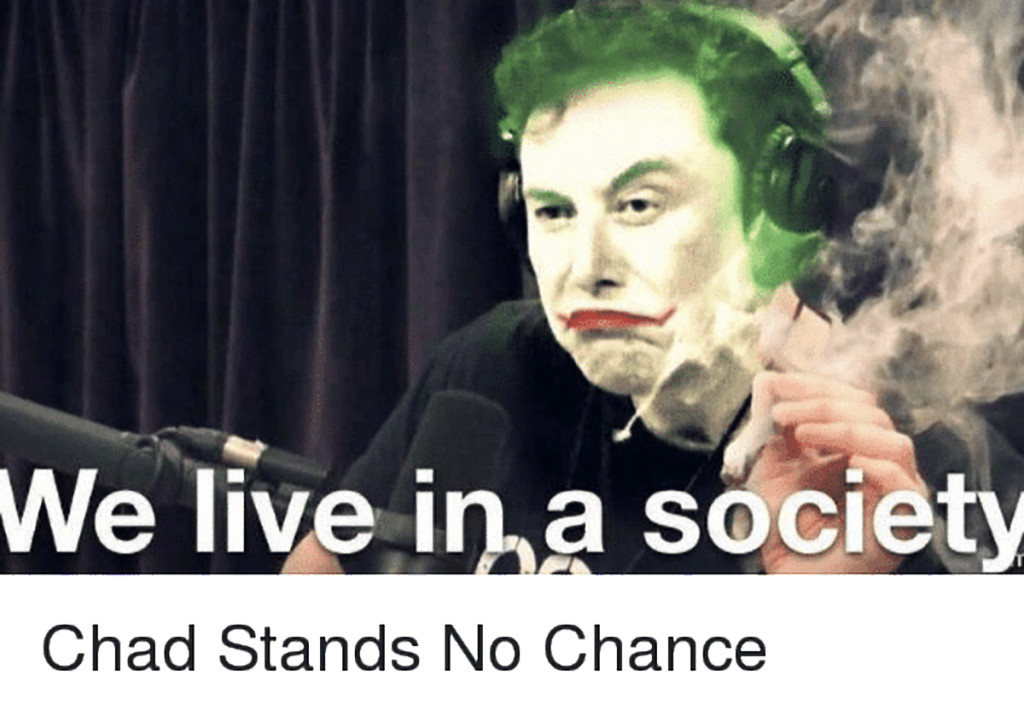
Yes, our connection with “Memes” is significant.

“If you got exceptional humor be my friend”

In a wide variety of contexts, we employ memes nowadays.
They help us connect and feel we are part of, can be the beginning of a conversation, and even assist you to manage a problem or make an observation.
Memes also allow us to relax while we surf and dwell in distressing news. They are free entertainment, a choice always even if you don’t have time to spend more time. It’s even easier to have them penetrate a large variety of specialist circles, being so great mixing cultures and touches of humor, to generate viral content.

The introduction of Meme Studies, an actual academic course on memes, at Northwestern University in the US state of Illinois in 2011 has long been cited as a barometer of the internet’s impact on society, from language to culture to beliefs.

Memes have a variety of goals and functions, but at their most basic level, they serve as a means of expressing people’s thoughts and feelings. Memes are created by appropriating sequences of words from television shows and films, which are then taken out of context, remixed with other content, and given new meanings in a humorous and relevant way. Meme content might range from whining about the difficulties of being a college student to expressing shame experienced during a daily encounter – something that everyone can relate to.

Memes, on the other hand, can have an impact on how we connect with others. Some aspects of meme culture have caused ripples in our social fields outside of the internet. After all, every meme has a creator who created it intending to spread a viral message, whether for enjoyment or to persuade others.

What exactly are memes? And how does it matter to our society?

Memes are statements that are clear, brief, and explicit, and this cultural paradigm reflects current society’s mentality – one that loves entertainment, celebrates materialism, and reinforces people’s need to stay relevant.
Memes can be used as propaganda tactics because of their accessibility and capacity to reach a large audience in minutes (and become part of the online vernacular in days), which means they can readily instill and cement opinions that fast become popular among cybernauts (a habitual user of the internet).

The working of memes that make them interestingly catchy to the readers allows them to further cultivate their humor and let them become a new mark or a strong speaker of the society. As we know memes are not only for entertainment but also imprint a deep message for society.

Memes allow people to communicate with one another. Knowing the correct memes can assist you in joining a group. They give a sensation of belonging to a group.
Memes are an excellent approach to get influence online because they are based on social media today. People can gain more followers by creating and reblogging popular memes, and these social ties can be used in both positive and negative ways.

Memes don’t merely bridge languages; their relatability fosters a sense of community among specific internet users of a certain age range. Memes are a simple and amusing way for youngsters to communicate with their pals, whether they’re used to express their opinions about certain socio-political concerns or to reinforce their fascination with famous people. Indeed, the process of spreading memes, sharing them on social media platforms, and tagging their friends within specific meme pages has improved global communication and made a significant contribution to globalization’s success.

But memes, just like many other parts of online culture, are easily misrepresented by those who aren’t familiar with them. Some people believe they are unimportant. Others believe memes are destructive and damaging to our communication, others in some sectors believe that memes, which have become the vernacular language of many a teen, have had a detrimental influence.

They suggest that memes obstruct communication in more ways than just reducing things to one-liners and visuals. They can be utilized to exacerbate hostile and discriminatory sentiments against various races, genders, religions, and sexualities, therefore expanding rather than closing the gap between people.

Memes, on the other hand, are a medium of communication that may be utilized for a variety of objectives. They can help to bring about constructive societal changes, but they can also be exploited to cause harm to others. It’s critical to establish a realistic understanding of memes’ potency as a communication medium, both today and in the future.