As more and more people invest in the stock market, dividends as a source of income gains popularity. Therefore, it is important to understand the legal framework of the process and its details in order to make a well-informed investment.
Sources of Dividend declaration
The basic principle of declaration of dividend is that it shall be paid out of profits only. However as per companies act dividend can be paid out of- 1) Current year’s profit of the company, or 2) Undistributed or accumulated profits of the previous years, or 3) Out of money provided by the Central Government or a State Government for the payment of dividend by the company in pursuance of a guarantee given by that Government.
Dividend Declaration Provisions
1) Depreciation: – Before the declaration of dividend, a company shall provide depreciation to all its depreciable assets, in accordance with the rates or useful life, as the case may be provided in Schedule – II of Companies Act -2013. 2) Transfer to Reserves:- A company may, before the declaration of any dividend in any financial year, transfer such percentage of its profits for that financial year, as it may consider appropriate to the reserves of the company. 3) Set off of previous year losses and depreciation: –A company shall not declare dividend unless carried over previous losses and depreciation not provided in previous year or years, are set off against profit of the company for the current year. 4) Free Reserves: – A company shall not declare or pay dividend out of its reserves, other than free reserves.
Conditions for declaration of dividend out of surplus reserves
As per Companies (Declaration and Payment of Dividend) Rules, 2014 a company may declare dividend out of surplus reserves subject to the fulfilment of the following conditions, namely: – 1) Rate of Dividend: – The rate of dividend declared shall not exceed the average of the rates at which dividend was declared by it in the three years immediately preceding that year. However, this condition shall not apply to a company, which has not declared any dividend in each of the three preceding financial year. 2) Total Amount to be withdrawn: – The total amount to be drawn from such accumulated profits shall not exceed one-tenth of the paid-up share capital and free reserves as appearing in the latest audited financial statement. 3) Utilization of withdrawn amount: – The amount so drawn shall first be utilized to set off the losses incurred in the financial year in which dividend is declared before any dividend in respect of equity shares is declared. 4) Balance amount of Reserves:- The balance of reserves after such withdrawal shall not fall below 15% of its paid up share capital as appearing in the latest audited financial statement.
Payment of dividend: According to section 123(5):
■ Dividends are payable in cash. Dividends that are payable to the shareholder in cash may be paid by cheque or warrant or in any electronic mode. ■ Dividend shall be payable only to the registered shareholder of the share or to his order or to his banker. ■ This subsection shall apply to the company, subject to that any dividend payable in cash may be paid by crediting the same to the account of the member, if the dividend is not claimed within 30 days from the date of declaration of the dividend. ■ Nothing in sub-section 5 of section 123, shall prohibit the capitalization of profits or reserves of a company for the purpose of issuing fully paid-up bonus shares or paying up any amount for the time being unpaid on any shares held by the members of the company.
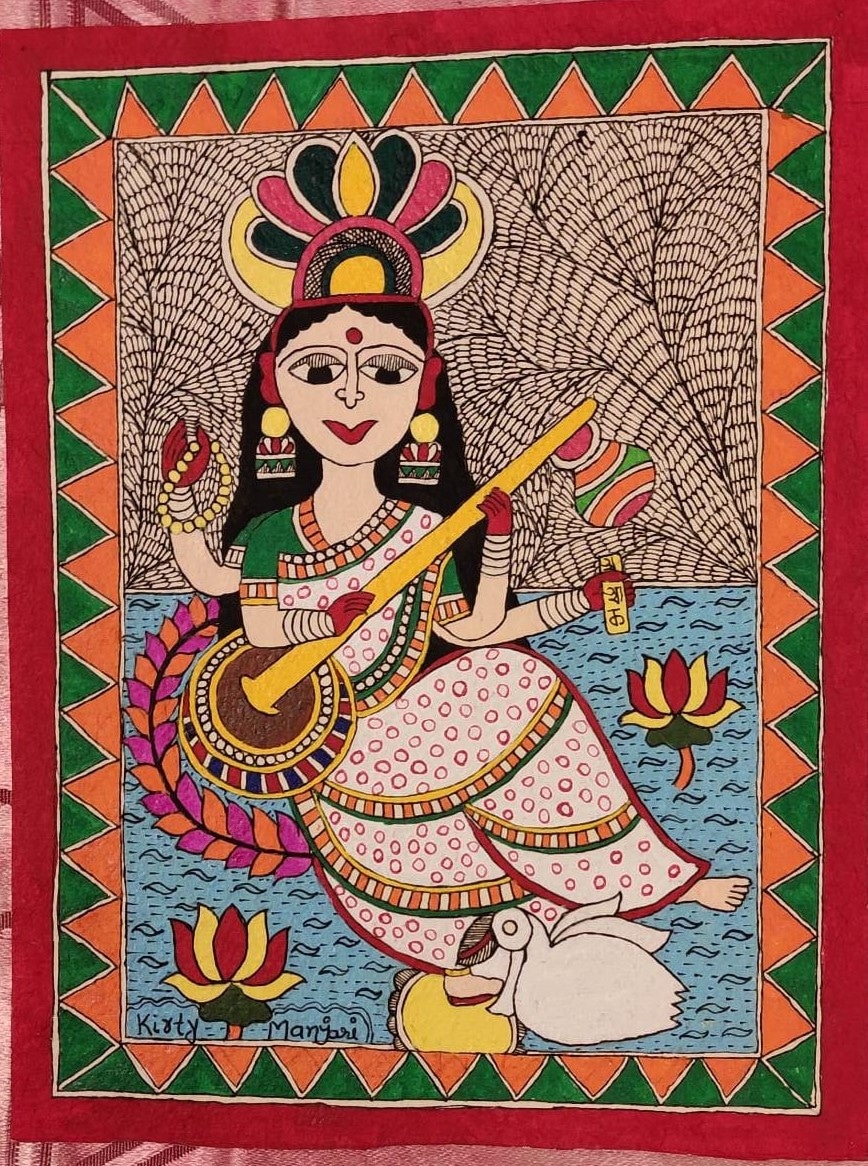
Madhubani Art (or Mithila painting) is a style of Indian painting, practiced in the Mithila region of the Indian subcontinent. This painting is done with a variety of tools, including fingers, twigs, brushes, nib-pens, and matchsticks and using natural dyes and pigments. It is characterised by its eye-catching geometrical patterns. There is ritual content for particular occasions, such as birth or marriage, and festivals, such as Holi, Surya Shasti, Kali Puja, Upanayana, and Durga Puja.
Madhubani painting (Mithila painting) was traditionally created by the women of various communities in the Mithila region of the Indian subcontinent. It originated from Madhubani district of the Mithila region of Bihar. Madhubani is also a major export center of these paintings. This painting as a form of wall art was practiced widely throughout the region; the more recent development of painting on paper and canvas mainly originated among the villages around Madhubani, and it is these latter developments that led to the term “Madhubani art” being used alongside “Mithila Painting.”
The paintings were traditionally done on freshly plastered mud walls and floors of huts, but now they are also done on cloth, handmade paper and canvas. Madhubani paintings are made from the paste of powdered rice. Madhubani painting has remained confined to a compact geographical area and the skills have been passed on through centuries, the content and the style have largely remained the same. Thus, Madhubani painting has received GI (Geographical Indication) status. Madhubani paintings use two-dimensional imagery, and the colors used are derived from plants. Ochre, Lampblack and Red are used for reddish-brown and black, respectively.
Madhubani paintings mostly depict people and their association with nature and scenes and deities from the ancient epics. Natural objects like the sun, the moon, and religious plants like tulsi are also widely painted, along with scenes from the royal court and social events like weddings. Generally, no space is left empty; the gaps are filled by paintings of flowers, animals, birds, and even geometric designs. Traditionally, painting was one of the skills that was passed down from generation to generation in the families of the Mithila Region, mainly by women. It is still practiced and kept alive in institutions spread across the Mithila region. Kalakriti in Darbhanga, Vaidehi in Madhubani, Benipatti in Madhubani district and Gram Vikas Parishad in Ranti are some of the major centres of Madhubani painting which have kept this ancient art form alive.
DIFFERENT STYLES OF MADHUBANI ART
Madhubani art has five distinctive styles:
Bharni
Katchni
Tantrik
Godna
Kohbar
In the 1960s Bharni, and Tantrik styles were mainly done by Brahman women, who are ‘upper caste’ women in India and Nepal. Their themes were mainly religious and they depicted Gods and Goddesses paintings. People of lower castes included aspects of their daily life and symbols, the story of Raja Shailesh (guard of the village) and much more, in their paintings. Nowadays Madhubani art has become a globalised art form, so there is no difference in the work on the basis of the caste system. They work in all five styles. Madhubani art has received worldwide attention.
AWARDS WON BY MADHUBANI ARTISTS
Madhubani painting received official recognition in 1969 when Sita Devi received the State award by Government of Bihar. Mamta Devi from the village Jitwarpur has also got National Award. Jagdamba Devi from Bhajparaul, Madhubani was given Padma Shri in 1975 and the National Award to Sita Devi of Jitwarpur village near Madhubani. Jagdamba Devi’s foster son Satya Narayan Lal Karn and his wife Moti Karn are also well-regarded Mithila artists, and they won the National Award jointly in 2003. Sita Devi received the Padma Shri in 1981. Sita Devi was also awarded by Bihar Ratna in 1984 and Shilp Guru in 2006. In 1984 Ganga Devi was awarded by Padma Shri. Mahasundari Devi received the Padma Shri in 2011. Baua Devi, Yamuna Devi, Shanti Devi, Chano Devi, Bindeshwari Devi, Chandrakala Devi, Shashi kala Devi, Leela Devi, Godavari Dutta, and Bharti Dayal were also given the National award. Chandrabhushan (Rasidpur), Ambika Devi (Rasidpur), Manisha Jha were also given the National award. In 2020, Madhubani artist Dulari Devi won the Padma Shri for contributions to art.
In the United Kingdom, a well-known textbook on the foundations of criminal law methodically develops numerous theoretical basis for explaining what should be a crime – that it should include some harm, must be of a particular degree of gravity, and so on. But then, in a single passage, it deconstructs this structure by reminding us that, at the end of the day, criminal law and crimes are whatever the state says they are. This political linkage is probably more pronounced in India: A majority government creates the laws and controls the investigative apparatus, which means it may not only define what constitutes a criminal but also selectively pursue just those offences that it is concerned about, forgetting the rest.
Across India, chaos reigns.
To what end should those offences be pursued, you could wonder. In the end, the concept of “crime” is meaningless without the associated penalty. We are all trained to fear losing our liberty when we are imprisoned. However, it is sometimes overlooked that this punishment may only be imposed upon a conviction at the conclusion of a trial. As a result, there is a synergy between the crime, the investigation, and the accountability of those found guilty, which is referred to as the criminal justice system. And everywhere you turn in India, it’s in chaos.
The heinous events in the Indian state of Uttar Pradesh are only one illustration of how awful things may become. After a confrontation with police, a prominent mobster fled and was subsequently apprehended in another state. Meanwhile, the news was saturated with tales suggesting the accused’s corrupt ties to public officials. An “encounter” occurred when his party was returning to Uttar Pradesh, and the accused was shot and killed.
There had been a crime, perhaps multiple crimes. It was determined to pursue it by the State Police. However, there was no need to wait for a trial to convict and sentence the guilty; punishment was immediately administered by the police. So much so that one ex-Supreme Court Judge said the State’s version of events made it look as though it didn’t care whether or not the encounter account was believed.
The extremities in Uttar Pradesh
If the death of Vikas Dubey indicated a readiness to punish without a trial, Uttar Pradesh has also shown a readiness to condemn without a trial. It enacted a legislation allowing the publication of enormous hoardings including the names and personal information of anyone accused of destroying property during the anti-Citizenship Act rallies. But here’s the thing: all of this happened before a court found them guilty of their crimes. Rather than a judicial ruling, the authority to condemn was derived from the ability to make claims, which is entirely executive in nature. In this way, the cops took on the roles of judge, jury, and executioner.
Of course, there are cases when the state has chosen to pursue alleged criminal activity. Many times, it turns a blind eye to acts of violence, either indefinitely or for a lengthy period of time. When her relatives discovered her on September 14 in the hamlet of Hathras, Uttar Pradesh, she had been viciously abused and left to die. The same family did what any reasonable person would do: they called the cops and took their daughter to the hospital. Despite the obvious injuries, the police did not file a report for many hours, and even then did not mention the major crime of rape. Naturally, when the police refused to file this one instance of rape, they quickly recorded at least 19 cases involving an alleged conspiracy to utilise the incident for political objectives in order to cast the State in a negative light.
Disconnect between the government and the judiciary.
These examples from Uttar Pradesh merely help to highlight that there are definite, obvious patterns. The first is the widening chasm between the government and the judiciary in questions of criminal justice; the second is the boosting of executive authority as a result of this chasm; and the third is the judiciary’s predictable copying of executive-mindedness. As a result, I suggest, the criminal justice system will be transformed into a problem-solving system.
The 2019 Crime in India numbers reinforce a trend that has been seen for decades: our police appear to be super-efficient, but our courts appear to be super-slow. Let’s stick with Uttar Pradesh for a while. Its police have a case pending rate of just over 15%, whereas its courts have a case pending rate of just over 90%. (for IPC crimes). Worryingly, they aren’t the worst data available. This implies that, as police departments continue to add cases to their dockets year after year, the courts’ capacity to conduct trials and make judgements is deteriorating.
The inherent time gap between the incident and any potential punishment is exacerbated, and the role of courts in the criminal justice system is diminished. This gap, among other things, undermines the significance of any conviction based on a trial, since individuals move on and life moves on in virtually all circumstances. It’s impossible to say how much this inclination is amplified in an era dominated by the 24-hour news cycle.
How can a system bridge the gap between an incidence and a final decision? By gradually legitimising the concept of penalties without repercussions or accountability. All that counts is that the situation is solved and that we move on.
The president obtains more authority in this system where judges have less authority. The arrest, not the conviction, is the turning point in the criminal justice system. At times, victims do not even consider proving anything in court; all that counts is arrest and indefinite imprisonment, or even an encounter if the charge is serious enough. At the same time, the government wants to legalise pre-trial detention and incarceration while simultaneously granting itself new powers to punish without conviction, including asset forfeiture.
The presumption of innocence.
When judges attempt to reclaim some of their lost ground by imitating the suddenly popular branch, the transition is complete. At the time of bail, courts are more than willing to examine the facts in great detail. Furthermore, by utilising jail as a negotiating weapon to push wrongly accused individuals to pay amends, judges become more ready to assist in reaching settlements during this stage. Because even courts no longer have the time for the procedure, courts deliberately replace facts established during cross-examination of a witness with her unproven charges that the police opted to pursue. So long as the problem is fixed and a victim is pleased, the assumption of innocence can be ignored.
There has been a soothing background tune playing steadily throughout this outbreak and the spiralling devastation it has caused. This is the systematic disintegration of any criminal justice system worth its name across India, and its gradual replacement with a problem-solving system in which initial accusations and their handling by the executive branch become most important, and values like presumption of innocence and establishing truth through trials have long vanished. The fact that certain states are in the forefront of this growth may be viewed cynically as another indicator of their success that makes many others envy.
Ajay Devgan’s latest film BHUJ: The pride of India trailer was released on Monday. It’s basically based on the Indo-Pakistani war of 1971. The Indo-Pakistan war is one of the most glorious moments in Indian history. The Indo-Pakistan war bears witness to the bravery and courage of the Indian army and the Indian civilians who helped them in so many ways. So, let’s take an overview of those proudest moments.
INDO-PAKISTAN WAR 1971
BRIEF OF INDO-PAKISTAN WAR of 1971:- The 1971 Indo-Pakistani war was a military confrontation between the Indian and Pakistani army during the Bangladesh Liberation War. It is one of the shortest wars in history, lasting only 13 days. During the war, the Indian and Pakistan armies clashed simultaneously in the eastern and western areas. The confrontation started when the Pakistani army launched its “CHENGIZ KHAN” operation and carried out air strikes on 11 Indian air stations.
CASUALITIES AND LOSSES:- India had lost between 2500 and 3843 soldiers and between 9851 and 12000 soldiers had been wounded during the confrontation. Naval planes, frigates and several aerodromes in West India were also damaged during the war. While up to 9,000 Pakistani soldiers were killed, 25,000 soldiers were violently wounded and 93,000 civilians, Razarks and soldiers were captured. India also destroyed the two destroyers of Pakistan, a minesweeper, a submarine, three patrol ships and seven gunboats. The main Pakistani port facilities in Karachi and various airfields were also destroyed during the clashes. A part of all these about 3 lakh to 3 crore civilians of Bangladesh was killed by Pakistani military and razarks.
RESULT OF THE WAR:- The war ended when the eastern command of the Pakistani army signed the instrument of surrender with the Indian army on 16 December 1971 in Dhaka. As a result, the eastern Pakistan was declared as an independent nation named Bangladesh. But due to the brutality of the Pakistani army and Razakars, approximately 8 to 10 million people from Bangladesh fled and became a safe haven in India.
AWARDS AND HONOURS:- The courageous Indian soldiers who fought valiantly on the battlefield were honored by the “PADAM VIR CHAKRA”. PADAM VIR CHAKRA award recipients as follows:-
Former Indian Prime Minister Indira Gandhi was also honored by the Bangladeshi government by posthumously awarding Bangladesh Swadhinata Sammanona on 25 July 2011.
Each time we read and hear the stories of the Indo-Pakistani war, it is given like a grumble. The Indo-Pakistani war is one of the proudest moments in Indian history that demonstrates to the world that we are no less than anyone else. I hope you all feel equally proud reading this blog as I feel about writing and researching about it. Finally greet all the soldiers that protect us without blinking. Have a good day and Happy Reading.
[If there are some mistake and misinformation in the blog so sorry about it and tell us to comment. All the information is taken from trusted sources. Thank you]
Rainwater is a life-giving resource, and without it, there’d be no life on earth. Its primary purpose is to give us water to drink. During a downpour, rain seeps into the ground to become part of rivers and lakes, or what is called ground water.
Rainwater harvesting is a technique of collection and storage of rainwater into natural reservoirs or tanks, or the infiltration of surface water into subsurface aquifers (before it is lost as surface runoff). One method of rainwater harvesting is rooftop harvesting. With rooftop harvesting, almost any surface – tiles,metal sheets,plastics – can be used to intercept the flow of rainwater and provide a household with water, conveniently accessible and available year – round.
General publications
There is a large and growing body of research and documentation on domestic Rainwater Harvesting (DRWH). Here we provide an overview of some introductory readings:
– Rainwater Harvesting Handbook (African Development Bank)
-Rainwater Harvesting in the Homestead (Peter Morgan)
Importance of Rainwater Harvesting
The importance of rainwater harvesting lies in fact that it can be stored for future use. Just as it can be used directly so also the stored water can be utilized to revitalize the ground level water and improve its quality. This also helps to raise the level of ground water which then can be easily accessible.
The theory of narco-terrorism stems from the realization that the two phenomena of drugs trafficking, and terrorism are inextricably linked, and that, as a result, a coordinated anti-drug and anti-terror policy can and must be employed to effectively combat both threats. Because of its nefarious partnership with terrorist groups, narcotic trafficking, which began as an organized cross-border crime, has now evolved into a menace to nation states.
Although it has been known for decades that there is a relationship between the drugs trade and terrorist organizations, as suggested by the name narco-terrorism, the international focus on terrorism after September 11, 2001, has intensified the attention given to the issue of narco-terrorism.
The Golden Crescent is the world’s greatest illegal opium production. In 1999, Afghanistan and Pakistan alone accounted for over 6000 metric tonnes of total illegal output. Because of this high-level production, narco-terrorism is increasingly linked to the reigns of central and southeast Asia. India being the southern part of Asia is concerned because these narcotics are a key source of money for Pakistani-sponsored terrorism in our nation. Also, India is the sole licit provider of opium to the international pharmaceutical sector, with an annual export income of roughly Rupees 209 crores in 1999. The economy of the Pak-Afghan border is based on poppy and cannabis cultivation. The drug money is being smuggled into the Indian money market in an unorganized but methodical way because of which financial institutions suffer.
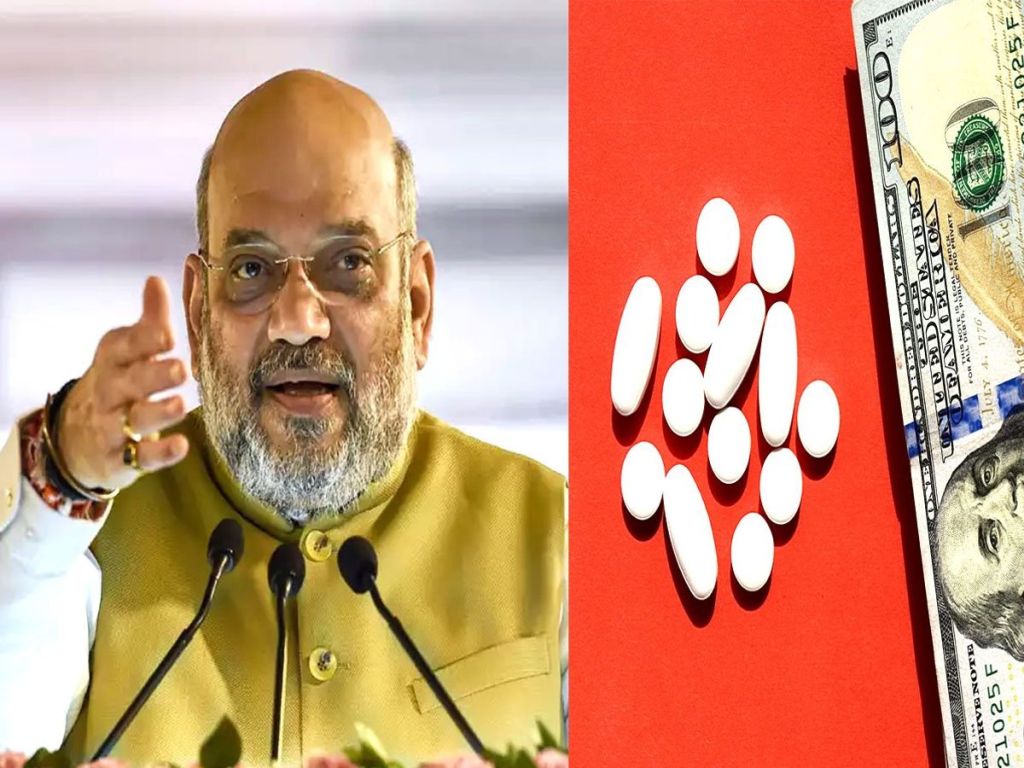
Because of illicit drug trafficking from Afghanistan and Pakistan poses a threat to India’s polity and economy. This issue requires serious attention from policymakers and law enforcement organizations before it is too late to intervene. Similar contention was also made by India’s home minister, Amit shah. He recently visited the National Forensic Sciences University (NFSU) in Gandhinagar to unveil the Centre of Excellence for Research and Analysis of Narcotic Drugs and Psychotropic Substances, which was established during Prime Minister Narendra Modi’s term as Chief Minister of the State of Gujrat. There he announced that India now faces the threat of narco-terror because of the rise of narcotics where drug traffickers and peddlers use drug money to promote their unlawful and disruptive operations. So to tackle this ongoing issue the Government has determined that narcotics would not be let into the nation, and that India will not be used as a transit point. He also mentioned that It is critical to put an end to this threat.
Talking about the inauguration he said that this Centre was chosen to be connected to Gujarat’s Forensic Science University when the government was constituted for the second time under Prime Minister Narendra Modi because to appreciate the university’s outstanding services, the union government had designated it as a national center of excellence. He further added that the administration emphasized the need of using scientific techniques to conduct faster and more effective criminal investigations. Therefore, Forensic science will play a significant part in this. He also commended the forensic science institution for its contributions to criminal investigations into cyber and drug-related crimes.
The theory of narco-terrorism stems from the realization that the two phenomena of drugs trafficking, and terrorism are inextricably linked, and that, as a result, a coordinated anti-drug and anti-terror policy can and must be employed to effectively combat both threats. Because of its nefarious partnership with terrorist groups, narcotic trafficking, which began as an organized cross-border crime, has now evolved into a menace to nation states.
Although it has been known for decades that there is a relationship between the drugs trade and terrorist organizations, as suggested by the name narco-terrorism, the international focus on terrorism after September 11, 2001, has intensified the attention given to the issue of narco-terrorism.
The Golden Crescent is the world’s greatest illegal opium production. In 1999, Afghanistan and Pakistan alone accounted for over 6000 metric tonnes of total illegal output. Because of this high-level production, narco-terrorism is increasingly linked to the reigns of central and southeast Asia. India being the southern part of Asia is concerned because these narcotics are a key source of money for Pakistani-sponsored terrorism in our nation. Also, India is the sole licit provider of opium to the international pharmaceutical sector, with an annual export income of roughly Rupees 209 crores in 1999. The economy of the Pak-Afghan border is based on poppy and cannabis cultivation. The drug money is being smuggled into the Indian money market in an unorganized but methodical way because of which financial institutions suffer.
Because of illicit drug trafficking from Afghanistan and Pakistan poses a threat to India’s polity and economy. This issue requires serious attention from policymakers and law enforcement organizations before it is too late to intervene. Similar contention was also made by India’s home minister, Amit shah. He recently visited the National Forensic Sciences University (NFSU) in Gandhinagar to unveil the Centre of Excellence for Research and Analysis of Narcotic Drugs and Psychotropic Substances, which was established during Prime Minister Narendra Modi’s term as Chief Minister of the State of Gujrat. There he announced that India now faces the threat of narco-terror because of the rise of narcotics where drug traffickers and peddlers use drug money to promote their unlawful and disruptive operations. So to tackle this ongoing issue the Government has determined that narcotics would not be let into the nation, and that India will not be used as a transit point. He also mentioned that It is critical to put an end to this threat.
Talking about the inauguration he said that this Centre was chosen to be connected to Gujarat’s Forensic Science University when the government was constituted for the second time under Prime Minister Narendra Modi because to appreciate the university’s outstanding services, the union government had designated it as a national center of excellence. He further added that the administration emphasized the need of using scientific techniques to conduct faster and more effective criminal investigations. Therefore, Forensic science will play a significant part in this. He also commended the forensic science institution for its contributions to criminal investigations into cyber and drug-related crimes.
Individualism stresses individual goals and the rights of the individual person. Collectivism focuses on group goals, what is best for the collective group, and personal relationships.
An individualist is motivated by personal rewards and benefits. Individualist people set personal goals and objectives based on self. Individualistic workers are very comfortable working alone and not part of a team.
The collectivist is motivated by group goals. Collectivistic people easily sacrifice individual benefit to recognize and strive for the team’s success. They believe maintaining social harmony, getting along with others, and meeting social expectations that have been set up by society over centuries.
In simple words, people from individualist cultures consider themselves as separate from others while people from collectivist cultures consider themselves connected to others.
In general, European and Western nations tend to be individualists while Asian and African typically collectivists.
This classification is common in education systems too. Taking an example, in USA schools and colleges you will almost never find group projects or assignments given to the students. Almost all of it will be individual work. But if we see in countries like India, most student assignments are group work based.
One big misconception is that individualism means a person is introverted and collectivism means a person is extroverted. This is in fact, wrong. A person from an individualist society can be extroverted and a person from a collectivist society can be introverted. This is because the two things are in no way related. While introverts enjoy being alone or with a small group of friends, an individualist person is self-reliant in doing their work. This individualist can do their assigned work all by themselves and then socialize with lots of people.
Everyone falls somewhere on the individualist-collectivist spectrum. Even within a very collectivist culture, you will find people who are more individualist. Research has shown that people shift along this spectrum, leaning more collectivist or individualist depending on the situation. This is most common in countries and societies that don’t limit themselves to one form of culture and are open to both and practice the two on different occasions.
Recently, to find the answer to the most important question of the hour, “Why did COVID-19 hit some countries harder than others?”, a research was conducted. They found that the more individualistic a country was, the more COVID-19 cases and mortalities it had. They also found out that the more individualistic people were, the higher the chances they would not cooperate to take COVID prevention measures. Therefore, we can see here that although both cultures have its pros and cons, when it comes to the current circumstances that our world is in, it is important that we think of ourselves as part of society and prevent taking any personal action that could possibly harm others.
Antioxidants are substances that prevent cell damage due to free radicals. It delays the oxidation rate.
Antioxidants help to maintain weight and proper vision. Supports immune system and improves mental health.
Free radicals cause chronic diseases like cancer, heart diseases, aging diseases. If free radicals are not efficiently removed, body does not function well.
Chewing tobacco, smoking, pollution, stress and radiation are some of the factors that excessively produce free radicals.
Antioxidants include well known enzymes and substances like Vitamin C, Vitamin E that counter damaging effects of oxidation.
Antioxidants can be natural or artificial. Food products like vegetable oils and prepared foods contain antioxidants to avoid reduction from the action of air. Fruits and vegetables have Vitamin C and E that are known to be effective antioxidants.
Foods Rich in Antioxidants –
Vegetables
Vegetables like broccoli, carrot, beetroot, avocados, radish, potatoes are all high in antioxidants. These vegetables have Vitamin C and E.
Green, leafy vegetables have excellent number of antioxidants. Green, leafy vegetables have more antioxidants compared to other vegetables.
Artichokes recommended to be included in a diet as it has nutrients and antioxidants for a good heart and liver. It is seen that boiling artichokes produces good antioxidant levels.
Red cabbage contains Vitamin C, A and K. It prevents cancer, helps reduce inflammation and maintains weight.
Fruits
Guava, mangoes, peaches, oranges, papaya, figs are all packed with vitamins. These fruits are highly recommended as they are rich in antioxidants.
Berries are well known for foods with vitamins and minerals. Usually, berries are consumed through bakery goods or salads. Raspberries and strawberries are both healthy foods for regulating high cholesterol levels.
Another health benefit of raspberry is that it is highly effective in case of breast cancer.
Nuts
Nuts are also known to have a lot of nutritional value. Nuts like macadamia, almond, cashews, hazelnuts should be part of your diet. You can start your morning with oatmeal and cereals to give your breakfast a healthy twist.
Pecans have high level of antioxidants and minerals. Eating pecans on a daily basis reduces risk of high cholesterol and increases blood levels.
Herbs and spices
Paprika, coriander, onions, ginger, garlic, cinnamon, cardamom are recommended for healthy diet.
Herbs like oregano, basil, tarragon contribute a punch of flavor to the meal and also have high antioxidant.
Dry Fruits
Dry fruits are quick and healthy snack. Can be carried easily anywhere you go. They are said to be rich in antioxidants as much as fruits. Raisins, plums, peaches can have added sugars so such dried fruits with added sugar should be avoided as it results in weight gain and high sugar levels. You should add dry fruits to your everyday meal.
Dark Chocolate
Chocolate is loved by children and adults. So, while eating chocolate make sure you eat dark chocolate, because it has impressive amount of antioxidant. It helps to reduce the risk of heart diseases and is beneficial for people with high blood pressure. High blood pressure is commonly found among people these days. The chances of high blood pressure can be decreased by consuming dark chocolate. It promotes good cholesterol in the body.
For a healthy body, one should include these foods that have high health benefits. Antioxidants are required by a body to reduce risks of potential chronic diseases and subsidize production of free radicals. All these foods are good source of antioxidants.
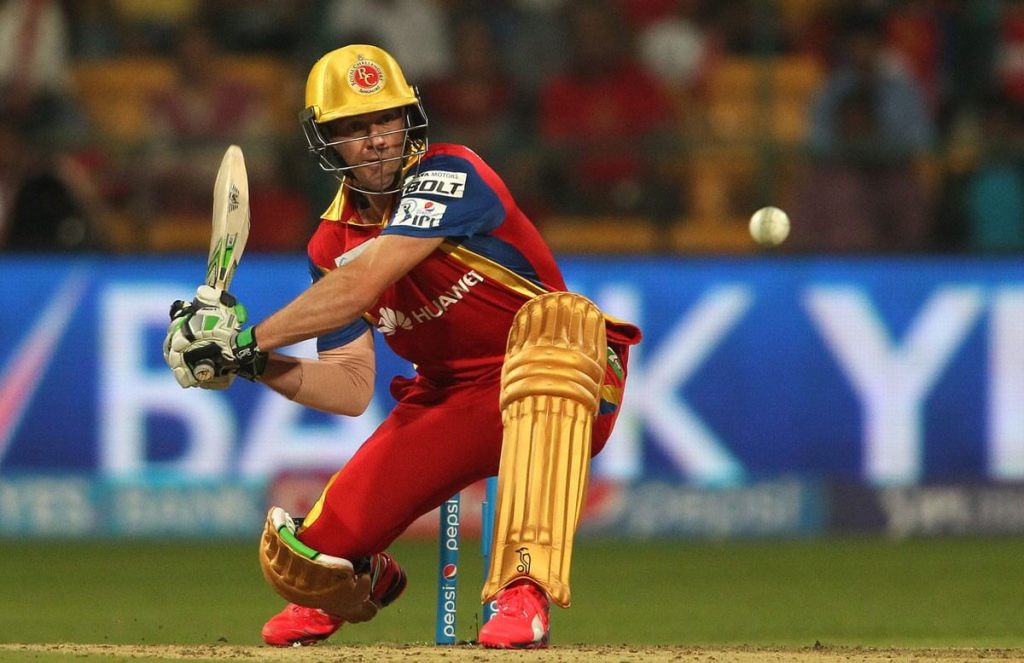
Very few people who have played this game can match the genius of AB De Villiers. He is a modern master of this game and has innumerable records to his name. Usually known for his 360 degree shots which got him the name Mr.360, he can tear any bowling attack apart when he is in a flow. His presence alone is enough to strike fear in the hearts of opponents. Born on 17th of February 1984 in a small town in South Africa, he is known all over the world as an ambassador for unorthodox shots. There isn’t any shot that he cannot play.
International Career
Having represented his country, South Africa for 14 years, he has won many matches for them and chased victory from the jaws of defeat. A clean striker of the ball, he has played various sports while growing up but decided to take up cricket. Result, 20,000+ runs 40+ centuries and countless breathtaking feats which mere mortals cannot achieve. He along with Hashim Amla, Faf duplessis and Quinton Dekock form a world class batting order which is almost impenetrable.
However, the tour that shot him to fame was the Australia tour in 2012 where he played a match saving knock along with the debutant Faf Duplessis. In the very next match, he scored a match winning hundred and won the test series. He ended his career with 8000+ runs in test at an average of over 50 and including 22 hundreds. He has an ordinary record in tests but has an unbelievable record in ODIs. Scoring over 9000 runs at an average of 53 and a strike rate of 101 is not an ordinary feat.
He has 25 hundreds to his name, all of which have been scored over a strike rate of 100. He holds the record for the fastest 50,100 and 150 in ODIs, all of which have been scored against West Indies. He also has impressive records against all the teams he played. Though his T20I record is not impressive, he managed to score 1600+ runs at a strike rate of 130 with 11 50s. His wide range of shots and his consistency has got him a chance to play various T20 leagues across the globe.
IPLthrough years
Getting a chance to play in the inaugural edition of the IPL through Delhi Daredevils, he hasn’t played an impressive part in his first season. However with the tournament being shifted to South Africa in the next edition, he got a chance to play all the matches and has scored over 400 runs including a hundred on Chennai Super Kings. He was in and out of the team frequently in the third edition and eventually was released from the squad.
The Bangalore based franchise, RCB bought him as a lower order batsman and he continued to impress them by chipping valuable runs down the order. Later, his promotion up the order worked wonders for the team. He along with the King, Virat Kohli won many matches on their own. On field, he is a live wire. His acrobatic fielding, agility and the way he strikes the ball has earned him a nickname of “Superman”. Even after retirement from international cricket, he is continuing to enthrall the spectators wherever he plays.
DNA stands for Deoxyribonucleic acid. Ever since this technology has paved its way it started revolutionizing each and every possible field from the food medicines research and a lot more. Every single individual has different genetic sequence and thus different DNA which is the reason why this technology is used. The advent of DNA technology proved to be very beneficial in the field of forensic science not only for providing criminal justice , determining the parent of the child but also finding a missing person or even identifying the dead remains of a person . Day in and day out we see innumerable catastrophic accidents happening over the globe but when it happens it is usually not possible to determine the person because their condition might have so deteriorated that all that would have left of them are ashes.
NEED
When these accidents happen it is the sole right of the family of the victim to get its body for a proper funeral but without DNA technology it would not have been possible . Not only this it is very difficult to find a missing person which can be resolved with the help of DNA technology by with the help of DNA profile of the missing persons family.
Research
We all have heard of 9/11 one of the darkest day so far that ripped off the humanity from the roots. Just a few days after that National Institute of Justice formed a panel making recommendations on forensic technologies, policies, and procedures to help identify thousands of victims who suffered death at the hands of the terrorists in the World Trade Center. Identification of victims were made by comparing their remains DNA with the samples present in their personal belongings or by with their biological family. These remains could be collected over 10 months to get the DNA sequence. More than one fourth of the case were able to be identified in this manner. US FBI formed CODIS (Combined DNA Index System) in which they contained DNA profile of missing persons relative to find him. This technology was used in India in 1992 to find the remains of the victims who suffered death in Rajiv Gandhi Assassination. NIJ also formed model legislature for proper utilization of this technology in any catastrophe .
Significance
DNA technology played an important role in the field of forensic mostly in finding remains of a person . More the decayed remains of an individual more is the role of DNA technology. Although this technology requires a lot of funding and the body parts which are in good condition can be identified using cheaper sources such as dental examination Xray etc but when it comes to fragments of body they are no match to DNA technology.
Mental health is a major concern worldwide and India is not far behind in sharing this. If we evaluate developments in the field of mental health, the pace appears to be slow. Dr. Brock Chisholm, the first Director-General of the World Health Organization (WHO), in 1954, had presciently declared that “without mental health there can be no true physical health.” More than 60 years later, the scenario has not altered substantially. About 14% of the global burden of disease is attributed to neuropsychiatric disorders. The burden of mental disorders is likely to have been underestimated because of inadequate appreciation of the inter-play between mental illness and other health disorders. There remain considerable issues of priority-setting based on the burden of health problems and of addressing inequalities in relation to determinants and solutions for health problems.
Progress in mental health service delivery has been slow in most low- and middle-income countries. Barriers include the existing public-health priorities and its influence on funding; challenges to delivery of mental health care in primary-care settings; the low numbers of those trained in mental health care; and the lack of mental health perspective in public-health leadership. There have been numerous calls for invoking political will, for enhancing advocacy and for galvanizing community participation; all with scant improvement in outcomes.
Thus, it becomes now opportune to explore the paradigm of mental health awareness as a means of combating stigma, enhancing prevention, ensuring early recognition, and also stimulating simple and practical interventions within the community. Today there are opportunities in terms of growing acknowledgement of mental disorders as key targets of global health action, as well as of leveraging new technologies particularly internet, big data and cell phones in amplifying simple field interventions found successful in primary care and other echelons.
Mental health awareness campaigns have yielded positive outcomes. Some of the strategies undertaken to target awareness and address stigma around mental illness include participation by family members, sensitization to treatment and social inclusion. Lack of knowledge about the mental illnesses poses a challenge to the mental health care delivery system. Research has highlighted the role of community-based systems in low-income countries and has also yielded positive results in creating awareness, thereby impacting participation.
Awareness and health literacy are two sides of the same coin. Stigma and discrimination are negative consequences of ignorance and misinformation. There are a few studies which have measured mental health literacy in the Indian context. One study found mental health literacy among adolescents to be very low, i.e. depression was identified by 29.04% and schizophrenia/psychosis was recognized only by 1.31%. Stigma was noted to be present in help-seeking.
These findings reinforce the need to increase awareness of mental health. Mental health literacy is a related concept which is increasingly seen as an important measure of the awareness and knowledge of mental health disorders. Health literacy has been described as “ability to access, understand, and use the information to promote and maintain good health.” Mental health literacy encompasses recognition, causes, self-help, facilitation of professional intervention, and navigating the information highway. Attitudes which hinder recognition and appropriate help-seeking can be counter-acted by information which is already readily available in the public domain. There are plenty of examples of awareness positively impacting mental health outcomes like the Norwegian campaign to reduce the duration of untreated psychosis.
Over the years, Amul, one of the most beloved brands of our country, has become the taste of India, just as its tagline claims. Every Indian millennial has grown up listening to the jingles of its many dairy products, and the Amul girl, the brand’s mascot in the polka-dotted dress, has become a nostalgia-evoking symbol. Amul has truly come a long way since its founding in 1946.
The beginning
Amul was formed as a part of a cooperative movement against Polson Dairy in Anand, Gujarat, which procured milk from local farmers of Kaira District at very low rates and sold it to the then Bombay government. Everyone except the farmers benefited from this trade. The farmers took their plea to Sardar Patel, who had advocated farmers’ cooperatives since 1942. The result was the formation of the Kaira District Co-operative Milk Producers’ Union Limited in Anand.
The union started pasteurising milk produced by a handful of farmers for the Bombay Milk Scheme and grew to 432 farmers by the end of 1948. The rapid growth led to problems including excess production that the Bombay Milk Scheme couldn’t accommodate. To solve this issue, a plant was set up to process all that extra milk into products such as milk powder and butter.
Amul is born
The late Dr. Verghese Kurien, rightly called the Milkman of India, was Amul’s true architect. His journey at Amul began in 1949 when he arrived in Anand to manage a dairy as a government employee. He went from helping farmers repair machinery to revolutionising India’s dairy industry with the White Revolution (or Operation Flood), the largest dairy development programme in the world.
The new dairy with the milk processing plant was ready for operation in October 1955, the year that also saw a breakthrough in dairy technology —buffalo milk was processed to make products for the first time in the world. The word ‘Amul’, derived from ‘Amulya’, which means ‘precious’ or ‘priceless’ in Sanskrit, was used to market the range of milk products developed by the Kaira Union. It is also an acronym for Anand Milk Union Ltd.
Dr Kurien had a vision. He wanted to offer small-scale dairy farmers quality-control units and centralised marketing, which were missing at the time in the dairy economy. Thus, the Gujarat Cooperative Milk Marketing Federation (GCMMF) was created in 1973 to market milk and all milk products produced by six district cooperative unions in Gujarat. GCMMF is the largest exporter of dairy products in India and Amul is the umbrella for all of its products.
Awards, accolades, and a global presence
Over the years, Amul, together with GCMMF, has won numerous awards. Some of these include the Rajiv Gandhi National Quality Award, 1999; the Golden Trophy for Outstanding Export Performance, 2009-10; Best Marketing Campaign, 2014; and World Dairy Innovation Award, among many others. Amul earned recognition all over the world when GCMMF introduced it on the Global Dairy Trade (GDT) platform, where only the six top dairy players across the world sell their products.
More than a mere slogan
Amul’s famous slogan, which is now a part of its logo, was created in 1994 by Shri Kanon Krishna of a Mumbai-based advertising agency called Advertising and Sales Promotion (ASP). According to Amul, the Taste of India slogan is more than just corporate positioning or advertising jargon. This slogan lends meaning to the brand’s never-ending commitment to taking quality food and products to the rural man, which he otherwise couldn’t have afforded.
The Butter Girl
Amul did not always have the round-eyed moppet as its mascot. The Butter Girl was born in 1966 when Sylvester daCunha, the then MD of the advertising agency handling Amul butter’s account, created her for its campaign. It was a pleasant change from the dull, corporate ads that the previous agency had come up with. Being a seasoned marketer himself, Dr Kurien gave daCunha complete creative freedom to create and release the ads without taking the company’s permission. 30 years later, the Utterly Butterly Girl still wins hearts wherever she is, whether on a billboard or on the packet of butter.
Amul is not just a brand; it is also a movement that represents farmers’ economic freedom. The name is now a household term that is here to stay, and the chubby-cheeked Amul girl will continue to cast a spell on the public.
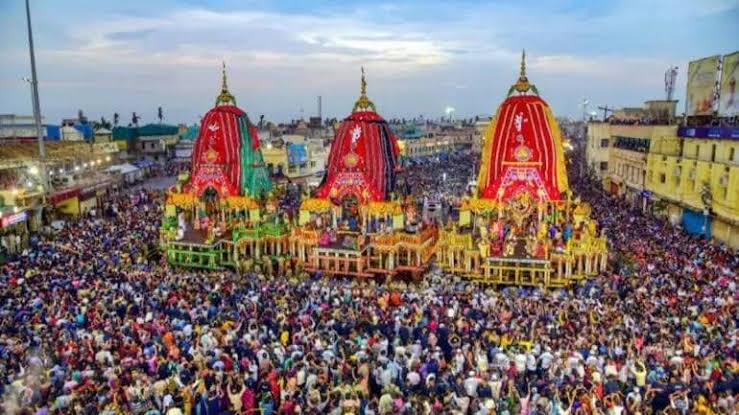
Rath Yatra or more commonly known as Jagnnath Rath Yatra is a Holy festival of Hindus celebrated every year in the Puri district of Odisha in India. Every year lakhs of tourists from India as well as from different parts of the world visit Puri to celebrate this festival. This Rath Yatra is considered as the oldest Rath Yatra not only in India but all over the world. This Rath Yatra is dedicated to the deities – Lord Jagannath, Lord Balbhadra and Lordess Subhadra.
Lakhs of Devotees attend Jagnnath Rath Yatra every year.
DESCRIPTION OF THE FESTIVAL :-
This festival is celebrated annually on Ashadha Shukla Paksha Dwitiya i.e., on the second day of the bright fortnight of Ashadha month according to the Hindu calender. The deities of the Jagnnath temple, Puri main temple – Jagannath, Lord Balbhadra and Lordess Subhadra are placed on their chariots from their respective positions in the temple. These chariots are built and decorated every year. The devotees of Jagnnath built these chariots.
Chariots (Raths) used in Jagnnath Rath Yatra.
The Rath Yatra starts from Jagnnath Temple and the first destination of it is Gundicha Temple named after King Indradyuman’s Queen. The chariot of Lord Jagnnath (named Nandighosa) waits for a while to pay tribute to Bhakta Salabega at his crematorium which is situated on the way of Rath Yatra.
This place has a story related to saving of Jagnnath Temple from the revenge of Ocean by the grace of Shri Kabir Saheb Ji. He had promised to Kaal that he will be going to save the Jagnnath Temple from the Ocean at any cost and he eventually succeeded in his efforts and saved the Jagnnath Temple.
Suna Besha is the ceremony organized after the chariots of all the deities return back to the main temple after staying for about a week at the Gundicha Temple. In this ceremony, they are worshiped on the chariot and attired in gold ornaments. This ceremony started way back in 1460 by the King Kapilendra Deb when he returned victorious from the war and donate gold to the Jagnnath Temple.
Lord Jagannatha returns to his main abode just before Devshayani Ekadashi and after the completion of Suna Besha, Lord Jagannatha goes to sleep for four months.
Many people believe that being physically healthy is a sign of good health, but do they even consider their mental health? Today I am going to discuss this particular topic called “Mental health of a human being”.
Today youngsters and even old people are very particular about their physical health. They join gyms, participate in various cardio activities to make themselves physically fit but what about their mental health? How people would understand whether they are mentally fit or not? And if they know, then how will they overcome it? Today in this era of competition in everything, being in studies or fashion or anything else, everyone is running a race and is trying to outshine each other. Because of this, they have forgotten that their mind should also be taken care of like anything else.
Anxiety and depression have now became a common issue for every individual. Some people try to hide their anxiety by talking too much or by remaining extremely quiet.
Have you ever wondered, everybody, talks about an illness like cancer, heart attack, migraine, etc very freely but when it comes to mental health, they often hide from everyone and consider it a shameful thing? No one openly talks about their mental illness because somewhere they think that it is shameful to share it with anyone. Even, if he/she talks about it openly then they get very little support and is stabbed by their friends in tougher times, which makes them weaker and lonely even when surrounded by a crowd. Nowadays there are some who understand this problem and openly help such victims. Else, earlier they used to tag that person insane and didn’t look after them.
But I want to convey to such people to come out, express yourself whatever you are feeling, either share it on your social media or talk with your loved ones, there are definitely people who will help you to overcome it. This is not something to be ashamed of, it is also a part of your health. Never feel low because of love failure, study stress or family problems, etc.
You are not alone in this. Your loved ones are standing behind you to support you.
And in the end, I would like to convey my message to those who take mental health for granted that please don’t judge people in any way. You have no idea about what a person is going through. So, LIVE AND LET LIVE.
The origin of biriyani in India is uncertain. Many theories are put forward in the origin of Biriyani in our country. The delicacy is considered as a food pride of our country. According to historian LizzieCollingham, the modern biryani developed in the royal kitchens of the Mughal Empire (1526–1857) and is a mix of the native spicy rice dishes of India and the Persian pilaf.Indian restaurateur Kris Dhillon believes that the dish originated in Persia, and was brought to India by the Mughals. Pratibha Karan the author of the book “Biriyani” says that it is derived from a South origin dish called pilaf . She speculates that the pulao was an army dish in medieval India. Armies would prepare a one-pot dish of rice with whichever meat was available. Over time, the dish became biryani due to different methods of cooking, with the distinction between “pulao” and “biryani” being arbitrary.
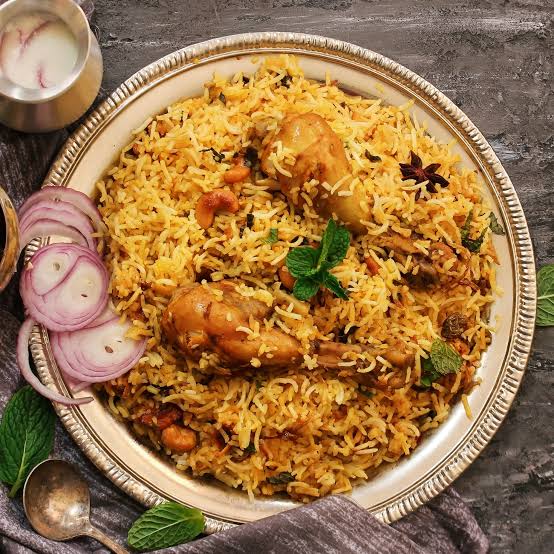
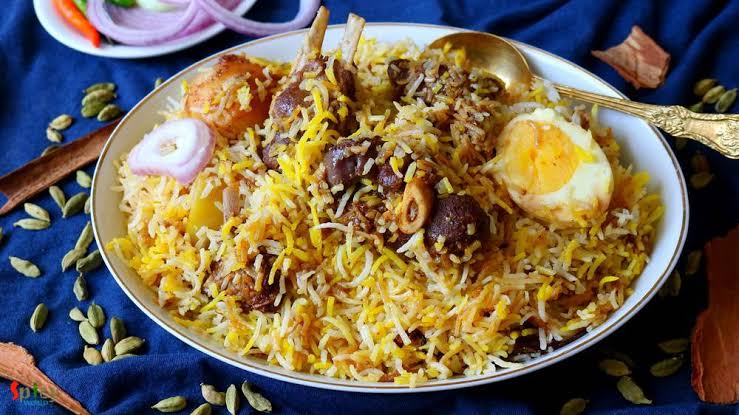
Biriyani ❤️
INGREDIENTS
The spices and condiments used in biryani may include ghee (clarified butter), nutmeg, mace,pepper, cloves, cardamom, cinnamon, bay leaves, coriander, mint leaves, ginger, onions, tomatoes, green chilies, and garlic. The premium varieties include saffron.
The main ingredient that usually accompanies the spices is chicken or goat meat; special varieties might use beef or seafood instead. The dish may be served with dahi chutney or raita, korma, curry, a sour dish of aubergine (brinjal), boiled egg, and salad.
The taste of India
VARIETIES OF BIRIYANI
There are many types of biryani, whose names are often based on their region of origin. For example, Sindhi biryani developed in the Sindh region of what is now Pakistan, and Hyderabadi biryani developed in the city of Hyderabad in South India.
Some have taken the name of the shop that sells it, for example: Haji Biriyani, Haji Nanna Biriyani in Old Dhaka, Fakhruddin Biriyani in Dhaka, Students biryani in Karachi, Lucky biryani in Bandra, Mumbai and Baghdadi biryani in Colaba, Mumbai. Biryanis are often specific to the Muslim communities where they originate; they are usually the defining dishes of those communities.
KOLKATA BIRIYANI
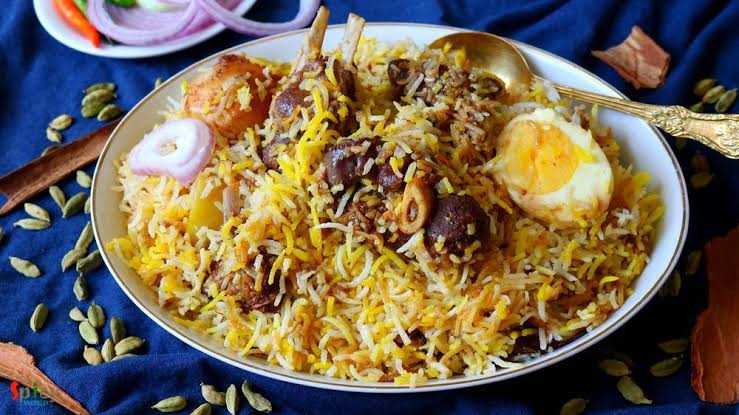
Calcutta or Kolkata biryani evolved from the Lucknow style, when Awadh’s last Nawab Wajid Ali Shah was exiled in 1856 to the Kolkata suburb of Metiabruz. Shah brought his personal chef with him. The Kolkata biriyani is characterized by the unique presence of potato in it, along with meat. It is said that the Nawab, having is lost his kingdom, could not afford meat, so his chefs tried to compensate by adding potato.
Kolkata biriyani
Biriyani is a dish which brings pride to our food culture
      Anuj Das













 Eduindex


You must be logged in to post a comment.