EduPub (Edupedia Publications Pvt Ltd) is a company dedicated to the development of the education, learning, research and innovation in the field of the research and books publication. We are pioneer in providing wide range of services to educational institutions, government agencies, individuals and corporates in the field of training and education, research and development, research and innovation. research and publication.
The pupfish, also known as the rarest fish in the world, are a group of killifish with striking coloration. They are mostly found in the extreme and isolated environment. These rare species of fish lives in a single pool in the Mojave Desert. They went almost extinct with their only canyon pool being pumped.
The description of Pupfish
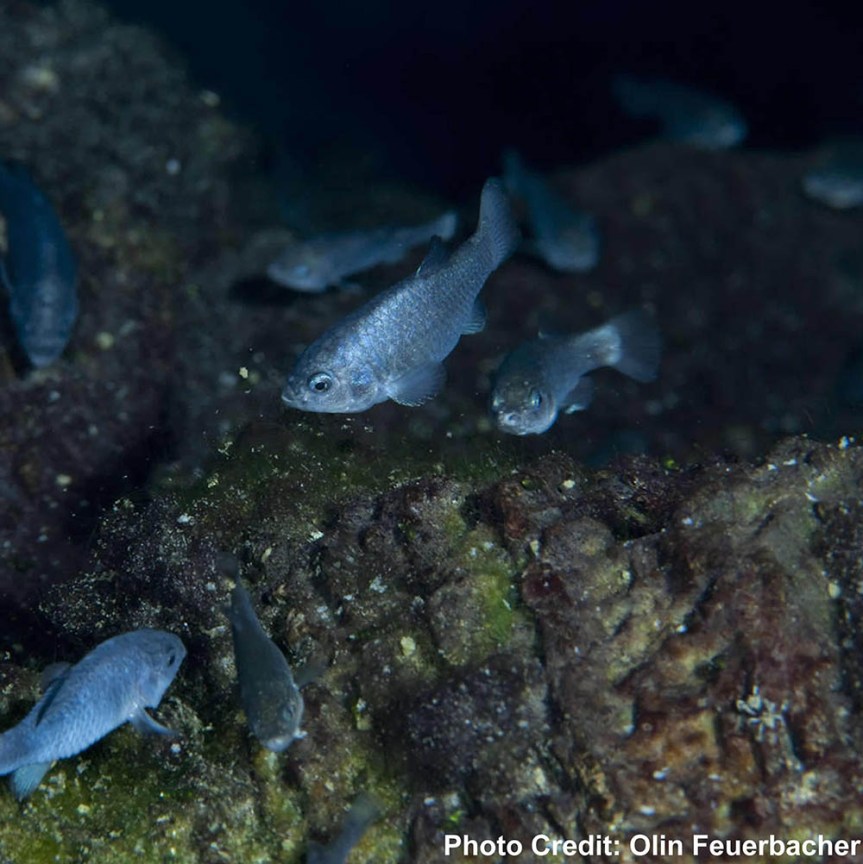
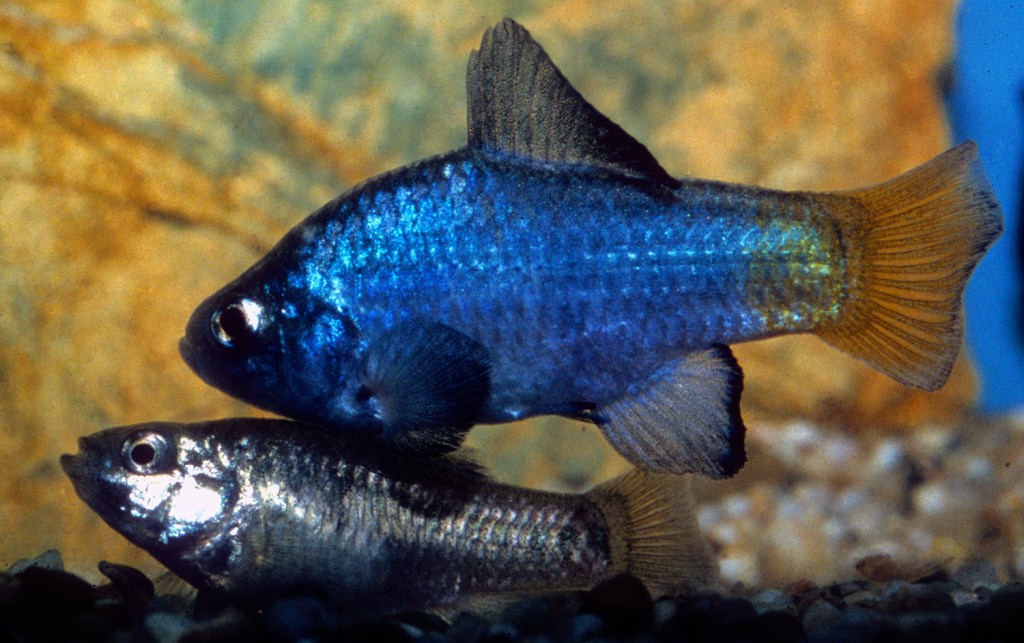
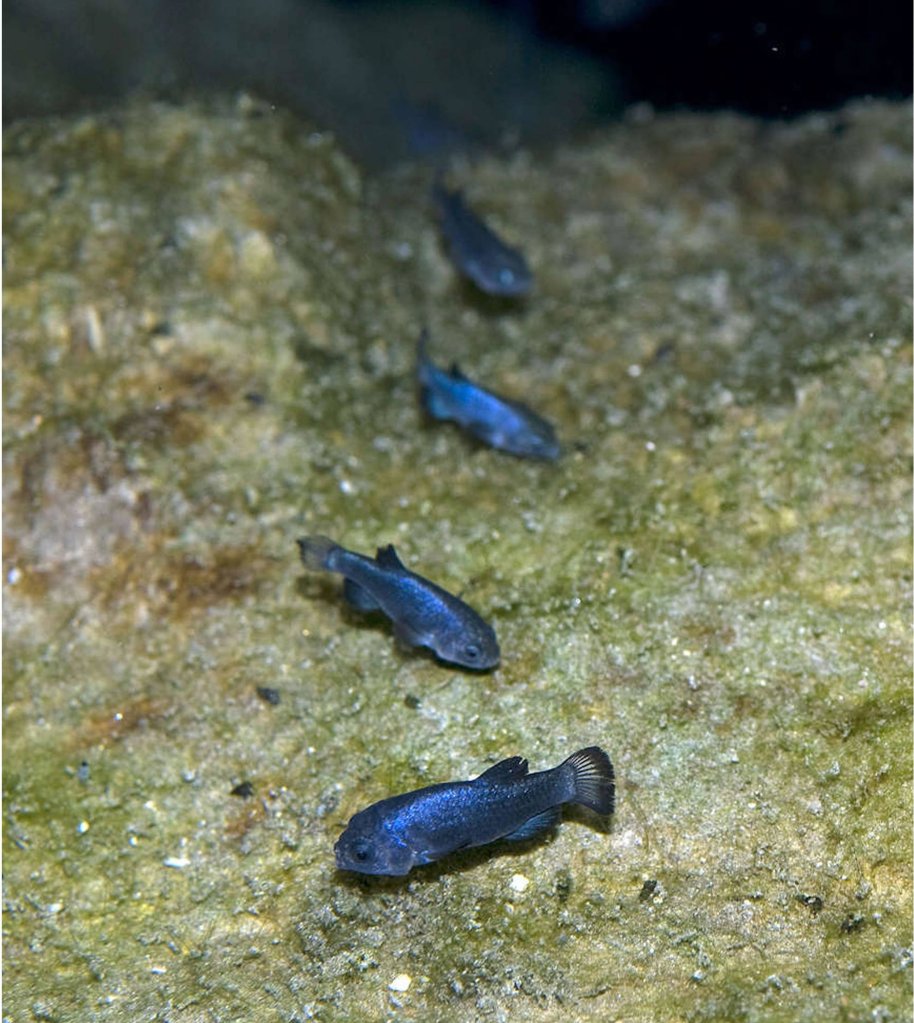
Pupfish are small, colorful, knuckle-sized and ray-finned fishes. The most famous amongst them are the Devil’s Hole pupfish. The Devil’s Hole pupfish are bright blue with purple accents whereas, the white sands pupfish has yellow and orange fins. Most of the pupfish are very tiny, some even less than an inch in length.
The diet of these pupfish includes variety of things, consisting of algae, plants, aquatic invertebrates and some insects.
About the devils hole pupfish
The fascinating and playful pupfish with bright, silvery-blue and lustrous body are found in an oasis within the Death Valley called as- The Devils Hole. These mighty goldfish-like fishes survive in the 92 degrees water of the Devil’s Hole. They withstand harsh conditions that would kill most other fish. Another fact about this fish is that it acts as an indicator of seismic activity around the globe.
The Death Valley as the name sounds is a land of the most extreme conditions. You can expect a scorching heat of 110 F to 120 F +. Even though this land experiences droughts and record summer heat, in the winters the peaks of the mountains are snow-laden. This land welcomes rainstorms rarely. Lush oases harbor tiny fishes and refuge for wildlife and humans. The name might sound very morbid but it is home to a great diversity of life.
What threatened their existence?
In the late 1960’s and early 1970’s, groundwater was pumped out extensively for the agricultural purposes. This activity led to a major downfall of the water level in Devil’s Hole. These invasions were a threat to the very existence of this fascinating species.
So, a group of academics, government employees and private citizens met in 1969 to speak about the protections needed for the fauna in Devil’s Hole.
The desert pupfish has been classified as endangered by IUCN. Due to the pumping of the aquifer since 1960’s, the fish never recovered. Later, it was decided that a back-up population was needed. A replica was created where one part of the population resides in the fake canyon, and the other in the natural canyon.
How many Devils Hole pupfish are left in 2020?
The observable population of the Devil’s Hole pupfish has reached 136. In the years 2006, 2007, and 2013 their population was less than 40. In the 1970s, 1980s, and 1990s, scientists counted near about 200 Devils Hole pupfish. And in the late 1990s there was startling decline in their numbers.
“Despite these extremes, Devils Hole pupfish continue to display their resiliency that have allowed them to survive for thousands of years”, said Brandon Senger, Supervising Fisheries Biologist for the Nevada Department of Wildlife (NDOW).
Language is undoubtedly the most valuable single possession of the human race. Man is clearly distinguished from other species by his capacity for using language. The term language is derived from the Latin word lingua meaning tongue.
Language is our most effective means of communication .We communicate with others through speech and writing .Communication is more effective when we speak .We can make use of variations in voice ,gesture other features to reinforce what we say .Writing does not offer such conveniences. Again ,speech has been with us ever since human beings evolved as a distinct species. But writing claim to have a history of hardly six thousand years . Moreover speech comes first in life of individuals too. Hence historians of language consider speech as primary and writing as secondary. Considering these facts Wardaugh defines language as system of arbitrary vocal symbols used for human communication .
Language helps man in several ways .It helps him to reach back into the collective knowledge of his ancestors. No one can ignore the role of language in placing humanity at the pinnacle of progress. Without language man would never have become fully human. Language is quite necessary for the continuity of civilization . It is mainly through language that human beings collect and preserve knowledge and transfer it to the next generation . It is not possible to imagine a society without language. Man’s social behavior is conditioned by the nature of his communication with fellow beings . That is why Barnett says ,”verbal communication is a condition of the existence of human society.”
It is true that animals too communicate .Some animals ,birds and insects have developed their own systems of communication .But their communicative systems are instinctively determined . They lack the flexibility and creativity of human language. Their communicative conventions are acquired genetically and not through learning.
The American linguist ,Charles F Hockett ,in a detailed study compared human communicative system with animal communicative system with animal communicative system with animal communicative systems. The aim of the study was to find out the essential defining characteristics of spoken language . He tried to determine what ‘counts’ as a human language as opposed to some other systems of communication . He identified thirteen characteristics of spoken language which he termed design features .They are , Auditory -vocal channel ,Broadcast transmission and directional reception, rapid fading , interchangeability total feedback, specialization ,semanticity , arbitrariness ,discreteness ,displacement ,productivity, traditional transmission and duality of patterning .
1. Security is a crucial foundation of the Internet while the major challenge for the Industrial Revolution 4.0. As time goes the trend of Industrial Revolution 4.0 inflates from millions of devices to billions. As increasing the number of connected devices, the chance to exploit safety vulnerabilities is also increasing, in cheap or low standard designed devices, due to incomplete data streams, the chances of data theft is increased by which people’s health and safety can be risky. Many IoT arrangements will also include collections of similar or adjacent similar devices. This homogeneity expands the potential impact of any single security weakness by the total number of devices that all have the same features.
2. As Authenticity, trustworthiness and confidentiality are important aspects there are some other requirements also important like discriminatory access to certain facilities, preclude them from sharing with other things at certain Times and business communications involving smart objects would need to be secure from opponents’.The data networks are still delicate and also costly in comparison to other developed countries. From an Indian perspective, the cloud storage operation is still in the emerging stage. Transmit the data to a cloud service for processing, sometimes includes a third party. The gathering of this information leaks legal and regulatory challenges facing data protection and privacy law. To realize the opportunities of the Industrial Revolution 4.0, some new strategies will be required for privacy choices through a broad range of expectations, while still developing innovation in new technologies and services.
3. Absence of standards and documents can assist Senseless activities by devices. Low standard or cheap designed and configured devices have undesirable consequences for the networking resources. Without standards to guide developers and manufacturers, sometimes design products that operate in disruptive ways on the Internet. When any technology has a standard development process then it can be easily available everywhere and can be used by all applicants and increase the growth also. While in today’s world, global standards are followed by every local station.
4. Implementation of every technology requires a team of skilled persons who have ample knowledge of network, hardware, software and about that technology. And India is developing at this point where manpower thinks when technology is spread, they lose their job and there is no life of new technology. So, they don’t take any initiative to learn about it. So, every organization face lots of problem during their changeover phase from the legacy systems to IoT enabled systems. Similarly, Scalability, Fault tolerance and Power supply are also big challenges in India.
5. Advanced technologies require advanced mechanisms which require more amount of money. As India is a developing country, it is not possible to invest on a large scale in Industrial Revolution 4.0. As a result of failed fueled ‘money’, India is not able to cope with Industrial Revolution 4.0.
6. Another major problem with a developing country like India is the fuel needed to run. While the population is on a way steady rise, demand is quite increasing. India produced 557 million tons (metric tons) of coal in 2012-13, and India’s rapidly growing power industry consumed the majority of it. Coal production has steadily increased since the industry was nationalized in the 1970s. A trend almost certain to accelerate as the country faces growing urbanization and an expanding middle class, India has a high dependence on imports for its petroleum needs and is the world’s fourth-largest importer of crude oil.
7. The percentage of illiteracy in India is alarming. Every five persons among ten in India are illiterate. The condition in villages is worse than in cities. Though several primary schools have been set up in rural India, the problem persists. Also, providing education just to children won’t solve the problem of illiteracy, as many adults in India are also untouched by education. The education system of India is blamed now and then for being too theoretical but not practical and skill based. Students study to score marks, not to gain knowledge. This so-called modern education system was introduced by the colonial masters to create servants who could serve but not lead, and we still have the same education system. Rabindranath Tagore had written many articles offering suggestions to change the education system of India. But still, success is as elusive as ever.
One of the most famous experiments in physics is the double slit experiment. It demonstrates, with unparalleled strangeness, that little particles of matter have something of a wave about them, and suggests that the very act of observing a particle has a dramatic effect on its behaviour.
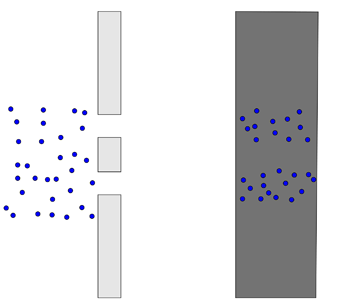
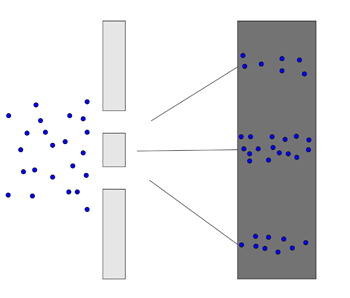
To start off, imagine a wall with two slits in it. Imagine throwing tennis balls at the wall. Some will bounce off the wall, but some will travel through the slits. If there’s another wall behind the first, the tennis balls that have travelled through the slits will hit it. If you mark all the spots where a ball has hit the second wall, what do you expect to see? That’s right. Two strips of marks roughly the same shape as the slits.
In the image below, the first wall is shown from the top, and the second wall is shown from the front.
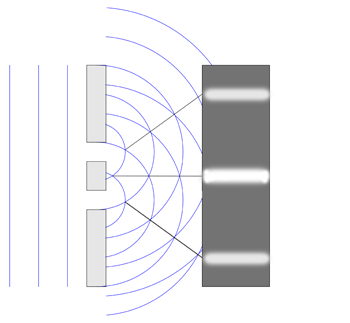
Now imagine shining a light (of a single colour, that is, of a single wavelength) at a wall with two slits (where the distance between the slits is roughly the same as the light’s wavelength). In the image below, we show the light wave and the wall from the top. The blue lines represent the peaks of the wave. As the wave passes though both slits, it essentially splits into two new waves, each spreading out from one of the slits. These two waves then interfere with each other. At some points, where a peak meets a trough, they will cancel each other out. And at others, where peak meets peak (that’s where the blue curves cross in the diagram), they will reinforce each other. Places where the waves reinforce each other give the brightest light. When the light meets a second wall placed behind the first, you will see a stripy pattern, called an interference pattern. The bright stripes come from the waves reinforcing each other.
Here is a picture of a real interference pattern. There are more stripes because the picture captures more detail than our diagram.
Now let’s go into the quantum realm. Imagine firing electrons at our wall with the two slits, but block one of those slits off for the moment. You’ll find that some of the electrons will pass through the open slit and strike the second wall just as tennis balls would: the spots they arrive at form a strip roughly the same shape as the slit.
Now open the second slit. You’d expect two rectangular strips on the second wall, as with the tennis balls, but what you actually see is very different: the spots where electrons hit build up to replicate the interference pattern from a wave.
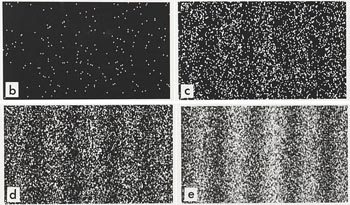
Here is an image of a real double slit experiment with electrons. The individual pictures show the pattern you get on the second wall as more and more electrons are fired. The result is a stripy interference pattern.
What does the experiment tell us? It suggests that what we call “particles”, such as electrons, somehow combine characteristics of particles and characteristics of waves. That’s the famous wave particle duality of quantum mechanics.
Have you ever wondered how you contributed to sabotaging the environment? If not it’s high time to dig deeper into the treasure, which is a greener Earth. You know what I’m speaking about. Yes, it’s about the fashion industry and the need for sustainable fashion. The fashion industry is one of the top industrial sectors in the world, with a value of 3 trillion dollars and produces 2% of the global GDP according to global fashion industry statistics. Accordingly, 1 in 6 people work in fashion or related industry Furthermore moving closer, the Indian fashion and apparel industry produces 1586 dollars in GDP per capita and enabled 45 million recruitments within the country. It is presently the second-largest employer within the country. Hence proving to be one of the top industries carrying out Apparel manufacturing process involving Product Design, Fabric Selection and Inspection, Patternmaking, Grading, Marking, Spreading, Cutting, Bundling, Sewing, Pressing or Folding, Finishing and Detailing, Dyeing and Washing, QC etc. 100 billion items of clothing are produced annually.
Adding onto the positives, there are many drawbacks to the very fortunate industry. It had been and is still on the top list of the contaminating industries in the world. Say, the textile industry is the second largest pollutant in the economy. The facts that had been put into due negligence till now is being brought to the limelight by Brands and fashion enthusiasts.
Blights of the fast fashion
1.Savagery towards animals
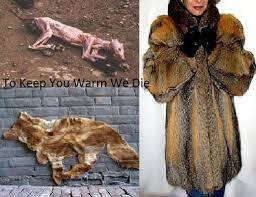
It is not a new fact to us that animals are manipulated to produce clothes or apparel items that seems to be a top trend. Most items produced from fur, leather, wool, feathers are obtained from the mass pestering of innocent animals. Sumanthran tigers and American alligators in the endangered category were still poached for cloth production.
2. Unfair wages and working conditions
As to the latest protests and struggles to achieve a full-fledged fashion revolution, we see the campaigns with people holding placards written ‘who made my clothes’ and ‘i made your clothes’. It wasn’t any happy day speech, they are the behind the scene labour workers under hardships produce all the commodities as to the recent demands. We often tend to forget them blindsided by the white-collar workers.it had been brought to the mainframe that blue-collar workers of Bangladesh, India, China, Indonesia, Vietnam, etc had minimal protection towards worker’s rights. Under prevailing pandemic conditions, these marginal workers were reported losing jobs, being underpaid, cancelled from orders or being not even adequately paid in which they suffered meeting even the food demands of their family. On the other hand, it has become a custom to exploit farmers to the company and middle-men needs.
3. Customer attitude
The next crucial factor towards non-circular fashion is the growing needs of customers for top quality, yet cheap and mind-blowing colourful garments. consumers are well aware of the upcoming trends and glams of the industry, leading to the fast adoption of these newbies. Speaking of which is a necessary evil. It is brought to the view that one in every three young women restricts herself from wearing a cloth multiple times. As to its blitzscaling, fashion companies are compelled to showcase more attire than the actual need.
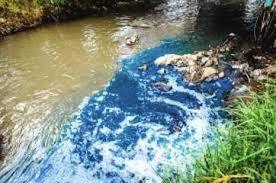
We have come to the major part of the discussion on fast fashion. It is every living being’s responsibility to safeguard the natural resources and pass on the same to the forthcoming generations. Water consumption of the textile industry had met its way beyond the danger zone. It takes 2720 litres of water to manufacture one cotton shirt and 7000 litres to make a pair of jeans. The pollution made to the water bodies doesn’t end there, the chemicals used for the mass production of the garments are disposed of directly or indirectly to the same. It is estimated that one-third of microplastics prolonging in the oceans is the impact of synthetic textiles. These are more deadly as the tiny they are, wouldn’t pass through the filters. The Aral sea, renowned as the world’s fourth-largest lake, has almost dried up as a result of the nearby cotton cultivation. The Kitex industry was recently accused of dumping excessive waste into the nearby waterbody.
5. Excessive carbon emissions
It is said to be true that the fashion industry is responsible for 8-10% of the total greenhouse gas emissions in the atmosphere. The major cause of this is the extensive use of synthetic fabrics like polyester, nylon and acrylic, spandex, faux fur, rayon, etc. Polyester ranks top on the intake of crude oil compared to all others by 70 million barrels annually. Transportation is the other means of carbon ejaculation contributed by the global distribution strategies.
6. Textile waste
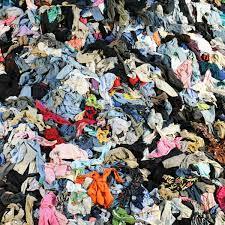
It is said that one garbage truck of textile waste is disposed of every second. This breathtaking fact does prove the intensity of the issue we are dealing with. This directly points out the rising rage for unsustainable fashion culture. For example, polyester is made from the polymerization of petroleum-derived ethylene glycol and purified terephthalic acid, which meltdown to produce polyethylene terephthalate (PET). As such many synthetic fibres are either termed plastic or made out of non-renewable substitutes that concern the ecology.
How can changes be made? How would fashion statements or the industry as a whole regain its fortune? Is the zero-waste fashion possible? Would buyers change their outlook on fashion?
It is time to join hands on the fashion revolutions put forth by fashion creators and promoters on ideas like sustainability, circular economy, zero waste fashion and so on. The idea of the fashion economy sabotaging ecology is given a better view as a result in modern days. Brands now are looking into logical practices to ensure sustainability and restrain themselves from misfortune. Let’s get to know the efforts taken by the industry dignitaries to achieve a stable eco-friendly fashion culture.
Overhaul to fad fashion
1. Sustainable brands
Brands that prove accountable to safeguard bionomics, sacrificing the trend sets should be promoted. Brands those prioritise natural fibres, work with local artisans and so on to gain environmental, economic and social well being. These companies tend to visualise customers as creatives. For example Reff jeans and Girlfriend collective
2. Circular fashion
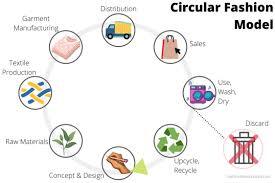
‘Circular fashion’ can be defined as clothes, shoes or accessories that are designed, sourced, produced and provided with the intention to be used and circulate responsibly and effectively in society for as long as possible in their most valuable form, and hereafter return safely to the biosphere when no longer of human use. (Anna Brismar, Green Strategy, 2017). This is the basic idea of the longevity of any garment cycle.
“The circular economy refers to an industrial economy that is restorative by intention; aims to rely on renewable energy; minimize, tracks and eliminates the use of toxic chemicals; and eradicates waste through careful design.” (Ellen MacArthur Foundation)
3. Zero waste fashion
It is the concept of reducing the waste produced with the garment during its life cycle. Furthermore, it is divided into two categories, pre-consumer zero-waste fashion and post-consumer zero-waste fashion. Pre-consumer zero-waste fashion is a holistic approach towards the removal of waste during the manufacture of garments. post-consumer zero waste fashion, on the other hand, is the approach towards post-consumer garments, what more the garment could be used for.
4. Natural dyeing
These are the ancestral dyeing methods using degradable and natural materials like plant sources like roots, fruits, etc. yet the wide-ranging possibilities of this are still in doubt. Whereas a bit of sacrifice towards betterment wouldn’t hurt.
5. Mutating customer attitude
Nowadays customers are more aware of the rising issues on the planet and do agree to take responsive mutation to the outbreaking situations. Social media has had a great influence in making this change possible. When buying an outfit, consumers should ask themselves questions like how is this made, is it a need, how long it would stand, and what to do after. Renting and swapping is too given better focus
6. Personal style
Rather than buying all the so-called latest trends, customers should be aware of their personal style. Personal style does mean the unique way you dress, determining what suits you well, colours favouring, vulgar eliminating, defining yourself and gives you much confidence.
7. Recycling commodities
Brands have come up with the idea of accepting their old products in store. Moreover, specific recycling methods are being conducted and succeeded to a certain level that includes unbinding the fibres to yarns and reforming them to new ones so the focus centralises virgin fibres. As of now, only 13% of clothing and footwear is recycled but in the near future, this is to be a big number. And take care the brands don’t blindside you with mere greenwashing recycling programs.
8. Aquatic treatment
Brands now maintain a ‘water budget’ to not exceed the water demands. It is also noted that natural fibres take in less water for manufacture. There are more ethical ways to dye clothes without the use of water is a plus. Whereas to solve the issue of microplastics, using guppy friend washing bags and installing Girlfriend Collectives microfibre filters in laundry machines is recommended.
9. Ban on poaching
This year London fashion week has been announced prohibiting animal fur due to the rising concerns and brands like Burberry, Gucci and Versace guaranteed to go fur-free. At the same time, Adidas and G-Star RAW introduced apparel produced of ocean plastic. Companies now are developing materials that substitute animal-based leather to the ones made with grape and orange skins which are more laboratory-made.
10. Reducing carbon outrush
The profound carbon emissions are put to a stop by altering synthetic fabrics made of crude oil to natural ones like peach palm fabrics. Transportation caused pollution could be eliminated by procuring and sourcing local resources and employing local artisans.
11. Neat and intact employment
Sustainability couldn’t be possible without fair wages, constant job opportunities with regular and stable working hours. Meanwhile, farmers and blue collars should ensure a safe environment with right protecting laws and policies from the government. So that they could be self honoured with at least meeting the daily living standards which every person of the democracy should enjoy.
12. Minimalism
This isn’t a very pleasing method compared to others on the list. Yet leading a simplistic life could make a big change. Demand is directly proportional to supply. So when demand decreases supply decreases and so will production. Less production leads to the concentration of ones being produced and existing ones, this is where the difference would be visible.
Organ Trafficking is a illegal crime of transporting,harbouring of living persons or deceased persons or their organs by means of abduction ,fraud that makes the abuse of power of a professionals position.Human Trafficking holds a critical place with transactional organized crime groups due to demand of organs at low rates of law enforcement.Organ Trafficking is considered to be dark form of illicit that causes destruction to the medical norms.Global Financial Integrity(GFI) estimates that 10 % of all the organtransplants includes lungs,Hearts and Liver.
According to the sources this illicit invloves a huge groups ,the donors of the organs are mostly targeted to be the orphans. This crime is a planned act which is against law and medical norms.The orphans are easy for this illicit as they have no identity to recognise from their legit.so this loophole is made as business by many Traffickers for operating from various locations.Desperate patients in need of Organ may fall as a prey for the Traffickers who could praise a high Ransom for the organ matching .The Medical reforms involved in this illicit are involves many skilled professional doctors,medicos etc.This professionals perform various Opeartions ,surgeries are a part of Financial exploitation creating multilevel equation of crime.
It is Extremely difficult to know exactly how much Transplantations Laundering generates annually WorldWide But it is estimated that the Illegal trade Conservatively generates around $800 millions to $1.7 Billions annually according to GFI,it is difficult for both law enforcement agents and anti-money Laundering(AML)professionals to detect related Financial activity.This is due to the bulk Groups involving in the crime and Transparency nature of the crime.The main scapegoats made for this illicits are the medical captives includes hospitals and the drug pharmacies.The pharamaceuticals required for the Transplantations are also acquried from various sources from several agencies.
Todays Digital world made easy menthod of transfers through various websites,agencies and medical tourisms that offer transplant services with transparency.Method of payments such as email money transfer,bulk and cash withdrawl,credit card Payments to agencies.
Some Economists generally claim and lean for arguments for organ legalization is the one way to overcome this Red market illicit.Although Governments have Imposed and Implemented initiatives with legal definitions to increase Organ donation through public awareness Campaigns,consent laws.Legalizing payments for organs would encourage more people to donate organs.criminal Middlemen often take large sums of money cut for the payment of the organ leaving a little money left for the donor,this had to be avoided to reduce harm for the donors.After the donors often do not receive any medical followup because they are afraid that their role in crime will be discovered.considering all the facts there is still a quest for this question whether this” Red market Crime can be Exposed or not?”.
Major considerations for this question also have a claim thought of making Organ Transplantation as a Legal Model.One of this model include Free market Model system to Combat the organ shortage that helps to drive the illegal Trade.Although it doesn’t still attain a clear attention as advocates counter these claims by saying that death or murder for financial gain already happens.The main motto to expose this crimes is to protect and prohibit medical professionals and drug Pharmacies from performing such illicit organ transplantations all over the world.
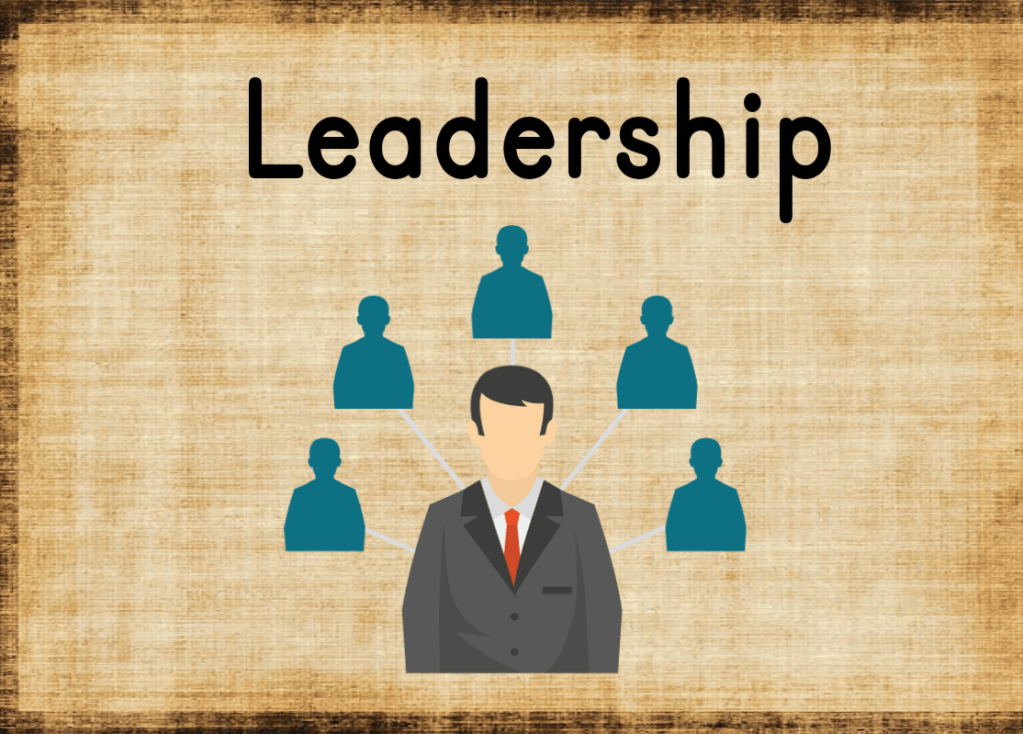
Leadership is the ability to motivate a group to focus on a particular goal to achieve it. In an organisation, managers have a right to do managerial task and not all managers have ability to lead effectively. Leader is an important person he can manage tasks as well as influence or motivate other members to achieve the goal.
Importance of Leadership
Commencement of work: Leader initiates or starts the work by explaining plans and regulations to subordinates who all are working together in a team.
Counselling: It is the duty of leader not to only supervise his subordinates but also counsel and guide them about their work, so that they can perform their work effectively and efficiently.
Motivation: Leader also plays a role of motivator. He motivates his subordinates by giving then opportunities and rewards based on their performance.
Developing confidence: It is important for every employee to be confident about their work, and leader is the person who can boost their confidence by encouraging them.
Coordination: For achieving any organisational goal, coordination is very important amongst employees and leader can maintain synchronisation through effective coordination.
Establish work environment: In every organisation it is important to maintain effective work environment. Employees are human resource for any organisation, it is necessary that leader should have personal contact with every subordinate and listen their concerns.
Qualities of leaders
A leader has special or unique trait which distinguish them from others. There are various qualities in a leader which enhances his work ability and which effectively motivates other to work hard.
Neutral: Leader should be neutral towards every individual. He should not be bias on any basis towards his subordinates, rather be logical and make fair decision.
Physical Characteristics: Physical appearance is important for every leader. Physique and health are necessary for leader so that subordinates can focus on what he wants to convey.
Communication ability: Good leader must have this quality because communication is the way to explain what he wants from his subordinates. With good communication skills leader can explain the policies and procedure to subordinates easily.
Responsible: Leader must be responsible towards his authority then only he can maximize his skills and capabilities in performing his role. Before motivating others he should himself feel motivated and give his best in performing each task.
Intelligence: Leader must be intelligent along with responsible then only he can find out solution for every problem faced by a team and he can analyze the advantages and disadvantages of a situation arise in an organization.
Leadership Styles
Leadership style is a way or attribute in which leader works in a group with other group member or perform in a team. There are various leadership styles which prevail in an organization:
Authoritarian Leadership
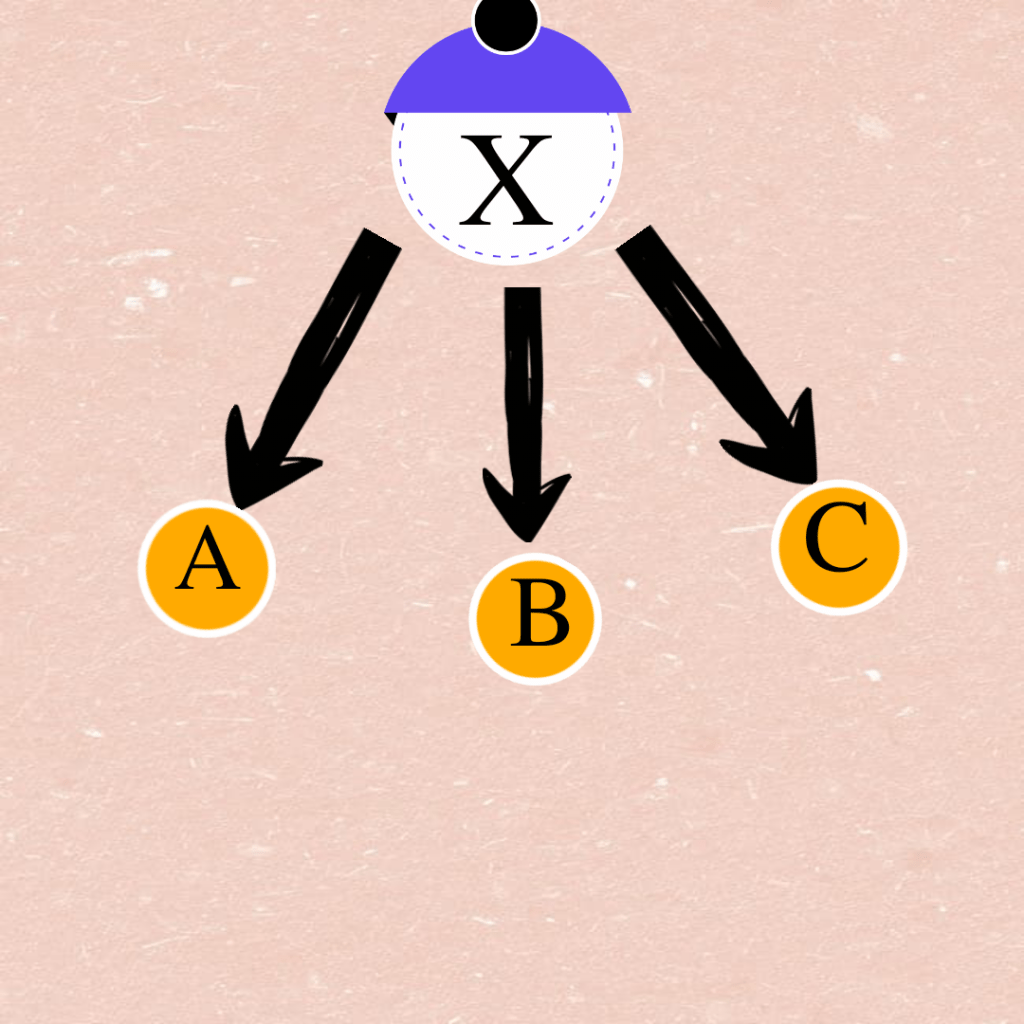
In this type of leadership, autocratic leader have full authority and responsibility of the work. He gives instructions and explains duties to his subordinates without consulting with them. He holds the power and has authority of decision making. This style of leadership has negative effect as leader himself takes all decisions, and doesn’t concern for his subordinates opinion. In autocratic leadership, less time is consumed in taking action because here leader is the one person who decides, give orders and employees do work accordingly. But somewhere, it have a negative impact on employees because may be they feel that their opinions and suggestions are of no use. Basically, in this type of leadership there is no delegation of authority by leader.
Autocratic Leadership
2. Democratic Leadership
In this type of leadership, leader includes every individual in decision making process or any policy formulation. He consults with his subordinate before taking any decision and let them influence his decision sometimes as per the requirements of management. He decentralise his authority by doing so. Leader himself forces his subordinates to give their input or ideas which will be beneficial for the management. It also helps in boosting morale or motivating employees, they feel that their participation is also important in decision-making process.
Democratic Leadership
3. Free-rein Leadership
This style of leadership is different from above two style of leadership in many ways. Here, leader delegate his responsibility to subordinates for decision making and he himself doesn’t intervene. He gives no order or direction to his subordinates and permits the group to work as per their opinion or ideas. He wants that each individual gives his best and take all efforts to achieve the set goals.
Social Media the world in which almost everybody is living ,you can hardly heard someone saying “I don’t use social media” . This is the keychain that connects us with the world , with its fastest growing usage it has started getting into other field other than just being a communication service provider , people had started using it for their business growth , big companies had started using social media as a tool to connect with their customers and provide their services directly to them it has converted into Marketing media , this extra usage has given rise to the post of “Social Media Manager”.
Who is a Social Media Manager?
Manager are those who manage certain thing for some specific purpose , so Social Media Manager is the one who manages the social media handles of various Companies , Business, NGO , Non-profit organization . With the world going digital every other person need their space in the social media for their business growth . All the business , companies , organization need to be active on social media , to expand their work , to connect with their target audience for which they hire a social media manager to handle their social media platforms.
What does Social Media Manager DO?
The work of Social Media Manager involve working on different social media platforms, managing the social media handle in an effective way to bring the best out of it , posting , creating content ,communicating with the audience , updating about new features , managing the websites , making strategies to expand the business online , creating traffic , making ads campaign , all these are the role of social media manager it may differ as per the requirement of the client but these are the most basics role that a social media manager need to perform.
Qualification and Skills required.
For being a Social Media Manager one need to have a Bachelor Degree in Marketing or Mass Communication or in any field related to marketing .
For skills , you need to have a knowledge of atleast 4 to 5 social media platform such as ” Youtube , Facebook , Pinterest , LinkedIn and Instagram , now knowledge here does not just mean, a raw idea about these platforms but you need to be expertise in using these platform . You need to have a good knowledge of marketing strategies as using the right platform for the right information does play a great role . You need to be aware of the SEO optimizer , have some Graphic designing skill also as this will help alot.
How to start and Growth aspects.
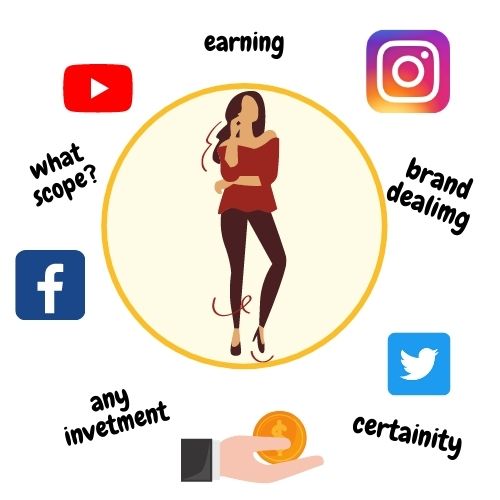
This field has a very wider scope as compared to other as it is very sure that social media is going to expand in the upcoming days , that means more gates will get open for you . The average pay of a Social media manager in “USA is $45K – 55K and in “India is RS 3 lAKHS ,in the initial it might be low but as per your work experience it will increase afterward. Initially you can start your work in this field as a social media coordinator , or marketing coordinator or work as a freelancer .By freelancing you can get the experience of working with many companies which will help you to get your feet fixed strongly , firstly do prefer to take 1 or 2 projects as it will help to give better work , then after getting fully aware of the work, you can take as many projects as you want . Do build portfolio or portfolio websites for better projects .
So , IF you are willing to build a career in this field and have the above mentioned skills than you should go for it as it a great career option to choose for the upcoming future and even if you don’t have the skills , and want to get into this field , than you can learn these skills online as there are so many courses available these days like you can try skill share , or there are courses in google also .Go give it a try
The developing utilization of online applications has opened diverse vocation roads for youth across the globe. Regardless of an applicant is a fresher or an accomplished one, these new position profiles help one in better proficient future and furthermore great motivations.
One of such occupation profile is of Search Engine Optimization (SEO) proficient. As a large portion of individuals across the world use web crawlers like Google to determine their questions. Website design enhancement is one of the advanced showcasing methods that assistance in better streamlining of a site and rank it top in web search tools for applicable questions.
There are many type of improvement, for example, on location content and site page enhancement or site backlink streamlining. Web optimization not just plans to rank better sites or drive quality traffic yet in addition assist with building brand perceivability in the online world.
Different ongoing investigations recommend that SEO will be a significant showcasing device for creating leads and procuring new clients. It has constrained pretty much every organization to put more in SEO prompting expanded interest of SEO experts in India. The developing interest of SEO experts has constrained alumni and website specialists to learn SEO for a superior profession ahead.
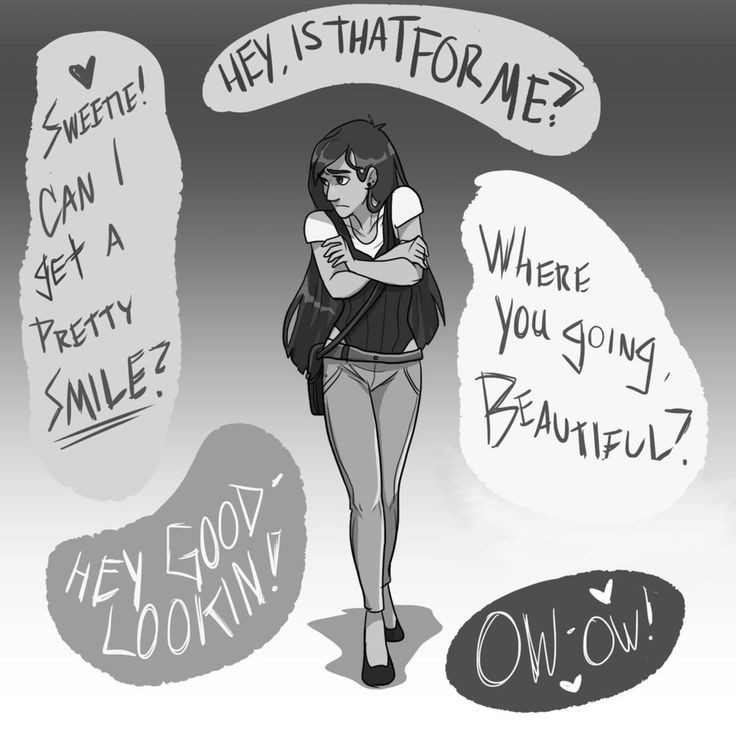
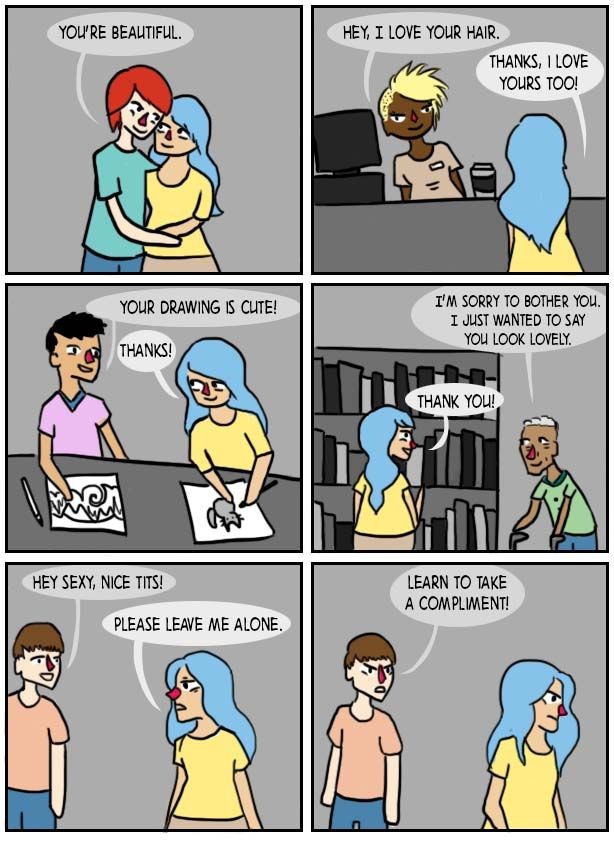
Catcalling is a form of harassment primarily consisting of unwanted sexual comments. This may include honking, wolf-whistling and indecent exposures. Most of the time, it is a man who catcalls and a woman who is catcalled.
According to surveys by Stop Street Harassment (a non-profit organization):
Nearly 95% of female respondents were honked at one or more times
Nearly 82% of female respondents were the target of a vulgar gesture at least once
Nearly 81% of female respondents were the target of sexually explicit comments from an unknown man at least once
Just over 77% of women said they were the target of kissing noises from men.
Where catcalling takes place?
Catcalling doesn’t only happen on the streets. Sexual harassers find targets on campus sidewalks, in restaurants and movie theaters, at work, inside homes – literally anywhere. Similarly, anyone can be a catcaller – including a person’s acquaintances. Online catcalling is also an issue just as severe as in-person catcalling. What’s worse, people on social media are able to say more because they are protected by a screen.
The Problems with Catcalling
It’s disrespectful: Catcalling is uncalled-for and usually makes the victim feel exposed and uncomfortable. In some cases, catcalling is used as a method of expressing power over someone, rather than the misperception of it being a “compliment”.
It’s not impressive: Someone may catcall in order to impress their friends, or the person they are catcalling at, but it’s actually unimpressive and immature.
Catcalling is not a compliment, it’s a harassment!!
Whilst compliments and flirting can be harmless and fun, shouting at strangers is not flattering, it leaves “targets” feeling exposed.
Catcalling is degrading, demeaning, and disgusting.
Women have the right to be treated with as much respect and dignity when walking down the street as any man. Women deserve to feel safe.
How to react if you are being catcalled?
Catcallers usually look for a reaction. Don’t give them one, especially fear.
Get to a safe or crowded place as soon as you can. Seek help if needed.
If you are around other people and it’s safe, you can use a simple comeback like “that’s harassment” or “don’t do that”.
While snapping back (if you choose to do so), make sure to keep walking and don’t stop.
Avoid the use of swear words or eye contact.
If it’s online, you can block and report them. Choosing to reply is also an option (e.g., asking “would you find it okay if someone spoke to your mother or sister in that way?”).
Document it: write it down or take a picture/screenshot. By doing this you can call them out later.
Share your story if you feel comfortable.
How to intervene if someone is being catcalled?
Call out the harasser if it is safe to do so.
Create a distraction or start chatting with the target (e.g., drop your keys and ask “are these yours?”).
Approach the target afterwards to see if they need company or if there is anything else you can do to help.
Whatever you do, don’t put the person who is catcalled at greater risk (e.g., becoming aggressive).
Catcalling has become normalized, as it is often disregarded as a “joke”, or even a compliment. These are some tips to learn why this is absolutely not the case.
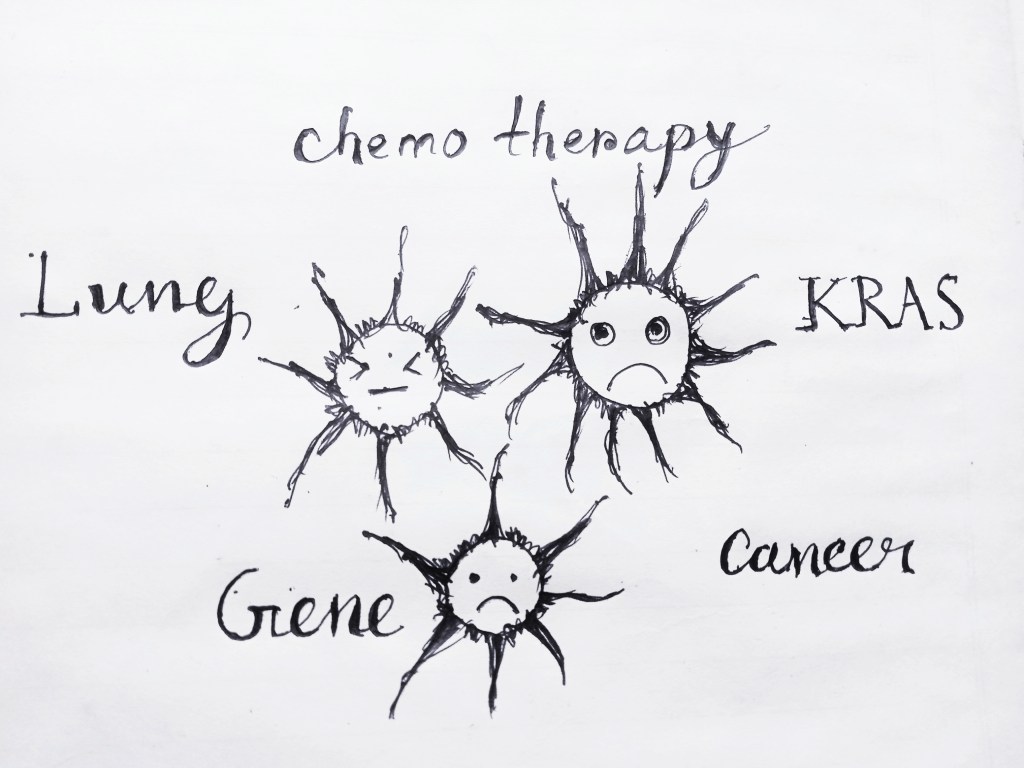
Lung cancer, which is considered as the deadliest cancer, takes lakhs of lives every year.
Sotorasib, the new Amgen drug has bring a new ray of hope in this field.
U.S. food and administration has approved this drug for small cell lung cancer, which will be sold under the brand name Lumakras. Patients having small cell lung cancers with the KRAS mutation, non-small lung cancer with KRASG12C mutation, and some colorectal and other type of cancers will be benefitted via this; because chemotherapy and other medicines didn’t show expected results in treating these.
The company officials assured that the drug can have U.S. list price of $17,900 per month
The T20 world cup 2021 will be held from October 17 to 14 November in UAE and OMAN as confirmed by the ICC on Tuesday. Matches will be played in four venues – Dubai International stadium, the sheikh Zayed stadium in Abu Dhabi, the OMAN Cricket Academy ground and Sharjah stadium. BCCI will remain the host of the event.
It the heartbreaking news for Indian fans but because of the pandemic and keeping in mind safety of the players this decision has been taken by ICC and BCCI .Good news is that T20 World cup going held without any delay and fans can watch it on their TV or in phone .
“The ICC Men’s T20 world cup 2021 will be staged in UAE and OMAN due to the on going covid-19 situation in India” ICC said on their official release.
Acting ICC CEO Geoff Allardice said: “Our priority is to deliver the ICC Men’s T20 World Cup 2021 safely, in full and in its current window. Whilst we are incredibly disappointed not to be hosting the event in India, the decision gives us the certainty we need to stage the event in a country that is a proven international host of multi-team events in a bio-secure environment. We will work closely with the BCCI, the Emirates Cricket Board and Oman Cricket to ensure fans can enjoy a wonderful celebration of cricket.”
President BCCI Sourav Ganguly said: “The BCCI is looking forward to hosting the ICC Men’s T20 World Cup 2021 tournament in UAE and Oman. We would have been happier hosting it in India but considering the uncertainty due to the Covid -19 situation and the importance of a world championship, the BCCI will now continue to host this tournament in UAE and Oman. The BCCI is looking forward to creating a spectacle.”
BCCI Secretary, Jay Shah, said:“The BCCI made every effort to stage the ICC Men’s T20 World Cup in India and provide its passionate fans with a reason to cheer after a long period of gloom. However, the prevailing pandemic situation in the country meant that the health and safety of everyone concerned was fraught with risk should a tournament of this stature is held across the country. The BCCI will continue to host the tournament, which will now be held in the UAE and Oman and work closely with the ICC to make it a memorable event.”
Vice President Emirates Cricket Board, Khalid Al Zarooni said: “Emirates Cricket Board is honoured that the BCCI (Board of Cricket Control India) and the ICC (International Cricket Council) have entrusted us with staging and delivering the ICC Men’s T20 World Cup. The UAE’s reputation as being a safe country in which to host high-profile sporting events is a strong compliment to our government’s unwavering commitment to implementing and monitoring effective health practices during the pandemic. Having hosted a number of high-profile tournaments in recent months our team is well-prepared and ready to mobilise to ensure the success of the T20 World Cup.”
Oman Cricket Chairman, Pankaj Khimji said, “It is indeed a great moment for Oman Cricket to be selected as a venue/host of the forthcoming ICC Men’s T20 World Cup. We shall leave no stone unturned to exceed the requirements of BCCI and ICC. Oman will certainly extend a very warm welcome to all the teams, officials and media in October.”
PharmEasy was founded in 2014 by Dharmil Seth and Dhawal Shah. Its parent company is API holdings private limited. It provides doorstep delivery of medicines and other medical equipment in India across 98% of Indian pin codes.The customers can order their items through PharmEasy’s Website or its mobile app. The idea behind this startup was to digitize the pharmacy sector and bring it under the umbrella of E-commerce. During the pandemic, PharmEasy doubled its revenue to 637 crores. The Pandemic has helped in accelerating its growth. The company’s current net worth is around $700 million. The company is all set to get listed in stock exchange and raise money through IPO (Initial Public Offering). On September 22, 2020, PharmEasy merged with Medlife and API Holdings Private Limited has acquired 100% stake of Medlife.
BUSINESS MODEL OF PharmEasy
The Business Model of PharmEasy is similar to any E-commerce Website like Flipkart, Amazon and Myntra. It sells Medicines and other equipment at cheaper rates and provides doorstep delivery of the products. The customers need to upload their prescriptions of medicines for verification. They can also verify their prescription from a doctor appointed by PharmEasy if the customers face any problems in verification. They provide up to 20% discounts on bookings done through mobile app so that more people download their app. They also earn money by displaying sponsored results of various pharmaceutical entities.
CHALLANGES AND COMPETITORS OF PharmEasy
1) The foremost challenge faced by PharmEasy was to attract customers to buy their medicines and other medical equipment online. Generally, People preferred buying their medicines from a physical pharmacy store.
2) India has low smartphone penetration among its population. Also, Internet users in India compared to the entire population is also quite low. Thus, It narrows the customer base for PharmEasy.
3) Customers hesitate in providing their prescriptions online. They are also afraid of getting expired and fake medicines.
4) The Competitors of PharmEasy are MedPlus, Netmeds, 1mg, Myra etc. PharmEasy has the market dominance and generates the maximum revenue in comparison to its Competitors.
FUTURE OF PharmEasy IN INDIA
1) PharmEasy has been expanding its network by investing more in Capital expenditure. It has been in talks that it is going to buy Thyrocare at 7000 crores which will increase its customer base and capital assets.
2) The Covid-19 Pandemic has provided a conducive Business Environment for PharmEasy. Now, People prefer to shop online and contactless delivery of products.
3) The increase in the demand of vitamins, immunity boosters, and other medicines has also contributed to the growth of PharmEasy. Pandemic has led to increase in demand of medicinal equipment.
4) There has been increase in the number of Internet users and the smartphone users in India in the past few years. It will help in increasing their potential customer base.
5) PharmEasy will have to face tough competition from other players which are aggressively participating in the market to increase their revenues.
How many of you are aware that you are including poison in your daily beverages, this is not to make you afraid but to make you aware!
First of all, there are numerous sugar fanatics all over the world, but little do they know how it affects their health in unimaginable ways. Anything that goes into your body in the form of sugar to eat or drink, it eventually converts the sugar into glucose.
The energy a human body receives solely depends on the glucose level. However, many people consume sugar containing food items, far more than they can burn off the energy level in their body.Eventually, this leads to tooth decay, belly fat, weight gain and increases the risk of various health conditions, such as heart disease and diabetes in common.
Basically, the roots of refined sugar come from sugar beets or commonly referred to as sugar cane, which are refined to extract sugar. Some go to delightful food items such as, white bread, pasta, white rice, pastries, pizza dough and most breakfast cereals are all a form of carbohydrate which contains refined sugar.
Some of the reasons for even sugar addicts to refrain consuming sugar, sugar maniacs listen up!
First and foremost, as we all know sugar is addictive. Consumption of sugar triggers the release of dopamine chemical, which creates a good sensation in the Brain. So eventually, it is stimulated to increase sugar intake and crave more which will make a person fall into a remorseless routine of sugar consumption.
Sugar leads to downfall in the immune system by reducing the white blood cells efficiency after consuming sugar, which restricts the human body’s ability to fight against diseases and infections.
Adapting to the old saying, “cancer loves sugar” excessive sugar consumption encourages the growth of cancer cells due to the production of insulin in the human body.
The ultimate lead for the causes of disease in the human body is caused due to the presence of glucose and fructose in refined sugar.
Apart, from affecting physical health, sugar consumption vastly affects mental health. To be more specific, we all would have experienced a feeling of bingeing after consuming sugar, which is caused due to a crash that’s created in the human body and mind after withdrawal of sugar which leads to addiction, loss of self control, overrating etcetera.
Besides, We all know how the current generation has huge effects of depression due to various reasons. But surely, none of us would be aware that sugar consumption could also be one of prominent causes of depression.
Consuming sugar doesn’t just stop from affecting physically but goes beyond that and creates depression, anxiety, irritability, unwanted emotions, mood swings, fatigue etc, all this is generated unknowingly because of the spike that’s produced in blood sugar and serotonin in the brain which is said to be a feel good chemical. This eventually creates addiction mentally and stimulates craving which leads to boundless negative effects in the human body.
So what do we do now? Is it possible to cut down sugar completely? Especially for sugar fanatics, yes, there’s an alternative for everything in this world and they are completely healthy and pure.
Stevia: it’s a natural sweetener that’s extracted from the leaves of shrubs.
Monk fruit: This sweetener Extracted from a monk fruit itself and also contains around 250 times sweet than sugar with zero calories.
Coconut sugar: This is extracted from the sap of sugar and contains healthy nutrients such as zinc, iron, calcium and potassium along with antioxidants.
Honey: honey is a well known sweetener. Which contains lots of healthy benefits. Rich in vitamins and minerals. An excellent alternative to sugar.
There are many more healthy and natural alternative sweetness around the world which are also easily available. Switching healthy sweetness instead of sugar reduces half of the issues that occur physically and mentally.
Lastly, anything consumed less would bring much great benefits, so moderation is the key.
The condition in which harmful and hazardous materials get mixed with the environment making it impure is called pollution . The harmful materials that make the environment impure are called pollutants. Pollutants can be natural as well as man made. For example volcanic ash is a natural pollutant whereas trash or runoff produced by factories are the pollutants created by humans. Pollutants damage the quality of air, water, and soil.
Types of pollution
Usually there are three types of pollution. They are as follows :-
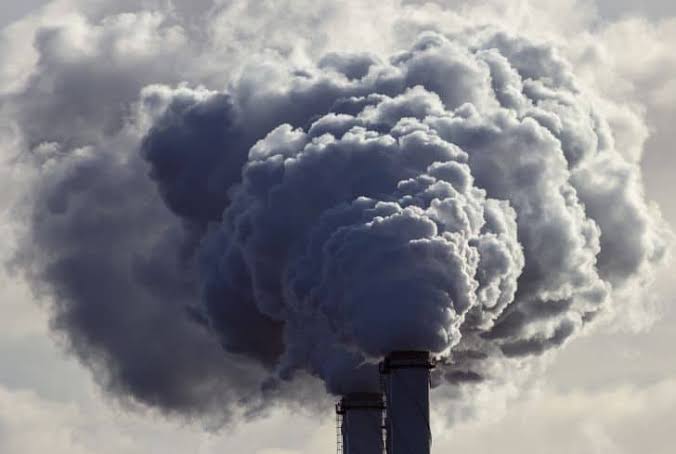
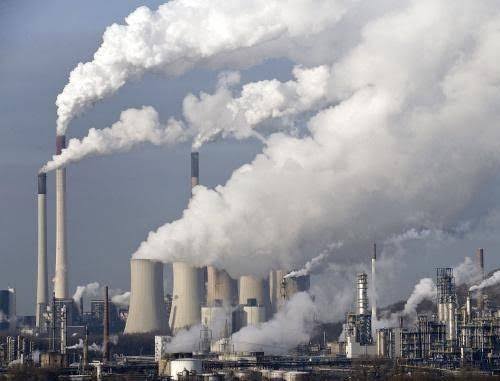
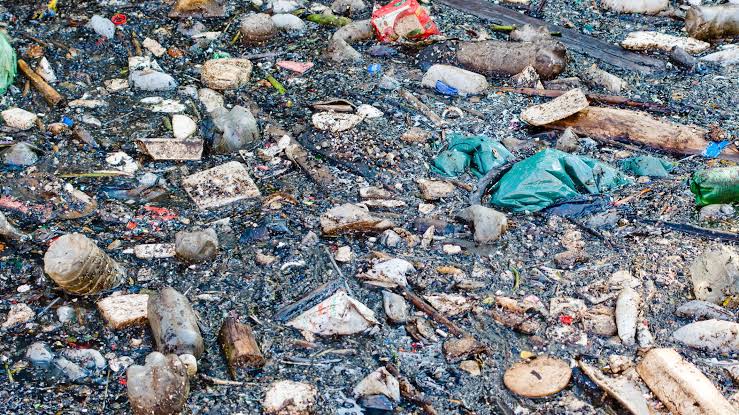
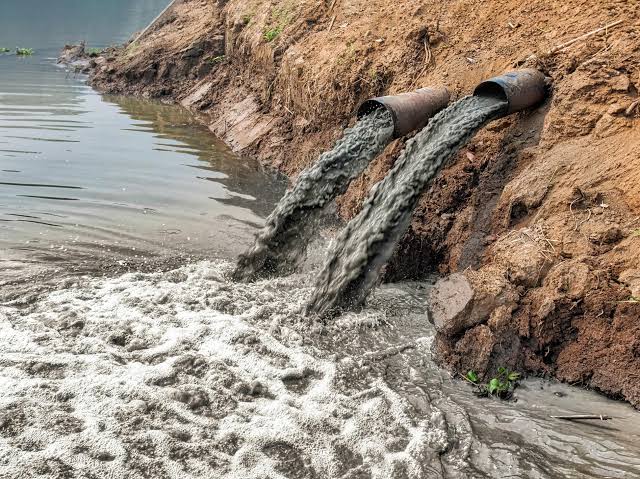
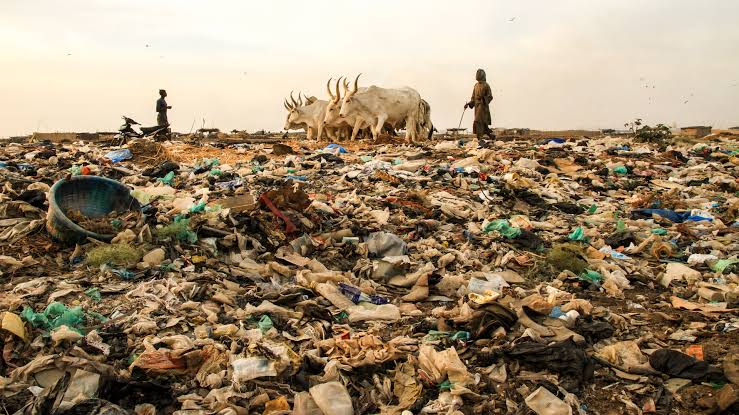
Air pollution : When the harmful hazardous substances mix with the air making it impure to breathe, it causes air pollution . According to the World Health Organization (WHO), every year almost seven million deaths occur because of air pollution. Nine out of ten human beings currently breathe air that exceeds the WHO’s guideline limits for pollutants, with those living in low- and middle-income countries suffering the most. Water pollution : Water pollution (or aquatic pollution) is the contamination of water bodies, usually as a result of human activities. Therefore when harmful pollutants and chemicals mix with the water of water bodies like lakes, rivers, oceans, aquifers and groundwater leads to water pollution. Water pollution is the leading worldwide cause of death and disease, e.g. due to water-borne diseases. Soil Pollution : The removal of useful substances from the soil or the addition of harmful substances to it is called soil pollution. Garbage, cotton clothes, newspapers, tree waste, are the causes of soil pollution. Plastic, glasses and metal objects may also cause soil pollution.
Causes of pollution in environment :
There are many causes of environmental pollution. The causes of pollution are as follows : Industries From the time of the industrial revolution,Industries have been polluting our environment. This is caused due to the increasing use of fossil fuels. In the 19th century and for a significant part of the 20th century, human force was being replaced by coal to make machines work faster.
Pollution by industries is the main cause of air pollution but it also causes contamination in soil and water. This is particularly the case for power-generating industries, such as plants producing electricity (May they be a dam, a nuclear reactor or some other type of plant). Transportation can also be harmful for the environment like petrol is transported through pipelines. A leak in the pipeline will automatically pollute the soil. At the same time, if the tanker transporting petrol from its production plant to the place where it will be consumed leaks or sinks then it will contaminate the water.
2. Transportation After the time when people r using petrol vehicles for transportation instead of using animal power the rate of environmental pollution has increased. Its levels have only been increasing day by day. Similarly to industries, pollution caused by transport can mainly be attributed to fossil fuels.
3. Agricultural Activities Agricultural waste is mainly a cause of water and soil pollution. This is caused by the increased use of pesticides, as well as by the intensive character of its production. Most of the pesticides are made from chemical substances and are meant to keep diseases and threatening animals away from the crops. However, by keeping these forms of life away, the harm is almost always made to the surrounding environment as well.
4. Trading Activities The production and exchange of goods and services fall under this category. As regards goods, pollution can be caused by packaging (which often involves the use of plastic, which is made from fossil fuels) or transport, mainly.
5. Residences Finally, residential areas provide their fair share of pollution as well. To build homes, the natural environment has to be destroyed in one way or another. Wildlife and plants are driven away and replaced by human constructions. As it requires the work of industries, construction itself is also a source of contamination of the environment.
Effects of Environmental Pollution
Now that we have identified the main causes of environmental pollution, let us study the negative effects it has:
1. Effects on Humans The effects of environmental pollution on humans are mainly physical, but can also turn into neuro-affections in the long term. It causes respiratory infections, in the form of allergies, asthma, irritation of the eyes and nasal passages, or other forms of respiratory infections. Environmental pollution has been proven to be a major factor in the development of cancer. This can happen, for example, when we eat reminiscences of pollutants used in the production of processed foods or pesticides from the crops. Other rarer diseases include hepatitis, typhoid affections, diarrhea, and hormonal disruptions.
2. Effects on Animals Environmental pollution mainly affects animals by causing harm to their living environment, making it toxic for them to live in. Acid rains can change the composition of rivers and seas, making them toxic for fishes; an essential quantity of ozone in the lower parts of the atmosphere can cause lung problems to all animals. Toxic algae overgrowth will be caused due to Nitrogen and phosphates present in water preventing other forms of life to follow their normal course.
Soil pollution will cause harm and, sometimes, even the destruction of microorganisms, which can have the dramatic effect of killing the first layers of the primary food chain.
3. Effects on Plants As for animals, plants, and especially trees, can be destroyed by acid rains ozone in the lower atmosphere block the plant respiration, and harmful pollutants can be absorbed from the water or soil.
4. Effects on the Ecosystem In short, environmental pollution, almost exclusively created by human activities, has a negative effect on the ecosystem, destroying crucial layers of it and causing an even more negative effect on the upper layers.
Prevention of environmental pollution
Environmental pollution can be reduced in many ways. The ways are as follows: The most important thing we can do is reduce , reuse and recycle goods like plastic things etc. We should lower the use of non biodegradable wastes Uses of chemical fertilizers must be reduced. To avoid pollution we should start afforestation. We must take care during sewage disposal so that the chemical does not contaminate the soil or water.















You must be logged in to post a comment.