THEOPHRASTUS – THE FATHER OF BOTANTY


The ancient Greek Theophrastus (371–286 B.C.E.) is known as the father, or founder, of botany. He wrote two large books, On the History of Plants and On the Causes of Plants. … He also developed a theory of plant growth and wrote about how plants were structured. He identified and described 550 different

While Theophrastus studied very diverse issues, he is best known for his work with plants. He has often been referred to as the first scientific botanist, and two of his practical, yet influential, books on the subject have survived into modern times.

Theophrastus was one of the few Peripatetics who fully embraced Aristotle’s philosophy in all areas of metaphysicsphysics, physiology, zoologybotanyethics, politics, and history of culture. His general tendency was to strengthen the systematic unity of those subjects and to reduce the transcendental or Platonic elements of Aristotelianism as a whole. Of his few surviving works, the most important are Peri phytōn historia (“Inquiry into Plants”) and Peri phytōn aitiōn (“Growth of Plants”), comprising nine and six books, respectively. Of dubious origin are the smaller treatises attributed to him on fire, winds, signs of weather, scents, sensations, and other subjects. His notable Charaktēres (many English translations) consists of 30 brief and vigorous character sketches delineating moral types derived from studies that Aristotle had made for ethical and rhetorical purposes; this work later formed the basis for the masterpiece of Jean de La BruyèreLes Caractères . . . (1699). In his ethical teachings, famous because of the assaults of the Stoic philosophers, Theophrastus reiterated Aristotle’s notion of a plurality of virtues with their relative vices and acknowledged a certain importance to external goods.

Among Theophrastus’ other works is the Physikōn doxai (“Opinions of Natural Philosophers”). As reconstructed by Herman Diels in Doxographi Graeci (1879), it provides a foundation for the history of ancient philosophy

Theophrastus and his reasearches

newsletter icon
  • Metaphysics (or On First Principles).
    • Enquiry into Plants: Books 1-5.
    • Enquiry into Plants: Books 6-9; Treatise on Odours; Concerning Weather Signs.
    •  De Causis Plantarum. There are 3 volumes of this book .
    • On Sweat, On Dizziness and On Fatigue. 

Theophrastus introduced his Physics with the proof that all natural existence, being corporeal and composite, requires principles,and first and foremost motion as the basis of all change.

Denying the substance of space, he seems to have regarded it, in opposition to Aristotle, as the mere arrangement and position (taxis and thesis) of bodies.Time he called an accident of motion, without, it seems, viewing it, with Aristotle, as the numerical determinant of motion. He attacked the doctrine of the four classical elements and challenged whether fire could be called a primary element when it appears to be compound, requiring, as it does, another material for its own nutriment.

Surely, then, if the life in animals does not need explanation or is to be explained only in this way, may it not be the case that in the heavens too, and in the heavenly bodies, movement does not need explanation or is to be explained in a special way? Theophrastus, Metaphysics, 10a.16-29
HUMAN ANATOMY

Introduction to Human Anatomy and Physiology

Anatomy is the study of the shape and structure of the body of organisms or living beings. The word anatomy is derived from the Greek words ‘ ana ‘ and ‘ tomy ‘ where ‘ ana ‘ means ‘apart’ and ‘tomy ‘ means ‘to cut’. In physiology, the functions of various system such as respiratory system, digestive system, nervous system, skeleton system and muscular system of organisms are studied. It can be said that physiology is the study of how the body and all its part function. It consists of two word, namely, ‘physio’ and ‘ ology’ where ‘physio’ means ‘nature ‘ and ‘ ology ‘ means ‘ study’. Here ,we will study human anatomy and human physiology.

Definition of Human Anatomy

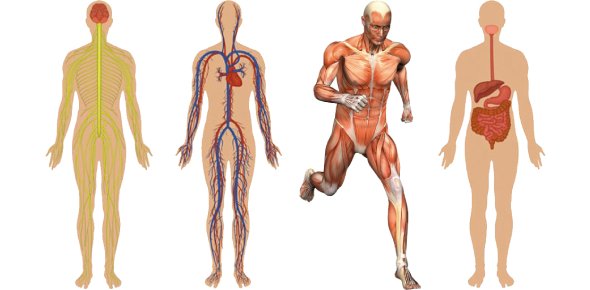
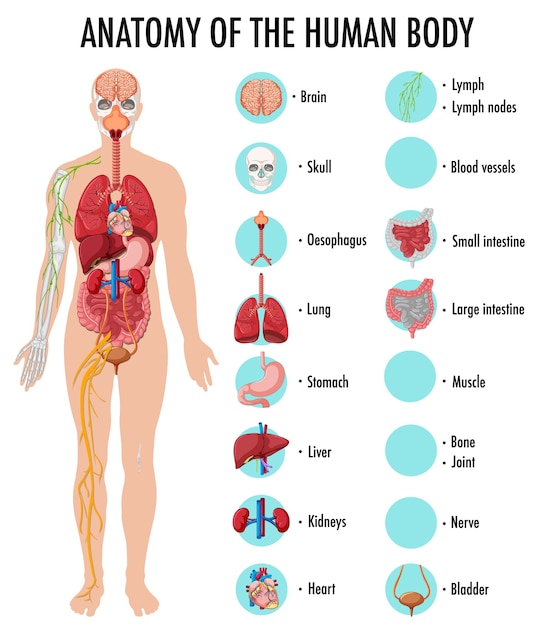
Free Vector | Anatomy of the human body information infographic

Human Anatomy is the study of structure ,shape, size , weight and location of all the organs of human body. A detailed knowledge of the structure of various system of human body is provided in human anatomy . For example , the shape, size, weight, structure and location of all the organs of the excretory system such as lungs, kidneys, large intestine, liver, skin, etc. are studied in human anatomy. Human anatomy can be defined as the science dealing with human body structure and relationships among structures.

Importance of Anatomy

The importance of anatomy and physiology is mentioned below.

  • Anatomy Provides the Knowledge of Structures of Various Organs : Human anatomy provides the detailed knowledge of the structure of various organ body . We get the knowledge of structure, shape, size, location and weight of organs of all the systems of our body. We come to know about the length of various organs such as the length, size and shape of the bones. With the help of anatomy , we get the knowledge of the percentage of white fibres and red fibres present in an individual. As a result of such knowledge , the teacher and coaches working in the field of physical education and sports may easily select the suitable sports according to the traits of students. For example, weightlifting is more appropriate for short statured students, who have more percentage of white fibres i.e., fast twitch fibres in comparison to red fibers i.e., slow twitch fibres can perform better in sprinting events instead of endurance events.

Genghis Khan: The Universal Ruler

Genghis Khan, originally known as Temujin, is known today as the man who established the largest land empire known in history. He had united the various nomadic tribes in Mongolia, and then went on to conquer huge parts of central Asia and China. Even after his death, his descendants expanded the empire to much greater lengths up to places like Poland, Vietnam, Syria and Korea. At their peak, the Mongols controlled around 12 million square miles of land. This is an area around the size of Africa, all controlled by a single empire. In contrast, the Roman empire was only about half the size of the USA. Hence, it is evident that Genghis Khan was a legendary ruler and is remembered well by history, but he is also regarded as the very avatar of savagery and barbarism. 

The Rise of Genghis Khan

Temujin, later Genghis Khan, was born around 1162 near the border of Mongolia and Siberia. At that time, many nomadic tribes in the central Asian steppes were constantly fighting and killing each other, and life for Temujin was violent and unpredictable. Before turning even 10 years of age, his father was poisoned to death by an enemy clan and his own clan had deserted him and his family. Following this, Temujin killed his older half-brother and took over the reins as the head of his abandoned and poverty-stricken family. He soon began making alliances, building a reputation as a warrior and attracting a growing number of followers. Most of what we know about Genghis Khan’s childhood comes from “The Secret History of the Mongols,” the oldest known work of Mongolian history and literature. Going against custom, Temujin preferred to put competent allies rather than relatives in important positions in his tribe. He also executed the leaders of enemy tribes, and incorporated the remaining members into his clan. By 1205, Temujin had vanquished all his rivals.

The Establishment of an Empire

Temujin thereby became the leader of a Mongol confederation consisting of all the tribes and territories that he had united. He established a nation similar in size to modern Mongolia, and was also proclaimed Chinggis Khan, which roughly translates to ‘Universal Ruler,’ a name that has now become bastardized to be known as Genghis Khan. After this, he started his conquests outside of Mongolia and garnered his brutal reputation through continuous invasions. Genghis Khan’s first campaign outside of Mongolia took place against the Xi Xia kingdom of north-western China, after which went to war against the Khwarazm Empire in present-day Turkmenistan, Uzbekistan, Afghanistan and Iran. He gradually expanded the borders of the Mongol Empire over the years of his reign, and many surrounding empires had started becoming wary of the Mongol threat. Genghis Khan also had an extensive network of spies which used to detect his enemy’s weaknesses, and made use of advanced military equipment like catapults and mangonels while attacking large cities. By 1227, the Khan had conquered much of Central Asia and made incursions into Eastern Europe, Persia, and India.

It is important to highlight here that it was not only because of his aggressive invasions and warfare that he was successful, but also because of his administrative capabilities. For example, he forbade the selling and kidnapping of women, banned enslavement and torture, and made livestock theft punishable by death. Moreover, he ordered the adoption of a writing system, conducted a regular census, granted diplomatic immunity to foreign ambassadors and allowed freedom of religion and protection within his empire.

The Fall of Genghis Khan

Genghis Khan eventually died in 1227, at the age of 65. But there is a lot of mystery and uncertainty surrounding his death. Some stories suggest that he died from injuries sustained after falling from his horse, while others suggest it was while he was trying to put down a rebellion in China. Furthermore, the final resting place of the Khan is unknown, as he wanted his death to be a secret.

Regardless, Genghis Khan conquered more than twice as much land as any other person in history, bringing Eastern and Western civilizations into contact in the process. Though he has a unfavourable reputation because of all the killing, plunder and rape he had caused, one cannot deny that he is among the greatest, if not the greatest conqueror in history.

East Timor: Brief analysis of its history & independence.

East Timor or Timor-Leste is a tiny island country in Southeast Asia nestled between Australia and Indonesia.

For more than 300 years the territory of East Timor was ruled by Colonial Portugal (Portuguese Timor). They set up both commercial outposts and catholic missions. On 28 November 1975, Portugal withdrew from the island territory when the Revolutionary Front for an Independent East Timor had declared the territory’s independence. But this exit from East Timor was not at all smooth and this enraged bitter rivalry between various local groups. Just nine days later in December 1975 East Timor was invaded and occupied by the Indonesian military. Suharto, the Indonesian president at that time didn’t receive much resistance from the western countries due to the left-leaning stance of East Timor at that time (Cold war).  The Indonesian occupation was a brutal and violent period in East Timor’s history with various suppression tactics many people lost their lives during that period.

The following decades were highly violent with many conflicts between the separatist groups known as Fretilin and the Indonesian military. The military fought a continuous guerilla war with the rebels in the island’s interior mountains. There were numerous rights violations and over 100,000 people died under the occupations of Indonesia.

One of the most defining instances happened on November 12, 1991, when the Indonesian military shot and killed over 250 people who had come for the memorial procession in honor of Sebastio Gomez, a pro-independence supporter killed by the Indonesian military. The events occurred in the Santa Cruz Cemetery in Dili, East Timor’s capital. This tragedy is known as the Santa Cruz Massacre. The event gained international media attention. Although the Indonesian occupation did not cede until eight years later in 1999, the Santa Cruz massacre was a defining moment in the island nation’s quest for independence.

In 1998 president Suharto resigned from his position after more than 30 years in power due to growing pressure and protests against him from within the country. His replacement was open towards more open towards the autonomy of East Timor. International pressure for East Timor grew in 1998. During the downfall of the New Order government, as part of Reformasi, a referendum was held in East Timor to ask whether they wished to remain in Indonesia with increased autonomy or become independent. On August 30, 1999, about 78% of the population of East Timorese chose to remain independent.

Following the referendum, violence again erupted in East Timor as Indonesian-backed militias increased their activities across the country. In September UN peacekeeping let by Australia force took control of the situation but a lot of damage was already done. In 2002 Xanana Gusmão was elected as the first president after three years of transitional governance by the UN.

As of today, the country has been relatively stable but the economic conditions have not been improved. Indonesia’s Timor has fared comparatively better than East Timor. It was also discovered that Australia, a country that East Timor considered as their ally had spied on East Timor to gain leverage over negotiations on the exploitation of natural resources in the Timor Sea. On a positive note, the country has comparatively good relations with Indonesia now.

References:

Sanskrit.

Sanskrit is a standardized dialect of Old Indo-Aryan, originating as Vedic Sanskrit as early as 1700-1200 BCE. One of the oldest Indo-European languages for which substantial documentation exists, Sanskrit is believed to have been the general language of the greater Indian Subcontinent in ancient times.

Sanskrit ; attributively संस्कृत-, saṃskṛta-; nominaly संस्कृतम्, saṃskṛtam, is a classical language of South Asia belonging to the Indo-Aryan branch of the Indo-European languages. It arose in South Asia after its predecessor languages had diffused there from the northwest in the late Bronze Age. Sanskrit is the sacred language of Hinduism, the language of classical Hindu philosophy, and of historical texts of Buddhism and Jainism. It was a link language in ancient and medieval South Asia, and upon transmission of Hindu and Buddhist culture to Southeast Asia, East Asia and Central Asia in the early medieval era, it became a language of religion and high culture, and of the political elites in some of these regions. As a result, Sanskrit had a lasting impact on the languages of South Asia, Southeast Asia and East Asia, especially in their formal and learned vocabularies.

Sanskrit generally connotes several Old Indo-Aryan varieties. The most archaic of these is Vedic Sanskrit found in the Rig Veda, a collection of 1,028 hymns composed between 1500 BCE and 1200 BCE by Indo-Aryan tribes migrating east from what today is Afghanistan across northern Pakistan and into northern India. Vedic Sanskrit interacted with the preexisting ancient languages of the subcontinent, absorbing names of newly encountered plants and animals; in addition, the ancient Dravidian languages influenced Sanskrit’s phonology and syntax. “Sanskrit” can also more narrowly refer to Classical Sanskrit, a refined and standardized grammatical form that emerged in the mid-1st millennium BCE and was codified in the most comprehensive of ancient grammars, the Aṣṭādhyāyī (“Eight chapters”) of Pāṇini.The greatest dramatist in Sanskrit, Kālidāsa, wrote in classical Sanskrit, and the foundations of modern arithmetic were first described in classical Sanskrit. The two major Sanskrit epics, the Mahābhārata and the Rāmāyaṇa, however, were composed in a range of oral storytelling registers called Epic Sanskrit which was used in northern India between 400 BCE and 300 CE, and roughly contemporary with classical Sanskrit. In the following centuries, Sanskrit became tradition-bound, stopped being learned as a first language, and ultimately stopped developing as a living language.

Bhimbetka

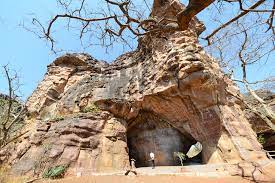
Bhimbetka is a beautiful archaeological site with nature enveloping its caves. It is derived from ‘Bhimbetka’ which means siting place of prince Bhima from the great mythology ‘Mahabharata’.  It also manifests for earlier traces of human life on earth and stone age. It is a UNESCO world heritage site; very limited people visit Bhimbetka which maintains its peace and silence. It was founded by Vishnu Walankar in 1957-58 during a visit to Ratapani Sanctuary.

LOCATION

It is situated in the foothills of Vindhya range near Raisen district of Madhya Pradesh, inside Ratapani wildlife sanctuary, the south of these shelters are successive range of Satpura hills. There are over760 rock shelters and 500 are bedecked by rock paintings.

MYTHOLOGY INTEREST

As the name signifies this place is where Bheema use to reside, it is known that pandavs were sent to vanvasa for 12 years and 1-year agyatvasa which means that pandavs were told to live away from Duryodhana’s shadow in agyatvasa. When vanvasa was over Lord Krishna sent pandavs here for some period. Bhima use to reside in these caves. Also, a temple is situated near Bhimbetka in Bhojpur with one of the largest shivling in India where pandavs use to offer prayers.

ARCHITECTURE

Its architectural significance span over upper palaeolithic, Mesolithic, chalcolithic, early history and medieval. There are over 750 archaeological caves spread over 10 km but only 12 to 15 caves are open for tourist to visit, these caves and their rock painting are assumed to be around 10,000 years old.

Auditorium cave 

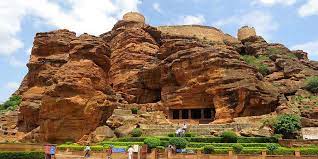
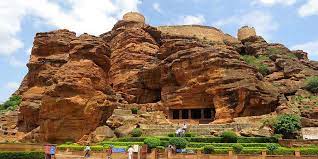
It is one of the largest caves in Bhimbetka and is visible from a distance, it is built up of 25-metre-long tunnel and also quartzite towers which are visible from several kilometres distance. Robert Bednarik describes the Auditorium cave as one with a cathedral atmosphere, with “its Gothic arches and soaring spaces”.

Extinct Dickinsonia

Dickinsonia is an extinct genus basal animal. Dickinsonia fossils are known only in the form of imprints. The specimens range from a few millimetres to about 1.4 metres in length and is found in Bhimbetka it is similar to Ediacara Member of Ediacara Hills in South Australia. These fossils are found within sandstone of Bhander Group of Vindhyan Supergroup mixed with sand deposits and intertidal facies

ROCK ART AND PAINTING

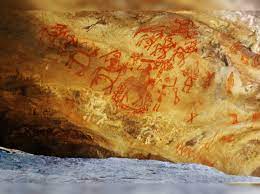
Tribals have always amused the current society with there culture, attires, jewellery, lifestyle and of course their beautiful paintings. One such example is also illustrated by Bhimbetka where paintings from stone age, medieval etc. can be found. The aesthetic art depicts basic story life of people living there and daily struggles in the form of Warli art. As the time flies many things get faded away but these paintings are still headstrong. Tribals used natural red, white, green and yellow colours are also used. The colours are a combination of manganese, hematite, wooden coal, soft red stone, plant leaves and animal fats.

These paintings can be classified according to seven periods-

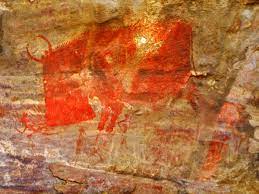
Period I Upper Palaeolithic: These are linear representations, in green and dark red, of huge figures of animals such as bison, tigers and rhinoceroses.

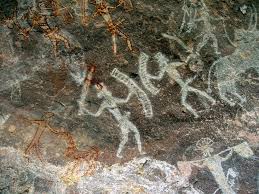
Period II Mesolithic: these show small linear decorations on the body, animals, human figures and hunting scenes and weapons they used- barbed spears, pointed sticks, bows etc. Some scenes are interpreted as depicting tribal war between three tribes. The depiction of communal dances, birds, musical instruments, mothers and children, pregnant women, men carrying dead animals, drinking and burials appear in rhythmic movement.

Period III Chalcolithic: these drawings tell us about the increasing communication and beginning of initial stage of barter system in the form of exchange, the cave dwellers of this area were in contact with the agricultural communities of the Malwa plains, exchanging goods with them.

Period IV & V Early historic: The figures of this group have a schematic and decorative style and are painted mainly in red, white and yellow. The association is of riders, depiction of religious symbols, tunic-like dresses and the existence of scripts of different periods. The religious beliefs are represented by figures of yakshas, tree gods and magical sky chariots.

Period VI & VII Medieval: These paintings are geometric linear and more schematic, but they show degeneration and crudeness in their artistic style. The colours used by the cave dwellers were prepared by combining black manganese oxides, red hematite and charcoal. They depict war scenes between kings.

Zoo Rock

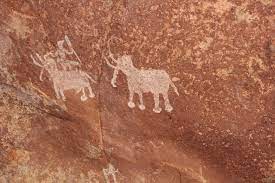
It depicts elephants, barasingha, bison and deer, peacock, a snake, a deer and the sun. On another rock, two elephants with tusks are painted. Hunting scenes with hunters carrying bows, arrows, swords, and shields also find their place in the community of these pre-historic paintings. In one of the caves, a bison is shown in pursuit of a hunter while his two companions appear to stand helplessly nearby; in another, some horsemen are seen, along with archers. In one painting, a large wild bovine (possibly a gaur or bison) is seen where people are trying to save their lives from bison. Also, there are some paintings when sun is a particular point

REFERENCES

Singh, H. (2016, July 28). Rock Shelters of Bhimbetka: Facts at a Glance. Jagranjosh.Com. https://www.jagranjosh.com/general-knowledge/rock-shelters-of-bhimbetka-facts-at-a-glance-1462443813-1

Goyal, A. (2020, October 12). Bhimbetka Rock Shelters and Pre-Historic Cave Paintings. Inditales. https://www.inditales.com/rock-paintings-of-bhimbetka/

Wikipedia contributors. (2021, July 10). Bhimbetka rock shelters. Wikipedia. https://en.wikipedia.org/wiki/Bhimbetka_rock_shelters#Auditorium_cave

Jagganath Rath Yatra 2021

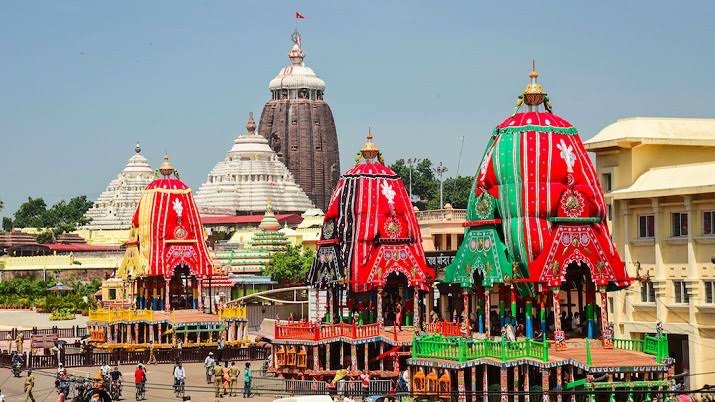
India is land of culture and tradition; its diversity is the main reason behind such a vast number of festivals, celebrations, rituals and ceremony that we Indians celebrate every year. This forms our culture, which is rich and beautiful. One such instance of our culture that showcase the devotion, unity and purity is Jagannath Rath Yatra, Orissa.
The preparation for Jagannath Puri rath yatra which is held every year during the month of June and July has begin from today. The yatra is held in Puri, located in Orissa in the Jagannath temple. The Jagannath temple is a holy shrine for the devotees constructed by king Chodagan Dev in 12th century. It is no less than a festival for the people of Orissa and lasts for many days.
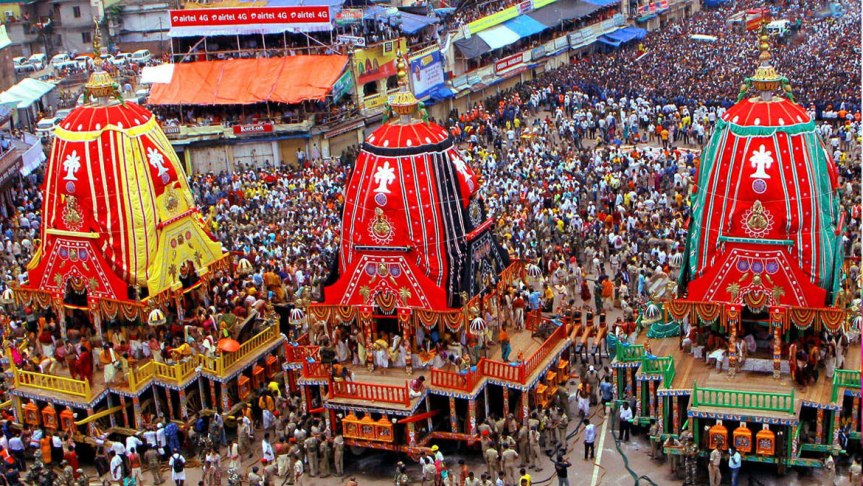
The word “Jagannath” which stands for lord of universe and rath yatra which refers to chariot journey. The popular yatra is basically about three deities lord Jagannath Bal Bhadra (brother of lord Jagannath) and sister Subhadra who travel from Jagannath temple to Gundicha shrine and they return back to Jagannath, the distance is approximately 3km and the whole celebration lasts for eight to nine days. Three big chariot which are made out of neem wood and other material, these are very tall and have long stretch canopies on the top made out of cloth and thousands of devotees pull these three chariots or rath and it takes 2 to 3 months to make these huge rath who can carry the idol of all three. Every year new rath are designed and the rituals start many days before the rath yatra.
Pulling these rath is considered a good deed and every year there are visitors from around the country to be a part of this extra ordinary rath yatra. It is a 460-year-old tradition, it has immense importance but, from the past two years the Yatra is held in the presence of limited number of people that too the main ones.
Well, this is only one out of many in India most of the time in a year people are celebrating their traditions, rituals and identity. The best part about this is getting to learn about the ancient practices and the importance they carry like why this is done, what is the speciality, where does all this takes place etc. All these things keep us connected to our land and people. Hence, of greater importance specially when you belong to such a diverse nation.

Does India has low divorce rate because of happy marriages?

Divorce refers to the legal cancellation of marriage declaring that marriage as null and void. Marriage which is said to be a union of two individuals is generally expected to last till the death of the couple but in some cases when the couple feels that they are not compatible with each other or are hindering each other’s growth or any other reason , they decide to legally cancel their marriage . The reasons for divorce are many not just the two reason which are mentioned above raging from domestic violence, to the cases where one partner commits infidelity to cruelty, insanity, desertion etc. It is not good to continue in a relation which is turning toxic as it will affect the mental as well as physical well being of an individual.

India , the second most populated country in the world has less than 1% of divorce rate while Maldives which is 11,031 times less populated in India has the highest divorce rate in the world with 10.67% of divorces happening per 1000 inhabitants. The reason for such a high rate is that being a Muslim country, Maldives prevents any kind of premarital physical relations and as soon as the children turn 18 , they marry . Also the marriages there are not at all a costly affair with $10 being the fee for the judge and 10 relatives being invited to the wedding. The decisions taken in such tender age of 18 are often proves to be wrong , as the partners mature with time they realise that their aims are very different from others. Also, there are no social obligation restricting them in a unhappy marriage.

Why is there such a huge discrepancy between both the countries? Is it because people in India are quite happy with their partners? Or is it because they are married with their choice of life partner? Read the blog completely to know the reasons.

Why does India has such low divorce rate?

The main reason for divorce rate being the lowest in the second most populated country in the world is that people consider divorce to be a taboo. Marriages in India are a big affair with every acquaintance being invited and treated to the best lavish dishes and luxurious gifts that the family can provide which often leads to the expenditure of the entire savings of the family and heft loan amounts. According to a common belief, here marriages are made in Heaven and even if you are suffering terribly you should not break the bond which is said to be pious tying to people in a matrimony for their next seven human lives. This belief is very contrary to what the VEDAS(the oldest religious scriptures in the world which is a theoretical source for all the laws written in the SMRITIS which used to govern the laws in ancient times) say.

Also, there is a social stigma attached to the divorces which questions the character of mainly the woman stating her to be incapable of “fulfilling her husband’s demands”. Women since centuries now, are a piece of toy who despite all her qualification fails to be called a successful woman if she is not married and has not produced the kids. It is a woman who is supposed to adjust, putting even her self respect at stake. This is the reason where a woman even after becoming a victim to domestic violence never dares to file for separation as victim blaming and shaming starts soon after and she eventually accepts domestic violence as a part of her life. A woman is supposed to have no voice of hers as she is considered incapable of taking correct decisions for herself. What an irony it is that staying in a venomous marriage is considered to be good for a woman! This is the reason that the states of Bihar, Haryana, Rajasthan and UP where patriarchy still has a strong hold have the lowest divorce rates while the liberal North East has the high rates. It is the state of Mizoram in India that has the highest divorce rate of 6.34%

The time period of divorce also stretches infinitely long sometimes taking years when the divorce is not mutual which drains the involved parties emotionally, mentally and financially due to the amount of alimony involved.

What does the VEDAS say about the marriage and divorce

According to Kirron Krishnan a Vedic spiritual theist, Rigveda (which contains information about religious, social and economic life of the people) or any of the other three Vedas do not contain any mention of the term called divorce. In those times the term was not needed because according to Rigveda , the husband takes the hand of the bride to live with her till their old age playing with their grandchildren respecting her , loving her and supporting her all along. Meanwhile the wife was the queen of her husband’s household who would over the same support , respect and love back. It was a mutual show of respect by both the parties which did not leave any scope for any domestic violence case. Further, unlike in today’s time where a daughter is considered to be a liability who is born just to be married off, in the days when India was a golden bird the women were trained and skilled by her family and was married to the groom of her choice and the same was prevalent with men.

However there is the mention of remarriage if one partner dies , rennounces the world , disappears , is involved in criminal activity or is impotent. The laws in the ancient times were far more suitable for both the genders than they are today.

Is it good to have such a low divorce rate in the country

By stating that the low divorce rates are not good it doesn’t implies that the divorces are good and more people should have it. If the couple in the marriage is happy then there are no issues, but if the couple in the marriage is not happy with each other and is only together “because they have no other way” then it is completely wrong as it will generate negative vibes harming the couple as well as their innocent children . It is seen in more than one cases that the children from unhappy marriages results in being a frustration box to their parents’ outbursts which hampers the growth of the child.

10 Best Places to visit in Dalhousie

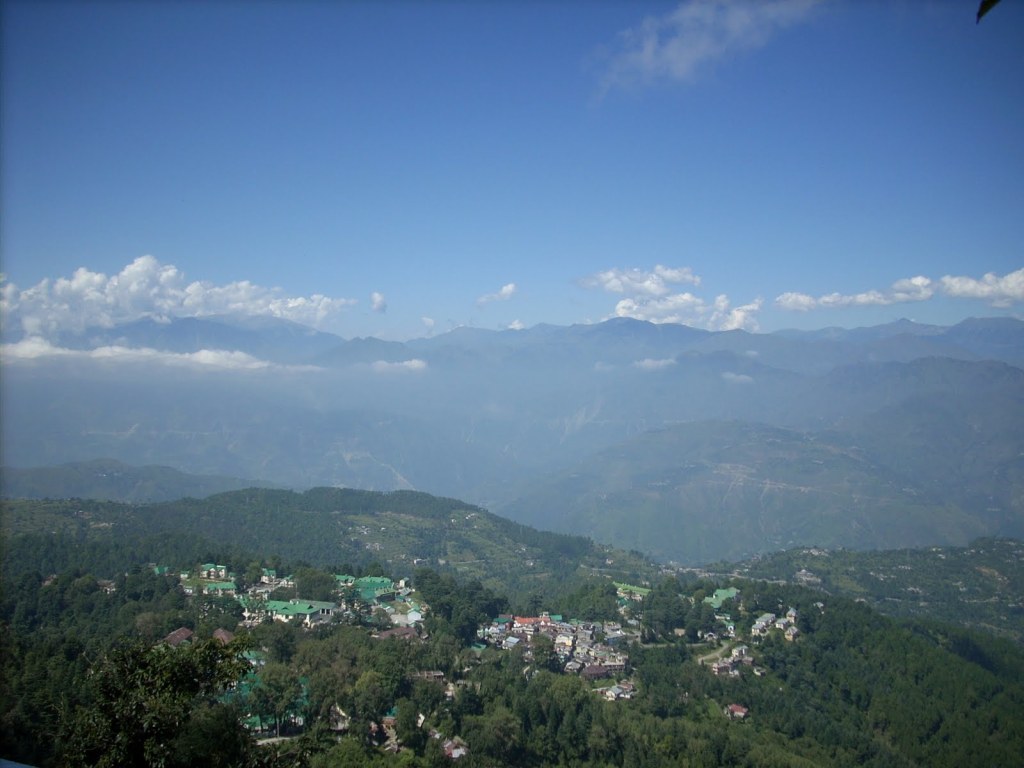
Dalhousie is a hill station in the Himachal Pradesh state of northern India, located in the Chamba district.

Some places you must visit if you are visiting Dalhousie are –

Khajjiar

Khajjiar, often known as the ‘mini-Switzerland of India,’ is a small town near Dalhousie noted for its green meadows, deodar trees, and cottages. There is a tiny lake in the midst of the meadow where you may relax and enjoy the landscape or participate in adventure sports like paragliding, zorbing, and horseback riding. During the winter, however, the road to Khajjiar may be blocked due to severe snowfall.

Kalatop Wildlife Sanctuary

The Kalatop Animals Sanctuary is made up of thick deodar foliage, a wealth of wildlife, snowcapped mountains, carpets of green meadows, and easy-on-the-eye streams of fresh water. It is also known as the Kalatop Khajjiar Sanctuary and is located in Himachal Pradesh’s scenic mountainous Chamba region. The term Kalatop means ‘black cap,’ referring to the dense, black forest cover on the sanctuary’s highest peak.

Chamera Lake

The Chamba Lake is a man-made reservoir for the Chamba Dam, located near Dalhousie in Himachal Pradesh’s Chamba District. It’s a popular picnic site as well as a sailing spot. On a speed boat or a rowboat, one may explore the lake and participate in sports such as kayaking and canoeing.

Rock Garden

Dalhousie’s Rock Garden is a lovely garden and a favorite picnic place. Apart from resting and refreshing at the park, you may also participate in one of the many adventure activities offered in the region, such as zip-lining.

Indo – Tibetan Market

The Tibetan market in Moti Tiba is one of Dalhousie’s greatest locations to buy, selling traditional Kashmiri shawls, needlework, purses, carpets, and a variety of handicrafts. Gandhi Chowk is home to the lively Indo Tibetan market, as well as various handloom and handicraft businesses, providing for an excellent shopping experience.

Chamba

Chamba is a Himalayan town in the Himachal Pradesh district of Chamba. Chamba is known for its breathtaking views of the Pir Panjal, Zanskar, and Dhauladhar mountains, as well as historic temples, caves, and edifices that speak well of Indian history.

This location should not be confused with the Uttarakhand town of Chamba.

Mall Road

Gandhi Chowk, often known as GPO, is Dalhousie’s busiest and most lively street. Dalhousie, unlike other hill stations, lacks a mall road, thus Gandhi Chowk serves as Dalhousie’s Mall Road. Dalhousie has numerous local bazaars and commercial hubs, including Gandhi Chowk. Simple local trinkets, woolen clothing, and daily gems may be found in the shops. GPO is also home to all of the main buildings and hotels. 

Cafe Dalhousie

Cafe Dalhousie is one of Dalhousie’s most renowned cafes, noted for its amazing food and ideal ambience. The cafe, which serves international food, also has magnificent views of the surrounding hills and valleys. Snacks including grilled sandwiches, pizza, and shakes are among the cafe’s most popular items.

Chamunda Devi Temple

The temple, which is devoted to Goddess Kali, is a significant religious site in the town. Goddess Ambika is supposed to have slain the demons, Munda and Chanda, at this temple. The Goddess’s divinity is kept covered in crimson fabric, holy and untouchable by the public. The region also has some stunning scenery and vistas.

Jot

On the Pathankot-Nurpur-Chowari-Chamba section, Jot is one of the highest altitude tourist spots in Chamba. It is closed to cars during the winter months since it is covered with heavy snow. In the summer, the road reopens, but because it is a less commercialized area, it is not overwhelmed with people. It’s a prehistoric stretch, ideal for people who enjoy exploring the unknown. Trekking and hiking are popular in Jot.

Nelson Mandela

Rolihlahla Mandela was born into the Madiba clan in the village of Mvezo, in the Eastern Cape, on 18 July 1918. His mother was Nonqaphi Nosekeni and his father was Nkosi Mphakanyiswa Gadla Mandela, principal counsellor to the Acting King of the Thembu people, Jongintaba Dalindyebo. In 1930, when he was 12 years old, his father died and the young Rolihlahla became a ward of Jongintaba at the Great Place in Mqhekezweni.
Hearing the elders’ stories of his ancestors’ valour during the wars of resistance, he dreamed also of making his own contribution to the freedom struggle of his people.
He attended primary school in Qunu where his teacher, Miss Mdingane, gave him the name Nelson, in accordance with the custom of giving all schoolchildren “Christian” names
He completed his Junior Certificate at Clarkebury Boarding Institute and went on to Healdtown, a Wesleyan secondary school of some repute, where he matriculated.
Mandela began his studies for a Bachelor of Arts degree at the University College of Fort Hare but did not complete the degree there as he was expelled for joining in a student protest.
On his return to the Great Place at Mqhekezweni the King was furious and said if he didn’t return to Fort Hare he would arrange wives for him and his cousin Justice. They ran away to Johannesburg instead, arriving there in 1941. There he worked as a mine security officer and after meeting Walter Sisulu, an estate agent, he was introduced to Lazer Sidelsky. He then did his articles through a firm of attorneys – Witkin, Eidelman and Sidelsky.
He completed his BA through the University of South Africa and went back to Fort Hare for his graduation in 1943.
Meanwhile, he began studying for an LLB at the University of the Witwatersrand. By his own admission he was a poor student and left the university in 1952 without graduating. He only started studying again through the University of London after his imprisonment in 1962 but also did not complete that degree.
In 1989, while in the last months of his imprisonment, he obtained an LLB through the University of South Africa. He graduated in absentia at a ceremony in Cape Town.
Entering politics:
Mandela, while increasingly politically involved from 1942, only joined the African National Congress in 1944 when he helped to form the ANC Youth League (ANCYL).
In 1944 he married Walter Sisulu’s cousin, Evelyn Mase, a nurse. They had two sons, Madiba Thembekile “Thembi” and Makgatho, and two daughters both called Makaziwe, the first of whom died in infancy. He and his wife divorced in 1958.
Mandela rose through the ranks of the ANCYL and through its efforts, the ANC adopted a more radical mass-based policy, the Programme of Action, in 1949.
In 1952 he was chosen as the National Volunteer-in-Chief of the Defiance Campaign with Maulvi Cachalia as his deputy. This campaign of civil disobedience against six unjust laws was a joint programme between the ANC and the South African Indian Congress. He and 19 others were charged under the Suppression of Communism Act for their part in the campaign and sentenced to nine months of hard labour, suspended for two years.
A two-year diploma in law on top of his BA allowed Mandela to practise law, and in August 1952 he and Oliver Tambo established South Africa’s first black law firm, Mandela & Tambo.
At the end of 1952 he was banned for the first time. As a restricted person he was only permitted to watch in secret as the Freedom Charter was adopted in Kliptown on 26 June 1955.
The Treason Trial:
Mandela was arrested in a countrywide police swoop on 5 December 1956, which led to the 1956 Treason Trial. Men and women of all races found themselves in the dock in the marathon trial that only ended when the last 28 accused, including Mandela, were acquitted on 29 March 1961.
On 21 March 1960 police killed 69 unarmed people in a protest in Sharpeville against the pass laws. This led to the country’s first state of emergency and the banning of the ANC and the Pan Africanist Congress (PAC) on 8 April. Mandela and his colleagues in the Treason Trial were among thousands detained during the state of emergency.
During the trial Mandela married a social worker, Winnie Madikizela, on 14 June 1958. They had two daughters, Zenani and Zindziswa. The couple divorced in 1996.
Days before the end of the Treason Trial, Mandela travelled to Pietermaritzburg to speak at the All-in Africa Conference, which resolved that he should write to Prime Minister Verwoerd requesting a national convention on a non-racial constitution, and to warn that should he not agree there would be a national strike against South Africa becoming a republic. After he and his colleagues were acquitted in the Treason Trial, Mandela went underground and began planning a national strike for 29, 30 and 31 March.
In the face of massive mobilisation of state security the strike was called off early. In June 1961 he was asked to lead the armed struggle and helped to establish Umkhonto weSizwe (Spear of the Nation), which launched on 16 December 1961 with a series of explosions.
On 11 June 1964 Mandela and seven other accused, Walter Sisulu, Ahmed Kathrada, Govan Mbeki, Raymond Mhlaba, Denis Goldberg, Elias Motsoaledi and Andrew Mlangeni, were convicted and the next day were sentenced to life imprisonment. Goldberg was sent to Pretoria Prison because he was white, while the others went to Robben Island.
Mandela’s mother died in 1968 and his eldest son, Thembi, in 1969. He was not allowed to attend their funerals.
On 31 March 1982 Mandela was transferred to Pollsmoor Prison in Cape Town with Sisulu, Mhlaba and Mlangeni. Kathrada joined them in October. When he returned to the prison in November 1985 after prostate surgery, Mandela was held alone. Justice Minister Kobie Coetsee visited him in hospital. Later Mandela initiated talks about an ultimate meeting between the apartheid government and the ANC.
Release from prison:
On 12 August 1988 he was taken to hospital where he was diagnosed with tuberculosis. After more than three months in two hospitals he was transferred on 7 December 1988 to a house at Victor Verster Prison near Paarl where he spent his last 14 months of imprisonment. He was released from its gates on Sunday 11 February 1990, nine days after the unbanning of the ANC and the PAC and nearly four months after the release of his remaining Rivonia comrades. Throughout his imprisonment he had rejected at least three conditional offers of release.
Mandela immersed himself in official talks to end white minority rule and in 1991 was elected ANC President to replace his ailing friend, Oliver Tambo. In 1993 he and President FW de Klerk jointly won the Nobel Peace Prize and on 27 April 1994 he voted for the first time in his life.
President:
On 10 May 1994 he was inaugurated as South Africa’s first democratically elected President. On his 80th birthday in 1998 he married Graça Machel, his third wife.True to his promise, Mandela stepped down in 1999 after one term as President. He continued to work with the Nelson Mandela Children’s Fund he set up in 1995 and established the Nelson Mandela Foundation and The Mandela Rhodes Foundation.
In April 2007 his grandson, Mandla Mandela, was installed as head of the Mvezo Traditional Council at a ceremony at the Mvezo Great Place.
Nelson Mandela never wavered in his devotion to democracy, equality and learning. Despite terrible provocation, he never answered racism with racism. His life is an inspiration to all who are oppressed and deprived; and to all who are opposed to oppression and deprivation.
He died at his home in Johannesburg on 5 December 2013.

Water

Water is the basic needs of the individual for the Survival. Some of the things like oxygen, water, food are very essential for the individual to live. After the oxygen, water is very much important for the individual survival and for the whole environment as well. Water is used in the daily basis for many of the activities like drinking, cleaning, watering, and also for some of the electric purposes etc.

There are plenty of water in the seas but there is no use of them. Because, all the seawater are salty and not food for drinking purpose. They can be made for drinking by some of the beautification methods which takes lots of processes and also the time. Scarcity of the water is not only the India’s problem but also the global problem.

If the wasteage of water is continued in the same way, there will be a day where no water can be found for drinking purposes and for some of the utility purposes. Most of the people waste water without any need. Using water for the purposes are all good but Wasting the water without any reason is a bad habit that an individual must not develop. It is very easy to waste water rather than saving the drop.

The main sources of water are surface water, ground water and rain water.

Importance of water :

Water is very important to the human body. Every one of your cells,organs and tissues use water to help with temperature regulation, keeping hydrated and maintaining bodily functions. In addition, water acts as a lubricant and cushions your joints. Driniking water is great for your overall health. Because your body loses water through breathing, sweating, and digestion, it’s important to rehydrate by drinking fluids and eating foods that contain water.

Water delivers important nutrients to all of our cells,especially muscle cells, postponing muscle fatigue. Water helps weight loss. Water helps you feel full longer,without adding any additional calories.

Benefits of Drinking water :

* Increases Energy & Relieves Fatigue. Since your brain is mostly water, drinking it helps you think, focus and concentrate better and be more alert.

* promotes weight loss.

* Flushes out Toxins.

* Improves skin complexion

* Maintains Regularity.

Best source of water :

1. Watermelon – water content : 92%

2. Strawberries – water content : 91%

3.cantaloupe – water content : 90%

4.peaches – water content : 89%

5.oranges – water content : 88%

6. Skim Milk – water content : 91%

7. Cucumber – water content : 95%

8. Lettuce – water content : 96%

9. Broths and soups – water content : 92%

10. Zucchini – water content : 94%

11. Celery – water content : 95%

12. Plain yogurt – water content: 88%

13. Tomatoes – water content : 94%

14. Bell peppers – water content : 92%

15.cauliflower – water content : 92%

16. Cabbage – water content : 92%

17. Grape fruit – water content : 88%

18. Coconut water- water content : 95%

19. Cottage cheese – water content: 80%

Disadvantages of water :

It is said that too much consumption of water can lead to fluid overload in the body and imbalance in the body. Excess water can lead it lower sodium levels in the body, which may further lead to nause, vomthing, cramps, fatigue. This condition is known as hyponatremia.

The best method to save water is to use in limited amounts. That is, to limit the water without wasting much water.

DURING RENAISSANCE.

The Renaissance began in Italy hand spreading the rest of Europe by the 16th century which influence was fit in art architecture philosophy literature music science technology politics religion and other aspects of the intellectual inquiry. The Renaissance scholars employed the humanist method of study and searched for realism and human emotion in art well after the first artist return to class system has been exchanged filed in the scripture of Nicole Pisano Florentine painter by Masacloio strove to portray the human form realistically developing techniques to render prospective and light more naturally. Some scholars such as Rodney stark play down The Renaissance in favour of the earlier innovations of the Italian City States in the middle ages.Lorenzo de Medici bajda catalyst for any enormous amount of arts patronage the leading artist of Florence including Leonardo da Vinci,Sandro Botticelli and Michelangelo Buonarrati.

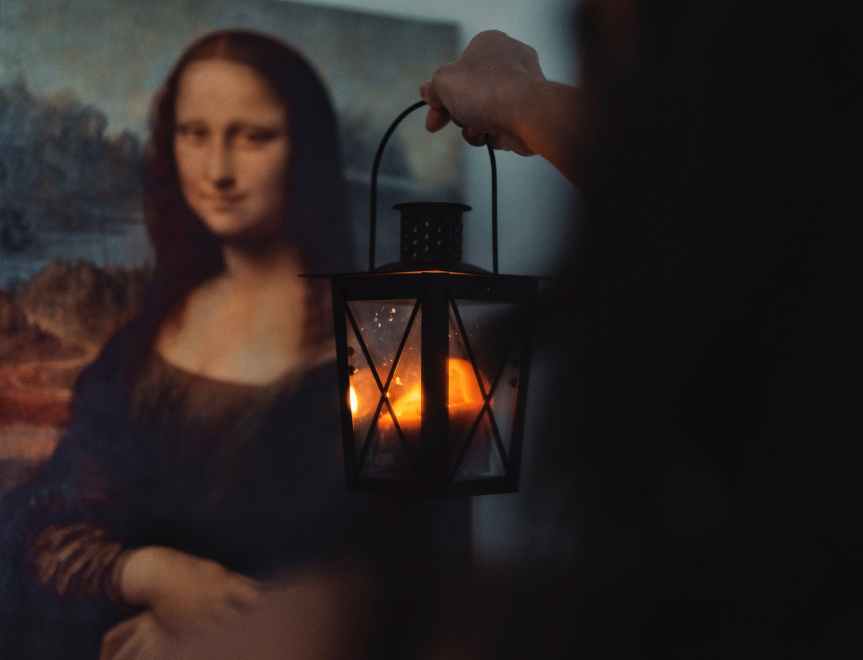
Looking on the famous renaissance artist Leonard da Vinci is probably the best known Renaissance artists famous for his mass works is innovative techniques including laying of paints precise attention to light shadow and human form and the and a detailed eye for expression and gesture the classic Renaissance man was not only an artist but also and innovator scientist architect engineer and more. Why is fame initially e registered on his achievements as a painter also became known for his notebooks on a variety of subjects including anatomy astronomy botany cartography painting and paleontology. He was known for painting drawing much more and of credited as the founder of high Renaissance. Is Magnum Opur the Mona Lisa is is best known work and often regarded as the world’s famous painting Salva. Image substantial discoveries in anatomy civil engineering hydrodynamics geology optics and tribology and the famous artwork of Da Vinci was Monalisa Last supper self-portrait head of women lady with ermine vitruvian man the virgin Salvator mundi Ginevra de benci the virgin and child with saint Anne.

Michelangelo was an accomplished artist poet architect and engineer is artist versatility watch as such as I order is output in this field there prodigious. Despite holding a low opinion of painting a also created two of the most influential frescoes in the history of the Western art as a young boys Michelangelo what sent for Florence to study grammar however issue no interest but referring to copy paintings from churches and later became artist most of Michelangelo works were Pieta,David Doni tonado (holy family) the large bathers. Raphael is known as third of the great master artist of Renaissance Italy is works trailer extremely influential even during his lifetimes. Raphael express the humanistic philosophy that we had learnt in the Urbino court as a boy. The Raphael artworks where resurrection of Christ the holy trinity the creation of Eve from Adam madana with lamp angel angel holding a scroll God the father and the virgin Mary Madonna Solly portrait of a man.

And finally Donatello who nailed from the period known as the early Renaissance . He mainly as a sculptor and the realism. Us able to create mark stark break common in middle age. Donatello was gaining reputation using innovative technique and extraordinary skills is workwear David Saint George the feast of Herod Magdalena penitent Judith and holeferner.

Mental Health- still a taboo?

Just because no one else can heal or do your inner work for you, doesn’t mean you can, should or need to do it alone.

Lisa Olivero

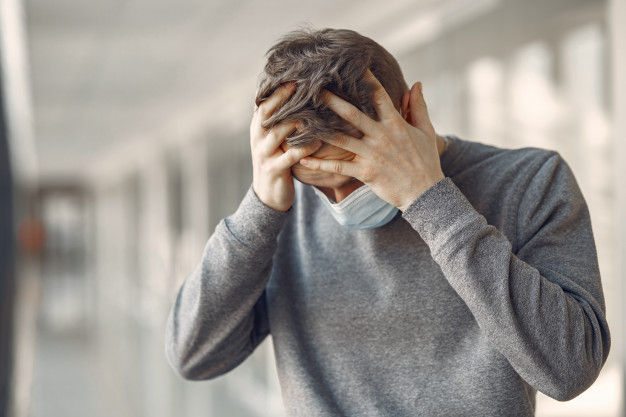
Have you ever felt the stark desire to inevitably scream in a room full of people, hoping they just care enough to notice the signs you have been leaving regarding your deteriorating mental state and how desperately you need help? But instead, you just accept your solitude in an empty chair and try to repress your bottled-up emotions deep within the realms of your consciousness.

A lot of us might have gone through the same situation at a certain point in our lives. The primary reason behind this subconscious aversion to the expression of thoughts is the mere fact that humans have been conditioned to do so throughout their lives. Men are typically the most vulnerable victims of this detrimental mindset. From an early age, they are frequently instructed to not cry like a girl. According to a survey, a significant percentage of men in the nation are currently depressed, and they themselves admitted that they lack a support system.

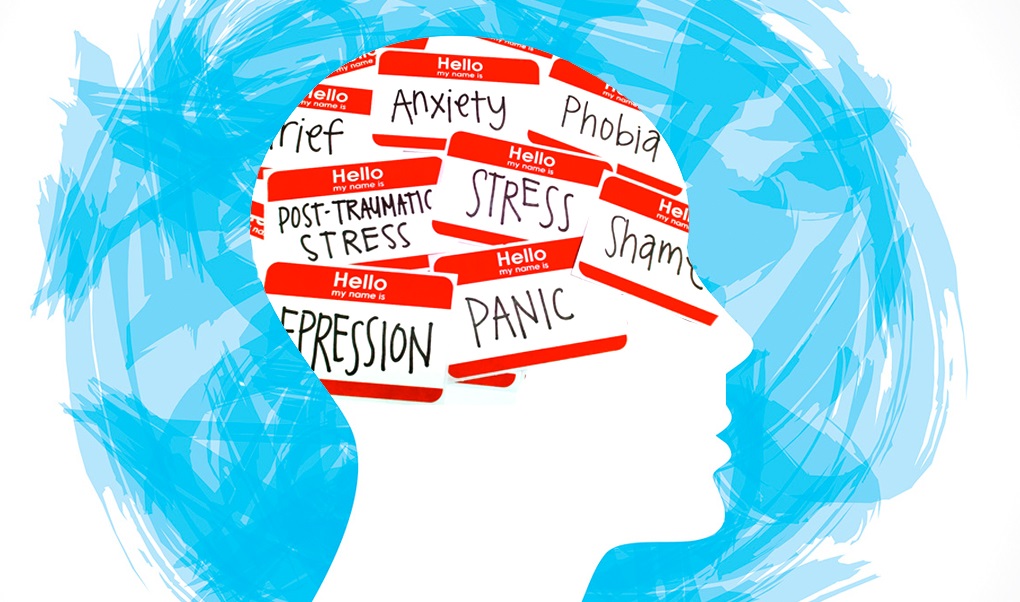
Mental health is still a deeply rooted stigma that people aren’t ready to accept. In order to understand the concept one needs to broaden the perspective of understanding humans and follow certain ways like-

  1. Instead of asking,”How are you?” ask,” How are you, really?”
  2. Look for obvious signs in a person- whether they feeling low from abnormal no. of days.
  3. Asking your closed ones to describe their day in detail and be a good listener.
  4. Do not mistreat someone who is already going through some sort of trauma.
  5. Treat people with kindness, you never know what someone is going through.

Additionally, in India, therapists continue to be overlooked as a useful resource for treating a person’s mental health. A person is called a “lunatic” if they see a therapist. In light of the increased public awareness during the pandemic’s lockdown time, these issues are being explored on social media, and many people now see psychology as a crucial component of the educational system. People have now started considering mental health as being equally essential as physical health as because of an alarming spike in suicide incidents during this period.
Still, awareness needs to be assured at ground level and there is still a long way to go to see the day when all of us are not reluctant to lend a helping hand to our fellow humans.

A fundamental aspect of any society should be understanding, accepting, and embracing each and every emotion one feels which makes them human.

CAN WE BUY EVERYTHING WITH MONEY?

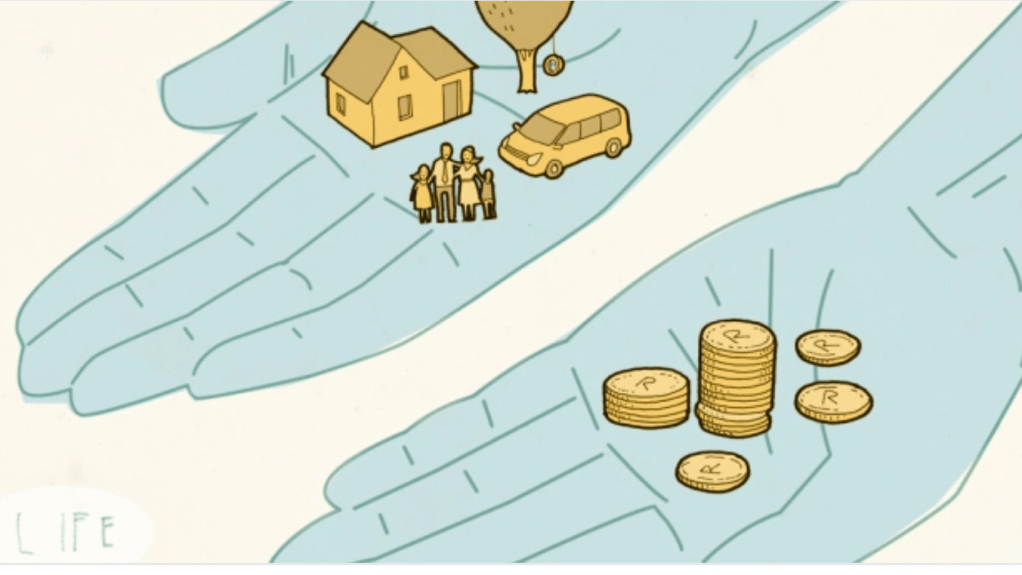
In todays world we all are in a race to earn more money to get everything but we never think about the things that we can’t buy with money because we all think that those things are very easy to get. In trying several methods to earn money we all miss the small and precious pleasures that life offers to us. We people sometimes behave too greedy in earning money and at some stage of our life we feel that money can itself give us all things we want. Yes, of course money can give us a good stature in the society but we can’t buy our health, satisfaction, happiness and many more things with money.

The most important thing in every body’s life is having a lovable and supportable family with us. Many of us think that we can buy those relationships with money or some of us may also think that every relation is made for the sake of money only. Guys we can buy the relations with money but we should always remember that we can’t buy the true love and effection of our dear ones with money. There is also a saying that the people who enters in our life because of our money will leave us easily when we loose all our assets.

It is important for all of us having an efficient money to enjoy the luxurious life style and it is also important for us to look after our parents who crossed all the barriers to see their children in heights but most of us neglect them when we reach our desired position and we forget about the responsibilities on us but I’m sure guys we can never get back our parents love and care once after losing them in our life though we are ready to pay a large amount of money for them. Guys , Money has it’s own signature in every moment of our life that may be positive or negative.

It is necessary for everyone to understand about the adverse effects of the money in order to know about the reality of our society. Guys always be conscious before losing anything that is available in nature that may be your parents or your health or your time and most importantly your life because you can not bring them back with your money if you lose them once.

To be clear, I’m not against of earning money or improving assets but I’m trying to convey that spend your money wisely and know the reality of the society to lead your life in a perfect way. Money can arrange all the necessary things in your life to survive but it is not only the thing which helps you to live your life happily. The only aim of this article is, one should give equal priority to their values and responsibilities in this running world apart from earning money and should understand that money is something that we need but not every thing in life and never forget that time is more precious than money.

Jagannath Puri Rath Yatra: 5 Fast Facts about the temple.

One of India’s biggest festivals, Rath Yatra begins today, July 12 and that is celebrated all across the world by millions of Indians. The festival has its primary significance in Indian states like Odisha, Jharkhand, West Bengal and Assam.

Picture Credits: India TV. Location: Puri Jagannath Temple.

As everyone has their eyes on Puri Jagannath Temple’s grand celebration for this festival, let us know some of the important facts about the temple.

1) Formation of Temple.

The temple was first built by the Ganga Dynasty ruler Anantavarman Chodaganga in 12 Century CE and was further developed by several other kings including that of the Ganga Dynasty as well as the Suryvamshi Dynasty.

2) Deities Worshipped

Lord Jagannath, Lord Balabhadra and Goddess Subhadra are worshipped inside the temple. The deities are adorned with different jewelleries and accessories according to different seasons.

3) Structure of the Temple.

The Temple has four distinct structures:

a) Deula, Vimana or Garba Griha where the triad deities are kept on the ratnavedi, the throne of pearls, in Deula Style.

b) Mukhashala, the frontal porch

c) Nata Mandir, Natamandapa which is known as Jagmohan, the audience hall or the dancing hall.

d) Bhoga Mandapa, the offerings hall.

The main temple is a curvilinear temple and crowning the top is the Srichakra, an eight spoked wheel of Lord Vishnu. It is also known as Nilachakra which is made out of Ashtdhatu and is considered sacrosanct.

4) The Food Offerings:

The food is offered to the Lord six times a day. The breakfast that is offered early morning is called Gopala Vallabha Bhog, the next offering at about 10 am is known as Sakala Bhog and another offering after some time is called the Sankhudi Bhoga which consists of Pakhala with curd and Kanji Payas.

The noon offering is known as Madhyanha Dhupa and that is followed by evening food at 8 pm known as Sandhya Dhupa. The last offering to Lord is called the Bada Simhara Bhoga.

5) Rosaighara- Temple’s Kitchen.

The temple’s kitchen is considered to be the largest in the world. About 56 varieties of food are produced which are purely vegetarian and prepared without the use of onions, garlic or chilies as prescribed by some Hindu Texts. Cooking is done only by using earthen pots with some water that comes from two nearby tube-wells known as Ganga and Yamuna. The most awaited food offering is known as Kotho Bhoga, offered during Mid-Day. After being offered to Lord Jagannath and other deities, the food is sold in a nearby market.