Learning is the process of acquiring new understanding, knowledge, behaviors, skills, values, attitudes, and preferences. The ability to learn is possessed by humans, animals, and some machines; there is also evidence for some kind of learning in certain plants.
Bhaurao Patil we born at Kumbhaj, a village on the banks of the river Warna on 22 nd september, 1887. Though agriculture was the main occupation of his family, Bhaurao’s father, Paigonda Devgonda Patil, preferred to work as a clerk in the Renenue Department of the Government of Bombay.
Bhaurao patil came to Kolhapur after the latter completed his primary education. He was admitted in a Jain students hostel run by the orthodox Jain Community. It was during his stay at Kolhapur that Bhaurao came under the influence of the Satya Shodhak Samaj. In his own district, the heroes of the underground resistance movement of 1942-45 received considerable help form Bhaurao Patil. He urged that every village should have a school and every village school should have a trained teacher. For several years he concentrated more on the opening of teacher training colleges and primary schools rather than secondary schools. He wanted his students to be self-reliant, and they were expected to learn while they earned their bread.
Bhaurao lived long enough to see his Rayat Shikshan Sanstha grow like a banyan tree. He was widely acclaimed as a great educator of the masses. A few days before his death on 9th may 1959, in the University of Poona conferred on him an honorary degree of Doctor of letters. This was surely one of the glorious moment in his ardous life when he felt happy over the public recognition and appreciation of the noble cause which he upheld against all odds. Today Bhaurao Patil was not in our but he always remember to all peoples through his work.
Everything has a positive and negative side. Similarly, online classes has both positive and negative sides. On one hand, the e-education and online classes have emerged as a solution for the educational crisis in current pandemic and thanks to these technological advancements which helped the students to continue their education. But on the other hand, online learning has numerous negative consequences also. In this article. we will try to identify and understand some these negative consequences and effects of online learning.
Due to pandemic, everybody lost many things, everyone’s life and lifestyle have changed and society has been altered but the there’s a huge impact of this pandemic is on the children’s of age group 4 to 9. These children’s should be learning new thing now, exploring and playing and making friends but all these things are nearly impossible for them in current situation. The pandemic forced the kids to moveout from the learning zone with which they were acquainted, like a classroom and are setup in the completely opposite scenario, where the students have missed many essential part of their education. The sudden transition of education from classroom studies to online learning will also have a huge impact on them. However, the new generation is very internet savvy but the e learning has certain limitations. Online learning comes with many challenges that has many impact on the students.
The main issue here is the lack of consistency…Children are more attentive and curious to learn things when they were in class but in this online learning scenario, the consistency of these children to be focused on studies and concentrated decreases. A students interest to answer the questions and clear doubts is more in classes but this is reduced in online learning. The willingness of a student to get his or her doubts cleared and participate in the class decreases due to the lack of one to one reaction with the teachers.
Reduced Concentration and Self Discipline… The major limitations that the students are currently facing in the online learning is reduced concentration in the class and self discipline. A school classroom provides the complete atmosphere which boosts the interest and concentration of students to learn. And such environment and structure which is effective for learning is not present at home. This classroom atmosphere give the best environment to student where they can learn, complete their assignment. Homes lack such things and as a result of which students struggle to finish their homework’s and assignments, lack of motivation and lower goals for themselves. This also discourages the students to do better in academics and explore new things.
Reduced Interaction with Peers…In addition to lack of motivation to study, the very important part of a child’s school life is also missed. This is their interaction with friends. Schools provide a neutral environment for students where they can study as well as enjoy. There is scope of social interactions which aids in developing many new skills such as understanding people of different personalities, setting boundaries, learning cooperation and empathy etc. These skills are very important for the students as it helps them in socializing with others. But such facilities cannot be provided in the homes due to the current pandemics. Because of this the students get isolated and a sense of isolation can emerge in them.
Health Hazards of Online Teaching… Online learning required continuous focus of screens which has many physical health and mental health hazards. The increase in screen time is one the major concerns and disadvantages of online learning. Some students may also develop bad posture and physicals problems. It has serious impacts on the eye sight of the students also.
IMUN conferences a way towards success. A platform where your voice matters. Before IMUN conference we have to know about IMUN first.
What is International MUN?
International MUN is recognized by the United Nations & has hosted MUN conferences in 5 different countries in the last 3 years i.e in Thailand, Vietnam, Egypt, China & Malaysia.
About IMUN conferences.
IMUN conferences is a platform where students (or anyone) are tasked to solve global issues like women empowerment, gender equality through research drafting, lobbying and debate to pass a suitable ‘resolution’. This conferences are held on sat-sun every week. After completing the whole registration process you will get a mail, in that mail they will give you the meeting link and the topics for the conference. You have to select one topic and have to research about that respective topic. e.g. I completed my whole registration process, got a mail and selected a topic. Suppose my topic is women empowerment, so I have to research about that topic like what are the issues and how can we solve those issues?. So on a day of online conference I will represent india (if I get india) and the women empowerment in India. I have to discuss the problems and respective solutions about the topic with other members. If you don’t wants to talk it’s okay, you just have to interact with the members.
What is an International Model United Nations (IMUN) conference and Why should someone participate in it ?
International MUN online conference is a 2-day model UN conference where participants from around the world present solutions to global issues. They can choose topics of their choices in every conference. In a 2-day conference, they research about the topics, debate, network with other participants from different countries etc.
Participants also get study materials, free MUN training sessions, experts QnA and position paper submissions. At the end of the conference, all participants receive participation certificates recognised by the Australian embassy and the United Nations. The best participants receive two certificates, one is participation certificate and another is award certificate.
What are the benefits of attending IMUN conferences?
Participating in IMUN conferences helps students to develop leadership skills, communication skills, public speaking, writing, research and many more. You will get a international certificate of participation by United Nation which will help you to get a good job. Interesting with foreign students, discussing and solving global issues with them what would be more interesting than this!!
How can I register? You can register through the link attached below
The term “drama” comes from a Greek word meaning “action” .
Drama is the specific mode of fiction represented in performance: a play, opera, mime, ballet, etc., performed in a theatre, or on radio or television.
A problem play is a type of drama . As the name suggests, problem play discusses problems openly in the form of play in theatre or stage. It is a drama built around a specific problem. The problem is generally of a sociological nature. Problems such as prostitution, inadequate housing, unemployment, labour unrest, etc. are mostly found as major subject matter of the play . It examines a specific social or political problem with the aim of igniting public debate.
It was established in France in the 19th century to deal with controversial social issues in a realistic manner openly to the audience. It flourished in England in the period between the last years of the nineteenth century and the middle of the twentieth.
It deals with the social problems or ills through debates between the characters on stage, exposing the conflicting points of view within a realistic social context.
According to Albert Guerated , ” The problem play is the presentation of a contemporary question through realistic techniques”
The dramatists of the problem play were preoccupied with the vital problem of contemporary life and morality and the drama which was directly inspired by the society of the time could be effective only if it adopts a realistic form or medium.
___________________________________________
The beginning of the problem play was introduced into England towards the end of the nineteenth century by Henry Arthur Jones & and Sir A. W. Pinero . Towards the end of the 19th century the English society started feeling the need of something new and refreshing on the stage and therefore the start of problem play began .
Pinero’s most popular play is The Second Mrs Tanqueray which deals with the marriage of “a woman with a past.
G. B. Shaw and Galsworthy took the problem play to its height in the twentieth century.
G.B Shaw plays , Widowers’ Houses, Mrs.Warren’s Profession ,Arms and the Man and many other plays are concerned ,as the writer saw it, less with the crimes of society, and more with its romantic follies and with the struggles of the individuals against these follies.
Some other examples of problem play are :-
The earliest forms work of Alexandre Dumas, dealt with the subject of prostitution in The Lady of the Camellias.
Shakespeare ‘s All’s Well That Ends Well, Measure for Measure, and Troilus and Cresside written between the late 1590s and the first years of the seventeenth century: These plays are difficult to classify because their sombre themes and cynical tones contrast oddly with their comedic elements, and the moral issues raised are not satisfactorily resolved.
Ibsen’s plays are mostly problem plays. His works usually concentrated on the moral dilemmas of a central character which dealt with a social problem such as in A Doll’s House (1879), sexually-transmitted disease in Ghosts (1882) and provincial greed in An Enemy of the People (1882).
In America the problem play was associated with the emergence of debates over civil rights issues. Racial issues were tackled in plays such as Angelina Weld Grimké’s, Rachel
Shaw’s Mrs Warren’s Profession (1902), examining attitudes towards prostitution; and Galsworthy’s Justice (1910), exposing the cruelties of solitary confinement and the legal system.
Some plays by later writers such as A. Wesker, J. McGrath, Caryl Churchill, H. Brenton, and D. Hare also raises contemporary issues, in the form of problem play.
___________________________________________
The problem play is also termed as “thesis play,” or “discussion play “ . As the play discusses the social ill and opens a room for discussion over certain important topics for the audience. Using the serious subjects it brings to life some contemporary controversy of the public,by creating a somewhat simplistic, didactic thesis with the audience .
The problem play is sometimes called “the propaganda play,” for the obvious reason that its intent is overtly didactic and propagandist.
Problem play or a play of ideas deals with a particular social or moral problem related to love, marriage, sex, war, peace, justice or crime etc. and tries to suggest a solution to it. It profusely takes the recourse of wit, intellect, materialism and realism. A problem play finally opposes and rejects all types of narrowness, confusion and falsehood, and adheres to the principles of equality, freedom or justice .
Scoffing at the romantic view of life the new genre of drama examined the social institutions and social ills . Slum landlords, prostitution, marriage conventions ,social prejudices, romanticized soldier, glamorous historical figure, medical profession, critics, religion- these are but some of the people and things which come under the major theme of problem plays during the 19th & 20 th century .
Many dramatists used problem play for the theme of socialist and socialism.
The problem play is supposed to have arisen out of sentimental drama of the nineteenth century and has often been identified with ‘serious drama ‘ ; a dramatic form distinctly serious but not tragic that aims at presenting the real life problems using fiction on a realistic level.
Technology is something every kid of today’s generation will be well familiar with. It has been growing at an immense rate and has been impacting every section of the world from quite a few years now. Technology has garnered high attention especially in the recent pandemic times as it has served as an indispensable tool for students amidst their ‘online classes’. However, we cannot restrict ourselves to only one aspect of technology, for technology has been bridging the learning gap from a long time by enabling students the access to a virtual world of resources at almost no cost.
A foremost benefit of technology has been the vast availability of resources for students and teachers. These resources can be in terms of education matters or to discover new ideas. Teachers now are also able to communicate with their students in a convenient way as well as have the freedom to employ new innovative teaching methods in their studies. Free access to e-books, e-magazines and other reading materials has made it a lot easier for students to acquire materials without having to search through libraries or spend a lot of money in bookstores. This divergent range in materials has also enabled them to research their subject of interest from different points of views and gain as much as knowledge available from verified sources.
The second pro point of technology is its feature to obtain a degree through online education. It does not matter whether you are young, old or just passionate about learning a new skill. It is now possible for any individual to gain a degree without the need to attend a university physically. Technology extension has provided such efficient modes that one can now enrol in prestigious universities located abroad without requiring the need for a passport or visa. Technology has also made it possible for people to sign up for a course offered by any valid institution and complete it within the time limit they wish. Giving them advantages like flexible study routines along with the comfort of their rooms.The third way through which technology has changed the lives of students is by giving them the opportunity to learn at their own pace and their own understanding level. Science has proved before that every individual learns and acquires knowledge differently. Some people are visual learners, some auditory, some verbal, some kinaesthetic etc etc. Here, technology gives a chance and means for every type of learner to learn at the best of their ability. For example, the availability of videos, audio books or audio contents, exercises etc accessible through the forum of technology gives every kind of learner a chance to shine compared to the usually dull and closed environment of physical classrooms. In addition to all this the advancement in technology has now enabled digital simulations and models thereby, enhancing the perceiving powers of students.
The fourth advantage of technology is the easy availability of any news or notices related to their subject or university. The official website of a university serves as a major way for students to procure information with ease, which can be further related to their classmates, friends or teachers through any social media apps of their choice. Not only does it provide an instant way to obtain the latest news but also helps to keep the students up-to-date along with their ongoing course subjects.Lastly, in the present times of pandemic, technology has proved to be a big boon in accessing online learning methodology. It has made assessing students efficient as well as helped vastly in maintaining records of student activities through a variety of online applications. Furthermore, teachers can upload their teaching materials and class recording on apps like Google Classroom and make it possible for students to revisit the teachings for revision sake or in case they end up missing any of their online lectures.
To conclude, technology has come a long way and has successfully impacted the lives of students. It has made students’ lives easier and more efficient by providing them various benefits like e-printed books, ease of access to education, faster communication with teachers and friends and overall comfort of homely environment.
Case study : Effect of global warming on the Sundarban National Park, West Bengal. Methodology:
Description of the problem.
Cause of the problem.
Analysis of the problem.
Control of the problem.
➡Introduction to the problem: The Sundarbans provide important protection against storms and flooding for cities including Kolkata, India, on the Bay of Bengal. But increasing global warming accelerates the sea-level which adversely affects the Sunderbans. This would eliminate the protection they provide against the region’s from the intense tropical storms.
Scientists project that under a high emissions scenario, relative sea-level rise is likely to inundate most of the Sundarbans by mid-century, and could wipe them out by the end of the century.
Mangroves of the Sundarbans prevents the damage caused by the cyclones and storms.
➡Cause of the problem:Global warming is one of the main reasons for the increased sea-level which adversely affects
the mangrove forests. Due to which reserved space is no longer a safe refuge for mangrove forests and their associated species. And other national parks also face damage due to climate change in the form of an increase in invasives, loss of vulnerable species, and changes in species composition. In a few cases, the biome as a whole faces extinction. Climate changes has already begun to have negative impacts on ecosystems and their families.
➡Analysis of the problem:
•Global Temperature Report for 2019 by Berkeley Earth: This is the report by the Berkeley Earth (a California non-profit organization) which clearly shows the continuous increase in temperature of earth in the past years.
•Ecosystem is a cycle which can only be run with balance. Any change in the climate causes imbalance of the ecosystem which causes different natural disasters and global warming is one of the biggest problems which we are facing nowadays.
➡Control of the problem: The only solution to control any of the problems is to keep balance in all the things. The main cause of the bad effects on the Sundarbans is global warming or we say continuous rise in the temperature of the earth which causes rise in the sea-level, cyclones, flooding, storms etc.., which adversely affects the reserved part of mangrove forests and other national parks.
Ways to prevent global warming:-
● Reduce⬇ Reuse⤴ Recycle🔄
● Power your home with renewable energy.
● Reduce excess use of water. There is a solution for every problem. We just need to focus on the problem and prevent rise of
The story of early skyscrapers begins in the late 19th and early 20th century America. Between 1884 and 1945 numerous skyscrapers were built American cities of New York City and Chicago. The two cities competed with each other with many subsequent constructions surpassing the earlier one. The growth of the skyscrapers in the 20th century American cities were mainly fueled by dynamic economic growth as the demand for various new office spaces to hold America’s expanding workforce of white-collar employees continued to grow. With better engineering and construction methods it became easier to construct taller buildings.
Flatiron Building in New York City finished its construction in June 1902. The 22 floors building was one of the first tallest skyscrapers and later in the subsequent decades even taller buildings were constructed.
But the developments of modern skyscrapers have many challenges and questions that need to be cleared. Though the growth of skyscrapers has not subsided, they are not the most ideal form of buildings. According to engineer Tim Snelson, of the design consultancy, a typical skyscraper will have at least double the carbon footprint of a 10-story building of the same floor area. This tells us that skyscrapers are not environmentally sustainable. Also, any additional methods to minimize the environmental impact will require overcoming the fight of the handicap of being a tall skyscraper in the first place. As the majority of the building is made with glass and steel frame, high-rise buildings are subject to the consequence of the substantial amount of sunlight and a lot of wind on their mostly glass skins. Glass is inherently inefficient in keeping excessive heat out of the buildings in summer or keep heat trapped in the colder months. This also leads to the reliance on continuous Air Conditioning.
The modern construction of skyscrapers in the cities of today is no longer driven purely by economic growth or the need for commercial office space, but instead, it is more driven by glamorous architecture construction and many times the dirty money gets funneled into the construction of Skyscrapers. High rises also separate people from the street and people lose a connection to nature and the outdoors. The occupants in the tall buildings are often isolated from the street of the city and meaningful contact with ground-level events is often disconnected with taller buildings.
High-rise buildings also lead to gentrification and inequality. It is no surprise that taller buildings often tend to be luxury units as the higher a building rises, it becomes more expensive to construct. This means that high rises also inflate the prices of the adjacent lands and driving out the affordable properties, thus increasing the inequality. The areas near the skyscrapers are often dark and swept under the shadow of these tall buildings.
Contrary to the popular notion, skyscrapers are not the only way to build high-density construction. The mid-rise buildings are often more able to house more amount of people per area compared to the high rises. Mid rises are also more flexible to affordable. The mid-rises can work as a good middle ground between the taller buildings and low-density buildings. Instead of blindly building taller buildings we will have to look at the construction of our future buildings that are more sustainable, affordable, and efficient.
I learnt of Climate change and global warming in high school and just revisited it after 7 years.
On the 6th of June 2018, Texas was hit by a hail storm – in the middle of a summer. The Artic has lost more than 50% of its ice. Russia, US, Scandinavian countries and many more are already on their way to claim the resource rich seas. The average temperature of the world is higher than ever. The awe that people had when the skies were clearer during the near global lockdown due to COVID-19 was evident. The amazon rainforests are on fire, yes, they still are. The Canadian and European forests are burning faster and earlier than in recorded history. There have been cases of untimely forest fires in India as well, not to forget that a large part of Australian bush wilderness was lost in 2020. To add to this, a million cubic meters of the Gulf of Mexico is dead, Antarctica is browning, Yemen has lesser water than the already no water situation and many countries have brought green energy into their federal budgets. That’s a lot many things happening together.
When I was still a high school student, we had studied about all the important conventions and their goals with regards to the planet – the Kyoto protocol, the Montreal Protocol and so on. Then came the Paris Accords. To add to it was the information that global temperatures must be limited to a degree and half more than the 1950 level or else the planet will go berserk. I don’t know how old the new news is, but the news is that the scientists concluded that there is no way the goal can be achieved. And now we must try to limit the temperature at four and a half degrees above the previously said level to avoid the loss of agricultural lands across the planet.
That is a huge leap of faith for me and maybe for many more people who do not really invest even very small amounts of time to know the news that the planet has to give. We are too occupied with corruption, civil wars and international blame games. To be frank, I try not to waste water, electricity or even throw plastics or dump trash outside a bin or a designated area. I try to walk or cycle and as of now, just lie around in my room for most of the time. And the trouble is, the environmental problems are too large now. Because one, everyone doesn’t carry out the simple acts of being considerate towards the environment and two, the emissions by the rich and the ones not so rich but busy in producing what we consume are too big and have restrictions full of loop holes on them. The environment norms are yet not very sturdy. Sturdy is not strict, rigid and harsh. Sturdy are the ones that help. For instance, to implement rules eliminating the use of fossil fuels based vehicular fuel eliminates the exhaust the vehicles shall produce. However, in most countries, especially the most populated ones in Asia, South America and Africa still produce their energy using fossil fuels. How are these countries going to charge electric vehicles? Using fossil fuels. That in turn means the use of “dirty” energy is itself not eliminated. There are several more examples like the flawed system of Carbon credits and so on.
What can we do? Be more considerate to the world to reduce domestic output of toxins. And to reduce consumption of goods that are harmful to this planet. And google is a sufficient enough aid for knowing which products do that and which don’t.
Any undesirable changes in the physical, chemical or biological characteristics of any component of environment i.e. air, water and soil – which can cause harmful effects on various form of life or property are called environmental pollution.
Consequences of pollution
Any favorable unpolluted environment has pertains a specific composition in their component i.e. air, water and soil.
The problem like pollution come into existence due to short-term economic gain over long-term ecological benefits for humanity.
During last few decades we have contaminated badly on air, water and land on which life itself depends with a variety of waste products.
Be the part of Solution , not the part of Pollution…
We can survive without food for a few days, without water for few hours but without air it is impossible to survive for few min.
An average human require about 12 Kg of their each day which is nearly 12 – 15 times greater than the amount of food we eat.
Types
Air pollution
Water pollution
Soil pollution
Marine pollution
Noise pollution
Thermal pollution
Nuclear hazard
Air pollution
Air pollution started from very beginning of human evolution. Hippocrates had mentioned air pollution in 400 BC.
Any undesirable changes in physical, chemical or biological characteristics of any component of the in air which can cause harmful effect on living things is called Air pollution.
Earlier the air pollution is caused only by burning of fire word as a means of cooking and heating.
With the industrial revolution the problem become more serious due to cold burning in the industries and development of Transportation system leads to large amount of petrol and diesel was started utilising in the beginning of 20th century.
Severe air quality problem due to diesel and petrol engines were felt for the first time in Los Angeles in1943.
The gaseous pollutants include oxides of sulphur, oxides of Nitrogen, carbon monoxide, volatile organic compound, Ozone etc.
Particulate pollutants includes smoke, soot, fumes, aerosoles, liquid droplets, Pollen Grain etc.
Radioactive pollutants include Radon222 , Iodine 131, Strontium 19 plutonium 239 etc.
Greatest industrial disaster leading to serious air pollution took place in Bhopal were extremely poisonous methyl isocyanide gas was accidentally released from union carbide pesticides manufacturing plant on the night of 3rd December 1984, the effect of this disaster on human health and the soil are felt even today.
Now we know this tragedy as Bhopal gas tragedy.
The London smog was the major disasters were recorded in 1952 which cause more than 8000 deaths due to accumulation of air pollutants over the city for 5 days.
Primary pollutants – primary pollutants are emitted directly from the point source (natural or human activities).
Five primary pollutants together constitute 90% of the Global air pollution
Carbon dioxide
Carbon monoxide
Sulphur oxide
volatile organic compound mostly hydrocarbon
suspended particulate matter
Secondary pollutants – secondary pollutants formed by the interaction of primary pollutants. example – peroxyacetyl nitrate, smog, Ozone, sulfuric acid, nitric acid, carbonic acid etc.
Indoor air pollution
Many people spend large portion of their time in inside the homes as much as 80% of their life.
We work study, eat, drink, sleep in enclosed environment whereas circulation may be restricted.
Children and Womens are more exposed to rest in indoor air pollution
Burning of dung cake , wood, kerosene for fuel.
Cigarette smoke
Incomplete combustion produce carbon monoxide that are injurious to health.
Chemical fumes from paint and solvents
Chemicals released from Modern building and Furnishing material
A national language is the symbol of unity amongst the people of a nation and binds them together. It is what separates a nation from other nation’s. Amidst the sea of human beings of different race and culture having same facial features, it is a language which the person speaks that shows his/her identity(nation). It is a heritage of the entire nation which the people take pride in and it is what becomes their identity on the global platform. A person knowing many languages, connects them to many culture but there will be only one particular language in which they will take pride which is their national language.
Significance of national languages
History is evident of the statement that all the great leaders did their best to strengthen their national language to get an authority of power for their nation at the global platforms. One such example is of Zedong Mao, founding father of the People’s Republic of China ,who despite knowing many languages preferred to converse in Chinese at all global platforms . Today Mandarin Chinese, one of the thirteen Chinese languages is the official language of China and is the largest spoken language by the native speakers i.e. majority of the Chinese population prefer to converse in this single language which showcase their strength and unity.
Language Movement was one of the major cause of the start of civil disobedience movement in East Pakistan which led to the formation of an independent nation what we now call Bangladesh. During the partition of India , Pakistan got the western part as well as extreme eastern part of the former India which consisted majority of Bengali Muslims followed by Bengali Hindus and Christians. Though the religions were different it was the common term “Bengali” which is the language spoken by the natives of Bengal, which united the people there and thus put forth the pressure on the dominant Pakistan government to carry out all the official works in Bengali instead of Urdu. The clash of language and the reluctance of the latter to fulfill the demands of the inhabitants of West Pakistan was the reason for the formation of a new country.
What is the need of a National Language in India
India is a land inhabited by billions of people belonging to different culture practicing different customs and traditions but what unites us is the term “INDIANS” i.e. the nationality we share. There are 22 languages recognized by the Indian constitution which are mentioned in the eighth schedule. In the land of diversity while our nationality is the thing which bonds us, language sometime acts as a barrier to express oneself when a person is in a different part of the country.
If a north Indian from Punjab goes to South, trying to converse in their regional language ,their mother tongue which is Punjabi, the receipient may not understand the words. However, if there was a common language apart from the mother tongue which both the parties understand the act of expressing would have become more easier.
Should Hindi be recognized as a national language?
According to the CBSE curriculum, which have its school spread across almost every city of the country, Hindi is a compulsory language till class VIII.
Moreover, there are two main branches of languages in India which are Indo-Iranian and Dravidian languages. The INDO-IRANIAN BRANCH OF LANGUAGE is mainly spoken in the northern part of the country and various languages spoken in the northern part are derived from it like Hindi, English, Punjabi, Marathi, Bengali, Urdu. Being from the same branch of language they are more or less the same.
Whereas, the DRAVIDIAN branch of language is dominant in south taking regional languages such as Tamil, Telugu, Kannada and Malyalam under it wing.
Also, the north eastern languages are different from both of these.
Since majority of India speaks Hindi, it can be included as the national language not forgetting that it symbolizes the name of the nation in hindi which is HINDUSTAN.
During the later half of the 18th century, there was a revival of interest in the life and art of medieval times. The gothic novel arose out of this new zeal for medieval life and fashions.
Gothic Novel:
The Gothic novels of the period sought to satisfy the reader’s craving for mystery and violent emotion and for stories set in remote times and places, depicting ghosts, portents, and demonic forces at work.
Themes of the Gothic Novel:
Generally, the central theme of the Gothic novel is romantic love. A somber, restless villain is the central figure.
The innocent, beautiful heroine probably imprisoned in a castle wants to be rescued by her lover.
The scene is placed in a castle or the dark cloisters of a ruined Abbey equipped with frightening secret passages and private chambers.
Structure of the Gothic novel:
Supernatural events, physical violence, and mental anguish are part of the thematic structure of the Gothic novel. Wild and desolate nature provides the background. The central sentiment of the Gothic novel is melancholy. The Gothic novel was, thus, a conscious protest against the rational and realistic creed of the earlier period.
The father of Gothic novel:
Horace Walpole is called the father of the Gothic novel. His “The Castle Of Otranto” published in 1764, set the trend. He used a medieval setting for this novel. There is death murder, intrigue, and villainy in the novel. The Castle looms large as a sinister symbol until a ghost throws it down.
Ann Radcliffe
Ann Radcliffe continued the gothic tradition in several novels. Her best work is ‘The Mysterious Of Udolpho’ published in 1794. It shows an extravagant spectacle of Gothic elements like the somber castle of Udolpho with its sliding panels, secret passages, and supernatural sounds. Her other important novel is “The Italian.” Her method way to arouse terror and curiosity by apparently supernatural events which are finally explained as natural events.
Some other Gothic novels:
Dracula by Bram Stoker
The strange case of Dr. Jekyll and Mr. Hyde by Robert Louis Stevenson
The Turn of the Screw by Henry James
The Fall of the House of Usher and Other Tales by Edgar Allan Poe
Wuthering Heights by Emily Brontë
Frankenstein by Mary Shelley
The Picture of Dorian Gray by Oscar Wilde
Why they are famous:
The plot and content of the gothic novels will be Scary and mysterious. The book contains several allusions and assumptions. The plot always seems creepy to the readers. And during that era, people needed some drama and unrealistic elements in their life to boost up the experience of reading time. When some novels started to fire up the process of Gothic literary forms, more authors started to write on this theme. Even, some well know authors who are famous for their humorous works and romance works started to write Gothic to follow the trend and current affairs.
However, People love unrealistic dramas and fiction, especially Gothic elements. Thus, Gothic novels will always entertain their readers with the plots and beautiful narration of dark aesthetics.
Japanese people have a unique way of living that provides many lessons for people willing to open their minds and understand their incredible culture. Japan boasts a nation of people who are incredibly kind, good-natured and polite.
The few things I learnt from them are :
REVERENCE TO PEOPLE
Japanese are masters of showing respect. Whether it’s the way they greet people they don’t know or their incredible attention to detail when it comes to developing relationships. The Japanese are mindful of respect at all times.
HARDWORK TO ACHIEVE GOALS
They work extremely hard to achieve their goals. Its for this reason that they’re one of the most pioneering, forward thinking nations on the planet! They work really hard in their careers, so they can support their families and work on self-growth.
VISIONARIES
Japan has some of the most pioneering technology companies on the planet, including Toyota, Nippon and Honda. The country has propelled its technological advancements to the forefront of human history. We must learn to believe in our vision, even if no one has achieved that.
DISCIPLINED LIFE
Discipline is akin to respect in Japan. To be disciplined is not to give in to your urges but to live a life that is respectable and based on profound will to do good for people.
CLEALINESS
In Japan, there is a general obsessiveness with cleanliness that starts in the home and extends to public spaces like parks and schools. It certainly makes the country an extremely pleasant place to be.
The Sri Yantra is a Mystical diagram, where the word “Sri” is known as “wealth” and the word “Yantra” is known as an “instrument”. This diagram is formed by nine interlocking triangles that are surrounded and radiated out from the Central (Bindu) point. The Two-dimensional Sri Yantra, when it is projected into three- dimensions is called a Maha Meru. In Hindu Vedas it is believed that worship of Sri Yantra creates a numerous positive effects. In simple words Sri Yantra is the symbol of Hinduism, which is purely based on the Hindu philosophy of vedas. In todays article I’m going to explain about a mystery on Sri Yantra which was found in Oregon, USA at 1990.
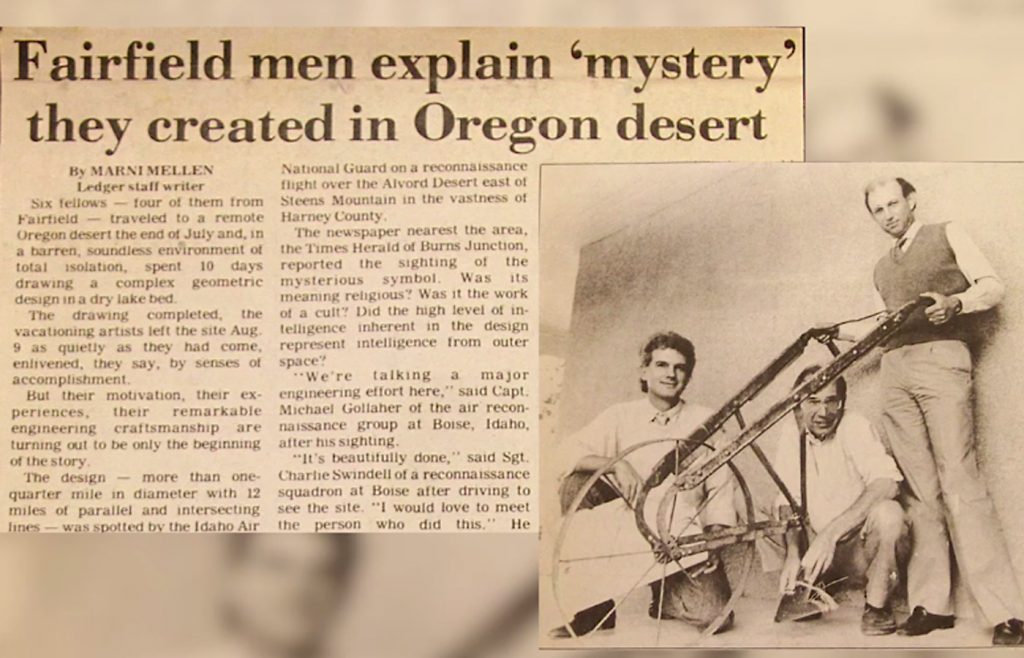
In the year of 1990 on august 10th an Air National Guard pilot Bill Miller noticed a strange formation on an Oregon dry lake bed that the Air National Guard frequently flew over on training missions. He noticed that massive formation is a quarter mile wide and is located 70 miles southeast of Burns, Oregon. Later they found that strange formation on lake bed as a Sri Yantra which occupied 13 miles in length and width.
Most of the officials suspected that mysterious formation took thousands of dollars and a lot of man power to complete along with high tech equipment and lasers and some people, including professors and researchers in USA believed that it was done by aliens and a team also assigned for searching clues about its formation.
For some time this event was treated with the head scratching bewilderment that accompanies crop formations. On the ground investigations revealed no tell tale signs of vehicles or human intervention. Word spread fast that it was an extra terrestrial event. People were intrigued and fascinated but got stuck on the how? And the wow! The event was debated for some time.
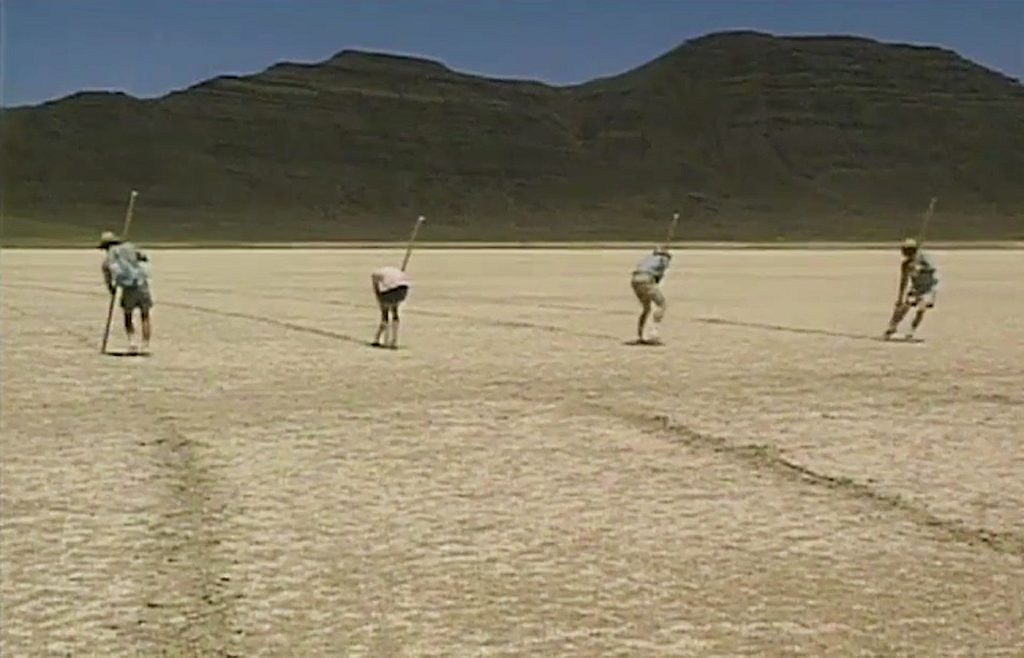
Suddenly everyone got surprised when an artist named as Bill Witerspoon from Iowa and his friends came into the picture of investigation by saying that, the mysterious formation of Sri Yantra on Oregon lake bed was done by them with the use of sticks, wires, 12 miles of string and a basic plow but most of the people doesn’t accepted with their statement on Sri Yantra formation. After a detailed interview with Bill witerspoon and his friends on this matter they said about the following matter
” In the year of 1990 on summer, Bill Witerspoon along with his group of friends went to a remote alkali lake bed in the high desert of southeast Oregon to inscribe a large Sri Yantra in the earth and they were also decided to live in the large central point that contain in Sri Yantra. For drawing the massive art form they chosen that site because of its beauty and remoteness. Almost no one, except a few ranchers, ever went there and they also felt that inscribing lines in the alkali surface would not disturb any vegetation and it would be a transitory event which eventually disappears back into the surface through the natural action of wind and the occasional water that floods the lake bed every few years. They also said that drawing of that art form took almost ten days for it’s completion.
After the completion of the art work they lived in the nine-foot central circle of the Sri Yantra for almost three weeks. During that period of their stay in that central circle they observed remarkable changes in the workings of Nature within the design and in the valley where it was situated.”
The art form that was drawn on that landscape subjected to change of the “feeling” within the valley which was eventually noted by ranchers and other people who have known the area for a long time. People reported experiencing qualities of energetic peacefulness, harmony with nature and enhanced intuition when they were in the design and valley. Another influence was a radical change in the quality of meditation that would repeatedly occur if individuals moved a few feet out of the central circle into the innermost triangle of the design or vice versa.
Changes in the environment were also observed vastly within the design, which had been inscribed in highly alkaline silt, incapable of supporting any kind of vegetation, there were remarkable changes in the direction of increased fertility. So, Guys this is the mystery behind the formation of SRI YANTRA on Oregon lake bed and there is no doubt in saying that people near Oregon lake bed had experienced the favourable changes only because of the Sri Yantra design on that landscape.
“A lie that is half-truth is the darkest of all lies.” ― Alfred Tennyson
In true sense, the word deception implies ‘make believe’, that is, convincing a person that something exists whereas, in reality, it does not exist. Deception is a simple tool for enticing people and trapping them to believe in something unbelievable. This is an evil that has subsisted among human beings since time immemorial in literature and history we come across several uses of deceptive methods; even in our contemporary world, deception is rampant. In fact, such is the enormity of deception that it is often difficult to distinguish the real from the fake. Consequently, even today we come across reports of how many large corporations, especially related to chit funds, dupe their investors through unrealistic schemes. As a result of their ‘get-rich-quickly schemes lakhs of innocent investors lose their lifelong savings because they are shown the dream of coming out of their miseries but are pushed to the brink of perishing.
Deception is also a major tool used in forging currency notes and other negotiable instruments like cheques and drafts. Governments across the world have introduced many new techniques to ensure that their markets are not flooded by fake currency notes or negotiable instruments but, so far, there has been no fool-proof methodology to prevent the menace. Master criminals always manage to deceive by preparing exact copies of the originals. The same applies for important documents like passports and visas.
With the dawn of online shopping, fraudsters have had a free-run as it is practically easy to dupe people and escape without leaving a trace. People end up paying money for products bought online but never actually receive the goods on many occasions, or even if they do, such goods are either defective or elaborately wrapped empty boxes are provided. Consequently, tracking cyber-criminals is very difficult and the number to solved cases is low.
However, like everything else, even deception is a double-edged weapon: it can be used against a deceitful enemy and so serves as an important military tactic, especially in guerrilla warfare. We have read how Babur, the first Mughal Emperor enticed Ibrahim Lodhi to charge headlong and then fall into the covered trenches on the battlefield or how Chhatrapati Shivaji, the great Maratha warrior, used deception to kill Afzal Khan and harass Aurangzeb. Nobody can ever forget the deception carried out by Mark Antony in inciting the Romans from the Forum to rebel against the conspirators who killed Julius Caesar.
In present day military tactics, elaborate plans are drawn out to combat the enemy. The best-known methodology is to plant spies among them so that delicate information can be easily retrieved and the opponent’s actions can be monitored.
Either Stable burning in various states accrued the air pollution in Delhi and created a gas chamber around NCR ; SC came upon a committee to observe scenario , Or 4 industries inflicting stream pollution were shut down by Maharashtra pollution board . Everybody has responsive to environmental problems as higher than . The key solution for resilience to environmental issues are provided by government in various legislations , enactments and provisions on environment laws .
In republic of India environmental law is concern with the policy and law for protection of the environment . It aims for achieving carbon free economy through taking measures for reducing climate change. All the acts under this laws are safeguards in ensuring effective management of the environment and its multiple ecosystems . It provides for preventing environmental damage .
Natural resources in the earth were unscathed from millions of years. It were remain pure until the industrialized started . After the industrialization this resources have been exploited in Spain of 100 years only . From 19th century, the environment (air , water and land ) is directly exploited by rapidly growing population at alarming-rates.
environment includes water, air and land and the inter-relationship which exists among and between water, air and land, and human beings, other living creatures, plants, microorganisms and property , as mentioned in section 2 of environmental protection Act of 1986 . Environment is a wide sphere , it consists of social, economically , political , religious dimensions .
Addressed area of environmental laws in India :
1. Quality of water : For the prevention and control of water pollution and to maintain or restore wholesomeness of water in the country the water act of 1974 was enacted. It further provides for the establishment of Boards ( CPCB and SPCB ) for the prevention and control of water pollution with a view to carry out the aforesaid purposes. This act prohibits the discharge of pollutants into water bodies beyond a given standard, it also lays down fine and penalties for non-compliance.
2. Reduction of air pollution and maintaining air quality : The Air (Prevention and Control of Pollution) Act, 1981 (the “Air Act”) is an act to provide for the prevention , protection and abatement of air pollution .It provides for establishment of Boards at the Central and State levels with a view to carrying out the aforesaid purposes.
3. Hazardous Waste management : legislations that directly or indirectly deal with hazardous waste management are the Factories Act, 1948, the Public Liability Insurance Act, 1991, the National Environment Tribunal Act, 1995 and rules and notifications under the Environmental Act.
4. Containment cleanup, damage mitigation : preventing future damage to the environment is undeniably the primary objective of environmental law, mitigating and reducing existing damage is also important. This area most often deals with issues like toxic leaks and oil spills. The central objective of this branch of environmental law is deciding liability, planning an appropriate response, and also determining the best process of investigation and monitoring in the overall clean up process. This area also concerns itself with the study and assessment of risk in the long term, to better mitigate any future accidents and risks.
5. Sustainability of resources : United Nations has put great emphasis on ensuring the sustainability of resources. For this vision , it has advocated the formation of various legal principles and legislation. In this regards concept of environmental impact assessment introduced .
Noble legislations and enactments on environment law in India :
Laws on Forest and wild life protection: • The Indian Forest Act, 1927 ; The Wildlife Protection Act, 1972; The Forest (Conservation) Act, 1980 ; The Environment (Protection) Act, 1986; The National Green Tribunal Act, 2010.
Laws on Water pollution : • The Water (Prevention and Control of Pollution) Act, 1974.
Laws on air pollution : • The Air (Prevention and Control of Pollution) Act, 1981 (the “Air Act”)
Laws on hazardous waste management : • Biomedical Waste (Management and Handling) Rules, 1998 ; Municipal Solid Wastes (Management and Handling) Rules, 2000 ; Batteries (Management & Handling) Rules, 2001 ; Hazardous Wastes (Management, Handling and Transboundary) Rules, 2008 ; E – Waste (Management and Handling) Rules, 2011 . Laws on wetlands
•Ramsar convention (1971) : This convention was initiated to push for greater conservation and sustainable use of wetlands ; Wetlands (Conservation and Management) Rules, 2017. Constitutional provisions on environment laws
• Part IVA (Art 51A-Fundamental Duties) of the constitution casts a duty on every citizen of India to protect and improve the natural environment including forests, lakes, rivers and wildlife, and to have compassion for living creatures.
• the Constitution of India under Part IV (Art 48A-Directive Principles of State Policies) stipulates that the State shall endeavour to protect and improve the environment and to safeguard the forests and wildlife of the country.
environment makes human life possible, and our cultural environment helps define who we are. It is therefore essential that our population and economic growth are environmentally sustainable.























 Eduindex
You must be logged in to post a comment.