Capture Your Prey!

“Your intuition knows what to write, so get out of the way.”

Ray Bradbury

Today’s article speaks about being a Tiger and Capturing your Prey. I’m sure you are left wondering as to how a tiger is related to writing. Let’s quickly delve into the topic to learn how!

Consider the entire concept of Writing as a Forest and the Tiger as a writer. A tiger succeeds in capturing his prey efficiently and is thus, proficient. Similar is the case with Writing. We have to Capture Creative Wordings in order to prove our efficiency. In short, the way you write is all that matters. Your Content is the prey! Capture it and be the king! Capturing the prey could also mean capturing the ‘X’ factor in the writing process!

However, some aspects are necessary to cover when aspiring to reach the ‘X’ factor. Let us view some of them!

Read More And More!

Consider reading books of famous authors who use native English vocabulary because they sometimes tend to make use of interesting phrases and go – to lines which you could use for your content.

Subscribe To YouTube Channels For English Learning!

YouTube, a widely used video platform comes with all the remedies, doesn’t it? All you’ve got to do is, type in the search bar “English learning for beginners” and vast options are available for you to scroll by!

Audio Books Are Bae!

A new concept is out in the market! You could purchase audio books and read them while listening. Sounds cray cray, doesn’t it? But that’s exactly what you can do if you aren’t much of a bookworm and would prefer listening rather than reading!

Try Conversing More In English!

Conversation is the key where vocabulary is the lock,

Go about framing interesting sentences as you talk!

Said by The Laconic Writer! 😉 This may be said by me, but isn’t it true? Go about framing interesting sentences which you picked up from the above mentioned sources. After all, when you learn something, you should implement it for further enhancement. That’s how conversation comes in handy! When you learn some advanced words, try using them in your day to day conversation so that you capture that particular phrase or word in your head for next use. However, make sure you don’t use heavy oxford dictionary words during regular conversations. After all, you don’t want your friends wondering the meaning of your emotions and expressions! 😉

Hold That Pen!

Another way is to hold the pen and write as much as you can think of and resolving to incorporate as many advanced words in your write up as possible! This helps develop your vocabulary.

Make A Note Of Certain Interesting Facts!

Try noting down certain mind boggling and humorous facts which you could use for your content. When you incorporate fun facts, your content becomes all the more engaging. Clutch an important topic and write an amazing fact on the basis of that!
Try Inventing Some Of Your Own Peculiar Phrases And Quotes!

That works! That really does work! Readers consider it interesting to read something new that you come up with. You could frame your own acronyms, come up with creative illustrations by dragging your mundane daily life elements or using natural aspects. For instance, helping caterpillars bloom into a butterfly meaning helping novices become experts 😉
These are some of the ways to effective English learning. All that matters is how well you Capture the Prey at the end while remembering that it comes from within and requires utmost imagination.

After you have gained expertise and strong hold on the reigns of vocabulary, remember to use your talent in copywriting. Don’t know what that is? Well, let me introduce you to it. Copywriting is content intending to make sales. It is solely used for marketing wherein you provide ample information regarding your services or products thereby compelling people to buy your facilities through the incorporation of various calls to action!

Call to action includes involvement of various links for customers to be redirected to the “buying” page. It also comprises of boosting content at the end that usually starts with a verb like, Try our products now and you won’t regret. You introduce discounts for your customers and create a sense of urgency by involving limited time periods for a specific offer or purchase of goods. You provide incentives to customers thereby getting them acquainted with the benefits of the product or service. You try creating convenient situations for them by providing money back guarantees. In short, customer satisfaction and well – being becomes your goal because marketing is all about understanding the pain points and desires of the mob.

Content is thus, the basis of digital marketing and to master copywriting, one needs to work on the creativity aspect of this interesting English language. Basic English vocabulary gives birth to intermediate expertise in it which in turn opens the doors to creativity and later helps you climb the advanced ladder of English language wherein you hop into copywriting.

A copy mustn’t ever include incorrect punctuations or grammar because that is enough to let your marketing efforts go down the drain!

Avoid redundancy or repetition of words. For instance, ‘We provide goods that are good enough for daily life.’ Sounds crazy doesn’t it?

Improper punctuation or overuse of it like, “We, provide, high quality, goods, and services.” Enough to infuriate the reader, isn’t it? That’s exactly why, it is advisable to work on enhancement of English before resolving to move towards copywriting.

Thus, now you know why improvement of vocabulary was stressed upon in the earlier part of this article.

What if you already are an ardent English fan and copywriting isn’t at all a monotonous or tedious task for you? Set up your own website and get marketing.

Thank You For Reading!

MIGRAINE- A Severe headache

Migraine is a medical condition described by severe recurring and intense headache. There can also be sensory changes called as aura. Aura includes visual disturbances like flashing lights, seeing zigzag pattern or a temporary vision loss. Other symptoms are nausea, stress, anxiety, hormonal changes, lack of sleep, vomiting, nasal congestion, sweating, diarrhea etc. Migraine affects the capacity to perform regular works due to pain. Sensitivity to light and sound may also increase. It is 3 times more common in women than men and affects more than 10% of the population worldwide. Migraine effects may vary from person to person.

HOW MIGRAINE IS DIFFERENT FROM NORMAL HEADACHE

Even though it is difficult to differentiate between the normal headache and a migraine, the intensity of pain may tell something about that. Migraine pain sometimes can be so severe that patient may need hospitalization which is not seen in the cases of normal headaches. Normal headaches tend to occur in both sides of the head. Migraine headaches can also occur in both sides, but majority instances include pain in only one part of the head. In normal headache you may feel pressure instead of throbbing which happens in migraine cases. Normal headaches are may be due to stress and worry or tiredness. But reason for migraine is unclear.

as already said, the cause of migraine is unknown. Some suspect that genetic features play a role in migraine. But it can be said that they arise mainly because of the changes in the way nerves communicate, loss of balance in chemicals and dilation of blood vessels in the head. But migraine can be triggered by hormonal changes, inadequate hydration, change in diet and some emotional triggers. Some medications can also cause it as side effects. Strong smells, loud noises or tiredness and lack of sleep also trigger migraine.

treatment

There is no cure for migraine. But medications can control or reduce pain and other symptoms. The frequency of the headache can also be reduced from the medication.

HOME REMIDIES TO REDUCE PAIN

Effective stress management and a good sleep habit will help to manage the pain. An improvement in the diet can also help. A regular practice of yoga and workouts may help but don’t do them while having pain. It may increase the pain. During pain staying in a dark quiet room or taking a good sleep will definitely help. Putting icepacks on forehead, neck and shoulders will help to manage the pain.

SOME FACTS ABOUT MIGRAINE
  • Migraine is found to be most common in the people belonging to the age group between 18 to 44 years.
  • Migraine tends to run in families.
  • It is the 6th most disabling illness in the world.
  • People who suffer from migraine are prone to depression and anxiety.
  • Majority of the migraine sufferers remain undiagnosed and majority people do not seek medication as well.
  • Migraine can be related to menstrual cycle as well.
  • Children can also get migraine.
  • There are surgical procedures available for migraine treatment.
  • migraines without headache and aura are also possible.

What Is Zen Buddhism?

Zen Buddhism is a Japanese school of philosophy that is said to have evolved from Mahayana Buddhism. It is more centred on meditation and intuition, and it is seen as a lifestyle rather than a fixed form of prayer or religion. 

The term “Zen” is the Japanese rendering of the Chinese word “Ch’an,” which means “meditation.” Around the eighth century, Ch’an arrived in Japan and became known as “Zen.” Though Zen Buddhism made its way to Japan via China, but it’s true home is India. Today, the term “Zen” is more often used in the West.

For many individuals from East Asian cultures, Zen is particularly essential in helping families show their continuing love and respect for their ancestors—departed family members who are in the afterlife awaiting rebirth.

CHARACTERISTICS OF ZEN BUDDHISM

Zen Buddhism is a simple, determined, uncompromising, to-the-point, meditation-based Buddhism that is uninterested in theological subtleties. Zen, which does not rely on scripture, dogma, or ritual, is validated by personal experience and is passed down ineffably from teacher to pupil, hand in hand, via rigorous, intimate practice.

Though Zen accepts – at least in part – the legitimacy of traditional Buddhist scriptures, it has developed its own writings over time. Much of ancient Zen literature is based on legendary stories of the great masters, and is liberally flavoured with Taoism, Confucianism, and Chinese poetry, as well as written in casual language studded with Chinese folk sayings and street slang. 

One of the most key characteristics of Zen Buddhism is Zazen or Zen meditation. Zen meditation’s objective is to control one’s attention. It is also referred to as a technique of “thinking about not thinking.” In zazen, practitioners sit on a cushion in a structured pose with a straight back, eyes half open, and legs crossed onto the opposite thigh in what is known as the full-lotus position.

HOW TO PRACTICE ZEN MEDITATION 

  1. Keeping an eye on one’s breath – During zazen (sitting meditation), meditators should adopt a comfortable position such as the Burmese, half-lotus, or Seiza pose. Sitting on a cushioned mat or cushion is preferable, although sitting in a chair is also fine. The focus of awareness focuses on a specific object of meditation, most commonly the breath and how it travels in and out of the abdominal area. 
  1. Stillness of mind – This type of meditation does not rely on a single point of focus, such as the breath. Meditation students are taught to let thoughts pass through their brains without judgement or rejection. This is known as shikantaza, or “simply sitting” in Japanese. This Zen Buddhist meditation technique is performed without the need of an object of concentration, attachments, or contents.
  1. Intensive group meditation – Committed meditators conduct intensive group meditation on a regular basis in meditation centres or temples. This is known as sesshin in Japanese. During this stage of intense meditation, practitioners dedicate the majority of their time seated. Each class lasts approximately 30 to 50 minutes and is interspersed with walking meditation, brief breaks, and meals. 

Finally, Zen Buddhism provides practitioners with means to mend their minds and hearts while also connecting with the world. Many practitioners nowadays turn to Zen in search of mental clarity and peacefulness through meditation. Zen, like other schools of Buddhism, begins with the recognition that humans suffer, and it offers a remedy to this suffering by realising the interconnection of all creatures and learning to live in accordance with this reality.  

Difference between a Data Analyst and a Business Analyst

In this blog, we are going to see the difference between a Business Analyst and a Data Analyst. 4 main things differtiate a Business Analyst from a Data Analyst in a team. They are Responsibility, Qualification, Skills and Salary. Let’s start off with responsibility.

Responsibilities:

First let’s look at the Business Analyst’s responsibilities. A business analyst works a lot with the clients to understand what they need and what the problem they are having. They are going to work with the managers and try to figure out how an idea is going to work within their team. They next thing they do is, using current data to outline a problem. They are going to go in and actually look at the data and then understand what the client is wanting so that they can describe to the  team what they are trying to solve and what they are looking for. The next thing they are going to do is outline and communicate what the client actually wants the team to do. After that a business analyst can only do all the analysis around that and then hands it off to either the programming team or Data analyst to look into this further and actually solve the problem. The Data Analyst is going to actually work with the programming teams that collect and analyse the data and so the difference between these two is a business analyst typically going to work mostly with the clients and the managers while the Data Analyst is going to work with the programming side. The next thing a Data Analyst is going to do is using pre-existing data to solve a problem and so the business analyst is going to bring the problem and define the problem and bring that to the programming team and the Data Analysts work with developers to actually solve the problem and figure out a solution. Then they have to create reports and dashboards and visually present the analytical findings to the team and that’s basically the part of any Data Analyst job.

Qualifications:

The qualifications for a Data Analyst and a Business Analyst are pretty similar. For a Business Analyst, a person must have a Bachelor’s degree in Business and Administration/ Finance/ Economics or something that is business related. Sometimes one may need a Master’s degree. For the most part, the business analysts mostly have MBA’s. Data Analysts typically don’t have MBA’s. For a Data Analyst, one must have a Bachelor’s degree and that’s typically in something like Computer Science/ Statistics/ Mathematics/ Economics or Finance. They is a lot of overlap between the Business Analyst and the Data Analyst.

Skills:

Business Analyst:

  • SQL
  • MS Access
  • Excel
  • Communication skills
  • Presentation skills
  • People skills

Data Analyst:

  • SQL
  • R/ Python
  • TABLEAu/ Power BI
  • Data Modeling
  • SAS/ SPSS
  • Excel
  • AWS/ Azure

Salary:

Business Analyst:

  • Entry level: 35k – 50k
  • Mid level: 50k – 75k
  • Senior level- 75k – 95k

Data Analyst:

  • Entry level: 45k – 60k
  • Mid level: 65k – 85k
  • Senior level- 85k – 110k

Data Analyst gets a little bit more salary on an average than a Business Analyst. This is because in small companies and at times in big companies, Data Analysts are asked to communicate with clients and in those cases there isn’t even necessary for a Business Analysts.

Who Says You Have To Get Out Of Your Comfort Zone?

I love my comfort zone. To me, that’s where the real magic happens.

In my comfort zone, I have my family, friends, work, music, books, movies, bike, gym, park, you name it. Everything I love.

And from that place of safety, I’m more open to trying new things and take risks.

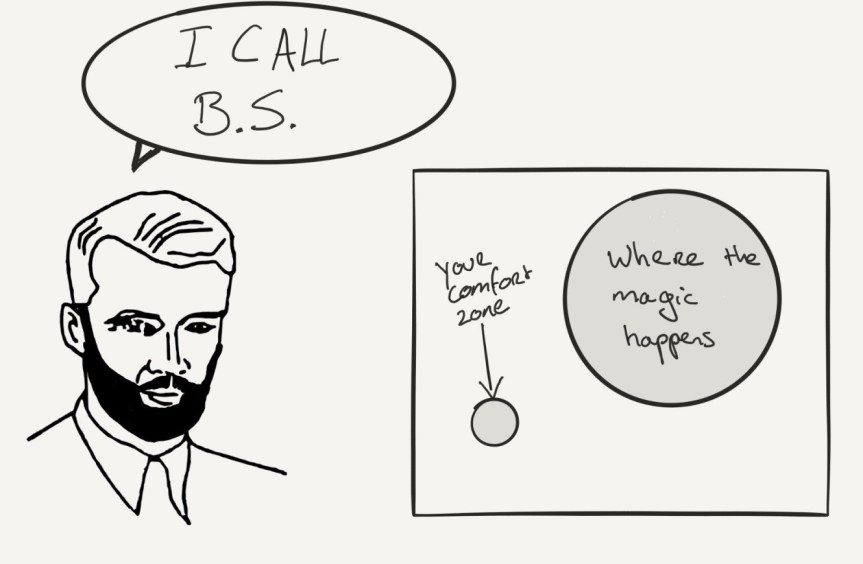
I’ve never believed the idea of that stupid little drawing. You know what I’m talking about, right?

  • “Your comfort zone.” A little circle.
  • “Where the magic happens.” A big circle that stands for the promise of success.

As if “magic” only happens when you step outside your comfort zone; that’s ridiculous. And while we’re at it; why pretend as if your comfort zone is bad? It’s this little pathetic circle displayed against the bigger “magical” circle.

Sure, I’m all about pushing yourself, trying new things, moving forward, growing, etc. But in contrast to many popular self-help people, I don’t believe the comfort zone is a bad thing.

Call me a pessimist. Call me a stoic. But more than anything, I’m merely a practical person.

And practically speaking, you don’t even want to make a huge leap outside your comfort zone. In fact, I believe in the slow road to “magic.”

Where’s The Magic People Talk About?

I’ve found that I do my best work when I don’t worry about money, finding new friends, getting familiar with a new environment, and anything else that is related to always moving around.

But don’t get me wrong. I’m not saying I prefer to stay put. Stagnation is a death sentence to me.

I believe that there are different phases to life. Sometimes, you take it easy, work on your skills, your character — you invest in yourself.

And sometimes, you just go out there and take a chance. Life’s too short to be a wimp.

But those two things are interconnected. If you don’t work on yourself, and if you lack self-confidence, you will never take a risk.

For years I wanted to do what I’m doing now. But instead of jumping out of my comfort zone (which was scary), I slowly took on new and bigger challenges.

First, I got two degrees in business. Then, I started a business together with my father. That was in 2010. And after two years of working on that business for six or seven days a week, I started doing freelance marketing work.

Again, after a few years of freelancing and starting (and failing) other businesses on my own, I took a job at a research advisory firm because I wanted to know how it is to work for a major corporation.

And after doing that for a year and a half, I finally decided to write and talk about productivity, career, and entrepreneurship on the internet.

By then, I‘d been doing the things I write about for more than 10 years. And yet, I don’t have all the answers—I just share the stuff I’ve learned.

So it would be ridiculous if I would join people who scream: “If you want to be successful, all you have to do is step outside your comfort zone. NOW!”

Well, have you ever stepped outside your comfort zone? Even just a little bit counts. And what did you find? A leprechaun with a bag of money?

That comfort zone shit is just a story. It might motivate some people, but you don’t have to believe it if you don’t want to. It’s just like when people claim you have to wake up early if you want to be successful. Says who?

I believe this: If you step outside your comfort zone, there’s only more work waiting for you. It’s not fancy at all. There’s no magic involved. Just blood, sweat, and tears.

Work Your Way Up From A Place Of Comfort

I think that most people who read these type of articles want to achieve something. Maybe you want to quit your job, start a business, grow your business, become an artist, publish a book, whatever.

And you probably also know that it’s not easy. So why do you make things even harder for yourself by doing shit that makes you very uncomfortable?

Instead, start from the very bottom. Build a strong foundation. Get comfortable before you do scary stuff.

“How does that foundation look like?”

If you want to live stress-free, you need enough money in your savings account so you can live and eat for six months in case things go south—see it as a fail-safe system. Again, that’s my practical mind speaking for me.

Make some calculations and figure your what that number is for you. And don’t even think about taking a risk before you have that money on your savings account.

Also, build a skill set that’s worth something. One of the reasons I don’t care about money is because I trust my ability to find work. Even when I go broke tomorrow, I’ll find a way to get work the next day. I’ve invested years and hundreds of thousands of dollars in my education.

The question is: What’s your skill? How can you add value to the world? What problems can you solve?

Other things that complete your foundation:

  1. Family. If you don’t have a family, create one.
  2. Friends. You can’t be friends with everyone. Stick to a few people who also stick to you.
  3. Yourself. Consciously improve your body and mind. Go to bed a little stronger and wiser every night.

Lastly, don’t try to be something you’re not. If you’re an introvert, don’t pretend that you can work in a boiler room. If you’re an extrovert, don’t pretend you can work in solitude.

Stay close to yourself—there’s no point in pushing yourself so badly that your life becomes miserable.

In the end, we all need comfort: It’s one of our basic needs as human beings. But we also need growth. So whatever you do, don’t stay in your comfort zone for too long.

Try to keep moving forward every day: Even if it’s just a tiny step. No magic. Just effort.

National Doctor’s Day . Celebrate and Appreciate The Life Savers of the World .

It is said ,
“diamonds are chunk of coals that did well under pressure”

Do you know about human diamonds ?
Think again, you might know them .
Yes you might have seen them ,even talked ,shared your problems ,they might have shined for you ,helped you solve your issues physically , mentally , emotionally .

Yes ,yes you are going the right way pal.
They help us without any time limit . They are available anytime whether it’s day or night .


Yes you got their dress code right,
They wear white coats and stethoscopes as their ornament .

Finally, here’s your answer.
They are doctors.


Amid the Covid-19 outbreak, when the world had no hope , when there was no Almighty omnipresent to save the world , when death threatening situation have elevated tremendously, the medical doctors have been working 24/7 risking their lives and desperately making an attempt to save several lives. Standing at the frontline battle of Covid -19 , facing the life threatening situations , instead of thinking about their own safety and their family’s safety they choose to serve the nation, putting their own lives at risk with selfless determination for the sake of saving lives despite of every possible chance of not seeing the world again .


The doctors and the staff have gone above and beyond everything one can ever expect them to during this Covid-19 battle.

Just like diamonds , taking pressure just to shine for others .
Doctors are just humans with white coats but with extraordinary will to serve and save people .

No words are enough to appreciate their service.
But one can always give a day to celebrate and appreciate their commitments.

In India , July 1st is celebrated as National Doctor’s Day .
A day when one can show their gratitude for all the support, dedicated service, care, and humbleness and surely the effective treatment by doctors .


National Doctor’s Day :-

Every year, July 1 is celebrated as National Doctors’ Day by the Indian Medical Association (IMA).
The day is dedicated to all the doctors and healthcare workers who have been serving the people by risking their lives.


History of Doctor’s Day in India :-


The National Doctor’s Day 1st July was first observed in 1991, commemorating the birth and death anniversary of former Bengal’s Chief Minister Dr Bidhan Chandra Roy to honour his contribution in serving humanity as a doctor .


About Dr Bidhan Chandra Roy :

Bidhan Chandra Roy , was an Indian physician, educationist, philanthropist, freedom fighter and statesman who served as the Chief Minister of West Bengal .


Dr Roy was a great doctor who made an enormous contribution to the medical field. He was born on July 1, 1882.


On 1 July 1962, his 80th birthday, around 11 in morning , after treating his patients , he died . He had gifted his house for running a nursing home named after his mother, Aghore Kamini Devi. He had also constituted a trust for his properties at Patna to carry out social service, with eminent nationalist Ganga Sharan Singh (Sinha) .


He played a significant role in establishing medical institutions like Jadavpur T.B. Hospital, Chittaranjan Seva Sadan, Kamala Nehru Memorial Hospital, Victoria Institution (college), Chittaranjan Cancer Hospital and the Chittaranjan Seva Sadan for women and children.
He was responsible for setting up a framework for dispensing grant-in-aid to hospitals and charitable dispensaries
He was honoured with Bharat Ratna, on February 4, 1961.

July 1 is celebrated as ‘National Doctor’s Day’ as National Doctors’ Day by the Indian Medical Association (IMA) in account of his service and for being the pedestal of the medical line in India .

Celebration around the world :-

The date of celebrating National Doctor’s Day varies from nation to nation depending on the event of commemoration that is marked as the national Day of celebrating the service of doctors.


Cards or red carnations are gifted to doctors , physicians and their spouses to celebrate their commitment and service by patients and staff.
A flower is also placed on the graves of deceased physicians.

Red Carnations bouquets are specially gifted to doctors because of its specific symbol. Red carnations symbolises love, affection and sacrifice which represents the gratitude of a patient towards his healthcare professionals.

The day is celebrated by health care organizations as well .


Significance The National Doctor’s Day :-

This day is observed to pay heed towards the medical doctors’ role and responsibilities in serving lives. The day is supposed to recognise their functions and obligations as well as their service of healing mankind .
A good doctor who works hard to serve humanity and handle his/her patient with care always deserves appreciation . Thus , doctor’s day is a day to celebrate and appreciate their selfless service.


“Medicines can cure, but a good doctor’s inspirational words can give the strength to fight from within “

Being at hospital can be a terrible experience for a person but a good doctor not only provides the best treatment but also strength to fight the disease and treat a person not only physically but also mentally and emotionally with their positive thoughts .

Oncologists, pediatricians, cardiologists, neurologists, general physicians, dermatologists, gynecologists, and psychiatrists , all such kinds of doctors take the Hippocratic Oath and through this oath, they swear to follow ethics laid down for medical practices.

Doctor’s services are the foremost necessary for life.
Doctors all over the world are given the stature next to God because of their life saving role play .

So let us all appreciate and show your gratitude to the Warriors and Life Savers for all their commitments and selfless deeds .

Other six Jyotirling of Lord Shiva

7. Mallikarjuna Jyotirlinga, Andhra Pradesh: According to the Shiva Purana, Lord Ganesha was married off before Kartikeya which left Kartikeya angered. He went away to the Kraunch Mountain. All the Gods tried to console him but in vain. Ultimately Shiva-Parvati themselves travelled to the mountain but were turned away by Kartikeya. Seeing their son in such a state they were very hurt and Shiva assumed the form of a Jyotirlinga and resided on the mountain by the name of Mallikarujna. Mallika means Parvati, while Arjuna is another name of Shiva. It is also known as “Kailash of the South” and is one of the greatest Shaivite shrines in India.

8. Ghrishneshwar Jyotirlinga, Aurangabad: According to the Shiva Purana, a couple named Sudharm and Sudeha resided on the Devagiri Mountain. They were childless, and thus Sudeha got her sister Ghushma married to Sudharm. They bore a son who rendered Ghushma proud and Sudeha jealous of her sister. In her jealousy, Sudeha threw the son in the lake where Ghushma used to discharge 101 lingams. Ghushma prayed to Lord Shiva who ultimately returned her the son and told her of her sister’s deeds. Sudharm asked Shiva to emancipate Sudeha which left Shiva pleased with his generosity. On Sudharm’s request, Shiva manifested himself in the form of the Jyotirlinga and assumed the name Ghushmeshwar.

9.  Trimbakeshwar Jyotirlinga, Nasik: According to the Shiva Purana, it is on the earnest request of River Godavari, Gautam Rishi and all the other Gods that Shiva decided to reside here and assumed the name Trimbakeshwar. Gautam Rishi earned a boon from Varuna in the form of a pit from which he received an inexhaustible supply of grains and food. The other Gods were rendered jealous by him and they send a cow to enter the granary. The cow was mistakenly killed by Gautam Rishi who then asked Lord Shiva to do something to purify the premises. Shiva asked Ganga to flow through the land to make it pure. Everyone thus sang praise for the Lord who then resided beside Ganga in the form of Trimbakeshwar Jyotirlinga. Hindus believe that this Jyotirlinga in Maharashtra is the one which fulfils everyone’s desires.

10. Rameshwar Jyotirlinga, Tamil Nadu:  It is believed that Ram on his way to Sri Lanka stopped at Rameshwaram and was drinking water on the seashore when there was a celestial proclamation: “You are drinking water without worshipping me.” Listening to this Ram made a linga of sand and worshipped it and asked for its blessings to defeat Ravana. He got the blessings from Lord Shiva who then turned into a Jyotirlinga and resided at the place for eternity.

11. Bhimashankar Jyotirlinga, Maharashtra: The legend about the existence of this Jyotirlinga is related to Kumbhakarna’s son Bhima. When Bhima learned that he was the son of Kumbhakarana who was annihilated by Lord Vishnu in his incarnation as Lord Ram, he vowed to avenge Lord Vishnu. He performed penance to please Lord Brahma who granted him immense power. On achieving this power, he started creating havoc in the world. He defeated the staunch devotee of Lord Shiva- Kamrupeshwar and put him in the dungeons. This angered the Lords who requested Shiva to descend Earth and put an end to this tyranny. A war ensued between the two and Shiva ultimately put the demon to ashes. All the Gods then requested Shiva to make that place his abode. Shiva then manifested himself in the form of Bhimashankar Jyotirlinga. It is believed that the sweat which poured from Shiva’s body after the battle is what formed the Bhima River. 

12.  Baidyanath Jyotirlinga, Jharkhand:  According to a famous legend, the demon king Ravana meditated and asked Lord Shiva to come over to Sri Lanka and make it invincible. Ravana tried to take Mount Kailash with him, but Lord Shiva crushed it. Ravana asked for penance and in turn, was given of the twelve Jyotirlingas on the condition that if it was placed on the ground it would remain rooted to that spot till eternity. While transporting it to Sri Lanka, Lord Varuna entered Ravana’s body and he felt an urgent need to relieve himself. Lord Vishnu came down in the form of a lad and offered to hold the lingam in the meantime. However, Vishnu placed the lingam on the ground and it got rooted to the spot. As a form of penance, Ravana cut off nine of his heads. Shiva revived him and joined the heads to the body, like a vaidya and hence this Jyotirlinga came to be known as Vaidyanath.

Mindfulness and its benefits.

Mindfulness is the basic human ability to be fully present, aware of where we are and what we’re doing, and not overly reactive or overwhelmed by what’s going on around us. (Definition given by Mindful.org)

According to me, it is a practice of maintaining a complete non-judgmental state of awareness of one’s thought and emotions.

Also, many of us confuse mindfulness and meditation. In simple words, meditation is one of the ways to achieve mindfulness, or we can say; mindfulness is a quality whereas meditation is a practice.

So here the question comes, what are the benefits of practicing mindfulness?

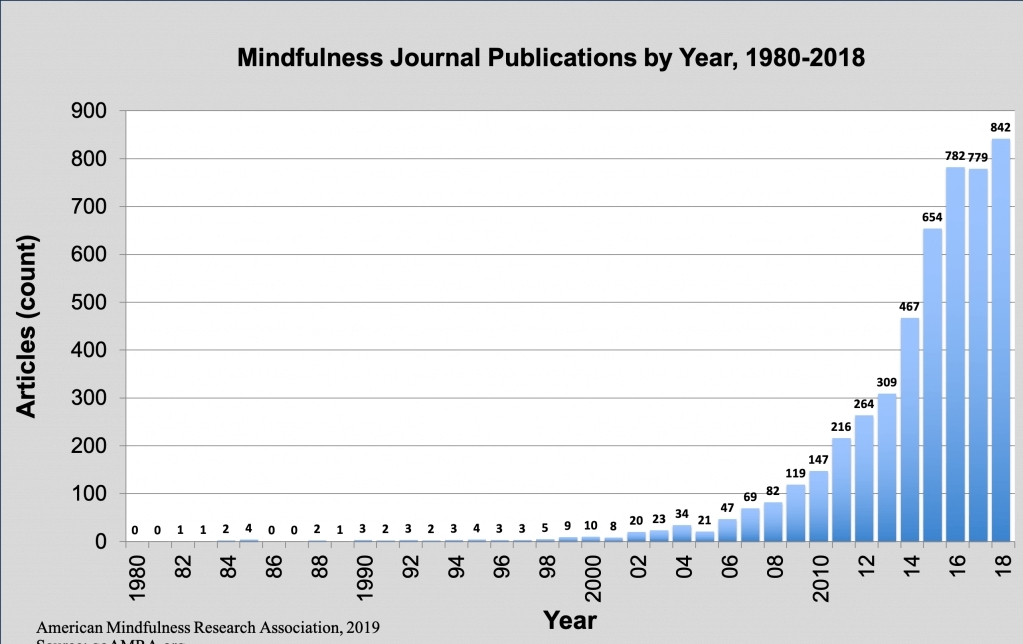
Well, to be honest, there are numerous. And seeing the popularity of the topic in positive psychology, we’ll probably be seeing a lot more to come. Have look at the graph below for example.

Mentioned below are just a few examples of what researchers have found.

1) Reduced emotional ‘reactivity’

In an emotional interference task conducted by Ortner and colleagues in 2007, participants with wide-ranging experience in mindfulness meditation were asked to categorize tones that were given either 1 or 4 seconds after a neutral or emotionally upsetting picture was presented.

The ones with more experience of practicing mindfulness-based mediation showed greater focus on the task even when emotionally upsetting pictures were shown.

2)  Enhanced visual attention processing

A study by Hodgins and Adair in 2010 has confirmed that those who practiced mindfulness-based mediation have shown better performance on tests of concentration, selective attention, and more.
      
3) Managing physical pain

Some research has also shown that mindfulness may have a role in helping with the management of physical pain.

4) Improved working memory

According to a study by Jha and colleagues in 2010, mindfulness is practically linked to enhanced working memory capacity.
    
According to the study, participants who practiced mindfulness-based meditation for 8 weeks have shown improvement in their working memory capacity.

5) Reduced stress

Bränström et al.(2010), found cancer patients who took part in mindfulness-based training have shown remarkably reduced self-reported stress than those who didn’t.

So these were a few of the many examples. Individuals who want to practice mindfulness can find many mindfulness-based training online and practice it on their own. Practicing mindfulness on a day-to-day basis is a great way to improve one’s well-being.
   

Doctor’s Day

The presence of the doctor is the beginning of the core.Doctor’s day is celebrated on 1st july .It is an occasion to marked to pay tribute to the doctor and their contribution in the society .In india,it is celebrated in honour Dr. Bidhan Chandra Roy’s birth and death anniversary .

Types of Security Attacks

Active Attacks

It is an attempts to alter system resources or affect their operation. It includes Modification of data, or creation of false data.

Four categories
 Masquerade
 Replay
 Modification of messages
 Denial of service

  1. Masquerade : It takes place when one entity pretends to be a different entity. For example, authentication sequences can be captured and replayed after a valid authentication sequence has taken place, thus enabling an authorized entity with few privileges to obtain extra privileges by impersonating an entity that has those privileges.
  2. Replay : Replay involves the passive capture of a data unit and its subsequent retransmission to produce an unauthorized effect.
  3. Modification of Messages : Modification of messages simply means that some portion of a legitimate message is altered, or that messages are delayed or reordered, to produce an unauthorized effect.
  4. Denial of Service : The denial of service prevents or inhibits the normal use or management of communications facilities. This attack may have a specific target; for example, an entity may suppress all messages directed to a particular destination (e.g., the security audit service). Another form of service denial is the disruption of an entire network, either by disabling the network or by overloading it with messages so as to degrade performance.

Passive Attacks

It attempts to learn or make use of information from the system but does not affect system resources. Passive attacks are in the nature of eavesdropping on, or monitoring of, transmissions. The goal of the opponent is to obtain information that is being transmitted.

Two types of passive attacks:

  • Release of Message Contents
  • Traffic Analysis
  1. Release of Message Contents : A telephone conversation, an electronic mail message, and a transferred file may contain sensitive or confidential information. We would like to prevent an opponent from learning the contents of these transmissions.
  2. Traffic Analysis : The opponent could determine the location and identity of communicating hosts and could observe the frequency and length of messages being exchanged. This information might be useful in guessing the nature of the communication that was taking place.

Climate Change

• Long-term change in the average weather patterns that have come to define Earth’s local, regional and
global climates.
 Frequent and intense drought.
 Increased frequency and intensity of storms and heat waves.
 Caused rising sea levels, melting of glaciers and warming of oceans.
 Directly harm flora and fauna, destroy the places they live, and wreak havoc on people’s livelihoods
and communities.

Atlas of Glacial Lakes

• Ministry of Jal Shakti -updated atlas of glacial
lakes that are part of the Ganga River basin.

• Similar inventory of glacial lakes was prepared for the Indus River basin.

• Present Ganga study – Glacial lakes were mapped
using Resourcesat-2 (RS-2) Linear Imaging Self Scanning Sensor-IV (LISS-IV) satellite data.

• Process of lake formation, location, and type of damming material – glacial lakes are identified in
nine different types & majorly grouped into four
categories.

• Bhuvan portal of National Remote Sensing Centre, ISRO.

• Create “comprehensive and systematic” glacial lake database for Ganga River basin.

Ganga River

• Ganga rises in the Gangotri glacier -Uttarkashi district of Uttarakhand.

• Source -Bhagirathi.

 At Devprayag joining another hill stream Alaknanda becomes Ganga.

• Principal tributaries from right – Yamuna, the Son and the Damodar.

• Principal tributaries from left -The Ramganga, the Ghaghra, the Gomati, the Gandak, the Kosi and the
Mahananda.
• The Chambal and the Betwa -important sub- tributaries.

• River Ganga -Uttarakhand, Uttar Pradesh, Bihar, Jharkhand, and West Bengal.

• River basin -Uttar Pradesh, Bihar, West Bengal, Madhya Pradesh, Rajasthan, Jharkhand, Haryana,
Uttarakhand, Chhattisgarh, Himachal Pradesh and the Union Territory of Delhi.

BODY POSITIVITY

Body positivity refers to accepting your body irrespective of weight and size of individual with embracing all flaws and imperfections, In simpler words loving and accepting the way you look. Body positivity is like a movement of empowering every individual, it also challenges the way people look and body shame other on basis of their physical appearance. You must have heard people saying that Omg she looks so fat or shew is pretty but fatty, they always made this comment and feel that they have empowered themselves and setting a good example for society but what they don’t know is that one single comment can destroy someone’s self esteem, can damage their mental health as well. so if a person is trying to accept themselves with all the flaws and imperfection, society has problem with that because they have never seen anyone to be bug and still loving their body, what they know is being slim is the only body type that should exist, that is what a ideal individual should look like.

Due to these things body positivity breaks all the stereotype and set some new rules for society that is

1- Having big body is as normal as being slim.

2- Loving yourself is normal and loving your imperfections is normal as well.

3- Not judging someone based on their physical; appearance is great.

Because body comes in all shapes and size and you look beautiful as you are, you don’t have to change yourself just because someone else wants you to, if they are not able to accept yourself fully that’s their problem not yours.

On a kind note: You are beautiful just accept it and embrace your flaws.

LEISURE HIDES THE SECRET OF PRODUCTIVITY

“Guard well your spare moments. They are like uncut diamonds. Discard them and their value will never be known. Improve them and they will become the brightest gems in a useful life.”
― Ralph Waldo Emerson

WHY NECESSARY?

Leisure means respite from work. It is essential for men tired with work. A little leisure refreshes the tired limbs and makes him fit for another period of work.

VARIOUS WAYS OF SPENDING SPARE TIME

Modern life is full of cares and worries. We have to work very hard with little or no success. Some work in factories from morning till night, some work in offices for seven, eight or nine hours a day every person has to work hard to earn his or her living. But human body is not a machine. It cannot work continually for hours together it requires some rest. Even a machine is given rest. Otherwise, it breaks down. That is why leisure is so essential. Like machines, our health will break down completely if we have no regular leisure. It always helps us regain our lost energy and refreshes so that we may continue to do our work next day with more vigour both mental and physical.

ITS USE AND MISUSE

So, leisure we all must have. But it does not mean complete cessation of work. Our limbs may stop working; but our mind is never idle. Once the tension of physical labour is gone mind has time to relax and engage itself in finding enjoyment in some entertainment or recreations. Leisure does not mean idleness. It can be utilised by engaging oneself in recreations. All work and no play makes Jack a dull boy. So, work must be followed by recreations that brace up the mind and spirit.

CONCLUSION

Leisure varies from one person to another. Some utilise it in light reading, while other in their particular hobbies, like playing at cards, or at instruments there are some who go to the stress or cinemas for entertainments, while there are others who take evening walks. There are some who simply sit tight and enjoy the pleasure of doing nothing Whatever may be the mode of enjoying leisure, we must have it. Otherwise our life would become dull. We will lose interest in life. Life has to be lived and lived fully and joyfully.

World social media day

Hello guys!!

Do you know we celebrate world social media day on June 30 th.
Today is a very special day cause today is the day we celebrate the evolution of media from old times till now to the present social media, which made communication lot more easier,accessible,accurate.

Social media is a platform where different kinds of people are connected together .But the security and privacy is still the top most priority of the social media apps

As technology is developing faster and faster the social media applications are also evolving at an
astonishing rate .

Especially during this pandemic
Social media was one of the reasons why people were still able to connect with people at various places.

Social media became extremely essential during these times.we can even say that bonds,relations and specially the connections between people is maintained .

They are even updating their apps constantly so users can benefit from it,the user should not feel alone when they use these apps that is what a successful app must have .

Through social media not only people connect ,but people with similar interests gather together under one roof that is to say at the same place same place and enjoy each other’s company.

Social media acts as a platform where even a small issue can gather lots of attention and raise awareness among people about various issues.It is changing people’s ideals it’s telling what is good and what is not.It is helping us to gain knowledge , entertainment,education,news etc.

Social media has their own advantages and disadvantages based on how we use them.

Social media is both boon and Bane because it is the reason why people who are at different places able to connect and it is also the reason why we are becoming more far to our own families .

So as they say everything should be done in limit,and anything that exceeds the limit is not good .

So even usage of social media should be limited .Even the applications are also updated their apps and added new features where we can view our usage of that particular app so we can limit our usage to certain extent.

So at last what I want to say is every thing is in your hands either to make social media your boon or your Bane depends on you.

Thankyou^^

INDIA AND INDUSTRIAL REVOLUTION 4.0 Part-2

This article is in continuation with the previous part INDIA AND INDUSTRIAL REVOLUTION 4.0 Part-1.

Reasons why Industrial Revolution 4.0 is lagging-

1. Security is a crucial foundation of the Internet while the major challenge for the Industrial Revolution 4.0. As time goes the trend of Industrial Revolution 4.0 inflates from millions of devices to billions. As increasing the number of connected devices, the chance to exploit safety vulnerabilities is also increasing, in cheap or low standard designed devices, due to incomplete data streams, the chances of data theft is increased by which people’s health and safety can be risky. Many IoT arrangements will also include collections of similar or adjacent similar devices. This homogeneity expands the potential impact of any single security weakness by the total number of devices that all have the same features.

2. As Authenticity, trustworthiness and confidentiality are important aspects there are some other requirements also important like discriminatory access to certain facilities, preclude them from sharing with other things at certain Times and business communications involving smart objects would need to be secure from opponents’.The data networks are still delicate and also costly in comparison to other developed countries. From an Indian perspective, the cloud storage operation is still in the emerging stage. Transmit the data to a cloud service for processing, sometimes includes a third party. The gathering of this information leaks legal and regulatory challenges facing data protection and privacy law. To realize the opportunities of the Industrial Revolution 4.0, some new strategies will be required for privacy choices through a broad range of expectations, while still developing innovation in new technologies and services.

3. Absence of standards and documents can assist Senseless activities by devices. Low standard or cheap designed and configured devices have undesirable consequences for the networking resources. Without standards to guide developers and manufacturers, sometimes design products that operate in disruptive ways on the Internet. When any technology has a standard development process then it can be easily available everywhere and can be used by all applicants and increase the growth also. While in today’s world, global standards are followed by every local station.

4. Implementation of every technology requires a team of skilled persons who have ample knowledge of network, hardware, software and about that technology. And India is developing at this point where manpower thinks when technology is spread, they lose their job and there is no life of new technology. So, they don’t take any initiative to learn about it. So, every organization face lots of problem during their changeover phase from the legacy systems to IoT enabled systems. Similarly, Scalability, Fault tolerance and Power supply are also big challenges in India.

5. Advanced technologies require advanced mechanisms which require more amount of money. As India is a developing country, it is not possible to invest on a large scale in Industrial Revolution 4.0. As a result of failed fueled ‘money’, India is not able to cope with Industrial Revolution 4.0.

6. Another major problem with a developing country like India is the fuel needed to run. While the population is on a way steady rise, demand is quite increasing. India produced 557 million tons (metric tons) of coal in 2012-13, and India’s rapidly growing power industry consumed the majority of it. Coal production has steadily increased since the industry was nationalized in the 1970s. A trend almost certain to accelerate as the country faces growing urbanization and an expanding middle class, India has a high dependence on imports for its petroleum needs and is the world’s fourth-largest importer of crude oil.

7. The percentage of illiteracy in India is alarming. Every five persons among ten in India are illiterate. The condition in villages is worse than in cities. Though several primary schools have been set up in rural India, the problem persists. Also, providing education just to children won’t solve the problem of illiteracy, as many adults in India are also untouched by education. The education system of India is blamed now and then for being too theoretical but not practical and skill based. Students study to score marks, not to gain knowledge. This so-called modern education system was introduced by the colonial masters to create servants who could serve but not lead, and we still have the same education system. Rabindranath Tagore had written many articles offering suggestions to change the education system of India. But still, success is as elusive as ever.

Read more about India and Industrial Revolution in next part, INDIA AND INDUSTRIAL REVOLUTION 4.0 Part-3.