To all the chocolate lovers out there, did you know that consumption of chocolate can be beneficial for your health too? Well, Dark chocolate i.e chocolate containing cocoa solids and cocoa butter sans the milk and butter generally found in milk chocolate has been scientifically proven to provide potential health benefits to humans.
The cocoa in dark chocolate contains flavonoids which helps our body to function more effectively. It fights off toxins and stressers and acts as a natural source of anti oxidant that helps in slowing down the ageing process in humans!
2)It is good for heart
Some of the compounds in dark chocolate especially flavanols helps in fighting off high blood pressure and high cholestrol which are the two major risk factors in heart disease. Henceforth, regukar consumption if dark chocolate may lessen the likelihood of a person developing heart diseases.
3) Improves brain function
According to researchers, dark chocolate may improve brain functions and prevent neurodegenerative conditions such as Alzheimer’s disease and Parkinson’s disease. According to a small study held in 2018, reasearchers suggested that the flavanols present in dark chocolate may improve neuroplasticity which is the brain’s ability to reorganise itself in response to intrinsic or extrinsic stimuli.
4) Improves blood sugar levels
Regular consumption of dark chocolate has been found to be helpful in metabolisation of glucose. A study in 2017 in the journal Appetite showed that participants who rarely consumed dark chocolate had higher risks of developing diabetes five years down the road when compared to participants who consume dark chocolate at least once per week.
5)May help with weight loss
Researchers suggest that dark chocolate may play a role in controlling appetite which in turn could help with weight loss. In the books Eat Chocolate, Lose Weight written by neuroscientist Will Clower suggests how eating a bit of dark chocolate before or after meals triggers hormones that signal to the brain you are full. However, proper diet chart and regular exercising should be done to help in successful weight loss.
The era of Indian Independence Struggle is one of the most painful and shattering phases in the country’s history. But it was also a period which saw the emergence of some of the finest leaders of the country.
Captain Lakshmi Sehgal is one such leader who ardently fought for the freedom of India. At a time when most Indian women rarely stepped outside of their society approved roles, here was a woman who not only broke all the social conventions but also aced her roles as a firebrand revolutionary and a medical practitioner.
Source: thetalentedindian.com
Early Life
Born to a progressive family in Madras, to S.Swaminathan, a criminal lawyer at Madras High Court and A.V Ammukutty, a renowned social worker and activist, Lakshmi Sehgal aka Captain Lakshmi was an iron lady who dedicated her entire life to public service in various capacities. She wore many hats: she was the commander of Rani of Jhansi regiment – the all-women regiment of the Indian National Army, a doctor, social activist and a member of the Communist Party of India (Marxist).
Right from her childhood, she never missed a chance to voice her opinions or rebel against the social evils. She came from a family of active Gandhi supporters who had strong nationalist leanings, so it was only natural that she was drawn into the ongoing freedom struggle.
Lakshmi Swaminathan to Captain Lakshmi – The Journey
In 1940, she left for Singapore, where she set up a clinic with a focus on making medical treatment and facilities available for people from all walks of life. Meanwhile, she also joined the Indian Independence League, formed by Rashbehari Bose. It was around this time, in 1942, that an army for Indian independence was formed by Captain Mohan Singh and a few other Indian war prisoners in Singapore. The army was slowly losing its initial momentumdue to the lack of a firm commitment from the Japanese side regarding their participation in the war. It was the arrival of Subhash Chandra Bose which proved to be a real game changer for the Indian independence movement in Singapore.
Captain Lakshmi was one among the many who had gathered to listen to Bose while he addressed the crowd in 1943 at Singapore. He was keen on forming an army not only composed of Indian war prisoners but also of civilian Indians settled in Malaysia, Singapore and Thailand. He also wanted to create an all-women regiment.
Rani of Jhansi Regiment
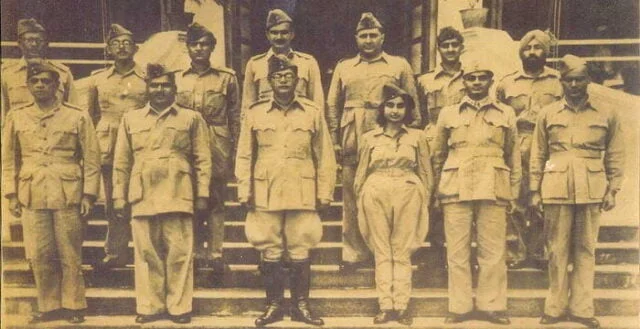
The turning point in Lakshmi Sehgal’s life came when she was asked by Netaji to form and lead the all-women regiment. Whether it was healing wounds or holding firearms, she always put her heart and soul into whatever she did. This young woman took charge and managed to mobilise around 25-30 women for the regiment. These were mostly second or third generation Indian women who had grown up in South East Asia, who were fighting for the freedom of their motherland that they hadn’t even seen. Her ability to galvanize such a group of civilians, train them and form a regiment speaks volumes about her determination and charisma.That was the beginning of the Rani of Jhansi regiment and her life as Captain Lakshmi.
Source:edtimes.in
The INA marched to Burma in 1944, but before they could enter Imphal they had to beat a retreat and she, along with others, was captured by the British army. She was placed under house arrest in Burma and was later sent to India in 1946.
She was a woman of mettle and nothing could ever dampen her spirits. She continued to fight for the freedom of the country once she was back in India and actively campaigned for the release and rehabilitation of the imprisoned INA personnel. Her fight for freedom continued even after the release of the war prisoners, including Col.Prem Kumar Sehgal, in March 1947. Later she got married to Col.Prem Kumar Sehgal and moved to Kanpur.
Later Life
For a person as enthusiastic and passionate as her, every day was a new opportunity to serve her country and its people. She continued her medical practice in Kanpur and was actively involved in providing aid for the refugees pouring into the country following the partition.
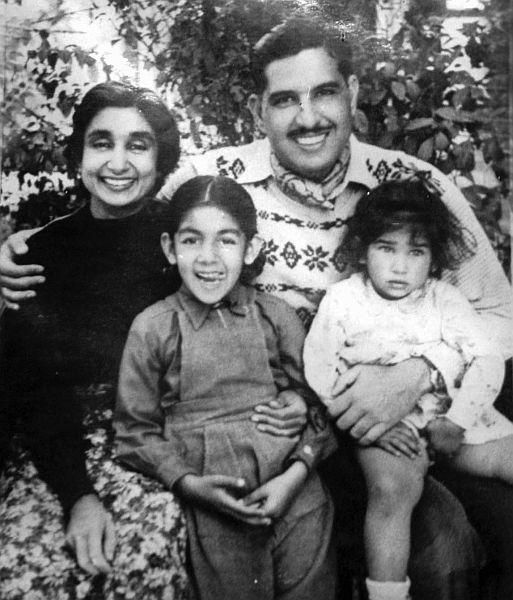
In the early 1970s, through her daughter Subhashini who had joined CPI(M), it was brought to her attention the need for doctors and medical supplies for the refugees from Bangladesh. She didn’t have to think twice before packing up enough supplies, clothes and medicines and leaving for Calcutta to provide her service in the Bangladesh refugee camps along the border areas.Her ideologies were inherently communist, and hence, she joined the Communist Party of India (Marxist) in 1971 and represented the party in Rajya Sabha.
Source: penbugs.com
She never shied away from going out onto the streets of Kanpur during the anti-Sikh riots of 1984, to confront the anti-Sikh mobs and to ensure the safety of the Sikhs and Sikh establishments near her clinic. She participated actively in the restoration of peace during the riots.
She was rightly called Captain Lakshmi for she was a born leader. Be it leading the campaigns and activities of the All India Democratic Women’s Association or the medical camps in Bhopal following the Gas Tragedy, she conducted it all with ardent passion and dedication.
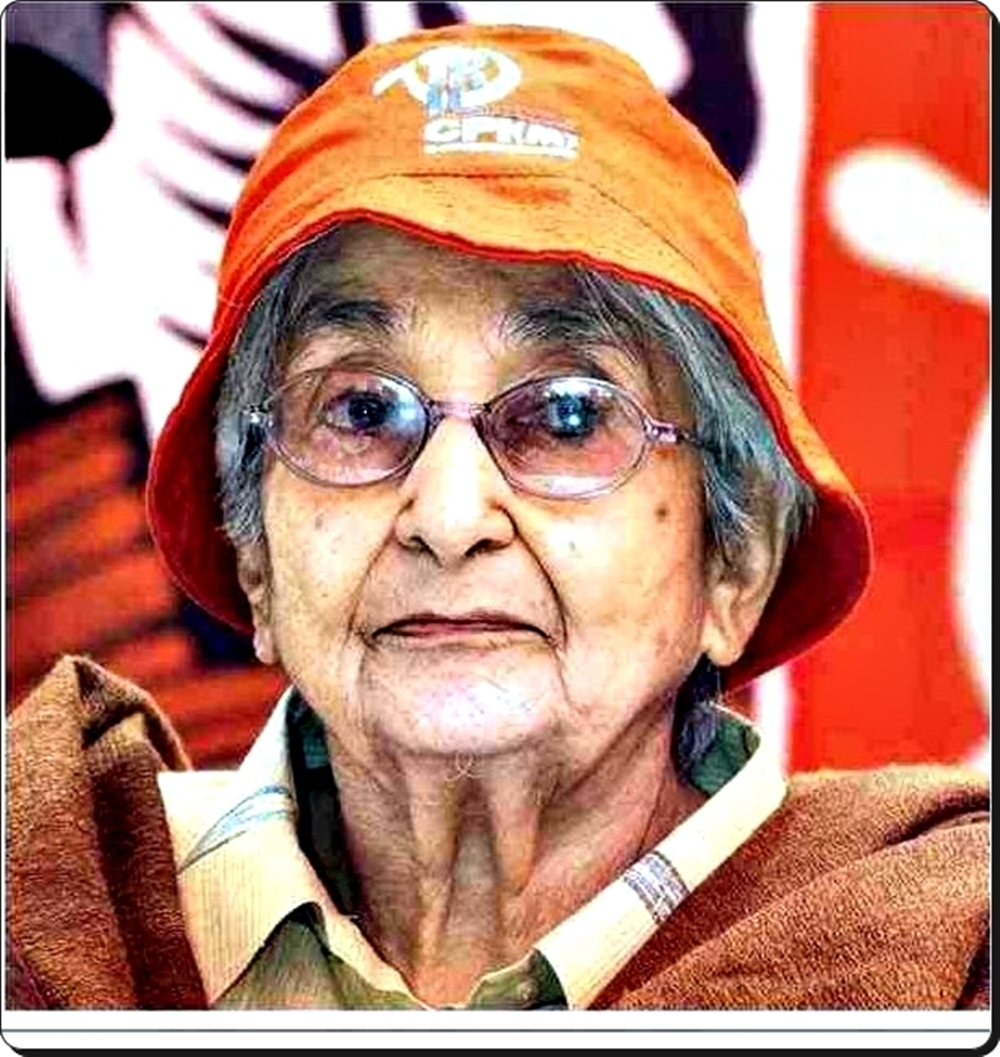
Her charisma, dedication and undying spirit to fight for what she believes in were a few of the many reasons why she was selected jointly by all four leftist parties as the sole opponent of Dr. APJ Abdul Kalam in the 2002 Presidential elections. In spite of knowing that her chances of winning are slim, she took that as a golden opportunity to scrutinise a political system that allowed the weeds of poverty and injustice to grow by feeding divisive and irrational thoughts to the society.
At an age when most people retired to the comforts of their homes, she regularly treated patients at her clinic. Service to humanity was the motto of her life and she never let her age get in the way of service.
She was honoured with Padma Vibhushan in 1998 and was also bestowed with an honorary doctorate by Calicut University.
source:thebetterindia.com
Captain Lakshmi was one such person who was hard to box in by the conventions of the society. During the course of her entire life, which was only a couple of years short of a century, she had seen it all – the colonial rule, India’s struggle for independence and the post-independence nation building and transformation of the country. And through it all, she had been an active contributor to the society, who always positioned herself firmly on the side of the oppressed and needy.
Captain Lakshmi passed away on 23rd July 2012 following a cardiac arrest, but not before leaving behind her a legacy of sheer will, compassion and valour, which continues to inspire thousands of people across the country.
The history is full of stories about the great
inventions of man-kind. These are the inventions that now make our life easier as
well as convenient. But some of these came into existence accidentally. Despite
that they made a huge change in fields of science and also our life-style. Below
is six- great inventions that were accidentally invented.
Saccharin-Artificial sweetener
Constantin Fahlberg,
a Russian chemist, was working in his lab right after which he went to have sandwiches
without washing his hands. He realized that the usual sandwich is sweeter. Upon
realizing that he discovered that his hand was covered with the compound,
benzoic sulfinide, formed after reaction of o-sulfobenzoic acid with phosphorus
chloride and ammonia is the one he tasted. Under different circumstances this
could have been a health hazard, but luckily he invented something edible.
Pace maker
Wilson Greatbatch, a professor of engineering at the
University of Buffalo, in the year of 1956 accidentally invented the pacemaker.
He was working on building a device that would record the heart beats and ended
up finding the device is giving off electric pulses, similar to that of a heartbeat.
Later Greatbatch then introduced his invention to a surgeon, William Chardack, with
whom he was to successfully abled control a dog’s heartbeat. And after few
years, in 1960, it was able to work on humans too.
Penicillin
One of the man-kinds best invention, Penicillin was invented
on accident. In the year of 1928, DR. Alexander Fleming left out his culture
Staphylococcus aureus in his lab two week. He was about to throw it away before
finding that its growth had being prevented by the mold called Penicillium
notatum. From there he isolated the mold and ran tests to determine that penicillin
has antibacterial effect on staphylococci and other gram-positive pathogens.
Champagne
The monks of the champagne, having the best access to
grapes, decided to make white wine. Since it was cold it hindered the fermentation
process and when the spring came, wine containers were filled with carbon
dioxide. The excess of carbon dioxide caused carbonation in the drink. To fix
this, French monk named Dom Pierre Perigon came over to champagne handle it. But
later people decide that the carbonation made the drink fizzy and hence tastier.
Popsicles
When Frank Epperson was 11-years old, he mixed some
soda power with water and left it in the freezer overnight completely by
accident. The next day he decided to lick the frozen soda solution and was delighted
by its taste. The young boy originally named it as ‘epsicle’, combining icicles
and his name, but later he changed it into what we know it as popsicles.
Superglue
Harry Coover, in the year of 1942, was searching for a
material that he could use to build clear plastic gun sights for the war, but
ended up with a chemical substance that would stick to everything it made
contact with. Despite that, his invention was rejected since the researcher
didn’t find any use of the sticky substance. Later in the 1951, the formulation
was innovated by Cooper and Fred Joyner as ‘alcohol-catalyzed Cyanoacrylate
Adhesive compositions’ or as we know superglue. And from the on the superglue
was embraced as one of the most useful invention.
Self-image and personality are two inseparable parts. Actually self is about the impression that we pose on others about ourselves. It is the central dominating and influencing component of one’s personality. Self-image is the concrete conscious awareness of our own self concerning all phases of one’s life, i.e., personal, social, intellectual, mental, and spiritual phases.
Our personality directly or indirectly depends on our acceptance of our image. If we accept and love ourselves, then we will possess a warm and pleasing personality, resulting in adjusting and being able to survive in society. Bernard Shaw once observes, “keep yourself clean and bright for you are the window through which you see the world.”
Because Self-acceptance is IMPORTANT
Society, the people around us, the people with us all impose their identity, feelings, emotions, and mentality into our individuality which may prove beneficial or fatal for our personality. A well-balanced self-image is one of the essentials of a well-balanced personality.
We all are different, we all are unique and that uniqueness of ours makes us beautiful and perfect incorporated with imperfections. We needto accept ourselves more than we focus on others’ validation.
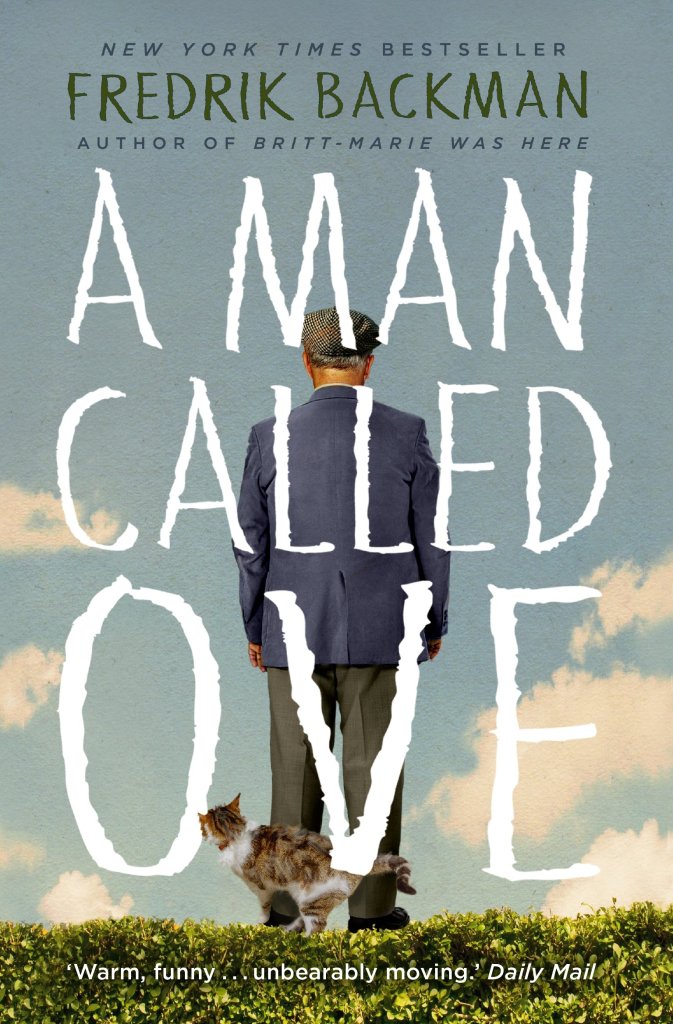
A book beyond the principles of judgment and society, barring the barriers of age, this masterpiece will remold your soul towards the kvetches in your life. A man called Ove, Created and written miraculously by Fredrick Backman, is a thin but infinitely everlasting book that will always stay with you once you turn the last page. As described on the cover page, it is a story about a man called Ove, and the short but satisfactory chronicles of his life. Being a cranky curmudgeon, he has a big habit of floccinaucinihillipilliphication. Big word, isn’t it? Google it (secretly gushing). He basically thinks every new technological thing that he cannot understand is paltry. His neighbors, His friends, everyone thinks he is an old trout. Well, when you are always seen with disgust and disappointment searing in your eyes, you wouldn’t expect much. But if you get to know the man who is called ‘the sorehead’, there is something irresistibly beautiful about Ove.
The story starts with a pouty old man who is seen buying an IPad or at least trying to buy an IPad, with a ‘you just broke my most precious possession and now I am going to kill you’ look. At that moment, the bewitching chronicle takes its first step into a beautiful tale about love, lived and lost.
Ove is a man who believes in practicality. Inaccuracy. In reality. Having a mighty adoration for tools, he was a straightforward man with no tolerance for nonsense, contrasting opinions, or even a happy sunshiny personality. Even after all this, there were so many things about Ove that were magnificent and adorable. That man’s life was simply great, he was arrogant, but down to earth. A man with a heart too big.
You’ll only feel the inklings of dismay and somewhat a sigh as the right side of the gem grows thinner page by page. The words start to reach the deepest core of our hearts, the dark noir on the crisp paper seems like the only world to exist. This little infinite tale will make you laugh out loud, and cry till you can’t breathe. My heart goes out to the author who has created such a magical fable, such an everlasting magnet of love and appreciation. Thank you. Fredrick Backman. Well done. Overall, I recommend this book to you, and I will do it again and again. Believe me.
Around 400 people sign-up to participate in games that they might have played during their childhood. Winners are promised cash prizes worth billions! Sounds too good to be true right? However, here’s the catch. Failing to succeed in these games may cause you to lose not only the money, but also your life! If that wasn’t shocking enough, with each eliminated player, more money gets added on to the intended cash prize. The events that follow post this realization forms the rest of the story in this series.
This Netflix series went on to earn critical acclaim upon its release. Millions of viewers across 94 countries tuned in to watch this thriller series. Its gripping plotline will surely keep you at the edge of your seats! But with the statistics and its popularity aside, let us look at some of the lessons this South Korean survival-drama taught us viewers.
If you haven’t watched the series yet. Be warned, there are serious spoilers ahead!
The very first game in the series stands as a witness to this claim. Amidst all the chaos and panic that erupted due to the massacre in the game ‘Red light, Green light’. A character named Ali had the heart to lend a helping hand to Gi-hun, one of the pivotal characters in the series. He risked his life to save a complete stranger during a life or death situation.
This certainly gives the viewers a hope that help will surely come during the different walks of life. It also encourages us to lend a helping hand like Ali, irrespective of familiarity with the person or the kind of situation.
As you sow, so you reap.
In the Squid Game series, Gi-hun’s generosity towards Il-nam was truly heartwarming. When nobody expected Il-nam to stand a chance in the games. Gi-hun stood by his side, encouraged him and supported him when necessary. However, little did he know that the person he was helping was much more than a frail old man with brain tumor. His kindness earned him the favor of a multi-billionaire well wisher who turned his life around for the better. Well….financially at least.
Being strong is good, but thinking smart can take you a long way.
Take the game of ‘Tug of war’ from the Squid Game series for example. The opponent team appeared strong indeed. But we were rooting for the team that consisted of a relatively less muscular batch of players. With the addition of a frail old man in the team, their chances of winning were very less. But Il-nam the old man was full of surprises!
The techniques of winning the game that he shared with the team gave them a temporary upper hand over their opponents. When they seemed to be losing in front of their opponents’ sheer strength. Sang Woo’s idea of the element of surprise brought them a life-saving victory over their adversaries. Moral of the story: Be strong, think smart.
Money is important, try not to run out of it.
The billionaires who created the squid games, played with the desperation of almost 400 money deprived people. Many of the participants were in huge debts and needed the cash prize to survive in the real world. Although one can do more than just survive with the cash prize on the line, greed and need forced the common and subtle people to go up to extreme lengths.
Hence, it is better to be educated, find a stable job, have insurance for your future, and make investments and expenditures wisely. Sang Woo from the Squid Game series is often criticised for the deceit he carried on against his friends and trustees. But it isn’t hard to understand why he did what he did. After drowning upto his neck with financial difficulties and his lonely mother waiting for him. Anyone would have done the same thing if they were in his shoes.
Sure, Money is important. But money isn’t happiness
Winning the intended cash prize along with the 455 others’ share of money. Gi-hun indeed won big in life. But what was left of him by the end of the Squid Game was a traumatized soul after witnessing the death of his friends and the dead body of his mother.
Il-nam, who is revealed to be the billionaire master-mind behind the squid game, couldn’t buy joy and happiness with all the money he had. As he participated in the games alongside the other participants, he experienced happiness as he re-lived his childhood memories and found a good friend in Gi-hun. But his idea of Squid Game was inhumane and barbaric.
The series ends with Il-nam dying, having made a questionable decision about starting the Squid Game and being the reason for the deaths of almost 400 people. Gi-hun is shown moving to the US after a significant makeover with his appearance, only to discover the Squid Game’s establishers seeking the next batch of participants for their game.
the creator of thoughtful grins on little souls, the molder of a legend, the light of an eye-blinding ray of literature, Lucy Maud Montgomery, or better known as L.M Montgomery is one of THE most phenomenal and unparalleled authors I have ever known. the beauty of her writing is miraculous, the plot of her stories is out of this world. She is honestly my crush and will be lifelong. Bloomed into this world on the 30th of November, 1874 in the chilly town of Clifton to Clara Woolner Macneill Montgomery and Hugh John Montgomery. Hardly had she reached her 2nd year in the world, when her mother, Clara, passed away suffering from Tuberculosis. Since then, she was lonesome and quiet. A blessed child, the seven-year-old lucy, moved to Prince Albert to lead her childhood with her grandparents, when she found her imaginary friends holding her hand, later, that time of her existence was credited as a development and expansion of her creativity. In 1887, the witty and bright lucy of 13, wrote in her diary that she had, quoting, “early dreams of future fame”, she didn’t know that fate took her ‘early dreams’ very seriously.
the year 1883 was spent with her attending the Prince of Wales college to get a teacher’s license, and slowly, her love for Prince Edward Island grew as she strolled solitarily through the tranquil and starry paths down the countryside. Remarkably extraordinary as she was, Lucy completed her two-year teaching program in one year, clearly a prodigy. After, she explored the fields of literature at Dalhousie University, Halifax, nova scotia.
A part of her life was spent teaching in various schools located in Prince Edward Island after she left dalhousie university. Though Not a fan of teaching, it lent her the time to write, a hobby she loved more than herself. The spree of resplendent writing began in the year 1887 when she started publishing her short creations in several newspapers and magazines. And look how it turned out, over a hundred stories were published and hence started her journey to endless fame and love.
A gorgeous beauty, she was known to own her ‘good looks’. Those good looks resulted in many love interests in Lucy’s life. At the blooming age of fourteen, a boy named Nate Lockhart gained her affection, In response, she got the same too. Their liking turned into a relationship, for lucy, the relationship meant merely a humourous and witty friendship. Unfortunately, the love between the two birds ended abruptly when she refused his proposal.
The year 1908 can be called THE BIG BREAK for Montgomery. It is the divine and holy year ANNE OF THE GREEN GABLES was published. No surprise an immediate success, by November 1909, It had accomplished more than 6 printings. Still alive in the shelves of bibliophiles and the history of literature, We can still feel each emotion throbbing through every page we turn in the book. Every sentence is magical, some parts of the story representing real circumstances in Montgomery’s life, it is partly fictional, The plot of it almost real. This light, funny, and beautiful story is the epitome of a relax read with fun and philosophical expressions. You’ll laugh, you’ll cry, you’ll have a new perspective of seeing things. The readers can feel the author’s soul which is put into it.
So many years have passed, so many revolutions the earth has taken, and still, here I am, writing about this miraculous phenomenon whom we know as our beloved L.M Montgomery.
Param Vir Chakra is India’s highest gallantry award.From Major Somnath Sharma to Captain Vikram Batra, 21 brave hearts of the Indian Armed Forces have so far received the prestigious Param Vir Chakra award. When Major Somnath Sharma, the first recipient of this award, laid down his life while defending his motherland, this award actually did not exist. It was later, when India became a republic in 1950, that the award was introduced, but with effect from 15th August 1947.
I’m sure most of you might have heard about this award, but what many are unaware of is that India’s highest military decoration was designed by a Swiss-born woman Eve Yvonne Maday de Maros aka Savitri Bhai Khanolkar.
Image source: dnaindia.com
Life as Eve Yvonne Maday de Maros
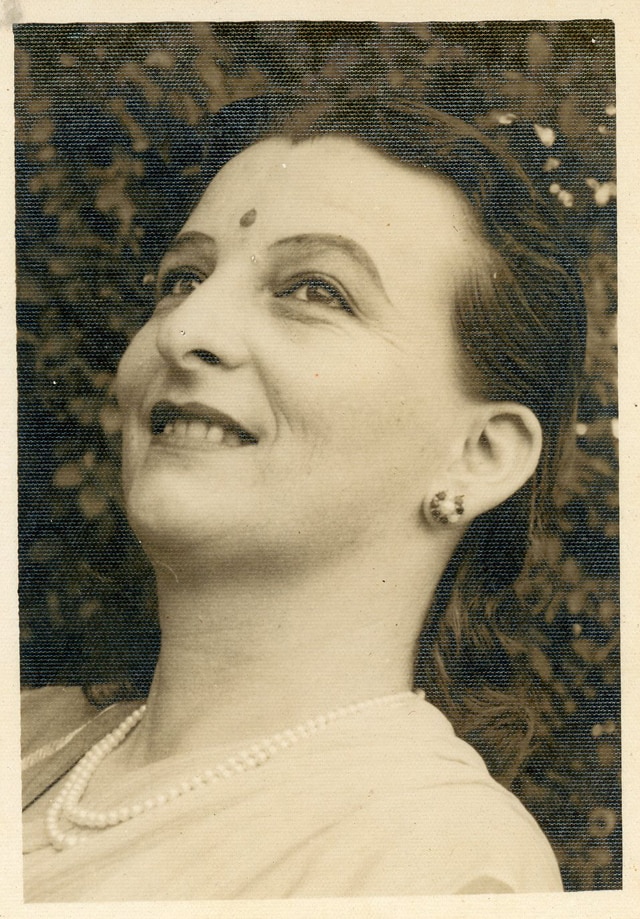
Eve was born in Neuchatel, Switzerland, to a Hungarian father Andre de Maday and a Russian mother Marthe Hentzelt, on the 20th of July 1913. She was raised by her father, after her mother’s death. She spent her early childhood in Geneva. As a child, she loved nature and liked being outdoors.
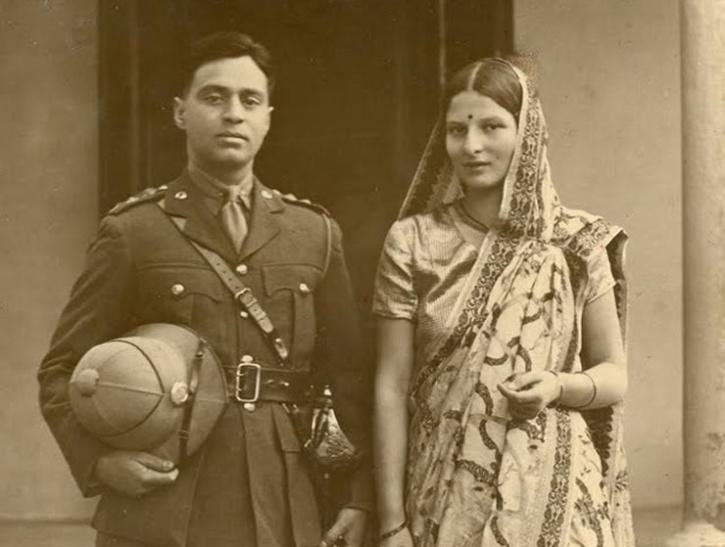
A turning point in her life was when in the winter of 1929, on a skiing holiday, she met Vikram Ramji Khanolkar, a young Indian Army cadet. Vikram, at that time was undergoing training at the Royal Military Academy, Sandhurst and was holidaying in Switzerland during a team break. The meeting was just the beginning of what later blossomed into a cross country love story. Neither Vikram’s age nor her father’s disapproval stopped her from pursuing her love. She moved to India a few years later and got married to the love of her life in 1932. She converted to Hinduism and adopted the name Savitri Bhai Khanolkar after moving to India.
Life as Savitri Khanolkar
Savitri Khanolkar was a European lady with an Indian soul. She loved everything about India and its culture, which made her cross-cultural transition rather smooth and comfortable. She picked up Hindi, Marathi and Sanskrit within a couple of years and could converse fluently in all the three. She was keenly interested in India’s history and culture and devoted herself to learning more about the country’s mythology, traditions and religious scriptures. She was a talented artist and made a series of paintings depicting the various ideals and principles of Vedanta and Hindu philosophy. She also wrote two books – ‘Sanskrit Dictionary of Names’ and ‘Saints of Maharashtra.’ Those who knew her personally described her as a warm and compassionate person with a great passion for the Hindu philosophy.
Maj General Vikram Khanolkar and Savitri Khanolkar | Image Source: indiatimes.com
Designer of Param Vir Chakra
After India became independent in 1947, especially in the light of the Indo-Pak war that had broken out, there was a pressing need to create new military honours and awards for independent India. Adjutant General Major General Hira Lal Atal had been assigned this responsibility. Major Atal hardly needed to think twice before choosing Savitri Bhai for the task. Her passion for Indian culture and Vedanta philosophy, talent as an artist and her in-depth knowledge of the country’s ancient history and traditions made her an ideal candidate for the job. Her military association as an army wife was an added bonus. She was asked to design the Indian equivalent of the British Victoria Cross – the Param Vir Chakra.
Param Vir Chakra : Design Inspiration
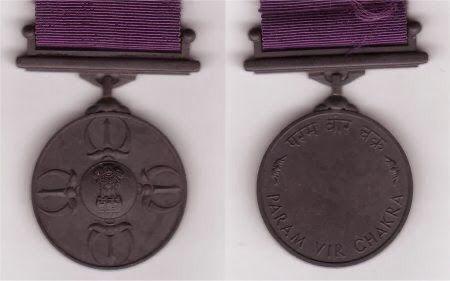
Savitri Bhai took inspiration from India’s ancient puranic literature and legends to design the Param Vir Chakra medal.She selected Indra’s weapon, the Vajra, which was made from the bones of Maharshi Dadhichi for the design. Maharshi Dadhichi was known for the ultimate sacrifice that he had made by giving up his body and thereby enabling the Gods to fashion the deadly weapon Vajra from his bones. The presence of Vajra in the medal is symbolic of the power and the selfless sacrifices of our legendary war heroes.
The final design consisted of the National emblem embossed in the centre, surrounded by four replicas of the double Vajra imprinted on the medal face and the rear side had the words ‘Param Vir Chakra’ inscribed both in English and Hindi, separated by Lotus flowers.The medal was cast in bronze and held by a purple ribbon.
Apart from the Param Vir Chakra, she also designed other gallantry medals including Ashok Chakra, Maha Vir Chakra, Kirti Chakra, Vir Chakra and Shaurya Chakra.
Coincidentally, the first PVC recipient turned out to be Savitri Bhai’s future son-in-law’s brother, Major Somnath Sharma.
Image Source : twitter
Later life
During the course of her life, Savitri Bhai always found time to engage in social work. She was a follower of Sri Ramakrishna and she immersed herself in numerous social activities through Ramakrishna Mission. She also worked for the welfare of Jawans and their families and refugees who had been displaced during partition. She lost her husband to a heart attack in 1952, after which she found solace in spirituality and retired to Ramakrishna Math.
The life of Savitri Bhai Khanolkar was truly a remarkable one. Be it joining the North India Flying Club or learning Indian classical dance and music or attending Patna university, she enjoyed every bit of her life as an Indian woman. She passed away on 26th November 1990, after leading a full life.
Let’s begin by knowing what Mass Media or Mass Communication is. Mass media refers to the media technologies such as movies, songs, news, podcasts, advertisements and photos, that are utilized to carry information to the masses.
Importance of Mass Media
This blog you are reading is helping you gain knowledge about Mass Media and communication. Hence this blog becomes a media technology and educating you in the field of Mass Media defines its importance. From applying for a job to reaching out to a friend on your phone, everything becomes a portion of Mass Media as they help users pass on information from one place to another or one person to another.
Here are some advantages of Mass Media to highlight its importance.
It becomes a voice for the voiceless: Mass Media provides every individual with an opportunity to practice their freedom of speech and spread their ideas among the world. YouTube is a great example of Mass Media. As a platform in this 21st century it helps both small and large creators publish their videos for everybody to watch.
Enables widespread communication: Today, the world is often referred to as a global village. This is made possible due to several types of mass media technologies such as social media, internet, and other digital content. It helps governments, businesses and organizations to communicate with each other and stay connected.
Diversifying culture: Mass Media helps in diversifying languages and cultures beyond its place of origin. A good internet connection and a mobile phone or a computer is all you need to learn a new language or gain knowledge about a new culture. You can even take a peek around the world without leaving your home.
The Evolution of Mass Media
Mass Media can be traced back to the 800 AD which consisted of prehistoric arts, writings and some basic printing technology. The introduction of Gutenberg’s printing press in the 1450s helped art and literature gain a wider reach among the people.The year 1605 witnessed the publishing of the first weekly newspaper in Antwerp, known as ‘Relation’. This was followed by the inventions of radio and television in 1895 and 1925 respectively. Finally in 1990, the world wide web was introduced by Tim Berners Lee.
The number of people benefiting from these media technologies witnessed a steady growth from a handful, to thousands, and millions with the introduction of newspapers, radios and televisions. Today, due to the internet, these numbers are reaching billions. In 2018, the number of World Wide Web’s users was estimated to be 4 billion.
The 21st century has introduced the ability for even individuals to broadcast a customised message for thousands across the globe. You no longer need to be a part of some huge networking channel to do so. A good internet connection and a hand held device can do the job.
The functions of Mass Media
Mass Media, in the form of writing, podcasting, and publishing, has a significant effect on the masses. Commercials on television, billboards and social media influence the audience into buying a product or availing a service. Hence companies across the world look for suitable mediums such as social media, blogs, forums, or video streaming platforms to convey their messages based on their businesses. Once they find the right mass media technology, they conduct campaigns to communicate their ideas.
Majority of the companies today create and maintain their social media pages, maintain blog posts on their websites, and run advertisements on video streaming platforms to educate viewers about their products or to entertain them. These define the functionality of Mass Media.
Courses in the field of Mass Media and communication
After addressing the ‘Wh’ questions of Mass Media, let us dive into the courses one can opt for in the field of Mass Media and communication. There are three kinds of courses available for aspiring students in the field of Mass Media and communication. Courses at undergraduate, postgraduate and diploma levels.
Both the course levels familiarise students both practically and theoretically in the field of Mass Media and Communication.
Eligibility for courses in Mass Media and communication (UG PG)
A student aspiring to seek admission in a Bachelor of Arts in Mass Communication course, he or she must fulfil some eligibility criterias.
The applicant should have completed senior secondary schooling (10+2) from a recognized university.
The applicant must have scored a minimum of 50% from the aggregate in their senior secondary schooling.
Similarly, students aspiring for seeking admission in the Master of Arts in Mass Communication course must fulfil the following eligibility criterias.
The applicant must have a Bachelor’s degree in any stream from a recognized university.
The applicant must have scored a minimum of 50% from the aggregates in their Bachelor’s degree.
Institutes may also require you to give an entrance exam to fulfil the admission process.
Here’s what you will learn from Mass Media and Communication courses
Courses in Mass Media helps you get acquainted with subjects such as Public Relations, Design and Graphics, Digital Media, Reporting and Editing for Print Media, Data Journalism, Photojournalism, Event Management, and Media Law and Ethics. The courses are inclusive of Computer based learning, Guest Lectures, Seminars, Workshops, Massive Open Online Courses, Individual and Group projects, and community based projects.
Scope for Mass Media courses under employment prospect.
With an increase in media technologies following new inventions and establishments such as Television Channels, Radio Stations, Advertising Agencies, PR Agencies, etc. Scope in this field is also parallely increasing. Here are some of the job profiles candidates can look out for upon completion of the course.
Journalism
Public Relations
Advertising
Media Planner
Broadcasting and Production
Event Manager
Conclusion
Mass Media and Communication as a field in academics has a great scope in India and overseas. Freshers with expertise in specific areas and sufficient experience will be hired by prominent media companies for different job profiles. Individuals with good communication skills, writing proficiency, and passion for learning can pursue an undergraduate or a postgraduate course in Mass Media and Communication.
References
Ritika Shrivastava, May 17, 2021 09:36 IST, shiksha.com
Once upon a time, there was a young athletic boy hungry for success for whom winning was everything and success was measured just by winning. One day, the boy was preparing himself for a running competition in his small village, himself and two other young boys to compete. A large crowd had gathered to witness the sporting spectacle and a wise old man, upon hearing of the little boy, had travelled far to bear witness also. The race commenced, looking like a level heat at the finishing line, but sure enough the boy dug deep and called on his determination, strength and power. He took the winning line and was first. The crowd was ecstatic and cheered and waved at the boy. The wise man remained still and calm expressing no sentiment. The little boy, however felt proud and important. A second race was called, and two new young fit, challenges came forward, to run with the little boy. The race was started and sure enough the little boy came through and finished first once again. The crowd was ecstatic again and cheered and waved at the boy. The wise man remained still and calm again expressing no sentiment. The little boy, however felt proud and important. “Another race, another race!” pleaded the little boy. The wise old man stepped forward and presented the little boy with two new challenges an elderly frail lady and a blind man. “What is this?”, quizzed the little boy. “This is no race” he exclaimed. “Race!”, said the wise man. The race was started and the boy was the only finisher, the other two challengers left standing at the starting line. The little boy was ecstatic, he raised his arms in delight. The crowd however were silent, showing no sentiment toward the little boy. “What has happened? Why not do the people join in my success?” he asked the wise old man. “Race again”, replied the wise man, “ this time, finish together, all three of you, finish together” continued the wise man. The little boy thought a little stood in the middle of the blind man and the frail old lady, and then look the two challengers by the hand. The race began and the little boy walked slowly, ever so slowly, to the finishing line and crossed it. The crowd were ecstatic and cheered and waved at the boy. The wise man smiled, gently nodding his head. The little boy felt proud and important. “old man, I understand not! Who are the crowd cheering for? Which one of us three?” asked the little boy. The wise old man looked into the little boy’s eyes, placing his hands on the boy’s shoulders, and replied softly.
Have you ever wondered how pi was calculated before Newton
discovered it. Up until the 250BC, mathematicians knew for a fact that the
value of pi is between 3 and 4. And you may ask that how did they know that,
the answer to that would be that they did that with the help of a hexagon and
square.
A unit circle (area = π)
was inscribed with a regular hexagon of unit sides. And the circle was inscribed in a
square. The hexagon was then further divided into 6 equilateral triangles with
unit sides. Then the perimeter of hexagon was found to be 6 units. Since the
hexagon was inside the circle the circumference of the circle must be a little more than
that of hexagon.
Circumference > perimeter
2 π > 6
π >3
On the other hand, the perimeter of square > circumference of the
circle.
2 π<8
π <4
Hence, it was concluded to be between 3 and 4, i.e, 3< π<4.
Later in the 250BC, Archimedes improved this calculation. He bisected
the hexagon into a dodecagon (12 sides) and inscribed one into the circle and inscribed
the circle in another 12-sided polygon. After calculation, it was found that π
lies between 6.212 and 6.431. This process repeated for centuries until they
reached the 96-sided polygon and found a range of 3.1408< π<3.1429.
In the late 16th century, Francois Viète
doubled a dozen times than Archimedes and computed the perimeters of polygon of
393,216 sides. And by the early 17th century, Ludolph van Caulen surpassed
him by calculating perimeter of polygon of 2^62 sides. He spent 25 years of his
life calculating π upto 35 correct decimal places.
People were used this method of computing pi until Sir Newton came along.
The first step to his discovery of π was building Binomial theorem from the Pascals triangle. Sooner after he also delt with the theorem being subjected to
incompetency when power of (1+x) was -1, since it would give an infinite
series. But he proved its accuracy by multiplying both sides by (1+x). The left
hand side gave 1 straightaway and when (1+x) was multiplied on the right hand
side, every term got cancelled leaving only one.
Afterward he went for (1+x) with power of ½ to solve for the area of a
unit circle by equation of the circle, which was given by x^2+y^2=1. Hence, the value y=(1-x^2)^1/2 can be calculated by substituting the value of x by -x^2.
Right after this, he also invented calculus. And the integration from 0 to 1
was used to find the area under y=(1-x^2)^1/2 which is the area of the quarter of
circle in the first quadrant. We also know that the area of quarter of circle
is (πr^2)/4. In this case it will be π/4 (since r=1). Upon equating them and calculating we get
the value of π. To make things easier and accurate he decided to integrate from
0 to ½. It gives the area of the circle from the left of y axis to the straight line of
x=1/2. That area can be calculated as area of a sector of 30 degrees, which
will be π/12, and a right triangle of sides 1 and ½ ( we can calculate the
third by Pythagoras).
And upon equating we once again can find the value of π. Not only that
but when you solve up to 5 places of the integration, you get results π for up to 5 decimal places. And it
will take calculation of integration up to 35 terms to get what Ludolph
van Caulen got after 25 years. This is how years of calculation was simplified
by Sir Isaac in a way it took only a few days to learn the value of pi.
The most important medium used in education today is the printed word. Knowledge is preserved in books and the first step in education is learning to read. But a blind man cannot read a book. is he then to be denied opportunities to educate himself? No, not necessarily so. The blind can get themselves educated, not only in the sense of being able to read and write but even in the sense of training themselves for the profession. Teachers of the blind have devised methods by which the blind can ‘read’ books without the aid of the eyes. The most famous of these methods is, undoubtedly, Braille.
Braille script
Braille ( named after its inventor )is a system of representation of printed symbols by raised dots on a flat surface. Six dots in various combinations are used to represent letters, numbers, punctuation marks, and some common words. The blind person ‘reads’ the boo by passing his fingers over the dots. Thousands of blind people all over the world have used Braille to educate themselves. A book in Braille is not so compact or handy as compared to any other book. The size makes it difficult for people to use Braille as easily as printed books.
To overcome the difficulties, a new method has been introduced in recent times. The American Association for the Blind made ‘Talking books’ or long-playing discs with recordings of books. The popularity of talking books and tape recording is steadily increasing, and governments and private agencies have come forward to support the effort to produce them and make them available to people who need them.
Report writing is an art and skill that all students should learn during their academic years in the university as this skill skill is must for a corporate and professional life.
Together, we can achieve this by utilizing?custom report writing tools to extract data from your system and present it back to you in almost any format you desire. We have years of experience optimizing the functionality that exists within custom report writers. The customization request we receive most often is to present data based on?certain circumstances, also known as?conditional reporting. For example, when analyzing the profitability report of your business, you may want the color of a field to change when invoices are below a 25% margin level, or to have the ability to define this margin level each time you run the report. This is just one example, and these types of conditions are…
Confidence isn’t walking into a room thinking that you’re better than anyone. It’s walking in knowing. That you don’t want to COMPARE yourself to anyone. Comparing yourself to another person that isn’t even in your system. There’s no thought of comparisons. There is no competition with any other human. You are not below anyone that’s confidence. When you can get to the place in your life. Where comparison is dead. When you are good enough not to others. But to yourself that is confidence and you can be good enough right now. Because you are good right now. You might just need to change your mindset.” CONFIDENCE “can be developed in many ways. You can start with your physiology, your posture. If I asked you what a confident person looked like would you be able to tell me? Of course you would they look strong, sure of themselves. How are they standing? They are standing TALL. How are their shoulders? They are BACK, upright. They make eye contact their head is up, not down. Now a SHY or introverted person might say. Yeah, well that’s all good for outgoing people but I will never be confident. Anyone can develop confidence. Some might have to work on it harder than others because they have conditioned themselves into a lack of confidence for much of their life but anyone can develop confidence. Even the majority of shy people have moments where they aren’t shy like around people they trust may be family, friends or their partner. Moments where they can be themselves fully. So the shyness is selective which means you can make confidence permanent. If you CONSCIOUSLY decide to be the person and do the things you do not just around those you trust the most, but all the time. Being confident doesn’t mean you are LOUD. It isn’t about being the one that has to be noticed. I’s the opposite, it’s knowing you’re great, without having to be seen. It’s the silent winner. It’s the humble champion. If you lack confidence, you can change. If you lack anything, YOU CAN CHANGE. You can be anything in life including radical personality change. IF you are COMMITTED to finding the answers. “UNLOCK THE GREATEST VERSION OF YOURSELF”. Your true nature of confidence of pure positive energy. Unlock your authentic power today.



















You must be logged in to post a comment.