Don’t you think life is weird sometimes? Take quitting.
Most of us believe that it’s wrong to quit. That it’s for losers. And that quitting equals failure.
The ‘never quit’ attitude is a good thing. Especially when we pursue hard things. I don’t think you should ever quit just because you can’t handle something.
However, quitting is also a smart strategy. Sometimes quitting is even the better option.
Seth Godin wrote a book about quitting. It’s called The Dip. And it’s very good. He says:
“Persistent people are able to visualize the idea of light at the end of the tunnel when others can’t see it. At the same time, the smartest people are realistic about not imagining light when there isn’t any.”
Sometimes you’re in a tunnel where there is no light to be found at all. So no matter how hard you work and persistent you are, you will never achieve anything.
Dead-end jobs, businesses, projects, relationships, behavior. We’ve all been there.
Quitting is not easy.
Be honest, how many times did you have the guts to quit? Because I’ll tell you this, quitting is one of the most difficult things I’ve ever done.
When I got a corporate job a few years ago, I was fed up with owning a business. I was burnt out, didn’t see the results I wanted, and felt overwhelmed. So I decided to quit my business and get a corporate job.
But I just couldn’t fully quit entrepreneurship. So I was stuck in the middle of a corporate job and not letting go of my business. I worked the corporate job during the days, and in the evenings and weekends, I worked for myself.
That made my life even more stressful. And after a year I had the same feeling as before I got the job. I was on a dead end.
I didn’t have the desire to climb the corporate ladder. And I also didn’t have the energy to grow my business. I realized that the path I was on lead to nowhere.
I knew what I had to do. I struggled with it daily in my mind. And it took months to get my act together and hand in my resignation. I did that with tears in my eyes. Quitting is not in my DNA.
If you can’t climb the ladder you’re on: Quit and pick a different ladder.
Let’s say you work at a corporation and you want to climb that ladder. I don’t think it’s a bad thing at all. You just need commitment. But I get why a lot of people don’t like it because there’s a lot of politics involved.
Look, I’m also not good at that stuff, but that doesn’t mean corporations are evil. They are only a reflection of society. And not everyone can become a CEO or board member. It’s simply a game of numbers. It’s not personal.
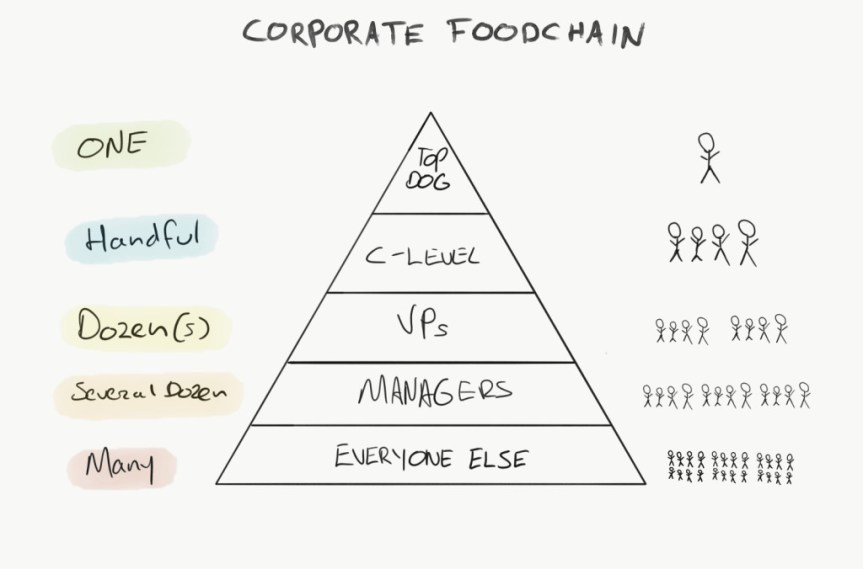
“Darwinism influences almost any pyramid-shaped structure, and the corporation is not only not an exception, it is probably the best example. There are simply not as many presidents as vice-presidents, there aren’t as many vice-presidents as there are managers, and so on.”
That book is from 1984. And yet, a lot of people don’t get the concept. The corporate food chain looks like this:
Many things are like that. If you don’t want to play that game, just get out.
In The Dip, Seth Godin argues that you should only strive for becoming the top dog. Everything else is not worth it.
In other words: Only try to climb the corporate ladder if you’re in it to win. Otherwise, it’s better to quit.
You make a bigger impact when you’re #1.
Seth Godin says:
“We reward the product or the song or the organization or the employee that is number one. The rewards are heavily skewed, so much so that it’s typical for #1 to get ten times the benefit of #10, and a hundred times the benefit of #100.”
I must say, I don’t like the way Seth puts this. You can easily interpret that it’s all about the rewards. In other words: Ca$h money, fame, status, etc.
I don’t care about that shit. If I would, I would be doing a lot of other things instead of writing a bunch of free blog posts. I agree with Seth’s message, but for a different reason.
To me, being #1 is good for only one reason: You get to make a bigger impact.
LeBron James. Richard Branson. Oprah Winfrey.
They are #1s in their fields. They also make the biggest impact. They help and inspire the most people.
Plus, they set the bar. They push the limits of what is possible. And others will either follow or move past them.
Don’t settle for mediocrity.
When it comes to quitting, there’s only one question you want to ask yourself:
“Is there light at the end of the tunnel I’m in?”
Are people responding to my blogs, videos, music?
Is there mutual respect in my relationship?
Are people buying my products?
Can I climb the ladder in my organization without playing politics? (In case you think this is not possible, read What They Don’t Teach You at Harvard Business School.)
If your answer is no, it’s time to quit. Find a different crowd. Move to a new company. Rediscover love.
Whatever you do, find a different tunnel. And keep doing that until you find one where there is light. And once you see one ray of light, cling to it and don’t quit before you reach the end (or top).
Bettering yourself can help you advance your career and accomplish professional objectives. For example, you could take a certification course in your field to increase your chances of a promotion. By taking steps to improve yourself, you can also acquire skills outside of traditional educational and occupational settings. Having well-developed hard and soft skills can aid you in a variety of workplace settings. For instance, you might decide to develop your communication skills. After improving yourself in that way, you may find that you can help mediate parties with different opinions.
1. Try a new schedule
Adopting a new schedule can offer a different perspective on how you use your time. Rethinking the way you spend your day and pinpointing your most productive hours can help you identify new ways to maximize the time you have.
For example, try waking up an hour earlier for an entire week to set aside time for yourself to learn, grow and improve. You can also allow yourself an hour before bed to read or allot an hour in the middle of the day to pursue a new hobby.
2. Commit to an exercise routine
Working out regularly can improve your health, increase your life span and contribute to a better quality of life at work and beyond. Adopting an exercise routine can also clear your mind and help you relax, which can improve your productivity.
Consider committing to working out for a few hours a week for an entire month. Choose a sport or a type of exercise you like, and consider partnering with a gym buddy to make the process fun. Cheer yourself on every time you accomplish a workout. If you miss a session, try to resume your normal workout schedule as quickly as possible to develop a healthy new habit.
3. Set big goals
On a typical day, you might have a series of small goals to accomplish. These can include everything from arriving at work on time and finishing a project to eating dinner with your family and finding time to relax together. You might even have long-term goals like saving for a down payment on a house or taking a vacation next summer. To improve yourself, make a point of thinking bigger.
For example, consider what you want to accomplish in the next five years, such as transitioning into a more rewarding career or launching your own startup company. Then establish specific, measurable, actionable, realistic and time-sensitive (SMART) goals to develop a plan for accomplishing these objectives.
4. Change your mindset
Take steps to adjust the way you think. When you change your mindset, you might realize you have more control over your circumstances than you previously thought. Knowing what you can and cannot control can empower you to improve your quality of life.
For example, you can start by questioning the status quo and any assumptions about your life situation. Consider asking yourself why you believe what you do, and challenge yourself to rethink the truth behind your beliefs.
5. Find a mentor
Striving for self-improvement can be more rewarding when you have a guide to lead the way. Whether you need professional inspiration or expert assistance, seeking a mentor can help you achieve your biggest goals.
To find a mentor, think about who you admire or who you want to be in 10 years. Look for a professional with excellent leadership skills and extensive experience in your field. Consider a mentor who can offer you the insight you need to accomplish your goals.
Coffee is a daily ritual in the lives of millions of humans around the globe. coffee is the most valuable legally traded commodity in the world. We love it, we rely on it, and we drink it in massive quantities. It is estimated that 2.25 billion cups of coffee are consumed each day worldwide. New Yorkers are said to drink 7 times the amount of any other U.S. city, which is why it may seem like there is a Starbucks on every corner of Manhattan. Famed French writer and philosopher Voltaire was rumored to have drunk 40 – 50 cups per day.
As with most foods that have been around for centuries, coffee’s beginnings are enveloped in mystery and lore. There is a popular Ethiopian legend wherein coffee is discovered by a goat herder named Kaldi, who found his goats frolicking and full of energy after eating the red fruit of the coffee shrub. Kaldi tried the fruit for himself and had a similar reaction. After witnessing their strange behavior, a monk took some of the fruit back to his fellow monks; they too spent the night awake and alert. Of course, they would have been reacting to coffee’s high dose of caffeine. This natural stimulant also serves as an inborn plant pesticide, protecting the coffee fruit from insects.
Before coffee became our morning beverage of choice, it appeared in a variety of different preparations. In its most basic, unprocessed form, coffee is a cherry-like fruit, which becomes red when ripe; the coffee bean is found at the center of the red coffee fruit. Early on, the fruit were mixed with animal fat to create a protein rich snack bar. At one point, the fermented pulp was used to make a wine-like concoction; incidentally, a similar beverage was made from the cacao fruit, before the advent of chocolate, which goes to show that humans are especially adept at finding new ways to imbibe. Another drink that appeared around 1000 A.D. was made from the whole coffee fruit, including the beans and the hull. It wasn’t until the 13th century that people began to roast coffee beans, the first step in the process of making coffee as we know it today.
HISTORY OF COFFEE:
Wild coffee plants, probably from Kefa (Kaffa), Ethiopia, were taken to southern Arabia and placed under cultivation in the 15th century. One of many legends about the discovery of coffee is that of Kaldi, an Arab goatherd who was puzzled by the strange antics of his flock. About 850 CE Kaldi supposedly sampled the berries of the evergreen bush on which the goats were feeding and, on experiencing a sense of exhilaration, proclaimed his discovery to the world.
The modern version of roasted coffee originated in Arabia. During the 13th century, coffee was extremely popular with the Muslim community for its stimulant powers, which proved useful during long prayer sessions. By parching and boiling the coffee beans, rendering them infertile, the Arabs were able to corner the market on coffee crops. In fact, tradition says that not a single coffee plant existed outside of Arabia or Africa until the 1600s, when Baba Budan, an Indian pilgrim, left Mecca with fertile beans fastened to a strap across his abdomen. Baba’s beans resulted in a new and competitive European coffee trade.
Coffee was introduced into one European country after another throughout the 16th and 17th centuries. Many accounts are recorded of its prohibition or approval as a religious, political, and medical potion. By the end of the 17th century, coffeehouses were flourishing across Britain, the British colonies in America, and continental Europe.
By the 20th century the greatest concentration of production was centred in the Western Hemisphere—particularly brazil. In the late 19th and early 20th centuries, industrial roasting and grinding machines came into use; vacuum-sealed containers were invented for ground roasts; and decaffeination methods for green coffee beans were developed. After 1950 the production of instant coffee was perfected. The popularity of instant coffee led to increased production of the cheaper Robusta beans in Africa.
In 1616, the Dutch founded the first European-owned coffee estate in Sri Lanka, then Ceylon, then Java in 1696. The French began growing coffee in the Caribbean, followed by the Spanish in Central America and the Portuguese in Brazil. European coffee houses sprang up in Italy and later France, where they reached a new level of popularity. Now, it is de rigueur for Parisians to indulge in a cup of coffee and a baguette or croissant at the numerous coffee cafes throughout Paris.
By the late 1800s, coffee had become a worldwide commodity, and entrepreneurs began looking for new ways to profit from the popular beverage. In 1864, John and Charles Arbuckle, brothers from Pittsburgh, purchased Jabez Burns’ newly invented self-emptying coffee bean roaster. The Arbuckle brothers began selling pre-roasted coffee in paper bags by the pound. They named their coffee “Ariosa,” and found great success selling it to the cowboys of the American West. It wasn’t long before James Folger followed suit and began selling coffee to the gold miners of California. This blazed the trail for several other big name coffee producers, including Maxwell House and Hills Brothers.
PROCESSING OF GREEN COFFEE :
HULLING :
The ripened fruits of the coffee shrub are known as coffee cherries, and each cherry generally contains two coffee seeds (“beans”) positioned flat against one another. About 5 percent of cherries contain only one seed; called peaberries, those single seeds are smaller and denser and produce, in the opinion of some, a sweeter, more-flavourful coffee.The cherries are processed by disengaging the coffee seeds from their coverings and from the pulp and by drying the seeds from an original moisture content of 65–70 percent water by weight to 12–13 percent; all beans must be removed from their fruit and dried before roasting. Three techniques are used for processing the coffee: the dry, or “natural,” process, the wet (and washed) process, and a hybrid process called the semi-washed, or “pulped natural,” method. The coffee resulting from those processes is called green coffee, which is then ready for roasting.
THE DRY PROCESS :
The oldest and simplest method of processing coffee, requiring little machinery, is practiced in dry climates such as those of Brazil and Ethiopia. After the fruits have been sorted (often by hand) and cleaned (via running water or washing canals or in large tanks), they are placed in the sun to dry on concrete, brick patios, or raised mats. The cherries are frequently raked or turned by hand to shift them onto the driest surface and to prevent fermentation and mold. The drying process may take several days or up to four weeks. The drying process is critical: overdried coffee will break, forming defective beans, and coffee too moist can deteriorate quickly if attacked by fungi and bacteria. When the fruits have been dried to a water content of about 12–13 percent, they are mechanically hulled to free the seeds from their coverings. In rainy regions where humidity and rains during harvest time are common, the dry process is obviously not practical.
THE WET PROCESS :
The wet process requires more equipment than the dry method but produces beans that are better preserved and more homogenous and have fewer defects. Most Arabica coffees are produced by the wet method, and they generally command a higher price.In the first step of the wet process, the skin and the pulp of the fresh fruit are removed by a pulping machine, which consists of a rotating drum or disk that presses the fruit against a sharp-edged or slotted plate, disengaging the pulp from the seed. Pulp still clings to the coffee seed, however, as a thin mucilaginous layer. That layer is eliminated by fermentation, actually a form of digestion in which naturally occurring pectic enzymes decompose the pulp while the wetted seeds are held in tanks for one to three days. Washing clears all remaining traces of pulp from the coffee seeds, which are then dried either by exposure to sunlight on concrete terraces or by passing through hot-air driers. The dry skin around the seed, called the parchment, is then mechanically removed, sometimes with polishing.
The “pulped natural” process:
A third method, called pulped natural, is a hybrid of dry and wet processing. Pulps are removed mechanically, but the beans are dried without any intermediate fermentation, and the mucilage is not removed until after drying. Beans thus treated have a good balance of sweet and acidic notes.
GRADING AND STORAGE :
The practice of grading and classifying coffee gives sellers and buyers a guarantee concerning the origin, nature, and quality of the product to aid their negotiations. Each coffee-producing country has a certain number of defined types and grades—based on characteristics such as growing altitude and region, botanical variety, method of processing, roast appearance, and bean size, density, and defects—but there is no universal grading and classification system. Fair Trade coffee, part of the larger Fair Trade movement, arose to ensure that coffee is harvested and processed without child labour and dangerous herbicides and pesticides and that growers and exporters, particularly in the poorer regions of the coffee-growing world, are paid a fair price. In moderate climates the conservation of dry lots does not pose a problem as long as they are stocked in well-ventilated places.
PROCESSING OF THE BEAN :
Decaffeination:
The process of decaffeination was initially solvent-based (in the early 20th century using benzene but later using methylene chloride or ethyl acetate). In the direct method, the coffee beans are steamed and then rinsed by the chemical agent. In the indirect method, the chemical agent never touches the beans but treats the water-base coffee solution in which the beans are first soaked. Although some high-volume companies still decaffeinate by using solvents (mainly ethyl acetate, as methylene chloride is considered a possible carcinogen), the process is regulated such that the chemicals are removed before the coffee is roasted.
Roasting:
The aromatic and gustatory qualities of coffee are developed by the high temperatures to which they are subjected during roasting or broiling. Temperatures are raised progressively from about 180–250 °C (356–482 °F) and heated for anywhere from 7 to 20 minutes, depending on the type of light or dark roast desired. Roasting releases steam, carbon dioxide, carbon monoxide, and other volatiles from the beans, resulting in a loss of weight between 14 and 23 percent. Internal pressure of gas expands the coffee beans by 30 to 100 percent. The beans become a deep, rich brown, and their texture becomes porous and crumbly under pressure. The most-important effect of roasting is the appearance of the characteristic aroma of coffee, which arises from very complex chemical transformations within the bean. Roasting too long can destroy volatile flavour and aroma compounds. For that reason, Robusta beans are often deliberately overroasted to rid the coffee of its natural harshness.
Regardless of the method used, the coffee, after leaving industrial roasters, is rapidly cooled in a vat, where it is stirred and subjected to cold air propelled by a blower. Good-quality coffees are then sorted by electronic sorters to eliminate those seeds, either too light or too dark, that roasted badly and whose presence downgrades the overall quality.
Grinding :
Some coffees are left as whole beans to be ground at the time of purchase or by the consumer at home. Much coffee, however, is ground, or milled, by the manufacturer immediately after roasting. In most modern roasting plants, grinding is accomplished by feeding the coffee through a series of serrated or scored rollers, set at progressively smaller gaps, that first crack the beans and then cut them to the desired particle size.The degree of fineness is important. If a coffee is too coarse, water filters through too fast to pick up flavour; if it is too fine, water filters through too slowly and retains particles that deposit at the bottom of the cup.
Packaging :
Effective packaging prevents air and moisture from reaching the coffee. Ground coffee alters rapidly and loses its aromatic qualities within a few days if it is not put into hermetically sealed containers immediately.The air, especially in humid atmospheres, causes rancidity through the oxidation of fatty components. Modern packaging materials, plastic films such as polyethylene and complexes of aluminium and cellulose, are capable of conserving the quality of coffee for a time. The most-satisfactory solution to the problem, however, is packing under vacuum or in an inertgas, in rigorously impervious containers.At the turn of the 21st century, manufacturers responded to consumer desire for freshness and easy-to-brew systems by producing single-cup coffeemakers using coffee capsules—small disposable containers filled with a premeasured amount of coffee and sealed airtight to maintain freshness.
Brewing and Drinking:
There are both hot and cold methods of extracting flavour and aroma from ground coffee, and the caffeine content varies with the variety of bean and method of brewing. In steeping or boiling, pulverized coffee is measured into hot water, which is set or boiled before being poured off the grounds. In percolation, water is brought to a boil in an urn and fed up a tube to a basket holding the coffee. After filtering through the coffee, the water drips back to the urn, where it is forced back up the tube and recirculated until the brew has reached the desired strength. In the filter, or drip, method, hot water is slowly filtered through the coffee and dripped into a receptacle; it is not recirculated.
Finally, high temperature is not needed to brew coffee—as long as one is willing to wait about 12 hours. In cold-water extraction, dampened grounds are left to sit and steep. When strained after some 12 hours, the resulting brew is a robust but smooth taste without the bitter acids and oils that traditionally accompany hot-water extraction methods. The cold concentrate keeps well for up to two weeks when refrigerated, and it is ideal as a cooking ingredient, as when making coffee ice cream.
INSTANT COFFEEMETHOD:
In the manufacture of instant coffee (called soluble coffee in the industry), a liquid concentration of coffee prepared with hot water is dehydrated. This can be done by spray drying or by freeze drying (a dehydration process known as lyophilization). The operations are complex, and methods vary among manufacturers. The resulting soluble powder, on the addition of hot water, forms reconstituted coffee. The average yield is 25 to 30 percent by weight of the ground coffee, thereby lowering shipping costs. Instant coffee is obviously quicker to make than brewed coffee, and it enjoys a longer shelf life than coffee beans, but it picks up moisture readily and must be kept dry. The taste of instant coffee is also widely considered inferior to brewed coffee.
COFFEE SHOP FRANCHISE BUSINESS :
A Coffee shop is not just a place to have a cup of coffee. It is a place where you can meet friends, family, co-workers or maybe even close a business deal. India, as an emerging nation, is growing at a fast pace to become one of the top coffee markets in the world. Coffee shops capture the imagination of sipping customers by providing a relaxed ambience that caters to youngsters, working professionals or just about anybody.
Cafe Coffee Day:
A part of India’s biggest coffee concoction, is the favorite coffee shop among all Indians. This largest retail cafe chain is ideal for the young and the old to unwind.
Indian Coffee House:
The oldest coffee franchise run by a set of working cooperative society members has a strong hold in this sector with almost 400 chains all over India. This cafe is owned and managed by the employees itself.
Barista Cafe and Restaurant:
Barista is a leading developer of Indian cafe culture. They have authentic flavors of coffee with cafes spread over many cities in India. This cafe is ideal for people to catch up and relax over a cup of coffee in their comfortable and friendly surrounding. This place also offers a wide range of snacks to go along with coffee.
Costa Coffee :
Costa coffee was first introduced by the Costa brothers Sergio and Bruno who worked to give special Mocha Italian blend of coffee to its customers. Now this coffee franchise has many outlets all over India and is planning to expand over the years.
Starbucks coffee company :
Globally famous American based coffee company is the world’s largest coffee chain. With more than 20,000 outlets all over the world, it has around 10 outlets in India committed to serve great quality coffee.
Cafe Mocha:
Cafe Mocha is one of India’s popular coffee chains which has its inspiration from coffee houses of Morocco and turkey where people gather to spend time over coffee, Hookah and conversations. Indian now enjoys the simple pleasures of life in the cafe with beautiful surrounding, good food and great coffee.
HEALTH EFFECTS :
Coffee consumption has been associated with various health benefits and health risks. In general, moderate consumption, amounting to three or four cups daily, is linked to a reduced risk of cardiovascular diseases, type -2 diabetes mellitus, liver cancer, and Parkinson disease. Research has also linked moderate coffee consumption to a longer life span.
Excessive coffee consumption can cause sleep disturbances, anxiety, jittery sensations, and heartburn. Studies conducted in the 20th century suggested a causative link between coffee and cancer. In 2016, however, the World Health Organization (WHO) removed coffee from the list of possible carcinogens because multiple studies had debunked a possible causative association between coffee consumption and cancer.
Prioritizing self-development can impact all areas of your life for the better. It can especially help you take on more responsibility at work or move your career forward. This article discusses the benefits of actively bettering yourself and explore ways to improve yourself.
1. Read often
Reading regularly is one of the easiest and most effective ways to learn. By reading often, you can gain more insight into your field and develop a strategic vision that helps you advance along your career path. Try searching for new sources that will expand your expertise. Seek out authors from different countries and cultures or read alternative viewpoints. Consider challenging yourself to learn a new language that introduces you to even more reading material.
For example, you can make a list of the top books, blogs and publications in your industry, then make time to read every day.
2. Adopt a new hobby
Work and family obligations might be your top priorities, but having a hobby or two is essential for creating work-life balance. Sports, crafts and other activities can help you take a break from your regular responsibilities, and they encourage you to learn and grow outside of work.
Think carefully about how you spend your time. You might be able to join a sports team, master a new-to-you craft or plan short getaways with just a few free hours each week.
3. Sign up for a training session
While you can learn new skills independently, joining a class can add structure to your learning experience. When you sign up for an extracurricular lesson or a company-sponsored training session, you can pursue hard or soft skills with the help of an expert.
You can start by signing up for a one-time training session that meets after work. After completing an individual session, consider registering for a multi-session workshop or a longer class. Choose the topic carefully by identifying specific goals you want to achieve.
4. Identify in-demand skills
If you are focused on advancing your career, identifying specific skills you need for advanced positions can help you improve yourself. In addition to standard abilities, pay attention to emerging skills that could help you gain a competitive edge.
Try reading industry publications to learn about the most in-demand skills in your industry. Consider signing up for a class to master these skills so you can position yourself at the top of your field.
“Fashion is the armour to survive the reality for everyday life”
BILL CUNNINGHAM
fashion industry is and always will be in high demand in the industry, with consumers looking for new trending style and designs available in the market, which is also unique and stand out among the individuals are high in demands. In the accessories industry manufacturers supply consumers with various items such as laptop and mobile skintice, hats sunglasses, necklace, ring, key chain, belts, ties, headband, cases and many more.
with the market being competitive in nature, the various companies and accessories industries attractive offers to bring consumer’s attentions, which is of course the reason being for them to restock their market with new products but improved and in enchanting ways. Increasing population is also bringing more consumers to the market and demanding products to their door step made easily available by new approaches by the companies and online delivery services also add to their easy, no hassle-free service. E-commerce experts give offers during festive seasons and different advertisement in social medias also create increase in demand.
Global Market Trend
leisure products : the global trend is populated with new accessories and becoming more aware and adaptable to new style. with the impact of social media peple are following the trend and get access to new equipment’s. consumers becomes more indulged in cycling and yoga’s, running, exercise and many more. This leads to the demand of different leisure products which can be used at many places other then home. The best way for the products to impact huge populations is through social media influencers hired by the companies as a contract between the parties.
People always looks for comforts but unique design as well. Companies always try to provide better products that suits them and their buyers, which will not only give pleasure but also that will suits the new market trend/Fashion. Such as new trendy luggage, Backpack, fanny pack, shoes formal, sneakers, others. today, fashion accessories is a separate market in itself, bringing in considerable amounts of capital and increasing its contribution to the fashion industry year by year. Modern fashion accessories can be loosely classified into the following key categories – scarves, shawls, stoles, dupattas, caps, hats, mufflers, gloves, mittens, muffs, hosiery, neckties & bows, handkerchiefs, socks etc. (apparel accessories), bags, belts and wallets (leather & other accessories), semi-precious and junk jewellery (fashion jewellry), time wear, eye wear and foot wear etc. The products largely contained in these categories are becoming more and more diversified, expanding the overall portfolio of the segment at a reasonably fast rate.
The market for fashion accessories and different gadgets demands is increasing and is expected to occupy bigger shares in the market because of its major reasons for its promise of growth in the unique quality of accessories of accentuating overall look of attire. with right accessories can bring big changes in the outlook and provide multiple looks to alter and design mix match and redesign look from head to the bottom all at economical prices but the quality of the product may differ according to their brand
1. What’s The Most Commonly Spoken Language Today?
First Language
Mandarin Chinese tops the list of most commonly spoken native languages with 870 million native speakers. With less than 200 million second language speakers, the vast majority of Mandarin speakers are native and also located in mainland China.
Second Language
When it comes to second languages, English takes the cake, with over 750 million second language speakers, which makes up the majority of the number of English speakers overall. Arabic is also a popular second language. With over 59 countries with an official language of Arabic, it’s easy to see why.
2. Is There A Language Spoken On All Five Continents?
There is, and you may be surprised to learn it is… French! French colonizers spread out all over the world, and as a result, there are both native and nonnative speakers in every continent.
3. What’s The Most Useful Language On The Internet?
Russian. A little less than half of all web content is written in Russian! Plenty is written in English as well, but if you are all about the internet life, you may want to learn some Russian.
4. What’s The Highest Demand Language?
Portuguese! This is due to the rapidly growing economy of Brazil. The native language of Brazil is Portuguese, an effect of colonizers in the area from Portugal. Brazil’s tourism industry is booming, and many companies are setting up locations in Brazil, making Portuguese a newly in-demand language.
With over one billion Mandarin Chinese speakers in the world, of course it tops the list of most important languages to learn in 2020.
Most speakers are located within China, however, so is it still one of the most important languages to learn? The answer is yes — with China emerging as a global power, it becomes increasingly more important for businesses to have team members that know Chinese.
Arabic
Arabic started as a nomadic language, spoken between moving tribes. Today it is the official language of the Arab League, consisting of 22 countries such as Egypt, Jordan, Morocco, and the United Arab Emirates. These popular travel destinations make it worthwhile to learn Arabic. Not just that, it is the language of the entire Muslim civilization and all of its texts. With over 1.8 billion Muslims around the world, no wonder Arabic made the list.
Portuguese
Portuguese is spoken all over the world — it is the official language of countries in Europe, South America, Asia, and Africa. If that wasn’t enough to prove that this language is one of the most important languages to learn, here’s more: Brazil is emerging as one of the world’s newest economic powerhouses. Tourism in the country is growing and global companies are setting up shop, so the demand for Portuguese speakers is growing.
Hindi
With some of the highest numbers of speakers in the world, Hindi is one of the most important languages to learn without a doubt. But like with other languages, it’s not just the sheer number of speakers that should entice you to learn the language, but the global power of where the language comes from. India is a huge part of today’s world economy, and as Hindi is the most spoken language in India, it’s the one to learn.
Italian
Italian may not have the most speakers on this list, but that doesn’t mean it isn’t an important language to learn. Italy is steeped in arts, culture, and history. Many world heritage sites are located in Italy, and many historical texts are written in Italian. This country is a popular travel destination, and knowing Italian will help you on a trip. Plus, knowing any of these similar romance languages — Spanish, French, Italian, and Portuguese, will make it much easier to learn the others in the group.
French, also called the language of love, was actually the international, diplomatic language for centuries. Only recently, historically speaking, with the rise of the United States as a global power, did English prevail as the language of diplomacy. France is still quite the economic powerhouse, and a popular travel destination, so French is definitely a language to learn!
Spanish
Spanish has a large number of native speakers, and a large number of overall speakers as well. Most Spanish speaking countries are located in South and Central America, which are extremely popular travel destinations in recent years. For this reason, you will find many across the world who speak Spanish. In addition, due to the large number of Spanish speakers in the US, if you live, work, or travel in the United States, Spanish is the one to learn!
Russian
Russian is an extremely influential language among many Eastern European and Europeasian countries. The Russian language also has the second highest percentage of internet content (following English), and the leading percent of internet content in Europe. This makes the Russian language one of the most important languages to learn for European business.
Japanese
While the Japanese language is not spoken widely outside of Japan, it’s still an important one to know. Whether you want to travel in Japan, love the culture and food, or the technology, knowing Japanese can get you far in many ways. It’s also an excellent introduction to other Asian languages. There are some Chinese characters in Japanese, and with similar grammar to Korean, learning Japanese puts you on the path to learn all three.
German
Germany is the most widely spoken language throughout Europe, as Germany remains Europe’s most dominant economy. For this reason, if you do business or plan to do business in Europe, German is one of the most important languages to learn. It’s a funny language to learn, with endings tacked on to words to give them specific meanings. But it is also a surprisingly easy language to learn.
Long after the dinosaurs were extinct from this world, Megalodon sharks were called as the biggest and the greatest hunters that chewed everything into pieces. It was known as the king of the ocean and was found everywhere in the largest water bodies. It was 2.5 million years ago when the last Megalodon sharks were seen. When the modern archaeologists searched areas, the only thing they found was a set of huge teeth that belonged to the Megalodon sharks.
large tooth of the Megalodon
These sharks had a short snout, a flat lower jaw, and a set of long and massive pectoral fins that supported its heavy weight. It is believed that the ancestors of the great white sharks were present during the Megalodon era. As Meg was not fast due to its huge body, the movements and actions were slower than that of those white sharks which were much nimble. The researchers said that the great whites would often quarrel with the giant megs for food and would actually win. They were successful because they were faster that Megs and would steal their prey before Meg could catch it.
Jaw of Megalodon
Megalodon had no food and had to eat whales, another huge marine animal. Adult Megs could easily catch a whale but when it comes to the baby megs, they were very small and super vulnerable. Baby Megs were twice smaller in size to that of the great whites. Baby megs often made a good meal for the great whites, bull sharks, and tiger sharks which caused a threat to the survival of the Megs.
Even if the case was that the baby Megalodon was safe and not confronted by the great whites, they weren’t able to find food for themselves. The population of other sharks increased and they took all the food for themselves. That resulted in the starvation of the budding Megalodon.
size comparison of Megalodon, great white, and human.
As the earth was warmer before and didn’t have extreme climates it was easy for Megs to live as they prefer warm water. Soon the poles of the earth started to get colder which was another threat to the Megs . The extreme change of temperature didn’t bother the whales and many marine animals as they were adjusting to the situation. Megs on the other hand were unable to do so which left them alone in the water with no food.
INTRODUCTION – Human body is complex. It consists of several organs, nerves, blood vessels, all structured in a specific way, performing a defined work for the sustenance of the individual. The body can be compared to a building with multiple rooms, all intertwined, giving rise to a beautiful building. But even a building has a basic unit from which it is made. It is a brick. Several bricks together structured in a defined way pave way for the building. Similarly, in a human body, which is often compared to a building with God being its engineer, the basic unit is a Cell.
Never try to view Cells through naked eyes. Because it won’t be possible as cells are microscopic and can only be viewed with the help of high-power microscopes!
Number of Cells – Is the number of cells in the body of an organism defined? Is it that a dog has ‘n’ number of cells and a cat has ‘x’ number of cells?
Cells are present in different organisms in different numbers and vary in shape and performance. As far as the number of cells in an organism is concerned, it runs in
billions and trillions and it is nearly impossible to take an actual count of the cells.
Organisms made of more than one cell are called multicellular. Whereas, organisms that sustain with only a single cell are called unicellular organisms.
Shape of cells – Generally, cells are round, spherical, and elongated in shape. Some are pointed at the ends and all these cells carry out different functions. Other shapes may also be present but that is totally dependent on the function of that specific cell.
Cell Size – How big are cells if they run into billions and trillions are still not visible without the help of a microscope?
Well, the size of cells in living organisms may be as small as a millionth of a meter or maybe as large as a few centimeters. The smallest cell is 0.1 to 0.5 micrometer in bacteria. The largest cell is that of an ostrich which measures 170mm*130mm.
Cell structure and function – As stated earlier, the human body is a complex structure made up of different organs. Each organ has a particular function to perform and is inevitable to an individual. The organ is made of tissues that are nothing but a group of similar cells performing a specific function.
Therefore cells combine together to form a tissue and tissues, in turn, combine to give rise to an organ.
Parts of a cell – Just like the body is made up of organs, organs form tissues and tissues form cells, similarly, a cell also has certain components from which it is made. Components that keep it safe and aid in its living among billions of other cells.
Let us look into some of the important parts of the cell.
a) CELL MEMBRANE – The other two important parts of a cell, the cytoplasm, and the nucleus are enclosed within this membrane. The membrane separates cells from one another and also the cell forms the surrounding medium to ensure its continuity. The membrane is porous and allows easy movement of substances or materials both inward and outward.
b)CYTOPLASM – It is the jelly-like substance present between the cell membrane and the nucleus. Various other components of the cell are safely enclosed in the cytoplasm.
c)NUCLEUS- It is an important component of the living cell. It is generally spherical and located in the centre of the cell. The nucleus is separated from the cytoplasm by the nuclear membrane. The nucleus, in addition to its role in inheritance, acts as the control centre of the activities of the cell.
Conclusion- Cell is indeed a wonderful creation. With a microscopic size and various functions to perform, carrying inside it so many components, it is definitely a wonder to read and know about it.
Learning languages is an important part of being very soft and friendly welcomed in different countries. Even only one language cans totally change the way of the communication, the attitude towards you and the impression which you will make in people with which you conduct a conversation.
Nowadays it is like must to study and learn new languages, in terms of self development, comfort and confidence. During the years of studying and later when you want to work the knowledge of language is a big advantage. Studying abroad gives opportunity for better education which leads to a better working position after graduation. But this cause is reachable only when you know forage languages.
Let’s learn some more benefits of learning languages.
1. Connect!
One of the most rewarding aspects of the human experience is our ability to connect with others. Being able to communicate with someone in his or her language is an incredible gift. Bilinguals have the unique opportunity to communicate with a wider range of people in their personal and professional lives. Knowing the language makes you a local no matter where you are, opening up your world literally and figuratively. You will be shaped by communities. You will be humbled by the kindness of strangers. You will build lifelong friendships. And for these reasons alone, you will see the reward of learning languages for many years to come.
2. Deepen Your Connection to Other Cultures
Language is the most direct connection to other cultures. Being able to communicate in another language exposes us to and fosters an appreciation for the traditions, religions, arts, and history of the people associated with that language. Greater understanding, in turn, promotes greater tolerance, empathy, and acceptance of others—with studies showing that children who have studied another language are more open toward and express more positive attitudes toward the culture associated with that language.
3. Go to the Source
In a world of more than 6,000 spoken languages, we sometimes require translation, but speaking at least one additional language empowers us to access information that would otherwise be off-limits. For example, individuals proficient in other languages are able to navigate the Internet as genuine global citizens—consuming and assessing foreign media and entertainment.
4. Strengthen Your Decision Making
Studies show that decisions made in your second language are more reason-driven than those made in your native language.4Contrary to popular assumptions, when we deliberate in a second or third language, we actually distance ourselves from the emotional responses and biases deeply associated with our mother tongue. The result? Systematic and clear-headed decisions based on just the facts.
5. Gain Perspective
As we explore a new language and culture, we naturally draw comparisons to what is most familiar. Learning about another culture sheds light on aspects of our own culture—both positive and negative—we may not have previously considered. You may find a greater appreciation for what you have, or you may decide to shake things up!
6. Become a Polyglot
Not only does learning a second language improve communication skills and multiply vocabulary in your first language—yes, really!—but research shows that it makes picking up additional languages a much easier feat, especially among children.3 That’s because when you learn a new language, you develop new brain networks that are primed and ready when you embark on learning a third language.
7. Boost Your Confidence
Any language learner can attest to making his or her share of mistakes while discovering a new language—often in front of an audience. It’s a necessary part of the learning process! Learning a language means putting yourself out there and moving out of your comfort zone. The upside is the amazing sense of accomplishment you’ll feel when conversing with someone in their native language.
Knowing more than one language is nearly vital in today’s world. Companies are all global, and the demand for multilingual applicants is high. But not all languages are created equal; some will get you further than others.
What Makes A Language Useful To Learn?
Feed Your Brain
The many cognitive benefits of learning languages are undeniable. People who speak more than one language have improved memory, problem-solving and critical-thinking skills, enhanced concentration, ability to multitask, and better listening skills. They switch between competing tasks and monitor changes in their environment more easily than monolinguals, as well as display signs of greater creativity and flexibility. If that weren’t enough, as we age, being bilingual or multilingual also helps to stave off mental aging and cognitive decline.
Number Of Speakers
Unsurprisingly, it is very important to know how many speakers there are of a language before you set your heart on learning it. Most people opt to learn languages spoken by the largest number of people. You should also consider how many people speak the language as a second language. With this information, you will open more doors to global communication.
Geographic Region
This is where your goals and interests come into play. Do you plan to travel in one particular region for a while? If so, look into what languages are commonly spoken there. If you want to learn a language that is widely spoken throughout the world, you may want to opt for English, French, or Spanish, which are spoken on all continents.
Usability And Versatility
When choosing a language, you may want to look at versatility. Mainly, can you use this language both at home and abroad? What about in both business and social contexts? Ask yourself, “How much will I use this language?” It takes time and effort to learn a language, and you will want to learn the one with the most usability for you!
Career Opportunities
Think of your current or future field, and location of business. If you are working in the United States, Spanish is a very useful language to learn. If you expect your industry or company will do a lot of international business, learn languages that will be useful in your field. It could be Chinese, Japanese, Italian, or German.
Technology is evolving rapidly. The enhancement in technologies has made it possible for various establishments over the world. It connects the whole world and has made our communication better and feasible through several digital platforms and social medias. It has developed and promoted many new and innovative approaches. We are into an era where the technologies has got over our lives. The social medias though help us for a better connectivity it also carries along with it some of the undeniable pitfalls which at times ruins an individuals’ life. One of the snags that it holds is the cyber bullying.
Cyber bullying also known as cyber harassment is a way of bullying / harassment through digital spaces or media. It creates a situation, which includes threats, humiliations, blackmail, or sexual bullying and the victim is ridiculed. It is less physical than the other traditional categories of bullying but it has very impactful and influential effects on individuals. Cyber bullying has become very common these days and has been increasing, especially among the teenagers who are exposed more to the social platforms because the young people are mostly influenced by internet usage more than ever due to the increased screen time. It comes in various forms. It doesn’t necessarily mean hacking anyone’s profile or posing to be someone else. It includes the pessimistic comments by the usage of abusive or derogatory words passed on someone for defamation or other reasons. It tarnishes the reputation/image of an individual that they have built over the years.
The false rumors could even destroys the people’s lives. Nowadays everybody owns an account in the various social lines and this makes it very easy for anyone to misuse this access. Cyber bullying portrays the unpleasant side of the internet. These hostile actions are seriously damaging and can affect anyone easily and gravely. A cyberbullying may not necessarily be a stranger, it may also be someone we know. It is dangerous as it affects the mental peace of a person and takes a toll on the person’s mental health. It shakes the self esteem of a person and makes them feel inferior and at times the stress or depressions developed may also lead to some physical health issues. The internet provides incognito and the chance to create a profile with a hidden identity. Most of the times cyberbully work in groups because in that way they feel strongly united. Cyber bullying can result in detrimental effects on both the bully and bullied. More than 1 in 3 young people have experienced cyber threats online. Over 25% of adolescents and teens have been bullied repeatedly through their cell phones or the internet. Well half of the young people do not even tell their parents when cyber bullying occurs.
Prevention
Section 507 IPC – The section states that if anyone receives criminal intimidation by way of an anonymous communication then the person giving threats shall be punished with imprisonment for up to two years. Cyber bullying prevention is the need of the hour. It has to be monitored sincerely. We can implement them at authoritative levels as well and arrive to effective solutions. From a personal standard one can refrain oneself from posting explicit photos in the social medias and avoid sharing personal information online or to unknow persons. When children expose themselves on the social media, their juvenile nature can make them as a prey to cyber bullies and fall at the wrong hands. So parents should have continuous monitorization over their children. Cyber bullying must be reported immediately when countered without any delay. There are helpline numbers, mail id’s and websites where we can report such crimes. This can prevent further incidents from taking place. We should create awareness about the forms of cyber bullying and its consequences.
Arianna Huffington got rejected by thirty six publishers. It’s laborious to believe that one among the foremost recognizable names in on-line publications was once rejected by 3 dozen major publishers. Huffington’s second book, that she tried to publish long before she created the currently ubiquitously recognizable Huffington Post empire, was rejected thirty six times before it absolutely was eventually accepted for publication. Even Huffington Post itself wasn’t a hit promptly. In fact, once it launched, there have been dozens of extremely negative reviews concerning its quality and its potential. Obviously, Huffington overcame those initial bouts of failure and has cemented her name jointly of the foremost productive shops on the net.
Gates watched his initial company crumble. Bill Gates is currently one among the world’s wealthiest people, however he didn’t earn his fortune in a very line to success. Gates entered the entrepreneurial scene with a corporation known as Traf-O-Data, that aimed to method associated analyze the info from traffic tapes (think of it like an early version of massive data).
He tried to sell the thought aboard his business partner, Paul Allen, however the merchandise barely even worked. it absolutely was a whole disaster. However, the failure didn’t hold Gates back from exploring new opportunities, and a couple of years later, he created his initial Microsoft product, and cast a replacement path to success.
George Steinbrenner bankrupted a team. Before Steinbrenner created a reputation for himself once he noninheritable possession of the the big apple Yankees, he closely-held atiny low five known as the Cleveland Pipers back in 1960. By 1962, as a results of Steinbrenner’s direction, the whole franchise went bankrupt.
That stretch of failure gave the impression to follow Steinbrenner once he took over the Yankees within the Nineteen Seventies, because the team struggled with variety of setbacks and losses throughout the Eighties and Nineties. However, despite public worry and criticism of Steinbrenner’s moot selections, eventually he LED the team to a tremendous comeback, with six World Series entries between 1996 and 2003, and a record jointly of the foremost profitable groups in conference Baseball.
filmmaker was told he lacked creative thinking. One of the foremost inventive geniuses of the twentieth century was once discharged from a newspaper as a result of he was told he lacked creative thinking. attempting to hold on, film producer shaped his initial animation company, that was known as Laugh-O-Gram Films. He raised $15,000 for the corporate however eventually was forced to shut Laugh-O-Gram, following the shut of a very important distributor partner.
Desperate and out of cash, film producer found his thanks to Hollywood and long-faced even a lot of criticism and failure till finally, his initial few classic films began to skyrocket in quality.
Steve Jobs was shod from his own company. Steve Jobs is a powerful bourgeois attributable to his infinite innovations, however conjointly attributable to his emphatic comeback from associate nearly forgotten failure. Jobs found success in his 20s once Apple became a vast empire, however once he was thirty, Apple’s board of administrators set to fireside him.
Undaunted by the failure, Jobs supported a replacement company, NeXT, that was eventually noninheritable by Apple. Once back at Apple, Jobs tried his capability for greatness by reinventing the company’s image and taking the Apple complete to new heights.
John Milton Hershey started 3 candy corporations before Hershey’s. everybody is aware of Hershey’s chocolate, however once John Milton Hershey initial started his candy production career, he was a no one. when being discharged from associate billet with a printer, Hershey started 3 separate candy-related ventures, and was forced to observe all of them fail.
In one last try, Hershey supported the Lancaster Caramel Company, and commenced seeing huge results. basic cognitive process in his vision for chocolate for the plenty, he eventually supported the Hershey Company and have become one among the foremost well-known names within the trade.
Draw inspiration from these stories subsequent time you expertise failure, in spite of the size. within the moment, some failure may appear just like the finish of the road, however bear in mind, there area unit innumerable productive men and ladies within the world these days United Nations agency area unit solely enjoying success as a result of they set to push past the inevitable gloom of failure.
Learn from your mistakes, replicate and settle for the failure, however go back your passion and keep following your goals in spite of what.
A tradition is a belief or behaviour (folk custom) passed down within a group or society with symbolic meaning or special significance with origins in the past. Modernity is defined as a condition of social existence that is significantly different to all past forms of human experience, while modernization refers to the transitional process of moving from “traditional” or “primitive” communities to modern societies.
Tradition: India is considered the birthplace of some of the world’s major religions: Buddhism, Hinduism, Jainism, and Sikhism. Today, other religions such as Muslim and Christianity have worked their way into the population as well, though Hinduism remains the most popular. For some visitors, the heavy spices and herbs used in Indian cuisine can be difficult to adjust to. Indian spices are legendary for their medicinal purposes, food-preserving powers and flavour kicks. Spices, such as cumin, turmeric and cardamom, have been used over thousands of years to make otherwise bland but nutritional dishes taste better. Though it varies from region to region, wheat, Basmati rice and pulses are staples of the Indian diet. Several religious groups are vegetarian or have certain limitations as to what meat they can consume, but lamb and chicken are most common for those who do eat meat. One most old tradition is wearing sari. Saris vary from five to nine yards long and two to four feet in breadth, and are wrapped around the waist and draped over the shoulder often baring the midriff. The sari may have originated among India’s temple dancers in ancient times because saris allowed them to maintain modesty while also giving their limbs the freedom of movement. A dhoti is an unstitched piece of cloth ranging from four to five yards in length and tied around the waist and legs. Gandhi used to wear a dhoti, and it was considered to be an attire that commanded dignity and respect.
Modernity: Modern Indian culture is a combination of traditional Indian customs, British heritage and other modern influences from around the world. It would impossible to cover every aspect of it, but let’s explore some important and interesting elements. The majority of the population practices one of the forms of Hinduism. This faith is a combination of several religious beliefs and traditions and is commonly perceived as a way of life. Islam is the second largest religion, coexisting with Buddhism, Sikhism, Jainism, Christianity and others. Modern India is also a test of two middle-ground philosophies. As an early proponent of non-alignment in international politics, India has attempted to establish a [middle] position between Western and [communist] oriented states. Over the years, its leadership in carving out a Third World posture demonstrated that there is a viable route for nations who did not want to take sides in Cold War politics, an approach which many other nations in Asia, Africa, Latin America, and the Middle East have followed and hope to sustain.
Conflict between tradition and modernity: It might benefit us to engage with the idea of parampara, which is the Sanskrit word, also used in many other Indian languages, for what we call tradition in English. While tradition is not exactly an equivalent, it is also quite resonant. Methodologically, it is useful to make key concepts across cultures and meaning universes to converse with each other, rather than subduing or supplanting each other—in our case, the Western idea superimposing and superseding ours. Indian modernity is Janus-faced, even schizophrenic. On the one hand, it looks to the West and to the future, but on the other hand, it looks to India and its past. Arguably, the single most significant problematic in recent Indian intellectual history is that of tradition vs modernity. After nearly 200 years of debate and discussion, it seems fairly clear that India can have neither pure tradition, nor uncontaminated modernity. Whatever we are or have become has to be some combination or amalgamation of both






































You must be logged in to post a comment.