Lok Adalat/People’s Court


Lok Adalat is one of the alternative dispute redressal mechanisms, it is a forum where disputes/cases pending in the court of law or at pre-litigation stage are settled/ compromised amicably. Lok Adalats have been given statutory status under the Legal Services Authorities Act, 1987. Under the said Act, the award (decision) made by the Lok Adalats is deemed to be a decree of a civil court and is final and binding on all parties and no appeal against such an award lies before any court of law. If the parties are not satisfied with the award of the Lok Adalat though there is no provision for an appeal against such an award, but they are free to initiate litigation by approaching the court of appropriate jurisdiction by filing a case by following the required procedure, in exercise of their right to litigate.

There is no court fee payable when a matter is filed in a Lok Adalat. If a matter pending in the court of law is referred to the Lok Adalat and is settled subsequently, the court fee originally paid in the court on the complaints/petition is also refunded back to the parties. The persons deciding the cases in the Lok Adalats are called the Members of the Lok Adalats, they have the role of statutory conciliators only and do not have any judicial role; therefore they can only persuade the parties to come to a conclusion for settling the dispute outside the court in the Lok Adalat and shall not pressurize or coerce any of the parties to compromise or settle cases or matters either directly or indirectly. The Lok Adalat shall not decide the matter so referred at its own instance, instead the same would be decided on the basis of the compromise or settlement between the parties. The members shall assist the parties in an independent and impartial manner in their attempt to reach amicable settlement of their dispute.

Nature of Cases to be Referred to Lok Adalat

1. Any case pending before any court.

2. Any dispute which has not been brought before any court and is likely to be filed before the court.

Provided that any matter relating to an offence not compoundable under the law shall not be settled in Lok Adalat.

Which Lok Adalat to be Approached

As per section 18(1) of the Act, a Lok Adalat shall have jurisdiction to determine and to arrive at a compromise or settlement between the parties to a dispute in respect of –

(1) Any case pending before; or

(2) Any matter which is falling within the jurisdiction of, and is not brought before, any court for which the Lok Adalat is organised.

Provided that the Lok Adalat shall have no jurisdiction in respect of matters relating to divorce or matters relating to an offence not compoundable under any law.

How to Get the Case Referred to the Lok Adalat for Settlement

(A) Case pending before the court.

(B) Any dispute at pre-litigative stage.

The State Legal Services Authority or District Legal Services Authority as the case may be on receipt of an application from any one of the parties at a pre-litigation stage may refer such matter to the Lok Adalat for amicable settlement of the dispute for which notice would then be issued to the other party.

Levels and Composition of Lok Adalats:

At the State Authority Level –

The Member Secretary of the State Legal Services Authority organizing the Lok Adalat would constitute benches of the Lok Adalat, each bench comprising of a sitting or retired judge of the High Court or a sitting or retired judicial officer and any one or both of- a member from the legal profession; a social worker engaged in the upliftment of the weaker sections and interested in the implementation of legal services schemes or programmes.

At High Court Level –

The Secretary of the High Court Legal Services Committee would constitute benches of the Lok Adalat, each bench comprising of a sitting or retired judge of the High Court and any one or both of- a member from the legal profession; a social worker engaged in the upliftment of the weaker sections and interested in the implementation of legal services schemes or programmes.

At District Level –

The Secretary of the District Legal Services Authority organizing the Lok Adalat would constitute benches of the Lok Adalat, each bench comprising of a sitting or retired judicial officer and any one or both of either a member from the legal profession; and/or a social worker engaged in the upliftment of the weaker sections and interested in the implementation of legal services schemes or programmes or a person engaged in para-legal activities of the area, preferably a woman.

At Taluk Level –

The Secretary of the Taluk Legal Services Committee organizing the Lok Adalat would constitute benches of the Lok Adalat, each bench comprising of a sitting or retired judicial officer and any one or both of either a member from the legal profession; and/or a social worker engaged in the upliftment of the weaker sections and interested in the implementation of legal services schemes or programmes or a person engaged in para-legal activities of the area, preferably a woman.

National Lok Adalat

National Level Lok Adalats are held for at regular intervals where on a single day Lok Adalats are held throughout the country, in all the courts right from the Supreme Court till the Taluk Levels wherein cases are disposed off in huge numbers. From February 2015, National Lok Adalats are being held on a specific subject matter every month.

Permanent Lok Adalat

The other type of Lok Adalat is the Permanent Lok Adalat, organized under Section 22-B of The Legal Services Authorities Act, 1987. Permanent Lok Adalats have been set up as permanent bodies with a Chairman and two members for providing compulsory pre-litigative mechanism for conciliation and settlement of cases relating to Public Utility Services like transport, postal, telegraph etc. Here, even if the parties fail to reach to a settlement, the Permanent Lok Adalat gets jurisdiction to decide the dispute, provided, the dispute does not relate to any offence. Further, the Award of the Permanent Lok Adalat is final and binding on all the parties. The jurisdiction of the Permanent Lok Adalats is upto Rs. Ten Lakhs. Here if the parties fail to reach to a settlement, the Permanent Lok Adalat has the jurisdiction to decide the case. The award of the Permanent Lok Adalat is final and binding upon the parties. The Lok Adalat may conduct the proceedings in such a manner as it considers appropriate, taking into account the circumstances of the case, wishes of the parties like requests to hear oral statements, speedy settlement of dispute etc.

Mobile Lok Adalats are also organized in various parts of the country which travel from one location to another to resolve disputes in order to facilitate the resolution of disputes through this mechanism.

As on 30.09.2015, more than 15.14 lakhs Lok Adalats have been organized in the country since its inception. More than 8.25 crore cases have been settled by this mechanism so far.


Approaching opposite gender

Why can’t I speak to opposite sex? What is the reason for it? What is it stopping many of us to atleast reply them in a gentle manner? I too don’t have a answer but the answer to my question lies in question itself. Is it shy or fear which is taking us far from here? These are common and frequently faced question by almost every individual.

When you can’t face you will never face it. If you face it now you will never have to face it again. Facing now will make you face it forever and will not make you feel as though you are facing it. If you have no wrong intention then you will feel free to talk. Feeling insecure about the opinion of the person whom you wanna talk will make you feel about yourself what you feel about the feel the other person gonna feel. But he’s never gonna feel because you will never gonna speak. It’s just a feeling that you feel that will be never felt by other person. If you can speak then speak, if you can’t speak then sont think about it. Wasting time on something that you will never do is something that you never get. It will happen all of sudden. If it is meant to happen it will happen for sure. Thinking about something that you can’t do unless some force make you do so is mere waste. Don’t wait for the moment because the moment happens when it wanted to.

Feel free to make a move. Have guts to do something that is not wrong. Doing something that never gonna harm others is acceptable and it’s never done because people beleive it as some wrong thing. Speaking to speak is good but speaking for the purpose of wrong intention is wrong. If you speak something that is not wrong then no one treats you in a wrong way. If you can’t speak and it’s not intended then atleast there will sometime in future where a situation arises where you have to speak because it had to happen. The only thing is stop wasting time on thinking on how to approach opposite sex to talk. It’s as simple as that. If you can, you will. If you can’t, you can’t. Don’t think of it, if it’s intended then it will happen. Daring at the moment will make you comfortable not inly to thay moment. The intensity of comfort increses as the fear decreases. Everything is normal unless you feel it so.

Divorce

The word divorce comes from Latin word ‘divortium’ which mean ‘to separate’.
Section 13- Any marriage that was solemnized before or after commencement of this act, can be dissolved by a decree of divorce by either husband or wife.
Section 13(1) – under section 13(1) there are some grounds of divorce for both husband and wife.
1) Adultery- adultery means sexual intercourse between a married person and third party. Adultery cannot be committed without one’s consent. Now, adultery is not a punishable offence but it is used as ground of divorce.
2) Cruelty- A spouse can file a divorce when he/she is subjected to any kind of mental and physical injury that causes danger to life.
3) Desertion- In desertion one party has abandoned the other party and there is no reasonable ground for abandoning. The only intention of abandoning is to end married life and this situation has been for more than 2 yrs.
4) Conversion- When one party converts its religion from Hindu to Muslim then also divorce can be granted.
5) Insanity- In case of insanity, respondent has been suffering from such mental disorder that the petitioner cannot expect to live with.
6) Venereal disease- is a sexual communicable form of disease. This disease is communicable and it is not necessary that it should have been communicated to the petitioner.
7) Renunciation- If other party has renounced the world and entered a holy world then it is considering as ground of divorce.
8) Presumption of Death- When other party is presumed to be dead or has not been heard of being alive for at least 7 yrs then it is consider as ground for divorce.

Section 13(1-A) Ground of divorce for both husband and wife

1) No presumption of cohabitation- when there is judicial separation but there is any resumption of cohabitation for 1 yr or more.
2) No restitution of conjugal rights when there is any restitution of conjugal rights after passing decree for 1 yr or more.

Section 13(2) – Provides special ground of divorce for wife

1) Bigamy husband has more than one wife
2) If husband proven guilty of rape, bestiality or sodomy.
3) If wife has obtained an order of maintenance under section 125 Cr.p.c. or cohabitation has not resumed between parties after 1 yr.
4) Marriage has been solemnized when wife was under 15 yrs and she repudiated marriage before she was 18 yrs.

Section 13B –Divorce by mutual consent
In this both parties agree to divorce whether the above mentioned grounds were available or not.

      Section 14- this section explain when parties can file divorce. Under section 14 of HMA parties cannot apply for divorce before 1 yr of their marriage, exceptional cases like domestic violence can be heard.

 Section15- Section 15 explains when divorced party can remarry. If no appeal to decree of divorce lies or if the time period of appeal has expired then parties can remarry.

Hindu marriage act 1955

Marriage is a socially permitted voluntary, stable and exclusive union between a male and female. In Hindu Religion, Marriage is treated as holy bond between two souls. It is not just union for this life but also for coming life as well. Marriage is treated as one of the essential ‘Sanskaras’. It is essential for every Hindu to marry.

A Hindu Marriage may be solemnized in accordance with the customary rites and ceremonies of either party to the marriage. There are some conditions through which Hindu marriage can be solemnized –
1) A Hindu marriage duly can be solemnized with customary rites and ceremonies of either party.
2) If the ceremony includes saptapadi the marriage become complete and it binds both parties immediately after seventh step is complete.
These ceremonies vary according to custom.
For e.g. – In Nair caste Kerala, the bridegroom and bride wear a pair of cloth given by bridegroom side which is an important customary element.
Tying of a thread around brides’ neck by bridegroom is another important custom in Hindus.

Section 8 of HMA 1955 defines proof of a Hindu Marriage are as follows-
 The state government is authorized to make rules for the registration of marriage.
 Such rules can be related to register their marriage to registrar as may be prescribed.
 It basically depends on state government to make registration of marriage compulsory in state or not. If any such direction of registration is passed by state gout then it is necessary to register their marriage otherwise it shall be punishable with fine which may extend to 25 rupees.
 Section 8(4) provides that register must be maintained by registrar and open for inspection and can be available as evidence in reasonable time.
Recently, SC has directed the centre and state gout to make necessary amendments in regard to compulsory registration of marriages by a nodal officer of their area. This compulsory registration of marriage would provide proof to the wives who failed to provide documentary proof of marriages in maintenance of suit.

Section 9 of HMA 1955 gives the explanation of Restitution of Conjugal Rights i.e. when either husband or wife evacuate of each other, the aggrieved party may apply to restitution of conjugal rights by petition to the court. And if the court believes to the truth of statement, then court can order decree of Restitution of conjugal rights. The decree of restitution of conjugal rights will be issued under order XXI rule of 32 of C.P.C.

Hindu Marriage joins two individuals together in a bond of living together. It is a union between two spouses which is completed with proper rituals and ceremonies. But it is observed under every form of marriage women’s are given lower status then men. The instances are women were kindnapped, sold in form of gifts etc. In Previous time, Marriage is considered even after the death of husband and remarriage of widows are not allowed. But with change in time the concept of divorce came up. After so much modernization still divorced was too radical for the Indian society. But with recent culture, online date or love marriage was recognized. Now, people love to do online dating on various matrimonial sites like Jewansathi.com and choose their life partner.

Section 375

In our country like India women’s are worshipped like goddess but still are not respected. There are lot of crimes against women like acid attack , stalking, hacking their personal pictures, sexual abuse, and many more which they have to face. So, we are here to discuss one of the most serious crime that occurs in every minute of time.Section 375 of IPC define one of the most henious crime i.e. Rape

Since we have assumed women to be weaker section of society, so all these sections are introduce for them , for their protection. Our laws gives them right where they can raise their voice and fight for their justice.
There is one real incident of a boy Manav Singh 17 yrs. old who committed suicide due to being falsely accused of rape. The girl, Bhavleen Kaur confessed that she was raped by him but there was no evidence and immediately his story gets viral . She and her friends started giving threaten calls and messages to the boy. He under tremendous pressure decided to commit suicide. This happens because there is no men’s commission to raise voice for falsely accused mens. We live in a society where no matter whatsoever is wrong or right we only accept that our narrow mindset allows. It is evident that there are few provisions in IPC which are anti – feminist. These provisions violates Article 14 i.e. equality to all but in our society women’s are portrayed as victims and men as perpetrators. In some cases, Women in the name of feminism use their rights in order to exploit men. Some laws must be introduced that safeguards the dignity of men as well.

India is a country where both men and women needs to acknowledged their rights. However, our constitution provides equal platforms to raise their voice against inequality. Society thinks that men need to be strong and they are treated as perpetrators. But there should be ‘ MENTOO’ to give equal rights like women.
But, even now if we see the situation of our country, society is stuck between old customs and narrow mindset. They believes that giving more liberty to women is against Indian culture which is not right. This society believes that once a woman is married then her implied consent for sexual intercourse is always present.
Many women are sexually assaulted by their husbands. So it’s high time that we criminalized Martial Rape but before criminalizing it a lots of changes are needed to be brought up not just in law but in our society too, the mindsets of people needs to be changed or upgraded to a better level where the men understands the dignity of women as their own and vice versa.

Battling COVID with stardom

Millions across the world, rich and poor, younger and older, does not matter where, we are always facing the lurking danger of coronavirus infection. It is causing a tumultuous effect on the day to day lives of people, with increasing healthcare costs, decreasing accessibility to the proper healthcare facilities, rising prices of commodities and the ever increasing number of deaths every day. Poverty has hit its record in India and with time, there is a rising inequality in the provision of treatment, thus leading to preferential treatment.  

But what is most astonishing is the fact that this diseases which was, at first, more common among the higher ranks of the society is spurring troubles among the lower ranks. Over the past few weeks, I could see a stark difference in the mode of treatment among the various ranks of the society. Consider the low wage or daily wage and the migrant workers. On the event of such a pandemic, they lost their sole earning potential, had to be transported back to their roots in ways that was unimaginable and even back at their home, poverty has reached the zenith of their lives. They basically had to pay their own fairs, which was multiple of the usual fares and they have to arrange for their own sanitation kit at the time, when they could not even afford the basic kit required for their survival. They are facing great uncertainties in their lives owing to stoppage of income, lost employment opportunities, educational hurdles of their children and many more. There were instances when the migrants tried to return to their homes walking on foot from the working locations and then losing their lives. It is very heart wrenching to see that how the lower sections of the society have to wait for uncountable hours just to get the basic treatment in the hospitals, and most of the times they succumb to their lives. Even for medical reasons other than COVID, they are being kept in isolation and the doctors do not even care to provide the basic treatment necessary to keep that patient alive. Such is the pathetic condition, not just for them but for all the common public.

And I am simply amazed to see how our own Bollywood is treating the entire pandemic. It seems like it’s a kind of spring break for them where they have been asked to do whatever they can. Many such pompous and self-centred Bollywood actors resorted to making videos such as washing the dishes when the bai is unable to come or when they are cooking some dish, which apparently we do it almost every day and then there are others who make their son playing an instrument while she teaches him how to do classical dance. And the worst part of it all is that, they all chant the same thing as to stay inside, wear mask, frequent sanitisation and doing things at home to keep mental stress at bay, but what they are forgetting is that they might have the opportunity to stay away at Disneyland, but others have to go out of their safe haven and do something to survive. Recently, a top notch Bollywood actor was tested positive for COVID and he and some of his ‘beloved’ family members had to be admitted to the hospital. He was tested on a regular basis for COVID and his family was getting the best medical care possible. The most surprising element of this news is that, first, it was broadcasted as a breaking news almost on all the national news channels and second, all the people were desperately praying for him and his family. Such is the disparity.

My only concern is in the fact that where is the praying when it comes to the ordinary people? People who are actually working for us, where are we when we need them? Why such disparity, even when the soul is not labelled?

Alas, our society still thinks actors are ‘heroes’.

Source: Self

Ruskin Bond: Literally a ‘Legend’

The Indian author of British descent, Ruskin Bond was born in Kasauli in 1934. Bond marks his 70 years of writing by releasing his book, ‘A Song of India’ on 20th july. This book is the fourth part of his memoir series, the preceding are ‘Looking for the Rainbow’, ‘Till the Clouds Roll By’ and ‘Coming Round the Mountain’.
A Song of India, describes his journey of becoming a writer. In this book he is shedding light on his lesser known life before becoming a celebrated author.

The seven decades of writing
One of the most beloved writer of the country, Ruskin Bond wrote his first novel, The Room on the Roof, when he was seventeen. For this very first novel he won John Llewellyn Rhys Memorial Prize in 1957.
Since then he has written many exceptional classics, over 500 short stories and various essays and poems. For his immense contribution in English writing he received the Sahitya Akademi award in 1992. He was awarded the Padma Shri in 1999 and Padma Bhushan in 2014.


The Himalayan Impact
The literacy legend has lived in various cities of the world, yet he finds the foothills of Himalaya the closest of his heart. He says that, ‘In these seven decades, I have written hundreds of stories for children and just as many for adults too and I am still continuing to do so. I am very fortunate to have lived in a beautiful part of the country, in the Mountains’. The bonding of Ruskin Bond with Mountains is quite significant in his writings.
In these seventy years, Bond experimented with almost every genre of writing. His works include fiction, non-fiction, short stories, novels, romance and autobiographies. Some of his significant writings are, With Love From The Hills, The Room on the Roof, Rusty Runs Away, A Flight of Pigeons, The Blue Umbrella, A Tiger in the House, A Town called Dehra and many more.

MOST LOW-PRICE & AFFORDABLE INTERNET IN THE WORLD

Internet has become the most essential virtual commodity due to the Global Pandemic 2020. Its demand has reached a peak now more than ever. It has been declared as the basic necessity along with Food, Clothing, Shelter and Education.

In most Countries, schools and colleges are functioning through digitalized classrooms which require high speed data. 75% of office goers are working from home and the servers that connects the employers to the employees is kept alive on internet connections.

How can everybody afford the Internet? A recent report by Visual Capitalist reveals how much 1GB of mobile data costs in every country. Let’s have a look at what it costs to stay virtually connected in many Countries of the World:


1) India:

The Visual Capitalist report states that India has the most-affordable mobile data plans worldwide. India offers 1GB mobile data for just under Rs. 7, which is the cheapest in the world.

 Why is data so cheap in India? A significant factor is the country’s intense market competition, driven by Reliance Jio—a telecom company owned by Reliance Industries, one of the largest conglomerates in India. Reliance Jio launched in 2016, offering customers free trial periods and plans for less than a $1 a month. This forced other providers to drop their pricing, driving down the overall cost of data in the region.


2)  Sri Lanka:

Mobile internet in India’s southern neighbouring country, Sri Lanka, costs roughly Rs 38 per 1GB data. Some of the biggest Telcos in the country are Dialog, Airtel Lanka, SLT Mobitel, etc.


3)  Russian Federation:

1GB of mobile data plan in Russia costs roughly Rs 39. This makes Russia the ninth most-affordable country for cheap mobile data plans. Some of the biggest telecoms in the country, which is the fourth biggest smartphone market, are Mobile TeleSystems (MTS), Beeline, MegaFon, etc.


4)  Vietnam:

Mobile Internet in Vietnam costs roughly Rs 43, which according to the latest data, ranks 10th in the list of countries that offer the most affordable 1GB data plan. The biggest telecom operators in the Asian country are Viettel, MobiFone, Vinaphone.


5)  Italy:

Italy ranks fourth in the list of countries that offer the most affordable data plans worldwide. In Italy, 1GB of mobile data Rs.32.


6)  Israel:

 1GB of mobile data in Israel costs roughly Rs 8, making it the second most-affordable nation for internet usage.


7)  Ukraine:

Ukraine shares a similar per GB mobile data tariff cost as Kazakhstan, where 1GB mobile data costs Rs 34.


8)  Somalia:

1GB mobile data in Somalia costs roughly Rs 38, slightly cheaper than Sri Lanka’s per GB cost. The biggest telecom operators in the African country are Hormuud, Telecom Somalia, etc.


There has been a significant surge in the number of internet users over the last few years, which has led to telecom service providers competing against each other and lure consumers with the most value-for-money packs. the internet in India is quite affordable if you compare it with the rest of the world. 

Jack Ma’s Ant Group chooses Hong Kong and Shanghai for its Mega IPO

One of China’s biggest tech firms has chosen to stay home for its blockbuster IPO, shunning Wall Street where Chinese companies are facing heightened Scrutiny because of rising geopolitical tensions.

Ant Group announced on Monday that it is planning “a concurrent initial public offering” in Hong Kong and on Shanghai’s Star Market, China’s answer to the Nasdaq extending a series of mega tech listings amid the fallout in US-China trade relations.

Ant Group, previously known as Ant Financial, is an affiliate of Alibaba Group Holding, the owner of the South China Morning Post.

Ant is affiliated with E-commerce giant Alibaba, which raised a record $25 billion when it debuted on Wall Street in 2014 still the world’s second largest IPO to date. Ant owns Alipay, one of the most popular payment apps in China, and also offers online financial services such as loans, investments and credit scoring systems.

While the provider of the Alipay service is still discussing the size and timing of the share sale, the outcome is likely to be one of the largest initial public offerings in years. Stock analysts are valuing Ant at more than US$200 billion, higher than state-owned China Construction Bank and just shy of Bank of America’s market capitalisation.

Alibaba received a 33 per cent equity interest in Ant Financial in September last year under a restructuring that also ended a profit-sharing arrangement between them, according to its prospectus in November. While Alibaba does not control Ant Group, its co-founder and China’s richest man Jack Ma effectively controls about 50 per cent of the voting interest in Ant Group, according to its annual report.

The public listing will enable Ant, which operates the Alipay wallet used across Alibaba’s e-commerce networks, to work toward several goals: digitize China’s service industry, such as getting mom and pop shops in far-flung regions to use its payments service; drive domestic demands, such as being a conduit of government-issued coupons for consumers amid coronavirus pandemic; expand globally through its e-wallet partners in nine countries; and finally, invest in new technologies.

Bankers are valuing Ant at a staggering $200 billion, according to sources from Reuters. The company declined to comment on its valuation. If Ant sells 10% of the company in the IPO, it would generate $20 billion in proceeds, which would place it third in terms of the largest IPO deals ever, just behind Alibaba’s $22 billion IPO and Saudi Aramco’s $25 billion IPO.

‘Aryabhata’- Father Of Indian Mathematics

Aryabhata was one of the first Indian mathematicians and astronomers belonging to the classical age. He was born in 476 BC in Tarenaga, a town in Bihar, India. His major work, Aryabhatiya, a compendium of mathematics and astronomy, was extensively referred to in the Indian mathematical literature and has survived to modern times. The mathematical part of the Aryabhatiya covers arithmetic, algebra, plane trigonometry, and spherical trigonometry. It also contains continued fractions, quadratic equations, sums-of-power series, and a table of sines. It is however definite that he travelled to Kusumapara for studies and even resided there for some time. It is mentioned in a few places that Aryabhata was the head of the educational institute in Kusumapara. The University of Nalanda had an observatory in its premises so it is hypothesized that Aryabhata was the principal of the university as well. On the other hand some other commentaries mention that he belonged to Kerala.

Mathematical Work

Aryabhata wrote many mathematical and astronomical treatises. His major work, Aryabhatiya, a compendium of mathematics and astronomy, was extensively referred to in the Indian mathematical literature and has survived to modern times. The mathematical part of the Aryabhatiya covers arithmetic, algebra, plane trigonometry, and spherical trigonometry. It also contains continued fractions, quadratic equations, sums-of-power series, and a table of sines. His chief work was the ‘Aryabhatiya’ which was a compilation of mathematics and astronomy. The name of this treatise was not given to it by Aryabhata but by later commentators. A disciple by him called the ‘Bhaskara’ names it ‘Ashmakatanra’ meaning ‘treatise from the Ashmaka’. This treatise is also referred to as ‘Arya-shatas-ashta’ which translates to ‘Aryabhata’s 108’. This is a very literal name because the treatise did in fact consist of 108 verses.

Aryabhata worked on the place value system using letters to signify numbers and stating qualities. He also came up with an approximation of pi and area of a triangle. He introduced the concept of sine in his work called ‘Ardha-jya’ which is translated as ‘half-chord’.

Astronomical Work

Aryabhata also did a considerable amount of work in astronomy. He knew that the Earth is rotating on an axis around the sun and the moon rotated around it. He also discovered the position of nine planets and stated that these also revolved around the sun. He pointed out the eclipses, both lunar and solar. Aryabhata stated the correct number of days in a year that is 365 days. He was the first person to mention that the earth was not flat but in fact a spherical shape. He also gave the circumference and diameter of the earth and the radius of the orbits of 9 planets.

More about Aryabhata

Aryabhata was a very intelligent man. The theories that he came up with at that time present a wonder to the scientific world today. His works were used by the Greeks and the Arabs to develop further. A commentary by Bhaskara I, a century later on Aryabhatiya says:

‘Aryabhata is the master who, after reaching the furthest shores and plumbing the inmost depths of the sea of ultimate knowledge of mathematics, kinematics and spherics, handed over the three sciences to the learned world.’

Aryabhata’s Legacy

Aryabhata was an immense influence to mathematics and astronomy. Many of his works inspired Arabs more particularly. His astronomical calculations helped form the ‘Jalali calendar’. He has been honored in many ways. The first Indian satellite is named after him as ‘Aryabhata’, so is the lunar crater. An Indian research center is called ‘Aryabhata Research Institute of Observational Sciences’.

Who is Aryabhatta? What is he known for? - Quora

TIPS TO FIND YOUR PASSION

Some people are born understanding their passions, but others have to work to find them— and it is overwhelming to consider how to begin. The first step is to start. Below are five tips to help you on your journey to finding work and hobbies you are truly passionate about:

1. WHAT DO YOU DO WELL?

This question helps you uncover that unique talent that sets you apart from others. Perhaps you’re good at public speaking or motivating others. Or maybe you’re good at finding computer bugs or supporting your friends through tough times. Whether you have a hard or soft skill, knowing what you do well will put you on your way to using your talent in your purpose.

2.   WHAT DO THE PEOPLE AROUND YOU SAY ABOUT YOUR SKILLS?

Unfortunately, it can be hard to recognize your own talent. When something comes naturally, it doesn’t always seem special. To get some help, ask your family or friends what they think you’re good at doing. This question gets to the heart of recognition “Most of us are not self-aware,” says Maxwell. “We all have blind spots, but you can ask others to help you identify your talents. “Ask several people, suggests Maxwell. When you start to hear certain talents over again, you’ve identified an area of strength.

3.   IF YOU COULD DO OR BE ANYTHING, WHAT WOULD YOU DO OR BE?

This question taps into your internal desires, and can help you identify your purpose. A good way to answer this question is to consider those things you like to do in your free time or the projects at work you volunteer for or seek out. You can also think about the spots in the day when time seems to fly—what are you doing when you get lost or immersed in a project?

These things should also align with your talent, and it’s important to not confuse purpose with passion, says Maxwell. “Sometimes your passion is something you’re not any good at,” he says. “If you’re passionate about something you’re not good at, you can make it a hobby, not a career.”

4.  WHAT GIVES YOU RESULTS WHEN YOU DO SOMETHING?

Your purpose will give you a return, and this question helps you identify the things you do that generate results. For example, if your talent is sales, you likely hit your goals every month. Or if you are good at innovative thinking, you might share ideas at work that prompt new projects. Pay attention to the tasks you do that get you accolades and awards.

Strengths and purpose are more than knowledge, says Maxwell. “Knowledge is overrated,” he says. “I can ask Siri, and she’ll tell me what I need to know. But what value is something if you know it but don’t use it? The result of knowing or learning is action application.”

5.   HOW CAN YOU GET BETTER?

Once you identify your uniqueness, you need to fine-tune and work harder at it to set yourself apart. While having talent helps make you special, developing it further can make you strong. “Your growth potential is connected to your strengths,” says Maxwell. “In your weak areas, your growth potential is low, but when you’re working to improve your strength, you have a higher capacity.”

Mark Twain once said the two greatest days in a person’s life are the day they’re born and the day they discover why. Deep? Definitely. But let’s be honest: the first day is a somewhat passive experience. The second day, however, can feel like a lot of pressure. While some of us can quickly identify our purpose (in our careers, or otherwise), others may struggle to answer the question “Why am I here?”

No one has ever been successful doing something that they didn’t like, and no one has ever been successful doing something they can’t do well, says Maxwell. “I see millions of people every day doing something they don’t like doing and wondering why they’re not a success,” he says. “Success is knowing your purpose in life and having a growth plan to help you reach your maximum potential.”


Changes in Labour Laws to reduce COVID-19 impact

Amidst the COVID-19 induced lockdown, many states such as Uttar Pradesh, Madhya Pradesh, Rajasthan, and Gujarat have brought in changes to their labour laws by way of amendments. Recently, Uttar Pradesh government has passed an ordinance by virtue of which businesses and both existing and new industrial units have been exempted from the purview of most labour law provisions for the next three years. The state cabinet cleared the labour law ordinance suspending more than 30 kind of labour laws in the state. Nonetheless, the four laws that will still apply to businesses and industries are the Building and Other Construction Workers Act, Section 5 of Payment of Wages Act, Workmen Compensation Act and Bonded Labour Act.

Other labour laws likes those related to settling industrial disputes, health and working conditions of workers and trade unions, contract workers and migrant workers will be defunct for three years. By such act of the State Government, the owners of the factories have been given more powers to hire and fire without attracting punitive measures from the labour department up to a certain limit. In another departure from the past, the enforcement wing would not raid the premises of factories on minor issues.

Labour minister Swami Prasad Maurya states that suspension of such labour laws would assist in establishment of new industries and ease the problems of existing ones during present catastrophic situations which has created a severe impact on the economy. “The laws will apply to both existing businesses and new industries. We have made sure that labourers do not suffer or are taken advantage of, but we also had to ensure to remove any additional burden on the industrialist,” he said.

Since labour is a concurrent subject, states can frame their own laws but will need the approval of the Centre to enforce them. Therefore, the ordinance will also be sent to the Central government for approval.

Like Uttar Pradesh, State Government of Madhya Pradesh has exempted employers from some obligations under various labour laws, like Madhya Pradesh Industrial Relations Act and Industrial Disputes Act, as well as Contract Labour Act for 1,000 days, allowing employers to hire and fire workers “at their convenience”. The state has also allowed exempted firms flexibility of extension of working hours. Further, it has exempted new factories under the Factories Act, 1948 from inspection from the Labour Department and permitted the flexibility to conduct third party inspections at will. The state has also issued an ordinance to the Madhya Pradesh Labour Welfare Fund Act, 1982, exempting all newly established factories from filing annual returns and paying prescribed nominal amount per labourer per year to the Madhya Pradesh Labour Welfare Board for next 1,000 days. It must be noted that the changes to the Madhya Pradesh Industrial Employment (Standing Orders) Act, 1961 will exempt industries employing up to 100 workers from the law’s provisions.

In a similar attempt, State Government of Rajasthan has raised the working hours from 8 hours per day to 12 hours per day. Moreover, the State Government has also amended the Industrial Disputes Act to increase the threshold for lay-offs and retrenchment to 300 from 100 earlier. Furthermore, in order to recognize the trade union, the threshold membership of the trade union has been increased from 15 per cent to 30 per cent.

The New Consumer Protection Act,2019 in India is an upper hand and an added advantage for the consumers in manifold ways

The Consumers can now cheer as the Consumer Protection Act, 2019 has recently replaced the three decade old Consumer Protection Act, 1986. The Consumer Protection Act, 2019 which came into effect on Monday (July 20) has replaced the earlier Consumer Protection Act, 1986.

The new Act as per the Experts say that “it gives more power to the consumers”. It seeks to revamp the process of administration and settlement of consumer disputes, with strict penalties, including jail term for adulteration and misleading ads by firms.

On July 20, 2020 certain provisions of the Consumer Protection Act, 2019 came into force as notified by the Central Government. Following the the key features of the relevant provisions:-

Key features of the Consumer Protection Act, 2019 which came into effect on July 20, 2020:-

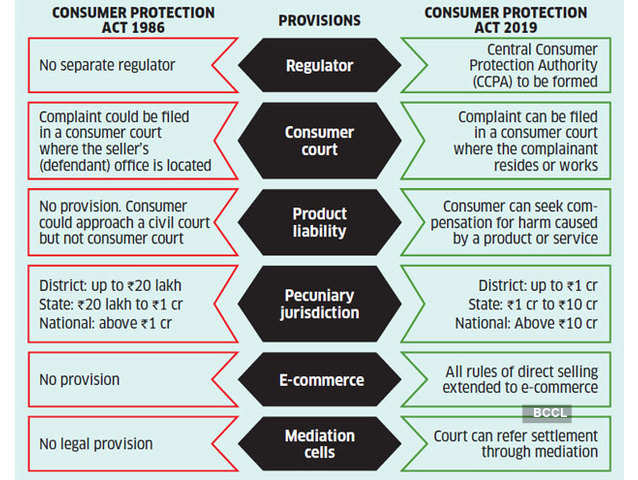
1) Consumers can now institute a complaint from where they reside or work for gain.

2) The original pecuniary jurisdiction of the District Commissions has increased upto ₹1 crore from ₹20 lakh earlier.

3) The Pecuniary jurisdiction of State Commissions has been increased from ₹1 crore to Rs. 10 crore.

4) The National Commission can hear cases above ₹10 crore when compared to above ₹1 crore earlier.

5) While the provisions relating to e-commerce are not yet notified, a section relating to electronic service provider (covering software services, electronic payments) is notified.

6) The opposite party needs to deposit 50% of the amount ordered by the District Commission before filing an appeal before the State Commission. Earlier, the ceiling was a maximum of ₹25,000, which has been removed.

7) The limitation period for filing of appeals to the State Commission has been increased from 30 days to 45 days.

8) The Parties can be allowed to settle the disputes through mediation.

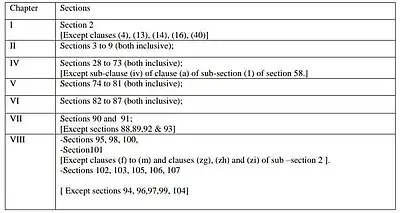
Following are the Sections which came into force:

Consumer Protection Act 2019- Sections to come into force from July 20,2020

Above mentioned provisions pertain to the Consumer Protection Councils, Consumer Disputes Redressal Forum, Mediation, Product Liability, punishment for manufacturing, selling, distributing etc spurious good or products which contain adulterant.

As per the rules, the e-commerce players will have to display the total ‘price’ of goods and services offered for sale along with break-up of other charges. Only a few certain miscellaneous provisions with regards and respect to the powers of the Central and State Government to make the rules and regulations have also been enforced.

On misleading advertisements there is provision for jail term and fine for manufacturers. There is no provision for jail for celebrities but they could be banned for endorsing products if it is found to be misleading.

For the first time there will be an exclusive law dealing with Product Liability. A manufacturer or product service provider or product seller will now be responsible to compensate for an injury or damage caused by the defective product or deficiency in services.

The Act has also defined an “e-commerce” as the buying or selling of goods or services including the digital products over digital or electronic networks. The existing definition of e-commerce has been adopted from India’s FDI Guidelines on e-commerce.

The definition of ‘e-commerce Entity’ as provided under the FDI Guidelines includes inventory and market place models.

There is also a provision for class action law suit for ensuring that rights of consumers are not infringed upon. The authority will have power to impose a penalty on a manufacturer or an endorser of up to 10 lakh rupees and imprisonment for up to two years for a false or misleading advertisement.

WEBSITES REFERRED

1)https://consumeraffairs.nic.in/acts-and-rules/consumer-protection

2)https://www.barandbench.com/news/law-policy/provisions-under-consumer-protection-act-2019-to-come-into-force-on-july-20-2020-centre-notifies

3)https://www.google.com/amp/s/www.thehindu.com/news/national/tamil-nadu/new-consumer-protection-act-gives-more-power-to-consumers-experts-say/article32135908.ece/amp/

4)https://www.google.com/amp/s/www.livemint.com/news/india/consumer-protection-act-rules-for-e-retailers-to-be-effective-by-this-weekend/amp-11595291549084.html

5)https://www.google.com/amp/s/zeenews.india.com/economy/new-consumer-protection-act-2019-comes-into-force-today-know-how-it-will-benefit-you-2297012.html/amp

6)https://www.google.com/amp/s/m.economictimes.com/wealth/spend/heres-how-consumers-will-benefit-under-the-new-consumer-protection-act/amp_articleshow/70711304.cms

7)https://www.google.com/search?q=consumer+protection+act%2C2019&tbm=isch&ved=2ahUKEwjOhv7-sN7qAhVIH3IKHTOCBfMQ2-cCegQIABAC&oq=Consumer&gs_lcp=ChJtb2JpbGUtZ3dzLXdpei1pbWcQARgAMgQIIxAnMgUIABCxAzIFCAAQsQMyBQgAELEDMgUIABCxAzoHCCMQ6gIQJzoCCAA6BwgAELEDEEM6BAgAEENQ0xRYzipg1jBoAnAAeACAAZABiAGHCJIBAzAuOJgBAKABAbABBcABAQ&sclient=mobile-gws-wiz-img&ei=e-QWX47dJsi-yAOzhJaYDw&bih=682&biw=393&prmd=ivn#imgrc=eILduqMFjleJaM

8)https://www.vecteezy.com/free-vector/consumer

9)https://www.google.com/amp/s/www.livelaw.in/amp/news-updates/most-provisions-of-consumer-protection-act-to-come-into-force-160003

Child labour

Child labour is a term you might have heard about in news or movies. It refers to a crime where children are forced to work from a very early age. It is like expecting kids to perform responsibilities like working and fending for themselves. There are certain policies which have put restrictions and limitations on children working.

The average age for a child to be appropriate to work is considered fifteen years and more. Children falling below this age limit won’t be allowed to indulge in any type of work forcefully. Why is that so? Because child labour takes away the kids opportunity of having a normal childhood, a proper education, and physical and mental well-being. In some countries, it is illegal but still, it’s a far way from being completely eradicated.

Causes of Child Labour

Child Labour happens due to a number of reasons. While some of the reasons may be common in some countries, there are some reasons which are specific in particular areas and regions. When we look at what is causing child labour, we will be able to fight it better.

Firstly, it happens in countries that have a lot of poverty and unemployment. When the families won’t have enough earning, they put the children of the family to work so they can have enough money to survive. Similarly, if the adults of the family are unemployed, the younger ones have to work in their place.

Moreover, when people do not have access to the education they will ultimately put their children to work. The uneducated only care about a short term result which is why they put children to work so they can survive their present.

Furthermore, the money-saving attitude of various industries is a major cause of child labour. They hire children because they pay them lesser for the same work as an adult. As children work more than adults and also at fewer wages, they prefer children. They can easily influence and manipulate them. They only see their profit and this is why they engage children in factories.

Eradication of Child Labour

If we wish to eradicate child labour, we need to formulate some very effective solutions which will save our children. It will also enhance the future of any country dealing with these social issues. To begin with, one can create a number of unions that solely work to prevent child labour. It should help the children indulging in this work and punishing those who make them do it.

Furthermore, we need to keep the parents in the loop so as to teach them the importance of education. If we make education free and the people aware, we will be able to educate more and more children who won’t have to do child labour. Moreover, making people aware of the harmful consequences of child labour is a must.

In addition, family control measures must also be taken. This will reduce the family’s burden so when you have lesser mouths to feed, the parents will be enough to work for them, instead of the children. In fact, every family must be promised a minimum income by the government to survive.

In short, the government and people must come together. Employment opportunities must be given to people in abundance so they can earn their livelihood instead of putting their kids to work. The children are the future of our country; we cannot expect them to maintain the economic conditions of their families instead of having a normal childhood.

Child labour refers to the exploitation of children through any form of work that deprives children of their childhood, interferes with their ability to attend regular school, and is mentally, physically, socially or morally harmful.[3] Such exploitation is prohibited by legislation worldwide,[4][5] although these laws do not consider all work by children as child labour; exceptions include work by child artists, family duties, supervised training, and some forms of child work practiced by Amishchildren, as well as by indigenous children in the Americas.[6][7][8]

Child labour has existed to varying extents throughout history. During the 19th and early 20th centuries, many children aged 5–14 from poorer families worked in Western nations and their colonies alike. These children mainly worked in agriculture, home-based assembly operations, factories, mining, and services such as news boys—some worked night shifts lasting 12 hours. With the rise of household income, availability of schools and passage of child labour laws, the incidence rates of child labour fell.[9][10][11]

In the world’s poorest countries, around one in four children are engaged in child labour, the highest number of whom (29 percent) live in sub-saharan Africa.[12] In 2017, four African nations (Mali, Benin, Chad and Guinea-Bissau) witnessed over 50 percent of children aged 5–14 working.[12] Worldwide agriculture is the largest employer of child labour.[13] The vast majority of child labour is found in rural settings and informal urban economies; children are predominantly employed by their parents, rather than factories.[14] Poverty and lack of schools are considered the primary cause of child labour.[15]

Globally the incidence of child labour decreased from 25% to 10% between 1960 and 2003, according to the World Bank.[16]Nevertheless, the total number of child labourers remains high, with UNICEF and ILOacknowledging an estimated 168 million children aged 5–17 worldwide were involved in child labour in 2013.[17]

The Child Marriage Restraint Act, 1929 and Jaya Jaitly Task Force

By Udbhav Bhargava

The minimum age of marriage for women in India will probably get changed from 18 to 21 as the government has created up a high-level committee to delve deep into to the matter to deliver their recommendations by July 31. The 10-member working group would have members from Women and Child Development, Law and Education ministries. An amendment in the marriage age provisions of the Sarda Act is seen as a probable conclusion.

Jaya Jaitly, former president of the Samata Party, is coined as the head of the committee and will guided by VK Paul (Health Department, NITI Aayog) along with the other members. The Task Force will discuss topics pertaining to motherhood and marriage at an early age, the age of motherhood, the imperatives of a decline in maternal mortality rates, and dietary changes.

A background of laws codifying legal age of marriage

The legislation prescribes a minimum marriage age to effectively prohibit child marriages and deter child violence. In 1860, the Indian Penal Code criminalized any sexual activity with a child below 10 years of age. Age of Consent Bill, 1927 found marriages with a girl below 12 illegitimate.

Sarda Act

The Child Marriage Restraint Act of 1929, defined 14 and 18 years as the minimum marriage age for women and men respectively. After its proponent Harbilas Sarda, a judge and an affiliate of Arya Samaj, the legislation is popularly known as the Sarda Act. It was the first topic of social change that an organized women’s community in India had taken up. Via picketing their delegations, carrying placards and shouting slogans, this group forced many lawmakers to back the act.  They thought passing of this act would show the world that India is serious about social reforms. During the colonial era of British rule in India the Act remained a futile exercise British did not want to gain the resentment among the communal elements of Hindus and Muslims. Principally states have been excluded from the effect of the Act.

Post-Independence the Sarda act was amended in 1978. Since then, the minimum legal age for marriage has been 18 for women and 21 for men. The Prohibition of Child Marriage Act, 2006 also prescribe 18 and 21 years as the minimum age of consent for marriage for women and men respectively and have codified provisions that enable stringent measures against the promoters of child marriage.