The previous article was about the different types of immune cells. This article is about a special molecule in immunity known as immunoglobulin.
There might be a question that what is so special about this immunoglobulin. There is a reason for this. These molecules play an important and inevitable role in the phagocytosis of pathogens. To understand this, it is essential to know about immunoglobulins.
The immunoglobulin is a gamma globulin, a specialized group of proteins (glycoprotein) produced in response to pathogens. It is produced by the plasma cells (a globulin protein present in the plasma). These constitute 25-30% of the blood proteins.
There are two important terms that are more commonly known by the most, they are the antigen and the antibody. The antigen is the molecule present on the surface of the pathogen and can stimulate an immune response. There is a small part of the antigen called the epitope which interacts with the antibody. The epitope is known as the antigen determinant site. An antigen can have unlimited epitopes.
On the contrary, the antibody is the molecule produced in response to the antigen in order to kick it away. The part of the antibody which interacts with the antigen is called a paratope. An antibody must have at least 2 paratopes. These antibodies belong to the immunoglobulins. All antibodies are immunoglobulins but not immunoglobulins are antibodies. To understand how the antibody helps in immunity, it is essential to understand the structure of an antibody/immunoglobulin. The image below shows the general structure of an immunoglobulin:-
There are two chains in an immunoglobulin namely the light chain and heavy chain. The light chain has 212 amino acids (the building block of protein) and the heavy chain has 450 amino acids. Each chain has two types namely the constant and variable. These regions are based on the amino acid sequences. Half of the light chain (1 out of 2) is constant and the rest is variable. A quarter of the heavy chain (1 out of 4) is variable and the rest is constant. These are linked by two types of sulfide bonds namely the intra (H-H AND L-L) and inter (H-L). These molecules contain carbohydrates (CHO) hence these are called as glycoproteins.
The tip of the variable regions of the heavy and light chain is hypervariable in nature and these constitute the antigen-binding site (Fab). These are hyper-variable because they have to produce amino acid sequences complementary to that of the antigen so that they can interact together. The other site is called a crystallizable region (Fc).
Having known all this, now it will be convenient to explain the process by which the antibody plays in the prevention of infections.
There are millions of substances that pass through the blood every day. So there must be a criterion/substance to identify them whether they are pathogenic. This is where antigen comes to play. These antigens present on the surface of the pathogens alert the immune system which then identifies this as a pathogen. So in response to the antigen, a suitable antibody is secreted and deployed to the target site. On reaching the antigen, the Fab region binds with the antigen.
The ultimate aim of the immune system is to abolish the pathogen and one way is by phagocytosing them. This is done by the macrophages. But it is essential for them to identify the substance before engulfing it. This is where the antibody comes to play. The Fc region of the antibody combines with the receptor of the macrophage. This facilitates the process of phagocytosis.
Hence the antibody acts like a bridge between the source (antigen) and the destination (macrophage) aiding in phagocytosis. This is essential because in most of the cases the macrophages, it is difficult to identify the non-self-objects and this is where antibody helps.
In the case of the new pathogen, the antigen is new, and therefore their might not be a suitable antibody. In that case, the macrophage cannot phagocytocise the pathogen and it reigns in the body causing infection and disease.
The next article is about the types of immunoglobulins.
The outburst of COVID 19 became a challenge to Indian economy by the potential downfall in the GDP. However, the second wave was much severe when compared to the first which made a downside risk to the economic activity due to National level lockdown. Several segments like manufacturing, small scale, Information technology, small unions are lost in the pandemic. The supply chain management with the global economy along with the procurement was drastically affected. The immensity of the impact is directly proportional to the health crisis and duration of the lockdown. In this the analysis had been done on the affected segments and the Government concentrations of lockdown to increase the capital expenditure and to implement the structured reforms as well.
CHANGES
There are several sectors which are impacted by the COVID-19 and the chances of their revival are not in the near future. Their profitability is continuously decreasing and fixed cost is intact. Like media and entertainment industry; all multiplexes are closed and people do not want to visit the multiplexes in the near future. Many organizations have taken loan from the commercial banks and other financial institutions. They have to pay interest on the loan despite of poor financial position.
Increase in the income provisions for the supportive measures of the rural and urban population The productive way is to increase recovery rate by emergency approval of the foreign vaccines when the demand for the vaccines increases in India. The Government and the RBI need to keep interest rate low despite borrowing on policy basis. The Success of the borrowing program depends on RBI support, by providing indirect liquidity which is really big as this is pandemic. But the liquidity expansions has its own limits.
FORECOMING CHALLENGES
The sectors like construction, trade and transport, hotel, mining, quarrying sectors and some other services are having a strong base effect on the challenging recovery part. These kind of hard situation are monitored clearly and the demand for those kind of sectors are faltering due to the crisis which would become more aggressive and would be the most unavoidable once for the upcoming years. The country’s long term goal is affected badly and the performance needed to with held by hard efforts for the further improved output.
Shivaji, also known as Chhatrapati Shivaji was born on 19
February 1630 – 3 April 1680.He was a brave Indian rulerwho formed Maratha empire from the declining Adilshahi Sultanate of Bijapur .
1. The origin of name ‘Shivaji’
The name of Shivaji Maharaj did not generate from
the name of Lord Shiva instead the name was derived from a regional deity by
the name Shivai.
2.Shivaji prioritized his
country over his kingdom
Shivaji
Maharaj motivated his soldiers that while fighting, they should keep in mind
that they are serving for their nation and not for any king. He had a goal of
achieving a free state.
3.Shivaji respected women
Shivaji
Maharaj respected women. He was strongly against any type of harassment towards
women. He strictly instructed his soldiers to respect women. Anyone who tried
to harass women were strictly punished by Shivaji Maharaj. During the reign of
Shivaji Maharaj, women of the captured territories were treated with respect,
unharmed and none were treated as prisoners.
4. Shivaji Maharaj cleverly
and strategically escaped from Panhala fort!
Shivaji
successfully escaped from Panhala fort cleverly and strategically. When Siddhi
Johar’s army trapped Shivaji Maharaj in Panhala fort, he made a strategy to escape
wherein he arranged two palanquins.
In one of
the palanquins, a barber who was similar to Shivaji was seated and had asked to
lead him out of the fort. The soldiers went after the fake palanquin and
Shivaji successfully fooled 600 soldiers and had then escaped from Panhala
fort.
5. Shivaji was extremely compassionate and forgiving in nature
Shivaji
Maharaj was very compassionate and forgiving and welcomed anyone in his army
who surrendered to him. He had an extremely caring nature and never captured
religious places and homes of the local people.
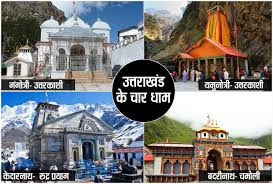
The Chardham Yatar- Chardham Yatra is India’s most devoted and featured part of India’s spiritual tour. Chardham is the most renowned and holy expendition in India that includes visting to four glorious shrines including Yamunotri, Gangotri, Kedarnath and lastly the Badrinath Dham. A visit to theseholy shrines together forms the Chota Chardham yatra in India all these famous sacred destinations are located in the astonishing Himalayan foothills of Uttarakhand districts.
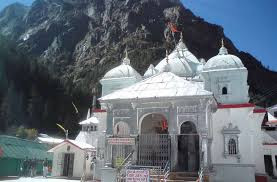
Gangotri Temple:One of the char dhams (the most sacred pilgrimage circuits in northern India with four holy destinations), Gangotri, in Uttarkashi, is a small town with the temple of Goddess Ganga at its heart. A 12-hour drive from Rishikesh, Gangotri is nestled among lofty Garhwal Himalayan peaks, glaciers and dense forests, and is one of highest pilgrimages in India (approx 3,415 m). Other than its divine atmosphere, Gangotri offers stunning vistas all around. According to Hindu legends, the most sacred of all rivers, Ganges (or Ganga), descended from heaven to earth at Gangotri, when Lord Shiva released the mighty river from his locks. The actual origin of the river is at Gaumukh in the Gangotri glacier, 19 km away from Gangotri and is accessible by trekking. After it originates from Gaumukh, the river is known as Bhagirathi and it acquires the name ‘Ganga’ after the river Alaknanda merges into it near the town of Devaprayag.
Yamunotri Temple: The source of River Yamuna, Yamunotri is also one of the four sites of Char Dham pilgrimage. Yamunotri is located at a height of 3293 mts above sea level and located in Uttarkashi District . It is surrounded by mountains on all sides and lies in close proximity of the Indo-China border.It is known for offering peace and tranquillity to its visitors.
The Bandarpunch Mountain is at a height of 6315 mts and lies north of Yamunotri. Yamunotri is at a distance of 236 km from Rishikesh , 21 km from Sanya Chatti 278 km from Dehradun , and 176 km from Chamba.
Shri Kedarnath Temple: Kedarnath temple is one of the sacred pilgrimage centre in Northern India, located on the bank of Mandakini river at an altitude of 3584 meters above sea level. The historical name of this region is “Kedar Khand”. Kedarnath temple is a part of Char Dhams and Panch Kedar in Uttarakhand and one of the 12 Jyotirlingas of Lord Shiva in India.
Shri Badrinath Temple: The famed town of Badrinath is among the four dominant Char Dham pilgrimage sites of Indiaas well as the Chota Chardham. It is perched at an average elevation of 3,300 metres (10827 feet) above sea level on the banks of Alaknanda River.
This holy town is named after the Badrinath temple dedicated to the preserver, Lord Vishnu. Many Hindu devotees are smitten by the charm of this holy shrine as it showcases the traditional Garhwali wooden architecture.
India is the country with more than half of the population of people between 18-45 years age group.
Till the age of 18 a person attains physical, mental and social maturity. He has grown in all aspects. He is well aware of what's wrong and what's right for him.
After 18 a person is able to live and survive in this world alone. He starts learning. He can enter the world of competition and race, where it's not necessary that he must win but it's important for him to compete. To be at a better place, he should develop his personality, his knowledge, he has to look inside himself and find out his full potential. He has to find ways to explore his capabilities. He has to establish his connections in the world, he has to create a chain of events that will help him reach success.
The youth has an ability, strength, thinking power, confidence and innovative thoughts which can help him grow and can contribute to the development of the nation too. The only necessity is realization. The young people of the country should realize their responsibilities of being a youth not for the nation, not for the society, not for the parents, but for themselves first. It will eventually benefit parents, society and the nation. If the brick is strong, the building will naturally be strong.
It's a fact that you never value something which is in a huge quantity. The value is realized by the scarcity. Youth population of India is a boon for the country, but it's turning into a ban as the productive population of India is not concerned neither about themselves nor about the nation.
Being an adult doesn't only mean that a person is eligible for voting. There are so many situations where you have to behave as an adult. It is said that charity begins at home. Similarly if you want to change the nation first you have to change yourself and your behavior at home.
Generally in India parents are possessive of their children. They never let their child grow up. They continue to pamper them, and feed them. A child grows into an adult physically but not mentally. Parents don't give responsibilities to their children. If children ask for it they don't allow them to do so.
In short, Indian parents are hypocrites. They expect two different things from their children at the same time. They want their children to be successful. To be a man of good name and fame. At the same time they want to pamper them. They don't leave them alone. They don't want them to struggle. They want to give them every luxury. They don't want them to face the same hardship they had faced. They earn for their child's pleasure, comfort and happiness.
They don't realize that all these facilities and comfort they are providing to their children is making them dependent, lazy, and unproductive. They would never struggle in their life if they get everything so easily.
Parents provide all the facilities and then control them and their freedom. If a child doesn't listen to them they feel bad that their child does not value their sacrifices and facilities they have been given.
Therefore the first and foremost step every person, who is above 18, should take is to be independent of their parents. They should be transparent. It must be clear to his parents from the very beginning that he wants to earn his pocket money on his own. He has to work and study simultaneously. This makes a child a mature adult and productive citizen.
When a person attains the age of 18 he has a fresh and innovative mind. He knows how to create new things which can bring a change in the world. Like Newton and Charles Babbage.
This universe has given everyone a unique identity and an amazing talent. Another person can help explore your talent but finding out that talent, having realization of the ability comes from within you. Some people become successful in finding a gem from the innermost corner of themselves and some easily spoil their life.
Let's say if 75% of the population of India is youth, only 25% of them are giving output to the nation and contributing to its growth. Rest all are either busy scrolling social media, engaged in drug activities, some are being terrorists, some are being smugglers and some are roaming around in the streets and staring at girls.
Nowadays people don't want to struggle but want all the facilities. All want success but nobody wants to pay blood and sweat for it. Nobody gains anything until you give something. Every drop of water makes up the huge ocean and hence development of an individual is far more necessary than of the entire nation. If every individual will develop, society and nation automatically will develop.
Women Empowerment itself elaborate that Social Rights, Economics stability, judicial strength and all other rights should be also equal to women. There should be no discrimination behaviour men and women. Women should now there fundamental social rights which they get once they born. There should be respect and dignity towards women. Have total independence of their own life and lifestyle inside the home and also outside at their work. They should make their decision, by their own choice. They should have a high social respect in society. Women Empowerment is the most important issue of the Indian society. There is huge demand of empowering women in the society to let them freely live their life, given them equal rights to take part in any activity.
“There is no tool for development more effective than the empowerment of women”.
Out of one hundred crore plus Indians only three bagged coveted medals for the country, and ironically, both were girls. Defying all odds and showing grace and killer instinct P.V Sindhu, Lovlina Borgohain and Mirabai Chanu.
Women in India are emerging in all sectors, including politics, business, medicine, sports and agriculture. History was made when two female scientists from the Indian Space Research Organisation led the country’s second lunar mission Chandrayaan-2 from its inception to completion in 2019. Female leadership for a huge space mission challenged the meta narrative that rocket science is a profession reserved for men. Another milestone was reached when the Supreme Court upended the government’s position on women serving as army commanders in 2020. Women were first inducted into the armed forces in 1992 and have served in a multitude of positions, including fighter pilots, doctors, nurses, engineers, signallers, etc. While the issue of women serving in combat roles continues to be a contentious one worldwide, these are instances where Indian women have overcome the glass ceiling in the armed forces.
India’s story on women empowerment is not complete without focusing on grassroots initiatives adopted by the government and civil society organisations. The federal and state governments have launched new schemes, policies and programmes to empower both urban and rural women. The Narendra Modi government has launched flagship schemes to promote gender equality, including Beti Bachao Beti Padhao (Save the Daughter, Educate the Daughter), Pradhan Mantri Ujjwala Yojana (a scheme to provide gas connections to women from below the poverty line households) and Mahila-E-Haat.The Bachao Beti Padhao Yojana scheme was launched in January 2015 to address the issue of a gender skewed ratio and generate greater welfare for the girl child. The focus is centred mostly on Northern India, including Haryana, Uttar Pradesh, Delhi, Punjab and Uttarakhand where the gender ratio is wider. The Mahila-E-Haat project, an online marketing campaign, was launched in 2016. It uses technology to support female entrepreneurs, self-help groups and non-government organisations (NGOs). Each scheme has its own unique objective, ranging from welfare of the girl child and community engagement to supporting aspiring female entrepreneurs.
As good as modern medical technology is, it can never save you from the problems caused by a life style that is unhealthy. Instead of getting a modern medical fix for every problem, it is far better to live in such a way that you will hardly ever fall ill.
An ounce of prevention is certainly better than a pound of cure. Here are seven tips on how to live a long and healthy life. In addition, the same life style that helps you to avoid illness also helps you to lose weight.
1. Get Enough Exercise
In the past people had to use their physical bodies in the course of their normal work. But today someone may get up, go to work in a car, then sit down, get up to go home in the car and when arriving at home, sit down again for the rest of the day. In such a life there is no physical labor. This physical inactivity is one of the main reasons for a host of diseases. Sport, running. walking and other things must be added to our life if our normal work does not require us to exert ourselves physically. I
2. Go to sleep when you feel sleepy
This may sound simple, but many people stay up late even when their body is telling them that it is time to sleep. Yoga and Ayurvedic doctors also say that it is better to sleep in the night and be active during the day. However, people such as students will take coffee and stimulants to study late into the night. Others develop the habit of remaining active at night and sleeping during the day. While we can do this, it eventually takes a toll on health. Alternative health doctors say that this kind of unnatural living is one of the contributing factors in the causation of cancer and other diseases
3. Eat when you feel hungry
This is also a simple idea, but once again we often go against the messages of the body. If you eat out of habit or due to social pressure at certain time of the day, even when you have no real appetite, then you will not digest your food properly. Acidity and indigestion begin, and this contributes to the likelihood of other more complex diseases taking root. Having an appetite is actually a sign of good health, but if you have no appetite you should wait a bit and then eat. (If you have no appetite even after awaiting a reasonable amount of time, then you should consult a doctor because something is wrong.)
4.Fast on a Regular, Systematic Basis
If you would ask any person to work 365 days per year without any rest, they would complain and say that they must have some rest or else they will break down. But we have never bothered to ask or to think about our digestive organs which we compel to work day after day without a rest. They cannot protest the way a person would to his boss, but they do give us signals that they cannot work non-stop. When we ignore those signals and still compel them to work, those organs break down. That is why periodic fasting is necessary. Refrain from eating for one complete day. This gives a rest to your digestive organs and also helps in the elimination of wastes from your body. Regular fasting allows a person to gain extra time for intellectual or spiritual pursuits. Fasting is not for hermits in a cave, but is a sensible practice that anyone can practice.
5. Wash with cool water before going to bed
As mentioned above, proper sleep is essential for the maintenance of health. If you wash your important motor and sensory organs (hands, arms, eyes, legs, mouth, genitals) before sleep using cool water, this will relax you and prepare you for deep sleep.
6. Perform meditation on a regular basis
Your body is linked to your mind. Many of the diseases of this era are psychosomatic. Stress and anxiety take their toll on our physical health. Meditation is a mental exercise which, among other things, allows you to detach yourself from the worries of life. Learn a simple technique and do it regularly.
7. Get up early every day
Once again the old proverb, “Early to bed, early to rise makes a person healthy, wealthy and wise.” I don’t know if it will make you wealthy, but it will certainly make you healthy. Your body needs just enough sleep, not too much and not too little.
It happened years ago when India faced partition be it with Pakistan or within Andhra Pradesh(making of Telangana). These involved change of boundaries and beliefs but moving ahead we all adapted to them and welcomed new beginnings.
Our Independent Nation was believed to be achieving great heights in the coming years of Independence. The hopes were high and so was the joy and enthusiasm among the citizens. They dreamt of a nation where everyone would be his own master; where they will earn their living their own way and where, there would be innumerable possibilities for growth and development. Of course, the excitement was over their mind and the feeling of freedom was another level of peace and serenity. But, did that happened likewise ? Yes we have come far enough and are still moving ahead. Our past position and present scenario are way different in terms of growth which we have had been able to achieve through years of struggle as a nation. Being labelled as a developing country shows the mark we have reached through collective efforts in the areas of infrastructure, economy and livelihood. The focus is now on sustainable development which aims at development at a pace which does not harm the future goals or requirements of the future generations. This appears a fantastic model but the present needs too need attention to the same level now.
The increasing rate of unemployment, poverty and discrimination are amongst the major issues need to be resolved in order to build a strong force serving the nation at its best.
Each human is a resource and can be utilised in a way that contributes not only to the growth of the nation but the world as a whole. There is a lot that is still unexplored or which requires actions to be taken globally. Individual growth is complimentary to this.
Employment opportunities need to be developed creatively. It simply implies there are already many opportunities, what lacks is creativity and innovation. Though we are constantly innovating ideas but they are technology oriented and not human focused. Innovation is required so that there are ample opportunities for all of us to explore and learn. Technology makes us sick when it is used to make even basic tasks of our life, automatic. Hard work should always be encouraged. Technology feels good when it is used to make complex things simple. The boundaries we see between the rich and the poor, the educated and the illiterate, the working and the unemployed, the women and the men; all these make up for the partition India is facing.
As it is said a lot, “rich are becoming richer, poor are getting poorer”, similarly, the distances are widening between the other above stated partitions as well. The discrimination on the basis of colour, caste, religion, region, gender, etc. are parting the country as we go on. It seems they are left behind on the journey towards development. Still there are many places where women are treated lower to men, having no freedom to live their own way. The ‘minority groups’ still don’t have their rights as a citizen. The “untouchables” continue to be unacceptable and what to say about discrimination faced by the transgender. It is not always the government to blame upon. In fact they launch various schemes to help and support all the classes and sections of the society. The dust remains in the mind of the people who are not ready to accept everyone as their equals, the ones who believe in superiority of one over the other even after living in a democratic country. It may also happen due to the past relations. “What we learn being grown up is what we follow”, this can be a reason why people have a fixed mindset which is hard to change. But as we keep moving there arises a need to take up all, together. The nation is one as a whole and these partition need to be erased for the sake of all. There are more issues that need attention by us, therefore the previous ones need to be sorted to focus on the upcoming. If we can bring the whole nation together, not only by words but behaviour as well, we would soon be able to solve our global matters of concern as well; which include pollution, over-population, ozone layer depletion, water management, etc.
On 15th August Taliban fighters entered the outskirts of Kabul, promised to not use any force but it all lead to panic among the residents. In a nationwide offensive that has taken just over a week, the Taliban has defeated, co-opted or sent Afghan security forces fleeing from the country, even though they had some air support from the U.S. military.
On Sunday, they reached Kabul. Three Afghan officials told The Associated Press that the Taliban were in the districts of Kalakan, Qarabagh and Paghman in the capital. Later, Afghan forces at Bagram air base, home to a prison housing 5,000 inmates, surrendered to the Taliban, according to Bagram district chief Darwaish Raufi. The prison housed both Taliban and Islamic State group fighters.
Kabul was gripped by panic. Helicopters raced overhead throughout the day to evacuate personnel from the US Embassy. Smoke rose near the compound as staff destroyed important documents, and the American flag was lowered. Several other Western missions also prepared to pull their people out.
The residents fear that Taliban might impose some brutal rules, eliminate women rights. Therefore they are leaving for the airport which lead to a great chaos there. Though the Taliban had promised a peaceful transition, the US Embassy suspended operations and warned Americans late in the day to shelter in place and not try to get to the airport. Commercial flights were suspended after sporadic gunfire erupted at the Kabul airport, according to two senior US military officials. Evacuations continued on military flights, but the halt to commercial traffic closed off one of the last routes available for fleeing Afghans.
It remained unclear when that transfer would take place and who among the Taliban was negotiating. The negotiators on the government side included former president Hamid Karzai, leader of Hizb-e-Islami political and paramilitary group Gulbudin Hekmatyar, and Abdullah, who has been a vocal critic of Ghani.
Baby Driver is some of the most fun I had watching a big summer blockbuster movie since John Wick. Edgar Wright is able to craft a riveting storyline that actually makes sense and conveys this narrative in an extremely stylish and exciting manner. First of all, Edgar Wright is one of the few people working in Hollywood today who knows how to helm an action sequence. On top of the action being extremely well directed with minimal cuts and long takes, everyone single action scene is well choreographed to match the music in the background, which still bemuses me of how good it is. The movie is also extremely fast-paced and you never really get bored throughout this movie.
Another thing that Edgar Wright did so well is developing the characters and their motivations. As I have already said, this movie is extremely fast-paced but Edgar Wright clever utilizes this short time to add more depth to the characters. At times you could definitely tell where the movie is headed to but the way it gets there is always very interesting and actually makes the movie unpredictable. The last thing I would like to praise the movie for is the use of practical effects, namely in its car chasing sequences. You could tell that there was a lot of effort put into all of the car’s chase sequences and the movie uses amazing camera work to follow the car to make it feel more realistic and immersive.
Though there is a lot I liked about this movie I definitely do not think that this is a flawless masterpiece. Most of the issues stem from the relationship between Baby and Debora. Debora is a character that is extremely thinly crafted and acts and behaves in a certain just to drive the plot along. The same can also be said about Kevin Spacey’s character who to just completely flips character during the third act of the film.
The rules are simple: choose the most significant moments from your relationship – one for each hour in the day.
You’d probably pick when you first met, right? And the instant you knew for sure it was love? Maybe even the time you watched the sunrise after your first night together?
But what about the car journey on the holiday where everything started to go wrong? Or your first proper fight?
Or that time you lied about where you’d been?
It’s a once in a lifetime chance to learn the truth.
But if you had to be completely honest with the one you love, would you still play?
For Esme and Tom, the game is about to begin. But once they start, there’s no going back . . .
Review
Our Life in a Day is the debut novel from Jamie Fewery, and the story of Tom and Esme. The night before they are due to go away for their anniversary Esme challenges Tom to pick important moments from their relationship that relate to each hour of the day. The book takes us on the journey of their relationship, the good and the bad, as we are voyeurs to their most private moments. This is such a beautiful book, in regard to the writing and the plot line, and was such a pleasure to read.
What I really enjoy about this book was the honesty the author employed in terms of the relationship; it wasn’t all hearts and flowers and wonderful memories, there were some incredibly sad and tense moments. In life it is the rough and the smooth that makes real relationships and Tom’s most significant moments certainly encompassed that. Yes, there are the romantic parts, the night they met, their first Christmas together, but there were also the arguments in the car on the way to their first anniversary away, the disastrous camping trip etc. One important thread that ran through these memories for Tom was his inability, or avoidance, of telling Esme about his past with depression. This secret, that comes up at several points, is always lurking in the background and as we all know huge secrets like that have a habit at coming out when least expected.
As characters, I loved Esme and Tom, they came from very different backgrounds, and represented the hope and fear we all have in starting new relationships. Esme is an independent character, with a great career, but in terms of relationships she doesn’t want marriage. Tom is a musician, we learn he went to university but left early, and has fantastic friends who are there to look out for him after an unknown event (revealed later in the book). Tom’s battle with depression is very topical with a lot of attention being on mental health issues especially in young men. Tom is obviously ashamed by his depression as he doesn’t want to discuss it or let Esme find out. Jamie Fewery’s writing on this subject is very compassionate, and he deals with the subject with great sensitivity and understanding.
One Day in a Life is an honest and heartfelt look at the dynamics in relationships. It certainly isn’t a slushy sentimental read; it has some difficult moments but there are also some humorous memories. The writing of the characters and story drew me straight in with the feeling of intimacy in relation to the characters and the easy flow of the plot line; it is hard to comprehend that this is Jamie Fewery’s debut novel. This is an emotional rollercoaster of a read that you won’t want to get off, a fabulous read!
I would like to thank Orion Books and Tracy Fenton for providing me with a copy of the book to read and review as part of the blog tour.
I have made it easier to leave comments on my posts so I look forward to reading your thoughts. Thank you for taking the time to read my review and for all follows and likes.
Author : Dan Brown Publication date : April 2003 Pages : 689 (U.S. hardback) 489 (U.S. paperback)
The novel explores an alternative religious history, whose central plot point is that the Merovingian kings of France were descended from the bloodline of Jesus Christ and Mary Magdalene, ideas derived from Clive Prince’s The Templar Revelation (1997) and books by Margaret Starbird. The book also refers to The Holy Blood and the Holy Grail (1982) though Dan Brown has stated that it was not used as research material.
Characters
Robert Langdon: A professor of symbology at Harvard University and the protagonist of the novel.
Jacques Saunière: The grandmaster of priory of Sion, Curator of Louvre Museum and primary antogonist of the novel.
Sophie Neveu: A Cryptologist of French police and granddaughter of Saunière.
Bezu Fache: A member of Opus dei and a French police.
Silas The monk: A member of Opus dei who murders Saunière.
Manuel Aringarosa: A bishop of Vatican and member of Opus dei.
Sister Sandrine: A Seneschal of priory of Sion and sister of St. Sulpice.
André Vernet: A guard of Zurich bank.
Sir Leigh Teabing The Teacher: A Grail scholar, living in Paris and secondary antogonist of the novel.
Rémy Legaludec: A maid who assist Teabing.
Jérôme Collet: A French police.
Marie Chauvel Saint-Clair: Sophie’s grandmother and Saunière’s wife.
Summary
In the Louvre, a monk of Opus Dei named Silas apprehends Jacques Saunière, the museum’s curator, and demands to know where the Holy Grail is. After Saunière tells him, Silas shoots him and leaves him to die. However, Saunière has lied to Silas about the Grail’s location. Realizing that he has only a few minutes to live and that he must pass on his important secret, Saunière paints a pentacle on his stomach with his own blood, draws a circle with his blood, and drags himself into the center of the circle, re-creating the position of Da Vinci’s Vitruvian Man. He also leaves a code, a line of numbers, and two lines of text on the ground in invisible ink.
A police detective, Jerome Collet, calls Robert Langdon, the story’s protagonist and a professor of symbology, and asks him to come to the Louvre to try to interpret the scene. Langdon does not yet realize that he himself is suspected of the murder.
After murdering Saunière, Silas calls the “Teacher” and tells him that, according to Saunière, the keystone is in the Church of Saint-Sulpice in Paris. The Teacher sends Silas there. Silas follows Saunière’s clues to the keystone’s location and discovers that he has been tricked. In a fit of rage, he kills Sister Sandrine Bieil, the church’s keeper and a sentry for the Priory of Sion. At the Louvre, Langdon meets Jerome Collet and Bezu Fache, the police captain, and realizes that the two policemen suspect him of the murder.
Sophie Neveu, an agent of the department of cryptology and Saunière’s granddaughter, arrives at the crime scene and tells Langdon that he must call the embassy. When Langdon calls the number Sophie gave him, he reaches her answering service. The message warns Langdon that he is in danger and should meet Sophie in the bathroom at the Louvre.
In the bathroom, Sophie shows Langdon that Fache is noting his movements with a tracking device. She throws the device out the window onto a passing truck, tricking the police into thinking that Langdon has escaped from the Louvre.
Sophie also tells Langdon that the last line in the secret message, “P.S. Find Robert Langdon,” was her grandfather’s way of alerting her: P.S. are the initials of her grandfather’s nickname for her, Princesse Sophie. Langdon thinks that P.S. might stand for Priory of Sion, an ancient brotherhood devoted to the preservation of the pagan goddess worship tradition, and to the maintenance of the secret that Saunière died protecting.
Langdon decodes the second and third lines in Saunière’s message: “Leonardo Da Vinci! The Mona Lisa!” Sophie returns to the paintings to look for another clue. The police have returned to the Louvre as well, and they arrest Langdon. Sophie finds a key behind the Madonna of the Rocks. By using the painting as a hostage, she manages to disarm the police officer and get herself and Langdon out of the building.
As Sophie and Langdon drive toward the Swiss bank identified on the back of the key, Langdon explains the history of the Priory of Sion and their armed force, the Knights Templar. He reveals that the Priory protects secret documents known as the Sangreal, or the Holy Grail. Langdon’s latest manuscript is about this very subject.
When Sophie and Langdon enter the bank, an unnamed security guard realizes that they are fugitives and calls the police, but André Vernet, the bank’s manager and a friend of Saunière’s, recognizes Sophie and helps her and Langdon escape. Sophie and Langdon figure out that the number left near Saunière’s body must be the account number that will open the vault. When they open the vault they find a cryptex, a message delivery device designed by Da Vinci and crafted by Saunière. The cryptex can only be opened with a password.
Vernet successfully smuggles Sophie and Langdon past Collet in the back of a locked armored car. Vernet turns on them, but they manage to get away with the cryptex, which Langdon realizes is actually the Priory keystone—that is, the key to all of the secrets the Priory holds about the location of the Holy Grail.
Langdon and Sophie go to the house of Sir Leigh Teabing, a historian, to ask for his help opening the box. Teabing tells them the legend of the Grail, starting with the historical evidence that the Bible didn’t come straight from God but was compiled by Emperor Constantine. He also cites evidence that Jesus’ divinity was decided by a vote at Nicaea, and that Jesus was married to Mary Magdalene, who was of royal blood, and had children by her. Teabing shows them the hidden symbols in The Last Supper and the painted representation of the Magdalene. He tells them that the Holy Grail is actually Mary Magdalene’s body and the documents that prove Mary’s blood line is related to Jesus. He says he thinks Saunière and the others may have been killed because the Church suspected that the Priory was about to unveil this secret.
As Langdon is showing off the cryptex, Silas appears and hits him over the head. Silas holds Sophie and Teabing at gunpoint and demands the keystone, but Teabing attacks Silas, hitting him on the thigh where his punishment belt is located, and Sophie finishes him off by kicking him in the face. They tie Silas up.
Collet arrives at the castle, but Sophie, Langdon, the bound Silas, Teabing, and his servant, Rémy, escape and board Teabing’s private plane to England. Sophie realizes that the writing on the cryptex is decipherable if viewed in a mirror. They come to understand the poem, which refers to “a headstone praised by Templars” and the “Atbash cipher,” which will help them arrive at the password. Langdon remembers that the Knights Templar supposedly worshipped the god Baphomet, who is sometimes represented by a large stone head. The word, unscrambled by the Atbash Cipher, is Sofia. When they open the cryptex, however, they find only another cryptex, this one with a clue about a tomb where a knight was buried by a pope. They must find the orb that should have been on the knight’s tomb.
Fache realizes that Teabing and the rest of them are in the jet. He calls the British police and asks them to surround the airfield, but Teabing tricks the police into believing that there is nobody inside the plane but himself. Then he goes with Sophie, Langdon, Rémy, and Silas to the Temple Church in London, the burial site of knights that the Pope had killed.
Rémy frees Silas and reveals that he, too, follows the Teacher. Silas goes to the church to get the keystone, but when he tries to force Langdon to give it up, Langdon threatens to break it. Rémy intervenes, taking Teabing hostage and thus forcing Langdon to give up the cryptex.
Meanwhile, Collet and his men look through Teabing’s house and become suspicious when they find that he has been monitoring Saunière. Over the phone, the Teacher instructs Silas to let Rémy deliver the cryptex. The Teacher meets Rémy in the park and kills him. The Teacher calls the police and turns Silas in to the authorities. As Silas tries to escape, he is shot, and he accidentally shoots his idol, Bishop Aringarosa.
Silas takes Bishop Aringarosa to the hospital and staggers into a park, where he dies. In the hospital the next day, Aringarosa bitterly reflects that Teabing tricked him into helping with his murderous plan by claiming that if the Bishop delivered the Grail to him, he would help the Opus Dei regain favor with the Church.
Sophie’s and Langdon’s research leads them to the discovery that Sir Isaac Newton is the knight they are looking for, the one buried by a Pope, because they learn he was buried by Alexander Pope. They go to Westminster Abbey, where Newton is buried. There, the Teacher lures them to the garden with a note saying he has Teabing. They go there only to discover that Teabing himself is the Teacher. Teabing suspected that Saunière had decided not to release the secret of the Priory of Sion, because the Church threatened to kill Sophie if the secret was released. Wanting the secret to be public knowledge, he had decided to find the Grail himself.
Teabing gives Langdon the cryptex and asks Langdon and Sophie to help him open it. Langdon figures out that the password is apple—the orb missing from Newton’s tomb. He opens the cryptex and secretly takes out the papyrus. Then he throws the empty cryptex in the air, causing Teabing to drop his pistol as he attempts to catch it and prevent the map inside from being destroyed. Suddenly, Fache bursts into the room and arrests Teabing.
The papyrus inside the second cryptex directs Sophie and Langdon to Scotland, where Sophie finds her brother and her grandmother. During the reunion, she discovers that her family is, indeed, of the bloodline of Jesus and Mary Magdalene. Sophie and Langdon part, promising to meet in Florence in a month. Back in Paris, Langdon comprehends the poem, which leads him to the small pyramid built into the ground in the Louvre, where he is sure the Grail must be hidden
Review
The Da Vinci Code by Dan Brown was a wonderful book. At several points in the book I found myself wondering what the next twist would be. The Da Vinci Code is about a symbologist named Robert Langdon.
I enjoyed how the author tied symbology into his novel. I learned things that I was not expecting to in a way that did not feel like I was in a class. I also feel that the action-packed novel kept me engaged with the characters. I often found myself sitting on the edge of my seat waiting for the next piece of the puzzle to be revealed. I highly recommend The Da Vinci Code to any who love mysteries or even to those looking for an adventure.
Looking for the positivity does not necessarily mean overlooking faults. being a positive thinker does not mean one has to agree or accept everything. It only means that a person is solution-focused.
– Shiv Khera
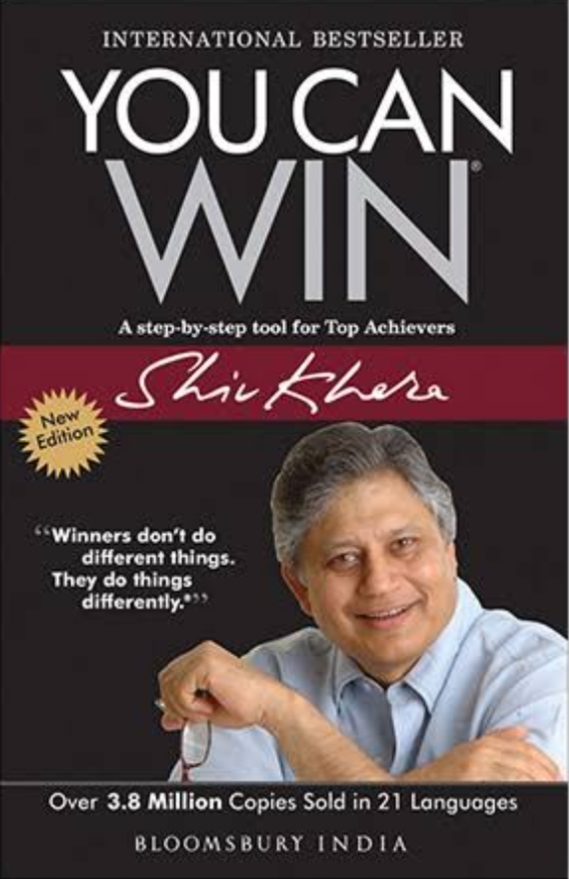
This book was recommended to me. I had high hopes on it that it will be as good as they said. And it turned true. It is one of the wonderful life-changing books. This book defines success. It gives us solutions to come from failure to success. Its easy language of description makes it easier to grasp the concepts
This book helps increase self confidence and achieve great goals in life. It gives a lot more inspiration for businesses related people. The book contains small basic stories, quotes in between and action plan at the end of every chapter to let you know about yourself.The perfect balance of professional & personal development can be maintained on reading & understanding this book.
Under Adverse conditions – some people break down,some break records
– Shiv Khera
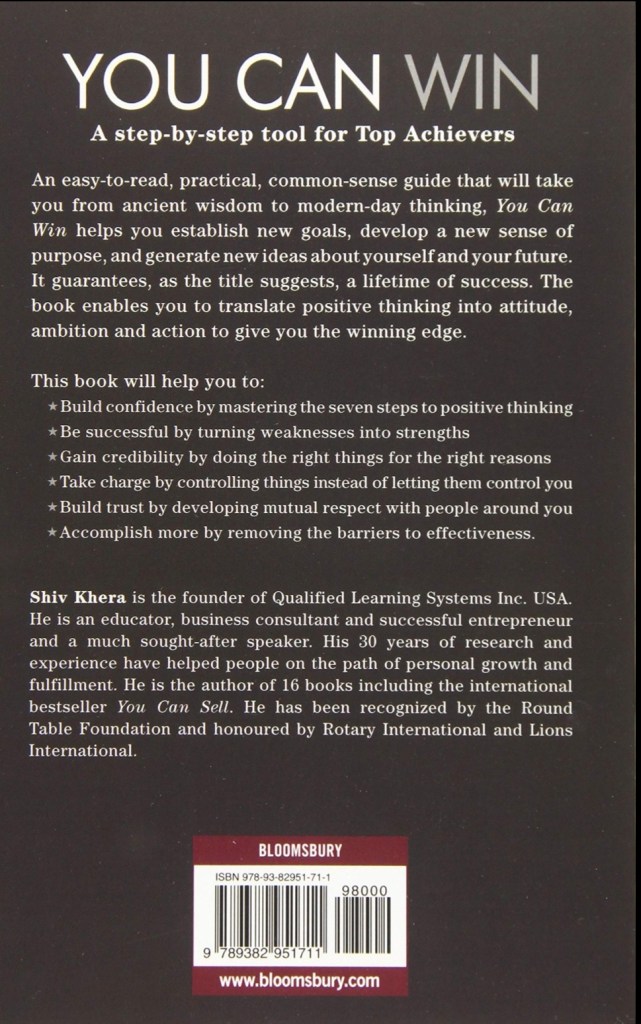
A practical, common sense guide that will help you: · Build confidence by mastering the seven steps to positive thinking · Be successful by turning weaknesses into strengths · Gain credibility by doing the right things for the right reasons · Take charge by controlling things instead of letting them control you · Build trust by developing mutual respect with people around you · Accomplish more by removing the barriers to effectiveness
Motivation is like fire—unless you keep adding fuel to it, it dies. Your fuel is your belief in your inner values.
– Shiv Khera
This book is totally worth every minute you spend on reading it. It’s even worth every penny you spend on it. It keeps you motivated. Hunger for positivity increases. This book is truly recommended to those who wish to change themselves for a better version of themselves.
Like I say : Reading books is magic, it makes you live hundreds of lives in a single one. Or atleast that’s what I believe. Hopefully this book will have an impact and magic you are/ were waiting for. I’ll take a leave.
The Taliban has encouraged India to desist from having a military role in Afghanistan, notwithstanding India’s humanitarian and developmental efforts in the country, including the construction of the Salma Dam, roads, and other infrastructural projects. Suhail Shaheen, a Taliban spokesperson stationed in Qatar, told ANI, “What do you mean by military role?” If they come militarily to Afghanistan and establish a presence. I believe that will not be beneficial to them, since they have witnessed the consequences of other countries’ military presence in Afghanistan. As a result, they have an open book in front of them. In terms of their assistance to the Afghan people or national programmes, I believe they have done a good job.
Basically, photography’s goal is to convey and archive explicit minutes on schedule. At the point when you snap an image and offer it with others, you’re showing a second that was caught in a photo. From the air to what people are doing, this moment can uncover a great deal.
For instance, in case you’re a city-based editorial picture taker, the pictures you take will remain chronicled for quite a long time. Individuals a long time from now will actually want to perceive what life resembled by taking a gander at the pictures.
In case you’re a wedding picture taker, the couple you’re shooting is depending on you to catch a rare occasion. The objective is to catch glad, cheerful, and adoring minutes. They will love these photos for the remainder of their life. As you investigate your general surroundings, photography records recollections and urges you to be available.
Hardly any reasons why photography is so significant
Photography is both a dream and a show-stopper. Catching photographs is essential for history and individuals’ lives, paying little mind to your ability level. Coming up next are a portion of the reasons why photography is so significant. Gathering significant minutes in your day to day existence requires the utilization of Photography. Photography is an awesome movement since it is both agreeable and open to individuals, all things considered. Nobody is forcing or testing you. In photography, all you need is a telephone and a camera. Gather minutes and trial in an unexpected way. The passage boundary is practically non-existent.
2. You can start at whatever stage in life, with any camera, and at any level. Taking photos is an exceptionally close to home insight. To start taking pictures and working on your abilities, you needn’t bother with a costly camera or an inventive foundation. I’ve seen some mind boggling photos taken with a mobile phone camera. There are numerous basic and charming things to find out about structure, light, openness, and altering that will quickly and effectively lift anybody’s photography.
3. Photos empower us to trade and convey data. Pictures are considerably more than simply an assortment of information. Photography takes advantage of our best and most liberal side: the motivation to share what we discover stunning and fascinating with others. You just need to look at the plenty of photograph sharing locales to see this propensity at work, as a large number of individuals offer their own, enthusiastic, and incidentally strange points of view on their general surroundings. To put it another way, our photos can permit aliens to impart our lives to us.
4. Self-articulation with blossoms on her head, a lady grins. Perhaps the most fundamental purposes behind the significance of photography is that it permits you to communicate your thoughts. It’s a fabulous imaginative source for communicating how you feel, conviction, think, and love. Best of all, you are allowed to do anything you desire. Photography knows no limits, regardless the “rules” and approaches are. You have total opportunity to communicate your thoughts.
5. We become craftsmen in light of photography. We can communicate our thoughts through photography as a fine art. We wish to photo dazzling landscape or an old man’s wrinkled face. Every one of us will have an interesting inspiration for snapping a picture, however we as a whole need to deliver something. Regardless of whether our all day lives are unremarkable, the formation of an image qualifies us as a craftsman.


















You must be logged in to post a comment.