It is important to understand what brand and branding is. Logo is a design term for a trademark. It can be a monogram or symbol. A trademark is not the brand itself. We need to learn the context of branding.
Branding is about decor, graphics, customer experience, staff, product, logo, messaging, packaging signage and website.
Brand identity is the collection of all elements that a company creates to portray the right image to its consumer.
Brand is the perception of the company in the eyes of the world.
Who you are as a brand is made up of a few key elements:
Your mission
Your values (what beliefs drive your company?)
Your brand personality ( what kind of personality does your brand have?)
Your unique trait
Your brand voice ( how will your brand communicate with its clients?)
LOOK at the brand, observe their attributes and list down the most important ones. They represent the core of the brand.
Alexander McQueen’s Branding Identity
Alexander McQueen is a British luxury fashion house. The world of Alexander McQueen is one defined by how the elements of fragility and strength, tradition and technology, severity and grace, contrast and complement each other to create a new vision for fashion in the 21st Century. Customers know when they see a gothic, perfectly tailored, creative and dark clothing, it might as well be from this maker. This is an example of successful identity branding.
There has always been a pressure to replace historical craft materials (bamboos) with more modern materials. But they believe that bamboo is a long standing historical plant that belongs to the nature.
Bamboo can do just about anything any other material can do. Bamboo varies in sizes, especially height and grows at least 15 cm per hour. If used correctly, bamboo is as strong as steel and as resilient as brick and concrete.
But why should we consider bamboo over other modern materials?
CLIMATE
Carbon trading and reforestation.
Fiber reinforced composite materials have enabled much industrial innovation. Currently composites reinforced by glass fibers and carbon fibers are being used extensively for many structural applications. However, there are economic and environmental challenges.
The climate change due to green-house gases and methane and nitrous oxide is for the worse. By using fossil fuel as energy source, the carbon emission has been at its peak compared to the last 800000 yrs. Implementation of renewable energy and biological and carbon sequestration would be most preferable in an attempt to decrease global warming.
Carbon sequestration or carbon dioxide removal is the long-term removal, capture or sequestration of carbon dioxide from the atmosphere to slow or reverse atmospheric CO2 pollution and to mitigate or reverse global warming.
Plants store co2 as building blocks and hence convert gaseous carbon to solid carbon. Since bamboos are fast growing and hence the most efficient in sequestration.
What If climate change was just a hoax/ what would happen to bamboo?
Humans share the need for hygiene and normal facilities. Clean water is a necessity.
Since the development of cities, there have been valiant efforts to plant trees in order to reduce environmental degradation linked to urbanization. Bamboo root structures help resting erosions, regulating water flow, clean water etc. In fact, bamboo can absorb human urine. Bamboo can clean soil and water from hazardous chemicals. It convert waste into viable resources.
Bamboo is used daily for regular appliances by 2.5 billion people in the world. Bamboo can be refined into bio fuel, bioplastics, and endless other applications.
CHALLENGES
The main reasons regarding why bamboo hasn’t been adopted into the modern age as extensively as materials like steel are:
Lack of awareness,
Lack of coordination among stake holders.
It’s dimensions differ greatly
the inability to grade the material and longevity,
It can’t play well with other materials, its completely organic, i.e., it can’t be combined with steel or glass.
Due to its limited budget, there are more common and modern materials in today’s market.
Tinker Hatfield started to define what working with athletes was like. It was about getting to know them as athletes and their performance. They had to build a product that catered to the athlete at the highest level such that the player could play with the same show after thirty years as well.
EARLY LIFE
Tinker was never focused on design but athleticism. He received a full sports scholarship to the University of Oregon. He met Bill Bowerman who was one of the two founders of Nike.
Tinker admits that pole vaulting needs a strong sense of commitment and confidence. This mentality that you can’t back off, your goal is to fly through the air.
When he was Seventeen years, Tinker fell and tore his ankle in half. After five surgeries, two years of rehabilitation, “ he felt his career was over.”
And then he learned he could draw on accident. His discipline was architecture and he also worked for Bill. He would tell, draw, and interpret his design when he presented his ideas to Bill. He was learning how to design shoes and solve problems for athletes since his university.
HIS PROJECTS WITH NIKE
He realized that design did involve art but art was a form of self-expression whereas, in design, the end goal is to solve a problem for someone else. Nike had developed very fast. And they were recruiting members by hosting a competition. Other designers started and tweaked some of their existing designs. But, Tinker worked for twenty-four hors and was unique in his storytelling. Two days after the competition, he was told he was a footwear designer for Nike.
His first project was the air max. He became the lead designer. He drew inspiration from the building whose inner mechanics were visible. The building itself was painted in primary colors, which people seemed to hate more than adore.
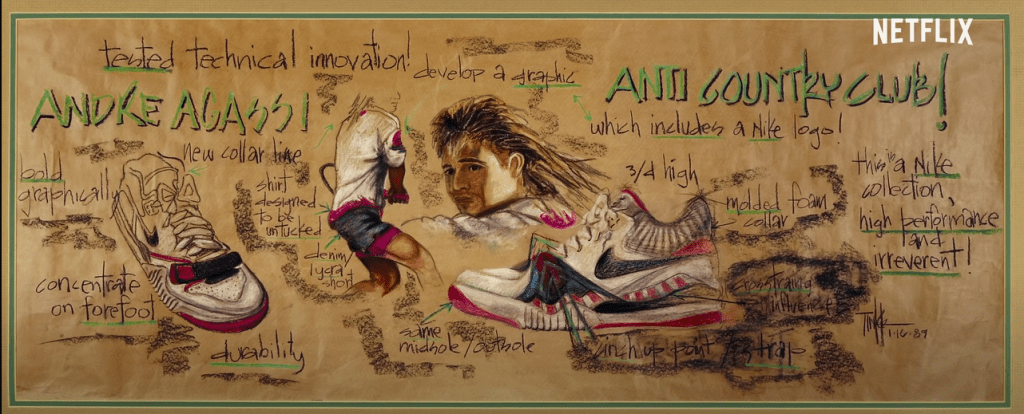
Andre Agassi
A basic design is functional, a great design will convey something. Andre Agassi was an upcoming star tennis player who was Nineteen years old at that time. He hadn’t started in country clubs and he didn’t always wear white.
This created speculation and Tinker had never worked with a tennis player like him before. So they created the new Nike shoe called anti-country club which was outrageous and pink and bright.
With the right athlete, they challenged the perception of the entire sport.
AIR JORDANS
Michael Jordan was Nike’s biggest client. Tinker got his new project for designing brand new Air Jordans. It was supposed to feel already broken into even though it was new. So they had soft leather, elephant print, he had also designed apparels to go with it. It was unlike any basketball shoe.
They’d progressed to Air Jordans VIII and Michael kept winning championships.
Air Jordan X had ten stripes that signified Michael’s ten yrs as a pro.
Air Jordan XV was the first one that had negative reviews, it was a sad time for both Tinker and Michael. After that shoe, Tinker withdrew from the Air Jordan projects. So he had to find a new direction for himself.
In 2005, he designed the Jordan XX. because of something special. He wanted Jordan to talk about the last twenty yrs of his life. He wanted to design a symbol that would define each of his stories. It was an avant-garde approach. it was the best storytelling product they’d ever done.
E.A.R.L.
Design is about predicting the needs of the future. The E.a.r.l.- Electro adaptive reactive lacing, was inspired by a movie. He wanted to make something that would excite the people about the future.
They applied the auto-lacing technology after several yrs. After the problems were discussed and solved by Tinker and the mechanism was foolproof, it was then applied in the shoe. The launch turned out to be very successful.
Conclusion
Get out there and experience life to translate that into unique design work. There are multiple designers who know how to interpret designs and slightly change them. But his job was to be provocative and problem-solving for a specific customer. If people don’t completely love or hate your work, know that you haven’t left an impact.
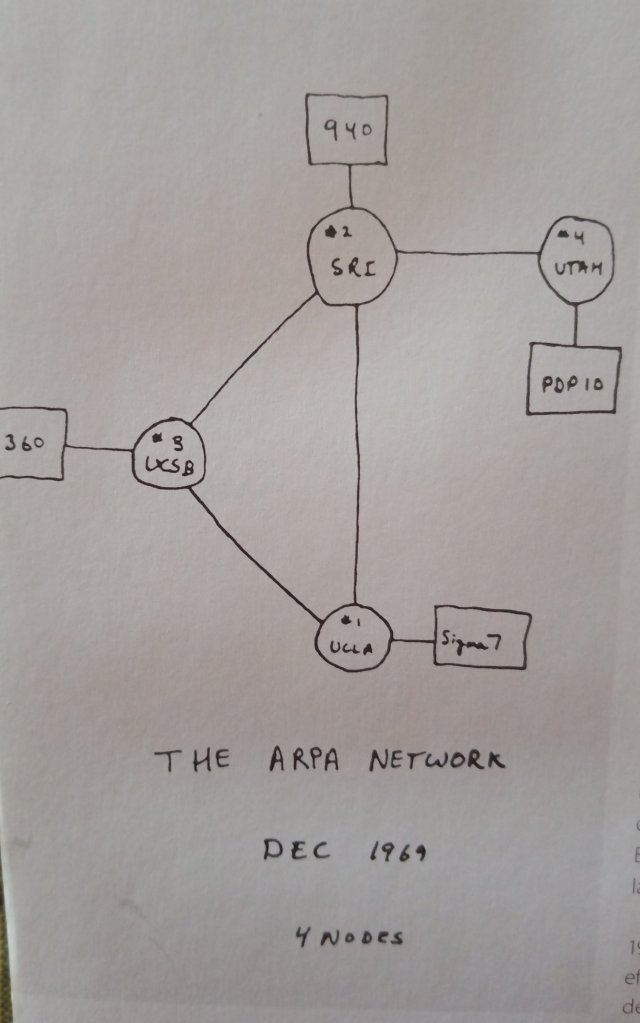
In 1963, the Advanced Research project Agency (APRA) unit, set up by the the US defence department began to build a computer network. Driven by fear of the Soviet nuclear threat, it aimed to link computers at different locations, so researchers could share data electronically without having fixit routes between them, making the system less vulnerable to attacks- even nuclear ones.
Data was converted into telephone signal using a modem (modulator- demodulator), developed at AT&T in the late 1950 s. In the 1960s, key advances where made, including “packet switching” – the system of packaging, labelling and routing data that enables it to be delivered across the network between machines. Paul Baran (b. 1926) proposed this system, which broke each message down into tiny chunks. This would be fired into the network which would then route switch the various pieces to the desired destination.
“Getting information off the Internet is like taking a drink from a fire hydrant”.
Mitchell Kapoor, software designer
So, if chunks of a message where travelling from Seattle to New York via Dallas, but Dallas suddenly went offline, the network would automatically route via Denver instead. Different Parts or packets of a message would go by different routes, before being reassembled back into the original message at their destination, even if they arrived in the wrong order. Baran published his concept in 1964, and five years later the new network- called APRANET – went live.
As the threat of nuclear war receded in the early 1970s, APRANET was renamed the Internet and effectively opened to all users. Since then, the development of e-mail, the creation of the World Wide Web ( WWW) , and browser technology has enabled the Internet to become a rich communications facility.
ETHERNET ( 1973):
In 1973, Bob Metcalfe Xerox Palo Alto Research centre (PARC) faced a problem. Increasing numbers of computers were bringing up around him all of which needed to be connected to each other. Just down the hallway the world’s first laser printer invented at PARC in 1971 was hungry for documents. Computer networking was in its infancy. The hardware was expensive and wiring at PARC looked like an explosion in a spaghetti factory. Any glitch in the computers or the cabling would bring down the whole system.
Today, Ethernet stands as the dominant networking technology…
The Economist (2003)
Metcalfe was given the job of building a simpler more reliable computer network. Desperate for inspiration from any source he stumbled across the university of Hawaii’s ALOHAnet radio network. Unlike most computer networks which were carefully regulated so only one computer could talk to another at any given moment, ALOHAnet was a free for all. If several computers tried to talk at the same time each computer would back off for a little while before trying again. Constantly developed ever since, Ethernet is now the most popular standard for local networks, if you send a document to your officer printer today, it is likely to travel down the wires of an Ethernet based network, directly descended from Metcalfe’s work.
If you ask any high school student or a graduate what is their career goal in life, you would get traditional answers like Engineer, Doctor, Lawyer, IAS, Banker etc. These are commonly known careers and as such have quite a large competition in the sector. The market is cut throat in these fields and very few manage to land the job of their dreams.
If you are passionate about these fields then more power to you but if not and you are still searching for your true calling then you can try your hands at these rare jobs not many are familiar with.
Headhunter
In other words professional recruiters, they are hired by organizations to hire employees without any advertisement. Finding a perfect candidate for a particular position is quite a hectic task so to save themselves time from interviewing multiple candidates, some companies prefer to hire a headhunter instead. This is mostly done to recruit higher level employees. It can be much more efficient for organizations to hire headhunters to cut down on the time and expense that goes into the recruiting process. To be successful in this field you need to have a strong professional network and a sharp eye for talent so you can shortlist the best available candidate for the job.
Art therapist
Did you know that art can be used as a form of therapy? Yes, this psychology career uses art to reduce person’s stress, anxiety and improve their self esteem. It’s main goal is to serve as a healing process and provide with many other mental health benefits. So, not only do you provide assistance to people in need, you are also doing something different. This can be useful for people who can’t express themselves verbally. If you are searching for interesting careers in psychology, then becoming an art therapist might fit the bill.
Professional Bridesmaid
You heard it right. Not many people think this could be a career option but it is and quite a successful one may I add. Now you may wonder why would anyone need a bridesmaid? Well answer is simple. Planning a wedding could be very tiresome for bride and her bridesmaids so hiring a professional bridesmaid can relieve them of that stress. As a professional bridesmaid your duty may involve Dress shopping, planning bachelorette party, managing guest list, catering, filling in for uneven number of bridal party. If you are a party planner and love weddings then this might just be a good opportunity for you.
Food scientists
Almost every edible item you consume has a good scientist working on it. They make sure that the food tastes delicious while maintaining the nutritional value of it. They are responsible for coming up with delicious flavors as well as different food processing techniques. They also come up with sustainable food items which can be used when the expenses increase every day.
Video game tester
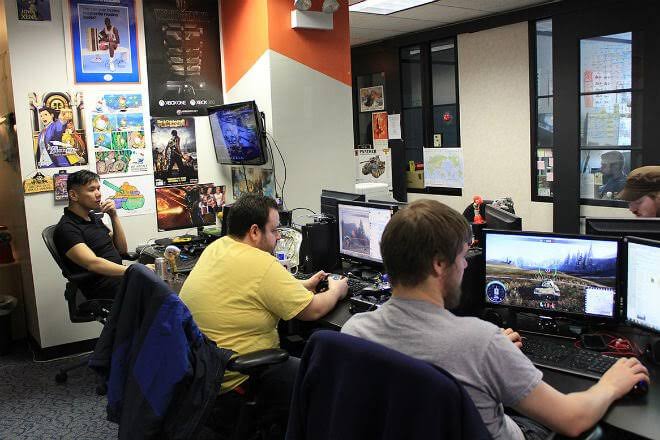
If you are avid gamer you might as well get paid to play it. Tester’s role is to play the games which haven’t been released yet. Your job is to check every element of the game for the developer to make sure there are no glitches or errors.
Typography may be dated back to the eleventh century, all through the innovation of movable type. Before the virtual age, typography changed into a specialised craft related to books and magazines, and ultimately public works. The first instance of typography may be visible in the Gutenberg Bible, which commenced a typography revolution in the west. Fast ahead the current era , in which typography is frequently related to each digital world and print. With the start of the internet got there an innovative explosion of the artwork of typography. Suddenly, net designers had an abundance of fonts and kind alternatives at their disposal, making typography extra visually numerous than ever before.
A type face gives words a personality, a coloring. It helps in establishing a strong visual tone. Graphic designers use typography to adjust the text within the design. This helps in creating content with a purpose, helps in creating harmony and order with the visuals. Because of such designs with unique typography ideas, a brand can communicate with its audience in an effective way.
The life of a designer is a fight against the visual flaws and somehow they need to cure it with design. A good typographer always has the knowledge about the spacing. Typography sometimes is all about the white space between the letters.
Helvetica
Since its launch in 1957, it’s become the go-to type for company logos and transport hubs, making it one of the most widespread designs of all time. It is a beautiful timeless type. Helvetica was a typeface that was clear, neutral; it originated from the need for legibility. It was modern. Helvetica didn’t have the meaning in itself, the content had the meaning. It is also the smoothness of the letters that they almost seem human. It invites open interpretation.
Now it’s become a default font, because of its versatility, it has basically no improvements to be made. The popularity of Helvetica continues today. It was the system font on the original iPhone, and it remained part of iOS until 2015, when Apple replaced it with its own San Francisco.
Bodini
This typeface was created in 1798 being inspired by the ideas of John Baskerville when he designed his namesake typeface. This was taken to the next level by Bodini by creating an extreme contrast between the tick and thin strokes, making the letters more vertical, and greatly condensing width than Baskerville. This went on to be recognised as the fonts main characteristics.
The Bodoni typeface has been used for a wide variety of different materials. In the eighteenth century it was used in Italian books to 1960s periodicals. In the 21st century, the late manner versions were used in advertising. The early manner versions were used for fine book printing. In the current centaury, this font is mostly used for display sizes. As their extreme thin strokes won’t reproduce well at smaller sizes, which can degrade their appearance and lessen readability.
Sustainable design seeks to lower the negative impacts that materials have on the environment and ecosystem. It in fact, increases the comfort of the inhabitants and improves building performance.
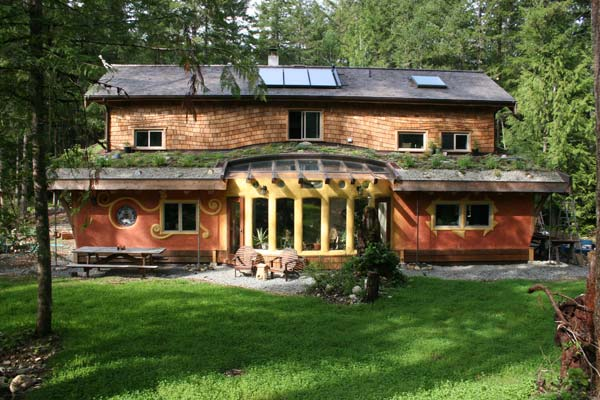
Eagleyew house
Eagleyew house and eagle nest sanctuary is a beautifully sculpted custom green home built with nearly 100 natural materials. The light clay walls are made with a mixture of clay and straw.
The promise of this house from the very beginning is that it’s a house that will last 300 years. It uses natural materials like clay and wood which when well taken care of will last for centuries. All the walls are one foot deep and are made of light clay which has many advantages amongst others absorbs and lets go both of humidity and heat. It keeps it at a very even temperature and it inhibits mold growth and it inhibits burning so it would be difficult to burn this house.
Techniques like permaculture farming and ags heating systems are used here. Permaculture can be understood as the growth of agricultural ecosystems in a self-sufficient and sustainable way. This form of agriculture draws inspiration from nature to develop synergetic farming systems based on crop diversity, resilience, natural productivity, and sustainability.
Right now the framing is around creating a sustainable, regenerative, and circular economy, whereby the things we create to meet our needs are designed to fit with the systems of the planet. Central to this success is the design of goods and services and that’s where these strategies and designers’ creativity fit in.
He was persistent on his dream to design cars, beautiful cars. The artistic style appealed to him more, he was sure about his interest in design since a very young age. His aunt encouraged him to write a letter to Mr. Iacocca and they answered back. His portfolio promised them of his talent. He felt loyal to Chrysler since when he was seventeen. .He appreciates his support system, his brother, his dad, his wife for encouraging and criticizing his work. He has clearly struggled to get what he want and has had dark times. He compares it to being a captain on a sinking ship, not leaving until the doors are closed. Gurney’s Automotive Repair is doing a great work.
Ralph Gilles’ work style
Gilles states that he likes to sketch the front of the automotive first because the first judgement happens by the front design. He also values proportion the most. He wants his work to be full of care and passion that people still love it after 50 yrs. The product should age gracefully.
This characteristic is what he vows by and the reason he was global head of design at Fiat Chrysler within five years of working with them. They claim that ralph became the youngest head of design so far.
Ex: the 300 is one of Ralph’s best designs, it looks aesthetic, gives an impression of speed. It was affordable and appealed to the hip hop crowd immediately. Racing is Ralph’s form of escape. He feels one with the machine and it gives him a sense of tranquility.
The steps to success:
Reinvention is key.
Ralph believes that designers create taste, they’re ahead of times and culture, and that is exactly how they’re supposed to be.
Designers should have to judge what the customer wants before the customer themselves knows what they want.
Passion and connection to vehicles is extremely powerful to be successful in this industry.
A lot of innovation and effort contributes to his successes, too.
The success of Chrysler depended on successful designed cars. There’s an emotional attachment to cars that keep even old designs alive.
Listen to the problems and create a product that solves multiple problems at the same time.
Sm-1 concept – the family vehicle.
In Detroit, the team discusses on making a car more like an extension of one’s home. Ralph realizes that he has to understand autonomous vehicles. He doubts if a car would be just another device to the people, no attachment to it whatsoever. They to take inspiration from his experiences and observations.
So, the sm-1 is an autonomous and capable car. The interior requires even more attention, to make it comfortable and holistic. Ralph emphasizes that the base is always important, a clear & distinctive base to capture the idea or the utility of the car.
He wants to adjust a car that appeals to not one but all kinds of people. Ralph Gilles and his team regularly reviewed their progress, and discussed on the changes to be made until they all had a clear view in their head of what the sm-1 looked & felt like.
The presentation
They set their aim as perfection. They made models and checked everything that is to be presented. The team and ralph have even discussed and set up the presentation room as to where the drawings and the depictions, the tools & models would be.
Ralph, himself, appears pretty anxious about the meeting, he understands that if Sergio Marchionne, decides to scrap it, they would just have to accept it. When sm-1 model was approved by Sergio, the team remembered to appreciate their efforts and they were evidently happy.
There are four types of introverts Social, Thinking, Anxious and Restrained.
Social Introversion is what’s commonly accepted and understood as the stereotypical definition of introversion social introverts prefer solitude or small groups of people over gatherings. They rather stay home with a book or laptop or hangout with close friends, then go to parties with many unfamiliar faces. Social Introversion is different however from shyness because there’s no anxiety attached to their need for solitude.
Thinking Introversion is a newer concept. Thinking introverts are introspective thoughtful and self reflective. Unlike social introverts, they don’t feel a need to avoid large social scenes instead they like to daydream using their rich imaginations and creative capacities.
Anxious Introverts on the other hand seek time alone because they feel awkward and self conscious. Unlike social introverts they experience painful shyness around new people and the anxiety doesn’t necessarily go away when they are alone because they let situations play over and over in their heads. Contemplating what might have gone wrong?
Restrain Introverts on a slower pace and prefer to think before they speak or act they’re also known for being reserved. They like to take their time preventing impulse from affecting their decision-making.
Introverts react quickly to new information, but are slow to monitor change. Introverts brain become more excited when they analyze what steps they must take in the future but hesitate when they need to prepare for action whereas extroverts need to minimize the thoughts in their heads to make a decision but act quickly afterwards.
Introverts dread small talk. Introverts might seem disinterested in other people because they dislike small talk however they only dislike it because he creates barrier between them and others. Instead introverts want to feel authentically connected, so they crave deep meaningful conversations that help lower social walls.
Child marriage in India, according to the Indian law, in a marriage where either the woman is below the age of 18 or the man is below the age of 21. Most child marriages involve girls, many of whom are in poor socio-economic conditions.
Child marriage was outlawed in 1929, under Indian law. However, in the British colonial times, the legal minimum age of marriage was set at 14 for girls and 18 for boys.
The minimum legal age for marriage was increased to 15 for girls in 1949, and to 18 for females and 21 for males in 1978.
Prohibition of Child Marriage Act
The Indian Government enacted the Prohibition of Child Marriage Act of 2006 by replacing the earlier legislation of the Child Marriage Restraint Act, 1929, to ensure that child marriage is eradicated from within the society.
Child Marriage Prohibition Officers (CMPO) are to be appointed in every state to prohibit child marriages, ensure the protection of the victims as well as prosecution of the offenders.
What is the punishment of child marriage? Whoever performs any child marriage shall be punishable with rigorous imprisonment which may extend to two years and shall be liable to fine which may extend to one lakh rupees unless he proves that he had reasons to believe that the marriage was not a child marriage.
Every single thing in this world is not for ever lasting be it as a human life, tangible things or even non tangible feelings. There are things which are very uncertian in our human lives mostly of the time. we dont really what might happen the next second, minute or a day after. Every second changes around us, within us while our planet earth is rounding around the sun each second. One second we are happy and next second we feel bad for being happy at this certain moment. We might be poor at the beginning but after such hard work and difficulties people become rich or well renowned at certain fields of life. We might love, cherish someone at point but gradually it ends due to certian conflicts. We are born to die on this planet. Nothing is permanent on this planet even trees at point gets cut down by humans greed or natural causes which is also man made. We forget the most important person in our life at certain point of life. why? because we got too much deep in money, fame and responsibilities that we forget whom we chersih and love. Which is why it is very important to always take a moment for yourself above all this hectic schedule and think what are you really doing? Is it what you want and need in your life? Is it really working towards your side? Whether its not backfiring? such things when take to question in your mind, you gotta think logically to answer than you will know what you really need to cherish in your uncertainty of life. Take a moment for your love ones and specially for yourself to reflect upon yourself to take proper logical reasoning decisions so at a moment you won’t have to ever regret choosing that path on your life. Things are uncertain in our life which we known better than other than yourself. Take a moment to think and take your life decisions.
Currently, the number of children involved in online activities are increasing by the day. With online classes and other activities, cyberspace is the new learning space for the kids. It is extremely important to provide a safe digital space for the children. Google is all set to launch a new set of updates to ensure online safety for children under the age of 18.
What are the New Updates?
The new updates focus on protecting the minor users of Google. They are working on multiple fronts to keep the online space safe. The key points of the update includes giving more control over the digital footprints, changes in advertising and digital well-being tools.
The new update aims to give more control to the minors over their digital footprints. It allows the children or their guardians to request removal of their images from Google search results. It will reduce the online exposure of the children below 18.
The location history of all those below 18 be will be turned off by default and it cannot be turned on without the supervision of the parents or guardian. Google search will also have the ‘safe search’ feature by default. It will remove any explicit results while searching. The Google Assistant will also have ‘default protections’ for the minors.
13 is the minimum age limit to create your own Google account. The Youtube videos uploaded by the people above the age of 13 and below 18 will be by default posted in the private mode. Google also said that it will remove the “overly commercial content” from Youtube Kids. Google will also prevent age sensitive advertisements from being displayed to children and teenagers. The personalized advertisements based on age, gender and interests will be blocked. However, advertisements based on the context, such as the person’s search request are still allowed.
In order to ensure digital well-being the content can be filtered out . It allows people to block access to news, webpages, podcasts on devices, using the filters on the Family Link app. The Family Link app lets parents set rules in order to ensure safe online learning, playing or searching space for their children.
After a lot of criticism of the tech companies alleging that they were not doing enough to protect children, there was pressure on these companies to take up steps to ensure protection. Previously, in 2019, Google had to pay a fine of 170 million dollars for violating the Children’s Online Privacy Protection Act (COPPA) for collecting data from the minor users without parental consent.
Google has emphasised that its objective is to work with “kids and teens, parents, governments, industry leaders, and experts in the field of privacy, child safety, wellbeing, and education to design better, safer products for the kids and teens.”
On August 12,2012, the inaugural World Elephant Day was launched to bring attention to the urgent plight of Asian and African elephants. The elephant is loved, revered and respected by people and cultures around the world, yet we balance on the brink of seeing the last of the magnificent creature.
The escalation of poaching, habitat loss, human-elephant conflict and mistreatment in captivity are just some of the threats to both African and Asian elephants. Working towards better protection for wild elephants, improving enforcement policies to prevent the illegal poaching and trade of ivory, conserving elephant habitats, better treatment for captive elephants and, when appropriate, reintroducing captive elephants into natural, protected sanctuaries are the goals that numerous elephant conservation organizations are focusing on around the world.
World Elephant Day asks you to experience elephants in non-exploitive and sustainable environments where elephants can thrive under care and protection. On World Elephant Day, August 12, express your concern, share your knowledge and support solutions for the better care of captive and wild elephants alike.
Chhattisgarh is a state located in the region of Central India. Formerly part of Madhya Pradesh, it was granted statehood on November 1, 2000. It is the 9th-largest state in India, with an area of 135,192 km2 . As of 2020, it has a population of roughly 29.4 million, making it the 17th most populated state in the country.
The state was formed by the partition of ten Chhattisgarhi and six Gondi-speaking districts in the southeast of Madhya Pradesh. Its capital city is Raipur. It borders 7 states – Uttar Pradesh to the north, Madhya Pradesh to the northwest, Maharashtra to the southwest, Jharkhand to the northeast, Odisha to the east, and Telangana and Andhra to the south. Currently, it comprises 28 districts.
Chhattisgarh is one of the fastest-developing states in India. Its Gross State Domestic Product (GSDP) is ₹3.63 lakh crore , with a per capita GSDP of ₹102,762 . A resource-rich state, Chhattisgarh provides electricity, coal, and steel to the rest of the nation
CULTURE – The state hosts many religious sects such as Satnampanth, Kabirpanth, Ramnami Samaj and others. Champaran is a small town with religious significance as the birthplace of the saint Vallabhacharya, increasingly important as a pilgrimage site for the Gujarati community.
Chhattisgarh has a significant role in the life of the Lord Rama. Lord Rama along with his wife Sita and his younger brother Lakshmana had started his Vanvas (exile) in the Bastar, then known as Dandakarayna. They lived more than 10 of their 14 years of Vanvas in different places of Chhattisgarh. One of the remarkable places is Shivrinarayan which is nearby Bilaspur district of Chhattisgarh. Shivrinarayan was named after an old lady Shabari. When Ram visited Shabari she said “I do not have anything to offer other than my heart, but here are some berry fruits. May it please you, my Lord.” Saying so, Shabari offered the fruits she had meticulously collected to Rama. When Rama was tasting them, Lakshmana raised the concern that Shabari had already tasted them and therefore unworthy of eating. To this Rama said that of the many types of food he had tasted, “nothing could equal these berry fruits, offered with such devotion. You taste them, then alone will you know. Whomsoever offers a fruit, leaf, flower or some water with love, I partake it with great joy.”
The Odia culture is prominent in the eastern parts of Chhattisgarh bordering Odisha.
CRAFTS – Chhattisgarh is known for “Kosa silk” and “Dhokra or Bell metal art”. Besides saris and salwar suits, the fabric is used to create lehengas, stoles, shawls and menswear including jackets, shirts, achkans and sherwanis. Works by the internationally renowned sculptor, Sushil Sakhuja’s Dhokra Nandi, are available at the government’s Shabari Chhattisgarh State Emporium, Raipur.
CUISINE – The State of Chhattisgarh is known as the rice bowl of India and has a rich tradition of food culture.
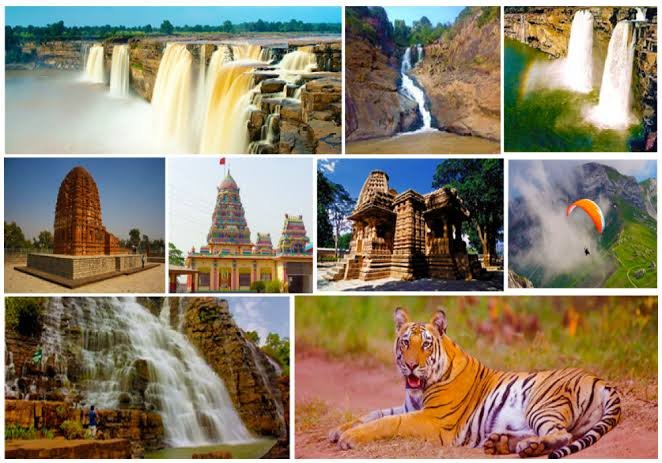
TOURISM – Chhattisgarh, situated in the heart of India, is endowed with a rich cultural heritage and attractive natural diversity. The state is full of ancient monuments, rare wildlife, exquisitely carved temples, Buddhist sites, palaces, waterfalls, caves, rock paintings, and hill plateaus.
Mainpat is mini Shimla of Chhattisgarh.
There are many waterfalls, hot springs, caves, temples, dams and national parks, tiger reserves and wildlife sanctuaries in Chhattisgarh.
India’s first man-made jungle safari is also situated in Raipur.
The word “olympics” itself is an emotion. The international sports festival which held in every 4 years in about 206 countries of the world. It is the worlds foremost athletic competition among the most promising & commendable citizens of the respective 206 countries. Olympics gives the opportunity to the citizens to showcase their aptitude and ability in every sport despite of any sense of discrimination among them. Olympics gives a friendly nature, a sense of peace and prosperity among the countries. It’s an international level sport which gives justice to each and every citizen to showcase their talent and their earnest nature in the name of their country, showcasing your country on an international level is something beyond reproach, it’s indescribable.
“Olympics Logo- 5 rings”
THE 5 RINGS OF OLYMPICS.
The five rings represent the five continents of the world that participate in “the fruitful rivalries” Of the Olympics games. The colors – blue, yellow, black, green and red – stand out against the white background which shows the sense of unity and togetherness of every colour under the white background despite of measuring the wavelength, tone and frequency in all the 5 colours, which represents that each and every citizen of every country can represent their nation without any sense of discrimination under the same sky.The six colors can be combined in any number of ways to reproduce the flag of every country without exception. It gives the opportunity to the citizens to showcase themselves in the name of their respective nations in different sports without any kind of inequity and bias among them.
IMPORTANCE OF OLYMPICS IN THE MODERN WORLD
As with the changing times, the youth of the world has become more generous and they have the sense of being vocal about their thoughts and their abilities which gives an ever-growing impression in the world. With the modern world, the youth has all the elements to showcase their respective interest in different fields. Since olympics gives an opportunity to the youth to represent their desire and talent in their respective best sport they are in, it gives a learning atmosphere for the youth to inspire and learn through a sport. Representing your culture, your country on a global level gives an indescribable emotion from which the youth seeks the importance of culture, its meaning.
Young athletes exhibiting their respective countries in 100’s of different sports in an international level competition and earns medals through their hard work, desire and generosity. It’s an unimaginable moment for the athlete who wins on a global level among 206 countries, Olympics truly gives so many of opportunities to the citizens, to earn through their hard work and desire without getting judged or discriminated in any form.
“HISTORY OF OLYMPICS”
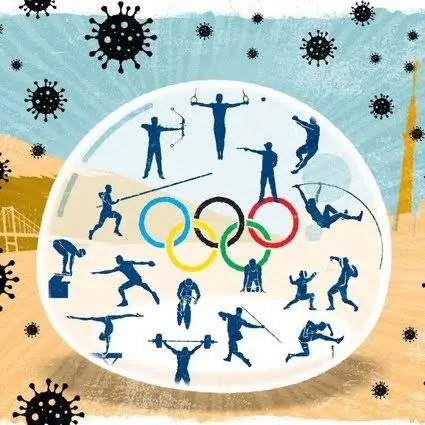
The Olympic Games, which originated in ancient Greece, 3,000 years ago, were revived in the late 19th century and have become the world’s prominent sporting competition. From the 8th century B.C. to the 4th century A.D., the Games were held every four years in Olympia, located in the western Peloponnese peninsula, in honor of the god Zeus. The first modern Olympics took place in 1896 in Athens, and featured 280 participants from 12 nations, competing in 43 events. Since 1994, the Summer and Winter Olympic Games have been held separately and have alternated every two years. The 2020 Summer Olympics, delayed one year because of the COVID-19 pandemic, will be held from July 23 to August 8, 2021 in Tokyo, Japan.
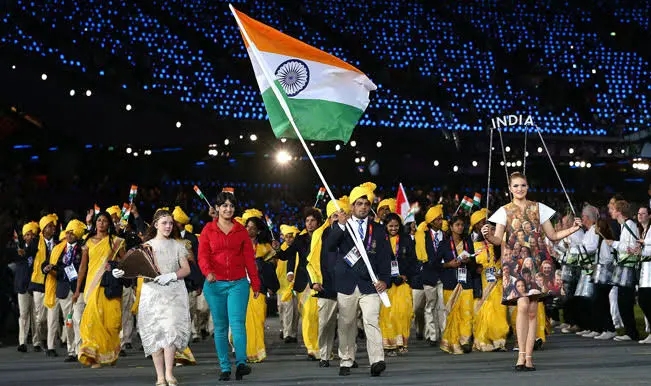
INDIA IN OLYMPICS
India has been participating in Olympics since 1900. Being the most diversified and culturally active country, it has been the most commendable and honoured country in the platform of Olympics as well. No doubt, India in the race of Olympics is not so graceful as compared to other countries, but India being the 2nd most populated country gives cultural competition to many other countries, it has gained prosperity in each and every sector, but in Olympics, India has a little disgraceful exhibition among the several countries.
WHERE INDIA LACKS?
Excess importance to cricket
We, as a country, are obsessed with a singular sport and that is cricket. It is only during major events like Olympics when other sports are given a part of the limelight and fan cheering. For the rest of the year, we stay ignorant of who’s who of other sports. They are promoted less, there are fewer sponsors for the other sports, there are even less fans hooting and cheering them to do better and then we go about complaining and trolling athletes when we do not get enough medals.
Lack of encouragement
The foremost factor right from the very beginning, youth in India are discouraged from pursuing a career in sports. Our parents are obsessed with the likes of medical and engineering. And for girls, the scenario is even worse with list of drawbacks and hindrances they have to face before they could persuade their parents to allow them to play. Most of them are forced to quit sports in order to do something that would give them better job security. Our success as an academically-oriented people proves that we are excellent at pursuing something that pays well, so does India’s obsession with cricket.
Poor administration
There is no proper governing of Administrative issues is the prime concern with Indian sports. Non-Involvement of ex-sportsman in administrative staff is also a major reason why India lacks in this sector. Our economy has been prospering and allotment of funds to different fields of development has been improvising with each year’s budget. However, there is still relatively very less allotment of funds for sports given the sheer number of youths who are willing to take up sports seriously. Enough of IITs and IIMs, when will we get a dedicated sports university?
IMPROVEMENTS TO BE DONE -Khelo India Youth Games Khelo India Youth Games, held annually in January or February, are the national level multidisciplinary grassroot games in India held for two categories, namely under-17 years school students and under-21 college students. Every year best 1000 kids will be given an annual scholarship of 5 lakh for 8 years to prepare them for the international sporting events. This is a great initiative by the Govt of India. -Collective efforts India being a developing country cannot invest a major part of it’s economy for sports. India has a huge number of industrialist and business men who can easily take up responsibilities to encourage these talented athletes and collectively make the necessary arrangements. Instead of giving them crores of rupees as rewards after winning, we should focus on giving them basic amenities for developing them as a good sports person. -Too much criticism There is a lot of criticism about the performance of Indian athletes over the years. This decreases their morale. The point is, if you can’t support them, don’t, but please don’t criticize them. You don’t know their stories, their food facility, coaching, support, Money, still they made it to Olympics to compete with the ones who were trained, supported and recognized well by their respective country or govt or organization. -Impartial We might have a lot of Dhonis but it’s difficult to find more Mary Koms and Sania Nehwals owing to the gender discrimination that has paved its way into sports. Sports and women are the two opposite ends of a pole. The society does not encourage girls to be an active part of sports, moreover they are considered to be delicate creatures and their potential in sports is questioned. This should be stopped. There should be special policies to encourage the participation of women in sports. -Transparency in the system Selection process of players and board members needs more transparency. Sports-governing body heads should be an ex-sportsman. This will create job opportunities for sportsmen as well. Players should be only judged upon their performance and not any other factors.































You must be logged in to post a comment.