Material Requirement Planning is a special technique to plan the requirements of materials for production. For the manufacturing company to produce the end items to meet demands the availability of sufficient production capacity must be coordinated with the availability of all raw materials and purchased items from which, the end items are to be produced.
In other words, there is a need to manage the availability of dependent demand items from which the products are made. Dependent demand items are the components, i.e., materials or purchased items, fabricated parts or sub-assemblies that make up the end product.
One approach to manage the availability of dependent demand items is to keep a high stock of all the items that might be needed to procured the end items and when the on-hand stock drops below a present re-order level, the items are procured or bought as the case may be to replenish the stock to the maximum level.
However, this approach is costly due to the excessive inventory of components, fabricated parts and sub-assemblies to ensure high service level.
An alternative approach to manage these items is to plan for procurement or manufacture of the specific components that will be required to produce the required quantities of end products as per the production schedule indicated by the master production schedule (MPS). The technique is known as Material Requirement Planning (MRP) technique.
A LOT OF US HAVE HEARD OF THE PHRASE “YOU LOOK SO BUBBLY AND CHUBBY, YOU ARE SUCH A CUTIE”. OK, I UNDERSTAND THAT I LOOK BEAUTIFUL AND DESERVE HAPPINESS. BUT, I WONT APPRECIATE BEING CALLED CHUBBY AND THEN A CUTIE. BEING CHUBBY IS NO WHERE CONNECTED TO BEING A CUTIE. WHY DONT YOU CALL ME BEAUTIFUL AND SMART? OH, YES! FAT GIRLS ARNT BEAUTIFUL $ SMART . RIGHT ? WE ARE ALWAYS TAUGHT TO BE THIN TO LOOK ELEGANT AND BEAUTIFUL. ZERO FIGURE, WAIST OF 24 INCH, FLAT BELLY IS WHAT PEOPLE ARE MADE TO WISH OF.
BEING MAINTAINED AND FIT IS APPRECIATED BUT BULLYING ME FOR BEING FAT IS NOT. OFFERING ME HEALTHY FOOD IS ACCEPTABLE BUT SNATCHING AND THROWING AWAY MY FOOD IS NOT. MAKING ME UNDERSTAND THAT FITNESS IS IMPORTANT IS GOOD BUT MAKING ME FEEL UNFIT IS UNACCEPTABLE.
I KNOW THAT HEALTH AND FITNESS IS IMPORTANT BUT WHO TOLD YOU IM NOT HEALTHY? I KNOW THAT THIN GIRLS LOOK PRETTY BUT WHO SAID IM NOT ? I ACCEPT THAT I AM BEAUTIFUL AND SMART WHO ARE YOU TO TELL ME IM NOT?
IF I WILL FEEL LIKE GOING TO THE GYM, I WILL GO. IF I FEEL LIKE EATING HEALTHY, I WILL EAT. IF I FEEL LIKE RUNNING, I WILL RUN. BUT, PLS STOP YOUR NOT SO REQUIRED SUGGESTIONS CAUSE IM DONE !
I WILL RISE WHEN I WILL WISH TO RISE . I WILL SHINE WHEN I WILL WISH TO SHINE. I WILL GO TO THE RESTAURANT WHEN I WILL WISH TO DINE. I DONT NEED YOUR SUPPORT BECAUSE I KNOW THAT IM HERE TO SHINE LIKE THE SHRINE.
Hello guys! Today I am going to tell you guys about a 400 year old art .
Abdul Gaffur khatri’s family is ” the only family in the world” that is keeping this art alive for almost 8 generations.
This art is called “The Rogan Art”.
The palm of the hand is the essential tool for getting this painting technique just right.
These designs were once popular throughout India, but the rise of industrial textiles forced many artisans to leave the craft for more lucrative work.
“Rogan means oil in Farsi”
From:roganartnirona
This art starts with castor oil. It’s the base of the paint.So the art is named after it .
In this process the oil should be heated for two days until it becomes a honey-like texture.
It’s a dangerous process only a few can handle.
After it cools they combine the oil with pigment to create the paint.The above mentioned steps are only for making the paint now comes the main thing.
In this art the use of the hand gives the Rogan art it’s unique nature.
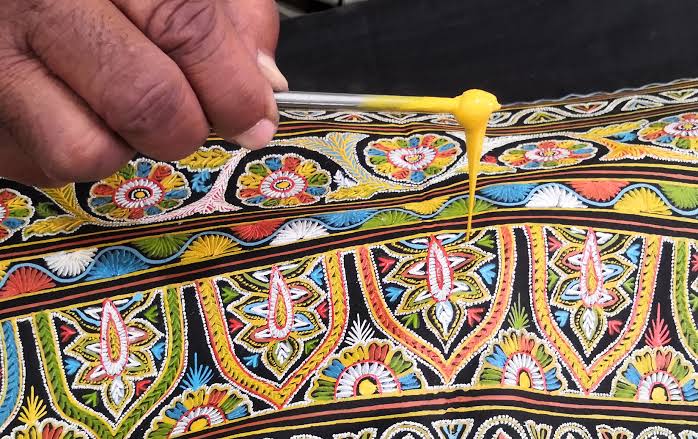
The paint needs to be swirled in the palm which in turn creates heat to thin it out after that the thread of paint is floated over the fabric using a metal rod.
From : The Indian express
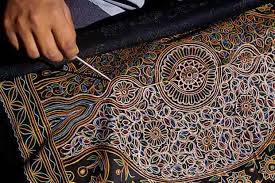
Using the other hand underneath the cloth to guiding the paint and this process is completely free hand which makes this art more peculiar as the final design is to be anticipated and not ready made before.
Before it dries, they folds the cloth to print the design’s mirror image.which is timesaving and also the design will be symmetric.
From:livemint.com
This art is said to have originated from from Persia400 years ago to India and it was once popular on bedding and ceremonial clothing here in India.
But with the rise of mass-produced textiles in the ’80s,locals lost interest in these more expensive handmade pieces.
Many artisans couldn’t compete with mass manufacturers and dropped their crafts to find other work.
This beautiful art is also going extinct and covid-19 has the greatest impact on these artisans forcing them to leave this and find some other work for their livelihood as before they used to sell their pieces to foreigners but after the pandemic even that income has come to a halt.
We have to encourage them so that the art’s legacy can carry on and our next generations can also see this beautiful art.
Global language is the language spoken internationally that many people learn as a second language. We use language to communicate and send messages to other people. Language is very important to have because it eases our lives by making our transfer of information to others much more easily. Different languages are spoken all over the world. There are between 10000 languages spoken. The country with the most languages spoken is Papua New Guinea. In New Guinea they speak approximately 820 languages, with English, as one of their official languages.
One Global Language
If there was to be a single global language that all the world’s citizens would have the ability to communicate easily with individuals from different countries thus creating more equality. If the world was better able to understand each other than there would likely be a reduced amount of conflict because there would be no loss of communication when being translated. A single global language would also prove to be more efficient in the global economy because the worlds businesses and corporations would be better able to communicate. For instance, every country has their own language because of cultural differences and background but in school they are taught another language to be able to communicate with someone of another ethnicity if they needed to.
Most of the wars and conflicts in our history are because of not having proper communication between nations. Countries such as USA and Canada usually have very good relationship partially because of having adequate mutual understanding of each other. This understanding between nations can be achieved when the nations and not only the intellectuals are able to communicate with each other directly. We live in a world where there exists thousands of languages , it is not possible for a person to learn all the languages so it’s not possible for us to have several global languages.
No Global Language
If we decide to keep one global language then all other languages would eventually disappear and along with them their cultures would disappear as well. Each language and culture is beautiful with its own way of life and own perspectives which will be lost if there were only one language. Our language is our identity to tell people where we come from and yes we could not change the worlds language because to learn it , it would be hard and it takes more time learn. There would be the argument from every country, France could say that they want the world to speak French or the British could say that they want the world to speak English also the music would be boring because all the music has one language and we also like different languages music. There should not be a global language because it would take away from the individuality of the differing countries and their diverse cultures. The world would be bland and if everyone was the same, new ideas and inventions would stagnate. The diverse groups of people in the world are what makes the human race what we are.
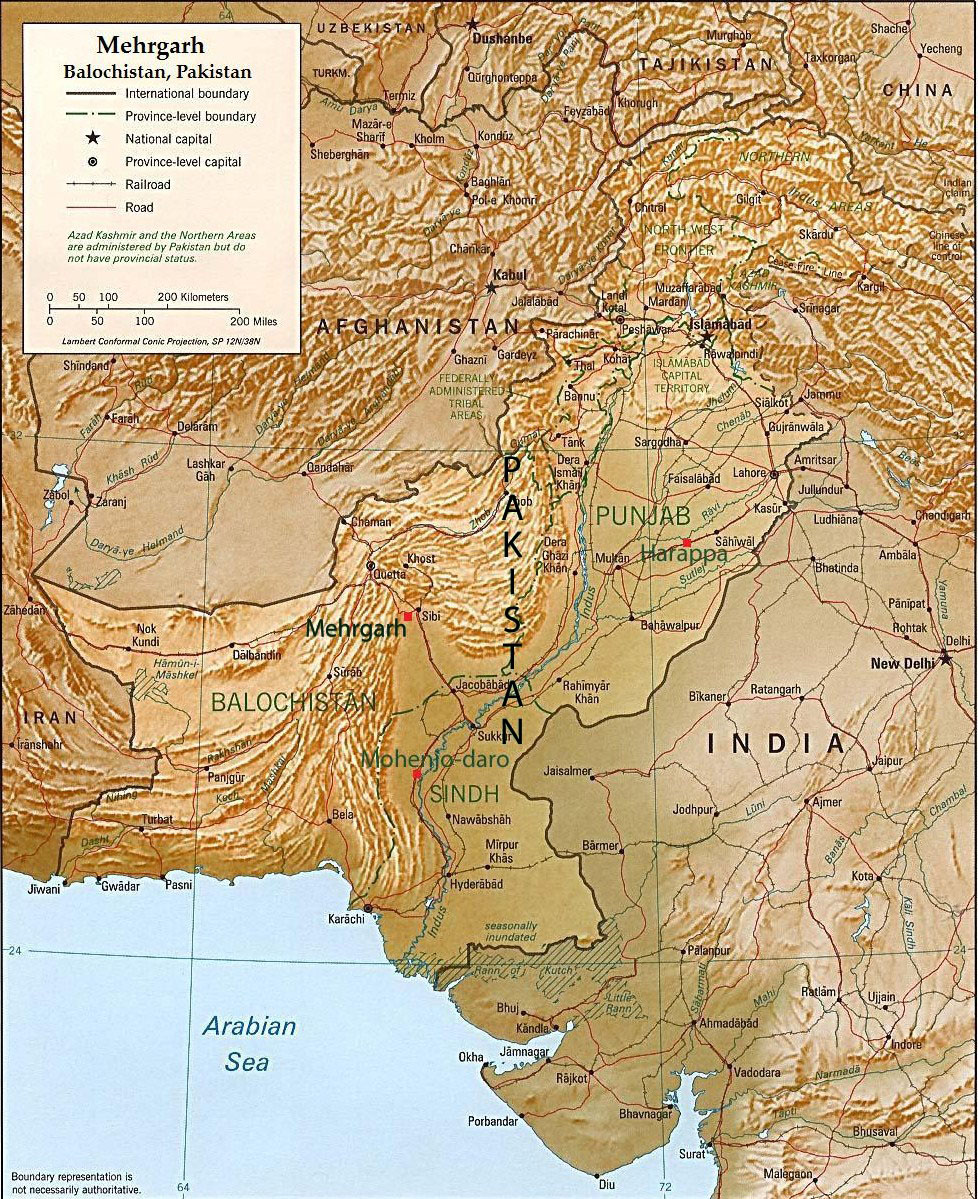
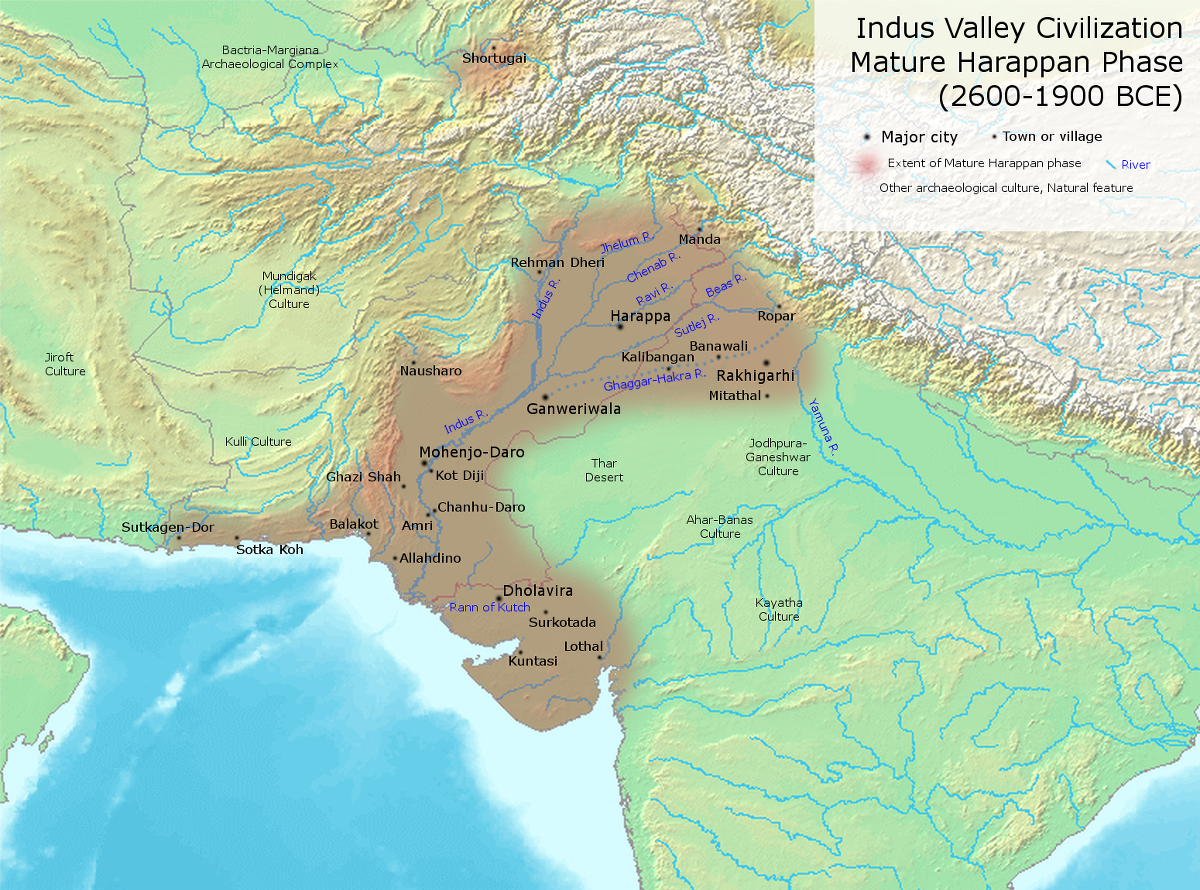
The Indus Valley Civilization existed through its early years of 3300-1300 BCE, and its mature period of 2600-1900 BCE. The area of this civilization extended along the Indus River from what today is northeast Afghanistan, into Pakistan and northwest India. The Indus Civilization was the most widespread of the three early civilizations of the ancient world, along with Ancient Egypt and Mesopotamia. Harappa and Mohenjo-daro were thought to be the two great cities of the Indus Valley Civilization, emerging around 2600 BCE along the Indus River Valley in the Sindh and Punjab provinces of Pakistan. Their discovery and excavation in the 19th and 20th centuries provided important archaeological data about ancient cultures.
Overview
The Indus River Valley Civilization, 3300-1300 BCE, also known as the Harappan Civilization, extended from modern-day northeast Afghanistan to Pakistan and northwest India.
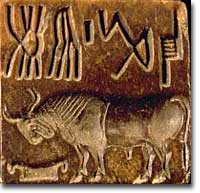
Important innovations of this civilization include standardized weights and measures, seal carving, and metallurgy with copper, bronze, lead, and tin.
Little is understood about the Indus script, and as a result, little is known about the Indus River Valley Civilization’s institutions and systems of governance.
The civilization likely ended due to climate change and migration.
Indus Valley Civilization:
The Indus Valley Civilization was one of the three “Ancient East” societies that are considered to be the cradles of civilization of the old world of man, and are among the most widespread; the other two “Ancient East” societies are Mesopotamia and Pharonic Egypt. The lifespan of the Indus Valley Civilization is often separated into three phases: Early Harappan Phase (3300-2600 BCE), Mature Harappan Phase (2600-1900 BCE) and Late Harappan Phase (1900-1300 BCE).
At its peak, the Indus Valley Civilization may had a population of over five million people. It is considered a Bronze Age society, and inhabitants of the ancient Indus River Valley developed new techniques in metallurgy—the science of working with copper, bronze, lead, and tin. They also performed intricate handicraft, especially using products made of the semi-precious gemstone Carnelian, as well as seal carving— the cutting of patterns into the bottom face of a seal used for stamping. The Indus cities are noted for their urban planning, baked brick houses, elaborate drainage systems, water supply systems, and clusters of large, non-residential buildings.
The Indus Valley Civilization is also known as the Harappan Civilization, after Harappa, the first of its sites to be excavated in the 1920s, in what was then the Punjab province of British India and is now in Pakistan. The discoveries of Harappa, and the site of its fellow Indus city Mohenjo-daro, were the culmination of work beginning in 1861 with the founding of the Archaeological Survey of India in the British Raj, the common name for British imperial rule over the Indian subcontinent from 1858 through 1947.
The Twin Cities :
The ruins of two ancient cities, Harappa and Mohenjo-Daro (both in modern-day Pakistan), and the remnants of many other settlements, have revealed great clues to this mystery. Harappa was, in fact, such a rich discovery that the Indus Valley Civilization is also called the Harappan civilization.
Harappa was a fortified city in modern-day Pakistan that is believed to have been home to as many as 23,500 residents living in sculpted houses with flat roofs made of red sand and clay. The city spread over 150 hectares (370 acres) and had fortified administrative and religious centers of the same type used in Mohenjo-daro. The modern village of Harappa, used as a railway station during the Raj, is six kilometers (3.7 miles) from the ancient city site, which suffered heavy damage during the British period of rule.
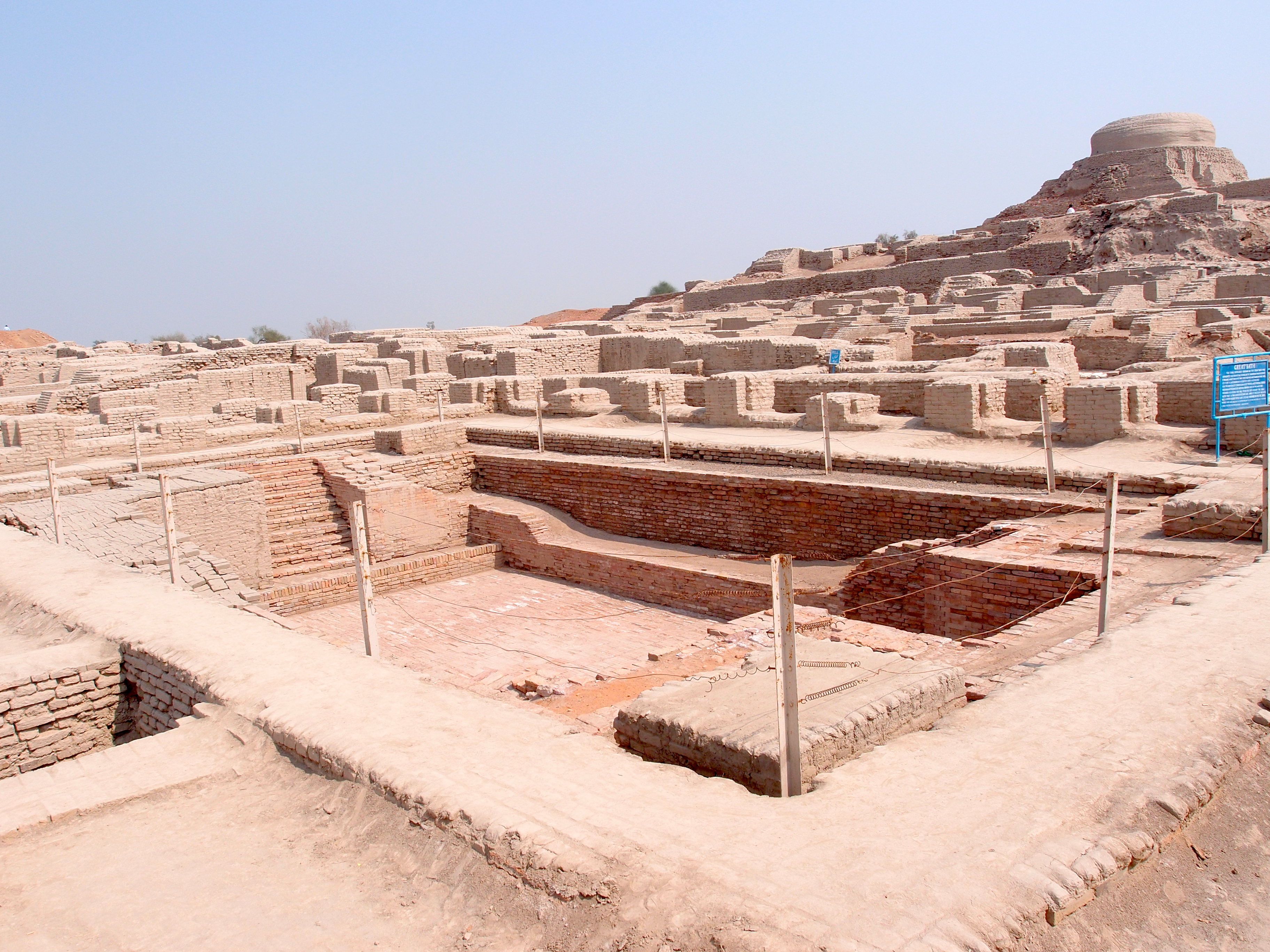
Mohenjo-daro is thought to have been built in the 26th century BCE and became not only the largest city of the Indus Valley Civilization but one of the world’s earliest, major urban centers. Located west of the Indus River in the Larkana District, Mohenjo-daro was one of the most sophisticated cities of the period, with sophisticated engineering and urban planning. Cock-fighting was thought to have religious and ritual significance, with domesticated chickens bred for religion rather than food (although the city may have been a point of origin for the worldwide domestication of chickens). Mohenjo-daro was abandoned around 1900 BCE when the Indus Civilization went into sudden decline.
The ruins of Harappa were first described in 1842 by Charles Masson in his book, Narrative of Various Journeys in Balochistan, Afghanistan. In 1856, British engineers John and William Brunton were laying the East Indian Railway Company line connecting the cities of Karachi and Lahore, when their crew discovered hard, well-burnt bricks in the area and used them for ballast for the railroad track, unwittingly dismantling the ruins of the ancient city of Brahminabad.
Geography and time-frame :
In 1856, British colonial officials in India were busy monitoring the construction of a railway connecting the cities of Lahore and Karachi in modern-day Pakistan along the Indus River valley.As they continued to work, some of the laborers discovered many fire-baked bricks lodged in the dry terrain. There were hundreds of thousands of fairly uniform bricks, which seemed to be quite old. Nonetheless, the workers used some of them to construct the road bed, unaware that they were using ancient artifacts. They soon found among the bricks stone artifacts made of soapstone, featuring intricate artistic markings.Though they did not know it then, and though the first major excavations did not take place until the 1920s, these railway workers had happened upon the remnants of the Indus Valley Civilization, also known as the Harappan Civilization, after Harappa, the first of its sites to be excavated, in what was then the Punjab province of British India and is now in Pakistan. Initially, many archaeologists thought they had found ruins of the ancient Maurya Empire, a large empire which dominated ancient India between c. 322 and 185 BCE.Before the excavation of these Harappan cities, scholars thought that Indian civilization had begun in the Ganges valley as Aryan immigrants from Persia and central Asia populated the region around 1250 BCE. The discovery of ancient Harappan cities unsettled that conception and moved the timeline back another 1500 years,situating the Indus Valley Civilization in an entirely different environmental context.
There is evidence of settlement in this area as early as 7000 BCE.The Indus Valley Civilization is often separated into three phases: the Early Harappan Phase from 3300 to 2600 BCE, the Mature Harappan Phase from 2600 to 1900 BCE, and the Late Harappan Phase from 1900 to 1300 BCE.
The Indus cities are noted for their urban planning, a technical and political process concerned with the use of land and design of the urban environment. They are also noted for their baked brick houses, elaborate drainage systems, water supply systems, and clusters of large, nonresidential buildings.The Indus Valley Civilization began to decline around 1800 BCE.
Urban infrastructure and architecture:
By 2600 BCE, small Early Harappan communities had developed into large urban centers. These cities include Harappa, Ganeriwala, and Mohenjo-daro in modern-day Pakistan and Dholavira, Kalibangan, Rakhigarhi, Rupar, and Lothal in modern-day India. In total, more than 1,052 cities and settlements have been found, mainly in the general region of the Indus River and its tributaries.Mohenjo-daro is thought to have been built in the twenty-sixth century BCE; it became not only the largest city of the Indus Valley Civilization but one of the world’s earliest major urban centers. Located west of the Indus River in the Larkana District, Mohenjo-daro was one of the most sophisticated cities of the period, with advanced engineering and urban planning.
Harappa was a fortified city in modern-day Pakistan that is believed to have been home to as many as 23,500 residents living in sculpted houses with flat roofs made of red sand and clay. The city spread over 150 hectares—370 acres—and had fortified administrative and religious centers of the same type used in Mohenjo-daro.Both cities had similar organization and featured citadels, central areas in a city that were heavily fortified—protected with defensive military structures.The remains of the Indus Valley Civilization cities indicate remarkable organization; there were well-ordered wastewater drainage and trash collection systems and possibly even public baths and granaries, which are storehouses for grain.Harappans demonstrated advanced architecture with dockyards, granaries, warehouses, brick platforms, and protective walls. These massive walls likely protected the Harappans from floods and may have deterred military conflicts.
Indus Valley Cities:
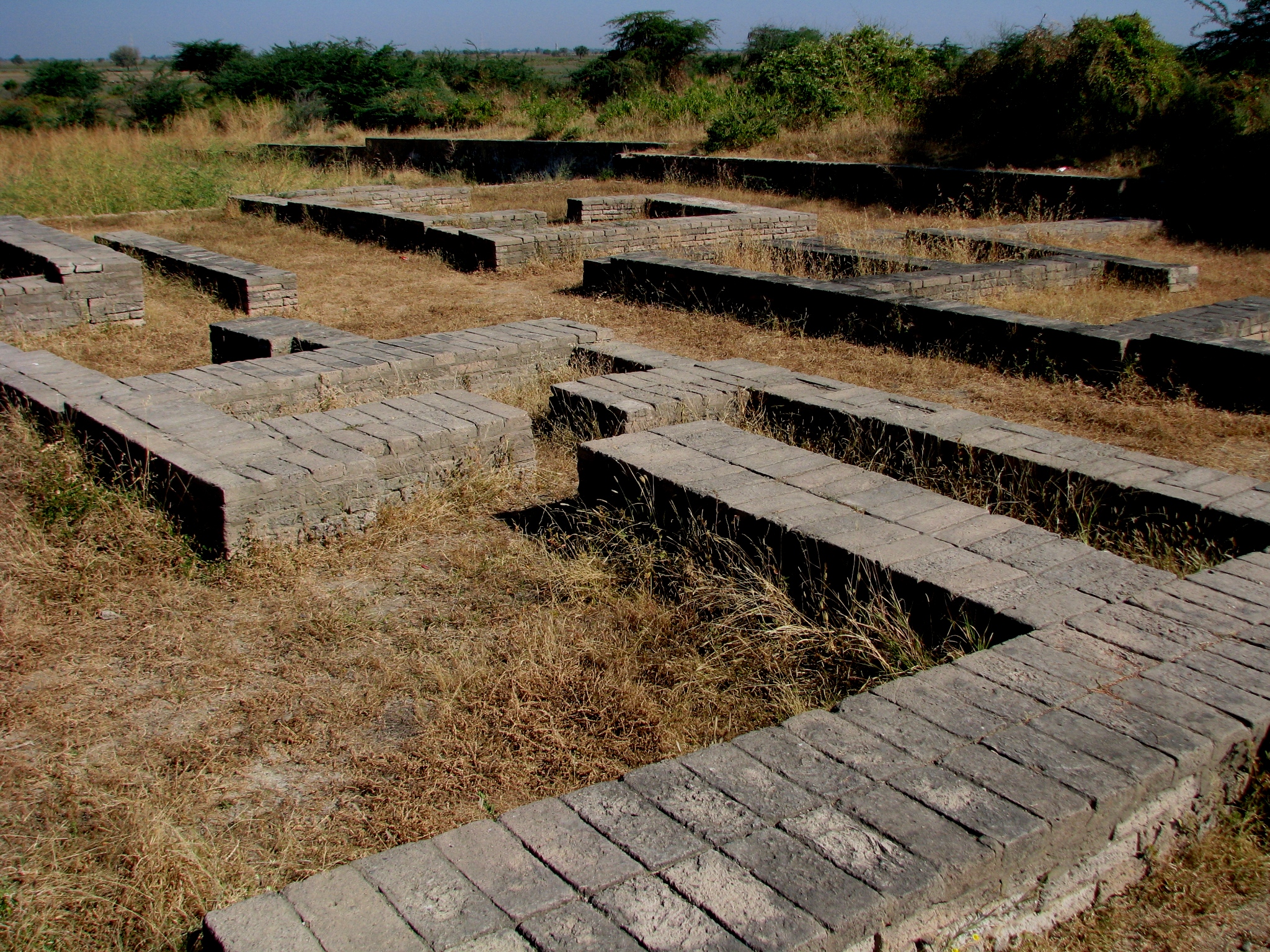
The cities of the ancient Indus Valley consisted of highly functional, multistory buildings and structures constructed with uniform, kiln-burnt bricks. There is evidence of urban planning due to the uniformity of size and the style of the brickwork, as well as the organization of streets and neighborhoods into grid patterns, much like many current cities.
The first-known sanitation system, whereby waste-water was directed into covered drains that lined major streets and where clean water was obtained from wells in a designated room in the home, was employed in the ancient Indus Valley. This system of sewage and drainage is quite remarkable and was more advanced than some seen even today.
The Indus Valley Civilization is also known for developing a unified system of weight and measurement, as well as a decimal system and the first known use of negative numbers. In 2001, it was discovered that people from the early Harappan period had knowledge of proto-dentistry with the excavation of the first evidence of drilled human teeth.
Art in the Indus Valley :
The Indus Valley period is well documented through the wealth of artifacts that were excavated from its magnificent cities. It is widely believed that most of the inhabitants of Indus Valley cities were tradespeople and artisans. Archaeologists have excavated sculptures, seals, pottery, gold jewelry, elaborate beadwork, and anatomically detailed figurines in terracotta , ceramic, bronze, lead, tin, and steatite from the ancient Indus Valley area.
A number of bronze, gold, stone, and terracotta figures of girls in dance poses reveal the presence of some dance forms from the time, and a harp-like instrument depicted on a seal indicates the use of stringed musical instruments.
Similarities in the iconography and construction of excavated artifacts suggest the considerable mobility and trade networks of the Indus Valley inhabitants. Raw materials found only in distant regions, such as lapis lazuli and steatite, were imported for artistic use. It is believed that the trade networks of the Indus Valley reached as far as Afghanistan, coastal Persia, northern and western India, Mesopotamia , and Egypt.
The Fall of Harappan Culture:
The remains of their walls yield clues about the culture that thrived in the Indus Valley. Clay figurines of goddesses are proof that religion was important. Toys and games show that even in 3000 B.C.E., kids — and maybe even adults — liked to play. Pottery, textiles, and beads are evidence of skilled craftsmanship and thriving trade
It was this intensive devotion to craftsmanship and trade that allowed the Harappan culture to spread widely and prosper greatly. Each time goods were traded or neighbors entered the gates of the cities to barter, Indus culture was spread.Eventually, though, around 1900 B.C.E, this prosperity came to an end. The integrated cultural network collapsed, and the civilization became fragmented into smaller regional cultures. Trade, writing, and seals all but disappeared from the area.
Many believe that the decline of the Harappan civilization was a result of Aryan invasions from the north. This theory seems logical because the Aryans came to power in the Ganges Valley shortly after the Indus demise of the Indus Valley Civilization. Because there is little evidence of any type of invasion though, numerous historians claim that it was an environmental disaster that led to the civilization’s demise. They argue that changing river patterns disrupted the farming and trading systems and eventually led to irreparable flooding.
Although the intricate details of the early Indus Valley culture might never be fully known, many pieces of the ancient puzzle have been discovered. The remains of the Indus Valley cities continue to be unearthed and interpreted today. With each new artifact, the history of early Indian civilization is strengthened and the legacy of this ingenious and diverse metropolis is made richer.
An Bengali guy lead most successful team, team India and his name is Sourav Chandidas Ganguly or Sourav Gangopadhyay affectionately known as DADA. He is popularly honoured as “MAHARAJ” of Indian Cricket. During his playing career, Ganguly established himself as one of the world’s leading batsmen and also one of the most successful captains of the Indian national cricket team. While batting, he was especially prolific through the off side, earning himself the nickname God of the Off Side for his elegant stroke play square of the wicket and through the covers.
Early And Personal Life:
Sourav Ganguly was born on 8 July 1972 in calcutta, and is the youngest son of Chandidas and Nirupa Ganguly. Chandidas ran a flourishing print business and was one of the richest men in the city. Ganguly had a luxurious childhood and was nicknamed the ‘Maharaja’, meaning the ‘Great King’. Ganguly’s father Chandidas Ganguly died at the age of 73 on 21 February 2013 after a long illness. Inspite of being right handed batsman, he become e left handed because he can use the kit of his brother. Showing some potential in batsman Sourav joined a cricket academy. He became the “Princess of Kolkata”. Some people called his “Bengal Tiger” due to his place of birth and partially due to the way he would pounce on the ball.
Cricket Career:
In 1991, Sourav Ganguly made a disastrous debut during the India tour of Australia and to add to it the media printed some articles alleging that he had, ‘attitude problems’. Sourav refuted these allegations but after that first one day with Australia that marked his debut he was forgotten for four years. It seemed like his career as an international cricketer had ended even before it took off. He continued to play domestic cricket and in 1996 earned a place in the Indian side touring England. Ganguly’s cricket career divided into two parts, one is pre 2003 and next one is post 2003. Ganguly made a destructive innings of 183 runs against Sri Lanka in the World Cup 1999. Ganguly was considered as a best Captain of Indian team. As captain of Indian team Ganguly led India in 49 test matches, winning 21 of those, including 12 that were played outside India. His careers biggest victory came when he captained the Indian side to a victory over Steve Waugh’s Australia in the 2001 Border-Gavaskar trophy.
Sourav Ganguly was a captain that the boys could count on. He was fearless, and intelligent enough to battle brains with the world’s best. During the final match of the 2002 NatWest Trophy held in Lords, after a brilliant performance by his teammates, Sourav took off his shirt in public and brandished it in the air to celebrate India’s winning the match. He was condemned for disrespecting Lords protocol but he earned brownie points nonetheless with the Indian fans.
Although Sachin and Sourav made a world best opening partnership but he pushed himself down to promote Sehwag in batting order. His falling individual statistics falling down and his controversies with Greg Chappell led him to be dropped from the team in October 2005.
Sourav Ganguly has risen like the Phoenix from the ashes. He has accumulated 1000 runs in the past year. His performance in the 2007, India vs. Pakistan test series has been simply brilliant. Here is a man who can reinvent himself after two decades at the age of thirty five; surely he deserves all praise and accolades.
“Competition is a good thing; it forces us to do our best.”
Nancy Pearcey
Since every aspect in life has two angles, competition too can be considered in the positive as well as the negative sense. Mostly, competition is used in the negative sense which is the reason most of the businesses end on a short note. Thus, we will be learning a positive sense of this word in today’s article.
The term becomes negative when you resolve to imitating the procedures followed by your competition. As discussed in earlier articles, a business needs to stand out for which uniqueness is quintessential. Thus, blindly following the footsteps of your competition isn’t going to help. Also, focussing merely on your competition and their profits isn’t the right move because that diverts your attention from the possible surplus you could generate. In short, avoid opening up an encyclopaedia of services offered by your competition just so as to match their ability because that isn’t possible. All have different capabilities and varied ways of thinking. Perhaps you could do better than the competition and in order to believe yourself, lay aside continuous inspection of the competition. Let us understand this better.
For instance, a company selling electrical appliances and will of course have competition because one can’t possibly come up with a business extremely alien to all, owing to the desires of the mob. Thus, competition persists because we need to consider the needs of the population on this planet and arrange for such services that would benefit. Uniqueness must come in the way we exhibit or present those services.
Getting back to the story, you are receiving good deal traffic but are occupied in considering the competition. You’re trying to get into their good books so as to know more about their ways of introducing and presenting the services. However, while you are busy understanding your competition, you failed to comprehend over the fact that you could understand the psychology of the customers and list their desires thereby coming up with a unique form of exhibition of your services. In short, you lose access to creativity when you are busy imitating which certain businessmen term as ‘taking inspiration’. A point to be noted is, that inspiration means simply learning from the competition and coming up with your own unique form of services while imitation is looking up services provided by the competition that seem to best appeal to the mob and trying out the same! Most businessmen resort to the latter but coin their efforts as former!
Yes, there is a possibility of better inclining towards the latter because we feel that more customers would be attracted to us as well, as they do to the competition. But a point that we miss out on is, that if the customers have already tried that way out, why would they be interested in yet another company offering the same format with no particular speciality or uniqueness in its services? Also, customers remain glued to the same company for ages owing to the trust and genuineness they feel towards that brand which is the reason, they wouldn’t actually be interested in trying out a new brand with the same level of services. Why take the risk and opt for a new brand with same manner of exhibition of services when the old one does the trick? That is when uniqueness comes into the picture because your aim shouldn’t be to snatch the customers of your competition which is a tedious task and may gain no possible results. Instead, your aim should be to gain a new set of enthusiastic customers for yourself. Don’t go for Renaissance in business that is rebirth or revival of your competition. Go for something unique that people would be excited enough to try out owing to the way it functions.
Thus, competition should be taken in a positive sense. Take inspiration from them. Capture some of their bonus points that help them and develop your business with creativity on the basis of that structure. In short, use your competition as stepping stones to success! Also, competition can help you grow vividly because it helps understand updates of market trends which keep changing and are visible in your competition. By closely observing the same, you could flourish your business and step by step, move further than your competition not by imitating them but by personal creativity. The competition would neither blame you for stealing their ideas nor would you feel guilty of being a copy cat! So, be yourself and unique in business to ensure additional bonuses in the future!
Focous on what ypu are feeling right now. If you’re sad,feel the sadness. Share your feelings with someone close to you. Do something nice for yourself. Take time to count your blessings. Eat well. Make social connections. Spend more time with your favourite person. Do what you like the most .
Negative thoughts affect areas of the brain that cause depression and anxiety. Positive thoughts on the other hand trigger chemical changes that trigger feelings of intense happiness and satisfaction.
Everyone has negative thoughts sometimes,but when you negative thoughts that cycle through your mind repeatdly,it can cause problems.Recurring negative thoughts can be symptoms of anxiety and depression disorders.
However, these positive emotions last only for a brief period and in order to fully experience its benifits, it is necessary that these positive thoughts be thought often.
Negative thinking can feel outside of your control and completely automatic. Fortunately,research and studies have come up with great ways with whose help you can break the habit of negative thinking and develop a more positive outlook towards life.This practice of overcoming negative thoughts has been studied and proven and has helped many individuals change their lives.
Given below is a list of these effective ways that can help you alter your thought pattern and learn to handle your negative thoughts in a positive way.
1)Be conscious of your thoughts:
As soon as you find yourself thinking a negative thought,stop yourself from thinking it.
One thought can lead to another and before you know you are experiencing deep grief and sorrow over your past mistake or hurts.
It is therefore important you stop at that very first negative thought itself. The next thing you can do is replace it with a postive thought or reframe your thought pattern into a positive one.Doing this will help you feel more positive and helpful.
2.keep youself Busy:
“An idle mind is the devil’s workshop” is a very true saying when it comes to negative thoughts.If you notice,you are more prone to negative thinking when you are sitting idle,rather than when you are busy.
According to research ,keeping your hands and mind occupied by doing tasks like cleaning, sorting, knitting etc., helps keep your mind off negative thoughts. Mainly keeping busy is associated with a battery of brain benefits.
This is because the busier you are the lesser time you have to devote to negative thoughts.
3. Avoid Triggers:
It is very easy to fall into the rut of negative thinking.That’s why it is important that one pay attention to their environment and intentionally remove all triggers that would initiate negative thoughts.
It could be a gift from an ex or a picture or a friend or a neighbour or a relative who might be the constant source of negative thoughts in your life.
According to some researchers,negative thinking is also a habit that one can easily pick up from others.Minimizing contact with such people and avoiding negative triggers can help keep you sane and positive.
4. Sufficient Rest and Sleep:
Lack of sleep greatly affects your mood,causing you to feel anxious, irritable and angry.Getting the sufficinet 8 hours of sleep helps keep the negative thoughts away and greatly improves your mental health.
Psychologists state that there is an important relationship between sleep and mood.
5. Music :
Listening to upbeat music is a great way to keep the negative thoughts away. It is hard to enterain troubling thoughts when you are listening to some groovy music.
According to reserachers just listening to your favourite music for 25 minutes, a day can bring about a great mood change and have a positive effect on your health and day .
6. Exercise :
Physically active people who exercises often according to study conducted by the researchers from the penn state university were found to experience greater feelings of enthusiasm and excitment. These people tend to experience more pleasant and happy feelings than people who exercise less or don’t exercise at all.
It is associated with pleasure and happiness is released in the brain every time you exercise,making it harder for negative thiughts to enter your mind.
7. Meditation :
Meditation is another great way to ward off negative thoughts and fill your mind with positivity. Brain studies have found out that meditation can help deactive the area of the brain that is responsible for the continuous negative thought pattern.
Meditating even just for 10 minutes a day can bring about a positive impact in your life.
8. Diet :
Many studies have found a siginificant correlation between a nutritionally poor diet that is high in refined sugars and impaired brain function. Mood and food have an important connection.
Eating nutritious food that is rich in vitamins, minerals, and antioxidants not only nourishes your brain but significantly impacts your thought processes and how you feel.
It is never too late to try changing your negative thought pattern. Try the above- proven methods and see how much difference positive thinking brings in your life
Software Evolution could be a term that refers to the method of developing software package at the start, then timely change it for varied reasons, i.e., to feature new options or to get rid of obsolete functionalities etc. … If the projected changes ar accepted, a replacement unleash of the software package is planned. There ar 5 distinct stages contribute in easy staged model (Initial development, Evolution, Servicing, Phase-out, and Close-down). in keeping with K.H.Bennett and V.T Rajlich, the key contribution is to separate the ‘maintenance’ section into AN evolution stage followed by a service and end stages.
In software package engineering, software package evolution is spoken because the method of developing, maintaining, and change software package for varied reasons. software package amendments ar inevitable as a result of there ar several factors that change throughout the life cycle of a bit of software package. a number of these factors include: demand changes.
.THE EVOLVING ROLE OF software package
it’s a product and, at a similar time, the vehicle for delivering a product. As a product, it delivers the computing potential embodied by element or, a lot of generally, a network of computers that ar accessible by native hardware. A software package method model is AN abstraction of the particular method, that is being delineated . It can even be outlined as a simplified illustration of a software package method. every model represents a method from a selected perspective. Laws used for software package Evolution:
Law of constant change: This law states that any software package that represents some real-world reality undergoes continuous amendment or become increasingly less helpful in this setting. Law of skyrocketing complexity: As AN evolving program changes, its structure becomes a lot of complicated unless effective efforts ar created to avoid this development. Law of conservation of organization stability: Over the lifespan of a program, the speed of development of that program is about constant and freelance of the resource dedicated to system development. Law of conservation of familiarity: This law states that in the active lifespan of the program, changes created within the sequential unleash ar virtually constant.
The necessity of software package evolution: software package analysis is critical simply because of the subsequent reasons:
a) amendment in demand with time: With the passes of your time, the organization’s desires and routine of operating might considerably be modified thus during this oft dynamic time the tools(software) that they’re exploitation have to be compelled to amendment for increasing the performance. b) setting change: because the operating setting changes the things(tools) that modify America to figure in this setting additionally changes proportionately same happens within the software package world because the operating setting changes then, the organizations would like intro of previous software package with updated options and practicality to adapt the new setting.
c) Errors and bugs: because the age of the deployed software package inside a company will increase their preciseness or impeccability decrease {and the|and therefore the|and additionally the} potency involved the increasing complexness work also frequently degrades. So, in this case, it becomes necessary to avoid use of obsolete and aged software package. All such obsolete Softwares have to be compelled to bear the evolution method so as to become strong as per the work complexness of the present setting.
Legion by Lenovo is a dedicated gaming emblem from Lenovo with aesthetics and specifications tailored to game enthusiasts. Even though the specifications are broadly speaking similar to the other laptops on this list, we’ve got the extra storage as you get a 256GB SSD in addition to a 1 TB hard disc drive. Summary of specifications: Intel i5-9300H, GTX 1050, 8 GB, 256 SSD + 1 TB HDD, 15.6-inch 1080p.
SPECIFICATION
OS
:
Windows 10 Home
Display
:
15.6-inch screen with (1920X1080) full HD display | Anti Glare technology | 60Hz refresh rate | 250 Nits Brightness | IPS Display
Processor
:
Intel I5-9300H, 2.4 Ghz base speed, 4.1 Ghz max speed, 4 Cores, 8Mb Smart Cache
The ASUS TUF Gaming series is all about making their hardware more accessible, and the FX505DD does just that by combining the Ryzen 5-3550H with the GTX 1050 and even having a high-refresh-rate panel. A recent drop has increased the value of this one-of-a-kind aggregate even further. Ryzen 5-3550H, GTX 1050, 8 GB RAM, 1 TB HDD, 15.6-inch 120 Hz 1080p display.
The HP Pavillion Gaming 15 series of laptops come in a wide range of configuration options. The only one we chose is powered by an AMD Ryzen 5-3550H processor and a GTX 1050 graphics card. This makes this one-of-a-kind SKU one of the best AMD-based configurations we could find. Summary specifications: Ryzen 5-3550H. GTX 1050, 8 GB RAM, 256 SSD + 1 TB HDD, 15.6-inch 1080p display.
SPECIFICATION
OS
:
Windows 10 Home
Display
:
15.6-inch Full HD (1920 x 1080) anti-glare IPS display | 60Hz refresh rate | 250 Nits Brightness
Processor
:
AMD Ryzen 5-3550H Quad-core processor (2.1 GHz base clock speed, up to 3.7 GHz max boost clock speed, 6 MB cache, 4 cores)
In terms of performance, the ASUS TUF Gaming FX505DY is quite close to the FX505DD. The Graphics card which is AMD RX 560X, and the display is a 60 Hz 1080p panel are the key differences between them. Specifications in summary: Ryzen 5-3550H, RX 560X, 8 GB RAM, 512 SSD, and a 15.6-inch 1080p display.
Xiaomi is the most latest company to release a laptop in India that is powered by an Intel Core i5-10210U processor and an NVIDIA MX350 GPU. As long as you keep the game settings to low or medium, you can play a few games on the MX350. Both the CPU and the GPU are designed for power efficiency rather than long gaming sessions. Summary configuration: Core i5-10210U, MX350, 8 GB RAM, 512 SSD.
SPECIFICATION
OS
:
Windows 10 Home
Display
:
Horizon Display|14-Inch (1920X 1080 )Full HD Anti-Glare Screen
Processor
:
Intel Core i7-10510U processor, 1.8 GHz base speed, 4.9 GHz max speed, 4 Cores, 8 threads
” Time and tide wait for none”. No matter how many times we hear or see this clichéd quote, not all of us actually understand the essence of these words. Time management is an essential skill for aspirants of all kinds. In this fast-evolving world, one must keep up par with others to achieve their goal. The fact that smart work is better than hard work is of the essence. Productivity is smart work. One such method to maintain productivity in our daily life is the Pomodoro technique.
Pomodoro technique is a time management method where a timer is used to break down the work at hand into intervals, separated by short breaks. This method was developed by Francesco Cirillo in the late 1980s. Each interval is called a ‘Pomodoro’ the Italian word for tomato, the tomato-shaped kitchen timer that Cirillo used as a college student.
The original technique has 6 steps
1. Choose a task you would like to get done
No matter how small or big the task is, it deserves your full undivided attention.
2. Set the timer for 25 minutes
Keep a promise to yourself that you don’t interrupt yourself for just 25 minutes. You can use your mobile timer or a good old clock for timing your session.
3. Work on the task until the timer rings
Immerse yourself. Meanwhile, if you remember anything other than the work at hand, write it down on a sheet of paper. You can give them thought later.
4. When the timer rings, tick off your completed task
Hurray! You have given your undivided attention to the task for 25 minutes.
5. Take a short break
Take a deep breath, meditate, grab a cup of your favourite beverage go for a stroll or do something that is relaxing for your brain to reward yourself.
6. After every 4 Pomodoros take a longer break
A break of 20 to 30 minutes is good enough to rest, preview the information and prepare yourself for the next set of Pomodoros.
To make the best out of these Pomodoro sessions you can:
Use the first few minutes of the session to review what you have done earlier.
Set up a timetable and try to be devoted to it.
You can use airplane mode or do not disturb mode on your mobile. (Apply only if you are not accountable for not picking up calls 🙂
Be mindful of the shorter breaks. They might prolong at times, thus unsettling your next Pomodoro cycle.
Understand your body — find out which part of the day you are most productive. This can work wonders and get a lot of things done.
The rules of the Pomodoro technique are not necessarily rigid. If you are not able to pull up 4 Pomodoros continuously, opt for one or two Pomodoros in a day. At the end of the day, what matters the most is how much productive and focus you are in those sessions and how much work gets done. You can also vary the time interval as 50/10 (50 minutes of focus and 10 minutes of break) instead of the traditional 25/5 technique if you are quite confident about your focus.
This technique is useful if you feel distracted or overwhelmed to focus on what matters to you. It has worked well for me in this lockdown and has helped a lot in my exam preparations. Hope it works for you too!
Securities and Exchange Board of India (SEBI) is a statutory regulatory body entrusted with the responsibility to regulate the Indian capital markets. It monitors and regulates the securities market and protects the interests of the investors by enforcing certain rules and regulations.
SEBI was founded on April 12, 1992 under the SEBI Act, 1992. Headquartered in Mumbai, SEBI has regional offices in New Delhi, Chennai, Kolkata and Ahmedabad along with other local regional offices across prominent cities in India.
The objective of SEBI is to ensure that the Indian capital market works in a systematic manner and provide investors with a transparent environment for their investment. To put it simply, the primary objective of setting up SEBI is the creation of such an environment that helps in effective mobilization as well as the allocation of resources with the help of securities market of India.
Objectives
SEBI has many objectives and is meant for the betterment of each participant in the market, be it investors, intermediaries or the issuers of securities. Some of these objectives are-
Provide protection: It guides and educates people who are willing to invest their money in the securities market. This is done in order to protect their interests.
Preventing malpractices: It aims at prohibiting of all kinds of malpractices which are prevalent in the trading market.
Professional and Competitive environment: SEBI has the objective to develop a code of conduct through which it can easily regulate the activities of the intermediaries. Brokers, merchant bankers are some of the intermediaries. The main objective of SEBI is to make these intermediaries professional and competitive.
Orderly Functioning: SEBI has been entrusted with the duty of promoting the functioning of the securities industry and stock exchanges in an orderly manner.
Establishing balance: SEBI also maintains a balance between the regulations provided by various statutes and the regulations made by the securities industry.
Functions of SEBI
SEBI is entitled to fulfil various functions, which can be divided into the following three parts:
Developmental functions
Protective functions
Regulatory functions
These broad functions can be subdivided into various other functions. Some of them are as follows:
DEVELOPMENTAL FUNCTIONS
There are various developmental functions of SEBI. Some of them are as follows:
Promoting fair trade: SEBI has made underwriting optional in order to achieve the goal of promotion of fair trade.
Research: SEBI also makes a publication of the data and information which is necessary for various participants of the market in order to conduct effective research.
Training of brokers: Intermediaries of the securities market are trained to promote the efficiency of the market.
PROTECTIVE FUNCTIONS
There are various protective functions of SEBI. Some of them are as follows:
Prevention of various Fraudulent and Unfair Trade Practices: Price ragging and purchase or sale of securities with the help of several misleading statements are some of instances of Fraudulent and Unfair Trade Practices. SEBI aims at prohibiting such practices.
Prohibition of Insider Trading: Promoters, directors and other key managerial personnel of the companies take advantage of the possession of the unpublished price sensitive information for making profits by trading into securities. SEBI aims at preventing such insiders to trade.
Educates Investors: SEBI organizes various campaigns in to order to promote awareness amongst the investors. This is done to protect them, from various fraudulent activities prevalent in the securities market.
Promotion of Fair Practices: SEBI is also responsible for the promotion of code of conduct and other fair practices in the market of securities in India. For instance, SEBI regularly keeps a check on the interests of debenture holders with respect to any midterm revision of rates of interest and many more.
REGULATORY FUNCTIONS
Notifications of various Rules and Regulations: SEBI is empowered to issue various rules and regulations to make the functioning of all the intermediaries existing in the securities market smooth.
Levying of Fees: If any of the players of the market contravenes any order or direction passed by it, SEBI has the power to levy penalties, fees and other charges for the same.
Registration of Agents and Brokers: For the purpose of making a safe market place for trading into the securities, it is mandatory for all the transfer agents, brokers, merchant banks, sub-brokers and so on to register themselves.
Regulator of Investment Schemes: It has made the registration of mutual funds and collective investment schemes mandatory in order to regulate them.
Exercising and Performing Powers: SEBI has been delegated various powers under the Securities Contracts (Regulation) Act 1956 by the Government of India. SEBI exercises and performs all such powers.
Enquiries and Inspection: SEBI conducts various inspections and undertakes audits and enquiries of stock exchanges of India.
The first scientifically minded celestial observers included people such as Nicolaus Copernicus (1473–1543), Johannes Kepler, and Galileo Galilei, who began looking at the sky through telescopes they built. Galileo’s view of Jupiter in 1610 transformed our view of the planets. They weren’t just dots of light in the sky. They were worlds. Over the years, more and better telescopes have revealed double stars and nebulae in the sky, and their discoverers set out to figure out what these things were. The science of “natural philosophy” uses mathematics, chemistry, and physics to explain objects and events in the universe. Nicolaus Copernicus came up with the heliocentric solar system, with the planets orbiting the Sun. The laws of planetary motion developed by Johannes Kepler and the laws of physics devised by Sir Isaac Newton helped explain the motions of bodies in space.
Contributions of Famous Scientists and Breakthroughs:
Nicolaus Copernicus – He wrote De revolutionibus orbium coelestium(on the revolution of the heavenly sphere)(1543) in which he proposed the heliocentric theory.
Galileo Galilei– He was the first one to look at the sky with a telescope. In 1610, with a telescope, he watched Jupiter and discovered 4 moons(Galilean moons). He also observed phases of Venus and sunspots. He wrote On motion , Dialogue concerning the two chief world systems and Discourses and mathematical demonstrations relating to two new sciences .
Hans Lippershey and Zacharlas Janssen (dutch-german opticians)- They invented the telescope(first to patent)
Johannes Kepler – He wrote Mysterium cosmographicum (latin for the cosmographic mystery)(1596) in which he defended copernican heliocentric ideas. In 1609, he published the first 2 laws of planetary motion.
Kepler’s laws: 1. The path of the planets about the sun is elliptical in shape, with the center of the sun being located at one focus.
2. An imaginary line drawn from the center of the sun to the center of the planet will sweep out equal areas in equal intervals of time.
3. The ratio of the squares of the periods of any two planets is equal to the ratio of the cubes of their semi-major axis.
Kepler’s Publications- Johannes Kepler published treatises about many topics. Here is a list of some of his other astronomy-related works.
1. Astronomia Pars Optica (Optics in Astronomy)
2. Astronomia Nova (The New Astronomy)
3. Dissertatio cum Nuncio Sidereo (Conversation with the Starry Messenger, an endorsement of Galileo Galilei’s observations)
4. Harmonice Mundi (The Harmony of the Worlds, in which Kepler describes harmony and congruence in geometry and presents his third law of planetary motion)
William Herschel– He deduced that the solar system is moving, and saw martian ice caps. He created a deep sky catalog and double star catalog and catalogue of 500 nebulae, nebulous stars, planetary nebulae,etc. He discovered uranus (1781). He also discovered infrared light.
Caroline Herschel- she was the first woman paid to do astronomy and she discovered 8 comets.
John Federick William Herschel- He published the general catalog of 10,300 multiple and double stars, and The New General Catalog of Nebulae and Clusters(NGC).
Isaac Newton– He gave the famous three laws of motion. 1.The first law states that an object at rest will stay at rest, and an object in motion will stay in motion unless acted on by a net external force.
2]The second law states that the rate of change of momentum of a body over time is directly proportional to the force applied, and occurs in the same direction as the applied force.
3]The third law states that all forces between two objects exist in equal magnitude and opposite direction.
He also gave the universal law of gravitation. He invented Newtonian reflectors- telescopes with reflecting mirrors.
Henrietta Swan Leavitt– She discovered cepheid variables(period of pulsation of star is related to intrinsic brightness of star), many other variable stars and novas.
Edwin Hubble– He showed that the universe was larger and beyond the Milky Way by showing that Andromeda was outside the milky way. He discovered the universe is expanding. He gave the hubble sequence of galaxy morphologies – spiral, elliptical, lenticular or irregular.
Einstein– He discovered the photoelectric effect, and wave-particle duality. He published the special theory of relativity and the general theory of relativity.
Jocelyn Bell burnell– The first pulsar that Bell found is called PSR 1919+21, and its signal repeats precisely every 1.33 seconds.It was called LGM-1.
Vera Rubin– She proved the existence of dark matter.
Clyde Tombaugh – In 1930, He discovered pluto.
Mike brown– He demoted Pluto to dwarf planet and wrote How I Killed Pluto and Why It Had It Coming.
Set in the 1910s in Bengal, this film originally known in Bengali as Pather Panchali is the first feature length film of one of India’s most acclaimed and celebrated directors: Satyajit Ray (1921-1992). The film focuses on an impoverished Brahman family in a Bengali village with the youngest member Apu being one of the central characters. It is his story that Ray focuses on in his two feature length films : Aparajito (The Unvanquished, 1956) and Apur Sansar (The World of Apu, 1959) thus making this movie the first in Ray’s critically acclaimed Apu Trilogy.
The film centers around Apu and his family members including his elder sister Durga, his priest of a father who dreams of being a poet and a playwright and his mother who is often engaged in a battle with his father’s cousin who she resents for stealing their food from the kitchen while she struggles to feed her children. The film is a slice of life and one that displays the harshness of reality for a family living in dire poverty. Since Apu’s mother is often busy, taking care of the family, it is Durga who cares for him like a second mother, often teasing him and sharing the simple joys of life with him like sitting under the cool shade of a tree, viewing the mind-boggling pictures through a travelling vendor’s bioscope or watching a folk theatre performed by a troupe or even chasing and salivating at the sweets of the candy man despite their empty pockets.
The film blindsides the viewer by showing a child’s perspective of the world. Be it Apu and Durga’s fascination with all the vendors and their goods or their wealthier friend’s jewellery and beads. A soundtrack composed by Pandit Ravi Shankar which includes mainly tunes played on the sitar, transports us to the village and its peace; free from the worries of the hustling-bustling cities.
Starring mostly amateur actors and a first-time director at the helm, the film struggled in its funding but was ultimately funded by the government of Bengal, giving Ray the opportunity to finish his masterpiece. Once released, the film was an astounding critical and commercial success. Grossing 100 million through positive word of mouth, the film received accolades from various national and international organizations the most noticeable being The National Film Awards and a screening at the Cannes Film Festival. The film cemented Satyajit Ray’s career as a director and placed India on the world cinema map. It created a new genre of film-making in which authenticity and realism were the primary themes, breaking the norms of traditional Indian filmmaking. The film may not hold the test of time from a technical stand point due to its poor print quality and damage to the original negatives, but from a story telling standpoint, the film still strongly puts forward its themes of poverty and child-like wonder, that are as relevant today as they were in a film that released 66 years ago.
People are mainly aware about the algae as seaweeds or algal blooms. They are the organisms with ability of photosynthesis and very much diverse community as well. But algae are important to man and their economic importance is manyfold. They are used as food, fodder and manure. They are also important in industrial field as well as agriculture.
there are 7 major types in algae
Chrysophytes
Euglenophytes
Pyrrophytes
Chlorophytes
Rhodophytes
Phaeophytes
Xanthophytes
these are the benificial roles of algae
Algae is a food source: In different parts of the world algae have been utilized as direct source of food. They are rich in proteins, carbohydrates, oils, vitamins and minerals hence used as a diet food. They possess minerals like Cu, Fe, Zn, Co, V, Mn and Cr. About 20 different seaweeds are used as food source. Nostoc,
Algae as fodder: Many seaweeds are as food for cattle, poultry and aquatic organisms. Sargassum is used as cattle feed in China. Laminaria and Fucus are also used for the same purpose. Seaweed meal increases the egg laying capacity of fowls. These eggs contain high amount of iodine and carotene.
Algae in agriculture: Algae are used as green manures in agriculture. Sargassum, Laminaria, Macrocystis and Gracilaria are the most commonly used ones. Seaweed manure increases the yield of barley, potato, coconut palms, citrus etc. Many blue green algae have the ability to fix the atmospheric nitrogen into the soil. So they can be used as biofertilizers. Saline and alkaline soils can be converted into productive ones by growing some blue-green algae on soil. Anabaena, Rivularia, Spirulina are used for this purpose.
Algae in Industries: In Industries many algae have been used as sources for the extraction of commercial products like agar-agar, diatomite, carrageenin and algin. Agar-agar is used as culture media for bacteria. It is also used as emulsifier in ice-cream, fruit jellies and dairy product preparation. Algin is used as painting pastes in textile industry and thickeners in cosmetics, pharmaceutical products etc. Carrageenin which is extracted from Chondrus crispus and Gigartina are used in food industry, textiles and leather industry. It is a remedy for cough.
Algae in sewage disposal: Sewage water contains organic and inorganic substances which makes it low in oxygen content. But sewage finds use in agricultural practice as they are rich in salts. To decrease the foul smell algae are used. Algae are used to decompose the organic and inorganic substances.
Algae and Research: Algae are used in the study of effects of pesticides, herbicides and UV light. They are used in the research for preparing biofuels.
Algae as pollution indicator: Some algae grow well in polluted water as they are more tolerant towards pollution. Growth of these algae indicates the pollution and its intensity. Scenedesmus indicates copper wastes and Ulothrix zonata indicates indicates paper mill wastes.
Though many algae are useful, there are harmful algae are also there. The development of water blooms is considered to be a bad effect of algae. There are some parasitic algae cause diseases in plants. Attachment of algae tp ship retards the speed of the ship. growth of algae on cloths are also seen and they ruin the cloth.
























 OS: WINDOWS 10
 DISPLAY: 15.6″ (1920 X 1080)
 PROCESSOR: 9TH GEN INTEL CORE I5 | 2.4 GHZ
 MEMORY: 8 GBGB DDR4











 Eduindex
You must be logged in to post a comment.