Global Nature Conservation Index

The Global Nature Conservation Index (NCI) 2024 is brought out recently, for the first time, by Goldman Sonnenfeldt School of Sustainability and Climate Change, Ben-Gurion University of the Negev, Israel and BioDB.com. India has been ranked 176 out of total 180 countries undermining the well-recognized efforts of India in Land Management, Threats to Biodiversity, Capacity & Governance and Climate Change Mitigation. NCI has not taken into account the country reported data in respect of many indicators and relied on many other sources leading to unrealistic NCI index. Further, NCI has completely ignored India’s leadership role in international environmental forums such as International Big Cat Alliance (IBCA), Mission LiFE, International Solar Alliance (ISA) and Coalition for Disaster Resilience Infrastructure (CDRI) advocating for global cooperation on biodiversity conservation as well as its leadership role on global climate change agenda.

In recent years, India has taken several measures in areas of land management and threats to its biodiversity which have not been taken into account while deriving NCI. For example, the Government of India enacted Biological Diversity Act, 2002, as amended by the Biological Diversity (Amendment) Act, 2023 (BD Act) together with new set of Rules to conserve, sustainably use and regulate the access of biological resources and knowledge associated thereto. The Act covers various measures under the provisions of the BD Act to conserve biodiversity including the constitution of Biodiversity Management Committees (BMCs), notification for Biodiversity Heritage Sites and notification for threatened species. The notification confers power to the State Biodiversity Boards (SBBs) for regulating access to the notified species and to take measures to rehabilitate and preserve those species.

Some of India’s key achievements in land management and biodiversity conservation are as follows:

  1. India has 1022 Protected Areas in the country, covering an area of 178,640 sq. km, which is about 5.43 % of the geographical area of the country.
  2. Total Forest Cover has increased from 21.23% in 2013 to 21.71% in 2021 .
  3. India has 72.16 lakh Ha of forest cover as per the FAO’s Global Forest Resource Assessment 2020, securing its place among the top ten countries worldwide.
    1. Eco-Sensitive Zones of 487 Protected Areas have been established across India.
    2. Number of Ramsar sites have increased from 26 in 2014 to 85 in 2024.
    3. There are 55 Tiger Reserves in India and tiger population has increased from 2226 in 2014 to 3682 in 2022.
    4. India’s Project Lion has fostered a growing lion population in the Gir Landscape—from 284 in 1990 to 674 in 2020.
    5. India has reintroduced Cheetah in the Indian habitat through the world’s first inter-continental large wild carnivore translocation project.
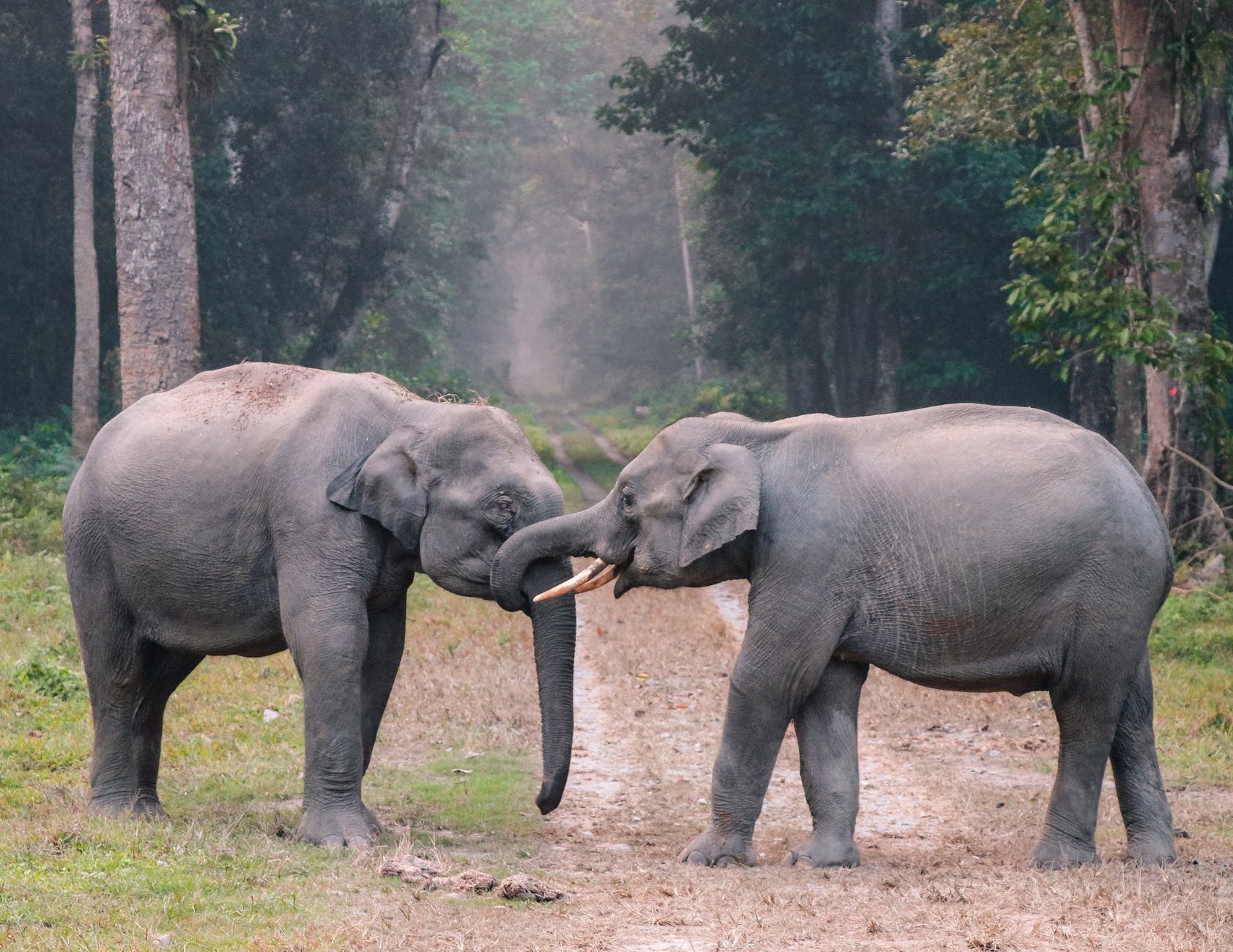
    6. With 33 Elephant Reserves, India holds by far the largest number of wild Asian elephants, estimated at about 30,000 or nearly 60% of the population of the species.
    7. India’s leopard population is estimated at 13,874 individuals, representing stable population in comparison to the similar area being sampled in 2018 with 12,852 individuals.
    8. The Namami Gange Programe to rejuvenate River Ganga and its tributaries has been recognised as World Restoration flagship project by UN which reflects the commitments of Government towards conservation, rejuvenation and development of natural ecosystems and its services.

India has already submitted its National Targets under the National Biodiversity Strategy and Action Plans on 10th September, 2024 and also submitted its National Biodiversity Strategy and Action Plan (NBSAP) on 31st October, 2024 on the Convention on Biodiversity Portal during the recently concluded CBD COP at Cali, Colombia. Both the National Biodiversity Targets and the Action Plans are fully aligned with the goals and targets set under the Kunming Montreal Global Diversity Framework (KMGBF). KMGBF is to be implemented in accordance with the national circumstances, priorities and capabilities.

India’s National Biodiversity Strategy and Action Plan (NBSAP) envisages  protecting terrestrial and marine areas, restoring degraded ecosystems and reducing biodiversity threats through pollution control as also invasive species management. India emphasizes species conservation, sustainable resource use, wildlife corridors to reduce fragmentation, and community engagement in biodiversity governance.

India has submitted its Long Term Low Emission Development Strategy (LT-LEDS) for reducing GHG emissions to UNFCCC in November 2022 highlighting strategic low-emissions development transitions for the country. The LT-LEDS was prepared in the light of India’s right to an equitable and fair share of the Global Carbon Budget, which is the practical implementation of Climate Justice. The key elements  of the strategy include- Low carbon development of electricity systems consistent with development; development of an integrated, efficient, inclusive low-carbon transport system; promoting adaptation in urban design, energy and material-efficiency in buildings and sustainable urbanisation; promoting economy-wide decoupling of growth from emissions and development of an efficient, innovative low-emission industrial system; CO2 removal and related engineering solutions; enhancing forest and vegetation cover consistent with socio-economic and ecological considerations; and developing strategy on economic and financial aspects of low-carbon development. Some of the initiatives include the Smart Cities Mission (SCM), National Action Plan of Climate Change (NAPCC) promoting climate-resilient and sustainable urban development.

The Adaptation Communication submitted to UNFCCC in 2023 outlines the actions taken for adaptation to climate risks and challenges, and future strategy for the same. India has developed an integrated approach, ranging from food security, energy use efficiency, and water management aiming to address these issues simultaneously through appropriate policies and initiatives.

International Tiger Day: A Call to Protect the Majestic Tigers

 International Tiger Day, also known as Global Tiger Day, is celebrated annually on July 29th to raise awareness about the plight of tigers and to promote efforts for their conservation. This day underscores the importance of protecting tigers and their natural habitats, ensuring that future generations can witness the majesty of these magnificent creatures in the wild. With tigers facing numerous threats to their survival, International Tiger Day serves as a crucial reminder of the collective responsibility we share in safeguarding these iconic animals.

The Origins of International Tiger Day

International Tiger Day was established in 2010 during the Saint Petersburg Tiger Summit in Russia, where leaders from 13 tiger-range countries committed to doubling the global tiger population by 2022. This ambitious goal, known as the TX2 goal, was a response to the alarming decline in tiger numbers, driven by habitat loss, poaching, and human-wildlife conflict.

The summit marked a significant milestone in global tiger conservation efforts, highlighting the need for international cooperation and concerted action to save tigers from extinction. Since then, International Tiger Day has become an important annual event, drawing attention to the challenges facing tigers and mobilizing support for conservation initiatives worldwide.

The Plight of Tigers: A Snapshot of the Challenges

Declining Populations

Tigers once roamed freely across Asia, from the eastern shores of Russia to the dense forests of India and Southeast Asia. However, over the past century, their numbers have plummeted dramatically. Today, there are estimated to be fewer than 4,000 tigers left in the wild, a stark contrast to the 100,000 that existed a century ago. This decline is primarily due to habitat loss, poaching, and illegal wildlife trade.

Habitat Loss and Fragmentation

The destruction of forests and grasslands for agriculture, infrastructure development, and urbanization has led to significant habitat loss for tigers. This not only reduces the space available for tigers to roam and hunt but also fragments their habitats, isolating populations and making it difficult for them to find mates and maintain genetic diversity.

Poaching and Illegal Trade

Tigers are highly sought after for their skin, bones, and other body parts, which are used in traditional medicine and as luxury items. Despite international bans, illegal poaching remains a significant threat to tiger populations. Poachers target tigers for their valuable parts, and the demand for tiger products continues to drive this illicit trade.

Human-Wildlife Conflict

As human populations expand into tiger territories, conflicts between tigers and humans have become more frequent. Tigers may prey on livestock or attack people, leading to retaliation from local communities. Such conflicts not only threaten tiger populations but also hinder conservation efforts by creating animosity towards these animals.

The Importance of Tigers: Ecological and Cultural Significance

Keystone Species

Tigers are apex predators, playing a crucial role in maintaining the balance of ecosystems. They help regulate prey populations, which in turn influences the health of vegetation and other wildlife. The presence of tigers indicates a healthy ecosystem, and their conservation can have positive ripple effects on biodiversity and ecosystem stability.

Cultural Icons

Tigers hold a special place in the cultural and spiritual traditions of many societies across Asia. They are revered in folklore, art, and religious practices, symbolizing strength, courage, and power. Preserving tigers is not just about saving a species; it’s about protecting a rich cultural heritage that has been intertwined with human history for millennia.

Conservation Efforts: Success Stories and Ongoing Challenges

Protected Areas and Wildlife Corridors

Establishing protected areas and wildlife corridors has been a cornerstone of tiger conservation. These areas provide safe havens for tigers and allow them to move freely between habitats. Countries like India and Russia have successfully implemented protected area networks, leading to notable increases in tiger populations in some regions.

Anti-Poaching Initiatives

Efforts to combat poaching and illegal trade include increased patrolling, the use of technology such as camera traps and drones, and stringent legal measures. Community-based conservation programs also play a crucial role, involving local people in protecting tigers and their habitats, and providing alternative livelihoods to reduce reliance on poaching.

International Collaboration

Conservation of tigers requires global cooperation, as tigers roam across national borders and face threats that transcend geographical boundaries. International organizations, governments, and NGOs are working together to implement conservation strategies, share knowledge and resources, and promote public awareness about the importance of saving tigers.

How You Can Help: Steps to Support Tiger Conservation

Raise Awareness

One of the most effective ways to support tiger conservation is by spreading awareness about the challenges tigers face and the importance of their protection. Use social media, participate in events, and engage in conversations to educate others about the significance of International Tiger Day and the need for conservation efforts.

Support Conservation Organizations

Many organizations are dedicated to saving tigers and their habitats. Consider donating to reputable conservation groups, volunteering your time, or participating in fundraisers. Your support can help fund critical research, anti-poaching efforts, and habitat restoration projects.

Promote Sustainable Practices

Human activities have a direct impact on tiger habitats. By supporting sustainable practices, such as responsible forestry and agriculture, and reducing your carbon footprint, you can contribute to the protection of the natural environments that tigers depend on.

Advocate for Policy Change

Advocating for strong environmental policies and regulations is crucial for tiger conservation. Support legislation that protects wildlife, bans illegal trade, and promotes sustainable land use. Engage with policymakers and join advocacy campaigns to push for effective conservation measures.

Conclusion

International Tiger Day is a powerful reminder of the urgent need to protect tigers and their habitats. It is a day to celebrate the strides made in tiger conservation, acknowledge the challenges that remain, and renew our commitment to saving these magnificent creatures. As we mark this important day, let us remember that the fate of tigers is inextricably linked to our own. By working together to conserve tigers, we are also safeguarding the health of our planet and the future of countless other species.

On this International Tiger Day, let us pledge to take action, raise our voices, and make a difference. Together, we can ensure that tigers continue to thrive in the wild, symbolizing the beauty and resilience of the natural world for generations to come.


Feel free to share this article to help spread awareness about tiger conservation and the importance of protecting our planet’s biodiversity.

Contribution of women in STEM & biodiversity conservation highlighted at the 10th Women Science Congress

 The contribution of women in all walks of life, including STEM, as well as conservation of biodiversity, was highlighted at the 10th Women Science Congress (WSC), organised as a part of the 108th Indian Science Congress at Rashtrasant Tukadoji Maharaj Nagpur University during 5-6 January 2023.

Padmashri Smt. Rahibai Soma Popere, a farmer and conservationist, highlighted the crucial role women have played in biodiversity conservation and also elaborated about her campaign to help farmers return to native varieties of crops while Chief Guest Mrs. Kanchan Gadkari, Head, Seva Sadan Sanstha, spoke about self-reliance among women. Several eminent women scientists shared their research and professional experiences with the audience.

Dr. Nisha Mendiratta, Advisor & Head, WISE-KIRAN Division, Department of Science & Technology (DST), emphasized on the need for interventions to promote women in STEM. She highlighted that in tertiary education, the percentage of girls is more than 55, but after that, there are high numbers of dropouts – an issue that needs to be addressed. Dr. Mendiratta underlined the efforts of DST in plugging the gap areas and promoting women’s participation in Science & Technology, benefiting more than 35000 girls and women in the last 8 years under various women-centric programs.

The experts discussed about the role of S&T in Women Empowerment; Opportunities in Food Science & Technology; Sustainable Development Goals; Science Communication, Role of Digitalization, etc.

A panel discussion was also organized wherein Dr. Indu Bala Puri, Scientist, DST, pointed out the importance of S&T-led development in rural areas. Dr. Suphiya Khan, Banasthali Vidyapith, asserted that innovation in research can excel in the output. Dr. Sangeeta Nagar, TIFAC, DST, briefed about the opportunities for women in the area of Intellectual Property Rights.

Dr. Zareena Qureshi, Principal, JNV Nagpur, shared the significance of the Vigyan Jyoti program for school girls to pursue a career in STEM fields. Dr. Sonal Dhabekar, beneficiary of the WOS-B program, highlighted how this program helped to reshape her scientific career after a long break.

Dr. Vijaylaxmi Saxena, General President of ISCA, appreciated the various initiatives of Govt. of India for empowering women. Dr. Kalpana Pande, Convener WSC, talked about the scientific temperament among women since ancient times. Around 5000 participants attended the 2-day event.


SNC/RR

Biodiversity – Types and causes of loss

Diversity at all the levels of the biological organisation ca be classified into-

(i) Genetic diversity: A single species might show high diversity at the genetic level over its distributional range. India has more than 50,000 genetically different strains of rice and 1,000 varieties of mango. 

genetic diversity

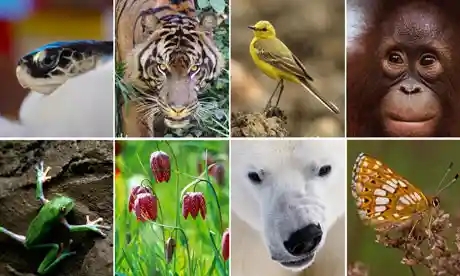
(ii) Species diversity: The diversity at the species level; for example, the Western Ghats have a greater amphibian species diversity than the Eastern Ghats. 

Species Diversity

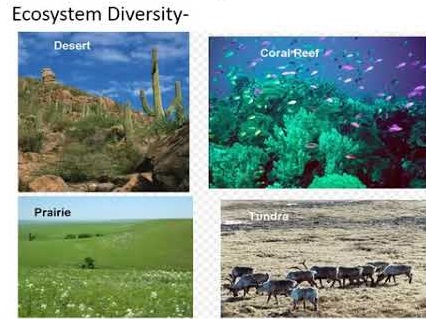
(iii) Ecological diversity: At the ecosystem level, India, for instance, with its deserts, rain forests, mangroves, coral reefs, wetlands, estuaries, and alpine meadows, has a greater ecosystem diversity than a Scandinavian country like Norway. 

Ecological diversity

Patterns of Biodiversity

  1. Latitudinal gradients: Species diversity decreases as we move away from the equator toward the poles. A forest in a tropical region like Equador has up to 10 times as many species of vascular plants as a forest of equal area in a temperate region like the Midwest of the USA.

What is so special about tropics that might account for their greater biological diversity?

(a) Speciation is generally a function of time, unlike temperate regions subjected to frequent glaciations in the past, tropical latitudes have remained relatively undisturbed for millions of years and thus, had a long evolutionary time for species diversification, 

(b) Tropical environments, unlike temperate ones, are less seasonal, relatively more constant and predictable. Such constant environments promote niche specialisation and lead to a greater species diversity

(c) There is more solar energy available in the tropics, which contributes to higher productivity; this in turn might contribute indirectly to greater diversity.

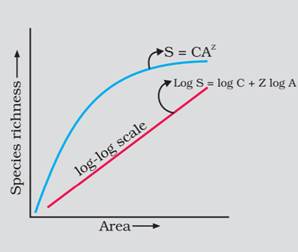
  1. Species-Area relationships: Within a region species richness increases with increasing explored area, but only up to a limit. The relation between species richness and area for a wide variety of taxa is a rectangular hyperbola.

log S = log C + Z log A,     where,

S= Species richness 

A= Area 

Z = slope of the line (regression coefficient) 

C = Y-intercept

Causes of biodiversity losses 

The accelerated rates of species extinctions that the world is facing now are largely due to human activities. There are four major causes ( ‘The Evil Quartet’ )

(i) Habitat loss and fragmentation

(ii) Over-exploitation

(iii) Alien species invasions: When alien species are introduced unintentionally or deliberately for whatever purpose, some of them turn invasive, and cause decline or extinction of indigenous species

(iv) Co-extinctions: When a species becomes extinct, the plant and animal species associated with it in an obligatory way also become extinct. 

Public Policy relevancy with Social welfare Programmes

Source: Shutterstock

Public Policy is new tool of Government to solve socio economic problems through several policies such as Agriculture Policy, Labour Policy, Health Policy, Education Policy, Wage Policy, Industrial Policy and Foreign Policy etc. Government view public policy as a dependent variable and study as to how society is evolving and Political system shaping the nation.

The field of public policy has emerged comparatively in beginning as traced in early 1950s. The concept of public policy was originated in 1951 from the publication of Harold Lasswell. According to Thomas R Dye, Public Policy is what Government will choose to do or not to do. In indian context, public policy could be government rules and Programmes in the form of political system of laws, ordinance, court decision, executive orders, decisions or even unspoken understanding  of what is to be done.

Paul Appleby, the essence of public administrative decision policy defined as a purposed course of action of an individual a group, an Institution or government to realize a specific objective or purpose, within a given environment. The process of public policy flows both top to bottom and bottom to top or even simultaneously. The policy process is viewed from higher level as execution of Policy and viewing meta Policy meaning  progressive.

After independence, India did not carry a specific structural path for economic development. It was decided that economic development must be based on social, political growth that transmutes human advancements. India adopted the Socio – economic development model in which major areas were industries and agriculture. Planning commission (now NITI Aayog) for the purpose of development initiatives adopted in a five year plan as a major development plan. structure policies Public policy developed as academic pursuit in the 1950s. However, Public Policy was very much evident in 1940, stimulating Government activities and academic organizations. Study of government, policy, Social Science involves political Science, public administration, economics and management.

Dimock stated public policy as “deciding at any time or place what objectives and substantive measures should be chosen in order to deal with particular problems”. Public Policy process structure to maximize and utilize all resources to overcome the catastrophic events. Public Policy is a continuous process, furiously working towards  acquiring best outcomes. Righteous and accurate conditioning helps to bring desired aims. The process requires transparency, decentralization, and effective policy implementation. Public Policy Process is significant to change nation economic, social, and political representation especially in the Case of developing nations.

According to Chandler and Plano, treated public Policy as ” the strategic use of resources to alleviate national problems  or governmental concerns”. Freeman and Sherwoods stated that it is the Public answer to the interest in refining the circumstances. Robert linebewy  emphasized on “it is what governments do and fail to do for their citizens”. Anderson expresses it,” policy is being made as it is being administered as it is being made”.

 Understanding of Public Policy

Source: iass.potsdam.de

 The Public Policy process is a kind of Physics  equation that if finding a small error will cost the huge problem, also diffuses the whole processing mechanism. Public policy processes require pointed manifestation at each level. Hogwood and Gunn (Policy Analysis for the Real World, 1984) concluded nine vital Stages in the policy process: Agenda Setting, object screening issue defining , forecasting alternatives, objectives & priorities, policy implementation, monitoring and control, policy maintenance, succession and termination, these all required for successful policy. As we are aware, policy making is a complex and dynamic strategy, it requires certain tools to resolve the real world problem of economic, financial, economic, social problems. Public Policy enacted by the government or its executives with the help of civil Societies, media, and pressure groups.

 In the Context of public policy process Lindblom stressed on a highly relative and plasticity decision making system characterised by compromise, incrementalism and continual adjustment. Public policy process is conceptualized as in sequence or stages ( Benson, Jordan, 2015). There are (1) sequence follows as – i) Problem emergence 2) agenda setting 13) Consideration of policy options, &) Decision making 5) implementation 6) evaluation (Jordan and Adelle, 2012).

A policy can be simple or complex, explicit or implicit, discretionary or detailed, private or public qualitative and quantitative. Government does not set advisory principles;  it is the Supreme Court who decides and provides new interpretations of the articles of constitution to curve out the new Policy.

Nature of public policy covering wide portion of its activities such as socio- economic development, women empowerment, child labour, equality, education and so on. Nature of Public policy foremost needs Policy making closely related to decision-making. Decision making includes an identification of a problem, sharp analysis, and the ability to see alternatives. Policies have specific goals, It is absolute to expect a policy to indicate the direction towards. where actions are required. The choices of policies or its objectives are frequently mesmerized. Thus, goals and objectives depend on the values of the policy makers. Planning or formulation is a key component to move forward in the public policy process. Administrators must maintain a planner to know the portion of resources, investments because goals cannot be achieved without having proper planning. Policy Analysis is most significant to rectify any problem in process; it is a technique to use in Policy Process. Basically used for problem assessment and monitoring. Before the decisions, Similarly, Policy Management is also familiar with implementation. It deals with policy making and policy preparation process, it ensures it is producing good quality policies.

 Thus, goals and objectives depend on the values of the policy makers. Planning or formulation is a key component to move forward in the public policy process. Administrators must maintain a planner to know the portion of resources, investments because goals cannot be achieved without having proper planning. Policy Analysis is most significant to rectify any problem in process; it is a technique to use in Policy Process. Basically used for problem assessment and monitoring. Before the decisions, Similarly, Policy Management is also familiar with implementation. It deals with policy making and policy preparation process, it ensures it is producing good quality policies.

 Policy management should be considered as a loose point or giving no importance, it is an Icebreaker of Public Process, if you assess anything wrong at this stage, there will be high chance to “trash in” the policy. That is why policy analysis and policy management is interdependent. 


Bio-diversity and climate change (Nature’s cries for assistance)

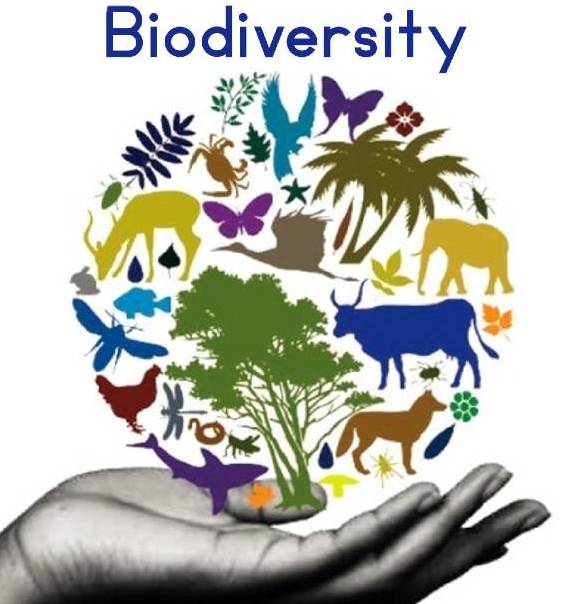
Bio diversity is the biological variability of life on earth. It is the variation of animal, plants, fungi and microorganisms like bacteria. Biodiversity is a variation in the genetic, species, and ecosystem level. Terrestrial biodiversity is usually greater near to the equator. Biodiversity is not equally distributed on earth. There are only 10% of tropical evergreen forests on earth but they contain about 90% of world species. Marine Biodiversity is greater is usually higher along the coast in western pacific where the sea temperature is highest. Biodiversity generally tends to cluster in hotspots and has been increasing through time. Biodiversity supports everything in nature that we need to survive: food, clean water, medicine, and shelter.

But as people put expanding weight on the planet, utilizing and devouring more assets than ever some time recently, we hazard disquieting the adjust of biological systems and losing biodiversity. Quick natural changes regularly cause mass terminations. More than 99.9 percent of all species that ever lived on Soil, producing to over five billion species, are evaluated to be terminated. In 2006, numerous species were formally classified as uncommon or imperiled or undermined; in addition, researchers have assessed that millions more species are at chance which have not been formally recognized. Approximately 40 percent of the 40,177 species surveyed utilizing the IUCN Ruddy List criteria are presently recorded as undermined with extinction—a add up to of 16,119.

The factors affecting the biodiversity are Residential & commercial development, Farming activities, Energy production & mining, Transportation & service corridors and human activities. Pollution is an another major cause of loss of biodiversity causing habitat destruction. Territory devastation has played a key part in terminations, particularly in connection to tropical woodland pulverization. Components contributing to living space misfortune incorporate: overconsumption, overpopulation, arrive utilize alter, deforestation, contamination (discuss contamination, water contamination, soil defilement) and worldwide warming or climate alter.

Climate change is the long-term alteration of temperature and normal climate designs in short. Climate alter might allude to a specific area or the planet as a entire. Climate alter may cause climate designs to be less unsurprising. These unforeseen climate designs can make it troublesome to preserve and develop crops in districts that depend on cultivating since anticipated temperature and rainfall levels can now not be depended on. Climate alter has too been associated with other harming climate occasions such as more visit and more seriously tropical storms, surges, deluges, and winter storms.

Effects of climate change are Hotter temperatures Nearly all land areas are seeing more hot days and heat waves; 2020 was one of the hottest years on record. Higher temperatures increase heat-related illnesses and can make it more difficult to work and move around. Wildfires start more easily and spread more rapidly when conditions are hotter. More extreme storms Changes in temperature cause changes in precipitation. This comes about in more extreme and visit storms. They cause flooding and avalanches, pulverizing homes and communities, and costing billions of dollars. Many more effects like Droughts, Rise in the level of oceans, shortage of food and more health problems.

Securing biodiversity could be a exceptionally complex errand since most of human’s activities have a negative impact on biological systems by overexploiting them. For occurrence, human exercises create contamination that influences living species. Deforestation crushes the living space of numerous animals, reptiles, and plants. Limiting deforestation Reducing the artificialization of natural environments and preserve natural areas as much as possible Reduce air pollution (by limiting our use of transport and our energy consumption, by switching to renewable energies) Fighting global warming by creating regulations for activities that contribute to the greenhouse effect. Making changes in the way industrial agriculture works and using more agroecology methods.

Significance of Biodiversity

Biodiversity in simple words is the biological diversity or the variety of life forms that can be found on earth as well as to the communities that they form and the habitats in which they live. Biodiversity provides us with various benefits directly or indirectly, it plays numerous functions which can be classified as : ecological, economical and social benefits. It maintains balance in the ecosystem by :
✓ Recycling and storage of nutrients
✓ Fighting pollution
✓ Stabilising climate
✓ Maintenance of water resources
✓ Replenishment of Soil and control of soil erosion
Economically provides us with all raw materials for industries, helps in meeting our medical needs and more importantly provides us with food. The biodiversity looks after us in all the aspects in one hand and on the other hand it repairs all the destructions caused by us.

Biodiversity is the basis for our survival. But we human beings are the major reason for its destruction. We are not only pushing other species to danger but slowly demolishing the habitat that we live in, further paving way towards our extinction.

The saddest part is that though most of us are aware of these facts, we are not paying attention to it. But we need to realise the fact that each and every action of us has an impact on the world. We can’t pass out a day without making changes or influencing our surrounding. The process of conservation is incomplete without our participation.So we must realise the need or the urge for conservation of biodiversity. Everyone must be aware of its importance and work towards preserving our future.

9 best vegan Omega-3 Supplements (2021) per Dietitians.

If you don’t have fish on your meal menu doesn’t mean you can’t get all the benefits of omega-3.

Omega-3 is also found in many plant foods, like chia and hemp seeds, in algal oil too. But mostly it is found in fish oil in significant levels.

For your vegan friends, there are plenty of options who wants to intake omega-3 and all of EPA, ALA L AND DHA.

Top Five Valuable Companies In India

1) LIC

LIC stands for life Insurance Corporation of India. It was established on 1 September 1956 by the government of India. The Indian government had passed the life Insurance Act and merged 245 insurance companies. You have questions, How the LIC is earning money? LIC buys money in the way of policies from the public and they invest it among the NIFTY campanies. LIC Managing Director says India’s largest life Insurance had made profit of over Rs 15000 crores on equity investment.https://m.economictimes.com/markets/stocks/news/this-institutional-player-is-making-money-with-both-hands-in-equity/articleshow/78869219.cms?utm_source=whatsapp_pwa&utm_medium=social&utm_campaign=socialsharebuttons The head of the LIC is owned by Ministry of Finance, Government of India. LIC holds the biggest company by market capitalisation with an estimate valuation of Rs 8-10 lakh crore.https://economictimes.indiatimes.com/markets/ipos/fpos/government-proposes-to-hike-lic-authorised-capital-to-rs-25000-crore/articleshow/81375724.cms

2) HDFC BANK

HDFC stands for Housing Development Finance Corporation Ltd. It is an financial services company and banking. This is the India’s largest private sector bank by assets. It was founded in August 1994.https://en.m.wikipedia.org/wiki/HDFC_Bank The Headquarters of HDFC in Mumbai, Maharashtra, India. Incorporated in 1994, HDFC Bank was the first bank in India approved by the RBI to offer financial services in the private sector. The revenue of HDFC is $22 billion in 2021. It has 120000 employees all over the India. The total valuation of HDFC is $22.70 billion.https://www.hdfc.com/

3) RELIANCE INDUSTRIES

Reliance is a multi-industry company. It has operating many business entities. It was founded by Dhirubhai Ambani on 8 May 1973. It have headquarters in Mumbai, Maharashtra, India. Reliance has business in petroleum, natural gas, petrochemical, textile, retail, telecommunications, media, television, entertainment, music, financial services, software. Now, the owner of Reliance is Mukesh Ambani. https://en.m.wikipedia.org/wiki/Mukesh_Ambani He holds (50.54%) of Reliance. The revenue of Reliance is 4.83 lakh crores INR in 2021. The total assets of Reliance is $190 billion. https://en.m.wikipedia.org/wiki/Reliance_Industries

4) TATA GROUP

Tata Group is a conglomerate company. It was founded in 1868 by Jamshedji Tata. Tata group is the one of the biggest and oldest industrial group in India. It has headquarters in Mumbai, Maharashtra, India. Tata has business in automotive, airlines, chemical, defence, FMCG, electric utility, finance, football club, home appliances, hospitality, IT services, retail , e-commerce, real estate, salt, steel, software, cement, telecom. The revenue of Tata group is $123 billion in 2020. It’s net worth is 9.3 trillion INR.https://en.m.wikipedia.org/wiki/Tata_Motors

5) HINDUSTAN UNILEVER LIMITED

Hindustan Unilever Ltd is an consumer goods of India. It was established in 1931. It has headquarters in Mumbai, Maharashtra, India. This have business like foods, cleaning, agents, person care, skincare and water purifier. The company as 18000 employees and had rs 34619 crores revenue in FY2017-18. The net income of Hindustan is rs 6764 crores in 2020.https://www.hul.co.in/ Hindustan Unilever has a market cap of ₹545,762.50 crores and is ranked among the top 10 Indian companies in terms of market capitalisation. A leader in India’s fast-moving consumer goods firm, the company has a rich history of over 80 years. The company website says on any given day, nine out of ten Indian houses use the company’s products. https://m.economictimes.com/hindustan-unilever-ltd/stocks/companyid-13616.cms

Why is Biodiversity so important ?

Hello Friends ……Our planet’s diverse thriving ecosystems may seem like permanent fixtures, but they’re actually vulnerable to collapse. Jungles can become deserts, and reefs can become lifeless rocks, even without cataclysmic events, like volcanoes and asteroids. What makes one ecosystem strong and another weak in the face of change? The answer, to a large extent, is biodiversity. Biodiversity is built out of three intertwined features: ecosystem diversity, species diversity, and genetic diversity. The more intertwining there is between these features, the denser and more resilient the weave becomes. 

Take the Amazon rainforest, one of the most biodiverse regions on Earth due to its complex ecosystems, huge mix of species, and the genetic variety within those species. Here are tangled liana vines, which crawl up from the forest floor to the canopy, intertwining with treetops and growing thick wooden stems that support these towering trees. Helped along by the vines, trees provide the seeds, fruits and leaves to herbivores, such as the tapir and the agouti, which disperse their seeds throughout the forest so they can grow. 

Leftovers are consumed by the millions of insects that decompose and recycle nutrients to create rich soil. The rainforest is a huge system filled with many smaller systems, like this, each packed with interconnected species. Every link provides stability to the next, strengthening biodiversity’s weave. That weave is further reinforced by the genetic diversity within individual species, which allows them to cope with changes. Species that lack genetic diversity due to isolation or low population numbers, are much more vulnerable to fluctuations caused by climate change, disease or habitat fragmentation. 

Whenever a species disappears because of its weakened gene pool, a knot is untied and parts of the net disintegrate. So, what if we were to remove one species from the rainforest? Would the system fall apart? Probably not. The volume of species, their genetic diversity, and the complexity of the ecosystems form such rich biodiversity in this forest that one species gap in the weave won’t cause it to unravel. The forest can stay resilient and recover from change. But that’s not true in every case. In some environments, taking away just one important component can undermine the entire system. 

Take coral reefs, for instance. Many organisms in a reef are dependent on the coral. It provides key microhabitats, shelter and breeding grounds for thousand of species of fish, crustaceans and mollusks. Corals also form interdependent relationships with fungi and bacteria. The coral itself is a loom that allows the tangled net of biodiversity to be woven. That makes coral a keystone organism, one that many others depend on for their suvival. So what happens when destructive fishing practices, pollution and ocean acidification weaken coral or even kill it altogether? Exactly what you might think. 

The loss of this keystone species leaves its dependents at a loss, too, threatening the entire fabric of the reef. Ecosystem, species and genetic diversity together form the complex tangled weave of biodiversity that is vital for the survival of organisms on Earth. We humans are woven into this biodiversity, too. When just a few strands are lost, our own well-being is threatened. Cut too many links, and we risk unraveling it all. What the future brings is unpredictable, but biodiversity can give us an insurance policy, Earth’s own safety net to safeguard our survival.

Environmental and Wildlife Crime

                                                          (Photo: Wildlife Conservation Trust)

Environmental and Wildlife crime is an illegal act which directly harms the environment.

There was a time when people were dependent on the environment and its resources for their existence. As if like they can’t live without it. But with time the situation changed. People started misusing the environment and wildlife for their own greedy purposes which led to a massive destruction of our environment, wildlife and especially our ‘Mother Earth’. As our country is developing, people are becoming greedy and selfish day by day. They have started mismanaging the resources that are actually meant to be used for useful purposes ,and due to this nowadays we are facing many harmful disasters like Tsunami, Earthquake, Flood, Poverty, Economic downfall all over the world. Not only these there are many other problems too.

Coming to the Wildlife, many animals are forcefully placed at zoo in a cage confining their lives within the walls of the zoo. We all know about Deforestation ,that is, “Cutting down the trees and plants”. Thousands of plants and trees are cut down everyday but we never think about the animals like how they will survive as forests are their only home to live in. Many animals are killed leading to the decreasing number of animals in the world. They are left abandoned or some people sell them just to mint money or use their skin to make leather and for many other purposes.

It is a true fact that human activities have a worse impact on nature and wildlife. “The term Environmental and Wildlife crime” should be categorized as crime in the present time. Many factors that influence these crimes are Socio-political and the weak judiciary. As we are all aware that there is no strict implementation of laws in many countries like, India. There are many organizations who works to highlight the issues and work on to prevent but there is no strict implementation not even the judiciary .And people do take benefits from this, and they continue to do these illegal crimes endangering our environment and wildlife. Coming to another factor ,that is, Economy. To increase the economy of the country, many people go after trading of the animals ,selling them at highest price just to mint money. Or even killing it before selling because we know that how expensive animals organs could be and how even just the skin of animals can be used for manufacturing purposes or say for preparing chemicals or weapons. Another factor is supply and demand. As our society is progressing, the demand is also increasing and so as the supply. This also increases an illegal employment opportunity for the people interested and thus, increasing their income.

Environmental and Wildlife crimes have caused a great threat to our environment and stood up with many challenges. Both the crimes have previously not been given importance in most of the countries thus, resulting in the lack of awareness and facilitating these crimes at a high speed which are actually a threat for various countries.

“The wildlife crimes has resulted in the loss of species and we need to start preventing it rather than waiting for the crimes to take place”. The organization has and is facing many problems such as jurisdiction where there is no strict implementation. All these factors have posed a serious threat not only to the environment but also to the organization.

SUGGESTIONS

·       To prevent the Environmental and Wildlife crime, first we need to create awareness about these among mass population.

·       The government shall become strict regarding the implementation of the norms in order to prevent it.

·       National organizations shall work together to keep a record of all the information related to both the crimes and to keep a steady pace with the change.

·       The government shall implement the principle of sustainable development due to the increase in the demands of the people in order to use the resources judiciously.

·       The countries where these crimes are prevalent must join the hands of the national organizations to work as a team for the speedy disposal of the cases.

·       Create a new organization which will deal with both the crimes to prevent any haphazard .This will decrease the burden on the judiciary court and will ensure the speedy disposal of the cases.

·       Organize campaigns and various other programs to educate people about both the crimes and teach them how these crimes are harmful for the society .

·       Involving the people of the society by asking them their suggestions or ideas to prevent the crimes.’

·       Plant more and more trees around your place ,on the streets to curb the pollution.

·       Stricter implementation of the guidelines under Wildlife protection act and Environmental act must be enforced.

Environment and Wildlife are important part of our lives. Environment and society are dependent on each other and we as the members of the society have a responsibility to protect our environment. Many laws and regulations have been made by various countries to protect our environment and wildlife. The protection of environment and wildlife has become a necessity today. Our judiciary looks after the constitutional provisions and reviews its own decisions but the strict implementation of the laws is not yet enforced. And that’s what needs to be changed. Unless and until there is strong and strict implementation, the main objectives of protecting the environment and wildlife cannot be achieved. Also the punishment for harming the environment should be made more strict and the convicts should be made to pay for their deeds. Each and every individual should be made aware towards the environment and wildlife because the government alone cannot fulfil the goals so the involvement of people at a large scale is really important. So it should be remembered that this environment belongs to everyone and the responsibility of conserving the environment and wildlife belongs to everyone.

“True benevolence or compassion, extends itself through the whole of existence and sympathizes with the distress of every creature capable of sensation”.

Economic Benefits of Biodiversity

All of us live in a world where we depend on each other for our needs. Almost all of our needs are met through biodiversity, directly or indirectly. Biodiversity refers to the variability among living organisms from all sources including terrestrial, marine and other aquatic ecosystems and the ecological complexes of which they are part, this includes diversity within species, between species and of ecosystems. Biodiversity in short is our whole environment including flora, fauna, microbes, gases and everything that constitutes our planet earth. It is the foundation of life.


Biodiversity is of great importance when it comes to its economic benefits. Here are some of the economic benefits of biodiversity.


(1) Biodiversity provides us with potential raw materials – Biodiversity provides a great diversity of materials for the construction and fuel including wood, biofuels and plant oils that are directly derived from wild and cultivated plant species.


(2) Food and fresh water – The most important services for the survival of human beings like food and water are provided by the biodiversity. Biodiversity regulates the flow and purification of water.
(3) Organic waste disposal – Biodiversity acts as an organic disposal ground for waste materials, as many things are naturally decomposed in the environment with the help of microbes present in the soil.


(4) Climate and air quality control – Trees provide shade while forests influence rainfall and water availability both locally and regionally. They also play an important role in regulating air quality by removing pollutants from the atmosphere.


(5) Nitrogen fixation – Nitrogen fixation is essential for plant growth and an insufficient quantity of it frequently limits biomass production in both natural and agricultural ecosystems. To increase production of crops, a process called biological nitrogen fixation is implemented through chemical uses, however natural biological nitrogen fixation proves to be healthier and more yielding than the commercial one.


(6) Moderates natural disasters – Extreme weather events or natural hazards include floods, storms, tsunamis, avalanches and landslides. Ecosystems and living organisms create buffer against natural disasters, thereby preventing possible damage. E.g. wetlands can soak up floodwater while trees can stabilize slopes.


(7) Species Habitat – Habitats provide everything that an individual plant or animal needs to survive. Each ecosystem provides different habitats that can be essential for species’ lifecycle.


(8) Medicinal Resources – Ecosystems and their biodiversity provide many medicinal plants used in traditional medicine and as well as provide raw materials for the pharmaceutical industry.


(9) Pollination – Insects and wind pollinate plants and trees, which is essential for propagation and development of fruits, vegetables and seeds.


(10) Biotechnology- Biodiversity has led to an important field of study in science known as biotechnology. Biotechnology refers to the technologies produced from animals, plants and microbes. Biotechnology is of utmost importance because it provides us with various beneficial products and inventions that lead to an advance in our economy and in human life.

(11) Tourism – Ecosystems and biodiversity play an important role for many kinds of tourism, which in turn provides considerable economic benefits and is a vital source of income for many countries.


These are only a few important economic benefits of biodiversity. Biodiversity as a whole has a lot more benefits and is our main sustainer of life. Therefore, we must strive to conserve our biodiversity.

Life of Michelle Obama

Michelle LaVaughn Robinson Obama is an American attorney and author who served as the First Lady of the United States from 2009 to 2017. She was the first African-American woman to serve in this position. She is married to the 44th President of the United States, Barack Obama.

Michelle LaVaughn Robinson was born on January 17, 1964, in Chicago, Illinois, to Fraser Robinson III (1935–1991), a city water plant employee and Democratic precinct captain, and Marian Shields Robinson , a secretary at Spiegel’s catalog store. Her mother was a full-time homemaker until Michelle entered high school

The Robinson and Shields families trace their roots to pre-Civil War African Americans in the American South. On her father’s side, she is descended from the Gullah people of South Carolina’s Low Country region. Her paternal great-great grandfather, Jim Robinson, was born into slavery in 1850 on Friendfield Plantation, near Georgetown, South Carolina. He became a freedman at age 15 after the war. Some of Obama’s paternal family still reside in the Georgetown area. Her grandfather Fraser Robinson, Jr. built his own house in South Carolina. He and his wife LaVaughn (née Johnson) returned to the Low Country from Chicago after retirement.

Robinson was inspired to follow her brother to Princeton University, which she entered in 1981. She majored in sociology and minored in African-American studies, graduating cum laude with a Bachelor of Arts in 1985 after completing a 99-page senior thesis titled “Princeton Educated Blacks and the Black Community” under the supervision of Walter Wallace.

Robinson met Barack Obama when they were among the few African Americans at their law firm, Sidley Austin LLP (she has sometimes said only two, although others have noted that there were others in different departments). She was assigned to mentor him while he was a summer associate. Their relationship started with a business lunch and then a community organization meeting where he first impressed her.

Before meeting Obama, Michelle had told her mother she intended to focus solely on her career. The couple’s first date was to Spike Lee’s movie Do the Right Thing (1989). Barack Obama has said the couple had an “opposites attract” scenario in their initial interest in each other, since Michelle had stability from her two-parent home while he was “adventurous”.

During an interview in 1996, Michelle Obama acknowledged there was a “strong possibility” her husband would begin a political career, but said she was “wary” of the process. She knew it meant their lives would be subject to scrutiny and she was intensely private.

Although she campaigned on her husband’s behalf since early in his political career by handshaking and fund-raising, she did not relish the activity at first. When she campaigned during her husband’s 2000 run for United States House of Representatives, her boss at the University of Chicago asked if there was any single thing about campaigning that she enjoyed; after some thought, she replied that visiting so many living rooms had given her some new decorating ideas. Obama opposed her husband’s run for the congressional seat, and, after his defeat, she preferred he tend to the financial needs of the family in what she deemed a more practical way.

Don’t ever make decisions based on fear. Make decisions based on hope and possibility. Make decisions based on what should happen, not what shouldn’t

Environmental laws in india

Either Stable burning in various states accrued the air pollution in Delhi and created a gas chamber around NCR ; SC came upon a committee to observe scenario , Or 4 industries inflicting stream pollution were shut down by Maharashtra pollution board . Everybody has responsive to environmental problems as higher than . The key solution for resilience to environmental issues are provided by government in various legislations , enactments and provisions on environment laws .


In republic of India environmental law is concern with the policy and law for protection of the environment . It aims for achieving carbon free economy through taking measures for reducing climate change. All the acts under this laws are safeguards in ensuring effective management of the environment and its multiple ecosystems . It provides for preventing environmental damage .


Natural resources in the earth were unscathed from millions of years. It were remain pure until the industrialized started . After the industrialization this resources have been exploited in Spain of 100 years only . From 19th century, the environment (air , water and land ) is directly exploited by rapidly growing population at alarming-rates.


environment includes water, air and land and the inter-relationship which exists among and between water, air and land, and human beings, other living creatures, plants, microorganisms and property , as mentioned in section 2 of environmental protection Act of 1986 . Environment is a wide sphere , it consists of social, economically , political , religious dimensions .


Addressed area of environmental laws in India :

1. Quality of water : For the prevention and control of water pollution and to maintain or restore wholesomeness of water in the country the water act of 1974 was enacted. It further provides for the establishment of Boards ( CPCB and SPCB ) for the prevention and control of water pollution with a view to carry out the aforesaid purposes. This act prohibits the discharge of pollutants into water bodies beyond a given standard, it also lays down fine and penalties for non-compliance.

2. Reduction of air pollution and maintaining air quality : The Air (Prevention and Control of Pollution) Act, 1981 (the “Air Act”) is an act to provide for the prevention , protection and abatement of air pollution .It provides for establishment of Boards at the Central and State levels with a view to carrying out the aforesaid purposes.

3. Hazardous Waste management : legislations that directly or indirectly deal with hazardous waste management are the Factories Act, 1948, the Public Liability Insurance Act, 1991, the National Environment Tribunal Act, 1995 and rules and notifications under the Environmental Act.

4. Containment cleanup, damage mitigation : preventing future damage to the environment is undeniably the primary objective of environmental law, mitigating and reducing existing damage is also important. This area most often deals with issues like toxic leaks and oil spills. The central objective of this branch of environmental law is deciding liability, planning an appropriate response, and also determining the best process of investigation and monitoring in the overall clean up process. This area also concerns itself with the study and assessment of risk in the long term, to better mitigate any future accidents and risks.

5. Sustainability of resources : United Nations has put great emphasis on ensuring the sustainability of resources. For this vision , it has advocated the formation of various legal principles and legislation. In this regards concept of environmental impact assessment introduced .

Noble legislations and enactments on environment law in India :


Laws on Forest and wild life protection:
• The Indian Forest Act, 1927 ; The Wildlife Protection Act, 1972; The Forest (Conservation) Act, 1980 ; The Environment (Protection) Act, 1986; The National Green Tribunal Act, 2010.


Laws on Water pollution :
• The Water (Prevention and Control of Pollution) Act, 1974.


Laws on air pollution :
• The Air (Prevention and Control of Pollution) Act, 1981 (the “Air Act”)


Laws on hazardous waste management :
• Biomedical Waste (Management and Handling) Rules, 1998 ; Municipal Solid Wastes (Management and Handling) Rules, 2000 ; Batteries (Management & Handling) Rules, 2001 ; Hazardous Wastes (Management, Handling and Transboundary) Rules, 2008 ; E – Waste (Management and Handling) Rules, 2011 .
Laws on wetlands


Ramsar convention (1971) : This convention was initiated to push for greater conservation and sustainable use of wetlands ; Wetlands (Conservation and Management) Rules, 2017.
Constitutional provisions on environment laws


Part IVA (Art 51A-Fundamental Duties) of the constitution casts a duty on every citizen of India to protect and improve the natural environment including forests, lakes, rivers and wildlife, and to have compassion for living creatures.


• the Constitution of India under Part IV (Art 48A-Directive Principles of State Policies) stipulates that the State shall endeavour to protect and improve the environment and to safeguard the forests and wildlife of the country.

environment makes human life possible, and our cultural environment helps define who we are. It is therefore essential that our population and economic growth are environmentally sustainable.

World Nature Conservation Day

Conservation is the care and protection of  resources so that they can persist for future generations.

Conservation seeks the sustainable use of nature by humans along with preservation.

Preservation means protecting nature.

World Nature Conservation Day is celebrated on 28 July annually.

It is celebrated to generate awareness of the nature and its conservation.

Nature conservation means conserving habitat of different living organism, preventing deforestation, halting species extinction, reducing overfishing and mitigating climate change.

There is increasing interest in extending the responsibility for human well-being to include the Welfare of sentient animals.

Government play a major role in conserving our natural resources and various living organism.

There are various natural conservation is the laws implemented by government.

There are various threat to biodiversity:-

  • Habitat loss and fragmentation
  • Introduction of alien invasive species
  • Disturbance
  • Harvesting and over exploitation
  • Soil, water and atmospheric pollution
  • Intensive agriculture and forestry
  • Climate change

Habitat loss and fragmentation

  • Forests and grasslands turned into deserts.
  • Mangroves get cleared for fuel wood and prawn farming leads to Habitat loss of marine fish.
  • Waste land is increasing.
  • Human activities likely to eliminate approx 10 Millions species by the year of 2050.
  • Rate of disappearance of tropical forest in India is 0.6 % per year.

Thus, there is a need for conservation of living organism as well as natural resources.

Project Tiger – 268 in 1972 in 9 tiger reserve which increases to 1500 in 1997 in 23 Tiger Reserves.

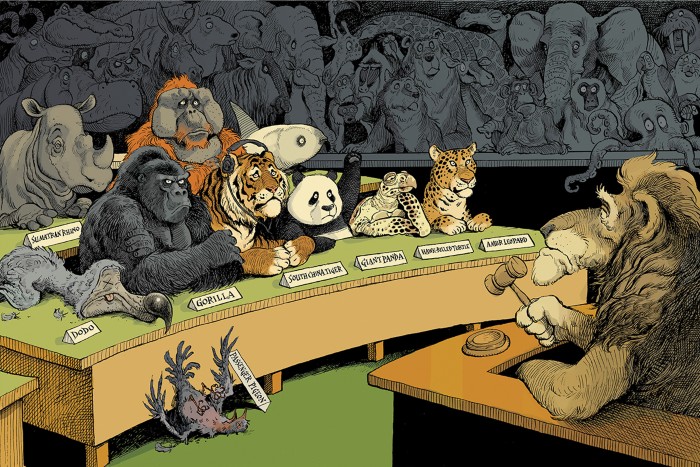
Extinction of Dodo in Madagascar

Alien species

  • Introduction of Exotic breeds and disappearance of native species through biotic interaction.
  • Invasive species is a threat for Island ecosystem due to lack of competitors and Predator that control the population of native ecosystem.
  • E.g.-
    • Amazon sailfin catfish responsible for destruction of the population of Switzerland of Kolkata
    • Water hyacinth
    • Lantana bushes

Disturbance

  • Natural disturbance are very much differ from man made disturbance.
  • Natural disturbance like forest fire, cyclone, draught, Tsunami, etc. They disturb ecosystem very different way.
  • Human disturbances like synthetic compound, pesticides, massive release of radiation or spillover of oil in soil also affect our environment.
  • Biomagnification.
  • Eutrophication i.e, nutrient enrichment
  • Effect of anti-inflammatory drugs, diclofenac on vultures.

Harvesting and over exploitation

  • Exploitation includes hunting, fisheries, the impact of trade in Species and species parts.
  • Due to exploitation many species are getting treated at Global label such as births 30%, mammals 33%, amphibian 6%, marine fishes and reptiles.
  • Fishing often takes large incident catches of non-targeted species and crawling can destroy whole Marine community that live on sea floor.
  • Illegal poaching of animal for large economic benefit.
    • Skin and bones of Tiger, Ivory of elephant, horns of Rhinos, perfume of the Musk deer.

Climate change

  • Climate change is a major threat for all the species present on the globe.
  • Due to climate change the Global temperature is rising (0.74 degrees celsius in global mean surface temperature relative to pre- industrial levels), more extreme weather events, changing pattern of rainfall and drought can expected to have significant impact on biodiversity.

These factors affect directly and indirectly to the species in the form of:-

  • Loss of Polar habitat
  • Loss of coral reef
  • Ocean acidification
  • Shifting of weather
  • Effect on food chain

IUCN  Red List category

Red list is a catalogue of taxa that are facing the risk of extinction.

  • At present it is known as International Union for the conservation of nature and natural resources
  • IUCN has recognised 9 Red List categories of species:-
    1. Extinct
    2. Extinct in the wild
    3. Critically endangered
    4. Endangered
    5. vulnerable
    6. Near threatened
    7. Least concern
    8. Data deficient
    9. Not evaluated

The protected areas of India are :- National Park, Wildlife sanctuaries, conservation Reserves, community Reserves, biosphere reserve, Marine protected areas.

Measures should be taken to conserve nature:-

  • Reduce reuse and recycle
  • Choose sustainable development
  • Choose long lasting light bulbs
  • Try to use renewable resources more than non-renewable resources.
  • Save water
  • Volunteer for clean up our environment
  • Volunteer for clean up our environment
  • Use public transport system
  • Plant more trees
  • Try to avoid plastic
  • Try to minimise pollution at individual level
  • Use reusable shopping bags
  • Educate others about anthropogenic activities or impact of anthropogenic actions on our environment and what can we do to prevent its bad effects.