Evolution Of Camera

N kavya

The history of the camera began even before the introduction of photography. Cameras evolved from the camera obscura through many generations of photographic technology – daguerreotypes, calotypes, dry plates, film – to the modern day with digital cameras and camera phones.

Camera obscura (Before the 17th century) -:

The forerunner to the photographic camera was the camera obscura. Camera obscura (Latin for “dark room”) is the natural optical phenomenon that occurs when an image of a scene on the other side of a screen (or for instance a wall) is projected through a small hole in that screen and forms an inverted image (left to right and upside down) on a surface opposite to the opening. The oldest known record of this principle is a description by the Han Chinese philosopher Mozi (c. 470 to c. 391 BC). Mozi correctly asserted that the camera obscura image is inverted because light travels in straight lines from its source. In the 11th century, Arab physicist Ibn al-Haytham (Alhazen) wrote very influential books about optics, including experiments with light through a small opening in a darkened room. It was wildly successful after debuting to the public in 1839 when both it and the calotype began introducing photography to the masses. Normally, having portraits taken was an activity exclusive to the upper classes. The cost and amount of time needed to produce such works were unreasonable for most working-class people. The speed of the camera, which only increased as time went on, made it possible for anybody to have quality portraits.

Early photographic camera (18th–19th centuries) -:

The development of the photographic camera, it had been known for hundreds of years that some substances, such as silver salts, darkened when exposed to sunlight.[9]: 4  In a series of experiments, published in 1727, the German scientist Johann Heinrich Schulze demonstrated that the darkening of the salts was due to light alone, and not influenced by heat or exposure to air.[10]: 7 The Swedish chemist Carl Wilhelm Scheele showed in 1777 that silver chloride was especially susceptible to darkening from light exposure and that once darkened, it becomes insoluble in an ammonia solution.[10] The first person to use this chemistry to create images was Thomas Wedgwood.

The first permanent photograph of a camera image was made in 1825 by Joseph Nicéphore Niépce using a sliding wooden box camera made by Charles and Vincent Chevalier in Paris.[10]: 9–11  Niépce had been experimenting with ways to fix the images of a camera obscura since 1816. The first photographic camera developed for commercial manufacture was a daguerreotype camera, built by Alphonse Giroux in 1839. Giroux signed a contract with Daguerre and Isidore Niépce to produce the cameras in France,[9]: 8–9  with each device and accessories costing 400 francs.[13]: 38  The camera was a double-box design, with a landscape lens fitted to the outer box, and a holder for the ground glass focusing screen and image plate on the inner box. By sliding the inner box, objects at various distances could be brought to as sharp a focus as desired. After a satisfactory image had been focused on the screen, the screen was replaced with a sensitized plate. A knurled wheel controlled a copper flap in front of the lens, which functioned as a shutter. The early daguerreotype cameras required long exposure times, which in 1839 could be from 5 to 30 minutes.

Within a decade of being introduced in America, 3 general forms of the camera were in popular use: the American- or chamfered-box camera, the Robert’s-type camera or “Boston box”, and the Lewis-type camera. The American-box camera had beveled edges at the front and rear, and an opening in the rear where the formed image could be viewed on the ground glass. The top of the camera had hinged doors for placing photographic plates. Inside there was one available slot for distant objects, and another slot in the back for close-ups. The lens was focused either by sliding or with a rack and pinion mechanism. The Robert’s-type cameras were similar to the American box, except for having a knob-fronted worm gear on the front of the camera, which moved the back box for focusing.

Early fixed images -:

The first partially successful photograph of a camera image was made in approximately 1816 by Nicéphore Niépce,[18][19] using a very small camera of his own making and a piece of paper coated with silver chloride, which darkened where it was exposed to light. His unhardened bitumen was then dissolved away. One of those photographs has survived.

Daguerreotypes and calotypes -:

After Niépce died in 1833, his partner Louis Daguerre continued to experiment and by 1837 had created the first practical photographic process, which he named the daguerreotype and publicly unveiled in 1839.[21] Daguerre treated a silver-plated sheet of copper with iodine vapor to give it a coating of light-sensitive silver iodide. After exposure to the camera, the image was developed by mercury vapor and fixed with a strong solution of ordinary salt (sodium chloride). Henry Fox Talbot perfected a different process, the calotype, in 1840. As commercialized, both processes used very simple cameras consisting of two nested boxes. The rear box had a removable ground glass screen and could slide in and out to adjust the focus. After focusing, the ground glass was replaced with a light-tight holder containing the sensitized plate or paper and the lens was capped.

Dry plates -:

Collodion dry plates had been available since 1857, thanks to the work of Désiré van Monckhoven, but it was not until the invention of the gelatin dry plate in 1871 by Richard Leach Maddox that the wet plate process could be rivaled in quality and speed. The 1878 discovery that heat-ripening a gelatin emulsion greatly increased its sensitivity finally made so-called “instantaneous” snapshot exposures practical.

The invention of photographic film -:

The use of photographic film was pioneered by George Eastman, who started manufacturing paper film in 1885 before switching to celluloid in 1888–1889. His first camera, which he called the “Kodak”, was first offered for sale in 1888. It was a very simple box camera with a fixed-focus lens and single shutter speed, which along with its relatively low price appealed to the average consumer.

35 mm -:

Some manufacturers started to use 35 mm film for still photography between 1905 and 1913. The first 35 mm cameras available to the public, and reaching significant numbers in sales were the Tourist Multiple, in 1913, and the Simplex, in 1914.

TLRs and SLRs -:

The first practical reflex camera was the Franke & Heidecke Rolleiflex medium format TLR of 1928. Though both single- and twin-lens reflex cameras had been available for decades, they were too bulky to achieve much popularity. The Rolleiflex, however, was sufficiently compact to achieve widespread popularity and the medium-format TLR design became popular for both high- and low-end cameras.

Instant cameras -:

Polaroid Model 430, 1971
While conventional cameras were becoming more refined and sophisticated, an entirely new type of camera appeared on the market in 1948. This was the Polaroid Model 95, the world’s first viable instant-picture camera. Known as a Land Camera after its inventor, Edwin Land, the Model 95 used a patented chemical process to produce finished positive prints from the exposed negatives in under a minute.

Automation -:

The first camera to feature automatic exposure was the selenium light meter-equipped, fully automatic Super Kodak Six-20 pack of 1938, but its extremely high price (for the time) of $225 (equivalent to $4,331 in 2021)[23] kept it from achieving any degree of success.

Digital cameras -:

Digital cameras differ from their analog predecessors primarily in that they do not use film but capture and save photographs on digital memory cards or internal storage instead. Their low operating costs have relegated chemical cameras to niche markets.

Digital imaging technology -:

The first semiconductor image sensor was the CCD, invented by Willard S. Boyle and George E. Smith at Bell Labs in 1969.[24] While researching MOS technology, they realized that an electric charge was the analogy of the magnetic bubble and that it could be stored on a tiny MOS capacitor.

Early digital camera prototypes -:

The concept of digitizing images on scanners, and the concept of digitizing video signals, predate the concept of making still pictures by digitizing signals from an array of discrete sensor elements. Early spy satellites used the extremely complex and expensive method of de-orbit and airborne retrieval of film canisters. Technology was pushed to skip these steps through the use of in-satellite development and electronic scanning of the film for direct transmission to the ground. The amount of film was still a major limitation, and this was overcome and greatly simplified by the push to develop an electronic image-capturing array that could be used instead of film.

Analog electronic cameras -:

Handheld electronic cameras, in the sense of a device meant to be carried and used as a handheld film camera, appeared in 1981 with the demonstration of the Sony Mavica (Magnetic Video Camera). This is not to be confused with the later cameras by Sony that also bore the Mavica name.

Early true digital cameras -:

In the late 1980s, the technology required to produce truly commercial digital cameras existed. The first true portable digital camera that recorded images as a computerized file was likely the Fuji DS-1P of 1988, which recorded to a 2 MB SRAM (static RAM) memory card that used a battery to keep the data in memory. This camera was never marketed to the public.

Digital SLRs (DSLRs) -:

Nikon was interested in digital photography since the mid-1980s. In 1986, while presenting to Photokina, Nikon introduced an operational prototype of the first SLR-type digital camera (Still Video Camera), manufactured by Panasonic.[48] The Nikon SVC was built around a sensor 2/3 ” charge-coupled device of 300,000 pixels. Storage media, a magnetic floppy inside the camera allows recording of 25 or 50 B&W images, depending on the definition.

Camera phones -:

The first commercial camera phone was the Kyocera Visual Phone VP-210, released in Japan in May 1999.[54] It was called a “mobile videophone” at the time,[55] and had a 110,000-pixel front-facing camera.[54] It stored up to 20 JPEG digital images, which could be sent over e-mail, or the phone could send up to two images per second over Japan’s Personal Handy-phone System (PHS) cellular network.

COMPUTER AND IT’S TYPES:-

A computer is a programmable device that stores, retrieves, and processes data. … The term was later given to mechanical devices as they began replacing human computers. Today’s computers are electronic devices that accept data (input), process that data, produce output, and store storage the results.A computer is a machine that can store and process information. Most computers rely on a binary system, which uses two variables, 0 and 1, to complete tasks such as storing data, calculating algorithms, and displaying information.Computer has become very important nowadays because it is very much accurate, fast and can accomplish many tasks easily.

TYPES OF COMPUTER:-

* ANALOG COMPUTER.

* DIGITAL COMPUTER.

* MAINFRAME COMPUTER.

ANALOG COMPUTER:-

An analog computer or analogue computer is a type of computer that uses the continuously variable aspects of physical phenomena such as electrical, mechanical, or hydraulic quantities to model the problem being solved planimeters, nomograms, operational amplifiers, mechanical integrators, slide rules, tide pool predators, electric integrators are some examples for analog computers.

DIGITAL COMPUTER:-

Digital computer, any of a class of devices capable of solving problems by processing information in discrete form. It operates on data, including magnitudes, letters, and symbols, that are expressed in binary codes using only the two digits 0 and 1.smartphones, calculators, tablets, personal computer are some examples for Digital computers.

MAINFRAME COMPUTER:-

A mainframe computer, informally called a mainframe or big iron, is a computer used primarily by large organizations for critical applications like bulk data processing for tasks such as censuses, industry and consumer statistics, enterprise resource planning, and large-scale transaction processing. IBM zSeries, System z9 and System z10 servers are some examples for Mainframe computers.

Mcaffeine Neem Face Wash

Mcaffeine Neem Face Wash Cleanser With Argan Oil & Vitamin E For Men And Women – 150 ml https://www.amazon.in/dp/B071X49GR9/ref=cm_sw_r_apan_glt_fabc_9B6RQWH965EW0W12D2T2

Factors used in this face wash are Caffeine, Neem, Argan Painting and Vitamin E. These all factor are skin-friendly. They not only clean your skin but also secure your skin. It’s extremely delicate to the skin, makes the skin smoother and vigour.

Computer – History, Advantages, Disadvantages

Computer

Today’s 21st century is the ‘Scientific age’. Our computer is the first of all technologies here. It is important to explore the pros and cons of such a computer in this article.

History of the Computer

The Chinese ‘Abacus’ device is considered to be the first stage of the computer. The electronic computer was invented in 1824 by Dr. Alan Turing. The computer we are accustomed to today was invented in 1944 by Dr. Howard Aiken, a professor at Harvard University. This was followed by the creation of the supercomputer in 1976. It is noteworthy that today’s sophisticated computers have undergone a variety of changes over a period of about four decades.

Types of Computer

Computers are in use in many different fields depending on the functions of the computer. They are computers such as analog, digital computers and hybrid computers. Computers that came after the first generation had the power to combine the functions of the first generation. Not only these but also computers for calculations for general business records are in use Computer.

 Advantages of the Computer

In the days to come, it will be difficult for us to do anything without a computer. It plays an important role in the medical field from the detection of pathogens to surgery. In nuclear industries it has become necessary to realize all the techniques from earth to space. In agriculture it is sensitive to the quality of the soil to the quality of the seed. The rule of the computer at home. We can go on and on about the need and benefits of computer in all fields like Police and Astrology. 

Disadvantages of the Computer

Lifestyle is a mixture of good and evil. There is good and bad in the use of all objects, not just life. Similarly, there is a risk of ‘Virus’ in the computer. And makes man lazy. Theme minded people use the computer today for various evil.

We will only benefit from the  computer by seeking actions that will benefit this computer in a good way home and country! Let’s get well!

4 Most Sought After Fields in Germany

German education standards are pretty high. Germany is known for the quality of education it provides as well as its globally recognized qualifications. German universities are highly regarded worldwide, besides being among the highest-ranked in the world.

Planning to study in Germany? Here are the four most popular courses to study there!

Engineering

Every student in the world who wants to do Engineering, for them Germany is like a dream country, all of them wants to complete their Engineering in Germany.

Of course you saw this coming, didn’t you? if you didn’t, where do you think most of your luxury cars are made? Comprising nearly 25% of international students, it is one of most popular courses in Germany. Specializations include – Automobile, mechanical and electrical engineering amongst others. Technical University of Munich, RWTH Aachen University, Karlsruhe Institute of Technology, and the Technical University of Berlin are some of the most renowned universities for this course. 

It takes more or less than 4.5 or 5.5 years to complete your Engineering program in Germany including the time required for learning German and the foundation courses. According to recent statistics, Germany has the second highest number of Engineering workers among all employees in the EU. German Universities offers numerous scholarship opportunities for Engineering students, while studying Engineering in Germany you can research and collaborate with the Engineering Industry. If the student manages to secure a position in any of the public university, study in Germany is free for Indian students, just like students from other part of the world. Students just have to pay a nominal semester fee (around 250 to 500 Euros) per semester        

Humanities

Surprised to see this on the list? Well, Germany offers around 6000 courses in the field of humanities. With some of the best- ranked universities in the world for courses in the Humanities. more than 11,000 international students in Germany were seeking a degree in the humanities, in 2019 only.

A majority of the humanities degree programmes in Germany offer integrated modules which give students the opportunity to obtain the necessary practical skills, besides the theoretical ones. German universities make sure to provide students with both, theoretical and practical skills, in order to ensure that once these students graduate, they will be fully equipped to enter the job market with confidence. Humanities programmes will comprise of professionally related events, study semesters abroad, as well as research projects or internships so students understand exactly what they will encounter in the future, in their professions. Students can also choose from a variety of combinations, which further enhances the experience.  There are many best universities where you can purse your love for languages and the social sciences in Germany. Studying the humanities in Germany, in comparison to other countries, slightly more affordable.

Business and Finance

Boasting of one of the best economies in Europe, Germany is one of the best countries to earn a degree in Business and finance and gain practical knowledge. The strong German economy means a constant influx of educated workers – including many English speakers, who are highly sought in Frankfurt’s finance and business communities. The nation’s GDP has continued to grow in recent years. Economic freedom is partly responsible for why the city has become a seedbed for innovation and entrepreneurial initiative. According to Eurostat, amongst the 28 countries in the European Union more than 40% of all patents are held by Germany. Half of the cities in top-30 metropolitan areas for patents are in Germany.

Germany also has one of the lowest unemployment rates at just over 5%. Germany is a global leader in R & D investment that further assures access to top – notch training and resources.

Computer sciences and Mathematics

Due to Germany’s extremely advanced technology, disciplines intertwined with it are always in demand. Germany is an excellent place to work as a computer engineer, as it’s companies invest heavily in development and research, maintaining the country’s results as the biggest economy in Europe and the third in the world. In a 2015 OECD/PISA study, Germany ranked 16th in mathematics as well as in science.

In turn, the employability rate for careers related to these degrees is also extremely high. Once again, these aren’t restricted to these, one can explore course like Scientific computing, knowledge – Based Systems and robotics among other!

BIG ENDIAN AND LITTLE ENDIAN

– There are two ways that byte addresses can be assigned across words.

→ computer store data in Memory 

→Formating at the byte level of the data which is called endianness which refer to ordering of bytes.

→The name big-endian is used when lower byte addresses are used for the more Significant bytes (Left most)

→The little-endian is used for the opposite ordering where lower byte address are used for the less significant bytes (Right most)

Endianness refers to the way bytes are ordered when a data item with a site bigger than 1 Byte is placed in memory / transferred over a communication interface.

Two type of endianness:-

  1. Little endian- The bytes are ordered with the LSB placed at the low and address. 
  2. Big endian- The bytes are ordered with the MSB placed at the lowest address.

COMPUTER PROCESSORS

  1. Solaris sparc(32-bit): – Intel has given a name to their solar-powered CPU, which was originally shown at IDF 2011 a few days ago. The CPU, codenamed Claremont, is based on an outdated Socket 7 Pentium design but has been tweaked to consume less than 10mW at peak power. Currently, ultra-low voltage CPUs require 15W or more, which is about 1,500 times as much power.
  2. AVR – It is a microcontroller family created by Atmel in 1996. These are modified Harvard architecture 8-bit RISC single-chip microcontrollers. The pin size varies depending on the AVR, for example, tiny AVR has 9-32 pins, mega AVR has 28-100 pins, and so on.
  3. MIPS- It is a reduced instruction set computer (RISC) instruction set architecture (ISA) created in the United States by MIPS Computer Systems, now MIPS Technologies. MIPS architectures were initially 32-bit; 64-bit variants were later created. It comes in a variety of variants, including MIPS I, MIPS II, MIPS III, and so on.
  4. Intel 8086: – The 8086 (also known as the iAPX 86) is a 16-bit microprocessor chip created by Intel between early 1976 and its introduction on June 8, 1978. The 8086 architectures gave birth to the x86 architecture, which went on to become Intel’s most successful processor series. It is offered as a DIP chip with 40 pins. It operates on a 5V DC power supply.
  5. ARM- It is a series of reduced instruction set computing (RISC) architectures for computer processors that may be customized for different situations. The original ARM1 featured a 32-bit internal structure but a 26-bit address space, limiting its main memory to 64 MB. This restriction was lifted with the ARMv3 series, which has a 32-bit address space, and numerous subsequent generations up to ARMv7 stayed 32-bit. It features about 32 pins, 28 of which may be utilized as general purpose bidirectional I/O pins. Pin P0. 31 is a single-output pin.
  6. AMD- Advanced Micro Devices, Inc. (AMD) is a global semiconductor firm headquartered in Santa Clara, California, that produces computer processors and related technologies for the commercial and consumer sectors. AMD unveils its Opteron and Athlon 64 processor lines, which are based on the AMD64 architecture, the first x86-based 64-bit CPU architecture.

Basic operation concepts

-The activity in computers is governed by Instruction. 

-To perform a given tosk, a set of instructions (program) is stored in memory.

→ Individual instructions are brought from the memory into the processor, which execute the specific operation.

– Data to be used of operands are also stored in memory

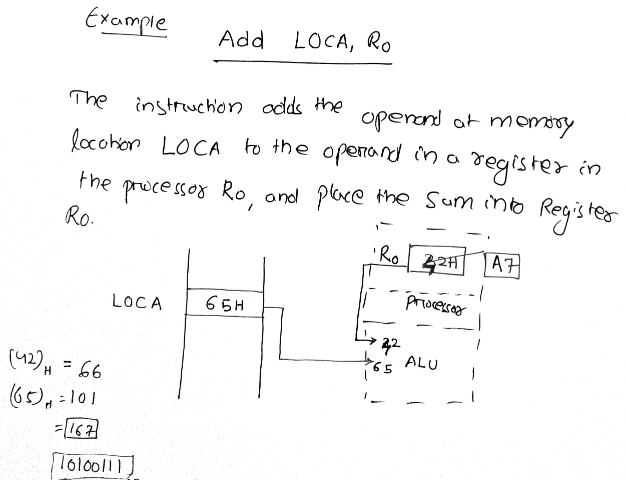
Example 

The instruction reined the several steps

1) The instruction is fetched from the memory into the processor.

2)Then operand at LOCA is fetched and added to the content of RO.

3)Resulting Sum is stored in RO.

→ The Add instruction comling a memory access operation with an ALU operation

Henceforth these two types of operation are performed by separate instruction for performance Reasons 

               Load LOCA, R₁   ; LOCA→R₁

               ADD R, Ro          ; R₁+Ro→Ro

1)The First instruction transfer the contents of memory location LOCA into processor Register R₁ 

2)The second instruction add  Ro & R₁ content and place the sum at Ro.

* Transfer between memory and the processor are sorted by sending the address of the memory location to be accessed to the memory unit and issuing appropriate control signals. Then data transfers from memory

WHAT DOES IT TAKE TO BUILD A CAREER IN AI?

“Artificial intelligence !” a new lucrative field in which many peeps wanna dive in and why not coz it is not just restricted to the computer science world but finance law industries etc . we are now living in a time where we have chatbots listening to our instruction doing as said, solving problems and looking for loopholes in a system the data better and faster than us. and it’s just starting AI and machine learning is going to grow more and more as time goes. With this huge need for AI experts, in all these fields will also come. Artificial intelligence isn’t just a fad. It’s here to stay! 

that’s why many interesting learners want to make a career in this AI field, here the very vital question arises as what does it take to build a career in AI?

Scientific-brain!

As AI is highly scientific, the primary attempt of AI is to make it work the same as humans( or better in some cases) it requires the person to have quite a lot of knowledge, training, and cognitive skill! A huge learning curve is there to understand to make suitable and best-approximated outcomes. Which requires years of learning and practice. like researchers and scientists.

Mathematical thinking

A huge need for mathematical ability is needed to make a career in AI. Fields like statistics, probability, predictions, calculus, algebra, Bayesian algorithms, and logic are going to be primary tools for you in your arsenals. With maths, you are also going to need some science knowledge such as mechanics, cognitive learning theory, language processing, and computer science skills that a mathematical thinker must have


A quip in Tesler’s Theorem says “AI is whatever hasn’t been done yet”

highly critical thinking

Being rational with the approach is very necessary as you go ahead you find yourself making choices that need to be based on critical thinking. nothing will be important at face value. huge experiments and failures will happen, and decisions would be based on results only! critical thinkers in normal day-to-day life are considered to be very smart and hard nuts! That’s what we search for in a field with many challenges.

Naturally curious

Working in AI field is unlike any other field where you faces similar problems which have to be solved with an already existing solution or where you exactly know what and why you doing and what will likely to happen but here it AI its just changes altogether as this field is about uncovering the unknown and exploring like a captain of a ship in this huge sea of unknown. What we can know or figure out with this technology is still a few drops. we have yet to reach the primary mission of us humans “ to make an artificial intelligence like the human brain. In this journey, we need curious peeps who love to think out of the box and think curiously

Loves challenges

Field with multiple failures and a huge need to push boundaries makes it really hard digestible tea for many. but if you have that willpower and love challenges in life! then this is your thing for sure. finding ways to do the same thing with different approaches, again and again, and again! Taking a huge toll of work on yourself and pushing yourself to reach deadlines! If you have these skills then this is it

No doubts AI is the future! and a career in this field is also very exciting and challenging! It gives everything that a person asks for!


pls let me know what you think in comment section and share ! :), sayonara!

Computer Organization and Architecture(COA)

The computer organisation and architecture (COA) course is one of the most essential and comprehensive subjects since it contains many basic concepts and information required in the design of a computer system.

The COA is also the most essential component of the syllabus for all computer science degrees at all institutions, as well as for many competitive tests.This lesson is specifically created for absolute novices to understand all important subjects connected to computer organisation and architecture. All fundamental concepts such as computer system functional units, processor, microarchitecture, programme instructions, instruction formats, addressing modes, instruction pipelining, memory organisation, instruction cycle, interrupts, and other important related topics are covered in the COA important topics.

Computer Architecture 

Let us first define architecture in order to comprehend the phrase computer architecture. Architecture is described as the art and science of designing a thing. Because the building is one of the most frequent objects in the human world, we typically associate the term architecture with it. The architecture aids in the definition of functional, physical, and performance criteria for any item.

Every item in the actual world is supported by some form of architecture. An architect, for example, will define the building in terms of architectural drawings and specifications for various construction components.Similarly, the system architecture specifies the computer system’s numerous functional components and how these units are linked. It specifies the performance parameters for the system and what the system should achieve in terms of performance.

The computer architecture is a high level design specification that does not specify details of the hardware components. The computer architecture gives an abstracted view of the structure of various functional units and its behaviour. In order to build a computer system, the first step is to design and develop the system architecture. The next step in the process is to finalize the computer organization details.

Computer Organization 

Let us first define the term “organisation” in the context of computers. The term organisation is defined as organising and categorising things rationally in order to enhance practical convenience.

Computer architecture serves as the foundation for computer organisation. The system architecture is implemented by the computer organisation. Simply defined, the computer organisation is concerned with arranging various system hardware components and how these components are interrelated. The computer organisation describes the numerous hardware components associated with the various functional units found in the system.

The computer organisation is concerned with the layout of various system hardware components as well as the function of the components. The presence of distinct functional units and their components is defined by computer organisation. It also specifies how distinct functional components interact with one another.The structure and behaviour of digital computers are defined by computer organisation. The primary goal of the computer organisation is to comprehend the various computer hardware components and their interactions.

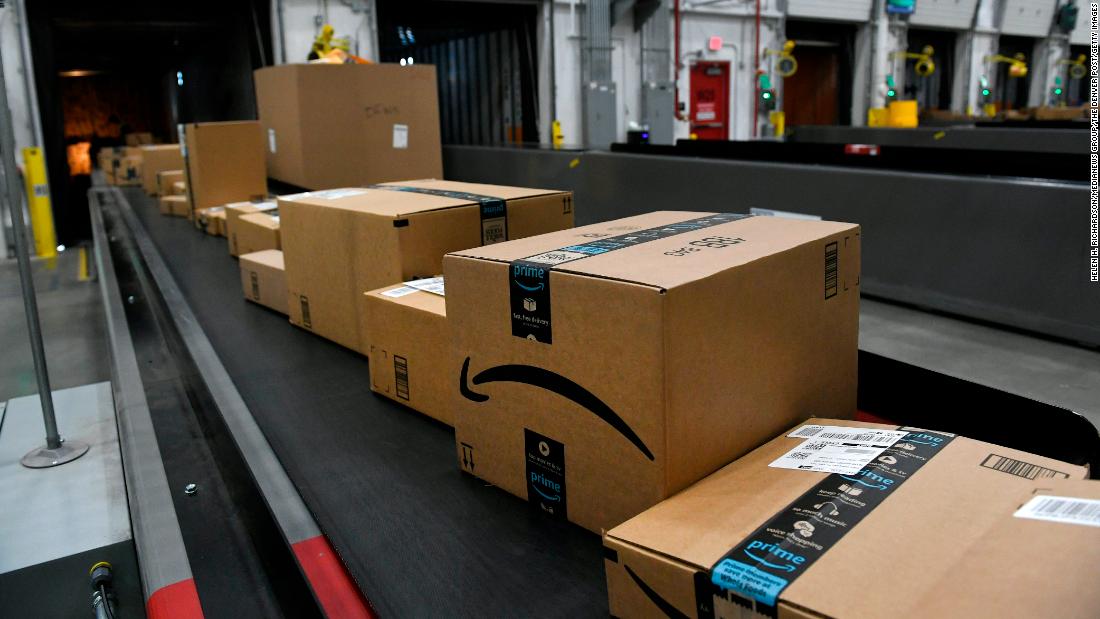
Who delivers the Amazon cardboard boxes???

Cardboard boxes that have been used for generations and thrived in the age of e-commerce continue to flourish or could the cardboard box be facing a new challenger? Cardboard boxes are a very big deal within the U.S. The United States is the Saudi Arabia of trees. Someone’s going to make the first box and that’s almost inevitably a mill generally in the Southeast United States. China certainly doesn’t have trees and India the extent they do have trees they’re not necessarily the right types of trees and shouldn’t be dedicated towards making boxes for us. The box business grew rapidly up through 1999 when the U.S. coordinated box market had its peak shipment. Starting in the early 2000s the U.S. corrugated box market faced multiple economic obstacles.

The great recession dragged on box demand and even after the recession demand continued to slow for commodity like soda and for the boxes that transport them. The move to digital devices also coincided with a drop in demand for copy paper and newsprint. But box makers found a grace in e-commerce sales and Amazon sale specifically which were growing at mostly integer rates within the recession and post-recession years. Those e-commerce sales have become a significant market for the containerboard industry. In 2018 told a U.S. e-commerce sales were estimated to be $512 billion almost 50 percent higher than in 2015. Amazon captured 48 percent of those sales. Most estimates are that e-commerce accounts for about 10 percent of the U.S. box market. Amazon accounts for close to 5 percent of U.S. box demand. By our estimates they are clearly the single largest box user in the US. International Paper with a third of the market I think does closer to 50 percent of all the amazon boxes evidently they got a bit more share than perhaps some of the smaller players.

Amazon's incredible, vanishing cardboard box - CNN

Amazon said they deal with most of the big box makers across the U.S. according to analysts. Those manufacturers include International Paper, WestRock, Packaging Corporation of America and Georgia-Pacific. Some investors were turning to these companies as a way to invest in the e-commerce giant without having to purchase Amazon’s pricey stock. People didn’t really start talking about buying International Paper or WestRock as a secondary investment in Amazon till about the last five years. Despite the boost from e-commerce sales the box business still isn’t growing all that much. And since 2018 their stocks have mostly underperformed the S&P 500. In 2018, 69 percent of International Papers total revenue came from the box business and that sales volume has been mostly flat for the past five years. Although the big producers sold less boxes in 2018 than in 2000, industry consolidation has dramatically narrowed the fields.

The handful of big players remaining are based in Memphis, Tennessee, Atlanta, Georgia and Lake Forest, Illinois. Analysts have told CNBC that substantial industry mergers have made it easier to collectively hike prices and those price increases have helped drive revenue. There are portions of the business that are in indisputable secular decline but if you’re in the brown part of the business, making these boxes, that’s been some very welcome growth. But those extra boxes piling up on people’s doorsteps have led to a backlash from disgruntled customers who are sick of receiving golf ball sized products in supersized boxes. It used to be that you’d order a toothbrush and it would come in three giant boxes and you’d say to yourself, what is this? Well, Amazon is trying to rectify that by using fewer boxes and using other types of packaging where appropriate. With e-commerce packaging underfire Amazon decided to change the way they do shipping. In 2008, Amazon introduced the Frustration Free Packaging program. It aims to reduce the extra packaging created when retail packaged products are placed inside Amazon boxes to be shipped. Instead, products certified in the program that are roughly the size of a blender or larger need to be packaged in their own ready to ship boxes. And those boxes also need to be made of 100 percent recyclable materials. For customers that means that the packaging is easy to recycle and the box is easy to open without all the excess packaging materials.

Use That Pile of Empty Amazon Boxes to Do Something Wonderful ...

Amazon offered vendors an incentive of a dollar per shipment to modify their packaging. And starting August 1st 2019 Amazon is charging a $1.99 penalty for each product shipped that needs to be reboxed. And basically the point of this deadline is for Amazon to get out of the business of packaging. They want their vendors to send them boxes that Amazon doesn’t have to touch or rebox. Over the last two years we have invented two different kinds of flexible mailers. One is the blue and white all plastic mailer. We’ve recently launched in the last six, eight months a paper padded mailer that’s actually fully recyclable with the paper stream. Amazon said they made about 10 million shipments using the paper padded mailer and depending on the month the plastic mailer is used about 20 to 30 percent of the time. So really when we come down to deciding if the product is of the size it can go on a mailer, it’s not likely to be damaged by going in the mailer, the mailer is always the better fitting option and frankly is easier for the customer to choose to recycle than breaking down a corrugate box. We’re driving in that direction for many different reasons. But those plastic mailers generally are not accepted in municipal recycling programs and you’ll need to bring them to a store that accepts plastic bags. The latest stats from the EPA show that corrugated boxes were recycled at a rate of 92 percent in 2015 while plastic bags, sacks and wraps were recycled at a rate of 13 percent in 2015.

AMAZON E-COMMERCE SELLERS, IT'S TIME TO REVIEW YOUR ADVERTISING ...

When you think about what is the greatest pain point for the consumer after having it get there safely arrive on time people are concerned about receiving something that is plastic or made a poly because of the environmental concerns. Some waste management companies say plastic packaging also causes problems for the recycling systems. Plastic mailers get caught in the recycling machinery slowing down the process and raising the costs for recyclers and sometimes contaminating entire bundles. Until Scotty on the Enterprise can beam the products from the warehouse to your living room I think Amazon’s going to be good for the corrugated business. I think there’s going to be noise I think you’re going to have challenges from time to time where people say, “Should we try and the plastic pouch?”, in the long run plastic is going to be on the wrong side of history. Because Amazon is a market leader in the U.S. e-commerce sector any move away from cardboard to plastic mailers could signal a shift for the entire industry. The corrugated box could be about to undergo a major facelift. We’re seeing some major trends among consumers and what they’re expecting from e-commerce and the first one is actually this desire for increased engagement with the package. In 2015, Amazon partnered with Universal Pictures and Illumination Entertainment to ship orders in bright yellow delivery boxes featuring cartoon characters from the movie Minions. The boxes promoting the movie and a special Amazon U.R.L. dedicated to shopping for merchandise from the film.

U.S. Defense Economy…

The police, obviously, they’re not in the business of of profiting from private acquisitions. We’ve seen extensive lobbying from defense industries who produce educational videos for police who were spending hundreds of millions of dollars to directly lobby Congress for defense spending, but also for these police programs. The police also have their own lobbying organizations that work toward security budgets and equipment for local law enforcement. The National Fraternal Order of Police is one of them and has lobbied in favor of federal grants that are responsible for the militarization of police. It’s really a variety of Homeland Security grants administered by the cops office, the home, the Department of Homeland Security, etc., that have allowed departments to directly purchase military grade equipment. And this has been essential to stimulating a domestic law enforcement market for military contractors. In some cases, the folks who provide the equipment actually directly assist police departments in making these grants. There’s even a Web site that is sponsored by these defense contractors and other providers of police equipment to aid departments in the production of these grant proposals. This whole industry grew significantly during the War on Drugs campaign in the 1970s.

Iranian threats 'put on hold', says US defence chief - BBC News
Congress passed a law that focused on incorporating cooperation between the military and the local law enforcement, particularly related to countering drug crimes and the war on drugs. Right. That was sort of the first connection between the military and domestic law enforcement. In 1989, Congress passed the National Defense Authorization Act, temporarily allowing the Department of Defense to transfer excess military equipment to federal and state agencies. The program continued until the 1997 National Defense Authorization Act expanded it to include local law enforcement and made it permanent under a new name. The 1033 program that began a massive transfer of military equipment to local police departments free of charge as long as they paid for shipping and maintenance. That 1033 program was the congressional authorization that allowed police departments to basically go online. There were catalogs of of weapons and vehicles and aircraft and watercraft and any kind of military surplus military equipment was available for the asking. And it was at no cost to law enforcement agencies.

Military budget - Wikipedia
Departments may purchase shotguns that are placed in police vehicles as a routine matter, and some departments are purchasing a variety of less lethal weaponry with their own resources. But when we see sniper equipment, armored vehicles, large amounts of body armor, this is often the result of federal spending. Since its inception, over 11,500 domestic law enforcement agencies have taken part in the ten thirty three program, receiving more than 7.4 billion dollars in military equipment. What you end up seeing is as a result of the 1033 program, local law enforcements continue to ramp up what we call special task force, like SWAT teams, gang task force, drug task force. Right. That all utilize this excess military material. In July 2014, Congressman Alan Grayson proposed that legislation to limit the transfer of certain weapons through the 1033 program. The amendment was met with immense opposition failing on a bipartisan vote of 62 to 355.
The people who voted not to change the 1033 program received 70 percent more money in campaign contributions from the defense sector than those who wanted restrictions. One of the really troubling developments about the involvement of the federal within the direct subsidy of purchases of militarized equipment is that this is often really about creating a new marketplace for defense contractors instead of really putting questions of public safety first. Besides providing free military equipment, the federal government also allows the police to purchase new equipment using their own funds. Under the 1122 program, it also gives local police departments the same discounts enjoyed by the federal government. We’ve seen instances across the country where local governing bodies, like boards of selectmen and mayors and city councilors are often unaware that tax dollars have been expended to acquire these kinds of military weapons and military vehicles. What makes both 1033 and 1122 programs so powerful is the lack of clear oversight and accountability.

Trump says 'revved up' economy will fund $54bn rise in military ...
The 1122 program, as an example , isn’t a grant or transfer program and thus isn’t required to be monitored by the federal . Meanwhile, the 1033 program has put lethal weapons within the hands of officers who haven’t any justifiable need for such equipment. We’ve seen instances reported of some small towns, even some college and university police departments that were acquiring military grade weapons with none demonstrable need for the utilization of these or the acquisition of these weapons. After the events in Ferguson, the Obama administration sought to tighten the 1033 program with additional requirements and restrictions after months of confrontations on America’s streets. President Obama today banned the federal government from giving some types of military equipment to local police. We’ve seen how militarized gear can sometimes give people a sense like there’s an occupying force as against a force that’s a part of the community that’s protecting them and serving them. And this led to calls in Congress to eliminate 1033 and eventually measure an executive order by the Obama administration to place some limits on the type of equipment that could be used, things like bayonets and turreted armored vehicles.
The Obama administration also required police agencies to justify purchases of equipment considered potentially lethal. President Trump, however, rescinded all of those measures within two years in office. Obama administration made some efforts to increase accountability in auditing of this. But even then, the restrictions and oversight were quite limited. Under the Trump administration, there’s even less evidence of any oversight. Any sense that we know how this equipment is being used or whether or not officers are being properly trained and how to use it. In some cases, equipment transfer through these programs has simply vanished due to a lack of oversight and poor bookkeeping.

Maximising the economic benefit of Australia's defence projects ...

There’ve been a number of situations where there have been audits of local police departments to try to figure out what they’ve done with this equipment. And these departments have been unable to provide adequate records. We don’t know if this is a local sheriff taking home camping supplies or if this is about, you know, stuff that’s really gone missing, has been resold or has just simply been lost. Oftentimes, the militarization of the police force might be what’s distracting them from their original purpose, protecting our communities.

Why economy of India is slowing down???

India is one among the world’s fasting growing economies. It had been touted as an economic and geopolitical counterweight to China. But recently its growth fell to its slowest pace in six years. Investment has weakened, and unemployment has risen. So what’s causing the slowdown, and how can it be reversed? Since the turn of the century, India’s economy has grown at a rapid rate, helping transform the country. Between 2006 and 2016, rising incomes lifted 271 million people out of poverty, meaning the proportion of Indians still living in poverty has fallen dramatically, from around 55% to twenty-eight . Access to electricity has also improved. In 2007 just 70% of the population had access to power. By 2017, that grew to nearly 93%.

India's economic growth likely to remain subdued in near future ...
More recently, the Indian government constructed around 110 million toilets — a huge step towards better sanitation designed to prevent the practice of open defecation. It’s a signature program of Prime Minister Narendra Modi, known as Swachh Bharat, or Clean India. All this development has been supported by a booming economy, but as lately , that expansion has begun to run out of steam. In the third quarter of 2019, India’s economic output grew by 4.5% – making it the primary time the country’s growth dipped below 5% since 2013. For context, 4.5% growth remains much above that of developed economies just like the U.S., But with 12 million Indians entering the workforce per annum , economists say the country needs annual growth rates to remain above nine percent to make sure there are enough jobs. So, what’s causing this recent slowdown? Well, officialdom argue turbulence in international financial markets is guilty.

Economy News, Latest economy news India, Indian Economy features ...
Political uncertainty and U.S.-China trade tensions mean confidence levels among investors and consumers everywhere have sunk. The United Nations has even warned that a global recession in 2020 is now a “clear and present danger”. But back to India – many economists say the country’s growth problems are literally self-inflicted. One obvious culprit is the shadow banking sector. During the 2000s, India saw an investment boom. It was fuelled by state banks dispensing a load of loans for giant infrastructure projects. But some of the companies taking advantage of these loans couldn’t keep up with the repayments. That meant the state banks weren’t getting paid back and therefore struggled to give out new loans. To keep business moving, shadow banks stepped in. These financial institutions, which operate like ordinary commercial banks but don’t follow traditional banking rules, eventually made up an estimated third of all new loans nationwide. The loans played a pivotal role for the millions of small businesses and consumers who would otherwise have no access to credit. But in 2018, shadow banking giant Infrastructure Leasing & Financial Services, defaulted on its debt repayments. Its collapse sent shockwaves through the economy and shook up more traditional banks that had supported the world.
It became harder for people to shop for expensive items like cars. That hurt India’s automotive industry, which is one among the country’s biggest. It employs about 35 million people and makes up about 7% of India’s GDP. Last summer, the industry suffered its worst sales performance in nearly 19 years, and reports suggest tens of thousands of workers are laid off. The agriculture and construction sectors have also been hurting, with small and medium businesses being hit the hardest. The country’s percentage has been on an overall upward trend since July 2017, rising several percentage points to 7.7%. Higher unemployment means consumers are buying less, resulting in the unfortunate cycle of slower manufacturing, production, investment and job creation.

Indian Economy Will Face Adverse Affects Of Coronavirus Gdp To ...
A survey from the Reserve Bank of India found consumer confidence has fallen to its lowest level in five years. But Indians still have a positive outlook for the longer term , with most consumers expecting to feel more optimistic during a year. However, if things don’t improve, debt could become another issue. Expecting better days ahead, many households have continued to spend, by taking out loans and dipping into savings. Household savings as a proportion of GDP has fallen from 23.6% to 17.2%. Meanwhile, household debt has surged to 10.9% during the same period. Critics say the govt in New Delhi has did not spot these risks and hasn’t done enough to urge the economy moving again. The Reserve Bank of India’s former governor Raghuram Rajan recently blamed the lack of significant reforms and a slowdown in investments since the global financial crisis. Even the country’s chief economic advisor recently admitted reforms are needed to form India more friendly to investors.
India has cut its corporate rate , but labor and land laws are still extremely strict. He also says the country must become pro-market, instead of just pro-business, to avoid costly government bailouts of failing sectors. But not all reforms have been good to the economy. In 2016, Prime Minister Modi tried to crack down on corruption, counterfeits and evasion by banning high value bank notes. In one night, the cash ban made 86% of all cash invalid. Three years later, many analysts say the policy disrupted the economy and did not achieve many of its original goals. In 2017, a replacement nuisance tax placed small businesses struggling and a few of them were forced to shut . In mid-2019, India’s government introduced a controversial new tax on foreign investors. Consequently, India’s stock exchange suffered its worst July performance in 17 years. Just one month later, the measure was scrapped.
The government has now refocused its efforts on international trade and investment, and thus the recent changes to the corporate rate could indeed help attract businesses and investors to India. But if the country wants to be a part of the world’s largest supply chains, it’ll need low and consistent tariff levels to encourage outsiders to take a position for the long term.

The country’s shifting export policy has harmed several of its largest industries, particularly clothing. India’s share of the worldwide apparel market has increased only slightly within the past 20 years. And though the Indian workforce is vast, both Bangladesh and Vietnam now export more. On top of that, the country’s import tariffs on the average are much above the world’s biggest economies. They’re also among the highest of the world’s emerging economies. Even U.S. President Donald Trump has called for the country to bring down its duties.

Has India’s growth actually slowed the maximum amount as we think? The government’s former chief economic advisor Arvind Subramanian caused a good little bit of controversy in June 2019, when he claimed the country’s official stats probably overstated GDP growth by 2.5% from 2011-2012 to 2016-2017. He says the bottom line is that India never recovered from the global financial crisis. The government denies this. But none of this has hurt Prime Minister Modi at the polls – he won by a landslide in the most recent election. So how will he keep his promise and double the dimensions of the economy by 2025? Many economists insist a well-explained economic vision would help. As would more long-term investment, better skilled workers and enhancements to infrastructure. It may not matter who or what’s responsible for India’s recent economic challenges, but bottom line – India’s economic process must recover , and fast.

How IPL is making millions & billions of dollors in every single match!!!

Cricket it’s a sport that dates back over 400 years. And as of 2019 is officially played in 104 countries around the world. Cricket’s worldwide fan base is comprised of roughly one billion people in the Indian subcontinent alone makes up 90 percent of those fans. In India, the country adopted a brand new shorter format of the game has drastically cut down on playing time from days to hours. The Indian Premier League or the IPL has only been around for twelve years but it’s fast become one of the most popular and valuable cricket leagues on the planet. The IPL is brand value has nearly doubled in the last five years. In 2018 the league was valued at 6.3 billion dollars. It rakes in and 510 million dollars each year from its broadcasting rights deal making it to only cricket league in the world to crack the top 20 most valuable media rights deals in all of professional sports joining the ranks of the NFL the NBA and MLB.

Future of India vs Pakistan cricket matches - CoA chief Vinod Rai ...

So how did the IPL become one the most lucrative cricket leagues on the planet. In India. Cricket is huge. It’s been a staple in Indian sports since the seventeen hundreds. It’s currently the most popular sport in the country. The IPL is one of the richest sports properties in the world. And while the IPL isn’t the only cricket league in India it is the most successful league in the country. The 48 day annual tournament was created in 2007 with the help of the Board of Control for Cricket in India and Indian businessmen Lalit Modi. Even though cricket already had a few pro cricket leagues they wanted to capitalize on the commercial success of 2020. So they modeled the IPL in a similar nature to pro sports in the US.

The IPL was specifically modeled after the likes of the NFL. Which has a decentralized league. meaning that all teams are owned and operated independently. Also similar to the NFL model the IPL is its own league with its own unique structure. There is a separate T20 World Cup where India competes. But that’s different from the IPL. even though matches are all held in India. Team rosters are chock full of top international talent. In 2018, teams spent 94 million dollars to buy 169 players in an auction. up from its 40 million dollars for 66 players in 2017. But what you’ve actually got in the IPL franchises who represent a city a place an industrial heartland and you’ve got the full support of some major entrepreneurs. So rather than let’s say Delhi again. So, you’ve got your IPL franchises based around the cities. I’m not as actually have a massive impact. in terms of global cricket. To make sure the stands are filled with as many IPL fans as possible and to maximize TV viewership. Matches are typically played in the evening and on weekends.

The IPL is a huge moneymaker in India since 2014. The IPL brand valuation has doubled to six point three billion dollars. The reason the IPL has won the largest fan base is for a single sports league in the world. During its opening week of the 2013 season the IPL broke records when 371 million viewers tuned in to watch and by the last week of the tournament a total of 769 million fans watched the 2013 IPL season. The ad revenue generated for that season was over 276 million dollars according to Star India’s managing director. High ratings and ad dollars were a big part of why a major U.S. media companies had their eyes on IPL broadcasting rights. When the IPL launched in 2008. The league issued being your rights to Singapore based sports marketing agency World Sport group. They broadcast an IPO matches on India’s Sony Max TV channel. Under the terms of the 10 year contract World Sport group paid the IPL approximately 1 million dollars per match in its first year for the exclusive broadcasting rights. The overall value of that broadcasting deal was 918 million dollars when the broadcasting deal expired in 2017.

IPL 2020 Team Previews | Indian Premier League | Wisden Cricket

There was a global bidding war for exclusive rights for the IPL. Fox and Sony put in competing bids while Facebook also put its hat in the ring for the 2018-2022 digital rights of the IPL making a 600 million dollar offer. Those TV and digital rights eventually went to Fox the American broadcasters struck a five year 2.5 five billion dollar deal for the global media rights of the IPL. The price per match jumped from 1 million dollars to about 8.47 million dollars per game. For comparison the NFL cost per game is around 22.5 million dollars. The English Premier League is around 13.2 million dollars. The NBA is close to 2 million dollars and the MLB is just 630 thousand dollars per game. Just two years after the ink dried on the Fox IPL deal Disney completed a 71 billion dollar deal for Fox entertainment assets one of the assets that Disney now owns is hot star. The Indian video streaming company in 2019. Streaming service at a global record for the number of people tuning into a life streaming event.

There are 18.6 concurrent viewers watching the IPL final match on the hot star’s website in app. And with that kind of viewership naming rights for the IPL are also huge for the league. Since 2008 the IPO naming rights have changed hands three times from brands DLF to PepsiCo India and finally to Vivo a mobile handset manufacturer in China. Vivo first took over title sponsorship in 2015 and in 2017 Vivo signed a fresh five year deal with the IPL worth approximately 341 million dollars in 2018. The average salary of cricket players in the IPL jumped nearly 30 percent from the year before. All thanks to the massive TV deal signed with Fox in 2017. Before the deal, players across the league had an average salary of 3.9 million dollars but in 2018 the average salary was just over 5 million dollars. And unlike other major sports leagues the IPL season is so short that players have a chance to bank even more cash in the off season.

iplt20.com | UserLogos.org

The IPL takes place in the spring starting at the end of March or early April and continuing through May. That means cricketers have the flexibility to play for other clubs around the world. Take the Mumbai Indians player Kieran Pollard. In 2017 he and more than one million dollars for two months. They play for the Mumbai Indians and IPL in that same year. Pollard had multiple revenue streams from playing for cricket leagues in Australia Bangladesh and South Africa. But just as cricket first spread across the world in the 18th century cricket’s latest form of 2020. Similarly. Taking root across the globe. There’s even a record breaking investment for 2020 league in a country where cricket is even remotely popular, the U.S. In May, 2019, USA Cricket received a 1 billion dollar investment from American cricket enterprises to develop a 2020 league in America. It’s one of the biggest deals for development of domestic cricket in the US and the launch of the league is set to take off in 2021 since the 2020 cricket format was introduced in 2003 and has taken the cricket world by storm. And it doesn’t seem to be slowing down anytime soon.

Coronavirus Scare: No spectators in stadiums for IPL 2020 matches ...

Will Oil Price go down???

America does rely on oil in many ways. It’s about 90 percent of the energy that we use in transportation. And it’s more than a third of the overall energy that we use. In fact, it’s probably going to stay that way for a lot, a lot longer. The Energy Information Agency administration predicts that going out to 2050 is still going to over a third of the energy that we’re going to use. So how was it possible for oil to reach a negative value and what does it mean for the American economy? To understand what happened, it’s important to know how a futures contract functions. So the futures market is a way to bet on the future price of a certain commodity.

Oil Price Fundamental Daily Forecast – Pressured by Renewed ...

Different types of oil from all across the world are traded by barrels in their individual market places. But two futures contracts serve as the major benchmark for oil price. Brent Crude trades oil from the North Sea in northern Europe, setting the standard for international oil prices. While the West Texas Intermediate, or WTI, trades a specific grade of oil traded in Cushing, Oklahoma, that serves as a domestic benchmark for oil prices. A refinery might have a contract with a producer and say, we will pay you that Brent price or we’ll pay you the Brent price minus the transportation costs. Or you know that it’s all subject to negotiation. And those two are well known. It’s a shorthand, if you will. And a lot of times other crudes are priced off of those crudes because they’re well, known the quality is high and has a long track record. Similar to most treated commodities, oil prices rely heavily on how much of it is available on the market. In other words, supply and demand. Oil like just about anything else in the world is determined that prices are determined by a willing buyer and a willing seller. And so that means that as demand goes up, more people are buying it.

The price will typically go up, supply stays the same and vice versa. If supply suddenly increases, then then typically the price will go down if the demand stays the same. The demand is determined by how much oil is needed at any given moment due to its crucial role in the economy. High demand has often been associated with a healthy economic growth. Historically, oil demand has moved with the economy of a country. It’s been very tightly tied because almost all transportation comes from burning oil and a lot of other industrial processes use oil. So when the economy is humming along strongly, the demand goes up. And when you have a recession, the demand goes down. On the other hand, supply is usually determined by the producers who have control over its output. Historically, the Organization of Petroleum Exporting Countries, otherwise known as OPEC, has played a crucial role in determining the supply. OPEC currently has 13 member countries, including Iran, Iraq, Kuwait, Saudi Arabia and Venezuela as founding members. However, a lot has changed in recent years as the U.S. surpassed both Russia and Saudi Arabia to become the world’s largest crude oil producer since 2018. Thanks to the rise in production from American shale fields. Essentially these countries and OPEC, everyone is competing for market share.

Oil prices inch higher on output cut support, but US coronavirus ...

Everyone wants to produce more for their country, but also the optionality to export it to another country and especially growth regions such as China, Asia. Being an investor or a producer in the oil industry means keeping an eye on this fine balance between supply and demand, as well as the geopolitical events that could threaten the industry. Never forget about geopolitics and the impact it can have on the oil price, because that can be that X factor of why oil may have a big premium or a big discount to fundamentals that you see supply and demand. It’s because geopolitics introduces other risk factors. A historic drop occurred on April 20th, 2020, with U.S. oil prices on WTI dropped by almost 300 percent. Trading around negative 37 dollars. What happened with oil in terms of the negative pricing in April with the futures contracts was rather unprecedented. We have seen negative prices before. For example, last year we were talking about negative natural gas prices and Waha in April 2019. But that’s more due to processing or field issues, not what is happened specifically this time with the COVID 19 and in the price war. Oil prices had been under pressure since January as China battled the spread of COVID 19.

When the pandemic finally reached the rest of the world, demand took a devastating hit. People started talking about the demand going down 2 or 3 percent instead of growing by 1 or 2 percent, as was had previously been expected. But then by the time it got to the United States and all over Western Europe, the forecasts were very different. And at the trough, we probably saw demand in April bottom out, down 30 percent. So we’ve never seen anything like this, certainly in the last 40 years since world oil markets have developed. To make matters worse, a price war erupted between Saudi Arabia and Russia in early March after OPEC and its allies failed to reach an agreement on deeper supply cuts. Oil saw its worst trading day in 20, 29 years. Yesterday, both WTI crude and Brent crude lost nearly a quarter of their value, and the S&P energy sector ended the day 50 percent off its 52 week closing high. Saudi Arabia launched a price war against other key producers. As supply remains steady while demand struck record breaking lows. The petroleum industry quickly began running out of storage space to put their oil. Cushing plays a very big role as one of the main hubs of that commercial storage. And Cushing at the time of the negative contract was around 70, 70 percent full, and what was left was perhaps already committed. So that was a huge issue because Cushing plays one of the main roles in pricing the WTI contracts. As the delivery date for WTI grew near. And investors had nowhere to put the oil. They soon began a massive sell off, prompting an unprecedented crash into the negative territory. WTI special in a way, because it’s so tightly connected to physical oil. And so if you’re holding a contract for WTI, you’re expected to take possession of oil.

Oil prices spike above $30 for first time in over a month | Fox ...

What was happening was the buyers who had bought a futures contract, which meant they had responsibility to take delivery of the oil, recognized that that storage was filling up and they had no place to put the oil and they didn’t want the oil. And so they wanted to get out of the contract. Usually they can get out of the contract by getting somebody else to take the oil instead at a positive price. Cause oil’s a valuable commodity. But there was nobody who wanted to take that oil, particularly because it was located in an area that was producing way more oil than they needed. And the pipelines to move oil out of that area were completely full. The historic drop quickly sent shockwaves through the U.S. financial market. The Dow plunged by over 1,200 points over the following two days, and brokerage firms like interactive brokers reported taking 109 million dollar hit to cover its customers losses. It was kind of like what happened in 2000 where we we’re wondering if the computers could roll over. Some of the traders computers couldn’t even handle the negative. They weren’t set up for a negative. So you can imagine the disarray and the surprise, you know, that some traders faced the next morning when they looked at their margin calls or what they owed based on the severity of this drop.

However, experts point out that although the event was unexpected, there was no need to panic. It was not unforeseen. The exchange itself saw it as a possibility ahead of time. They actually discussed what to do if that were to happen, reprogram their software and so forth. And at least one major media outlet reported on it a week ahead of time before it happened. Also, some other products have gone negative in the past. Things like natural gas. So I think it’s important to put it in perspective that while this had never happened with oil before, it was just on one particular instrument. The WTI was just for one day and it was seen as at least a remote possibility ahead of time that it happened. It was very few contracts. There was very little trading at those prices and the price very quickly rebounded into positive territory.

Indian economy to benefit from slump in international oil prices ...