In a rapidly changing world, creativity and curiosity are crucial skills for young minds. These traits not only enhance learning but also equip children with the tools they need to thrive in an unpredictable future. By fostering an environment that nurtures these qualities, we can help unlock each child’s potential and prepare them for lifelong success.
Creativity is more than just artistic expression. It encompasses problem-solving, critical thinking, and the ability to see things from different perspectives. Encouraging creativity in children helps them adapt to new situations and challenges, enhancing their ability to innovate and think independently.
Curiosity as a Catalyst for Learning
Curiosity is the driving force behind exploration and discovery. When children are curious, they are motivated to learn and seek answers. This intrinsic motivation leads to deeper understanding and retention of knowledge, making curiosity a vital component of effective learning.
Creating a Stimulating Environment
To nurture creativity and curiosity, it’s essential to create an environment rich with opportunities for exploration. This includes providing diverse materials and experiences that spark interest and encourage experimentation. A variety of art supplies, building blocks, and open-ended play items can inspire imaginative play and critical thinking.
Encouraging Open-Ended Questions
One of the most effective ways to nurture curiosity is by asking open-ended questions. These types of questions prompt children to think deeply and express their ideas, fostering a sense of wonder and exploration. Instead of asking yes-or-no questions, encourage children to explain their reasoning and expand on their thoughts.
The Role of Play in Creative Development
Play is a powerful tool for nurturing creativity and curiosity. Through play, children learn to experiment, take risks, and solve problems. Whether it’s building a fort or pretending to be a superhero, play allows children to explore their environment and discover new ideas in a fun and engaging way.
Incorporating Art and Music
Art and music are integral to fostering creativity in young minds. These mediums allow children to express themselves freely and explore different emotions and ideas. Encouraging children to draw, paint, or play an instrument can enhance their creative thinking and provide a valuable outlet for self-expression.
Encouraging Outdoor Exploration
Nature is a rich source of inspiration and discovery for young minds. Time spent outdoors helps children develop their senses and observe the world around them. Encourage activities like nature walks, gardening, and outdoor games to spark curiosity and connect children with the natural environment.
Storytelling and Imagination
Storytelling is a powerful tool for nurturing creativity and curiosity. When children hear stories, they create vivid images in their minds and explore different scenarios. Encourage children to tell their own stories, helping them develop their imagination and communication skills.
Supporting Risk-Taking and Failure
A key aspect of nurturing creativity is allowing children to take risks and learn from their mistakes. By creating a safe environment where failure is viewed as a learning opportunity, children become more willing to experiment and try new things. This mindset fosters resilience and encourages innovation.
Fostering a Growth Mindset
Teaching children to adopt a growth mindset is crucial for nurturing creativity and curiosity. When children believe that their abilities can improve with effort and persistence, they are more likely to pursue challenges and learn from setbacks. Encourage children to view obstacles as opportunities for growth and exploration.
Encouraging Collaboration and Teamwork
Working with others can enhance creative thinking and problem-solving skills. Encourage children to collaborate on projects and activities, promoting teamwork and communication. This collaborative approach helps children learn from different perspectives and develop a sense of shared accomplishment.
Conclusion
Nurturing creativity and curiosity in young minds is essential for their development and future success. By providing a supportive and stimulating environment, encouraging exploration and play, and fostering a growth mindset, we can help children reach their full potential. Whether it’s through art, storytelling, or outdoor activities, every experience contributes to a child’s learning journey. For parents in the daycare in West Jordan, these practices can be particularly beneficial, providing a foundation for creativity and curiosity that will last a lifetime.
A microphone is a device that translates sound vibrations in the air into electronic signals and scribes them to a recording medium or over a loudspeaker. Microphones enable many types of audio recording devices for purposes including communications of many kinds, as well as music vocals, speech and sound recording.
Types Of Microphone
There are three main types microphones based on construction -:
A microphone in which the sound waves cause a movable wire or coil to vibrate in a magnetic field and thus induce a current.
Key Advantages -:
1. Rugged and able to handle high sound pressure levels, like those delivered by a kick drum. 2. Provide good sound quality in all areas of microphone performance. 3. They do not require a power source to run 4. They are relatively cheap
Key disadvantages -:
Heavy microphone diaphragm and wire coil limits the movement of the assembly, which in turn restricts the frequency and transient response of the microphone Generally not as suitable as condenser microphones for recording instruments with higher frequencies and harmonics, such as a violin.
Dynamic microphones can be used for many applications, produce an excellent sound and are suitably rugged – great for traveling on the road. They are best avoided when recording high-frequency content on an important recording.
For reliable, everyday tasks you will not find a more multifaceted, trustworthy device than a good quality dynamic microphone.
Ribbon -:
A ribbon microphone, also known as a ribbon velocity microphone, is a type of microphone that uses a thin aluminum, duraluminum or nanofilm of electrically conductive ribbon placed between the poles of a magnet to produce a voltage by electromagnetic induction. Ribbon microphones are typically bidirectional, meaning that they pick up sounds equally well from either side of the microphone
Key Adavantages -:
1. Ribbon Microphones are very sensitive and accurate 2. Ribbon microphones have a very low noise 3. Ribbon microphones tend not to pick up lots of background noise 4. Ribbon microphones can be very expensive 5. Ribbon microphones are good to produce a thin and tinny sound
Key disadvantages -:
1. Ribbon microphones can be very large and heavy 2. Ribbon microphones are very sensitive to air movements 3. It is very difficult to achieve a tight polar pattern 4. The ribbon is fragile and susceptible to damage 5. Ribbon microphones are not as popular as dynamic microphones Ribbon microphones require more maintenance
Ribbon microphones are often described as the most natural-sounding microphones available, and for good reason: they condenser microphones that use a thin ribbon of aluminum foil to pick up sound (instead of a solid diaphragm).
Condenser/ Capacitor Microphones -:
A Condenser capsule is constructed similarly. It consists of a thin membrane in close proximity to a solid metal plate. The membrane or diaphragm, as it is often called, must be electrically conductive, at least on its surface. The most common material is gold-sputtered mylar, but some (mostly older) models employ an extremely thin metal foil.
When sound waves hit the diaphragm, it moves back and forth relative to the solid backplate. In other words, the distance between the two capacitor plates changes. As a result, the capacitance changes to the rhythm of the sound waves. Thus, converted sound into an electrical signal.
Key Adavantages -:
1. They have a Greater Dynamic Range than Ribbon or Dynamic Mics. 2. They Have a Better Frequency Response than Dynamic Mics. 3.They Have a Better Noise Floor than Dynamic or Ribbon Mics. 4. When Hit with Loud Transients, They Generally Sound Snappier than Dynamic or Ribbon Mics.
Key Disadvantages -:
1. The limited number of operating microphones at the same time and place. 2. The limited number of radio channels. Sound files can use up a lot of computer memory in a device. 3. Voice recognition system software is not as accurate as typing manually.
Condenser microphones are best used to capture vocals and high frequencies. They are also the preferred type of microphone for most studio applications.
Conclusion -:
Microphones are used everywhere, from stage performances, broadcasting, and even talking on the phone. The microphone is a transducer, a machine that changes one form energy to another form of energy. Microphones are an essential part of any audio recording system.
The history of the camera began even before the introduction of photography. Cameras evolved from the camera obscura through many generations of photographic technology – daguerreotypes, calotypes, dry plates, film – to the modern day with digital cameras and camera phones.
Camera obscura (Before the 17th century) -:
The forerunner to the photographic camera was the camera obscura. Camera obscura (Latin for “dark room”) is the natural optical phenomenon that occurs when an image of a scene on the other side of a screen (or for instance a wall) is projected through a small hole in that screen and forms an inverted image (left to right and upside down) on a surface opposite to the opening. The oldest known record of this principle is a description by the Han Chinese philosopher Mozi (c. 470 to c. 391 BC). Mozi correctly asserted that the camera obscura image is inverted because light travels in straight lines from its source. In the 11th century, Arab physicist Ibn al-Haytham (Alhazen) wrote very influential books about optics, including experiments with light through a small opening in a darkened room. It was wildly successful after debuting to the public in 1839 when both it and the calotype began introducing photography to the masses. Normally, having portraits taken was an activity exclusive to the upper classes. The cost and amount of time needed to produce such works were unreasonable for most working-class people. The speed of the camera, which only increased as time went on, made it possible for anybody to have quality portraits.
Early photographic camera (18th–19th centuries) -:
The development of the photographic camera, it had been known for hundreds of years that some substances, such as silver salts, darkened when exposed to sunlight.[9]: 4 In a series of experiments, published in 1727, the German scientist Johann Heinrich Schulze demonstrated that the darkening of the salts was due to light alone, and not influenced by heat or exposure to air.[10]: 7 The Swedish chemist Carl Wilhelm Scheele showed in 1777 that silver chloride was especially susceptible to darkening from light exposure and that once darkened, it becomes insoluble in an ammonia solution.[10] The first person to use this chemistry to create images was Thomas Wedgwood.
The first permanent photograph of a camera image was made in 1825 by Joseph Nicéphore Niépce using a sliding wooden box camera made by Charles and Vincent Chevalier in Paris.[10]: 9–11 Niépce had been experimenting with ways to fix the images of a camera obscura since 1816. The first photographic camera developed for commercial manufacture was a daguerreotype camera, built by Alphonse Giroux in 1839. Giroux signed a contract with Daguerre and Isidore Niépce to produce the cameras in France,[9]: 8–9 with each device and accessories costing 400 francs.[13]: 38 The camera was a double-box design, with a landscape lens fitted to the outer box, and a holder for the ground glass focusing screen and image plate on the inner box. By sliding the inner box, objects at various distances could be brought to as sharp a focus as desired. After a satisfactory image had been focused on the screen, the screen was replaced with a sensitized plate. A knurled wheel controlled a copper flap in front of the lens, which functioned as a shutter. The early daguerreotype cameras required long exposure times, which in 1839 could be from 5 to 30 minutes.
Within a decade of being introduced in America, 3 general forms of the camera were in popular use: the American- or chamfered-box camera, the Robert’s-type camera or “Boston box”, and the Lewis-type camera. The American-box camera had beveled edges at the front and rear, and an opening in the rear where the formed image could be viewed on the ground glass. The top of the camera had hinged doors for placing photographic plates. Inside there was one available slot for distant objects, and another slot in the back for close-ups. The lens was focused either by sliding or with a rack and pinion mechanism. The Robert’s-type cameras were similar to the American box, except for having a knob-fronted worm gear on the front of the camera, which moved the back box for focusing.
Early fixed images -:
The first partially successful photograph of a camera image was made in approximately 1816 by Nicéphore Niépce,[18][19] using a very small camera of his own making and a piece of paper coated with silver chloride, which darkened where it was exposed to light. His unhardened bitumen was then dissolved away. One of those photographs has survived.
Daguerreotypes and calotypes -:
After Niépce died in 1833, his partner Louis Daguerre continued to experiment and by 1837 had created the first practical photographic process, which he named the daguerreotype and publicly unveiled in 1839.[21] Daguerre treated a silver-plated sheet of copper with iodine vapor to give it a coating of light-sensitive silver iodide. After exposure to the camera, the image was developed by mercury vapor and fixed with a strong solution of ordinary salt (sodium chloride). Henry Fox Talbot perfected a different process, the calotype, in 1840. As commercialized, both processes used very simple cameras consisting of two nested boxes. The rear box had a removable ground glass screen and could slide in and out to adjust the focus. After focusing, the ground glass was replaced with a light-tight holder containing the sensitized plate or paper and the lens was capped.
Dry plates -:
Collodion dry plates had been available since 1857, thanks to the work of Désiré van Monckhoven, but it was not until the invention of the gelatin dry plate in 1871 by Richard Leach Maddox that the wet plate process could be rivaled in quality and speed. The 1878 discovery that heat-ripening a gelatin emulsion greatly increased its sensitivity finally made so-called “instantaneous” snapshot exposures practical.
The invention of photographic film -:
The use of photographic film was pioneered by George Eastman, who started manufacturing paper film in 1885 before switching to celluloid in 1888–1889. His first camera, which he called the “Kodak”, was first offered for sale in 1888. It was a very simple box camera with a fixed-focus lens and single shutter speed, which along with its relatively low price appealed to the average consumer.
35 mm -:
Some manufacturers started to use 35 mm film for still photography between 1905 and 1913. The first 35 mm cameras available to the public, and reaching significant numbers in sales were the Tourist Multiple, in 1913, and the Simplex, in 1914.
TLRs and SLRs -:
The first practical reflex camera was the Franke & Heidecke Rolleiflex medium format TLR of 1928. Though both single- and twin-lens reflex cameras had been available for decades, they were too bulky to achieve much popularity. The Rolleiflex, however, was sufficiently compact to achieve widespread popularity and the medium-format TLR design became popular for both high- and low-end cameras.
Instant cameras -:
Polaroid Model 430, 1971
While conventional cameras were becoming more refined and sophisticated, an entirely new type of camera appeared on the market in 1948. This was the Polaroid Model 95, the world’s first viable instant-picture camera. Known as a Land Camera after its inventor, Edwin Land, the Model 95 used a patented chemical process to produce finished positive prints from the exposed negatives in under a minute.
Automation -:
The first camera to feature automatic exposure was the selenium light meter-equipped, fully automatic Super Kodak Six-20 pack of 1938, but its extremely high price (for the time) of $225 (equivalent to $4,331 in 2021)[23] kept it from achieving any degree of success.
Digital cameras -:
Digital cameras differ from their analog predecessors primarily in that they do not use film but capture and save photographs on digital memory cards or internal storage instead. Their low operating costs have relegated chemical cameras to niche markets.
Digital imaging technology -:
The first semiconductor image sensor was the CCD, invented by Willard S. Boyle and George E. Smith at Bell Labs in 1969.[24] While researching MOS technology, they realized that an electric charge was the analogy of the magnetic bubble and that it could be stored on a tiny MOS capacitor.
Early digital camera prototypes -:
The concept of digitizing images on scanners, and the concept of digitizing video signals, predate the concept of making still pictures by digitizing signals from an array of discrete sensor elements. Early spy satellites used the extremely complex and expensive method of de-orbit and airborne retrieval of film canisters. Technology was pushed to skip these steps through the use of in-satellite development and electronic scanning of the film for direct transmission to the ground. The amount of film was still a major limitation, and this was overcome and greatly simplified by the push to develop an electronic image-capturing array that could be used instead of film.
Analog electronic cameras -:
Handheld electronic cameras, in the sense of a device meant to be carried and used as a handheld film camera, appeared in 1981 with the demonstration of the Sony Mavica (Magnetic Video Camera). This is not to be confused with the later cameras by Sony that also bore the Mavica name.
Early true digital cameras -:
In the late 1980s, the technology required to produce truly commercial digital cameras existed. The first true portable digital camera that recorded images as a computerized file was likely the Fuji DS-1P of 1988, which recorded to a 2 MB SRAM (static RAM) memory card that used a battery to keep the data in memory. This camera was never marketed to the public.
Digital SLRs (DSLRs) -:
Nikon was interested in digital photography since the mid-1980s. In 1986, while presenting to Photokina, Nikon introduced an operational prototype of the first SLR-type digital camera (Still Video Camera), manufactured by Panasonic.[48] The Nikon SVC was built around a sensor 2/3 ” charge-coupled device of 300,000 pixels. Storage media, a magnetic floppy inside the camera allows recording of 25 or 50 B&W images, depending on the definition.
Camera phones -:
The first commercial camera phone was the Kyocera Visual Phone VP-210, released in Japan in May 1999.[54] It was called a “mobile videophone” at the time,[55] and had a 110,000-pixel front-facing camera.[54] It stored up to 20 JPEG digital images, which could be sent over e-mail, or the phone could send up to two images per second over Japan’s Personal Handy-phone System (PHS) cellular network.
YouTube Marketing is the practice of promoting businesses and products on YouTube’s platform, by uploading valuable videos on a company’s YouTube channel or using YouTube ads. more and more companies are including YouTube as part of their digital marketing strategy.
That’s partly because YouTube as a platform is growing insanely fast. But it’s also because the video is an extremely powerful medium.
The truth about youtube marketing -:
YouTube is an opportunity to get more traffic and customers. YouTube can be a very competitive place. This means you can’t just start uploading videos and expect to see results. Countless “big brands” have jumped into YouTube marketing head-first… with only a handful of views and subscribers to show for it.
The truth is, to succeed on YouTube, you need to have a winning strategy, the ability to create great videos, and the SEO know-how to optimize those videos around keywords and topics that people on YouTube care about.
Why youtube is considered a major market for advertising – :
1. YouTube is the 2nd most-visited website in the world.
2. 2 billion people log in to YouTube every month.
3. 68% of YouTube users state that videos help them make a “purchasing decision”.
4. The number of SMBs advertising on YouTube has doubled over the last 2 years.
What is the main goal of YouTube marketing?
One of your objectives for your YouTube marketing should be to help your customer find you. A catchy slogan or prominent company name throughout the video can keep you on people’s minds long after they’ve seen your message online. They can then do an online search and find you.
Objectives of Youtube marketing –:
YouTube videos should have clear objectives that align with your company goals. focus all of your efforts on gimmicks that will get the attention of viewers and help your video go viral, you may overlook the reason you market on YouTube to get more business. Make sure your attention-getting videos help you move toward your company objectives.
1. Reaching Your Target Customer -:
If your target demographic is women between the ages of 35 and 45, and your video catches on with teenagers, you may be popular, but you won’t be effective. Think about the kinds of images and messages that would appeal to your customer, and make it one of your objectives to use as many of those images as possible.
2. Making It Easy to Find You -:
One of your objectives for your YouTube marketing should be to help your customer find you. A catchy slogan or prominent company name throughout the video can keep you on people’s minds long after they’ve seen your message online. They can then do an online search and find you. You should include a link to your website, along with any other contact information, such as an email address, business address, or phone number. Don’t lose sight of your objective of helping customers contact you.
3. Establishing a Relationship -:
You should evaluate the relationship you want with your customers, and create a video that helps them feel you are one of them. You can convey a sense of trust, lightheartedness, sophistication, down-to-earth values, or even anger, to name a few relationship starters.
4. Keeping Your Product in Mind -:
Don’t get so involved with making an interesting video that you lose sight of your number-one objective: letting people know about your product or service. Feature your product prominently and clearly, so that viewers won’t have to wonder what you are marketing.
Importance of YouTube to Business -:
1. Advertising -: the largest video-sharing website on the Internet, according to NBC, YouTube also doubles as one of the largest video search engines in the world
2. Customer Communication -: YouTube provides an array of channels for businesses to communicate with customers and prospects.
3. Internal Communication -: YouTube provides a convenient and easy-to-use video hosting service, it can serve as an inexpensive way to post instructional videos, announcements, and other internal communications.
4. Complaints –: As a business owner, you should carefully monitor YouTube for customer feedback and complaints.
5. Considerations -: YouTube can offer numerous important benefits to businesses, but you should keep some considerations in mind when using this resource.
Advantages of YouTube Marketing –:
1. Heavy Traffic
2. Higher Visibility on Google
3. Build Your Email List on YouTube
4. Higher Conversion Rates
5. Multiple Video Types
6. Massive Media Library
Disadvantages of Youtube Marketing –:
1. Control
2. Targeting
3. Ad Bypass
4. Auctions
5. Sales Conversion
YouTube provides every business with an insane opportunity to get more traffic and customers. However, it is also a very competitive place as well. This means that you can’t just start uploading videos and expect to see results overnight. Many big businesses jump into YouTube marketing with no strategy – their lack of views and subscribers show for it. The truth is that to succeed on YouTube is not just about creating great videos. It’s knowing how to optimize those videos around keywords that people on YouTube are searching for.
Learning with toys develop the creativity and sensitivity in students and give wings to their imagination said Dr Subhas Sarkar, Minister of State for Education while addressing the valedictory session of the International Webinar on ‘Toys and Games to Play, Make and Learn’ organized by the NCERT under the agies of Ministry of Education with an objective to promote Toy Based Pedagogy in school education for joyful learning.
Shri Sarkar said that toys teach children from being possessive to sharing, co-operative to empathy, exploring toys to make one on their own, inculcates among them imagination, creativity, and much more. It is the need of hour that parents teach their children through the toys as it will make things comprehensible for the students.
The Minister highlighted that we have a rich heritage of traditional toys which has originated in the subcontinent several thousand years ago in the Indus Valley civilization. Indian toys not only entertain, but also teach us scientific theories such as ‘Lattu’ teaches us gravity and balance, ‘Gullel’ teaches us potential and kinetic energy, he added.
He expressed that the International webinar is an important step towards reinventing a timeless tradition of toys and games. He hoped that the webinar has provided a roadmap for the school education which has been envisaged by the National Education Policy of 2020 to be based on India’s rich heritage and knowledge systems and prepare our youth for the challenges of the 21st century.
On the 2nd day of the webinar today, there were two technical sessions on Toys and Games to Play, Make and Learn, and Toys to address different societal concerns, mainly to address the concerns of Children With Special Needs and 9 scholars presented their papers. There was a panel discussion on Innovative Toys and Technology, where innovators, educationists and entrepreneurs from different countries shared their views on the need for promoting innovation and entrepreneurship in toy making. There were 7 presentations by the practitioners and case studies on toys, toy design and startups.
The Session started with Prof. Sridhar Srivastava, Director, NCERT welcoming the dignitaries present on the occasion and the participants who had joined from different locations of various countries. Prof. Anupam Ahuja, Head, Division of International Relations, NCERT and a member of the Organizing Committee of the Webinar presented the brief report of two days of deliberations. Smt. L. S. Changsag, Joint Secretary (Instt), Ministry of Education shared the initiatives taken by the Ministry of Education in regard to Toy Based Pedagogy and the way forward. Prof. Anil D. Sahasrabudhe, Chairman, AICTE addressed the participants and enlightened them with his views.
Towards the closing of the 2 days deliberations of the International webinar, Prof. Jyotsna Tiwari, Head, Department of Gender Education, NCERT and the coordinator of the webinar proposed a vote of thanks to all the dignitaries, participants and invited audience.
No one remains a stranger to this phrase, But there is nothing more vague and inarticulate than this phrase. From the moment we are born into this world, we are being directed to behave and do things in a certain way. When we reach adolescence, we no longer have to be told to behave in a certain way as we begin to realise what the society expects from us and behave in accordance to their expectations. Finally, when we enter adulthood, we become champions in complying to societal expectations.
After going through all these stages in life, while in a group discussion or a meeting, a team leader or a manager asks us to think outside the box. That’s unfair. Nobody taught us to think for ourselves, even if we did, it fell in the societal pattern of studying, marrying, rearing kids, and retiring.
What is thinking out of the box?
In a professional terminology, thinking out of the box basically means coming up with a new idea (because the contemporary ones didn’t work) that would reap huge benefits for the company. In terms of life, thinking out of the box means being indifferent to societal norms and expectations as you do things your own way. Although my monologue above is defensive towards societal expectations, it is often impractical as not all of us can afford to waste our time and resources on carving a new path, when we can comply with our society and become financially stable and independent.
How to think outside the box?
Nevertheless, we can still incorporate the habit of thinking outside the box to make a difference in our lives when needed. Thinking out of the box does not require racking your brains till you come up with a feasible idea.
Take up a new course
Enrolling yourself for a new course will open doors to learning about new and unfamiliar things. Learning new things will influence your thinking in different areas and aspects of your life. Thereafter when you are confronted with a problem, you will be equipped with knowledge from the specialisation in a certain field that can aid you with thinking out of the box.
Daydream
Although it sounds counter intuitive, daydreaming is an important factor that influences your thinking out of the box. While daydreaming, your brain is led astray from the logical aspects and helps you make connections and co-relations that you couldn’t come up with while racking your brain. So, turn your attention away from the problem you are facing and let your imagination go wild!
Read a book from a new genre
Thinking out of the box would require you to do things differently or try new things. So how about reading from a different genre than the one you usually prefer? Try nonfiction or didactical if you have always preferred fiction. Fiction might have accustomed you to think in a certain manner. To break that monotony in thinking, reading from a different genre might just do the trick.
Pen a poem
The motive behind doing this relatively weird stuff during a serious confrontation is to break free from rational and logical thinking and invite new possibilities and ideas into the situation. Try writing a poem on the basis of your problems. As your mind begins wandering to support your efforts in poetry, you expand your horizon of thinking, leading to thinking outside the box.
So there you go, a vague article on an equally vague topic. Thinking out of the box. Do drop in your thoughts in the comment box. Now that’s a rhyme scheme created which can be considered as the first two lines of a poem. I was wondering how to end this article so I made a rhyme scheme, a.k.a a poem.
Global Citizen Live is a charity concert organized by the Global Citizen Organization founded in 2008. It hosts an annual music festival, one of the main objectives of the event is to raise awareness of global poverty and climate change.
Broadcasting from sites on six continents, including New York’s Central Park and in front of the Eiffel Tower in Paris, Global Citizen also secured pledges from France for 60 million COVID-19 vaccine doses for developing countries and corporate pledges for planting 157 million trees around the world.
This year’s festival held across six continents, was the largest, part of global citizen’s 2021 Recovery Plan For The World Program. Added to the festival mission was an aim to help bring an end to the COVID-19 pandemic. The main focus was on equity.
Artists and politicians alike from around the world had converged for the cause of the festival. International artists like Shawn and Camilla Mendes, Ed Sheeran, Doja Cat, Billie Eilish, BTS, Metallika, Coldplay, Lizzo, One Republic, Jennifer Lopez, Paul Simon, Demi Lovato, H.E.R., among many others.
Personalities from India included Priyanka Chopra as the host. Others like Amitabh Bacchan, Anil Kapoor, Amit Trivedi, Farhan Akhtar, Badshah, Tanishk Bagchi, Ayushmann Khuranna, Dia Mirza, Hritik Roshan, Sonakshi Sinha also played their considerable part in the event.
Vaccine pledges, which also came from the governments of Croatia and Ireland, followed numerous pleas, including from Prince Harry and Meghan, the Duke and Duchess of Sussex, onstage at Central Park on Saturday afternoon.
“This year, the world is expected to produce enough doses to meet the target of vaccinating 70per cent of people in every single country,” Meghan, the Duchess of Sussex, said to cheers from the Central Park crowd. “But it is wrong that so much of the vaccine supply has only gone to just 10 wealthy nations so far, and not everyone else.”
Imagination is our creation, we have always followed this streak of points of view that being creative is drawing characters and theories in the world of imagination where they live as long as we keep believing in them right?
In every field either its arts and relation or its commerce and markets strategy, everywhere we go we are asked to imagine the next step or the reaction or the situation or the condition which could happen and we can be prepared for everything that is going to happen and hence adding in the constant growth.
But most of the time they ask us to think out of the box and come up with different things, reactions, and situations but does it ever occurred to anyone that what kind of box we are required to think beyond and what if there is any box to even start with I mean if we are telling ourselves we have to think out of the box that does mean that we are saying there was a range and limit beyond which we couldn’t think but there isn’t any limit to even start with.
Keep thinking and you might come up with something that actually is out of every range and limits we drew even in our imagination, though imagination is our own free will and just our own.
But there are many interesting facts about the power of imagination and why creating one takes a lot more than just thinking out of the box. Horsing the mind in the limitless area of our brain and aimless thoughts and even the traumatic events though it all might seem bad and it is but it does have some of the positive impacts on the creative side of our brain.
Solitary Activity
Morning hot showers or walking alone where there is no one to disturb and just in all the standing beneath the hot shower head relaxing your mind does the number on our creative mind as well which can be confirmed by 72% of our population.
A survey showed that taking a bath in the morning confirms that people do get some insightful thoughts and ideas while they are really relaxed and calm there, bathing away the dirt as well as any blockage which could stop the horse of their thoughts.
Hunching Thrives
Hunch, whenever our intuitions tell us something most of us feels the need to ignore it or just consider it as the feeling that arrives when we are in a certain situation and that is just our reaction though most of the time it could be right but doing with the hunch has been proved the right thing to let your imagination thrive So hunch the way out of the box.
Trying New Things
Thinking out the box is common but knowing first where your box lies and what kind of restraint you have imposed could help you get a better outcome and to do so always be ready to try out the new things as whenever we learn something our brain gets one more topic or thing to continuously wander about without any restraint.
Before thinking about how to be more creative, let me begin point out some real barriers that some people seem to have when wanting to enhance creativity, have a think if any of these things are applicable to you and your life;
1. Lack of time. This is not as major as you may think. Linking thoughts and ideas only takes seconds. It can happen anytime, anywhere. Provided you are in the right state and pay attention to your own experience.
Creativity in my opinion is more about the quality of the time you have and being receptive to yourself. Though this does take some time.
2. Fear of being judged. When I worked for a national newspaper and we had brainstorming sessions, individuals were often scared of expressing ideas. Creativity results in unusual ideas and perhaps even being different in some way. They can be thought of as strange, odd or challenging. Fear of being considered weird, stupid or just different often kills creativity. If I feared people thinking any of those things about me, I would not bother getting out of bed in the mornings; I love the fact that people think I am all of those things!!
3. Lack of self-esteem. When you do something creative, you go beyond the bounds of what has been safe and familiar in the past, to yourself and maybe even others. When you are not sure about yourself, being different in any way can feel risky or make you feel vulnerable. The danger is that you give up your new insight to just blend in. Smash out of those shackles!
4. Fear of failure. This inhibits us. If you are making a new connection in your brain there can be no inherent “right” or “wrong” about it. Failure can only have two meanings really; firstly, that it didn’t work in the way you wanted it to. Secondly, Someone else did not like it. But so what??!! I have to tell you all that I get many comments on how I generate so many successful projects and am often asked how I do it. I always point out that these projects are actually only about 10% of what I have imagined. The other 90% didn’t work or didn’t get out of my brain.
Creativity is not reserved for genius only. Einstein was brilliant but he is not necessarily the best model of creativity for us. You do not need specialist expertise to be creative. The fruits of your creativity may manifest in many, many differing ways, in fact I expect so.
If at any time you doubt your ability to be creative, remind yourself that several times every night you create an entirely new dream, which you script, act in and watch, which involves all your senses and has effects that can last long after they are over. This creation is so very effortless most people don’t even recognise it as such.
How to be more creative.
Ok, so how does one actually go about getting more creative. Let me give you some ideas;
1. Find the right frame of mind. Explore what states you associate with being creative. Discover properly what it is that triggers and maintains you being creative. What’s your best time of day? The best environment? Do you need to be alone or with others or alone in the midst of others? Do you need sounds or silence or background sounds? Build a profile of your creativity state, then make time and space for it on a regular basis instead of waiting for some divine intervention and for it to just happen on its own.
2. Cultivate dreaming. Pay attention to your experience of life and attention to your existing creativity rather than dismissing day-dreams and dreams. Don’t allow yourself to waste what you may already be discovering by ignoring it.
3. Ask yourself “What if?” and “What else?” and “How else?” Always go beyond what you fist thought, find more and more different ideas.
4. When and/or if you hit a problem, pretend your usual solution is not available. This can work in many different ways. If your PC crashes today, how else might you do your work? If you usually argue face to face, what would happen if you wrote your feelings down instead? Some solutions may be no better than the ones you’re used to: others may offer you brilliant new opportunities. Do something different. I wrote about that idea in an earlier article entitled Do something Different, go check it out.
5. See how many different results you can get with the same ingredients. I am sure many of you know that there is a cookbook called “Recipes 1-2-3″ by Rozanne Gold, in which every recipe is made out of only three ingredients.
Some recipes use the same three ingredients but different processes or quantities come up with different results.
You can have some great fun by taking an every day object and imagine or think about how many other uses it can have, you can even think about how to combine them with other objects.
6. Think of different ways to do the familiar. Change the order in which you do things, use different things, use your less favoured hand; as soon as we break routine, we move from a state where we are on auto-pilot to one where we are alive and alert. You exercise unfamiliar brain connections and help build new links in your brain. A glorious feeling!
7. Look out for the difference that makes the difference. When you encounter something that strikes you as different, ask yourself what it is about it that is so different or new or unusual. Where does the key difference actually lie?
I want to mention a strategy that is well talked about in NLP circles and that I have used for many years and that is the Disney Creativity Strategy.
The Disney creativity strategy is for developing your dreams and giving them the best possible chance of becoming reality. It is named after Walt Disney, who often took on three different roles when his team was developing an idea; the dreamer, the realist and the critic. Robert Dilts, an NLP pioneer, modelled and developed this strategy as an NLP tools. Some of Robert’s articles that he kindly donated can be found at my website.
The strategy separates out these three vital roles involved in the process of translating creative ideas into reality so that they can be explored separately for maximum clarity and effect.
Many companies have specialists in each of the three fields and I have done consultancy work with companies myself whereby I have asked different team members to take on one of the roles. You can also play all three roles yourself as I often do in coaching or business consultancy, with your own wants, needs and goals.
However, the usual way to use it is to allocate three roles to different people (realist, dreamer and critic) to assess plans or tasks. Ask someone to act as the dreamer and tell you all the possibilities of the idea. Ask someone else to examine exactly what would be involved in putting it into practice (realist), and someone to take a hard look at it and really evaluate its strengths and weaknesses (critic). You may want to rotate the roles. If doing it on your own, be sure to keep the roles very separate and write them down. I do this with lots of my own ideas and with changes I want to make in my life.
You can even use this in a meeting broken down into three stages; Each role as a separate stage. Get everyone brainstorming and being creative first; then get them thinking about what would actually have to happen in practical terms; then get them critically evaluating the possibilities.
I suggest that you have some fun being creative and doing things differently to generate more creativity. It feels wonderful and if you have found that your progress to success or the outcomes you desire has been blocked or gone stagnant, then think about being more creative in how and what you are doing.
Chess was the most important indoor game of the nineteenth century in England. It enjoyed centuries-old privileged status. It was considered as a ‘rational recreation’. Chess, unlike any other game, deals more with logic and rationality rather than fun, as we know, Rationalism had taken over the Victorian era abundantly.
(Alice playing Chess in Looking Glass world)
Alice, at once, recognizes the chess board stretched on the vast land in the Looking Glass World. It shows that although she is just seven and a half years, still familiar to the this game, which signifies the popularity of Chess in England in Victorian Era, especially among the bourgeois class(as it is also called ‘game of royals’) and Alice belonged to the same.
In life we make ‘choices’, in chess we make ‘moves’. In order to attain something valuable in life as to capture the opponent’s castle in chess, initiative has to be taken. Nobody can make decisions for me, I’ll have to play myself, it’s just suggestions that our people may put before us. Here, Alice makes a choice to participate in the game ‘imagining’ her goal where she wants to be in the end. Well, talking about imagination with reference to Victorian era, it significantly brought out a drastic change in society, though previously children along with adults were forced into realism. ‘Imagination’ is quite efficient to presume one’s position in the coming years and then working out to get there can be useful, because life makes it hard to calculate the further possibilities due to lack of information. Alice restrained herself asking the Queens about their arrival, thinking it would be obtrusive, which keeps her away from the information, also we see Alice not able to distinguish between Red Knight and White Knight and actually who’s there to save her declares her ignorance towards information.
Chess is symbolic to attributes of life, we see, there are (apparently) three stages in chess, that is, opening, middle game and the end game, similarly we have childhood, youth and adulthood in life. Alice joins the giant Chess game of life as a white pawn, that is, she holds very limited power and can move once at a time. We always need to start from the beginning, that is, from the very first ladder in order to earn it step by step. Alice has the freedom to setup her ‘goal’ to be a Queen, but she has no power over her inevitable maturation that’s leading her to womanhood. Within the framework of the chess game, Alice has almost no control over her path and she, with certain implied rules of the game, is driven by the corresponding characters in the book, as in chess, every piece moves in answer to the move of the other one. She is pushed towards her goal by the various situations occurring before her in every square, such as, the train ride, no-name forest, Humpty Dumpty and the White Knight. Thus, it can be traced from the narrative that in life, there is some invisible force that’s propelling every individual in the direction of set goal. It can be comprehended that collaboration is the biggest instrument to victory, for example, White Knight saved Alice from the attack of Red Knight without which it had been a Herculean task for her to reach to final square. We will have to rely on our people somehow, otherwise we can’t achieve our dreams just by our own self. In chess, one can take full credit for one’s victories, but in life it would be naive to say that what I achieved is all because of my sole efforts.
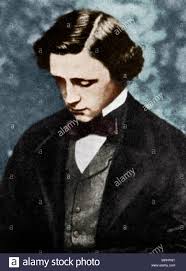
(Lewis Carroll)
The game of Chess in Through The Looking Glass represents the interest of Carroll in logics and mathematics, and the agent is ‘Alice’. This game is not about luck unlike other indoor/board games, rather brainy. In the same way, Life is more about randomness, it’s not alone in the hands of fate, though life is much more unpredictable. We need statistics as well as probability in both chess and life. Also, chess possesses two different colors, that is, one is light and the other one is dark, where I suppose, they stand for logic and nonsense respectively. Based on this idea, Alice often proves to be smarter, more prudent than the so-called adults she confronts in the Looking Glass world. This might also be a reverse-reflection of actual world, I guess, where we see adults inclined towards logic and children uttering stuff and nonsense and vice-versa, here, in the world of mirror.
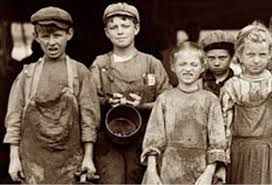
(Children doing factory chores in Victorian England)
Life of the children in Victorian period was totally opposite to that of present-day children. They were considered as miniature adults and were expected to be highly sophisticated, more in the case of rich class children. Children were not allowed to shout, complain, interrupt or disagree with anyone. The children of rich parents were usually looked after by governesses, no matter humble or strict, and they only used to teach them manners and the way of living. Here, in Looking Glass world, Red Queen, the first character to guide Alice in the reverse world,
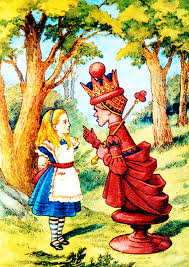
(Red Queen scolding Alice)
resembles very much like a governess of Alice when she teaches her how to not tweedle her fingers while speaking, how to behave, and to curtsey, and how Alice couldn’t go against her. She says, “when you’ve once said a thing, that fixes it, and you must take the consequences.”, because Alice is a Pawn and a Pawn cannot move backward, it is also allusion to the fact that once you have made the decision/choice, you can’t step back and stay committed bearing with it’s outcome, and she also asks Alice only to speak when she was asked to. Even we see TweedleDum-TweedleDee not ready to converse with Alice before she greets them. When Alice thinks that asking the Queens how they arrived would be impertinent, it shows again the social structure built for children in the real Victorian world.
When we are in a state of childhood, we want to turn into an adult soon. Similarly, Alice is excited about her lone-tour of adulthood through the Looking Glass world as she thinks she will be free of all the scolding, she says, “….no one here to scold me away from the fire….and can’t get me!” In the beginning, Alice was thrilled about her journey but as she is heading forward, she encounters the sense of loneliness in her journey to become a Queen(apparently) and acts adult herself. Though she is surrounded by different creatures many a times, but she feels alienated to their foreign ways. Hence, here Chess is a symbol of journey advancing from childhood to adulthood. She undergoes many crucial experiences, putting forward the idea of challenges one has to face in this journey of adulthood in one’s life. In the beginning, we see Alice being rude to Gnat about his jokes and later we see her kindness with White Knight that declares the change in her attitude as moving towards adulthood. When the Queen gives Alice directions as how to be a proper queen, it indicates that Alice wasn’t actually prepared to become a queen, just as it’s hard to prepare to be an adult in real world. Every square leads her to different characters and every character teaches Alice something significant, as we know, advice can come from the most unexpected places. For example, revelation of identity imposed by the situation in the woods of forgetfulness, the White Queen teaches her to believe in impossible, the fall of Humpty Dumpty symbolizes ‘the fall of man for pride’ and also ‘the fall of innocence’ proceeding towards maturity, and likewise all the other characters. These teachings help Alice to inherent the characteristics of adulthood within her. The crown here, symbolizes the transformation of Alice from childhood to adulthood.
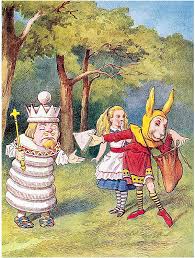
The Red King and the White King are almost doing nothing throughout the game as compared to their Queens. The Red King, as first encountered by Alice, is sleeping and his other pieces are performing their tasks to save him, whereas, the White King seems to be nervous not able to catch up with her Queen.
White King
Red King
Now these characters resemble in moves of both as that of the White and Red King in the real chess board. These actions of Queens and Kings in the world behind the mirror, may portray the position of women in the Victorian era. Women, at that time, used to engage themselves working for their husband and family, and also middle class and the working class women were employed to earn bread for their family, in support of their husbands. Red Queen saying to Alice, “…if you want to get somewhere else, you must run at least twice as fast as that!” may ascertain the idea that in a male-dominated society, women need to work double/toil harder in comparison to men in order to attain recognition. Women in the nineteenth century were not given much of the rights and privileges. This period is named after Queen Victoria, who was in the place of power. It is strange to encounter such a frivolous situation of women at the time when a lady herself was reigning over the society. When we behold Alice as a little woman moving from actual world to Looking Glass world, it may seem as she is struggling to change her confided world. She starts her journey all by herself which reflects the essence of independence in her. The characters like Live flowers resemble the social class structure that pushes Alice to follow their rules. When she chooses to be a Queen, she establishes the path for women/girls to upgrade their status because Alice learns that she must have a powerful authority to control Looking Glass world when one of the servants at once answers her after she turns into a Queen, so is the case for women in Victorian era, for example, Queen Victoria.
We need not be afraid of our high-rated opponents and feel incapable before them and it is then only that Alice is able to shake Red Queen in frustration and raises her voice against her rather than stitching her lips out of fear as evident in the beginning, that is, crown here, symbolizes her transformation from childhood to womanhood, gives her voice and finally renovates her status from a pawn to a queen. All the exclusive pieces are placed right behind the pawns. And a Pawn in comparison to them is just an ordinary, common piece that can slowly and gradually become a Queen. Even a pawn can cut down a King, pertaining to life, a single human being, regardless of his status, is enough to bring about revolution in the society, and win the castle of life. Alice suffering through all the odds, obstructions eventually made it, checkmated the Red King and turned into a Queen.
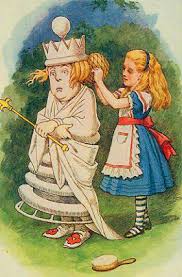
As a Queen in the game, the Red Queen and the White Queen are able to move swiftly and effortlessly. The White Queen, as she says, “jam-tomorrow and jam-yesterday, but never jam-today.”, and screams before pricking her thumb, travels in past and future which is true for the Queen,
(Alice tying clumsy hair of White Queen)
in general, in chess that she can freely move in every direction possible, but she is seen nervous and messy all the time here, and ultimately at two points passes up a chance to checkmate and on another occasion she missed the opportunity to capture the Red Knight. Similarly, the Red Queen said to Alice, “Speak when you’re spoken to!”, and having supporting her words, she doesn’t announce it after putting White King on the check, hence, the check is ignored. Their individual character traits restrained them from performing their duties. This also discovers their absent-mindedness and reverse effect of the mirror world.
The Knight in the chess moves very distinctively and is allowed to jump over any other pieces. Riding and falling of the White Knight in looking glass world is signifying it’s unique L-shape movement. The inventions of White Knight are here to present his powerful character trait, like in chess board Knight is an only piece imbibed with many powers, unlike other pieces, not even a Queen can move in same way as Knight, though his inventions are unprofitable disclosing the touch of the illusionary world, still it is pointing to the fact that precaution is must, so his horse wears spikes on it’s ankles to protect it from shark bites and he collects things that might be useful in the difficult situation. The White Knight is the only character that is benevolent with Alice and saves Alice from the attack of Red Knight (stopping her to be a Queen/upgrade the position of women in society), but it can be an example of gender-biased society where a man is shown as a powerful figure and woman belongs to a weaker section. Alice, here, is represented as a weak girl and this action of White Knight throws light on the concept of feminism, and make Alice learn that a woman must stand for herself and must discover her own capabilities.
Chess wasn’t just one of the themes in Carroll’s story, indeed, it was the ground for the novel’s structure. The game of chess in real world is ‘logical’ while in looking glass world it can be called as ‘maddening game of chess’. Also as an inverted image created by the mirror, this indoor game is displayed as an outer giant field of chess. The pieces are definitely running and moving under the implied rules, but the pattern is not applied evenly. This game sets the deterministic way of life. Both life and chess are, more or less, synonymous in almost every aspect.
Creativity has no exact definition, and there can’t be any because creativity differs as per the perspective of each and every individual.
Creativity is a free spirit that lives within each of us since the day we are born, the only difference is that every one practices Creativity in a different manner and it’s not about the traditional Creativity which is mostly associated with a painter, artist or cartoonist but, every one. It is not about drawing shapes or abstract art, but anything.
It is always said that a child lives in every person and as we grow up and become adults that child get lost somewhere in the busy life and adulthood, same goes with creativity with time some of us just forget how brilliant they are at being creative in their work , creativity keeps us alive and most importantly it challenges our mind to bring up new ideas. A person who is good at convincing people is a type of creativity, as it requires planning and study of facts in order to be successful at this similarly, a sand artist how did he became a sand artist ? He choose the element sand to showcase his creativity, identifying your style, idea and inspiration can help you claim your creativity. It is possible to look beyond the normal horizon which is also called imagination and today each one of us is aware about the power of imagination.
Thus, the above example shows how creativity can be practiced professionally and non professionally. It is present at every place well the place where we live which is a planet, planet earth is another example of creativity. Universe was not formed in a day or two it took million of years to make things the way they look today but, for once this is creativity it is called creativity of God the formation of solar system, the planets, birth of first human, land , water and everything.
The people who are close to art and craft are often attracted by creativity, they have a 6th sense that can identify the difference quickly that a normal busy man can’t basically creative difference.
Creativity and challenge go side by side. Creativity is challenging like the works today is dynamic and things keep on changing and in this process of change our work is adapting to the changes and be progressive with the work So, creativity is in high demand. Apart from being intelligent, humble, punctual, creativity is also considered in top priority. A creative person can come up new ideas and strategy, it’s just like writing in lesser number of words but the meaning is deep. Here creativity can solve the purpose.
Health education is a profession of educating people about health. Areas within this profession encompass environmental health, physical health, social health, emotional health, intellectual health, and spiritual health, as well as sexual and reproductive health education.
Health education teaches about physical, mental, emotional and social health. It motivates students to improve and maintain their health, prevent disease, and reduce risky behaviours. It also focuses on emotional, mental and social health too. Educating students on the importance of health builds their motivation.
Health education is one strategy for implementing health promotion and disease prevention programs. Health education provides learning experiences on health topics. Health education strategies are tailored for their target population. Health education presents information to target populations on particular health topics, including the health benefits/threats they face, and provides tools to build capacity and support behavior change in an appropriate setting.
History
From the late nineteenth to the mid-twentieth century, the aim of public health was controlling the harm from infectious diseases, which were largely under control by the 1950s. By the mid 1970s it was clear that reducing illness, death, and rising health care costs could best be achieved through a focus on health promotion and disease prevention. At the heart of the new approach was the role of a health educator.
Code of ethics
The Health Education Code of Ethics has been a work in progress since approximately 1976, begun by the Society for Public Health Education (SOPHE).
“The Code of Ethics that has evolved from this long and arduous process is not seen as a completed project. Rather, it is envisioned as a living document that will continue to evolve as the practice of Health Education changes to meet the challenges of the new millennium.”
Importance of Health Education .
Health education builds student’s knowledge, skills, and positive attitudes about health. Health education teaches about physical, mental, emotional and social health. It motivates students to improve and maintain their health, prevent disease, and reduce risky behaviours.
Health education curricula and instruction help students to learn skills so that they will use to make healthy choices throughout their lifetime.
Health education teaches people of all ages about how diet and exercise contribute to a healthy lifestyle. It also encourages positive changes in behaviour and lowers the risk of addiction to drugs, alcohol and unsafe sexual practices. The majority of schools around the country have courses aimed at teaching health education to students. These courses often revolve around the body, healthy eating, sex and exercising. Some students are taught basic health and physical fitness early on. More in-depth courses are designed for middle and high school students.
Health education encourages a person to make healthy choices. They are instructed to avoid unhealthy habits. ‘A sound mind lives in a sound body’. Rabindranath Tagore and C.V. Raman, if they were confined to sick bed, could not have won the Nobel Prize. In fact, a sickly student with all his talents and abilities lags behind in the race of life.
Health education also teaches about the emotional and mental health of the student. A healthy person is the happiest person in the world.
Soft skills… Every one of us has heard this phrase. Also, you might have heard from employees, grad students, millennials, school students, or young people complaining that they lack certain soft skills.
There is a wide range of skills that falls under the term “Soft Skills”. These skills are also known as “transferable skills”.
A definition of Soft Skills:-
Soft skills are certain sets of traits and interpersonal skills that don’t depend on the acquired knowledge. Soft skills include common sense, the ability to deal with people, a positive flexible attitude, or how you approach life and work.
The good news is one can learn and enhance their soft skills over some time. Though it is often hard to do so. Like Hard skills, one can work on their Soft skills and can make themselves capable of using them. One can’t measure Soft skills by any exam, the only way to measure the development of one’s Soft skills is by knowing how one manages relationships around them.
What are the most important Soft Skills?
Well, there are a lot of Soft skills. But, mentioned below are five skills that you need to learn/enhance:-
★ Communication Skills
The most essential skills include Communication skills. People with good communication skills can maintain/build good relationships around them. Also, they are likely to avoid misunderstandings and can make any workplace better.
★ Decision Making
Being able to make decisions is a crucial part of life. Everyone one of us has to make decisions in our day-to-day life from what we want to eat to what we should wear. But sometimes the actual decision doesn’t seem to matter; what matters is that you have made one and moved on.
★ Time management
Time management can help you finish any work within the deadline. Time management is sometimes described as having a ‘good work ethic’. Also, it is very useful for organizing family or team.
★ Leadership skills
These skills are needed to take the lead when necessary. These skills include the ability to manage and motivate others, and to commissioner work. One can learn leadership skills by enrolling in many leadership training courses.
★ Creativity and problem-solving skills
These skills are as highly valued as leadership skills because they are hard to develop. Although it is being believed that creative thinkers are born not made. But like any other skill, these skills can also be developed.
The skills mentioned above along with other Soft skills are required in every field whether you are a student, an employee/employer, a business owner, etc. You can reach to various programs to develop and enhance your soft skills.
Creative Writing is one of today’s most demanded courses and work across the world. With proper techniques and love for writing anyone can do it. Creative writing is an art well known to people. A good writer can create a web of emotions that people all across the world can relate too. Writers with ability to capture people in their words are much appreciated by the people.
Using simple and understandable language to convey emotions and feelings are an important aspect of being a good writer, although we can find writers who have a style of using complex language too.
Here are some forms of creative writing that everyone can practice at home.
Poem
The idea of writing a poem comes so easily to all of us, inside most of us is a poet writing down his/her feelings. Poetry has a lot of different forms. There is an endless list on the types of poetry that can come under this section. Ranging from Ballad, Sonnet, Carol, Epic, Haiku , black out poetry etc. Poetry is classified on terms of its writing style, rhyming scheme, number of words used and lots more. Modern day poetry has been more open and not restricted to any kind of style. It is lot more expressive and simpler in understanding than the traditional poetry.
Musing
Musings are bits of moments of our reflection in life, it is that sudden though you have over a period of time. Some people write down their thoughts and weave them into creative pieces. Musings were quite an old technique.
Rant
Writing down your feelings that you have held back for so long is called a rant. It is as its literally meaning, ranting down your expressions and thoughts in ways closer to your heart. You could write it as much as you want, after all its rant.
Short Story
Writing short and creative plot involving stories are a thing now. We can find writers who write short story series. It has captured the attention of people so much these days. Readers look forward to short stories these days.
Open letter
An open letter is a redefinition of the traditional way of letter writing. It is addressed not to a single person but to the public or a group of persons as whole. It is usually a writing to address a social issue. It is to grab wide attention of people.
Thought
A thought can be an idea flashing upon our minds. It is that very short thing from which a writer can write more on.
Diary Entry
This is something that is so common, everybody keeps a diary at least in point of their life time. People write down what happens in their life, different events, important dates etc. It is in most people’s diary that we can find their creative minds.
Review
A review is basically a writing about an outline of a book or a movie or a certain thing. The writing talks briefly about the figure of attention.
America’s economy is approaching a big milestone. If it keeps humming until July 2019, it’ll be the longest expansion in U.S. history. It would be exactly one decade and one month old by then. But there’s another country with an even more impressive run It’s even called the ‘lucky country’ Three big lessons from Australia.
Be smart.
Be organized.
Be lucky.
So, if I’ve got any advice for other countries, it’s try and be as lucky as Australia That luck has to do with Australia’s treasure trove of natural resources. You know Australia is on the other side of the world and sitting on tremendously valuable minerals right at the point where the Chinese economy is just around the corner and exploding. Australia and every one its natural resources were within the right geographic neighborhood even as the Chinese economy began to begin . And it just so happens that China did a big fiscal stimulus in 2008 and spent a great deal of money building new cities. So all of these resources were drawn from places like Australia. So that also served as a huge tailwind at a time when developed markets were in a whole lot of trouble.
The year 2008 was a time of economic turmoil The Global Financial Crisis hit and markets crumbled around the world. But as it turns out this was also a year for Australia’s economic management to really show off At the time the government had a very helpful and very low level of debt. One reason? Pension reform in the 1990s. Australia set up a compulsory retirement system called the superannuation system. It requires employers put money into its employees’ retirement savings.
Since companies and citizens have to build up retirement savings, some of the financial burden to pay off pensions was taken off of Australia’s government As other economies reeled in the wake of the 2008 crisis, the Australian Government was then able to put money directly into people’s bank accounts This boosted consumer spending in order to stimulate growth In 2008, the Australian Government unlike some other developed market governments actually jumped in very quickly with fiscal stimulus, so that helped to kind of minimize the effect of the crisis The country’s numbers continued to look sluggish after the financial crisis. But they never quite dipped low enough or for long enough to satisfy the definition of a recession. It takes two quarters of negative growth to fall into a recession. Australia’s economy did post a couple of negative quarters since 2008, but no country’s perfect. Overall Australia’s economy has been managed pretty much in recent years partly due to a robust and stable financial institution.
Australia has an independent financial institution and it is a very well-run financial institution . It also has a floating exchange rate and the exchange rate helped it adjust to international shocks. Australia’s economic reforms gave it flexibility in times of hardship. For example, floating the Australian dollar In 1983, Australia’s government moved the dollar onto a floating exchange rate This meant that the dollar would be valued by supply and demand instead of being subject to influence from its government or its central bank It allows the economy to react to shocks as well Typically when an economy is hit by some sort of negative shock. The currency will adjust. It will depreciate and that helps promote exports. Another reason behind Australia’s economic diary lies in its immigration policy. Since the late 1990s, Australia has seen growth in temporary migration, many arriving to the country on student or temporary work visas. The number of temporary migrants peaked in the year 2000. However a recent change to immigration law in 2018 gave visa applicants more hurdles to get through if they wanted to come to the country Even when our GDP per capital average incomes aren’t rising by much because the number of people continues to rise that means the total GDP continues to rise at even more rapid pace Part of that’s underpinned by much faster population growth Most experts think Australia’s economy remains strong in 2019, but it’s not without risks.
Australia’s suffering at the instant from pretty weak wage growth. That’s worrying a lot of people. There’s a lot of fear right now that China is hitting a wall. That will hit demand for Australian products. The good news is to the extent that the Chinese are buying commodities hopefully will find buyers from overseas for many of those commodities if the Chinese are not there The bad news is the rest of the world economy is not doing that well.














 Eduindex
You must be logged in to post a comment.