COST

Cost refers to the expenditure incurred by a producer on factor as well as non-factor inputs for given output of a commodity. It can be categorized into explicit ( Opportunity cost of hiring inputs from the market, measured in cash payments that firm make to others.) and implicit costs. ( Opportunity cost of using self-owned inputs, measured in terms of imputed costs of self owned resources.). It is also termed as selling ( expenditure caused due to promote sale of good.) and production costs ( expenditure on inputs to produce an output.)

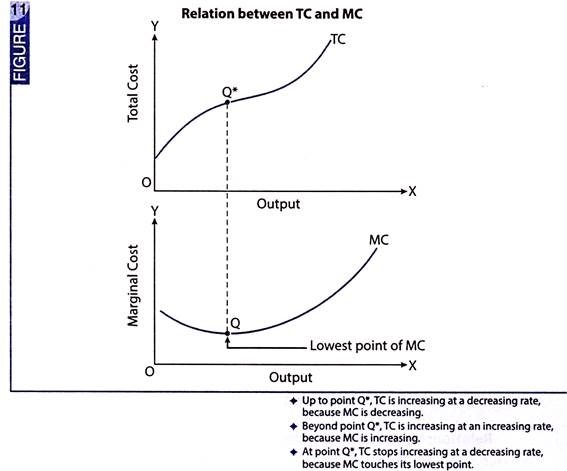
Fixed costs are costs related to use of fixed factor of production in short period like, machines, license fee, land expenditure, etc. They do not change with change in output. Variable costs on other hand refer to expenditure by producer on use of variable factors of production like, costs of raw material, wages of workers, wear and tear expense, etc. They increase with increase in output and vice-versa. Graphical representation is given by-

Cost Behavior

Total cost is defined as sum of variable and fixed costs. Since total variable cost tends to increase at diminishing rate initially, meaning that less and less of additional cost is incurred in every additional output. This happens due to increasing return to a factor and eventually TVC increases at an increasing rate.

Relationship between TVC and MC:

i) Marginal cost is estimated as the difference between total costs of two successive units of output. Thus,

MCn = TCn – TCn-1

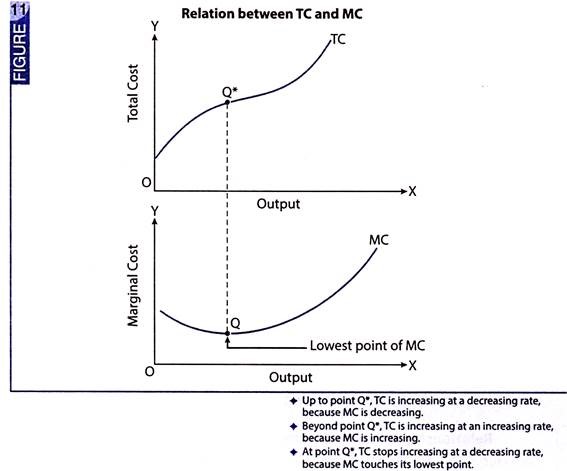
(ii) When MC is diminishing, TC increases at a diminishing rate.

(iii) When MC is rising, TC increases at an increasing rate.

(iv) When MC reaches its lowest point (point Q in Fig. 11), TC stops increasing at a decreasing rate (point Q* in Fig. 11).

Briefly, MC is the rate of TC.

RBI Had Not Printed Rs 2000 Notes In 2019-20, Currency is Still Valid

Rs. 2000 notes were introduced by the Government of India after the announcement of the demonetisation of 500 and 1000 rupees notes in November, 2016. Currently, it is the highest denomination currency note of the country. According to the annual report of the RBI, the Rs 2000 denomination note was not printed at all during 2019-2020. These notes were introduced after the government announced demonetisation of old Rs 500 and Rs 1,000 notes 4 years back. At that time, those two denominations had accounted for 86% of the then total currency in circulation.

The number of Rs 2,000 denomination notes had peaked at 3.36 billion units in 2017-18. This number had dropped to 3.29 billion in the years 2018-19. It has again fallen to 2.73 billion in 2019-20. The currency note presses of the Reserve Bank of India (RBI) did not print even one Rs 2,000 note in the last year. This happened because the presses did not receive any order for printing those. This seems to indicate a conscious decision for starting the trend of decreasing the number of notes which are circulated. The 2000 notes under circulation was 50% in 2016-17 and it has come down to almost 22% in 2019-20. These figures are based on RBI’s Annual Report for 2019-20, which was released on August 25 2020.

It is also known that RBI has also disposed a disproportionate share of Rs 2,000 notes in the soiled category. This has raised many questions on the government’s plan about the 2000 denomination note. In January, 2019 the was an indication that the Rs. 2000 notes were not being printed any further because there was adequate supply.

A total of 176.8 million pieces, which is quite a high number, of Rs 2,000 notes under the category of soiled notes were disposed of in 2019-20 by the RBI. While in 2018-19, just 1 million Rs 2,000 notes were disposed of and in 2016-17 or 2017-18, no Rs 2,000 notes were disposed of. Both the 2000 and 500 denomination notes were introduced after demonetization. In 2019-20, the share of Rs 2000 notes which were disposed of was 6.5% while that of Rs.500 notes was 0.6%. Out of the 22 billion currency notes printed in 2019-20, more than 50% of those were of the Rs 500 denomination. Due to these changes in currency composition, the Rs 500 notes has reached a very high share in the total currency under circulation.

The Minister of State for Finance Anurag Singh Thakur had told the Lok Sabha on March 16 2020 that, “Printing of bank notes of particular denomination is decided by the government in consultation with RBI to maintain the desired denomination mix for facilitating transactional demand of public. No indent was placed with the presses for printing of Rs 2,000 denomination notes for 2019-20. However, there is no decision to discontinue the printing of Rs 2,000 bank notes.”

A government official said that, “The Rs 2,000 notes were introduced in 2016 to quickly fill the gap created by demonetization of Rs 500 and Rs 1,000 notes. It was the need of the hour. Gradually, with increased supply of smaller notes, including new notes of Rs 100 and Rs 200, and with growing popularity of digital transactions, the urgency to issue new Rs 2,000 notes is no longer there. But this does not mean that there is any move to discontinue Rs 2,000 notes. Increasingly, commercial banks are also using more and more smaller notes because their customers often find difficulties in getting change for Rs 2,000 notes.”

TOP 9 Small Business & Start-Up Ideas for 2020 (ONLINE FROM HOME)

Today, we’re going to talk about TOP business ideas for 2020. They are not going to be those obvious ideas that you can think of yourself like starting a restaurant or a car wash; we are going to talk about ideas based on recent trends, recent growing markets.

How To Start A Business

A very important rule! If you decide to start your own business, your motivation shouldn’t be because someone said: “It’s going to be a great business!”. Your perfect business idea should consist of the following things: it should be something you like doing and it should be something you are really good at.

1. Coworking Space

Remote workers are spurring on a new revolution for white-collar professionals, as many roles traditionally set in the office space transition to working via the web. Since loneliness is an all-too-common affliction for remote workers and working from a coffee shop isn’t always the quietest choice, the appeal of shared coworking spaces grows each year.

2. Posture Corrector

Nowadays, people constantly hunch over their phones and laptops, it’s no surprise that there’s been a rise in back and neck pain. The keyword “posture corrector” gets about 74,000 monthly searches proving to be a great startup idea for new entrepreneurs.

3. Fitness Tech

Apps related to diet and fitness account for 3.31% of all app on the Apple Store. People are constantly on the move. Making it possible for consumers to fit daily workouts conveniently into their crazy schedules closes another barrier to a healthy lifestyle.

4. Men’s Cosmetics

Men’s cosmetics industry is worth approximately $3.4 billion. One of the most popular niche products targeting men is beard oil, a part of the male grooming industry that makes approximately $6 billion in annual sales. Approximately 39% of American men have beards.

5. Food truck

Food trucks represent all the benefits of a restaurant but without the initial investment of a brick and mortar business space. Only 10-20% of food trucks fail, whereas the failure rate for new restaurants can be as high as 90%.

6. Healthy Fast Food

Think about why people flock to their favorite fast-food chains. The price, speed, and convenience offer consumers a quick way to eat on the go and on a budget. With high demand and low competition, healthy fast food makes a great business idea for 2020.

7. Reusable Bags

As people become more conscious of the waste they produce in their homes, some are starting to use reusable bags to lower the amount of plastic waste. Business ideas centered around preserving the environment can help you build a socially conscious brand.

8. Smart Apparel

With smart apparel’s surging growth rates, this niched industry is looking to net over $4 billion by 2024. This subsector is still so new, making it fresh for innovative ideas from budding entrepreneur techies.

9.Travel Consulting

If traveling is your passion and you are always updated about things like best airplane ticket options and hotel deals, then you fit the bill. You can start by helping your family and friends, securing the best travel deals and selling rewards flights.

Hope these ideas are useful to young budding minds out there looking forward to being Entrepreneurs of tomorrow!

How to Become Rich Faster than Others (Practical Steps)

Everybody wants to become RICH one day.

Still, how is it that some people have all the answers? How do the rich keeping getting richer while the poor keep getting poorer? Is the game actually rigged against us? Are we, in fact, doomed to live ordinary lives, merely controlled by our hedonistic desires and pleasures, forced to succumb to our animalistic urges, never able to actually get ahead in life, let alone get rich? Or, is there some solution? A way out, if you will? 

How to Become a Millionaire and Get Rich the Right Way

Clearly, these are questions posed by the masses. But not everyone can pull it off. What separates those who seem to have all the answers from those that are constantly jumping from one ship to the next, never able to truly find their gravy train? Well, the answers are far simpler than most would imagine. 

Don’t spend more money than you make.

 Not many people follow this advice. Many are focused on spending as much as possible. Whether it’s to revel in the perception of being more well-off than they actually are, or some other purpose, this is the truth across much of the developed world. 

Keep a Diary of your Expenses.

Benjamin Franklin once said, “Beware of little expenses. A small leak will sink a great ship.”

As easy as it might seem to ignore the little stuff, so to speak, the more you sweat the details, the better off you’ll be. Cancel that gym membership you haven’t used in six months. Eliminate that costly cable television plan. Stop buying expensive lattes and eating out when you know you can’t afford to do it. Download an app or purchase a small notebook and track every expense no matter how small or how big. 

Quit all the Bad Habits- drinking, smoking, gambling, etc.

Bad habits hold us back from achieving many kinds of goals. They stop us from losing weight, making more money, saving, investing and everything in between. The only way you can actually get ahead in life is to decimate those bad habits. You need to quit the bad habits before they lead you down a deathly spiral. 

It’s hard to achieve something that takes so much of your energy, such as getting rich, without eliminating your bad habits first. I’m not just talking about poor financial habits; I’m also talking about any other habit that eats away at you, physically, emotionally or mentally. 

Save 20 % of your Income every Month.

In order to get rich, you need to save at least 20 percent of your income off the top. Everyone has heard this before, but how many people actually follow this advice? 

The term “pay yourself first” holds major weight here. While some don’t find the importance in this, others realize that this not only provides a rainy-day fund in case of emergencies, but also moment-of-the-opportunity cash. When the right opportunity comes by, you need cash to seize it. If you don’t have the cash, you just missed the proverbial boat. 

Pay-Off your Debts.

When you’re debt-free from the bad debt (not the good debt like mortgages for investment properties and loans to grow you business, for example), take that money and put it towards your savings. The trick is not to go spending cash and splurging on a vacation or a new car once you’re debt-free. Stay focused. 

Don’t Rent but Own your House.

No matter what it takes, even if you have to downgrade your living situation, you should do what it takes to purchase a home. Sit down with a mortgage broker and assess your situation. Set some goals and create a plan of action.

Even if you don’t have enough money saved for a down payment right now, figure out what it’s going to take to buy your home. We’re not talking about your dream home here. However, over time, the money spent on your mortgage is far better invested than money spent paying rent. 

Invest, but only after Researching the hell out of it.

Many people invest for the sake of it. If you don’t have proper knowledge about the plans your investment offers then you might never really grow your money in it. The better you know an industry or niche, the more likely you’ll be able to spot ideas that could possibly create massive amounts of income for you in the future. No one else is going to do this for you. And when you do invest in something that you know, be sure to track it vehemently.

Multiple source of income but not mainstream.

Anyone who’s serious about getting rich needs to build multiple streams of passive income. Passive income is incredibly important when it comes to amassing wealth. Simply put, you to need to generate your income on autopilot if you want to create a considerable net worth. 

There are a number of passive income generating ideas that you could implement. Some of the most popular involve real estate and dividend income for those that can afford the often high-cost barrier of entry into those fields. Others opt for generating passive income by starting a blog, creating digital products such as e-books or courses, and even creating online tutorials, just to name a few examples.

Time Value of Money.

We all have the same amount of time in this world. You don’t have more than the next person and that person doesn’t have more time than another. No matter if they’re a powerful politician, a business magnate or a famous athlete, they don’t have more time than you do. Time is life’s greatest equalizer. 

It all depends on how you utilize your time. Every second is precious. Become lazy or procrastinate and lose your dream of being rich.

Rome was not built in a day.

Daily goal setting provides milestones on your way to your bigger goals. Break the big goal down to achievable daily goals that won’t seem so overwhelming. For example, if you want a $10 million dollar net worth in the next five or 10 years, figure out what it’s going to take on a daily basis to move closer to that goal. 

Best low-risk Investments in 2020

Due to the Corona Virus Global Pandemic 2020, our economy has faced unprecedented challenges. With businesses shutting down and stocks facing a fall, INVESTORS are looking for stability in their returns by opting for low-risk investment options. Low-risk investments earn only modest or meager returns; and inflation can erode the purchasing power of money stashed in low-risk investments. But it all depends on what your economic requirement is and how much risk you are willing to accept.

Photo by Pixabay on Pexels.com

Lets dive into the top low-risk Investments in the year 2020.

  • High YEILD Savings Accounts.

Savings accounts offer a modest return on your money. A savings account is completely safe in the sense that you’ll never lose money. Most accounts are Government insured up to certain limits, so you’ll be compensated even if the financial institution fails.

  • Saving Bonds

Scrictly speaking rather than investments these bonds are more like saving instruments. Bond is a good choice for protection against inflation because you get a fixed rate and an inflation rate added to that every six months.

  • Certificate of Deposits

With a CD, the bank promises to pay you a set rate of interest over a specified term if you leave the Certificate of deposits intact until the term ends. Some savings accounts pay higher rates of interest than some CDs, but those so-called high-yield accounts may require a large deposit.

  • Money Market Funds

Unlike a CD, a Money market fund is liquid, which means you typically can take out your funds at any time without being penalized. Money market funds usually are pretty safe. The bank tells you what rate you’ll get, and its goal is that the value per share won’t be less than $1.

  • Corporate Bonds

Companies also issue bonds, which can come in relatively low-risk varieties (issued by large profitable companies) down to very risky ones. The lowest of the low are known as “junk bonds.” When you buy a corporate bond, you’re loaning money to the company. In return, you receive periodic interest payments until the bond matures and your principal investment is returned.

  • Dividend paying stocks

A dividend is a portion of a company’s profits paid out to the company’s shareholders. When a company makes a profit, it can choose to reinvest that profit back into the business, but sometimes it pays a percentage of it back out to shareholders. Not every company pays dividends, but those that do often have slow, reliable growth.

  • Preferred Stocks

Preferred stock is more like a lower-grade bond than it is a stock. Still, it may fluctuate substantially if the market falls. Like a bond, preferred stock makes a regular cash payout. But, unusually, preferred stock may be able to suspend this dividend in some circumstances, though often it has to make up any missed payments.

Building an investment portfolio that has at least some less-risky assets can be useful in helping you ride out the volatility in the market, and there’s been no shortage of that this year.

The New Consumer Protection Act,2019 in India is an upper hand and an added advantage for the consumers in manifold ways

The Consumers can now cheer as the Consumer Protection Act, 2019 has recently replaced the three decade old Consumer Protection Act, 1986. The Consumer Protection Act, 2019 which came into effect on Monday (July 20) has replaced the earlier Consumer Protection Act, 1986.

The new Act as per the Experts say that “it gives more power to the consumers”. It seeks to revamp the process of administration and settlement of consumer disputes, with strict penalties, including jail term for adulteration and misleading ads by firms.

On July 20, 2020 certain provisions of the Consumer Protection Act, 2019 came into force as notified by the Central Government. Following the the key features of the relevant provisions:-

Key features of the Consumer Protection Act, 2019 which came into effect on July 20, 2020:-

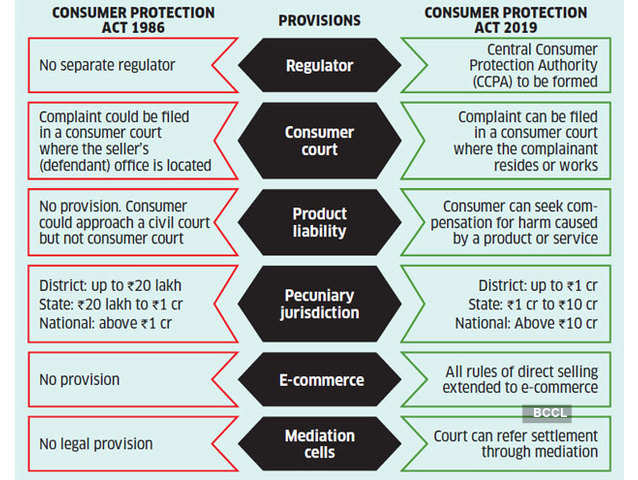
1) Consumers can now institute a complaint from where they reside or work for gain.

2) The original pecuniary jurisdiction of the District Commissions has increased upto ₹1 crore from ₹20 lakh earlier.

3) The Pecuniary jurisdiction of State Commissions has been increased from ₹1 crore to Rs. 10 crore.

4) The National Commission can hear cases above ₹10 crore when compared to above ₹1 crore earlier.

5) While the provisions relating to e-commerce are not yet notified, a section relating to electronic service provider (covering software services, electronic payments) is notified.

6) The opposite party needs to deposit 50% of the amount ordered by the District Commission before filing an appeal before the State Commission. Earlier, the ceiling was a maximum of ₹25,000, which has been removed.

7) The limitation period for filing of appeals to the State Commission has been increased from 30 days to 45 days.

8) The Parties can be allowed to settle the disputes through mediation.

Following are the Sections which came into force:

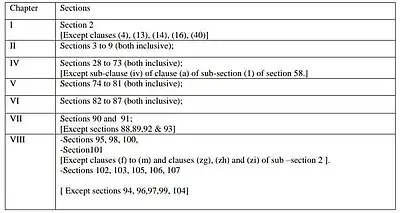
Consumer Protection Act 2019- Sections to come into force from July 20,2020

Above mentioned provisions pertain to the Consumer Protection Councils, Consumer Disputes Redressal Forum, Mediation, Product Liability, punishment for manufacturing, selling, distributing etc spurious good or products which contain adulterant.

As per the rules, the e-commerce players will have to display the total ‘price’ of goods and services offered for sale along with break-up of other charges. Only a few certain miscellaneous provisions with regards and respect to the powers of the Central and State Government to make the rules and regulations have also been enforced.

On misleading advertisements there is provision for jail term and fine for manufacturers. There is no provision for jail for celebrities but they could be banned for endorsing products if it is found to be misleading.

For the first time there will be an exclusive law dealing with Product Liability. A manufacturer or product service provider or product seller will now be responsible to compensate for an injury or damage caused by the defective product or deficiency in services.

The Act has also defined an “e-commerce” as the buying or selling of goods or services including the digital products over digital or electronic networks. The existing definition of e-commerce has been adopted from India’s FDI Guidelines on e-commerce.

The definition of ‘e-commerce Entity’ as provided under the FDI Guidelines includes inventory and market place models.

There is also a provision for class action law suit for ensuring that rights of consumers are not infringed upon. The authority will have power to impose a penalty on a manufacturer or an endorser of up to 10 lakh rupees and imprisonment for up to two years for a false or misleading advertisement.

WEBSITES REFERRED

1)https://consumeraffairs.nic.in/acts-and-rules/consumer-protection

2)https://www.barandbench.com/news/law-policy/provisions-under-consumer-protection-act-2019-to-come-into-force-on-july-20-2020-centre-notifies

3)https://www.google.com/amp/s/www.thehindu.com/news/national/tamil-nadu/new-consumer-protection-act-gives-more-power-to-consumers-experts-say/article32135908.ece/amp/

4)https://www.google.com/amp/s/www.livemint.com/news/india/consumer-protection-act-rules-for-e-retailers-to-be-effective-by-this-weekend/amp-11595291549084.html

5)https://www.google.com/amp/s/zeenews.india.com/economy/new-consumer-protection-act-2019-comes-into-force-today-know-how-it-will-benefit-you-2297012.html/amp

6)https://www.google.com/amp/s/m.economictimes.com/wealth/spend/heres-how-consumers-will-benefit-under-the-new-consumer-protection-act/amp_articleshow/70711304.cms

7)https://www.google.com/search?q=consumer+protection+act%2C2019&tbm=isch&ved=2ahUKEwjOhv7-sN7qAhVIH3IKHTOCBfMQ2-cCegQIABAC&oq=Consumer&gs_lcp=ChJtb2JpbGUtZ3dzLXdpei1pbWcQARgAMgQIIxAnMgUIABCxAzIFCAAQsQMyBQgAELEDMgUIABCxAzoHCCMQ6gIQJzoCCAA6BwgAELEDEEM6BAgAEENQ0xRYzipg1jBoAnAAeACAAZABiAGHCJIBAzAuOJgBAKABAbABBcABAQ&sclient=mobile-gws-wiz-img&ei=e-QWX47dJsi-yAOzhJaYDw&bih=682&biw=393&prmd=ivn#imgrc=eILduqMFjleJaM

8)https://www.vecteezy.com/free-vector/consumer

9)https://www.google.com/amp/s/www.livelaw.in/amp/news-updates/most-provisions-of-consumer-protection-act-to-come-into-force-160003

Why economy of India is slowing down???

India is one among the world’s fasting growing economies. It had been touted as an economic and geopolitical counterweight to China. But recently its growth fell to its slowest pace in six years. Investment has weakened, and unemployment has risen. So what’s causing the slowdown, and how can it be reversed? Since the turn of the century, India’s economy has grown at a rapid rate, helping transform the country. Between 2006 and 2016, rising incomes lifted 271 million people out of poverty, meaning the proportion of Indians still living in poverty has fallen dramatically, from around 55% to twenty-eight . Access to electricity has also improved. In 2007 just 70% of the population had access to power. By 2017, that grew to nearly 93%.

India's economic growth likely to remain subdued in near future ...
More recently, the Indian government constructed around 110 million toilets — a huge step towards better sanitation designed to prevent the practice of open defecation. It’s a signature program of Prime Minister Narendra Modi, known as Swachh Bharat, or Clean India. All this development has been supported by a booming economy, but as lately , that expansion has begun to run out of steam. In the third quarter of 2019, India’s economic output grew by 4.5% – making it the primary time the country’s growth dipped below 5% since 2013. For context, 4.5% growth remains much above that of developed economies just like the U.S., But with 12 million Indians entering the workforce per annum , economists say the country needs annual growth rates to remain above nine percent to make sure there are enough jobs. So, what’s causing this recent slowdown? Well, officialdom argue turbulence in international financial markets is guilty.

Economy News, Latest economy news India, Indian Economy features ...
Political uncertainty and U.S.-China trade tensions mean confidence levels among investors and consumers everywhere have sunk. The United Nations has even warned that a global recession in 2020 is now a “clear and present danger”. But back to India – many economists say the country’s growth problems are literally self-inflicted. One obvious culprit is the shadow banking sector. During the 2000s, India saw an investment boom. It was fuelled by state banks dispensing a load of loans for giant infrastructure projects. But some of the companies taking advantage of these loans couldn’t keep up with the repayments. That meant the state banks weren’t getting paid back and therefore struggled to give out new loans. To keep business moving, shadow banks stepped in. These financial institutions, which operate like ordinary commercial banks but don’t follow traditional banking rules, eventually made up an estimated third of all new loans nationwide. The loans played a pivotal role for the millions of small businesses and consumers who would otherwise have no access to credit. But in 2018, shadow banking giant Infrastructure Leasing & Financial Services, defaulted on its debt repayments. Its collapse sent shockwaves through the economy and shook up more traditional banks that had supported the world.
It became harder for people to shop for expensive items like cars. That hurt India’s automotive industry, which is one among the country’s biggest. It employs about 35 million people and makes up about 7% of India’s GDP. Last summer, the industry suffered its worst sales performance in nearly 19 years, and reports suggest tens of thousands of workers are laid off. The agriculture and construction sectors have also been hurting, with small and medium businesses being hit the hardest. The country’s percentage has been on an overall upward trend since July 2017, rising several percentage points to 7.7%. Higher unemployment means consumers are buying less, resulting in the unfortunate cycle of slower manufacturing, production, investment and job creation.

Indian Economy Will Face Adverse Affects Of Coronavirus Gdp To ...
A survey from the Reserve Bank of India found consumer confidence has fallen to its lowest level in five years. But Indians still have a positive outlook for the longer term , with most consumers expecting to feel more optimistic during a year. However, if things don’t improve, debt could become another issue. Expecting better days ahead, many households have continued to spend, by taking out loans and dipping into savings. Household savings as a proportion of GDP has fallen from 23.6% to 17.2%. Meanwhile, household debt has surged to 10.9% during the same period. Critics say the govt in New Delhi has did not spot these risks and hasn’t done enough to urge the economy moving again. The Reserve Bank of India’s former governor Raghuram Rajan recently blamed the lack of significant reforms and a slowdown in investments since the global financial crisis. Even the country’s chief economic advisor recently admitted reforms are needed to form India more friendly to investors.
India has cut its corporate rate , but labor and land laws are still extremely strict. He also says the country must become pro-market, instead of just pro-business, to avoid costly government bailouts of failing sectors. But not all reforms have been good to the economy. In 2016, Prime Minister Modi tried to crack down on corruption, counterfeits and evasion by banning high value bank notes. In one night, the cash ban made 86% of all cash invalid. Three years later, many analysts say the policy disrupted the economy and did not achieve many of its original goals. In 2017, a replacement nuisance tax placed small businesses struggling and a few of them were forced to shut . In mid-2019, India’s government introduced a controversial new tax on foreign investors. Consequently, India’s stock exchange suffered its worst July performance in 17 years. Just one month later, the measure was scrapped.
The government has now refocused its efforts on international trade and investment, and thus the recent changes to the corporate rate could indeed help attract businesses and investors to India. But if the country wants to be a part of the world’s largest supply chains, it’ll need low and consistent tariff levels to encourage outsiders to take a position for the long term.

The country’s shifting export policy has harmed several of its largest industries, particularly clothing. India’s share of the worldwide apparel market has increased only slightly within the past 20 years. And though the Indian workforce is vast, both Bangladesh and Vietnam now export more. On top of that, the country’s import tariffs on the average are much above the world’s biggest economies. They’re also among the highest of the world’s emerging economies. Even U.S. President Donald Trump has called for the country to bring down its duties.

Has India’s growth actually slowed the maximum amount as we think? The government’s former chief economic advisor Arvind Subramanian caused a good little bit of controversy in June 2019, when he claimed the country’s official stats probably overstated GDP growth by 2.5% from 2011-2012 to 2016-2017. He says the bottom line is that India never recovered from the global financial crisis. The government denies this. But none of this has hurt Prime Minister Modi at the polls – he won by a landslide in the most recent election. So how will he keep his promise and double the dimensions of the economy by 2025? Many economists insist a well-explained economic vision would help. As would more long-term investment, better skilled workers and enhancements to infrastructure. It may not matter who or what’s responsible for India’s recent economic challenges, but bottom line – India’s economic process must recover , and fast.

IMF’s lowering the India’ growth, means the economy will not automatically bounce back

The IMF yesterday brought down its quarterly figure of India’s financial development for 2020-21 to – 4. 5%, from around 1. 9% it had foreseen in April. In only three months, India’s development gauge has been brought down by 6. 4 rate focuses. Alongside a decrease in India’s figure, IMF has brought down the estimate for the remainder of the world. All the significant economies, except for China, are figure to get this year.

This figure ought to be remembered when the administration searches for “green shoots” of recovery. A halfway resumption of monetary movement after the lockdown isn’t equivalent to nascent indications of financial restoration. Truth be told, IMF has additionally brought down its development estimate for one year from now too. We are still at a beginning phase of reviving and it’s impractical to precisely pass judgment on the degree of harm fashioned by the Covid-19 flare-up. In this manner, it’s significant for the legislature to stay focussed on the reviving and be prepared to loan support any place required.

Why Australia is least affected by recession!!!

America’s economy is approaching a big milestone. If it keeps humming until July 2019, it’ll be the longest expansion in U.S. history. It would be exactly one decade and one month old by then. But there’s another country with an even more impressive run It’s even called the ‘lucky country’ Three big lessons from Australia.

  1. Be smart.
  2. Be organized.
  3. Be lucky.

So, if I’ve got any advice for other countries, it’s try and be as lucky as Australia That luck has to do with Australia’s treasure trove of natural resources. You know Australia is on the other side of the world and sitting on tremendously valuable minerals right at the point where the Chinese economy is just around the corner and exploding. Australia and every one its natural resources were within the right geographic neighborhood even as the Chinese economy began to begin . And it just so happens that China did a big fiscal stimulus in 2008 and spent a great deal of money building new cities. So all of these resources were drawn from places like Australia. So that also served as a huge tailwind at a time when developed markets were in a whole lot of trouble.

What Currency Is Used In Australia | Australian Dollar : Compare ...

The year 2008 was a time of economic turmoil The Global Financial Crisis hit and markets crumbled around the world. But as it turns out this was also a year for Australia’s economic management to really show off At the time the government had a very helpful and very low level of debt. One reason? Pension reform in the 1990s. Australia set up a compulsory retirement system called the superannuation system. It requires employers put money into its employees’ retirement savings.

Since companies and citizens have to build up retirement savings, some of the financial burden to pay off pensions was taken off of Australia’s government As other economies reeled in the wake of the 2008 crisis, the Australian Government was then able to put money directly into people’s bank accounts This boosted consumer spending in order to stimulate growth In 2008, the Australian Government unlike some other developed market governments actually jumped in very quickly with fiscal stimulus, so that helped to kind of minimize the effect of the crisis The country’s numbers continued to look sluggish after the financial crisis. But they never quite dipped low enough or for long enough to satisfy the definition of a recession. It takes two quarters of negative growth to fall into a recession. Australia’s economy did post a couple of negative quarters since 2008, but no country’s perfect. Overall Australia’s economy has been managed pretty much in recent years partly due to a robust and stable financial institution.

Reserve Bank of Australia – Australia's LGBTQ Inclusive Employers

Australia has an independent financial institution and it is a very well-run financial institution . It also has a floating exchange rate and the exchange rate helped it adjust to international shocks. Australia’s economic reforms gave it flexibility in times of hardship. For example, floating the Australian dollar In 1983, Australia’s government moved the dollar onto a floating exchange rate This meant that the dollar would be valued by supply and demand instead of being subject to influence from its government or its central bank It allows the economy to react to shocks as well Typically when an economy is hit by some sort of negative shock. The currency will adjust. It will depreciate and that helps promote exports. Another reason behind Australia’s economic diary lies in its immigration policy. Since the late 1990s, Australia has seen growth in temporary migration, many arriving to the country on student or temporary work visas. The number of temporary migrants peaked in the year 2000. However a recent change to immigration law in 2018 gave visa applicants more hurdles to get through if they wanted to come to the country Even when our GDP per capital average incomes aren’t rising by much because the number of people continues to rise that means the total GDP continues to rise at even more rapid pace Part of that’s underpinned by much faster population growth Most experts think Australia’s economy remains strong in 2019, but it’s not without risks.

Australia’s suffering at the instant from pretty weak wage growth. That’s worrying a lot of people. There’s a lot of fear right now that China is hitting a wall. That will hit demand for Australian products. The good news is to the extent that the Chinese are buying commodities hopefully will find buyers from overseas for many of those commodities if the Chinese are not there The bad news is the rest of the world economy is not doing that well.

Australian economic growth slows, enters per capita recession ...

Are products really ‘Made In China’ ???

Made in China. We’ve become accustomed to seeing the label on products manufactured in the world’s second biggest economy. But buying one of these products in China instead of say, the U.S., doesn’t guarantee you’re getting a better price. Chinese tourists have built a reputation for being big spenders abroad, spending a whopping $277 billion in 2018, much more than any other nationality. A lot of times, people think that purchasing something in China will be inexpensive, but that isn’t always the case. So how much of a difference are we talking? If we bring four products from four popular western brands to compare. Starbucks, H&M, Adidas store, a Godiva store. To keep things consistent, we will be using 2019’s average foreign exchange rate. The products compared are:

  1. A standard black t-shirt at H&M.
  2. Starbucks Grande Cappuccino.
  3. Godiva Chocolates.
  4. An Adidas hat.

Now let’s compare:

  1. The shirt at H&M is priced nearly the same in the U.S. and China.
  2. A Grande Starbucks cappuccino will cost you $4.63 in Beijing, but in Los Angles, California, $3.95.
  3. This case of Godiva chocolates, called Pearls, is priced at $7.24 in Beijing, but only $3.95 in LA.
  4. The Adidas hat will set you back $42.27 in China, nearly double the price of a similar hat in the U.S.

This experiment has made clear that pricing are complicated. So much so, that websites have popped up like the Mac Index, a site that compares Apple product prices from around the world. So many ads for Apple here in this area. According to an analysis done by Tech Insights, the cost to make an Apple iPhone 11 Pro is $490.50. Yet according to The Mac Index, the price to buy one is $1,318 in Japan, $1,477 in the U.S., $1,658 in Mainland China and more than $2,000 in Turkey and Peru. Prices vary across countries due to factors like demand, tariffs and tax refunds. And then there’s the supply chain: the network of people, organizations, activities, information and resources involved in the creation of a product.

close up of camera over black background
Photo by ATC Comm Photo on Pexels.com

Apple’s current CEO Tim Cook is considered by some to be a mastermind in supply chain. He first joined Apple in 1998 with a mandate to clean up the company’s manufacturing and distribution. Over time, he closed factories and warehouses, instead opting for contract manufacturers in China. That’s great for Apple’s profit margins, but it’s certainly not praised by President Trump, who has asked Apple to make its products in the U.S. If, say, iPhone production was moved to the U.S., instead of China, different analyses show the price for the consumer could go up from anywhere from $30 or $40 to hundreds of dollars to even $30,000-100,000. That’s partially why, despite Apple pledging to invest more money in American manufacturing, it maintains China as its hub for making its gadgets.

american and chinese flags and usa dollars
Photo by Karolina Grabowska on Pexels.com

That’s Omar Slim, a senior portfolio manager at global asset manager, PineBridge. When you hear about made in this country or that country is really quite relative and it’s a simplification of things because it’s most likely made in a number of countries. Here’s an example. Let’s say we want to make lasagna for dinner. If Jeff cooks the ground beef and prepares the cheese, Sarah makes the tomato sauce and layers the ingredients into a pan; and Blair, who bought all the ingredients, puts it in the oven, who gets the credit for making the lasagna? Now, let’s apply that to Apple’s iPhone. While the phone might say ‘Made in China,’ some of its parts come from other parts of Asia, Europe and even the U.S. Even though an iPhone may be assembled in China, it’s still tariffed in China as a U.S. product because Apple is an American company. The brand makes that clear with by, ‘Designed by Apple in California. How they’re treated in terms of customs, they will be treated as a U.S. product. So regardless of where they come, it’s essentially a U.S. product. Same for Chinese products going into the U.S. and same for, for instance, European cars.

India simply cannot afford to boycott Made in China — Quartz India

China became a popular manufacturing hub in the 1980s after it started to open to the world. It became known for its cheap labor costs, lax regulations and business-friendly environment. As China’s manufacturing sector grew, it took the crown from Germany as the world’s top exporter in 2010. While Made in China has become synonymous with cheap and low-quality products, China is hoping to change that. In 2015, it launched a Made in China 2025 initiative, which aims to shift its economy from low-end manufacturing to high-end, high-tech products. In 2017, Tim Cook said China lost its place as a low labor cost manufacturing nation many years ago. The U.S.-China trade war resulted in a tit-for-tat increase in tariffs on many products.

Petition · Political Parties: Boycott 'Made in China' products in ...

With increasing costs being passed on to consumers, many companies are looking to diversify their supply chain, instead of being so reliant on China. That sentiment has only grown, following the coronavirus pandemic’s hit on the global manufacturing industry. Along that supply chain, there will be some companies, that instead of manufacturing it in China, if they could, they could try to replace. In fact, companies including Apple, Microsoft and Google are reportedly looking into moving some of their hardware production from China to Vietnam or Thailand. But that might be harder than it sounds. The other countries will have a hard time to compete along with the fact that the infrastructure is shown that it’s quite good, along with the fact that in certain countries would not want to compromise the relationship with China.

70 Reasons that makes us Proud to be Made In India - Sanjay Dalmia

The reality today is that a product likely has many components which are sourced globally. A phone may be designed in the U.S, but its screen is sourced from South Korea, the sensors and microchips may be from Taiwan or Germany, with its assembly in China. So, the next time you see a product with the words, “Made in China,” remember that the full story is seldom pure, and never simple.

Life after corona…

In amidst this global pandemic,life has become very harsh for many poor and middle class people. This lockdown has also locked the earnings making them struggle everyday to meet their daily needs. The biggest question of the hour has turned out to be”when will this pandemic meet an end?”.But it is necessary that we must focus on life after corona.

This corona virus has taught us many things ,it has helped in integration of people not only in the country but also worldwide. This virus has taught us that discrimination of people on basis of caste,religion,region has no sense. It has also became agent of mother earth wherein it brought the pollution levels significantly down all over the world. 

It is clear indication that we must start using non-conventional energy sources after this crisis. It is clear that we must understand that humanity is the only religion and serving needy is next to serving god. 

We should maintain social distancing at least for following year and help needy. If we all stand United and act wisely we will surely be victorious in this situation and once again we can live that golden days enjoying railway rides, shouting for our favourite team in stadiums and the birds chirping in the forest without our intervention, but for now we must stay home stay safe. 

The New Normal

­In these times of COVID-19, the big challenge for most of us is how to protect ourselves and our families from the virus and how to hold on to our jobs. For policymakers that translates into beating the pandemic without doing irreversible damage to the economy in the process.

With over 4 million cases and some 250,000 victims of the virus to date globally, and the expected loss of the equivalent of 305 million jobs worldwide by mid-year, the stakes have never been higher. Governments continue to “follow the science” in the search for the best solutions while foregoing the obvious benefits of much greater international cooperation in building the needed global response to the global challenge.

This is moreover a global crisis, and vision has not yet focused on the new realities in other leading powers and major economies. If we try to take an unflinching measure of the impact globally, we can see both good news and bad news—although the two are by no means equally balanced.

But with the fight against COVID-19 still to be won, it has become commonplace that what awaits us after victory is a “new normal” in the way society is organized and the way we will work.

The bad news, on the other hand, lies in the nature of the virus itself and in its implications for human life and socioeconomic arrangements. Covid-19 is an extremely contagious virus with high lethality for those exposed to it, and it can be transmitted by asymptomatic “super spreaders.” Further, since this disease is zoonotic (contracted from another species) and novel (our species has no preexisting immunity), the pandemic will roam the world in search of human quarry until an effective vaccine is invented and mass-produced—or until so many people are infected that herd immunity is conferred.

The potential downside of this crisis looks dire enough for affluent societies: even with excellent economic management, they may be in for gruesome recessions, both painful and prolonged. But the situation for the populations of low-income countries—and for least-developed, fragile states—could prove positively catastrophic. Not only are governments in these locales much less capable of responding to pandemics, but malnourished and health-compromised people are much more likely to succumb to them. Even apart from the humanitarian disasters that may result directly from raging outbreaks in poor countries, terrible indirect consequences may also lie in wait for these vulnerable societies. The collapse of economic activity, including demand for commodities, such as minerals and energy, will mean that export earnings and international remittances to poor countries are set to crash in the months ahead and remain low for an indefinite period. Entirely apart from contagion and lockdowns, this can only mean an unavoidable explosion of desperate need—and under governments least equipped to deal with this. While we can hope for the best, the worst could be much, much worse than most observers currently imagine.

This is hardly reassuring.

We are still very much in the “fog of war” phase of the calamity. The novel coronavirus and its worldwide carnage have come as a strategic surprise to thought leaders and political decision-makers alike. Indeed, it appears to be the intellectual equivalent of an unexpected asteroid strike for almost all who must cope in these unfamiliar new surroundings. Few had seriously considered the contingency that the world economy might be shaken to its foundations by a communicable disease. And even now that this has happened, many remain trapped in the mental coordinates of a world that no longer exists.

Because nobody seems able to say what the new normal will be. Because the message is that it will be dictated by the constraints imposed by the pandemic rather than our choices and preferences. And because we’ve heard it before. The mantra which provided the mood music of the crash of 2008-2009 was that once the vaccine to the virus of financial excess had been developed and applied, the global economy would be safer, fairer, and more sustainable. But that didn’t happen. The old normal was restored with a vengeance and those on the lower echelons of labor markets found themselves even further behind.

So May 1, the International Day of Labor is the right occasion to look more closely at this new normal, and start on the task of making it a better normal, not so much for those who already have much, but for those who so obviously have too little.

This pandemic has laid bare in the cruelest way, the extraordinary precariousness and injustices of our world of work. It is the decimation of livelihoods in the informal economy – where six out of 10 workers make a living – which has ignited the warnings from our colleagues in the World Food Program, of the coming pandemic of hunger.

It is the gaping holes in the social protection systems of even the richest countries, which have left millions in situations of deprivation. It is the failure to guarantee workplace safety that condemns nearly 3 million to die each year because of the work they do.

And it is the unchecked dynamic of growing inequality which means that if, in medical terms, the virus does not discriminate between its victims in its social and economic impact, it discriminates brutally against the poorest and the powerless.

The only thing that should surprise us in all this is that we are surprised. Before the pandemic, the manifest deficits in decent work were mostly played out in individual episodes of quiet desperation. It has taken the calamity of COVID-19 to aggregate them into the collective social cataclysm the world faces today. But we always knew: we simply chose not to care. By and large, policy choices by commission or omission accentuated rather than alleviated the problem.

Fifty-two years ago, Martin Luther King, in a speech to striking sanitation workers on the eve of his assassination reminded the world that there is dignity in all labor. Today, the virus has similarly highlighted the always essential and sometimes heroic role of the working heroes of this pandemic. People who are usually invisible, unconsidered, undervalued, even ignored. Health and care workers, cleaners, supermarket cashiers, transport staff – too often numbered among the ranks of the working poor and the insecure.

Today the denial of dignity to these, and to millions of others, stand as a symbol of past policy failures and our future responsibilities.

On May Day next year we trust that the pressing emergency of COVID-19 will be behind us. But we will have before us the task of building a future of work which tackles the injustices that the pandemic has highlighted, together with the permanent and no longer postponable challenges of climate, digital and demographic transition.

This is what defines the better normal that has to be the lasting legacy of the global health emergency of 2020.

Will India have SUPERPOWERS like USA?

The world is almost ruled by powerful countries like USA, China, Japan, Russia etc. and its none of the wonder that developed countries are helping as well as exploiting the developing countries. Developing countries like India, Pakistan, Srilanka and many more… are mostly dependent on the developed countries, but the biggest question arises will India be list of the superpower countries by 2050. The answer would be yes, but unfortunately due to pandemic situation that number will rise to 2055-2060 because India faced a major setback due to this and also India build a strong relation with other countries with help of our respected Prime Minister sir. Let us look out which factors are going to help to build a nation with superpowers:

1- Economic growth

Chinese economy is based on foreign investment, while India is growing based on a more local economic sector. So if we look in future i.e. after 30-40 India will overtake as it is very slow process. We know very well that many MNCs have begun to invest tremendously in India and has started to rely on Indian engineers for their next generation products. Companies like GM, Boeing, Motorola and many others have begun to build their Research and Development facilities and Asian headquarters in India. They see more potential on Indian market. If India is able to maintain this steady growth, it can definitely become 2nd largest economy by 2050.

money bills currency euros
Photo by Dom J on Pexels.com


3) Military power

India stands on 4th rank in terms of defense with the budget of 54 billion $ and 13L+ army man. India has a total of 2,102 aircrafts and a naval strength of 295 and is ready to tackle any military emergency. India is gaining new technology and ideas from world and also our DRDO is working very efficient like wise India adopted 5th generation fighter plane from Russia and Defense Drone technology from USA and other technology too from Israel. Therefore if India increases the defense budget in next 3-4 decades, specially in Air force and cyber and New technology than India definitely can handle any worse situation.

download (1)

Image source: economictimes.com

3- Diplomacy and international relations

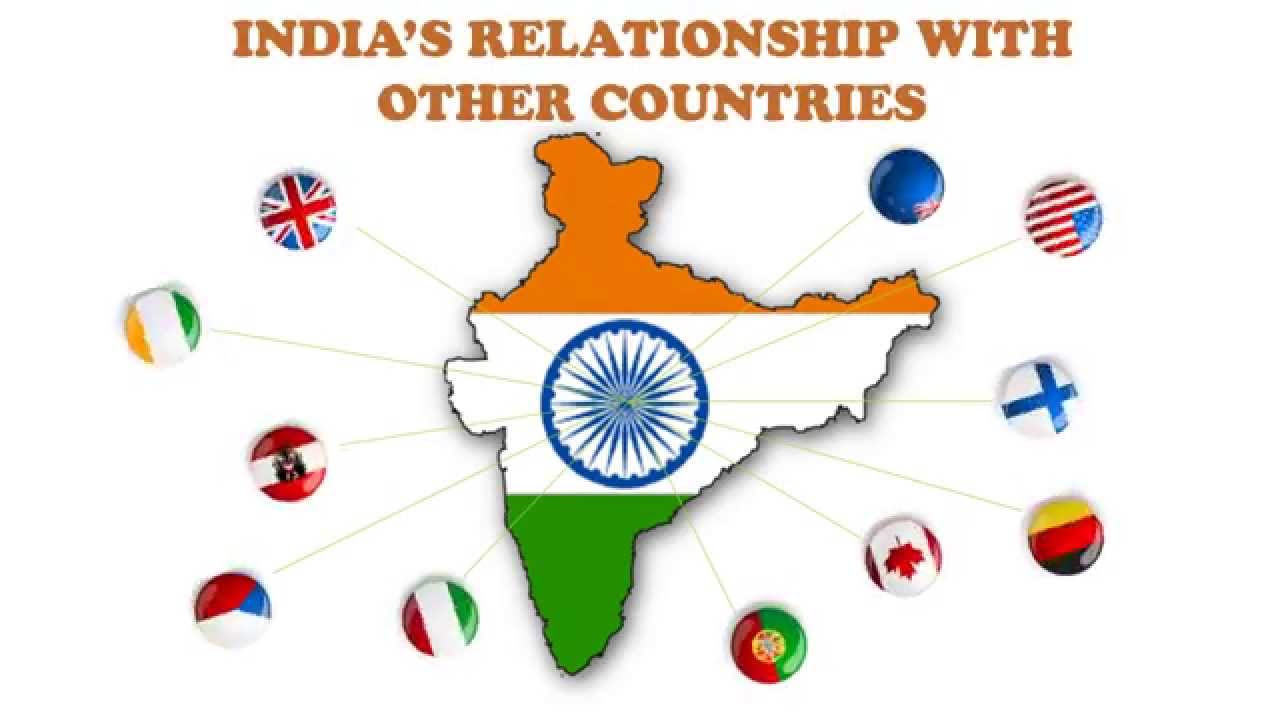
India’s Diplomacy is standing at a good potions no matter still there are many internal disputes but in the eyes of world India is at a better place. India is able to maintain relation with foreign countries in a stable and steady manner which will ultimately help the people of India. In the coming years India will be able to maintain permanent seat in UN Security Council which will be biggest achievement in diplomatic point of view.

maxresdefault

Image source: Kosha group

4) Population

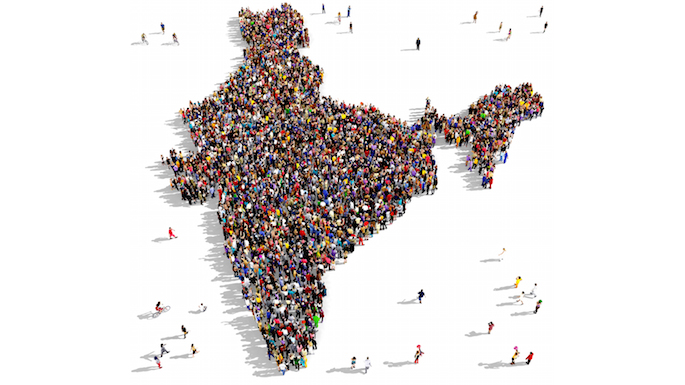
India has highest number of fresh minds, they are handled correctly with innovative and interesting education system than none of the country can stop India to be listed in top 5 countries. Youth is the biggest asset of India and no other country has this much amount of youth in their population. In the coming years, some of the strong nations of the world will face problem of decrease in populations and this will lead to, a decline in workforce, India will face no such problem.

India’s education system need to be modified a bit and student instead of memorizing theories, they should be taught to learn and understand the concept. The subject related to entrepreneurship should be added at early age so that they get knowledge of business at early age which would help them and ultimately help the nation.

1487221957_mnnhdhd9498jp534h1ctvc3aj7indian-population

Image source: Indiannewsonweb.com

5- Science and Technology

India has greatest potential yet to be showed to the world in the field of science and technology. New and new startups are evolving around us day by day and that will help a lot. Our scientist proved that India can even complete the mission on a budget of bollywood movie. India is also 4th country to land on the moon. India is emerging slowly in the field of software and will create a great impact in the near future.

creative internet computer display
Photo by Markus Spiske on Pexels.com


INDIA MOVING TOWARDS SELF RELIANCE

Progress of India towards self-reliance is governed by certain pressing issues and their timely solution to achieve self-reliance. India has succeeded in keeping the rate of spread of Coronavirus which has caused a lot of injury to the social and emotional status of the society and created obstacles for India in achieving the aim of becoming self-reliant and seek self-sustenance.

If we look back to the days when economic reforms were introduced in the 1990s that gradually brought improved result in bringing the economy on the right track and resulted in improvement in the living standards of the people. However, we could have put in more thrust on technological and related advancements. This lacuna surfaced because of the trade policy on import and export of the goods.

The Central Government is now focusing more on development of infrastructure, usage of technology to optimum, upliftment of human resources. This is the right time when India can revive the economy by bringing about some major changes in the usage of available resources with the help of penning down new methodologies.

Issues that have caused hindrance for India’s progress towards self-reliance are; keeping away from full open markets that aligned with globalization, rate of production and manufacture, China playing an indispensable role in the Indian economy, Centre-State face off in concurrent sectors particularly agriculture.

If we shift our focus towards the solutions available to us viz. the availability of trained and skilled workforce for self-sustenance, shifting the dependence of manufacturing from China to India. India has a considerable young population strength that can be trained to attract new investments from global manufacturing giants. Optimum utilization of Indian human resource can set a new trend in the global economy. India is a ground for development and also a market with a huge potential for finished goods.

India possesses relevant aspects for generating the demand and consumption of the supply which can boost Indian self-sustenance. At the same time, while striking the balance between opening more areas for investment, India needs to seek healthy competition among the local and regional level. An opportunity to recognize the scattered local expertise of the Indian people in creating hand made useful things.

Policies can be framed to give more inclination towards local innovative crafts and skills so that they survive capitalism. Increasing control over agricultural products, defence sector, public health system and developing an indigenous chain of supply will enhance the self-sustenance. Increasing transparency in government purchase system adopting global procurement standards can enhance the rate of provision of material for expecting real-time growth.

India can focus on areas where it can shoulder the leadership and invite the investors. Usage of technology for the growth of Indian subcontinent is still underexplored. The world has turned virtual and advancement towards artificial intelligence and automation is the need of the hour. Hence, it can be summed up that framing real-time policies that focus more on meeting the results and adequate pumping of resources for proper development of education sector, health sector and catering for training the human resources will take India a step closer to achieve self-reliance.

Easing out the lockdown

The World Health Organization (WHO) has declared that the rate of infection of coronavirus has increased in those countries that relaxed the lockdown at once. They have indicated that underestimating the challenges that may arise in the future needs to be taken into consideration by the stakeholders.

WHO Director-General Tedros Adhanom Ghebreyesus has said that China and Germany have reported an increase in cases after a lockdown was relaxed. Any lifting of restrictions imposed for safeguarding the people be done with proper planning and catering for the contingencies, which includes testing on priority and vigilance of the government on every development.

The country lifting the lockdown should possess enough medical potential to deal with the development of new clusters of the coronavirus. Easing out the pressure on medical fraternity is the need for time as they are under stress for the last couple of months. A gradual and firm approach in lifting the restrictions is required. Indian public health system has been doing well when we think of coping up with the coronavirus pandemic.

India needs to facilitate investment in the health system to cope with any development of the second wave. The limitations of testing can be addressed by the government on top priority to avoid any resurgence going unnoticed for a longer period. A steep rise in the infected coronavirus cases can be seen for the last three days, India is about to touch the figure of the daily rise of coronavirus infected cases to ten thousand which is a matter of concern.

Rolling out of effective plans to revive the economy amidst the spread of coronavirus after keeping a lockdown for a considerable period is understood. However, hurried opening or relaxing the restrictions may boomerang on society and can cause a huge spread of coronavirus. Social distancing measures can be converted to the law for a certain period and people breaking the same can be imposed a penalty to stay in quarantine etc. this will reduce the unnecessary burden of movement of people.

Health and survival of the people be given the topmost priority over giving impetus to economics. A steep rise in the coronavirus cases during the past week in India is a sign to the government to monitor the cases more closely. The government needs to plan an effective exit strategy for a smooth transition from a complete halt.

Workplaces that require less manpower and contribute more to the development of the economy can be opened by the government on priority rather than the opening of malls and educational institutes that may become a hub of the spread of the infection. India has succeeded in keeping the mortality rate low due to coronavirus at a bare minimum in comparison with the developed countries of the world who delayed the lockdown and suffered the loss of lives.

Migrant workers moved to their native place causing economic loss to the place from where they moved and adding to the burden of accommodating them to their native place. Unemployment is increasing in urban areas and the migration of people has carried the infection to rural areas too. Unambiguous guidelines of the government are required and center-state face-off must be avoided on political grounds by both, rather the states should support the central government in dealing with the entire scenario diligently.