COVID-19 and its effect on students career

In his prophetic Ted talk on ‘The Next Outbreak’ in 2015, Bill Gates mentioned  the great danger posed to humankind by global epidemics as compared to nuclear war. Five years later, we are right in the middle of what may be termed as the greatest global crisis since the Second World War. Covid 19 pandemic has swept the globe and is perhaps going to be recorded in history as the most impactful and consequential event of this century. It has stretched capacities of governance , public , health , infrastructure etc.

The covid 19 started out as a health pandemic, has created  long-lasting changes to the way we live and work. As it continues to spread across the globe, many countries have decided to close the schools as part of a social distancing policy. However, these closure od educational institutions has affected the education of more than 1.5 billion children and youth worldwide due to the amid pandemic situation.

1.students re-evaluating their career choices

With a lot of uncertainty surrounding future educational prospects a report says that 63% students feel that their initial career plans have been severely affected due to Covid-19, while 42% students feel that they have been forced to reconsider their preferred career choices and are thinking of having a backup plan now. The ongoing pandemic has further triggered and put question marks about travelling overseas for education. A lot of students who were originally planning on studying at an overseas university are now likely to change their higher education plans.

With the Covid-19 pandemic has  impacted student’s career plans and according to a report its  seen that careers like medicine, life sciences and allied medicine are among the top 15 careers which students are looking at pursuing. The top five career choices of students include business management, computer applications and IT, entrepreneurship, medicine and design.

2. E-learning

With all the educational institutes being  closed, its one of the biggest test of online teaching and home-schooling amid the covid 19 situation In these testing circumstances due to impromptu closure, the biggest scourge and the blessings in disguise are the online learning platforms also known as eLearning. This online learning method is catering  to the growing demands of the students in the most efficient manner. The online learning platforms have seen a spur in the number of students who are enrolling in the plethora of courses they offer. From courses on various Government sector exams, technical courses to activities like painting and even dancing there is a unceasing list that is available to the students at the most affordable price. Technology and online learning platforms have become increasingly crucial and due to this college costs could dwindle tremendously as more students will like via online methods. 

Nevertheless we cant deny the fact that this pandemic has  widen the digital divide.A country like India, which is not new to eLearning but it should be kept in mind that closures of schools are likely to widen the learning gap between children from lower-income and higher-income families. While many parents with access to technology and internet are progressively turning to online education technology to keep their kids learning at home while some may not be able to. In a recent survey from India Welfare Trust, it has shed light on how children are bearing the impact of the unprecedented outbreak.

3.Graduates facing uncertainty

  • Unemployment -Students graduating from college in 2020, will have a tougher time finding their first job, unlike your immediate seniors, and its obvious that unemployment levels three months after graduation will be higher.
  • Job first, choice later -Students will  start off fast through by making more efforts and by taking risks. Salaries may be lower by nearly 20% and students may not find jobs in their preferred domain so its important to prioritise getting any job to gain work experience and shift domains once the market improves. It is advisable that working through unpaid internships or investing  your time in family business will be beneficial
  • Digital skills– The job market always changes after a major crisis. This time, the change is an increased focus on online, technology and digital skills that enable workers to contribute remotely. Whatever your line of education be, you are unlikely to be considered unless you demonstrate comfort with digital tools in your field of work.

In this time of crisis well rounded and effective educational practice is what is needed for capacity building of young minds .

What are the options after graduation in Australia?

Many students aspire to study in Australia for their graduation across the world. Australia has world-renowned universities offering versatile programs to the students. Many of the prestigious universities are present in Australia. A large number of students take admissions in Australian universities every year for undergraduate, postgraduate, or doctoral programs. A valid question that would arise in most students’ minds is the options they can opt for post completing their graduation in Australia. Here is a detailed list of options every student has after they become a graduate in Australia.

List of options for students after graduation in Australia

  • If you are an international student living in Australia for your studies, you can return to your country. You can easily apply for jobs in your country, or become an entrepreneur. This is a legitimate option for many international students in Australia.
  • If you have completed your graduate studies in Australia, you are eligible to apply for the research fellowship programs there. You can apply for the Ph.D. programs at your university or submit your applications in other Australian universities. Once you get the offer to be a research fellow at one of the universities in Australia, you would be able to start your research under a mentor as well as teach the undergraduate students at the university.
  • If you plan on becoming a resident in Australia, you can apply for that as well. Many international students wish to stay in Australia after the completion of their graduation. You have to know the details regarding their visa program or migration program to become a permanent resident in Australia.
  • If you don’t want to become a permanent resident, you can choose to work in Australia’s suitable sectors. You can work for the educational sector or the business sector, according to your convenience. In this way, you will have experience in the market field, and with the in-hand expertise, you would be able to secure a better job anywhere in the world.
  • Many universities have excellent placement cells for the students who just completed their graduation. You can attend one of the workshops and choose your area of interest. After your interview, if you are selected, you will get the opportunity to work at one of the many companies in Australia.
  • Australia has a visa for students who wish to work and travel there. Once you are done with your graduation, you can easily apply for a visa, which will avail you one year. In this one year, you can work in Australia as well as travel in and around Australia.
  • Many students, after their graduation, plan on spending the upcoming months traveling around Australia. You can take a break and trip to the beautiful cities in Australia, and you can also decide on your plans while going.
  • After graduation, you can enroll yourself in a foreign language course in Australia. Learning a foreign language would widen your career opportunities and give you many other choices later. Also, it would be brilliant to be able to read, speak, and write in another language. After the completion of your foreign language program, you can try for various job opportunities in Australia like translator, interpreter, or working in the publishing sector.

There are innumerable choices when you think of the next step post completion of your graduation in Australia. All you need to remember is to apply for a new visa, and you can start working on the choice you made after securing your permit. Concentrate on what you want to do and how you would like to pursue your dreams after graduation. Once you are sure of your goals, it will be much easier for you to choose an option.

Are products really ‘Made In China’ ???

Made in China. We’ve become accustomed to seeing the label on products manufactured in the world’s second biggest economy. But buying one of these products in China instead of say, the U.S., doesn’t guarantee you’re getting a better price. Chinese tourists have built a reputation for being big spenders abroad, spending a whopping $277 billion in 2018, much more than any other nationality. A lot of times, people think that purchasing something in China will be inexpensive, but that isn’t always the case. So how much of a difference are we talking? If we bring four products from four popular western brands to compare. Starbucks, H&M, Adidas store, a Godiva store. To keep things consistent, we will be using 2019’s average foreign exchange rate. The products compared are:

  1. A standard black t-shirt at H&M.
  2. Starbucks Grande Cappuccino.
  3. Godiva Chocolates.
  4. An Adidas hat.

Now let’s compare:

  1. The shirt at H&M is priced nearly the same in the U.S. and China.
  2. A Grande Starbucks cappuccino will cost you $4.63 in Beijing, but in Los Angles, California, $3.95.
  3. This case of Godiva chocolates, called Pearls, is priced at $7.24 in Beijing, but only $3.95 in LA.
  4. The Adidas hat will set you back $42.27 in China, nearly double the price of a similar hat in the U.S.

This experiment has made clear that pricing are complicated. So much so, that websites have popped up like the Mac Index, a site that compares Apple product prices from around the world. So many ads for Apple here in this area. According to an analysis done by Tech Insights, the cost to make an Apple iPhone 11 Pro is $490.50. Yet according to The Mac Index, the price to buy one is $1,318 in Japan, $1,477 in the U.S., $1,658 in Mainland China and more than $2,000 in Turkey and Peru. Prices vary across countries due to factors like demand, tariffs and tax refunds. And then there’s the supply chain: the network of people, organizations, activities, information and resources involved in the creation of a product.

close up of camera over black background
Photo by ATC Comm Photo on Pexels.com

Apple’s current CEO Tim Cook is considered by some to be a mastermind in supply chain. He first joined Apple in 1998 with a mandate to clean up the company’s manufacturing and distribution. Over time, he closed factories and warehouses, instead opting for contract manufacturers in China. That’s great for Apple’s profit margins, but it’s certainly not praised by President Trump, who has asked Apple to make its products in the U.S. If, say, iPhone production was moved to the U.S., instead of China, different analyses show the price for the consumer could go up from anywhere from $30 or $40 to hundreds of dollars to even $30,000-100,000. That’s partially why, despite Apple pledging to invest more money in American manufacturing, it maintains China as its hub for making its gadgets.

american and chinese flags and usa dollars
Photo by Karolina Grabowska on Pexels.com

That’s Omar Slim, a senior portfolio manager at global asset manager, PineBridge. When you hear about made in this country or that country is really quite relative and it’s a simplification of things because it’s most likely made in a number of countries. Here’s an example. Let’s say we want to make lasagna for dinner. If Jeff cooks the ground beef and prepares the cheese, Sarah makes the tomato sauce and layers the ingredients into a pan; and Blair, who bought all the ingredients, puts it in the oven, who gets the credit for making the lasagna? Now, let’s apply that to Apple’s iPhone. While the phone might say ‘Made in China,’ some of its parts come from other parts of Asia, Europe and even the U.S. Even though an iPhone may be assembled in China, it’s still tariffed in China as a U.S. product because Apple is an American company. The brand makes that clear with by, ‘Designed by Apple in California. How they’re treated in terms of customs, they will be treated as a U.S. product. So regardless of where they come, it’s essentially a U.S. product. Same for Chinese products going into the U.S. and same for, for instance, European cars.

India simply cannot afford to boycott Made in China — Quartz India

China became a popular manufacturing hub in the 1980s after it started to open to the world. It became known for its cheap labor costs, lax regulations and business-friendly environment. As China’s manufacturing sector grew, it took the crown from Germany as the world’s top exporter in 2010. While Made in China has become synonymous with cheap and low-quality products, China is hoping to change that. In 2015, it launched a Made in China 2025 initiative, which aims to shift its economy from low-end manufacturing to high-end, high-tech products. In 2017, Tim Cook said China lost its place as a low labor cost manufacturing nation many years ago. The U.S.-China trade war resulted in a tit-for-tat increase in tariffs on many products.

Petition · Political Parties: Boycott 'Made in China' products in ...

With increasing costs being passed on to consumers, many companies are looking to diversify their supply chain, instead of being so reliant on China. That sentiment has only grown, following the coronavirus pandemic’s hit on the global manufacturing industry. Along that supply chain, there will be some companies, that instead of manufacturing it in China, if they could, they could try to replace. In fact, companies including Apple, Microsoft and Google are reportedly looking into moving some of their hardware production from China to Vietnam or Thailand. But that might be harder than it sounds. The other countries will have a hard time to compete along with the fact that the infrastructure is shown that it’s quite good, along with the fact that in certain countries would not want to compromise the relationship with China.

70 Reasons that makes us Proud to be Made In India - Sanjay Dalmia

The reality today is that a product likely has many components which are sourced globally. A phone may be designed in the U.S, but its screen is sourced from South Korea, the sensors and microchips may be from Taiwan or Germany, with its assembly in China. So, the next time you see a product with the words, “Made in China,” remember that the full story is seldom pure, and never simple.

What you need to get the best out of you.

The Goal is Not the Point

Imagine, for a moment, that your life is like a treasure hunt.

It’s not much of a leap, really. Like any good treasure hunt, you have a map to guide you. In life, the map is your corner of the universe. Some of the areas on the map you know quite well. These areas are the places and people and things that you’re familiar with and that are part of your daily life.

Other areas of the map are foreign to you. These yet-to-be-explored regions are home to the milestones in life that you can imagine reaching, but that have eluded you thus far. This undiscovered portion of the map is where your hopes and goals and dreams live. These goals are like little pieces of buried treasure that are hidden somewhere out on the map, somewhere that you hope to get to soon.

One day, a particular goal grabs your attention and you decide to set out on a treasure hunt.

Searching for Buried Treasure

You begin the long hike toward your treasure and encounter a challenge or two along the way. Already the actual path is starting to look different than the buried treasure that you had been imagining. Things get worse when you finally arrive to the spot of the treasure.

This whole time, you had been imagining a chest filled with gold. After uncovering the treasure, however, all you can find are a few scraps of silver and some antique relics. These items are valuable in their own right, for sure, but they were not what you were thinking about this whole time.

You say to yourself, “This doesn’t look like the treasure I was envisioning! I must be on the wrong path. I wasted all this time!”

After thinking for a few moments, you wonder, “Hmm… maybe I should switch goals? I bet there is bigger treasure elsewhere.”

Theory vs. Practice

I’ve certainly experienced situations similar to the treasure hunt described above. Perhaps you have too.

I’m talking about situations where the goal we were excited to pursue—getting a degree, starting a new exercise routine, making a career change—turns out to look very different in practice than in theory.

It’s natural to feel a sense of disappointment or confusion or frustration when this occurs, but I think the deeper problem is rooted in how we approached the treasure hunt in the first place.

Goals as a Compass

The problem with a treasure hunt is that most people spend all of their time thinking about the treasure. The fastest way to get to a particular spot, however, is to set your compass and start walking.

The idea here is to commit to your goal with the utmost conviction. Develop a clear, single-minded focus for where you are headed. Then, however, you do something strange. You release the desire to achieve a particular outcome and focus instead on the slow march forward.

Pour all of your energy into the journey, be present in the moment, be committed to the path you are walking. Know that you are moving unwaveringly in one clear direction and that this direction is right for you, but never get wrapped up in a particular result or achieving a certain goal by a specific time.

In other words, your goal becomes your compass, not your buried treasure. The goal is your direction, not your destination. The goal is a mission that you are on, a path that you follow. Whatever comes from that path—whatever treasure you happen to find along this journey—well, that’s just fine. It is the commitment to walking the path that matters.

New Solutions vs. Old Solutions

We have a tendency to undervalue answers that we have already discovered. We under utilize old solutions—even if they are best practices—because they seem like something we have already considered.

Here’s the problem: “Everybody already knows that” is very different from “Everybody already does that.” Just because a solution is known doesn’t mean it is utilized.

Even more critical, just because a solution is implemented occasionally, doesn’t mean it is implemented consistently..

We assume that new solutions are needed if we want to make real progress, but that isn’t always the case.

Use What You Already Have

This pattern is just as present in our personal lives as it is in corporations and governments. We waste the resources and ideas at our fingertips because they don’t seem new and exciting.

There are many examples of behaviors, big and small, that have the opportunity to drive progress in our lives if we just did them with more consistency. Flossing every day. Never missing workouts. Performing fundamental business tasks each day, not just when you have time. Apologizing more often.

Of course, these answers are boring. Mastering the fundamentals isn’t awesome, but it works. No matter what task you are working on, there is a simple checklist of steps that you can follow right now—basic fundamentals that you have known about for years—that can immediately yield results if you just practice them more consistently.

Progress often hides behind boring solutions and underused insights. You don’t need more information. You don’t need a better strategy. You just need to do more of what already works.

How Starbucks captured the coffee & the world…!!!

With nearly 30,000 cafes across the world , Starbucks has become over just a household name. From its iconic cups, often adorned with misspelled names, to the espresso inside them, Starbucks has catapulted from one coffee bean shop in Seattle to a sprawling $80 billion business over the last 47 years.

Starbucks has a 'void in innovation' and healthy beverages won't ...

Starbucks sales account for 57 percent of the total cafe market. Yes, 57 percent, nearly two-thirds of all coffee sold at cafes in the U.S. comes from a Starbucks. But this impressive expansion hasn’t come without growing pains. With more than 14,000 locations in the U.S. alone, Starbucks has spread itself too thin. Having too many stores has led to fewer transactions at individual stores. To compensate, the company has raised prices. But doing this too quickly or too often can drive customers away. So how did this happen? And what’s a coffee giant to do about it? The year is 1970.
Three college friends, Zev Siegl, Jerry Baldwin and Gordon Bowker decide to get into the coffee business. They found a mentor in Alfred Peet, founder of Peet’s Coffee and the man responsible for bringing custom coffee roasting to the U.S. He knew the coffee industry inside and out, especially the gourmet end. He was the most educated coffee guy in the country at that time. So with Peet’s help, the three friends open Starbucks, a coffee bean shop and roastery at Seattle’s famous Pike Place Market in 1971. Peet provided the young entrepreneurs with roasted coffee beans and connected them with coffee brokers until they could set up their own roastery and source their own beans. For the first decade, the founders opened five more locations in Seattle. At this point, contemporary coffee consumers might have noticed a glaring absence: actual coffee drinks. But that’s the thing about the 70s coffee culture: it didn’t really exist outside the home. There were no coffee bars nor was there much of a requirement for espresso-based drinks. You purchased coffee beans and you either took them home as beans or we ground them for you in the store. Nobody expected to urge a beverage at a Starbucks coffee store until after 1980.

Starbucks Story - CEO, Founder, History | Coffee Company | Success ...
Starbucks’ initial focus was bringing high quality beans to consumers who were more accustomed to instant or canned coffee, but that changed with the addition of one man. The company hired its first really professional Director of Marketing and Sales, and that man was Howard Schultz. And he couldn’t figure out why we weren’t selling beverages. In 1983, Schultz travels to Italy and returns with an idea: turn the coffee bean stores into cafes. Starbucks served its first latte the next year. The experiment was a success, and four years later, Schultz partnered with investors and bought Starbucks for $3.8 million. He was only 34 at the time. Schultz pursued a strategy of aggressive expansion. By the time the company went public in 1992, it had 165 stores, in 1996 it had opened more than a thousand locations, including its first international cafes in Japan and Singapore.
Growth was so rapid that, just three years later, Starbucks opened its 2,000th location. Schultz switched from CEO to Executive Chairman in 2000, at which era Starbucks operated 3,500 stores in additional than a dozen countries. Between 2000 and 2007, the number of Starbucks cafes more than quadrupled, from 3,500 to over 15,000. During this era , the corporate opened a mean of 1,500 stores per annum , including 2,500 in 2007 alone. Sales shot up from $2 billion to $9.4 billion. Consumers were increasingly ditching their kitchen mugs for these iconic paper to-go cups. But then, Starbucks hit a wall: the 2007 financial crash. That year, its rapid growth screeched to a halt and its stock price plummeted by 50 percent as cash-strapped consumers backed away from pricey coffee habits. So, Starbucks brought back Howard Schultz. This news alone caused Starbucks stock to increase by 9 percent.

Xed Knowledge
Schultz halted growth and focused on customer experience. He shuttered cafes – more than 600 in 2008 and another 300 in 2009 – and laid off around 6,700 baristas. A month after his return, Schultz ordered Starbucks to shut all of its U.S. locations for one afternoon so he could retrain more than 135,000 baristas about how to make its signature espresso. Schultz’s goal was to remind customers what they loved about the brand by making the stores an experience, not just a place to get a quick coffee. They stopped selling breakfast sandwiches and brought back in-house grinding, infusing the cafes once again with that fresh coffee aroma. Schultz even mandated the removal of automatic espresso machines. These made service faster, but removed much of the romance and theatre of watching baristas craft each cup of coffee. Schultz’s makeover worked.

Starbucks | Description, History, & Facts | Britannica
The company’s stock soared more than 143 percent in 2009 and same-store sales rebounded. Starbucks has posted positive same-store sales ever since. During Schultz’s makeover of the cafes, Starbucks barely opened any new stores. But the pace picked up again in 2012. By 2017, Starbucks opened nearly 3,000 more locations, ending the year with 28,000 cafes round the world. However, this brings us back to the first problem: profit cannibalization. Over-saturation, particularly in urban locations, has spread sales thin. Because Starbucks has numerous locations, customers do not have to be loyal to only one. So albeit Starbucks overall sales are growing, its individual same-store sales won’t reflect it. Compounding this problem are changing consumer preferences. People are shying away from sugar-laden calorie bombs. which happens to be one of Starbucks’ staples. These signature Frappuccinos contain an average of 57 grams of sugar. That’s more than double the recommended daily limit of sugar. So, to combat these problems, Starbucks is changing once more . The company announced the closure of 150 stores in 2019. That may seem like a drop in the bucket for a sprawling company like Starbucks.

Starbucks App Users Now Drive 17 Pct Of Sales | PYMNTS.com

The company’s biggest undertaking is its new line of upscale stores: Starbucks Reserve Roasteries. These massive, 20,000-square foot stores are designed to be a tourist destination. Here, Starbucks baristas and bartenders’ experiment with different brewing methods and craft new, innovative beverages. These have proven popular. In the first weeks, the Shanghai Roastery made an average of $64,000 every day, which is double what a regular cafe makes in a week.

Best sites for online education

With the evolvement of technology, the way of education has changed over time. Now we can learn diverse technologies like machine learning, Artificial Intelligence or whatnot by sitting at our home and even can pursue an online degree from well-reputed colleges. There are many sites on the web which are providing an online platform for students or employers or anyone who keenly want to learn something new. Let look over the 6 best online course provider.

1.Coursera

Coursera is an online learning platform founded in 2012 that offers enormous online courses, specializations, and degrees from top universities like Yale, Michigan, Stanford.

They offer varieties of topics such as engineering, data science, machine learning, mathematics, business, computer science, digital marketing, humanities, sciences, and even musical chapters and whatnot. Numerous Specializations operate on a subscription costing between US$39-79 per month. They even offer several free online courses and one can also apply for financial aid in the case when one cannot afford to pay to access the paid courses. The mobile app makes learning more convenient and one can earn certification at the completion of course.

2.Udemy

Udemy is an online learning and teaching platform with over 130000 courses covering surplus of a subject like programming, marketing, data science and many more with supporting 60+ languages that are really great about this online course provider. It offers 1000 of free courses same like Coursera but it’s hard to find online free course one has to go through the effort of going through courses and the effort is worthy. The List rates range from $9 to $300, but it always offers a great discount and would fit in the budget.

3.edX

Edx is one of the best free online course provider created by Harvard and MIT. It is a nonprofit organization founded in 2012. It concentrates on delivering high-quality educational content to enrich learning. eDX host university-level course on psychology, languages, computer science and much more. It offers 2,500 courses from a majority of the top-ranked universities in the globe. It also provides paid content like another online education platform.

4.Khan Academy

Khan Academy is a non-profit educational organization founded in 2008 by Salman Khan, with the purpose of evolving a set of online tools that can benefit anyone from anywhere. All of Khan Academy’s offers standards-aligned videos, articles, practice questions, and lessons which are doesn’t cost you a single penny for anyone who wants to learn. It covers subject like mathematics, Programming, Economics, Humanities. One of the perks of this online platform is that it is totally free.

5.NPTEL

NPTEL is a mutual venture by Indian Institute of Technology and Indian Institute of Sciences to bring online courses in the field of advanced Sciences and technology. It is a totally free platform but you have to pay for the certification. You can learn through online courses without opting certifications. You have to complete an assignment if you are willing to earn a certificate and pass an exam conducted by them on their located centres.

There are many more like Alison, Unacademy, Ednerds and the choice of the online platform depends on which course one wanted to opt for.

The Power of ATTITUDE💪 – Lion & Eagle

There are only two animals on the planet that the creator identified himself with the first one is the eagle and the second animal is the lion and when we study these two animals because if he is the leader of the universe and we want to be a leader on earth we need to better find out the nature of these animals and also the up attitude of those animals.

If we discover that both of them are the kings of their domain the Eagle is the king of the bird Kingdom and the lion is the king of the animal kingdom but let’s talk a little bit about the lion, the lion has the spirit of leadership and this word spirit here is referring to attitude everybody’s attitude a leader has attitude that makes him or her different from followers now the lion is the king of the jungle but the lion to is a great source of encouragement to all of us. I want you to write down this down remember this as long as you reside favorite the lion isn’t the tallest animal within the jungle number two the lion is not the largest animal in the jungle number three the lion is not the heaviest animal in the jungle number four the alliant is not the smartest animal or the foremost intelligent animal within the jungle and yet when he shows up all of them run away.

Your attitude matters in your life – Journey of life Continues
It really brings home the purpose a military of sheep led by a lion will always defeat a military of lions led by a sheep and therefore the answers thereto dilemma is that this because leadership can transform cowards into violent warriors the proper quite leadership can transform a timid into bold people that are fellows leadership is that powerful leadership can walk into a camp of depressed people on in 20 minutes. They are turned on into unbelievable powerful armies because leadership determines everything the lion is that the king of the jungle due to one-word attitude.

Attitude is Everything (@attitudetweets) | Twitter
Lion features a different attitude that creates every animal scared of him now we do not want to steer by fear but it does take respect for you to become a leader once I use the word fear within the jungle we’re talking about respect the elephant respects the lion the hyenas respect the lion they the giraffes they respect the life what makes these massive animals respect such a small cap the attitude is the difference for example, a lion will see an elephant and the thing that counts with mine one word lunch I could eat this thing and he acts the way he thinks now here’s another amazing mystery the elephant is larger, bigger, stronger, more powerful, heavier and more intelligent and yet when the elephant sees the lion one word involves mind eater attitude may be a product of belief you can’t have an attitude beyond your belief so your attitude comes from your belief system the lion is that the king due to what he believes about himself.

Academia

Academia.edu is a platform for academics to share research papers. The company’s mission is to accelerate the world’s research.

Academics use Academia.edu to share their research, monitor deep analytics around the impact of their research, and track the research of academics they follow. Over 129 million academics have signed up to Academia.edu, adding 25 million papers. Academia.edu attracts over 63 million unique visitors a month.

Guided by a mission to accelerate the world’s research, Academia.edu aims to make every academic paper ever published available for free online and accessible by anyone in the world.  Academia.edu was founded in 2008 in San Francisco by Richard Price who recognized the need for open access of scholarly work while he was a doctoral candidate in philosophy at Oxford University.

Visit academia.edu at https://www.academia.edu/

Follow Academia.edu on Facebook, LinkedIn, and Twitter

Academia’s new mobile app represents a significant breakthrough in ensuring that scholarly research reaches beyond the Ivory Tower and into the real world where its true impact can be harnessed, all through the convenience and accessibility of a simple smartphone.

Mobile app users will be able to read millions of academic papers on over two million research interests, all for free. An Android version of the mobile app will be released in the coming months.

Academia.edu announced its acquisition of peer review platform Plasmyd, with the intention of proving that the two academic startups do indeed intend to generate an industry-wide shakeup.

Plasmyd is itself a peer-review platform, that has handled thousands of scientific papers and provided a space for scientists to discuss and critique each other’s work. Plasmyd sees itself as binding its scientific search engine platform with Academia.edu’s user base (which just hit 5 million yesterday). The two companies view this as a way to begin promoting new online academic platforms. “[Academia.edu has] built the largest online community of scientists while we’ve been working on building the next generation tools of peer review,” said Plasmyd’s co-founder Adnan Akil.

Research sharing platform Academia.edu is adding an analytics dashboard in order to allow measurement of the reach of academic papers shared on the site.

The new dashboard enables researchers to see who is accessing their research and how it is being referenced, both by academics and by non-academics. This information becomes invaluable when academics need to defend the merit of new research by noting, for example, that an individual’s research is being cited in Congressional hearings, public interest press releases, journal articles and news briefs.

The dashboard is now fully available for members after previously being available in a beta form.

Metrics available for members to browse include:

  • Total profile and research views for each member’s material;
  • Information on which search engines have driven traffic to a profile page;
  • Details on specific keywords that drive traffic; and
  • Breakdowns on which countries’ citizens are viewing specific research.

One of the things that might help such profile sites as Academia.edu grow is the presence of other researchers with whom you can network and whose work you can follow, as they maintain their profiles. Communities based around particular disciplines or research groups might well form around different sites like this one. I have chosen to “follow” a couple of my colleagues on Academia.edu and it works a bit like Facebook or LinkedIn or lots of other “Web 2.0” or social networking sites in the sense that my home page tells me about the activity of the people I have chosen to follow.

Apart from networking opportunities which are reliant upon community use, researchers could use this site as a place to promote their publications and their research expertise/interests. I uploaded my papers when I set up the profile and it was interesting to see recently that someone had viewed my profile after searching for keywords that are key to the topic of one of my papers. My own papers are of niche interest to librarians, so I won’t have a lot of activity to keep track of(!), but for researchers who are keen to monitor and to be able to demonstrate impact of their research, they could do worse than to see how often people are finding out about their work and which keywords are bringing people to their profile.

I do recommend that researchers put listings of their publications on lots of sites, but rather than uploading the full text of papers to external sites like this one, I think it best to put reference details up here and link back to the WRAP repository for the full text. I recommend this because it will boost the search engine ranking of a page if there are lots of links to it from an external domain, so you can use profile sites like this one to help the ranking of your paper at the web location you prefer most. Also, it makes sense if you want to collate statistics about those who read the full text of your work if you are always referring people to one source.

HRD Minister Calls Exams Mandatory for Final Year Students

DU Exams 2020 : HRD Minister Calls Exams Mandatory for Final Year Students

The Union Minister of HRD, in an interview with the Zee News last night, addressed the speculations concerning the fate of the examinations in the universities and the colleges across the country.

The minister highlighted the formation of a UGC taskforce to receive recommendations in order to orchestrate the examinations of the graduation and the post-graduation courses. He mentioned that the students in their first semester/year of study will be entirely evaluated on the basis of their Internal Assessments. The students in their intermediate semester/year will be awarded a composite grade on the basis of their marks in the previous semester/year and the Internal Assessment marks of the present semester/year. These were the provisions for the promotion of the students to the next academic year.

The minister, however, clarified the stance on the examinations of the final year students and emphasized on the necessity of their examinations to be conducted. He said that though the examinations cannot be conducted in the month of July because of the health crisis across the country, the students will have to appear for their final examinations when the situation improves. The new academic session, he declared, will begin only after the final examinations are conducted.

GTU to conduct Examination for final year students, here’s how it will be conducted…!

GTU – Gujarat Technological University to conduct online as well as offline exams on 2nd of July. V.C. of GTU Navin Seth and V.C. of MS University Parimal Vyas raised an issue about exams and said that:

“All private universities are conducting examinations and if state universities do not conduct exams, the students enrolled with them are going to face serious repercussions for the same – in terms of not being able to go for higher study, or even bag a job. “Their competence in the time to come will be challenged.”

So, the GTU has decided to conduct examination for final year candidates.

GTU (@GTUoffice) | Twitter

“Allow universities to frame examination guidelines as per their requirement and local dynamics. The new proposed guidelines may create further issues, so the framework of new guidelines regarding cancellation of examination must incorporate the flexibility of giving autonomy to individual universities for taking the decision regarding the date, mode of examination and other related guidelines in line with the set norms of UGC,” – the V.C. said.
GTU also plans to conducts for those who have fear and lives in containment zone via online mode as well as off in the month of September-October.
We have students from 32 states. To bring uniformity in exam patterns for Gujarat, out of state and of India students, we decided to conduct online exams for all. I raised only one point and asked All India University members that they should convey to UGC that universities should be given autonomy to decide and conduct exams. No mandatory guidelines for all universities should be set for blanket implementation,” Vyas said
GTU gets 'Most Trusted State University' - Times of India
The online mode of exam will be conducted with high safety in hand on hand with varasity, and planned to conduct exams of around 1600+ students with 1 supervisor for each 15 student and the computers will be completely checked there will be no copy-paste option available as well as browsing on the internet will also be disabled for an additional security each and every 1600+ students movement will be recorded, computers will be properly sanitized before and after use.
The offline exams will be conducted for those who are willing to go for offline mode. There will only 15 students on each class and 1 supervisor for each 15 students proper distance will be allotted between each student and proper sanitation procedure will be followed up.
The timings of the online mode is 2.5 hours where as for offline mode is 2 hours with the reduced question. For different typing speed of each student differs additional half hour time is allotted for students of online mode of examination.
GTU diploma, PDDC and BPH December 2018 exam result declared at ...

Pros of mobile phones for students !

The device which you are holding right now in your hand for reading this article has changed the world. It is not only providing us with a calling facility but also something much more. Mobile phones have changed the pattern of study for students. The time when we found knowledge between the pages of books has gone now. The mobile phone has diversified the area of knowledge. In this article, we have enlisted some of the advantages of mobile phone for students.

Now let us discuss how the mobile phone has changed the lives of students. What are the advantages of the same.

  • Great source of knowledge

Whenever you got confused and you don’t get a clear idea of some topic, then at that time the mobile phone will be of great use for you. You can search for that particular topic and can get a mirror image of the topic. It also provides knowledge regarding similar topics.

  • Helps to be prompt and punctual 

The mobile phone helps in managing the data. You can manage and make notes regarding important things. Then you will not going to miss something really important. You can also set alarms with a title so that on time you get reminders for the things, that will help you to be punctual and be available on time for your things.

  • Helps in Navigation and Finding Place

Mobile phones now come with a feature known as GPS  which helps to track your location. It is very helpful for navigation purposes too. If sometimes student got stuck anywhere, at that time having a mobile phone in their hand will be bliss. They can use google map to know their exact location. Then they can inform their parents about their location and can easily reach to their places. You can also share your location with your parents so that they can know where you are.

  • Help in learning left topics

Sometimes the situation arises when students are not able to attend the classes. So if at that time teacher has taught something really important then what to do? There is nothing to worry about this. You can simply google out the topic and can get a full explanation for the same. And Yes one more thing there is not only one option or site for the topic, but there are many sites you can access according to your requirement for the same topic written by various experts.

  • Great source of entertainment

Whenever students feel bored or get tired of studying for hours and hours, at that time they can listen to their favourite music, or watch movies sitting at home itself in their mobile phone. This will help them to get rid of boredom and feel fresh. Students can also read novels or even listen to audible stories whenever they get the time or they need some relaxation. There are various apps available such as Kindle, Wattpad, Novel cat, Aldiko, etc. They can access to these apps easily. This will not only help them to overcome boredom but also help them in learning something new.

  • Introduce you to the various social media platform

Facebook, Tweeter, Instagram and many more social media platforms are available now on play store where students can make their account and get connected to more number of peoples, friends, family members which are far away. They can post their activities and can see other activities too. They can also get the latest news of Hollywood, Bollywood, and their favourite celebrities.

  • Helps in Collecting proofs

Whenever students find something black lentils or they feel some types of exploitation done to them by a teacher such as when they think teacher do favouritism to students who are taking coachings from them, and not giving deserving marks to other students. Then, they can record this and show it to a higher authority and save themselves from favouritism. Or if they feel exploitation or being bullying from other students then they can record the incident and collect evidence regarding the matter in their mobile phones and can help in catching the culprit red-handed.

  • Provides Various Apps for learning

Nowadays, there are hundreds of learning apps available on mobile phones for every standard students. They can use them in free for learning, various courses are available which helps in their skill development. They can also use a mobile phone in time when they are not having books with them. So, they can use these apps to get their course-related topics cleared. This will also save their time to wait for the books.

  • Capture the moment

Students can capture their significant and sizzling moments in their mobile phones. Students who have an interest in photography, and purchasing any professional camera is not possible for them at that time they can use their mobile phones for their passion.

  • Helps in building a bright future

Mobile phones can be used in various ways and for various purposes by the students. But everything is useless until we use it for some useful purpose. There are various apps available such as LinkedIn, Internshala, freelancer, etc. Nowadays, world is on the way of digitalization. There are various types of jobs and internships available for students on these apps. They can grab them and add something useful to their CV and to their life as well.

  • Dictionary: Improve your Vocabulary

Carrying Huge dictionary everywhere with you is really a tough task. So, now they need of lifting it is over. The mobile phone provides you with various types of offline and online dictionary such as Oxford online and offline dictionary, V-Dictionary, Color Dict dictionary, Concise Oxford Dictionary by, where you can find the meaning of each and every word you are stuck at.

  • Storage of Data

The best use of the mobile phone is that you can store huge amount of data in it. Students who want to learn something new, they can download the matter and various pdfs, documents, about the same topic and they can even take notes from their friends and teacher through WhatsApp. This will prevent making any hard copies of the topic. You can even store data for a long time and even can keep it till you don’t want to erase it.

  • Easy Money Transfer

Mobile phones are primarily used for online transactions nowadays. People sitting at home can easily transfer and receive money to someone else in just some quick steps. Students who are living away from home can use these applications such as google pay, phone pay, pay pal, Paytm and many more to receive money from their parents to submit free or for their basic expenses.

  • Online Shopping

Students can use various online shopping apps such as Amazon, Flipkart, Myntra, Nykaa, etc to get their desired and essential products at their doorsteps. This will save their time and they don’t have to roam here and there to grab things.Advertisements

CBSE Evaluation Criteria for 10th 12th Result 2020 released – Explained, how marks would be calculated

CBSE Evaluation Criteria has been released for CBSE 10th 12th Results 2020. Result for all students would be released. Here is how the marks would be calculated for the papers that were cancelled.

Central Board of Secondary Education, CBSE has submitted the assessment and evaluation criteria for the cancelled 10th 12h board examinations. The board would be awarding the students based on the papers they have attempted. For the students who have not attempted a minimum of 3 papers (especially students of North East Delhi) the results would be based on internal evaluation. Check complete notice and details here.

For students whose all papers were complete, the marks would be declared basis the performance in the examination For students of classes 10 and 12 who have appeared in more than 3 subjects, the marks for the pending subject would be based on the average marks obtained in the best three subjects For students who have appeared only for 3 subjects, average marks on the basis of the three attempted subjects would be used for determining the marks of the pending exams that were cancelled For the Class 12 students whose only 1 or 2 papers could be conducted (true for students from North East Delhi), their results would be declared basis the performance in the appeared subjects as well as the performance in the internal/practical/project assignment. These students would have an option to appear for the examination at a later date. The results of all such students, however, would be announced along with the results of all the students.

For CBSE Class 10 students (barring students from North East Delhi), all core exams of 5 subjects were completed. The CBSE Class 10 results of the students, hence would be basis the performance in the examinations attempted. All the other examinations were cancelled this year and as such the board would not be grading students on those papers.

Results would be declared by the board by July 15, 2020 for all CBSE Class 12 students, irrespective of the number of subjects students had appeared for, so as to facilitate the admissions to higher educational instituted. Marks and option to appear for the examinations at the later date would depend on the way their result is calculated.

Students who appeared for all their papers

Most of the students of CBSE Class 12 had already appeared for the papers they had opted for. For all such students, the marks would be awarded basis the performance in the examinations attempted. All such students would not get an option to appear for the examination at a later date. Their results would be binding.

Students who appeared three or more papers and 1 or 2 subjects were pending

For such students, the board would be awarding students as per the average of the best three performed subjects. For instance, say a student appeared for English, Maths, Accountancy and Economics and the Business Studies paper was pending. Now, the student scored (out of 100), 75 in English, 45 in Maths, 85 in Accountancy and 90 in Economics, then the student’s marks in English, Accountancy and Economics would be considered for calculating the average marks in Business Studies. All such students would have an option of appearing for the board exam for the subject that was cancelled when it is conducted by CBSE at a later date. Students can also choose to accept the average marks awarded by the board. However, should the student choose to opt for and appear in the examination at the later date, the marks thus obtained by the students in the examination would be considered final (even if they are less than the average score that was awarded).

Students who appeared for only three other papers

For all such students, the marks would be awarded on the basis of the average score of the three subjects appeared for by the student. For example, say the students appeared for English, Physics and Chemistry and secured (out of 100) 75, 80 and 80 marks respectively, the marks for the remaining two subjects would be given on the basis of the average of these three subjects. All such students too would have an option of appearing for the cancelled papers at the later date. Again, should the students opt to appear for the examination at the later date, the marks thus obtained would be considered final – irrespective.

Students who appeared for only 1 or 2 papers (Students from North East Delhi)

For such students, the marks would be a combination of the average of the performance in the subjects the students appeared in as well as their performance in internal assessment (practical, project, etc.). These students too would be allowed to appear for the examination at a later date to improve their performance.

IMPORTANT TO NOTE

No exams for Class 10 students would be conducted. The results thus calculated and released would be finale. CBSE Class 12 students would have an option to appear for the exams whose marks were awarded based on averages as detailed above. In such a case, the performance in the paper appeared would be considered. CBSE has not shared when the students need to share their choice for optional.It can be assumed the CBSE may provide the students the option to appear for the examination once the results are declared.

CBSE Class 10, 12 Board Exams 2020 which were scheduled for July have been cancelled. The board presented the evaluation criteria to the Supreme Court, which has in turn accepted and allowed CBSE to release the same. The notification detailed above would be released on cbse.nic.in by end of day today. ICSE Board, too, decided to cancel the pending exams. The evaluation criteria, as per CISCE Counsel, would be slightly difference from CBSE and students may be given an option too. The evaluation criteria of ICSE board would be released in a weeks’ time.

By :- Kanika

Motivational Factors that Will Encourage Student to Study Well

Climbing a mountain does not happen at once. More than 40% of high school students are chronically disengaged from their educational institutions as reported by The National Research Council.

Most probably, these children don’t realize the importance of learning, especially education . Taking under consideration it’s impossible to continue the tutorial trip without passing the initial stage, school, many modern kids fail to succeed at the first stages. It is difficult to revive later.

Visualize Yourself Taking Action
Numerous researches discovered that visualization features a strong, positive impact on the training process. Even in sports, it makes a difference to the performance of athletes. Students can be compared to those athletes as well, so it might be a good idea to visualize things for them too.

Interactive content will do:

In-class PPT presentations
Photographs and images
Videos and documentaries
Games
After-class practice
A teacher should dedicate longer to attending theatres, museums, and cinemas to let the scholars imagine particular scenarios. Vivid life examples will help to know the topic better.

As for the scholar , it’s necessary to pretend you’re already taking certain actions (e.g., writing the last page of a search paper, collecting study materials, getting enrolled in the dream college, etc.) This technique assists in accomplishing things on your list.

Remember: Even Smallest Actions Add up
Many times in our life, we can get bogged down being sick and tired of things happening around us.

Working on 10,000-word research or composition could be one among the explanations for facing stress. No teacher assigns such large assignments on the submission eve. It means every student features a few weeks or maybe months to organize the paper. Thus, if you come up with 5-10 sentences per day, you’ll manage to end the project before the deadline. Postponing it to the last minute will not help.

Right, every action adds up to accomplishing a big , long-term goal.

The best thing a student can do trying to make a strong dissertation is handling 500 words a day . If you finish earlier, it is still better than being late. Late papers result in F in 90% cases.

Writing 500 words a day will cause you to complete the project in only 20 days, and it’s but one month! Even if you propose to go away weekends aside, which will do. Remember: worry disappears in the face of action.

Keep Telling Yourself It Will Not Last Forever
Knowing that at some point the “nightmare” will end, and you’ll obtain far more freedom may be a perfect motivation. Who knows: perhaps, at some point you’ll become a manager in some cool firm, which can cause you to tell people what to try to to , and not the other way around .

Focusing and Keeping Things in Mind
Start re-reading the study materials 3 times from today. An old and really wise teacher shared this hint with us a while ago. We managed to find out some historical episodes by memory and even improved the knowledge of some languages.

You should not go into every detail – the photographic memory will help you to scan the letters and store them somewhere deep inside your head. And yes – ask questions whenever you revise the fabric and find out things that sound weird to you.

Break down the Readings Classes like World’s History or English Literature demand students to read long swathes of content. It would be easier to review by dividing the whole material into chunks of one page (approximately 500 words). Put down at least 5 questions related to the discussed topic and ask your tutor or experts to answer.

A better idea to organize the things would be involving the flash cards in the educational process. The sooner you get the answers, the sooner you will master the topic.

Cooperate in Teams
Get together with your peers to speed up the learning process. Brainstorm in groups to gather sources and find replies to the essential questions. It will also help to improve communication skills, analysis, and critical thinking.

It is impossible to write down huge volumes during one evening. Besides, the teachers shouldn’t overwhelm students with multiple homework assignments, so it’s okay to urge professional help if your teacher breaks the rule.

The cat families…Part 1

Felis catus also called house cat or domestic cat, domesticated member of the family Felidae, order Carnivora, and the smallest member of that family. Like all felids, domestic cats are characterized by supple low-slung bodies, finely molded heads, long tails that aid in balance, and specialized teeth and claws that adapt them admirably to a life of active hunting. Cats possess other features of their wild relatives in being basically carnivorous, remarkably agile and powerful, and finely coordinated in movement.

there are more than, 45 types of cat family members are present around the globe, which include the king lion, tiger, leopard, and many more. Here is the information regarding it.

1.Abyssinian:

undefined
Abyssinian, breed of domestic cat, probably of Egyptian origin, has been considered to approximate the sacred cat of ancient Egypt more closely than any other living cat. The Abyssinian is a lithe cat with relatively slender legs and a long, tapering tail. The short, finely textured coat is ruddy reddish-brown, with individual hairs of the back, sides, chest, and tail distinctively ticked, or tipped, with bands of black or brown. The nose is red, the eyes are hazel, green, or gold, and the tail tip and backs of the hindlegs are black. The Abyssinian is noted for being affectionate and quiet, though generally shy with strangers.

2.African wildcat:

undefined
The African wildcat, also called Egyptian wildcat, small, tabby like a cat (family Felidae) found in open and forested regions of Africa and Asia. Likely the first cat to be domesticated, the African wildcat is somewhat larger and stockier than the modern house cat, with which it interbreeds readily. Its coat, paler in the female, is light or orange-brown with narrow dark stripes. The length of the animal is about 70 cm (28 inches), excluding the 40-cm tail; shoulder height averages 23 cm (9 inches), and the cat weighs about 3.5 kg (7.7 pounds). The African wildcat is a solitary nocturnal hunter that preys mainly on birds and small mammals. Mating generally occurs early in the year, and a litter of two to five kittens is born about 56 days later.

3.black panther:

undefined
Black panther, colloquial term used to refer to large felines classified in the genus Panthera that are characterized by a coat of black fur or large concentrations of black spots set against a dark background. The term black panther is most frequently applied to black-coated leopard of Africa and Asia and jaguars of Central and South America; black-furred variants of these species are also called black leopards and black jaguars, respectively. Besides, the term is sometimes used to describe dark-colored bobcats, lynx, jaguarundis, tigers, and pumas, even though reports of black-colored representatives of some species, such as the puma, have not been confirmed.

4.bobcat:

undefined
Bobcat, also called bay lynx or wildcat, bobtailed North American cat, found from southern Canada to southern Mexico. The bobcat is a close relative of the somewhat larger Canada lynx.

5.calico cat:

undefined
Burmese, breed of domestic cat, presumably of Asian origin. The Burmese are a compactly built cat with a small, rounded head and wide-set, round, yellow, or golden eyes. The short, finely textured, and glossy coat darkens from a milk-chocolate color in the kitten to a rich sable brown in the adult. The underside is paler than the coat; the ears, face, legs, and tail may be darker. The tail is tapered and may be either straight or kinked near the tip.

6.caracal:

undefined
Calico cat, In North America, a blotched or spotted domestic cat, usually predominantly white with red and black patches (a pattern also called tortoiseshell-and-white). Because the genetic determination of some coat colors in cats is linked to the sex chromosome, calicoes are almost always female.

7.cat:

undefined
Cat also called house cat or domestic cat, domesticated member of the family Felidae, order Carnivora, and the smallest member of that family. Like all felids, domestic cats are characterized by supple low-slung bodies, finely molded heads, long tails that aid in balance, and specialized teeth and claws that adapt them admirably to a life of active hunting. Cats possess other features of their wild relatives in being basically carnivorous, remarkably agile and powerful, and finely coordinated in movement.

8.cheetah:

undefined
Cheetah, one of the world’s most-recognizable cats, known especially for its speed. Cheetahs’ sprints have been measured at a maximum of 114 km (71 miles) per hour, and they routinely reach velocities of 80–100 km per hour while pursuing prey. Nearly all the cheetahs remaining in the wildlife in Africa.

9.clouded leopard:

undefined
Clouded leopard, also called clouded tiger, strikingly marked cat, very similar in coloring and coat pattern to the smaller, unrelated marbled cat . There are two species of clouded leopard, which are genetically distinct from one another. Neofelis nebulosa, found on the mainland of southeastern Asia, particularly in forests and other wooded regions, and N. diardi, found on the islands of Sumatra and Borneo, are thought to have diverged about 1.4 million years ago. The population of clouded leopards declined sharply in the latter half of the 20th century as a result of hunting and deforestation. They are reported to be nocturnal and to live in trees; they prey on birds and small mammals, such as pigs and monkeys.

10.domestic shorthair:

undefined
Domestic shorthair, also called British Shorthair, breed of a domestic cat often referred to as a common, or alley, cat; a good show animal, however, is purebred and pedigreed and has been carefully bred to conform to a set standard of appearance.

11.feline:

undefined
Feline any of 37 cat species that among others include the cheetah, puma, jaguar, leopard, lion, lynx, tiger, and a domestic cat. Cats are native to almost every region on Earth, except Australia and Antarctica. They are carnivorous mammals that live in a wide variety of habitats, but they are typically woodland animals.

12.fishing cat:

undefined
Fishing cat a tropical cat of the family Felidae, found in India and Southeast Asia. The coat of the fishing cat is pale gray to deep brownish-gray and marked with dark spots and streaks. The adult animal stands about 40 cm (16 inches) at the shoulder, weighs 8–11 kg (18–24 pounds), and is from 60 to 85 cm long, excluding the black-ringed tail, which accounts for an additional 25–30 cm. The fishing cat lives near water and in jungles, reed beds, and marshes. It is reported to fish by scooping its prey out of the water.

13.flat-headed cat:
undefined
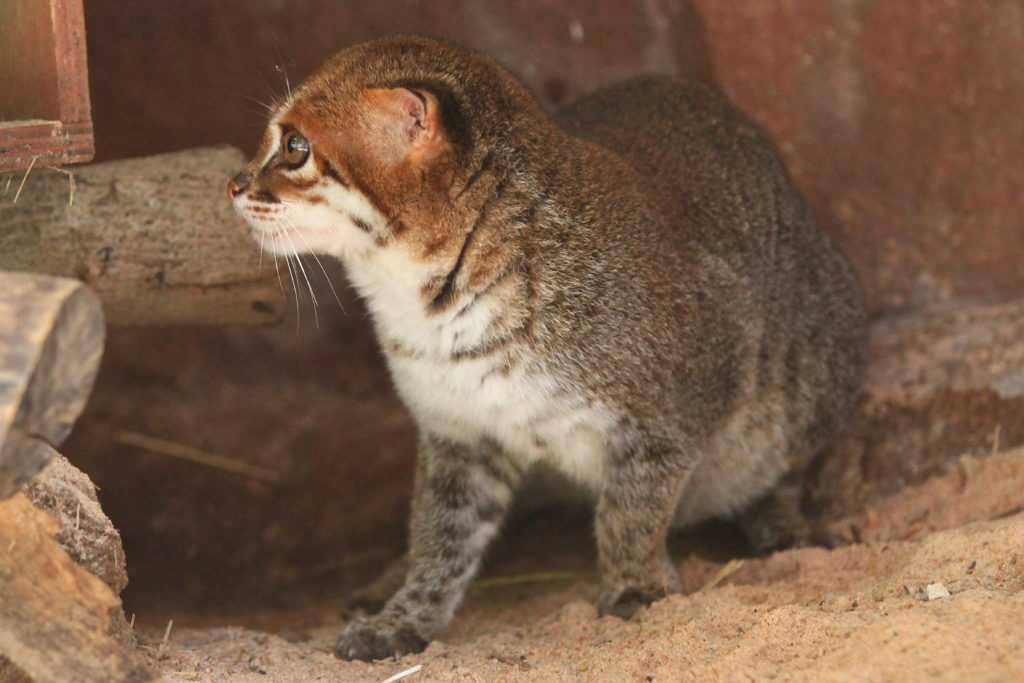
Flat-headed cat extremely rare Asian cat found in the Malay Peninsula, Sumatra, and Borneo. One of the smallest members of the cat family, Felidae, the adult is from 40 to 60 centimeters (16 to 24 inches) long without the 15–20-cm tail and weighs from 1.5 to 2.5 kilograms (3.3 to 5.5 pounds). Its coat is reddish above and white with red spots below; there are white markings around the eyes. It is the only felid known to include any substantial amount of vegetation in its diet, with a preference for fruit and, when available, sweet potatoes and similar foods. Little else is known about this cat, which is reported to be nocturnal and to hunt fish and frogs along rivers.

14.Florida panther:

undefined
Florida panther, member of a population of large New World cats belonging to the species Puma concolor, family Felidae, confined to a small, isolated, and inbred group in southern Florida. This population is the only breeding group of pumas in the eastern United States. The Florida panther was traditionally classified as a distinct subspecies of puma and was reclassified as a population of the P. concolor cougar subspecies in 2017 after genetic analysis. The Florida panther was one of the first animals listed under the Endangered Species Act when the law first passed in 1973, and it is recognized as the state animal of Florida.

15.Geoffroy’s cat:

undefined
Geoffroy’s cat South American cat of the family Felidae, found in mountainous regions, especially in Argentina. It is gray or brown with black markings and grows to a length of about 90 cm (36 inches), including a tail of about 40 cm (16 inches). Geoffroy’s cat climbs well and preys on small mammals and birds. It breeds once a year; litters consist of two or three kittens.

17.Himalayan:

undefined
Himalayan, also called colorpoint, or colorpoint, breed of domestic cat with the coloring of the Siamese and the build and coat of the longhair, or Persian. The Himalayan is produced by matings between Siamese and longhairs followed by selected breeding of the offspring to bring out the proper coloring, coat, and build. A good Himalayan is cobby and short-legged with long, soft fur, a broad, rounded head, and round blue eyes. Born cream-colored, it later develops the darker points (ears, face, legs, and tail) of the Siamese. The points, as in the Siamese, maybe deep brown (seal point), lighter brown, blue-gray , pinkish-gray , or reddish-orange .

18.jaguar:

undefined
Jaguar also called el Tigre or Tigre americano, the largest New World member of the cat family, once found from the U.S.-Mexican border southward to Patagonia, Argentina. Its preferred habitats are usually swamps and wooded regions, but jaguars also live in scrublands and deserts. The jaguar is virtually extinct in the northern part of its original range and survives in reduced numbers only in remote areas of Central and South America; the largest known population exists in the Amazon rainforest.

19.jaguarundi:
undefined
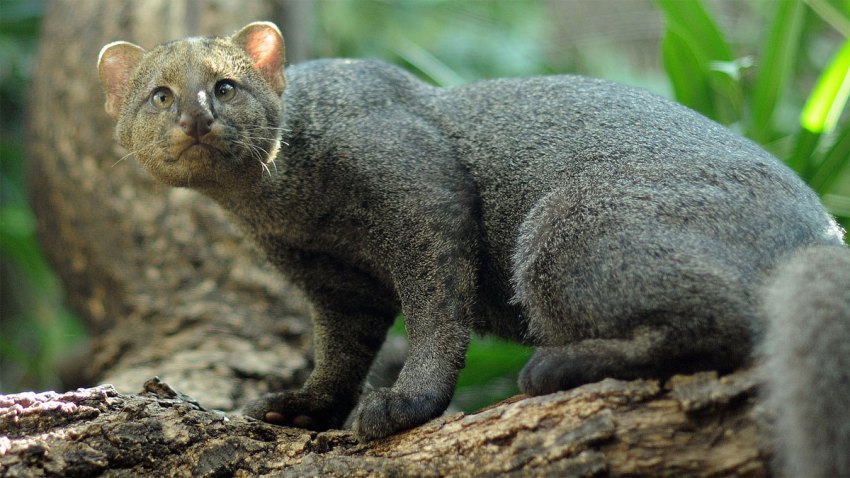
Jaguarundi, also spelled Jaguarondi small, unspotted New World cat (family Felidae), also known as the otter-cat because of its otterlike appearance and swimming ability. The jaguarundi is native to forested and brushy regions, especially those near water, from South America to the southwestern United States; it is, however, very rare north of Mexico.

20.leopard:

undefined
Leopard also called a panther, large cat closely related to the lion, tiger, and jaguar. The name leopard was originally given to the cat now called cheetah—the so-called hunting leopard—which was once thought to be a cross between the lion and the pard. The term pard was eventually replaced by the name leopard.

21.leopard cat:

undefined
Leopard cat forest-dwelling cat, of the family Felidae, found across India, Southeast Asia, and nearby islands. The leopard cat is noted for its leopard-like coloring. The species is generally divided into one mainland subspecies, P. bengalensis bengalensis, and several island subspecies—including P. bengalensis borneoensis in Borneo, P. bengalensis Heaney on Palawan, P. bengalensis rabori on the Philippine islands of Cebu, Negros, and Panay, P. bengalensis javenensis on Bali and Java, and P. bengalensis sumatranus on Sumatra and Tebingtinggi.

22.liger:
undefined
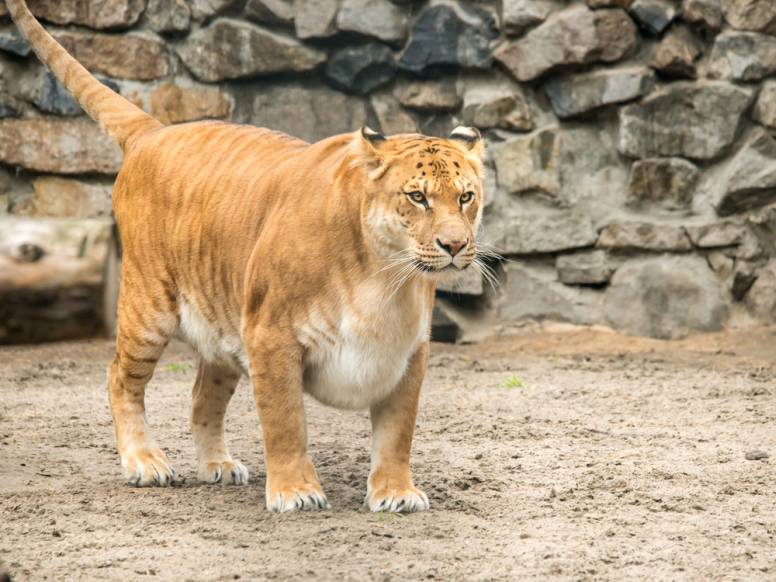
Liger, offspring of a male lion and a female tiger. The liger is a zoo-bred hybrid, as is the tigon, which is the result of mating a male tiger with a female lion. The liger and the tigon possess features of both parents, in variable proportions, but are generally larger than either. It is thought that most, if not all, male ligers and tigons are sterile. The females, however, on occasion, may be able to produce young. The terms liger and tigon are portmanteaus of the words lion and tiger.

23.lion:

undefined
Lion is large, powerfully built cat that is second in size only to the tiger. The proverbial “king of beasts,” the lion has been one of the best-known wild animals since the earliest times. Lions are most active at night and live in a variety of habitats but prefer grassland, savanna, dense scrub, and open woodland. Historically, they ranged across much of Europe, Asia, and Africa, but now they are found mainly in parts of Africa south of the Sahara. An isolated population of about 650 Asiatic lions constitutes a slightly smaller race that lives under strict protection in India’s Gir National Park and Wildlife Sanctuary.

24.longhair:

undefined
Longhair, also called Persian, breed of domestic cat noted for its long, soft, flowing coat. Long-haired cats were originally known as Persians or Angoras. These names were later discarded in favor of the name longhair, although the cats are still commonly called Persians in the United States. The longhair, a medium-sized or large cat with a cobby , short-legged body, has a broad, round head, a snub nose, and a short, heavily haired tail. The large, round eyes may be blue, orange, golden, green, or copper-colored, depending on the color of the cat. The soft, finely textured coat forms a heavy ruff about the neck.

25.lynx:

undefined
Lynx, (genus Lynx), any of four species of short-tailed cats found in the forests of Europe, Asia, and North America. The Canada lynx and the bobcat live in North America. The Eurasian lynx and the Iberian lynx are their European counterparts. The Iberian lynx is the most endangered feline; as of 2013, possibly fewer than 300 individuals remained in the mountainous scrubland of southern Spain.


Coming together in COVID-19

Since the dawn of civilization, epidemics and pandemics have continued to haunt mankind. From the outbreak of Spanish Flu to Yellow fever, history of these pandemics dates back to the time of plague in Athens (430 B.C).But perhaps; COVID-19 (spread by SARS-COV-2 virus) is greatest in the history of mankind. This particular virus has brought entire world to a halt, something that the modern world history hasn’t witnessed before.

The virus, whose roots can be traced back to Hubei Province in China, has spread globally causing the infected number of cases rising over 92 lakh. From the Superpowers to third world countries, this virus has brought down healthcare sector, economies and the entire human race on its knees; India being no exception. Yes, various sectors such as healthcare, education, energy, and logistics have faced a serious crunch amidst lockdown. With the global economy shrinking to an all time low, economists predict a depression like situation in the near future. One might question whether we are heading towards an inevitable crisis? Or is the humanity doomed? Such negative thoughts do more harm to us than the virus itself.

Just like all other major turmoil and struggles, COVID-19 too comes with its own share of lessons and learning for the mankind. Lessons in humility, humanity and gratitude. These simple lessons which we had long forgotten in the rat race for materialistic pleasures.  While some countries initially played the “blame game” but very soon they realized that the mightiest weapon in combating the virus lies in unity and mutual co-operation. Shunning the geo-political differences, the SAARC countries came together and contributed to the COVID-19 relief fund. Other stories include those of Hindu-Muslim harmony in Telangana where a group of Muslim men performed the last rituals of a Hindu woman in the middle of lockdown restrictions. This virus has brought out heart warming stories of real heroes to the forefront. From the generous acts of donating her education savings by 13 yr old Nethra of Madurai, few Jamatis voluntarily coming forward to donate plasma serve as a ray of hope in these turbulent times.

Despite the social distancing, humanity is coming closer than ever before with a mutual sense of compassion, empathy and concern towards fellow human beings.  While we stay hidden indoors amidst fear, the mother earth is breathing back to life. Those little sparrows playing in my balcony, which I hadn’t seen in a long while, are a living testimony to that. The medical staff, sanitation workers and the COVID warriors whom we once took for granted are risking their lives to save ours. What else could be a nobler act than this!

The corona virus has indeed enabled us to look beyond economic differences. Becoming more sensitive and considerate towards our domestic helps. We’ve begun appreciating simple acts of kindness, engaging in deep conversations with our loved ones and clapping to say “thank you”. Our generation is more enlightened than ever before with the realisation however evolved the human race might become but in the end we’ll only remain a tiny spec in the universe. The forces of natural world are far mightier than we could possibly become. Humans may change the course of nature but can’t defy it.

The Chinese symbol “Ying and Yang” illustrates the philosophy of life beautifully. Life flows when energies complement rather than contradict each other. The mankind and nature must maintain balance for life to exist .The day we try to overpower the forces of natural world; it will only take a single microcosmic organism to perish the entire human race.

Yin and yang: business and IT | CIO

No, I’m not implying living in a utopian world and becoming ignorant of this deadly virus .True that our healthcare and education systems have failed required to meet necessary standards. But if it wasn’t for COVID-19, these loopholes might have gone neglected. There is no better time to reshape the economy, healthcare, politics and culture than now for the dawn of new world post COVID-19.

But why did it take a virus for this realisation?

Because sometimes we need to get sick in order to get better”.

Let’s change our outlook towards this pandemic. Instead of perceiving it as a threat we need to see it as opportunity and emerge stronger than ever before. We are a fortunate generation having the privilege to shape a better world than the one we left behind. All we need is to shed stigmas and embrace this change.

Concluding in the words of Yuval Noah Harrai (bestselling author of Sapiens)

“The storm will pass, humankind will survive, most of us will still be alive –but we will inhabit a different world.”