A society that can breach the stereotype in India .

I never feel confined by gender, by labels, by expectations, by stereotypes. I’m free to be myself.

Princess Nokia

Introduction

During the last two decades it is said that to be a women is the most precious gift a human can have . To be able to give birth to another human being that lives inside precisely 9 months at most .

But their is another dispute that a women can only be a insider . That can fulfill the needs of the dominant society.

Isn’t these two statements are contradictory. In first one a women is a precious gift and in another she can only fullfill one’s needs but only in four walls .

Aren’t they human or a thing that can only live under the roof of men for living ?

Women have always played an important role in the society . Even in the ancient times , they were considered as an equal with the men . So what change , the air , the water , the life style or the mindset . We can also say that the stereotype mindset in society .

Years and years before people grew their ego and think about their individual benefits. Women lead life with virtue , wisdom and respect .

When it start

It was all not same as it was now , their were times when women rule the nation . But due to the foreign invasion , women suffer immensely . At the mediaeval times , women came to be confined within the four walls of the house .

Mediaeval period also known as ‘DARK AGE ‘ as very few women’s were found to be a ruler at that period . It was the period when women brought to the deeds where they made to be inferior to men .

They were raped and brutally killed by the demons who think they can dominate them .

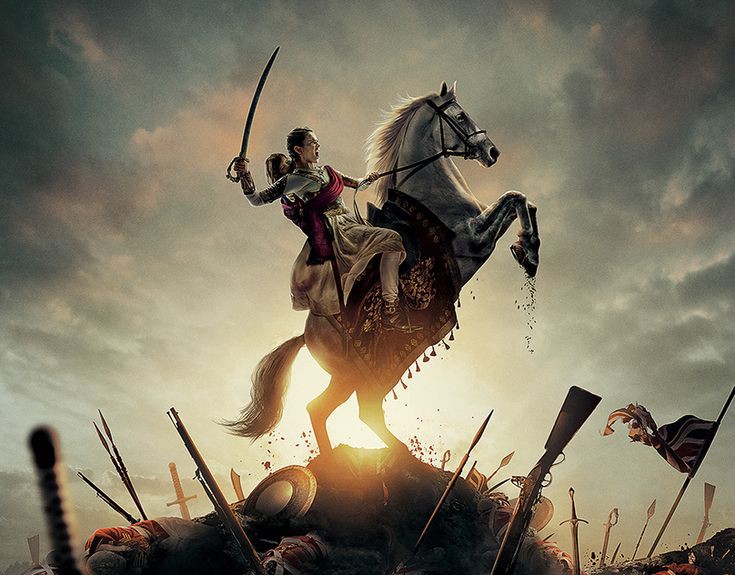
Rani Padmavati, Jodha Bai, Gulbadan Begum, Nurjahan, Jahan Ara , Mumtaj Mahal, Razia Sultan , Jija Bai are some of the women who fought for their right , safety , people , family and love also saved many .

“And one day she discovered that she was fierce, and strong, and full of fire, and that not even she could hold herself back because her passion burned brighter than her fears.”

– Mark Anthony

Modern era

It’s a century of love , reliability , equality and most important individuality .

Then why women are always compared to the men . Why they questioned when they are innocent . ( Well not all are innocent and victim , just for those who are ) .

I do believe that men and women are different . Their differences doesn’t make them weak . It’s just a perspective and view of people that make them vulnerable .

But do women care , it’s their own life not to say that anyone means ANYONE can come and stamp their ‘so called ’ rules on them . Not against the male gender but to those who think they can dominate and lock them in four walls .

Not to say, if women lock men in four wall room . So what will happen to them . Umm. Let’s think , they run like a horse at the time when the room unlocked .

If OJO -MOJO can’t stay in their rooms can’t OLLE do the same . Yes she can , also kick their humpy dumpy bum.

Let’s end the topic and eat some more . It’s a 21st century donot let someone walk on you , you can stand for yourself .

“Don’t let anyone speak for you, and don’t rely on others to fight for you.”

– Michelle Obama

This editorial is written under one’s perspective . Neither against any gender nor in favour .

GENDER? No, we aren’t supposed to impose it at birth.

The above statement may appear intriguing to some, but that’s what we need to do, at least in 2021. Even today, majority of the world population is not aware about the distinction between ‘sex’ and ‘gender’.

Gender is something that is most often thrown and forced upon us according to the sex we received at birth. We are told to act, dress and behave in a certain way. In more simple words, ‘sex’ is what nature has given us at birth, for example, ‘female’ and ‘gender’ is something that we identify ourselves with as we grow up, for example, ‘woman’.

In this way, we can say that gender is a social construct, that is, gender is a human made concept while sex is a naturally grown system we have on our respective bodies since our birth.

It is also important to note that gender is variant and we would be doing injustice to the gender minorities like agender, non- binary and gender fluid people if we overlook them.

Moreover, we should also keep in mind that, lack of awareness regarding the difference between ‘sex’ and ‘gender’ is one of the main reasons of patriarchy. As mentioned above, since our birth we are expected to behave in a certain way. For example, when a male child is born, we expect them to be tough and physically strong and compare them with wild tigers and lions while when a female child is born we expect them to be soft and pleasant like an angel.

Another example could be, male toddlers are gifted guns and cars whereas female toddlers are gifted doll houses and ‘kitchen sets’, because from the beginning only we have this sexist notion ingrained in us that the male child will grow up and ‘earn’ the bread while the female child will ‘bake’ the bread.

‘Sex’ and ‘gender’ are most often used interchangeably and this also contributes to patriarchy, in fact it shows how patriarchy is deeply ingrained in us. Some of us indulge in patriarchy without even knowing it.

Patriarchy may favour males but it is beneficial to no genders in the world. In global context, gender expressions like ‘feminine’ stereotypically means one needs to be loving and
caring and ‘masculine’ stereotypically means one needs to be daring and challenging. Now here comes the problem- for example- a male who has ‘loving’ and ‘caring’ characteristics and identifies himself as a ‘man’ suffers due to these socially constructed ideas of being ‘masculine’. Similarly, a female who has ‘daring’ and ‘challenging’ characteristics and identifies herself as a ‘woman’ has to suffer due to the culturally made concepts of being ‘feminine’.

Another interesting thing is to note that if a man identifying male has some stereotypically feminine characteristics like caring, being soft and submissive, they are trolled and if a woman identifying female has some stereotypically masculine characteristics like daring, being loud and dominant, they are praised. This proves that the patriarchal world we live in hates femininity and just loves masculinity.

If a man celebrates his masculinity, he is praised but if a woman celebrates her femininity, then she becomes inauspicious for the society. It is important for us to note that femininity and masculinity is subjective and depends on person to person.

INDIAN CULTURE

We respect and honour our Indian culture a lot. India is a famous country all over the world for its culture and tradition. It is the land of various culture and tradition. It is the country of oldest civilizations in the world. The vital components of the Indian culture are good manners, etiquette, civilized communication, rituals, beliefs, values, etc. Even after the life styles of everyone has been modernized, Indian people have not changed their traditions and values. The property of togetherness among people of various cultures and traditions has made India, a unique country. People here live peacefully in India by following their own culture and traditions.
People beliefs and follow various customs and traditions according to their own religions. We celebrate our festivals according to our own rituals, keep fast, take bath in holy water of Ganga, worship and pray to God, sing ritual songs, dance, eat delicious dinner, wear colourful dresses and other lots of activities. We also celebrate some National festivals by getting together such as Republic Day, Independence Day, Gandhi Jayanti, including various social events. People of different religions celebrate their festivals in various parts of the country with great zeal and enthusiasm without interfering each other.
Variety of eras came and gone but no one was so powerful to change the influence of our real culture. The culture of younger generations is still connected to older generations through umbilical cord. Our ethnic culture always teaches us to behave well, respect elders, care helpless people and always help the needy and poor people. It is our religious culture that we should keep fast, do worship, offer Gange Jal, do Surya Namaskar, touch feet of elder in family, do yoga and meditation on daily basis, give food and water to the hungry and disabled people. There is great culture of our nation that we should always welcome our guests like a God very happily, that’s why India is famous for a common saying like “Atithi Devo Bhava”. The basic roots of our great culture are humanity and spiritual practices.
Festivals play an important role in Indian culture and tradition. People from different religions celebrate different festivals in India. Popular festivals like Diwali, Dussehra, Navratri, Janmashtami, Shivratri, Ganesh Chaturthi, etc. are celebrated by Hindu people in India. Whereas Eid-ul-Fitr, Bakrid, Muharram, etc. festivals are celebrated by Islamic people in India. Other than this, many harvest festivals like Makar Sankranti, Chapchar kut, Pongal, Sohrai, etc. are celebrated by farmers.

However, Christians also celebrate Christmas, Good Friday, etc. festivals in India. There also exist different regional festivals in each state of India like Teej, Onam, Ugadi, Saraswati Puja, Panna Sankranti, Chhath Pooja, Pongal, Lohri, and so forth.
Indian Costumes are different for the different states of India. It varies depending on the origin, climate, and heritage of the place. Indian culture still follows traditional costumes. In eastern states such as Odisha, West Bengal and southern states like Tamil Nadu and Karnataka, women wear saree as the authentic clothing. It is a single and long fabric piece draped around the body.

In a similar way, men wear Dhoti-Kurta or Kurta-Pyjama as the authentic clothing in eastern states. In northern states like Punjab, women wear salwar kameez and Kurti as traditional clothing. Whereas men wear headgear or turban known as the Dastar as the traditional clothing. In India, all the married Women wear Sindoor, a vermilion powder in the parting of their hair. They also wear bindi, Mehendi, bangles, and earrings as part of their attire.
India is a land of rich culture and tradition which teaches people kindness, generosity, and tolerance. Indian culture differs from place to place as it is a multilingual, multicultural, and multi-ethnic society. Indian culture is a unique blend of modern western culture and historical traditions. India is a country of great legends where many great people were born and remembered forever due to their sacrifice for the nation. People across the world come to enjoy and feel the culture and tradition of India. India is well known for its “UNITY IN DIVERSITY “, across the world. That means India is a diverse nation where many people live together peacefully having there own different cultures.

equity not manhating

Feminism is just another word for equality. As we all know feminism is being criticized on favoring women over men. It means mass empowerment. It’s  men being aware of the need for women empowerment. All sexes being treated the same under the same roof. Being independent irrespective of whatever you are. No matter what sex, race, religion, caste, creed, status anyone is they all have the same right to enjoy the facilities provided. Who says feminism is just women empowerment? It is the collective empowerment of the people.  It’s the word that stands proudly against inequality and injustice. It is the key to freedom and individuality.

“Feminism is the radical notion that women are human beings.”

 Cheris Kramarae

Speaking about my country, it’s far below in feministic thoughts. As I have already mentioned, most people thinks it as something against man. This is just because of the misconception prolonging on the very word. There was one incident where a famous television show anchor said that she supports equality but not feminism. How pathetic isn’t it? Its high time human beings define the word perfectly. Women are still below in many areas. Decisions in women’s lives are still made by men either husband, father or their own sons. The complexity of the statement kills itself. And to my surprise there are a large percentage of women those nurture themselves as well their children to stay under men in all aspects of life excluding sacrifice. At the same time I shouldn’t be neglecting the fact that seeds of changes are sprouting in the desert.

anti sexist movement
Anti-sexist movement spreading throughout the world

Furthermore, I have seen people opposing feminism as disapproval of the idea of women and men are the same. Women and men aren’t the same and the very prospect of feminism isn’t sameness, rather it is equality. Sameness means look alike but equality isn’t look alikeness its equal say and being treated the same. Empowerment isn’t women-only term as life isn’t for copulation only. As a conclusion, I would like to quote that development isn’t possible without feminism. 

Decline of Political participation of Females in India

Since the beginning of rebellious movements against the oppressive British regime in 19th century, women have played an integral part in freedom struggle in India. From Rani Lakshmibai in 1857 to Mantangini Hazra in 1942, women have always upheld the patriotism and love for their nation.

Sarojini Naidu, an Indian political activist, joined Indian Independence movement back in 1905 and later became the Governor of Uttar Pradesh in Independent India, making her India’s first female Governor.

In the post independent India, prominent freedom fighter Sucheta Kriplani became the first female Chief Minister of India for Indian State Uttar Pradesh. In 1966, Indira Gandhi became the first female Prime Minister of India.

But if women participated in Indian politics and independence movements so actively at a time when women weren’t even allowed to walk out freely, why do we see a sudden decrease in participation of women in Indian Politics in 21st Century?

In 1990s, there were about 6 sitting female Chief Ministers in India and in 2021, there is only one sitting female Chief Minister in India, that is, Mamata Banerjee in West Bengal. Let us see the reasons behind lack of participation of females in Indian politics.

Assault on Indian female politicians:

India holds a bad history of torture, discrimination and hostility towards female politicians. From Ms. Jayalalitha who was brutally assaulted in late 1980s to Ms.Mayawati and Ms. Mamata Banerjee who were assaulted ruthlessly in mid-1990s proves that Indian Politics has never been safe for women. These female politicians were assaulted especially by male chauvinists to intimidate them for being a woman and raising voice in politics. These assaults discourage women in India to join politics.

Indian Political Parties are Male-dominated:

Unless a political party is formed by a female, all other political parties be it left, right or centre are by nature male-dominated in India. Females are not given powerful positions in these parties which further lower their self-esteem and this influences other women negatively to not join politics.

Systematic Sexism in Politics:

Even if women are given political positions, they are mostly given those positions that are stereotypically considered “womanly”. Women holding positions are also often harassed by male politicians. Women who want to hold more prominent positions thus get discouraged. Although some things have changed in recent years where we have seen women holding powerful positions in Defence and Finance Ministry, still a lot more has to be done.

Patriarchal Society:

This is a bitter reality that our male-dominated society doesn’t love “dominant female leaders”. For instance, when in 2019, two Female MPs from West Bengal wore a shirt and jeans, they were criticised and shammed for wearing western whereas so many male members in Parliament wearing jeans wasn’t an issue. The fear of getting judged by the society also discourages women to join politics.

What can be done to improve the situation?

First and foremost, we should make a safe political environment for women and listen to the issues they face in politics. Second, society and the government must have a feminist approach so that women come out and lead political movements. And lastly, although India has women friendly laws, these laws aren’t implemented and thus proper implementation of these laws must be done, for example, taking strict action against male politicians who make misogynistic statements, abuse women and like.

Being in the imagination or live in the realistic world .

Being born in money or torn away by poverty is the world where we live

The Hallucination

Are the money makers living their life without fear ?

Can a poorer get to live more life than its fated ?

Will you ignore the one who hurt you immensely ?

Or like a coward , can you run from the truth ?

If yes , than pray to god for providing you such an imaginary world . Don’t take it seriously but you really need to wake up .

The Truth

The life that we are living is not a game to play . We need be realistic while taking decisions in our life . I don’t want to sound like an arrogant person . But we need to think before taking any decision because it may or may not harm our future . In our life we only focus on materialistic things and grow accustom to them . Which leads to the situation where we become selfish and fiercely jealous to one’s personality .

We judge them regarding to their status , money , power , clothes and their physique . Ding ding …. It’s time for the truth we become impetuous .

So what we learn from OJO -MOJO . 1. Like OJO that donot study and fail in your class. OR 2. MOJO that learn workhard and get award from the school . I choose options 1 (hehe don’t get any ideas I am a hardworker so I will choose my handsome MOJO not an overconfident OJO )


The REALITY

Not against the world of imagination just a believer of reality .

Life is not easy I agree with you but can we make it easy , Is the question only you can answer .

For me , we can only when we are focusing on our work rather than its result . I am not repulsive about getting a promotion on my first day on the work . But I am excited about learning new things and improve my capabilities . That how we need to react . I didn’t get the idea of getting a luxurious jet when I didn’t even have a penny to spend on my health . Well if you can just don’t forget to take me as well ( Huh.. greedy me ) .

I do imagine my life being in the island with some hot people around me ( its a wild imagination) . Well I can’t change that . But what I can change is the accept the reality ( like sitting in my PJ’s , eating popcorn and drooling over Michele Morrone yeah I am fan of 365 days ) .

Conclusion

Life is a series of natural and spontaneous changes. Don’t resist them; that only creates sorrow. Let reality be reality. Let things flow naturally forward in whatever way they like.

Lao Tzu
things that are written in the blog is my perspective of life . i am not taunting anyone . 
its your life you can live according to your rules .

and yes pictures that i used in the blogs are from pintrest .

enjoy your reading .

Feminism In History

Sita Devi, Malala Yousafzai, Arunachalam Muruganantham, Justin Trudeau, Jim Parsons – they have one thing in common – Feminism.

Equality is like gravity. We need it to stand on this earth as men and women, and the misogyny that is in every culture is not a true part of the human condition.

Joss Whedon

A whole lot of us choose not to be called feminists due to the envelope of wrong teachings of ancient patriarchy. Despite standing for nothing but inclusivity and equality, it is seen as a gimmick to assert the dominance of women over men, something that it is just “anti-men.” This is the root cause of the negative connotations attached to feminism. Years of wrong, limited portrayals in the media have stereotyped a feminist as the one uncouth woman who drinks, smokes carelessly, abuses shamelessly, does not understand the need to get married, hates pink, and loathes men. That is definitely not what feminism specifically stands for.

lindgrensmith.com

The movement has made a ton of heads turn and as it forged ahead, feminism reached the level of cultural relevance that it hadn’t been subjected to in years. Now, a major item of cultural discourse, it has definitely led to the ‘clear as mud’ conversations as quite a lot of the population was unaware of the basic terminology of feminism.

One can’t give a single definition to the word ‘feminism’, but in short, it signifies putting a full stop to gender discrimination and focusing on gender equality. There’ve been different types of feminism that’ve come into the picture. Instead of describing them separately, feminism was divided into different phases based on the timeline called the “waves of feminism.” You might think that this history is a straightforward arc. The reality is that there are many sub-movements building on (and standing against ) each other. That being said, the wave metaphor serves as a good starting point. It doesn’t tell the whole story, but it helps outline it.

The First-wave feminism of the early 1900s had a fairly simple goal: have society recognize that women are humans too, not property. However, it only focused on the privileges and freedom of white women primarily.

The Second-wave feminism of the 1960s, built on first-wave feminism challenged women’s roles in the society. Traditional gender and family roles were questioned and the theory of Queer population was more in discussion. Women were now given access to male-dominated spaces, promoting equality. The system was questioned of being inherently patriarchal and that only an overhaul could liberate women.

While first and second-wave feminism had largely neglected racial disparities within gender, the Third wave brought attention to it. The term ‘intersectionalism’ was brought into the picture – how different kinds of oppression – like those based on gender and race – intersect with each other.

Social media has lobbed the movement into the technological age. The fourth wave emphasizes on inclusivity and trans rights are a big part of the conversation, too.

Half-knowledged people say that the misogyny faced by women today is idealized by Sita who faced similar things in her life too. The despotism tolerated by Sita has set a baseline for torment in our culture for the women to follow today. However, this is untrue. The truth had just lost its translation. She had her own fight against the patriarchal world but she rose above her status to show free will and courage to stand up against injustice. In the end, she stopped looking for any saviour and reclaimed her honour and defied what she thought was wrong.

Feminism does not associate itself only with equality of women. It addresses the issues of caste, race, disabilities, and more. By the same token, it works to liberate men from the toxicity of society. It serves as a means to uplift marginalized people who were denied equality historically. Hence, trying to shun it by using the concept of ‘equalism’ would be like overlooking the centuries of trauma and injustice. Its aim now is fighting kyriarchy ( a social system or set of connecting social systems built around domination, oppression, and submission) as well.

It’s the perception of feminism that needs a change. The only bad guy here is the structural oppression which affects every person – man or woman, in some way. A man tied in the shackles of patriarchy needs a voice too and that’s the perk of feminism. It is time to stop looking at it in the wrong light as it would only drive you away from the reality of intersectional problems.

Yoga!

Yoga Sanskrit: योग; Sanskrit for “yoking” or “union”, is a group of physical, mental, and spiritual practices or disciplines that originated in ancient India. Yoga is one of the six orthodox philosophical schools of Hinduism. There are a broad variety of yoga schools, practices, and goals in Hinduism, Buddhism, and Jainism and there are four paths or types of yoga: Karma yoga, Kriya yoga, Bhakti yoga, and Jnana yoga. Research studies have shown that traditional yoga systems that include breathing exercises and asanas or postures, chants, and meditation can reduce stress and improve immunity and lung functions. Traditional forms and modern methods of yoga are practiced worldwide.

The practice of yoga has been thought to date back to pre-vedic Indian traditions, possibly in the Indus valley civilization around 3000 BCE. Yoga is mentioned in the Rigveda, and also referenced in the Upanishads, though it most likely developed as a systematic study around the 5th and 6th centuries BCE, in ancient India’s ascetic and Śramaṇa movements.

The chronology of earliest texts describing yoga practices is unclear, varyingly credited to the Upanishads. The Yoga Sutras of Patanjali date from the 2nd century BCE, and gained prominence in the West in the 20th century after being first introduced by Swami Vivekananda. Hatha yoga texts began to emerge sometime between the 9th and 11th century with origins in tantra.


Yoga gurus from India introduced yoga to the West following the success of Vivekananda’s adaptation of yoga without asanas in the late 19th and early 20th centuries. The term “yoga” in the Western world often denotes a modern form of hatha yoga and yoga as exercise, consisting largely of the asanas. Outside India, it has developed into a posture-based physical fitness, stress-relief and relaxation technique. Traditional yoga, however, includes physical exercise, meditation, and spirituality. Yoga has its own epistemological method, which assumes the ontology and metaphysics of the closely correlated Samkhya darsana.

In this today’s world it’s so difficult to spend our time and go to gym and take a diet and etc etc. But yoga is formed to pe in a peace of mind where we are not just physically but we are mentally fit too.

MENSTRUAL HYGIENE: A CHALLENGING DEVELOPMENT ISSUE


Menstruation is still now a social taboo in Indian Society.The major reasons behind menstruation still being a taboo in the Indian society are illiteracy, poverty and lack of awareness.

WHAT IS MENSTRUATIONS?
The blood coming out from vagina normally occurs as part of a woman’s monthly cycle called menstruation or periods. Every month, our body prepares for pregnancy. The uterus, or womb, sheds its lining in case of no pregnancy . The menstrual blood is partly blood and partly tissue from inside the uterus. We can say that periods are the onset of puberty in girls. During this time a girl goes through several physical and psychological changes in her body. It is associated with bleeding along with stomach ache , nausea as well as mood swings.
After the onset of puberty , it brings various rules, restrictions, isolation and changed expectations in the girls life by the society. These changes in attitude towards girls such as restrictions on their self expressions, schooling, mobility and freedom has far reaching consequences on the mindset of women.

MENSTRUATION- A TABOO
In the Indian society menstruation is still considered as a taboo. Till now, adolescent girls are not given proper information about menstruation. People create major hurdles in educating girls about menstrual hygiene.

Mothers also don’t talk with their daughters about this topic because they feel shy while expressing the terms. Another reason they don’t discuss this topic is because most of them lack scientific knowledge on puberty and menstruation.
Most of the people in India, especially the girls are illiterate. This is one of the reasons for which menstruation is still a relevant taboo in our Indian society. The other important reasons are poverty and lack of awareness about menstrual health and hygiene.
Very less number (less than 18 percent) of Indian women use sanitary pads.

TROUBLES SUFFERED BY THE WOMEN:
In many families women’s freedom is still in the hands of patriarchal discourse. With the evolution of these cultures, there has not been any significant change in people’s attitudes and mentality towards menstruation.

In some families menstruation is still denoted as an unclean or embarrassing thing. For them even mentioning menstruation in public or private places is embarrassing. Most girls feel embarrassed to go to a medical store to buy sanitary pads for them. There are also many girls who cannot afford to buy the Sanitary Napkins.

Most of the girls in financially unprivileged families drop out of school when they begin to menstruate. More than 77 percent of girls and women in India use an old cloth, which is often reused, ashes, newspapers, dried leaves and husk sand during periods.

During these periods women are not allowed to participate in day-to-day activities. They are not allowed to enter the house or carry in with their household chores. They are even restricted from entering the kitchens. They are restricted from entering the temple. They are not even allowed to any sacred places and also not allowed to perform any rituals. They are restricted from doing all these works because they think that a menstruating woman is impure and everything she touches turns impure or bad. They think after menstruation a woman must be purified before entering the house or other places.
While menstruating, a woman goes through several psychological trauma and mood swings . During this time they should be given proper care but instead they are treated poorly by the society.

SURVEYS:
According to the latest National Family and Health Survey 58 per cent of young Indian women (15-24 years) use a hygienic method of protection (mostly sanitary pads) which is a significant increase from the 12 percent using pads in 2010. This is a consequence of greater attention to menstrual hygiene management over the past few years in India. This not only prevails in the Indian society but is a global issue.
On a global level, at least 500 million women and girls lack adequate facilities for menstrual hygiene management. The lack in appropriate information on sanitation and hygiene facilities, especially in public places like schools, workplaces or health centres can pose a major obstacle to women and girls.

CONCLUSION:
To prevent this troubles faced by the menstruating women in our society, we must give them proper education about menstrual health and hygiene, provide financial support or distribute sanitary napkins to the unprivileged women so that they don’t have to suffer the ill fate. @track2traininginstitute @edunewsnetwork

Covid-19: let’s see what’s going to be.

Some experts are also with the opinion that it could become the dominant strain in most of the parts of the world.

Okay, let’s keep this aside but do you think that this unlock would give us the better results, I’m neutral here as, the economy of the India is important I know it’s important but the lives of our Indians is the most important thing. Giving it a basic trail if you’ve have heard about those individuals and who were so happily living their lives who used to sing, dance, cook and etc etc. But after a few days they were no more you might heard it from your parents from your relatives from your friends that, that particular guy isn’t here with us he/she died due to covid and even when they were treated with the best medicines, from our best doctors but we all know from where does it started so let me tell you being careless about this pandemic would make you sit on the bed, so let me tell you my experience around 5-6 days ago me and my friend we were going for a morning walk and he removed his mask saying that he’s strong he won’t be having covid. I mean guys we have to be honest with ourselves that are we giving our best ladies and gentlemen please take care of yourselves:

Make sure you are wearing a proper mask.

Make sure you are washing your hands.

Make sure you are done with your doses (vaccination)

Make sure you are not going outside without any need.

Make sure you and your family are safe. And our nation is your family too.

Take care of yourselves covid is not gone yet.

Tick if you’re a male, female or other?

See it’s so disturbing to read, every time we fill any form or login into something they ask us to fill about our gender, is this really important?

What they are going to figure out from this? And if you doubt anything then you can ask Are you a robot or a human. THIS SOUNDS BETTER THO.

WHY IN THIS WORLD SEXUALITY IS A BIG THING? WHY?

Oh! You know he is gay, she is lesbian, see how he/ she is behaving. She is a girl and sees how she is wearing clothes like boys, Hey you are a boy & boys don’t cry.

WE ARE YOUTHS OF THIS COUNTRY AND CHANGE WILL COME BY US!!

We can’t change the thinking of the old generation because they lived in that period where things were different but we are the new generation we can bring the change by supporting every gender and in the upcoming time we have to teach our children about the equality that’s how things will turn into everyone’s favor.

AUTHOR: Rishita jain

Disrupt, Divide, and Develop

The Effects of Covid-19 on Education

The pervasive nature of the Covid-19 pandemic has created one of the largest disruptions of education in human history, countervailing all efforts to provide education for all children. It caused unprecedented changes and continues to change numerous aspects of education that we took for granted. In March 2020, schools around India began closing to avoid the spread of Covid-19. These sudden closures led to confusion and uncertainty amongst students, especially those who were appearing for their board exams. For other students, these abrupt closures brought about a perplexing break from school. These ostensibly temporary closures were made permanent once the nationwide lockdown was effectuated and students were separated from their schools.

According to data by UNICEF and UNESCO, more than 1 billion children were at risk of falling behind due to school closures during the pandemic. Schools for more than 168 million children globally have been completely closed for almost an entire year. Around 214 million children globally, which is equivalent to 1 in 7 children, have missed more than three-quarters of their in-person learning. Furthermore, more than 888 million children worldwide continue to face disruptions to their education due to full and partial school closures. 

In India, the closure of 1.5 million schools in 2020 impacted 247 million children enrolled in elementary and secondary schools. In early March 2021, only eight States and Union Territories had reopened classes 1 to 12; 11 had reopened classes 6-12 and 15 had reopened classes 9-12. However, the ongoing second wave has caused the complete closure of schools yet again, as well as either the cancellation or postponement of board exams, competitive exams, and entrance exams. 

We began a new academic year like never before – from our homes. To continue the process of education, schools were compelled to adapt, adopt, and evolve. The biggest change has been the abandonment of traditional notions of schooling and the shift to online learning and teaching. Teachers have had to adapt to teaching online, a complete shift for those who’ve had many years of traditional classroom teaching experience. The fun and exciting trip to school has been diminished to clicking a link to join our classes. Interactive classes have become eerily similar to videos on our laptop or phone screen with a tincture of interaction arising when teachers ask us whether we’re present. The extreme sport of completing notes just before the teacher calls out our names has become the tedious process of scanning our notes and sending them as a pdf. Eating with our friends in the school canteen has been replaced with us eating alone during classes. Our classmates have become little rectangles on our screens. Outdoor sports have disappeared from the list of extracurriculars that we did in school. The end of school or college life is marked by video calls instead of grand graduation ceremonies. A lot has changed. 

These changes have led to some pernicious problems. The blurring of lines between school and home has led to students feeling overworked. This holds true for teachers too as they answer questions, clear doubts, and create lesson plans at all hours of the day. Students often have to study and sleep in the same rooms now. According to scientific studies, this often leads to a decrease in productivity and concentration. Students, especially younger ones, are easily distracted during online classes, despite attempts to marshal concentration and focus, as a classroom atmosphere is non-existent. Teachers are unable to pick up cues such as body language and facial expressions, making it challenging to connect with and understand their students. Problems such as eye strain and headaches are more common now due to the drastic and unavoidable increase in screen time for students. Online classes are often disrupted by copious internet problems, power cuts, background noise, and vexing software problems. All forms of practical education have been eliminated. A lack of clarity on important events such as board exam and entrance exam dates has led to the upheaval of students’ plans that were formulated before the pandemic began, fueling a rise in students’ anxiety and uncertainty.  

Covid-19 has also been a catalyst to the widening of socio-economic gaps in society on numerous fronts. While the virus cossets no one, the fact that it has disproportionately affected students belonging to less affluent households, especially those in rural India, is indubitable. Undoubtedly, access to the internet and an appropriate device are the lifelines of online education. 

A UNICEF report from August 2020 highlighted that only 24% of Indian households have access to the internet. While television and radio were purported as an alternative, there is no substitute for an actual teacher. A more recent survey conducted by Learning Spiral in February 2021 revealed that more than 50% of Indian students in rural and urban areas don’t have access to the internet. Moreover, only 47% of the households that have access to the internet own a device that can access the internet. It also revealed that, while 27% of all Indian households have access to the internet, only 28% of those are in rural India, even though rural India comprises of nearly 71% of India’s households.

Families in rural India are plagued with other impediments to online education –  insufficient or no smartphones, having to borrow smartphones (and therefore may not get them at the time needed), not having enough money to buy an appropriate internet package, and patchy connectivity even if they have internet access. The severity of these problems is incalculable and more prevalent than in urban households.   

Assuming that the problems stop here would be specious. The closure of schools has obstructed the “Mid Day Meal Scheme”. India has about 120 million children enrolled in the scheme in over 1.26 million schools across the country. However, due to the disruptions caused by Covid-19, many States and Union Territories have been forced to stop this initiative, depriving children of their basic nutritional needs. This scheme also serves as a huge incentive for children to attend school. Therefore, its removal may negatively impact both their health and their education. Furthermore, incidents of domestic abuse and child labour have drastically increased as students can no longer be protected by going to school. 

The Covid-19 pandemic has been atrocious but there has been a silver lining. The pandemic has led to an “academic revolution” that, unfortunately worsened certain differences in our society, but has also alleviated certain differences. 

Even before Covid-19, there was high growth in and adoption of education technology. Projections have shown that the overall market for online education may be valued at $350 Billion by 2025. There has been a significant surge in the usage of language apps, virtual tutoring, video conferencing tools, online learning software, etc. This is not only providing alternative paths for education but it is also future-proofing education. Through programs such as Coursera and edX, students can attend classes that they normally wouldn’t have had access to. India is considered the largest marketplace for Massive Open Online Courses (MOOCs) after the USA.

In certain aspects, online learning has made school more inclusive and obviated numerous hindrances to education. The use of videos in class greatly benefits visual learners. The use of tools such as online polling and chats have improved the class participation of those who otherwise may have hesitated to speak up. Notes, videos, and other study material that are sent to students can be reviewed anytime so the pressure on students to complete their work “before the bell” has been reduced. Furthermore, differently-abled students who found it difficult to attend school in-person can now attend classes with their friends from their homes. 

As students are attending classes from their homes, commuting to school no longer blocks their schedules. This gives them more time for extracurriculars such as internships, online courses, and online competitions. It also allows them more time to do the things they enjoy such as singing, cooking, writing, and painting. Students are also honing their online collaborative skills and improving their digital literacy, this will immensely benefit them in the future as the entire world shifts online.    

Hopefully, the move to online learning creates a new, permanent, and more effective method of educating students. While this “new normal” has had certain benefits, we must remember the value of education for all and prudentially strive to shrink the divide caused by this unavoidable transition to online learning.     

Domestic Violence; eating up someone’s pride, self respect and the willingness to live

Article by – Shishir Tripathi

Intern at Hariyali Foundation
In collaboration with
Educational News

In a country with such a huge population and so much of diversity in culture and nature, it is so common that there would surely be diversity among various types of violence too. Domestic violence includes any type of violence or torture basically against women in any form whether it is physical, emotional, sexual, verbal or economic abuse or torture.

India is poorly ranked in a total of 167 countries all across the world according to the data for cases of domestic violence. Domestic violence has always been a shame for the Indian society. A woman contributes a lot in the nurturing of a whole family and sacrifices her dreams (in most of the cases) for taking care of her husband and his parents and the children too.

A woman is the only person in the family who is always ready to sacrifice her health, her dreams and her happiness just for making the family happy. A woman is the one who turns a house into a home. A home built with the bricks of a woman’s dreams and her crushed desires. Everyone wants to go out, see the world and meet the people, enjoy their selves, but for making this happen somebody is always there at home for taking care of food and for arranging everything, it is always and always a Woman.

In spite of making all these sacrifices, it is the woman only who has to become the victim of the anger of her husband, her in-laws and her children too. Basically in India, it is generally assumed that the woman, the bride is a servant (when she’s jobless) and an ATM machine without any password (when she’s working). A woman is the one who is always expected to make sacrifices and take care of her family and home. Why? Because it is her work, this is the stuff why she was born?! If somebody gets angry, then she is the only river to pour down all the anger.

Moving ahead, everyone knows that from the past times and still at present most of the women at their place are going and suffering through a lot. According to a National Family and Health Survey in 2005, total lifetime prevalence of domestic violence was 33.5% and 8.5% for sexual violence among women aged 15–49. A survey carried out by Thomson Reuters Foundation said that India is the most dangerous country in the world for women.

In 2012 National Crime Records Bureau report of India states a reported crime rate of 46 per 100,000, rape rate of 2 per 100,000, dowry homicide rate of 0.7 per 100,000 and the rate of domestic cruelty by husband or his relatives as 5.9 per 100,000.

But every reader knows that these are just figures and data, too away from the reality. Yes, every reader is correct. Because of poverty and lack of awareness and education, at present many women don’t at all know that they can really complain about this suffering of theirs. Many women don’t tell the concerned authorities for saving the respect of their husband and their family and start making compromises; some fear of survival as they never went to school and couldn’t get a job after separation.

There is mental or psychological absue too. Psychological abuse can erode a woman’s sense of self-worth and can be incredibly harmful to overall mental and physical wellbeing. Emotional/psychological abuse can include harassment; threats; verbal abuse such as name-calling, degradation and blaming; stalking; and isolation.

Women who experience domestic violence overwhelmingly tend to have greater overall emotional distress, as well as disturbingly high occurrences of suicidal thoughts and attempts. According to a study by the National Centre for Biotechnology Information, suicide attempts in India are correlated with physical and psychological intimate partner violence. Of the Indian women who participated in the study, 7.5% reported attempting suicide. This correlation is supported by the high rates of domestic violence in India, although the rates differ greatly by region, individual socioeconomic status and other factors.

And it is shocking to listen that this lockdown period that occurred for stopping the rapid spread of Covid-19 was even more painful for women. As all the activities were banned and there was complete lockdown, men were continuously at home along with all other family members. Hence, many women were suffering domestic violence to far greater extent. The number of domestic violence complaints received by the National Commission for Women has doubled from 123 distress calls to 239 domestic violence complaints, from March 23, 2020, to April 16, 2020.

This so pathetic to read that the lockdown, ‘the so called national holiday when most of the people developed new skills, helped their wives at home’, there were some more monsters and demons who physically, emotionally and sexually assaulted their wives at home.

It actually never changed for women. Almost every Indian woman has to make compromises every day. A lot of women who can’t bear the physical and the emotional pain commit suicides. The report by the National Crime Records Bureau says that in 2018, the number of housewives killing themselves –22,937 – increased by 6.9% when compared to 21,453 women in 2017.

Cases of domestic violence occur either due to the demand of dowry or simply the ill mentality of the husband or the family or even both. Women need to stand against this. There are various laws in the constitution including Dowry Prohibition Act of 1961 and the other two new sections, Section 498A and Section 304B were introduced into the Indian Penal Code in 1983 and 1986. On 19 March 2013, the Indian Parliament passed a new law with the goal of more effectively protecting women from sexual violence in India. It came in the form of the Criminal Law (Amendment) Act, 2013, which further amends the Indian Penal Code, the Code of Criminal Procedure of 1973, the Indian Evidence Act of 1872, and the Protection of Children from Sexual Offences Act, 2012. The law makes stalking, voyeurism, acid attacks and forcibly disrobing a woman explicit crime for the first time, provides capital punishment for rapes leading to death, and raises to 20 years from 10 the minimum sentence for gang rape and rapes committed by a police officer. However, talking about the downside of the law, the new law doesn’t address marital rape, rape committed by the armed forces or rape against men.

Therefore, people should realize that domestic violence of any form is not at all acceptable by men and women both. Keeping into mind the mental health of the sufferer it should be realized that awareness should be spread amongst people and they should be told about their rights. Those who are able bodied and well aware, should take this responsibility into their hands. And whenever a woman or even a man (in some cases) is seen suffering from domestic violence, it should not go unreported.

Because those who stay silent after seeing everything are more wrong than those who commit such heinous acts.

Title – Being Women

Introduction –
‘It has never been a good time to be a woman.’ Shackled at home, deprived of rights in society, and subjected to gender bias at the workplace, women have borne the brunt of being the weaker sex all through history. Though the skew in rights and treatment haven’t quite corrected itself, women are possibly in a better place today than ever before. This is because of rising awareness, availability of global forums, and social media to voice their anguish and angst, changes in laws to empower them, and proactive governments to implement gender-neutral law. Still, there are many areas that can do with a nudge to empower them, one being the succession, inheritance laws, Marriage, Divorce (especially in Muslim law), Maintenance, Protection, Equal rights, and freedom. The share of inheritance of a woman is half that of a man. Since upon marriage, a woman receives mahr and maintenance from the husband, as well as inheritance, while a man only has the inherited property, it is generally considered that the woman should have a lesser share in the inherited property.
When all these things get over, there comes lack of freedom to choose what to wear, whom to marry, Pursuing career is war-like situation for a woman and when she fights with all this taboo she fears walking on the road with a sense of Security. She faces Eve Teasing, Assault, Violence, Rape, Trafficking, and whatnot. She even needs to prove to the law that she doesn’t bleed by choice, but that’s natural and sanitary napkins, taprooms are not luxurious but essential commodities. 

Though there are multiple amendments as of 2019 for women’s wellbeing still there is wide scope for development in the following fields – 
1 – Right to Education and pursue  job to make them self-reliant
2 – Equal Share in Inheritance Property 
3 – Protection against Unconstitutional way of divorce.
4 – Gender Equality 
5 – Protection against men doing four Nikhas (marriage) and get entitlement under uniform civil code and such act shall get published under bigamy or polygamy as the case may be. 
6 – Freedom to choose a life partner from other caste as well, as India is Secular country hence prohibiting adults to choose a partner to get married from same cast shall be offense. 7 – Age of puberty shall not be same as Age of maturity hence At least till women attain age of 18 she shall not be forced to get married as she should be given chance to develop mentally and physically for becoming part of married life and having sexual intercourse or say conceiving child.(under Muslim Law) 

Article 44 of Indian Constitution – Uniform Civil Code v. Women’s Right – 
Because none of the politician want to loosen their vote banks, they never actually give a try for uniform civil code for all citizens irrespective of Gender or Caste. But unfortunately Womans specially Muslim Sisters are suffering alot to get justice because of their own septate Muslim Act (not being against their Act but raising voice for equal opportunity and justice for both gender) I feel it’s peak time to make uniform law in practicality and end this controversy of applicability of Article 44.

“Women don’t need special treatment they just need protected environment with equal opportunity to develop as a human and enjoy Right to Life and Personal liberty provide under Article 21 of Constitution.”

#woman #Article44 #Article21 #righttobleed #righttosafety

                                                                                                                       By Sonu Chaturvedi 

Cooking and Cleaning as Life Skills, nothing to do with Gender.

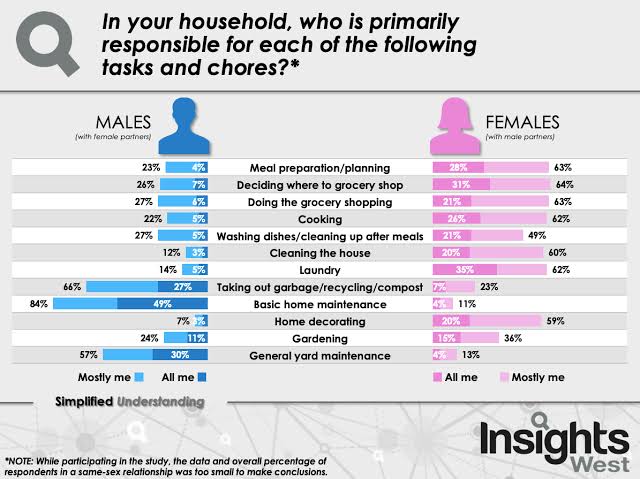
Taking care of your stuff is a life skill and it shouldn’t be embarrassing to do so. The girls mostly are indulged in household chores irrespective of boys. Girls between 5 and 14 years old spend 40 percent additional time, or 160 million more hours a day, on unpaid household duties and collecting water and firewood compared with boys of their age, according to a report released by UNICEF ahead of International Day of the Girl on 11 October. This appropriate data shows the disproportionate burden on girls that begins at an early age of 5. Girls between 5 and 9 of age devote approximately 40 million more hours a day in the household tasks as compared to boys. As the age increases, the time spent also increases with girls of 10 to 14 years old contributing 120 million more hours each day. 

Deepening gender gap as household works are girls responsibilities!

“The overburden of unpaid household work begins in early childhood and intensifies as girls reach adolescence,” said UNICEF’s Principal Gender Advisor Anju Malhotra.  “As a result, girls sacrifice important opportunities to learn, grow, and just enjoy their childhood. This unequal distribution of labor among children also perpetuates gender stereotypes and the double-burden on women and girls across generations.” The report also states that the efforts of girls are less valued and even not noticeable by the society. They can’t enjoy their life, socialize and devote time to studying as that of boys. 

Story of a girl who was raped while traveling to the market.

Heading to or from the market, collecting firewood and water often leaves women and girls at risk of rape. A sixteen-year-old girl who was raped while traveling from her village to Nyala, the capital of South Darfur, described the attack on Human Rights.

[I was with] a group of girls traveling from our village to Nyala….I had a brother working in the market and I wanted to collect some goods from him. Some of us were traveling on donkeys and others were walking. Suddenly the Janjaweed attacked us; they took our money and our donkeys. The majority [of the girls] managed to escape; me, my cousin and my sister were captured. They took all our topes and veils, they left us only with our dresses. We were screaming. I was taken with my younger cousin to the wood; I don’t know where they took my sister. One of them forced me on the ground and all the time I was resisting them….all the time one of the Janjaweed kept his gun pointed at my head. They started raping me. I was bleeding heavily but could do nothing. It was so painful, but fear was even more than pain. Four of them raped me.

The point is, there are numerous crimes of sexual assault that are committed when girls and women go for collecting firewood or water.

Safety and responsibilities begin at home!

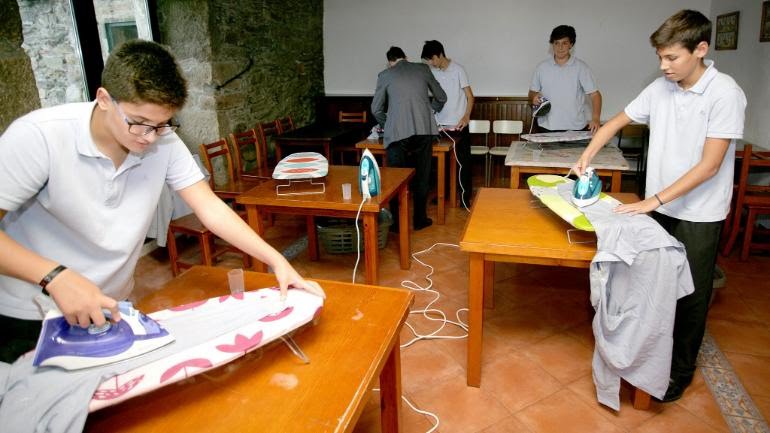
A college in Spain introduced ‘Home Economics’ as a compulsory subject.

This idea of household chores as women’s responsibility is not anymore completely true. This Spanish school is attempting to improve this thinking by introducing”Home Economics”. Colegio Montecastelo, an institute located in Vigo, a town near North-Western Spain. The initiative was started as just a cooking class but later it was appreciated and hence skills of washing, ironing, and keeping a tidy house were added. Now, Colegio Montecastelo is intending to expand access to this course while different institutions in Spain have begun to develop their example by giving such classes to develop everyday life skills for students.

Will this initiative become a big win for gender equality?