National Federation of Information Commissions of India

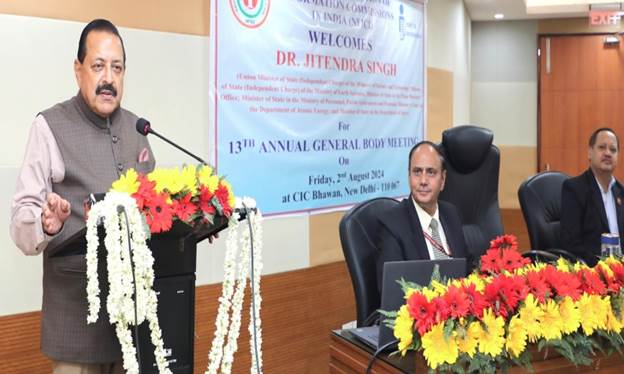
 Union Minister Dr. Jitendra Singh today addressed and later interacted with Central and State Information Commissioners at the 13th Annual General Body Meeting of the “National Federation of Information Commissions of India” (NFICI) at the Central Information Commission headquarters here today.

Addressing the annual meeting, Dr Jitendra Singh said “NFICI has been instrumental in advancing the cause of the Right to Information Act, 2005. Ever since Sh Narendra Modi took over as Prime Minister in 2014, transparency and citizen-centric governance have been central to the Government’s model of governance.”
Referring to RTI Act as a provision to ensure maximum disclosure and minimum exemptions, consistent with Prime Minister Narendra Modi’s Vision of “Maximum Governance Minimum Governance”, Dr Jitendra Singh shared that India’s CPRAMS is now a role model on Grievance Redressal for many other nations of the world who are keen to emulate the same. He shared that the effective time for redressal is as less as 5 days due technology linked solution and flagging of grievances.

Dr. Jitendra Singh directed the Information Commissioners to integrate Artificial Intelligence and new age tools to increase efficiency in public disclosure of Information. The Minister at the same time underscored the importance of Human Intervention by recalling the setting up of the Human Desk to take feedback from citizens after disposal of the grievances. The Minister reiterated the Modi Govt.’s driving principle of boosting transparency, Accountability and Citizen Centricity in the working of the Government. During The interaction he also heard the State Information commissioners noted their grievance and suggestions and assured a positive response to them.

Dr. Jitendra Singh appreciated Central Information Commission’s efforts in increasing efficiency and emphasized on almost 100 percent disposal of Right to Information (RTI) appeals with pendency coming down every year. The Minister also highlighted the exemplary work done by CIC during Covid pandemic as they were functional throughout. He categorically mentioned the ease to residents of J&K after opening a branch in the union territory.
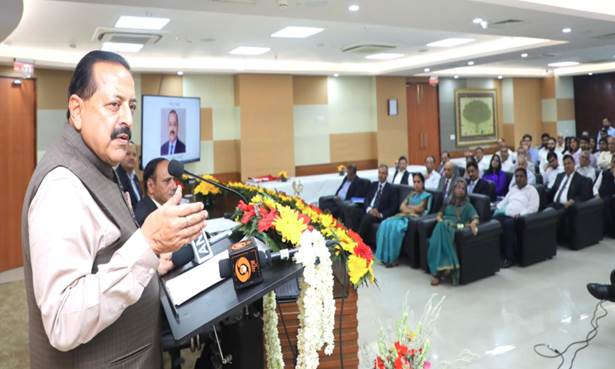
Dr. Jitendra Singh recalled that the CIC got its independent office complex after 2014 when the new Government came, before that CIC was operated from a rented place. In an inspiring message to young officers of CIC, he called them torch bearers and conscience keepers of VISION 2047.

Chief Information Commissioner of India, Heeralal Samariya informed the minister about the steady progress and said the second appeals reaching to the CIC nearly 17000 appeals are disposed of every year.


TOP FIVE INFORMATION TECHNOLOGY IN INDIA

Information technology is the use of computer to create, process, store, and exchange all kinds of electronic data and information. IT is typically used within the context of business operation as opposed to personal or entertainment technologies. Here I came with top five most-valuable information technology in India

1) TATA CONSULTANCY SERVICES

Tata Consultancy Services is a global leader in IT services, consulting & business solutions with a large network of innovation & delivery centers. https://www.tcs.com/home TCS is the largest IT services company in the world by market capitalisation ($200 billion). It was founded in 1968 by TATA Sons. It has headquarters in Mumbai, Maharashtra, India. The main service of the company is consultancy, services, outsourcing. TCS is the second largest Indian company by market capitalisation and is among the most valuable IT services brands worldwide.Tata Consultancy Services has around 380,000 offices across 46 countries and 147 delivery centres in 21 countries. There are 378,210 offices in India alone. The revenue of TCS is Rs1.62 trillion in 2020.https://en.wikipedia.org/wiki/Tata_Consultancy_Services

2) WIPRO

Global company delivering innovation-led strategy, technology, and business consulting services. https://www.wipro.com/ Mohamed Premji was founded WIPRO in 1945. It was founded to trade refined oil and manufacturing vegetables. After the death of Mohammad Premji https://en.wikipedia.org/wiki/Azim_Premjihis son Azim Premji took over wipro as chairman in age of 21. During the 1970s and 1980s, the company shifted its focus to new opportunities in the IT and computing industry, which was at a nascent stage in India at the time.In February 2002, Wipro became the first software technology and services company in India to be certified. The revenue of wipro is ₹61,943 crore in 2021. https://en.wikipedia.org/wiki/Wipro

3) INFOSYS

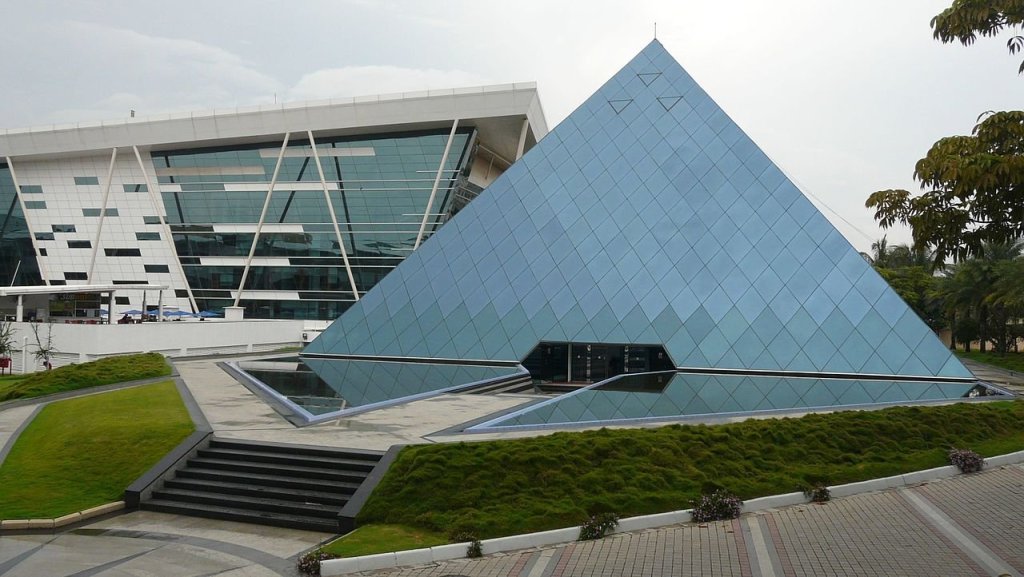
Infosys is a global leader in next-generation digital services and consulting.https://www.infosys.com/ Infosys was founded by seven engineers in Pune, Maharashtra, India with an initial capital of $250 in 1981. Infosys provides software development, maintenance and independent validation services to companies in finance, insurance, manufacturing and other domains.Infosys had a total of 259,619 employees as of 2021, out of which 38.6% were women. Out of its total workforce, 229,658 are software professionals and remaining 13,796 work for support and sales.https://en.wikipedia.org/wiki/Infosys In 2016, 89% of its employees were based in India. The revenue of this company is ₹102,673 crore in 2021. Website is https://www.infosys.com/

Infosys Pyramid in Bengaluru

4) TECH MAHINDRA

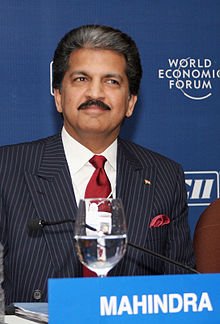
Tech Mahindra is an Indian multinational company that provides information technology and business process outsourcing services. A subsidiary of the Mahindra Group, the company is headquartered in Pune and has its registered office in Mumbai. It was founded by Anand Mahindra. https://en.m.wikipedia.org/wiki/Anand_Mahindra in 1986. This company has services in worldwide.

ANAND MAHINDRA

Tech Mahindra have 125,236 (2020) . The revenue of this company is ₹38,642 crore in 2021. Website is http://www.techmahindra.com/

5) HCL

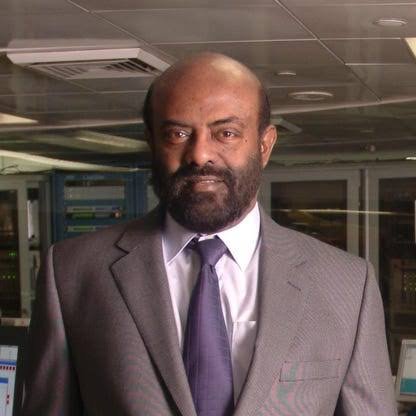
HCL was founded in 1976, HCL is one of India’s original IT garage startups. HCL stands for Hindustan Computers Limited. The company has offices in 50 countries. It was founded by Shiv Nadar https://en.wikipedia.org/wiki/Shiv_Nadar in 11 August 1976. It operates across sectors including aerospace and defense, automotive, banking, capital markets, chemical and process industries, energy and utilities, healthcare, hi-tech, industrial manufacturing, consumer goods, insurance, life sciences, manufacturing, media and entertainment, mining and natural resources, oil and gas, retail, telecom, and travel, transportation, logistics & hospitality. It aslo have services in consulting, outsourcing and software development. The revenue of this company is ₹76,306 crore in 2021. The website for this company is https://www.hcltech.com/.

Founder of HCL

DIGITAL MARKETING!

DIGITAL MARKETING is a part of marketing that is done by using internet and online based digital media such as mobile, laptops, computers, and other digital media platforms to promote goods and services. During 1990s and 2000s digital marketing made a huge difference for the brands and businesses for promotion of their products and services. In the era of 21st century the digital platforms have indulged into all marketing plans and everyday life. Many people use digital devices instead of visiting the places or shops physically, digital marketing has become a new trend in today’s world. With the use of digital marketing, it helps to connect the brand with potential customer.

POV, if marketing campaign contains digital communication, it is DIGITAL MARKETING.

CHANNELS OF DIGITAL MARKETING

WEBSITE MARKETING

Website marketing is a master of all digital marketing activities. Beside this it is consider as one of the most dynamic way of marketing. The objective is to pull off the attention of people who may be interested in product or services of a company. More the traffic to a site more the opportunities for company to put the value proposition toward the potential customer. A website should represent a brand, product, or service in a crystal-clear way. It should be swift, easy to use and mobile friendly.

PAY-PER-CLICK ADVERTISING (PPC)

PPC is paying when every time a person clicks on the ad posted by you on the digital flatform. Marketer can setup their PPC campaign on Google, Bing, LinkedIn, Pinterest, and Facebook any many more to display the ad to potential customer who are in search of similar term linked with product and services. Campaign under PPC can segment users according to their demographic attribute (like age or gender) or even can target specific interest or location.

CONTENT MARKETING

The objective of content marketer is to reach the potential customer through the use of content. Website in which content are posted and then promotion is done through social media, email marketing, SEO, or even PPC campaigns.

Bolgs, ebook, podcaste and webinar are the tools of content marketing.

EMAIL MARKETING

One of best effective marketing channel is also an email marketing. Email marketing one of method to get in touch with the potential customer or the people interested your brand. Digital marketers use email to add their leads in the email and then through email marketing, they produce customer acquisition funnels and then convert these leads into customer.

SOCIAL MEDIA MARKETING

It is process of creating brand awareness by engaging people in online discussion Facebook, Twitter and Instagram are most popular flatform for social media marketing.

AFFILIATE MARKETING  

One of the oldest forms of marketing is affiliate marketing. And the internet has brought a new life to this old form of marketing. Through affiliate marketing influencer promote products of other people and get commission when every sale is made or when a lead is generated.

SEARCH ENGINE OPTIMIZATION (SEO)

It is a process of enhancing the quality and quantity of website traffic for a website or web page. SEO particularly concentrate on unpaid traffic (organic marketing) rather than paid or direct traffic.

A STORY FROM FAILURE TO SUCCESS – JACK MA

The Alibaba.com logo at the Alibaba.com headquarters in Hangzhou, China. Alibaba.com is one of the worldÕs leading Internet companies. With its Business-to-Business platform, manufactures and purchasers are connecting and making purchases that otherwise would have gone through state run trading companies. Aliababa.com is allowing small manufactures to take control of their own marketing and reach clients that would have otherwise been unavailable. (Photo by Ryan Pyle/Corbis via Getty Images)

Building one of the biggest online e-commerce platforms, does not require any techniques or specialized knowledge or application and not even a business plan, then what makes your business to run long?

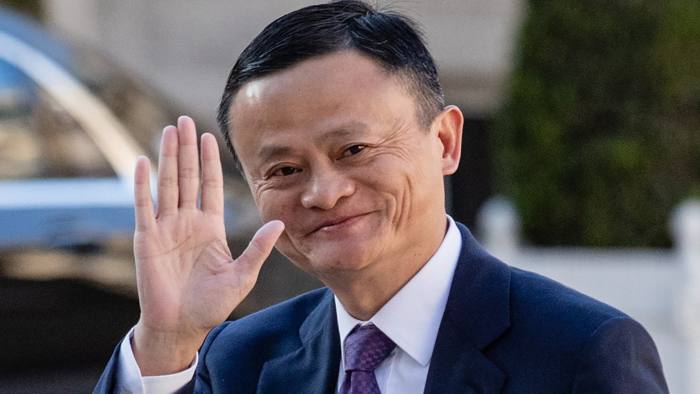
Today we will read a story. A story of man’s life who has transform the economy of China and the internet industry almost alone, single handedly. His life is not less than the story of Robert or Spider that we used to enjoy during kindergarten. Yes, it is the story of Jack Ma.

WHO IS JACK MA?

Jack Ma is the founder, owner of the giant E-commerce platform the Alibaba and he is also a stakeholder at Alipay, company which is an e-payment portal. He is counted in the list of one of the richest men in the world with the net worth of $35 billion. Ma only holds only 7.8% stake in Alibaba and 50% in Alipay.

The beginning can make you to think that the story of self-important and the billionaire has never faced the dark. But do not let these number mentioned above confused you, they can trick anyone. We cannot deny the fact, that Ma has also faced many hard times to reach and achieve all the success and position where he is today.  A true story from being an ordinary man to be the richest, his story is definitely the one that will motivate and inspire you at your darkest.

THE BACK STORY

Ma Yun a.k.a Jack Ma a self-made billionaire was born on 10 September 1964 in Hangzhou in the part of China. He was born and brought up with an elder brother and a younger sister. As a boy Ma did everything, he could do to learn English. At the age of 12 he got an idea to improve his communication in English. Every morning he use to rode bicycle to the international hotel in his hometown and use to wait for tourist to com. He made proposal with tourist. He used to take them around the city and in return they helped him with English.

EDUCATION

During his childhood, Ma failed in Primary School Examination not once but thrice. He also failed the university entrance exam. Later finally he joined Hangzhou Normal University. Ma also failed to get the job in his bachelor’s degree.  He then recalled his one of the worst interview ever “When KFC came to China 24 people came for the interview out of which 23 of them got selected and I was the only guy rejected” , he also applied for the in the police force and he was one of the 5 applicants and again he was the only guy who was not selected and being told “No, you’re no good.”

ENTREPRENEURIAL EXPERIENCE

As being an entrepreneurial, Jack Ma failed in his two initial ventures, but this did not stop him of dreaming big.

THE COME BACK

Finally, after gathering 17 of his friends to invest and to join the e-commerce start up- Alibaba, the apartment became his company. Alibaba started with no single penny in investment from anyone. But later they raised $20 million and $5 million from SoftBank and Goldman Sachs respectively in the year 1999. After being successful at the age of 31 in his first company even having not experience in selling something to anyone, Ma runs one of the biggest E-commerce platforms in the world. Alibaba saw a rapid growth and expanded all over the world.

MUST VISIT PLACES NEAR KEDARNATH

  1. OMKARESHWAR TEMPLE

Located in Ukhimath this temple is the home of lord Kedarnath and Madhyamaheswar during winters.

2. BHAIRAVANATH TEMPLE

Bhairav Baba is known as ‘kshterapal’ the protector of Kedarnath Temple and kedar valley.

3. TRIYUGINARAYAN TEMPLE.

This is the place where Lord Shiva and GODDESS Parvati got married in presence of Lord Vishnu and Brahma.

4. VASUKI TAL

According to legends, Lord Vishnu had descended onto the earthly realm into this lake for a holy bath during the auspicious festival of Raksha Bnadhan.

5. RUDRA CAVE

Located one and half kilometers left from the Kedarnath Temple complex, Rudra Cave is an undergroung meditation cave.

6. SONPRAYAG

Soonprayag is a tiny hamlet on the confluence banks of river Mandakini and Basuki. Devotees take a dip in the holy waters with the faith to attain nirvana.

7. SHANKARACHARYA SAMADHI

It is believed that Sri Shankaracharya who propounded the adwaita Philosophy established this holy shrine and one of his four Mathas in the 8th century and attained Nirvana at age 32 here.

8. AGASTYAMUNI

Dedicated to Saint Agastya, the temple commemorates his one year tapas here. This ancient temple stands as an example of grand architecture and interiors with wall art adoring its wall.

THE INSPIRING STORY OF THE MISSILE MAN – APJ ABDUL KALAM

“IF YOU WANT TO SHINE LIKE A SUN, FIRST BURN LIKE A SUN”- KALAM

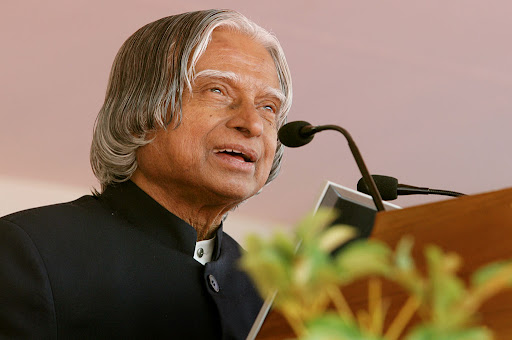
Avul Pakir Jainulabdeen Abdul Kalam was the man loved by all the Indian as well as he was respected outside the India also. Kalam was the man with 0 haters he was one who gave the wings to fly. From a newspaper delivery boy to the President of Indian, his great contribution toward India is remarkable which cannot be ignored.

Let’s read more about the success of the missile man of India-

EARLY LIFE AND CHILDHOOD

Kalam was born on 15th October 1931 in a Tamil Muslim family in the city of Tamil Nadu, Rameswaram. Jainulabdeen, Kalam’s father was a boat owner and IMAM of a local mosque, Ashiamma his mother was a home maker. He was blessed with 4 brothers and 1 sister. He was the youngest among all the siblings.

In his childhood, due to the financial crisis in the family, Kalam was forced to sell newspaper at a very young age to support his family. Kalam was an average student during his school time, but he was hardworking, good learner as well as a bright student as per his teacher’s saying. Abdul Kalam completed his schooling in Schwartz Higher Secondary School. In the year 1954 he completed his graduation in physics from Saint Joseph’s College. Later in the year 1955, Kalam went to Madras Institute Of Technology to study aerospace engineering.

Kalam’s wanted to be a fighter pilot, but he almost missed his dream, as there were only 8 position and Kalam secure 9th position in the qualifiers of Indian Air Force (AIF).

ABDUL KALAM’S CAREER

Career as scientist: – After completing his graduation from Madras University in the year 1960. Kalam joined Aeronautical Development Establishment of the Defense Research and Development Organization [DRDO] as a scientist. His career began when he started to design small hovercraft, but he was not happy as he was not satisfied with his job. Later in the year 1969, he was appointed as the director of India’s 1st Satellite launch vehicle [SLV-III] in Indian Space Research Organization  [ISRO] which was successful in July 1980. Tremendous and huge contribution and efforts of Kalam in the development of Polar Satellite Launch Vehicle [PSLV] and SLV-III launched between 1970s and 1990s and by the grace of God both were successful and one of the most important victory for India. Kalam was also invited to witness the India’s first nuclear test ‘’Smiling Buddha” by Raja Ramanna.

Career as president: – Abdul kalam became 11th President of India in the year 2002, he was 3rd president of India who was honoured with Bharat Ratna before he became the President. He was the only scientist and bachelor to occupy ‘Rashtrapati Bhawan’.

The Tragic death of Kalam: – On 27th July, when he of 83, we lost the gem of India. When kalam was delivering a seminar on “Creating a liveable planet Earth” at IIM Shillong, he collapsed he was rush to near by hospital, but he was dead at that time due to the cardiac arrest. APJ Abdul Kalam was famously knowns as ‘Missile Man of India’. He was the one who made India to fly high and achieve success. He was love by children and his story inspires us for the success.  

The Story of the Best Selling Video Game of all time: Tetris

Tetris has its origin in the Dorodnitsyn Computing Centre (Research Lab). It was one of the foremost research institutes of the Russian Academy of Sciences, located in St Petersburg, Soviet Union (Now Russia). Created by software researcher Alexey Pajitnov in 1984, Tetris is a simple tile-matching game that took the world by storm upon it’s release.

It was developed for Electronika 60, which was a computer, made in the Soviet Union. This period was the final stage of the Cold war Era and computers were becoming more popular as well.

The game wasn’t intended as a commercial product just like the creation of the music record. But it was to be distributed freely among academic institutions around the Soviet Union and the economic bloc of countries aligned with the USSR in Eurasia, Africa, and the Americas that demonstrated use cases for the software.

As USSR was a communist state, so Pajitnov did not technically own the program as the game was under the ownership of the state. Pajitnov along with the help of a colleague, Dmitry Pavlovsky, and a teen computer programmer, Vadim Gerasimov continued to work on the game project even though commercializing it would have been a risky move under the Soviet government. Gerasimov further ported the game from the old and bulky Elektronika 60 to the more widely used (IBM) compatible PCs.

As Elektronika 60 had no graphics output, the individual blocks in the game were made of different text, but with the port in PC, they were able to support color graphics. This brought the game to life.

Pajitnov and Gerasimov had started distributing Tetris for (PC) in 1985 among their friends and colleagues in various math or computer conventions. Soon the sharing spread and the game was smuggled outside USSR to Hungary. During mid-80s U.S and Japan had a more prevalent console market whereas, in Europe, gaming was primarily done on computers. There was a non-existent software market in Russia and most software was usually copied in floppy disks.

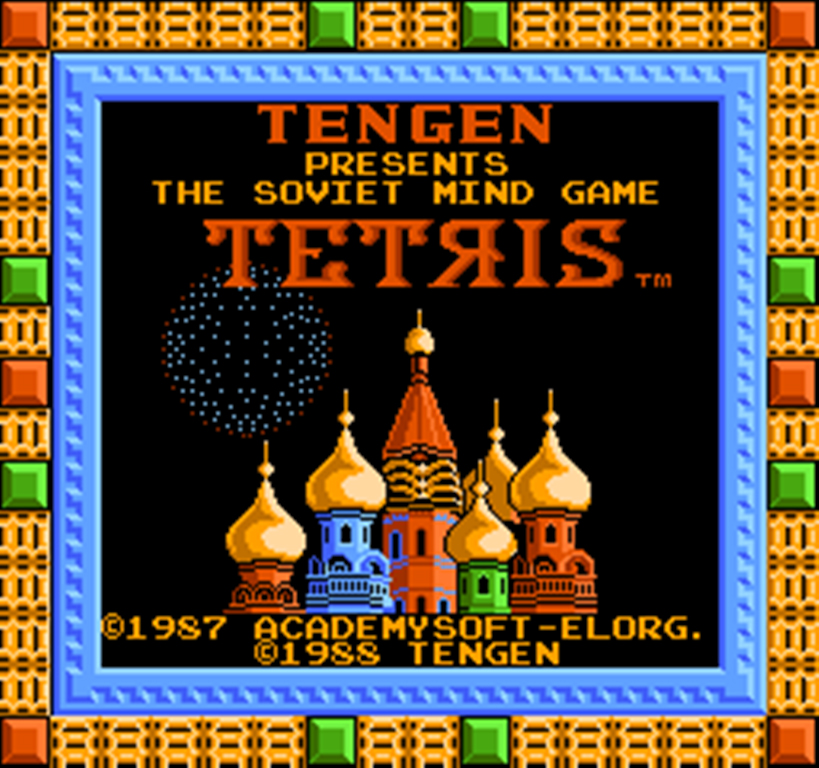
Welcome screen of 1987 version of Tetris

In 1986 Robert Stein, a salesman from the UK-based software company Andromeda spotted Tetris at Hungary’s Institute of Computer Science. He was convinced by the potential of the software and he struck an agreement with Pajitnov to sell the games internationally. But legally Tetris was still under the ownership of the Soviet government.  There was one problem, the agreement was only for the PC and not for any other platform and Stein has struck a deal with Sega to launch the game on their platform. Later Henk Rogers, another salesman from the Netherlands wanted to find a good launch game for the Nintendo’s new Game Boy handheld. The Soviet government was not happy with the Stein deal. But Rogers convinced the Soviet government and they agreed and he also formed a good relationship with Pajitnov. Later Andromeda’s license of Tetris was deemed illegal. Nintendo was given the right to launch the game on its console. The GameBoy was a platform to showcase one of the first video games exported from Russia. The game was a commercial hit and it has been ported to the most number platforms to date. The game also holds the record as the best-selling game of all time. In 1996, Pajitnov was able to reclaim the ownership of the rights and formed the Tetris Company, along with Henk Rogers. Even though he missed collecting the potential royalties for Tetris which were over hundreds of millions, he was still able to secure the future royalties.

References:

WHEN THE GATEWAY FOR INDIANS TO HOLLYWOOD CLOSES

After their two decades of service, the renowned English film channel HBO which served as a gateway for Indians to Hollywood Movies, has discontinued its airing in India on 15th December 2020. WarnerMedia International has already announced that they will be shutting down HBO and WB movies in other South Asian countries including Pakistan, Bangladesh, and Maldives along with India by the end of the year 2020. This decision was taken as a result of the shifting market dynamics with the introduction of OTT streaming platforms like Amazon Prime, Netflix e.t.c. Even though there was an exponential growth in the number of viewers preferring to view contents in english, TV channels like HBO and WB were unable to capitalize on this, but to loose their grounds owing to the stringent competition from the on demand streaming platforms.

“After 20 years of successes for the HBO linear movie channel in South Asia and more than a decade with the WB linear movie channel, this was a difficult decision to make. The pay-TV industry landscape and the market dynamics have shifted dramatically, and the Covid-19 pandemic has accelerated the need for further change,” said Siddharth Jain, senior vice president and managing director for WarnerMedia’s entertainment networks in South Asia. 

WarnerMedia International is planning for a resurgence to the South Asian market through launching their own streaming service named HBO Max. But for the time being, they will be offering their content through Disney’s streaming platform. They have also declared that their entertainment organization will continue its broadcasting in popular kids channels like Cartoon Network, POGO e.t.c in the South Asian region. They are planning to invest more in this stream, with a focus on local animation production.

For Gen Z Indians, HBO has always been a part of their childhood. They were introduced to the world of Hollywood movies through the channel. Though the newly introduced OTT platforms provide great contents, for most of the Indians who grew up watching the likes of Harry Potter, Home Alone series, e.t.c, the shutdown of HBO will be considered as a great loss.

Curiosity (science)

• Why do we wake up from sleep?

Sleep is essential to give the brain and nerves some rest. While we sleep, our bodies too, get a chance to recover from the fatigue caused by daily activities. When we are well rested, both physically and mentally, we wake up. Sometimes, we wake up because we feel cold or hungry or because a bad dream has made us afraid.

To sum up, we all have an internal body clock that tells our brain to wake our bodies up after a certain amount of time. However, some things or situations such as noise, temperature in the room or sunshine interrupt our sleep and wake us up too.

• Why doesn’t glue stick to the insides of the bottle?

The regular white glue that we use is made up of a variety of chemicals that are either sticky or stretchy. White glue also contains water. Water acts as a solvent that keeps the glue liquid until you want it to stick. When you put glue on a piece of paper, the water in it is exposed to air. The water eventually evaporates and as it does so, the glue dries and hardens and holds the things that need to be glued, stuck together.

When the glue is inside the bottle, there’s not enough air inside the bottle to cause the water to evaporate to make the glue sticky. The bottle protects the glue from the air and keeps the glue runny. This is also why if you’ve ever left the top off a glue bottle for a while, the next time you try to use the glue, it would have dried up.

• Why do the lights of a distant town appear to twinkle?

When you are traveling at night, the lights of towns in the distance appear to twinkle. This is because of the constant movement of air above towns. The air above towns is warm, as a result of the heat given off from buildings. Warm air keeps moving up to be replaced by cold air which then gets heated and rises. This constant movement of air is known as turbulence.

When we are near a town or in it, we don’t notice the turbulence because it is quite small and the lights are nearly. However, when we are some distance away, the lights are far away too. They appear as only pinpricks. The warm and cold air that make up the turbulence above the town have different densities and light passing through the layers is bent at different angles because of this difference. As a result it appears as though the lights of the distant town are twinkling.

• Why do clouds have different shapes?

Clouds are made up of tiny droplets of water vapour or ice particles or both. The shape of the cloud depends on its height and temperature. Cumuliform clouds are shaped liked mushrooms and are formed when rising warm air cools as it goes up. Stratiform clouds come in flat, dull layers and are formed when air sinks in a high pressure area, creating a layer of cold air near the ground that doesn’t rise or rises only very slowly. Cirriform clouds are clouds that have risen on a front or tropical cyclone and frozen into ice crystals at very high altitude. They look like thin hair. The shape of cloud also depends on the time of the day.

Towards evening, clouds tend to be thinner and flatter than during daytime. Changes in wind patterns also change the shapes of cloud.

Thank you for reading. Have a nice day!🌼

Beverages from scratch…

Wine

Wine is as old as civilization itself and it has a significant place in many ancient cultures. Many experts agree that wine probably dates to 6000 B.C., to Mesopotamia where wild vines grew in abundance. The popularity of wine eventually spread to Egypt, along the Nile Delta. Wine came to Europe with the spread of the Greek civilization around 1600 B.C. It was an important article of Greek commerce and Greek doctors including Hippocrates, were the among the first to prescribe it. The Greeks also learned to add herbs and spices to mask spoilage.

Starting about 1,000 B.C., the Romans made major contributions in classifying grape varieties and colours, observing and charting ripening characteristics, and popularizing the growing of vines and manufacturing of wines. As time progressed, the wealthy enjoyed the fruits of the vine. After the collapse of the Roman Empire, Europe’s wine industry was saved by the church as monks planted vines to provide wine for Mass. Before long, France emerged as a leader, with some of the world’s finest wines.

Did you know that an ancient Persian fable credits a lady of the court with the discovery of wine? This princess lost favour with the king and attempted to poison herself by eating some table grapes that had ‘spoiled’ in a jar. She became intoxicated and fell asleep. When she awoke, she found that she felt much more relaxed and stress free and wine was discovered!

Coffee

According to legend, an Arabian shepherd named Kaldi found his goats dancing joyously around a dark green leafed shrub with bright red cherries in the southern tip of the Arabian Peninsula. Kaldi soon determined that it was the cherries on the shrub that were making them act this way. After trying the cherries himself, he learned of their powerful effect. These were coffee berries and monks at a local monastery started using a drink made of these berries to stay awake during extended hours of prayer. And so, coffee was born.

The ancient Ethiopians made balls of crushed coffee beans and fat to give them energy during long journeys. The coffee we are familiar with originated in Arabia, where roasted beans were first brewed around A.D. 1,000. Later, coffee was brought to the rest of Asia from where it was taken to Europe by a merchant from Venice.

Did you know that the name coffee is derived from the Arabic term ‘gahwa’ which means ‘that which prevents sleep’?

Tea

Did you know that tea is 5000 years old? According to legend, it was discovered in 2737 B.C., by a Chinese emperor when some tea leaves accidently blew into a pot of boiling water. The emperor was interested in the new liquid, drank some, found it very refreshing, and tea was created!

Tea consumption spread throughout Chinese society reaching into every strata. In time, drinking tea became part of the social and cultural life in the far East and India. Tea was introduced to India by the silk caravans travelling from the Orient to Europe. It was a Buddhist priest who brought the first tea seeds from China to Japan. In Japan, tea received almost instant imperial sponsorship, and spread rapidly from the royal court and monasteries to the other sections of Japanese society. Dutch traders and Portuguese missionaries brought tea into Europe and tea became an extremely fashionable drink in the court of Charles II of England. Tea has played a very important role in the history of England for it brought fortune to the British empire and at the same time, it was a tax levied on tea that led to the loss of her colonies in the New World.

Today, tea is grown on tea estates, and 70% of the tea we drink is grown in Sri Lanka, India, Indonesia, Kenya, Argentina and China. Amazing, we drink virtually the same tea today that the Chinese emperor drank the day he discovered it!

Carbonated soft drinks

Do you love fizzy soft drinks? Well, even the ancient Romans loved to drink the bubbling waters of mineral springs and they believed that this water was very good for health as well. Later, scientists discovered that it was the carbon dioxide in the water that caused these bubbles and tried to find a way to introduce this gas into plain water to give the same effect. Thanks to the efforts of such scientists as Joseph Riestley and John Nooth, this feat was accomplished and carbonated water was available for sale by the end of the 1700.

The next step was to flavour this sparkling water. In 1784, citric acid was developed from lemon juice and by 1833, carbonated lemonade was on sale in England. Soon, other flavours were introduced and in 1886, Coca Cola entered the market and created soft drink history.

Thank you for reading. Have a nice day!🌼

Food from scratch…

Noodles

A 4000 year old bowl of noodles unearthed in China is the earliest example ever found of one of the world’s most popular foods. Noodles have been a staple food in many parts of the world for at least 2000 years. But who inverted the noodle? This is a hotly contested topic – with the Chinese , Italian and Arabs all staking a claim.

Ice cream

The first ice cream was probably made by chance when someone left some milk outside on a cold night and it froze!

Alexander the great enjoyed ice cream made with milk, fruit juice, honey and snow in the 4th century B.C. and the Roman emperor Nero ordered ice to ne brought from the mountains and combined it with fruit toppings. The Chinese also had a method of making ice creams and some believe that ice cream came to Europe from China.

It was Quintus Maximus, a roman general, who first wrote down a recipe for ice cream. Marco Polo brought the Chinese recipe to Venice after his visit to Peking. The king of England, Charles I is supposed to have offered his chef a handsome reward to keep his ice cream recipe a secret!

You favourite ice cream cone was invented by a pastry maker Ernest Hamwi in 1904, at the World Fair in St. Louis. He put a scoop of ice cream on his pastry when an ice cream seller in a neighbouring stall ran out of dishes- and it became an instant hit!

Chocolate

Cocoa, from which chocolate is made is said to have originated in the Amazon atleast 4000 years ago. The origins of chocolate can be traced back to the ancient Mayan and Aztec civilization in central America, who first enjoyed ‘chocolatel’, a much prized spicy drink made from roasted cocoa beans, the Aztecs believed that the cocoa tree was a gift from their God, Quetzalcoatl. According to legend, He had been banished by the other gods for giving the tree to mankind, but he promised to return to them one day.

The Spanish, led by Hernando Cortez, invaded Mexico in the 16th century. When the Aztecs saw Cortez, they believed their god had returned and welcomed him with a golden cup of chocolate! When Cortez returned to Spain in 1528, he loaded his galleons with cocoa beans and equipment for making the chocolate drink. Soon ‘chocolate’ became a fashionable drink enjoyed by the rich in Spain.

It was in 1847 that solid chocolate, as we know of today, was made by Fry and sons of Bristol by mixing sugar with cocoa powder and cocoa butter and your favourite treat was born.

Chewing gum

Thousands of years ago people chewed gum in it’s natural form. The most common ancient chewing gum was tree resin lumps, but people chewed various sweet grasses, leaves, grains and waxes also. The first commercial Chewing gum was made and sold in 1848 by John Bacon Curtis. He made a sticky, rubbery material from the spruce tree which could be chewed. In the 1860’s, Thomas Adams began selling chicle, a gum from the sapodilla tree of Mexico’s Yucatan desert.

Thank you for reading. Have a nice day!🌼

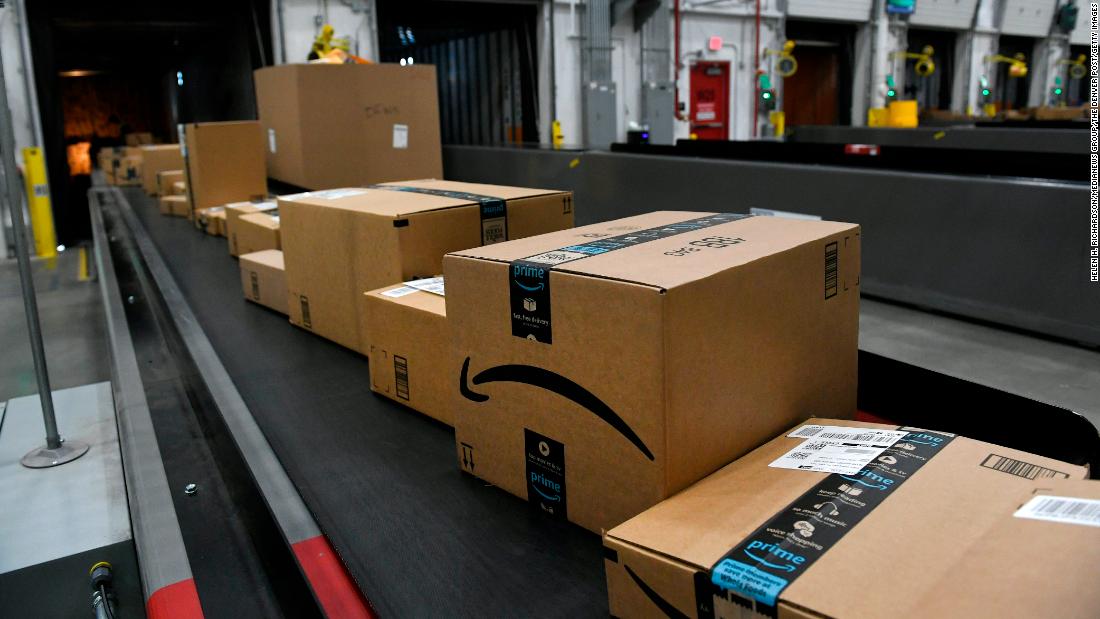
Who delivers the Amazon cardboard boxes???

Cardboard boxes that have been used for generations and thrived in the age of e-commerce continue to flourish or could the cardboard box be facing a new challenger? Cardboard boxes are a very big deal within the U.S. The United States is the Saudi Arabia of trees. Someone’s going to make the first box and that’s almost inevitably a mill generally in the Southeast United States. China certainly doesn’t have trees and India the extent they do have trees they’re not necessarily the right types of trees and shouldn’t be dedicated towards making boxes for us. The box business grew rapidly up through 1999 when the U.S. coordinated box market had its peak shipment. Starting in the early 2000s the U.S. corrugated box market faced multiple economic obstacles.

The great recession dragged on box demand and even after the recession demand continued to slow for commodity like soda and for the boxes that transport them. The move to digital devices also coincided with a drop in demand for copy paper and newsprint. But box makers found a grace in e-commerce sales and Amazon sale specifically which were growing at mostly integer rates within the recession and post-recession years. Those e-commerce sales have become a significant market for the containerboard industry. In 2018 told a U.S. e-commerce sales were estimated to be $512 billion almost 50 percent higher than in 2015. Amazon captured 48 percent of those sales. Most estimates are that e-commerce accounts for about 10 percent of the U.S. box market. Amazon accounts for close to 5 percent of U.S. box demand. By our estimates they are clearly the single largest box user in the US. International Paper with a third of the market I think does closer to 50 percent of all the amazon boxes evidently they got a bit more share than perhaps some of the smaller players.

Amazon's incredible, vanishing cardboard box - CNN

Amazon said they deal with most of the big box makers across the U.S. according to analysts. Those manufacturers include International Paper, WestRock, Packaging Corporation of America and Georgia-Pacific. Some investors were turning to these companies as a way to invest in the e-commerce giant without having to purchase Amazon’s pricey stock. People didn’t really start talking about buying International Paper or WestRock as a secondary investment in Amazon till about the last five years. Despite the boost from e-commerce sales the box business still isn’t growing all that much. And since 2018 their stocks have mostly underperformed the S&P 500. In 2018, 69 percent of International Papers total revenue came from the box business and that sales volume has been mostly flat for the past five years. Although the big producers sold less boxes in 2018 than in 2000, industry consolidation has dramatically narrowed the fields.

The handful of big players remaining are based in Memphis, Tennessee, Atlanta, Georgia and Lake Forest, Illinois. Analysts have told CNBC that substantial industry mergers have made it easier to collectively hike prices and those price increases have helped drive revenue. There are portions of the business that are in indisputable secular decline but if you’re in the brown part of the business, making these boxes, that’s been some very welcome growth. But those extra boxes piling up on people’s doorsteps have led to a backlash from disgruntled customers who are sick of receiving golf ball sized products in supersized boxes. It used to be that you’d order a toothbrush and it would come in three giant boxes and you’d say to yourself, what is this? Well, Amazon is trying to rectify that by using fewer boxes and using other types of packaging where appropriate. With e-commerce packaging underfire Amazon decided to change the way they do shipping. In 2008, Amazon introduced the Frustration Free Packaging program. It aims to reduce the extra packaging created when retail packaged products are placed inside Amazon boxes to be shipped. Instead, products certified in the program that are roughly the size of a blender or larger need to be packaged in their own ready to ship boxes. And those boxes also need to be made of 100 percent recyclable materials. For customers that means that the packaging is easy to recycle and the box is easy to open without all the excess packaging materials.

Use That Pile of Empty Amazon Boxes to Do Something Wonderful ...

Amazon offered vendors an incentive of a dollar per shipment to modify their packaging. And starting August 1st 2019 Amazon is charging a $1.99 penalty for each product shipped that needs to be reboxed. And basically the point of this deadline is for Amazon to get out of the business of packaging. They want their vendors to send them boxes that Amazon doesn’t have to touch or rebox. Over the last two years we have invented two different kinds of flexible mailers. One is the blue and white all plastic mailer. We’ve recently launched in the last six, eight months a paper padded mailer that’s actually fully recyclable with the paper stream. Amazon said they made about 10 million shipments using the paper padded mailer and depending on the month the plastic mailer is used about 20 to 30 percent of the time. So really when we come down to deciding if the product is of the size it can go on a mailer, it’s not likely to be damaged by going in the mailer, the mailer is always the better fitting option and frankly is easier for the customer to choose to recycle than breaking down a corrugate box. We’re driving in that direction for many different reasons. But those plastic mailers generally are not accepted in municipal recycling programs and you’ll need to bring them to a store that accepts plastic bags. The latest stats from the EPA show that corrugated boxes were recycled at a rate of 92 percent in 2015 while plastic bags, sacks and wraps were recycled at a rate of 13 percent in 2015.

AMAZON E-COMMERCE SELLERS, IT'S TIME TO REVIEW YOUR ADVERTISING ...

When you think about what is the greatest pain point for the consumer after having it get there safely arrive on time people are concerned about receiving something that is plastic or made a poly because of the environmental concerns. Some waste management companies say plastic packaging also causes problems for the recycling systems. Plastic mailers get caught in the recycling machinery slowing down the process and raising the costs for recyclers and sometimes contaminating entire bundles. Until Scotty on the Enterprise can beam the products from the warehouse to your living room I think Amazon’s going to be good for the corrugated business. I think there’s going to be noise I think you’re going to have challenges from time to time where people say, “Should we try and the plastic pouch?”, in the long run plastic is going to be on the wrong side of history. Because Amazon is a market leader in the U.S. e-commerce sector any move away from cardboard to plastic mailers could signal a shift for the entire industry. The corrugated box could be about to undergo a major facelift. We’re seeing some major trends among consumers and what they’re expecting from e-commerce and the first one is actually this desire for increased engagement with the package. In 2015, Amazon partnered with Universal Pictures and Illumination Entertainment to ship orders in bright yellow delivery boxes featuring cartoon characters from the movie Minions. The boxes promoting the movie and a special Amazon U.R.L. dedicated to shopping for merchandise from the film.

Why economy of India is slowing down???

India is one among the world’s fasting growing economies. It had been touted as an economic and geopolitical counterweight to China. But recently its growth fell to its slowest pace in six years. Investment has weakened, and unemployment has risen. So what’s causing the slowdown, and how can it be reversed? Since the turn of the century, India’s economy has grown at a rapid rate, helping transform the country. Between 2006 and 2016, rising incomes lifted 271 million people out of poverty, meaning the proportion of Indians still living in poverty has fallen dramatically, from around 55% to twenty-eight . Access to electricity has also improved. In 2007 just 70% of the population had access to power. By 2017, that grew to nearly 93%.

India's economic growth likely to remain subdued in near future ...
More recently, the Indian government constructed around 110 million toilets — a huge step towards better sanitation designed to prevent the practice of open defecation. It’s a signature program of Prime Minister Narendra Modi, known as Swachh Bharat, or Clean India. All this development has been supported by a booming economy, but as lately , that expansion has begun to run out of steam. In the third quarter of 2019, India’s economic output grew by 4.5% – making it the primary time the country’s growth dipped below 5% since 2013. For context, 4.5% growth remains much above that of developed economies just like the U.S., But with 12 million Indians entering the workforce per annum , economists say the country needs annual growth rates to remain above nine percent to make sure there are enough jobs. So, what’s causing this recent slowdown? Well, officialdom argue turbulence in international financial markets is guilty.

Economy News, Latest economy news India, Indian Economy features ...
Political uncertainty and U.S.-China trade tensions mean confidence levels among investors and consumers everywhere have sunk. The United Nations has even warned that a global recession in 2020 is now a “clear and present danger”. But back to India – many economists say the country’s growth problems are literally self-inflicted. One obvious culprit is the shadow banking sector. During the 2000s, India saw an investment boom. It was fuelled by state banks dispensing a load of loans for giant infrastructure projects. But some of the companies taking advantage of these loans couldn’t keep up with the repayments. That meant the state banks weren’t getting paid back and therefore struggled to give out new loans. To keep business moving, shadow banks stepped in. These financial institutions, which operate like ordinary commercial banks but don’t follow traditional banking rules, eventually made up an estimated third of all new loans nationwide. The loans played a pivotal role for the millions of small businesses and consumers who would otherwise have no access to credit. But in 2018, shadow banking giant Infrastructure Leasing & Financial Services, defaulted on its debt repayments. Its collapse sent shockwaves through the economy and shook up more traditional banks that had supported the world.
It became harder for people to shop for expensive items like cars. That hurt India’s automotive industry, which is one among the country’s biggest. It employs about 35 million people and makes up about 7% of India’s GDP. Last summer, the industry suffered its worst sales performance in nearly 19 years, and reports suggest tens of thousands of workers are laid off. The agriculture and construction sectors have also been hurting, with small and medium businesses being hit the hardest. The country’s percentage has been on an overall upward trend since July 2017, rising several percentage points to 7.7%. Higher unemployment means consumers are buying less, resulting in the unfortunate cycle of slower manufacturing, production, investment and job creation.

Indian Economy Will Face Adverse Affects Of Coronavirus Gdp To ...
A survey from the Reserve Bank of India found consumer confidence has fallen to its lowest level in five years. But Indians still have a positive outlook for the longer term , with most consumers expecting to feel more optimistic during a year. However, if things don’t improve, debt could become another issue. Expecting better days ahead, many households have continued to spend, by taking out loans and dipping into savings. Household savings as a proportion of GDP has fallen from 23.6% to 17.2%. Meanwhile, household debt has surged to 10.9% during the same period. Critics say the govt in New Delhi has did not spot these risks and hasn’t done enough to urge the economy moving again. The Reserve Bank of India’s former governor Raghuram Rajan recently blamed the lack of significant reforms and a slowdown in investments since the global financial crisis. Even the country’s chief economic advisor recently admitted reforms are needed to form India more friendly to investors.
India has cut its corporate rate , but labor and land laws are still extremely strict. He also says the country must become pro-market, instead of just pro-business, to avoid costly government bailouts of failing sectors. But not all reforms have been good to the economy. In 2016, Prime Minister Modi tried to crack down on corruption, counterfeits and evasion by banning high value bank notes. In one night, the cash ban made 86% of all cash invalid. Three years later, many analysts say the policy disrupted the economy and did not achieve many of its original goals. In 2017, a replacement nuisance tax placed small businesses struggling and a few of them were forced to shut . In mid-2019, India’s government introduced a controversial new tax on foreign investors. Consequently, India’s stock exchange suffered its worst July performance in 17 years. Just one month later, the measure was scrapped.
The government has now refocused its efforts on international trade and investment, and thus the recent changes to the corporate rate could indeed help attract businesses and investors to India. But if the country wants to be a part of the world’s largest supply chains, it’ll need low and consistent tariff levels to encourage outsiders to take a position for the long term.

The country’s shifting export policy has harmed several of its largest industries, particularly clothing. India’s share of the worldwide apparel market has increased only slightly within the past 20 years. And though the Indian workforce is vast, both Bangladesh and Vietnam now export more. On top of that, the country’s import tariffs on the average are much above the world’s biggest economies. They’re also among the highest of the world’s emerging economies. Even U.S. President Donald Trump has called for the country to bring down its duties.

Has India’s growth actually slowed the maximum amount as we think? The government’s former chief economic advisor Arvind Subramanian caused a good little bit of controversy in June 2019, when he claimed the country’s official stats probably overstated GDP growth by 2.5% from 2011-2012 to 2016-2017. He says the bottom line is that India never recovered from the global financial crisis. The government denies this. But none of this has hurt Prime Minister Modi at the polls – he won by a landslide in the most recent election. So how will he keep his promise and double the dimensions of the economy by 2025? Many economists insist a well-explained economic vision would help. As would more long-term investment, better skilled workers and enhancements to infrastructure. It may not matter who or what’s responsible for India’s recent economic challenges, but bottom line – India’s economic process must recover , and fast.

How IPL is making millions & billions of dollors in every single match!!!

Cricket it’s a sport that dates back over 400 years. And as of 2019 is officially played in 104 countries around the world. Cricket’s worldwide fan base is comprised of roughly one billion people in the Indian subcontinent alone makes up 90 percent of those fans. In India, the country adopted a brand new shorter format of the game has drastically cut down on playing time from days to hours. The Indian Premier League or the IPL has only been around for twelve years but it’s fast become one of the most popular and valuable cricket leagues on the planet. The IPL is brand value has nearly doubled in the last five years. In 2018 the league was valued at 6.3 billion dollars. It rakes in and 510 million dollars each year from its broadcasting rights deal making it to only cricket league in the world to crack the top 20 most valuable media rights deals in all of professional sports joining the ranks of the NFL the NBA and MLB.

Future of India vs Pakistan cricket matches - CoA chief Vinod Rai ...

So how did the IPL become one the most lucrative cricket leagues on the planet. In India. Cricket is huge. It’s been a staple in Indian sports since the seventeen hundreds. It’s currently the most popular sport in the country. The IPL is one of the richest sports properties in the world. And while the IPL isn’t the only cricket league in India it is the most successful league in the country. The 48 day annual tournament was created in 2007 with the help of the Board of Control for Cricket in India and Indian businessmen Lalit Modi. Even though cricket already had a few pro cricket leagues they wanted to capitalize on the commercial success of 2020. So they modeled the IPL in a similar nature to pro sports in the US.

The IPL was specifically modeled after the likes of the NFL. Which has a decentralized league. meaning that all teams are owned and operated independently. Also similar to the NFL model the IPL is its own league with its own unique structure. There is a separate T20 World Cup where India competes. But that’s different from the IPL. even though matches are all held in India. Team rosters are chock full of top international talent. In 2018, teams spent 94 million dollars to buy 169 players in an auction. up from its 40 million dollars for 66 players in 2017. But what you’ve actually got in the IPL franchises who represent a city a place an industrial heartland and you’ve got the full support of some major entrepreneurs. So rather than let’s say Delhi again. So, you’ve got your IPL franchises based around the cities. I’m not as actually have a massive impact. in terms of global cricket. To make sure the stands are filled with as many IPL fans as possible and to maximize TV viewership. Matches are typically played in the evening and on weekends.

The IPL is a huge moneymaker in India since 2014. The IPL brand valuation has doubled to six point three billion dollars. The reason the IPL has won the largest fan base is for a single sports league in the world. During its opening week of the 2013 season the IPL broke records when 371 million viewers tuned in to watch and by the last week of the tournament a total of 769 million fans watched the 2013 IPL season. The ad revenue generated for that season was over 276 million dollars according to Star India’s managing director. High ratings and ad dollars were a big part of why a major U.S. media companies had their eyes on IPL broadcasting rights. When the IPL launched in 2008. The league issued being your rights to Singapore based sports marketing agency World Sport group. They broadcast an IPO matches on India’s Sony Max TV channel. Under the terms of the 10 year contract World Sport group paid the IPL approximately 1 million dollars per match in its first year for the exclusive broadcasting rights. The overall value of that broadcasting deal was 918 million dollars when the broadcasting deal expired in 2017.

IPL 2020 Team Previews | Indian Premier League | Wisden Cricket

There was a global bidding war for exclusive rights for the IPL. Fox and Sony put in competing bids while Facebook also put its hat in the ring for the 2018-2022 digital rights of the IPL making a 600 million dollar offer. Those TV and digital rights eventually went to Fox the American broadcasters struck a five year 2.5 five billion dollar deal for the global media rights of the IPL. The price per match jumped from 1 million dollars to about 8.47 million dollars per game. For comparison the NFL cost per game is around 22.5 million dollars. The English Premier League is around 13.2 million dollars. The NBA is close to 2 million dollars and the MLB is just 630 thousand dollars per game. Just two years after the ink dried on the Fox IPL deal Disney completed a 71 billion dollar deal for Fox entertainment assets one of the assets that Disney now owns is hot star. The Indian video streaming company in 2019. Streaming service at a global record for the number of people tuning into a life streaming event.

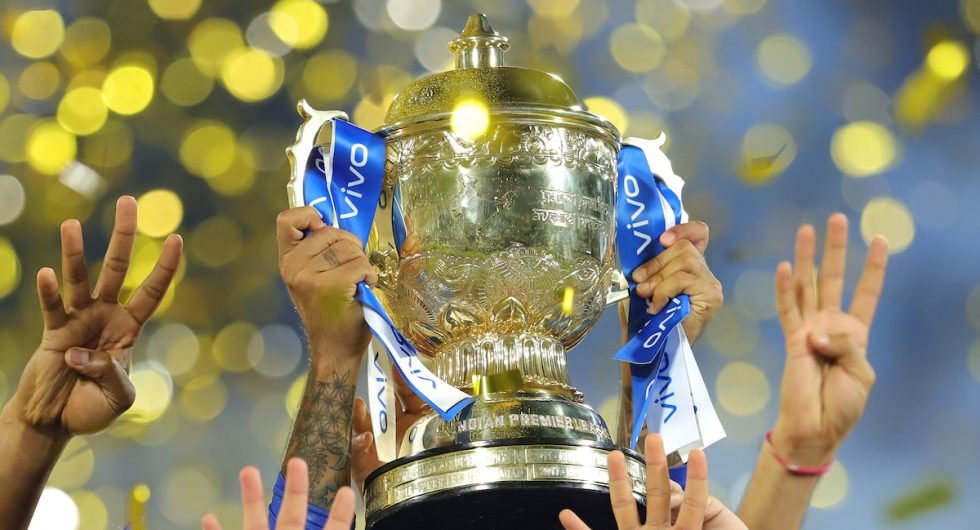
There are 18.6 concurrent viewers watching the IPL final match on the hot star’s website in app. And with that kind of viewership naming rights for the IPL are also huge for the league. Since 2008 the IPO naming rights have changed hands three times from brands DLF to PepsiCo India and finally to Vivo a mobile handset manufacturer in China. Vivo first took over title sponsorship in 2015 and in 2017 Vivo signed a fresh five year deal with the IPL worth approximately 341 million dollars in 2018. The average salary of cricket players in the IPL jumped nearly 30 percent from the year before. All thanks to the massive TV deal signed with Fox in 2017. Before the deal, players across the league had an average salary of 3.9 million dollars but in 2018 the average salary was just over 5 million dollars. And unlike other major sports leagues the IPL season is so short that players have a chance to bank even more cash in the off season.

iplt20.com | UserLogos.org

The IPL takes place in the spring starting at the end of March or early April and continuing through May. That means cricketers have the flexibility to play for other clubs around the world. Take the Mumbai Indians player Kieran Pollard. In 2017 he and more than one million dollars for two months. They play for the Mumbai Indians and IPL in that same year. Pollard had multiple revenue streams from playing for cricket leagues in Australia Bangladesh and South Africa. But just as cricket first spread across the world in the 18th century cricket’s latest form of 2020. Similarly. Taking root across the globe. There’s even a record breaking investment for 2020 league in a country where cricket is even remotely popular, the U.S. In May, 2019, USA Cricket received a 1 billion dollar investment from American cricket enterprises to develop a 2020 league in America. It’s one of the biggest deals for development of domestic cricket in the US and the launch of the league is set to take off in 2021 since the 2020 cricket format was introduced in 2003 and has taken the cricket world by storm. And it doesn’t seem to be slowing down anytime soon.
Coronavirus Scare: No spectators in stadiums for IPL 2020 matches ...

Why Australia is least affected by recession!!!

America’s economy is approaching a big milestone. If it keeps humming until July 2019, it’ll be the longest expansion in U.S. history. It would be exactly one decade and one month old by then. But there’s another country with an even more impressive run It’s even called the ‘lucky country’ Three big lessons from Australia.

  1. Be smart.
  2. Be organized.
  3. Be lucky.

So, if I’ve got any advice for other countries, it’s try and be as lucky as Australia That luck has to do with Australia’s treasure trove of natural resources. You know Australia is on the other side of the world and sitting on tremendously valuable minerals right at the point where the Chinese economy is just around the corner and exploding. Australia and every one its natural resources were within the right geographic neighborhood even as the Chinese economy began to begin . And it just so happens that China did a big fiscal stimulus in 2008 and spent a great deal of money building new cities. So all of these resources were drawn from places like Australia. So that also served as a huge tailwind at a time when developed markets were in a whole lot of trouble.

What Currency Is Used In Australia | Australian Dollar : Compare ...

The year 2008 was a time of economic turmoil The Global Financial Crisis hit and markets crumbled around the world. But as it turns out this was also a year for Australia’s economic management to really show off At the time the government had a very helpful and very low level of debt. One reason? Pension reform in the 1990s. Australia set up a compulsory retirement system called the superannuation system. It requires employers put money into its employees’ retirement savings.

Since companies and citizens have to build up retirement savings, some of the financial burden to pay off pensions was taken off of Australia’s government As other economies reeled in the wake of the 2008 crisis, the Australian Government was then able to put money directly into people’s bank accounts This boosted consumer spending in order to stimulate growth In 2008, the Australian Government unlike some other developed market governments actually jumped in very quickly with fiscal stimulus, so that helped to kind of minimize the effect of the crisis The country’s numbers continued to look sluggish after the financial crisis. But they never quite dipped low enough or for long enough to satisfy the definition of a recession. It takes two quarters of negative growth to fall into a recession. Australia’s economy did post a couple of negative quarters since 2008, but no country’s perfect. Overall Australia’s economy has been managed pretty much in recent years partly due to a robust and stable financial institution.

Reserve Bank of Australia – Australia's LGBTQ Inclusive Employers

Australia has an independent financial institution and it is a very well-run financial institution . It also has a floating exchange rate and the exchange rate helped it adjust to international shocks. Australia’s economic reforms gave it flexibility in times of hardship. For example, floating the Australian dollar In 1983, Australia’s government moved the dollar onto a floating exchange rate This meant that the dollar would be valued by supply and demand instead of being subject to influence from its government or its central bank It allows the economy to react to shocks as well Typically when an economy is hit by some sort of negative shock. The currency will adjust. It will depreciate and that helps promote exports. Another reason behind Australia’s economic diary lies in its immigration policy. Since the late 1990s, Australia has seen growth in temporary migration, many arriving to the country on student or temporary work visas. The number of temporary migrants peaked in the year 2000. However a recent change to immigration law in 2018 gave visa applicants more hurdles to get through if they wanted to come to the country Even when our GDP per capital average incomes aren’t rising by much because the number of people continues to rise that means the total GDP continues to rise at even more rapid pace Part of that’s underpinned by much faster population growth Most experts think Australia’s economy remains strong in 2019, but it’s not without risks.

Australia’s suffering at the instant from pretty weak wage growth. That’s worrying a lot of people. There’s a lot of fear right now that China is hitting a wall. That will hit demand for Australian products. The good news is to the extent that the Chinese are buying commodities hopefully will find buyers from overseas for many of those commodities if the Chinese are not there The bad news is the rest of the world economy is not doing that well.

Australian economic growth slows, enters per capita recession ...