Importance of NCERT Books

The National Council of Education Research and Training (NCERT) attribute towards developing the valuable content for the CBSE students.
The NCERT books published on the principle of child-centred system .The books inculcating creativity and treat children as participants in learning ,not as receivers of a fixed body of knowledge.The NCERT books enhance this endeavour by giving higher priority and space oppurtunities for contemplation and wondering.

Why to use NCERT books ??
Syllabus designed of the NCERT books tried to address the problem of curriculum burden by reorientating knowledge at different stages.

Especially designed for CBSE students
The NCERT books are especially designed in curriculum with CBSE students .NCERT books are the best choice for CBSE students .
All the answers to the tricky questions asked in CBSE exams could easily be answered by using these NCERT books. There will not be a single question which would be beyond the scope of NCERT books.

Easy to understand language
The best advantage of using NCERT books is that ,its quite easy to understand .The NCERT books are written in very simple and easy to understand language. The NCERT books are very simple to understand.

NCERT books especially adhere to CBSE syllabus
CBSE students should use NCERT books as they are strictly adhere to CBSE syllabus .Each and every single topic of CBSE syllabus is covered in NCERT books.

Important question
NCERT books contains all the important question at the end of the books.The questions are very helpful in scoring handsome marks in the Exams .Even if you touch them at the last minute of examination ,you can score good marks in exams .

CONCLUSION
The NCERT books are very helpful for CBSE students .The CBSE board itself suggest the students to use it .Its quite logistics to use NCERT books for CBSE exams .

RTI ACT and Investigative Journalism.

Just like citizens, the RTI act has enabled lot many journalists in the country to investigate regarding their concerned issues. RTI act over the years has become an important weapon for journalists to divulge hidden and lesser known information. RTI act has become so crucial and an “everyday thing” for some journalists that they have build their entire career out of it.

Some of the famous cases where RTI act has helped journalists in their investigation procedure are:

1) Chhatrapati Shivaji Memorial Project by journalist Mr. Vishwas Waghmode:

Mr. Waghmode, a journalist at the time in The Indian Express investigated the controversial Chhatrapati Shivaji Memorial project. According to him, the initial cost quoted by the contractor was Rs.3826 crores which was supposed to be the lowest bid as opposed to the government’s bid which was Rs.2500 crores. The government in order to resolve this issue set up a committee led by the chief secretary in order to renegotiate the cost which successfully got the cost down to the government’s estimate of Rs.2500 crores. Mr.Waghmode in connection with this case stated that the rules do not allow renegotiation but rather they are supposed to issue fresh tenders. He further added that the opposition was alleging the government had reduced the height of the statue in order to reduce the cost which the government vehemently denied.

In order to have the “genuine information”, he took the help of RTI act. Mr. Waghmode discovered and revealed how the government had in reality decreased the height of the statue and the horse by 7.5m. But in order to show that the height of the statue was not reduced, they had instead increased the height of the sword by 7.5m. He further revealed that since the sword was straight, the amount of money required to build the sword was quite less when compared to the reduction in height and that in turn helped them reduce the cost by a substantial amount.

RESULT:

When all of this came into the public eye, the State Government could not justify why the height of the sword was increased and was in deep shame.

2) HONORARY DOCTORATE SCAM by Shyamlal Yadav.

When we talk about investigative journalism in India, we can never ignore this name, that is, Shyamlal Yadav. In 2018, Mr. Shyamlal Yadav in The Indian Express published a series of investigative reports on how India has emerged as one of the biggest markets for “predatory” publishers of substandard research journals.


On February 6, 2018, The Indian Express scrutinised over 500 RTI applications filed over 470 higher educational institutions to find that monitoring authorities, and hundreds of politicians and bureaucrats were awarded such degrees between 1997 and 2017.

The list for instance included former director of IISC, who received 18 honorary doctorates from public universities between 2006 and 2012 when he was chairman of NAAC’s EC. The list also had several UGC chairmen who had such degrees during their tenure.


RESULT:
Rules were made by higher authorities in 2019 after the investigative report via RTI files whereby NAAC officials, family weren’t allowed to accept honorary doctorates from institutions under their watch. RTI was used to dig out crucial facts in this case.

3) Discontinuation of LIC policies by Shyamlal Yadav

Shyamlal Yadav got information through RTI from Life Insurance Corporation (LIC) that there were 59 million insurance policies those were lapsed permanently due to discontinuance of premium. And the premium deposited since then had become LIC property. Despite many efforts LIC did not provide the info on total money deposited against those policies till the date they lapsed. As a result, Indian Express published the story about the discontinuation.


RESULT:


Within 25 days of publication of the story, LIC issued fresh
advertisements regarding renewal of policies.

4) Streams of Filth by Shyamlal Yadav:

This was an investigation by Shyamlal Yadav regarding water pollution in India that took over one year. About 39 RTI applications regarding expenses by Government on water projects were filed.
It came into notice that large amount of money was spent by Government for water purification projects but there was little effect on nation’s lifelines.
The story was published in The Indian Express and was selected by UNESCO as one of the 20 best Investigative pieces in the world.


RESULT:
Central Pollution Control Board said the rivers of India are not just polluted but severely toxic.

KNOWLEDGE IS POWER

Knowledge is power, which indicates that a person can use knowledge to gain education and complete control over his life. Educated people can deal with life’s challenges with ease. Knowledge is the most powerful tool for empowering people, and no other power on the planet can defeat it. Knowledge, we may say, gives power to a person who strives for his rights and competes with the rest of the world. The distinction between a man and an animal has been made by knowledge. Human beings cannot be compared to animals in terms of physical strength, but because of the power of knowledge, they have been the most powerful species on the planet.

Humans are physically weaker than animals. Every knowing person is educated, but not everyone who is educated is knowledgeable. This may appear strange, yet it is correct. Almost everyone in today’s world is educated, but they have little understanding of the subjects they have studied. Furthermore, knowledge is a critical tool for bringing about positive changes in society or in a country. Knowledge provides us with a glimpse of our future and what we may accomplish there. The effect of knowledge is that all countries around the world use technologically advanced tools and technology, among other things. Knowledge, not weapons or bombs, is what makes a country powerful.

Benefits of Knowledge:

Enables Problem Saving: There is a solution to every problem in life. Solutions, on the other hand, are only supplied by people who are knowledgeable. Problems will inevitably arise in life, and by gaining knowledge, you may train yourself to be a problem solver. You will become important in your culture if you accomplish this. Doctors, for example, cure ailments by giving patients medications, but they cannot do so if they are uninformed.

Builds Confidence: When you are well-informed, your self-assurance grows. You won’t be able to solve problems if you don’t have faith in yourself. You can have faith in yourself if you have knowledge. Your level of confidence in approaching a task will be determined by your knowledge of the subject. People who are familiar with the situation are rarely afraid. When issues develop, they may even rejoice since it gives them the opportunity to shine. Consider how the stars shine brightly at night while humans strain to see them.

Breeds Success: Knowledge is a key to success. What guys know determines their success. What you know about the subject determines your success as a student. Let’s face it: we can’t demonstrate that we grasp a problem if we keep failing. Failure indicates that there is still something you don’t understand. Once you’ve overcome your ignorance, you’ll be on your way to success.

In conclusion, we may state that accurate knowledge aids in the development of a person. It also keeps people out of confrontations and corrupt situations. Knowledge also provides happiness and wealth to a country. Above all, information is the key to everyone’s success. We should also be willing to learn new things in areas where we believe we are experts. Let us not be afraid to fail in our pursuit of knowledge.

Investing lesson of Peter Lynch


Peter Lynch is one of the most successful and top value investor of all time. He was a legendary fund manager who gave 29% returns to their investors for 13 years in a row. He wrote books on value investing , where he shared his investment lessons which he learned and used during his journey as an investor. He is one of the greatest value investor of all time. He is a firm believer that an average investor can also pick winning stocks as Wall Street professional with right research, patience , steady discipline and common sense.


Some of his investment principles are –

1. Invest in what you already know – “The worst thing you can do is invest in companies you know nothing about. Unfortunately buying stocks on ignorance is still a popular American pastime.” -Peter Lynch
People can perform well by investing in what they already know. For instance if a doctor wants to invest in banking sector (about which he know nothing) , he will not have that great return as compared to if he will invest in pharmaceutical companies ( as he already knew about drugs, healthcare sector and their companies)
“Invest in what you know. It leaves out the role of serious fundamental stock research. People buy a stock and they know nothing about it. That’s gambling and it’s not good.” -Peter Lynch
So, it’s better to choose the company whose products/services are either used by you or you are familier of the products/services of that company in some way or other. These knowledge will lead you to invest in better stocks .
2. Invest in companies not in stocks – “Look for small companies that are already profitable and have proven that their concept can be replicated. • Be suspicious of companies with growth rates of 50 to 100 percent a year”-Peter Lynch

Behind every stock there is a company. If companies will perform well, the stocks automatically will perform well. So, it’s important to know about the company, it’s business model. Choose a company whose fundamentals are strong. A company whose business model is so easy to understand that anyone can understand and run that company.

“Go for a business that any idiot can run – because sooner or later any idiot probably is going to be running it” -Peter Lynch

Know a companies management, it’s fundamentals and then ask yourself , “are you able to understand the mission and vision of the company? “ or “If you’ll be given the responsibility to run this company, will you be able to run the company? “
If the answers to the above questions are a YES then it’ll be great to invest in that company.
So always remember that you have to invest in a company and not in a single stock.


“Behind every stock is a company. Find out what it’s doing.” -Peter Lynch

“Never invest in a company without understanding its finances. The biggest losses in stocks come from companies with poor balance sheets.”

3. Don’t take unnecessary risks. Take calculated risks – You don’t have to take risks which you can’t bear. Only take calculated risks.
Let’s say, you have $10 dollar, maybe if you will lost this, you won’t regret. But what if you lost $100 or $1000! Always buy stocks of the amount if you lose won’t regret. You are not required to put all your money in market and risk all that money. Instead put only that amount which if you lose won’t make you regret of investing.
Also, invest only the amount you will not need ever back in your life
4. Peter Lynch said that the most important thing that keep in mind while investing is : know why you own it.

“ You have to know what you own ,and why are you own it .” -Petrr Lynch

It sounds simple but it is not . He said when I asked most people they just don’t know why they own a stock . 80% of investors have no answer to this question .

They maybe hear some tip from anywhere and put their money at risk and when they lose it they blame institutions .
First you have to know the reason . Why you should invest in this company ,research about that company . Check their balance sheets . Without proper research you are not investing you are just gambling . Read and know as much as you can about the company. And remember to buy the company and not just a stock.

“If you’re prepared to invest in a company, then you ought to be able to explain why in simple language that a fifth grader could understand, and quickly enough so the fifth grader won’t get bored.” – Peter Lynch

5. Invest for long time- Lynch used to hold stocks for long period of time. He used to sell the stocks when the fundamentals of any company gets changed. This is his advice for all investors out there to not go behind short term profits but invest for a long period of time.
He even conducted many studies to understand the power of compounding.

“People who succeed in the stock market also accept periodic losses, setbacks, and unexpected occurrences. Calamitous drops do not scare them out of the game.”


Some more investment lessons by Peter Lynch :

• “Never invest in any idea you can’t illustrate with a crayon .”

• “The trick is not to learn to trust your gut feelings, but rather to discipline yourself to ignore them. Stand by your stocks as long as the fundamental story of the company hasn’t changed”

• “Whenever you invest in any company, you’re looking for its market cap to rise. This can’t happen unless buyers are paying higher prices for the shares, making your investment more valuable.”


• “There’s no shame in losing money on a stock. Everybody does it. What is shameful is to hold on to a stock, or worse, to buy more of it when the fundamentals are deteriorating.”

• “Never invest in any company before you’ve done the homework on the company’s earnings prospects, financial condition, competitive position, etc”

• “Big companies have small moves, small companies have big moves.”

• “Good management, a strong balance sheet, and a sensible plan of action will overcome many obstacles, but when you’ve got weak management, a weak balance sheet, and a misguided plan of action, the greatest industry in the world won’t bail you out.”

• “In the long run, a portfolio of well chosen stocks and/or equity mutual funds will always outperform a portfolio of bonds or a money-market account. In the long run, a portfolio of poorly chosen stocks won’t outperform the money left under the mattress.”


This is how he succeed in the world of investment. You can learn from him and help yourself to reach the level you want in investment.


Thank you.

Parliamentary Privileges

Introduction

India is called the world’s largest democratic country. The power to make law exists with the Indian Parliament. The members of lower house of Parliament are elected from the direct election while the members of upper house are elected from the Legislative Assembly of States and Union territories by means of single transferable vote through proportional representation. The concept of parliamentary privilege in the Constitution of India has been taken from British Constitution. Parliamentary privileges are special rights, immunities, exceptions enjoyed by the members of the two houses of Parliament and their committees. The main motive of these privileges is to uphold the supremacy of the offence of the office of the Parliament and its members.

Who Enjoys Parliamentary Privileges

These rights are mainly for the members of both houses of Parliament. Apart from this, these rights are also given to those individuals who speak and participate in any committee of the Parliament, which includes the Attorney General of India and the Union Ministers. President, even if he is a part of Parliament, does not have parliamentary privileges.

Breach of Parliamentary Privileges

If any person or officer violates the individual or collective privileges of a Member of Parliament, such as, disrespect, abuse, attack, etc., such acts are comsidered as breach of Parliamentary Privileges which is punishable by the house.

Thus, the above facts make it clear that Parliamentary Privileges in India have been enforced so that the respect of the Parliament and its members can be ensured.

But it is observed that after winning the elections, these representatives do not respect the public while on the other hand they expect that the public should give them due respect. Apart from this, you may have noticed that the Parliamentarians are often seen misbehaving with the officials and the general public. This is called the misuse of parliamentary privileges.

Therefore, it is the need of the hour that if the government wants to maintain the dignity of the democracy then it should make appropriate changes in the parliamentary privileges because nobody can be superior to the general public.

Conclusion

The privileges are conferred on the members for smooth functioning of the Parliament. But, these rights should always be in conformity with the fundamental rights because they are our representatives and work for our welfare. If the privileges are not in accordance with the fundamental rights then the essence of democracy for the protection of the rights of the citizen will be lost. It is the duty of the Parliament not to violate any other rights which are guaranteed by constitution. The members should also use their privileges wisely and not misuse them. They should always keep in mind that the powers do not make them corrupt. The Parliament cannot adopt every privilege that is present in the house of commons but should adopt only those privileges that accordingly suits our Indian democracy.

Structure of banking system in India

Introduction

Banking in India in the mdern sense originated in the last decades of the 18th century . The first banks were Bank of Hindustan (1770-1829) and the General Bank of India established 1786. The largest bank and the oldest still in existence, is tge State bank of India, which originated in the Bank of Calcutta in June 1806 , which almost immediately became the bank of Bengal. This was one of the three presidency banks , the other two being The Bank of Bombay and The bank of Madras , all three of which were established under charters from the British East India Company. The three banks merged in 1921 to form the Imperial Bank of India , which , upon India’s independence became the State Bank of India in 1955. For many years the presidency banks acted as quasi-central banks , as did their successors until the reserve Bank of India was established in 1935 .

Reserve bank of India (RBI)

The Reserve Bank of India is India’s central banking institution, which controls the monetary policy of the Indian rupee. It commenced its operations on 1 April 1935 during the British Rule in accordance with the provisions of the Reserve Bank of India Act,1934 and in 1949 it was nationalized.The central office of the Reserve Bank was initially established in Calcutta but was permanently moved to Mumbai in 1937. The central office is where the Governor sits and where policies are formulated. Sir CD Deshmukh is the first Governor of RBI. The RBI has four zonal offices at Chennai, Delhi, Kolkata, Mumbai and 20 regional offices mostly located in the state capitals and 11 sub-offices. Reserve Bank of India Act,1934 is the legislative act under which the Reserve Bank of India was formed. This act along with the Comapnies Act, which was amended in 1936, were meant to provide a framework for the supervision of banking firms in india.

Scheduled and non-scheduled banks

Scheduled banks in India refer to those banks which have been included in the second schedule of Reserve Bank of India Act, 1934. Banks not under this schedule are called non-scheduled banks. In other words, Banks with a reserve capital of less than 5 lakh rupees qualify as non-scheduled banks. Unlike scheduled Banks , they are not entitled to borrow from the RBI for normal banking purposes, except, in emergency or ‘abnormal circumstances’. Coastal local Area Bank Ltd. (Vijayawasa,AP), Capital Local Area Bank Ltd. (Phagwara, Punjab), Krishna Bhima Samrudhi Local Area Bank Ltd. (Mehbubnagar, Telangana), Subhadra Local Area Bank Ltd. (Kolhapur, Maharashtra) are the only non-scheduled banks in India.

Scheduled banks are further internally classified into commercial banks and cooperative banks.

Public Sector Banks

Public sector banks (PSBs) are banks where a majority state (ie., more than 50%) is held by a government . The shares of these banks are listed on stock exchange. There are a total of 21 PSBs in India and State Bank of India group.

  • In 1969, the Indira-Gandhi headed government nationalised 14 major commercial banks ( Allahabad Bank , Bank of Baroda , Bank of India , Bank of Maharashtra , Canara Bank , Central Bank of India , Dena Bank , Indian Bank , Indian Overseas Bank , Punjab and Sindh Bank , Punjab National Bank, Sindicate Bank , UCO Bank , United Bank of India)
  • In 1980 , a further 6 banks were nationalised (Andhra Bank , Cooperation Bank , New Bank of India , Oriental Bank of Commerce, Punjab and Sindh Bank , Vijay Bank )
  • IDBI Bank is an Indian government-owned financial service company, formarly known as industrial Development Bank of India , headquartered in Mumbai , India .It was established in 1964 and nationalised in year 2005 .

Private Sector Banks

The ‘Private- Sector’ banks are baks where greater parts of share or equity are not held by the government but by private shareholders . There are many Indian and Foreign Banks in India . HDFC Bank , ICICI Bank , Axis Bank , Kotak Mahindra Bank , Yes Bank , IDFC Bank , RBL Bank , Federal Bank , City Union Bank are the major private banks in India.

Regional Rural Banks

Regional Rural Banks were formed on October 2,1975 upon the recommendations of M. Narsimham working group during the tenure of Indira Gandhi’s government. The object behind the formation of RRBs was to serve large unserve population of rural areas and promoting financial inclusions . They have been created with a view to serve primarily the rural areas of India with basic banking and financial services. However, RRBs may have branches set up for urban operations and their area of operation may include urban areas too.

Cooperative Banks

The cooperative banks are furtger classified into:

  • State cooperative banks: These are small financial institutions which are governed by regulations like Banking Regulations Act , 1949 and Banking Laws Cooperative Socities Act ,1965 . At present there are about 33 state cooperative banks of which 19 are scheduled.
  • Urban/ Central cooperative banks: The term urban cooperative banks (UCB) refers to primary cooperative banks located in urban and semi-urban areas . These banks till 1996 , were allowed to lend money only for non-agricultural purposes. This distinction does not hold today . They essentially lent to small borrowers abd business . There are about 2,104 UCBs of which 56 were scheduled Banks. About 79 percent of these are located in 5states- Andhra Pradesh, Gujarat, Karnataka, Maharashtra and Tamil Nadu .
  • Primary credit Socities: Primary Credit Societies or primary agricultural credit society (PACs) is a basic unit and smallest cooperative credit institutions in India. It works on the grassroot level (Gram panchayat and village level ) . It virtually function like banks , but whose net worth is less than Rs. 1 lakh; who are not members of the payment system and to whom deposit insurance is not extended .

Comparative Study b/w Parliamentary and Presidential System of Government

Parliamentary system is a democratic form of government in which the party with the greatest representation in parliament (legislature) forms the govt., its leader becoming prime minister or chancellor. Presidential form of govt. is a democratic and republican govt. in which a head of govt. leads an executive branch. The head of govt. is in almost cases also the head of the state, which is called the President. India follows a parliamentary form of govt. modelled on Britain’s.

Features

Features of Presidential system are that the executive can veto acts by the legislature, the President has a fixed tenure and cannot be removed by a vote of no confidence in legislature. The President has the power to pardon or commute judicial sentences awarded to criminals and the President is elected directly by the people or by the people or by an electoral college whereas features of parliamentary system are- close relationship b/w the legislature and the executive, executive is responsible to the legislature, there are two executive i.e. real executive and titular executive, bicameral legislature, no fixed tenure, leadership of Prime Minister.

Merits

Merits of Presidential system are- seperation of powers, expert govt., stability and less influence of the party system.

Merits of Parliamentary system are- better coordination b/w executive and legislature, prevents authoritarianism, responsible govt., represents diverse groups, flexibility in the system.

Demerits

Demerits of Presidential system are- less responsible executive, deadlocks b/w executive and legislature, rigid govt., spoils system as the system gives the President sweeping powers of patronage.

Demerits of Parliamentary system are- no seperation of powers, unqualified legislators, instability, failure to take prompt decision because there is no fixed tenure, party politics is more.

Conclusion

The Presidential system is better for one because of its seperation of powers, the role of judiciary and the govt. accountability to its people. We should ensure a system of govt. whose leaders can focus on governance rather than on staying in power. The present parliamentary system has been tried and tested for nearly 70 years. It can be reformed thoroughly to remove the challenges thrown up by it. Also, there is a need to reform the electoral processes to make democracy more robust.

RTI ACT- Every Citizen’s right!

Right to Information (RTI) is an act of the Parliament of India which sets out the rules and procedures regarding citizens’ right to information. This particular act was passed as an independent act by the Indian Parliament in the year 2005.

The RTI act has been useful in getting to know our personal grievances, making our politicians and elected representatives accountable.

The RTI act empowers common public in India by indirectly involving them in decision making and in other important public affairs. Every citizen in India through this act got the privilege of right to be informed.

RTI ACT: Controversial, yet beneficial.

Very recently, an RTI application was filed by a group of individuals seeking to know about source of a particular line in NCERT History textbook of grade 7th which said “Temples were rebuilt after they were destroyed by the Mughals”. The individuals wanted to know about the source of information regarding the text to which the response was “Source of information is unknown”.

In such a case, one may argue that RTI act doesn’t mandate an authorised body to respond “according to the query” (meaning, they just have to respond, it does not matter what the response is) that is, an authorised body doesn’t necessarily have to respond, they can just pass the query off by saying “no source of information available.”

But at the same time, RTI ACT as mentioned earlier is a powerful tool for citizens through which commoners in the country can keep an eye on the government and its activities. For example, in 2016, when Demonetisation was announced by the Government of India, Mr. Venkatesh Nayak filed an RTI application which revealed that RBI did not agree with Government of India’s justification that the decision would curb corruption in India.

Another example could be the Commonwealth Games Scam, in which an RTI application was filed by a non-profit organisation which revealed that Delhi Government had diverted Rs. 744 crores from funds which were kept only for Dalits to Commonwealth Games.

A very successful case was also found in Bangalore where a bundle of corruptions and dereliction of duties in allowing encroachment of government land of 12,000 square feet without the permission from the respective authorities by New Cambridge School Trust. The Assistant Executive Engineer who was supposed to actions against the encroachment of land which was worth Rs. 6 crores was found protecting the illegal encroachment of land. These irregularities came out when an RTI application was filed before the Executive Engineer Division in Bangalore.

Denouement:

RTI act from the beginning has been into controversies for being chaotic and problematic in many cases. But in my view, these instances of chaos are again because of the same loopholes we have in our democratic system and legal system we strive to fight against via the help of RTI act. Nonetheless, the act has enabled the citizens to become more aware and hold the government accountable when required. This is evident from the fact that India ranked 4th best in the world for RTI laws. The recent amendment of act in 2019 is however criticised as many feel, it would give Central Government more power.

ELON MUSK

ELON MUSK, the famous and most successful person in the tech world, who played many roles and faced many struggles to become what he is today. Elon Musk was born and raised in South Africa.

We all know him as an entrepreneur, businessman, CEO of Tesla and spacex, but he is also a skilled investor, software developer, designer, inventor, rocket scientist, actor, film producer, one of the richest man in the world.

During his school days, he was a victim of severe bullying. At the age of 12, he created a video game(blaster) and sold it to a computer magazine. Elon Musk is the founder of X.com (later it became paypal), spacex, Tesla motors.

Recently Elon Musk turned 50, over the past decades Musk managed to become CEO of Tesla and spacex, founder of the boring company, co-founder of OpenAI, Neuralink. He also played a vital role in space rockets, electric cars, solar batteries.

“”Failure is a option here, if things are not failing then you are not innovative enough.””.                 – Elon Musk

“” I think it’s possible for ordinary people to choose to be extraordinary.””                                                                   –Elon Musk

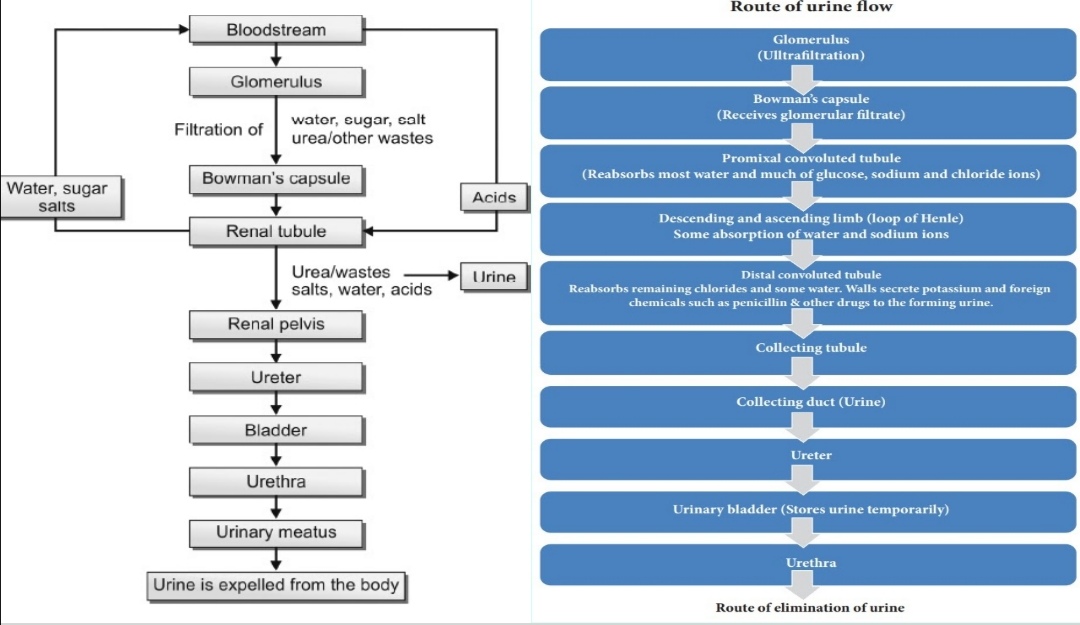
THE EXCRETORY SYSTEM

Excretion

Removal of nirogenous waste produce during metabolism of protein and nucleic acid.

Human excretory system includes:-
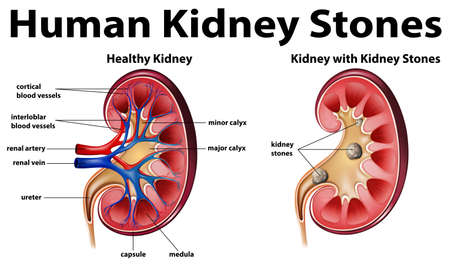
Pair of kidney
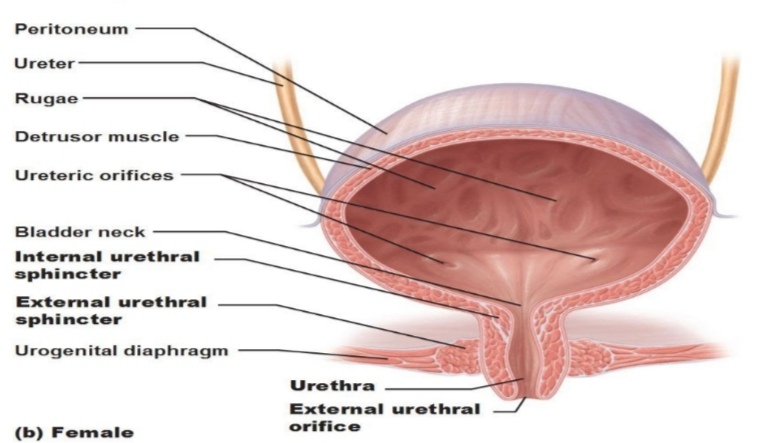
Pair of ureter
Urinary bladder
Urethra

Function of kidney

Kidneys regulate the osmotic pressure of a mammal’s blood through extensive filtration and purification, in a process known as Osmoregulation.

  • Kidneys filter the blood; urine is the filtrate that eliminates wastes from the body via the ureter into the urinary bladder.
  • The kidneys are surrounded by three layers:
    1.  Renal fascia
    2. perirenal fat capsule
    3. Renal caps

EXTERNAL ANATOMY

A typical adult kidney (mass – 135–150 g) is:

10–12 cm- long
5–7 cm – wide
3 cm cm- thick

  • The concave medial border of each kidney faces the vertebral column. 
  • Near the centre of the concave border is an indentation called the Renal hilum, through which the ureter emerges from the kidney along with blood vessels, lymphatic vessels and nerves.
  • Human kidney are Retroperitoneal(covered with peritoneum) 
  • Present between 12th thoracic vertebrae to 3rd lumber vertebrae. 
  • Left kidney is higher than the right kidney due to position of liver in right side. 

Three layers of tissue

a) .The Renal capsule(Deep layer) – Smooth, transparent sheet of dense irregular connective tissue that is continuous with the outer coat of the ureter.

  •  It serves as a barrier against trauma and helps maintain the shape of the kidney. 

b) The adipose capsule (middle layer) – Mass of fatty tissue surrounding the renal capsule. 

  •  Protects the kidney from trauma and holds it firmly in place within the abdominal cavity.

c) The renal fascia(superficial layer) – Thin layer of dense irregular connective tissue 

  •  Anchors the kidney to the surrounding structures and to the abdominal wall 

On the anterior surface of the kidneys, the renal fascia is deep to the peritoneum

Internal anatomy

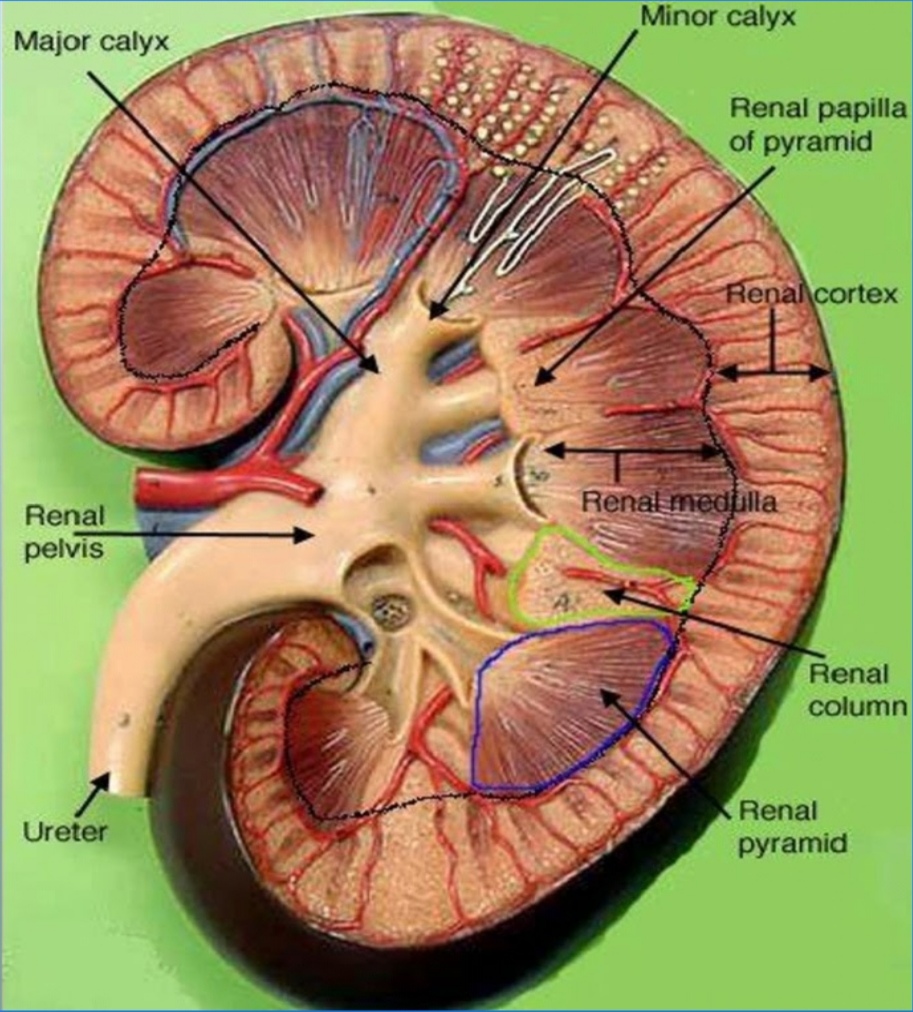
A frontal section through the kidney reveals two distinct regions: 

  1.  Renal cortex (outer)
  2.  Renal medulla (inner). 

The renal medulla consists of several cone-shaped renal pyramids. 

The base (wider end) of each pyramid faces the renal cortex, and its apex (narrower end), called a renal papilla, points toward the renal hilum. 

The renal cortex, smooth textured area extending from the renal capsule to the bases of the renal pyramids. 

It is divided into an outer cortical zone and an inner juxtamedullary zone.

Ureter

Muscular tubes of 25-30cm length, 3m in diameter. 

Wall of Ureter

  • Innermost-Transitional epithelium
  • Middle layer-Muscular(longitudinal and circular muscle) 
  • Outermost layer – Tunica adventita. 

Urine is move through ureter by peristalsis.

Urethra conduct the urine from urinary bladder to outside.
Female urethra is short.
Male urethra is long.


Urinary bladder

It is hollow muscular organ  that stores urine from the kidneys before disposal by urination. 

In humans the bladder is a hollow distensible organ that sits on the pelvic floor

Nephron

Structure and functional unit of kidey.

Each kidney contain about 1 million nephron 

Each nephron has 2 part 

  • Glomerulus
  • Renal tubules.
  • Take a simple filtrate of the blood and modify it into urine.
  • Cleanse the blood and balance the constituents of the circulation.
  • Many changes take place in the different parts of the nephron before urine is created for disposal. 
  • The term urine will be used here after to describe the filtrate as it is modified into true urine. 
  • The principle task of the nephron population is to balance the plasma to homeostatic set points and excrete potential toxins in the urine.

RENAL CORPUSCLE

It CONSISTS OF A GLOMERULUS SURROUNDED BY A BOWMAN’S CAPSULE. 

THE GLOMERULUS ARISES FROM AN AFFERENT ARTERIOLE AND EMPTIES INTO AN EFFERENT ARTERIOLE. 

THE SMALLER DIAMETER OF AN EFFERENT ARTERIOLE HELPS TO MAINTAIN HIGH BLOOD PRESSURE IN THE GLOMERULUS.

THE BOWMAN’S CAPSULE IS DIVIDED INTO THREE LAYERS:

  • OUTER PARIETAL LAYER- MADE UP OF EPITHELIAL CELLS WITH MINUTE PORES OF DIAMETER 12NM.
  • MIDDLE BASEMENT MEMBRANE-IT IS SELECTIVELY PERMEABLE.
  • INNER VISCERAL LAYER-IT CONSISTS OF LARGE NUCLEATED CELLS CALLED PODOCYTE(BEAR FINGER-LIKE PROJECTIONS CALLED PODOCEL) 

Renal tubule

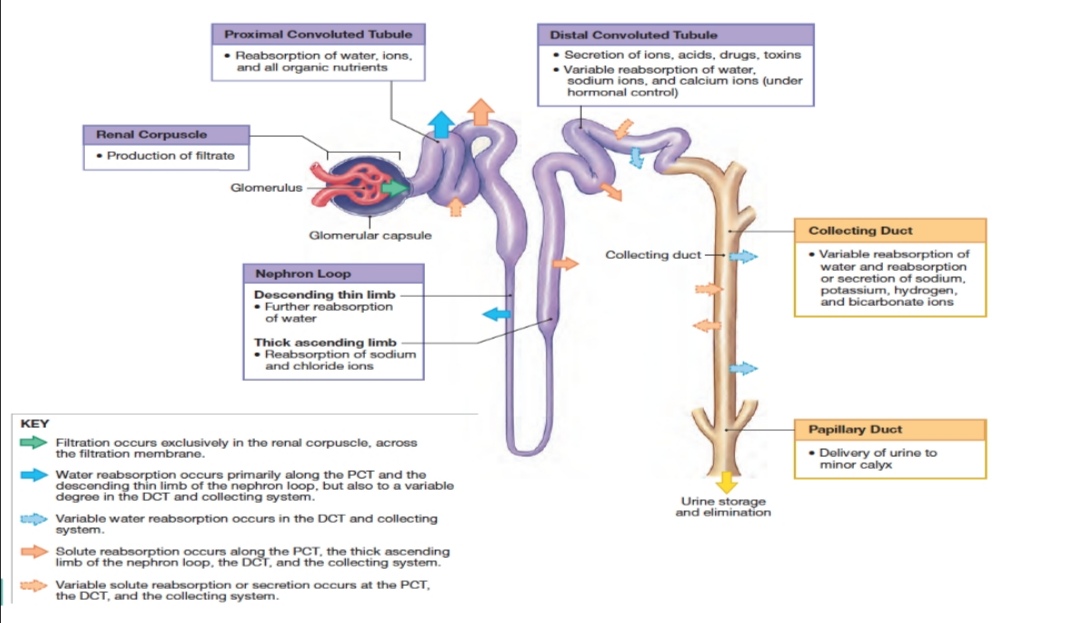
It IS A LONG AND CONVOLUTED STRUCTURE THAT EMERGES FROM THE GLOMERULUS 

IT CAN BE DIVIDED INTO THREE PARTS BASED ON FUNCTION:-

  1.  PROXIMAL CONVOLUTED TUBULE (PCT) –  IN THE RENAL CORTEX.
  2.  THE LOOP OF HENLE, OR NEPHRITIC LOOP – IT FORMS A LOOP (WITH DESCENDING AND ASCENDING LIMBS) THAT GOES THROUGH THE RENAL  MEDULLA.
  3. DISTAL CONVOLUTED TUBULE (DCT)- IN THE RENAL CORTEX.

Loop of Henle

Thick segment-Simple cuboidal epithelium
Thin segment-Simple squamous epithelium.

DCT

Distal  convoluted tubules

Cuboidal epithelium with fewer mitochondria and microvilli

  • Conditional reabsorption of water under the effect of ADH.
  • Na+ – Aldesteron
  • Ca²+ – parathyroid hormone
  • Reabsorption ofHCO3¯and secretion of H+, K+and NH3 to maintain pH. 

Collecting duct

Cuboidal epithelium

Conditional reabsorption of water, Na+, Ca²+. 

Permeability for urea 

PCT

⅔rd of water reabsorption and 60% of glomerular filtrate is reabsorbed. 

Water, Na+, Cl-, HCO3-, Glucose, vit. C, amino acid, K+and little amount of urea and uric acid.

Descending Limb-permeable to water only. 

Ascending Limb– permeable to ions only. 

Na+, Cl-, k+, Mg²+, Ca²+

Reabsorption is minimum. 

Urine formation

1) Glomerular filtration
2) Tubular reabsorption
3) Tubular secretion

Glomerular filtration 

  • WATER AND SOLUTES ARE FORCED THROUGH THE CAPILLARY WALLS OF THE Glomerulus INTO THE BOWMAN’S CAPSULE (GLOMERULARCAPSULE)
  • FILTRATE –THE FLUID THAT IS FILTERED OUT INTO BOWMAN’S CAPSULE. 
  • Glomerulus filtrate-same as plasma but protein are absent. 

Contains-Water, ions, Glucose, amino acid, water soluble vitamin, urea, uric acid etc. 

Tubular reabsorption

OCCURS BOTH PASSIVE AND Actively. 

GLUCOSE, AMINO ACIDS, AND OTHER NEEDED IONS (NA, K, CL, CA, HCO3) ARE TRANSPORTED OUT OF THE FILTRATE INTO THE PERITUBULAR CAPILLARIES ( REABSORBED BACK INTO THE BLOOD)

ABOUT 65% OF THE FILTRATE IS REABSORBED IN THE PCT. 

AS THESE SUBSTANCES ARE Reabsorbed, THE BLOOD BECOMES HYPERTONICSO WATER EASILY FOLLOWS BY OSMOSIS. 

REABSORPTIONIN THE DCT IS UNDER Hormonal CONTROL ALDOSTERONE CAUSES MORE SALT TO BE ABSORBED

 ADH CAUSES MORE WATER TO BE ABSORBED

TUBULAR SECRETION

WASTE PRODUCTS SUCH AS UREA AND URIC ACID, DRUGS AND HYDROGEN AND BICARBONATE IONS ARE MOVE OUT OF THE PERITUBULARCAPILLARIES INTO THE FILTRATE; THIS REMOVES UNWANTED WASTES AND HELPS REGULATE PH

Urine

It is pale yellow in colour due to Urochrome pigment that is byproduct of red blood corpuscles(RBC) breakdown. 

Around 1-1.5 litre of urine is formed per day. 

PH =6 (vary 4.2 – 8.2) 

It can be four times as concentrated as the blood i. e-1200mosmol/L.

Heavier than water

  • contain
  • 95% =water
  •  5%= urea, uric acid, K+, H+, NH4+, sulphate, hippuric acid, oxalate


Star Clusters- The family of stars

Many Stars in the milky way spend at least part of their lives in clusters.  Clusters are scientifically interesting because all their stars formed around the same time and generally have similar characteristics. For example, if the cloud in which they formed was rich in certain kinds of elements, then the stars from that cloud will contain higher amounts of those materials. If the cloud was metal-poor (that is, it had a lot of hydrogen and helium but very little of other elements), then the stars that form will reflect that metallicity. Their similarity makes cluster stars good targets for the study of stellar evolution (how stars age and die). Very young clusters interact with the remains of the gas and dust cloud from which they formed. Understanding how all types of clusters form in our galaxy gives astronomers good insights into how the process happens in other galaxies as well.  There are two types—open and globular.  

Open Clusters

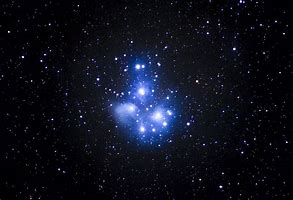
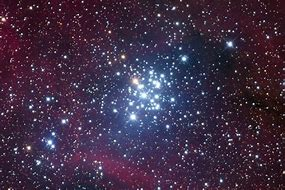
Open clusters usually have up to a thousand or so stars gathered into an irregularly shaped collection. They are often found in the plane of the galaxy, which is where they form. Most of the stars in these clusters are less than 10 billion years old, and some still lie embedded in what’s left of their birth clouds. Our Sun was created in an open cluster that formed about 4.5 billion years ago. It has since moved away from its stellar siblings and now travels the galaxy alone.  Open clusters are generally found in spiral galaxies such as the Milky Way and irregular-type galaxies such as the Large and Small Magellanic Clouds, which are two of our galaxy’s closest neighbors.  Example of Open Clusters:

Pleiades in Taurus constellation

Jewel Box in Crux constellation

Globular Clusters

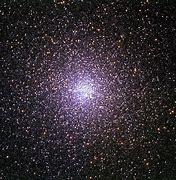
Globular clusters are collections of hundreds of thousands of old stars. The gravitational influence of all those stars binds the cluster together into a spherical, globular shape. Globulars swarm around the central region of the galaxy, called the halo. The Milky Way Galaxy has about 160 of these tightly packed clusters, but other galaxies have many more. Globulars roam around the halo and probably formed about the same time as the galaxy did.  Example of Globular Cluster: Tucanae

Cluster Formation

A cluster begins to form when some event triggers motion and turbulence in the birth cloud. For an open cluster, it could be a supernova explosion or a fast-moving wind ejecting material from an aging star in the near neighborhood. For a globular cluster, a galaxy collision could be one kind of trigger event. Whatever happens, it sends fast-moving material and shock waves through the birth cloud and starts the process of star birth. Once formation is complete, the cluster stars continue to evolve. If they are not strongly bound together by gravity, after about 100 million years they start to go their separate ways. Even though members of the cluster may get separated by large distances, they all tend to move through space in the same direction and at about the same speed. Sometimes interactions in the cluster will “kick” some stars out into space, sending them on radically different trajectories into the galaxy. Eventually, these stellar associations dissipate into what’s called a moving group, before they finally scatter to become part of the larger stellar population in the galaxy.

http://en.wikipedia.org/wiki/Star_cluster
https://en.wikipedia.org/wiki/Open_cluster

The Big Bang

Ever heard of the Big Bang? No, not the TV show. The beginning of the Universe as we know it. 

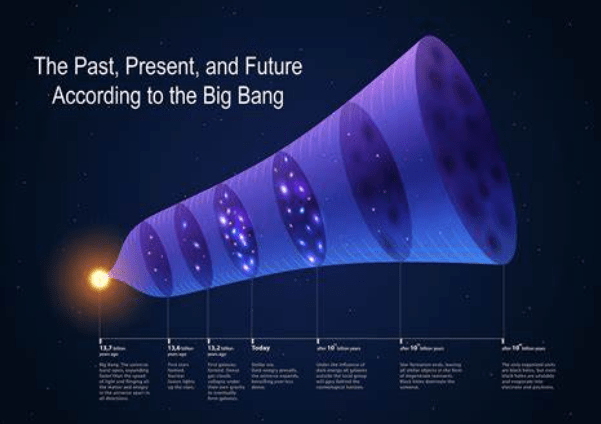
The Big Bang theory is the prevailing cosmological model explaining the existence of the observable universe from the earliest known periods through its subsequent large-scale evolution. The model describes how the universe expanded from an initial state of high density and temperature,  and offers a comprehensive explanation for a broad range of observed phenomena, including the abundance of light elements, the cosmic microwave background (CMB) radiation, and large-scale structure.

Crucially, the theory is compatible with Hubble–Lemaître law—the observation that the farther away a galaxy is, the faster it is moving away from Earth. Extrapolating this cosmic expansion backwards in time using the known laws of physics, the theory describes an increasingly concentrated cosmos preceded by a singularity in which space and time lose meaning (typically named “the Big Bang singularity”). Detailed measurements of the expansion rate of the universe place the Big Bang singularity at around 13.8 billion years ago, which is thus considered the age of the universe. 

Timeline

The first second after the Big Bang, the entire universe was a soup of subatomic particles, superheated to 10 billion degrees. In that first second, amazing things happened: The force of gravity separated out from the electronuclear force and was joined soon thereafter by the electromagnetic force. The universe changed from being a hot soup of quarks and gluons (elementary particles), and protons and neutrons began to form. At the ripe old age of one second, the newborn universe was cool enough that it began forming deuterium (a form of hydrogen) and helium-3. At this point, the newborn universe had doubled in size at least ninety times!

Over the next three minutes, the infant universe continued to cool down and expand, and the creation of the first elements continued. 

For the next 370,000 years, the universe continued its expansion. But it was a dark place, too hot for any light to shine. There existed only a dense plasma, an opaque hot soup that blocked and scattered light. The universe was essentially a fog. 

The next big change in the universe came during the era of recombination, which occurred when matter cooled enough to form atoms. The result was a transparent gas through which the original flash of light from the Big Bang could finally travel. We see that flash today as a faint, all-encompassing, distant glow called the cosmic microwave background radiation (sometimes shortened to CMB or CMBR). The universe was leaving its cosmic dark ages behind. Gas clouds condensed under their own self-gravity (possibly helped along by the gravitational influence of dark matter) to form the first stars. These stars energized (or ionized) the remaining gas around them, lighting up the universe even more. This period is called the Epoch of Reionization.

From the Big Bang to You 

Pre–Big Bang: quantum density fluctuations

Pre–Big Bang: cosmic inflation

13.8 billion years ago: the Big Bang

13.4 billion years ago: the first stars and galaxies 

11 billion years ago: the Milky Way Galaxy starts to form 

5 billion years ago: the Sun begins to form, along with the planets 

3.8 billion years ago: the first life appears on Earth 

2.3 million years ago: the first humans appear Modern time: you were born

https://en.wikipedia.org/wiki/Big_Bang
https://science.nasa.gov/astrophysics/focus-areas/what-powered-the-big-bang

The Stunning Galaxies

A galaxy is a gravitationally bound system of stars, stellar remnants, interstellar gas, dust, and dark matter.The word galaxy is derived from the Greek galaxias , literally “milky”, a reference to the Milky Way. Galaxies range in size from dwarfs with just a few hundred million (108) stars to giants with one hundred trillion (1014) stars, each orbiting its galaxy’s center of mass.

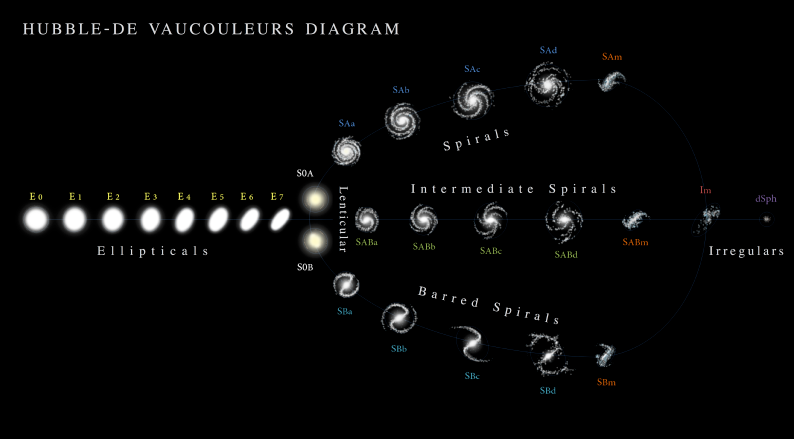
Galaxies are categorized according to their visual morphology as elliptical, spiral, or irregular. Many galaxies are thought to have supermassive black holes at their centers. 

Some famous Galaxies: 

1]Milky Way

ESO-VLT-Laser-phot-33a-07.jpg

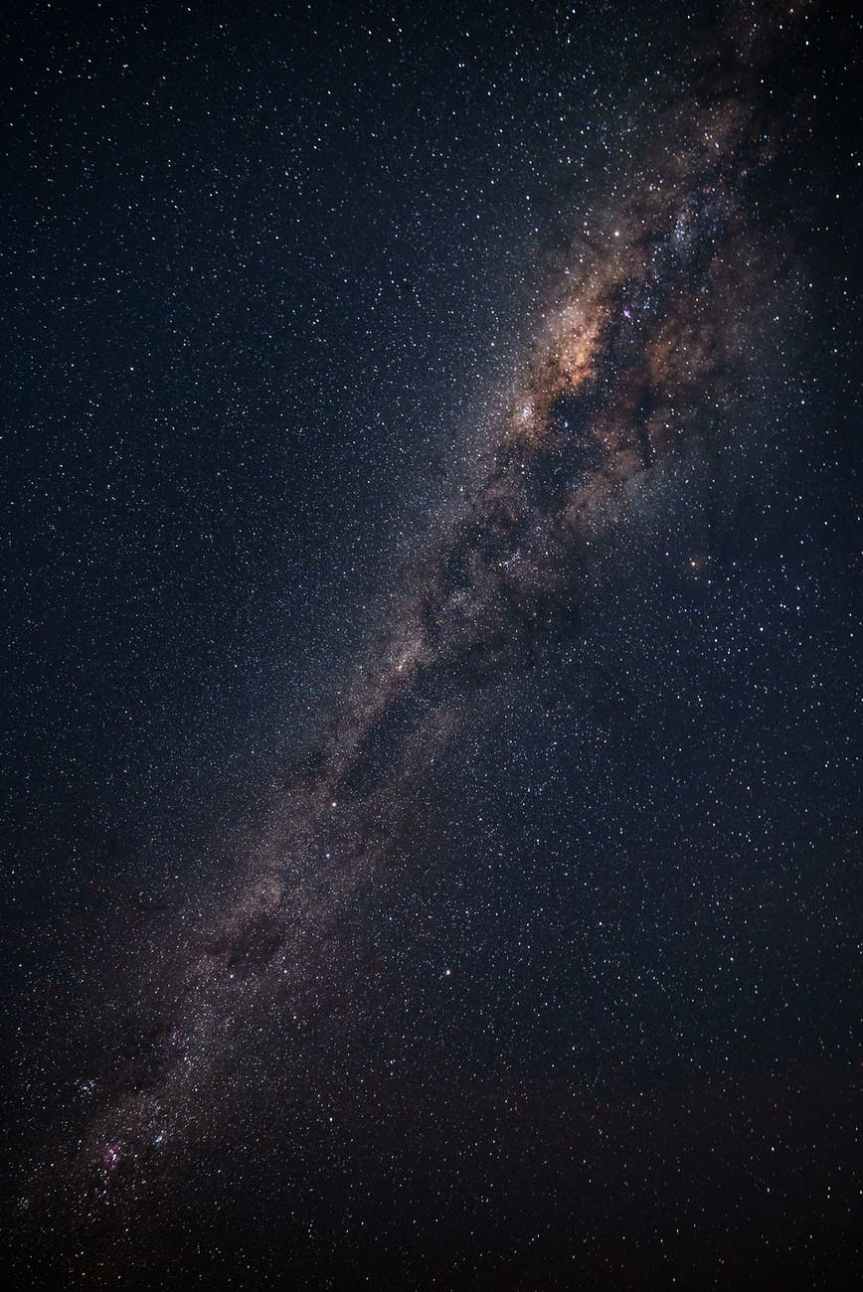
The Milky Way is the galaxy that includes our Solar System, with the name describing the galaxy’s appearance from Earth: a hazy band of light seen in the night sky formed from stars that cannot be individually distinguished by the naked eye. From Earth, the Milky Way appears as a band because its disk-shaped structure is viewed from within. Galileo Galilei first resolved the band of light into individual stars with his telescope in 1610. The Milky Way is a barred spiral galaxy with an estimated visible diameter of 100,000–200,000 light-years. Recent simulations suggest that a dark matter disk, also containing some visible stars, may extend up to a diameter of almost 2 million light-years. The Milky Way has several satellite galaxies and is part of the Local Group of galaxies, which form part of the Virgo Supercluster, which is itself a component of the Laniakea Supercluster.

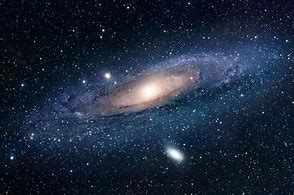
2]Andromeda-

The Andromeda Galaxy also known as Messier 31, M31, or NGC 224 and originally the Andromeda Nebula, is a barred spiral galaxy approximately 2.5 million light-years (770 kiloparsecs) from Earth and the nearest major galaxy to the Milky Way. The galaxy’s name stems from the area of Earth’s sky in which it appears, the constellation of Andromeda, which itself is named after the Ethiopian (or Phoenician) princess who was the wife of Perseus in Greek mythology. The virial mass of the Andromeda Galaxy is of the same order of magnitude as that of the Milky Way, at 1 trillion solar masses (2.0×1042 kilograms). The Andromeda Galaxy has a diameter of about 220,000 ly (67 kpc), making it the largest member of the Local Group in terms of extension. The number of stars contained in the Andromeda Galaxy is estimated at one trillion (1×10¹²), or roughly twice the number estimated for the Milky Way.

3]Barnard’s galaxy

NGC 6822

NGC 6822 (also known as Barnard’s Galaxy, IC 4895, or Caldwell 57) is a barred irregular galaxy approximately 1.6 million light-years away in the constellation Sagittarius. Part of the Local Group of galaxies, it was discovered by E. E. Barnard in 1884 (hence its name), with a six-inch refractor telescope. It is one of the closer galaxies to the Milky Way. It is similar in structure and composition to the Small Magellanic Cloud. It is about 7,000 light-years in diameter.

4]Black eye galaxy

The Black Eye Galaxy (also called Sleeping Beauty Galaxy or Evil Eye Galaxy and designated Messier 64, M64, or NGC 4826) is a relatively isolated spiral galaxy 17 million light-years away in the mildly northern constellation of Coma Berenices. It was discovered by Edward Pigott in March 1779, and independently by Johann Elert Bode in April of the same year, as well as by Charles Messier the next year. A dark band of absorbing dust partially in front of its bright nucleus gave rise to its nicknames of the “Black Eye”, “Evil Eye”, or “Sleeping Beauty” galaxy. M64 is well known among amateur astronomers due to its form in small telescopes and visibility across inhabited latitudes.

5]Whirlpool galaxy

The Whirlpool Galaxy, also known as Messier 51a, M51a, and NGC 5194, is an interacting grand-design spiral galaxy with a Seyfert 2 active galactic nucleus. It lies in the constellation Canes Venatici, and was the first galaxy to be classified as a spiral galaxy. Its distance is estimated to be 31 million light-years away from Earth

http://en.wikipedia.org/wiki/NGC_6822
https://en.wikipedia.org/wiki/Black_Eye_Galaxy

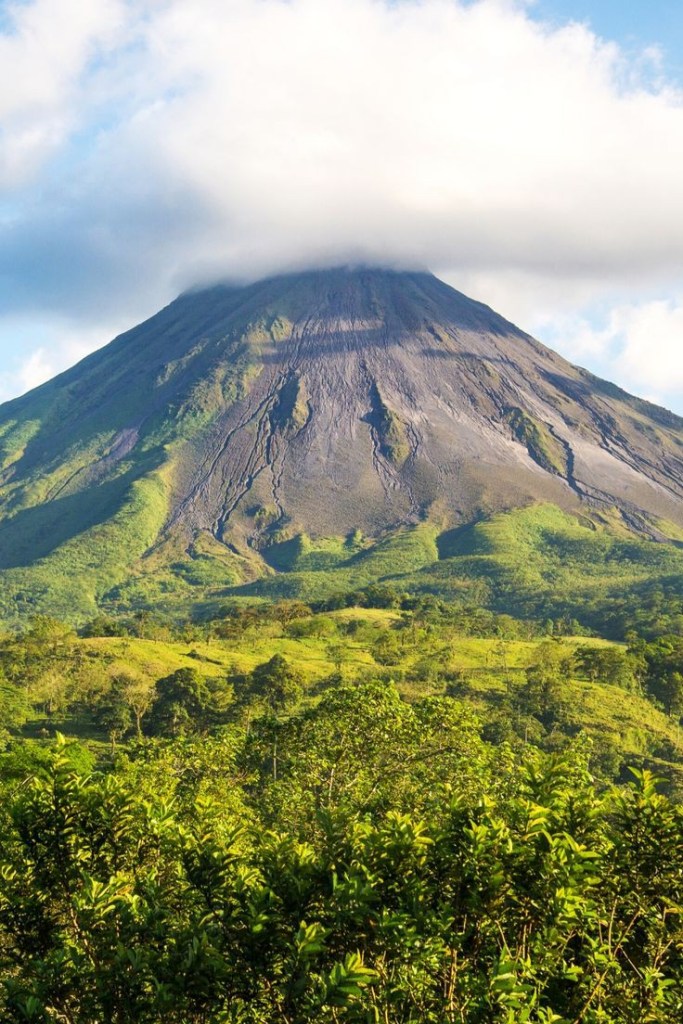
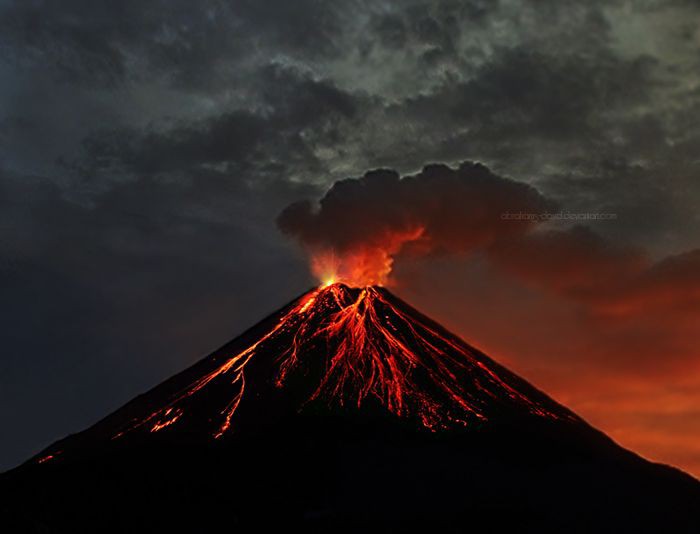
Volcano Eruption

“We are, all of us, growing volcanoes that approach the hour of their eruption, but how near or distant that is, nobody knows- not even God.”

~ Friedrich Nietzsche

We always talk about , what it would be like to see volcano eruption in front of your eyes ?

How amazing it would be like to find out , how the volcano erupt ?

There are many things that we don’t know exist in our earth 🌍. Do you want to know about it . If yes , than read the editorial .

Introduction

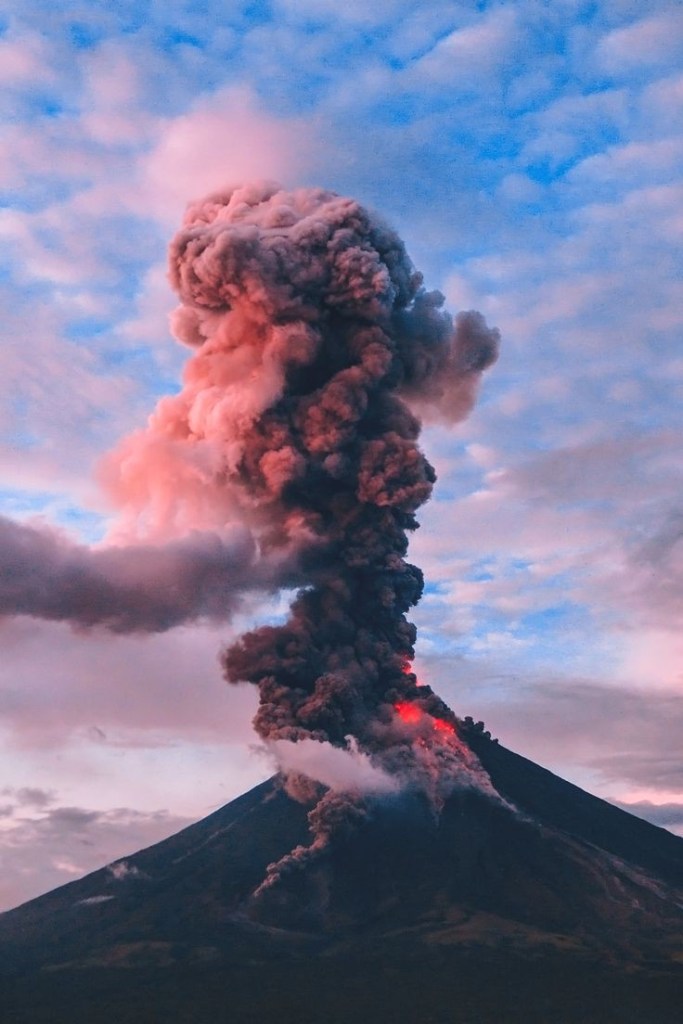
A volcano is a rupture in the crust of a planetary-mass object, such as Earth, that allows hot lava, volcanic ash, and gases to escape from a magma chamber below the surface.

On Earth, volcanoes are most often found where tectonic plates are diverging or converging, and most are found underwater.

The word volcano is derived from the name of Vulcano, a volcanic island in the Aeolian Islands of Italy whose name in turn comes from Vulcan, the god of fire in Roman mythology.

Many ancient accounts ascribe volcanic eruptions to supernatural causes, such as the actions of gods or demigods. To the ancient Greeks, volcanoes’ capricious power could only be explained as acts of the gods, while 16th/17th-century German astronomer Johannes Kepler believed they were ducts for the Earth’s tears.[87] One early idea counter to this was proposed by Jesuit Athanasius Kircher (1602–1680), who witnessed eruptions of Mount Etna and Stromboli, then visited the crater of Vesuvius and published his view of an Earth with a central fire connected to numerous others caused by the burning of sulfur, bitumen and coal.

Types of eruptions

  • Hydrothermal eruption. An eruption driven by the heat in a hydrothermal systems.
  • Phreatic eruption. An eruption driven by the heat from magma interacting with water.
  • Phreatomagmatic eruption.
  • Lava.
  • Strombolian and Hawaiian eruptions.
  • Vulcanian eruptions.
  • Subplinian and Plinian eruptions.

How do volcanoes erupt?

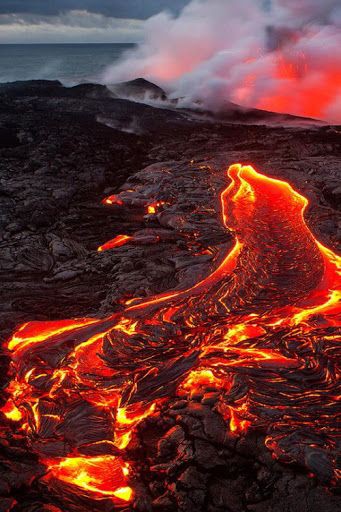
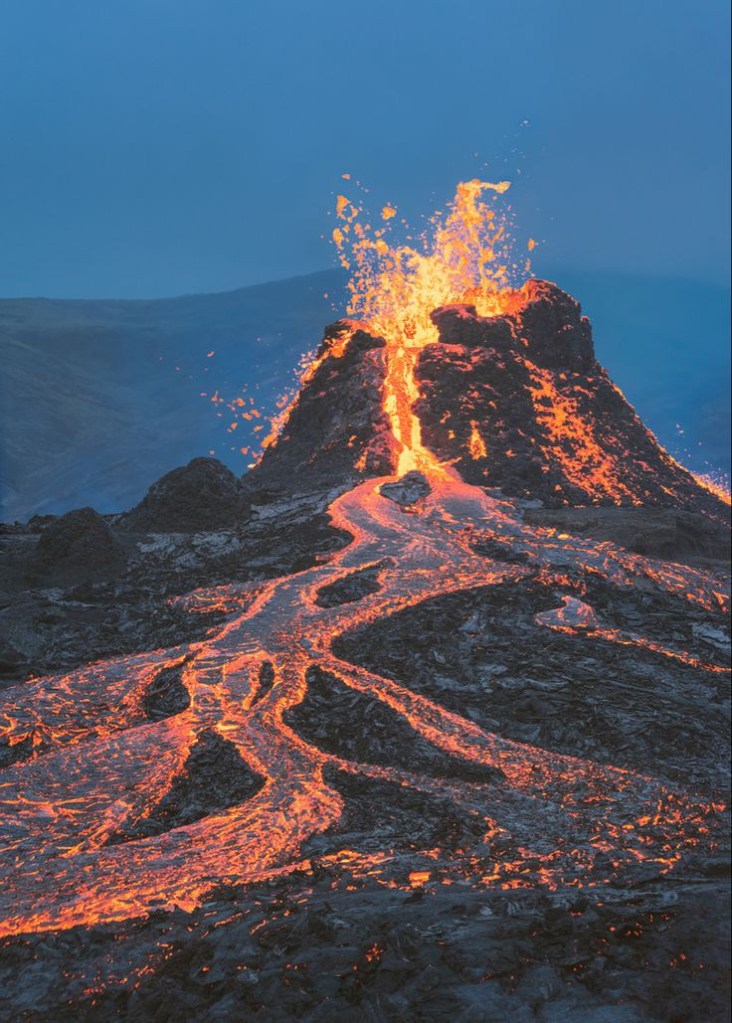
Deep within the Earth it is so hot that some rocks slowly melt and become a thick flowing substance called magma. Since it is lighter than the solid rock around it, magma rises and collects in magma chambers. Eventually, some of the magma pushes through vents and fissures to the Earth’s surface. Magma that has erupted is called lava.

The explosivity of an eruption depends on the composition of the magma. If magma is thin and runny, gases can escape easily from it.
Explosive volcanic eruptions can be dangerous and deadly.

Humans and volcanoes

Volcanic eruptions pose a significant threat to human civilization. However, volcanic activity has also provided humans with important resources.

Although volcanic eruptions pose considerable hazards to humans, past volcanic activity has created important economic resources.

Volcanic ash and weathered basalt produce some of the most fertile soil in the world, rich in nutrients such as iron, magnesium, potassium, calcium, and phosphorus.

Volcanic activity is responsible for emplacing valuable mineral resources, such as metal ores.

The paradox of volcanoes was that they were symbols of destruction but also life. Once the lava slows and cools, it solidifies and then breaks down over time to become soil – rich, fertile soil.
She wasn’t a black hole, she decided. She was a volcano. And like a volcano she couldn’t run away from herself. She’d have to stay there and tend to that wasteland.
She could plant a forest inside herself.

Matt Haig, The Midnight Library

Link

Introduction about different Schools, Colleges, Universities

Introduction about different Schools:-

INTRODUCTION:-

ust as teachers may teach a broad spectrum of subject matter from math, science, English, to foreign languages, technology and the arts, they also teach across a wide age range and in many different classroom settings around the country.

The specific type of school in which a teacher teaches can have a huge impact on many aspects of their teaching career. From public schools — including magnet schools, charter schools, urban schools, rural schools and high needs schools — to private schools including military schools and boarding schools, every classroom setting is different and each has it’s own unique benefits and challenges. Deciding where you are best able to make a difference can be difficult.

Learn more about each type of schools to help you decide where you can fit in best:

  • Public Schools
  • Charter Schools
  • Magnet Schools
  • Private Schools
  • High Needs Schools
  • Urban Schools
  • Rural Schools

1. Public Schools:-

 A public school is government funded and all students attend free of cost.Because of funding from several sources, private schools may teach above and beyond the standard curriculum, may cater to a specific kind of students (gifted, special needs, specific religion/language) or have an alternative curriculum like art, drama, technology etc. Public schools have to adhere to the curriculum charted out by the district, and cannot deny admission to any child within the residential school zone.Public schools are often thought of as shoddy, less disciplined and low-grade curriculum.

2. Charter Schools:-

A charter school is a public school that operates as a school of choice. Charter schools commit to obtaining specific educational objectives in return for a charter to operate a school. Charter schools are exempt from significant state or local regulations related to operation and management but otherwise adhere to regulations of public schools — for example, charter schools cannot charge tuition or be affiliated with a religious institution.In other words, charter schools are publicly accountable — they rely on families choosing to enroll their children, and they must have a written performance contract with the authorized public chartering agency. Charter schools are also autonomous — they have more flexibility in the operations and management of the school than traditional public schools.

3. What Is A Magnet School:-

Unlike charter schools or private schools, a magnet school is part of the local public school system. At regular public schools, students are generally zoned into their schools based on the location of their home – students go to the school that is nearest where they live. However, this may not always be true since boundaries can seem arbitrary and in some smaller towns schools are not zoned at all. But, magnet schools exist outside of zoned school boundaries. Whereas private schools are completely separate from local public school districts, and charter schools are public schools with private oversight, magnet schools remain part of the public school system and operate under the same administration and school board.

4. Private Schools:-

Many of the private primary and secondary schools in the United States were founded by religious institutions in order to incorporate religious beliefs and teachings into their students’ education, integrating it with a traditional academic curriculum. Some of the first religious schools were founded by the Catholic Church, and these parochial schools are still prevalent amongst private schools. Since then, however, many other religious denominations have started schools to provide religious education, and families often choose to enroll their children in schools whose policies reflect their own values. Nowadays, Protestant, Jewish, Muslim, Orthodox Christian and other religiously based schools are quite common. In addition, some private schools, boarding schools and military academies, offer their own unique approaches to education.

5. High Needs Schools:-

The No Child Left Behind Act of 2001 External link  defines a high-needs school as “within the top quartile of elementary and secondary schools statewide, as ranked by the number of unfilled, available teacher positions; or is located in an area where at least 30 percent of students come from families with incomes below the poverty line; or an area with a high percentage of out-of-field-teachers, high teacher turnover rate, or a high percentage of teachers who are not certified or licensed.” Essentially, high needs schools require teachers because they cannot fill job vacancies or retain teachers, or they have teachers who are not qualified or who teach in subjects outside their field. High-needs schools also serve communities of higher poverty rates, where classrooms are influenced by the difficulties of their students’ lives. Most high-needs schools are located in rural or urban areas.

6. Urban Schools:-

When thinking of high need schools, the first thing that comes to mind for many people is the image of an inner city school, crowded and poorly funded. The truth is, while this is a stereotype and many urban schools perform exceptionally well, there are still urban schools across the country that are in high need of teachers and resources.At the most technical level, urban schools are classified as city schools by the National Center for Education Statistics External link  (NCES). The NCES categorizes all schools into four locales by their size, population density and location in relation to a city. This is an “urban-centric” classification system. The four locale categories used by the NCES’ urban centric classification system External link  are city, suburb, town and rural. Urban schools are then broken down into three subcategories based on the Census Bureau External link ’s definitions of urbanicity:

7. Rural Schools:-

Ultimately, the technical definition of a rural school corresponds to our general understanding of rural areas; they are characterized by geographic isolation and small population size. All schools are categorized into four locales by their size, population density and location. The National Center for Education Statistics External link  (NCES) defines these locales by the school’s proximity to a city an “urban-centric” classification system. The four locale categories used by the NCES’ urban centric classification system External link  are city, suburb, town and rural. Rural schools are then broken down into three subcategories based on the Census Bureau External link ’s definitions of urbanicity. Rural schools are also all classified as high need schools.

Introduction about different Colleges:-

INTRODUCTION:-

college (Latin: collegium) is an educational institution or a constituent part of one. A college may be a degree-awarding tertiary educational institution, a part of a collegiate or federal university, an institution offering vocational education, or a secondary school.

In most of the world, a college may be a high school or secondary school, a college of further education, a training institution that awards trade qualifications, a higher-education provider that does not have university status (often without its own degree-awarding powers), or a constituent part of a university. In the United States, a college offers undergraduate programs; it may be independent or the undergraduate program of a university, it is generally also used as a synonym for a universitywhile in some instances a college may also be a residential college. A college in francophone countries [fr]—France (see secondary education in France), Belgium, and Switzerland—provides secondary education. However, the Collège de France is a prestigious advanced research institute in Paris.

Learn more about each type of colleges to help you decide where you can fit in best:

  • Community and Junior Colleges
  • Historically Black Colleges and Universities 
  • Liberal Arts Colleges
  • Women’s Colleges
  • Tribal Colleges
  • Technical Institutes and Professional Schools

1. Community and Junior Colleges:-

These colleges offer the first two years of a liberal arts education, as well as career or vocational training. Successful completion of a community or junior college curriculum earns graduates an associates degree. Many students continue on to a four-year institution after completing a community or junior college program.

2. Historically Black Colleges and Universities:-

These colleges originated when African-American students were legally denied access to most other institutions of higher education. Now, these colleges celebrate African-American culture and empowerment, and give black students the chance to experience an educational community in which they are finally part of the majority. A common abbreviation for this type of college is HBCU.

3. Liberal Arts Colleges:-

These colleges focus on the education of undergraduate students (students who are earning a bachelors degree). Classes are generally taught by professors who see teaching as their primary responsibility. Because most liberal arts colleges are smaller than universities, classes tend to be smaller and more personal attention  is available. Instead of preparing for a specific career path, students who attend liberal arts colleges are exposed to a broad sampling of classes. In addition, they select at least one area of in-depth study that is their college “major.” Many employers look for graduates of liberal arts programs.

4. Women’s Colleges:-

These colleges offer women the opportunity to enjoy a learning community where they are in the majority. Additionally, these colleges have a much larger population of female faculty and administrators. Women’s colleges graduate a high number of science majors, as well as students who continue on to graduate school or professional studies.

5. Tribal Colleges:-

Like HBCUs or Women’s colleges, these colleges focus on the needs and education of a group that has been traditionally underrepresented in higher education. In this case, these colleges focus on the education and empowerment of Native American students while celebrating a specific tribe’s unique culture and accomplishments.

6. Technical Institutes and Professional Schools:-

These colleges or institutes enroll students who have made a choice as to what career path they are taking. The curriculum at these colleges focuses solely on preparing students for these specific careers. Most of the career options offered at these colleges are in music, fine arts, engineering, or technical sciences.

Introduction about different Universities:-

INTRODUCTION:-

The original Latin word universitas refers in general to “a number of persons associated into one body, a society, company, community, guild, corporation, etc”. At the time of the emergence of urban town life and medieval guilds, specialized “associations of students and teachers with collective legal rights usually guaranteed by charters issued by princes, prelates, or the towns in which they were located” came to be denominated by this general term. Like other guilds, they were self-regulating and determined the qualifications of their members.

In modern usage the word has come to mean “An institution of higher education offering tuition in mainly non-vocational subjects and typically having the power to confer degrees,” with the earlier emphasis on its corporate organization considered as applying historically to Medieval universities.The original Latin word referred to degree-awarding institutions of learning in Western and Central Europe, where this form of legal organisation was prevalent and from where the institution spread around the world.

Learn more about each type of Universities to help you decide where you can fit in best:

  • Central universities, or Union universities
  • State Universities
  • Private Universities
  • Deemed university

1. Central universities, or Union universities:-

in India are established by an Act of Parliament and are under the purview of the Department of Higher Education in the Ministry of Education.In general, universities in India are recognised by the University Grants Commission (UGC), which draws its power from the University Grants Commission Act, 1956.In addition, 15 Professional Councils are established, controlling different aspects of accreditation and coordination.Central universities, in addition, are covered by the Central Universities Act, 2009, which regulates their purpose, powers, governance etc., and established 12 new universities.As of 1 June 2020, The list of central universities published by the UGC includes 54 central universities.

Other types of universities controlled by the UGC include:

  • State universities are run by the state government of each of the states and territories of India, and are usually established by a local legislative assembly act.
  • Deemed university, or “Deemed-to-be-University”, is a status of autonomy granted by the Department of Higher Education on the advice of the UGC, under Section 3 of UGC Act, 1956.
  • Private universities are approved by the UGC. They can grant degrees but they are not allowed to have off-campus affiliated colleges.

Apart from the above universities, other institutions are granted the permission to autonomously award degrees. These institutes do not affiliate colleges and are not officially called “universities” but “autonomous organisations” or “autonomous institutes”. They fall under the administrative control of the Department of Higher Education.These organisations include the Indian Institutes of Technology, the National Institutes of Technology, the Indian Institutes of Science Education and Research, the Indian Institutes of Engineering Science and Technology, the Indian Institutes of Management, the National Law Schools, the All India Institute of Medical Sciences, and other autonomous institutes.

2. State Universities:-

State universities are run by the state government of each of the states and territories of India, and are usually established by a local parliament act. As of 26 August 2011, the UGC lists 281 state universities, around 170 of which are receiving Central/UGC assistance. The oldest establishment date listed by the UGC is 1857, shared by the University of Mumbai, the University of Madras and the University of Calcutta.

In India, state universities are run and funded by the state government of each of the states of India.Following the adoption of the Constitution of India in 1950, education became a state responsibility. Following a constitutional change in 1976, it became a joint responsibility of the states and the central government.As of 17 March 2021, the UGC lists 426 state universities.

3. Private Universities:-

Private universities are approved by the UGC. They can grant degrees but they are not allowed to have off-campus affiliated colleges. The UGC list from 1 September 2011 lists 94 private universities.

Private universities and private colleges are usually not operated by governments, although many receive tax breaks, public student loans, and grants. Depending on their location, private universities may be subject to government regulation. This is in contrast to public universities and national universities. Many private universities are nonprofit organizations.

4. Deemed university:-

Deemed university, or deemed-to-be-university, is an accreditation granted to higher educational institutions in India, conferring the status of a university. It is granted by the Department of Higher Education.To quote the Ministry of Human Resource Development (MHRD), “An Institution of Higher Education, other than universities, working at a very high standard in specific area of study, can be declared by the Central Government on the advice of the University Grants Commission (UGC), as an Institution ‘Deemed-to-be-university’. Institutions that are ‘deemed-to-be-university’ enjoy the academic status and privileges of a university.”

Deemed university, or “Deemed-to-be-University”, is a status of autonomy granted by the Department of Higher Education on the advice of the UGC, under Section 3 of UGC Act, 1956. The UGC list from 23 June 2008 lists 130 deemed universities. According to this list, the first institute to be granted deemed university status was Indian Institute of Science which was granted this status on 12 May 1958. Note that in many cases, the same listing by the UGC covers several institutes. For example, the listing for Homi Bhabha National Institute covers the Institute of Mathematical Sciences, the Indira Gandhi Centre for Atomic Research and other institutes. The list below includes only the major institute granted the status, and such additional institutes are not listed separately.

Reference Link:-

https://teach.com/careers/become-a-teacher/where-can-i-teach/types-of-schools/rural/

https://www.cappex.com/articles/match-and-fit/the-different-types-of-colleges

https://sites.google.com/site/universitiesindiaonline/types-of-universities-in-india