At the time of Independence from the British rule in 1947, there were many princely states. Sardar Vallabh Bhai Patel, the then home minister, played a stellar role in amalgamating these states into the union of India. The Constitution of India was adopted on 20th November 1949 and came into effect on 26th January 1950, which defined Union of India, comprising of different states and union territories. In 1956, the states were recognized on linguistic basis.
Language is a system of mutually intelligible vocal symbol by which the member of a society communicates. It serves as a medium of communication and expression of and for the masses, thereby instilling in them a sense of belongingness and warmness. In a broader sense, language plays an essential ROK in constructing a sense of identity.
India is one such country which holds more than a billion population comprising of a vast communities having its own ethnocentric and distinctive profile of spoken and written languages. About 400 languages and 300 dialects spoken across 29 states and 7 Union Territories of India. According to 2011 linguistic survey, census at a reports there are a total of 121 languages and 270 mothertongues. There are 22 languages specified in the 8the constitution of India, of which Hindi is the predominant language spoken by about 43.63% of the population followed by Bengali (8.03%), Marathi (6.83%), Telugu (6.70%) and Tamil (5.70%).
The multilingual aspect of the country affects every aspect of its national life. At present the language problem has become so acute that it has posed a major threat to national integration. Most often linguistic tensions are being manifested in the borders which are bilingual.
Of course English is a great language, but the problem is that, no nation can grow great with the help of a foreign language, simply because a foreign language fails to represent the indigenous culture. In the past, India did not have the problem of languages, because Sanskrit and Prakrit served as link language. At present, although Hindi has been recognized as the official language of the Union, but his has promoted bitter hostilities, particularly in the South.
Development of one national language, that is, Sanskrit maybe keep the linguistic unrest under control as most of the languages owe their origin to the Sanskrit grammar and literature. States should be recognized as administrative unit rather than linguistic units. There should be ban on the political organizations which try to solidify linguism.
In conclusion, language is the most delicate part of the body of community. It should not ordinarily be disturbed in the process of national development or social regeneration.
Language is an essential part of human connection. Although different species have their different ways of communicating, humans are the only ones to have mastered language as a mode communication as it allows us to express share our ideas, feelings, and thoughts with others. So basically humans are made by the language. For most of the people language comes naturally whereas learning a language, say some foreign language means one has mastered the system of complex words, structure, and grammar to communicate efficiently with people of different cultures and societies. Language also plays an important role in the business field as without language one cannot share ideas and grow them into something better. Language also has the power to build or sometimes even destroy the societies.
As language can show our perspective, our understanding, the origin of the nation, our levels of education, and sometimes even our characters. Thus language acts as a mirror of us .Therefore for the communication to well both the parties that involves the sender and the receiver needs to have a proper command over their language.
Language is considered a basic tool of communication but it does not end here as it also acts a tool by which we think. Language indeed influences what we think. One such theory that supports this idea is the linguistic determinism.The concept of linguistic determinism is that language and its structures limit and determine human knowledge or thought, as well as thought processes such as categorization, memory, and perception. This term implies that people’s native languages will affect their thought process and way of thinking therefore people will have different thought processes based on their mother tongues. The differences in the conduction of how the different speakers of different origin such as Mandarin Chinese and English think and talk about time and this was included in one of the illustrations related to this phenomenon. In order to talk about time, the speaker of English origin tends to use terms that explains horizontal changes along the dimension. For example, the phrases used by him were “I’m running behind schedule” or “Don’t get ahead of yourself”. Meanwhile the speaker of Mandarin Chinese explained time in horizontal terms, the vertical arrangement of terms is not unusual to be used. According to the speaker, “up” might be used to describe past and “down” to describe future. It proves that variation in performance is interpreted by the variation language on tests planned with respect to the ordered relation between a mentioned event and an expression of time. The purpose of the test was to evaluate how rapidly one can acknowledge the said relation. Although Language does not completely establishes our thoughts as our thoughts are far too flexible, but habitual use of language can surely influence our habit of thought and action.
Apart from these, the relationship between communication and culture can be noticed from our daily ways of communication or interaction with individuals or a group of people. As the language we use must have been influenced by places we live and the society in which we are born and brought up in which has it own unique culture and identity. Therefore culture in regarded to way of life lived by human beings. Humans learn, think, feel, believe, and even look for whats appropriate according to their culture. Apart from Language, friendships, social and economic activity, politics, and even technologies are based on the various culturals. As for people who speak English, Hindi, Bengali, Gujarati, Telugu etc, this is all because they have been raised in a culture that contains these characteristics. Their actions are a response to their cultural functions. Therefore culture and communication cannot be disassociated as it not only gives an idea about the persons who are having the communication and the topic of communication but also helps to encode the meaning of the messages.
Still there a lot of debate about language being a part of culture and language and culture being different, but they have a very close relationship, so it cannot be separated as most of the things in the culture are reflected in the language as well. If there is diversity in culture, there are also various communication practices. Even the background of a person can also be determined by the language he speaks or the way he speaks. Thus, it can be said that language used is influenced by the culture and vice versa.
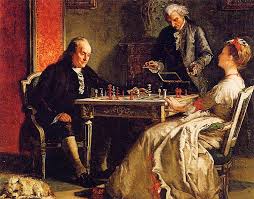
Chess was the most important indoor game of the nineteenth century in England. It enjoyed centuries-old privileged status. It was considered as a ‘rational recreation’. Chess, unlike any other game, deals more with logic and rationality rather than fun, as we know, Rationalism had taken over the Victorian era abundantly.
(Alice playing Chess in Looking Glass world)
Alice, at once, recognizes the chess board stretched on the vast land in the Looking Glass World. It shows that although she is just seven and a half years, still familiar to the this game, which signifies the popularity of Chess in England in Victorian Era, especially among the bourgeois class(as it is also called ‘game of royals’) and Alice belonged to the same.
In life we make ‘choices’, in chess we make ‘moves’. In order to attain something valuable in life as to capture the opponent’s castle in chess, initiative has to be taken. Nobody can make decisions for me, I’ll have to play myself, it’s just suggestions that our people may put before us. Here, Alice makes a choice to participate in the game ‘imagining’ her goal where she wants to be in the end. Well, talking about imagination with reference to Victorian era, it significantly brought out a drastic change in society, though previously children along with adults were forced into realism. ‘Imagination’ is quite efficient to presume one’s position in the coming years and then working out to get there can be useful, because life makes it hard to calculate the further possibilities due to lack of information. Alice restrained herself asking the Queens about their arrival, thinking it would be obtrusive, which keeps her away from the information, also we see Alice not able to distinguish between Red Knight and White Knight and actually who’s there to save her declares her ignorance towards information.
Chess is symbolic to attributes of life, we see, there are (apparently) three stages in chess, that is, opening, middle game and the end game, similarly we have childhood, youth and adulthood in life. Alice joins the giant Chess game of life as a white pawn, that is, she holds very limited power and can move once at a time. We always need to start from the beginning, that is, from the very first ladder in order to earn it step by step. Alice has the freedom to setup her ‘goal’ to be a Queen, but she has no power over her inevitable maturation that’s leading her to womanhood. Within the framework of the chess game, Alice has almost no control over her path and she, with certain implied rules of the game, is driven by the corresponding characters in the book, as in chess, every piece moves in answer to the move of the other one. She is pushed towards her goal by the various situations occurring before her in every square, such as, the train ride, no-name forest, Humpty Dumpty and the White Knight. Thus, it can be traced from the narrative that in life, there is some invisible force that’s propelling every individual in the direction of set goal. It can be comprehended that collaboration is the biggest instrument to victory, for example, White Knight saved Alice from the attack of Red Knight without which it had been a Herculean task for her to reach to final square. We will have to rely on our people somehow, otherwise we can’t achieve our dreams just by our own self. In chess, one can take full credit for one’s victories, but in life it would be naive to say that what I achieved is all because of my sole efforts.
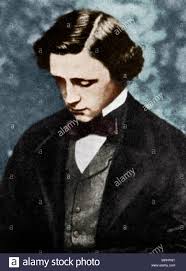
(Lewis Carroll)
The game of Chess in Through The Looking Glass represents the interest of Carroll in logics and mathematics, and the agent is ‘Alice’. This game is not about luck unlike other indoor/board games, rather brainy. In the same way, Life is more about randomness, it’s not alone in the hands of fate, though life is much more unpredictable. We need statistics as well as probability in both chess and life. Also, chess possesses two different colors, that is, one is light and the other one is dark, where I suppose, they stand for logic and nonsense respectively. Based on this idea, Alice often proves to be smarter, more prudent than the so-called adults she confronts in the Looking Glass world. This might also be a reverse-reflection of actual world, I guess, where we see adults inclined towards logic and children uttering stuff and nonsense and vice-versa, here, in the world of mirror.
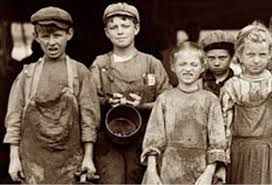
(Children doing factory chores in Victorian England)
Life of the children in Victorian period was totally opposite to that of present-day children. They were considered as miniature adults and were expected to be highly sophisticated, more in the case of rich class children. Children were not allowed to shout, complain, interrupt or disagree with anyone. The children of rich parents were usually looked after by governesses, no matter humble or strict, and they only used to teach them manners and the way of living. Here, in Looking Glass world, Red Queen, the first character to guide Alice in the reverse world,
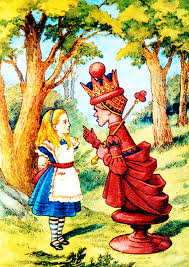
(Red Queen scolding Alice)
resembles very much like a governess of Alice when she teaches her how to not tweedle her fingers while speaking, how to behave, and to curtsey, and how Alice couldn’t go against her. She says, “when you’ve once said a thing, that fixes it, and you must take the consequences.”, because Alice is a Pawn and a Pawn cannot move backward, it is also allusion to the fact that once you have made the decision/choice, you can’t step back and stay committed bearing with it’s outcome, and she also asks Alice only to speak when she was asked to. Even we see TweedleDum-TweedleDee not ready to converse with Alice before she greets them. When Alice thinks that asking the Queens how they arrived would be impertinent, it shows again the social structure built for children in the real Victorian world.
When we are in a state of childhood, we want to turn into an adult soon. Similarly, Alice is excited about her lone-tour of adulthood through the Looking Glass world as she thinks she will be free of all the scolding, she says, “….no one here to scold me away from the fire….and can’t get me!” In the beginning, Alice was thrilled about her journey but as she is heading forward, she encounters the sense of loneliness in her journey to become a Queen(apparently) and acts adult herself. Though she is surrounded by different creatures many a times, but she feels alienated to their foreign ways. Hence, here Chess is a symbol of journey advancing from childhood to adulthood. She undergoes many crucial experiences, putting forward the idea of challenges one has to face in this journey of adulthood in one’s life. In the beginning, we see Alice being rude to Gnat about his jokes and later we see her kindness with White Knight that declares the change in her attitude as moving towards adulthood. When the Queen gives Alice directions as how to be a proper queen, it indicates that Alice wasn’t actually prepared to become a queen, just as it’s hard to prepare to be an adult in real world. Every square leads her to different characters and every character teaches Alice something significant, as we know, advice can come from the most unexpected places. For example, revelation of identity imposed by the situation in the woods of forgetfulness, the White Queen teaches her to believe in impossible, the fall of Humpty Dumpty symbolizes ‘the fall of man for pride’ and also ‘the fall of innocence’ proceeding towards maturity, and likewise all the other characters. These teachings help Alice to inherent the characteristics of adulthood within her. The crown here, symbolizes the transformation of Alice from childhood to adulthood.
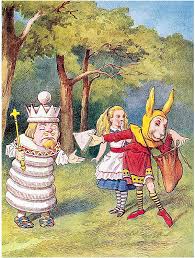
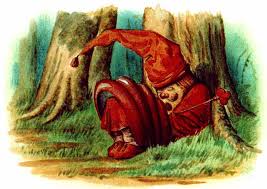
The Red King and the White King are almost doing nothing throughout the game as compared to their Queens. The Red King, as first encountered by Alice, is sleeping and his other pieces are performing their tasks to save him, whereas, the White King seems to be nervous not able to catch up with her Queen.
White King
Red King
Now these characters resemble in moves of both as that of the White and Red King in the real chess board. These actions of Queens and Kings in the world behind the mirror, may portray the position of women in the Victorian era. Women, at that time, used to engage themselves working for their husband and family, and also middle class and the working class women were employed to earn bread for their family, in support of their husbands. Red Queen saying to Alice, “…if you want to get somewhere else, you must run at least twice as fast as that!” may ascertain the idea that in a male-dominated society, women need to work double/toil harder in comparison to men in order to attain recognition. Women in the nineteenth century were not given much of the rights and privileges. This period is named after Queen Victoria, who was in the place of power. It is strange to encounter such a frivolous situation of women at the time when a lady herself was reigning over the society. When we behold Alice as a little woman moving from actual world to Looking Glass world, it may seem as she is struggling to change her confided world. She starts her journey all by herself which reflects the essence of independence in her. The characters like Live flowers resemble the social class structure that pushes Alice to follow their rules. When she chooses to be a Queen, she establishes the path for women/girls to upgrade their status because Alice learns that she must have a powerful authority to control Looking Glass world when one of the servants at once answers her after she turns into a Queen, so is the case for women in Victorian era, for example, Queen Victoria.
We need not be afraid of our high-rated opponents and feel incapable before them and it is then only that Alice is able to shake Red Queen in frustration and raises her voice against her rather than stitching her lips out of fear as evident in the beginning, that is, crown here, symbolizes her transformation from childhood to womanhood, gives her voice and finally renovates her status from a pawn to a queen. All the exclusive pieces are placed right behind the pawns. And a Pawn in comparison to them is just an ordinary, common piece that can slowly and gradually become a Queen. Even a pawn can cut down a King, pertaining to life, a single human being, regardless of his status, is enough to bring about revolution in the society, and win the castle of life. Alice suffering through all the odds, obstructions eventually made it, checkmated the Red King and turned into a Queen.
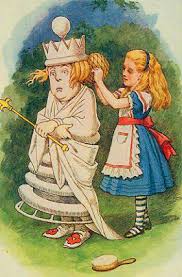
As a Queen in the game, the Red Queen and the White Queen are able to move swiftly and effortlessly. The White Queen, as she says, “jam-tomorrow and jam-yesterday, but never jam-today.”, and screams before pricking her thumb, travels in past and future which is true for the Queen,
(Alice tying clumsy hair of White Queen)
in general, in chess that she can freely move in every direction possible, but she is seen nervous and messy all the time here, and ultimately at two points passes up a chance to checkmate and on another occasion she missed the opportunity to capture the Red Knight. Similarly, the Red Queen said to Alice, “Speak when you’re spoken to!”, and having supporting her words, she doesn’t announce it after putting White King on the check, hence, the check is ignored. Their individual character traits restrained them from performing their duties. This also discovers their absent-mindedness and reverse effect of the mirror world.
The Knight in the chess moves very distinctively and is allowed to jump over any other pieces. Riding and falling of the White Knight in looking glass world is signifying it’s unique L-shape movement. The inventions of White Knight are here to present his powerful character trait, like in chess board Knight is an only piece imbibed with many powers, unlike other pieces, not even a Queen can move in same way as Knight, though his inventions are unprofitable disclosing the touch of the illusionary world, still it is pointing to the fact that precaution is must, so his horse wears spikes on it’s ankles to protect it from shark bites and he collects things that might be useful in the difficult situation. The White Knight is the only character that is benevolent with Alice and saves Alice from the attack of Red Knight (stopping her to be a Queen/upgrade the position of women in society), but it can be an example of gender-biased society where a man is shown as a powerful figure and woman belongs to a weaker section. Alice, here, is represented as a weak girl and this action of White Knight throws light on the concept of feminism, and make Alice learn that a woman must stand for herself and must discover her own capabilities.
Chess wasn’t just one of the themes in Carroll’s story, indeed, it was the ground for the novel’s structure. The game of chess in real world is ‘logical’ while in looking glass world it can be called as ‘maddening game of chess’. Also as an inverted image created by the mirror, this indoor game is displayed as an outer giant field of chess. The pieces are definitely running and moving under the implied rules, but the pattern is not applied evenly. This game sets the deterministic way of life. Both life and chess are, more or less, synonymous in almost every aspect.
Our speech sounds can produce a wide variety of speech sounds. However , each language makes use of only a selected group of sounds .These selected sounds are organized in different ways in different languages .This selection and organization of speech sounds in an individual language is called Phonology .
PHONEMES
Every language has a definite number of distinctive sound units .These sound units constitute the phonemes of that language .They are the most basic and smallest elements in the expression system of a language .A phoneme may be defined as the minimal ,distinctive sound unit of a language .By minimal we mean that it cannot be sub-divide ; by distinctive we mean that , when one phoneme is substituted by another it produces a meaning change .Thus the phoneme is the smallest unit of sound that forms the basis of distinction between words in a language .The two words , for example , bat and cat are distinguished and differentiated by the initial phonemes of these two words , /b/ and /k/ .
When /p/ is substituted by /b/ in the word pit it becomes bit . With substitution , a different word with a different meaning is formed . Thus /p/ and /b/ are contrastive in English and hence they are two phonemes in English. Phonemic symbols are enclosed with in slant lines ; phonetic symbols within square brackets indicate the precise phonetic qualities of sounds represented by the symbols . It is also to be noted that phonemes refers to sounds and never to spellings .
The English RP has a system of forty four phonemes .Hindi has forty six phonemes and Malayalam has fifty two .All these languages have their own language specific phonemes .As phonemes are contrastive units of sound in the sound system of a particular language , they have validity only in that language.
Our speech sounds can produce a wide variety of speech sounds. However , each language makes use of only a selected group of sounds .These selected sounds are organized in different ways in different languages .This selection and organization of speech sounds in an individual language is called Phonology .
PHONEMES
Every language has a definite number of distinctive sound units .These sound units constitute the phonemes of that language .They are the most basic and smallest elements in the expression system of a language .A phoneme may be defined as the minimal ,distinctive sound unit of a language .By minimal we mean that it cannot be sub-divide ; by distinctive we mean that , when one phoneme is substituted by another it produces a meaning change .Thus the phoneme is the smallest unit of sound that forms the basis of distinction between words in a language .The two words , for example , bat and cat are distinguished and differentiated by the initial phonemes of these two words , /b/ and /k/ .
When /p/ is substituted by /b/ in the word pit it becomes bit . With substitution , a different word with a different meaning is formed . Thus /p/ and /b/ are contrastive in English and hence they are two phonemes in English. Phonemic symbols are enclosed with in slant lines ; phonetic symbols within square brackets indicate the precise phonetic qualities of sounds represented by the symbols . It is also to be noted that phonemes refers to sounds and never to spellings .
The English RP has a system of forty four phonemes .Hindi has forty six phonemes and Malayalam has fifty two .All these languages have their own language specific phonemes .As phonemes are contrastive units of sound in the sound system of a particular language , they have validity only in that language.
Speech sounds are of two types vowels and consonants . A consonant is a speech sound during the articulation of which there is an obstruction with in the oral cavity or a narrowing of the air passage by various organs of speech so that lung air escapes with audible friction . In other words , all speech -sounds necessitating a closure or narrowing ,which involves plosion or friction ,are called consonants .
Consonants are produced in one of the two ways : either there is a closing movement of one of the speech organs forming such a narrow constriction that it is possible to hear the sound of the air passing through or the closing movement may involve the lips ,the tongue or the throat . The over-all effect in each case is quite different from the open unobstructed articulation found in the case of vowels .
During the production of certain consonants , vocal cords vibrate . Those consonants that involve the vibration of vocal cords are called voiced consonants . During the production of the rest of the consonants ,vocal cords do not vibrate .Those consonants that are produced without the vibration of vocal cords are called voiceless consonants .This distinction ,however ,is not absolute .The position of the consonant in a word , to a great extent , determines the degree of voicing .For example , if a voiced consonant appears at the end of a word it loses a great deal of its vibration . The /z/ sound at the beginning of the word zebra /zi:bra/ is much more vibrant than the /z/ sound at the end of the word jazz /dzaez/.
CONSONANTS OF ENGLISH RP
There are 24 consonants in english RP. The following details regarding their production are necessary for the description of these consonants .
For the communication language is used in two ways speech and writing. A systematic study of the spoken and written. A systematic study of spoken and written forms of language is called linguistics. The branch of linguistics that deals with the spoken forms of the language is known as phonetics. It studies the production, transmission and reception of speech sounds. It deals with all possible sounds human vocal organs can produce.
Phonetics can be classified into three groups.
Articulatory phonetics: It deals with the movements of the speech organs in the production of speech sounds. It studies how the outgoing air from the lungs is regulated along the vocal tract to make different speech sounds.
Acoustic phonetics: The transmission of sound from the speaker to the listener is studied by acoustic analysis. Acoustic phonetics deals with the physical properties of speech sound like frequency and amplitude.
Auditory phonetics: it deals with the reception and perception of speech sounds.
From the previous article, we learned about how important passion and profession are. What are the simplest ways to earn money from some of the businesses and most probably with the lowest investments. In this part, we will uproot some more businesses which can give you a stable income and highly demanded fields.
BAKING BUSINESS:
Baking business is one of the simplest ways to earn money. If you are great at cooking and love to bake this will be the best way for you to follow your passion. You can bake different types of delicious cakes. People always would love to have homemade foods and things. Thus, they will crave cakes too… You can even start this in your kitchen with a regular oven and other materials. You can even do chocolates, cookies. Sweets are the best to gift someone. Thus, there will be no negative statements to this idea. If you are also a creative person you can decorate and wrap them beautifully to attract the audience.
BOOK MERCHES:
Book merches are none other than book-related things and products. for Example, If you are a fan of The Chronicles of Narnia books or movies You can create some bookish merch which is related to the theme of NARNIA. Like, A printed coffee mug with a book theme (A famous quote or picture of the characters in the mug), enamel pins with the image of The Lion Aslan. Badges with the images or the quotes from the books. Postcards stamps, T-shirts even you can do a scarf with the quotes like a newspaper look. Most of the readers would love to have them in their showcase as well as in their Book photographs. And you can sell, key chains, bookmarks, bags, wallets, book sleeves, tote bags, Polaroids photos, watches necklace rings anything and everything related to books. There is a huge demand for these things among book bloggers and collectors. Especially, if you did customized products.
WORKSHOPS:
Conducting workshops is merely like teaching online or offline. It depends on your comfort zone. If you know any of the passions that are mentioned above or upcoming ideas or even any other related ideas you can do them to start your own workshop. For example, If you know mandala artworks you can teach them online or offline and for teaching them you can collect some amount as tuition fees. Remember, teaching is one of the precious Jobs in the whole world knowledge is not free. Even though if it comes free it’s not easy to teach someone. You should have some passion for teaching. And you should provide notes instructions videos and other requirements about the Art that you want to teach. Some of the ideas that you can carry out, if you know any of examples like, Journal makings, skincare products making, baking, Fashion designings, paper making, language skills if you have any bilingual skills like, German, French, Spanish, English, and Japanese, etc You can teach them and can get loads of money. Because students love learning new languages and there is a huge demand for bilingual People.
If you have passion for anything from the above… Start to develop the skill to take up as a passionate business. Most of the billionaires started from nothing. If they can why you can’t? If you can’t then who can? Let’s make our passions into actions.
What it means to “explain” something in science often comes down to the application of mathematics. Some thinkers hold that mathematics is a kind of language–a systematic contrivance of signs, the criteria for the authority of which are internal coherence, elegance, and depth. The application of such a highly artificial system to the physical world, they claim, results in the creation of a kind of statement about the world. Accordingly, what matters in the sciences is finding a mathematical concept that attempts, as other language does, to accurately describe the functioning of some aspect of the world
At the center of the issue of scientific knowledge can thus be found questions about the relationship between language and what it refers to. A discussion about the role played by language in the pursuit of knowledge has been going on among linguists for several decades. The debate centers around whether language corresponds in some essential way to objects and behaviors, making knowledge a solid and reliable commodity; or, on the other hand, whether the relationship between language and things is purely a matter of agreed-upon conventions, making knowledge tenuous, relative, and inexact.
Lately the latter theory has been gaining wider acceptance. According to linguists who support this theory, the way language is used varies depending upon changes in accepted practices and theories among those who work in particular discipline. These linguists argue that, in the pursuit of knowledge, a statement is true only when there are no promising alternatives that might lead one to question it. Certainly this characterization would seem to be applicable to the sciences. In science, a mathematical statement may be taken to account for every aspect of a phenomenon it is applied to, but, some would argue, there is nothing inherent in mathematical language that guarantees such a correspondence. Under this view, acceptance of a mathematical statement by the scientific community–by virtue of the statement’s predictive power or methodological efficiency–transforms what is basically an analogy or metaphor into an explanation of the physical process in question, to be held as true until another, more compelling analogy takes its place.
French, also called the language of love, was actually the international, diplomatic language for centuries. Only recently, historically speaking, with the rise of the United States as a global power, did English prevail as the language of diplomacy. France is still quite the economic powerhouse, and a popular travel destination, so French is definitely a language to learn!
Spanish
Spanish has a large number of native speakers, and a large number of overall speakers as well. Most Spanish speaking countries are located in South and Central America, which are extremely popular travel destinations in recent years. For this reason, you will find many across the world who speak Spanish. In addition, due to the large number of Spanish speakers in the US, if you live, work, or travel in the United States, Spanish is the one to learn!
Russian
Russian is an extremely influential language among many Eastern European and Europeasian countries. The Russian language also has the second highest percentage of internet content (following English), and the leading percent of internet content in Europe. This makes the Russian language one of the most important languages to learn for European business.
Japanese
While the Japanese language is not spoken widely outside of Japan, it’s still an important one to know. Whether you want to travel in Japan, love the culture and food, or the technology, knowing Japanese can get you far in many ways. It’s also an excellent introduction to other Asian languages. There are some Chinese characters in Japanese, and with similar grammar to Korean, learning Japanese puts you on the path to learn all three.
German
Germany is the most widely spoken language throughout Europe, as Germany remains Europe’s most dominant economy. For this reason, if you do business or plan to do business in Europe, German is one of the most important languages to learn. It’s a funny language to learn, with endings tacked on to words to give them specific meanings. But it is also a surprisingly easy language to learn.
Learning languages is an important part of being very soft and friendly welcomed in different countries. Even only one language cans totally change the way of the communication, the attitude towards you and the impression which you will make in people with which you conduct a conversation.
Nowadays it is like must to study and learn new languages, in terms of self development, comfort and confidence. During the years of studying and later when you want to work the knowledge of language is a big advantage. Studying abroad gives opportunity for better education which leads to a better working position after graduation. But this cause is reachable only when you know forage languages.
Let’s learn some more benefits of learning languages.
1. Connect!
One of the most rewarding aspects of the human experience is our ability to connect with others. Being able to communicate with someone in his or her language is an incredible gift. Bilinguals have the unique opportunity to communicate with a wider range of people in their personal and professional lives. Knowing the language makes you a local no matter where you are, opening up your world literally and figuratively. You will be shaped by communities. You will be humbled by the kindness of strangers. You will build lifelong friendships. And for these reasons alone, you will see the reward of learning languages for many years to come.
2. Deepen Your Connection to Other Cultures
Language is the most direct connection to other cultures. Being able to communicate in another language exposes us to and fosters an appreciation for the traditions, religions, arts, and history of the people associated with that language. Greater understanding, in turn, promotes greater tolerance, empathy, and acceptance of others—with studies showing that children who have studied another language are more open toward and express more positive attitudes toward the culture associated with that language.
3. Go to the Source
In a world of more than 6,000 spoken languages, we sometimes require translation, but speaking at least one additional language empowers us to access information that would otherwise be off-limits. For example, individuals proficient in other languages are able to navigate the Internet as genuine global citizens—consuming and assessing foreign media and entertainment.
4. Strengthen Your Decision Making
Studies show that decisions made in your second language are more reason-driven than those made in your native language.4Contrary to popular assumptions, when we deliberate in a second or third language, we actually distance ourselves from the emotional responses and biases deeply associated with our mother tongue. The result? Systematic and clear-headed decisions based on just the facts.
5. Gain Perspective
As we explore a new language and culture, we naturally draw comparisons to what is most familiar. Learning about another culture sheds light on aspects of our own culture—both positive and negative—we may not have previously considered. You may find a greater appreciation for what you have, or you may decide to shake things up!
6. Become a Polyglot
Not only does learning a second language improve communication skills and multiply vocabulary in your first language—yes, really!—but research shows that it makes picking up additional languages a much easier feat, especially among children.3 That’s because when you learn a new language, you develop new brain networks that are primed and ready when you embark on learning a third language.
7. Boost Your Confidence
Any language learner can attest to making his or her share of mistakes while discovering a new language—often in front of an audience. It’s a necessary part of the learning process! Learning a language means putting yourself out there and moving out of your comfort zone. The upside is the amazing sense of accomplishment you’ll feel when conversing with someone in their native language.
This is a very simple title, yet a major loophole that our society is facing for many decades. This is not about giving rights to a specific gender but the suppressions which a language creates in the backdrop of society and makes it a center of concern. Never thought language can create such discrimination against two genders.
In colloquial context we see that every day we speak our language and communicate flawlessly yet we never recognized the ocean of problem which a language brings every day.
Profoundly, the title itself gives us the best example as to how we use the word “Manmade”, linguistically whenever a thing is made by a human it is denoted as manmade. But the question here arrives is that why don’t we spell it as human-made?
There are many endless words where the wordings are based on one gender-biased, for say: countrymen, mankind, etc and mostly these words denote men and women were often neglected or ignored since the formation of words.
“Language has always been a media through which many cultures and communities bounded and created a sense of harmony with each other”.
Whereas we can notice that Gender Discrimination has always been a core of fear since civilization. It has become one of the cliché topics when it comes to feminism and cause of this people are ignorant as they assume that the world is changed and there is no more discrimination in today’s society.
Taking back to the advent of the problem we can observe that many writers, critics have battled to always protect the women community as they are always considered the “weaker section of the society”. We can’t deny this fact but, inevitably, they are still subjected when it comes to literature and language.
How Women are Neglected by Language as Language reflects Patriarchal world:
She says, “Women can either read and choose to stay trapped in their bodies by a language that does not allow them to express themselves, or they can use the body as a way to communicate.”
– Helene Cixous (in; “The Laugh of Medusa” )
This very quote is taken from the famous article written by a critic, writer, and feminist; Helene Cixous who has explained how a woman had gone through repression in history and how literature and language had given an upper hand to the men in society to suppress women.
In “The Laugh of Medusa”, she explains how women should find their voice and the Language is the symbol of how a person portrays themselves. “Writing is for you, you are for you, your body’s yours, take it”. This line highlights that it’s high time that women should raise their head and minds and be themselves by being flawlessly independent and break the walls which portray women as fragile and frail.
The author claims that there is a very close relationship between women’s bodies and their writings and both have been repressed by men for centuries. Literature, in particular, explains to us how women as a writer were hard for the audience to accept them due to cultural prejudices laid against them since ages.
Writers like Virginia Woolf show us the patriarchal world through one of her works namely “Room of one’s own” through the lens of all the women present in the world and the problems they go through.
“A Woman must have money and a room of her own if she is to write fiction”. This quote is quite relatable for the women of contemporary society, but this was a major issue which women of the 18th and 19th centuries were facing, to be independent they always needed acceptance to flourish in their fields and for that, they always needed acceptance which was a great hurdle in their lives. For their personal growth, they were bounded to be under 4 walls and do all sorts of wifely duties which gave the society that women are doing dutiful jibs under their husbands present.
But unfortunately, those women were never accepted who was unique and out of the box because society was not people’s perspective, rather it was the male perspective.
Even in “Room of one’s own”, Woolf mentions Judith Shakespeare ( was considered as Shakespeare’s real sister), her character portrays us the devastation a woman goes through while struggling for getting justice.
It also portrays us that many decades of literature didn’t accept women’s works as they were not considered as talented and rather, they were judged based on patriarchal society.
Females were Disowned yet contributed best Literature:
As when we look into 18th century British literature, we can see that several female writers have given an immeasurable piece of works which is still remarkable to date.
It would be a disgrace if we forget to mention Jane Austen, the Bronte sisters, Virginia Woolf, who were the pillars of 18th-century literature. Whether it is a broody romantic novel of wuthering heights or it is jane Eyre, every writer has spilled their hearts and provided the real situation of women in the era.
Some great writers are unforgettable like J.K Rowling who made us believe in fantasy and made childhood more fascinating by giving us Harry Potter which always provides us nostalgia going back to those days.
Unfortunately, these writers have always struggled to prove their identity to the world, that these immense writers like J.K.Rowling, Emily Bronte, had to change their names to get worldwide recognition. Even in the postmodern age, the situation didn’t change and the process of women hiding their originality, their names was like a custom they followed for ages.
But these female writers never let their readers down and always provided the best piece of art even having so many hurdles in their life.
It’s a long way to go, but still, the situation is better as women are gaining recognition and fame in society, the world, and literature through their masterpieces of works.
World’s Oldest Language It is not possible to answer exactly how many languages of the world are there. According to an estimate, the total number of languages in the world is about 6809, out of which the number of speakers of 90 per cent of the languages is less than 100000. There are about 200 to 150 languages that are spoken by more than 1 million people. There are about 357 languages that only 50 people speak. Not only this, but there are also 46 languages whose number of speakers is only one.
But do you know which is the oldest language in the world? If you are not aware of the answer to this question then after reading this article you will know which is the oldest language in the world, because in this article we are giving the details of the 10 oldest languages of the world according to the origin.
World’s 10 oldest languages
10. Armenian Language The Armenian language is also part of the Indo-European linguistic group, which is spoken by the Armenians. Bibles written in the fifth century exist as its earliest appearance. The Armenian language originated in 450 BC. At present, about 5 per cent of people speak this language. This language is spoken in Mesopotamia and the intermediate valleys of the caucus and in the southeastern region of the Black Sea. The region falls in Armenia, Georgia and Azerbaijan (northwestern Iran). It is the official language of the Republic of Armenia.
9. Korean language The Korean language is spoken from around 600 BC. At present, about 80 million people speak the Korean language. The script of this language is Hangul. In ancient times, the Chinese settled in Korea, so the Korean language is strongly influenced by the Chinese language.
8. Arabic language This language is found in Hebrew and Arabic languages today. It was once the official language of the Armenian Republic. There is evidence of its presence even 1,000 years before Christ. Even today the Arabic language is spoken in Iraq, Iran, Syria, Israel, Lebanon and modern Rome.
7. Chinese Language Chinese is the most spoken language in the world. It is spoken in China and some countries of East Asia. The Chinese language belongs to the Chinese-Tibetan language-family and is actually a group of languages and dialects. Standardized Chinese is actually a language called “mandarin”. This language is 1200 years old even before the arrival of Jesus. Currently, about 1.2 billion people speak Chinese.
6. Greek Language The Greek language is the oldest language in Europe, spoken since 1450 years before Christ. Currently Greek is spoken in Greece, Albania and Cyprus. About 13 million people still speak Greek today.
5. Egyptian Language The Egyptian language is the oldest known language in Egypt. This language belongs to the Afro-Asian linguistic family. it is 2600–2000 years old from Christ. This language is still keeping its nature alive.
4. Hebrew Language Hebrew is the language falling under the Semitic branch of the Sami-Hami language-family. The Hebrew language is about 3000 years old. It is currently the official language of Israel, after its extinction, the Israeli people revived it. The Jewish community considers it to be ‘holy language’ and the Old Testament of the Bible was written in it. The Hebrew language is written in the Hebrew script, read and written from right to left. Studies of Hebrew are relatively popular nowadays in Western universities. The official language of Palestine after the First World War is also modern Hebrew.
3. Latin Language Greek is the third oldest language in the world. Latin was the official language of the ancient Roman Empire and ancient Roman religion. It is currently the official language of the Roman Catholic Church and the official language of the Vatican City. Like Sanskrit, it is a classical language. Latin comes in the romance branch of the Indo-European language family. From this, French, Italian, Spanish, Romanian, Portuguese and the most popular language of the present time, English has originated. Due to the dominance of Christianity in Europe, Latin language in medieval and pre-modern times was the international language of almost all Europe, in which books of all religions, science, higher literature, philosophy and mathematics were written.
2. Tamil Language The Tamil language is recognized as the oldest language in the world and it is the oldest language of the Dravidian family. This language had a presence even around 5,000 years ago. According to a survey, 1863 newspapers are published in the Tamil language only every day. At present, the number of speakers of Tamil language is around 7.7 crores. This language is spoken in India, Sri Lanka, Singapore and Malaysia.
1. Sanskrit Language World’s oldest language is Sanskrit. The Sanskrit language is called Devbhasha. All European languages seem inspired by Sanskrit. All the universities and educational institutions spread across the world consider Sanskrit as the most ancient language. It is believed that all the languages of the world have originated from Sanskrit somewhere. The Sanskrit language has been spoken since 5,000 years before Christ. Sanskrit is still the official language of India. However, in the present time, Sanskrit has become a language of worship and ritual instead of the language of speech. All the auspicious works performed in Hindu religion are recited by Veda Mantra, whose language is Sanskrit.
There is no National language in India. Hindi is also one of our official languages. Hindi is recognized as the official language of 9 states and 3 union territories, and one of the two parliamentary languages of India. Although the language is widely understood by the majority of Indian citizens, Hindi has not been accepted as the national language of this country.
Clause 1 Article 343 of the constitution of India states that the official language of the Union shall be Hindi in Devanagari script. The constitution does not assume any language for that matter in the category of the national language. Hindi and English have been acknowledged as official languages of the parliament. However, every state can exercise the right to authorize a particular language through legislation.
Hindi should be our National Language because it is easy to understand and in today’s world where everyone watches television, web shows and through internet everybody is familiar with Hindi language. Our country must have a internal language which can be understood and spoken by everyone i.e Hindi, I love Hindi and support it to be our national language. According to me it gives me the feeling of united one India. I get that unity feeling as an Indian. Hindi is the only language which unites people from different states and it increases belongingness to whole India not only limited to their own state.
But still there are many people from South India and West Bengal who opposes Hindi to be our national language and many people from South don’t even understand Hindi properly. They need to understand the fact that if Hindi becomes our National Language that will not decrease the importance of their regional language, other languages is not going to extinct. This narrow mentality which is limited to their state only should be changed, otherwise India can never be one. Sanskrit could be chosen too for our National Language but the thing is many generations already been passed who were not taught Sanskrit and they are not enough familiar with sanskrit to speak this language. Only Hindi now a days can become the language which can unite Indians and therefore India. Therefore Hindi should be taught compulsorily in every state along with English and their regional languages respectively.
The Hindi Language is very old and has a direct line of evolution to Sanskrit. As such Hindi is incredibly important in the historic development of the world’s cultures and well worth not just honoring, but studying. Anyone with an interest in world history or languages would do well to do a little bit of intense reading on the subject of Hindi.
Popularity of Hindi in other countries
Nepal has the second largest group of Hindi speaking people. Surprisingly the United States is home to the third largest group of Hindi speaking people. About 650, 000 people speak the language in the country making it the 11th most popular foreign language in the United States. A third of Mauritians ( 450,000) speak the Hindi language.
Indian songs and hymns have been adapted and used by various popular rap and pop music artists. From science to commerce and business to various multimedia as shown India to becoming a viable world economy with increasing interest in the world. Bollywood as it is called the second biggest film following Hollywood. Indian music becomes influential, not only audiences in the United States but also with the rest of the world.
When tillage begins, other arts follow. The farmers, therefore, are the founders of human civilization.”
— Daniel Webster
Introduction
It all started thousand of years ago , when the human civilization came into existence . Agriculture was a key to survival . People were farming for there domestic purpose , not for the others .
As the civilization started to grow accustomed of agriculture , they grew food in surplus that enabled people to live in cities. Plants were independently cultivated in at least 11 regions of the world.
The development of agriculture enabled the human population to grow many times larger than could be sustained by hunting and gathering.
It was the beginning of different civilization in different parts of the World. From those civilizations , one of them was our’s The Indus Valley Civilization . Vedic literature provides some of the earliest written record of agriculture in India. Rigveda hymns , describes plowing, fallowing, irrigation, fruit and vegetable cultivation.
Some of the ancient and historical evidence suggests rice and cotton were cultivated in the Indus Valley.
Agriculture : In India and World today .
India ranks second worldwide in farm outputs. As per 2018, agriculture employed Indian work force and contributed 17–18% to country’s GDP.
In 2016, agriculture and allied sectors like animal husbandry, forestry and fisheries accounted for 15.4% of the GDP (gross domestic product) with about 41.49% of the workforce in 2020.India ranks first in the world with highest net cropped area followed by US and China.The total agriculture commodities export was US $ 3.50 billion in March – June 2020.
Agriculture is the primary source of livelihood for about 58% of India’s population. Share of agriculture and allied sectors in gross value added (GVA) of India at current prices stood at 17.8 % in FY20.
During 2019-20 crop year, food grain production reached a record of 296.65 million tonnes. In 2020-21, Government of India is targeting food grain production of 298 million tonnes.
India is among the 15 leading exporters of agricultural products in the world. Agricultural export from India reached US$ 38.54 billion in FY19 and US$ 35.09 billion in FY20.
Agriculture is an important industry in the United States. The agriculture industry, which includes both crops and livestock, is responsible for producing most of the world’s foods and fabrics. Agriculture impacts so many things that it’s hard to imagine a world without this important industry.
Schemes and Initiatives
Due to the high requirement of agriculture . It is important for the government to take initiatives and provide better infrastructure to the farmers. However , the required level of investment for the development of marketing, storage and cold storage infrastructure is estimated to be huge.
The Indian Council of Agricultural Research (ICAR), established in 1905, was responsible for the search leading to the “Indian Green Revolution” of the 1970s. The Union Minister of Agriculture is the president of the ICAR. The Indian Agricultural Statistics Research Institute develops new techniques for the design of agricultural experiments, analyses data in agriculture, and specialises in statistical techniques for animal and plant breeding.
Schemes by government for Indian agriculture :
Dairy Entrepreneurship Development Scheme.
Rainfed Area Development Programme (RADP)
Paramparagat Krishi Vikas Yojana (PKVY)
Pradhan Mantri Krishi Sinchai Yojana (PMKSY)
National Agriculture Market (e-NAM)
Pradhan Mantri Kisan Maandhan yojana.
Pradhan Mantri Fasal Bima Yojana (PMFBY)
Kisan Credit Card (KCC) scheme.
Pashu Kisan Credit Card Scheme.
PM-Kisan Scheme.
Conclusion
Agriculture sector is one of the prominent sector in India as well as all over the world . India is becoming self – sufficient in pulses and other crops .
Gone are the days , when India was unable to provide sufficient amount of food to the citizens . Gone are the days , when people used to think agriculture was not as important as other sectors . Gone are the days , when people used to think less of farmers . And gone are the days , when people were less educated about agriculture.














 Eduindex
You must be logged in to post a comment.