Contribution of MSMEs in Economy

The Ministry of Micro, Small and Medium Enterprises (MSME) implements various schemes and programmes for promotion and development of Micro, Small and Medium Enterprises (MSMEs) throughout the country. These include the schemes/programmes such as Prime Minister’s Employment Generation Programme (PMEGP), Scheme of Fund for Regeneration of Traditional Industries (SFURTI), A Scheme for Promoting Innovation, Rural Industry and Entrepreneurship (ASPIRE), Entrepreneurship and Skill Development Programme (ESDP), Credit Guarantee Fund Scheme for Micro and Small Enterprises, Credit Linked Capital Subsidy – Technology Up-gradation Scheme (CLCS-TUS), Micro & Small Enterprises – Cluster Development Programme (MSE-CDP), National Scheduled Caste and Scheduled Tribe Hub (NSSH), etc.

Under Atmanirbhar Bharat, Government recently announced a special economic and comprehensive package of Rs. 20 Lakh crore for all the sections of the society including Industries and MSMEs.  Government has taken a number of initiatives to support the MSME sector in the country which include the following;

  1. Rs 20,000 crore Subordinate Debt for MSMEs.
  2. Rs 3 lakh crores Collateral free Automatic Loans for business, including MSMEs.
  3. Rs. 50,000 crore equity infusion through MSME Fund of Funds.
  4. New revised criteria for classification of MSMEs.
  5. New Process of MSME Registration through ‘Udyam Registration’.
  6. No global tenders for procurement up to Rs. 200 crores, which will help MSMEs.

The Prime Minister has launched an online Portal “Champions” on 01.06.2020. The portal covers many aspects of e-governance including grievance redressal and handholding of MSMEs. Through the portal, 19,593 grievances have been redressed upto 17.09.2020.

The Government has notified Public Procurement Policy for Micro and Small Enterprises (MSEs) Order, 2012 under MSMED Act. Under this policy, 25% of annual procurement by Central Ministries /Departments/Public Sector Enterprises (CPSEs) has to be made from Micro & Small enterprises. This includes 4% from MSEs owned by SC/STs and 3% from MSEs owned by Women entrepreneurs. 358 items are reserved for exclusive procurement from MSEs.

The Micro, Small and Medium Enterprises Development (MSMED) Act, 2006 contains specific provisions to deal with cases of delayed payments of the Micro and Small Enterprises (MSEs). Under the provisions of the Act, Micro & Small Enterprises Facilitation Councils (MSEFC) have been set up in the States/UTs. These Councils can be approached by the MSEs for resolution of delayed payment cases by way of conciliation and/or arbitration.

Ministry of MSME has launched SAMADHAAN portal to enable Micro & Small Enterprises (MSEs) to directly register their cases on the portal relating to delayed payments by Central Ministries / Departments/ CPSEs/ State Government & other buyers.

Ministry of MSME implements a scheme namely “Building Awareness on Intellectual Property Rights (IPR)”, to encourage registration of IPR by MSMEs. Under the scheme, financial assistance is provided to MSMEs on grant of IPR. During the FY 2019-20, Rs. 9.41 crore was released under the scheme.

This information was given by Shri  Pratap Chandra Sarangi, Minister of State for Micro, Small and Medium Enterprises in written reply to a question in Lok Sabha today.

Lok Sabha passes 3 Historic and path breaking Labour Codes

Minister of State (I/C) for Labour & Employment, Shri Santosh Gangwar, while responding to the debate in the Lok Sabha, has stated today that the three Bills introduced in the House for historic labour reforms in the country, will prove to be a Game Changer in the labour welfare reforms covering more than 50 crores organized and unorganized workers in the country.  This also includes gig, platform and also opens up the doors for social security to those in the self-employment sector.  

The 3 bills which were passed in the Lok Sabha today are (i) Industrial Relations Code, 2020 (ii) Code on Occupational Safety, Health & Working Conditions Code, 2020 & (iii) Social Security Code, 2020.  These bills are part of Government’s earnest desire to bring much needed labour welfare reforms in the country which has not been done for the last 73 years.  In the last 6 years, many multi-stakeholders consultations were held with all stakeholders i.e. Trade unions, Employers, State Governments and experts of labour sector.  This also includes holding 9 tripartite consultations, four Sub Committee meetings and 10 Regional Conferences, 10 inter-ministerial consultations and views of citizens.  

Shri Gangwar said that under the dynamic leadership of visionary Prime Minister Shri Narendra Modi, this Government has taken number of steps to fulfill the dreams of Baba Saheb Ambedkar from 2014 onwards and gave equal importance to ‘Shramev Jayate’ and ‘Satyamev Jayate’.   Government is ceased with the problems faced by workers and for the last 6 years, My Ministry has been working tirelessly to provide social security and other welfare measures to both organised and unorganised workers including during this Covid-19 epidemic. He added that unprecedented steps were taken by Governnment under the leadership of our visionary Prime Minister, Shri Narendra Modi and launched many welfare measures such as increasing the maternity leave for our sisters from 12 weeks to 26 weeks, women were allowed to work in mines under Pradhan Mantri Protsahan Rozgar Yojana.  Formal employment was increased portability in EPFO and welfare schemes and and expansion of ESIC facilities to our fellow citizens. 

The Minister, while replying to the issues raised by the Members of Lok Sabha, said that the Bills takes into account the holistic development of the country by keeping the labour interest uppermost in the mind. He said these are the people who have suffered mostly by having multiple laws on labour which involved procedural complexities thereby hindering implementation of various welfare and safeguard provisions.  He further said that 29 labour laws are being subsumed in the simplified, easy to understand transparent 4 labour codes. Out of the 4 labour codes, Code on Wages has already been passed by Parliament and have become the law of the land.  All the labour laws (29 in number) being amalgamated into 4 labour codes are :

JOINT PRESS RELEASE OF THE 6TH ROUND OF SENIOR COMMANDERS’ MEETING BETWEEN INDIA AND CHINA

On September 21, the Indian and Chinese Senior Commanders held the 6th round of Military Commander-Level Meeting. The two sides had candid and in-depth exchanges of views on stabilizing the situation along the LAC in the India – China border areas. They agreed to earnestly implement the important consensus reached by the leaders of the two countries, strengthen communication on the ground, avoid misunderstandings and misjudgments, stop sending more troops to the frontline, refrain from unilaterally changing the situation on the ground, and avoid taking any actions that may complicate the situation. The two sides also agreed to hold the 7th round of Military Commander-Level Meeting as soon as possible, take practical measures to properly solve problems on the ground, and jointly safeguard peace and tranquility in the border area.

Importance of talking.

we humans are no super heroes, we are blessed with various things like ability to help people, emotional intelligence, gut feelings so on and so forth

But we can’t read minds- right?

there’s a gap between your and others brain every brain works differently and to bridge that gap you have to be vocal and be clear

Set the expectations make yourself heard loud and clear as worst case scenario if things don’t work out you have your satisfaction that you were vocal and you can end things peacefully.

transparency is the key – be transparent so that the people can in act and interact with you.

If you are an introvert, then for you I will suggest that speaking in mind is never gonna help you but I will always put you in a situation where you find yourself uncomfortable. So, atleast talk little bit and if not then Stop filling gap and also thinking to fill the gap. That way you can lead a good way.

So, tell us why you think it’s important to talk, in comment section down below.

See yaa…

Impact of COVID on personal life.


“Kya se kya hogyaaa” if you are an Indian, you must have use this sentence to explain this lockdown. Still, we are not able to collect that when and how it happened. More than 7 months in home, after staying away for this many days huh!! Wasn’t a dream for all of us and also was a real challenge, isn’t it?

This blog is for those who were out from there home town and had to return back. Actually, I guess many of us has returned, but, those who didn’t are lucky and also not so lucky.  Like everything has pros and cons of it and both has to be faced by every individual in respect of there action.

Let me first clear that we are not going to discuss about the business world and COVID impact on it because when we say business we mean surviving through ups and downs with tactics and making profit. But, the great impact of it was felt in every individuals life and I’m sure that something has changed in every one of us. So, I’m gonna talk about that according to my experience and level of thinking. You are free to judge here.

So, Dec 2019 has started and everyone was excited for the coming year. We can say that 2019 was little rough for all of us till that time when we were hoping for 2020. We heard about the COVID that time but we were not soo serious about it because we all have thought about it as some kind of regular flue which will be gone in few days.
But, as we entered 2020 we came to know that it is not going to end soon. And them march 2020 came when govt announced total lockdown in country.

Some of us still didn’t BELIVED that this was really happing, but soon we all. And then second news we got about work from home.
Hush! What a relief that was. Now, work and family was together. For some days it was like best thing to do but after that it became a trouble. As, staying at hom for work.e and still not able to have a good time really makes you uncomfortable, isn’t it?. We all must have started felling left out from certain things, while there were many things which again started to build up. People started working on their bonds and relationship stuffs  with there loved ones. but, it also make them distracted from there work. And at last they all understood that office was best because that place had full concentration for work.

Now, let’s see the bachelor side of view. How lockdown or COVID put an impact on them?. I guess, pretty well because they are adjustable. They got some break from everything. Yeah! Even though they didn’t have such hard job to do but still for a class 1 student it’s class 1st syllabus what is hard for them. And they also weren’t getting paid. What really didn’t worked for them is not meeting there friends daily and staying in house. These bachelors have hot blood so they can’t just sit at one place for long time. And second thing was now they were under restrictions. Those who were not living with there parents from many years will be getting that being with them after so many days for these many days was a kind of trouble, right?. Like we weren’t far from them but living 24hr with them after many days needs some kind of adjustment and understanding after living alone with all the pockets money. But, at last we all came out of it and I’m pretty sure now it will be difficult to live alone again, na!.

Overall we can say that this COVID was a drastic things but it also did some good things which can’t be ignored.

So, leaving you all here with a question, How you felt this COVID impacted on personal life? Tell us below in comment section about your answer.

See yaa..

ABUSING A TEACHER WAS NEVER COOL

Covid-19 struck us without a warning and left all educational institutions scrambling to respond to its urgencies. It has also created a need to creatively deal with such unforeseen and once-in-a-century catastrophic events that are being called the ‘new normal’.

Educational institutions deserve appreciation for a quick response to the lockdown restrictions amid the pandemic. Their readiness has resulted in a wave of online classes for learners of every level, ranging from course subjects, co-curricular areas such as fine and performing arts to mental wellness and physical fitness.

Bullying by students, argumentative parents who often peep into classes, and distracted children — these are just some of the challenges teachers face during online classes.

While teachers in private schools primarily complain about online bullying by students during video calls, their government counterparts claim the biggest challenge is reaching students who belong to the economically weaker section.

Students are bored in their homes which often results in them doing mischievous activities for entertainment.  They share links of online classes that are sent to them by their teachers. They also tend to create Zoom IDs in random, unidentifiable names and troll teachers. Some switch off their camera and call teachers by their names from these IDs, some use them to send memes to teachers.

Teachers also claim that student’s relatives use the link to log into the class and “see what the teacher looks like, what she teaches and how she speaks”.

As per foreign media reports, Singapore banned some video conferencing applications used for teaching after hackers posted obscene images during classes.

Students who bully teachers, relate it with being cool and laugh it out, in the process what they don’t realize is how much embarrassment the teacher must have felt. 

However, with no clue yet on when institutes can reopen, teachers say they are trying their best to get past the hurdles which often means just ignoring undisciplined behavior.

UGC RELEASES ACADEMIC CALENDAR FOR UG AND PG 2020-21 SESSION

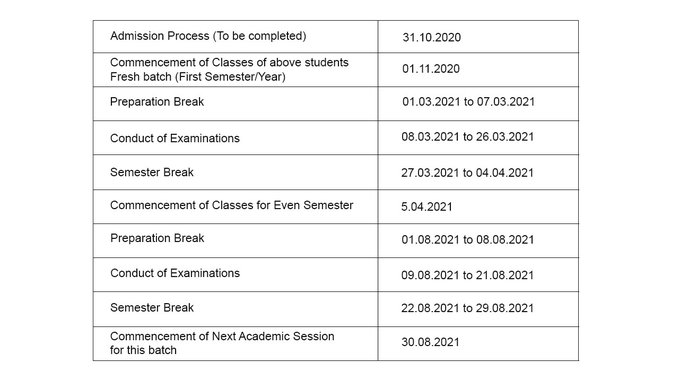
University Grants Commission, UGC has directed all the varsities to start the classes for the new sessions from November 1 onwards, as per the revised academic calendar approved by UGC on Monday. The first-year classes for undergraduate and postgraduate courses can begin in November. The varsities have been asked to wrap up the admission schedule by October 30.

Union Education Minister, Dr Ramesh Pokhriyal Nishank took to his official Twitter handle and made the important announcement. In his tweet, Dr Ramesh Pokhriyal Nishank said, ‘In view of the COVID-19 pandemic, the Commission has accepted the Report of the Committee and approved the @ugc_india Guidelines on Academic Calendar for the First Year of Under-Graduate and Post-Graduate Students of the Universities for the Session 2020-21.’ He also shared the suggested UGC new academic calendar 2020.


According to the suggested calendar, the classes for first-year students oof UGC undergraduate courses and UGC postgraduate courses will start from November 1, 2020, and the exams will be held from March 8, 2021, to March 26, 2021. Earlier UGC had advised that the new academic session of 2020-2021 should begin in September. However, due to the rising number of COVID-19 cases in India, the UGC calendar has been revised. Here is a look at Dr Ramesh Pokhriyal Nishank’s Twitter and important dates of the suggested UGC new academic calendar 2020.

To avoid financial hardship being faced by the parents due to lockdown and related factors, a full refund of fees will be made on account of all cancellation of admissions/ migration of students, up to 30.11.2020, for this very session as a special case.#UGCGuidelines                                      — Dr. Ramesh Pokhriyal Nishank (@DrRPNishank) September 22, 2020

In a separate tweet, the minister also noted that to avoid financial burden being faced by parents due to lockdown and related factors, a full refund will be made on account of all cancellation of admissions/ migration of students, up to 30 November.

Meanwhile, the Supreme Court on Tuesday asked the Central Board of Secondary Education (CBSE) to declare the results of compartment exams as soon as possible and coordinate with the University Grants Commission (UGC) to enable around two lakh students passing out in these exams to apply in colleges in the current academic year.

Kesavananda Bharati Whose Plea Led To Landmark SC Verdict Dies

It is really a matter of profound grief that the legendary Kesavananda Bharati whose plea to the Apex Court is considered the “real reason” behind the much acclaimed “basic structure” doctrine propounded in 1973 which clipped the widest power of Parliament to amend the Constitution and simultaneously gave judiciary the authority to review any amendment because of which the case is also known by his name passed away on the morning of September 6 at his ashram named Sri Edneer Mutt in Kerala’s Kasaragod district. He was suffering from breathing and heart ailments and was 79 years of age. He was the head of Jagadguru Shankaracharya Samsthanam Mutt which belongs to the Shankaracharya tradition. The Mutt is believed to have been established by Totakacharya who is one of the four disciples of Adi Shankaracharya.  

                           As grief poured in from all over as soon as news regarding his demise spread, a Kerala High Court lawyer Raghul Sudheesh who had visited the Mutt in 2011 to meet him laid bare his feelings by saying that, “Bharati was revered as a God-like figure. He treated everyone with much affection and care. My stay at the Mutt afforded me the opportunity to experience his hospitality and affection.” 

                                It would be instructive to mention here that Bharati was a Carnatic and Hindustani vocalist and wrote many devotional songs and plays and was also a patron of Kannada art and culture. His Mutt manages many educational institutions. It also runs a Veda Pathasala which imparted lessons in Advaitha and Vedic lessons to many students. In 2018, Bharati was honoured with the Justice VR Krishna Iyer award which made everyone feel proud of him! Very rightly so!   

                                      To put things in perspective, he was the petitioner in the leading case titled His Holiness Kesavananda Bharati Sripadgalvaru and Ors. Vs. State of Kerala and others AIR 1973 SC 1461 : (1961) 4 SCC 225 popularly known as “Fundamental Rights” case in which the Supreme Court ruled that the basic structure of the Constitution is inviolable and cannot be amended by Parliament. Kesavananada was the Chief of the Kerala Mutt. He filed a writ application under Article 32 of the Constitution.   

                               It must be mentioned here that the Apex Court held in this case that there is no wrong in treating the Preamble as a part of the Constitution. The Court held that Parliament cannot while amending the Constitution, destroy the basic structure of the Constitution. The Apex Court in this case overruled its decision in Golak Nath v. State of Punjab AIR 1967 SC 1643, and held that Parliament has power to amend the Constitution including the provisions relating to the Fundamental Right but has no power to amend the basic structure of the Constitution. It also clarified that a constitutional amendment is not law within the meaning of Article 13. 

                                When a question arose in this case for the relationship among Preamble, Fundamental Rights and Directive Principles of State Policy, the Supreme Court held that they are part of the same constitutional scheme and form a part of the Constitution. They are complementary and supplementary to each other and are closely related. The Apex Court also upheld the validity of all the three Constitutional amendments – 24th, 25th and 29th which were under challenge. 

                                   It cannot be lightly dismissed that the petition of Kesavananda Bharati was heard by a 13-member Bench which is the largest-ever Bench in the history of the Supreme Court till now! The historic case till now remains the longest heard before the Apex Court. It was heard for 68 working days between October 31, 1972 and March 23, 1973.

                                      Be it noted, the Supreme Court then had 16 Judges and yet the then Chief Justice SM Sikri had constituted a 13-Judge Bench which is the largest-ever till date. The judgment was pronounced on April 24, 1973. It was historic also because 11 of the 13 Judges wrote separate judgments. 

                                        It must be borne in mind that by a wafer thin majority of 7:6, the Apex Court ruled that the party in office with its brute majority in Parliament could not amend the basic features of the Constitution which famously came to be known as the ‘basic structure doctrine’ and it is followed till date. Those thirteen Judges consisted of Chief Justice SM Sikri, JM Shelat, KS Hegde, AN Grover, AN Ray, P Jagmohan Reddy, DG Palekar, HR Khanna, KK Mathew, MH Beg, SN Dwivedi, AK Mukherjee and YV Chandrachud. JM Shelat and AN Grover, JJ and KS Hegde and AK Mukherjea, JJ delivered judgments jointly. The judgment was written in 595 pages.       

                       Needless to say, Kesavananda Bharati had challenged the Kerala’s state government two land reform Acts meant to restrict the management of religious properties. It was on March 21, 1970 that Bharati had moved the Apex Court challenging the Kerala government’s takeover of land owned by the mutt as per the land reforms Act of 1969. It may be recalled that following the enactment of the law, the Mutt had lost its property and was struggling for financial resources.

                         As it had turned out, the veteran barrister MK Nambiar who was the father of KK Venugopal who is currently the Attorney General of India had introduced Kesavananda to jurist Nani Palkhivala and he had helped Kesavananda to file the petition in the Apex Court. In his petition, Kesavananda had sought enforcement of rights guaranteed under Article 25 (Right to practice and propagate religion), Article 26 (Right to manage religious affairs), Article 14 (Right to equality), Article 19(1)(f) (Freedom to acquire property) and Article 31 (Compulsory acquisition of property). He had prayed that provisions of the Kerala Land Reforms Act, 1963 (Act 1 of 1964) as amended by the Kerala Land Reforms (Amendment) Act 1969 (Act 35 of 1969) be declared unconstitutional, ultra vires and void.

            No doubt, this Kesavananda Bharati case had become a watershed moment in the constitutional jurisprudence of the country and it shall always be remembered in the days to come! The then PM late Mrs Indira Gandhi was so miffed at this judgment that she made sure that those Judges who had decided against the government would not be able to become the Chief Justice of the top court. Sanjay Hegde who is a senior Supreme Court lawyer very rightly pointed out that, “Kesavananda doctrine swung against the government by the narrowest of majorities of 7:6 with Justice HR Khanna signing against the government in favour of the doctrine. It foreshadowed the coming of the Emergency because soon after the judgment, Justices KS Hegde, AN Grover and JM Shelat were superseded for the post of Chief Justice of India and Justice AN Ray who was junior to them was appointed to the post.”

                                         As we all know, Justice KS Hegde, Justice AN Grover and Justice JM Shelat had ruled against the government due to which they were superseded while Justice AN Ray had favoured the government and so he was promoted. This certainly tarnished severely the image of the government and posed a big question mark on the independence of the judiciary most seriously for the first time ever which cannot be ever forgotten!

                              Truth be told, even though Kesavananda Bharati may have lost the landmark case just like a battle is lost but seen in hindsight, he has still won the war as his case became the most landmark case which shall always be written in golden letters in the pages of history! It is true that the Apex Court in this landmark case endorsed the power of the government to amend any part of the Constitution but a rider was also simultaneously added in the words that “It should not infringe upon the basic structure of the Constitution.” In other words, this clearly implies that Parliament could not do as it pleases with the Constitution by amending whatever it wanted to amend. 

                                      Interestingly enough, the Apex Court in this notable case did not give any exhaustive list of what would constitute the basic structure of the Constitution. This was left open-ended. This truly enhanced the power of the Apex Court to intervene anywhere in any such case where it felt that the basic structure of the Constitution was being challenged. This also explains why it is so fondly remembered always! 

                                          To put it succinctly, Chief Justice SM Sikri considered the following features as to constitute the basic structure:

1.  Supremacy of the Constitution

2.  Republican and Democratic forms of Government

3.  Secular character of the Constitution

4.  Separation of powers between the legislature, the executive and the judiciary

Justice JM Shelat and Justice AN Grover held that the basic structure was not a vague concept. They maintained that the basic features could only be illustrative and could not be catalogued. They considered the following features to constitute the basic structure:

1.  The Supremacy of the Constitution

2.  Republican and Democratic form of Government and Sovereignty of the country

3.  Secular and Federal character of the Constitution

4.  Demarcation of power between the legislature, the executive and the judiciary

5.  The dignity of the individual secured by the various freedoms and basic rights in Part III and the mandate to build a Welfare State contained in Part IV

6.  The Unity and the Integrity of the Nation.

Justice KS Hegde and Justice AK Mukherjee attributed the following as basic features:

1.  Sovereignty of India

2.  The Democratic character of our polity

3.  The Unity of the country

4.  The essential features of the individual freedoms secured to the citizens.

5.  The mandate to build a Welfare State and egalitarian society.

But they also said that these limitations are only illustrative and not exhaustive.

Justice P Jagmohan Reddy observed that the mere fact that the essential elements constituting the basic structure could not be enumerated exhaustively was no ground to deny their existence. In his view, a Sovereign, Democratic, Republic, Parliamentary Democracy and the three organs of the State constituted the basic structure.

Justice Khanna by way of example held that the democratic government could not be changed into dictatorship or hereditary monarchy nor the Lok Sabha and the Rajya Sabha be abolished. Likewise, the secular character of the State could not be done away with. But the right to property was not the basic structure or framework of the Constitution.  

                         Needless to say, this has been used on many occasions by the Apex Court in many cases to strike down the respective Constitutional amendments that the Supreme Court felt had violated the basic structure of the Constitution. This alone explains why none other than Upendra Baxi who is an eminent jurist and a Professor of Law in University of Warwick and former Vice Chancellor of Universities of South Gujarat and Delhi very rightly terms in his enlightening and enriching editorial titled “A constant irritant to power” in ‘The Indian Express’ dated September 16, 2020 this ‘Kesavananda Bharati’ case in the opening para itself as “I call the judgment the second most important text after the Constitution of India.” Very rightly so! 

                                      The Apex Court also made it clear in this case that the power to amend under Article 368 does not include the power to completely abrogate Constitution and replace it by an entirely new Constitution. It would certainly not be an exaggeration to say most vocally that “This case is the mother of all cases and the true protector of our Constitution as it severely restricts the power of the Government to tamper with the basic features of the Constitution!” Kesavananda Bharati may have died physically but what he has done by his case by being the petitioner will forever be remembered by all those having even a basic understanding of the Constitution. No denying it!      

Sanjeev Sirohi, Advocate,

s/o Col BPS Sirohi,

A 82, Defence Enclave,

Sardhana Road, Kankerkhera,

Meerut – 250001, Uttar Pradesh

Misandry is not feminism.

Recently, the statement “I am a feminist” has become synonymous to the statement “I hate men.” The mere idea of feminism is being misconstrued as the idea of hating men. It’s become a widely spread belief that feminism represents the idea of switching the power structure so that men are on the bottom and women are on the top; however, this is a common misconception.

The correct word choice for a man-hater is a “misandrist’ and not a feminist. 
The correct word choice for a man-hater is a misandrist. According to the Merriam-Webster dictionary, misandry is the hatred of, contempt for, or prejudice against men or boys. Misandry can manifest itself in numerous ways, including sexual discrimination, denigration of men, violence against men, and sexual objectification of men. The belief in a matriarchal structure like this is the true ideology for those who wish to completely switch the power structure.

According to Merriam-Webster dictionary, feminism is a range of political movements, ideologies, and social movements that share a common goal: to define, establish, and achieve political, economic, personal, and social equality of sexes.

This includes seeking to establish educational and professional opportunities for women that are equal to those for men. This doesn’t mean that feminists wish to switch the power structure, but instead that the ideology behind feminism is to disassemble the patriarchal structure.

The patriarchal structure doesn’t necessarily mean that a man will benefit from all situations. It’s harmful to both men and women. It does refer to the idea that women should have husbands to take care of them, that women are overly emotional, and that women are the primary caretakers of a family, but it also refers to the idea that a man cannot show emotion, cannot be sexually assaulted or abused, and cannot take care of children as well as a woman can.

Many seem to think that feminism is a movement driven by anger and aggression. A true feminist would say that the movement is actually driven by emotion and determination. Hatred is not something a feminist wants; hatred is not included in the definition.

Feminists are branded with a horrible reputation that simply isn’t fair. The term “feminazi” and other ones like it have become increasingly popular, and it’s absolutely astounding that one would compare a group fighting for equality to a group that contributed to the mass murder of millions of people.

In the eyes of an anti-feminist, a “feminazi” represents the entire community; it defines feminists as evil, angry, over-the-top. Is it fair to, first of all, stereotype and misuse the concept of feminism? And second, compare its members to some of the cruelest people in history?

Again, feminists fight for equal opportunities, rights, pay, and expectations for all genders. Feminism was built on the construct of the main gender oppression, which is why it is a majority female space. Men would be just as adamant about gender equality if the roles were reversed.

The ultimate goal of a feminist mandate is to uproot the violent system of patriarchy. In advancement of that goal, feminists have done extensive work and research to investigate social norms and to expose them for how detrimental they are for our societies, including men.

It was through feminism that we started to question the notion of masculinity and how we constructed it in such a rigid fashion that created emotionally stunted men and, in worse case scenario, violence perpetrators that are incapable of resolving conflict in a healthy way.

Feminism has, at the very base of it, advocated that it’s okay for men to cry. Even further, it was feminist activists that fought for men’s right to paternity leaves and for men to be more involved in the lives of their children and their domestic affairs.

It is our duty to understand that just because misandrists tag themselves as feminist doesn’t mean that they are. The false understandings about feminism should be put an end to.

Feminists want equity and equality for women not because we are women but because we are humans.

Prime Minister of India Shri Narendra Modi to virtually address the 22nd Convocation IIT Guwahati tomorrow

Prime Minister Shri Narendra Modi will be addressing the convocation of IIT, Guwahati through video-conferencing at 12 Noon, on Tuesday 22nd September 2020.Union Education Minister, Shri Ramesh PokhriyalNishank ,Chief Minister of Assam Shri Sarbananda Sonowal,  Minister of State for Education Shri Sanjay Dhotre and other dignitaries will participate in the event. Dr. Rajiv I. Modi, Chairman, Board of Governors, IIT Guwahati, and Prof. T.G. Sitharam, Director, IIT Guwahati, will be present during the event.

1803 students including 687 B.Tech and 637 M.Tech students will be receiving degrees tomorrow.

For the Convocation, to celebrate the graduate’s accomplishments online through virtual mode, the Institute has created a virtual reality-based award distribution where one can experience an avatar of the recipient of the award collecting a medal from Director’s own avatar surrogating him, from the comfort of their home. The Institute has also created a photo-booth, with an option of different backgrounds, for students to take pictures at some selected locations on the campus. IIT Guwahati’s faculty and students have developed a telepresence module for a virtual visit to the Institute.

Ocean Services, Modelling, Applications, Resources and Technology (O-SMART) SCHEME of the Ministry of Earth Sciences

The objectives of O-SMART (Ocean Services, Modelling, Applications, Resources and Technology) scheme of Ministry of Earth Sciences (MoES), Govt. of India are

(1) To generate and regularly update information on Marine Living Resources and their relationship with the physical environment in the Indian Exclusive Economic Zone (EEZ),

(2) To periodically monitor levels of sea water pollutants for health assessment of coastal waters of India, to develop shoreline change maps for assessment of coastal erosion due to natural and anthropogenic activities,

(3) To develop a wide range of state-of-the art ocean observation systems for acquisition of real-time data from the seas around India,

(4) To generate and disseminate a suite of user-oriented ocean information, advisories, warnings, data and data products for the benefit of society,

(5) To develop high resolution models for ocean forecast and reanalysis system,

(6) To develop algorithms for validation of satellite data for coastal research and to monitor changes in the coastal research,

(7) Acquisition of 2 Coastal Research Vessels (CRVs) as replacement of 2 old CRVs for coastal pollution monitoring, testing of various underwater components and technology demonstration,

(8) To develop technologies to tap the marine bio resources,

(9) To develop technologies generating freshwater and energy from ocean,

(10) To develop underwater vehicles and technologies,

(11) Establishment of Ballast water treatment facility,

(12) To support operation and maintenance of 5 Research vessels for ocean survey/monitoring/technology demonstration programmes,

(13) Establishment of state of the art sea front facility to cater to the testing and sea trial activities of ocean technology,

(14) To carryout exploration of Polymetallic Nodules (MPN) from water depth of 5500 m in site of 75000 sq.km allotted to India by United Nations in Central Indian Ocean Basin, to carryout investigations of gas hydrates,

(15) Exploration of polymetallic sulphides near Rodrigues Triple junction in 10000 sq. km of area allotted to India in International waters by International Seabed Authority/UN and,

(16) Submission of India’s claim over continental shelf extending beyond the Exclusive Economic Zone supported by scientific data, and Topographic survey of EEZ of India.

The Indian Tsunami Early Warning Centre (ITEWC) was established at Indian National Centre for Ocean Information Services (INCOIS), Hyderabad, an autonomous body under Ministry of Earth Sciences which continues to provide timely tsunami advisories to stake holders and has functioned flawlessly since its establishment in October 2007. The ITEWC is also providing tsunami services to 25 Indian Ocean Countries as part of the Intergovernmental Oceanographic Commission (IOC) of UNESCO framework. INCOIS has introduced several innovative concepts in tsunami modeling, mapping of coastal inundation, Decision Support System, SOPs to meet the emerging challenges and provide accurate and timely tsunami early warnings. INCOIS has established a Global Navigation Satellite System (GNSS) & Strong Motion Accelerometers in Andaman and Nicobar Islands for quick and reliable estimation of source parameters for near source earthquakes. In addition, INCOIS has carried out Multi-hazard Vulnerability Mapping (MHVM) along the mainland of Indian coastland MHVM atlas has been prepared. The ITEWC, INCOIS regularly conducts workshops, training sessions and tsunami mock exercises to create awareness and preparedness about the tsunamis. In addition to workshops and trainings for disaster managers, ITEWC is also coordinating with coastal States/UTs to implement Tsunami Ready Programme, a concept introduced by UNESCO, at community level. Odisha has implemented the programme in two villages (Venkatraipur and Noliasahi) and based on the national board recommendation, IOC (UNESCO) recognized these villages as Tsunami ready communities.

We have better Tsunami prediction models at ITEWC and INCOIS is continuously working towards improving its accuracy.

This information was given by the Union Minister of Science and Technology, Earth Sciences and Health and Family Welfare, Dr Harsh Vardhanin a written reply in Rajya Sabha on September 20, 2020.

Schemes of the Ministry of Science & Technology to provide attractive avenues and opportunities to Indian researchers residing in foreign countries to work in Indian Institutes and Universities

The Ministry of Science & Technology has formulated following schemes to provide attractive avenues and opportunities to Indian researchers who are residing in foreign countries to work in Indian Institutes and Universities.

  1. Visiting Advanced Joint Research (VAJRA) Faculty Scheme:    This Scheme is to bring overseas scientists and academicians including Non-resident Indians (NRI) and Overseas Citizen of India (OCI) to India to work in public funded Institutions and Universities for a specific period of time. The scheme offers adjunct / visiting faculty assignments to overseas scientists including Indian researchers to undertake high quality collaborative research in cutting edge areas of science and technology with one or more Indian collaborators.
  1. Ramanujan Fellowship: This Fellowship provides attractive avenues and opportunities to Indian researchers of high calibre, who are residing abroad, to work in Indian Institutes/Universities in all areas of Science, Engineering and Medicine. It is directed to scientists and engineers below the age of 40 years, who want to return to India from abroad.
  1. Ramalingaswami Re-entry Fellowship: The programme is to encourage scientists (Indian Nationals) working outside the country, who would like to return to the home country to pursue their research interests in Life Sciences, Modern Biology, Biotechnology, and other related areas.
  1. Biomedical Research Career Programme (BRCP): This program provides opportunity to early, intermediate and senior level researchers to establish their research & academic career in Basic biomedical or Clinical & Public Health in India. These fellowships are open to all eligible researchers who wish to relocate or continue to work in India.
  1. Scientists/ Technologists of Indian Origin (STIO) in Indian research Laboratory: There is a provision to appoint Scientists/ Technologists of Indian Origin (STIO) on a contractual basis at Council of Scientific and Industrial Research (CSIR) laboratories to nurture a research field in their area of expertise.
  1. Senior Research Associateship (SRA) (Scientist’s Pool Scheme): This scheme is primarily meant to provide temporary placement to highly qualified Indian scientists, engineers, technologists, and medical personnel returning from abroad, who are not holding any employment in India. The Senior Research Associateship is not a regular appointment, but is a temporary facility to enable the Associate to do research/teaching in India while looking for a regular position.

Ministry of Science and technology does not keep track or estimates the number of Indian scientists, who leave India to work in other countries. However, to avoid brain drain Ministry of Science and Technology is promoting global level of research through implementation of various competitive schemes / programmes such as Core Research Grant, Research fellowships such as JC Bose and Swarnajayanti fellowship etc. There are some special schemes for young scientists e.g. Start-up Research Grant, National Postdoctoral Fellowship etc. for making them independent and motivate them to remain in the country. Towards gaining global competitiveness Ministry of Science is also connecting Indian Research with Global research through International bilateral and multilateral S & T cooperation with about 80 countries and various multilateral organizations/agencies.

Indian Tsunami Early Warning Centre is providing Tsunami Services to 25 Indian Ocean Countries: Dr. Harsh Vardhan

The objectives of O-SMART (Ocean Services, Modelling, Applications, Resources and Technology) scheme of Ministry of Earth Sciences (MoES), Govt. of India are

(1) To generate and regularly update information on Marine Living Resources and their relationship with the physical environment in the Indian Exclusive Economic Zone (EEZ),

(2) To periodically monitor levels of sea water pollutants for health assessment of coastal waters of India, to develop shoreline change maps for assessment of coastal erosion due to natural and anthropogenic activities,

(3) To develop a wide range of state-of-the art ocean observation systems for acquisition of real-time data from the seas around India,

(4) To generate and disseminate a suite of user-oriented ocean information, advisories, warnings, data and data products for the benefit of society,

(5) To develop high resolution models for ocean forecast and reanalysis system,

(6) To develop algorithms for validation of satellite data for coastal research and to monitor changes in the coastal research,

(7) Acquisition of 2 Coastal Research Vessels (CRVs) as replacement of 2 old CRVs for coastal pollution monitoring, testing of various underwater components and technology demonstration,

(8) To develop technologies to tap the marine bio resources,

(9) To develop technologies generating freshwater and energy from ocean,

(10) To develop underwater vehicles and technologies,

(11) Establishment of Ballast water treatment facility,

(12) To support operation and maintenance of 5 Research vessels for ocean survey/monitoring/technology demonstration programmes,

(13) Establishment of state of the art sea front facility to cater to the testing and sea trial activities of ocean technology,

(14) To carryout exploration of Polymetallic Nodules (MPN) from water depth of 5500 m in site of 75000 sq.km allotted to India by United Nations in Central Indian Ocean Basin, to carryout investigations of gas hydrates,

(15) Exploration of polymetallic sulphides near Rodrigues Triple junction in 10000 sq. km of area allotted to India in International waters by International Seabed Authority/UN and,

(16) Submission of India’s claim over continental shelf extending beyond the Exclusive Economic Zone supported by scientific data, and Topographic survey ofEEZ ofIndia.

The Indian Tsunami Early Warning Centre (ITEWC) was established at Indian National Centre for Ocean Information Services (INCOIS), Hyderabad, an autonomous body under Ministry of Earth Sciences which continues to provide timely tsunami advisories to stake holders. The ITEWC is also providing tsunami services to 25 Indian Ocean Countries as part of the Intergovernmental Oceanographic Commission (IOC) of UNESCO framework. INCOIS has introduced several innovative concepts in tsunami modeling, mapping of coastal inundation, Decision Support System, SOPs to meet the emerging challenges and provide accurate and timely tsunami early warnings. INCOIS has established a Global Navigation Satellite System (GNSS) & Strong Motion Accelerometers in Andaman and Nicobar Islands for quick and reliable estimation of source parameters for near source earthquakes. In addition, INCOIS has carried out Multi-hazard Vulnerability Mapping (MHVM) along the mainland of Indian coastland MHVM atlas has been prepared. The ITEWC, INCOIS regularly conducts workshops, training sessions and tsunami mock exercises to create awareness and preparedness about the tsunamis. In addition to workshops and trainings for disaster managers, ITEWC is also coordinating with coastal States/UTs to implement Tsunami Ready Programme, a concept introduced by UNESCO, at community level. Odisha has implemented the programme in two villages (Venkatraipur and Noliasahi) and based on the national board recommendation, IOC (UNESCO) recognized these villages as Tsunami ready communities.

We have better Tsunami prediction models at ITEWC and INCOIS is continuously working towards improving its accuracy.

This information was given by the Union Minister of Science and Technology, Earth Sciences and Health and Family Welfare, Dr Harsh Vardhanin a written reply in Rajya Sabha on September 20, 2020.

Cabinet approves Minimum Support Prices (MSP) for Rabi Crops for marketing season 2021-22

The Cabinet Committee on Economic Affairs (CCEA) chaired by the Prime Minister Shri Narendra Modi has approved the increase in the Minimum Support Prices (MSPs) for all mandated Rabi crops for marketing season 2021-22. This increase in MSP is in line with the recommendations of Swaminathan Commission.

In view of nutritional requirements and changing dietary pattern and to achieve self-sufficiency in pulses and oilseeds production, the Government has fixed relatively higher MSP for these crops.

The highest increase in MSP has been announced for lentil (Rs. 300 per quintal) followed by gram and rapeseed & mustard (Rs. 225 per quintal each) and safflower (Rs. 112 per quintal). For barley and wheat, an increase of Rs. 75 per quintal and Rs 50 per quintal respectively has been announced. The differential remuneration is aimed at encouraging crop diversification.

IFSCA Committee submits interim report on development of international retail business

The International Financial Services Centres Authority (IFSCA) Expert Committee on international retail business development in the IFSC has submitted its interim report to the Chairperson of the IFSCA. The interim report covers a number of suggestions aimed at swift and efficient development of international retail businesses in the IFSC, and focuses mainly on the banking vertical. Other key business verticals, i.e., insurance, asset management, and capital markets, will be covered in reports that the committee plans to release subsequently.

The Expert Committee has been constituted by the IFSCA with an aim to suggest how to develop international retail business in International Financial Services Centre (IFSC) along with potential strategies for making IFSC attractive for international financial services; provide a roadmap for future growth of international retail business in IFSC; and also examine and recommend any other issues that are important in the development of the IFSC.

Speaking of the vision for GIFT IFSC, Shri Injeti Srinivas, Chairperson, IFSCA, said, “Our focus is to provide a best in class jurisdiction with progressive and light touch regulation to create an attractive location for international financial services. Our vision is to establish GIFT IFSC as a Dominant Gateway for global financial flows into and out of India, and simultaneously emerge as a major global financial hub.”

The committee suggests that the IFSC can aim at:

(i)  Becoming a gateway to India growth story for international investors and business

(ii) Providing Indian diaspora and individuals from Asia and Africa with a comprehensive range of financial services from the IFSC.

(iii) Serving domestic residents availing liberalized remittance scheme.

Further, the IFSC with its approach of “FinServe from IFSC” would complement the ‘Make in India’ vision of the Government of India. “There is immense immediate potential to promote international retail business in IFSC, and if done efficiently, it will meet three key objectives – boost job creation, generate additional revenue for India, and attract funds (especially from the Indian diaspora) for building India’s infrastructure. The IFSC must aim to provide best in class jurisdictions and aim to build its competitiveness in terms of key factors like reputation, regulatory environment, taxation and ease of operations,” said Pradip Shah, Chairman of the Expert Committee. The other members of the Expert Committee comprise G. Srinivasan, (Ex-CMD, New India Assurance Ltd.), Siddhartha Sengupta, (ex-DMD, State Bank of India), Shyamal Mukherjee (chairman, PWC), Prakash Subramanian (head-strategy, Standard Chartered Bank), Dipesh Shah (head-IFSC dept., GIFT IFSC) and Nitin Jaiswal (head-Govt Affairs and Strategic relations, Bloomberg, Asia Pacific).

The Government of India had constituted the IFSCA with Shri I Srinivas as its Chairperson earlier this year to develop and regulate the financial services market in the IFSC in India. Apart from channelizing India’s offshore business to the IFSC located at GIFT City and making it the gateway for India centric international financial services, the objective is to make it a global hub for international financial services on the lines of London, Hong Kong, Singapore, and Dubai.