Should we use a smartphone?

Mobile is the essential thing nowadays, we all know that food, clothes, and shelter these are the basic requirement of the human cycle, however, in this cycle human added mobile phone as a basic need, because of the advancement of the technology, furthermore, majority people on earth have own smartphone from old age people to a small child have it.

in modern times, no one can live without a cellphone, people forget to eat and take care of their child, but never lost or forget their phone. According to the article which was published by Global System for Mobile Communications, in that post, they declared the ratio of cellphone user around the globe, and the ratio is 5.13 billion people have owned a mobile phone, and the ratio is increasing day by day. from around the globe, many companies like GSMA have an eye on the users and what they surf on the cellphone and how much time people spent on it in the day.

As we all know that without the internet, mobile is like empty and codless phone, which our grandparents use at their young age, we can find each and everything on the internet, whenever we stuck any were in education or on the place at the time mobile phone help us, by finding the solution, google has all answer of the question, which we have in our mind, just we have to ask to google and it displays on the screen, and the speed is like no one can beat it.

Capture

Here are some advantages of using a smartphone:

1) Communication: with the help of a cellphone one can connect themselves with others ever living far distance with the help of audio as well as video call.

2) Social media: in the age of social media, the whole world is like a small global village, people can share a post, communicate by messaging, and displaying the timeline, many time people make their friends online, chat with them and enjoy the company and never get bored in free time.

3) Daily News: on the mobile phone there are many news applications, where we are connected to the things happening around the world, we can find news regarding sports, politician, current affairs, daily stories, and we also get pop-up notification daily morning and a whole day, so we do not have to turn on the television and change the channels.

4) Photography: with the help of mobile phone all youngster becomes the photographer, additionally, mobile companies also focus and endorse the features of the camera with high resolution, which capture the important and long life memories, whenever people see in future they can recognize well.

5) Online services: nowadays each and every item available online on our phone, by playing games on can earn money, on can maintain their financial balance, banking also be done online, shopping, booking a ticket for holidays, and ordering food. and these all things can be done by just tapping on the screen.

6) Education: Parents and children can learn many things online from anywhere and every ware at any place and the choices of times is according to us. in the situation like COVID-19 we can see that all classes held online even student who studied in 6th grade they also have online classes on that way it will help us.

If we consider the downside of mobile phone:

1) when people use a mobile high rate then they may be addicted to the cell phone they never left this addiction and it will affect the time and health like insomnia.

2) If people use a smartphone till late night, they will not gonna have proper sleep and rest, so,it will harm full for their eyesight

3) sometimes people use a phone for the whole day, they will miss the outdoor fun with friends, or if they are in the home, they will miss the quality time with there family, and it will lead to the communication gap between family members.

4) whenever we use the smartphone touch screen, there may behave millions of micro germs, and when we use those hands while eating, it will spread in the whole body and our body might be infected.

Every people, know the famous personality steve jobs, the owner of the Application company. in the year 2011, the new york times published the interview of the MR.steve and he told that “he prohibited his kids from using the newly launched IPad and other product” and he also limited the technology in his house. he also told, ” he knows that he made monster in the form of Apple product”. Furthermore, Bill Gates also said in the public press “he never allows their child to use the smartphone until the child becomes over 14 years old.

So, by taking motivation from those two legends parents should restrict the usage of mobile phone at their home.

thanks for reading.


6 Spoonerisms(and Other Twists of the Tongue)

Once upon a time in a coreign fountry, there lived a very geautiful birl. Her name was Rindercella. She lived with her mother and her two sisters and in the same coreign fountry there lived a very pandsome hrince…. Well, you better know what’s going to follow next. You might be wondering that why the word’s letters are being exchanged? Here comes the term SPOONERISM.

It is an accidental activity and creates a comic effect. As in the above story, Cindrella is pronounced as ‘Rindercella’(‘r’ and ‘c’ are exchanged), foreign country as ‘coreign fountry’(‘c’ and ‘f’ are exchanged), handsome prince as ‘pandsome hrince’(‘p’ and ‘h’ are exchanged).

So, the slip of the tongue is responsible for such blunder accidents. The term Spoonerism has been derived from the name of WILLIAM A. SPOONER who is well-known for making such tongue twists.

A SPOONERISM is where a switch in the first letters or phonetic sounds of two consecutive words creares a new pair of words and their meanings get twisted. It is basically an exchange. Moreover, its scientific name in Greek is METAPHASIS. It is observed that consonants are often transposed than vowels.

Some of William’s famous spoonerisms are:

  • I am a word botcher – (bird watcher).
  • The lord is a shoving leopard – (loving shepherd).
  • You were fighting a liar in the quadrangle – (lighting a fire).

6 famous spoonerisms over the years:

  • RINDERCELLA Archie Campbell is a well-known writer recognised for his long-running skits. He loved using spoonerisms in the skits on the show. Campbell’s Rindercella is his best creation of spoonerism. A girl who slopped her dipper. Also, there was a Beeping Sleauty.
  • THE CANADIAN BROADCORPING CASTRATION Just imagine when it was being live on the air as “The Canadian Broadcorping Castration” instead of “The Canadian Broadcasting Corporation”. The poor broadcaster had accidentally turned himself an element of joke in from of the mass.
  • BASS-ACKWARDS Abrahan Lincoln was fond of spoonerisms. His one of the letters contained, “He said he was riding bass-ackwards on a jass-ack through a patton-crotch.”
  • RUNNY BABBIT Runny Babbit: A billy sook was written by Shel Silverstein and you could infer that this book is flooded with spoonerisms as the name suggests.
  • HOOBERT HEEVER You might have burst into laughter after reading this name. If you wish to get that feeling more, then try saying it again and again but at the end it’s going to be all fun for most of us. But, it could be a biggest mistake if you are a broadcaster. There was a broadcaster Harry Von Zell who was talking about Hover’s life as a part of his birthday tribute. After making it long, his tongue slipped and he accidentally referred to the President as “Hoobert Heever”. But fortunately, the device was not operative and his career was fine. Also, this is a “Kniferism”, another tongue twister and not a spoonerism as it has reverses the middle syllables of the words instead of the initials.
  • APOSTLE PEALE Norman Vincent Peale was a protestant preacher who used to dislike Adlai Stevenson. So, once Stevenson intentionally used a spoonerism in his speech saying, “Speaking as a Christian, I find the Apostle Paul appealing and the Apostle Peale appalling.”

Some more spoonerisms are listed below:

  • you’ve tasted two worms – (you’ve wasted two terms)
  • a half-warmed fish – (a half-formed wish)
  • I am mending the sail – (I am sending the mail)
  • I’ll slap fight in your race – (I’ll slap right in your face)
  • two of hearts – (who of tarts)
  • no tails – (toe nails) …………………..the list is never ending..

Other tongue twisters:

FREUDIAN SLIP:

similarly., like spoonerisms, it also involves accidental mixing up of words. But, Freudian slips are less accidental than spoonerisms. The ycome out as the words from you sub-conscious thoughts that you are holding back. In other words, Freudian slip is meant to reveal what you were thinking of. It is named after Sigmund Freud, who was a famous neurologist.

MALAPROPISM:

It is a verbal mistake in which a word is substituted with another word that sounds similar but means something entirely different. It leads to comic effect. The word is taken from the character, Mrs. Malaprop, in a 1775 play called The Rivals. The word Malaprop is considered as incorrect which is interchangeable with the word malapropism.

KNIFERISM:

It refer to the reversing of the middle syllables of the words instead of the initials.

Ex: During a live broadcast in 1931, a radio presenter Harry Von Zell accidentlly mispronounced US President Herbert Hoover’s name as “Hoobert Heever.”

Leadership Lessons from Mother Nature

You must have learnt valuable lessons from many great leaders, it’s time to know from where the great leaders got their dose of inspiration.  Every great leader is a self learner. In this sense it can be said that great leaders are capable of learning things by looking at the examples set in front of them. Not just the examples set by great men but examples that are set by something even greater than any man on earth:

The Mother Nature herself. Nature inspired man to reinvent the wheel by looking at the moon. A big leap from zero to one. But for the modern man, nature is even a greater source of inspiration than ever before. Coming back to our regular office space. It’s not that hard to accept that survival of the fittest works perfectly here. But this is not the only thing you can learn from nature. It goes beyond. It has a consciousness of its own. It’s like everything speaks despite the apparent silence. Let’s know what leaders can learn from nature. Sometimes Silence Speaks A Better Language Than Words This is one reason that nature is silent.

To prove my point let me tell you a story someone told me: Two frogs once jumped into a death pit. No frog who jumped into that pit had ever survived. Other frogs watched them struggle and discouraged them, with no point trying. One of them gave up and died while the other one miraculously escaped the pit.

ReasonThat frog was deaf, he never heard a single word; all he could sense was others telling him to struggle harder. Staying positive works. As a great leader you can get more out of your team by being positive rather than negative. Rather than telling your team to do something, set examples for them that they can follow. Speak silently. Facts are False, Interpretations are True How many times have we been told to only look at the facts when making decisions. The million dollar wisdom; there are no facts only interpretations. It’s a fact that sun rises in the east, but it is an interpretation where the direction east is. It is a fact that apple falls at the ground but it is an interpretation that it falls due to gravity. That’s what helped Columbus discover America and Newton Gravity. And that’s what the sign of a genius is─a different way to look at a fact.

Remember this: As an entrepreneur may be one day you will understand why your team is unable to paint the perfect picture. Because all you feed them are facts, but what they want is an interpretation. And that’s how you ignite innovation at work. Your Thoughts and Words are like an Invisible Force of Gravity Every morning thought and midnight memory that an entrepreneur has is always a form of a career joy or a career pain. In other words, you always have a story within your mind. Use this story to hand down your thoughts to your team and let them figure out how to make these thoughts come alive. Graphically every good story can be imagined as a mountain. To be a good storyteller you need to take your audience to the peak of your mountain, as effortlessly as possible, and then throw them of the cliff; catch them at the other end. Make them think that they owe you their lives. Things don’t stop just here. There are so many things that one can learn from nature. For this you need to learn to interpret nature’s language and that happens by having faith that nature speaks a language. This way you will find a hidden meaning behind everything that nature does.

Faculty Development Program (FDP) conducted by Track2Training from June 10 to June 20, 2020

  The Faculty Development Program (FDP) conducted by Track2Training from June 10 to June 20, 2020, was a comprehensive and immersive online event designed to enhance the skills and competencies of educators in various aspects of teaching and learning. Here is a detailed overview of the program:

Overview

Event: Faculty Development Program
Dates: June 10 – June 20, 2020
Mode: Online
Organizer: Track2Training
Objective: To equip faculty members with modern teaching methodologies, technological tools, and innovative strategies to improve educational delivery and student engagement.

Key Components

  1. Curriculum and Content:

    • The program covered a broad range of topics relevant to contemporary educational practices.
    • Sessions included pedagogical innovations, assessment and evaluation techniques, curriculum design, and integration of technology in teaching.
  2. Schedule and Structure:

    • The FDP was structured over 10 days, with daily sessions divided into lectures, workshops, and interactive discussions.
    • Each day consisted of multiple sessions, including keynotes from industry experts, hands-on training, and Q&A segments.
  3. Learning Management System:

    • The program was facilitated through a robust online learning management system (LMS) that provided seamless access to resources, recorded sessions, and interactive tools.
    • Participants had access to a dashboard for tracking progress, submitting assignments, and engaging with peers and instructors.
  4. Expert Speakers and Facilitators:

    • The FDP featured a lineup of distinguished speakers and facilitators from academia and industry.
    • Experts shared insights on various educational trends, technological advancements, and best practices in teaching.
  5. Interactive and Practical Approach:

    • The sessions emphasized active learning through case studies, group activities, and role-playing exercises.
    • Participants were encouraged to share their experiences and apply new strategies in simulated classroom environments.
  6. Assessment and Feedback:

    • Participants underwent periodic assessments to gauge their understanding and application of the content.
    • Feedback mechanisms were in place to provide constructive criticism and guide improvement.

Detailed Session Breakdown

  1. Day 1-2: Introduction to Modern Pedagogy

    • Overview of current trends in education.
    • Understanding student-centered learning.
    • Techniques for fostering critical thinking and problem-solving skills.
  2. Day 3-4: Technology Integration in Teaching

    • Utilizing digital tools for effective teaching.
    • Introduction to e-learning platforms and virtual classrooms.
    • Best practices for creating engaging multimedia content.
  3. Day 5-6: Curriculum Development and Assessment

    • Principles of curriculum design and alignment with learning outcomes.
    • Innovative assessment techniques for measuring student performance.
    • Designing effective rubrics and feedback mechanisms.
  4. Day 7-8: Enhancing Student Engagement

    • Strategies for motivating and engaging students.
    • Incorporating gamification and interactive elements in lessons.
    • Understanding diverse learning styles and adapting teaching methods.
  5. Day 9: Research and Innovation in Education

    • Encouraging research-based teaching practices.
    • Exploring opportunities for educational research and publication.
    • Introduction to grant writing and research funding.
  6. Day 10: Reflection and Future Directions

    • Reflecting on learning outcomes and personal growth.
    • Developing action plans for implementing new strategies.
    • Networking and collaboration opportunities with fellow educators.

Outcomes and Benefits

  • Enhanced Skill Set: Participants gained practical skills in curriculum development, technology integration, and student engagement.
  • Professional Development: The program contributed to participants’ professional growth, enhancing their teaching effectiveness and career prospects.
  • Networking Opportunities: Attendees connected with peers, experts, and industry leaders, fostering collaboration and knowledge exchange.
  • Certification: Participants received a certificate of completion, validating their participation and newly acquired competencies.

The Faculty Development Program organized by Track2Training from June 10 to June 20, 2020, was a highly impactful initiative that equipped educators with essential skills and knowledge to navigate the evolving landscape of education. Through a blend of theoretical insights and practical applications, the program successfully addressed the challenges faced by modern educators and provided a platform for continuous learning and professional advancement.

Digital Marketing: Unfolding of a new arena

In today’s digital era, when almost every information out there is in your hands using a smartphone and an internet connection, even the markets of advertising and content creation have undergone a shift from conventional channels like the radio, print, television towards mire internet-based options like being a blogger, YouTuber, podcasts, etc.

Due to this shift, more eyeballs are now fixed on a smartphone screen than ever, hence even brands are now channelizing their branding and advertising towards digital mediums. That’s where a new hot area of self- employment, entrepreneurship, or even business gave birth to digital marketing.

From a student’s perspective, it is a great opportunity, provided that the millennials are so comfortable and easily adapt to the fast pace changes coming forth in the world of the internet. Data is believed to be the new oxygen of this century and more than 500 million internet users in the Indian subcontinent alone prove it. This number is set to increase across the globe that’s where this arena of being a digital marketer becomes the new hotspot of employment and business like the IT industry picked up the boom in the early 2000s after the burst of the dot-com bubble.

Digital marketing is like a combination of a variety of skills like Search Engine Optimization (organic marketing), Search Engine Marketing (inorganic marketing), social media marketing, blog writing as per keyword researches, managing social media handles, online reputation management and many more. From being an employee at a digital marketing company to being a self-employed blogger or starting your own business without almost no investment, whatever your work ethic suits you, this budding field has everything in the pack for you.

Now, the question arises from where to learn this skill of digital marketing?
It’s easy, start simple. Learn about some of the terms and key factors involved in it from well established digital marketers like Harsh Aggrawal, Ankur Aggarwal, Mark Manson, etc. Either learn from their blogs or some of them even have their YouTube channels. Also, as a beginner, I would recommend you to get certified in the fundamentals of digital marketing by the most used search engine and the tech-giant: Google itself. Yes, you read it right! There is a free course on Google Digital Garage, absolutely free of cost (with certification).

Just start it as a hobby along with your regular education, and have a learning attitude because within a few years you will possess a great skill that will be greatly relevant for your future. Moreover, then you can start your website through a domain and hosting provider or work as a digital marketing intern. Further, it is believed that skills like digital marketing, communication skills, presentation skills are going to have omnipresent demand in almost every career choice amongst the multi-talented coming generation. These skills are more practical application and experience-based unlike conventional theoretical based. So, in this social media age, the students should have a mindset not to be just a content consumer but also be a creator or marketer of a particular niche to have an edge over the competition.

Missions to exploring Sun: World Exclusive Report @2020-21

The Indian Space Research Organization (ISRO) is preparing for its first scientific expedition to study the Sun, Aditya-L1. It would be placed into a point in space known as the L1 Lagrange point.

  • Aditya L1 will be ISRO’s 2nd space-based astronomy mission after AstroSat, which was launched in 2015.
  • Aditya 1 was renamed as Aditya-L1. The Aditya 1 was meant to observe only the solar corona.

AstroSat

  • AstroSat, was launched in September, 2015, by PSLV-C30 from Sriharikota (Andhra Pradesh).
  • It is the first dedicated Indian astronomy mission aimed at studying celestial sources in X-ray, optical and UV spectral bands simultaneously.

Key Points

  • Launch Vehicle: Aditya L1 will be launched using the Polar Satellite Launch Vehicle (PSLV) XL with 7 payloads (instruments) on board.
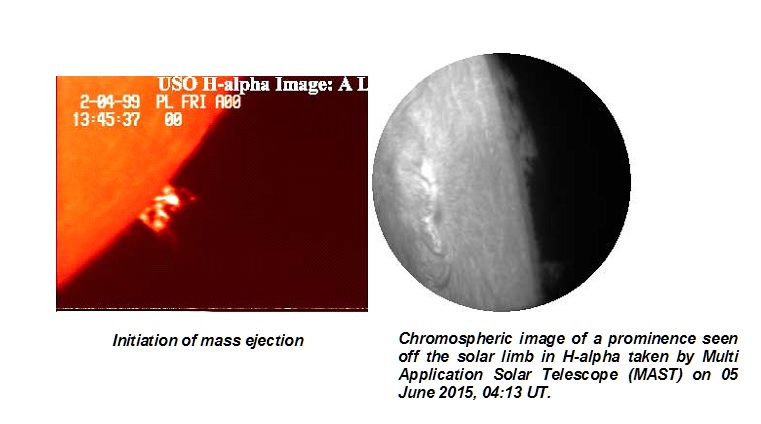
  • Objective: Aditya L1 will study the Sun’s corona (Visible and Near infrared rays), Sun’s photosphere (soft and hard X-ray), chromosphere (Ultra Violet ), solar emissions, solar winds and flares, and Coronal Mass Ejections(CMEs), and will carry out round-the-clock imaging of the Sun.
  • Challenges: The distance of the Sun from Earth ( approximately 15 crore kms on average, compared to the only 3.84 lakh kms to the Moon).This huge distance poses a scientific challenge.
    • Due to the risks involved, payloads in earlier ISRO missions have largely remained stationary in space; however, Aditya L1 will have some moving components which increases the risks of collision.
    • Other issues are the super hot temperatures and radiation in the solar atmosphere. However, Aditya L1 will stay much farther away, and the heat is not expected to be a major concern for the instruments on board.
Credits- Third Party Reference

Importance

  • Evolution of every planet, including Earth and the exoplanets beyond the Solar System, is governed by its parent star i.e the Sun in our case. The Solar weather and environment affects the weather of the entire system. Therefore, it is important to study the Sun.
  • Effects of Variation in Solar Weather System: Variations in this weather can change the orbits of satellites or shorten their lives, interfere with or damage onboard electronics, and cause power blackouts and other disturbances on Earth.
  • Knowledge of solar events is key to understanding space weather.
  • To learn about and track Earth-directed storms, and to predict their impact, continuous solar observations are needed.
  • Many of the instruments and their components for this mission are being manufactured for the first time in the country.

Lagrange Point 1

  • Lagrange Points, named after Italian-French mathematician Josephy-Louis Lagrange, are positions in space where the gravitational forces of a two-body system (like the Sun and the Earth) produce enhanced regions of attraction and repulsion.
  • The L1 point is about 1.5 million km from Earth, or about 1/100th of the way to the Sun.
  • L1 refers to Lagrangian/Lagrange Point 1, one of 5 points in the orbital plane of the Earth-Sun system.
  • These can be used by spacecraft to reduce fuel consumption needed to remain in position.
  • A Satellite placed in the halo orbit around the Lagrangian point 1 (L1) has the major advantage of continuously viewing the Sun without any occultation/ eclipses.
  • The L1 point is home to the Solar and Heliospheric Observatory Satellite (SOHO), an international collaboration project of National Aeronautics and Space Administration (NASA) and the European Space Agency (ESA).

Aditya L1 Mission

The Aditya-1 mission has conceived as a 400kg class satellite carrying one payload, the Visible Emission Line Coronagraph (VELC) and was planned to launch in a 800 km low earth orbit.  A Satellite placed in the halo orbit around the Lagrangian point 1 (L1) of the Sun-Earth system has the major advantage of continuously viewing the Sun without any occultation/ eclipses.  Therefore, the Aditya-1 mission has now been revised to “Aditya-L1 mission” and will be inserted in a halo orbit around the L1, which is 1.5 million km from the Earth.  The satellite carries additional six payloads with enhanced science scope and objectives.

The project is approved and the satellite will be launched during 2019 – 2020 timeframe by PSLV-XL from Sriharikota.

Aditya-1 was meant to observe only the solar corona.  The outer layers of the Sun, extending to thousands of km above the disc (photosphere) is termed as the corona.  It has a temperature of more than a million degree Kelvin which is much higher than the solar disc temperature of around 6000K. How the corona gets heated to such high temperatures is still an unanswered question in solar physics. 

Aditya-L1 with additional experiments can now provide observations of Sun’s Corona (soft and hard X-ray, Emission lines in the visible and NIR), Chromosphere (UV) and photosphere (broadband filters).  In addition, particle payloads will study the particle flux emanating from the Sun and reaching the L1 orbit, and the magnetometer payload will measure the variation in magnetic field strength at the halo orbit around L1.   These payloads have to be placed outside the interference from the Earth’s magnetic field and could not have been useful in the low earth orbit.

Credit- Third Party Reference

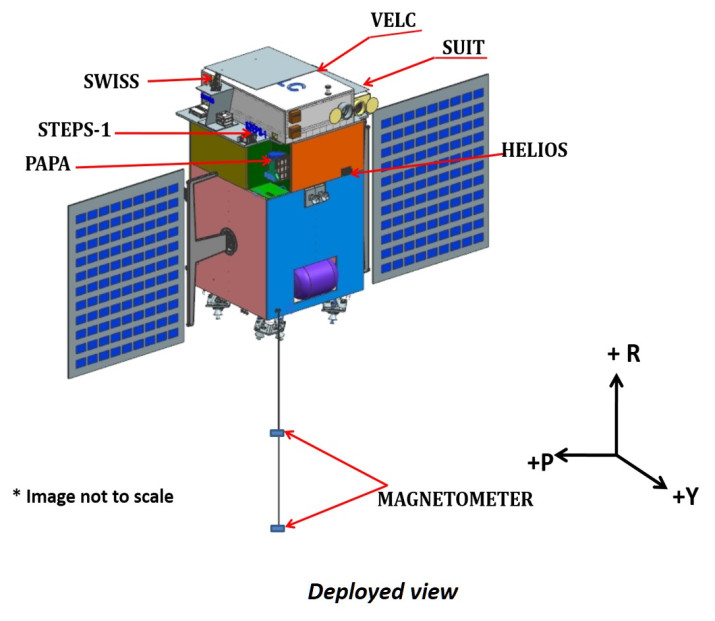
The main payload continues to be the coronagraph with improved capabilities.  The main optics for this experiment remains the same.  The complete list of payloads, their science objective and lead institute for developing the payload is provided below:

  • Visible Emission Line Coronagraph (VELC): To study the diagnostic parameters of solar corona and dynamics and origin of Coronal Mass Ejections (3 visible and 1 Infra-Red channels); magnetic field measurement of solar corona down to tens of Gauss – Indian Institute of Astrophysics (IIA)
  • Solar Ultraviolet Imaging Telescope (SUIT): To image the spatially resolved Solar Photosphere and Chromosphere in near Ultraviolet (200-400 nm) and measure solar irradiance variations – Inter-University Centre for Astronomy & Astrophysics (IUCAA)  
  • Aditya Solar wind Particle Experiment (ASPEX) : To study the variation of solar wind properties as well as its distribution and spectral characteristics – Physical Research Laboratory (PRL)        
  • Plasma Analyser Package for Aditya (PAPA) : To understand the composition of solar wind and its energy distribution – Space Physics Laboratory (SPL), VSSC        
  • Solar Low Energy X-ray Spectrometer (SoLEXS) : To monitor the X-ray flares for studying the heating mechanism of the solar corona – ISRO Satellite Centre (ISAC)
  • High Energy L1 Orbiting X-ray Spectrometer (HEL1OS): To observe the dynamic events in the solar corona and provide an estimate of the energy used to accelerate the particles during the eruptive events – ISRO Satellite Centre (ISAC)and Udaipur Solar Observatory (USO), PRL
  • Magnetometer: To measure the magnitude and nature of the Interplanetary Magnetic Field – Laboratory for Electro-optic Systems (LEOS) and ISAC.

With the inclusion of multiple payloads, this project also provides an opportunity to solar scientists from multiple institutions within the country to participate in space based instrumentation and observations.  Thus the enhanced Aditya-L1 project will enable a comprehensive understanding of the dynamical processes of the sun and address some of the outstanding problems in solar physics.

Other Missions to the Sun

  • NASA’s Parker Solar Probe’s aim is to trace how energy and heat move through the Sun’s corona and to study the source of the solar wind acceleration.
    • It is part of NASA’s ‘Living With a Star’ programme that explores different aspects of the Sun-Earth system.
  • The earlier Helios 2 solar probe, a joint venture between NASA and space agency of erstwhile West Germany, went within 43 million km of the Sun’s surface in 1976.

A more recent technical report on this topic by Dr. Angel, in which the idea is taken to another stage in development using only electromagnetic launch from Earth and no construction on the Moon or at L1

So we hope these mission will able to unveiled the secret of Sun’s Atmosphere and its Corona. Aditya L1 mission will create history for Indian Space Program and proved to be landmark as expected.

Reference- https://www.drishtiias.com/

Power Of Introversion

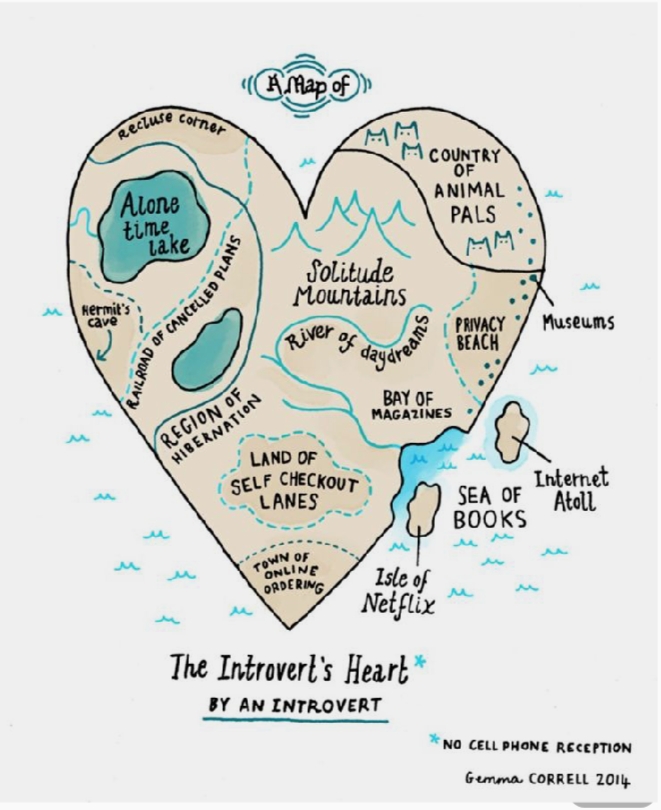
“The Heart Of An Introvert

There are a lot of misconceptions about introverts, like that they are anti social, unfriendly, shy or lonely. But in many cases, being an introvert can actually be an asset. Introverts are people who get their energy from spending time alone. Its kind of a battery they recharge. And then they can go out into the world and connect really beautifully with people.

  • They’re good listeners

Introverts are naturally adept when it comes to actively listening. Extroverted people are more inclined to jump into a conversation before fully processing what the other person has said. Conversely, introverts process information internally. That skill allows them to hear, understand and provide carefully considered insight when they do respond.

  • They’re observant

In addition to their superior listening skills, introverts possess a superpower: their observation skills. We notice things others might not notice because they’re talking and processing out loud. Although it may look like they’re just sitting quietly during a meeting, introverts are actually soaking in the information that’s being presented and thinking critically. They can tell when a person is thinking, processing and observing and then gives them the space to do so. They allow time to really connect with people.

  • They’re thoughful networkers

Being in a group where the goal is to meet, talk, and make a good first impression can be overwhelming for many, espeacially for us. Introverts use their natural strengths to create meaningful connections. This type of network can be more beneficial.

  • They make loving romantic partners

Introverts crave personal space to reflect and refuel, and they can sense when their partners need space, too. At the end of a long day, they’re there to listen and support their partner without feeling compelled to talk about themselves. There can be something attractive about the mystery factor of introverts, that can inspire curiosity and wanting to know the person better.

Quietness Is The Key

“We need quiet time to examine our lives openly and honestly – spending quiet time alone gives your mind an opportunity to renew itself and create order.” – Susan L. Taylor 

Let’s face it. Their is a lot of noise and distraction in the world. Sometimes, the din is so loud and the interruptions so many and varied that it’s tough to tend to what’s necessary and right, much less what is desired. The yearning for peace and quiet, however, has more significance than just taking a well-deserved break. It’s an important and integral part of growth, renewal and joy of living.

But making the time to find comfort in solitude and silence is often seen as an unaffordable luxury. After all, if you’re off being quiet and reflecting, you’re not accomplishing anything, right?

This is the wrong way to look at the situation. When you’re quiet and engaging in self-reflection, you’re doing something much more profound and that is helping to establish a cadence and priority, finding that life-affirming spark of enthusiasm and coaxing it into a fire that motivates and inspires you to act.

Why does anyone need quiet time? How do you prepare for it? What do you do to nurture it? How do you ensure there’s time in your schedule to accommodate your need for self-reflection? Here are some thoughts.

1. You need to rest to renew.

It’s humanly impossible to just keep going without ever stopping to rest. Even machines need downtime for repairs and maintenance. The human body is no different, with the exception that the mind often tries to influence continued action at the expense of physical, emotional and spiritual needs. You need quiet time, that uninterrupted silence that is so elusive and prized, to rest and renew.

2. Quiet time helps you discover what’s important.

When you’re constantly doing things, caught up in the whirlwind of the moment, you may tend to forget or ignore what’s important. By involving yourself in too many activities, taking on too much or spending time on unnecessary and time-wasting projects and tasks, you’re losing sight of what matters most. You need quiet time to rediscover what you’ve neglected and to discover what is most important to you if you’ve never done so.

3. When it’s quiet, you can make order out of chaos.

When you’re deep in a flurry of activity is no time to prioritize tasks. You’re too busy working on making progress. The time to examine your reasons for what you’re doing and to figure out some semblance of order that works for you is during times of quiet self-reflection.

4. There’s grace and spiritual renewal in quiet time.

All the negatives attendant in everyday life can overshadow the good and positive that co-exist. You need quiet time to allow grace to suffuse you and your spirit to renew itself in those golden moments of quiet introspection. Savor the silence. Allow your thoughts to wander where they will and then draw back your attention to your center. This is the core of mindfulness meditation.

5. Quiet time reinforces your sense of place in the universe.

Since you are human and not a machine, you can put things into perspective. This is difficult when you’re crashing to meet a deadline or attempting to multitask. You need quiet time to do that. It’s now when you’re able to think about where you are in the universe, to discover your purpose and find meaning in what you are fully capable of doing in this lifetime.

6. Reduce stress with regular quiet time.

If you cannot escape stress, you can certainly do something to mitigate it. One quick and straightforward way to reduce stress is to carve out 10-15 minutes regularly to sit quietly, meditate, listen to music, go for a peaceful walk, take a brief nap. If you have longer, perhaps on your lunch break, you can extend your quiet time. The point isn’t how long you’re quiet, but that you give quiet time its proper place in your life. There’s no easier way to nourish your body and soul. A bonus is that you return to the task at hand at work, home or school energized and more focused.

7. Quiet time helps you heal.

It’s no coincidence that caretakers and medical professionals encourage a darkened, quiet room for patients in recovery from surgery, illness or other chronic conditions that require constant management. Healing takes time and the body needs complete rest to jumpstart this process. Emotional wounds from anxiety and depression similarly benefit from quiet time. In a fast-pace world, stepping off the treadmill — as is necessary when sick or recuperating from serious illness — and allowing the quiet to envelope you are basic components in the overall healing process.

Politics vs India

images

Will you imagine the world without politics?

The terminology of politics has its origin in the Greek term ‘polis’ which means city-state. A number of city-states like Athens, Sparta existed in ancient Greece where polity touched every aspect of social life is it education, occupation, organizations, culture, etc. Later on, as organized life became more complex, polity turned into a more specialized activity restricted to secular and civil affairs in western countries. Since that time, politics has begun and spread all over the world and people are caught up in the rat race of politics. in the past, there was only one political party congress, it started from 18 December 1885, and they lead the nation, and the first precedent if the congress was Womesh Chunder Bonnerjee and after that, all congresspeople make many discussion regarding the education, business, finance sector, and health sector which help people to live batter life after getting freedom from the British people.

congress lead India for 70 years and they did many frauds and scams, Several top Congress leaders have been accused of indulging in multi-crore scams with some of the corruption cases running into lakhs of crores. According to the ZEE news, congress allowed scams after scams during its rule which have resulted in the loss of a staggering amount of Rs 48,20,69,00,00,000 over the last 70 years. The jeep scandal of 1948 was one of the first major corruption case in independent India in which the Jawaharlal Nehru-led Congress government was the accused.

After that, the BJP party was announced on 6th April 1980 and the early year they try to breakdown the congress party but they could not when the Narendra Modi-led government came to power in 2014, India’s ranking on the global corruption index improved as the new regime cracked down on those accused in scams and graft cases. The country’s ranking had dipped to an all-time low of 94 during UPA reign in 2013.BJP leader Narendra Modi was done many appreciate work for the people like Goods and Service Tax The GST is the indirect tax that subsumed a variety of central and state levies and replaced a cascading and complicated tax system. infrastructure work This is the one bright spot in the government’s record. The speeding up of highway construction, the new Bharatmala and Sagarmala projects, the building or revival of regional airports and regional air connectivity, and much work on modernizing and expanding railways are all achievements that the Modi government can claim. furthermore, they also have done Flagship Programmes like Swachh Bharat, Make in India, Ujwala Millions of us gave up subsidised cylinders when Modi gave a call, Ayushman Bharat. however, if we considered the National Security the Narendra Modi never stape back he has introduced Pakistan Policy, Kashmir Policy. he has open all the scams cases like Rafale Deal and Mallya & two Modis. He also took revenge from Pakistan in the form of URI surgical strick, and give justice to the Indian soldier.

Nowadays, in the time of Coronavirus, congress never gives up to accuse the BJP party, they always see the negative side of BJP which is only 15-20% but they never update themself or support and give motivation to the citizens what to do in this kind of scenario or support BJP. whenever BJP politicians do something good, congress always ready to pull them down they never see good work done by the opposition party. in time of critical condition, all BJP candidates done a lot of good work but the congress party came out for a showing off. we also see many debates on the news channels regularly they fight like cats and dogs.

all people from India always pray that please put politics behind and do something to bring out the country in developed countries index.


Confessions Of A Socially Anxious Introvert

I spend countless nights awake alone, because I can’t sleep, and nobody is there to share my emptiness while people kéep adding to it. The doubts and questions raised upon me by society, and more so, my family, are heart- wrenching. Nobody watches me being undressed in a manner that i dont want to ease out of my clothes, but my flesh. Nobody sees the hollow in my eyes, and feels the screams I gulp down while everyone complains of me being anti- social. Nobody sees me laughing aloud wishing my tears will go by unnoticed and it was me who scribbled behind the washroom door, ‘ Let me live’, while i was dying. I wish someone’s love would have been enough to conceal me from all the hurt from outside, but everybody asks me to shut up and forget about this crap. Nobody can never save me from the hurt within myself. Nobody can wear my skin with pride. I want to run away from the ignorance of my family, from the mockery of my siblings, from the toxicity of this society, but more so because i hope to run away from myself. They created that invisible prison for me.

It would have taken just a few words to keep me all happy and make me feel comfortable and confident in the sheets of my skin.

‘are you really ok’ instead of ‘why are you so distant

”do you want to talk’ instead of ‘stop overthinking”

how can I help you’ instead of ‘what’s wrong with you”

I can understand you’ instead of ‘ why dont you mix and open up with others’

I wish if people would have said these words more often, perhaps I wouldn’t have thought of running away to somewhere else where the new air frees me and prevent my heart prying apart into peices.

POSITIVITY

Positive thinking can change your life. If you want to live longer, be happy, healthy and successful, all you have to do is think positive.

More and more people (including Doctors and Scientists) are turning to positive thinking because it is a powerful tool for transforming your inner self into an amazing health generating, and self-healing entity. Optimistic people have discovered that the human mind has the power to turn wishes into reality through positive thinking. Researchers continue to find increasing evidence pointing to the many benefits of positive thinking. According to a Stanford Research Institute study – success is 88 percent positive thinking, and only 12 percent education. Therefore, positive thinking is an important factor in your ability to succeed in life.

Positive thinking is an optimistic state of mind that always sees the bright side of life and focuses on the glass being half full instead of half empty. Positive thinking is a mental attitude that produces constructive results. Positive thinking brings inner satisfaction, happiness, peace and better health; improves relationships and attracts success into your life. While we all have this powerful tool, many of us are not aware of it.

Some long term studies on positive thinking and health have been conducted that confirms positive thinking strengthens the immune system and assists in healing. The evidence so far affirms that positive thinking leads to positive outcomes. Perhaps the greatest contribution made by psychology and neuroscience is that positive thinking is linked with virtues like kindness and compassion, and in proving that positive thinking leads to “wealth” of mind, body, and soul.

How does the power of positive thinking work?

According to psychology our mind controls our body. You can tap this capability by following a few simple steps. Each person is capable of programming their own mind to achieve what they desire. By learning to direct your thinking, you can change the way you behave and achieve a positive mindset. With a positive mindset, you always expect more joy, happiness, better health, greater success which also helps you reduce your stress levels. Basically, whatever your mind thinks and believes is what you expect. Anticipate positive situations and you’ll get positive outcomes. So, taking charge of your mind becomes a vital factor in keeping your body healthy. You can do this through affirmations and by consciously relaxing your mind through meditation.

The power of positive thinking helps us cope more easily with the daily affairs of life, see the opportunities all around us, and gives us the courage to take action when the moments of truth arise. There is no greater joy than a healthy, positive life. You feel exhilarated, energetic, happy and on top of the world. A sense of total well being permeates your mind. The future looks bright. You feel good to be alive. Adopting positive thinking as a way of life will bring constructive changes into your life, and makes them happier, brighter and more successful. An emerging field of psychology takes a scientific approach to the power of positive thinking and has come up with some surprising revelations:

· Positive thinking is a “skill” that can be learned to create happiness.

· Happiness is the cause of positive outcomes in life, not the result.

· Wealth does not bring happiness, but using one’s wealth to benefit others does contribute to personal happiness.

· Happy people tend to have deep religious or spiritual beliefs.

How to develop Positive thinking?

Many of us know what positive thinking is, but not all of us know how to be positive or how to maintain a positive attitude. Watch what you say – try to say positive things to people, avoid complaining and saying negative statements. In order to turn the mind toward positive thinking, some inner work is required, since attitude and thoughts do not change overnight.

You can develop this state of mind by reading inspiring and motivating literature, through visualization, affirmations and meditation. When your state of mind is generally optimistic, you’re able to handle everyday stress in a more constructive way. This ability may contribute to the widely observed health benefits of positive thinking.

Here are 10 simple things you can do to jump-start positive thinking:

1. Smile and Laugh – It has been scientifically proven that smiling can improve your overall mood and outlook in life. Laughter is the best medicine and they aren’t lying. Join a Yoga laughter club for group support for laughing and Meditation practice for calming the Mind, Body and the Soul.

2. Help others unselfishly – Focus on helping others by donating your time, wisdom, and money.

3. Eliminate your ego – Human ego is a dangerous thing since it makes people criticize and judge others.

4. Gratitude – Being grateful improves your chances of becoming more happy and content in your life. By being thankful for what you have, you will achieve true happiness.

5. Set goals – Set your goals daily on a piece of paper and plan out your priorities from the top to bottom. Having goals will provide the drive and motivation you need to become happy and successful in life.

6. Train your mind to focus on more positive thoughts – Replace negative with a positive thoughts and also take positive action.

7. Surround yourself with positive people – Hang out with people who have a positive attitude and outlook on life.

8. Be persistent and find the positive in all situations – Make positive thinking a daily habit and way of life.

9. Work Out & Eat Right – Eating healthy and working out will keep you in a great state of being and help maintain an active mind. Go for a long walk, run, or go to the gym. Also include Yoga, Meditation and Pranayam in your daily routine.

10. Listen to your favorite music.

Health Benefits of Positive Thinking

Researchers continue to explore health benefits that are produced by positive thinking and optimism. For example, positive thinking may help to:

· Lower stress levels;
· Improve your body’s immune system;
· Make you more resilient and to develop the ability to overcome life’s difficulties;
· Bring more happiness and respect from other people;
· Increase your life span;
· Create greater inner power and strength to inspire and motivate yourself and others; and
· Reduce depression.

Conclusion

Positive thinking is a mental attitude that helps us see the “silver lining”. Having a positive mindset causes us to anticipate happiness, joy, health, and favorable results. Real and effective positive thinking requires focusing on positive thoughts and positive emotions, and also taking positive action to bring about favorable outcomes.

The power of positive thinking is about committing yourself to get the most out of your day – every day. It is about being enthusiastic, keeping your mind focused on important things and developing strategies for dealing with problems. Positive thinking can help you to do your best each day. It can also help you to look back at things that happen along the way and view them as positive life lessons. In addition, in sharing positive mood and positive experiences, you and those around you enjoy an emotional boost.

We create our entire world by the way we think. Thoughts are the causes and conditions are the effects. Our circumstances and conditions are not dictated by the world outside; it is the world inside us that creates the outside. Regardless of our circumstances, each person has the innate, God given ability to create or alter reality using the power of positive thinking. Studies show that people who participate in positive thinking lead more successful and happier lives than people who don’t.

Positive thinking reduces stress by eliminating negative self-talk which, in turn, can even improve your health. When you share your positive experience, both you and those around you enjoy an emotional boost. So, refuse to waste time participating in negative inner dialogues. Instead, display a more positive emotional and mental attitude toward yourself, other people and situations.

Positive thinking is the cause of success and happiness. Positive thinkers will look at circumstances realistically, search for ways to improve a situation, and try to learn from their experiences. Positive thinking helps you cope more easily with the daily affairs of life. It brings optimism into your life, and makes it easier to avoid worries and negative thinking. If you adopt positive thinking, it will bring constructive changes into your life, and make experiences happier, brighter and more successful. Choose to be positive. You’ll feel better, make others feel better, and, you’ll look younger too!

Agroecology and Natural Farming Could Accelerate Inclusive Economic Growth in India

International experts in a convention organized on 29 May by NITI Aayog endorsed efforts to significantly boost agroecological and natural farming approaches in India.

Speaking to an audience of senior international and national experts and policymakers, Minister of Agriculture Shri Narendra Singh Tomar stated, “Natural farming is our indigenous system based on cow dung and urine, biomass, mulch and soil aeration [. . .]. In the next five years, we intend to reach 20 lakh hectares in any form of organic farming, including natural farming, of which 12 lakh hectares are under BPKP [Bharatiya Prakritik Krishi Paddhati Programme].’

He further noted that the Paramparagat Krishi Vikas Yojana launched in 2015 to promote organic farming among small and marginal farmers has in the last four years covered 7 lakh hectares and 8 lakh farmers. He pointed out that Andhra Pradesh, Karnataka, Himachal Pradesh, and Kerala have taken up natural farming on a large scale. Andhra Pradesh alone has brought 2 lakh hectares under natural farming under this scheme. He concluded by highlighting that the need of the hour, in light of the covid-19 pandemic, was to have ‘food free from chemical fertilisers and pesticides’, while not ignoring the need to feed and nourish the country.

Setting the scene for the online High-level Roundtable, the first of its kind in India, NITI Aayog Vice Chairman Dr Rajiv Kumar established a high bar for the transformation and renewal of agriculture in India when he asked whether agroecology and natural farming can ‘avoid excessive and wasteful use of water, prevent farmer indebtedness, contribute to mitigating greenhouse gases while supporting farmer incomes and their ability to adapt to climate change’.

International experts from the US, UK, Netherlands, CGIAR, Australia, Germany, and of UN acknowledged India’s pioneering leadership in the arena of agroecology—the science of applying ecology to agriculture for sustainable outcomes that are more resilient to climate shocks such as droughts or flooding and pest attacks, but are still productive and support farmer’s livelihoods—and especially natural farming, which is a form of agroecology. Natural farming avoids use of synthetic fertilisers and pesticides, while focusing on reviving the beneficial soil organisms that contribute to fertility and good nutrition of the plants. Experts explained that well-nourished plants lead to well-nourished human beings.

The gathered experts provided evidence from latest studies, cutting-edge research, and science as well as practical experience from economics, finance and markets. The overwhelming conclusion was to support the Minister’s conclusion that natural farming and other agroecological approaches, such as organic agriculture, have great promise for a renaissance of Indian agriculture, so that farming is not just productive but truly regenerative and sustainable.

Experts concluded that it would be a mistake to view natural farming as a step backwards to the farming techniques of our forefathers, but rather, as the high level panel of experts report on Agroecology to the Committee on Food Security of FAO so clearly demonstrated, it is based on cutting-edge science of the future that recognises the need for systemic approaches to dealing with complex adaptive systems that are the basis of a healthy natural world. Working with nature, understanding how to do so will help us ‘build back better’ as one expert noted.

Others noted the huge interest, to the scale of hundreds of billions of dollars, in investing in natural farming and agroecology as they were systems of the future. Prof. Ramesh Chand, Member (Agriculture) of NITI Aayog, called for more research to ensure that natural farming could truly live up to its expectations. The need for innovation, science and technology was endorsed by experts who noted the importance of regenerating soils and building on biodiversity as two key elements, along with use of natural inputs readily available to farmers in this knowledge intensive approach.

Commenting on the presentations made by assembled experts, Principal Scientific Adviser to the Government of India Prof. K. Vijayraghavan remarked, ‘We are running behind yields at the cost of diversity and nutrition. To protect our planet there is need for change in our attitude towards use of chemical fertilisers and pesticides. Technology can help in changing the way we farm and will enable the poorest of the poor to enhance their nutrition status and livelihoods.’

In his concluding remarks Dr Rajiv Kumar emphasized that agroecology is the only option to save the planet and is in line with Indian traditions said, ‘[. . .] it is not man vs nature, but man in nature or man with nature. Humans need to realize their responsibility in protecting other species and nature. We need knowledge-intensive agriculture and the metrics need to be redefined where production is not the only criterion for good performance. It has to include the entire landscape and the positive and negative externalities that are generated by alternative forms of agriculture practices.’

Participants & Programme: Notable participants, other than Union Agriculture Minister Narendra Singh Tomar, included the host, NITI Aayog Vice Chairman Dr Rajiv Kumar; Principal Scientific Adviser Prof. K. Vijayraghavan; Mr Satya S. Tripathi, UN Assistant Secretary General; Mr Pavan Sukhdev, President of WWF International; Mr Alexander Mueller, Managing Director of TMG: Think Tank for Sustainability; Dr Ramesh Chand, Member NITI Aayog; as well as a host of very senior officials from the GoI and state governments, leading experts, researchers, specialists and thought leaders.

List of speakers is available below along with the programme.

Programme & Speakers

Welcome remarks:

Dr Rajiv Kumar, Vice Chairman of NITI Aayog, Government of India

Opening remarks:

Mr Narendra Singh Tomar, Minister of Agriculture and Farmers Welfare; Minister of Rural Development, Government of India

Panel Discussion on Environment and Ecology:

Moderator: Mr Pavan Sukhdev. This session focused on the challenges and potential benefits for India by adopting a system-scale transition to natural farming.

Speakers: Prof. Philip Landrigan, founding director, Global Public Health Program, Boston College; Dr Pushpam Kumar, Chief Environmental Economist of UNEP; and Mr Walter Jehne, Climate Scientist and Microbiologist. 

Panel Discussion on Regenerative Agriculture:

Moderator: Mr Alexander Mueller, Managing Director of TMG Thinktank in Germany, is former German State Secretary and Assistant Director-General of FAO. This session focused on the tremendous opportunities in harnessing India’s ancient agricultural practices and wisdom in rolling out a sustainability revolution based on regenerative agriculture improving livelihoods and health of people and the planet.

Speakers: Prof. Ramesh Chand, Member (Agriculture), NITI Aayog; Dr Ravi Prabhu, Deputy Director General, World Agroforestry (ICRAF); Mr Sanjay Agarwal, Secretary, Agriculture, Government of India; and Mr Daniel Moss, Executive Director of AgroEcology Fund.  

Panel Discussion on Market Access and Sustainable Finance:

Moderator: Mr Satya S. Tripathi, UN Assistant Secretary-General. This session focused on expanding market access for naturally farmed agricultural commodities and sustainable financing options for a system-scale transition to natural farming.

Speakers: Mr Sean Kidney, CEO, Climate Bonds Initiative; Mr Craig Cogut, Chairman and CEO, Pegasus Capital Advisers, Mr Joost Oorthuizen, CEO of Sustainable Trade Inititiative (IDH); and Mr David Rosenberg, CEO of Aerofarms. 

Dekho Apna Desh Webinar Series -India’s rich diversity under Ek Bharat Shreshtha Bharat

The 26th session of the Dekho Apna Desh webinar series of Ministry of Tourism on 30.05.2020 titled “The Tenacity of Survival”-Inspirational story of Kutch showcased the history, culture, crafts, textile heritage of India’s largest district Kutch, Gujarat and the resilient spirit of the people of Kutch to fight natural calamities, the skills that form the report card of the continuous dynamics defining the Indian civilization. The webinar displayed the message of Kutch that “Kutch nahi Dekha toh Kuch nahi Dekha”.  Dekho Apna Desh Webinar Series is an effort to showcase India’s rich diversity under Ek Bharat Shreshtha Bharat

 This session of webinar moderated by Ms. Rupinder Brar Additional Director General, Ministry of Tourism and was presented by Dr. Navina Jafa, Director, Indian Cultural Heritage Research.

Ms. Jafa through her powerful narration skills presented the contrasting geographical features, and genetic cocktail that defines India in the most dramatic manner.

Kutch is a land of salt desert, grasslands and mangroves. Interestingly, the mangroves here are known for an amazing phenomenon of being world’s only Inland Mangrove. The Rann of Kutch alone produces three-fourth of total salt supply of India. The place is also the home to the Kharai breed of camel which has the special ability to survive on both dry land as well as in the saline water. They can even swim in sea water and feed on saline water and plants. They are well-adapted to the extreme climate of the desert and high salinity of water.

The key highlights of the presentation were virtual visit to the community of Ajrakh traditional block printers. Ajrakh is one of the oldest types of block printing on textiles still practiced in parts of Gujarat and Rajasthan in India. Textiles printed in this style are hand-printed using natural dyes on both sides by a laborious and long process of resist printing (a method of printing in which designated areas in the pattern are treated to resist penetration by the dye).

The seminar then took the participants visit to Bannithe Salt Desert in Kutch where the work of three major indigenous communities engaged in pottery, embroidery and leather work was showcased. Ms. Jafaalso spoke about the monastery of the ear torn ascetics (the siddhi sidhhant sect) and the langar (Community kitchen) run by the Monastery.

The presentation also covered the coastal town of Mandavi, where regional Sufi beliefs guide traditional boat builders on the Arabian Sea.

The other salient attractions of Kutch showcased in the webinar included:

• Dholavira- UNESCO World Heritage Site and second largest Harappan site located in India. It is indeed a marvellous example of town-planning and architecture.

• Fossil Park

• Rann of Kutch-Salt Desert of Arabian Sea

• Kala Dungar

• Guru Gorkanath Temple

• Narayan Sarovar Temple

• Lakhport Fort & Port

• Surhando- Unique peacock-shaped instrument plays a melodious music

• Thaali Dance- A balancing dance performed to commensurate the celebrations of marriage and child birth

• Tooofaan- Famous wild dance of the ocean also known as “Samundar ki Masti”

• Waai Sufi Mystics

Dhordo is a village in Bhuj taluka of the Kutch district of Gujarat. The eco-system of this place not conducive for any other activity boosted tourism like anything. The Rann Utsav which is annually organisedfromNovember to March has become the main driver for tourism in Gujarat. This transformation of the most challenging Dhordo White Rann to the most happening tourist destination of Gujarat has led to many temporary and permanent accommodation structures in and around Dhordo. The sheer human grit, imagination and enterprise have transformed a harsh and unusual terrain in to an engine of socio economic and cultural vibrancy, bringing to its people a sense of self reliance and pride. The most popular of them all is the Rann Utsav Tent City organized with the support of Gujarat Tourism.

Rann Festival held every year is celebrated from December to February. The Bhuj city is converted into a Tent City with basic amenities. The festival has attractions of BSF Band, Hot Air Ballooning activities, a cultural fiesta of folk music and dance, shopping and tasting the traditional cuisines.

An itinerary for 3-4 days and 7-8 days was shared for capturing the real spirit of Kutch. The itinerary aimed to guide the tourists travelling to Kutch, have a bird’s eye view of things, locations or the tourist sites and to look into the culture, traditions, textiles, block printing, musical instruments, market places, village tours and dance forms.

Bhuj is a well-connected by road from its neighbouringcities in Gujarat, good rail connectivity from various parts of the country especially from Delhi and Mumbai and is also accessible by air from the Rudra Mata Airport.

The sessions of webinars are now available on the https://www.youtube.com/channel/UCbzIbBmMvtvH7d6Zo_ZEHDA/featured and also on all social media handles of Ministry of Tourism, Government of India.

The next episode of the Webinar scheduled on, 2nd June 2020 at 11:00 am, is titled ‘Haryana: Culture, Cuisine and Tourism’. Please register here: https://bit/ly/3dmTbmz

Cyclone Nisarga : Another fear factor

It’s not been even two weeks since the coasts of West Bengal and Orissa are hit by the Amphan cyclone. We are moving ahead towards facing another deadly cyclone but on the western coast. Nisarga cyclone is going to hit the Maharashtra coast on Wednesday which is moving in its full swift northwards, in the Arabian Sea. If we compare Amphan with Nisarga, Amphan was more powerful and intense than this coming cyclone. Moreover, studies have shown that it is not even a full-fledged cylone. Infact it is more similar to a ‘depression’ which has converted itself into ‘deep depression’ lately. The depression is likely to make a landfall between the coastline of Maharashtra and Gujarat. To be precise, Daman and Rigarh are the places where the cyclone is about to make a landfall. IMD(India Meteorological Department) has issued red alert, and instructed the evacuation of the low-lying areas of the western coast.As of 1 June, it has speed of 11 kmph which is laid centered over East-Central Arabian Sea which is 280 kms west-southwest of Panjim, 490 kms south-southwest of Bombay and 710 kms south-southwest of Surat.

Intensity

By the time, it will be evolved into a Severe Cyclonic Storm, it will be of strength 2 on the scale of 1-5 used to measure the strength of cyclones. Their strengths are measured by the magnitude of the wind speeds generated by them. Nisarga’s wind speed would be in the range 95-105 kmph, at its strongest. Cyclones originated in the Arabian Sea side are found less stronger and less intense than those formed in the Bay of Bengal side of the north Indian Ocean. Amphan was called as ‘Super cyclone’ when it was of magnitude 5 but later on it weakened to 4, as ‘Extremely Severe Cyclonic Storm’. Usually the cold water of the Arabian Sea prevents the formation of such strong cyclones which is faced by the eastern coast every year.

What kind of destruction can be caused?

The IMD has said that Nisarga could flood the low-lying areas causing huge structural damage in big cities like Bombay such as falling of trees and power polls. This has lead to the concern that how would the people cope up with such a loss who are already struggling with Covid-19. Some coastal districts of Maharashtra are likely to come directly under the threat of Nisarga. The IMD has already warned the fishermen to not to go towards the Arabian Sea coastline. Cities like Rigad, Thane, Sindhudurg and Ratnagiri are also ought to be affected. Alert has been issued to them. Basically, a red-alert signifying about the possibility of heavy rainfall of more than 204.5 mm. A depression has already marked its presence parallelly to the western coast which keeps on intensifying and is gradually moving along the coast. Both Maharashtra and Gujarat government has ordered the people living in the low-lying areas to move towards the safer places. Due to such circumstances, the southeast and the east-central regions of Arabian Sea are experiencing rough weather, which is about to get intensified by this coming cyclone.

What leads to the formation of cyclones?

Cyclones are formed when due to heat, the water converts into warm and moist air which rises upwards. Thus, a low pressure area is created. Near the equator, tropical cyclones are formed from the warm ocean water. After that, the cool air from the surroundings gradually descends down to fill the low pressure area. Then the process continues and in this way Cyclonic Storms are caused. The warm air which rose up containing the water vapour forms the clouds due to condensation. This cycle is maintained and this system keeps itself feeding from the ocean’s water.

When the system of the storm starts rotating and increases its speed, then an eye is formed at the centre. The surrounding is very clear and calm around the eye. The storm is termed as ‘tropical cyclone’ when its speed crosses 120 kmph. These tropical cyclones are usually weakened when they are not fed by the water vapours of the ocean. Before dying out, they cause rainfall and heavy wind damage. The windy storms bring ocean water to the shore causing flood. This phenomenon is termed as storm surge and it is dangerous for the coastal areas. Cyclones can be of many types depending on the destruction they cause as well as the kinds of winds they produce.

The Truth of the Sophisticated Life @2020

Literature the mirror of the society. India refers to the country of the literature. In India the earlier works of literature was orally transmitted. Sanskrit literature begins with the oral literature of the Rig Veda a collection of literature during the period of 1500-1200 BCE. The Sanskrit epics Ramayana and Mahabharata appeared towards the end of the 2nd millennium BCE. In India literature was not only limited to the language Sanskrit but it was spread as the Hindi literature all across the world and gives the frame to the Indian literature. The literature that was based on reality, the literature that portrays the life of normal peoples of the country, the literature that shows the tradition, culture and beliefs of the Indian society.

 India is the fusion of many cultures, traditions, languages, festivals, beliefs, customs etc and this was only shown in the great ancient Indian literature which was popular all across the world. That literature portrays the life of the Indian villages. It’s Simplicity, its innocence; it’s down to earth nature. That literature represents the life of the ordinary peoples, their struggles, their challenges. Indian literature is very ancient it is coming from the times of rishi, minis and will last forever because of its reality. That literature teaches us the real meaning of our life, teaches us the ways to live your life happily in the amount of materials you have. That literature allows us to meet from our inner self, form our reality, from the reality of the country and even many old television shows was based on this only.  Earlier television used to be the face of the society, the face of the reality. The show of the doordarshan allows us to relate the instances of the shows with our surroundings but now the time has changed.

Today everyone is running for the money, frame and for the life of glamour which takes them out from the real world. Today people just want to become famous; they don’t love the lives of simplicity, the life near the nature. Everyone wants to fulfil their needs by destroying environment. Now they don’t love those farmlands where they have spend their childhood, today’s children’s want the video game in place of those gilli danda, in place of their traditional outdoor games like kabaddi, kho-kho and many more which was also responsible for their healthy lifestyle and this might be the reason the literature is also changed . Today the children’s love the fiction stories, fictious world in place of their traditional literature which gives the sense, the sweet smell of their soil.

When come the difference between fiction and nonfiction i.e. reality Joseph Salvatore, Associate Professor of writing & Literature at The New School in New York City, says

I teach a course on the craft, theory, and practice of fiction writing, and in it, we discuss this topic all the time. Although all of the ideas and theories… are disputed and challenged by writers and critics alike. I’d say there are some basic components of fiction.

Fiction is just based on author’s imaginations and that what he/she wants readers/viewers to do just imagine and this is what happening in today’s world where children are following the fictitious superheroes like superman, ironman instead of the real superheroes likes Mahatma Gandhi, APJ Abdul Kalam etc.

Today people are liking the supernatural movies, shows and stories instead of the real stories and this is the reason that the story of the struggles of the real hero in not liked by the people because they want the stories of the visual hero’s with their powers and with all thei

They are not ready to face the tough situations, the challenges of their life and this is what happening everywhere. Now no one likes the story of the normal boy who faces lots of struggles and takes India to the world of space, who takes ISRO to the impossible space research organisations to Indian Space Research organisation, who just vanish the word impossible of the field of space research in India. Now a person wants a story of the superhero that does all its work just by moving their hands or by using its power and that is the reason everyone wants to become superman and ironman.

It’s not the thing to just sit and just writing an article or just having a discussion, it’s the topic to think where we are today, it’s the topic to realize the need of an hour i.e. to come out of this virtual world and accept the reality, the reality of life. It’s not the time to just think it’s the time do the action, it’s the time to realize what we have done to our planet, it’s the time to realize that we have to fight for our rights, we have to face each and every challenges of our life and we only have to come out of it no superman will come with her powers to protect us. We only have to wake up and go through the road of success and we only have to defeat every difficulties of our life. “We are only responsible for every good or for every bad thing, we are only responsible!!