Discipline

Discipline is very important in everyone’s life. It is so important to be disciplined in the life. Discipline is not acquired from a single day. It is a achieved by a continued process.parents are the important in every individual’s life. The are the main reason for the discipline of their children.

After the parents, teacher is the most important person in an individual’s life. Teacher is the one who moulds the individual from the initial stage of the life and makes the individual into and perfect one. Even though the teacher schools or beats sometimes it is all for the well-being of the student and for the bright future of the student.

The first teacher in everyone’s life is their mother. Beginning with the correct thing the first mistake of the child, mother plays a very important role in correcting many of the mistakes in an individual’s life. Also the father who corrects the mistakes and puts the children in a correct way. And the teacher, who is very important in our students life to achieve their desired goals.

Teachers play a very important role in making the student perfect and make them to understand the need of the situation. Teachers help the students to reach their desired goals and in any situation teacher motivates a student to get up and stand in all the ups and downs. Like that of the mother and the father, the teacher also feels equally happy when their student acheives high in their life and when they reach their desired goals.

IMPORTANCE OF DISCIPLINE IN LIFE :


TIME MANAGEMENT :


A disciplined person always has the time to complete all the tasks within given deadlines. This is because they are focused and they know how to schedule the time properly. They dont’t believe in wasting time on unnecessary things. They understand the value of time and they know that time once has gone never comes back.


LEADERSHIP :


All great leaders are not born. Most of them follow a very tight schedule and maintain discipline in their life to become good leaders. Good discipline generates a positive attitude towards society. It creates confidence and eagerness to do something great. It helps people to build an attitude that becomes the key to becoming successful. They are able to set a great examples for others in society.

DECISION MAKING :


It is because everything gets finished within the given deadlines, disciplined people always have time to revise their work and improve their decisions.
People who are disciplined are more focused both mentally and physically. They are better able to gain their body and mind with their ideas and goals. Finally, everything is regulated in order and increases their productivity in all the activites they undergo.


ACHIEVEMENTS :


Disciplined people are more motivated and concentrated. Therefore, they achieve more when compared to a person who is not disciplinef with the activites he/she undertakes. As per study, 92% of people are able to achieve their goals in life because of the reason of being disciplined.

STABILITY AND STRUCTURE :


With discipline, comes stability in all the tasks. It helps to schedule and organize the activites and tasks in a proper structure. If a person is focused and regularly follows this particular structure, he/she is sure to succeed in their life.

RESPONSIBILITY AND CONTROL :


With great discipline comes great responsibility. Only by making schedules and timetables a person cannot become successful. It is very important regularly follow and fulfill the responsibilites which are mentioned in the schedule. This will help them to develop self- control and also build good relations with others.

RESPECT :


A disciplined person always respected by society. He/she is lookef upon as role models and mentors. Through discipline, they worked hard and achieved their goals which made them a respectful figure in the eyes of others.

IMPROVES MENTAL HEALTH :


Modern society suffers alot from anxiety and depression. We cannot blame them for their condition. Just by maintaining a little discipline in their life, they can easily improve it. Discipline will help them to reduces stress and take control of their tasks. They would be able to overcome their fears and also control their emotions.

MAINTAIN PEACE IN SOCIETY :


Disciplined people are lie assets to society. If there is no law and order, there would bee too many activites. Discipline is required to prevent such things in society. By setting the requiref rules and regulationa, it becomes easier to live in a society that is full of peace and harmony.


STAY ACTIVE :


Disciplined people have time to do every activity in the schedule. They plan their schedule in such a way that improves both their academic/ instituational performance and also their physical health. They know what is good and bad for them and thereby have good eating habits, exercising habits, sleeping and waking up paterns, etc.


SELF DISCIPLINE self discipline means self control, the ability to avoid unhealthy excess of anything that could lead to negative consequenes.


• It is the ability to reject instant grafication and pleasure, in favor of some great grain, which requires spending effort and time to get it.
• It means perservetance and not giving up.
• It is the strength not to give in to negative feelings.
• It means overcoming one’s weakness.
• It is the ability to pursue one plan despite temptations to abandom them.
• Delayed gratification in favour of accomplishing long term goals.
Discipline is very important. It helps people to showcase their attitude and represent their character and thinking. Both the body and mind are honed by discipline. Descipline helps to address individual problems and develop a society that is both peaceful and respectful. Therefore, it would be right to say that without disciplinr there is no life at all.

Time management

Time is nothing but the count of the life. It is measured in Hours, minutes and seconds. It is very important to manage the time as it is very precious and cannot come back once it is lost. It is also very important to utilize the time properly.

Managing the time is very important. Many of the people don’t know how to manage the time. Let us now know some of the time management techniques and how to use them.

•Make schedules:-

Making schedules is one of the best methods to manage the time. All you have to do is, think of the things what you have to do on a particular day and allot some particular time for each activity. Complete particular activity in the allotted time. When the work takes too much time, then leave it aside and go for another work. Whenever all the work is finished, go for the work which is unanswered in the beginning and complete it. This is how schedules helps for time management and makes the proper use of the time.

•Don’t spend much time on one thing:-

Spending much time on a particular thing disturbe the individual and disturbs the concentration. So, to focus on the work, an individual must go for some another work whenever they get bored on a particular work. So, it helps to focus on the work and for not wasting the time.

Time management is the process of planning and controlling how much time to spend on specific activities.
BENEFITS OF TIME MANAGEMENT :


The ability to manage your time effectively is important. Good time management leads to improved EFFICIENCY and productivity, less stress, and more success in life. Here are some benefits of managing time effectively:

  1. STRESS RELIEF :
    Making and following a task schedule reduces anxiety. As you check off items on your ” to- do” list, you can see that you are avoid feeling stressed out with worry about whether you’re getting things done.

  2. 2.MORE TIME :
    Good time management gives you extra time to spend in your daily life. People who can time- manage effectively enjoy having more time to spend on hobbies or other personal pursuits.
  3. MORE OPPORTUNITIES:
    Managing time well leads to more opportunities and less time wasted on trivial activities. Good time management skills are key qualities that employes look for. The ability to prioritize and schedule work is extremely desirable for any organisation.

  4. 4.ABILITY TO REALIZE GOALS :
    Individuals who practice good time management are able to better achieve goals and objectives, and do so in a shorter length of time.

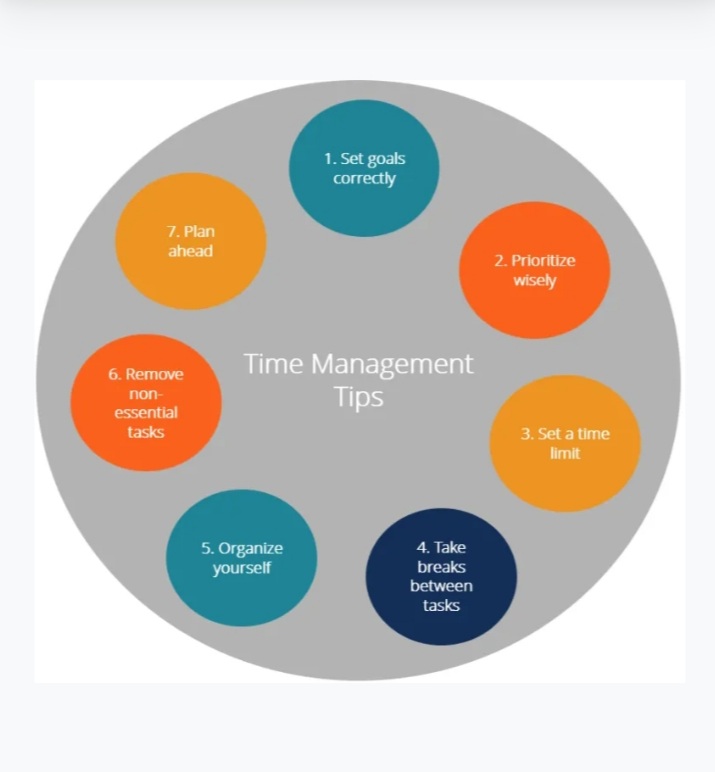
  5. LIST OF TIPS FOR EFFECTIVE TIME MANAGEMENT:


  1. 1.SET GOALS CORRECTLY:
    Set goals that are achievable and measurable. Use the SMART method when setting goals. In essence, make sure the goals you set are specific, Measurable, Attainable, Relevant, and Timely.

  2. 2.PRIORITIZE WISELY :
    Prioritize tasks based on importance and urgency. For example, look at your daily tasks and determine which are :
  • Important and urgent : Do these tasks right away.
  • Important but not urgent : Decide when to do these tasks.
  • Urgent but not important: Delegate these tasks if possible.
  • Not urgent and not important : set these aside to do later.

  • 3.SET A TIME LIMIT TO COMPLETE A TASK :
    Setting time constraints for completing tasks helps you be more focused and efficient. Making the small extra effort to decide on how much time you need to allot for each task can also help you recognise potential problems before theyv arise. That way you can make plans for dealing with them.

  • 4.TAKE A BREAK BETWEEN TASKS:
    When doing alot of tasks without a break, it is harder to stay focused and motivated. Allow some downtime between tasks to clear your head and refresh yourself. Consider grabbing a brief nap, going for a short walk, or meditating.

  • 5.ORGANISE YOURSELF :
    Utilise your calendar for more long term time management. Write down the deadlines for projects, or for tasks that are part of completing the overall project. Think about which days might be best to dedicate to specific tasks. For example, you might need to plan a meeting to discuss cash flow on a day when you know the company CFO is available.

  • 6.REMOVE NON- ESSENTIAL TASKS :
    It is important to remove excess activities or tasks. Determine what is significant and what deserves your time. Removing non- essential tasks frees up more of your time to be spent on genuinely important things
  • IMPLICATIONS OF POOR TIME MANAGEMENT :
  • Let us consider the consequences of poor time management ;
  1. PLAN AHEAD :
    Make sure you start everyday with a clear idea of what you need to do- what needs to get done THAT DAY. consider making it a habit to, at the end of each workday, go ahead and write out your ” to- do” list for the next workday. That way you can hit the ground running the next morning.
  2. POOR WORKFLOW :
    The inability to plan ahead and stick to goals means poor efficiency. For example, if there are several important tasks to complete, an effective plan would be to complete related tasks together or sequentially. That translates to reduced efficiency and lower productivity.
  3. WASTED TIME :
    Poor time management results in wasted time. For example, by talking to friends on social media while doing an assignment, you are distracting yourself and wasting time.

  4. 3.LOSS OF CONTROL :
    By not knowing what the next task is, you suffer from loss of control of your life. That can contribute to higher stress levels and anxiety.

  5. 4.POOR QUALITY OF WORK :
    Poor time management typically makes the quality of your work suffer. For example, having to rush to complete tasks at the last minute usually compromises quality

  6. 5.POOT REPUTATION :
    If clients or your employer cannot rely on you to complete tasks in a timely manner, their expectations and perceptions of you rely adversely affected. If a client cannot rely on you to get something done on time, they will likely take their business elsewhere.

Animals

Since the time Earth developed the quality of sustaining life, life has always gone under the process of evolution. Life started from single celled organisms and developed stage by stage. One organism extinct to develop into its better developed species or even at times it happens that some animals get erased from the surface of the earth due to extreme environmental condition.

EXTINCT ANIMALS: Species of animals which existed in the surface of the earth once upon a time but has no current existence, this may have been a result of extreme environmental condition or some other condition for existence. For example, we have dinosaurs, Dodo.

ENDANGERED ANIMALS: The species of animals which have only a few animals left on the surface of the earth and are in the mouth of being extinct are known as endangered, currently this is a result of poaching i.e., unethical killing of wild animals with purpose or change in the climate due to pollution and other factors. For example, we have the Royal Bengal Tiger.

We cannot do anything for the species which are extinct but we can definitely take steps and save our endangered species. Poaching laws should be made stricter and it should be taken care that people follow them.

Different types of animals :

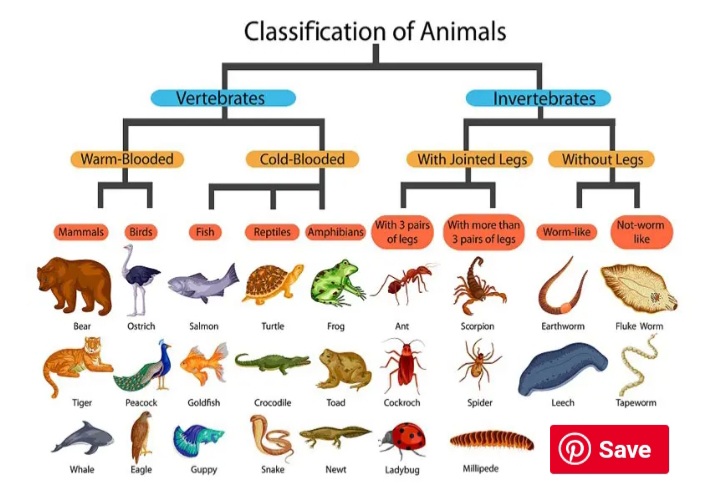
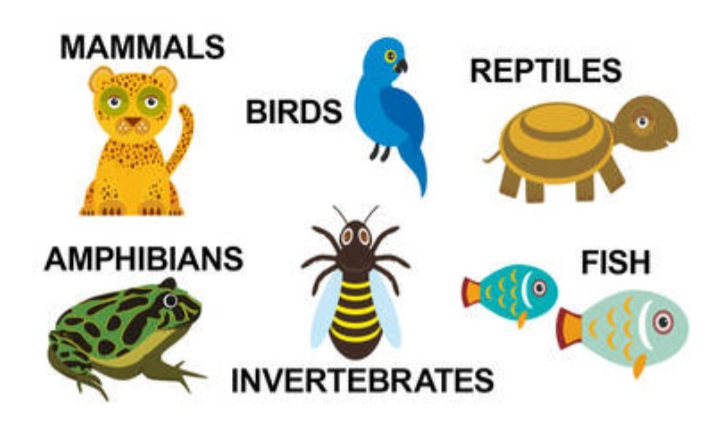
Scientists sort the different types of animals in the world into categories based on certain characteristics. Animals are generally grouped into six types of aninals. The system for animal classifications is called taxonomy.

The Animal Kingdom :

All animals belong to a biological kingdom called kingdom Animalia. This kingdom is then broken down into over 30 groups. About 75% of all species on earth are aninals. Animals are then broken down into two types : vertebrates and invertebrates.

* Animals with a backbone are vertebrates.

* vertebrates belong to the phylum called phylum chordata.

* vertebrates are classified into five classes. They are amphibians, birds, fish,mammals, and reptiles.

* Animals without a backbone are invertebrates.

* Most invertebrates are in the phylum Arthropoda.

1. Amphibians :

All amphibians are vertebrates, and they need moist environment or water to survive.

* They are cold- blooded.

* They absorb water and breathe through their thin skin

* They have at least one special king gland used for defense.

* Most follow the life cycle of egg-larva- adult.

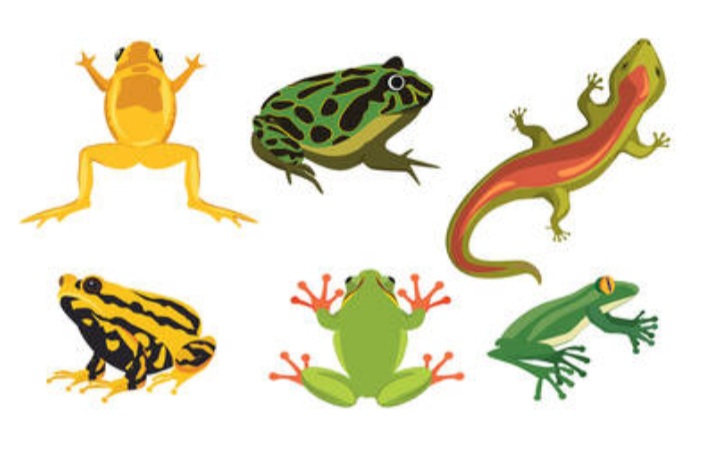
* examples : frog , newts, salamanders, toads.

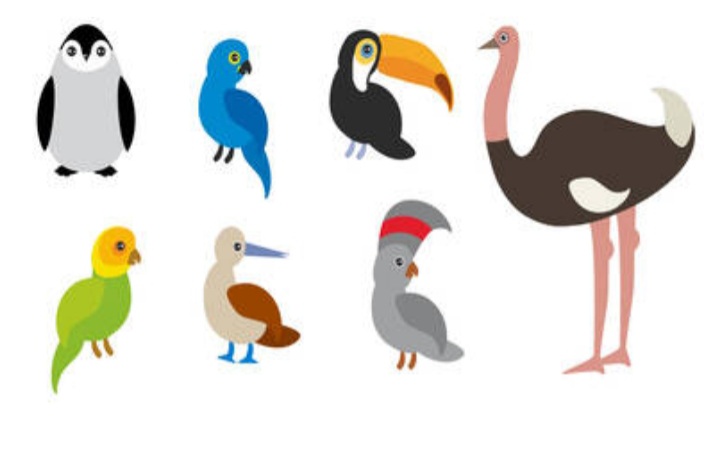
2. Birds

Birds are a type of warm- blooded vertebrate that are adapted to fly.

* Not all birds can fly, but they do all have wings.

* Birds have beaks that help them catch and swallow food.

* The digestive system of a bird allows it to eat whenever it can and digest that food later.

* Birds lay egg to reproduce.

* They are endothermic, mening they maintain their own constant body temperature.

* They are bipedal, which means they have two legs.

* They have hollow bones and their bodies are covered in feathers.

* Birds belong to the class called Aves.

* Examples : albatrosses, chickens, hummin birds, falcons, falmingoes, ostriches, owls, parrot, penguins, pigeons.

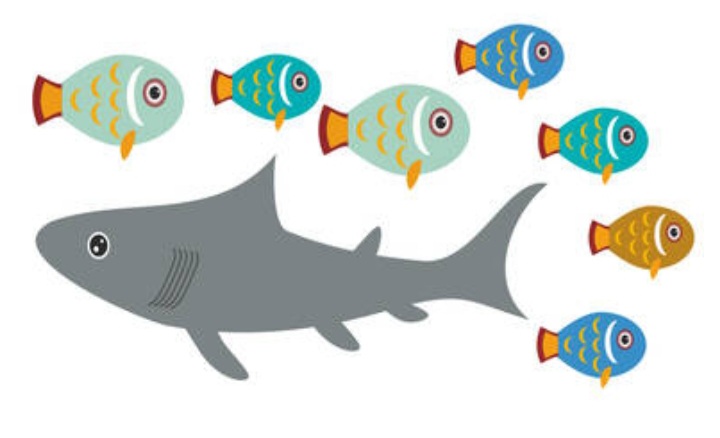
3. Fish :

Fish are also vertebrates, and they are considered the oldest-known vertebrates.

* They are ectothermic, or cold- blooded, which means they rely on their surroundings to regulate their body temperature.

* Fish have funs.

* Most, but not all, fish have bodies covered in scales and breathe through gills.

* Fish live under water.

* Examples : eels, hangfish, lampreys, minnows, rays, salmon, seahorses, sharks.

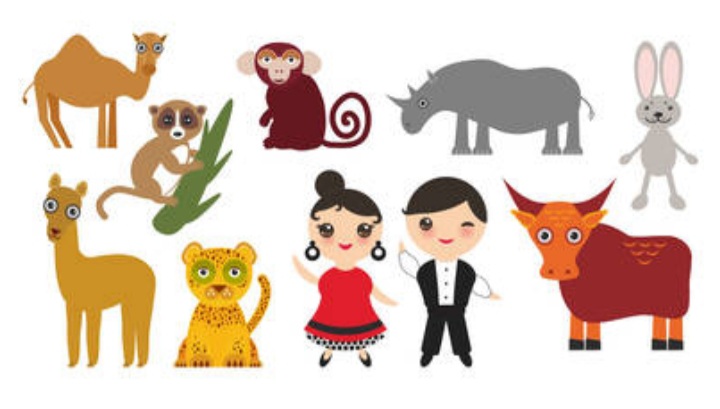
4. Mammals :

Mammals are another type of vertebrate that belongs to the class Mammalia.

* young mammals get nourishment from milk produced by their mothers.

* Most mammals have hair.

* Their jaw is hinged directly to their skull unlike all other vertebrates.

* Almost aĺl mammals give birth to live bsbies.

* They are endothermic, or warm- blooded.

* Examples : there are over 5500 living species of mammals all over the world. Aardvarks, bats, elephants, hamsters, human, rabbits, rhinoceroses, whales.

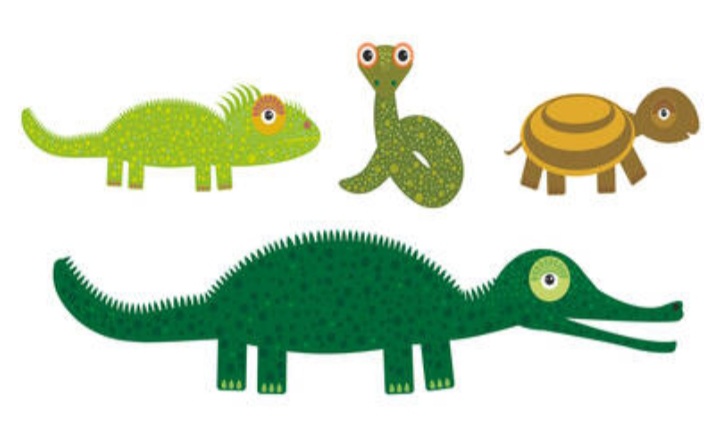
5. Reptiles :

Reptiles are thought to be the first vertebrates to live completely on land. But, not all reptiles live only on land today.

* They are cold- blodded, or ectothermic

* They lay eggs to reproduce.

* They have four legs or descended from animals with four legs.

* They breathe through lungs

* Their bodies are covered in scales or scutes.

* Examples : crocodiles, geckos, lizards, sea turtles, snakes, tortoises.

Invertebrates :

Approximately 95% of all animals are invertebrates. Invertebrates do not have a backbone. There are different types of invertebrates, but they all share a few characteristics.

• They are made up of many cells that work together, or multicellular.

• Most, but not all have tissues, cells that work together in a more complex way.

• Most, but not all, can move.

• There are over 35 phyla of invertebrates.

• They generally have soft babies.

Types of Invertebrates :

There are eight phyla of invertebrayes that are alive today.

* Annelida – have a segmented body and primitive brain

* Arthropoda – have jointed appendages and an exoskeleton.

* Cnidaria – have tissues and an incomplete digestive system

* echinodermata – have some type of spiny structure on their bodies

* Mollusca – generally have sofy bodies and a hard exoskeleton.

* Nematoda – unsegmented with worm- shaped bodies

* platyhelminthes – have soft, ribbon- like worms with no respiratory system.

* porifera – multicellular organisms living in water with no organs or tissues.

Examples : anemone( cnidaria) , clams ( mollusca), coral,

China’s 5 Year Plan (2021-2025): Proposed Dam on River Brahmaputra

The five-year plans are a sequence of economic and social development initiatives furnished by the CCP (Chinese Communist Party) since 1949. The five-year plans were inspired by the five-year plans from the USSR and the focus was on launching new schemes, reforms and setting new growth targets.

Since the 11th five-year plan (2006-2010), the Chinese government has mentioned it as ‘Guidelines’ instead of plans. Currently China is on its 14th five-year plan/ guidelines. Unlike the previous five year plans, there is no specific GDP growth target and instead, the government announced that growth would be kept in “reasonable range” and an annual target would be set based on the specific conditions each year. The focus of the current plan is on self-sufficiency as the country had to endure difficulty after the United States had restricted China’s major chip makers from using American technology. Other areas of focus will be on the above 7 percent growth in the research and development spending. The government will also try to raise the urban residents to 65 percent of the population while maintaining green development and increasing the life expectancy by 1 year. Infrastructure will also be an area of priority with a focus on high-quality development of the belt and road initiative.

One of the biggest infrastructure projects of the 14th The five-year plan (2021-2025) has been officially approved to build a series of dams in the lower reaches of the Yarlung Zangbo River, as the Brahmaputra is known in Tibet before it flows into India.

The proposed dam would be in Medog, Tibet region will have a maximum possible capacity of 60 gigawatts and could potentially produce 300 billion kWh annually. The location is an area called ‘the great bend’ also known as ‘Yarlung Tsangpo Grand Canyon’ where the river goes through a very drastic U-turn and then the river descents from an elevation of 3000 meters to around 800 meters. Due to the drastic elevation change, the river flow is quite strong and is also an ideal location to build the dam.

The location of the dam could be a strategically risky move by china as it is very close to the Indian border but the other issue is that this proposed dam can undermine the water security of India. India relies heavily on the Brahmaputra River for agriculture and various other purposes.  Due to this, the proposed Dibang Dam by India in downstream (Arunachal Pradesh) might be the solution to offset the effect of the Chinese proposed dam. Although the majority of the catchment area of Brahmaputra is on the Indian side there is still the issue of water flow from the upstream as Assam usually suffers from floods in the rainy season and any additional water flow from the Chinese dam would make the situation worse. The problem will not only affect India but also Bangladesh due to its low-lying land and flood-prone region. Problem is that the region is ecologically diverse and sensitive and any kind of development in this region will negatively affect the ecology of this region. Due to turbulent tectonic plates, there are high chances of landslides and earthquakes as well. India will have to be vigilant and develop its strategy according to the developments on the Chinese side.

References:

Biography-Abraham Lincoln

” I walk slowly, but I never walk backward” -Abraham Lincoln

Abraham Lincoln, the 16th President of the United States, guided his country through the most devastating experience in its national history- Civil War. He is considered by many historians to have been the greatest American President. He was born on 12February,1809 in Hardin (now Laure) country in Kentucky. His father Thomas Lincoln was a skilled carpenter and his mother was Nancy Hanks. Lincolns left Kentucky and moved to Indiana in 1816. There little Lincoln attended some schools for less than a year altogether. Lincolns left Indiana for Illinois in 1830. In 1831 Lincoln left home for New Salem and served briefly in the black Hawk War (1831). The military interlude was uneventful except that he was elected Captain of his volunteer Company. In 1842 he married Mary Todd. He served one term (1847-49) as a member of the US House of Representatives where he opposed the Mexican War as unnecessary and unconstitutional. He had been indifferent about the annexation of Texas, already a slave territory, but he opposed any expansion that would allow slavery into new area, gained as a result of the Mexican war. He expressed his view that the nation would become “either all slave or all free”. He won the Presidential election as the 16th President of the US and his inauguration was held in March 1861. He was soon noted for taking vigorous measures in the Civil War sometimes at odds with the Constitution and often at odds with the ideas of his military commanders. He was naturally anti-slavery. He endorsed the 13th Amendment to the Constitution abolishing slavery and thus charged the racial future of the United States. But it agitated a section of the white people. John Wilkes Booth, a Negrophobe shot Lincoln while he attended a performance at Ford’s Theatre in Washington on 14th April, 1865. Lincoln’s achievements for saving the Union and freeing the slaves, and his martyrdom just at the War’s end assured his continuing fame forever.

Students and social service.

Man is a social being and social service is a must in a system of man-making education, There are so many kinds of social service and students have a lot of work to do in this field. They have some duties to remove illiteracy. They can hold night schools for the illiterate adults and give them lessons on the three R’s. They can remove bad customs and inform the people of the rights and duties. They can clean dirty ponds and maintain hygiene around their area. In times of emergency such as flood, famine and earthquake, they can take an active part in bringing relief to the sufferers like giving them food, clothes, and finding them shelter. In times of normalcy they can organise cultural functions for the poor villagers as we know that poverty is depressing but drudgery is killing but most of the time students waste their time in idle gossip, in roaming and in fruitless work. It is better to utilise the power of youth in socially productive work than to squander our precious time in loitering at the market place or before theatre hall. It is true also that the studies of students will be affected somewhat if they turn their attention to social service. But, on the whole, they will be gainer as social service will promote their fellow-feeling, increase their love for the country and develop their organising capacity.

High schools can deliver social services on campus or refer students to outside agencies for assistance like various NGO’s.

If a student utilizes his time fruitfully and in socially useful work he gets contentment. Contentment is his satisfaction with his position. Students should remember that they are born for the improvement of the society by instilling the spirit of service in them. They can help the mankind in the best possible way.

The value of social service should be taught to students to create inspiration in them. They should be enthused to pay their utmost strength and service to the society to make their existence meaningful.

Students can co-operate with people on matters of public interest such as education, sanitation, trade and commerce and be a part of that so that they can help more and more people.

Students have a spirit to work but the guardians and teacher should guide them in the right way. Social service can be safely managed if they can be guided properly. Our leaders should guide them in the right way.

India beats Sri Lanka by 7 wickets in the 1st Odi : Dhawan, Shaw,Kishan steal the show.

India defeated sri lanka in their first match of the odi series played in Colombo. Indian outplayed the inexperienced Sri-lankan in every aspects of the game.

Sril Lanka won the toss and opted to bat first and things were going there way until chahal stricked and removed Fernando.
Contributions from bhanuka 27 of 44, rajpaksa 24 of 22, Dhananjay de Silva 14(27), assalanka 38(65), Shanaka 39 (50),
Chanika karunatana and chameera scored 40 runs in last 3 overs to get teams total to 263.

Bhubaneshwar kumar looked off colour today and went wicketless with figure 9-63-0,Deepak chahar took 2 wickets and looked in great touch. Spin duo of kulcha shared 4 wickets between them. While Pandya brothers shared 1 wickets each and   Kurnal Pandya was most economical with figure 10-1-26-1.

Chasing down the target of 263, P shaw and captain Dhawan came to crease. P shaw smacked the Lankans all over the ground and was progressing towards half century before falling to de selva at long-off at 43(24).


Then, debutant Ishan kishan came and smacked the lankans all over the ground and scored half century. And he edged one delivery to the wicketkeeper and scored 59(42).

Next,Manish Pandey came to crease and with captain he stitched a partnership of 74. Throughout his innings of 26(40),he looked uncomfortable and except few strokes,he was in a hurry to finish the innings.Then,another debutant surya Kumar Yadav joined captain in middle and finished the game. Dhawan carried his bat with an unbeaten 86*(95) and sky scored quickfire 31*(20).

Dhananjay de selva bagged 2 wickets and lakshan Sandakan took 1 wicket. india leads the series 1 -0 , Lankan side will be looking to bounce back while indian side will be looking to continue their winning streak.

How did the Earth come into being??

A whooping 7.9 billion people, 8.7 million discovered eukaryotic species and an estimated 1 trillion microbes- How did it all came into being? How did our Earth or even better, the solar system or the whole universe came into being?

Photo by Pixabay on Pexels.com

So, it all began about 13.8 billion years ago. There existed a single point, a minute, hot and really dense point which violently exploded-‘The Big Bang’, and it is how everything came into being- Matter, Energy space, universe, stars, solar system, me, you-everything. After the explosion took place, it expanded into what we today call the universe. And, what’s more interesting is the fact that it is still expanding, and this is how the scientists came to believe that it all began with a big bang.

Scientists divide the period after the big bang into 2 era-

  1. Radiation era
  2. Matter era

Radiation era

The period between 10^(-43) seconds (after the explosion took place)-the Planck era(here, the current laws of physics do not apply), to about 30,000 years after the big bang is referred to as the radiation era. During this period, the temperature of the atmosphere was soo high that there was no distinction between matter and radiation ,or even better, no matter existed.

It is divided into 7 era or epoch-

  1. Grand unification epoch- Named for the unification of 3 grand forces of nature- Electro-magnetic forces, Weak forces, Strong nuclear forces. With a temperature greater than 1029 K, it began 10−43 s after the big bang. At the end of this epoch, the strong nuclear force broke away from the other two.
  2. Inflationary epoch- With a temperature greater than 1032 K, it began 10−36 s after the big bang. As the name suggests, the universe rapidly expanded in this epoch. The universe, ta this time had electrons, quarks and antiquarks.
  3. Electroweak epoch- Here, now all the 4 forces of nature have split off. Temperature- 10^20 K and time after big bang- 10^(-32)s.
  4. Quark epoch- Temperature here is 10^16K and 10^-12 s have passed since the big bang. All of the ingredients required to form subatomic particles were present but the universe still was too hot and dense.
  5. Hadron Epoch- Temperature- 10^10 K and Temperature-10^-6 s. The universe has not finally cooled down enough for subatomic particles to form and hence, quarks bind to form protons and neutrons.
  6. Lepton epoch- Temperature- 10^ 12 K and finally, about1 sec have passed since the big bang.
  7. Nuclear epoch- Temperature-10^9 K and 100 s approximately have passed since the big bang.

In these last two epoch, when the universe has cooled down quite a lot, the protons and neutrons fuse together to form the very first chemical elements- Hydrogen and Helium. And now that our universe is capable of forming elements, it brings us to the end of radiation era and the matter era begins.

Matter Era

Matter era includes 3 epoch that spread over billions of years and include the formation of our galaxy, solar system and even the present day.

  1. Atomic epoch- With the temperature of 3000 K and time after big bang- 50,000 years, this epic marks the beginning of attachment of electrons to nuclei. This process is known as recombination.
  2. Galactic epoch- Now, 200 million years have passed since the formation of our universe. With the ability of universe to now form Hydrogen and Helium molecules, the universe is dotted with atomic clouds. Within the clouds, due to gravity, clusters were formed which later led to the formation of galaxies.
  3. Stellar epoch- 3 billion years have now passed. Within those clusters of clouds, now stars will be formed. Stars begin their lives as proto-stars. These are formed as a result of gravitational forces between particles of dust and gas and heat is generated due to friction and collision. When the proto-star becomes extremely hot, the process of thermonuclear fusion starts taking place. This is how stars generate heat and electricity. This heat within the clouds convert the already exiting elements into all others that are currently known to humankind. When stars burn themselves and are destroyed in explosion know as supernova, it destabilizes the heat cloud, which then begins to rearrange itself in the shape of a flattened disc. At the center a proto-star forms (eg.- our sun). The clumps of dust are flash heated and form chrondules that later from planetesimals by cohesion. These planetesimals then, later accrete to form what we call today as planets.

And this is how our solar system was formed about 4.5 billion years ago. It is located in the Milky Way galaxy’s Orion Star Cluster and has about 8 planets with a total of 63 moons. The inner 4 planets (also known as terrestrial planets) are separated form the outer 4(also known as jovian planets) by a belt of asteroids. Terrestrial planets are known as such because they are made of rocky material, have solid surface, do nor have rings and are relatively small. Earth, among these, is the only one to have a moon.

The jovian planets, on the other hand, have multiple moons, support ring system, have no solid surface and are immense in size. The Oort Cloud, a collection of icy debris, marks the edge of our solar system as the gravitational and physical influence of sun diminishes .

This is how our solar system and our Earth were formed. Now, can our solar system end? If yes, then how and by when? It’s a question for a later time.

FIBONACCI SEQUENCE! THE MAGIC!!!

Though mathematics is an interesting and beautiful subject, most of us find it difficult to learn. We often learn mathematics to do calculations and learn formulas to get good grades in the exams. Mathematics is a wonderful subject which we tend to apply in our day-to-day life. If you see maths through a different dimension, it will be as interesting as social media. We learn so many formulas and theorems, but where do we apply them? Think and come to a solution to make mathematics an interesting one. To prove mathematics an interesting subject, here come the Fibonacci numbers. Most of us have heard it once or twice in our classes when our teacher says about it. If you love to play with numbers, then Fibonacci numbers are the one. Let’s see how interesting these Fibonacci Numbers are!!

The Fibonacci Sequence in Nature

Fibonacci numbers are numbers, such that each number is the sum of the two preceding numbers starting from 0 and 1. The Fibonacci numbers or Fibonacci sequence are first used in the book, Liber Abaci, by Fibonacci which is used in the calculation of the growth of the rabbits. The Fibonacci numbers are closely related to the golden ratio. The ratio of the two consecutive Fibonacci numbers gives the golden ratio as n increases. {Golden Ratio: 1.61803398875}. Though, Liber Abaci contain the earliest description outside India, Indian mathematicians are the ones who described Fibonacci sequence as early as the sixth century.

Fibonacci Sequence

The Fibonacci day is celebrated on November 23rd every year. If we write it in mm/dd format, 11/23; it is also a Fibonacci number. The name Fibonacci is named after its inventor, Leonardo of Pisa, commonly known as Fibonacci was an Italian Mathematician, who was famous for his invention in the history of mathematics.

Leonardo of Pisa, commonly known as Fibonacci (1170 – 1250)

Let’s see the Fibonacci sequence with the example of rabbit, A farmer put a pair of rabbits on a closed surface. How many rabbits can be produced from the pair in a year, if it is that every month each pair produces a new pair which from the second month on becomes productive? The solution is the Fibonacci sequence. The sequence will go on like   1, 1, 2, 3, 5,….. and so on.

FIBONACCI SEQUENCE IN NATURE!!

  • In some flowers, the petals are arranged in the Fibonacci sequential arrangement which is enough to prove that Fibonacci sequences are available in nature too.
  • In the branches of plants, the leaves are spirally arranged in the Fibonacci sequence arrangement. In small plants, it will be 5 or 8. In larger ones, it will be 8 or 13 based on the growth of the plant.
  • The pattern of the seeds within the sunflower follows the Fibonacci sequence (1,1,2,3,5, …..).
The nature of design: the Fibonacci sequence and the Golden Ratio -  Cleveland Design

Fine! Till now, we saw what is a fibonacci sequence, and who is the inventor and where can we see this fibonacci series. Now, shall we see where these fibonacci sequence are used practically? Yeah! Come on!

IN MATHEMATICS,

  • The Fibonacci numbers occur in the sum of the shallow diagonals of Pascal’s triangle.
Fibonacci sequence and Pascal’s triangle
  • The Fibonacci sequence is also used in the Pythagoras theorem. The hypotenuse of the triangle can be a Fibonacci number.
  • The Fibonacci sequence is also used in the network topology for parallel computing.

IN COUMPUTER SCIENCE,

  • The Fibonacci numbers are important in the analysis of algorithms (computational run-time analysis) of Euclid’s algorithm.
  • Its also used in the common factor tree method that is called a binary tree method which is the Fibonacci number minus one.
  • This Fibonacci sequence also used in the game called poker, it is a step in the game development.

Fibonacci sequence are used not only in these two fields but also in many other fields. To put it simply, I have given these two fields. As we saw earlier, fibonacci sequence can also be seen in nature. While contructing tall buildings, climb up and see from the top, this is also an example of a fibonacci sequence.

Algorithms 101: Climbing stairs in JavaScript | by Joan Indiana Lyness |  JavaScript in Plain English

These are the various interesting facts in the Fibonacci sequence. It’s just a small part of mathematics. If we take an interest in various parts or topics in mathematics, we can make maths an interesting one. Mathematics is an ocean, where Fibonacci sequence is a small fish in it. Let’s try to catch various fishes like the Fibonacci sequence and make our lives a great one. If you find it interesting, just do some more research and excite by yourself like how I got excited!!

Reference links;

https://www.mathsisfun.com/numbers/fibonacci-sequence.html

http://www.eniscuola.net/en/2016/06/27/the-numbers-of-nature-the-fibonacci-sequence/

How to foster mental health?

Mental health is often overlooked and underrated but it is just as prominent as our physical well being. More frequently people relate the term health to the physical body but mental and physical health are closely inter-related. Though we separate the terms as body and mind, one cannot be physically fit completely if he/she carries a poor mental health because it leaves a negative impact on the physical body. A good mental state paves the way for a healthy lifestyle and prevents several serious health conditions. A study found that positive mental well being can mitigate the risks of heart attacks and strokes. The mortality rate from cancer and heart disease is higher amidst people who suffer from depression or other mental health conditions. It is apparent that our body can give rise to many physical problems when we are mentally ill. Mental illness in simple terms can be the depression, anxiety, irregular eating habits and stress, that are faced by many in their day to day lives which lay the root causes for many complicated mental disorders. How to promote mental health for a thriving and vigorous life?

In the contemporary world everyone are rapidly running to acquire means for a wealthy lifestyle but in this process we have forgotten that health is our greatest wealth. In this modernized society we afford every thing by just a single click from the tip of our hands, perform more smart works rather than hard work, for this our mind should be clear and strong but on the other hand mental illness is an issue faced even by the little ones these days and so we have to frame some valuable time to engage in a mindfulness to lead a fruitful life. There so much factors that contributes to the stress and depression from time to time but mental health is very salient for the further going.

In the rushing lifestyle just make some time for your hobbies, do things that you relish and which makes you feel relaxed. As mental health can have a positive impact on the physical body similarly take good care yourself physically to improve the mental health. Intake nutritious food, have a regular and adequate sleep because lack of sleep contributes to a high rate of depression, stay hydrated. Exercise regularly which curtails stress & anxiety levels and enhances the mood. It will sharpen our memory and augments our thinking capacity. Benefits of yoga are well known and it could be a great stress reliever and improves the quality of life. It will help build confidence & self esteem, calm the mind and gradually helps to boost the immunity. When you feel that sometimes when life is getting over you just get a grip yourself with the succor of your family and friends, widen your horizons, seek out activities that can get you out of the mental trauma. Surround yourself with good people and positive thoughts which tends to leave a huge positive impact in your mind. If you have any intense mental issues do consult a psychiatrist without any hesitation and delay as prevention is better than cure. Things will be beautiful in its time and just wait for your time to arrive without becoming more stressed or intimidated about the future.

Healthy mind in a healthy body is the healthy style of living.

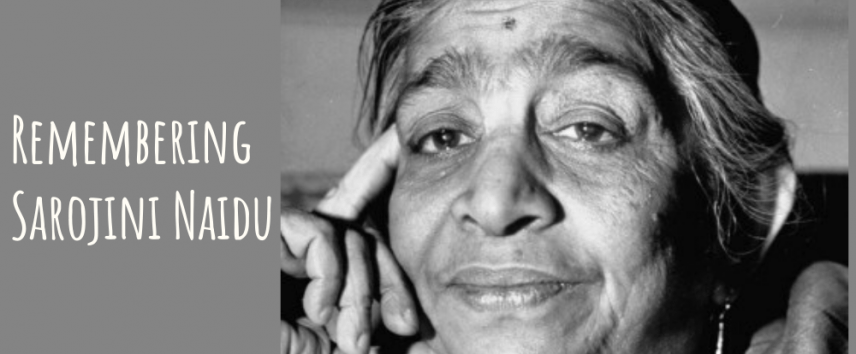
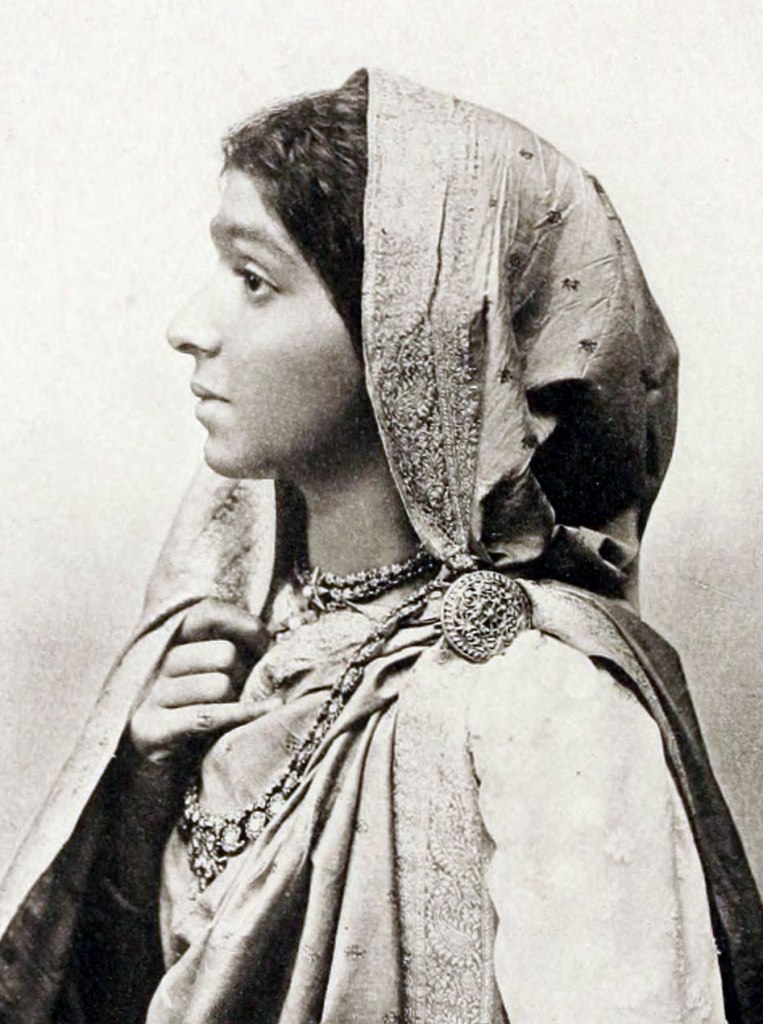
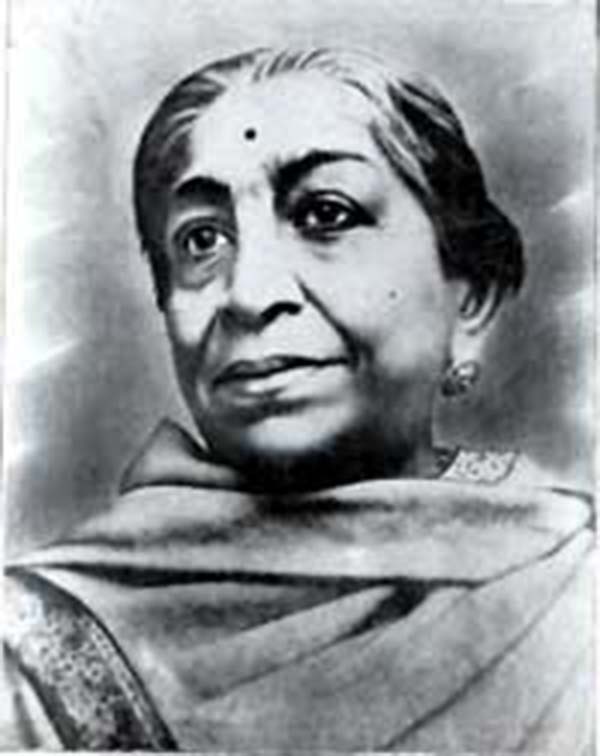
The Nightingale Of India

“As long as I have life, as long as blood flows through this arm of mine, I shall not leave the cause of freedom…I am only a woman, only a poet. But as a woman, I give to you the weapons of faith and courage and the shield of fortitude. And as a poet, I fling out the banner of song and sound, the bugle call to battle. How shall I kindle the flame which shall waken you men from slavery…”

Introduction

She was an Indian political activist and poet. A proponent of civil rights, women’s emancipation, and anti-imperialistic ideas, she was an important figure in India’s struggle for independence from colonial rule. Naidu’s work as a poetess earned her the sobriquet ‘the Nightingale of India’, or ‘Bharat Kokila’ by Mahatma Gandhi because of colour, imagery and lyrical quality of her poetry.

Birth and death

Born in a Bengali family in Hyderabad, Naidu was educated in Madras, London and Cambridge. Following her time in England, where she worked as a suffragist, she was drawn to Indian National Congress’ movement for India’s independence from British rule. She became a part of the Indian nationalist movement and became a follower of Mahatma Gandhi and his idea of swaraj. She was appointed as the President of the Indian National Congress in 1925 and later became the Governor of the United Provinces in 1947, becoming the first woman to hold the office of Governor in the Dominion of India.

Naidu’s poetry includes both children’s poems and others written on more serious themes including patriotism, romance, and tragedy. Published in 1912, “In the Bazaars of Hyderabad” remains one of her most popular poems. She married Govindarajulu Naidu, a general physician, and had five children with him. She died of a cardiac arrest on 2 March 1949.

Work

“Tell me no more of thy love, papeeha,
Wouldst thou recall to my heart, papeeha,
Dreams of delight that are gone,
When swift to my side came the feet of my lover…”

– A Love Song From The North by Sarojini
Naidu

1905: The Golden Threshold, published in the United Kingdom.
1912: The Bird of Time: Songs of Life, Death & the Spring, published in London.
1917: The Broken Wing: Songs of Love, Death and the Spring, including “The Gift of India” (first read in public in 1915) .
1919: Muhammad Jinnah: An Ambassador of Unity.
1943: The Sceptred Flute: Songs of India, Allahabad: Kitabistan, posthumously published.
1961: The Feather of the Dawn, posthumously published, edited by her daughter, Padmaja Naidu.
1971:The Indian Weavers.

After India attained independence, she became the first woman Governor of an Indian state, Uttar Pradesh. She served as governor till she passed away in March 1949, when she was working late in office.

As a Feminist

“Sarojini Naidu inspired the Indian Renaissance Movement and had a mission to improve the life of Indian woman.”

Bappaditya Bandopadhyay

Sarojini Naidu played an important role in women’s rights struggle in India. She helped in shaping Women’s Indian Association in 1917 with Annie Besant and others. The Association sought equal rights including the right to vote and represent. She presented the need to include more women in the Congress and in the freedom struggle. During 1918, British and Indian feminists including Naidu set up a magazine called “Stri Dharma” to present international news from a feminist perspective.

Link

How to learn Typing and typing speed

How to increase typing speed? Tips to improve typing speed - inORGnet

The Most, if not all, careers involve some computer-based work and require strong typing skills. Information technology professionals, for example, must be efficient typists in order to write code for computer and software programs. Accuracy is equally as important as speed, as a simple typo could result in a system-wide error.

Now way day’s technology-driven world, students and young adults become familiar with computers at an early age. Some schools have stopped teaching typing altogether, assuming students already possess the skills necessary to be successful in the modern workplace, according to an article in MIT’s Technology Review.

without proper training and practice, many individuals resort to hunt-and-peck typing, or looking down at the keyboard to select the right keys one-by-one. Mobile technology, such as tablets and smartphones, have also increased reliance on hunt-and-peck strategies.

Preferred typing method is known as touch-type, or typing without looking at the screen. This is much more efficient than hunt-and-peck; the average person types at an average of 40 words per minute, but a person who relies on the touch-type method can exceed 75 words per minute, allowing them to complete their work much more quickly and with minimal errors.

You can prepare to enter the workforce, here are some pointers to improve your own typing skills:

1.) Use the correct starting position

When practicing your typing skills, it’s important to use proper hand placement. To start, keep your fingers positioned over the home row keys (left hand over the A, S, D, and F keys, and the right hand over the J, K, L, and ; keys), with your thumbs hovering over the space bar. From here, you can move your fingers slightly to reach neighboring keys. Your hands should always return this starting position.

These conventions are meant to help you familiarize yourself with the keyboard. As you become more experienced, you can experiment with different variations of this starting position to find the placement that is most comfortable and natural for you.

2.) Don’t look down your hands

Instead of looking down at your hands, focus on your screen. This can be difficult at first, especially if you have not yet mastered the exact placement of the keys. However, looking at the screen will help improve your accuracy because you will be able to catch your typos as they occur. You’ll also begin to memorize the placement of the keys, so you’ll be able to type more quickly as you practice.

3.) Maintain good posture

Sitting in an upright position is going to make it easier to type faster. If you are used to slouching in your chair or working from the couch, try moving to a straight-backed chair or working at your desk.

4.) Find a comfortable position for your hands

The wrong hand placement can make it uncomfortable to type for extended periods of time. The space bar of your keyboard should be centered with your body, so that you are not reading your screen or typing from an angle. As you type, rest your elbows on the table and keep your wrists slightly elevated. You should never bend or angle your wrists dramatically.

5.) Practice!

Nothing is mastered overnight, and in order to really improve your typing accuracy and speed, you need to practice every day. There are many websites that offer free typing skills tests and practice, such as Typing Academy, TypingClub and How To Type. It’s important to take your time with these typing exercises and assessments. Attempting to rush through them will only result in more errors at first. Trust that your speed will improve naturally as you become more familiar with the keyboard.

Improving your typing skills will not only make your student life much easier, it will benefit you in your future career as well. It might take a lot of practice to see improvement, but don’t give up. You’ll be typing like a pro in no time!

What’s Opt ed and how to write one?

As you all guessed it already, yes, it is a section in a newspaper. So, what do you think exactly is the expansion of ‘opt ed’ and the meaning behind it? Before going deep into the answer, let’s know editorial page in a newspaper is a separate page that is fully devoted for public express their opinions through letters to the editor. This is important to know as Opt ed is often placed on the editorial page.

Opt ed column

What is Opt ed?


Opt ed is the abbreviation of the word opposite the editorial page. Opt ed is an article that often has the author expressing an opinion to create a discussion among the readers, this article is not affiliated with the media publisher. It is written by a person who is qualified enough to have an opinion. It is between 700 – 800 words. As it represents the clarity of thinking, it is very important for the person who is writing the opt ed to have a defined clarity on his or her opinion.

How to write one?


There are few suggestions to produce an effective opt ed article.

Ways to attract a reader


Catchy title


The title of the article should be appealing, as you have not got all the time of the reader. The reader should be pulled in to read the article just by looking at the title and be convinced that it’s worth his or her time to continue.


Start your article by addressing the issue


Instead of spending a paragraph to introduce the issue, it is better to get straight to the main point. As a lengthy introduction can tire the reader.


Make it look short


Sticking to the word limit is an important rule to be followed. Article will be more effective if it is short and clear. As lengthy-looking articles are often rejected by readers. In other words, sticking to the word limit decides whether the reader will pick the paper or not.


The opinion should belong to you


You should own the opinion that is being expressed. It is better not to be a ghost writer (a person writing someone else’s opinion). Owning the opinion is very important as the ghost writer may not always agree with your opinion, which will end with the article being not so effective and powerful.


Evidence


The article would be well built if your points or opinion on an issue is addressed with evidences. Placing more evidences on the article can give more clarity to the readers.


Knowledge


You should have significant knowledge on the issue that you are going to write about. Providing information regarding the topic with inaccuracy will land you and the newspaper organization that published on trouble. On the other hand, it will mislead the readers.

Do Opt ed writers get paid?


Before knowing the answer, let us know Opt ed writers are of two types – one that works when the newspaper organization approaches him or her to write an Opt ed article and the other is one of the readers (public) who approach the newspaper organization to get their article published on their newspaper columns.
The first type of Opt ed writers get paid mostly while the second type often gets rewarded with publicity that adds to their market image.

Few Newspaper Organizations in the market

What’s Opt ed and how to write one?

As you all guessed it already, yes, it is a section in a newspaper. So, what do you think exactly is the expansion of ‘opt ed’ and the meaning behind it? Before going deep into the answer, let’s know editorial page in a newspaper is a separate page that is fully devoted for public express their opinions through letters to the editor. This is important to know as Opt ed is often placed on the editorial page.What is Opt ed?Opt ed is the abbreviation of the word opposite the editorial page. Opt ed is an article that often has the author expressing an opinion to create a discussion among the readers, this article is not affiliated with the media publisher. It is written by a person who is qualified enough to have an opinion. It is between 700 – 800 words. As it represents the clarity of thinking, it is very important for the person who is writing the opt ed to have a defined clarity on hi or her opinion.How to write one?There are few suggestions to produce an effective opt ed article.Catchy titleThe title of the article should be appealing, as you have not got all the time of the reader. The reader should be pulled in to read the article just by looking at the title and be convinced that it’s worth his or her time to continue.Start your article by addressing the issueInstead of spending a paragraph to introduce the issue, it is better to get straight to the main point. As a lengthy introduction can tire the reader.Make it look shortSticking to the word limit is an important rule to be followed. Article will be more effective if it is short and clear. As lengthy-looking articles are often rejected by readers. In other words, sticking to the word limit decides whether the reader will pick the paper or not.The opinion should belong to belong to youYou should own the opinion that is being expressed. It is better not to be a ghost writer (a person writing someone else’s opinion). Owning the opinion is very important as the ghost writer may not always agree with your opinion, which will end with the article being not so effective and powerful.EvidenceThe article would be well built if your points or opinion on an issue is addressed with evidences. Placing more evidences on the article can give more clarity to the readers.KnowledgeYou should have significant knowledge on the issue that you are going to write about. Providing information regarding the topic with inaccuracy will land you and the newspaper organization that published on trouble. On the other hand, it will mislead the readers.Do Opt ed writers get paid?Before knowing the answer, let us know Opt ed writers are of two types – one that works when the newspaper organization approaches him or her to write an Opt ed article and the other is one of the readers (public) who approach the newspaper organization to get their article published on their newspaper columns.The first type of Opt ed writers get paid mostly while the second type often gets rewarded with publicity that adds to their market image.

ENTRY STRATEGIES OF AN ENTREPRENUERSHIP

Entrepreneurship can be defined as the recognition of opportunities and the use of creation of resources to implement innovative ideas for new, thoughtfully planed ventures. The essential characteristic of an entrepreneur is identifying the opportunity and elaborating that opportunity into a formal but it is also important to have an entry strategy while setting up a startup. So, today in this article we are going to learn the entry strategies and risk reduction strategies that are applied by every entrepreneur is explained clearly.

ENTREPRENEURIAL STRATEGIES:

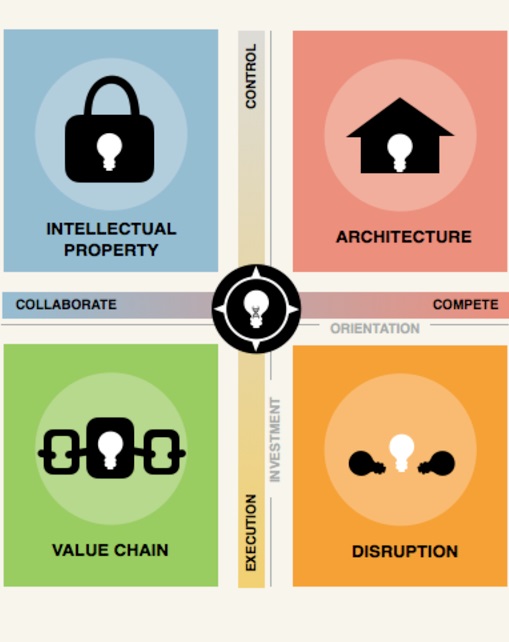
Entrepreneurial strategy involves identifying and choosing among a set of distinct choices that define a company as it translates an idea into a meaningful value proposition. So, setting up a strategy clearly describes ” what not to do? ” that is, a strategy act as a back bone for an entrepreneurship. The four strategies that can be explored for an idea are as follows:

FUNDAMENTAL ENTREPRENEURIAL STRATEGIES

1 INTELLECTUAL PROPERTY STRATEGY:

Entrepreneurs who pursue intellectual property strategy for their ideas choose to invest in control over their underlying innovation in order to construct a value chain through collaboration with incumbent firms in industry to create value for the final end consumers.

  • This type of startups focuses on idea generation and development to avoid the cost of down stream, customer facing activities. because cooperation requires alignment with incumbent activities. Simply, the startup which use this strategy probably choose technological investments with existing systems.

2 DISRUPTION STRATEGY:

This type of strategy highlights about decision to compete directly with incumbents emphasizing commercialization of idea and rapid growth of market share rather than control on ideas of development. Disruption entrepreneur aims to redefine established value chain.

  • Therefore, a disruption startup chose the competition orientation against established firms in the industry by choosing to compete through execution. Disruption strategy founders will inevitably face threat of imitative competition from incumbents and new entrants alike because of choosing invest in execution than in getting control over their idea.
  • Even value chain strategy is also similar to the disruption strategy where entrepreneurs choose to invest in execution rather than control but the only difference is that, they create value with the cooperation of industry incumbents.

3 ARCHITECTURAL STRATEGY:

The final strategy in the entrepreneurial strategy framework is architectural strategy. Unlike the other type of strategies , architectural strategy is about architecting an entire new value chain in the market place rather than boosting the performance of an existing value chain.

  • This type of strategy requires entrepreneurs to figure out how to build a new and integrated value chain that delivers value to customers while also building an economic support by maintaining control over their idea as they compete directly against incumbents.
  • Architectural entrepreneurs establish competitive advantage through the traditional strategic approaches. Compared to other strategies, architectural strategy used entrepreneurs must be committed to their vision and plan.

RISK REDUCTION STRATEGIES:

The situation that threatens the capability of the startup or a company to achieve its financial goals is considered as a risk to the business. There may be ma strategies in order to manage and reduce the financial loss to the company. The three type of risk reduction strategies are as follows:

1 NARROW SCOPE STRATEGY: Narrow-scope strategy offers a small product range to a small number of customer groups to satisfy a particular need. The narrow scope can reduce the risk that the firm will face competition with larger firms. A narrow-scope strategy is vulnerable to the risk that market demand does not materialize as expected. Having a narrow-scope strategy is like putting all your eggs in one basket that is, it reduces some competition-related risks but also increases the risks associated with market uncertainties.

2 BROAD SCOPE STRATEGY: Broad scope strategy highlights portfolio approach dealing with uncertainties about attractiveness of different market segments. By offering a range of products the entrepreneur gains knowledge on whole market through a process of trial and error. A broad-scope strategy reduces risks from market uncertainties, but it increases the exposure of competition. When the risk of competition is great and market uncertainties are minimal, a narrow-scope strategy is more effective at reducing risk but when a new firm entered into market with same sort of creation then, a broad-scope strategy reduces the major risk of uncertainties over customer preferences.

3 IMITATION STRATEGY: Imitation strategy copy’s the best practices of other firms in order to minimize the risk of downside loss associated with new entry in to the market. An imitation strategy has the potential of reducing the entrepreneur’s costs associated with R&D and also reduces the customer uncertainty over the firm. Imitation strategy makes the new entry to look legitimate from day one onwards. This imitation strategy is also known as me too strategy.