Hardware and software

Computer is a device comprising both hardware and software.The functions of hardware and software combines together to make the computer functional.A hardware device helps to enter input information.The software processes the input data and gives the output in the monitor,a hardware device.Thus computer is like a human body,where human body is the hradware and soul is the software.

Hardware

Hardware

Hardware is the parts of the computer which we can touch and feel.Hardware includes Input and output devices, Cabinet,Hard Disk,Mother Board,SMPS,CPU,RAM,CD Drive and Graphics card.

Software

Hardware is lifeless without software in a computer.Software are programmed and coded applications to process the input information.The software processes the data by converting the input information into coding or profmgrammed language.Touching and feeling the software is not possible but we can see the functions of the software in the form of output.

Software

Types of software

The software is divided into two types based on the process.They are

  1. System software (operating system)
  2. Application software

System software

System software is software that makes the hardware devices process the data inputted by the user and to display the result on the output devices like Monitor.Without the opening devices like Monitor . Without the operating system, computer cannot function on its own.Some of the popular operating system are Linux, windows,Mac, Android etc.

Application software

Application software is a program or a group of programs designed for the benefit of end user to work on computer.The application programs can be installed in the hard disk for the usage on a particular computer.This type of application program completes one or more than two works of the end user.The following are the examples of application program:

  • Video player
  • Audio player
  • Word processing software
  • Drawing tools
  • Editing software,etc.

System and Application software types

The opening system and application software are available in two forms.They are:

  1. Free and open source
  2. Paid and proprietary software

Free and open source

Free and open software is available at Free of cost and can be shared to many end users.Free software is editable and customisable by the user and his leads to updation or development of new software.Examples of free and open source software:LINUX,open office , operating system,Geogebra etc.

  • Conventional software developers, distributors and sellers fear that FOSS will undercut their profits.
  • Abuse of FOSS privilege may lead to questionable claims of copyright or trademark protection,thereby spawning litigation.
  • The monetary value of FOSS is unclear, so government’s have trouble figuring out how to tax it.

Paid and proprietary software

There is software that is to be paid to use either permanently or temporarily,these types of software are paid and need a licence to use it.The licence of the software would not be provided unless it is purchased.Similarly the end users are legally prohibited to steal the software program or to use the pirated version of the paid and proprietary software.Some of the examples of paid & proprietary software are: windows, Microsoft office,Adobe photoshop,etc.


Healthy Nutrition…. Healthy life

Health can be defined as the physical,social, psychological and spiritual well-being of individuals.Now a days it is the main source everyone’s life by maintaining better Healthy nutrition immunity increases . Immunity defines the wealth and happiness of an individual.

we can improve our daily intake to maintain health by nutritive values .

NUTRITION :

The process of providing or obtaining the food necessary for health and growth.

NUTRIENTS :

A substance that provide nourishment essential for the maintenance of life and for growth.

There are different types of foods that provide various nutrients to nourish the organs and their system in human body.Here there are some nutrients and their food sources.

You may not get all the micronutrients your body needs. Americans tend to eat foods that are high in calories and low in micronutrients. These foods often also contain added sugar, sodium (salt), and saturated or trans fats. This type of diet contributes to weight gain. It can increase your risk of health issues, such as type 2 diabetes and heart disease.

According to the U.S. Department of Agriculture (USDA), American adults may not get enough of the following micronutrients.

Nutrient and Food sources :

Calcium : Nonfat and low-fat dairy, dairy substitutes, broccoli, dark, leafy greens, and sardines .

Potassium : Bananas, cantaloupe, raisins, nuts, fish, and spinach and other dark greens.

Fiber : Legumes (dried beans and peas), whole-grain foods and brans, seeds, apples, strawberries, carrots, raspberries, and colorful fruit and vegetables .

Magnesium : Spinach, black beans, peas, and almonds .

Vitamin A : Eggs, milk, carrots, sweet potatoes, and cantaloupe.

Vitamin C : Oranges, strawberries, tomatoes, kiwi, broccoli, and red and green bell peppers.

Vitamin E Avocados, nuts, seeds, whole-grain foods, and spinach and other dark leafy greens.

We can prepare some recipes by combining other foods wich gives required nutrients to our body.

Rice and Beans :

Both these foods alone are healthy choices. But if you’re trying to get in all your protein without eating meat, beef, or chicken, a serving of rice and beans can do the trick! A complete protein is one that contains all the amino acids your body needs – an egg is considered the most perfect protein around. The amino acids found in rice complements those found in beans, making it a high-quality protein when eaten together.

Leafy Greens and Tomatoes:

Dark leafy greens like spinach, kale, and collards contain iron. But it’s tough to absorb the iron from these plants without the assistance of vitamin C. Combine fresh or sautéed leafy greens with tomatoes, a splash or lemon juice or slices of strawberries.

Egg and Cheese:

Calcium and vitamin D work in synergy to help promote healthy bones. A glass of milk will give you both, but so can an egg and cheese sandwich, frittata or omelet. Egg yolks contain vitamin D and you’ll find calcium in the cheese.

Oatmeal and Water :

Oatmeal cookies and a warm bowl of oatmeal can foot the bill, but be sure to drink plenty of water. The oats need to absorb water in order to work properly and provide their many benefits. The fiber found in oatmeal has been shown to help reduce blood cholesterol levels and to help keep you full longer.

Tomatoes and Olive oil :

The antioxidant lycopene helps promote a healthy heart, could prevent macular generation and may lower the risk of colon cancer. Cooked tomato products like tomato sauce, ketchup, tomato soup, and tomato paste are the best sources of lycopene. Combine it with heart-healthy monounsatured olive oil for maximum absorption.

Jour de la Bastille (Bastille Day)

Jour de la Bastille, the national day of France is commonly known as Bastille Day in English. Every year on 14th July France celebrates her national day. On this day France celebrates the storming of the Bastille as a national holiday. Bastille was a military fortress and prison. The Bastille symbolized the tyranny of the French monarchy especially King Louis XVI.

France used to celebrate this day very enthusiastically but from 2020 this celebration holds back. As in 2020 for the first time since 1945, authorities have called off the annual military parade along the Champs-Elysees in Paris due to the Covid-19 outbreak. Only 2,000 soldiers – half the usual number were gathered at the Place de la Concorde. In 2020 French Macron tweeted “This July, we will pay tribute to those who have put all their strength, all their skills, all their humanity against the virus.”

This year, France celebrated her national day with a traditional national military parade but firework has been canceled due to the pandemic and concerns over the Delta variant. This year the theme of the parade is “Winning the Future” highlighting “the French’s will to overcome health crisis-related difficulties”. The occasion reveals the army’s anticipation role “thanks to high technology (…) able to prevent crisis and imagine fights from the future”. This year, French President Emmanuel Macron wishes to express “The [Nation’s] affection for the army” and pay tribute to the women and men “who chose to fight for France and shown a sense of commitment and availability like no other”.

Fall of Bastille

The Bastille was built in the 1300s during the Hundred Years’ War against the English. It was designed to protect the eastern entrance to the city of Paris. And later used as a French state prison and a place of detention for important persons during the 17th and 18th centuries by the reign of Louis XVI.

During the time of the American Revolution, America and France worked together. France helped America with the aim to end England’s power in the American colonies. A lot of money was spent in the war and consequences were paid by the people of France suffering from starvation, unemployment, and tensions in the country.

In 1789, there was an economic crisis and tensions in France, the people of France were frustrated and angry with the cruel behavior of kings and elites, and clergies. The Bastille was a symbol of the tyranny of king and queen. The revolutionaries, more than 1000 people most of them were craftsmen and store owners of the Paris marched towards the Bastille on 14th July 1789. They demanded that the military leader (governor de Launay) of Bastille surrender the prison and hand over the gunpowder but he refused and due to this crowd become angry. The revolutionaries managed to enter the courtyard and began to try and break into the main fortress. The soldiers started firing and the fight begins. But an interesting or turning point of this fight was when soldiers joined the side of the crowd. And the military leader surrendered the fort to the revolutionary. Governor de Launay was killed, some prisoners were released (only seven prisoners were inside) and Bastille was razed and mixed in the soil. The storming of Bastille led to a series of events that led to overthrew of King Louis XVI and the French Revolution. The people who took part in the storming of Bastilles were considered heroes during the revolution and took the title “Vainequeurs de la Bastille” meaning “winners of the Bastille”.

The date 14th July represents the unity of French people

The date of the fall of Bastille 14 July is celebrated today as the French National Day. In France, it is called the “The National Celebration” or The Fourteenth July”.

Social media.

Social media are interactive technologies that allow the creation or sharing/exchange of information, ideas, career interests, and other forms of expression via virtual communities and networks. While challenges to the definition of social media arise due to the broad variety of stand-alone and built-in social-media services currently available, there are some common features:

Social media are interactive Web 2.0 Internet-based applications.
User-generated content—such as text posts or comments, digital photos or videos, and data generated through all online interactions—is the lifeblood of social media.
Users create service-specific profiles for the website or app that are designed and maintained by the social-media organization.
Social media helps the development of online social networks by connecting a user’s profile with those of other individuals or groups.

Users usually access social media services via web-based apps on desktops and laptops, or download services that offer social media functionality to their mobile devices (e.g., smartphones and tablets). As users engage with these electronic services, they create highly interactive platforms through which individuals, communities, and organizations can share, co-create, discuss, participate, and modify user-generated content or self-curated content posted online. Additionally, social media are used to document memories; learn about and explore things; advertise oneself; and form friendships along with the growth of ideas from the creation of blogs, podcasts, videos, and gaming sites. This changing relationship between human and technology is the focus of the emerging field of technoself studies.

Since the dramatic expansion of the Internet, digital media or digital rhetoric can be used to represent or identify a culture. Studying how the rhetoric that exists in the digital environment has become a crucial new process for many scholars.

Observers have noted a wide range of positive and negative impacts of social media use. Social media can help to improve an individual’s sense of connectedness with real or online communities and can be an effective communication (or marketing) tool for corporations, entrepreneurs, non-profit organizations, advocacy groups, political parties, and governments. Observers have also seen that there has been a rise in social movements using social media as a tool for communicating and organizing in times of political unrest.

Uganda 🇺🇬

The problem has been the supply side,” said Baryomunsi, who is also an epidemiologist. “We have the money but we simply can’t get the vaccine. This is a challenge of access and equity. We have to rely on the western world and the western world has focused on its population. The impression is that people there don’t care about Africans.”

Uganda, which successfully repressed earlier waves of infection, has like other countries across Africa risked significant economic damage by imposing another severe lockdown.

“There was complacency that set in with the population and then a new variant that was much more aggressive,” Baryomunsi told the Guardian. “We have lost many people. The good news is that we have started to bring down infections.”

Dr Matshidiso Moeti, the WHO’s director for Africa, told reporters the continent had just marked its most dire pandemic week ever. “But the worst is yet to come as the fast-moving third wave continues to gain speed and new ground,” she said.

In the seven days to Thursday, the continent recorded 251,000 cases, a 21% increase. So far only 1.6% of vaccine doses administered globally have been given in Africa, and less than 2% of its population vaccinated.

The risk 2

Labour Productivity in Agriculture Versus Non-agriculture
The National Commission on Enterprises in Unorganised Sector (NCEUS) estimated
that in 2004-05 the ‘per worker GDP’ (called ‘labour productivity’) in agriculture
was about one-fourth of industrial sector GDP and one-sixth of service sector
GDP. The ratio of labour productivity in agriculture to that in non-agriculture has,
in fact, been continuously declining since 1983. This implies that the relative economic
condition of agricultural workforce (vis-à-vis industrial and service sector
workforce) has deteriorated over time. Further, due to limited access of farmers
and agricultural workers to employment in high value added non-agricultural
activities, a large number of them could not be occupationally mobile and per
force remained dependent on agriculture for their livelihood.
Employment Elasticity in Agriculture Versus Non-agriculture
Employment growth in agricultural and non-agricultural activities for the period
1993-94 to 2004-05 is presented in Table-7.1. Between 1993-94 and 1999-00,
agricultural employment witnessed a negligible 0.03 percent growth (i.e. annual
average percentage growth). During this period, agricultural GDP increased by 2.9
percent per annum. As a result, the employment elasticity (defined as the ratio of
employment growth to the corresponding GDP growth which indicates the
employment generated for every unit of income generated or added to the sector)
was low at 0.01. However, in the non-agricultural activities, the employment growth
was as high as 2.5 percent, GDP growth was 8.1 percent and the consequent
employment elasticity was also high at 0.31. The growth rate of real wages in the
non- agricultural sector (5.03) also was nearly twice as high as compared to the
agricultural sector (2.74). The growth story was similar even during the next
quinquennium i.e. 1999-00 to 2004-05 but the situation for the agricultural sector
was one of improvement. The employment elasticity in the non-agriculture was
0.65 as against 0.49 in agriculture. But the improvement in the employment elasticity
of agricultural sector itself, from 0.01 in 1994-95 to 0.49 in 2000-2005, is
significant. Notably, the real wages in agriculture also grew faster than the non￾agriculture i.e. 1.46 percent in the former as compared to 0.13 in the latter. These
facts are empirically encouraging from the point of view of agricultural development in India

The risk

As we by now know well, a large number of poor people directly or indirectly
depend on agriculture. Growth in the agricultural sector creates increased demand
for basic rural non-agriculture wage goods and services. Many of these goods are
mostly produced and consumed locally. A high growth in agriculture has great
potential for generating employment and income in the rural non-farm sector. The
World Development Report (WDR 2008) argues that agricultural growth is four
times as effective in reducing poverty and inequality as growth in non-agricultural
sectors. Another UN report entitled ‘Sustaining Growth and Sharing Prosperity’
(ESCAP, 2008) also says that persistent poverty in the Asia-Pacific region are the
result of decades of neglect of agriculture. The survey says that close to a third
of the region’s poor (i.e. an estimated 218 million), could be lifted out of poverty
if average agricultural labour productivity is raised. Growth in agricultural income
is therefore regarded as more effective in reducing poverty. You may note that the
rate of decline in poverty in India was greater during the relatively higher agricultural
growth period of 1980s than during the low agricultural growth period of 1990s.
For instance, rural poverty in India declined by 9 percentage point between 1993-
94 and 2004-05 while between 1977-78 and 1987-88, it had declined by 14
percentage points.
Inadequate accessibility of food is one of the main causes of poverty, hunger and
malnutrition which is widely spread in rural India. Due to malnutrition and hunger,
a worker would be physically too incapable to earn enough to feed himself and
his family. An increase in agricultural production and productivity would play a key
role in reducing poverty by raising agricultural wages and making food and other
agricultural commodities affordable to the poor households. However, agricultural
growth would be more effective in reducing poverty when supported by adequate
investment in human development components such as health and education. The
provision of basic education, as well as formal or informal training for developing
and upgrading skills, is crucial for farm workers, as they with sufficient knowledge
and skills are better able to respond to new technology, market opportunities, and risk

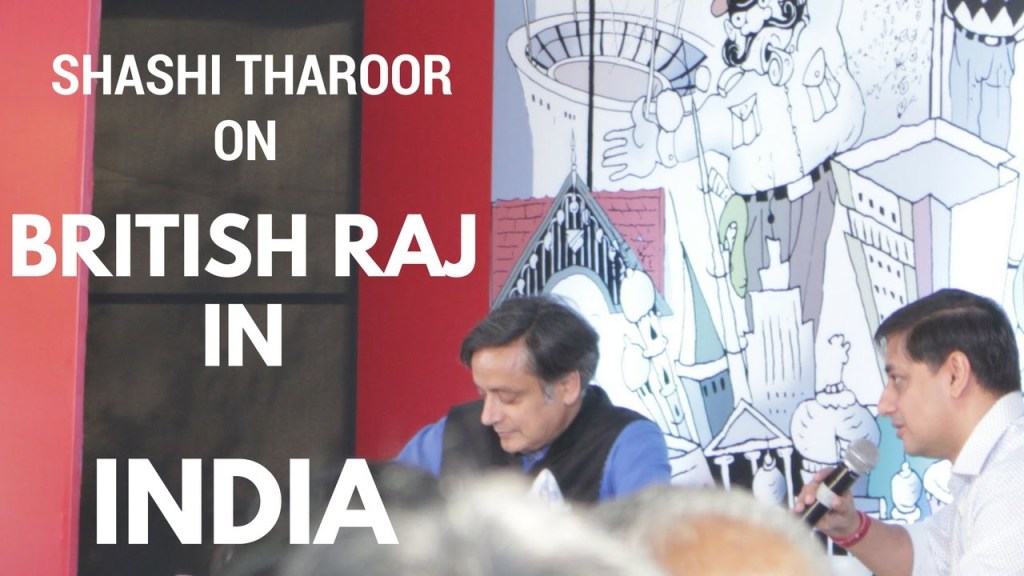
Shashi Tharoor and his ideology about the British rule in India.

Shashi Tharoor is an Indian politician, a prolific writer, diplomat and an active member of Parliament from Kerala since 2009. He wrote several fictional as well as non-fictional books including “An era of darkness: the British Empire in India, “Inglorious empire: what British did to India” and many more.
His collective ideology is assembled in every of his article and book that oppose the controversial notion that the British Raj was beneficial to India, in the long run. The damage that the British government did to India is beyond the act of reparation, quoted by Tharoor in his interview.


Furthermore, the British bequest such a Railways, rule of law, parliamentary democracy, and all those extravagant commodities were not intended for the betterment of Indians. The only motive of establishing “The Railways” was to siphon off the Indian resources to the Britain treasury. British entered India as an East India Company to trade spices and deceptively captured 2/3 of India including Bengal. Several policies such as the Free Market policy, The Malthusian policy, Victorian fiscal prudence were made by the British that worsens the conditions of Indians in their motherland even more. Poor Indians were forced to live in miserable situations with no basic rights. Millions of Indians died due to starvation in the year 1891-1900 due to over-exploitation of agricultural produce and partly due to Free-market policy up to some extent. To be more accurate, the policies made by the British had the hidden agenda of corruption and injustice that damage the country and countrymen altogether. Under British Raj, the most thriving textile industry in India perished into the thin air. It was a common practice of East India Company to mutilate the skilled workers by chopping off their fingers so that they couldn’t weave anymore, thereby destroyed the largest part of the Indian economy.

The Bengal Famine of 1943 is another outrageous event that happened under the British raj that costs millions of lives. According to a recent study, the famine was not only caused by the drought but also by the complete failure of the policy of British India under the Ministry of Winston Churchill, who is remembered as the man who caused the Bengal famine.

Besides corruption, brutality and the horrendous massacre, “The Jalianwala Bagh”, is the heinous crime for which The Royal family owe an apology to every Indian or at least to the family undergone terrible damage under the British reign.


Tharoor has written a total of 15 books in his career, and thousands of articles in publications including the New York Times, the International Herald Tribune, The Times of India and many more. His books are available in many languages across the globe such as French, Italian, Roman, Polish as well as Bengali and Malayalam. He is known for his humorous criticism of the inhuman system in a civilised manner.


CONVERTING LANGUAGES AS PER CUSTOMER’S PREFERENCE

Guidance for using your favorite media in your own preferred language

Let me discuss about a world-wide used social media platform that is absolutely a messenger to connect their closed ones via messages, calls or video chats. This messenger is utilized by more than 200 million people in these modern days that has been accessed in 180 countries to try this platform. A user-friendly application that is helpful for people among different age groups. The aspect of this pandemic is by using this messenger we were able to connect with our surroundings that includes friends, family and relations to be in personal touch with them.

It gives a feeling of satisfaction as if their connections are in reality with them. It was recently owned by the successfully running platform Facebook in which some unique features are also added to enhance and improvise their customers. But it is necessary to know all the tools and features hidden in this application for better performance of this platform in certain situations. A reliable app for chatting, calling that is valid for all phones world-wide.

Explore the wide range of platform so you get a better understanding about it and to share your knowledge with new comers/users to it. This social media can be used in pc, laptops and even mobile phones of any version.

In smartphones, you can find WhatsApp in Play Store or App Store to download according to your operating system. Mostly the specifications will be a compatible one for latest arrival of gadgets so you need not worry whether will it work on your mobile.

It is noted that the media consists of 40 languages only for iOS especially but there 60 languages to be found in any android phones followed as per the same rules for laptops and pc. They have considered ten local languages only from India to be used in their application (Hindi, Bangla, Punjabi, Telugu, Marathi, Tamil, Urdu, Gujarati, Kannada, Malayalam).
This hassle-free module helps us in changing from one language to another language that has only been recognized in their servers to be used. But for doing this there are certain that can be tedious for you but don’t worry a step-by-step procedure with guidance might help you out in sorting this issue simply. 

Since there two different operating systems within these handy gadgets there are separate rules for each one. So, I request to observe and read my content carefully before doing things on your as it might make you puzzled.

Exploring on your own is really appreciable but if you can’t find where to even start or any knowledge regarding it (especially freshers), I request to adopt my guidelines with little attention to solve it.

Keep patience while doing this work as it has a little procedure one after the another simultaneously. I consider myself that I have created an awareness and the instructions of downloading it, now let me move on to sorting out Language issues.

  1. Converting to a preferred language in android

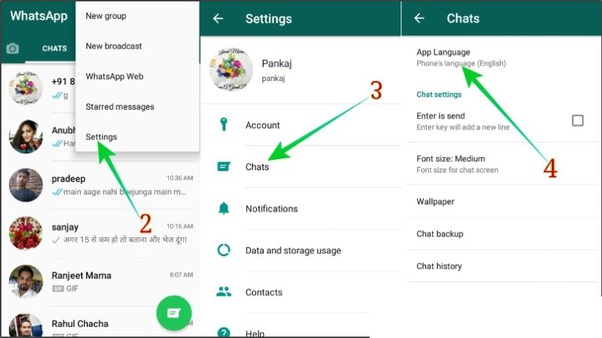
Open/get inside your application of WhatsApp on your gadget so you can find your chats in the display screen. Tap the three dots on the right end top of your screen so you enter into those options. Now try to figure out the Settings option in your device and tap on the chats below in that running application. Go inside the languages of the application and find out your favorite language and choose it so they from that time onwards you can use language as per your own preference to all your connections.

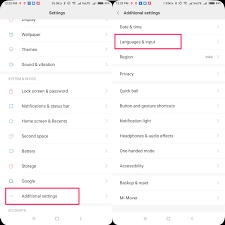
Or directly enter your mobile settings where you can find system option that takes you to various languages and input supported by your device. So, after selecting the option of languages and input go through open languages as you can find multiple languages and long press on a language position to make it as your desirable language or add a separate own language of yours if you don’t find one.

  • Changing a preferred language in Apple models (iOS)

So, for changing a chat language in WhatsApp especially in a sophisticated operating system like iPhones it is a bit different from ordinary ones but it isn’t a very tough process. Try adopting my ways of selecting your own preferred language to use conveniently.

Enter your phone settings that can be visible in your display screen followed by the option of general. Then click on the feature of Language and others where you have a choice of selecting your language for the high standardized phone. Now you find a multiple number of languages in your gadget, so by selecting on a language continue with the option done and apply the changes to use your newly changed language in your iPhone.

These are the simple and easy ways to modify your language as per your preference and utilize the benefits at ease. These methods can help you out to land on a correct lane as I have explained them at my simple terms that can clearly make you understand of the process. Try it out and be happy fellas.

IMPORTANCE OF AGRICULTURE ( in Indian Economy)

The word agriculture is derived from the Latin language importance of agriculture. So we all know that India is an agricultural country . And we have been hearing this since the very beginning . That is , most of the people here are involved in agriculture, So no doubt that when so many people are involved in agriculture,  then maximum people will get national income. So agriculture plays a very important role in the Indian economy. Agriculture generates 24% of the nation’s income. Means, out of 100 rupees, 24 rupees comes from your agriculture and the rest is in other sectors. And which is 60% of the population of India, it is in agriculture, which means that 40% of the population is either they are doing service or they work in the industry. And until production does not come from agriculture, then you can think that no industry will serve. The industry which depends on the agricultural product also cannot survive without the product And the agriculture that plays an important role of development of industries and foreign trade. Because so many companies are, it depends on the agricultural product itself. Agriculture play the back bone of Indian economy.

Following one the role of agriculture in the India economy.
  • 24% of the national income comes from agriculture.       
  • There is 60% employment in agriculture.
  • Supply of raw material: If we want to make any product, then we need items. Like we need seeds to make oil. We need cotton for textile industries, so all these sources we call raw material, The things from which any other product is made, we called it raw material like cotton, seeds accepted vet, all these raw materials are supplied to us from agriculture.
  • Role A agriculture in international trade: About 70% of the products we export to other countries, we export products that are supplied from agriculture or apiculture. There are some important products which export from India. Like Tea, Sugar, Oils Seeds, Tobacco, Spices, Rubber are all agricultural products which we export to other countries.
  • Contribution to GDP(Gross Domestic Product):Apart from the industries in our country, agriculture sector and human being contribute to the multi GDP.So we can say that agriculture plays a very important role in increasing GDP.Agriculture has contributed 51% in 1950-52, while between 2018 and 2019, only 14.4% was contributed But this does not mean that there is no importance of agriculture sector but agriculture also plays a very important role If the contribution of agriculture to GDP has been reduced, then the reason is because that the people who are they have started moving towards the secondary and territory sector They have moved out of the ruler area to Auburn Places and started working, so the agriculture contribution has come down a bit in GDP But still we will say that agriculture is very important for us.
  • Supply of wage goods: We get oil, wheat, rice, all from agriculture. In India or outside country, we also need important stuff like oil, rice, wheat. All that we get from agriculture And you can see that in today’s time, 121 crore people in India get all these things from agriculture.85% of what we take every day is an agricultural product, while the remaining 15% comes from egg milk and meat.
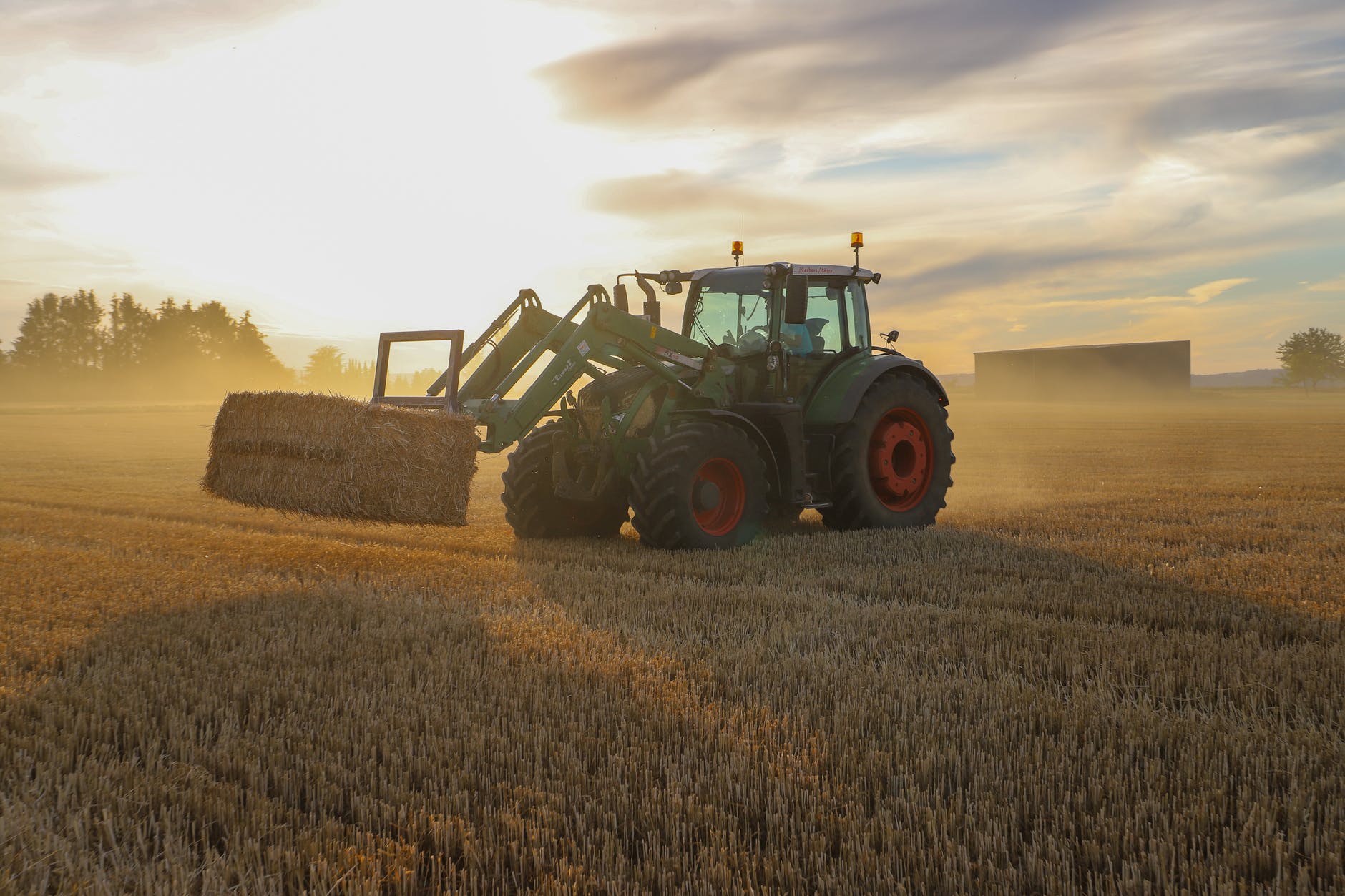
  • Source of employment: Agriculture is a huge source of employment because even today there are many people who depend on agriculture He grows crops on his farm and he himself takes consume and also earns money by selling it to the market 50% of the population is engaged in agriculture Agriculture is also taken care of in the economy planning that is made for India.
  • Source of demand for industrial goods :The work of industrial goods is to make heavy products, make heavy machines And now our agriculture sector which is there demands this kind of machine Because we need tractor, compiler, all this in agriculture which comes from industries This means that agriculture demands industries to make machines and we will buy them So agriculture plays a very important role for industries as well.
  • Support to transport industry :So we all know that rail, roadways, air comes in transport But agriculture, which is mostly beneficial for railways, roadways Like goods trains, trucks, food items go in all these, if there is no agriculture then there will be no sugar can then there will be no transport Means has also given maximum employment opportunity in this, Agriculture is also very important in transport industries.
  • Wealth of Nation : The most important thing in our country is that we have agricultural land And there will be very few such countries in the world which have agricultural land So this is our heritage and we have to protect it and keep improving That’s why we would say that agriculture is very important to us because it is a wealth of nation.

And these are all the points due to which agriculture is considered important .

Agriculture

Agriculture

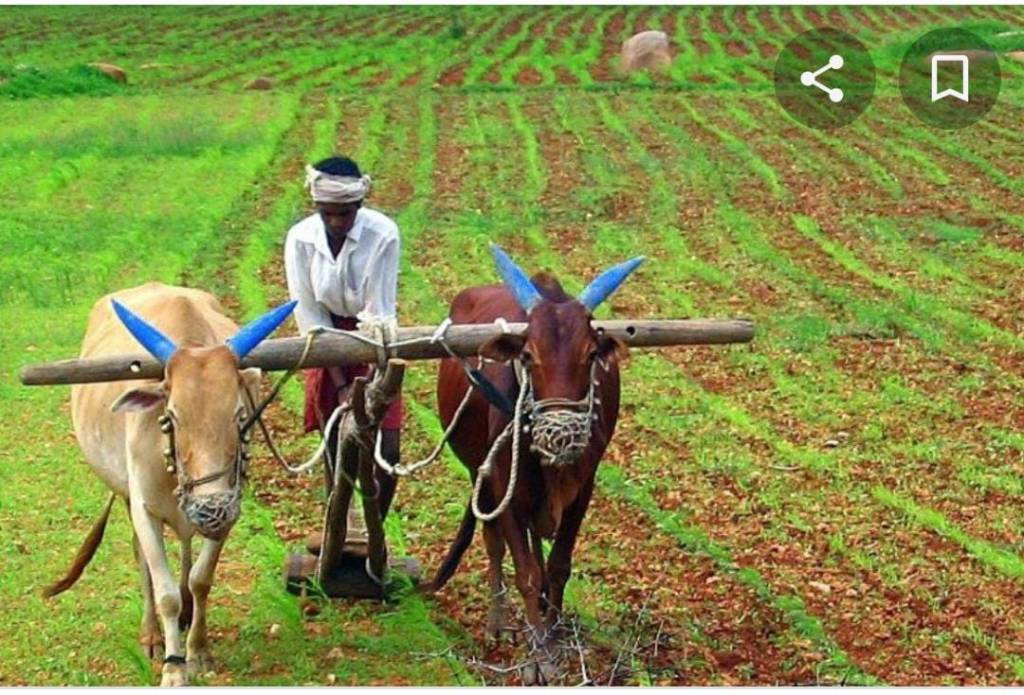
Agriculture is the backbone of our country.More than 50% of Indian’s population is dependent on agriculture.A few decade ago people people used to do farming using ancient tools, but now after the Green Revolution high yield varieties of food grains and vegetables have also been invented which has led to greater growth in agriculture in India. Government has constructed Dams and Canals on several rivers for irrigation purposes.

Our country India is the world’s largest producer of fresh fruits like Mango,Banana, Guava, Papaya etc.India also produces dry fruits, spices and vegetables.Food grains like rice and wheat are produced in ample amount.

Food is one of the basic necessities of human being.Hence, more and more people should focus on agriculture for their source of income.The food which we get to eat daily is the gift of hard work of the farmers.We as a society must respect the farmers and appreciate their hard work.If they stop working, we won’t get enough food.

MOTHER TERESA

Who Was Mother Teresa?

Nun and missionary Mother Teresa, known in the Catholic church as Saint Teresa of Calcutta, devoted her life to caring for the sick and poor. Born in Macedonia to parents of Albanian-descent and having taught in India for 17 years, Mother Teresa experienced her “call within a call” in 1946. Her order established a hospice; centers for the blind, aged and disabled; and a leper colony. 

In 1979, Mother Teresa received the Nobel Peace Prize for her humanitarian work. She died in September 1997 and was beatified in October 2003. In December 2015, Pope Francis recognized a second miracle attributed to Mother Teresa, clearing the way for her to be canonized on September 4, 2016.

Mother Teresa’s Family and Young Life

Mother Teresa was born on August 26, 1910, in Skopje, the current capital of the Republic of Macedonia. The following day, she was baptized as Agnes Gonxha Bojaxhiu.

Mother Teresa’s parents, Nikola and Dranafile Bojaxhiu, were of Albanian descent; her father was an entrepreneur who worked as a construction contractor and a trader of medicines and other goods. The Bojaxhius were a devoutly Catholic family, and Nikola was deeply involved in the local church as well as in city politics as a vocal proponent of Albanian independence.

In 1919, when Mother Teresa — then Agnes — was only eight years old, her father suddenly fell ill and died. While the cause of his death remains unknown, many have speculated that political enemies poisoned him.

In the aftermath of her father’s death, Agnes became extraordinarily close to her mother, a pious and compassionate woman who instilled in her daughter a deep commitment to charity. Although by no means wealthy, Drana Bojaxhiu extended an open invitation to the city’s destitute to dine with her family. “My child, never eat a single mouthful unless you are sharing it with others,” she counseled her daughter. When Agnes asked who the people eating with them were, her mother uniformly responded, “Some of them are our relations, but all of them are our people.”

Education and Nunhood

Agnes attended a convent-run primary school and then a state-run secondary school. As a girl, she sang in the local Sacred Heart choir and was often asked to sing solos. The congregation made an annual pilgrimage to the Church of the Black Madonna in Letnice, and it was on one such trip at the age of 12 that she first felt a calling to religious life. Six years later, in 1928, an 18-year-old Agnes Bojaxhiu decided to become a nun and set off for Ireland to join the Sisters of Loreto in Dublin. It was there that she took the name Sister Mary Teresa after Saint Thérèse of Lisieux.

A year later, Sister Mary Teresa traveled on to Darjeeling, India, for the novitiate period; in May 1931, she made her First Profession of Vows. Afterward, she was sent to Calcutta, where she was assigned to teach at Saint Mary’s High School for Girls, a school run by the Loreto Sisters and dedicated to teaching girls from the city’s poorest Bengali families. Sister Teresa learned to speak both Bengali and Hindi fluently as she taught geography and history and dedicated herself to alleviating the girls’ poverty through education.

CASE OF SHAYARA BANO

BY MEETALI SONI


Shayara Bano is a name of a muslim girl who fought a long legal battle against triple talaq(third time divorce), has joined the Bharatiya Janata Party (BJP). A Constitution Bench has declared that the practice of instantaneous Triple Talaq is unconstitutional. On 22nd August 2017, the 5 Judge Bench of the Supreme Court pronounced its decision in the Triple Talaq Case, declaring that the practise was unconstitutional.
Shayara Bano case popularly known by , the “TRIPLE TALAQ CASE ” .Shayara Bano, a 35-year-old woman from Uttarakhand She was married to Rizwan Ahmed in 2002. She suffered a lots of problem in her marriage . Her is not working . She was visiting her parents in october 2015 with her five children. her husband sent a letter a divorce letter , the word talak was written thrice time in it (talak – i-biddat).Talaq-e- bidat is a practise which gives a man the right to divorce his wife by uttering ‘talaq’ three times in one sitting without his wife’s consent. Nikah Halala is a practise where a divorced woman who wants to remarry her husband would have to marry and obtain a divorce, from a second husband before she can go back to her first husband. And polygamy is a practice which allows Muslim men to have more than one wife.On 16th February 2017, the Court asked Shayara Bano, the Union of India, various women’ rights bodies, and the All India Muslim Personal Law Board (AIMPLB) to give written submissions on the issue of talaq-e- bidat, nikah-halala and polygamy. The Union of India and the women rights organizations like Bebaak Collective and Bhartiya Muslim Mahila Andolan (BMMA) supported Ms Bano’s plea that these practices are unconstitutional. She claimed that they violated several fundamental rights under the constitution of india namely Article 14 (Equality before law) , Article 15 (Prohibition of discrimination including on the ground og gender). Article 21 (Right to life )and Article 25 (Freedom of religion ).
There are two issues in this case are :-

  1. The validity of triple talaq.
  2. Whether triple talaq is an essential religious pratice?
    The judges are from different communities are chief justice JS KHEHAR (a Sikh), KURIAN JOSEPH (a Christian) , R.F NARIMAN (a Parsi),U. U LALIT (a Hindu ) , and ABDUL NAZEER (a Muslim ).
    On 22 of August 2017, the five judges bench of the supreme court pronounced is its decision in the triple talaq case, declaring that the practice was unconstitutional by a 3:2 majority. After 6 days of arguments from both side, it reserved the case for judgement.The court directed the Parliament to take legislative measures against the practice of triple talaq.Justice Rohinton Nariman and Uday Lalit held that talaq e biddat is regulated by the Muslim personal law (shariat) application 8, 1937. They held the practice is unconstitutional because it is manifestly arbitrary in nature. Justice Kurian Joseph on the other hand, in his concurring opinion, noted that triple talaq is against the Quran, and thus lack legal sanction. He wrote, “what is held to be bad in the holy Quran cannot be good in Shariat and, what is bad in theology is bad in law as well”.

On 22nd August 2017 Indian Supreme Court beamed instant triple talaq or talaq e biddat unconstitutional. On 30th July 2019, Parliament of India declared the practice of triple talaq as illegal, unconstitutional and made it punishable act from 1st August 2019 which is deemed to be in effect from 19th September 2018.

South Indian Kingdom

By the early 7th century, synchronising with the Harsha’s region in the north,the fat south had come under the control of the pallava kings of Kanchipuram.Pallava sovereignty included the domains of the Cholas and the Pandyas.The latter were then emerging as ruling dynasties in their respective river valley regions.Much of the central and eastern Deccan was under the Chalukyas of Badami(Batali),who were then pushed away by the Rashtrakutas.The Medieval period in India was marked by thee mergence of regional centres of power.There was no single imperial power like Mauryas or Guptas who exercised control over the greater part of India in this period.

The pallavas

The pallava kings ruled around the prosperous agraian settlement and important trade centre of India.Kanchipuram was well known to Chinese and Roman merchants.From the flourishing trade centre of Kanchipuram,the later pallavas extended their sovereignty over all the Tamil-speaking regions during the 7th and 8th centuries.The central part of their kingdom, however,was Thondaimandalam,a large political region comprising northern parts of Tamil Nadu and the adjoining Andhra districts.

Pallava Genealogy (prominent kings)

There were early pallava rulers who were feudatories of Satavahanas.Simhavishnu,son of Simhavarman I I (around 550AD(CE),created a strong pallava kingdom after destroying the Kalabhras.He defeated many kings in the south including the Cholas and the pandyas.His able son was Mahendravarman I .He was succeeded by his son Narasimha Arman I .The other prominent pallva rulers were Narasimha Arman I I or Rajasimha and Nandivarman II. The last pallava ruler was Aparajita.
Mahendravarman (c.600-630AD(CE)) contributed to the greatness of the pallava kingdom.Mahendravarman I was a follower of Jainism in the early part of his rule.He embraced saivism by the Saivite saint Appar (Tirunavukkarasar).He was a great parton of art and architecture.He is known for introducing a new style to Dravidian architecture ,which is referred to as ‘Mahendra style’ . Mahendravarman also wrote plays, including (c.620) Mattavilasaprahasana.(The Delight of the Drunkards )in sanskrit,which denigrates Buddhism.
Mahendravarman’s reign involved constant battles with the Western Chalukya kingdom of Badami under PulakesinI I . Pulakesin seems to have defeated Mahendravarman in one of the battles and taken over a large part of his territory in the north.His son Narasimavarma I avenged the defeat by capturing Batali,the capital of Chalukyas.He set Vatapi on fire, killing Pulakesin in the process.
Narasimavarma II(c.695-722),also known as Rajasimha,was a great military strategist.He exchanged ambassadors with China.His reign was comparatively free from any political disturbance.Therefore,he could concentrate on temple-building activities.During his reign,the famous kailasanatha temple at Kanchipuram was built.

Pallava’s contribution to Architecture

Pallava period is known for architectural splendour.The shore Temple and various other temples carved from granite monoliths and the Varaha cave(7th century) at Mamallapuram,are illustrious examples of pallava architecture.In 1984 , Mamallapuram was added to the list of UNESCO World Heritage sites.Pallava architecture can be classified as

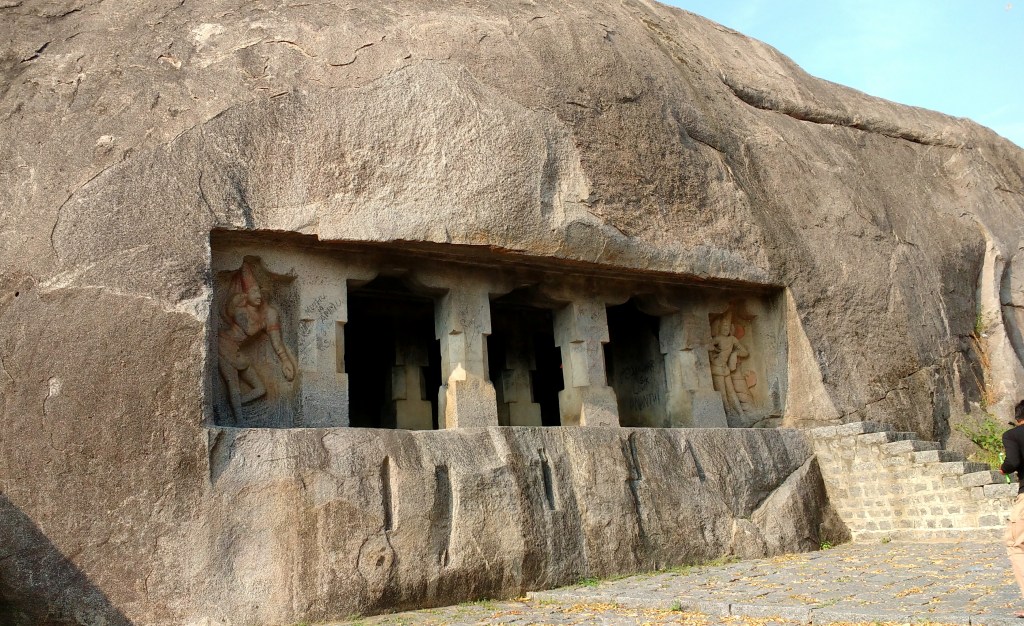
  1. Rock-cut temples – Mahendravarman style
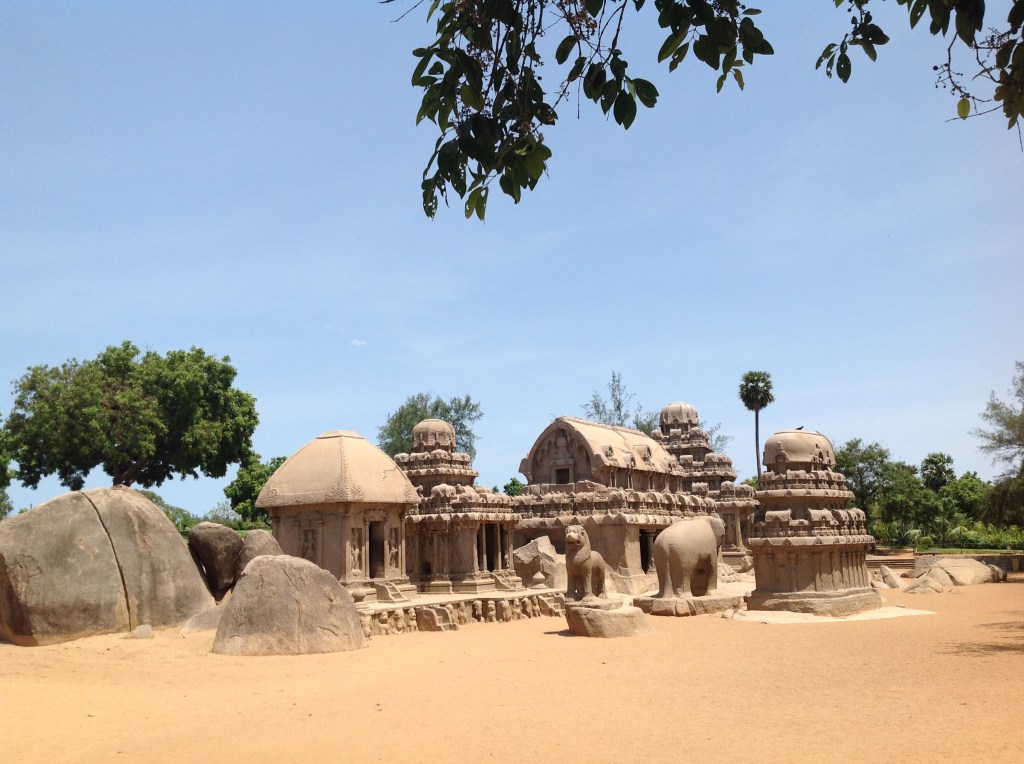
  2. Monolithic Rathas and sculptural Mandapas – Mamallan style
  3. Structural Temples – Rajasimha style and Nandivarman style

Mahendra style

The best example of Mahendravarma style monuments are cave temples at Mamdagapattu,Mahendravadi,Mamandur,Dalavanur, Tiruchirapalli,Callam,Tirukazhukkundram and Siyamangalam.

Cave Temple Mamdagapattu

Mamalla style

The five Rathas,popularly called Panchapandavar rathas, signify five different style of temple architecture.Each ratha has been carved out of a single rock.So they are called monolithic.The popular Mandapas(pillars pavilions)they built are Mahishasuramardhini mandapam,Thirumoorthi mandapam and Varaha mandapam.

Panchapandavar Rathas

The most important among the Mamalla style of architecture is the open art gallery.Several miniature sculptures such as the figure of lice-picking monkey, elephants of huge size and the figure of the ascetic cat have been sculpted beautifully on the wall of a huge rock.The fall of the River Ganga from the head of Lord siva and the Arjuna’s penance are notable among them.The Great penance panel is considered to be the world’s largest open-air bas relief.

Rajasimha style

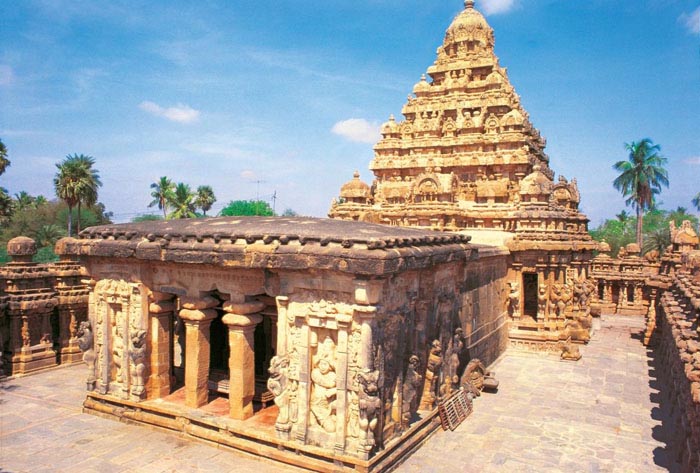
Narasimavarma II,also known as Rajasimha,constructed structural temples using stone blocks.The best example for the structural temple is kailasanatha temple at Kanchipuram.This temple was built by using sand stones.Kailasanatha temple is called Rajasimheswaram.

Kanchi Kailasanatha Temple

Nandivarma style

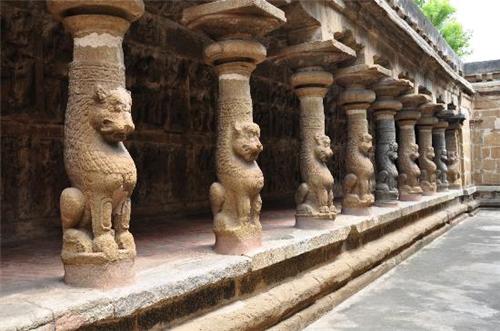
The last stage of the pallava architecture is also represented by structural temples built by the later pallavas.The best example is Vaikunda perumal temple at Kanchipuram.

Society and culture

The Pallava supported Jainism, Buddhism and the Vedic faith.They were great patrons of music, painting and literature.Some of the Pallava kings patronised the Azhwars and Nayanmars.These exponents of Bhakti Cult Preached a new form of Vaishnavism and Saivism.Among the Saivites were Appar and Manikkavasakar.Among the Vaishnatives were Nammazhvar and Andal.The Bhakti movement aimed at preaching a popular faith,in which prayers in Tamil were preferred to those in sanskrit.Women were encouraged to participate in the religious congregations.The Tamil devotional cult was competitive with Buddhism and Jainism.Therefore the latter suffered a gradual decline in most parts of Tamil Country.

Pallava Art

The Pallava kings had also patronised fine arts.The music inscriptions in Kudumianmalai and Thirumayam temples show pallava’s interest in Music.The famous musician Rudracharya lived during Mahendravarma I .The sculptures of this period depict many images in dancing postures.

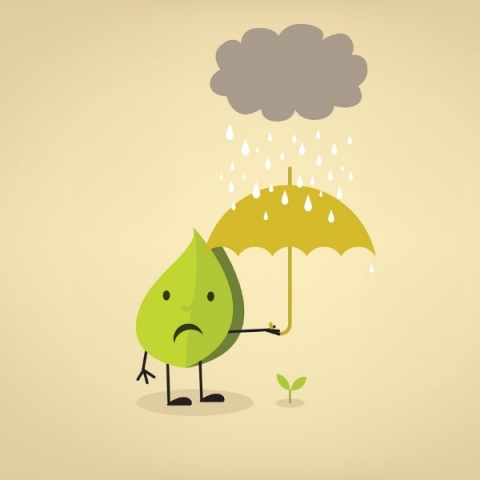
Acid Rain

“The unthinkable is that we’re distorting this atmospheric balance. We’re shifting the chemical balance so that we have more poisons in the atmosphere – ozones and acid rain on ground level – while we’re also changing the thermal climate of the earth through the greenhouse effect and – get this – simultaneously causing destruction of our primary filter of ultraviolet light. It’s incredible. Talk about the national-debt crisis – we’re piling up debts in the atmosphere, and the piper will want to be paid.”

~ Michael Oppenheimer

Introduction

Acid rain, or acid deposition, is a broad term that includes any form of precipitation with acidic components, such as sulfuric or nitric acid that fall to the ground from the atmosphere in wet or dry forms. This can include rain, snow, fog, hail or even dust that is acidic.

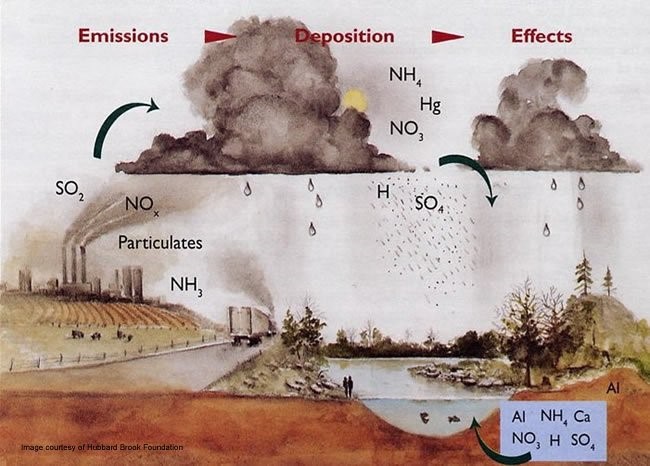
Acid rain is caused by a chemical reaction that begins when compounds like sulfur dioxide and nitrogen oxides are released into the air. These substances can rise very high into the atmosphere, where they mix and react with water, oxygen, and other chemicals to form more acidic pollutants, known as acid rain.

It can have harmful effects on plants, aquatic animals, and infrastructure.

Effects of Acid Rain

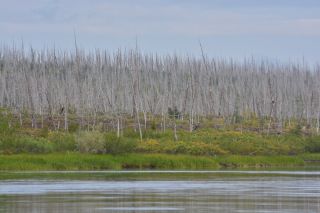
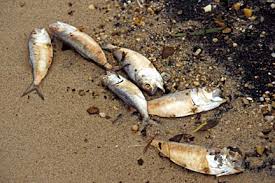
The ecological effects of acid rain are most clearly seen in aquatic environments, such as streams, lakes, and marshes where it can be harmful to fish and other wildlife. As it flows through the soil, acidic rain water can leach aluminum from soil clay particles and then flow into streams and lakes.

Acid rain has been shown to have adverse impacts on forests, freshwaters, and soils, killing insect and aquatic life-forms, causing paint to peel, corrosion of steel structures such as bridges, and weathering of stone buildings and statues as well as having impacts on human health.

Acid rain also causes the corrosion of water pipes. Which further results in leaching of heavy metals such as iron, lead and copper into drinking water.

Prevention

1. The only precaution that we can take against acid rain is having a check at the emission of oxides of nitrogen and sulphur.
2. We have so far seen the details of acid rain and its harmful effect on animals, plants and the monuments.
3. Being responsible citizens, one should be aware of the harmful effects they cause and of the industries which give out nitrogen and sulphur compound wastes unethically. 4.A great way to reduce acid rain is to produce energy without using fossil fuels. Instead, people can use renewable energy sources, such as solar and wind power. Renewable energy sources help reduce acid rain because they produce much less pollution.

Acid Rain in India

Analysis of rainwater samples from Nagpur, Mohanbari (in Assam), Allahabad, Visakhapatnam and Kodaikanal in the decade 2001-2012 showed a pH level varying from 4.77 to 5.32, indicating that these places have actually been receiving ‘acid rain’. Rainwater with pH below 5.65 is considered acidic.

As energy requirements in India will grow rapidly in tune with the economy, coal dependence is expected to increase threefold over the current level of consumption, making the clouds of acid rain heavier over many highly sensitive areas in the country – the northeast, parts of Bihar, Orissa, West Bengal ,etc ,.

The rains in the Indian Ocean and the Arabian Sea and the Bay of Bengal have become acidic. Studies show the importance to regularly monitor more places for acid rains. But the mechanism to study acid rains is at present inadequate in India. imd stations are not located in the most polluted areas in the country.

Link