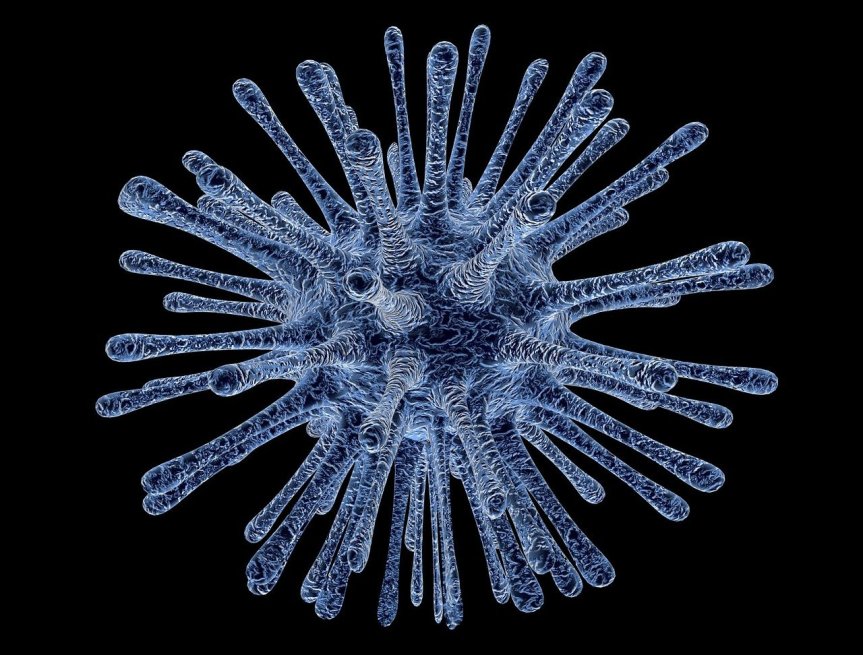
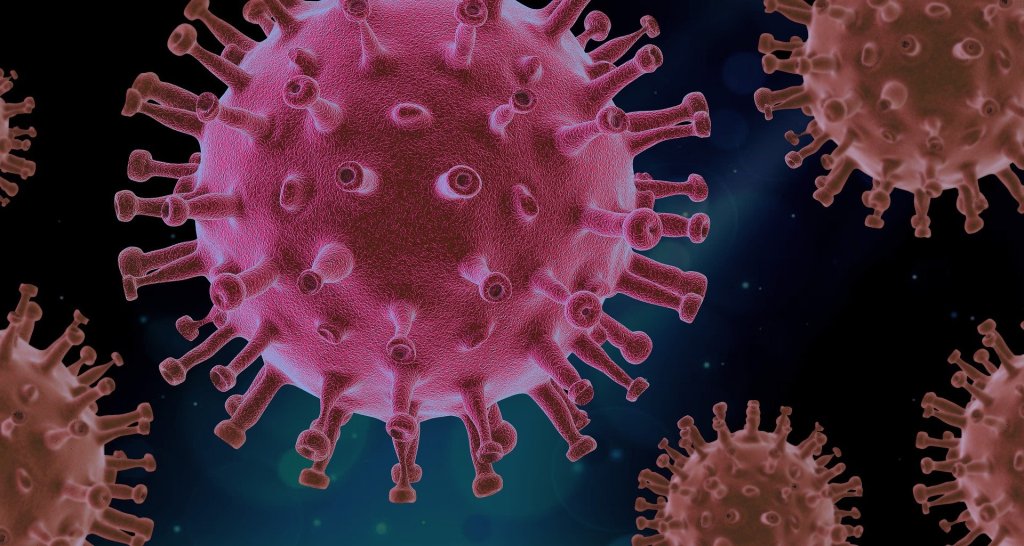
We are in the middle of a pandemic which is caused by a virus. Viruses are ultramicroscopic, disease causing entity of organic matter, It can replicate or multiply only in the presence of a living host cell. They are called as entity because they exhibit both living and non living characters and it is difficult to conclude them as any one.
history
Russian botanist Dimitri Ivanovskii reported the virus for the first time in 1892. He explained tobacco mosaic virus. In 1898 M. W. Beijerinek recognized that viruses were smaller than bacteria, and they can easily pass through bacterial filters. In the same year, Friedrich Loeffler and P. Frosch, in Germany demonstrated the cause of Foot and mouth disease in cattles are due to viruses. In 1900 Walter Reed et al. explained yellow fever disease in humans was due to viruses. And in1915 F. W. Twort in England discovered bacteriophages.
In 1935 W. M. Stanley isolated Tobacco mosaic virus and crystalized. He explained that virus also contain proteins. In 1936 Bawden and Pirie demonstrated viruses to be nucleoproteins, they are made up of Nucleic acids and proteins. The major development was determining the ultrastructure of TMV by x-ray diffraction which was accomplished by R. Franklin and A. kling. Discovery of cyanophages was done in 1963.
What are the general characters of a virus
They are very small, so small that even they are not visible under compound microscope. Their size varies from 20nm to 400nm.
they are obligate parasites, They multiply only in the presence of a living host cell.
Viruses do not contain any type of cells.
Like Bacteria, viruses can not be cultured in labs on a synthetic media.
Viruses are highly specific. While infecting they just do not infect randomly any cell. They find specific cells for them which varies from virus to virus. They are also specific to tissues, organ, organism and species.
Viruses can be inactivated by heat or chemicals.
Viruses also lack metabolism. They are totally dependent on the host cell.
Viruses undergo mutation very often.
Living characters shown by viruses:
Are viruses living? we don’t know. But they contain nucleic acids which we consider the basis of life. As every other organism they have definite form and size. They grow and reproduce in the host cell. They can infect the host cells and cause diseases. They show mutation and inherit their characters to their reproduced offspring. These call characters are shown by living organisms.
non living properties of viruses:
Even though they exhibit some of the living characters as mentioned above they lack cellular organizations like other organisms. This arises the biggest confusion. They behave like non living outside the host cell. Some of the viruses can be crystalized and stored in bottles and jars. And they lack metabolism which is the basic characteristic of a living organism.
how viruses are classified?
The types of virus based on the hosts they infect includes, Bacteriophages- Which infect bacteria, Cyanophages- which infect blue green algae, phytophaginae-which infect plants and the Zoophages- which infect animals.
a bacteriophage
The viruses are considered to be DNA virus if the nucleic acid present in them is DNA and RNA virus if the nucleic acid present is RNA.
No matter how they are classified or what are their features, viruses are unique and mostly dangerous to animals. Even though vaccinations can help, Avoiding exposure to them will be the best way to keep oneself safe.
We have started our view on Area-51 in the previous blog. This blog is a continuation of that.
Many people were curious to know what was inside Area-51. But the government didn’t let any information go out. At that time, an American conspiracy theorist named ‘Bob Lazer’ claimed that he had worked inside Area-51 and also told that inside Area-51, the traped Aliens that came to Earth and were doing research on them. Many believed him, many did not. But his claim is that they were doing reverse engineering on alien technologies. He said that the alien bodies, their tools and the spacecraft of aliens were taken into control by the USA government and research works on those items was going underground. Many questioned whether he is a credible person. Many believed him. He claims that he studied in MIT. But there was no evidence or certificate that proves that he studied in MIT. He said that the USA government deleted all his records and tried to portray him as a lier and looser. He was strong on his claim that there were aliens inside Area-51. Like his say, some random incidents happen at times to make people think that there are aliens inside Area-51.
In 2019, a 21- year old guy named Matty Roberts, who calls himself a gamer, has watched a documentary in which Bob Lazer spoke and he came to an idea to organise an event in Facebook. The event was planned such that on September 20, 2019, a big mass of people should run towards Area-51. If they run in masses, no one could stop them. That was his plan. As a shock to him, that plan went viral. It reached people worldwide. 20 lakh people from many corners of the world supported him and said that they would come for this event.
The American government warned them when that event plan went viral. They said the army would shoot every person whoever comes to that event. The government had shut the air strips that were near to Area-51 and maintained a high security.
In a small town called ‘Rachel’ in that desert, around 150 people were living. That town was near to Area-51. When the people of the town knew that lakhs of people were planning to go there on September 20, they arranged all the facilities for the people coming. They planned to make a small business out of this event. But what happened was something disappointing to them. Out of the 20 lakh people who supported the event and told that they would come there, only 500 went there. Many went from foreign and European countries. They had to get immigration pass, land on a distant airport and take many kilometres of car travel and walk through the desert to get near to the gates of Area-51. Out of them, only 45 reached the Area-51. But they too came back on seeing the cops with gun. They also had permission even to kill people trying to entry Area-51. At last, the event was a failure. That made people to realise that everything in the internet is not always serious.
The Area-51 story still remains a mystery. Still there are people saying that it is an army base of the USA, some saying that nothing is there and the government tries to fool other nations by hiding something that is not real. But still the story continues. The government didn’t reveal anything to the people.
The Indian Air Force, also known as Bharatiya Vayu Sena is the air arm of the Indian Armed Forces. Its key role is to keep the Indian aerospace resistant to attacks and manage aerial warfare during the conflict.
Established on October 8, 1932, it possessed the strength of 25 soldiers of which 19 were combat pilots. Ever since then, the air force has gone through extreme modernisation and expansion, both in the strength of man and technology.1. With around 1,70,000 personnel and 1,500 aircraft, it is the fourth largest air force in the world after the US, China, and Russia
2. It is also the seventh strongest Air Force in the world, better than that of Germany, Australia and Japan
3. The IAF flag, adopted in 1951, is blue in colour and contains the National Flag in the first quadrant and a roundel of the Tricolour
4. Its crest is considered to be of great historical and sentimental value and is approved by the President of India
5. Its motto Nabha Sparsham Deeptham is taken from the eleventh chapter of the Bhagvad Gita. The way Lord Krishna shows his divine form to Arjuna, in a similar way, the Indian Air Force aims to overwhelm adversaries with aerospace power to defend the nation
6. It has its own museum in New Delhi. It has a rich collection of memorabilia of Indian Military Aviation and displays the history of the Indian Air Force7. The chief of the Indian Air Force is Air Marshal Birender Singh Dhanoa. He was commissioned the position on January 1, 2017.
8. Arjan Singh is one of the most respected Indian Air Force Marshals. In recognition of his services, he was awarded a ‘Five Star’ rank in the year 2002
9. The latest addition to the Air Force arsenal, Mirage 2000, French single-seated air defence and multi-purpose fighter jet, is powered by a single engine with a maximum speed of 2,495 kilometre per hour. On external stations, it carries two 30mm integral cannons and two Matra Super 530D medium-range and two R-550 magic ll close combat missiles
10. From October 1, 1993, to December 21, 1994, the IAF took part in peacekeeping duties in Somalia as part of the Indian contingent supporting UN operations.It has been over eight decades that the Indian Air Force has been shielding the country and its people. The IAF has the core purpose of safeguarding Indian territory and national interests from all threats in connection with the other branches of the armed forces by protecting Indian aerospace.
Fear is one of the seven universal emotions experience by humans all over the world. Any fear arises with the threat of harm, physical, emotional, or psychological – from a real or imaginary situation.
Usually perceived as a negative emotion, fear can also be positive and healthy. Fear serves as a survival instinct helping humans in recognizing situations that can be harmful or dangerous.Fear makes one foggy and makes it impossible to think clearly or make the correct decision. However, some people enjoy fear and gain pleasure due to the adrenaline rush experienced in some situations.
Fear will hold one back from achieving victories and significant accomplishments. Everything that one does in life will strike a little bit of fear in their hearts; however, overcoming the fear and giving one’s best is the most satisfying feeling. Don’t let your fears stop you from fulfilling your dreams.
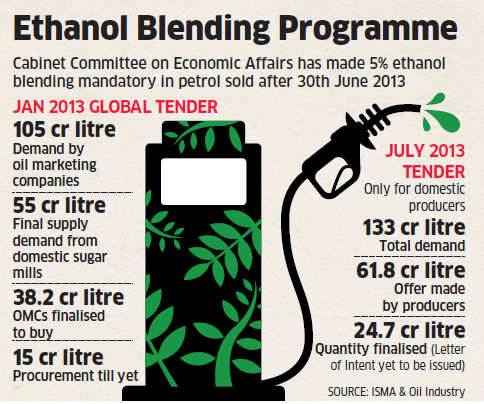
Recently the central government has released an expert committee report on the Roadmap for Ethanol Blending in India by 2025.
The roadmap proposes a gradual rollout of ethanol-blended fuel to achieve E10 fuel supply by April 2022 and phased rollout of E20 from April 2023 to April 2025.
What makes Ethanol so important?
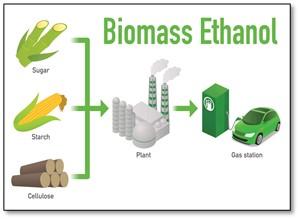
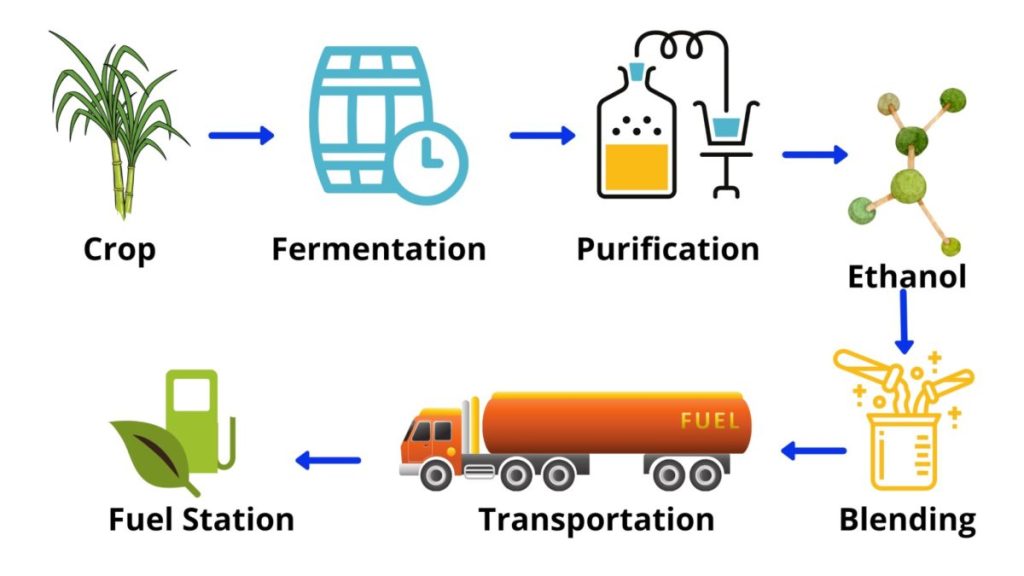
Ethanol is one of the principal biofuels, which is naturally produced by the fermentation of sugars by yeasts or via petrochemical processes such as ethylene hydration.
Ethanol can be produced from sugarcane, maize, wheat, etc which are having high starch content. In India, ethanol is mainly produced from sugarcane molasses by fermentation process.
Reasons for Ethanol Blending
Energy Sufficiency – It is estimated that a 5% blending can result in replacement of around 1.8 million Barrels of crude oil, Ethanol blending in fuels could reduce our dependency on imported fuel.
Green Fuel – As the ethanol molecule contains oxygen, it allows the engine to more completely combust the fuel, resulting in fewer emissions and thereby reducing the occurrence of environmental pollution. The renewable ethanol content, which is a by-product of the sugar industry, is expected to result in a net reduction in the emission of carbon dioxide, carbon monoxide (CO) and hydrocarbons (HC) which can help us reach our green targets faster.
Incentives for Farmers – The oil companies will procure ethanol from farmers that benefits the sugarcane farmers.
Protection against the fluctuating oil prices – Since most of our fuel is imported Ethanol blending can reduce on the oil bill and protect us against the sky rocketing oil prices.
India’s Blending Target
The Government of India has advanced the target for 20% ethanol blending in petrol (also called E20) to 2025 from 2030.
Currently, 8.5% of ethanol is blended with petrol in India.
Hence the roadmap proposes a gradual rollout of ethanol-blended fuel to achieve E10 fuel supply by April 2022 and phased rollout of E20 from April 2023 to April 2025
Challenges for Ethanol Blending
Less Production: Currently, domestic production of bioethanol is not sufficient to meet the demand for bio-ethanol for blending with petrol at Indian OMCs. Sugar mills, which are the key domestic suppliers of bio-ethanol to OMCs, are able to supply only 57.6% of the total demand. Sugar mills do not have the financial stability to invest in biofuel plants.
Water Crisis – Since sugarcane is an water intensive crop it will cause an environmental damage.
Compromise on sugar crystals – Since the availability of the crop is less it will lead to companies concentrating on Ethanol production more than sugar leading to price hike of sugar.
Management Issues – Ethanol being a highly flammable liquid marks obligatory safety and risk assessment measures during all phases of production, storage and transportation, thus increasing the cost and risk factor.
Steps taken by the Government
The government of India has advanced the target for 20 per cent ethanol blending in petrol (also called E20) to 2025 from 2030.
The central government has released an expert committee report on the Roadmap for Ethanol Blending in India by 2025. The roadmap proposes a gradual rollout of ethanol-blended fuel to achieve E10 fuel supply by April 2022 and phased rollout of E20 from April 2023 to April 2025.
The Ministry of Petroleum & Natural Gas (MoP&NG) had instituted an Expert Group to study the issues such as pricing of ethanol, matching pace of the automobile industry to manufacture vehicles with new engines with the supply of ethanol, pricing of such vehicles, fuel efficiency of different engines etc.
The Cabinet Committee on Economic Affairs (CCEA) has approved Pradhan Mantri JI-VAN (Jaiv Indhan- Vatavaran Anukool fasal awashesh Nivaran) Yojana to create an ecosystem for setting up commercial projects and boost to Research and Development in Ethanol sector.
The three public OMCs Indian Oil Corporation Ltd. Bharat Petroleum Corporation Ltd. and Hindustan Petroleum Corporation Ltd. are currently in the process of setting up bioethanol plants.
Initiatives of the Corporates
Balarampur Chinni has planned to setup its 5th Distillery unit in Uttar Pradesh to produce ethanol.
Dalmia Bharat Sugar has planned to double its ethanol manufacturing capacity by January 2022.
Dwarikesh Sugar has planned to sell 0.05 billion litres of ethanol in FY22 vs 0.03 billion litres in FY21.
Conclusion
Bioethanol not only provides a clean source of energy, but also increases income to farmers and help meet the aim of doubling the farmers income by 2020 and prevent them from having to burn agricultural waste which can be a major source of air pollution.
It has not just helped us reduce the import bill, also reduced our carbon footprint.
Though Ethanol production from sugarcane is water intensive, hence the Government can focus on non-cane sources to produce ethanol. Alternative feedstock like agricultural waste, recycled cooking oil, provides for more environmentally friendly bio-fuels.
India has an untapped resource of Ethanol, efficient use of resource could help the economy in huge. We can start utilising our resource by incentivising both public and private players to set up ethanol production facilities.
On July 11, Virgin Galactic will make a giant leap toward commercial suborbital spaceflight. The company will launch its first fully crewed flight of its SpaceShipTwo space plane Unity with a special passenger on board: the company’s billionaire founder Richard Branson.
Branson, three crewmates and two pilots will launch on the historic flight after being carried into launch position by Virgin Galactic’s carrier plane VMS Eve. They will take off from the company’s homeport of Spaceport America in New Mexico, with a live webcast chronicling the flight. Here’s everything you need to know about the mission, which Virgin Galactic has dubbed Unity 22.
WHAT TIME IS VIRGIN’S GALACTIC LAUNCH & AND CAN I WATCH?
Virgin Galactic has not released a specific time for the actual Unity 22 launch, but the company has announced it will begin webcasting the mission at 9 a.m. EDT (1300 GMT). And it looks like it’s going to be fun. The crew will walk out to the ship about an hour earlier.
Stephen Colbert, host of The Late Show on CBS, will host the webcast along with singer Khalid (who will debut a new single during the launch), former Canadian Space Agency astronaut Chris Hadfield and future Virgin Galactic astronaut Kellie Gerardi, who will launch on a research flight in 2022.
The webcast will begin with the Unity spacecraft and its carrier plane taking off from its runway at Spaceport America, which is located 55 miles (88 kilometers) north of Las Cruces, New Mexico.
Branson has stated that the entire flight will take about 90 minutes, including the ascent up to launch position, release, flight to space and glide back to Earth for a runway landing at Spaceport America.
Virgin Galactic will launch six people on the Unity 22 flight, although the spacecraft is designed to carry up to eight people (two pilots and six passengers).
Unity 22’s crew includes four mission specialists:
Sirisha Bandla, Vice President of Government Affairs and Research Operations at Virgin Galactic. She will evaluate the human-tended research experience via an experiment from the University of Florida that requires several handheld fixation tubes to be activated at various points in the flight profile.
Colin Bennett, Lead Operations Engineer at Virgin Galactic. He will evaluate cabin equipment, procedures and the experience during the boost phase and weightless environment inside Unity.
Sir Richard Branson, founder of Virgin Galactic. Branson will evaluate the private astronaut experience. He will receive the same training, preparation and flight as Virgin Galactic’s future ticket-buying astronauts and use the flight to fine ways to enhance the experience for customers.
Beth Moses, Chief Astronaut Instructor at Virgin Galactic. She will serve as cabin lead and test director in space. Her tasks include overseeing the safe execution of the test flight objectives. Moses has launched on Unity before.
Two veteran Virgin Galactic pilots will be at the helm of Unity during the launch. They have both launched to space on Unity before and are:
Dave Mackay: Mackay is Virgin Galactic’s chief pilot and grew up in the highlands of Scotland. He is a former Royal Air Force pilot and flew for Branson’s airline company Virgin Atlantic before joining Virgin Galactic.
Michael Masucci: Michael “Sooch” Masucci is a retired U.S. Air Force colonel who joined Virgin Galactic in 2013 who racked up over 9,000 flying hours in 70 different types of airplanes and gliders during more than 30 years of civilian and military flight.
Two other pilots will fly the VMS EVE carrier plane that will carry SpaceShipTwo into launch altitude. They are:
Frederick “CJ” Sturckow: A former NASA space shuttle commander who joined Virgin Galactic in 2013 with Masucci. A retired Marine Corps colonel, he was the first NASA astronaut to join the company and flew four space shuttle missions.
Kelly Latimer: Latimer is a test pilot and retired lieutenant colonel in the U.S. Air Force who joined Virgin Galactic’s pilot corps in 2015. She was the first female research test pilot to join what is now NASA’s Armstrong Flight Research Centre.
The primary objective for Unity 22 is to serve as a test flight for future passenger flights by Virgin Galactic. As its number suggests, this will be the 22nd flight of Unity, but only its fourth launch to space.
The four mission specialists will each evaluate different experiences that Virgin Galactic has promised its future customers, many of whom have already reserved trips to space with the company at $250,000 a seat.
Bandla, for example, will test the experience of performing experiments aboard Unity during different phases of the flight, including the weightless period. Branson will take note of the flight as a paying passenger to look for ways to enhance the trip for ticket holders looking for the experience of a lifetime.
Moses is Virgin Galactic’s Chief Astronaut Trainer and will ensure everyone is safe in their tests while Bennet will examine Unity’s cabin performance to look for potential enhancements.
This mission is a critical flight or Virgin Galactic, which Branson founded in 2004. VSS Unity is the company’s second SpaceShipTwo after the first, VSS Enterprise, broke apart during a 2014 test flight, killing one pilot and seriously injuring another. Virgin Galactic has made numerous safety upgrades to prevent such an accident from happening again.
The mission will begin with takeoff from Spaceport America, where Virgin Galactic has built its “Gateway to Space” terminal to serve its future customers. The crews of Unity and Eve will walk out to their vehicles at about 8 a.m. EDT (6 a.m. local time, 1200 GMT). They’ll be wearing custom Under Armour flight suits made for Virgin Galactic.
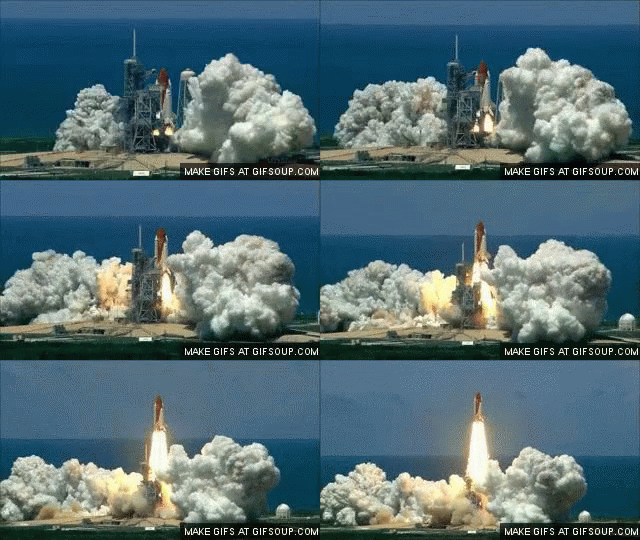
After takeoff, the carrier plane VMS EVE will haul the SpaceShipTwo VSS Unity (short for Virgin Space Ship) to an altitude of about 50,000 feet (15,000 meters), when it will drop the the spacecraft.
Virgin Galactic’s first test passenger Beth Moses looks out the window of the VSS Unity during a test flight with pilots Dave Mackay and Michael “Sooch” Masucci, on Feb. 22, 2018. (Image credit: Virgin Galactic)
After separation, Unity will ignite its hybrid rocket motor, which uses a mixture of solid and liquid propellant, to begin the boost phase. This will carry Unity to its target altitude above 50 miles (80 kilometers), where the pilots and crew can expect up to 4 minutes of weightlessness. They will exist their seats and enjoy sweeping views of the Earth below through the many round windows that dot the space plane’s fuselage.
After that short encounter with weightlessness, the crew will climb back into their seats as Unity prepares to return to Earth. Pilots Mackay and Masucci will have “feathered” the spacectraft’s twin tail booms to provide stability during atmospheric reentry.
The feathered tail will then be locked back into place for the glide back to Earth, which will end with a runway landing at Spaceport America. The entire flight, from takeoff to landing, should last about 90 minutes, Branson has said.
WILL VIRGIN GALACTIC REALLY REACH SPACE WITH UNITY 22?
Virgin Galactic’s VSS Unity spaceliner captured this view of Earth during the vehicle’s first trip to space, on Dec. 13, 2018. (Image credit: Virgin Galactic)
Virgin Galactic will launch Unity to an altitude above 50 miles (80 km), which NASA, the Federal Aviation Administration and the U.S. military classify as space. They will earn astronaut wings for reaching that height.
Another widely recognized boundary of space, the Kármán line, is at an altitude at 62 miles (100 km) above Earth. The SpaceShipTwo VSS Unity won’t reach this milestone, which has led Virgin Galactic’s competitor Blue Origin (which does fly higher than 62 miles) to call out Virgin Galactic for missing that mark.
WHERE DOES VIRGIN GALACTIC LAUNCH SPACESHIPTWO FROM?
Click here for more Space.com videos…Sorry, the video player failed to load.(Error Code: 101102)Advertisementhttps://e42edf55977935dba9fbedb9fb4dde49.safeframe.googlesyndication.com/safeframe/1-0-38/html/container.html
Virgin Galactic initially launched SpaceShipTwo test flights from the company’s facilities at Mojave Air and Space Port in California. However, in 2020 the company moved Unity and its carrier craft to its permanent home at Spaceport America, where it plans to fly regular passenger flights beginning in 2022.
Spaceport America is located near Las Cruces, New Mexico and is home to Virgin Galactic’s “Gateway to Space” terminal, a welcome center and waiting room for ticketed passengers preparing for trips to space. It also sports a large hangar designed to fit multiple SpaceShipTwo spaceplanes and the VMS Eve. Virgin Galactic has also built a new vehicle, the SpaceShip III VSS Imagine.
WHEN COULD I LAUNCH TO SPACE WITH VIRGIN GALACTIC?
If you booked a trip with Virgin Galactic early and have one of the first reservations, you may get your chance to fly in space as early as 2022. If not, there’s a long wait ahead. And that’s assuming you can afford the $250,000 ticket price.
Virgin Galactic has said it plans to begin passenger launches in 2022 after a series of final test flights in 2021. The company does have hundreds of reservations for customer flights in backlog from eager would-be astronauts that have been waiting for over 17 years (since Richard Branson first announced Virgin Galactic in 2004) for the SpaceShipTwo to finally fly. The company paused taking new reservations after the 2014 accident.
Virgin Galactic is expected to resume taking reservations for “a limited number of tickets for future spaceflights” sometime this year, according to its website.
“ One cannot think , love , sleep well if one has not dined well”
People are leading a hectic lifestyle to make their ends meet. In the midst of all the chaos , they take no notice of their intakes and health. The unhealthy lifestyle followed is the primary cause for all the major health issues prevailing in most of us. Although we are aware of this act we cannot control the same due to the shortness in alternatives. The main reasons for poor quality food is use of pesticides and fertilizers which eventually causes soil and water pollution. This has caused many chronic disorders and deaths all over the world. The per hectare consumption of pesticides and fertilizers are increasing day by day.
“The Discovery of Agriculture was the first big step towards a civilized life “ – Arthur Keith
Naturophonic Farming:
Naturophonic farming is a method in which plants are grown with RO water. The farming method is completely soilless and thus the by-products are completely free from contamination. The world is developing at a rapid phase and as innovations flourish in every field , it is no wonder that the agricultural field is also improving its methodologies. Starting from vertical farming to soil less farming , many companies and individuals are laborious in bringing changes to the industry.
Gourmet Garden:
Gourmet Garden is a Bengaluru based company started in 2018 with an aim of providing high quality food products. They have a variety of products like fresh fruits , vegetables , mushrooms , herbs and spices to choose from . They are currently operating in metropolitan cities like Bangalore and Chennai and deliver their fresh produce to their customers.
Funding:
“Chase the vision , the money will end up following you” – Tony Hseih
The company has successfully completed 60,000 orders . It’s interesting to know that most of their orders come from their initial customers. A company which understands the customer needs well and develops a good customer base has more chances of raising funds. The initial funding of the company was done by Whiteboard Capital and Incubate Fund India. They have recently raised a fund of about Twenty Five Crores (25 Cr INR) in a series A funding in a funding campaign led by Beyond Next Ventures , M Ventures capital . Gourmet Garden is set to expand its business to other parts of India with the funding raised and thus deliver fresh foods all over the country.
Another night, another 3 a.m, another binge watch? You promised yourself to sleep on time tonight, didn’t you? It has become an addiction, isn’t it? Speaking on behalf of the masses, laying in bed at 2:30 a.m, in a cozy blanket and a bowl of popcorn by the corner is our most favorite thing to do! We will to survive another day feeling worn out, we will even curse ourselves for the never altering schedule we have! However, we will be the same owls at night who have their eyes glued to their television screen, just to find out what next happens in the mystery at hand.
We are the generation that has seen everything. Right from Nokia 650 to Iphone 12 pro, from going to the restaurants to having delivered through Swiggy and Zomato, from the time when 1.5 GB data was enough for a whole month to the time when same 1.5 GB data is less for 24 hours, from Congress to BJP, from living life to surviving life, from street cricket to PUBG, we have come a long way, haven’t we?
Waking up early to hang out with friends is not a thing anymore. Specific time for cartoons is a long gone history. Catching up on weekends is a thing of past now. We as a generation are competent, we have a clarity in our thoughts and power in our speech which probably our ancestors didn’t have. We stand up for what we think is right, we protest, we support, we have a specific drive for life. We are not among them who work within the limits, we are the ones who break the stereotype, invent something new, no matter how many questions are thrown upon us.
We believe in thinking outside the box. End game for us is not studying medical or engineering, it is about doing what we love, and we do not care how many of our society look down upon us. Our target is not a 9 to 5 job, we think bigger, we aim for everything that is considered impossible.
Yes we are the Netflix generation, yes we are not bound in the mornings and nights of twenty four hours, yes we like to do things our own way. Yes our dream one day is to prove to our elders that we can mould our lives the way we want it to be.
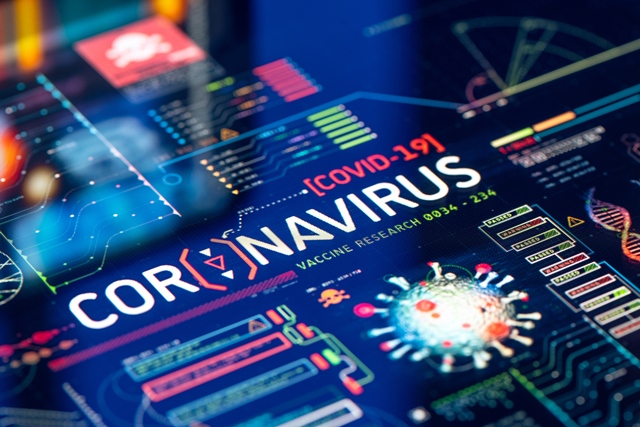
The novel Corona Virus epidemic has had an instant and serious impact on the globally integrated automotive industry. Prodromes include a disruption in Chinese parts exports, large-scale manufacturing interruption across the world.
Due to an upset in supplying chains, a shortage of chips was created, which enforced automobile makers to drop production. A Shortage of a very critical part known as semiconductor chips has been brought up as a key reason. Both global and Indian manufacturers had announced production circulation linked to the obtainability of chips and been feigned to apply brakes on mass production.
What are the circumstances?
A conventional component across automobiles, electronic goods, medical devices, and smart appliances is the integrated circuits (IC) chips. IC’s are the foundation of all modern electronic equipment and the chip is their brain and nerve center. The circuit is a conglomeration of all electronic components — resistors, transistors, capacitors — compressed into a small silicon chip and connected all together, to perform individual or numerous tasks.
Earlier to the covid-19 pandemic, about trillions of chips were being produced on average globally every year. That is about 120 chips per person, which would appear to a great extent. All in all only a small percentage of the global population uses high-end connected equipment holding many chips. Nevertheless, the chip shortage today has a lot to do with the epidemic and how it changes customer’s actions.
After countries by countries went under lockdown people started purchasing more and more electronic equipment such as computers, mobile phones, gaming devices as they have to stay home. As a result of the lockdown in which factories were shut down, automobiles cut down on chip purchases. This affected the supply and demand throughout the world. Now as demands for automobiles appear to be on stream, chip companies are scrambling to adjust the production and distribution of the sectors such as automobiles.
Carmaking uses chips in most of the parts of the automobile, in everything from the power steering wheel, and fuel injector sensors to the navigation system, and parking cameras. As cars are also getting additional technologies and smarter and more affiliated electronic devices and equipment today, account for 40% of the cost of a new internal combustion engine car, up from less than 20% from last two decades, chips account for a scale of this escalate.
why may not carmakers hoard up?
At the last moment, the carmakers usually kept economical account holding and depended on an electronic industry contributing chain to nurture the production lines as per the opportunity. There can be two objectives behind that:-
(1) Firstly, constant reduction in the cost of production.
(2) Secondly, advancement in the processing powers of chips.
The counts of transistors going on an increase in the IC chips have doubled every year. This fact is widely known as Moore’s Law signifies the smaller device with substantial processing speeds.
Nevertheless, plenty of the evolution in chips design exists on the non-auto edge. The auto industry undergoes and large stuck to basic chips that have the same function for years.
So, what happens nowadays?
Countries’ evidence in semiconductor production is functioning to safeguard the dispense of their chips. The Indian government also started again to make an old effort for having companies build semiconductor fabrication set-up in India or get hands-on semiconductor fabs outside India. The Center’s primary effort on making India self-made for semiconductor fabs has overall been imposed severely by the company’s request to protect inevitable expenditures with different sops.
The Indian Navy is the naval branch of the armed forces of India. With 55,000 men and women, including 5,000 naval aviation personnel and 2,000 Marine Commandos (MARCOS), it is the world’s fifth largest navy. The Indian Navy currently operates more than 155 vessels, including the aircraft carrier INS Viraat.
India uses its navy to enhance its international relations through joint exercises, port visits, and humanitarian missions, including disaster relief. The Indian Navy is increasing its capabilities as a true blue-water navy; the Indian Navy’s doctrine states that this is for the collective good of nations.
The Indian Navy sees several principal roles for itself:In conjunction with other armed forces of the union, act to deter or defeat any threats or aggression against the territory, people or maritime interests of India, both in war and peace;
· Project influence in India’s maritime area of interest, to further the nation’s political, economic and security objectives;
· In cooperation with the Indian Coast Guard, ensure good order and stability in India’s maritime zones of responsibility.
· Provide maritime assistance (including disaster relief) in India’s maritime neighborhood.· To play a key role as part of ‘a pluralistic security order’ for a better world.
The Indian Navy is well known to provide emergency relief to the marooned due to natural cause or conflicts in and around the Indian Ocean.
Each of the three Naval Commands has an active Flag Officer Commanding in Chief. The commander of the Navy is the Chief of Naval staff (CNS).
The Indian Navy is divided into the following broad Categories:• Administration
• Logistics and Material
• Training
• The Fleets• The Naval Aviation
• The Submarine Arm
The Marine Commando Force (MCF) known as MARCOS is a Special Forces unit that was raised by the Indian Navy in 1987. Modeled after the US Navy SEAL and the Royal Marines it was created to handle reconnaissance, raids and counter-terrorism in a maritime environment. The Indian Navy conducts naval exercises with friendly navies strengthening bilateral relationships with other navies and nations.
Some such exercises take place annually like the Exercise VARUNA with the French Navy, KONKAN with the British Royal Navy, INDRA with Russian Navy, MALABAR with the U.S. Navy, and SIMBEX with Republic of Singapore Navy. The Indian Navy also conducted exercise with the Chinese PLAN in 2003 and with various other navies.India conducted TROPEX (Theatre-level Readiness Operational Exercises) 2007 in which, the new doctrine of influencing the land and air battle in support of Indian Army and the Indian Air Force was validated . Indian Navy conducted naval exercise with JMSDF and U.S Navy in the Pacific and also exercised with Chinese Navy.
The Indian Navy regularly conducts adventure expeditions, the most remarkable among the various adventures being the sailing ship and training vessel INS Tarangini circumnavigating of all the different ports belonging to different countries this was done intending to foster good relations with various other nations, she returned to India after visiting 36 ports in 18 nations. This helps to bridge gaps between nations and develop strong political and military relations.
The men in white are the ones responsible to safeguard coastal boundaries around India and are the very reason we sleep peacefully. Their never ending determination will always ensure a safe and bright future for India. No wonder there are a million Indians waiting to join the Indian Navy.
Indian armed forces are divided into three parts – Indian army, Indian Airforce and the Indian Navy. Indian army is the land-based unit, while Indian Airforce deals in air defence and Indian Navy is the naval unit. Our Indian army is the second largest in the world with about 1.23 million personnel on active rolls and another 9.6 lakhs in reserves.
Indian army is mainly responsible to protect the country against land based attacks. It also lends a helping hand to other agencies in dealing with terrorism, tackling emergency situations in the country and also rescuing people in case of natural calamities like flood, earthquake etc.
The current chief of army staff (COAS) is General Bipin Rawat (as of 2018). As Indian army is very huge, it is divided into regiments. Some important regiments are Punjab regiment, Madras regiment, Rajputana rifles, Sikh regiment etc. It also has its own intelligence unit, known as “Military Intelligence” or “MI” in short.
Indian army before independence (under British rule) had participated in World War I and II. After independence it has also fought many full-fledged wars like the Kargil war (1999), Bangladesh liberation war (1971), India -Pakistan war (1965), India-China war (1962) and first Kashmir war (1947). Besides these, Indian army has also handled some smaller conflicts like Siachen conflict (1984), Operation Polo (1948), India-China conflict (1967) etc.
There is no doubt that our Indian army is one of the best armies in the world.
The world has just started recovering from the deadly Covid-19 virus, even though it is a thing to be happy about, there are still sectors that are trying to rise including the entertainment industry (movie productions, theaters, film cities) from the hard hit by the pandemic.
What happened to the Cinema theaters of India?
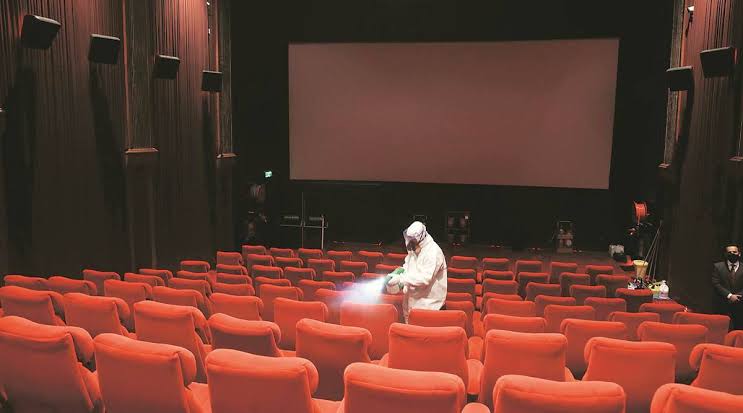
India cinemas, with 6780 single screens and 2,100 multiplexes, is going through dark months amid the Covid-19 pandemic. This pandemic has resulted in the death of more than 40% of the single screens across the nation. Even though, the theaters nation-wide have implemented rules and regulations to minimize the danger by separated seats with 50% occupancy and encouraging digital payments. It would not be right to mention that the theater halls are full, as there are still large groups of people in the country who are hesitant to step inside cinema halls. Contrast to this, cinema lovers feel heartbroken to stare at empty cinema halls. It is predicted by many that most of the theater halls wouldn’t be able to survive the pandemic, in other words, many theaters will go missing when the pandemic comes to an end. This great fall of theaters has led many stars of the cinema industry to go for OTT release of their movies.
A cinema hall being sanitized
Rise of OTT Platforms in India
The fall of movie theater industry has led to the tremendous growth of Over The Top platforms in India. The situation has not only made top actors run behind OTT platforms but has also made cinema lovers to subscribe to OTT platforms craving for new releases. Hence making the whole movie watching experience easier and more comfortable. Just a click, would start a movie. Letting the audience themselves set the ambience for the movie watching experience at home. OTT platforms let the audience to control the volume and go back and forth in the movie, which makes the movie-watching experience being more ‘customized’. The year 2020 has seen a growth of OTT platforms by 60% followed by 20% growth in the first 4 months of 2021.In the year2020, the revenue from subscriptions for OTT platforms in India stands at 19 billion INR. “We are stuck” says Ekta Kapoor, a famous producer from the North Indian Television Industry. Producers have got no choice other than opting for an OTT release rather than releasing their movies in a half-filled screen. The business is favorable for the producer when the movie is streamed on Netflix or Amazon Prime Video or Hotstar, as the money is made with no prolonged worries. Although, top stars of the film industry are against the idea of streaming their movies on OTT Platforms they have to do it for the sake of the producer who invested crores on the project.
Major Over The Top Platforms of India
Amazon Firestick
Amazon Firestick, also known as Amazon Fire TV, is a famous Indian micro-console developed by Amazon. It is an USB-like device used to stream videos and movies via internet, connected to the HD television. The firestick includes a remote to access. With more than 50 million users currently, it was released in India on April 19, 2017. It was introduced with 1080p and 4k picture quality along with Dolby Digital Plus 7.1 Surround Sound System. Amazon firestick created huge waves in the OTT industry by making users get access to watch their favorite movies more comfortably. The major perk of this gadget is that it is an user-friendly device which means, it can be understood and used easily by any age group. This feature made Firestick make millions in the market. As more than 70% of the elders in the country spend most of their time on watching television shows, producing a user-friendly gadget like Firestick will tempt the costumers to buy the product as easier accessibility is the important feature most of the people look forward to. Amazon firestick includes YouTube, which covers the kids and teenagers. India is currently emerging as the fastest growing market for Amazon’s firestick. As most of the content on the platforms are in Hindi and other local languages like Tamil, Telugu, Malayalam and Kannada there is a stronger engagement in India than other countries. Now the next big step from the company is that Amazon Fire TV is looking forward to collaborate with local companies to have the system pre-built into televisions. This would let the audience to watch their favorite local channel shows on smart TV.
A mobile phone, also known as a cell phone, is something that all of us are familiar with and own. When the mobile phone was initially introduced, it was used primarily for phone calls and messaging. Today, phones have a computing speed greater than even some larger technological devices like a computer or television, and are so technologically advanced that we do not have to bother with most physical actions that take up time and effort. All of it can be done through the phone and the internet available on it, whether it be banking, paying bills, ordering something, etc. Furthermore, we can stay connected through phones with friends and family on the other side of the globe, through means such as video calling and multimedia messaging. A world of social media has opened through the phone that helps us connect with people all over the planet. However, like every other device, the mobile phone also has its own disadvantages.
The Good and the Bad
Possibly the biggest advantage of the mobile phone is that it has helped us stay connected to the people in our lives. This has occurred not only in the form of voice calling, but now also through video calling and social media contacts. It makes day-to-day life so easy and efficient, and has a range of tools that are accessible to us. For example, we can check the weather, the route to our destination, and use a calculator; all on our phones. Furthermore, it is perhaps the biggest source of entertainment in today’s day and age, with a multitude of games and mass media all available on it. Apart from these, the access of internet through our phones has meant that we can perform all our functions and meet all our life’s requirements through this simple device. It acts as a source of a large amount of information about the world, access to things like YouTube and Twitter, and allows to conduct monetary transactions all through the touch of a finger. In this sense, it is an amazing multipurpose, all-in-one device which is a necessary in our lives.
However, the mobile phone can also be the source of distress and disadvantage in one’s life. People are prone to addiction to their mobile phones, and end up using them for hours on end. This means that there is a lack of real-life communication and interaction, as people get sucked into the online world of their phones. Perhaps the most pressing concern today, especially among teenagers, is social media addiction. People get addicted to social media which has wide-ranging effects on their personal health, both mental and physical. Mobile phones also may cause health hazards, as they emit blue light and radiation which can damage brain cells. Furthermore, the mobile phone has also been the primary cause for lack of privacy in today’s world, as all our personal information is available for everyone to see. It is easy to get pulled into the world inside our phones and waste countless hours of our time on it. The phones almost become our lives, and this means that losing our phones is almost equal to losing our lives.
Conclusion
The mobile phone is a fantastic and necessary invention, but we must keep in mind that it comes with its own curses. How the mobile phone affects our lives depends on how much importance we give to it and how much we use it. It is all about finding a middle-ground in such a case, where you are not addicted or living in in your phone, but also not completely neglecting it and how it can enrich your life and make it more convenient. Regardless of its shortcomings, it is impressive to see how far our society has come through the invention of the mobile phone. Now we have everything within the reach of our hands, and the mobile phone has brought about a revolution in the lives of people in this century.
Agriculture in India is livelihood for a majority of the population and can never be underestimated. Although its contribution in the gross domestic product (GDP) has reduced to less than 20 per cent and contribution of other sectors increased at a faster rate, agricultural production has grown. This has made us self-sufficient and taken us from being a begging bowl for food after independence to a net exporter of agriculture and allied products.
Total foodgrain production in the country is estimated to be a record 291.95 million tonnes, according to the second advance estimates for 2019-20. This is news to be happy about but as per the estimates of Indian Council for Agricultural Research (ICAR), demand for foodgrain would increase to 345 million tonnes by 2030.
Increasing population, increasing average income and globalisation effects in India will increase demand for quantity, quality and nutritious food, and variety of food. Therefore, pressure on decreasing available cultivable land to produce more quantity, variety and quality of food will keep on increasing.
India is blessed with large arable land with 15 agro-climatic zones as defined by ICAR, having almost all types of weather conditions, soil types and capable of growing a variety of crops. India is the top producer of milk, spices, pulses, tea, cashew and jute, and the second-largest producer of rice, wheat, oilseeds, fruits and vegetables, sugarcane and cotton.
In spite of all these facts, the average productivity of many crops in India is quite low. The country’s population in the next decade is expected to become the largest in the world and providing food for them will be a very prime issue. Farmers are still not able to earn respectable earnings.
Even after over seven decades of planning since the independence, majority of the farmers are still facing problems of poor production and/or poor returns. Major constraints in Indian agriculture are:
According to 2010-11 Agriculture Census, the total number of operational holdings was 138.35 million with average size of 1.15 hectares (ha). Of the total holdings, 85 per cent are in marginal and small farm categories of less than 2 ha (GOI, 2014). Farming for subsistence which makes scale of economy in question with majority of small holdings. Low-access of credit and prominent role of unorganised creditors affecting decisions of farmers in purchasing of inputs and selling of outputs Less use of technology, mechanisation and poor productivity for which first two points are of major concern Very less value addition as compared to developed countries and negligible primary-level processing at farmers level. Poor infrastructure for farming making more dependence on weather, marketing and supply chain suitable for high value crops. Future of agriculture is a very important question for the planners and all other stakeholders. Government and other organisations are trying to address the key challenges of agriculture in India, including small holdings of farmers, primary and secondary processing, supply chain, infrastructure supporting the efficient use of resources and marketing, reducing intermediaries in the market. There is a need for work on cost-effective technologies with environmental protection and on conserving our natural resources.
The reforms towards privatisation, liberalisation and globalisation affected inputs market at a faster pace. Agricultural marketing reforms after 2003 made changes in marketing of agricultural outputs by permitting private investment in developing markets, contract farming and futures trading, etc. These amendments in marketing acts have brought about some changes but the rate is less.
Along with this, the information technology revolution in India, new technologies in agriculture, private investments especially on research and development, government efforts to rejuvenate the cooperative movement to address the problems of small holdings and small produce etc are changing face of agriculture in India.
Many startups in agriculture by highly educated young ones show that they are able to understand the high potential of putting money and efforts in this sector. Cumulative effects of technology over the next decade will change the face of agriculture.
All the constraints in agriculture make the productivity and returns complex but still a high untapped potential is there in India’s agriculture sector.
Advantageous weather and soil conditions, high demand for food, untapped opportunities, various fiscal incentives given by the government for inputs, production infrastructure, availability of cheap credit facilities and for marketing and export promotion are attracting many individuals, big companies, startups and entrepreneurial ventures to do a lot of investments on innovations, inventions, research and development and on other aspects of business.
The efforts are being done to convert all the challenges in agriculture into opportunities and this process is the future of agriculture.
Key trends expected
1. Changing demand due to increase in incomes, globalisation and health consciousness is affecting and going to affect more the production in future. Demand for fruits and vegetables, dairy products, fish and meat is going to increase in future.
2. Researches, technology improvements, protected cultivation of high value greens and other vegetables will be more. There will be more demand of processed and affordable quality products.
3. More competition will be there among private companies giving innovative products, better seeds, fertilisers, plant protection chemicals, customised farm machinery and feed for animals etc in cost effective ways at competitive prices giving more returns on investment by farmers. Use of biotechnology and breeding will be very important in developing eco-friendly and disease resistant, climate resilient, more nutritious and tastier crop varieties.
4. Some technologies will be frequently and widely used in future and some will become common in a short time while some will take time to mature. For producing the same products in other way so as to use resources judiciously and using new resources also like hydroponics, use of plastics and bio-plastics in production. There will be more of vertical and urban farming and there will also be efforts in long term to find new areas for production like barren deserts and seawater.
5. Precision farming with soil testing-based decisions, automation using artificial intelligence will be focused for precise application inputs in agriculture. Sensors and drones will be used for precision, quality, environment in cost effective manner.
Small and marginal farmers will also be using these technologies with the help of private players, government or farmer producer organisations (FPO). Use of GPS technology, drones, robots etc controlled by smart phones etc can make life of farmers easy and exciting with good results. These advanced devices will make agriculture be more profitable, easy and environmentally friendly.
6. Use nano-technology for enhancement of food quality and safety, efficient use of inputs will be in near future. Nano-materials in agriculture will reduce the wastage in use of chemicals, minimise nutrient losses in fertilisation and will be used to increase yield through pest and nutrient management. IFFCO has already done successful tests in nano-fertilisers.
7. India has improved remarkably in its digital connectivity and market access has become very easy. The number of internet users is projected to reach 666.4 million in 2025. Farmers will be behaving more smartly with mobiles in hands and would be able to be more aware and connected with different stake holders. Government will be making wide use of digital technology for generating awareness among farmers, information sharing, government schemes using digital technology for direct transfers of money.
8. There will certainly be more work by government, village communities, agri startups and private players in conserving sharply depleting water resource. Use of digital technology can make revolution in this direction. There will be use of satellites, IoT, drones for better collection of data regarding soil health, crop area and yield which will make cost for insurers less with better estimations and system will be more exact and effective.
9. There will be more of niche marketers in operations, area, and crop specific small equipments which will make operations even at small farms easier and efficient. Food wastage will be less and better use of waste materials in agriculture will be more. Number of warehouses in private sector will be more and linkages between government and private warehouses will be increasing. This will help in balancing supply with demand and stabilisation of prices of agri-outputs in the market.
10. Retailing in agriculture will largely be digitalised. A study estimates that over 90 per cent of kirana stores across the country will be digitalised by 2025 with modern traceable logistics and transparent supply chain. Many players have already taking kiranastores to the door steps of consumers like Amazon and Jio Mart.
Question arises whether farmers will be able to make use of modern technologies in a country where education, holding size, infrastructure, low level of technology adoption and many other constraints are there.
Lakshya is a patriotic movie launched in 2004. The movie showcase how an aimless person who under the influence of his friend joined Army Academy. He ran away due to the frequent punishments he received there but returned with an aim of joining army. Due to his efforts in the Academy he joined the army where he led a team of 12 army officers and soldiers to a successful clash to defeat the Infiltrators and re acquire the territory occupied by them.
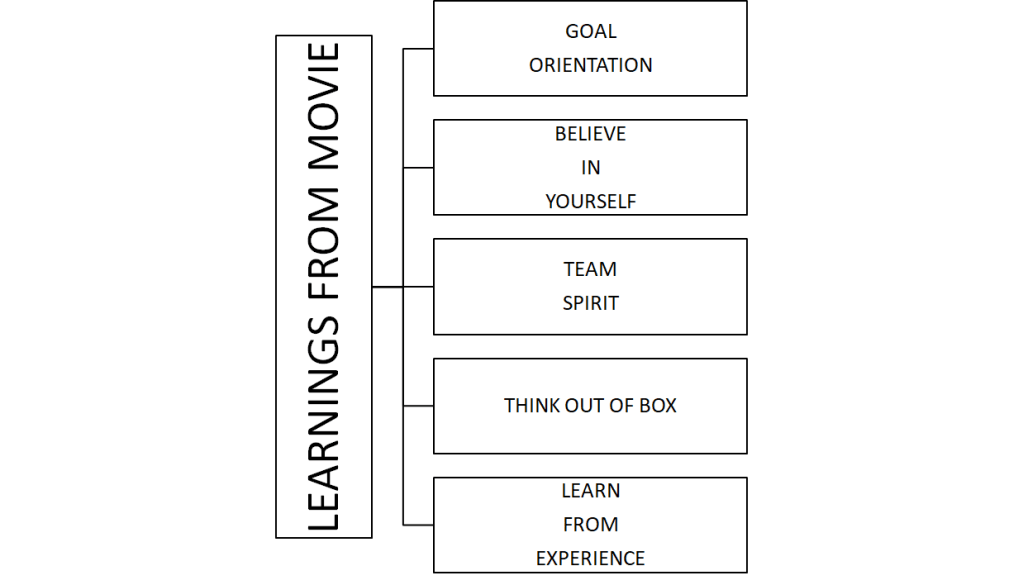
Goal Orientation
“Lakshya” as the name of the movie suggests the movie revolves around the value of having a goal in the life. Whether it be an individual, group, organisation all requires an aim to work upon. The protagonist of this film (Karan) was a lazy and aimless young man who has no goals for his future. He joined a Military Academy under the influence of his friend and as a result he ran away from the academy due to the punishments he had to face due to his undisciplined and lazy attitude. But after he firmly decided to join the army he returns, takes his punishment, becomes a disciplined and focused officer cadet and eventually commissions into the Army.
Believe in Yourself
To achieve a goal a person, need to have faith in himself/herself that he/she can achieve the goal and is ready to face all the challenges and hurdles that act as a barrier in the same. The person should follow the policy that “ I can, and I will.”
When a person builds a believe in himself/herself then this believe acts as a self motivation which plays a crucial role in achieving the individual goals and the goals of the organisation with whom he/she is associated.
In the movie the proctor along with other team members were able to climb a 1000-foot-high rock cliff of the mountain because of the determination and the self believe they proved that nothing is impossible.
Team Spirit
A single person can’t achieve an organisational goal on his own. He requires the support , unity and co-ordination of all his team members whether it be his senior or sub-ordinates. All the efforts are worthless if the aim is not achieved. A single person can never be expert in all the fields and requires the knowledge and experience of other members to achieve the goal. This team spirit helps to raise new and innovative ideas to make the path of achieving goal effective and efficient. It also helps to improve the interpersonal relationships between the employees of an organisation which is crucial for best output from an employee.
Henri Fayol in one of his Principles Of Management i.e. in the Principle of “Esprit De Corps” defines that an organization must make every effort to maintain group cohesion i.e. a feeling of unity in the organization. He adds that a conflict in the team member and division of team due to conflict is a serious issue and needs to be resolved at priority to achieve the objective of an organization.
In the movie a team of 12 army officers and soldiers had a faith in each other and had a feeling of unity which helped them to defeat the infiltrators









 Eduindex
You must be logged in to post a comment.