Can India’s rural economy change due to revival in agriculture and cottage industry?

so what comes to your mind when you hear the words economy ,agriculture and industries ,they are somewhere linked right ?we do have a basic idea that agriculture does contribute to our country’s economy and so do these industries but how do they?

India is known as an agricultural country, as most of the population of villages depends on agriculture. Agriculture forms the backbone of the country’s economy. The agricul­tural sector contributes most to the overall economic development of the country.

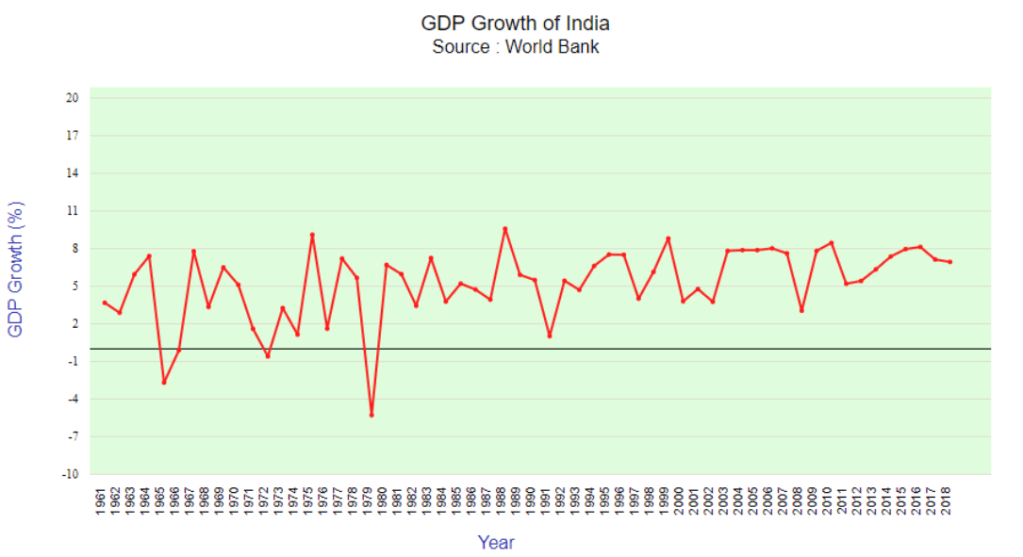
Did you know that historically, India was the  largest economy of the world for most of two millennia from the 1st until the 19th century .Since the start of the 21st century, annual average GDP growth has been 6% to 7%,and from 2013 to 2018, India was the world’s fastest major growing economy, surpassing China. . The economy slowed in 2017, due to shocks of “Demonetisation” in 2016 and the introduction of the goods and service tax in 2017.In 2020, pandemic has affected trade and India was the world’s 14th largest importer and the 21st largest exporter.

For a continuous duration of nearly 1700 years from the year 1 AD, India was the top-most economy, constituting 35 to 40% of the world GDP .Under British rule, India’s share of the world economy declined from 24.4% in 1700 down to 4.2% in 1950. India’s GDP (PPP) per capita was stagnant during the mughal empire and began to decline prior to the onset of British rule .India’s share of global industrial output declined from 25% in 1750 down to 2% in 1900. At the same time, the United Kingdom’s share of the world economy rose from 2.9% in 1700 up to 9% in 1870.

There is no doubt that our grievances against the British Empire had a sound basis. As the painstaking statistical work of the Cambridge historian Angus Maddison has shown, India’s share of world income collapsed from 22.6% in 1700, almost equal to Europe’s share of 23.3% at that time, to as low as 3.8% in 1952. Indeed, at the beginning of the 20th century, “the brightest jewel in the British Crown” was the poorest country in the world in terms of per capita income. -MANMOHAN SINGH

In the 1980s and early 1990s the tides began to change. Liberalisation came to India and a growing belief contrary to what Nehru believed, began to rise . By the turn of the 21st century, India had progressed towards a free-market economy, with a substantial reduction in state control of the economy and increased financial liberalisation .

 India experienced high growth rates, averaging 9% from 2003 to 2007. Growth then moderated in 2008 due to the global financial crisis. In 2003, Goldman Sachs predicted that India’s GDP in current prices would overtake France and Italy by 2020, Germany, UK and Russia by 2025 and Japan by 2035, making it the third-largest economy of the world, behind the US and China. India is often seen by most economists as a rising economic superpower which will play a major role in the 21st-century global economy.

India started recovery in 2013–14 when the GDP growth rate accelerated to 6.4% from the previous year’s 5.5%. The acceleration continued through 2014–15 and 2015–16 with growth rates of 7.5% and 8.0% respectively. For the first time since 1990, India grew faster than China which registered 6.9% growth in 2015. However the growth rate subsequently decelerated, to 7.1% and 6.6% in 2016–17 and 2017–18 respectively, partly because of the disruptive effects of 2016 Indian banknote demonetisation and to goods and service tax India. India’s GDP growth has been slowing rapidly, from a high of 8.3% in 2016 to just 4.2% in 2019.

Historically, India has classified and tracked its economy and GDP in three sectors: agriculture, industry, and services.
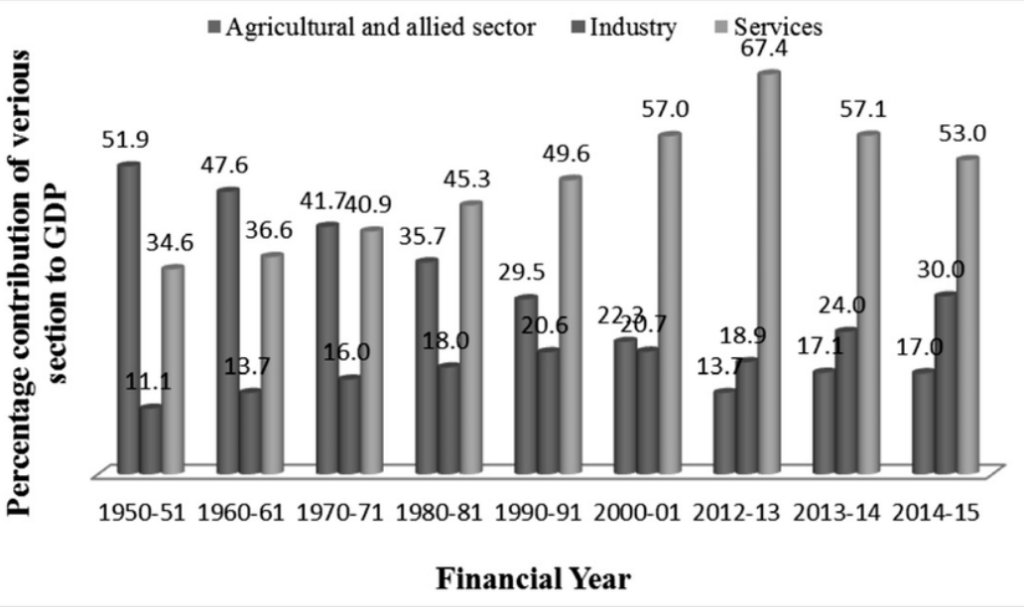
Agriculture and allied sectors like forestry, logging and fishing accounted for 17% of the GDP, the sector employed 49% of its total workforce in 2014.Agriculture accounted for 23% of GDP, and employed 59% of the country’s total workforce in 2016. As the Indian economy has diversified and grown, agriculture’s contribution to GDP has steadily declined from 1951 to 2011, yet it is still the country’s largest employment source and a significant piece of its overall socio-economic development. Crop-yield-per-unit-area of all crops has grown since 1950, due to the special emphasis placed on agriculture in the five-year plans and steady improvements in irrigation, technology, application of modern agricultural practices and provision of agricultural credit and subsidies since the Green Revolution in India. However, international comparisons reveal the average yield in India is generally 30% to 50% of the highest average yield in the world. The states of Uttar Pradesh, Punjab, Haryana, Madya Pradesh, Andhra Pradesh, Telangana, Bihar, West Bengal, Gujarat and Maharashtra are key contributors to Indian agriculture.

At around 1,530,000 square kilometres (590,000 sq mi), India has the second-largest amount of arable land, after the US, with 52% of total land under cultivation.

Agriculture farming in India is a century-old activity, and is currently the highest contributor to the GDP of India. Agriculture remains the largest contributor to the country’s GDP and farmers constitute 58% of India’s population .Farming is one of the oldest economic activity in our country.

As per 2018, agriculture employed more than 50% of the Indian work force and contributed 17–18% to country’s GDP.

The economic contribution of agriculture to India’s GDP is steadily declining with the country’s broad-based economic growth. Still, agriculture is demographically the broadest economic sector and plays a significant role in the overall socio-economic fabric of India.

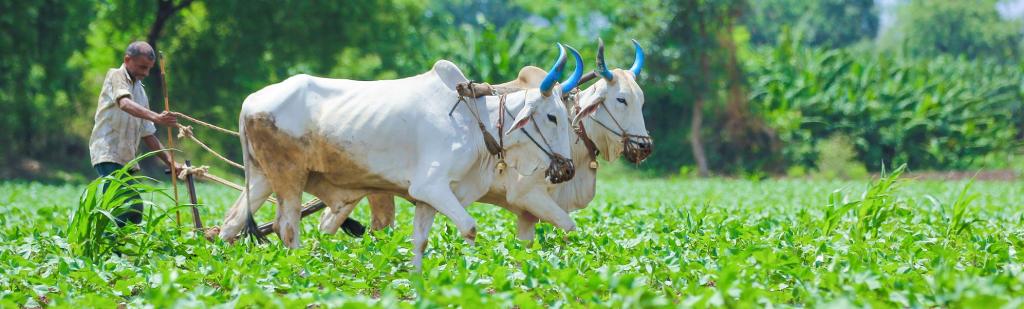
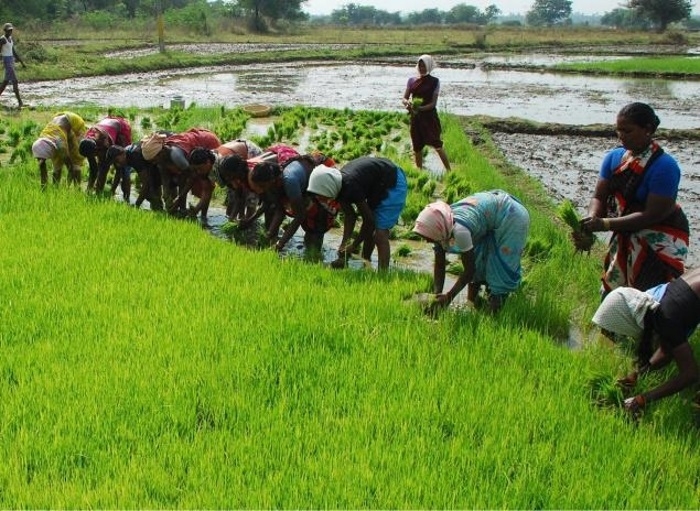
The main pillar of the rural economy is based on agriculture. Agricultural land and livestock are the primary means of production for people of the rural areas in any society. Livestock farming consists of the major part of the economy of the majority of people. It relies typically on labor-intensive methods for raising crops and healthy livestock. Livestock feed is shipped all over the country, and land is frequently needed for cultivation, farrowing, watering, and other activities.

 The advent of modern technology has also revolutionized the agriculture sector. Farmers are adopting more sophisticated techniques to get more production from small pieces of land. So the use of advanced techniques is urging the farmers to focus on small land in order to get more production. But the farmers also need support from the government and also they need help in hard times like no enough rainfall or over rainfall etc. The government must extend a helping hand towards the farmers ,they are the ones who work selflessly and for the sake of the whole country’s population and they do not worry about in which season they are working in ,they put all their hard work and efforts into their work and they are the ones who worship their proffesion .

The rural economy mainly depends upon agriculture. Even though traditional farming still exists, the use of advanced technology has revolutionized the agriculture sector. It has proved a blessing for small-scale farmers. They can adopt modern agricultural techniques to get more produce from their small farms. Organic farming is another window of opportunity for farmers. They can grow more food to generate better revenue. 

The cottage industry or the small scale industry plays a vital role in the rural economy of India. Majority of the population of India lives in rural areas; it is where the real India resides. Apart from agriculture, the cottage industry is the primary source of livelihood in rural India. Cottage industry or the small scale industry are those where the business is carried on at home with small numbers of workforce or labours . the members may be of the same family, religious groups or the community. Most of the workers of the small scale industry are the traditional artisans who have inherited their work as art from their ancestors.

In India, more than 74 per cent of the total population lives in the villages where their lot is linked with agriculture. They have to live in the villages as they cannot leave their fields which give them their ‘living’. Side by side they must be provided with some kind of cottage industries upon which they can depend during that period in which they remain idle and unengaged’.

After independence, our country has been taking gigantic strides towards industrialisation. Cottage industries can become and alternative means of employment for the people living in the rural areas. Cottage industries will be of benefit for our villages, which form the back bone of the nation.

The place of cottage industries in the national economy in the country has been unique since time immemorial. India was famous, in the past, for the wealth of the land and for the high artistic skill of her craftsmen. India was exporting wonderful jewellery and superfine embroideries to Europe. European merchants were attracted towards India more by her craft and industry than by the rich raw material.

It must not be forgotten that cottage industries are the back-bone of our rural economy and no rural uplift is possible without the protection of and encouragement to these small-scale industries. Apart from all other considerations, small-scale or cottage-industries are essential for providing employment to our tillers of soil in their leisure time or when they remain idle.

To improve and encourage the cottage-industry in our country we have to change the views of the general public. The people should be made interested in patronizing home-made goods. A ready market is a further urgency in this direction.

Rural Co-operatives and Rural Banks should be established and stabilized by the Government for advancing short-term loans on nominal interest.

Lastly, adequate marketing facilities should be arranged for them, as sale of goods has now-a-days become as complicated an affair as production itself.

Hence, the artisans must be helped to get the best price of their goods. Frequent exhibitions should be organized to enable the artisans to show their art and industry and give them impetus and inspiration to create still better patterns of handicrafts.

Basically the agriculture and cottage industries are the main sources of livelihood in India and they contribute most to our economy , we all know that these both professions are being practiced from very long period of time ,like around some centuries in India ,they have been contributing to the country’s economy from very beginning. the rural economy’s most percentage is received from agriculture and cottage industry and without their contribution our country’s economy might destroy or decline very rapidly ,even a small change in their contribution percentage might affect the economy of country ,but its economy right and GDP ,it wont stay constant there are many ups and downs ,in a year our GDP might good where as in the other it might be bad we cannot predict that ,there might be various reasons for the decline of GDP, like in 2017 it was demonitisation and in 2020 the pandemic hit us and it affected the whole world’s economy , and India’s GDP has been declined by 23.9% by 2020.
Agriculture and cottage industry are major contribution of rural economy , and for these people if government is trying to extend a helping hand to them then probably our economy might go to better figures and it’s a fact that our rural economy can be developed by agriculture and cottage industries and the Rural Economy in India is wholly agriculture based and it is of tremendous importance because it has vital supply and demand links with the other Indian industries. Agriculture is the main stay of the Indian economy, as it constitutes the backbone of rural India which inhabitants more than 70% of total Indian population.
Can India's rural economy change due to revival in agriculture and cottage industry?

so what comes to your mind when you hear the words economy ,agriculture and industries ,they are somewhere linked right ?we do have a basic idea that agriculture does contribute to our country’s economy and so do these industries but how do they?

India is known as an agricultural country, as most of the population of villages depends on agriculture. Agriculture forms the backbone of the country’s economy. The agricul­tural sector contributes most to the overall economic development of the country.

Did you know that historically, India was the  largest economy of the world for most of two millennia from the 1st until the 19th century .Since the start of the 21st century, annual average GDP growth has been 6% to 7%,and from 2013 to 2018, India was the world’s fastest major growing economy, surpassing China. . The economy slowed in 2017, due to shocks of “Demonetisation” in 2016 and the introduction of the goods and service tax in 2017.In 2020, pandemic has affected trade and India was the world’s 14th largest importer and the 21st largest exporter.

For a continuous duration of nearly 1700 years from the year 1 AD, India was the top-most economy, constituting 35 to 40% of the world GDP .Under British rule, India’s share of the world economy declined from 24.4% in 1700 down to 4.2% in 1950. India’s GDP (PPP) per capita was stagnant during the mughal empire and began to decline prior to the onset of British rule .India’s share of global industrial output declined from 25% in 1750 down to 2% in 1900. At the same time, the United Kingdom’s share of the world economy rose from 2.9% in 1700 up to 9% in 1870.

There is no doubt that our grievances against the British Empire had a sound basis. As the painstaking statistical work of the Cambridge historian Angus Maddison has shown, India’s share of world income collapsed from 22.6% in 1700, almost equal to Europe’s share of 23.3% at that time, to as low as 3.8% in 1952. Indeed, at the beginning of the 20th century, “the brightest jewel in the British Crown” was the poorest country in the world in terms of per capita income. -MANMOHAN SINGH

In the 1980s and early 1990s the tides began to change. Liberalisation came to India and a growing belief contrary to what Nehru believed, began to rise . By the turn of the 21st century, India had progressed towards a free-market economy, with a substantial reduction in state control of the economy and increased financial liberalisation .

 India experienced high growth rates, averaging 9% from 2003 to 2007. Growth then moderated in 2008 due to the global financial crisis. In 2003, Goldman Sachs predicted that India’s GDP in current prices would overtake France and Italy by 2020, Germany, UK and Russia by 2025 and Japan by 2035, making it the third-largest economy of the world, behind the US and China. India is often seen by most economists as a rising economic superpower which will play a major role in the 21st-century global economy.

India started recovery in 2013–14 when the GDP growth rate accelerated to 6.4% from the previous year’s 5.5%. The acceleration continued through 2014–15 and 2015–16 with growth rates of 7.5% and 8.0% respectively. For the first time since 1990, India grew faster than China which registered 6.9% growth in 2015. However the growth rate subsequently decelerated, to 7.1% and 6.6% in 2016–17 and 2017–18 respectively, partly because of the disruptive effects of 2016 Indian banknote demonetisation and to goods and service tax India. India’s GDP growth has been slowing rapidly, from a high of 8.3% in 2016 to just 4.2% in 2019.

Historically, India has classified and tracked its economy and GDP in three sectors: agriculture, industry, and services.

Agriculture and allied sectors like forestry, logging and fishing accounted for 17% of the GDP, the sector employed 49% of its total workforce in 2014.Agriculture accounted for 23% of GDP, and employed 59% of the country’s total workforce in 2016. As the Indian economy has diversified and grown, agriculture’s contribution to GDP has steadily declined from 1951 to 2011, yet it is still the country’s largest employment source and a significant piece of its overall socio-economic development. Crop-yield-per-unit-area of all crops has grown since 1950, due to the special emphasis placed on agriculture in the five-year plans and steady improvements in irrigation, technology, application of modern agricultural practices and provision of agricultural credit and subsidies since the Green Revolution in India. However, international comparisons reveal the average yield in India is generally 30% to 50% of the highest average yield in the world. The states of Uttar Pradesh, Punjab, Haryana, Madya Pradesh, Andhra Pradesh, Telangana, Bihar, West Bengal, Gujarat and Maharashtra are key contributors to Indian agriculture.

At around 1,530,000 square kilometres (590,000 sq mi), India has the second-largest amount of arable land, after the US, with 52% of total land under cultivation.

Agriculture farming in India is a century-old activity, and is currently the highest contributor to the GDP of India. Agriculture remains the largest contributor to the country’s GDP and farmers constitute 58% of India’s population .Farming is one of the oldest economic activity in our country.

As per 2018, agriculture employed more than 50% of the Indian work force and contributed 17–18% to country’s GDP.

The economic contribution of agriculture to India’s GDP is steadily declining with the country’s broad-based economic growth. Still, agriculture is demographically the broadest economic sector and plays a significant role in the overall socio-economic fabric of India.

The main pillar of the rural economy is based on agriculture. Agricultural land and livestock are the primary means of production for people of the rural areas in any society. Livestock farming consists of the major part of the economy of the majority of people. It relies typically on labor-intensive methods for raising crops and healthy livestock. Livestock feed is shipped all over the country, and land is frequently needed for cultivation, farrowing, watering, and other activities.

 The advent of modern technology has also revolutionized the agriculture sector. Farmers are adopting more sophisticated techniques to get more production from small pieces of land. So the use of advanced techniques is urging the farmers to focus on small land in order to get more production. But the farmers also need support from the government and also they need help in hard times like no enough rainfall or over rainfall etc. The government must extend a helping hand towards the farmers ,they are the ones who work selflessly and for the sake of the whole country’s population and they do not worry about in which season they are working in ,they put all their hard work and efforts into their work and they are the ones who worship their proffesion .

The rural economy mainly depends upon agriculture. Even though traditional farming still exists, the use of advanced technology has revolutionized the agriculture sector. It has proved a blessing for small-scale farmers. They can adopt modern agricultural techniques to get more produce from their small farms. Organic farming is another window of opportunity for farmers. They can grow more food to generate better revenue. 

The cottage industry or the small scale industry plays a vital role in the rural economy of India. Majority of the population of India lives in rural areas; it is where the real India resides. Apart from agriculture, the cottage industry is the primary source of livelihood in rural India. Cottage industry or the small scale industry are those where the business is carried on at home with small numbers of workforce or labours . the members may be of the same family, religious groups or the community. Most of the workers of the small scale industry are the traditional artisans who have inherited their work as art from their ancestors.

In India, more than 74 per cent of the total population lives in the villages where their lot is linked with agriculture. They have to live in the villages as they cannot leave their fields which give them their ‘living’. Side by side they must be provided with some kind of cottage industries upon which they can depend during that period in which they remain idle and unengaged’.

After independence, our country has been taking gigantic strides towards industrialisation. Cottage industries can become and alternative means of employment for the people living in the rural areas. Cottage industries will be of benefit for our villages, which form the back bone of the nation.

The place of cottage industries in the national economy in the country has been unique since time immemorial. India was famous, in the past, for the wealth of the land and for the high artistic skill of her craftsmen. India was exporting wonderful jewellery and superfine embroideries to Europe. European merchants were attracted towards India more by her craft and industry than by the rich raw material.

It must not be forgotten that cottage industries are the back-bone of our rural economy and no rural uplift is possible without the protection of and encouragement to these small-scale industries. Apart from all other considerations, small-scale or cottage-industries are essential for providing employment to our tillers of soil in their leisure time or when they remain idle.

To improve and encourage the cottage-industry in our country we have to change the views of the general public. The people should be made interested in patronizing home-made goods. A ready market is a further urgency in this direction.

Rural Co-operatives and Rural Banks should be established and stabilized by the Government for advancing short-term loans on nominal interest.

Lastly, adequate marketing facilities should be arranged for them, as sale of goods has now-a-days become as complicated an affair as production itself.

Hence, the artisans must be helped to get the best price of their goods. Frequent exhibitions should be organized to enable the artisans to show their art and industry and give them impetus and inspiration to create still better patterns of handicrafts.

Basically the agriculture and cottage industries are the main sources of livelihood in India and they contribute most to our economy , we all know that these both professions are being practiced from very long period of time ,like around some centuries in India ,they have been contributing to the country’s economy from very beginning. the rural economy’s most percentage is received from agriculture and cottage industry and without their contribution our country’s economy might destroy or decline very rapidly ,even a small change in their contribution percentage might affect the economy of country ,but its economy right and GDP ,it wont stay constant there are many ups and downs ,in a year our GDP might good where as in the other it might be bad we cannot predict that ,there might be various reasons for the decline of GDP, like in 2017 it was demonitisation and in 2020 the pandemic hit us and it affected the whole world’s economy , and India’s GDP has been declined by 23.9% by 2020.

Agriculture and cottage industry are major contribution of rural economy , and for these people if government is trying to extend a helping hand to them then probably our economy might go to better figures and it’s a fact that our rural economy can be developed by agriculture and cottage industries and the Rural Economy in India is wholly agriculture based and it is of tremendous importance because it has vital supply and demand links with the other Indian industries. Agriculture is the main stay of the Indian economy, as it constitutes the backbone of rural India which inhabitants more than 70% of total Indian population.
Organic Farming in India: The Future of Sustainable Agriculture

Organic Farming Produce

Introduction

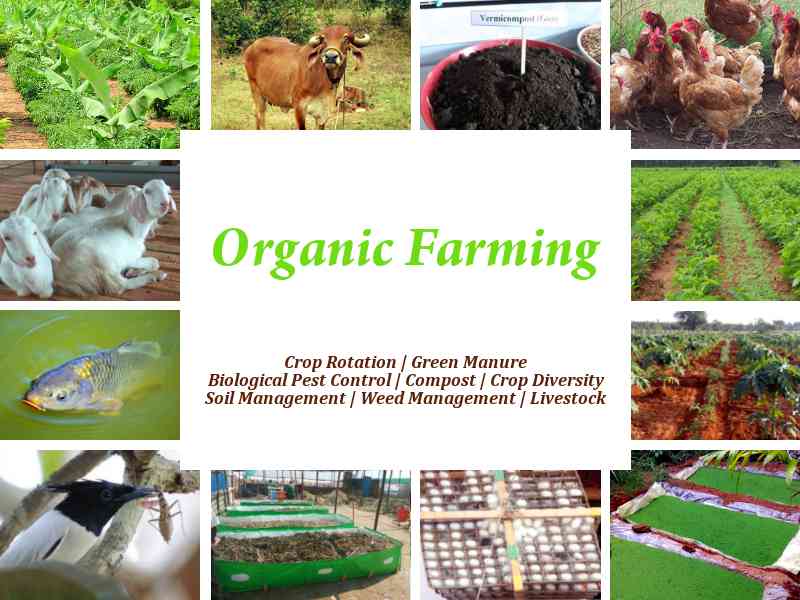
The term ‘organic’ was first coined by Northbourne, in 1940, in his book entitled ‘Look to the Land’. In recent years, organic farming as a cultivation process is gaining increasing popularity . Organically grown foods have become one of the best choices for both consumers and farmers. Organically grown foods are part of go green lifestyle.

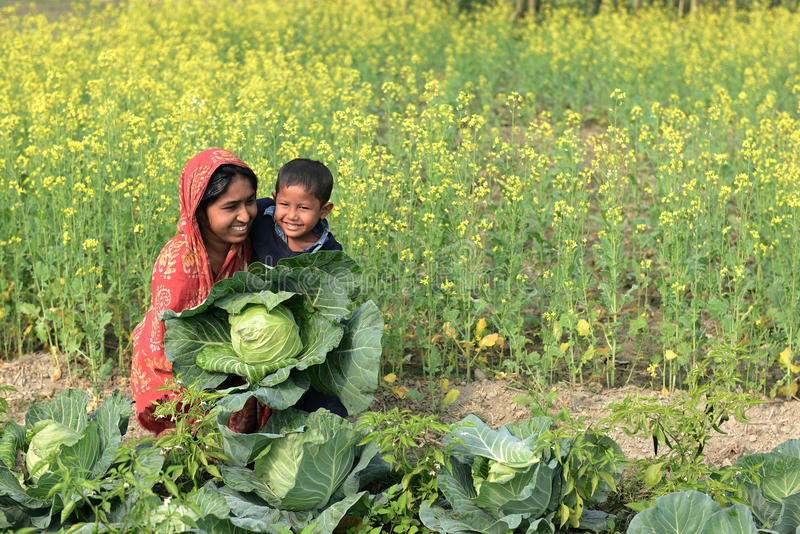
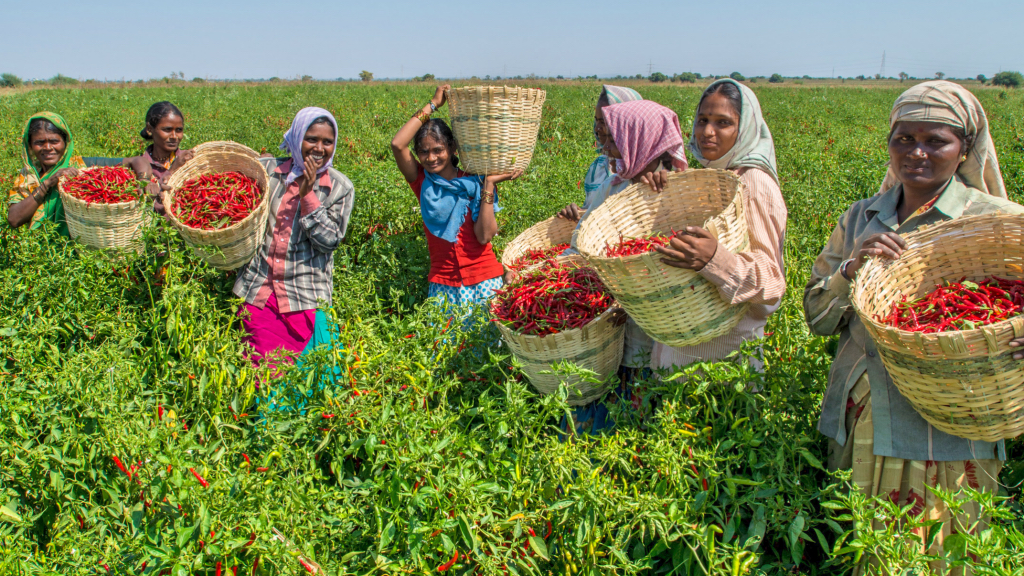
Farmers showing their Organic Harvest

Why Being Preferred These Days: The Importance of Organic Farming

Food quality and safety are two vital factors that have attained constant attention in common people. Growing environmental awareness and several food hazards (e.g. dioxins, bovine spongiform encephalopathy, and bacterial contamination) have substantially decreased the consumer’s trust towards food quality in the last decades. Intensive conventional farming can add contamination to the food chain. For these reasons, consumers are quested for safer and better foods that are produced through more ecologically and authentically by local systems. Organically grown food and food products are believed to meet these demands.

Organic Farming Processes

Organic Farming Process

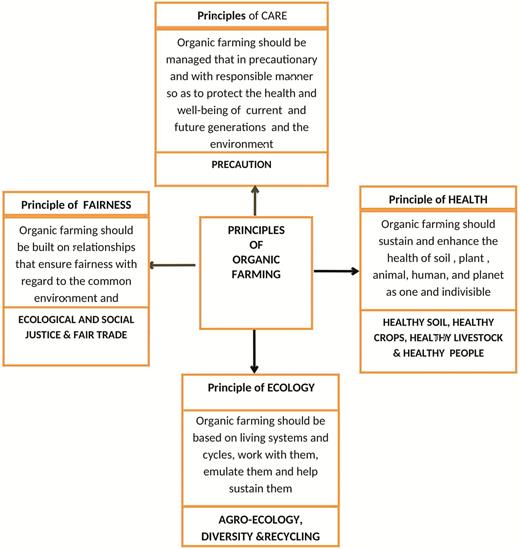
Organic farming and food processing practices are wide-ranging and necessitate the development of socially, ecologically, and economically sustainable food production system. The International Federation of Organic Agriculture Movements (IFOAM) has suggested the basic four principles of organic farming, i.e. the principle of health, ecology, fairness, and care . The main principles and practices of organic food production are to inspire and enhance biological cycles in the farming system, keep and enhance deep-rooted soil fertility, reduce all types of pollution, evade the application of pesticides and synthetic fertilizers, conserve genetic diversity in food, consider the vast socio-ecological impact of food production, and produce high-quality food in sufficient quantity.

Principles of Organic Farming  

According to the National Organic Programme implemented by USDA Organic Food Production Act (OFPA, 1990), agriculture needs specific prerequisites for both crop cultivation and animal husbandry. To be acceptable as organic, crops should be cultivated in lands without any synthetic pesticides, chemical fertilizers, and herbicides for 3 years before harvesting with enough buffer zone to lower contamination from the adjacent farms. Genetically engineered products, sewage sludge, and ionizing radiation are strictly prohibited. Fertility and nutrient content of soil are managed primarily by farming practices, with crop rotation, and using cover crops that are boosted with animal and plant waste manures. Pests, diseases, and weeds are mainly controlled with the adaptation of physical and biological control systems without using herbicides and synthetic pesticides. Organic livestock should be reared devoid of scheduled application of growth hormones or antibiotics and they should be provided with enough access to the outdoor. Preventive health practices such as routine vaccination, vitamins and minerals supplementation are also needed.

Principles of Organic Farming

Types of Organic Farming

Organic Farming are of two types. Here are the two types of Organic Farming being performed in India.

(a) Pure Organic Farming – pure organic farming, there is avoiding every unnatural chemical. In the process of pure farming, fertilizer and pesticides obtain from natural sources. It is called a pure form of organic farming. Pure organic farming is the best for high productivity. 

(b) Integrated Organic Farming – Integrated organic farming consists of integrated nutrients management and integrated pest management.

Organic Farming in India

Organic farming is in a nascent stage in India. About 2.78 million hectare of farmland was under organic cultivation as of March 2020, according to the Union Ministry of Agriculture and Farmers’ Welfare. This is two per cent of the 140.1 million net sown area in the country. A few states have taken the lead in improving organic farming coverage, as a major part of this area is concentrated only in a handful of states. Madhya Pradesh tops the list with 0.76 million of area under organic cultivation — that is over 27 per cent of India’s total organic cultivation area. The top three states — Madhya Pradesh, Rajasthan and Maharashtra — account for about half the area under organic cultivation. The top 10 states account for about 80 per cent of the total area under organic cultivation. Sikkim is the only Indian state to have become fully organic so far. Even though India has very small organic area under cultivation, in terms of number of organic farmers it is being ranked first. India has over 1.9 million farmers as of March 2020, which is 1.3 per cent of 146 million agricultural landholders.

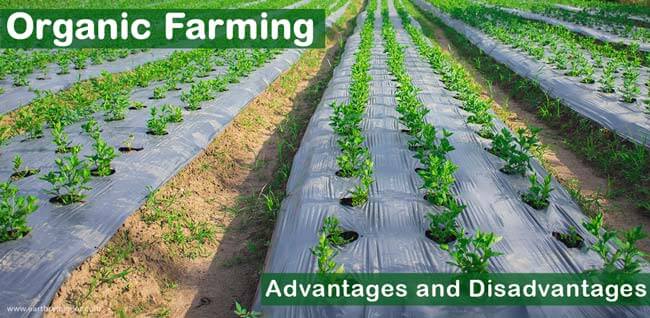
Advantages and Disadvantages of Organic Farming

Advantages of Organic Farming

Organic farming in India is very economical, it uses no expensive fertilizers, pesticides, HYV seeds for the plantation of crops. It has no expenses. 

With the use of cheaper and local inputs, a farmer can earn a good return on investment. This is one of the most important benefits of organic farming in India. 

There is a huge demand for organic products in India and worldwide and can earn more income through export.

Organic products are more nutritional, tasty, and good for health to chemical and fertilizer utilized products. 

Organic farming in India is very environment friendly, it does not use fertilizers and chemicals. 

Disadvantages of Organic Farming

Organic farming in India has fewer choices, and off-season crops are limited.

Organic agricultural products are low in the early years. Farmers find it difficult to accommodate mass production.

The main disadvantage of organic farming is the lack of marketing of the products and Inadequate infrastructure.

Organic Farming in India

Future of Organic Farming in India

India is an agriculture-based country with 67% of its population and 55% of manpower depending on farming and related activities. Agriculture fulfils the basic needs of India’s fastest-growing population accounted for 30% of total income. Organic farming has been found to be an indigenous practice of India that practised in countless rural and farming communities over the millennium. The arrival of modern techniques and increased burden of population led to a propensity towards conventional farming that involves the use of synthetic fertilizer, chemical pesticides, application of genetic modification techniques, etc.

Organic Farming leads to Sustainability and Holistic Growth

Even in developing countries like India, the demand for organically grown produce is more as people are more aware now about the safety and quality of food, and the organic process has a massive influence on soil health, which devoid of chemical pesticides. Organic cultivation has an immense prospect of income generation too. The soil in India is bestowed with various types of naturally available organic nutrient resources that aid in organic farming.

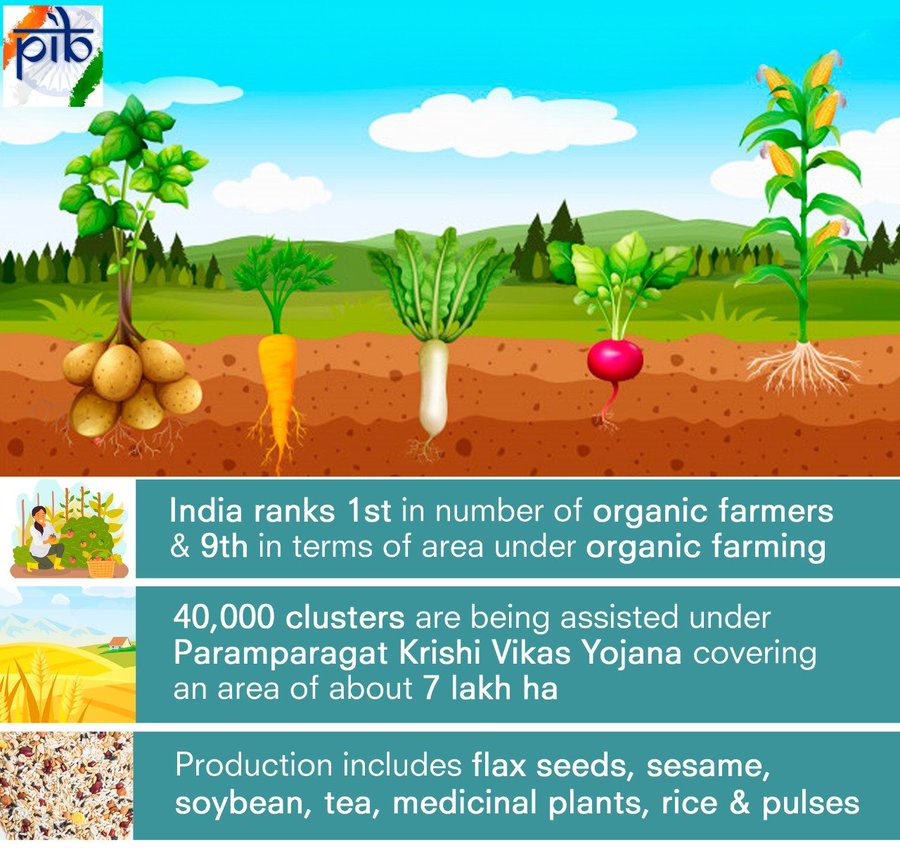
As per data collected from Government of India

Conclusion

India is a country with a concrete traditional farming system, ingenious farmers, extensive drylands, and nominal use of chemical fertilizers and pesticides. Moreover, adequate rainfall in north-east hilly regions of the country where few negligible chemicals are employed for a long period of time, come to fruition as naturally organic lands. Organic farming yields more nutritious and safe food. The popularity of organic food is growing dramatically as consumer seeks the organic foods that are thought to be healthier and safer. Thus, organic food perhaps ensures food safety from farm to plate. The organic farming process is more eco-friendly than conventional farming. Organic farming keeps soil healthy and maintains environment integrity thereby, promoting the health of consumers. Moreover, the organic produce market is now the fastest growing market all over the world including India. Organic agriculture promotes the health of consumers of a nation, the ecological health of a nation, and the economic growth of a nation by income generation holistically. India, at present, is the world’s largest organic producers and with this vision, we can conclude that encouraging organic farming in India can build a nutritionally, ecologically, and economically healthy nation in near future.

Promoting Agroforestry and Horticulture

 Sub-Mission on Agroforestry (HarMedh Par Ped) Scheme was launched in 2016-17 to encourage tree plantation on farm land along with crops/ cropping system to help the farmers get additional income and make their farming systems more climate resilient and adaptive. Presently, the scheme is being implemented in 23 States/UTs including Maharashtra. Under the scheme, assistance to farmers is given through State Govt. for nursery development, boundary plantation and block plantation of prominent tree species to promote, inter-alia, fruit bearing trees, tree borne oilseeds, medicinal & aromatic plants, silk & lac rearing host plants in addition to timber species, so that farmers get early returns.

 In case of promotion of horticulture, the Mission for Integrated Development of Horticulture
(MIDH), a Centrally Sponsored Scheme is being implemented w.e.f. 2014-15, for holistic growth  of  the horticulture sector covering fruits, vegetables, root and tuber crops, mushrooms, spices, flowers, aromatic plants, coconut, cashew, cocoa and bamboo. All States and UTs are covered under MIDH.

Preservation of Quality of Native Indian Seeds

 There is well established system available for analysis of seed quality of native Indian crop and trees in the Country. 161 State Seed Testing Laboratories and six Central Seed Testing Laboratories are functioning in the Country. These laboratories are analyzing seeds of native Indian crop and trees for various quality parameters.

As per the information there was a call for greater biodiversity in agriculture sector during COP 26, however, no consensus on the proposal of biodiversity in agriculture among the participating Countries and no final decision was taken. Hence, India has not committed anything on the biodiversity during the COP 26. However, the Government has a policy to encourage conservation of the seeds of native Indian varieties of various crops and trees. The National Bureau of Plant Genetic Resources (NBPGR) has conserved 94,609 native Indian varieties of different crops and trees in Gene Banks located in different States.

The Protection of Plant Varieties and Farmer’s Rights Authority (PPV & FRA) has also registered 1896 native Indian varieties of different crops enabling the farmer to commercialize these varieties. PPV & FRA encourages the community and individuals engaged in conservation, improvement and preservation of plant genetic resources of economic plants and their wild relatives particularly in the areas identified as agro-biodiversity hotspots by awarding the community and individuals who have played stellar roles in such activities. 

In order to ensure availability of native seeds and improve their usage by farmers., Indian Council of Agricultural Research is developing high yielding and multi stress tolerant varieties of different crop including cereals, millet, pulses, oilseeds and fruits suited to different agro-climatic condition. In the last seven years, 1956 improved varieties have been developed out of which 924 of cereals, 291 of oilseeds, 304 of pulses, 239 of fiber crops, 118 of forage crops, 64 of sugarcane and 16 of under-utilized crops. In addition, 288 varieties of horticultural crops have been developed.

In order to enhance indigenous species of trees, this Department is implementing Scheme called Sub-Mission on Agro-forestry since 2016-17 to encourage and expand tree plantation. Prominent tree species including indigenous tree species like Indian rosewood, Teak, Eucalyptus, Malabar Neem, ailanthus, Poplar, etc. are promoted for plantation on farm land along with other species. Details of State wise and year wise financial assistance provided under Sub-Mission on Agro-forestry Scheme is at Annexure-I.

In addition, this Department is providing assistance for seed production and distribution under various existing Schemes viz. National Food Security Mission, National Mission on Edible oil-oil palm, Rashtriya Krishi Vikas Yojana,  Mission on Integrated Development of Horticulture and Sub- Mission on Seeds and Planting Materials.

ANNEXURE-I

Details of the financial assistance provided to State Governments/UTs for the promotion of agro-forestry under Sub-Mission on Agro-forestry Scheme since inception.

(Amount Rs in Crore)

S.No.

Name of State

2016-17

2017-18

2018-19

2019-20

2020-21

1

Meghalaya

0.00

1.00

0.00

0.00

0.26

2

Mizoram

0.00

0.50

1.50

1.75

1.00

3

Nagaland

0.00

0.91

1.50

0.73

1.10

4

Andhra Pradesh

3.15

0.00

0.00

0.00

0.00

5

Bihar

0.00

3.00

0.00

1.00

0.20

6

Chhatishgarh

0.00

2.50

1.50

2.00

1.00

7

Gujarat

4.50

2.70

4.00

4.00

4.00

8

Haryana

1.75

0.00

0.00

0.00

0.00

9

Himachal Pradesh

1.15

0.487

1.00

0.83

0.75

10

Jharkhand

0.00

4.00

1.00

2.00

0.00

11

Jammu & Kashmir

0.00

0.61

3.00

0.00

0.75

12

Karnataka

3.25

4.50

5.56

7.00

5.36

13

Kerala

0.00

2.06

0.00

0.00

0.00

14

Madhya Pradesh

4.20

0.00

0.00

0.00

0.00

15

Maharashtra

0.00

4.00

2.00

0.75

1.60

16

Odisha

0.00

4.00

2.00

0.75

1.50

17

Punjab

2.00

0.00

4.48

2.50

1.38

18

Rajasthan

0.00

6.00

0.00

0.00

0.00

19

Tamil Nadu

2.50

0.00

0.00

2.31

3.34

20

Telangana

0.00

0.00

0.80

0.00

0.00

21

Uttar Pradesh

0.00

6.00

0.00

2.00

4.00

22

UT of Ladakh

0.00

0.00

0.00

0.00

0.50

Total

22.50

42.27

28.35

27.62

26.73

Converting Rural Haats into Mini Agriculture Produce Marketing Committee (APMCs)

 Physical infrastructure/ facilities under Mahatma Gandhi National Rural Employment Guarantee Scheme (MGNREGS) have been developed in 1351 village haats and is under development in 1632 number of village haats.

As on 31.03.2020, there are 6845 numbers of Agriculture Produce Marketing Committee (APMC) markets in the country. In order to provide better farmer – market linkages and fair prices to farmers, in addition to regulated markets, there are other markets also like non-regulated wholesale markets, farmer – consumer markets, purchase centers and private wholesale markets. In addition, Government is promoting to declare warehouses and cold storages as deemed market yards to improve the farmer – market linkages.

Further, Government of India had launched reform linked National Agriculture Market (e-NAM) scheme, a virtual platform integrating physical wholesale mandis/ markets of different States/ Union Territories (UTs) to facilitate online trading of agriculture and horticulture commodities to enable farmers to realize better remunerative prices for their produce. All these contribute towards better marketing efficiency and also better prices to farmers.  

So far, based on earlier targets and as per the proposals received from States/ Union Territories (UTs), 1000 mandis of 18 States and 3 UTs have been integrated with e-NAM platform. As on 9th February, 2022, more than 1.72 crore farmers & 2.16 lakh traders have been registered on e-NAM platform. Further agricultural produce trade with a value of Rs. 1.74 lakh crore have so far been recorded on e-NAM platform.

60th Convocation of ICAR-IARI, New Delhi

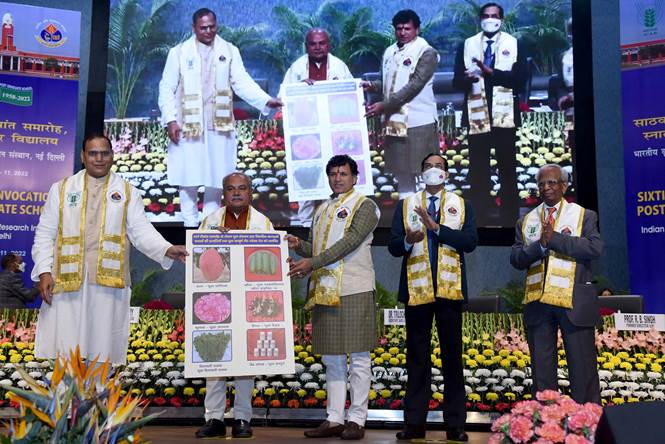
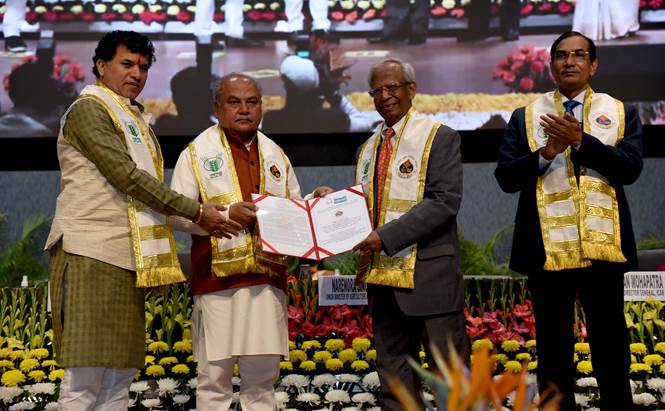
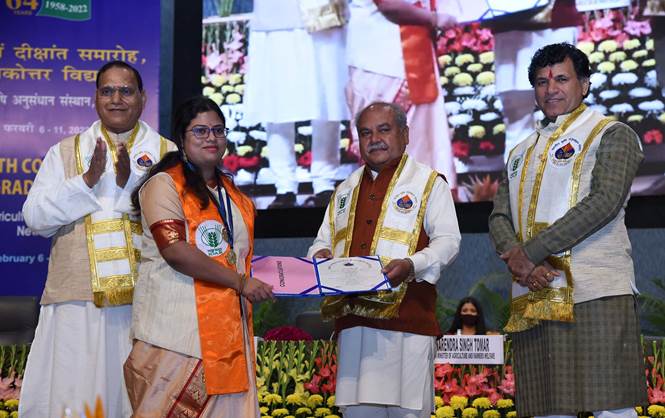
 Union Minister for Agriculture and Farmers’ Welfare Shri Narendra Singh Tomar today handed over awards and degrees to the 284 students, which includes 8 foreign students, of the Post Graduate School of ICAR-Indian Agriculture Research Institute, New Delhi. On the occasion, Shri Tomar also dedicated 6 varieties of fruits and vegetables to the nation viz., two varieties of mango Pusa Lalima, Pusa Shresth, brinjal variety Pusa Vaibhav, palak variety PusaVilayati palak, cucumber variety Pusa Gynoecious Cucumber Hybrid-18 and Pusa Alpana variety of rose. The bio-fertilizer ‘PUSA Sampoorn’ developed by the division of Microbiology was also released.


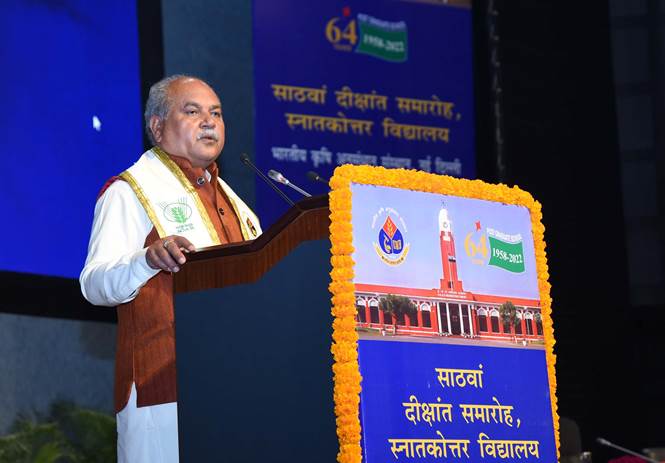
Addressing the gathering, Shri Narendra Singh Tomar appealed to all agriculture institutes to focus on producing good farmers. He said Institutes are producing very talented teachers and scientists which is commendable. Because of this knowledge and technology remain limited to the institutes only. If institutes produce farmers then they can bring this knowledge to the grassroots level. He also exhorted the students for entrepreneurship development and appealed for taking up farming as a profession.


Highlighting the government priorities in the field of agricultural research, Shri Tomar said that under the leadership of Prime Minister Shri Narendra Modi, India is placed among the top 10 Agri products exporting countries. “We aim to put India among the top 5 countries and I am sure that with the efforts and research of our agriculture institutes, India will achieve it very soon”, the Minister added.

Speaking on implementing the use of drone technology for the benefit of farmers and employment generation for various stakeholders, the Agriculture Minister said that the government is giving 100% as a grant for the purchase of drones to agriculture institutes so that the technology can be taught in the institutes. He also said that Agriculture graduates are also eligible to receive grant support for drone purchases.  The Minister advised the new graduates to see this as a huge opportunity in the field of drone technology.

The Agriculture Minister appreciated the significant contributions made by the institute for ensuring food and nutritional security through the development of superior varieties and technologies in the field of Agriculture. Shri Tomar congratulated all the awardees and appealed to them to contribute to the growth story of Aatmanirbhar Bharat by making Atmanirbhar Krishi. 

Earlier, the Director of the institute, Dr A.K. Singh presented the significant achievements of the institute and informed that wheat varieties developed by this institute contribute nearly 60 million tons of wheat to the nation’s granary worth Rs. 80,000 crores annually. Similarly, the Basmati varieties developed by the institute predominate basmati cultivation in India accounting for 90% of the total foreign exchange (Rs. 29524 crores) earned through the export of Basmati rice amounting to Rs. 32,804 crores. About 48% of the mustard grown area in the country is cultivated with IARI varieties. The total economic surplus generated from Pusa Mustard 25 is estimated at Rs 14323 crores (at 2018 prices) during the last 9 years.


On this occasion, NABARD-Professor VL Chopra Gold Medal & Best Student of the Year award for MSc and PhD were presented to Ms Debarati Mondal and Dr Siddharood Maragal, respectively. Prof. R.B.Singh; Former Director, IARI, New Delhi was conferred upon D.Sc honoris causa. VIth Dr A.B. Joshi Memorial award was presented to Dr D.K. Yadava, ADG (Seeds), ICAR, New Delhi. The 2nd Best Agricultural Extension Scientist Award was presented to Dr R.N. Padaria, Head & Professor, Division of Agricultural Extension, IARI, New Delhi. XXII Shri Hari Krishna Shastri Memorial Award was given to Dr A.D. Munshi, Principal Scientist, Division of Vegetable Science, IARI, New Delhi. XXII Sukumar Basu Memorial Award was presented to Dr Rajan Sharma, Principal Scientist, Dairy Chemistry Division, ICAR-NDRI, Karnal and IARI Best Teacher award was given to Dr C.M.Parihar, Division of Agronomy, IARI, New Delhi.


Sh. Kailash Choudhary, Minister of State, Ministry of Agriculture and Farmers Welfare was the guest of Honour during the event. Dr Trilochan Mohapatra, Secretary DARE and Director General, ICAR and Dr Rashmi Aggarwal, Dean and Joint Director (Education) also graced the occasion.

The event was also attended by the other dignitaries including Deputy Director Generals and Additional Director Generals of the Council, former Directors and Deans of the Institute, Project Director (WTC), Head of Divisions and Professors. A large number of Faculty members, Students and staff of the Institute watched the event through virtual mode.

*****

50th Anniversary Celebrations of ICRISAT

 The Prime Minister, Shri Narendra Modi visited the International Crops Research Institute for the Semi-Arid Tropics (ICRISAT) campus in Patancheru, Hyderabad and kickstarted the 50th Anniversary celebrations of ICRISAT. The Prime Minister also inaugurated ICRISAT’s Climate Change Research Facility on Plant Protection and ICRISAT’s Rapid Generation Advancement Facility. These two facilities are dedicated to the smallholder farmers of Asia and sub-Saharan Africa. Prime Minister also unveiled a specially designed logo of ICRISAT and launched a commemorative stamp issued on the occasion. Governor Telangana  Smt Tamilisai Soundararajan, Union Ministers Shri Narendra Singh Tomar and Shri G. Kishan Reddy were among those present on the occasion.

The Prime Minister noted the auspicious occasion of Basant Panchami and congratulated ICRISAT for 50 years. Underlining the importance of next 25 years for both the country and also for ICRISAT, the Prime Minister stressed the need for new goals and working for them. The Prime Minister lauded ICRISAT for their contribution in helping agriculture in large part of the world including India. He appreciated their contribution in water and soil management, improvement in crop variety, on-farm diversity and livestock integration. He also praised their holistic approach in integrating farmers with their markets and promoting pulses and chick pea production in Andhra Pradesh and Telangana. “Your research and technology have helped making agriculture easy and sustainable”, Shri Modi said.

The Prime Minister said that the worst affected by climate change are the people on the last rung of development with little resources. That is why, the Prime Minister reiterated India’s request to the world to pay special attention to the climate changes. He talked of LIFE- Lifestyle for Environment; P3 – Pro planet people movements and India’s net zero target by 2070. “Pro planet people is a movement that connects every community, every individual with climate responsibility to tackle the climate challenge. This is not limited to just words, but is also reflected in the actions of the Government of India”, he added.

Referring to 15 Agro-Climatic Zones and 6 seasons of the country, the Prime Minister highlighted the depth of ancient experience of Indian agriculture. He pointed out that India’s focus is on the fusion of ‘back to basic’ and ‘march to future’ to protect its farmers from climate challenge.  “Our focus is on our more than 80 per cent farmers who are small and  needs us the most”, the Prime Minister said.

He mentioned another dimension of changing India i.e. digital agriculture which he termed as India’s future and stressed that talented Indian youth can contribute a great deal in this. He listed areas like crop assessment, land records digitization, spraying insecticides and nutrients by drones which are witnessing increased use of technology and artificial intelligence. “India’s efforts are increasing relentlessly for empowering farmers through digital technology”, he said.

The Prime Minister emphasized that in the Amrit Kaal, India is focussing on inclusive growth along with higher agriculture growth. Women in agri-sector, are being supported through self-help groups. “Agriculture has the potential to take a large chunk of population out of poverty  and take them towards better life-style. This Amrit Kaal will also provide new means to the farmers of geographically difficult areas”, he said.

The Prime Minister said that India is working on a dual strategy. On the one hand, a large part of the land is being brought under irrigation through water conservation and connecting of rivers. Water use efficiency through micro irrigation is being encouraged in areas with limited irrigation, on the other.

The Prime Minister said that National Mission for self-reliance in edible oils indicates India’s new approach. The Mission aims to increase palm oil area by 6 lakh hectare. “This will help Indian farmers at every level and will prove very beneficial for the famers of Andhra Pradesh and Telangana”, the Prime Minister pointed out.  He also dwelled on the steps taken to strengthen post-harvest infrastructure like creating cold chain storage capacity of 35 million tonnes and creation of 1 lakh crore rupees Agriculture Infrastructure Fund.

India is also focusing on establishing FPOs and Agriculture value chain. “We wish to create an alert and potent market force out of small farmer by organizing them into thousands of FPOs”, he said.

The Prime Minister said that India’s goal is not just increasing food grain production. India has enough surplus food grain to run one of the world’s big food security programme. “We are focusing on food security as well as nutrition security. With this vision, we have developed many bio-fortified varieties in the last 7 years”.

ICRISAT is an international organisation that conducts agricultural research for development in Asia & sub-Saharan Africa. It helps farmers by providing improved crop varieties and hybrids and also helps smallholder farmers in the drylands fight climate change.

***********


Food & Public Distribution, Government of India

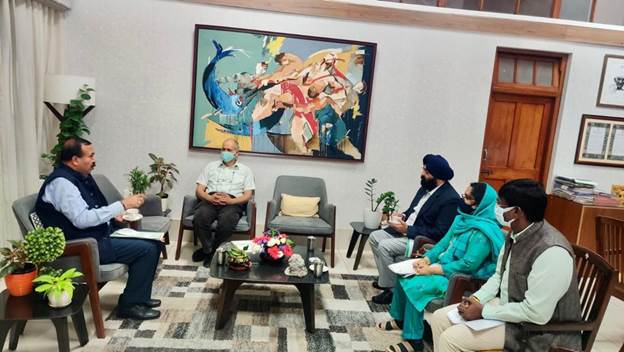
 The Secretary Department of Food and Public Distribution under Ministry of Consumer Affairs, Food and Public Distribution,  Shri Sudhanshu Pandey  held a meeting with the Chief Secretary, Government of Karnataka wherein the settlement of procurement incidental claims, preparations of the state for procurement operations, setting up of units for production of fortified rice kernels, distribution of fortified rice, encouraging production of millets, setting up of ethanol blending units etc. were discussed. 

The Secretary informed the state that the procurement incidentals claims and distribution subsidy amounts to the extent of automated EPOS distribution quantities are already approved for payment to the state. He further informed that the state should have their procurement and distribution plans approved from the department well in advance and that the revised guidelines for procurement and distribution of course grains will be stretching to a period of 10 months.

Description: C:\Users\HP\Desktop\MoCAFPD\2022\January\08\WhatsApp Image 2022-01-08 at 5.59.48 PM.jpeg

Shri Pandey further informed that 2023 being declared as International year of Millets and Karnataka being large producer of Ragi, the state should gear up with increased production of millets and tie up with the Indian Institute of Millets in Hyderabad for increased market penetration of millet products through start-ups. The Secretary Food further informed that the requirement of millets of other states can also be met by Karnataka with centre bearing all the handling and transportation costs.

He informed that the centre has already approved procurement of local verities of paddy in Udupi and Dakshin Kannada for self-consumption by the state. On the request of Chief Secretary for release of advance subsidy, it was informed that the state should send their provisional expenditure before commencement of procurement operations based on which advances can be released.

Drawing the attention of the state to the important project of the Centre which is distribution of Fortified Rice under ICDS and MDM schemes, he suggested that the state health department should be roped in for monitoring the health developments of such children. As the state has ambitious plans of increased paddy procurement he suggested that the fortified rice can be procured locally with FRK units being established on long term objective of 100% fortified rice for aspirational and heavy burdened districts. He suggested that the state should do the fortification of rice at milling stage itself.

With Karnataka being one of the largest producer of sugar, Secretary Food suggested that the ethanol production and blending has to be encouraged as Karnataka is one of the eight identified states planned for introduction of 100 ethanol bunks in metros. 

The Chief Secretary has suggested to have one unified software for procurement operations to which the secretary had informed that the same is under consideration.

The secretary had informed that one nation one ration for migrant labours, coffee plantation workers and other settlement workers engaged in construction activities can be actively taken up by the state for real benefit of the poor.  

*****************

Purvanchal region emerges as new hub for India’s Agri-export

 Working in close collaboration with the Ministry of Commerce & Industry, the Agricultural and Processed Food Products Export Development Authority (APEDA) has taken several initiatives in making landlocked Purvanchal region as a new destination of agri-export activities through development of Varanasi Agri – Export Hub (VAEH).

APEDA has identified potential districts of Uttar Pradesh to be covered under the VAEH. The Purvanchal division covers districts of Varanasi, Mirzapur, Azamgarh, Prayagraj, Gorakhpur, Basti, Ghazipur, Jaunpur, Chandauli and Sant Ravidas Nagar.

The Varanasi region, where there are negligible agri-exports used to take place because of lack of basic infrastructure, is now abuzz with activities which has given a boost to exports. After the intervention of APEDA, Varanasi region has recorded exemplary changes in the export scenario and registered many first-of-its-kind achievements in a very short span of time.

With the active intervention of APEDA, about 20,000 Metric Tonne (MT) of agri- produce have been exported from Purvanchal region in the last six months. Out of these shipments, about 5,000 MT fresh fruits and vegetables and 15,000 MT of cereals have been exported to Vietnam, Gulf nations, Nepal and Bangladesh by all modes of transportation.

Varanasi and nearby areas witnessed an export of around 12 MT, 22 MT and 45 MT in the months of October, November, December respectively in the year 2021. Also, around 125 MT have been exported from Varanasi and nearby areas.

As Varanasi is a territory based in the plains of river Ganges, it has rich nutritional composition of soil with ample amount of fertility which leads to production of good quality agri-produce. Varanasi region also has reputed institutions of central and international level such as Indian Institute of Vegetable Research (IIVR), International Rice Research Institute (IRRI), Banaras Hindu University (BHU).

Currently, the Varanasi region has a number of exporters and exports of agricultural products is being undertaken through air route due to establishment of robust quarantine as well as custom clearance facilitation centre at Lal Bahadur Shastri International (LBSI) Airport. APEDA has organised more than 30 capacity building programmes in the entire Varanasi region followed by eight international buyer-seller meets, which has provided a platform to the exporters to market their food products in the global marketplace.

To monitor the product and production, a project of AI tech is also being considered for approval. APEDA is also planning to take member Farmer Producer Organization to different successful territories for unveiling the agri-supply chain and market linkage.

The government is also considering replicating the Varanasi model in the Gorakhpur region of Purvanchal as the geography, demography and few other parameters are common in both the places. The newly established international airport in Kushinagar may play a vital role in triggering the export. The DDU Gorakhpur University, Indian Institute of Seed Science, Mau are the institutions actively working towards promotion of agri- activities in the region.

APEDA has also approved three projects for comprehensive grain and nutritional quality profiling of non-Basmati Rice, value added products from Rice and rice-based food systems. An APEDA-funded project for integrated IT solutions to enhance Agri Export in Varanasi Region is under process.

The export of the first trial shipment of 14 MT green chilly was facilitated by APEDA from Varanasi to Dubai’s Jebel Ali Port in December 2019.

For the first time, from Varanasi 3 MT fresh vegetables was exported to London, 3 MT fresh mangoes to Dubai, 1.2 MT fresh mangoes to London, 520 MT regional rice to Qatar and 80 MT regional rice to Australia during the Covid pandemic in 2020, after APEDA’s intervention.

Meanwhile, Trisagar Farmer Producer Company Ltd, which is based in Sant Ravidas Nagar district, has started sending shipments on a daily basis to the international market after the intervention of APEDA. In another success story, Gazipur district-based Shivansh Krishak Producer Company Ltd with a base of 1,500 progressive farmers has managed to get a decent realisation for its commodities after exporting a good volume of agri-produce.

Similarly, Varanasi-based FPO Jaya Seed Farmer Producer Company Ltd, which grows mangoes in around 50 acres, is getting higher price as compared to average price of the market after the intervention of APEDA. Prior to the initiative taken by APEDA, the FPC used to sell mangoes at an average price of Rs 25/kg, but in recent season they have sold it at Rs 50/kg to a Netherland-based company named Super Plum having few outlets in Bangalore and Mumbai.

***

Agriculture and Farmers Welfare

 Agriculture has been the bright spot in the economy despite Covid 19 in the year 2021. The Ministry of Agriculture and Farmers Welfare Year End Review of achievements and initiatives of the various Schemes, Programmes and Missions is as follows: 


Achievement of Department of Agriculture & Farmers’ Welfare for the year 2021-22


  1. Production: For year 2021-22, the production data is available for only kharif crops (as per first advance estimates) 
  • Foodgrains (kharif) – 150.50 MT
  • Oilseeds (kharif) – 23.39 MT
  • Sugarcane – 419.25 MT


  1. PM- KISAN:


  • Under Pradhan Mantri Kisan Samman Nidhi Scheme (PM-KISAN), more than 1.60 lakh crore rupees have been directly transferred to more than 11.54 crore farmers till now.


  1. PM-KMDY:


  • Total 21,42,718 number of farmers have been enrolled under Pradhan Mantri Kisan Maandhan Yojana (PM-KMDY).


  1. AIF


  • Till date, a total of 8702 projects have been sanctioned under the scheme with a loan amount of Rs. 6254 crores, out of which, Rs. 2291 crores have been disbursed for 4315 projects.


  1. MSP:


  • The Union Budget for 2018-19 had announced the pre-determined principle to keep MSP at levels of one and half times of the cost of production. In line with the same principle, Government had announced the increase in MSP for all mandated kharif crops of year 2021-22 on 9th June, 2021. The expected returns to farmers over their cost of production is estimated to be highest in case of bajra (85%), followed byurad (65%) and tur (arhar) (62%). For rest of the crops, return to farmers over their cost of production is estimated to be at least 50%.
  • On 8th September, 2021, the Government has announced the MSP for all mandated Rabi crops for Rabi Marketing Season (RMS) 2022-23. The expected returns to farmers over their cost of production are estimated to be highest in case of wheat and rapeseed & mustard (100% each), followed by lentil (79%); gram (74%); barley (60%); safflower (50%).


  1. National Food Security Mission:


  • During 2021-22, NFSM is being implemented in identified districts of 28 states & 2 Union Territories (UTs) viz. Jammu & Kashmir and Ladakh in the country:
  • NFSM-Rice in 193 districts of 24 states & UT of Jammu & Kashmir.
  • NFSM-Wheat in 124 districts of 10 states & 2 UTs viz. Jammu & Kashmir and Ladakh.
  • NFSM-Pulses in 644 districts of 28 states & 2 UTs viz. Jammu & Kashmir and Ladakh. NFSM-Coarse Cereals in 269 districts of 26 states & 2 UTs viz. Jammu & Kashmir and Ladakh. 
  • NFSM-Nutri-Cereals in 212 districts of 14 states.
  • NFSM-Coarse Cereals in 269 districts of 26 stats & 2 UTs viz. Jammu & Kashmir and Ladakh. 
  • NFSM-Commercial Crops, Cotton is implemented in 15 states, Jute in 9 states and Sugarcane in 13 states of the country.
  • The Targeting Rice Fallow Area (TRFA) programme under NFSM is implemented in 11 states of the country to promote cultivation of pulses in rice fallow areas of the states.
  • An amount of Rs. 1560.00 crore (BE) has been allocated for NFSM during 2021-22.


  • Oilseeds:


  • NFSM-Oilseeds is being implemented in 27 States and 3 UTs. 
  • Annual Action Plan of the states / UTs have been approved for an amount of Rs. 276.46 crores. Out of this, an amount of Rs. 62.42 crore has been released to the state so far for implementation of NFSM-Oilseeds.
  • Besides, Annual Action Plan of the 8 states for an amount of Rs. 50.00 crore has been approved for implementation of TRFA Oilseeds. 
  • Govt. of India has fixed targets of 29.21 million ha for area coverage, 36.56 MTs for production and 1337 kg/ha for productivity under Oilseeds. 
  • Distribution of over 834535 Soyabeanminikits with yield of not less than 20 qtl/ha and distribution of 58416 groundnut seed minikits with yield not less than 22 qtl/ha under Kharif 2021-22 season. 
  • In Rabi season, over 8,20,600 Mustard minikits and 11,000 groundnut minikits are plan to be distributed.


  1. Mission Organic Value Chain Development for North Eastern Regions (MOVCDNER):


  • 170 FPO/FPCs created covering 153116 farmers and 155495 ha area
  • 288 Collection, Aggregation, Grading units, Custom Hiring Centres, 26 processing and pack house entities created under FPO/FPCs and private ownership
  • 93 transportation vehicles provided to FPO/FPCs
  • 7 states developed their own brands
  • Marketing facilitation of ginger, turmeric, pineapple and king chilli have been major success and FPCs have been supported with buyback agreements
  • The export of king chilli sauce, pineapple (canned) and ginger flakes to UK, USA, Australia, France and Swaziland have already started
  • Industry mentorship model with necessary infrastructure development with 3 FPCs
  • Contract production of Ginger and Turmeric with 100% buyback assurance finalized with 3FPOs in Arunachal Pradesh with Parvata Foods
  • Contract cultivation of other high value crops such as Perila, black thai ginger and Calandula flowers is under process.


  1. Paramparagat Krishi Vikas Yojana (PKVY):


  • Under PKVY Scheme 19043 clusters formed during 2018-19 to 2020-21 in Phase-II against the target of 20500 clusters. Work continue in 19043 clusters (Phase-II) and old 11891 clusters of Phase-I (2015-16 to 2017-18) in 2021-22.
  • Total 3.81 lakh ha area covered formed during 2018-19 to 2021-22 in Phase-II against the target of 4.10 lakh ha area and work continues in 2.38 lakh ha area covered in Phase-I (2015-16 to 2017-18) in 2021-22 under PKVY. 
  • Total 9.52 lakh farmers have been benefitted during 2018-19 to 2020-21 in Phase-II and farmers are engaged for completing the spillover activities during the CFY 2021-22.
  • In addition to above, Under NamamiGangeProgrammeRs 101.56 crore funds has been released for 6181 clusters and 1.23 lakh ha area covered till date since 2017-18.
  • In addition to above, under natural farming fund released for an area of 4.09 lakh ha area since 2020-21.
  • In Jaivik-kheti portal total 5.45 lakh farmers, 16905 local groups, 75 input suppliers, 7881 buyers and 178696 products have been registered.
  • Government has initiated Large Area Certification (LAC) programme since 2020-21 to certify large traditional/default organic areas such as hills, islands, tribal or desert belt with no past history of GMO and agro chemical uses.  Under this programme 14,445 ha area under Car Nicobar and Nancowry group of islands in Union Territory of A&N Islands have been certified to transform entire territory of these islands to organic similar to Sikkim. Proposal of 5000 ha area has been received from Ladakh under LAC and fund Rs 11.475 lakh has been released. The entire cultivable land of 2700 ha area of Lakshadweep have been certified organic under Large area certification
  • Various Brands developed and business tie-ups have been formed with various business groups for marketing of organic produce under PKVY Scheme.  


Rashtrya Krishi Vikas Yojana (RKVY-RAFTAAR) in 2021-22


  • Rs. 1034.21 crore has been released to the States during 2021-22.
  • So far, 286 projects has been approved by the States for implementation during 2021-22 .


  1. Seeds:


  • During 2021-22, under Seed Village Programme, assistance amounting to Rs. 13.44 crore has been released and 6.32 lakh farmers benefited (as on date). 
  • Under National Seed Reserve 1.75 lakh qtls. seeds of short and medium crop varieties proposed to be maintained to meet the contingency and unforeseen situations like drought and flood for Kharif-2021 and an amount of Rs.4.77 crore has been released.
  • During 2021-22, a total amount of Rs.1.33 crore has been released to create Seed Storage Capacity of 2600 MT.
  • Transport subsidy of Rs. 4.86 crore has been released for movement of 2.54 lakh quintals of seeds to North-Eastern States and other States etc.
  • Rs.4.00 crore has been released for strengthening and renovation of 5 Seed Testing laboratories   in the Country.
  • An amount of Rs.0.30 crore has been released for establishment of 3 Green House in the Country.
  • An amount of Rs.0.06 Crore has been released for organizing Training on Seed related Activities in the Country. 
  • An amount of Rs.1.43 Crore has been provided for support to Seed Certification Agency (for the staff cost). 


  1. Agricultural Mechanization:


  • During 2021-22, an amount of Rs.331.94 Crore, Rs.193.35 Crore, Rs.159.59 Crore respectively have been sanctioned to Punjab, Haryana and Uttar Pradesh under Promotion of Agricultural Mechanization for In-Situ Management of Crop Residue.
  • An amount of Rs. 523.04 crores have been allocated/ released to the State Governments for provided 75,223 numbers of various machines and equipment to the formers on subsidy, 1540 Custom Hiring Centers, 53 Hi-tech hubs and 2629 Farm Machinery Banks.
  • 10,166 trainees have been trained & 394 numbers of demonstrations have been conducted through FMTTIs, 829 agricultural machineries and equipment have been tested through FMTTIs and Identified Institutes of DA&FW, 75,223 numbers of agricultural machinery & equipment have been distributed on subsidy to the farmers and 4222 numbers of Custom Hiring Centers/Hi-tech Hubs/Farm Machinery Banks have been established to provide machines and equipment to small and marginal farmers on rental basis.
  • On multi-lingual mobile app-based aggregator platform ‘FARMS’ (Farm Machinery Solutions) App 42,179 service providers have registered with more than 1,64,011 machines for renting. More than 5,23,95,476 farmers/other users have also registered for availing the services through this app.


  1. Pradhan Mantri Fasal BimaYojana(PMFBY):
  2.  
  • Against budget provision of Rs. 16000 crore, Rs. 9719.24 crore have been released/utilized during 2021-22.


  • During Kharif 2021, total number of 484.6 lakh farmers applications have been enrolled over an area of 244.7 lakh ha. for a sum insured of Rs. 99368 crore.
  • Out of the partial claims of Rs. 11148 crore for the year 2020-21, claims of Rs. 10385 crore have already been paid to 110.7 lakh farmer applications.


  1. Rained Farming System:


  • Government has announced for augmentation of Micro-Irrigation Fund corpus created in NABARD of Rs. 5000 cr by another Rs. 5000 cr and continuation during 15th Finance Commission for expanding area of micro-irrigation in country


  • An  area of 59.37 lakh ha has been covered under Micro Irrigation in the country from 2015-16 till date under PMKSY-Per Drop More Crop programme.


  1. Budget Allocation:


  • The Department of Agriculture, Cooperation and Farmers’ Welfare has been allocated Rs 1,23,018 crore in financial year 2021-22.


  1. Trade:


  • The export of Agri and allied commodities during 2020-21 were Rs. 310811.44Croreas compared to the same period last year indicating an increase of 22.86 %. The commodities which posted significant positive growth in exports were wheat, Other Cereals, Rice (other than Basmati), Soya meal, Raw Cotton, Fresh Vegetable, and Processed Vegetables etc. 
  • Wheat and other cereals posted huge growth over last year, i.e., increased from Rs444.20 Crore to Rs4173.08 Crore and Rs1454.72 Crore to Rs5198.42 Crore, respectively. India has witnessed tremendous growth of 839.46 % for Wheat export.Country has witnessed significant growth in export of Other Than-Basmati Rice that is 146.92%. Export of Other Than-Basmati Rice has gone up fromRs14400.33 Crore in 2019-20 to Rs.35557.04 Crore in 2020-21. 
  • Other commodities of Agri& Allied basket witnessing significant increase in export 2020- 2021 as compared to corresponding period during 2019-20, have been Raw Cotton (Rs 13968.38 Crore vs Rs 7539.53 Crore, growth 85.27%), Fresh Vegetable (Rs.5388.03 Crore vs Rs 4617 Crore, growth 16.69%) and Processed Vegetables (Rs 3150.06 Crore vs Rs 2212.03 Crore, growth 42.41%) etc. 
  • The export details of agriculture commodities in 2021-22 (upto October, 2021) are as follows-  Raw cotton – Rs9224.07 Crore, Fresh vegetable – Rs3648.69 Crore, Processed vegetable – Rs1887.94 Crore. 
  • Despite COVID-19, balance of trade in agriculture has favorably increased during 2020-21 to Rs 156300.23 Crore as against Rs. 105530.25 Crore during the same period in 2019-20.


  1. Plant Protection: 
  • During 2021-22, an amount of Rs. 108.74/- Crore has been released (as on 03.12.21). 
  • A total no. of 12,013 (Till October 2021) samples were analyzed for pesticide residue under Monitoring of Pesticide Residue at National Level (MPRNL) Scheme. 
  • Approximately 120.48 Lakh hectare Area has been covered under Locust Surveillance in the year 2021-22. ‘2’ nos. National Training Workshop on Desert Locust was conducted in collaboration with FAO and 22 nos. Locust Awareness Programme has been conducted.
  • Total No. of Farmers Field School (FFSs) conducted under CIPMCs are 70-Kharif & 212-Rabi (undergoing). Total No. of farmers trained under CIPMC are 2450 (Kharif) & 7420 (Rabi). 
  • Up to November, 2021 a total No. of 4,53,573 Export Phyto-Sanitary Certificate and total 1,17,227 Import Release Order has been issued. Total Revenue generated through Plant Quarantine activities is 381.31/- Crore. 
  • Total No. of Registration Certificates (CRs) issued under various categories u/s 9(3b) (provisional registration)/9(3) (new molecule registration)/9(4) (already registered molecules) under Insecticide Act, 1968 w.e.f. up to 28.12.2021 are 23009.
  • A total no. of 46 pesticides have been banned till date. It is further informed that no pesticide has been banned in the year 2021-22 as on 28.12.2021. 
  • Total No. of Awareness Programme conducted under National Institute of Plant Health Management (NIPHM) are 121 Nos. and total No. of persons trained are 5803 Nos.


  1. National Beekeeping & Honey Mission (NBHM):


  • 8 project proposals of the State Govts./ Agencies/ Organizations/ Departments/ ICAR/ CAUs/ SAUs, etc. for total assistance of Rs. 1223.45 lakhs has approved by EC under NBHM by NBB.
  • Madhukranti portal for online registration/ traceability system for source of Honey & other beehive products have been launched.
  • More than 11,000 Beekeepers/ Beekeeping & Honey Societies/ Firms/ Companies with’17.00 lakhs honeybee colonies registered with NBB and uploaded on Madhukranti portal.
  • A State of the Art honey & other beehive products testing lab at lARl, Pusa, New Delhi has been launched.
  • 100 FPOs of Beekeepers/Honey Producers have been allotted to TRIFED (14 nos.), NAFED (60 nos.) and NDDB (26 nos.) in the identified areas/ Districts/Ctusters selected by the National Bee Board (NBB) for implementation of activities under NBHM.
  • AMUL honey has been launched in collaboration with Gujarat Cooperative Milk Marketing Federation Ltd. (GCMMF) and Banaskantha District Cooperative Milk Federation, Gujarat.


  1. ATMA:


  • During the current financial year i.e 201-22, an amount of Rs.225.83 crore has been released to States/UTs under ATMA scheme (till date). States/UTs have reported physical achievements upto 31/10/2021 viz. Training of 20101 Extension Personnel, Training of 734529 Farmers, Exposure Visits of 165148 Farmers, Demonstrations on the field of 210712 Farmers, 320060 farmers visited in 4236 Kisan Melas, Mobilization of 11595 Farmers Interest Groups and Setting up of 10082 Farm Schools on the field of Progressive/Awardee Farmers.


  1. Agri-Clinics and Agri-Business Centers:


  • During 2021-22, with the release of amount of Rs.1194.98 lakhs, total 3033 candidates trained, 1337ventures established and 166 ventures subsidized till now. 


  1. Kisan Call Centre:


  • During 2021-22, total 32,95,656 calls answered and Rs. 2336.01lakhshave been released till now.


  1. Sub-Mission on Agro-forestry (SMAF) Scheme: 


  • Since inception of the scheme w.e.f. FY 2016-17, a total of 401 lakh trees under an area of 93,809 hectares have been planted in the country so far. Under the scheme, about 76,373 farmers have been benefitted under the scheme so far.  


****

Odisha and Agriculture – A Literature Review

Odisha is primarily an Agrarian State. Agriculture is the mainstay of the majority of the population. Though agriculture sector contributes only about 26 per cent to the Gross State Domestic Product (GSDP), almost more than 70% of the population is dependent on it. In spite of such low contribution, the labour force has not yet move out of this sector which ultimately results in low per capita income in this sector.

Agriculture in Odisha is characterized by low productivity due to sporadic rainfall, disrupted irrigation facilities as well as due to the fact that the state is prone to various natural calamities (Pattanayak & Nayak, 2003). Various literatures have studied cropping pattern of the state and have indicated that the cropping pattern of the state is changing over the years. Various studies have also confirmed that Odisha have not only experienced low productivity but also declining productivity. Agriculture plays a major role in providing a source of livelihood to a large proportion of population. Its development becomes important as it still remains the sector where majority of the workers are concentrated. It provides raw materials to various agro-based industries and also ensures food security-the basic necessity of life.

A number of studies have examined and analysed the agrarian structure and conditions of the country in terms of cropping pattern, determinants of cropping pattern, conditions of the agricultural labourers among many others. Given below is the review of few studies that have discussed various aspect of agrarian conditions in their work. The relevance of these works increase keeping in mind the point that they have brought out successfully many key issues in agriculture and how cropping pattern of a region or the country reflects the infrastructure of a place. The study of these literature have been undertaken to get a clear picture of the subject concerned and an insight of different lenses through which agrarian conditions of the country have been looked upon, before embarking on the study.

Despite the changes made in the macroeconomic policy framework and trade liberalisation, Bhalla and Singh (2009: 34, 43, 44), argued that the agricultural sector in India neither experienced any significant growth subsequent to the initiation of economic reforms in 1991 nor did it derive the expected benefits from trade liberalisation. They further asserted that, when compared with the immediate pre-liberalisation period (1980-83 to 1990-93), agricultural in India recorded a visible deceleration in its growth rates of aggregate yield and output and the process of agricultural diversification during the post-liberalisation period (1990-93 to 2003-06). There are different reasons for its slowdown but decline in public investment in irrigation and water management and thus limited irrigation facilities can be said to affect it the most.

Mruthynajay and Praduman (2003: 159) argued that the cropping pattern strategy followed in post green revolution period has led to narrowing down the base of agricultural production. In terms of allocation of acreage, the cropping pattern in the agricultural scenario of India has been skewed towards food grain. Though area under non- food grain has increased, food grains are still dominant (Ghosh, 2011: 115). The cropping pattern changes revealed that area under different crops was strongly linked with decline in cost of production due to-government subsidies, improved irrigation facilities-hence increase in cropping intensity of certain crops such as that of rice and wheat (Mruthynajay and Praduman, 2003: 163). High yield of crops and subsequent expansion and substitution are also the major reasons for such a change post green revolution with rice, wheat, mustard and cotton emerging as main crops for the farmers with area under coarse cereals declining (Ghosh, 2011: 119). The expansion of area under such crops as well as substitution of coarse cereals resulted in narrowing of the base of production, and crops such as pulses and oilseeds were not given due attention. Thus, the success attained in food crop production post green revolution has also caused serious crop imbalances in the cropping pattern, widened regional disparities, increased instability in production and unplanned import of commodities. So, there is a need to re-examine green revolution strategy keeping in mind the crops and areas that were bypassed so far (Mruthynajay and Praduman, 2003: 165).

The cropping pattern in Orissa is such that most of the districts of Orissa are experiencing a lateral movement towards crop specialisation and crop diversification, but over the years, crop specialisation can be noticed, where about 50% of Gross Cropped area is under paddy due to high yield, improved irrigation facilities and changes in the food habits of people (Pattanayak and Nayak 2004: 6, 13). The adoption of modern varieties of rice (HYV) in Orissa, its degree of adoption is inversely related to the farm size while its intensity of adoption is proportional to its farm size and varies with access to modern inputs. These are positively associated with borrowing since lack of investible cash retard the process of diffusion of modern technologies while tenancy is negatively associated, for the moneylenders feel that the adoption of HYVP would reduce the dependency of tenants on them (Sarap and Vashisht,1994: 90, 92).

However, holding other factors constant, Pattanayak and Nayak (2004: 5, 10, 19) argued that the contribution of agriculture in primary sector and in Gross State Domestic Product has declined but the labour force has not move out of the primary sector in post- reform period in Orissa. The districts are diverging as far as agricultural productivity is concerned and asserted that this variation is due to variation in the use of inputs amongst the districts. The skewed distribution of land, small size of operational holding, high incidence of share tenancy and rural poverty are few of many factors which negatively affect the agricultural productivity. The long-term solution lies in improved agricultural productivity and conscious policy decisions to reduce inter district disparity.

Regarding change in labour demand, Lahiri (1970: A-111, A-114) confirms the general belief that demand for agricultural labour has increased due to High Yielding Varieties Programme (HYVP). There was a high variability amongst different states with respect to total labour required and hired labour as well as contribution to labour days was quite low in pre HYVP days; but on the basis of the data gathered, figures revealed that the introduction of HYVP led to the increase in demand for labours. He further makes a point that changes in the demand for agricultural labour are unable to completely explain the changes in the wage levels of agricultural workers. Since demand for agricultural labours are seasonal, season-wise analysis of wage level would to an extent give a picture of wage-demand relation. Post HYVP, demand for labour has increased; and regarding the changes in cropping pattern- it has been noticed that the tendency has been to shift towards only few crops such as that of paddy and wheat and ignoring other crops. Thus, the study of these literature brings forth the point that post green revolution, many new technologies came forth, but the strategy followed was concentrated to few crops and few developing regions causing regional imbalances. Another major debate that came forth is that the post reform period instead of witnessing growth in agricultural output as it was meant to, have faced declining productivity and growth. These phenomena were observed both at all India level as well as in Odisha.

Image credit: News Bharti

Retrieved from: Google

URBAN FARMING: AN INITIATIVE FOR FOOD SECURITY

Even after living or residing in a city, a person can start his or her business in agriculture industry and it is sustainable also. The business will provide food into the busy and populated areas and cities. Urban Farming.

WHAT IS URBAN FARMING?

In simple terms Urban farming is the process of producing or cultivating food inside the city limits. This business has both pros and cons. This business faces challenges but it also offers many benefits to the city, like increased food security, decreased waste, community involvement and many more. Urban Farming is also known as Urban Gardening or Urban Agriculture and it means the practice of cultivating, processing and distributing food in and around cities or towns or urban areas. It involves animal husbandry. bee keeping, horticulture, aquaculture etc.

NEED OF URBAN FARMING:

  • Provide Food to the growing population
  • Reduce pressure on the traditional methods of cultivation
  • Help improve Quality of Life
  • Reduce Food Security
  • Reduce Environmental Impact
  • Help improve the landscape of the city

TYPES OF URBAN FARMING

Urban Farming is of many types, like: Street Landscaping, Tactical Gardening, Backyard Gardens etc.

VERTICAL FARMING
  1. Backyard Gardens: It generally means growing food in the property of a home and sharing it with family, friends or neighbors.
  2. Street Landscaping: Improving the landscape of the streets with the help of living street design or community gardens etc.
  3. Tactical Gardens: Utilizing small spaces available in a practical way (that doesn’t involve much expenses). Ex: Keyhole Garden which replace parking spot in streets.
  4. Forest Gardening: Gardens in urban forests including crops, fruits or herbs or nuts and even vegetables.
  5. ROOFTOP GARDENS: Using spaces of roof for growing food. This method helps in reducing Urban Heat Island effect and help in improving the quality of air.
  6. Green Walls : Using the space on internal and external walls to grow food.
  7. Vertical Farms: Planting or cultivating vertically for reducing the usage of land and land footprint of agriculture.
  8. Animal Husbandry: Raising animals for food and cities also allow residents to raise a limited number of such animals.
  9. Urban Beekeeping: It is a very common hobby and has many benefits for the local environment.
  10. Aquaponics: Raising aquatic animals such as fish etc. and in urban areas this can be done by capturing storm water and creating self sustaining system.
ROOFTOP FARMING

IMPORTANCE OF URBAN FARMING:

Urban Farming is an essential part of urban ecological and urban ecosystem and helps in improving the sustainability of the area. It plays an important role in Urban management system . A growing city will produce large number and amount of waste and urban agriculture acts like a solution for solving this issues by turning urban wastes into productive resource system. It helps in bringing original and nurtitious food to the local communities which has many direct health benefits. It reduces the risk of harmful conditions and vulnerability to get exposed to different chemicals used for increasing the longevity of the food and fruits.

Modern Agriculture

Agriculture is the main occupation in India, whilst it is more than an occupation, as it is regarded as the backbone of our country. It does not just a need or merely a source of livelihood but a way of life without which we could not imagine our existence on Earth. On a literal note agriculture means the production and cultivation of crops and livestock on a farm. It provides the highest contribution to national income and is currently the highest contributor to the GDP of India. It is the basic salient factor for the economic growth of a country on the same hand the development of agriculture is very prominent for a country’s development. It plays a crucial role and an integral part in the entire life of an economy which presses the need of its development. Speaking about the enhancement in the field of agriculture there are many methods and technologies in the contemporary world that contributes to its growth. Modern agriculture is the juncture where technologies and agriculture meets.

It is an evolving approach to many innovations in the agricultural field and farming practices that can help the farmers to augment efficiency by implementing several methods and reduce the number of natural resources like water, land, and energy necessary to meet the world’s food, fuel and fiber needs in a more effective form to increase productivity and decreasing environmental impact. It is driven by continuous improvement, using technology, digital tools and data. Precision agriculture allows the farmers to be more accurate that includes the use of Global Positioning Systems which results in the effectual use of resources.

Techniques in modern agriculture

Aeroponics system– It is the process where plants are grown in the air or mist environment without the use of soil. Plants grow in a soilless medium called rockwool. By using this method farmers will have better control over the amount of water to use. Lot of vegetables and fruits like beets, broccoli, cabbage, carrots, cauliflower, cucumber etc can be grown using this method.

Monoculture– It is the raising of a single crop within a specified area which in contrast to the traditional technique of farming , which relied on multiple crops being planted within a specific area. Many indoor farms growing medicinal herbs and flowers are measured to be monoculture farms. Monoculture farming is widely used in both industrial farming and organic farming and has allowed increased efficiency in planting and harvest. It reduced plant opposition for nutrients, space and solar radiation.

Drones in farming – It is an unmanned aerial vehicle applied to farming in order to help increase crop production and monitor crop growth. Sensors and digital capabilities can give farmers a well-heeled picture of their fields. The drones in agriculture have the potential to launch the agriculture industry into a future of sustainability. It is very effective at collecting data to help farmers improve crop health and allows farmers to gain immediate knowledge about the status of the fields.

Hybrid seed technology– It is a cross between two or more unrelated inbred plants. The two dissimilar varieties of plants are cross bred, resulting in a seed that carries one or more favorable traits. They are common in commercial farming, mainly to increase crop yields. It shows enhanced disease resistance, improved crop yields, increased flavor of fruits and vegetables.

Tissue culture – It is a method where the fragments of a tissue plant are introduced into a new, artificial environment, where they continue to function or grow. It is the expansion of tissues or cells separate from the organism. This is naturally facilitated via the use of a liquid, semi-solid or solid. such as broth or agar. It is a fast technique in which thousands of plants can be created in a few weeks time from a small amount of plant tissue and the plants are disease free.

Irrigation technologies-Water is one of the most essential factors in the deciding the survival of plants. The modern methods of irrigation include surface irrigation- flood irrigation, sprinkler- water is sprinkled or sprayed on plants which is similar to rainfall, drip – small diameter pipes with emitter or drippers that lie close to grounds and subsurface. The modern methods are better because it saves more water and also reduces the time and labor.

Drip Irrigation System

Micro Irrigation has gained attention during recent years because of its potential to increase yields and decrease water , fertilizer and labour requirements if managed properly.

Principal characteristics distinguishing the micro Irrigation with other pressurized technologies are:

  • Low flow rate
  • Localized , partial wetting of the soil volume
  • Frequent water application due to the limited wetted volume
  • Low operating pressure ,compared to sprinkler irrigation

Drip Irrigation involves technology for irrigating plants at the root zone through emitters fitted on a network of pipes( mains ,sub-mains and laterals). The emitting devices could be drippers ,micro sprinklers, mini sprinklers ,micro jets, misters ,fan jets, micro sprayers, foggers and emitting pipes, which are designed upon specific requirements , which may vary from crop to crop . Water requirement, age of plant spacing ,soil type , water quality and availability are some of the factors which would decide the choice of the emitting system .

In cases where the water sources is an open well or tubewell / borewell , then for assessment of water availability and pumping power requirement it is necessary to compute the following:

  • Depth of the water table
  • Discharge of the well
  • Total pumping level
  1. The depth of water level below the ground level, before pumping begins ,is the depth of the water table . It can be measure by a simple procedure using a rope with a stone tied at one end .
  2. The discharge of the well / tubewell is measured after running the pump for a period of 30 minutes to 1 hour . It can be measure by adopting volumetric measure.Under this method , the discharge is emptied into a ditch of container of know dimensions for a certain length of time . the rate of discharge is calculated by dividing the total volume of water discharged by the time taken. This method works for low discharge say upto 5 litres per second. For higher discharges volumetric measurement may be difficult and therefore standard devices like water meter/c.notch/flume may be used.
  3. Total pumping level includes the depth of the water level, drawdown and height of the outlet above the ground level. To measure the drawdown the pump installed over the well/tubewell is run for a period of 30 minutes to one hour so that constant water level is attained in the well/tubewell. The new depth of the water level is measured. The difference between the depth and level above the ground level is also to be measured . Once the total pumping level is determined , the horsepower .

HP= Q*H/75*n

where Q = Discharge ,Ips

H=Total head ,m

n = Efficiency of the pump and motor

Depending up on the water availability and water requirement of the crop (as given in the table ) for the entire area in calculated .Then the piping network and number of sections will be decided accordingly.