Environmental laws in india

Either Stable burning in various states accrued the air pollution in Delhi and created a gas chamber around NCR ; SC came upon a committee to observe scenario , Or 4 industries inflicting stream pollution were shut down by Maharashtra pollution board . Everybody has responsive to environmental problems as higher than . The key solution for resilience to environmental issues are provided by government in various legislations , enactments and provisions on environment laws .


In republic of India environmental law is concern with the policy and law for protection of the environment . It aims for achieving carbon free economy through taking measures for reducing climate change. All the acts under this laws are safeguards in ensuring effective management of the environment and its multiple ecosystems . It provides for preventing environmental damage .


Natural resources in the earth were unscathed from millions of years. It were remain pure until the industrialized started . After the industrialization this resources have been exploited in Spain of 100 years only . From 19th century, the environment (air , water and land ) is directly exploited by rapidly growing population at alarming-rates.


environment includes water, air and land and the inter-relationship which exists among and between water, air and land, and human beings, other living creatures, plants, microorganisms and property , as mentioned in section 2 of environmental protection Act of 1986 . Environment is a wide sphere , it consists of social, economically , political , religious dimensions .


Addressed area of environmental laws in India :

1. Quality of water : For the prevention and control of water pollution and to maintain or restore wholesomeness of water in the country the water act of 1974 was enacted. It further provides for the establishment of Boards ( CPCB and SPCB ) for the prevention and control of water pollution with a view to carry out the aforesaid purposes. This act prohibits the discharge of pollutants into water bodies beyond a given standard, it also lays down fine and penalties for non-compliance.

2. Reduction of air pollution and maintaining air quality : The Air (Prevention and Control of Pollution) Act, 1981 (the “Air Act”) is an act to provide for the prevention , protection and abatement of air pollution .It provides for establishment of Boards at the Central and State levels with a view to carrying out the aforesaid purposes.

3. Hazardous Waste management : legislations that directly or indirectly deal with hazardous waste management are the Factories Act, 1948, the Public Liability Insurance Act, 1991, the National Environment Tribunal Act, 1995 and rules and notifications under the Environmental Act.

4. Containment cleanup, damage mitigation : preventing future damage to the environment is undeniably the primary objective of environmental law, mitigating and reducing existing damage is also important. This area most often deals with issues like toxic leaks and oil spills. The central objective of this branch of environmental law is deciding liability, planning an appropriate response, and also determining the best process of investigation and monitoring in the overall clean up process. This area also concerns itself with the study and assessment of risk in the long term, to better mitigate any future accidents and risks.

5. Sustainability of resources : United Nations has put great emphasis on ensuring the sustainability of resources. For this vision , it has advocated the formation of various legal principles and legislation. In this regards concept of environmental impact assessment introduced .

Noble legislations and enactments on environment law in India :


Laws on Forest and wild life protection:
• The Indian Forest Act, 1927 ; The Wildlife Protection Act, 1972; The Forest (Conservation) Act, 1980 ; The Environment (Protection) Act, 1986; The National Green Tribunal Act, 2010.


Laws on Water pollution :
• The Water (Prevention and Control of Pollution) Act, 1974.


Laws on air pollution :
• The Air (Prevention and Control of Pollution) Act, 1981 (the “Air Act”)


Laws on hazardous waste management :
• Biomedical Waste (Management and Handling) Rules, 1998 ; Municipal Solid Wastes (Management and Handling) Rules, 2000 ; Batteries (Management & Handling) Rules, 2001 ; Hazardous Wastes (Management, Handling and Transboundary) Rules, 2008 ; E – Waste (Management and Handling) Rules, 2011 .
Laws on wetlands


Ramsar convention (1971) : This convention was initiated to push for greater conservation and sustainable use of wetlands ; Wetlands (Conservation and Management) Rules, 2017.
Constitutional provisions on environment laws


Part IVA (Art 51A-Fundamental Duties) of the constitution casts a duty on every citizen of India to protect and improve the natural environment including forests, lakes, rivers and wildlife, and to have compassion for living creatures.


• the Constitution of India under Part IV (Art 48A-Directive Principles of State Policies) stipulates that the State shall endeavour to protect and improve the environment and to safeguard the forests and wildlife of the country.

environment makes human life possible, and our cultural environment helps define who we are. It is therefore essential that our population and economic growth are environmentally sustainable.

WHAT IS PHONETICS?

For the communication language is used in two ways speech and writing. A systematic study of the spoken and written. A systematic study of spoken and written forms of language is called linguistics. The branch of linguistics that deals with the spoken forms of the language is known as phonetics. It studies the production, transmission and reception of speech sounds. It deals with all possible sounds human vocal organs can produce.

Phonetics can be classified into three groups.

  1. Articulatory phonetics: It deals with the movements of the speech organs in the production of speech sounds. It studies how the outgoing air from the lungs is regulated along the vocal tract to make different speech sounds.
  2. Acoustic phonetics: The transmission of sound from the speaker to the listener is studied by acoustic analysis. Acoustic phonetics deals with the physical properties of speech sound like frequency and amplitude.
  3. Auditory phonetics: it deals with the reception and perception of speech sounds.

Why Animal Experiments Should Be Banned

Animal experimentation has been increasing at an immense rate. Each year, millions of animals are used to test the safety, effectiveness, and usability of various products like cosmetics, drugs, chemicals, etc. These animals often undergo genetic modification, are deprived of their natural habitats, and tortured all in the name of “Scientific experiments”. Hence, it is a cruel and unnecessary activity and therefore Animal Experiments should be banned.

In the name of ‘Science’ many animals are exploited, ill-treated and made to suffer immense bouts of pains during the experimental process. The animals are cut, burned, poisoned and given crippling diseases in order to test the effects of drugs or to measure the safety of products. For instance, in the Draize Test the substance or product being tested is placed in the eye of the animal and the animal is kept under observation for further damage reports. This experiment not only leaves the animal afflicted with pain and blindness but also proves to be an act full of cruelty. Moreover, the experimented animal is not allowed euthanasia to free it from its misery but caused to bear the pain a long time. Thus, animal experiment is highly cruel and painful and must be banned.

Secondly, there are many better alternatives that can replace animal testing and provide just as much accurate results. For instance, the development of a synthetic cellular tissue that closely resembles human skin. This has enabled researchers to test the potential damage of a product on the skin by using this artificial “skin” instead of testing it on animals. Computers have also been used as an alternative, to simulate and estimate the potential damage that a product or chemical can cause. In another alternative method, in vitro testing, cellular tests are done inside a test tube. All of these tests have been proven to be useful and reliable alternatives to testing products on live animals. Therefore, because effective means of product toxicity testing are available without the use of live animal specimens, testing potentially deadly substances on animals is unnecessary.

Although there are alternatives available and animal testing significantly proves to be painful, some people still argue that animal experimentation is valid because animals are lower than humans. They believe that animals don’t possess the intelligence or knowledge like humans and thus animal experiments are justifiable. However, this is a baseless justification. Medical research proves that even though animals are lower than humans in the evolutionary chart, animals possess many features that resemble humans. For e.g. many animals, especially those belonging to the mammalian class, possess many internal organs and structures that are identical humans. Therefore, animals’ lives should be respected because they have an inherent right to be treated with dignity. The harm that is committed against animals should not be minimized because they are not considered to be “human”.

In conclusion animal experimentation should be banned because it proves to be highly painful and unnecessary. There are plenty of alternatives that can be considered instead of animal testing. Animals have the rights to live freely and to be treated with compassion. Hence, animal exploitation in any form should be banned because it is the most inhumane act that one can do towards other living beings.

What is Beauty?

We live in a culture that is obsessed with beauty. Movies, shows and other media constantly push the idea that we should look good and that we should look for beauty in our partners.

But what is beauty? How do your define it ? What do you find beautiful?

The idea of external beauty tends to be very shallow. A person we know to be cruel and harsh might be attractive, but we would not describe them or see them as beautiful. Even the best make-up or photoshop filters are not enough to make someone truly beautiful.

Beauty is something internal.

A person who is there is for you when you are down, someone who is kind, intelligent, virtuous and giving is lot more beautiful, and that is a beauty that lasts a lifetime.

No matter how well we care for our looks, they will fade and change with time. They might be affected by sickness or an accident or simply age. They are not lasting or deeply purposeful. However, what’s inside is. Beauty is based on empathy and compassion. Beauty is having self-awareness and being willing to admit when we are wrong. Its about being generous and giving, emotionally as well as in the material sense. Its internal beauty that matters, however, what allows us to live truly good lives.

OBESITY

Difference Between Obesity and Morbid Obesity | Difference Between

Nowadays, obesity has become an enormous as well as fatal health problems. This problem not only in India but in other countries also. Even in United States of America, one out in three adults and one out of five children and teenagers are facing the problems of obesity. In India also, we are sailing in the same boat. Most of the people since childhood fall prey to obesity is most of the countries of the world . In fact, ‘obesity is that condition of the body in which the amount of fat increases at extreme level.’ In other words, obesity can be defined as ‘the condition when an individual weighs 20 per cent or more than the ideal weight. ‘ A child weighing around 30 pounds (approximately 13.600 kg ) or more than the ideal body weight is usually considered an obese. In the state of obesity, the body weight of the individual is always more in comparison to height . Due to a number of health risks of obesity , it has been declared a disease . It has been observed that obese persons usually fall prey to diabetes, hypertension, cardiovascular diseases, cancer, arthritis , osteoarthritis, flat foot, respiratory problems , varicose veins , liver malfunctions , etc .

Generally , the questions arises : What should be the ideal body weight of an individual ? Who is obese and who is not? Different methods are used in various countries to know the obesity of an individual .According to the first method , after having a glance over the shape of the body it can be observed whether he/she is obese or not . But this method cannot be called an appropriate method to know about obesity of an individual because the approval of a society about body shape changes with the passage of time . For example , plump females used to be liked by society in yester century in India . According to the second method , if an individual’s body weight is more than in proportion to height (according to height and weight chart) , the individual will be obese . But this method cannot be accepted as the best method. The third method is a more scientific method . In this method , the body fat percentage is calculated . If the body fat percentage of a person is more than the requirement , he/she will be an obese . This is the most accurate method to know the obesity but it is not easy to apply this method . In comparison to other methods , the weight and height chart is still preferred to know one’s obesity because it is easily available , cheap and easy to use . Another method to know the obesity is BMI (or Body Mass Index ). If you want to know your body mass index , then divide your body weight in kg by your height in meter square viz .

Obesity - Lompoc Valley Medical Center

THE DETECTIVE NOVELS

The Detective novel is one in which the story and plot are woven around an initial crime or murder the secret of which is solved by an investigator or detective. He does it by logical assembling and evidence as known as clues.

The Major themes of the Detective novels are:

  • The plot will always begin with a murder or a mysterious case.
  • The case will be superior and unfamiliar to the police
  • So that, they seek the knowledge of detectives to solve the mystery behind the case.
  • The detective will be curious and different from the rest of the characters portrayed in the novel
  • The wrongly accused suspect at whom circumstantial evidence points
  • The villain will be the mysterious element of the novel
  • The startling and unexpected denouement

It was Edgar Allen Poe who launched this literary form with his story “The Murder in the Rue Morgue” in 1841. In the later 19th century, in England, Wilkie Collins preferred the art of the Detective novel with the publication of his “Moonstone” the first full-length detective novel in English. The first full-length detective novel in America was Anna Katherine Green’s “The Leavenworth Case” published in 1878.

In 1887 Sherlock Holmes series by Conan Doyle began to appear and continued up to 1927. His creation of Sherlock Holmes was, however, is the greatest achievement.
The exploits of this sharp sleuth and his companion in adventure and chronicler, Dr. Watson, soon catapulted Doyle to international status. A prolific writer, he has written 4 novels and 56 short stories. Sherlock Holmes series ruled detective novels from all over the world. And which is still cherished by the readers, movie lovers. Many authors adapted the Sherlock Holmes series and created some different versions taken this as a root base.

Detective novels in different ages:

After 1920 a series of novels known for their haunting suspense and artistic structure by Agatha Christie appeared. Hercule Poirot is the detective in her Novels. Agatha Christie is known throughout the world as the queen of crime. She is the author of 80 crime novels and short story collections, 19 plays, and 6 novels written under the name of Mary Westmacott.

Initial causes of it’s wide spread:

The spread of paperbacks and the establishment of book clubs helped the growth and development of the detective novel after the fifties.

Why Detective Novels are so popular:

It satisfies the “puzzle-solving” element of traditional puzzles.
It allows us to invoke our imagination
Be gripped by the suspense of a who done it.
Making the puzzle even more fascinating and the desire to reach the “goal” stronger.

What we learn from them:

Mysteries Often Make Children Central Characters and they can relate to the characters better than they can with other stories. By choosing to read mystery books that are youth-focused, you are helping them become more engaged and interested in the story. Detective novels also help adults to look forward to the mysteries of life inside the books. The stories will be mind-blowing and adults and elder people also will fall into them.

Detective fiction will continue to attract the readers as long as man’s fascination for mystery and suspense does not disappear.

Guide for Solar Water Pumps

In today’s technology driven world, people are turning towards less harmful modes of electricity. For many years now, solar power, hydro power, and wind energy have been the main source of electricity across the globe. But now more advanced technology is known to the world and it is being used to create more effective methods. Scientists and engineers are devising methods to create such sources of energy which will reduce the use of conventional resources furthermore. Solar water pumps are another product of that technology. Many people are already enjoying its benefits. Why aren’t you? Are you searching for the best one? We are here to guide you through the whole of it. At the end of this, you will be able to choose the best solar water pump there is and you can enjoy it too.

What to Look For in a “Solar Water Pump”

  • Efficiency – Efficiency is the most critical factor to check in the solar water pump. The pump should provide great efficiency to work properly.
  • Flow rate – Flow rate defines how fast the water will flow through the pump. More the flow rate, the better. You must remember that the ideal instantaneous water flow rate of a pump must be equal to one-third of its daily consumption.
  • Head – The head of the pump represents the increase in energy accumulated by 1 liter of water. It is also an important factor to consider as it may reduce pressure loss.
  • Power – The power of the solar water pump should be considered properly. It depends on the conversion of solar energy into electrical energy.
  • Speed – Speed is the number of revolutions taken by the pump in a specific interval of time. You need to make sure that you have a high speed pump available.
  • NPSH (Net Positive Suction Head) – Net Positive Suction Head is the main factor to keep in mind while buying a solar water pump. It indicates its inability to create absolute volume.
  • Raw material – You need to check the raw material used to make the solar water pump. It plays an important role in defining the lifetime of the pump. If the pump is made from weak raw materials, it will not last long and will cost you more for maintenance.
  • Quality – Quality is the first and most important factor you keep in mind while buying anything so it applies to solar water pumps too. The quality of a pump varies from company to company and is different for different manufacturers.
  • Size – The size of the pump should also be considered before buying it. It depends on your preference where you want to install the pump or for what purpose you are going to use it.

What do we mean by Solar Water Pump and how does it work?

Solar Water Pumps are also called Solar Photovoltaic Water pumping systems. They are designed like the old, traditional water pumps. But the difference is that they are powered by solar energy instead of fossil fuels.

Photo by eberhard grossgasteiger on Pexels.com

Why use a Solar Water Pump?

There are several purposes for using a solar water pump. Some of them are listed below:

  1. For pumping water for livestock
  2. Providing water for farms and residential areas
  3. For pumping water for crops and irrigation
  4. Providing water supply for general need in households
  5. May be used for water treatment
  6. For pumping fluids across a long distance

And of course, sunlight is free and abundant and water is essential for all living beings. So why not put it to use?

Are they worth it over other conventional options?

Yes, the solar water pumps are worth more than the other conventional options. The main reason is that they are more eco-friendly as compared to the fossil fuels burning for electricity.

Should you just DIY a Solar Water Pump

If you want to experiment with your skills and have much free time on your hands, then you can make a DIY solar water pump at your home. Some of the crucial information you will need to do that is given below:

Main Components of Solar Water Pump

  1. Solar Cell Module –  Solar power generating device that directly converts solar energy into electrical energy.
  2. Solar Pump Inverter – most important equipment of the photovoltaic system. It controls and regulates the operation of the whole system.
  3. Water pump, pipeline, and reservoir – To pump, deliver and store water

Typical Design of Solar Water Pump

  1. Model selection process
  • Confirm head and flow rate of the pump
  • Confirm solar panel capacity
  • Confirm the power of the water pump
  • Confirm the inverter
  • Selection of cable specification
  1. Obtain user demand – Daily water demands, the diameter of the well, depth of the well, area to irrigate, average sunshine daily in the area.

Some Specifications of Solar Water Pumps

  1. Head: 110m
  2. Flow: 1000/(300*0.8*3.5)= 1.19 m3/h
  3. Pump selection: pump motor power 1.5kW, flow 1.2m3/H, head 115m
  4. 1.5KW water pump is equipped with 2.2KW solar pump inverter 
  5. The working voltage of the solar pump inverter is 200V-360V.

Steps of Construction

Step 1: Find a perfect location

  • Before building a solar water pump, the most important requirement is finding a perfect location where you want to lace the water pump. So go on the search right away and get back here to start building your solar water pump.

Step 2: Choose the size

  • The size of the pump is the main factor to look after while building a solar water pump. It is going to affect the amount of water that can be pulled from a water source. For this, you can use a power cord or simply install a solar panel for reducing any further costs.

Step 3: Assemble the pump

  • Assembling the main unit of the pump will be a tiresome job. But it can be easily done by following the instruction manual provided to you with the components of the pump. After you are done assembling the pump, move on to the next step.

Step 4: Add the solar panel

  • Now you are building a solar water pump all by yourself, which means you need to keep a check on your budget. So to ensure that you should install a solar panel instead of a power cord. Choose your solar panel properly. It should be large because you want to absorb as much sunlight as you can. In addition, place it at a proper angle, preferably facing the east or west to absorb light effectively during the day.
  • After installing the solar panel, attach it to the main unit of the pump so that you don’t have to use a power cord. 

Step 5: Cover the pump

  • The last important step you need to follow is to cover the pump so that it is not visible as it may not look good in the middle of the garden. If you don’t want it as decor then consider hiding it in a corner.

Step 6: Modify the pump

  • A solar water pump will be a feast to the eyes in the garden. To decorate it you can add some flowers, some tree leaves, or other things you want it to design it with. You can be creative and make an excellent piece of decor for your garden or pool in the backyard.

That’s it. You are done. In just these 6 simple steps you will have a perfect homemade solar water pump. You can use it to decorate your garden or place it in a pool.

Pros and Cons of Solar Water Pumps

If you are not sure how to decide about the solar water pumps, check out the listed advantages and disadvantages of the same. You will get a proper image of what to look for in a solar water pump before buying. These will help to change your mind about your preference or maybe make you sure of what you want. 

Advantages

  1. Zero fuel cost – Solar water pumps are powered by solar energy so it does not require fuels to operate. Fuel adds a significant cost to the cost of the whole solar water pump system.
  2. Installation costs only – Once you install the solar water pump system, then it only requires sunlight. That means after installation it is free.
  3. Less labor and maintenance – Solar water pumps require very little labor to operate properly. It also does not require much maintenance. In addition, it reduces the time taken to irrigate the farm.
  4.  Environment friendly – They are sustainable and use non conventional energy sources.

Disadvantages

  1. Can’t pump when it’s dark – However great solar water pumps are but they do need sunlight to operate. So this is the biggest disadvantage of them. They can’t operate when it’s dark.
  2. High upfront costs – This may be the reason why it is not much use for the farmers because it is not as easily affordable.

Frequently Asked Questions

Here are some of the important frequently asked questions about solar water pumps.

  1. How does a solar water pump work?
  • It works like any other water pump. The only difference is that it is operated by sunlight.
  1. What is the use of solar water pumps?
  • A solar water pump is useful in irrigation for farms and for extracting water from wells and ponds.
  1. What are the different types of solar water pumps?
  • There are several types of solar water pumps:
  • Submersible pump
  • Surface pumps
  • DC pumps
  • AC pumps
  1. Can a solar water pump be relocated?
  • The system once installed can be relocated but it is not recommended. The process is expensive and can cause severe damage to the system.

CONCEPT OF EMOTIONS

List of Emotions: 54 Ways to Say What You're Feeling

The word ‘emotion‘ is derived from a Latin word ‘emovere’ which means ‘to stirr up ‘ ,to agitate ‘ or ‘excite ‘. Emotions play a very significant role in human life . These are related with internal needs of human beings . Emotions stimulate the mind and as a result emotions became intense . During the stage of emotion an individual appears to feel impatience which enhances physical and mental readiness . To understand the clear cut meaning of emotion , the following definitions may be beneficial :

  • According to Mc Dougall , ”Emotion is a moved or stirred up state of feeling in an individual, linked with some tendency. There are physiological changes associated with each emotion frequently of a muscular or glandular nature”.
  • According to Gates , ‘Emotions are episodes in which the individual is moved or excited”.
  • According to Woodworth, ”It is a moved or stirred up state of an organism. It is a disturbed muscular and glandular activity”.

In simple words , emotions is any strong agitation of the feelings actuated by experiencing love, hate, fear, etc., and usually accompanied by certain physiological changes, as increased heartbeat or respiration and often overt manifestation , as crying or shaking.

Indeed, emotions appear to influence action in various ways. The stronger the emotion, the greater the activity to which it will give rise. It is a well-known fact that emotions disturb our logical thinking . Whenever any emotion is aroused we usually lose our head; functioning of our vital organs changes due to simulation of our nervous system . Emotions change our face expression . Under the influence of emotions , sometimes we are not able to perform the activity naturally . During emotions impossible thing can be made possible. Sometimes under the influence of emotions simple things become complex and intricate.

As a matter of fact, various emotions play a very significant role in the field of games and sports such as fear, anger, pride, jealousy, anxiety, frustration, worry, hope, enthusiasm , vitality, confidence, joy, etc. The emotions of fear, anger, frustration, pride, etc., have a negative effect on the movement of muscles . In fact, such emotions should be under control for better performance in games and sports.

Body Positivity

Body positivity is the belief that everyone deserves a good body image, regardless of how society and popular culture define ideal shape, size, or appearance.

Photo by Polina Tankilevitch on Pexels.com

The following are some of the goals of the body positivity movement:

1)Questioning society’s perceptions about the body

2)Advocating acceptance of all people’s bodies

3)Assisting people in developing self-esteem and acceptance of their own bodies

4)Confronting unattainable physical standards

Body positivity, on the other hand, is about more than just questioning how society views people based on their physical size and shape. It also acknowledges that race, gender, sexuality, and disability are frequently used to make judgments.

Body positivity also tries to educate people on how popular media themes influence people’s attitudes toward their bodies, including how they feel about food, exercise, clothing, health, identity, and self-care. People may be able to create a healthier and more realistic relationship with their bodies by better comprehending the impact of such forces.

HISTORY OF BODY POSITIVITY

Body positivity has its origins in the late 1960s fat acceptance movement. Fat acceptance aims to put an end to the culture of fat shaming and prejudice against those who are overweight or obese. The National Association to Advance Fat Acceptance was founded in 1969 and is still working to change the way people talk about their weight.

When a psychologist and an individual who had undergone eating disorder treatment launched the website thebodypositive.org in 1996, the phrase “body positive” was coined. The site provides information and instructional materials to help people feel good about their bodies by shifting the focus away from dieting and exercising in unhealthy ways.

In its current form, the body positivity movement emerged around 2012, primarily focusing on opposing unrealistic feminine beauty standards. As the movement gained traction, the emphasis shifted from weight acceptance to the idea that “all bodies are beautiful.”

Despite the fact that body positivity is becoming more mainstream, many individuals are still unsure what it entails. One of the reasons why body positivity is so misunderstood is that there are so many diverse interpretations of what the movement entails.

REASON BEHIND BODY POSITIVITY

One of the main goals of body positivity is to address how body image affects mental health and well-being. People’s feelings about their appearance and even how they assess their self-worth are influenced by their body image. According to research, having a bad body image is linked to an increased risk of mental illnesses such as depression and eating disorders.

A person’s subjective perception of their own body—which may differ from how their body actually appears—is referred to as body image. Body image feelings, emotions, and actions can have a significant impact on your mental health and how you treat yourself.

The creation of one’s body image begins at a young age. Even small infants, however, can experience body dissatisfaction. More than half of girls and nearly a third of boys between the ages of 6 and 8 believed their ideal body weight was smaller than their present weight, according to a research published by Common Sense Media. The findings also found that 25% of children had tried some form of dieting activity.

While the concept of body positivity is meant to make people feel better about themselves, it is not without flaws and criticism.

One issue is the notion that body positivity entails people doing whatever they think they need to do in order to feel good about their appearance. Unfortunately, people are constantly assaulted with messaging implying that smaller, fitter people are happier, healthier, and more attractive.

Body positivity is meant to promote acceptance and love of one’s own body, yet it can be a struggle that adds to the pressure and unrealistic expectations. The idea of body positivity is that you should modify how you feel about yourself, yet it can also be seen as yet another demand.

SELF CARE IN IMPORTANT

Self-care can sometimes be misconstrued as a means of altering or controlling one’s looks, but it should instead focus on activities that make you feel good about the body you have now.

Respect yourself and your body. Consume nutritious foods to keep your mind and body in good shape. You should exercise because it makes you feel strong and energized, not to change or control your physique.

Remove profiles from your social media feeds that make you feel bad about yourself. You’re less likely to feel good about yourself if you’re continually comparing yourself to others.

Follow accounts that pique your curiosity and leave you feeling uplifted. Many Instagram accounts, in example, are solely dedicated to showcasing perfection or an idealized view of the body.

While it may be difficult, improving the portrayal of all body types in popular media may aid in the fight against poor body image.

Cooperatives

  • Cooperatives play an important role in the growth of a country, although they are rarely the focus of policy planning.
  • According to the government, the formation of a new Union Ministry to manage the cooperatives sector will save it from neglect.
  • Cooperatives aren’t supposed to follow the market logic of maximising profits, but rather to evenly distribute the advantages to all stakeholders.
  • Cooperatives have made major contributions to poverty alleviation, food security, natural resource management, and environmental protection in India, albeit they are not consistent.
  • True, the sector has devolved into a tool of favouritism and plunder. In several states, mismanagement and corruption ruined the sector.
  • Cooperatives are effective at mediating politics at the local level, outside of the parliamentary system, in addition to helping localities and segments that markets may overlook.
  • As market conditions change, cooperatives in states like Kerala have expanded their businesses to include IT parks and medical schools.
  • More expansion opportunities, such as insurance, remain untapped, and the regulatory framework must keep pace.
  • Because cooperatives are on the Constitution’s State List, the Centre will have to come up with new ways to ensure the new Ministry’s legal validity.
  • However, the sector’s distributed capacity can be marshalled by a different Ministry.
  • Conclusion-The need for greater openness and efficiency in the sector is compelling; yet, this goal must be pursued not by terrifying the industry’s very soul, but by fostering a cooperative spirit.

Health Benefits of Carrot

Carrots

 Its scientific name is Daucus carota. It is a root type of vegetable. It is crunchy, sweet in taste. It is highly nutritious and very healthy for our body. It is a widely known vegetable. It comes with many colors like white, Orange, yellow, red and purple. Let’s take a look at the nutrition value of carrot ––

Various Colorful Carrots

Nutrition value: If we take an average quantity of raw carrot, we get the following nutrition –

  1. 0.6 gram protein per 100 gram raw carrot.
  2.  0.2 gram protein per 100 gram raw carrot.
  3. 6.8 gram of carbohydrate per 100 gram raw carrot.
  4.  6.6 gram sugar per 100 gram raw carrot.
  5. 2.8 gram dietary fiber per 100 gram raw carrot.
  6.  8.72 microgram vitamin A per100 gram raw carrot.
  7.  174 mg potassium per 100 gram raw carrot.
  8.  0.12 mg Vitamin B6 per 100 gram raw carrot.
  9.  21 mg of folate per 100 gram raw carrot. Carrot is a very good source of Beta carotene, vitamin A, Vitamin B6, folate, fiber , lycopene and Alpha carotene. It contains  88% water in its body and so many antioxidants. Carrot also gives 156/37 kilo joule energy per calories per 100 gram raw carrot. Carrot is one of the big source of dietary fibers , Vitamin A ,starch .                                                                                                                                                                          
Carrot Juice

How to Eat A Carrot :                                                                                                            Carrot is a mostly used as a salad ingredient. It can be eaten raw or cooked but raw carrots are most nutritious one. Carrot juice are the most effective among them. Carrot leaves have so much Vitamin C then carrot root. Carrot leaves are also used as garnishing ingredient of salads, soup and other dishes. It is used as herb.

Health benefits:

  1. Beta carotene and Alpha carotene have the power to prevent various cancer like breast cancer, colon cancer , stomach cancer. So, the risk of Cancer is reduced by carrot .
  2. Carrot helps to reduce bad cholesterol in blood and prevent heart disease.
  3. It also helps to maintain blood sugar level in blood .So carrot is very good for diabetic patients.
  4. The vitamin A and fiber helps to deposit excessive fat in our liver and nourishers liver.
  5. The antioxidants ,Vitamin A and beta-carotene of carrots make human skin glow and youthful. It also fight against sin damage of skin ,aging effect ,wrinkles ,dry skin problems etc.
  6. Carrot helps to increase immunity power of body & prevents the common dieses like common cold to attack our body .
  7. Carrot contain very low amount of calories so carrot helps to lose our weight & used as aided vegetable .
  8. Vitamin and beta-carotene are good for our eyes and prevent blindness.
  9. Vitamin K ,which is able to find in carrot strengthen the bone strength of our body and heals the broken bones crack in faster speed.
  10. Carrot contains big amount of Vitamin A .Vitamin A is very good for our oral system .It helps to clean our gum & teeth .The minerals in carrots prevents the tooth damage & cavities for its anti bacterial property .

TRAVELLING…

In simple words, Travelling can be defined a transporting or moving from one place to another. Travelling can be an awesome source of education as if enhances the exposure of people to different places, different types of environment, surrounding and people etc. Travelling provides away by which people can share their knowledge and can also be a source of income and an individual can learn many things from travelling.

LEARNING DIFFERNT LANGUAGE: Travelling provides a way to connect with others and visit different places. By commuting to other places and communicating with the native citizens provides an awesome opportunity to learn their language and the interest of the travelers to do so also increases, as they get a chance to interact and enjoy more. Learning a new language helps the travelers to understand them better and make new friends in different areas. Learning a new language gives you an opportunity to learn something new and different and helps you to be creative. Learning the native language can help in a number of ways while traveling. It makes helps in connecting with the local people and helps you to be confident with the help of proper lingual skills and interact with the people smartly.

LEARN HISTORY : Every city or place has its own history and culture which makes it unique from other places and this identity is inherited. A person gets to know about that place and its history by travelling. People get to know about the stories, amazing tales etc. related to that place from the locals which makes the experience more thrilling.

INCREASE YOUR FRIEND CIRCLE: Making new friends is the best part of travelling and make the journey even more enjoyable and interesting. You can make new friends, hang out with them, spend quality time and learn many new things. The current advancement in digital media and communication helps to stay in touch with them. It helps people to understand people of different personalities, nature and behavior. This will help in exploring their places and can also be your guide and can make the tour really effortless and easy.

LEARN NEW SKILLS : Travelling helps in providing new skills by increasing your experience and exposure to different areas and cities. All these new skills and exposure will help you in long run.

ENJOY NATURE : Travelling shows different sides of nature and its beauty. It increases your exposure to beautiful natural spots and places. The world is full of amazing places and excitements. Different places show different sides of nature. There are lot of things that you have not seen yet and travelling helps to explore and find the beauty of nature.

UNDERSTNADING PEOPLE : After living for a few days will help in finding few people who will like you and will be friends. In this way you will be able to learn a lot and understand people of different regions.

There are number of reasons to travel… Travel can be a real fun and can be a source of education and business. On the basis of someone’s financial situations, travelling can be planned.

Mother Teresa

A lady of great caliber who spends her whole life serving the poor and needy people. Although she was not an Indian still she came to India to help its people.


Mother Teresa was not his actual name but after becoming a nun she received this name from the church after the name of St. Teresa. By birth, she was a Christian and a great believer of God.

Early life
Her real name was  Agnes Gonxha Bojaxhiu on August 26th, 1910, at Skopje.
Her father, Kole, was a widely traveled businessman. Her mother, Drana, was a housewife.

How Mother Teresa helped the society?
Mother Teresa created many homes for the dying and the unwanted from Calcutta to New York to Albania. She was one of the first to establish homes for AIDS victims.

Mother Teresa joined a Roman Catholic religious order that sent her on a mission from her homeland in what is now Macedonia to far-off India. She went on to found the organization Missionaries of Charities.1962 Padma Shri Award for distinguished service.

Awards

1962 Padma Shri Award for distinguished service.
1971 Pope John XXIII Peace Prize
1971 Prize of the Good Samaritan, Boston
1971 Kennedy Prize
1972 Jawaharlal Nehru Award for International Understanding
1972 Koruna Dut, angel of charity from the President of India.
1973 Templeton Prize
1975 Albert Schweitzer International Prize
1977 Honorary PhD in Theology, University of Cambridge, England
1979 Nobel Peace Prize
1982 Honorary PhD from the Catholic University Brussels, Belgium
1985 Presidential Medal of Freedom
1996 Honorary U.S. citizenship (only the 4th person to receive this honor)
1997 Congressional Gold Medal

RURAL AND URBAN UNEMPLOYMENT AND ITS CAUSES IN INDIA

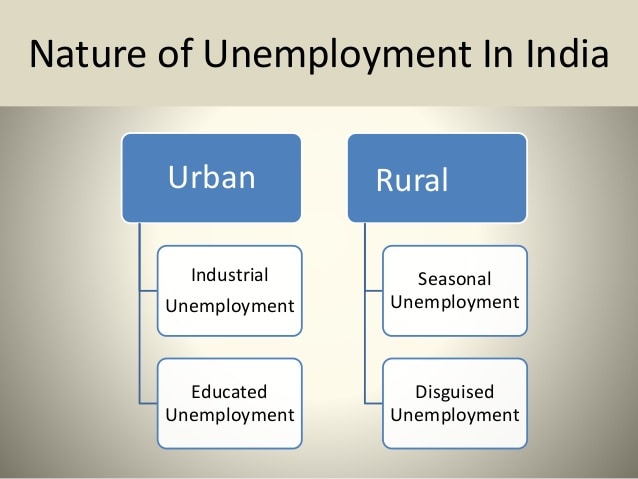
Unemployment refers to a situation in which the workers who are capable of working and willing to work do not get employment. Unemployment also refers to a situation where the persons who are able to work and willing to work, fail to secure work or activity which gives them income or means of livelihood.

RURAL EMPLOYMENT:

In Rural employment, both unemployment and underemployment exist side by side. The increasing population implies an increasing pressure on land. This pressure on land has resulted in an increase in number of agriculturists, and this has largely contributed to the problem of ununtilized labour in the agriculture sector.

1. SEASONAL UNEMPLOYMENT- caused by seasonal varieties in production or demand or both. When the works are engaged in a particular work or occupation, get employment only for a limited period and remain idle for the remaining period.

2. DISGUISED UNEMPLOYMENT- In Indian villages, people are found to be apparently engaged in agricultural activities. In such a situation, even if many works are withdrawn, same work will continue to be done by fewer people. It follows that all the workers are not needed to maintain the existing level of production. The contribution of such labourers to production is zero or near zero.

URBAN EMPLOYMENT:

Urban employment is largely the off-shoot of rural employment. With the growing process of making of peasantry very poor in the wake of introduction of the capitalist system of farming, and in the face of increasing pressure of population on land, a mass departure of population from rural areas to urban areas take place.

1. STRUCTURAL UNEMPLOYMENT- caused by structural changes like rapidly growing population, fall in the rate of capital formation, technological change etc., in the economy. It is of long run nature.

2. DISGUISED UNEMPLOYMENT- A person is apparently employed bit their marginal product is zero. Marginal product means the product and the produce added to the existing production due to the addition of new employee/ worker.

3. EDUCATED UNEMPLOYMENT- Even a person who is educated/trained and skilled fails to obtain a suitable job suited to his qualification he is said to be educated unemployed.

4. OPEN UNEMPLOYMENT- The labourers when live without any work and they dont find any work to do they come under the category of unemployment. Educated unemployment and skilled labourers unemployment are included in open unemployment. The migration from rural to urban areas in search of work is very often found in India is an example of open unemployment.

5. UNDER UNEMPLOYMENT- refers to the underutilization of manpower available both in terms of time and skill. If a master of engineering graduate work as a clear or an office assistant in an office, he is underutilized in terms of man power.

6. VOLUNTARY UNEMPLOYMENT- Though jobs are available some person may want to remain idle come under the category of this kind. The people who do not have the mind set to work regardless of their economic position and lazy people are included in this category.

7. NATURAL UNEMPLOYMENT- Unemployment ranging between 2 to 3% in the country is considered natural and inevitable. This minimal percentage of unemployment cannot be eliminated at all.

CAUSES OF UNEMPLOYMENT:

The unemployment problem in India has assumed alarming dimensions since independence.

1. POPULATION GROWTH- The galloping in population of our country during the last decades has increased the unemployment problem in the country.

2. INSUFFICIENT RATE OF ECONOMIC PROGRESS- The rate of growth is inadequate to absorb the entire labour force in the country. The opportunity of employment are not sufficient to absorb which are taking place as result of the rapidly increasing population in India.

3. ABSENCE OF EMPLOYMENT OTHER THAN AGRICULTURE- Agriculture is the principle area of employment in the country A major cause of rural unemployment refers the extremely low rate of growth of agriculture.

4. JOINT FAMILY SYSTEM- Existence of joint family system in India promotes disguised unemployment. Usually the members of a family work on their family farms or do family business.

5. SLOW DEVELOPMENT OF INDUSTRIES- Industrialization is not rapid in our country and industrial labours finds few job opportunities. The surplus labour in the agriculture sector labour is not absorbed by the industrial sector.

6. INAPPROPRIATE TECHNOLOGY- An important cause in the urban industrial sector is the use of inappropriate technology. Instead of using technology suited to our requirement of utilizing abundant labour supply available in the country, western modern highly capital-intensive technology is adopted which minimizes use of labour.

The need of hour to fight poverty and unemployment is to have belief approach towards education system and employment generation programmes in rural areas through recent initiatives such as skill India which is a campaign launched by Prime Minister Damodardas Modion 15 July 2015 which aim to train over 40 crore people in India in different skills by 2022.

“JULIUS CAESAR” biography

“Julius Caesar” was a Roman consul. He was born in Rome on 12 or 13 July 100 BC. His father’s name was Gaius Julius Caesar and mother’s name was Aurelia Cotta. His father was a politician after this sudden death of his father in 85 BC all the responsibilities fell on the 16 year old Julius.

At that time there was a civil war going between this uncle Gaius Marius and Lucius Cornelius Sulla. He was nominated to Peete new high priest and got married to Cornelia, daughter of Lucius Cornelius Cinna, Marius biggest ally. Sulla was victorious in the war and his new target was Ceaser. In a bid to save himself from Sulla, Ceaser decided to go to Asia for military service. He came back only after Sulla death he started his career as a prosecuting advocate and studied philosophy temporally in Rhodes. In 69 BC, he was elected the quaestor by the Assembly of people and later as curule aedile in 65 BC. He was elected as pontifex Maximus in 63 BC. In 59 DC elected senior consel of the Roman Republic by the centuriate assembly. He was in desperate need of the consul money and Pompey influence. Thus the informal union, called the first Triumvirate was formed. His discontentment led to the start of the Gallic Wars, in which remaining parts of France and Germania was annexed to Rome. He then waged wars against many other Nations. Altogether, Ceaser conquered 800 cities, subdued 300 tribes, sold a million slaves and had another 3 million killed in action.

Pompey married Cornelia Metalla, the daughter of Caesar’s greatest enemy Scipio. In 50 BC, Caesar was asked by the Senate and Pompey to resign, he refused and in order to avoid prosecution, he fled to Italy by crossing the Rubicon river and civil war broke out he marched his troop to Rome and conquered it in 49 BC and then spent the next 18 months fighting Pompey. Pompey fled to Egypt after being defeated by Caesar frightened that Caesar wood invade Egypt, the young Pharaoch, Ptolemy VIII, had Pompey killed and presented her head as a gift to caeser. After caeser was declared Dictator he established Police Forces, introduced land reforms, abolished taxes and re-established the tribune system. The Roman calendar was according to the movement of the Moon so Caesar changed it according to the sun’s moment just like the Egyptian. Even the Rome had its senate, the real power was with Caesar and they were scared of Rome being governed by a king Caesar did not wish to become the king but the fear of the republicans let the Senate to conspire against Caesar. On the ideas of March Caesar was assassinated by the senator’s. His second marriage was with Pompeia from 67 BC to 61 BC. He got married for the third time to Calpurnia Pisonis in 59 BC. ” IT IS EASIER TO FIND MEN WHO WILL VOLUNTEER TO DIE, THAN TO FIND THOSE WHO ARE WILLING TO ENDURE PAIN WITH PATIENCE” Said by “JULIUS CAESAR”.