By: Astha Raghav.
Category: News
Comprehensive, up-to-date news coverage, aggregated from sources all over the world by EduindexNews.
Neutraceuticals as an alternative of pharmaceuticals
By: Astha Raghav
Neutraceuticals is a broad umbrella term is used to describe any product derived for food sources with extra health benefit in addition to the basic nutritional value found in foods.
Neutraceuticals are products, which other than nutrition are also used as medicine. A neutraceuticals products may be defined as a substance, which has physiological benefit or provides protection against chronic diseases. Neutraceuticals may be used to improve health, delay the aging process, prevent chronic diseases, increase life expectancy or support the structure or functions of the body. Nowadays, neutraceuticals have received considerable interest due to potential nutritional, safety and therapeutic effects. In recent studies have shown promising results for these compounds in various complications. The recently published papers about different aspects of neutraceuticals as alternative for pharmaceutics were searched using scientific sites such as Medline, PubMed and Google Scholar. It included neutraceuticals and allergy, Alzheimer, cardiovascular, cancer, diabetes, eye, immune, inflammatory or Parkinson.
Ad copies & Taglines of five different existing brands
JBI earphones
Headline-Feel the heavenly music anywhere at anytime
Tagline -Your solace place
Tired of carrying those huge headphones ?Try getting one pair of your JBI earphones at the lowest price up to 50% off grab now for best offers.
GOBIBO
Headline- Get the first rate experience
Tagline-Live better
Get your tickets booked for Mega travel sale and get amazing offers for your first booking up to rupees 1200 off on domestic flight and up to rupees 5000 off for international flights. Hurry!
BURGER KING
Headline-The smooth taste will melt Your Heart Away
Tagline-Happiness at your eyes
Fill your tummies with the most lighted 7 incher burger filled with deliciousness combining single beef patty ,cheese and crispy onions .Order today at flat Rs. 200 and experience in deliciousness.
AMITY UNIVERSITY
Headline-To make your destiny shiny is our responsibility
Tagline-Your home away from home
Book your seats today at the top most University providing you varieties of courses designed according to your interest. Seats are limited, apply to Amity and learn at your pace.
NATUREBOX
Headline-Get best snacks at your doorstep
Tagline-Taste at its best
Try a free sample of our snacks starting at just Rs. 60 filled with awesomeness health benefits, sweetness and flavours. Hurry now.
Transcription
Story based on Srivaibhavi’s interview
An interview with Ms. Srivaibhavi
Srivaibhavi is a student from CMR university where she pursued her B. Com and completed in the year
of 2017.She was very much fascinated about social work since childhood and started volunteering since
a very young age. She started working for mercy homes basically known as old age homes in Kannauj,
UP. As a student of KV school even the teachers noticed how she was into social work she started
volunteering since 8th grade and her teachers supported her. Later in her 11th grade she took an
initiative to call out her friends to join her and form a small ngo known as ‘Bring smile’, she along with
her friends started volunteering for government schools teaching unprivileged kids hindi, english,
maths.She along with her friends started to raise funds for the school so that they can provide the
school with good cupboards, school bags, notebooks etc. She inspired a lot of students and her friends
during her schooling days and was also awarded from her school principal. In her university days she
was very well known for the cause she was working for and it inspired people to join her and work for
the underprivileged students. She has worked for many causes for bihar floods, assam floods, kerela
floods, plantation around the city etc along with her team. After all these years of work, she tells one
must follow their heart and put their 100 percent into it to make it a success, she gains happiness by
sharing the happiness of the underprivileged kids she has worked for during her entire journey.
Interview Transcription
Acronyms:Srivaibhavi:SV
Interviewer:IN
IN:Hello miss vaibhavi, Thankyou for giving me your precious time.
SV:It’s my pleasure.
IN:Shall I begin the interview?
SV:Yes, please
IN:So since when have you been interested in social work?
SV:My aunt served her entire life for the society, she was into social work and I always found it very fascinating and interesting. She has been my inspiration and I always looked up to her. I even started accompanying her when I was in 6th grade so it started since then. IN:When did u get the thought that u also should follow your aunt’s step?
SV:I actually started it from 7th grade when I told my aunt that I also want to start social work. She recommend me an old age home and that was the first ngo I started working as a school student.
IN:How was your first experience?
SV:I still remember washing their clothes, bedsheets, combing their hairs, helping them in taking bath and there was an old lady known as mala she adored me a lot as a kid and would offer me sweet milk everyday, I still miss those days.
IN:As u said you were in 7th grade, how was your teachers reaction towards it?
SV:I studied in KV Kannauj, UP and KV conducts lots of activities and volunteering options are also given and my teachers always supported me and through me many of my classmates also were interested to work along with me. My school even awarded me for my work and maybe that was my first achievement.
IN:So when did you take the major step to start your own NGO? SV:I was in 11th grade, I took major in commerce in the same school and I thought of starting my own organization ‘Bring smile’ And lot of my friends we’re a part of it.
IN:Which cause did you focus into?
SV:I then wanted to devote my life for the unprivileged kids who had no source to pursue education, as you know education is a major part of our life and I was always curious to work and mould kids who were in need of my help. I started working for a government school and I along with my maths, hindi etc. We started raising funds to provide them notes, pen, books etc. We even started to work so that I along with my team can provide them a proper place to sleep I’m their school as they had a hostel in school which had no proper beds, walls, cupboards neither clothes. IN:What were the other things which were also included ?
SV:I also thought of showcasing their talents through art like painting, dancing and singing. So we would reach out to students who were good in these field and in weekends they would visit the school to teach particular art according to the interest of the kids. We at the final day conducted a program where all the kids got a chance to showcase their talent.
IN:Did all this affect your studies?
SV-Not really, I was happy by helping people and that also motivated me to concentrate in my studies. I was sn average student but my passion never affected my studies.
IN:I see, I heard u pursued B. Com as your major? How this sudden thought come into your mind?
SV:My dad wanted me to pursue B. Com as he said it might be helpful for my carrier my parents were always supportive but I choosed bcom because my dad suggested it to me.
IN-That’s really thoughtful of you. So how long it has been now? SV:It has been years I’m into this field inspiring the youth of the country to choose this particular field. During my university days I conducted lots of events for raising funds for the kids. I even took part in the plantation drive around the Bangalore city. I worked as a volunteer for assam floods, kerela floods and bihar floods. It’s very necessary to put your time into other things too. Today we do a lot of activities all around UP conducting self defence classes for girls and many other activities.
IN:This is so inspiring,Are u satisfied making it your proffession? SV:I am very much happy because I don’t work here for money, money was never my thought, my choice was to bring change and to bring a smile in their face. That was my main motive. I always believe follow what your heart say and put your 100 percent into it to make it a success, I gained happiness by sharing the happiness of the underprivileged kids and many other causes which I have worked for during her entire journey.
IN:You have been so inspiring and have also inspired lots of people who are with you today. Thank you for your time.
SV:It was my pleasure.

Barak valley flaunting COVID-19 rules during pujo
Anindita sinha
Last Tuesday during vijaya dashami residents of barak valley were seen to unfollow the Covid-19 guidelines
which are imposed by the barak valley government for the city residents especially. There were strict
rules and guidelines issued by the district administration for silchar, karimganj and many others nearby
districts whereas the protocols were maintained for the initial days of the pujo. It was for the first time
there was no huge celebration for the festival as it remained quite and calm due to the pandemic and
heavy rainfall, there was continuous rainfall for the past 3 days of the festival except for the last day of
the festival which is known as the dashami. Barak valley people belive that the festival have bought light
into their hearts and this might be the end of the pandemic too.There has been no distribution of prasad
among the pandal and no offering of ‘anjali’ to the chanting of mantras by priests during the initial days
but it didn’t last during the last day of the festival. However the active cases are increasing rapidly and
whatever steps taken by people should be considered by them so that they can be safe, till now there is
no news of people getting affected by the virus which is a good news however one must consider it not
to follow the same step again as the virus is still on its process of catch holding people .
What has led today’s younger generation to be devoted towards the Korean language and its culture & where can you meet native Korean speakers in India?
Rise of the Korean culture:
The vibrant and mind-blowing Korean culture has fascinated a lot of youth as of today’s date. The culture and its awesomeness have urged lots of youths as well as adults to learn the Korean language, so that it could be easier to watch K-dramas and also K-POP songs. The influence of the culture has urged lots of people to major in Korean language in India. As a result, people not only throng the institutes where Korean language is being taught, but also opt for those classes online even from rural areas. In the past decades, people were eager to learn
Western languages like French, German, Spanish etc., and would spend tons of dollars learning these.
Obsession towards the culture and it’s language:
The Korean industry is on the pinnacle of its glory due to its technology, K- beauty and K-pop. It has inspired a significant population of the youth, converting people into Korean language learners and Korean culture enthusiasts. Additionally, it also inspires them to meet native Korean speakers, so that they could learn from them and watch Korean dramas with ease instead of relying on the English subtitles. Moreover, it lets you experience the culture with deep insight and also helps you to learn the language more fluently. Today, the number of Korean language learners has increased exponentially in India especially during the pandemic which led them to enroll for different Korean language courses online, where they find proper guidance. Nonetheless, meeting a native speaker can add a huge impact.
Where can you meet Korean native speakers?
1.Hellotalk-A social media app designed for users to learn and exchange language and cultures.
2.Meff-Another social media app to make connections and friendships through social media.
3.Churches-You can find lots of Korean native speakers at churches as well, especially on
Sundays (it specifically includes metro cities).
4.Korean Restaurants-Another great place where you can find native speakers.
5.Tourist spots-Taj Mahal has never ceased to surprise and captivate the hearts of Koreans. It
tops the list of the tourists’ spots that are chosen by Koreans during their visits to India. Yes!!!!
every year there is a huge multitude of Koreans visiting the Taj Mahal.
korea#korean#Korean Language#foreignlanguage#kdramas#kpop#culture
Discovery and working of an MRI
The MRI (Magnetic resonance imaging) scan is a medical imaging procedure that uses a magnetic field and radio waves to take pictures of our body’s interior. It is mainly used to investigate or diagnose the conditions that affect soft tissue such as tumors or brain disorders. The MRI scanner is a complicated piece of equipment that is expensive to use and found only in specialized centers. Although Raymond Vahan Damadian (1936) is credited with the idea of turning nuclear magnetic resonance to look inside the human body, it was Paul Lauterbur (1929-2007) and Peter Mansfield (1933) who carried out the work most strongly linked to Magnetic resonance imaging (MRI) technology. The technique makes use of hydrogen atoms resonating when bombarded with magnetic energy. MRI provides three dimensional images without harmful radiation and offers more detail than older techniques.
While training as a doctor in New York, Damadian started investigating living cells with a nuclear magnetic resonance machine. In 1971 he found that the signals carried on for longer with cells from tumors than from healthy ones. But the methods used at this time were neither effective nor practical although Damadian received a patent for such a machine to be used by doctors to pick up cancer cells in 1974.

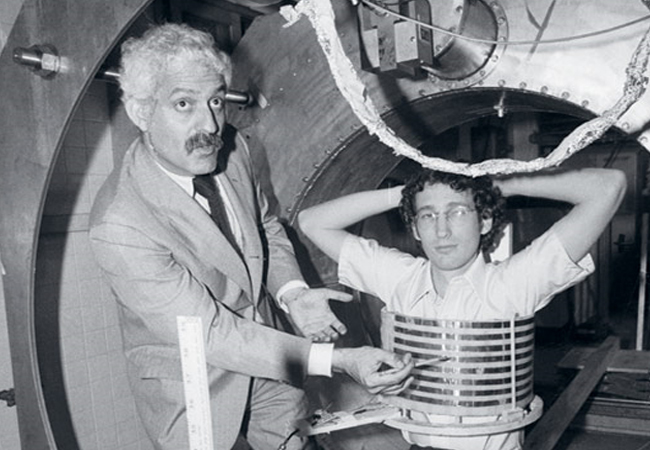
The real shift came when Lauterbur, a U.S, chemist, introduced gradients to the magnetic field so that the origin of radio waves from the nuclei of the scanned object could be worked out. Through this he created the first MRI images in two and here dimensions. Mansfield, a physicist from England, came up with a mathematical technique that would speed up scanning and make clearer images. Damadian went on to build the full body MRI machine in 1977 and he produced the first full MRI scan of the heart, lungs, and chest wall of his skinny graduate student, Larry Minkoff – although in a very different way to modern imaging.
Working of an MRI machine
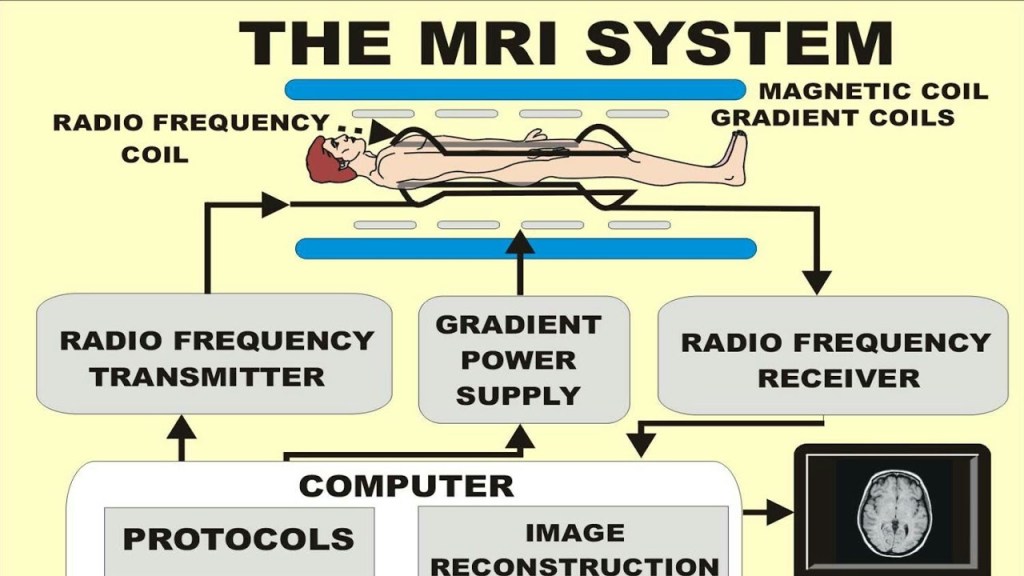
The key components of an MRI machine are magnet, radio waves, gradient, and a super advanced computer. We all know that human bodies are made up of 60% water, and water is magnetic. Each of the billons of water molecules inside us consists of an oxygen atom bonded to two hydrogen atoms that are called as H2O. Small parts of the hydrogen atoms act as tiny magnets and are very sensitive to magnetic fields. The first step in taking an MRI scan is to use a big magnet to produce a unified magnetic field around the patient. The gradient adjusts the magnetic field into smaller sections of different magnetic strengths to isolate our body parts. Take brain as an example, normally the water molecules inside us are arranged randomly. But when we lie inside the magnetic field, most of our water molecules move at the same rhythm or frequency as the magnetic field. The ones that don’t move along the magnetic field are called low energy water molecules. To create an image of a body part, the machine focuses on the low energy molecules. The radio waves move at the same rhythm or frequency as the magnetic fields in an MRI machine.

By sending radio waves that match or resonate with the magnetic field, the low energy water molecules absorb the energy they need to move alongside the magnetic field. When the machine stops emitting radio waves, the water molecules that had just moved along the magnetic field release the energy they had absorbed and go back to their position. This movement is detected by the MRI machine and the signal is sent to a powerful computer which uses imaging software to translate the information into an image of the body. By taking images of the body in each section of the magnetic field the machine produces a final three dimensional image of the organ which doctors can analyze to make a diagnosis.
“Medicine is a science of uncertainty and an art of probability”. –William Osler
Pradhan Mantri Jan Dhan Yojana
Pradhan Mantri Jan Dhan Yojana which was announced on 2014 has completed its seven years. It has various objectives too. It make sure that people can get access to different services related to finance like you will get access to the credit, insurance and also the pension to those who belongs to weaker section of the society or has low income. This Yojana also helps in using of technology to lower cost and hence wide area of people can get them.
Basically, it’s a national mission for financial inclusion. It will help that you all get access to different financial services like saving and deposit accounts, credit, insurance, pension, remittance too.
Few achievements
PMJDY accounts have grown three time from 14.72 crore in 2015 to 43.04 crore in 2021. If talk about who are getting benefits then it is observed that mostly the women who are enjoying it and it is also found that people are from rural and semi-urban areas too. Deposits under this account has increased upto 6.38 times till 2021. The use of Rupay card has much increased. There are various app too that are created for easy banking. About 5 crore accounts are getting Direct Benefit Transfer under various government schemes.
Impacts And Challenges
Through DBTs, there are very less chances of any leakages. Total security to the account is provided. This yojana has nearly completed its initiative to provide every adults with a bank account. It provides path to the poor so that they can bring their savings into the formal financial system.
But there is lack of physical and digital connectivity to the hilly areas. Sometimes there is technical issues too. Village people don’t want to deposit their money to a far located place. There is still a lack of awareness, knowledge and also skills. There are chances that people can make multiple accounts so that they can get much benefits.
References
Superstitions Prevalent in India
By – Supriya
Superstition may be defined as an illogical or unreasonable belief, or acceptance of a certain phenomenon as it is without trying to know it’s cause. It also involves belief in omens, charms ,demons,witches,useless ceremonies and in the existence of supernatural beings.Superstitions mostly are the outcome of ignorance , outdated and unwarranted beliefs and backwardness. In this age of scientific reasoning ,logic and progress , superstitions still cloud the mind of a common man. Although western influence- to an extent has been successful in erasing out superstitious beliefs through the spread of education and public awareness ,yet superstitions have great hold on the all developing countries including the Orient.Somehow the Orient i.e., the East has always been equated to exotic settings , remote places and strange happenings. The forests of Africa were believed to have a hypnotizing and mesmerizing quality and it was suspected that people changed and got transformed in Africa. Even India, for long, was considered a land of snake – charmers , magicians ,witches and strange sights ,by the westerners.


Generally, women are found more susceptible to Superstitions, may be because it was the female sections of the society that remained uneducated and ignorant for years. Now, women are trying to break free from the unprogressive shackles of superstitions. The only effective weapon against the cobwebs of superstitions is education, awareness and development of scientific attitude as well as aptitude. Firstly, there is a need to educate women who are responsible for educating the entire family. Besides, nothing should be accepted without any scientific reasoning. Then only can we shake off the deep and age-old roots of superstitions which have now become a part of our tradition ,ritual, culture and religion. With advancement in science and technology, although we have been successful in evaluating superstitions to an extent, yet a little more effort is needed to completely remove these from our daily lives.
THANKYOU
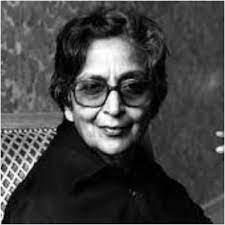
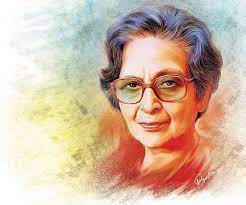
About the phenomenon: Amrita Pritam
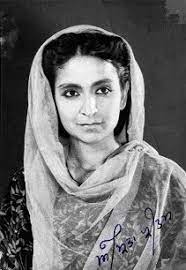
A woman of India, a woman of our hearts. Amrita Pritam was a poet and author, primarily adept in writing Punjabi and Hindi poems. She was born in the year of 1919, on the 31st day of August, in a village named Gujranwala, Punjab(British Raj) to Raj Bibi, a school teacher, and Kartar Singh Hitkari, a writer and poet, as Amrit Kaur. With the grief of her mother passing away when she was just 11, she felt her inside hollow and dark. And to express that utter emptiness, she started writing, and she never stopped. Gradually, along with expressing that sorrow, writing filled her hollow, thriving her into publishing her first anthology at 16 named Amrit Lehran (immortal waves), the same year, she got married to a guy named Pritam Singh. and hence, she was now called as Amrita Pritam. No one knew then, that in a few years, this name was going to be in everyone’s hearts.

After a few years of anguish, pain and numbness, her marriage fell apart. To have a living of her own, Amrita started working in the radio. she worked their till 1961, a year after her marriage ended. the partition of 1947 started to scar her thoughts, a Punjabi refugee, she shifted from Lahore to Delhi while having her son in her womb. In those devastating days, she wrote a poem called ‘aaj aakhaan waris shah nu‘ meaning ‘I ask Waris Shah today’, to enlighten her on how the world was falling apart and if he could help from the grave he was in. How could w=one know that this poem itself would be the infinite reminder of how depressive the world had gotten during the partition and how Amrita was rendered a legend the minute she rested her pen down when finishing this beautiful work of art.

Her novel Pinjar, published in 1950, described where the riots of 1947 left the women of the countries, and how badly they suffered the wrath of the communities, of the religions. this novel, which was then made into a film, was one of the greatest works of Amritaji.
She edited nagmani, a Punjabi literary magazine which she ran with Imroz for 33 years, though after the partition, she started writing in Hindi as well. she was the first recipient of the Punjabi Rattan Award. She also started writing spiritual themed books, like kaal chetna, agyat ka nimantran etc. her autobiographies included, Rasidi Ticket, Kala Gulab etc. The list of her works is almost endless, this phenomenon wrote more that 100 books containing poems, novels, autobiographies, and what not. These were then published in over 50 languages all over the world.
One of the most highly controversial women in India, she had an indefinite affection for the known, Sahir Ludhianvi, who found comfort in singer Sudha Malhotra, rather than the lovestruck Amrita. In a matter of time, she found her solace in painter Imroz. After many years of illness and disease, she left in peace, in her sleep at the of 85. Though her body died, her legacy lived on. she is still an asset to the world and its poets, and loved dearly on both sides of the India-Pakistan border. this is called a life well lived.

IMPORT PROCEDURE
of goods and services from outside the nation is called importing. Usually, it
is done in case the country is not able to produce that good themselves
efficiently due to lack of resources. The process of importing is a lengthy
one. There are lots of paperwork and decisions made in order to trade
internationally. Let’s have a look at the procedure here.
1.TRADE
ENQUIRY
The first
and foremost step is to enquire and collect all the information about the
countries and the firms that can export the required goods in the importing
nation. The importer comes into contact with the exporter with the help of a
‘trade enquiry’ where he requests for all the details related to the goods need
to be imported.
In response
to the enquiry, the importer receives a ‘Performa Invoice’ which
contains all of the information that he asked for.
2.IMPORT
LICENSE AND IEC NUMBER
Some goods
can be shipped across nations freely without any restrictions. But some goods
need a license to be imported to a certain territory. This list of restricted
goods can be checked through the ‘Export Import Policy’ (EXIM). A
license must be acquired if the required goods falls under this list.
Also, in
India, it is necessary for all the importers to register themselves under the
Directorate General Foreign Trade (DGFT) and get an Import Export Code (IEC)
which must be mentioned on the import documents.
3.FOREIGN
EXCHANGE
Now, the
importer has to arrange for foreign exchange as the payment for the goods must
be made in the currency of the exporting country. For instance, India will have
to pay in US Dollars if the goods are being imported from USA. In India, these
exchanges can be procured by the Exchange Control Department of Reserve Bank of
India.
4.PLACE
ORDER
After the
foreign exchange is procured, the importer has to place an order to the
exporter with all the necessary information such as quantity, quality,
insurance, weight, date and time of delivery, packaging and lot more. This
order can either be directly placed by the importer or could be placed through
a middleman.
5.LETTER
OF CREDIT (LOC)
An exporter
needs to be sure about the financial condition of the importer to secure his
payment. For this reason, he demands for an LOC from the importer which is
issued by the importer’s bank as a guarantee that the importer is financially
stable enough to make the payments. This LOC will only be issued by the bank if
they are sure about his credibility.
6.FINANCE
ARRANGEMENT
The importer
has to pay for the goods when they arrive in order to retrieve them. Therefore,
he must arrange the finance way before the delivery of the goods so that he
won’t be penalized for letting the goods stay at the port due to insufficient
funds.
7.RECEIPT
OF SHIPMENT ADVICE
After the
exporter has loaded the goods on the ship, he prepares a ‘shipment advice’
for the importer which contains information such as description of the goods,
bill of lading, date and time, name of the ship, invoice number and more.
8.IMPORT
DOCUMENTS
After the
shipment of the goods, the exporter hands over the important documents like
bill of lading, packaging list, marine insurance police, certificate of origin
etc. to the banker of the importer to be sent to the importer. These documents
are only delivered to the importer when he accepts the bill of exchange.
9.ARRIVAL
OF GOODS
At the
arrival of the goods, the one in charge of the ship informs the in charge of
the dock and provides him with a ‘general manifest’ which contains all
the information regarding the imported goods. The unloading of the goods in the
importing country takes place on the basis of this document.
10.CUSTOMS
CLEARANCE
In order to
take the delivery, the importer has to clear the customs duty. Firstly, the
importer has to get a delivery order by the shipping company in order to take
the delivery. Then he must pay the dock charges for receiving the goods on the
port. After this, a ‘bill of entry’ has to be filled by the importer for
the assessment of the customs duty. This bill of entry consists of the name and
address of importer and exporter and information about the goods.
Only after
the completion of these process is the importer allowed to take away the
consignment with him.
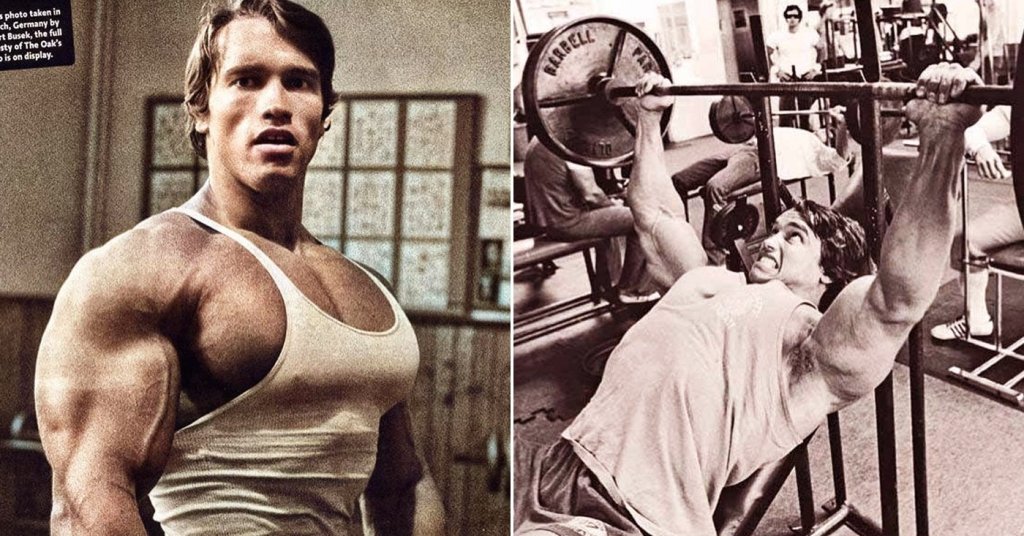
TOP FIVE EXERCISE TO BUILD MUSCLES
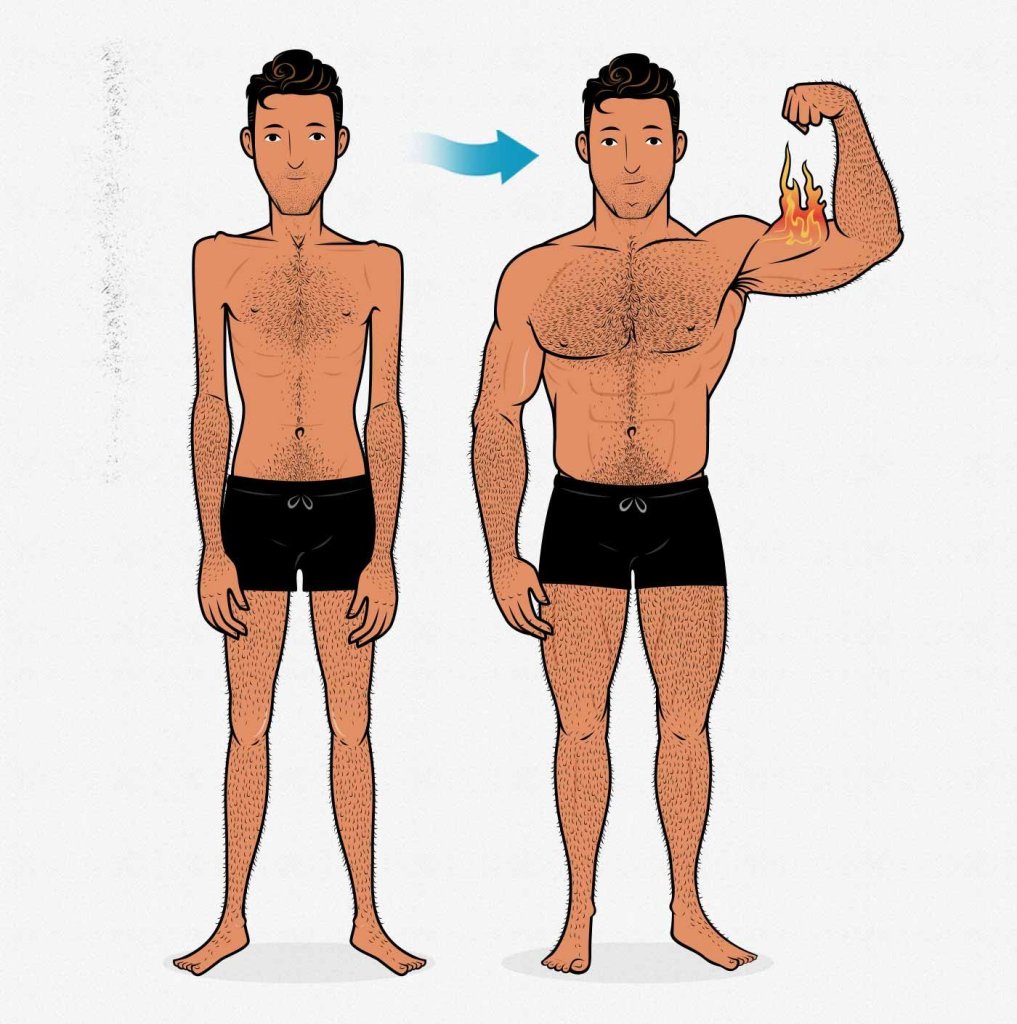
There are so many people who are in skinny body so they fell low in confident, attraction. Here I came with few exercises to build muscle and attractiveness to yourself. But also it’s to done consistently for the optimistic results.

1) SQUATS

A squat is a strength exercise in which the trainee lowers their hips from a standing position and then stands back up. During the descent of a squat, the hip and knee joints flex while the ankle joint dorsiflexes; conversely the hip and knee joints extend and the ankle joint plantarflexes when standing up. https://en.m.wikipedia.org/wiki/Squat_(exercise)
Here are some advantages of squats: 1) Strengthens your core. 2) Reduces the risk of injury.
3) Crushes calories.
4) Strengthens the muscles of your lower body.
5) Boosts athletic ability and strength.
2) DEADLIFTS
The deadlift is a weight training exercise in which a loaded barbell or bar is lifted off the ground to the level of the hips, torso perpendicular to the floor, before being placed back on the ground. It is one of the three powerlifting exercises, along with the squat and bench press. https://en.m.wikipedia.org/wiki/DeadliftA barbell deadlift is a compound exercise and works the gluteus maximus with further work on the quadriceps femoris, hamstrings, trapezius, lats, and erector spinae. The quadriceps, hamstrings, adductor magnus, and soleus serve as synergists during the exercise.

Here are few advantages of DEADLIFTS:
- Muscle building workout
- Improves stamina
- Good for heart
- Helps in growth hormones
3) BENCH PRESS

The bench press, or chest press, is an upper-body weight training exercise in which the trainee presses a weight upwards while lying on a weight training bench. The exercise uses the pectoralis major, the anterior deltoids, and the triceps, among other stabilizing muscles. https://en.m.wikipedia.org/wiki/Bench_press A conventional bench press uses the pectoralis major, anterior deltoids, and Triceps brachii to horizontally adduct the shoulder. It also uses predominantly triceps and anconeus to extend the elbows.

Here are some advantages of beach press:
- Good for upper body.
- Enables confidence.
- Better feel than yesterday
4) LUNGE
A lunge can refer to any position of the human body where one leg is positioned forward with knee bent and foot flat on the ground while the other leg is positioned behind. https://en.m.wikipedia.org/wiki/Lunge_(exercise) Doing this exercise will promote your legs bigger and better. This lunge exercise will improve in legs and avoid leg injuries.

Here are some advantages of lunges:
- Good for hamstrings
- Relief pain from joints
- Improve posture
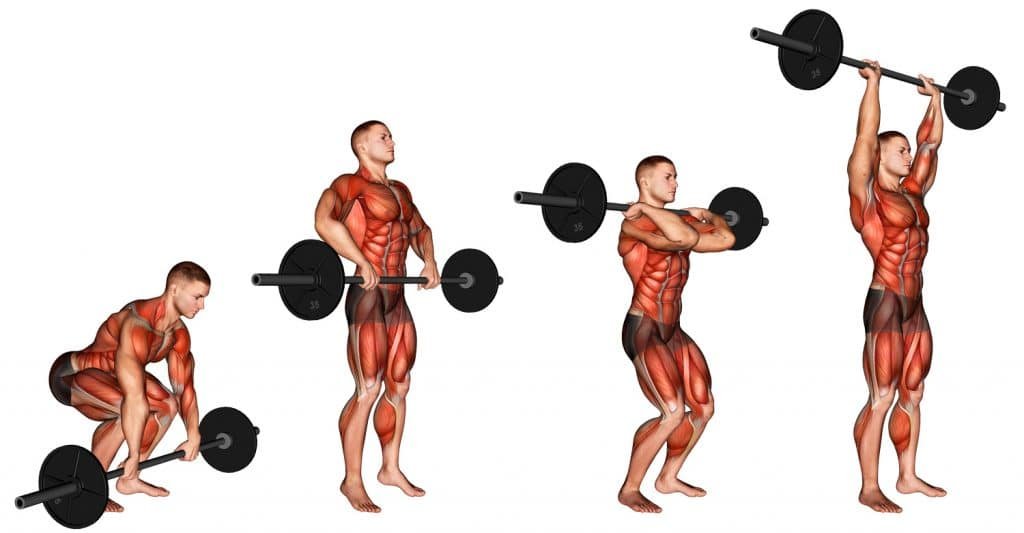
5) CLEAN AND PRESS
The clean and press is a two-part weight training exercise whereby a loaded barbell is lifted from the floor to the shoulders and pushed overhead.https://en.m.wikipedia.org/wiki/Clean_and_press The main muscle worked in a clean and press is your shoulders, but the movement also works your traps, triceps, middle and lower back, abdominals, glutes, quadriceps, hamstrings, and calves. It is a full body exercise, which not only can be performed for hypertrophy, but also for strength.

Here are few advantages of clean and press:
- Good for abs, triceps, biceps,
- Promote stamina
- Helps in good posture
- Enables slow-aging
- Fell better than yesterday
What Islam says about hygiene
HOW DO WE KNOW THAT CLEANLINESS IS VERY IMPORTANT IN ISLAM? We must bathe at least once a day and we must do Wudu before our prayers. We should also wash and dry ourselves properly everytime we use the toilet and remember to wash and clean our hands.
THE significance of cleanliness and hygiene cannot be overlooked by any society. Every faith and civilisation stresses the importance of cleanliness. Historically, cleanliness has been considered one of the important factors by which to judge a civilisation’s or society’s development.
Islam places great emphasis on cleanliness and purity, both physically and spiritually. In Islam, spiritual purity is linked to physical cleanliness and purity. More importantly, cleanliness is termed an indispensable fundamental of faith.
However, this fundamental and powerful tenet of our faith, unfortunately, is not reflected in our society practically. Serious reflection is required on our individual as well as collective practices in order to make this valuable principle of Islam part of our lives.
There are many verses in the Holy Quran which reflect the importance of cleanliness. For example, Allah says “…Truly, Allah loves those who turn to Him constantly and He loves those who keep themselves pure and clean” (2:222). In the Quran worship and seeking Allah’s love is conditioned with cleanliness and purity as the Holy Book says “…In it [mosque] are men who love to clean and to purify themselves. And Allah loves those who make themselves clean and pure” (9:108). Furthermore, in one of his sayings, the Holy Prophet (PBUH) has termed cleanliness as half of faith.
Gandhi Jayanti
By: Astha Raghav.
Gandhi Jayanti is celebrated on October 2 every year to mark the birth anniversary of Mohandas Karamchand Gandhi, popularly known as Mahatma Gandhi. Known as the ‘Father of the Nation’, the ideologies, struggles and kindness of Gandhi drove India to its independence. One of the most prominent leaders of India’s independence movement, Gandhi was the man behind non-violent civil disobedience.
This year will mark the 152nd birth anniversary of Mahatma Gandhi and the entire world observes this day as ‘Gandhi Jayanti’. It is a national holiday in India to honour the legendary leader without whom India wouldn’t have tasted independence. The United Nations also observe Gandhi Jayanti as ‘International Day of Non-Violence’ every year.
Gandhi played a key role in India’s freedom movement and his philosophies towards India have impacted people’s lives. His method of non-violence inspired many civil rights movements in the world and he also fought to bring significant changes in society.
Who was Mahatma Gandhi?
Born on October 2, 1869, in Porbandar in Gujarat, Mahatma Gandhi is considered as the nation’s tallest leader of the independence movement. As a child, he always expressed his feelings about patriotism and united India with his thoughts and ideologies to fight for freedom.
He successfully led India’s non-violent movement against the colonial British empire. He went to South Africa to study law and led nationwide campaigns for farmers and labourers and also fought against caste of athall age groups discrimination and was vocal about expanding women’s rights.
Thank You!
Unemployment
By: Astha Raghav.
Unemployment is measured by the unemployment rate, which is the number of people who are unemployed as a percentage of the labour force (the total number of people employed added to those unemployed).
Unemployment can have many sources, such as the following:
- new technologies and inventions
- the status of the economy, which can be influenced by a recession
- competition caused by globalization and international trade
- policies of the government
- regulation and market
Unemployment and the status of the economy can be influenced by a country through, for example, fiscal policy. Furthermore, the monetary authority of a country, such as the central bank, can influence the availability and cost for money through its monetary policy.
In addition to theories of unemployment, a few categorisations of unemployment are used for more precisely modelling the effects of unemployment within the economic system. Some of the main types of unemployment include structural unemployment, frictional unemployment, cyclical unemployment, involuntary unemployment and classical unemployment. Structural unemployment focuses on foundational problems in the economy and inefficiencies inherent in labor markets, including a mismatch between the supply and demand of laborers with necessary skill sets. Structural arguments emphasize causes and solutions related to disruptive technologies and globalization. Discussions of frictional unemployment focus on voluntary decisions to work based on individuals’ valuation of their own work and how that compares to current wage rates added to the time and effort required to find a job. Causes and solutions for frictional unemployment often address job entry threshold and wage rates.
According to the UN’s International Labour Organization (ILO), there were 172 million people worldwide (or 5% of the reported global workforce) without work in 2018.
Because of the difficulty in measuring the unemployment rate by, for example, using surveys (as in the United States) or through registered unemployed citizens (as in some European countries), statistical figures such as the employment-to-population ratio might be more suitable for evaluating the status of the workforce and the economy if they were based on people who are registered, for example, as taxpayers.
Thank You!


You must be logged in to post a comment.